


The Underground Ecosystem That Prevents Plant Failure | Dr. Mani's Magic
The Underground Ecosystem That Prevents Plant Failure (And Why Most Gardeners Never Know It Exists)
Picture this. You're standing in your backyard, staring at a plant that should be thriving. You watered it. You fertilized it. You followed the instructions on the bag. And yet something is wrong. The leaves are pale. The growth has stalled. Maybe it's slowly dying, and you can't figure out why.
You're not imagining it. And it is not your fault. There is an invisible world living just beneath your feet — a living, breathing underground ecosystem made up of billions of bacteria, fungi, protozoa, and nematodes. When that world is alive and humming, your plants practically grow themselves. When it is dead, damaged, or missing, your plant is fighting alone with no backup. No amount of fertilizer can fix that. No amount of water can replace it. And the big chemical companies that sold you those products? They never told you this part.
After growing over 250,000 trees at our South Texas nursery, we learned one thing above all else: the plant you see above the soil is only half the story. The real story — the one that determines whether your tree fruits, your lawn greens up, or your garden explodes with life — is happening underground, right now, in a world you cannot see. Let us show you what it looks like, why it matters, and how to protect it.

Plant Super Boost
Key Takeaways
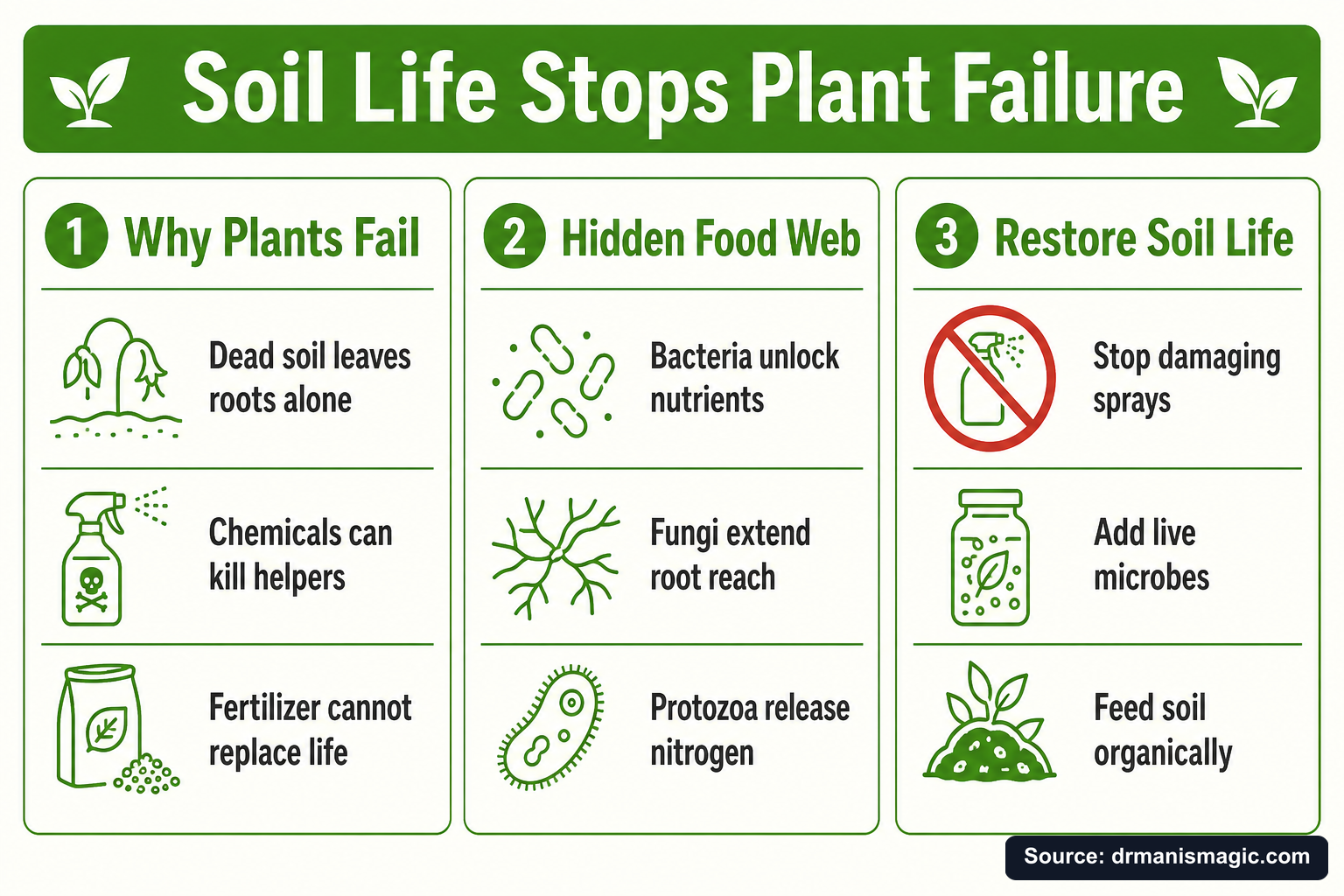
- Your soil contains a living food web of bacteria, fungi, protozoa, and nematodes that feeds, protects, and strengthens every plant you own.
- When this underground ecosystem is dead or damaged — by synthetic fertilizers, herbicides, fungicides, or poor soil — plants fail even when watered and fed.
- Mycorrhizal fungi extend your plant's root system up to 100 times its natural reach, pulling in water and nutrients the roots alone could never find.
- Most microbial products on store shelves are either dried-dead powders or smelly, anaerobic liquids with little to no viable biology left inside.
- Salt-based synthetic fertilizers actively kill the beneficial microbes your plant depends on — making the problem worse every time you apply them.
- Living soil can be restored, but it takes time, the right inputs, and a commitment to stopping the damage first.
- The Three Plant Pillars — mineral soil, live microbials, and organic fertilizer — work together as a complete system to rebuild and protect the underground ecosystem your plants were born to live in.
What Is the Soil Food Web and Why Does It Keep Plants Alive?
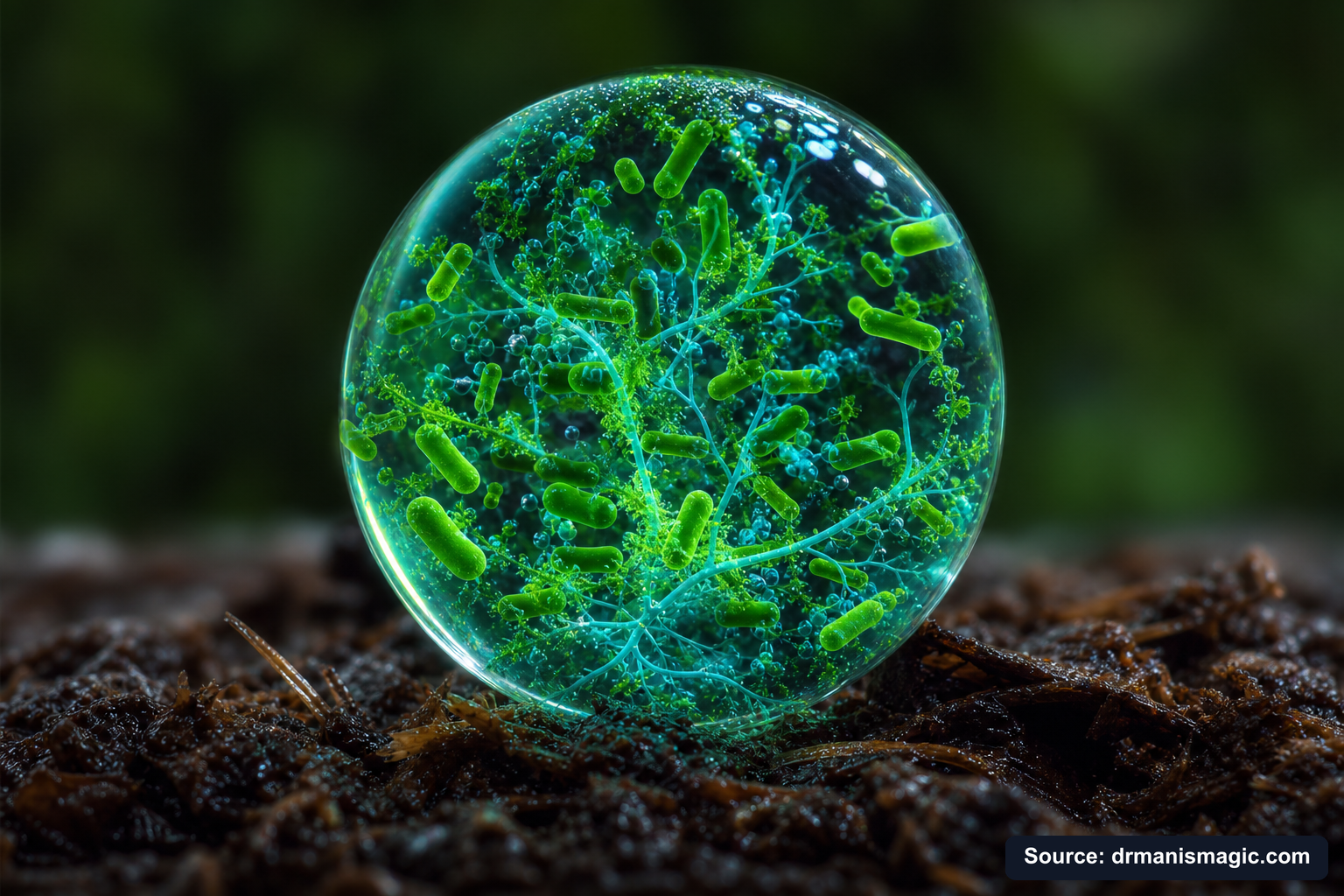
Quick Answer: The soil food web is a living network of bacteria, fungi, protozoa, nematodes, and other organisms that decompose organic matter, cycle nutrients, suppress disease, and build soil structure. Without it, plants cannot access the nutrition locked in the ground around them, no matter how much fertilizer you add.
Think about a forest. Nobody fertilizes it. Nobody waters it on a schedule. Nobody sprays it with pest control. And yet those trees grow enormous, live for centuries, and fruit every single year without fail. How?
The answer is not magic. It is biology.
Every healthy patch of soil on earth contains a layered, interconnected food web. It is like a city underground. Each organism has a job. Each job feeds into the next. Together, they do something no bag of fertilizer can replicate: they run a living, self-renewing system that feeds the plant, fights its enemies, and builds its home.
The USDA Natural Resources Conservation Service describes soil organisms as central to nutrient cycling, water availability, soil structure, erosion resistance, and pest and disease suppression. These are not minor benefits. They are the difference between a thriving plant and a struggling one.
Here is how the food web works, layer by layer.
| Organism | What It Does for Your Plant | What Destroys It |
|---|---|---|
| Beneficial Bacteria | Decompose organic matter, fix nitrogen from the air, suppress pathogens, produce plant growth hormones | Salt-based fertilizers, herbicides, soil compaction |
| Mycorrhizal Fungi | Extend root reach up to 100x, pull in phosphorus and water, produce glomalin to hold soil together | Synthetic fungicides, tillage, fumigation, high phosphorus inputs |
| Protozoa | Graze on bacteria and release plant-available nitrogen near the roots — a process called the "bacterial loop" | Pesticides, drying out, salt stress |
| Beneficial Nematodes | Prey on root-damaging pests, cycle nutrients, control pathogenic nematode populations | Broad-spectrum pesticides, soil fumigants |
| Earthworms and Arthropods | Aerate soil, shred organic matter, move microbes to new zones | Compaction, synthetic chemicals, bare soil |
Every single one of these organisms lives within a few inches of your plant's roots. They are not passive bystanders. They are your plant's invisible workforce — and when you lose them, you lose everything they were doing quietly behind the scenes.
See also: The Hidden Reason Synthetic Fertilizers Cause Root Rot
Why Do Plants Fail Even When You Water and Fertilize Them?
Quick Answer: Plants fail despite watering and fertilizing because most nutrients in soil exist in forms the plant cannot absorb on its own. It takes living microbes to unlock, convert, and deliver those nutrients to the root. Without that biological bridge, the fertilizer sits unused and the plant slowly starves.
This is the question that drives gardeners crazy. You did everything right. The bag said to apply every two weeks. You never missed a watering. And the plant still looks terrible.
Here is what nobody at the garden center told you.
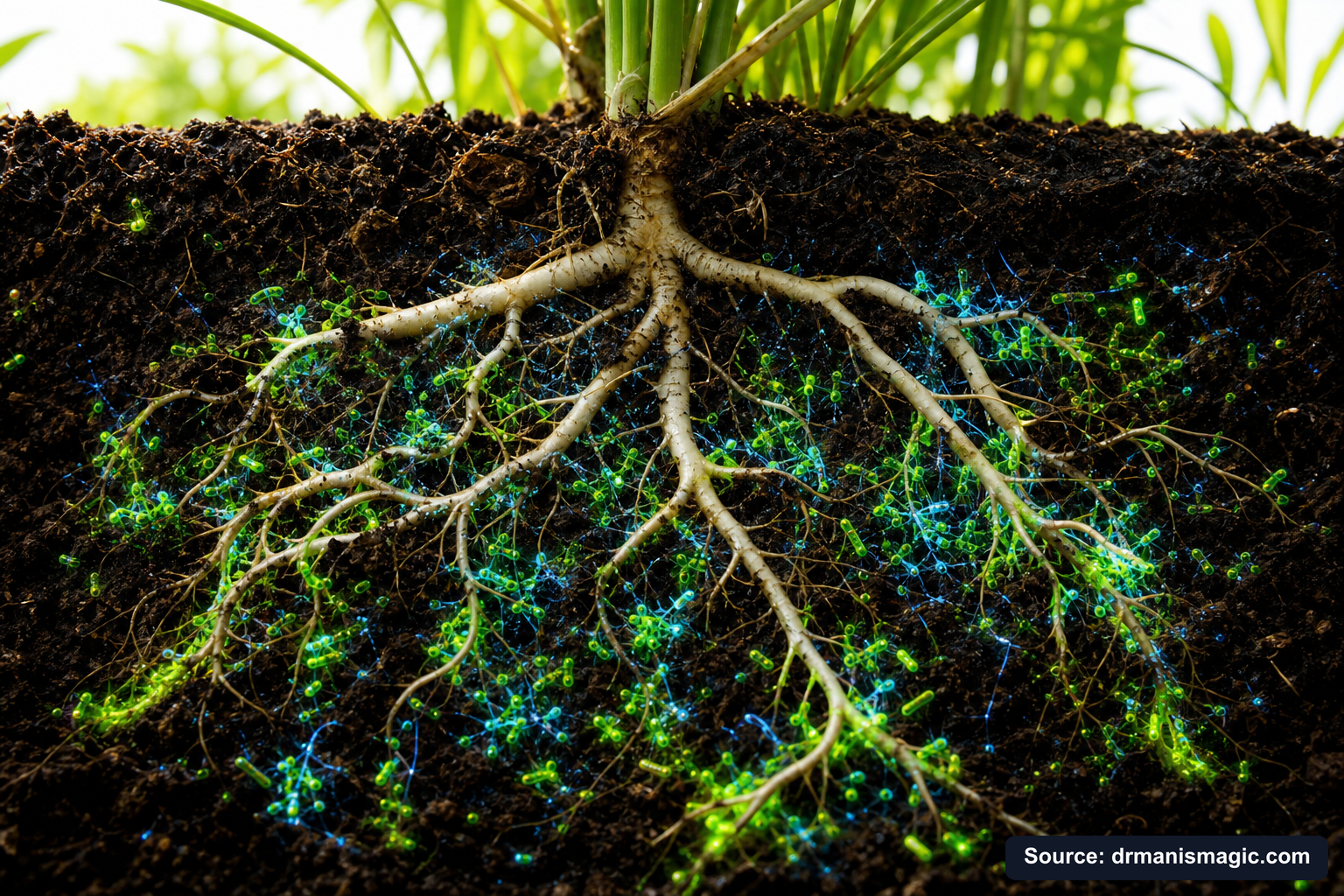
Nutrients do not feed plants directly. Not really. The plant needs microbes to act as the middleman. Bacteria break down organic matter and release nutrients in forms the root can drink up. Mycorrhizal fungi physically attach to the root and extend it outward — sometimes hundreds of feet — pulling in phosphorus, zinc, and water from zones the roots could never reach alone. Protozoa graze on bacteria and release a concentrated burst of nitrogen right where the roots are growing.
When you dump salt-based fertilizer on damaged soil, you skip all of that. You force-feed the plant a concentrated chemical salt. It gets a quick green-up — like a sugar rush — and then crashes. Meanwhile, those salts are killing the microbes you need for long-term health. You have started a cycle. The plant becomes dependent on chemical inputs. The soil gets weaker. You buy more product. The plant gets worse.
The plant is not broken. The ecosystem it depends on is broken.
This is the lie at the center of modern gardening advice. Big chemical companies profit when your plant stays just sick enough to keep buying. Dr. Mani Skaria — a plant pathologist with 40 years of research at the Texas A&M Citrus Center — saw this pattern repeat thousands of times. It is why he built the Three Plant Pillars system around restoring biology first, not masking symptoms with chemicals.
What Do Mycorrhizal Fungi Actually Do Inside Your Soil?
Quick Answer: Mycorrhizal fungi attach to plant roots and grow a web of ultra-thin threads called hyphae that extend far beyond what roots can reach. These threads mine phosphorus, zinc, and water from deep in the soil and deliver them directly to the plant in exchange for sugars. They also produce glomalin, a sticky protein that holds soil particles together and prevents compaction.
Pull a weed out of the ground sometime. Look closely at the roots. If you see fuzzy white threads clinging to them, that is mycorrhizae. That is the reason weeds grow so aggressively even in terrible soil. They have a fungal army working for them underground.
Your garden plants and fruit trees need that same army.
The word mycorrhizae comes from the Greek words for fungus and root. These fungi form one of the oldest and most successful partnerships in plant history. University of Minnesota Extension notes that arbuscular mycorrhizal fungi — the kind that work with most food plants and trees — cannot even be grown on artificial media. They must be cultured on living plant roots. That tells you something important: they are not a product you can manufacture in a factory and bottle. They are a living relationship that must be nurtured.
Here is what mycorrhizal fungi do that nothing else can replace:
- They extend the root's effective foraging zone by up to 100 times its natural reach.
- They unlock phosphorus, which is one of the most important but least mobile nutrients in soil. It sits just out of reach without fungal help.
- They produce a protein called glomalin that acts like biological glue, holding soil particles together into aggregates. These aggregates create the air pockets roots need to breathe.
- They share resources between neighboring plants through underground networks — sometimes called the "wood wide web."
- They improve drought tolerance by pulling water from soil zones that roots cannot access.
When you apply a synthetic fungicide — even to treat a real fungal disease — you often wipe out your mycorrhizal network at the same time. The pathogen may be gone, but so is your plant's underground support team.
What Is Living Soil vs. Dead Soil and How Can You Tell the Difference?
Quick Answer: Living soil contains billions of active microbes, holds moisture evenly, smells earthy and clean, and supports vigorous plant growth. Dead or damaged soil is biologically inactive — it may look fine but it drains poorly or not at all, smells sour or flat, and plants grown in it stay weak, yellow, and prone to disease even when fed regularly.
You can feel the difference between living soil and dead soil before you even plant anything.
Living soil smells like a forest after rain. That rich, deep, earthy scent — scientists call it petrichor — comes from a compound called geosmin produced by actinobacteria. When you smell that, you are literally smelling microbial life. Living soil also feels crumbly and light. It holds water without becoming soggy. Dig into it and you will find earthworm tunnels, white fungal threads, and dark organic matter woven through the particles.
Dead soil is different. It may look dark or rich, but it is biologically quiet. Pack some in your hand and it either falls apart like powder or clumps into a dense, airless ball. Water sits on top before slowly soaking through. Plants grown in it look okay for a few weeks — especially if you are fertilizing — and then stall. New leaves are small. Roots stay shallow. The plant has no resilience when stress comes.
This is what happens to most potting mixes within six to twelve months. The pine bark and wood fiber that fills those bags starts decomposing. It steals oxygen from the root zone. The mix compacts into a dense, suffocating sludge. Beneficial microbes cannot survive in that environment. What fills the vacuum? Pathogens. Root rot follows.
Research published in peer-reviewed soil science literature confirms that when soil is sterilized or severely disturbed, microbial communities can take weeks to months to begin recovery — and fungi recover more slowly than bacteria. During that recovery window, the plant is vulnerable to pathogen invasion. That is exactly when root rot, leaf drop, and decline happen.
| Characteristic | Living Soil | Dead / Damaged Soil |
|---|---|---|
| Smell | Earthy, clean, forest-like | Flat, sour, or chemical |
| Texture | Crumbly, light, aggregated | Powdery or dense, no structure |
| Water behavior | Absorbs quickly, drains evenly | Puddles on surface or drains too fast |
| Plant response | Consistent growth, strong roots, vibrant color | Stalled growth, yellowing, shallow roots |
| Disease pressure | Low — biology suppresses pathogens | High — pathogens fill the biological vacuum |
| Fertilizer response | Efficient uptake with small amounts | Poor uptake even with heavy feeding |
| Root appearance | White, firm, branching with fungal threads | Brown, soft, sparse |
You Never Had a Brown Thumb.
You were handed the wrong tools. This free guide hands you the right ones.
You watered it. You fed it. It died anyway.
It was never you. It was the dirt, the salt food, and the bad advice.
This guide shows you what really went wrong, and how to fix it for good.
- Why your plants really died, and why it was never your fault
- The salt hiding in your plant food that quietly burns the roots
- The hidden killer in almost every bag of store soil
- The tiny helpers that grow a whole forest for free
- The rescue trick that brings a half dead plant back to life

How Do Salt-Based Fertilizers Destroy the Underground Ecosystem?
Quick Answer: Salt-based synthetic fertilizers raise the salt concentration in soil water. Beneficial bacteria and fungi cannot tolerate high salt levels and die off in large numbers after each application. The plant gets a short burst of forced nutrition, but the biological support system that provides lasting health is steadily wiped out with every dose.
Imagine pouring a small amount of table salt onto a slug. You know what happens. The salt pulls water out of the slug's body through osmosis and it shrivels.
The same thing happens to soil microbes when synthetic fertilizer hits the ground.
Every granule of conventional fertilizer is a salt. Ammonium nitrate. Potassium chloride. Monoammonium phosphate. These are all salts. When they dissolve in soil water, they create a high-salt environment. Beneficial bacteria and fungi — which evolved in balanced, low-salt soil — experience osmotic shock. Their cell walls rupture. They die.
The plant gets a quick green flush. You think it worked. But the biology that would have made that nutrition available sustainably — and protected the root from pathogens, and extended the root's reach, and built soil structure — just took a heavy hit.
Do this a few times a year for a few years and you have biologically dead soil. The plant becomes completely dependent on your inputs. Miss a feeding and it crashes. Keep feeding and the salts accumulate. Root tips burn. Water uptake drops. The plant looks like it has root rot — because functionally, it does.
This is not an accident. It is a business model. A plant that thrives in living soil needs very little. A plant in dead soil needs constant inputs. One of those outcomes is better for the companies selling you products.
See also: Why Most Fertilizers Are Actually Salt in Disguise
Are the Microbial Products at the Store Actually Alive?
Quick Answer: Most microbial products on store shelves contain either dried, dormant spores with very low viability or liquid suspensions that have gone anaerobic during shipping and storage. After testing dozens of products at our South Texas nursery, we found that the vast majority showed no measurable benefit to plant growth. Genuinely live, full-spectrum microbial inoculants are rare.
Walk into any garden center and you will find shelves of products claiming to be packed with beneficial microbes. Bags of white powder. Bottles of dark liquid. Labels covered in long Latin species names and colony-forming unit counts in the billions.
Most of them do not work. We know because we tested them. For years. On 250,000-plus trees at US Citrus Nursery.
Here is what is actually inside most of those products.
The dried powder problem. Many microbial products are grown in large factory vats, then spray-dried into powder. The manufacturer hopes the spores will reactivate when you add water. The problem is that the drying process and subsequent storage — sitting in a warehouse, then a truck, then a store shelf at fluctuating temperatures — kills the majority of those organisms. By the time the powder reaches your garden, the biology is largely gone.
The smelly liquid problem. Other products start as compost tea or living liquid cultures. They are genuinely alive when made. But then they go anaerobic — meaning the oxygen runs out and the microbes start dying and fermenting. You know this product the moment you open it. It smells like sewage. It might hiss or fizz. That smell is microbial death. Some plant benefit remains from the humic and fulvic acids in the liquid, but the living biology you paid for is gone.
The lactobacillus shortcut. Some products use lactobacillus — the same bacteria in your yogurt — because it is cheap, vigorous, and easy to keep alive. The problem is that lactobacillus is so aggressive it crowds out the beneficial bacteria your plant actually needs. It belongs in your gut, not your soil.
| Microbial Product Type | Viability at Application | Spectrum of Organisms | Odor | Real-World Result |
|---|---|---|---|---|
| Dry / powdered lab microbes | Very low | Narrow (1-5 species) | None | Little to no plant response in our trials |
| Dry microbes added to liquid | Very low | Narrow | Mild | Same result — spores do not reliably activate |
| Compost tea, fresh under 24 hours | Moderate (if aerated) | Broad but variable | Earthy, then sour | Good results only when applied immediately |
| Compost tea, older than 24 hours | Low — anaerobic | Partial | Strong, foul | Minimal biology; some humic acid benefit |
| Lactobacillus-based products | High (stays alive) | Narrow — one dominant species | Mild | Crowds out beneficial microbes; not recommended |
| Plant Super Boost (stabilized, full-spectrum) | High — genuinely live | 2,000+ bacteria, 400-500 fungi including mycorrhizae, plus protozoa and nematodes | Earthy, not foul | Visible microbial activity under microscope; confirmed by lab analysis |
The reason Plant Super Boost is different is because of how it is made. It starts as hand-crafted compost — real, hot, active compost teeming with life. A compost pile can reach over 140 degrees Fahrenheit, and that heat is the signature of explosive microbial activity. Then, using a proprietary all-natural stabilization method developed by a world-renowned compostologist who has advised royal families and governments, those living microbes are captured and stabilized without going anaerobic. They stay alive. They do not rot. They do not stink. And you can literally watch them moving under a microscope.
That is not marketing language. That is biology you can verify with your own eyes.
Can Dead or Damaged Soil Actually Come Back to Life?
Quick Answer: Yes, damaged soil can recover biological activity, but it requires stopping the inputs that caused the damage first, then systematically rebuilding organic matter and reintroducing living microbes. Recovery is measured in weeks to months, not days — and it requires consistent effort because many soils have been damaged by decades of synthetic inputs, pesticides, and salt accumulation.
The good news is that soil biology is remarkably resilient when you stop fighting it.
The bad news is that recovery does not happen overnight. Research on microbial recovery after soil sterilization found that bacterial populations begin rebounding faster than fungal communities — but the full food web takes significantly longer to stabilize. During that window, the soil is vulnerable. Pathogens can fill the gap before the beneficial organisms return.
That means you cannot just add microbes once and walk away. You need to stop the damage, feed the biology, and reintroduce living organisms consistently until the ecosystem can sustain itself.
Here is a practical recovery protocol we use at US Citrus Nursery when a plant or soil has been chemically damaged, fumigated, or biologically depleted:
- Stop the stressor first. Identify and eliminate what killed the biology — synthetic herbicides, salt-based fertilizers, broad-spectrum fungicides, or soil fumigants. You cannot rebuild what you keep destroying.
- Test and correct the basics. Check soil pH and salt levels if possible. High salt concentrations from accumulated synthetic fertilizer must be flushed before microbes can reestablish. Rainwater is the best flushing agent.
- Add mature compost or mulch. Organic matter is the food source that feeds the microbial food web. Without it, even the microbes you introduce have nothing to eat. A two-inch layer of compost or wood chip mulch on the surface works with gravity to slowly feed the soil beneath.
- Reintroduce living microbes. Apply a genuinely live, full-spectrum microbial inoculant to the root zone. Monthly applications give the biology the reinforcements it needs while the native community rebuilds.
- Transition to organic fertilizer. Switch from salt-based to organic, slow-release fertilizer. Organic nutrients feed the microbes as well as the plant, reinforcing the biological cycle instead of short-circuiting it.
- Protect with mineral-based soil where possible. In containers especially, replacing decomposing potting mix with a permanent mineral-based soil eliminates the root suffocation problem that creates conditions for pathogens to thrive in the first place.
- Be patient and consistent. The ecosystem will not rebuild in a week. Give it 30 to 90 days of consistent care. Watch for improving root color, new growth flush, and that clean earthy smell returning to the soil.
What Are the Three Plant Pillars and How Do They Protect the Underground Ecosystem?
Quick Answer: The Three Plant Pillars are the foundation system developed by Dr. Mani Skaria and proven across 250,000 trees at US Citrus Nursery. Pillar One is mineral-based soil that provides permanent drainage and aeration. Pillar Two is live microbials that restore and protect the biological ecosystem. Pillar Three is organic fertilizer that feeds both the plant and the microbes without salt damage. Together, they create conditions where the underground ecosystem thrives and the plant becomes nearly bulletproof.
Dr. Mani Skaria spent 40 years as a plant pathologist watching plants fail. He saw the same pattern repeat across citrus groves, home gardens, and nursery containers. The plant was not the problem. The system the plant was growing in was the problem.
He built the Three Plant Pillars as a first-principles answer to that pattern. Not a product pitch. A framework. A way of thinking about what a plant actually needs at the root level to thrive.
Pillar One: Mineral Foundation. Most potting mix is made from pine bark, sawdust, and other organic material that decomposes within months. As it breaks down, it compacts, steals oxygen from the root zone, and creates the anaerobic, waterlogged conditions that root rot pathogens love. Mineral-based soil — built on silica-rich sandy loam from the Rio Grande Valley — does not decompose. It holds its structure permanently. Roots can breathe. Water drains. The underground ecosystem has the air and moisture balance it needs to function.
Pillar Two: Microbial Muscle. This is the invisible workforce. Beneficial bacteria, mycorrhizal fungi, protozoa, and nematodes working in concert to unlock nutrients, suppress pathogens, build soil structure, and extend the root's reach. No microbes means no resilience. Every stress — drought, disease, temperature swing — hits harder when the biology is gone. With a thriving microbial community, the plant has a defense system, a nutrient delivery network, and a growth engine all operating simultaneously.
Pillar Three: Organic Fertilizer. The plant needs nutrients. But it needs them in a form that does not kill the microbes delivering them. Organic, slow-release fertilizer — built from crab meal, kelp, and amino acids — feeds the plant gently and continuously. It also feeds the bacteria and fungi in the soil, reinforcing the food web instead of burning it down. No synthetic salts. No PFAS. No biosludge. No plastic-coated granules leaching into the environment.
When all three pillars are in place, something shifts. The plant stops fighting to survive and starts investing energy in growth. Roots go deeper. Leaves get darker. Fruit sets more consistently. And the underground ecosystem — that invisible city of billions — hums along doing the work quietly, the way nature always intended.
You can get the complete system through the Three Plant Pillars bundle, built and proven by the same team that has grown over 250,000 trees in South Texas.
What Can You Do Right Now to Start Rebuilding Your Soil's Underground Ecosystem?
Quick Answer: Start by stopping the inputs that damage soil biology — synthetic salt fertilizers, broad-spectrum herbicides, and chemical fungicides. Then add organic matter to feed the food web, apply genuinely live microbial inoculants monthly, and transition to organic fertilizer. Results begin within 30 days when all three Plant Pillars are in place together.
You cannot get time back. That is the truth nobody likes to say out loud.
Every month a plant spends in biologically dead soil is a month of growth that is gone forever. Every season you spend chasing symptoms — yellow leaves, root rot, stunted fruiting — with products that make the underlying problem worse is a season you will never get back. The most common thing people tell Dr. Mani when they contact us is some version of: "I just want to see this tree fruit while I still can." Not someday. Now. In their lifetime. In their backyard. For their family.
That urgency is real. And it is completely achievable — but only if the foundation is right.
Here is what you can do starting today:
- Stop applying salt-based synthetic fertilizer. Let the soil's salt levels normalize.
- Add a two-inch layer of compost or wood chip mulch around your plants to start feeding the food web from the top down.
- Apply a genuinely live microbial inoculant to the root zone monthly. Make sure what you buy is actually alive — it should smell earthy, not foul, and it should come from a source you can verify.
- Switch to an organic, slow-release fertilizer that feeds both plant and microbes without salt damage.
- If you are potting or repotting anything, use a mineral-based soil that will not compact and suffocate roots over time.
If you want a starting point that has already been tested on a quarter-million trees and refined over 30 years in South Texas, download the Free Plant Care Field Guide. It walks you through the Three Plant Pillars step by step, without jargon, without guesswork, and without any of the noise that has been clouding this conversation for decades.
The underground ecosystem your plant needs has always been there — waiting to be restored. You just needed to know it existed. Now you do.
See also: How Salt-Based Feeding Quietly Destroys Root Systems
Frequently Asked Questions
Most gardeners water, fertilize, and follow every instruction on the bag. And still their plants struggle. The reason is almost always underground, in a world you cannot see. These are the questions we hear most often from people who are finally ready to understand what is really going on beneath their soil.
What is the underground ecosystem in soil and why does it matter for my plants?
The underground ecosystem is a living world of bacteria, fungi, protozoa, and nematodes packed into every handful of healthy soil. These tiny organisms break down nutrients, fight off disease, and feed your plant's roots around the clock. When this ecosystem is alive and active, plants grow strong almost on their own. When it is dead or damaged, your plant is fighting alone with no backup, no matter how much you water or feed it. At Dr. Mani's Magic, we built our entire Three Plant Pillars system around protecting and rebuilding this living world.
What destroys the underground ecosystem in my garden soil?
Salt-based synthetic fertilizers are the number one killer. They wipe out beneficial bacteria and fungi every time you apply them. Fungicides, herbicides, and harsh pesticides do the same damage. Even most potting mixes hurt the ecosystem because they are made from wood and pine bark that rots, compacts, and chokes out oxygen. We proved this over 30 years and across more than 250,000 trees at our South Texas nursery. The fix starts with stopping the damage first, then rebuilding with the right inputs.
What are mycorrhizal fungi and what do they do for my plants?
Mycorrhizal fungi are a special type of beneficial fungus that wraps around and grows into your plant's roots. They act like a second root system, extending the plant's reach up to 100 times its natural size. That means more water, more nutrients, and more protection than the roots could ever find alone. Our Plant Super Boost is packed with live mycorrhizae along with beneficial bacteria. These are real, living organisms, not dried-out powders sitting dead on a store shelf.
Why do most microbial products from the store not work?
Most microbial products are either dried-dead powders or smelly anaerobic liquids that have gone bad by the time you open the bottle. Dead microbes cannot help your plant. Period. Dr. Mani partnered with a compost expert who discovered a special all-natural way to keep live microbes stable in a bottle without refrigeration and without the rotten smell. That is what makes Plant Super Boost different. When it reaches your door, the biology inside is still alive and ready to work for your roots.
Can I rebuild a dead or damaged underground ecosystem in my existing garden?
Yes, you can. But it takes the right three things working together. First, you need mineral-based soil that drains well and lets roots breathe, not sawdust-based mixes that compact and rot. Second, you need live microbials added back into the soil. Third, you need organic fertilizer that feeds the plant slowly without burning the microbes you just added. That is exactly what the Three Plant Pillars system does. Most people start seeing real improvement within the first 30 days of using it correctly.
Does a healthy underground ecosystem mean I need fewer chemicals in my garden?
Absolutely. When your soil food web is alive and working, plants build their own natural defenses. Beneficial bacteria and fungi crowd out pathogens and help roots absorb what they need without synthetic help. You stop chasing problems with sprays and treatments. That means no more label warnings, no more worrying about your kids or pets on the lawn, and no more wondering if the fruit you just picked is safe to eat. A living soil ecosystem is the most natural form of plant protection there is.
How do I know the Three Plant Pillars system actually works?
We did not guess at this. Dr. Mani Skaria spent 35 years as a plant scientist, led Texas's clean citrus program, and tested this system on more than 250,000 trees at our South Texas nursery. The results earned a 4.9 out of 5 star rating from over 2,400 real customers. The Three Plant Pillars, which are mineral-based soil, live microbials, and organic fertilizer, are not a theory. They are a proven foundation that works for citrus trees, houseplants, lawns, flower beds, vegetable gardens, and everything in between.
About the Author
Dr. Mani Skaria, PhD
Dr. Mani Skaria, PhD, is a plant pathologist and the scientific founder of Dr. Mani's Magic. He earned his doctorate at Purdue University and spent 48 years studying how plants, soil, and living microbes work together, including his years as Professor Emeritus at Texas A&M and as a member of the USDA NAREEE Advisory Board. He invented micro-budding, a method for growing healthier, stronger trees, and has grown more than 250,000 trees on the family farm in Hargill, Texas - US Citrus Nursery. His life's work takes real lab science and practical experience and turns it into simple, safe, organic plant care anyone can use at home.


