


The Underground Economy That Feeds Every Fruit Tree | Dr. Mani's Magic
The Underground Economy That Feeds Every Fruit Tree: Roots, Fungi, Bacteria, and the Soil Food Web
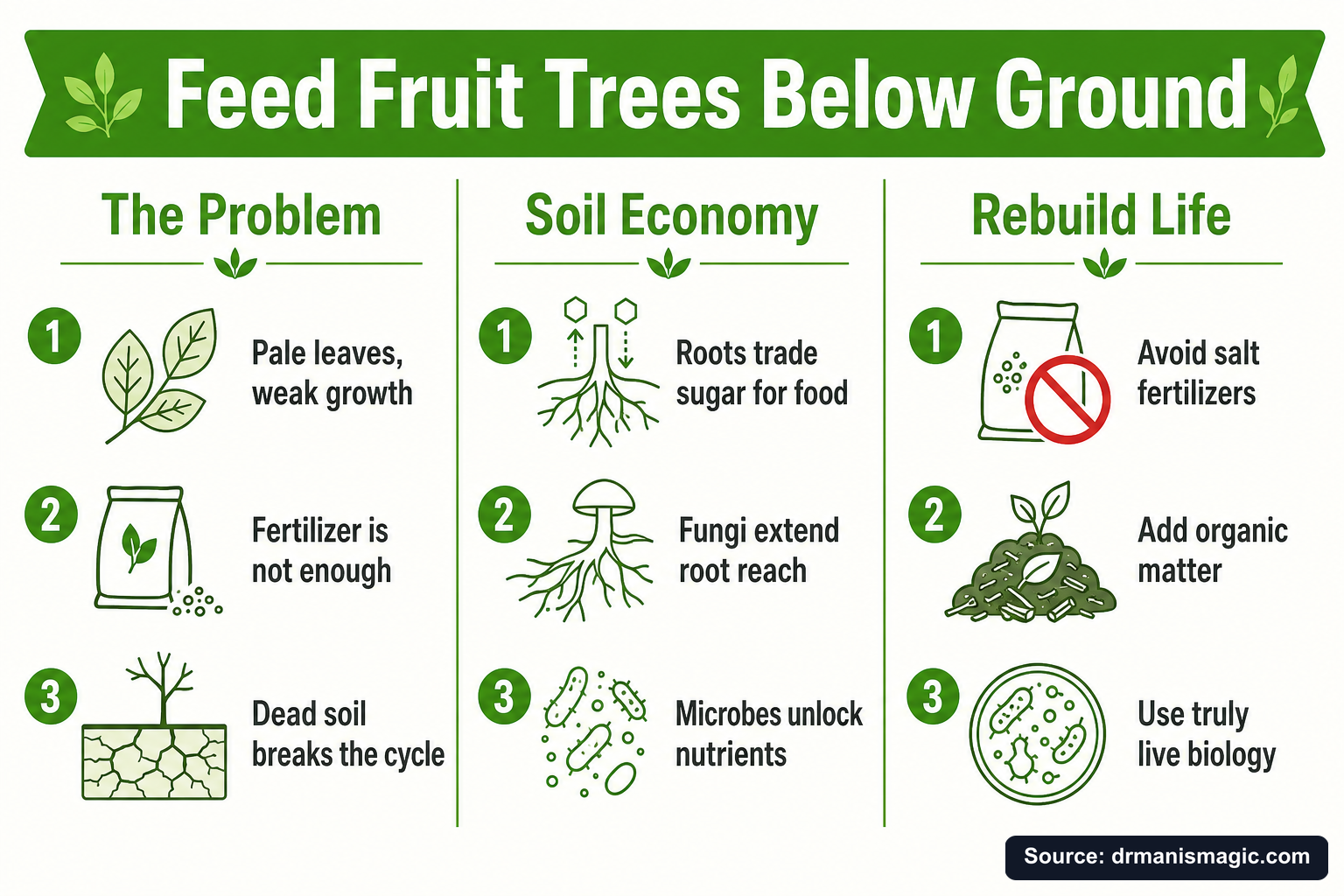
Picture this. You're standing in your backyard on a warm Saturday morning. Coffee in hand. Sun on your face. You're looking at your fruit tree — the one you planted two springs ago with big dreams. But instead of heavy branches drooping with fruit, you see pale leaves, spindly growth, and maybe a handful of sad little nubs that never quite made it.
You've fed it. You've watered it. You've tried three different fertilizers from the big box store. And yet something is still missing. Something invisible. Something happening — or not happening — in the dark soil beneath your feet right now.
Here's what nobody told you: your tree doesn't eat what you pour on top of it. Not directly. Your tree eats what a living underground economy prepares for it. And if that economy is broken — starved, poisoned, or never there to begin with — your tree will always be fighting upstream. No matter how much fertilizer you throw at it. We learned this the hard way growing over 250,000 citrus trees at our South Texas nursery. And once we understood it, everything changed.
Key Takeaways
- Your fruit tree survives above ground only because of a living economy of microbes working below ground.
- Bacteria, fungi, protozoa, and nematodes each play a specific role in feeding, protecting, and strengthening your tree's roots.
- Mycorrhizal fungi act like a second root system, extending reach by up to 700 times and pulling in nutrients and water the roots alone cannot reach.
- Salt-based synthetic fertilizers kill the very microbes your tree depends on — creating a cycle of dependency, not health.
- Most bottled microbial products are either dried and dead, or alive but going anaerobic and smelling like a sewer. Neither works well.
- Damaged soil can be rebuilt with the right inputs, but it takes consistent effort and genuinely live biology.
- The Three Plant Pillars — mineral-based soil, live microbials, and organic fertilizer — are the foundation every plant needs to thrive long-term.
What Is the Underground Economy Beneath Your Fruit Tree?
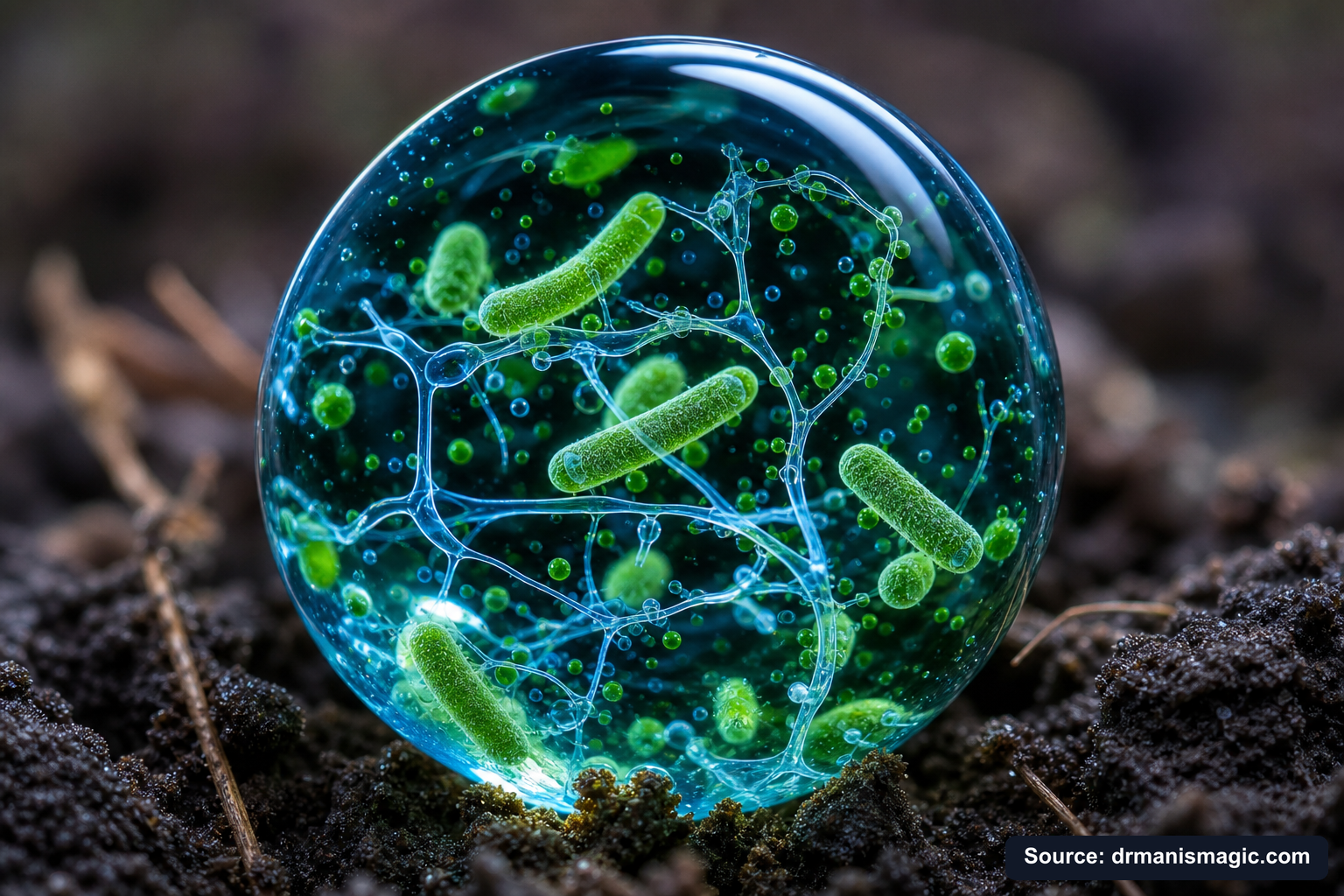
Quick Answer: The underground economy is the living network of bacteria, fungi, protozoa, and nematodes in your soil that trade nutrients with plant roots. Roots release sugars to feed these microbes. Microbes unlock and deliver minerals in return. This invisible exchange drives everything above ground — fruit size, flavor, root strength, and disease resistance.
Think of your soil as a city. Not a pile of dirt. A city.
The streets are fungal threads. The workers are bacteria. The recyclers are protozoa and nematodes. The marketplace is right at the root tip — a narrow zone scientists call the rhizosphere. This is where the real action happens.
Your tree's roots release sugary compounds called root exudates into this zone. It's deliberate. The tree is paying for services. Bacteria and fungi rush in to feed on those sugars. In exchange, they break down minerals, unlock nitrogen, and deliver nutrients directly to the root surface in forms the tree can actually absorb.
The University of Minnesota Extension reports that soil biological processes supply roughly 75% of plant-available nitrogen and 65% of available phosphorus. Not your fertilizer bag. The biology. That means your tree's canopy — every leaf, every bloom, every piece of fruit — is largely a reflection of what's alive in your soil.
Carbon is the currency. Roots are the marketplace. Fungi are the trade routes. Bacteria are the processors. Protozoa and nematodes are the recyclers. Organic matter is the bank. And fruit? Fruit is the dividend.
When that economy thrives, your tree thrives. When it collapses, no amount of fertilizer can make up the difference.
Who Are the Workers? Meet Your Soil Food Web
Quick Answer: The soil food web is made up of bacteria, fungi, protozoa, and nematodes working in layers. Bacteria decompose organic matter and fix nitrogen. Fungi extend root reach and suppress disease. Protozoa graze on bacteria and release plant-available nitrogen. Nematodes regulate populations and recycle nutrients further up the chain.
Most people have heard of bacteria and fungi. But the full crew is bigger than that. And every member has a job.
Let's walk through the team.
Bacteria: The First Responders
Bacteria are the most numerous workers in your soil. A single teaspoon of healthy garden soil can hold up to one billion bacteria. They break down organic matter into simpler forms. They fix nitrogen straight from the air. Some species produce natural antibiotics that suppress root pathogens. Without them, nutrients stay locked up in forms your tree cannot touch.
Fungi: The Trade Routes
Fungi spread through soil as thin threads called hyphae. They connect root systems to distant nutrient deposits the roots could never reach alone. The most important group for fruit trees is mycorrhizal fungi. These form a direct partnership with roots, trading phosphorus and micronutrients for sugars. UC ANR research has found that organic citrus orchards had higher mycorrhizal biodiversity and more frequent tree associations than conventional ones. More fungi, more fruit.
Protozoa: The Underrated Recyclers
Protozoa are tiny single-celled organisms that eat bacteria. That sounds like a problem. It isn't. When a protozoan eats a bacterium, it releases the nitrogen locked inside that bacterium as plant-available ammonium — right at the root zone. Think of them as the nitrogen ATMs of your soil. Almost nobody talks about protozoa in gardening content. But they drive a huge portion of your tree's nitrogen supply.
Nematodes: Not the Villain You Were Told
Say "nematode" to most gardeners and they flinch. But here's the truth: most nematodes in healthy soil are beneficial. They eat bacteria, fungi, and other nematodes. They recycle nutrients. Some even attack and kill soil-dwelling insect pests. The problematic ones — like citrus nematodes — thrive when biological balance is missing. A healthy, diverse soil food web keeps them in check naturally.
| Organism | Primary Role | Key Benefit for Your Tree | Beneficial or Harmful? |
|---|---|---|---|
| Beneficial bacteria | Decompose organic matter, fix nitrogen, suppress disease | Unlock nutrients, protect roots, build soil structure | Beneficial |
| Mycorrhizal fungi | Extend root network, trade phosphorus for sugars | More water, more nutrients, drought tolerance | Beneficial |
| Decomposer fungi | Break down woody organic matter | Release carbon and minerals back into soil | Beneficial |
| Protozoa | Graze on bacteria, release nitrogen | Plant-available nitrogen delivered at root zone | Beneficial |
| Bacterial-feeding nematodes | Eat bacteria, release nutrients | Nitrogen cycling, population balance | Beneficial |
| Predatory nematodes | Eat harmful nematodes and pest larvae | Natural pest control, soil balance | Beneficial |
| Citrus nematodes | Feed on root tissue | Root damage, reduced uptake, tree decline | Harmful |
| Phytophthora | Water mold, infects roots | Root rot, crown rot, tree death | Harmful |
| Fusarium / Pythium / Rhizoctonia | Pathogenic fungi | Root rot, damping off, seedling death | Harmful (when dominant) |
The key insight here is balance. Harmful organisms exist in almost every soil. But in a healthy, diverse underground economy, beneficial organisms out-compete them. The pathogens never get a foothold. The moment you strip out the beneficial biology — through chemicals, salt fertilizers, or sterile inputs — the harmful ones rush in.
How Do Mycorrhizal Fungi Help Fruit Trees Specifically?
Quick Answer: Mycorrhizal fungi attach to fruit tree roots and grow outward in all directions, multiplying the effective absorbing surface area dramatically. They pull in phosphorus, zinc, and water from soil zones the roots cannot reach. They also bind soil particles together, improve drought tolerance, and create a physical barrier that slows root pathogens like Phytophthora.
Here's a number that will stop you cold: mycorrhizal fungi can extend a root system's effective absorbing area by up to 700 times.
Seven hundred times.
Your tree's roots, on their own, can only reach so far. A few inches in every direction from the root tip. But mycorrhizal hyphae are thinner than roots and can push into tiny soil pores that roots can't enter. They reach water held in micro-spaces during dry spells. They find phosphorus locked in mineral form and release it for the tree.
They also produce a sticky protein called glomalin. Glomalin glues soil particles together into clumps called aggregates. Those aggregates create air pockets. Air pockets mean oxygen reaches the roots. Roots need oxygen the same way you do. Compact, airless soil is where roots suffocate and root rot begins.
And when mycorrhizal fungi are present in abundance, they form a dense biological sheath around the root zone. Pathogens like Phytophthora — the organism responsible for the most devastating citrus root rot — have a harder time reaching the root surface when mycorrhizae are crowding them out.
Pull up a weed sometime. Look at the roots. If you see fine white threads clinging to them, that's mycorrhizae. Weeds get this benefit for free. Your fruit tree deserves it too.
See also: The Hidden Reason Synthetic Fertilizers Cause Root Rot
What Kills the Underground Economy and Why Does It Matter?
Quick Answer: Salt-based synthetic fertilizers, broad-spectrum pesticides, systemic herbicides like glyphosate, synthetic antifungals, soil fumigation, and long-term bare soil all damage or destroy the underground economy. Once the biology is gone, pathogens move in, nutrients lock up, and no amount of fertilizer can substitute for what was lost.
Here's the part the big chemical companies never put on the label.
Salt-based synthetic fertilizers — the kind sold in most big box stores — are essentially concentrated mineral salts. They dissolve in water and push into the root zone fast. That's why plants "green up" quickly after you apply them. It looks like progress.
But those same salts are toxic to soil microbes. The bacteria and fungi in your root zone absorb water through osmosis. High salt concentrations pull water out of microbial cells the same way they pull it out of root cells. Microbes die. Fungi retreat. The living economy shrinks.
Now your tree is more dependent on the next application. Not less. The fertilizer company sells more product. Your tree's biology gets weaker every season. And eventually the roots are exposed — no protection, no biological armor — and Phytophthora or Fusarium moves in.
That's not bad luck. That's the predictable end of a broken system.
Other killers include:
- Glyphosate (Roundup): Disrupts microbial communities, particularly bacteria involved in nutrient cycling.
- Broad-spectrum pesticides: Kill beneficial insects and soil organisms alongside pests.
- Synthetic antifungals: Wipe out mycorrhizal fungi along with the pathogenic ones.
- Soil fumigation: Leaves soil biologically sterile — a blank slate for whoever colonizes next, often pathogens.
- Long-term bare soil: No organic matter input means the food web starves over time.
- Biosludge-based inputs: Can introduce PFAS and other persistent contaminants that alter soil chemistry and harm biology.
We've seen the aftermath of all of these at our nursery. When the biology is gone, even the best soil can't save a tree.
You Never Had a Brown Thumb.
You were handed the wrong tools. This free guide hands you the right ones.
You watered it. You fed it. It died anyway.
It was never you. It was the dirt, the salt food, and the bad advice.
This guide shows you what really went wrong, and how to fix it for good.
- Why your plants really died, and why it was never your fault
- The salt hiding in your plant food that quietly burns the roots
- The hidden killer in almost every bag of store soil
- The tiny helpers that grow a whole forest for free
- The rescue trick that brings a half dead plant back to life

Live Microbes vs Dead Microbes: Why Most Bottled Products Fail
Quick Answer: Most bottled microbial products either contain dried, dormant spores that fail to reactivate in soil, or they're liquid compost teas that go anaerobic and smell foul before they reach you. Dead microbes cannot do the work living microbes do. The only effective product is one with genuinely live, stable, active biology — verifiable under a microscope.
Walk into any garden center today and you'll find shelves full of microbial products. Bottles with impressive names. Labels listing dozens of species. They all promise the same thing: living biology for your soil.
Most of them are theater.
Here's what's actually happening behind those labels. There are essentially three ways these products are made:
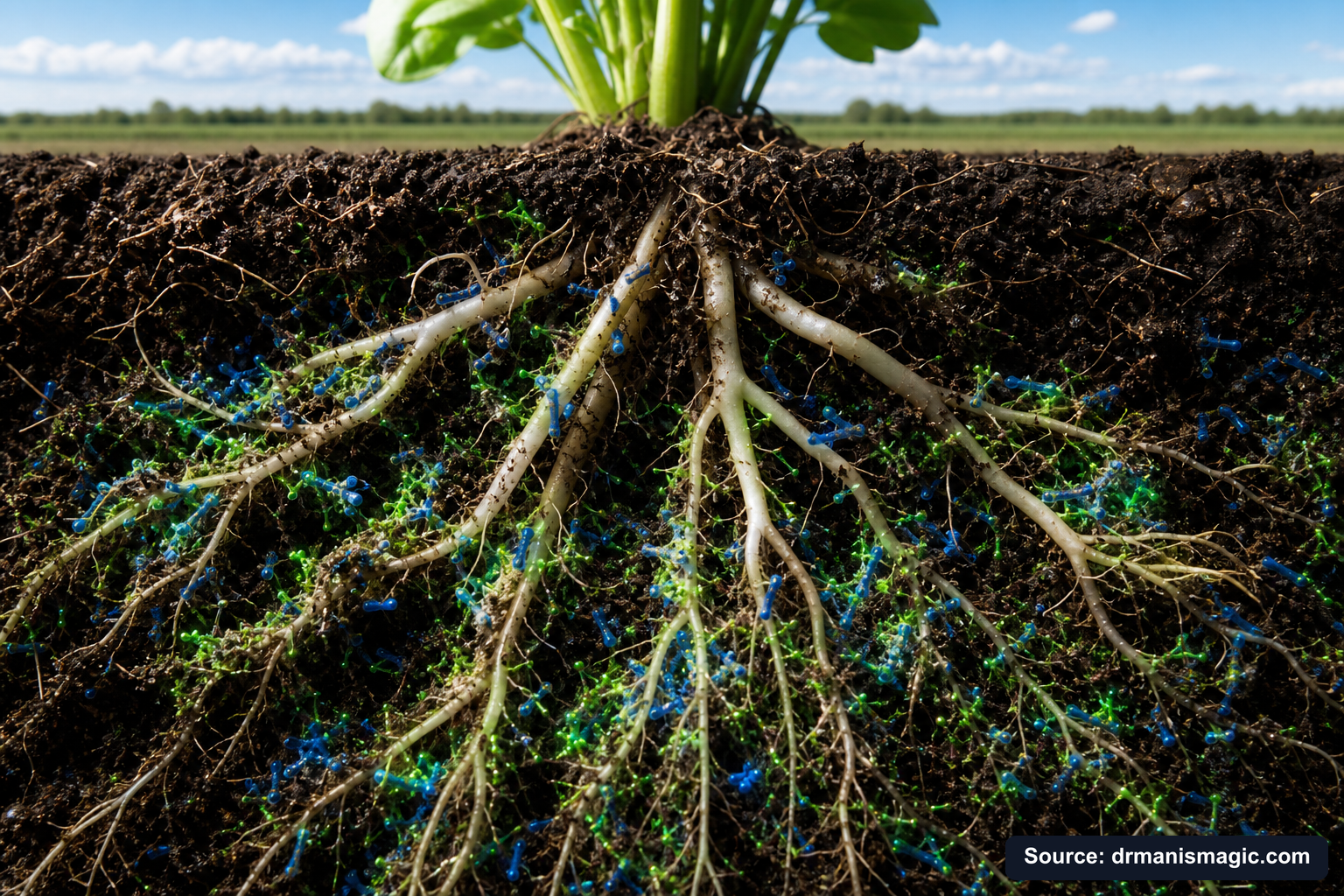
Method 1: Dried lab-grown microbes. A factory grows specific strains in giant vats. They dry them into powder, hoping the dormant spores will "wake up" once they hit your soil. Sometimes companies rehydrate this powder and sell it as liquid. We've tested dozens of these at our nursery. Across the board, we saw no meaningful improvement in our trees. The spores either don't reactivate or the strains are too narrow to support a real soil food web.
Method 2: Compost tea gone bad. These products start from real compost — a legitimate source of living biology. But once bottled and shipped, the microbes consume all available oxygen within about 24 hours. The liquid goes anaerobic. The microbes die or switch to fermentation mode. The bottle fizzes when opened. The smell is unmistakable — like a sewer. If your microbial product stinks, the biology is already gone. You're paying for dead stuff with some residual humic acid.
Method 3: Lactobacillus-based products. These are made with the same bacteria found in yogurt. They're easy to produce and they do stay alive. But lactobacillus is so aggressive it crowds out the other beneficial microbes in your soil. It belongs in your digestive system, not your root zone.
| Product Type | Microbial Viability | Spectrum of Organisms | Odor | Real-World Results |
|---|---|---|---|---|
| Dried / powdered lab microbes | Very low | Narrow (a few strains) | None | We saw no meaningful benefit in our nursery trials |
| Lab microbes rehydrated in liquid | Very low | Narrow | Minimal | Same problem — dormant spores rarely activate |
| Fresh compost tea (under 24 hours) | Moderate to high | Broad (natural compost diversity) | Earthy | Works well but requires on-site production and immediate use |
| Old compost tea (over 24 hours) | Very low (anaerobic) | Diminished | Strong and foul | Mostly dead; some residual humic acid value only |
| Lactobacillus products | High (but wrong organisms) | Narrow and competitive | Sour | Crowds out beneficial microbes — not recommended |
| Plant Super Boost (stabilized, full-spectrum) | High — live and active | 2,000+ bacteria strains, 400–500 fungi including mycorrhizae, plus protozoa and nematodes | Earthy — not foul | Visible microbial movement under microscope; confirmed by lab analysis; proven across 250,000+ trees |
The Dr. Mani's Magic story starts with a meeting that almost didn't happen. Dr. Mani Skaria — Professor Emeritus of Plant Pathology, inventor of micro-budding, founder of the Clean Citrus Program in Texas — had spent decades trying to solve the biology problem in his nursery. He tried the powders. He tried the commercial liquids. Nothing moved the needle.
Then through what he calls a providential encounter, he met a world-famous compostologist who had spent his career perfecting a natural method of stabilizing live compost biology in liquid form. This man had seen such dramatic results with large citrus groves that the big chemical companies had worked to discredit and blacklist him. At one point, he feared for his safety.
Years later, he joined the team at US Citrus Nursery. Together, they developed Plant Super Boost — a stabilized, full-spectrum live microbial formula harvested from real handcrafted compost, not lab tanks. No PFAS. No biosludge. No synthetic salts. Zero foul smell. If you put a drop under a microscope, you can watch the microbes moving. Lab analyses confirm it every time. That's not a marketing claim. That's biology you can see.
What Does a Fruit Tree Actually Feel When Biology Is Working?
Quick Answer: When soil biology is functioning well, fruit trees develop deeper, more branched root systems, show stronger growth, produce more blooms, set more fruit, and recover faster from heat, drought, and disease pressure. The difference is visible within weeks and dramatic within one growing season.
Imagine your tree on a hot July afternoon. The kind of day where the air shimmers and the ground bakes. A tree with dead soil around its roots is already stressed. Its stomata are closing. Its growth has stalled. It's in survival mode.
Now picture that same tree with a thriving underground economy. Mycorrhizal threads are pulling water from pockets deep in the soil. Bacteria are releasing the nitrogen locked in last season's leaf mulch. The root zone has oxygen because fungal glomalin is holding soil structure open.
That tree is still growing. Still pushing fruit. Still standing tall.
The fruit tastes different too. Nutrient density in fruit is directly connected to the mineral uptake driven by soil biology. Trees grown in biologically rich soil consistently produce fruit with more complex flavor, deeper color, and higher sugar content. You can taste the difference between a tomato grown in living soil and one grown hydroponically on synthetic nutrients. The same principle applies to your lemons, oranges, figs, peaches, and avocados.
Time matters here too. You cannot get lost years back. Every season you spend growing a tree in depleted, biologically dead soil is a season of fruit you will never recover. The number one thing people tell Dr. Mani they want is simple: they want to see fruit on their own tree while they still can. That drive — that primal need to tend a garden and harvest something from it — is not sentimental. It is real. And it is being stolen from millions of gardeners by a system that profits from their failure.
Don't let another season pass on a broken foundation.
How Do You Rebuild a Dead or Damaged Underground Economy?
Quick Answer: Rebuilding damaged soil biology requires stopping what killed it, adding organic matter as food for microbes, introducing genuinely live full-spectrum biology repeatedly over time, and letting the ecosystem restabilize. There is no single application fix. But with the right inputs and patience, most soils respond within one growing season.
Whether your soil was fumigated, flooded, salted by years of synthetic fertilizer, or simply never had biology to begin with — the path back is the same. It just takes consistency.
Here is a practical recovery checklist:
- Stop adding what's killing it. Eliminate or dramatically reduce salt-based synthetic fertilizers, systemic herbicides, and broad-spectrum antifungals. Every application is resetting the clock.
- Flush accumulated salts. Deep watering over several cycles helps leach salt buildup out of the root zone. If you're in a container, this is especially important.
- Check your soil structure. Compacted, oxygen-starved soil cannot support biology. If your current potting mix is breaking down into sludge, it's time for a mineral-based soil like Super Soil that holds structure permanently without decomposing into root-choking muck.
- Add organic matter as food. Mulch, compost, and organic matter are the food supply for your microbial workforce. Bare soil starves them. A 2-3 inch layer of organic mulch around your tree's drip line feeds biology while regulating moisture and temperature.
- Introduce genuinely live full-spectrum biology. Apply a real microbial inoculant monthly. Not a powder. Not a foul-smelling liquid. Living, active, broad-spectrum biology that includes bacteria, fungi, mycorrhizae, protozoa, and beneficial nematodes together.
- Feed with organic, not synthetic. Organic slow-release fertilizer works with the biology, not against it. Inputs derived from crab, kelp, and amino acids provide the full spectrum of macronutrients and trace minerals in forms that microbes can process and deliver to roots without burning them or raising salt levels.
- Be patient and consistent. Rebuilding an ecosystem is not a one-time event. Plan for monthly microbial applications through at least one full growing season. Most growers see meaningful improvement within 4-6 weeks and dramatic transformation by the end of the season.
The three inputs that make this recovery plan practical and proven are the same ones we use across our entire nursery operation. They are the foundation of what we call the Three Plant Pillars: mineral-based soil, live microbials, and organic fertilizer. Not because we invented the concept — nature invented it. But because we built products that bring it to your backyard without the guesswork.
See also: Why Most Fertilizers Are Actually Salt in Disguise
Synthetic Fertilizer vs Living Soil: An Honest Comparison
Quick Answer: Synthetic fertilizers deliver fast, visible results but damage soil biology over time, increase dependency, and leave roots biologically unprotected. Living soil biology delivers slower, deeper results that compound season after season, reduce disease pressure, and build genuine long-term resilience without the chemical cost to your family, pets, or soil.
This is the comparison nobody in the fertilizer industry wants you to see clearly.
| Factor | Salt-Based Synthetic Fertilizer | Living Soil with Organic Inputs |
|---|---|---|
| Speed of visible response | Fast (days) | Moderate (weeks), then compounding |
| Effect on soil microbes | Kills or suppresses beneficial biology | Feeds and multiplies beneficial biology |
| Root protection from pathogens | None (biology removed) | Strong (biology crowds out pathogens) |
| Nutrient dependency over time | Increases with each application | Decreases as biology matures |
| Drought tolerance | Low (salt increases osmotic stress) | High (mycorrhizae extend water access) |
| Risk of root burn | High | Very low with organic slow-release |
| Safety for children and pets | Variable to concerning | Excellent — no harsh chemical warnings |
| PFAS / biosludge risk | Present in some biosolid-based products | Zero with clean organic inputs |
| Long-term soil health trajectory | Declining | Improving season after season |
| Fruit quality (flavor, density) | Adequate but flat | Richer, more complex, more nutritious |
The fast green-up from synthetic fertilizer is real. We're not pretending it isn't. But it's borrowed time. You're spending your tree's biological capital to get a short-term visual result. Every application leaves your tree a little more exposed, a little more dependent, a little further from the resilient, self-sustaining system nature designed it to be.
Think about what's really at stake. You can always buy more fertilizer. You cannot buy back the growing seasons you lost on a broken system. You cannot buy back the years a tree spent struggling when it should have been fruiting. The real cost of the old way isn't measured in dollars. It's measured in time.
What Can You Do Right Now to Wake Up Your Soil?
Quick Answer: Start with the Three Plant Pillars today. Get your soil structure right so roots can breathe. Add genuinely live full-spectrum microbial biology monthly. Feed with organic slow-release nutrients that work with the biology, not against it. Most plants show meaningful improvement within 30 days on this foundation.
You don't need to understand every organism in the soil food web to benefit from it. You don't need a PhD in plant pathology. You need three things working together at the same time.
First: Give your roots a home they can breathe in. Organic potting mix breaks down into airless sludge within 6-12 months. Mineral-based soil holds structure permanently. Roots need oxygen. Oxygen needs space. Space requires structure that doesn't collapse.
Second: Flood that root zone with live biology every month. Not dried powder. Not stinky fermented tea. Genuinely living, full-spectrum microbes — bacteria, fungi, mycorrhizae, protozoa, beneficial nematodes — working together the way nature built them to. If you can see movement under a microscope and the bottle smells like fresh earth rather than sewage, you have something real.
Third: Feed the tree and the biology together with organic slow-release nutrition. No synthetic salts. No biosludge. No PFAS. Inputs derived from whole natural sources that microbes can process and deliver in exactly the forms roots want.
That's it. That's the whole system. We've proven it across 250,000+ trees at our nursery in South Texas. We've watched trees that were struggling for years come back to life within a single season once these three pillars were in place. We've watched home gardeners who called themselves "brown thumbs" grow fruit they didn't think was possible in their backyard.
The underground economy was always there, waiting to be rebuilt. It just needed someone to stop poisoning it and start feeding it instead.
If you're ready to stop guessing and start growing on a real biological foundation, explore our Free Plant Care Field Guide — it walks you through the entire Three Plant Pillars system step by step, for any plant you're growing, in plain language with no jargon and no upsell pressure. Just the truth about what your plants actually need to thrive.
The fruit you've been imagining? It's not a fantasy. It's what happens when the underground economy finally gets to do its job.
Frequently Asked Questions
Most gardeners stare at a struggling fruit tree and blame themselves. But the real story is happening underground, right now, in ways most people never learn about. These questions get to the heart of what is actually feeding your fruit tree, and why the invisible world beneath your soil matters more than anything you pour on top of it.
What is the underground economy that feeds a fruit tree?
It is the living network of bacteria, fungi, protozoa, and nematodes working in your soil every single day. Your tree's roots release sugars to feed these microbes. In return, those microbes unlock minerals and deliver nutrients the roots can actually absorb. When this system is alive and thriving, your tree thrives. When it is dead or damaged, no fertilizer bag in the world can fully replace it. Dr. Mani proved this growing over 250,000 citrus trees in South Texas.
Why do synthetic fertilizers hurt fruit trees over time?
Most store-bought fertilizers are salt-based. Salt kills the beneficial bacteria and fungi your tree depends on underground. You might see a quick green flush after applying them, but the soil biology takes a hit every single time. Over months and years, your tree gets weaker, not stronger. It becomes addicted to the fertilizer and loses the natural support system that was doing the real work. That is the cycle Dr. Mani's Magic is designed to break.
What do mycorrhizal fungi actually do for a fruit tree?
Think of mycorrhizal fungi as a second root system your tree grows for free. These fungal threads extend out from the roots and reach nutrients and water that the roots alone could never find. They can expand the root's effective reach by hundreds of times. They also help protect against disease and drought. Without them, your tree is working with one hand tied behind its back. Plant Super Boost delivers live mycorrhizae straight to your roots.
Can damaged soil biology be fixed?
Yes, but you have to stop feeding it poison first. That means ditching salt-based synthetic fertilizers and switching to organic inputs. Then you rebuild with live microbials, mineral-based soil, and slow-release organic fertilizer. This is exactly what the Three Plant Pillars are built to do. It takes consistent effort, but most gardeners start seeing real improvement within the first month. The soil wants to come back to life. It just needs the right help.
What makes Dr. Mani's Magic Plant Super Boost different from other microbial products?
Most bottled microbials are either freeze-dried and barely alive, or they have gone anaerobic and smell like a sewer. Neither one does much good for your plants. Plant Super Boost uses a special all-natural preservation method that keeps the microbes genuinely alive and active right up until they hit your soil. It smells earthy, not rotten. That means you are getting real, working biology, not a bottle of wishful thinking. It is made right here in the USA.
Why does the type of soil you use matter so much for fruit trees?
Most potting mixes are made from pine bark and wood that breaks down fast. As it rots, it steals oxygen from the roots and turns into a soggy, compacted mess. Roots suffocate. Disease moves in. Dr. Mani's Magic Super Soil is built on mineral-based sandy loam from South Texas. It does not break down. It drains perfectly. Roots breathe and push deep. That is Pillar One of the Three Plant Pillars, and it is the foundation everything else is built on.
How long does it take to see results when you fix the soil food web?
Most gardeners using the Three Plant Pillars, which means mineral-based soil, live microbials, and organic fertilizer together, start noticing healthier color, stronger growth, and more root activity within the first 30 days. Long-term results keep building from there. The key is consistency and using all three pillars together. Fix just one and you are still leaving growth on the table. Use all three and you give your fruit tree the same foundation that helped Dr. Mani grow 250,000 trees successfully in South Texas.
About the Author
Dr. Mani Skaria, PhD
Dr. Mani Skaria, PhD, is a plant pathologist and the scientific founder of Dr. Mani's Magic. He earned his doctorate at Purdue University and spent 48 years studying how plants, soil, and living microbes work together, including his years as Professor Emeritus at Texas A&M and as a member of the USDA NAREEE Advisory Board. He invented micro-budding, a method for growing healthier, stronger trees, and has grown more than 250,000 trees on the family farm in Hargill, Texas - US Citrus Nursery. His life's work takes real lab science and practical experience and turns it into simple, safe, organic plant care anyone can use at home.


