


The Soil Food Web Explained Like a Campfire Story | Dr. Mani's Magic
The Soil Food Web Explained Like a Campfire Story
Picture yourself sitting around a campfire on a cool night. The fire crackles. Orange sparks drift upward and disappear into the dark. Someone feeds the flame a handful of dry twigs. The fire catches, spreads, and suddenly the whole circle of people glows warm.
Now close your eyes and push that whole scene underground. Roots instead of logs. Bacteria instead of sparks. Fungi weaving through the dark like slow-burning coals. Tiny creatures grazing and releasing heat in the form of nutrients. The fire never goes out — unless someone pours something terrible on it.
That underground fire is your soil. And most of us have been accidentally drowning it with salt, plastic-coated chemicals, and dead products that promised life but delivered nothing. After growing more than 250,000 trees at our South Texas nursery, we learned the hard way that the fire has to burn on its own terms. Your only job is to stop pouring water on it — and maybe toss in a little extra kindling.

Plant Super Boost
Key Takeaways
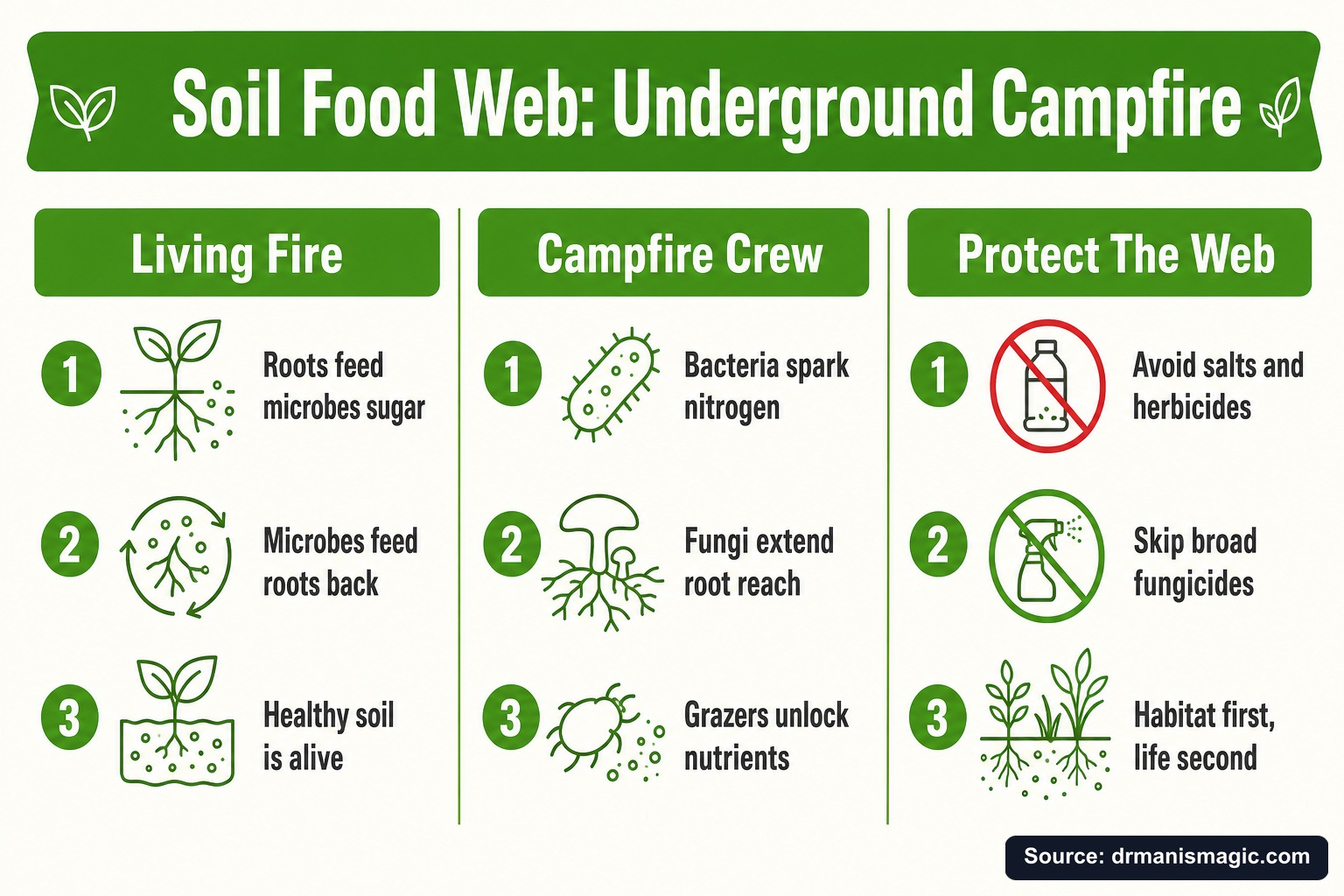
- The soil food web is a living underground economy where plants feed microbes and microbes feed plants back.
- Bacteria are the fast sparks — they multiply quickly, break down simple sugars, and cycle nitrogen.
- Fungi are the long coals — slow, deep, and capable of extending a plant's root reach by hundreds of times.
- Protozoa and nematodes are the grazers — they eat bacteria and release locked nutrients right at the root zone.
- Salt-based fertilizers, synthetic herbicides, and broad-spectrum fungicides are like buckets of water thrown on the fire.
- Dead or dried microbe products cannot restart a living system — only genuinely alive, full-spectrum biology can.
- You can rebuild a damaged soil food web, but it takes the right sequence: habitat first, biology second.
What Is the Soil Food Web and Why Should You Care?
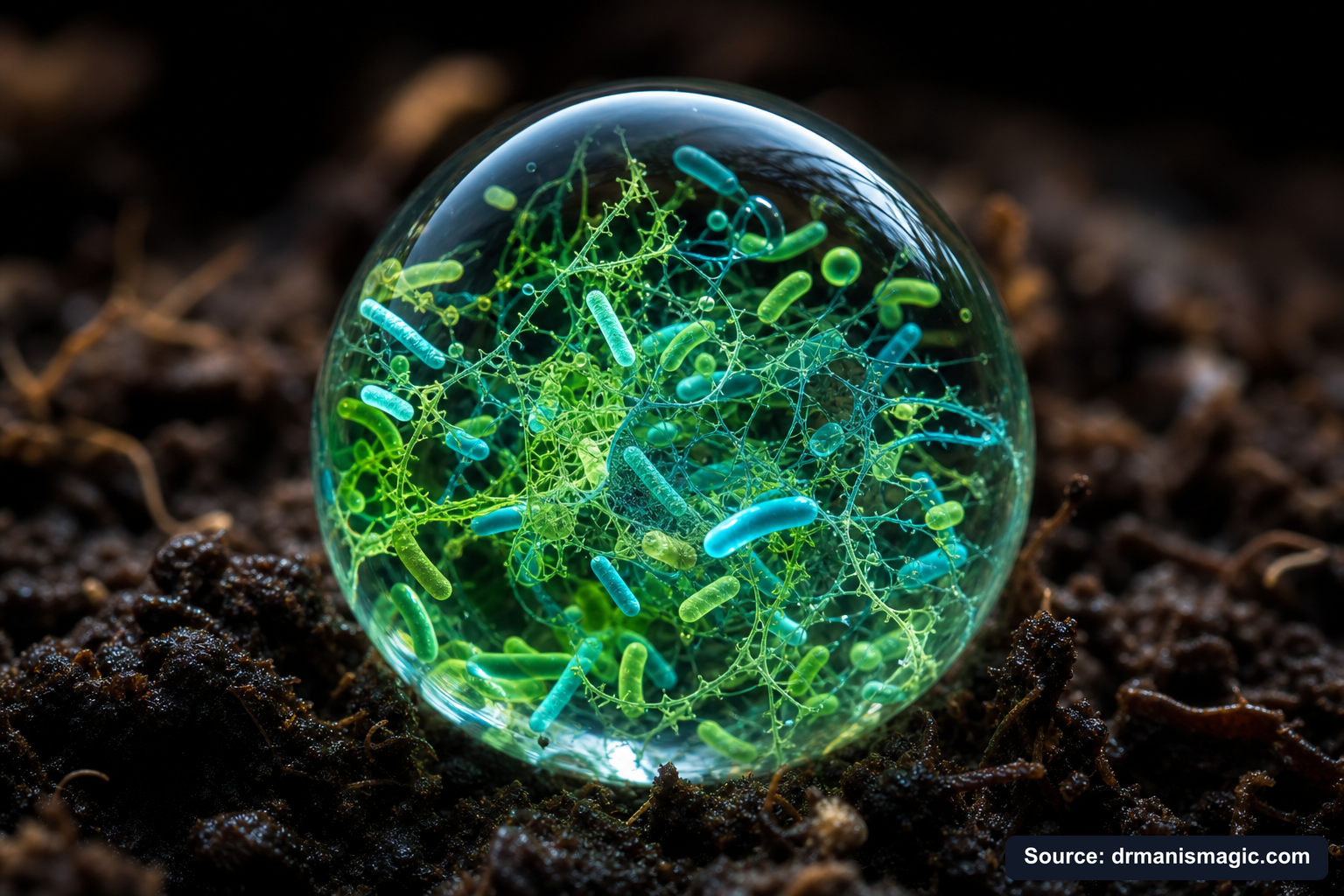
Quick Answer: The soil food web is the network of living organisms in soil — bacteria, fungi, protozoa, nematodes, arthropods, earthworms, and more — that eat each other, break down organic matter, and release nutrients that plants can actually absorb. Without it, plants struggle to feed themselves no matter how much fertilizer you pour on them.
The soil food web is not a diagram. It is a story. A story with characters, conflict, and a payoff.
Here is how it works, told the way it should be — around a fire.
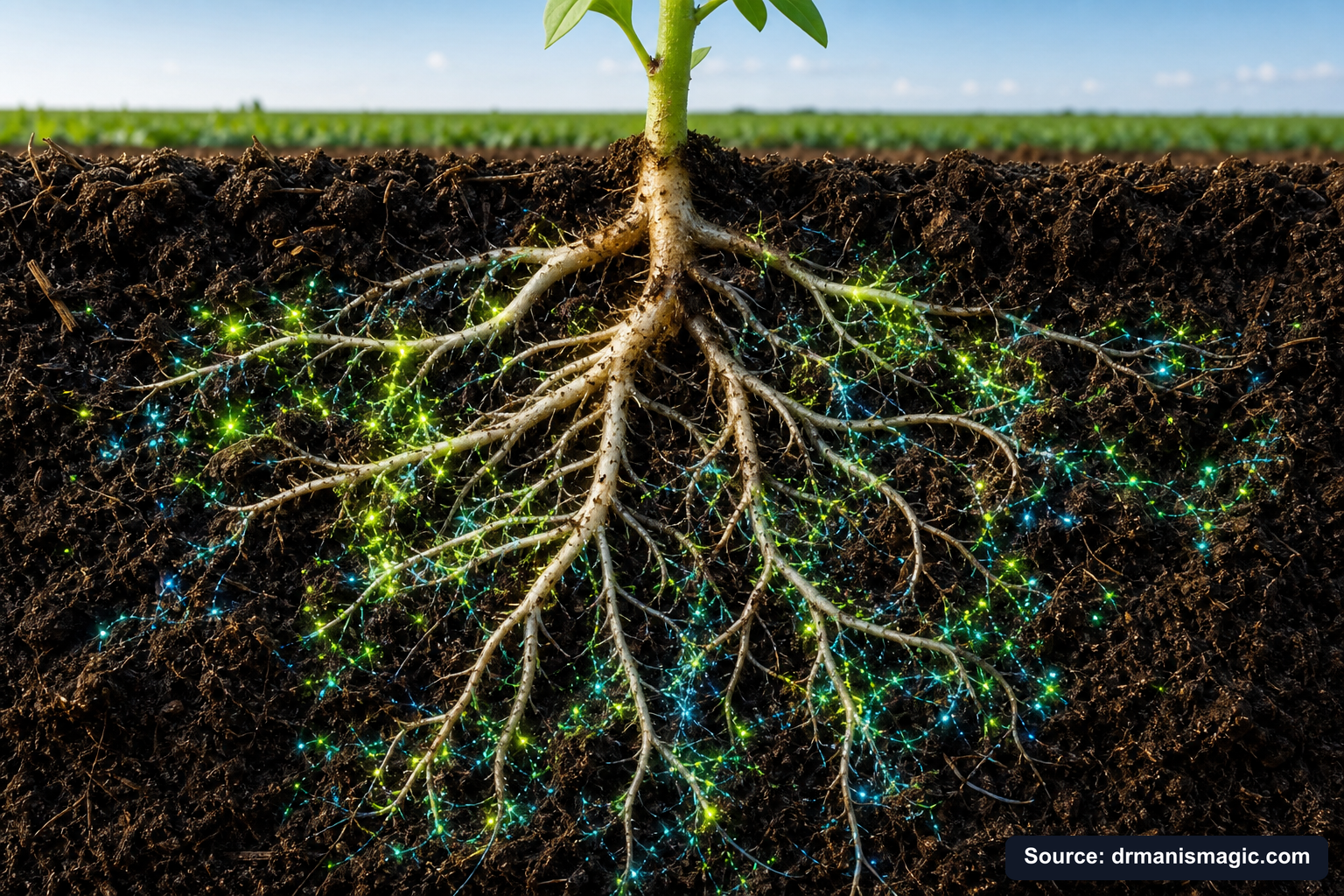
Every living plant is doing something remarkable right now that most people never think about. It is pumping liquid sugar out of its roots. On purpose. That sugar is called a root exudate, and the plant is literally feeding the ground beneath it. Scientists at the University of Minnesota Extension describe this exchange as one of the most important biological transactions in nature. The plant gives carbon. The soil gives back nutrients. Simple trade. Miraculous result.
That trade only works if someone is home to receive the sugar.
That someone — billions of someones — is what we call the soil food web.
Who Are the Characters in This Underground Campfire Story?
Quick Answer: The main characters are bacteria (fast sparks), fungi including mycorrhizae (slow coals and deep networks), protozoa and nematodes (grazers that release nutrients), arthropods and earthworms (the cleanup crew), and the plant itself (the one feeding the fire). Each plays a different role, and the system only hums when all of them show up.
Let us meet each character the way they deserve to be introduced.
The Plant: The One Who Brings the Wood
Every campfire needs someone to gather the wood. That is the plant. Through photosynthesis — capturing sunlight — the plant makes carbon-rich sugars. It keeps some for itself. But it deliberately leaks up to 40 percent of those sugars out through its roots. This is not a mistake. It is a deliberate invitation. "Come eat," the plant says. "And bring me something in return."
Bacteria: The Fast-Burning Sparks
Bacteria are the first responders. They show up the moment those root sugars hit the soil. They are tiny, they are fast, and they are everywhere. A single teaspoon of healthy soil holds more bacteria than there are people on Earth.
Bacteria do several critical things:
- They break down simple organic compounds into smaller pieces plants can absorb.
- They pull nitrogen right out of the air and convert it into a form roots can drink.
- They produce sticky compounds called polysaccharides that glue soil particles together, creating the crumbly, breathable structure your roots need.
- They crowd out pathogens — bad bacteria and fungi — by simply out-competing them for space and food.
Think of bacteria as the small twigs and sparks of your campfire. They catch fast. They burn hot. They make the heat that everything else depends on.
Fungi: The Long Coals That Keep the Fire Burning All Night
Fungi are slower. Quieter. But they build something bacteria cannot.
Regular soil fungi break down tough materials like wood chips, straw, and dead roots. But the most important fungi for your plants are called mycorrhizal fungi. The word mycorrhizae (my-cor-RY-zee) comes from the Greek words for fungus and root. That tells you everything.
Mycorrhizal fungi attach to your plant's roots and grow outward into the soil like a second, invisible root system. They can extend a plant's effective water- and nutrient-absorbing area by as much as 700 times. Seven hundred times. That is not a typo.
The plant pays for this service in sugar. The fungus delivers water, phosphorus, zinc, and other nutrients the roots could never reach alone. According to Penn State Extension, mycorrhizal associations occur in over 80 percent of plant species — meaning this is not some exotic garden trick. This is what plants have always done, everywhere, for millions of years.
When you pull a weed and see fuzzy white threads clinging to its roots? That is mycorrhizae. That is why weeds grow so stubbornly. They have the fire going underground. Most garden plants in pots and treated soils do not.
Protozoa: The Grazers Who Release the Feast
Here is where the story gets interesting. And almost nobody tells this part.
Bacteria eat the plant's root sugars. Bacteria multiply like crazy. Nutrients get locked up inside all those bacterial bodies. The plant cannot use nutrients that are locked inside a bacterium.
Enter the protozoa. These tiny single-celled creatures graze on bacteria the way cattle graze on grass. They eat the bacteria. They digest what they need. And they release the rest — nitrogen, phosphorus, micronutrients — right back into the soil, right at the root zone.
This is called nutrient mineralization. It is the moment the campfire releases warmth to the people sitting around it. Without protozoa, the nutrients stay locked in the bacteria. The plant stays hungry. No matter how much fertilizer you add.
Nematodes: The Misunderstood Middle Child
Say the word "nematode" and most gardeners get nervous. They picture plant-killing root worms. And yes, those parasitic nematodes exist. But the majority of nematodes in healthy soil are beneficial.
Beneficial nematodes do the same thing protozoa do, but higher up the food chain. They eat bacteria. They eat fungi. They eat other nematodes. And every time they eat and excrete, nutrients get released in plant-available forms. They also eat the bad guys — fungal gnats, grubs, and harmful nematode species.
They are the middle management of the soil food web. Unglamorous. Essential.
Arthropods and Earthworms: The Cleanup Crew
Beetles, mites, springtails, millipedes, and earthworms shred and grind organic matter into smaller pieces that bacteria and fungi can work with faster. Earthworms pull organic material down from the surface. Their castings are some of the most nutrient-dense material in nature. They also create channels for air and water to move through soil.
No cleanup crew means the fuel never reaches the fire.
What Does the Whole Soil Food Web Cycle Actually Look Like?
Quick Answer: The plant feeds root sugars to bacteria and fungi. Bacteria multiply and lock up nutrients in their bodies. Protozoa and nematodes eat the bacteria and release those nutrients back at the root. Fungi extend the root system and trade water and minerals for more sugar. Arthropods and earthworms break down surface material and feed the whole cycle from the top down. It is a loop, not a line.
Here is the full cast and their roles in one clear table:
| Organism | Campfire Role | What They Do for Your Plant | What Destroys Them |
|---|---|---|---|
| Plant roots | The one who brings the wood | Releases root exudates (sugars) to feed microbes | Root rot, compaction, oxygen deprivation |
| Bacteria | Fast-burning sparks | Cycle nitrogen, decompose organics, suppress pathogens, build soil structure | Salt-based fertilizers, herbicides, broad-spectrum pesticides |
| Mycorrhizal fungi | Deep, long-burning coals | Extend root reach up to 700x, deliver water, phosphorus, zinc | Synthetic fungicides, excess phosphorus fertilizer, tillage |
| Other soil fungi | Slow coals on tough material | Break down woody debris, cycle carbon, contribute to soil structure | Fungicides, over-tillage, chemical inputs |
| Protozoa | The grazers who release the feast | Eat bacteria, release locked nutrients at the root zone | Pesticides, herbicides, compaction, drought |
| Beneficial nematodes | Middle management | Eat bacteria, fungi, bad nematodes; release nutrients, suppress pests | Chemical inputs, soil compaction, UV exposure |
| Arthropods and earthworms | The cleanup crew | Shred organic matter, create soil channels, produce castings | Synthetic pesticides, compaction, bare soil |
How Does the Campfire Die? What Kills the Soil Food Web?
Quick Answer: The soil food web dies when it gets flooded with salt-based synthetic fertilizers, doused with broad-spectrum herbicides or fungicides, starved of organic matter, or compacted so hard that oxygen disappears. Once the biology is gone, no amount of fertilizer can replace what those microbes were doing for free.
Here is the part nobody at the big box store ever told you.
That bag of blue synthetic fertilizer? It is salt. Literally. Salt-based nitrogen, phosphorus, and potassium dissolved in water and sprayed on your soil. And salt kills microbes. It does not slow them down. It kills them. The same way salt on a slug works. Osmotic shock. The cells collapse.
Every time you pour synthetic fertilizer on your soil, you are pouring a small bucket of water on your underground campfire.
You get a quick green flash — the plant absorbs those salts fast — and then things slow down. The microbes are fewer. The protozoa have nothing to eat. The mycorrhizae start retreating. The nutrient cycle slows. You add more fertilizer. The fire dims more. You add more. It becomes a cycle that profits the fertilizer companies enormously and leaves your soil a little more sterile every season.
See also: The Hidden Reason Synthetic Fertilizers Cause Root Rot
The other fire-killers:
- Synthetic herbicides like glyphosate disrupt microbial communities, reducing diversity and resilience.
- Broad-spectrum fungicides do not know the difference between the fungus rotting your root and the mycorrhizal fungus extending it.
- Bare soil with no organic mulch or cover bakes in the sun, dries out, and gives microbes nothing to eat.
- Compaction from foot traffic or heavy machinery squeezes out the oxygen microbes need to breathe.
- PFAS and biosludge from contaminated composts and fertilizers introduce chemical loads that disrupt soil biology in ways we are still learning about.
The result? A plant that looks like it is surviving, but is actually on life support. Yellowing leaves. Weak fruit. Root rot that seems to come out of nowhere. Pest problems that multiply. Sound familiar?
It is not your fault. The whole system was designed to keep you buying more products, not to fix the actual problem.
You Never Had a Brown Thumb.
You were handed the wrong tools. This free guide hands you the right ones.
You watered it. You fed it. It died anyway.
It was never you. It was the dirt, the salt food, and the bad advice.
This guide shows you what really went wrong, and how to fix it for good.
- Why your plants really died, and why it was never your fault
- The salt hiding in your plant food that quietly burns the roots
- The hidden killer in almost every bag of store soil
- The tiny helpers that grow a whole forest for free
- The rescue trick that brings a half dead plant back to life

Live vs. Dead Microbe Products — Why Does This Difference Matter So Much?
Quick Answer: A live microbe product can restart your soil food web. A dead or dried microbe product cannot. Most products on shelves today are made from dried lab-grown bacteria that do not survive rehydration, or compost-tea liquids that went anaerobic (airless and dead) before they reached you. The smell tells you the truth — if it stinks like sewage, the microbes are dead or dying.
This is where the story gets personal for us.
Dr. Mani Skaria — Professor Emeritus of Plant Pathology, inventor of micro-budding, founder of the Clean Citrus Program in Texas — spent decades watching plants respond to biology. At our nursery in Hargill, South Texas, we tested product after product looking for a microbial inoculant that actually worked. Dozens of them. Powders, liquids, capsules, teas.
Most did nothing. Some made things worse.
Here is what we found:
| Product Type | How It Is Made | Viability When It Reaches You | Smell | Does It Work? |
|---|---|---|---|---|
| Dry/powdered lab microbes | Grown in vats, dried into powder, labeled and shipped | Very low — spores rarely reactivate well | Odorless | We saw no results across dozens of tests |
| Dry microbes rehydrated into liquid | Same dried base, mixed into water | Very low | Neutral to slightly off | Same problem; avoid |
| Compost tea (fresh, less than 24 hours, aerated) | Brewed from fresh compost with aeration | Moderate if used immediately | Earthy | Yes — but only if you make it yourself and use it within hours |
| Compost tea (old, more than 24 hours) | Same, but gone anaerobic | Very low — microbes dying in airless liquid | Strong sewage stench | No — and the smell tells you why |
| Lactobacillus-based products | Easy to brew; found in yogurt | High viability — but wrong organisms | Sour | No — lactobacillus outcompetes beneficial microbes |
| Plant Super Boost (stabilized, full-spectrum) | Harvested from hand-crafted compost, stabilized by a proprietary all-natural technique | High — visible under a microscope; lab-verified | Earthy, not foul | Yes — 2,000+ bacteria species, 400-500 fungi including mycorrhizae, plus protozoa and nematodes |
The key difference is the stabilization technique. Our compost expert — a world-renowned figure who once advised royal families and governments on farming practices, and who was later blacklisted by large chemical companies when his methods started showing results in commercial citrus groves — brought us a way to keep the full spectrum of compost microbes alive without letting them go anaerobic.
That is why Plant Super Boost smells like earth, not sewage. The microbes are not rotting. They are resting. Ready to go to work the moment they hit your soil.
You can even take a drop and look at it under a microscope. The microbes move. That is not marketing. That is biology.
What Is the Difference Between Mycorrhizal Fungi in a Bottle vs. Mycorrhizae That Already Live in Your Soil?
Quick Answer: If your soil already has healthy native mycorrhizal fungi — and you have not killed them with chemicals, tillage, or excess phosphorus — adding an inoculant may not do much extra. But if your soil has been treated with fungicides, synthetic fertilizers, or has been in a pot or planter, native fungi are likely gone. That is when a genuinely alive, compatible inoculant makes a real difference.
This is the part most living-soil companies skip because it makes their product sound less magical. We are going to tell you anyway.
Mycorrhizal fungi are not one-size-fits-all. Different plant families prefer different fungal species. The fungi in a product need to be alive when they reach the root. They need low existing competition from native fungi. They need the right soil conditions — adequate oxygen, proper moisture, not too much phosphorus (high phosphorus actually makes plants stop investing in fungal partnerships because they do not need the help).
So when does a mycorrhizal inoculant make the biggest difference?
- When your plant is in a pot or raised bed with no native soil biology.
- When your garden has been treated with fungicides, herbicides, or synthetic fertilizers for years.
- When you are transplanting a young tree or seedling into soil that has been disturbed.
- When you have confirmed through poor plant performance that your soil biology is depleted.
In those situations — which describe most American home gardens and container plants — a full-spectrum living inoculant is not optional. It is the difference between a fire and a pile of cold logs.
How Do You Rebuild a Dead or Damaged Soil Food Web?
Quick Answer: Start with habitat, not a bottle. Fix drainage, add organic matter, stop chemical disruption, and create the conditions microbes need to survive. Then introduce live biology. Without the right habitat, even the best microbes in the world will not stick around.
This is the most important practical question anyone can ask after learning how the soil food web works. And the answer most people get is wrong.
They get told: "Just buy this bottle of microbes and pour it on." So they do. Nothing happens. They conclude that microbes are a scam.
The microbes were not the problem. The habitat was.
Imagine dropping a living fish into a bucket of salt water. The fish dies. Does that mean fish are scams? No. The water was wrong.
Here is the correct recovery sequence — in the right order:
- Fix your soil structure first. If your soil is compacted, waterlogged, or packed with decomposing bark that steals oxygen from roots, microbes cannot survive there. Switch to a mineral-based soil for containers, or add compost and organic matter to break up compaction in garden beds. Roots need oxygen. So do the microbes.
- Add organic matter to the surface. Mulch, compost, wood chips, straw — these are food for the cleanup crew (arthropods, earthworms) who feed the rest of the chain. Bare soil has no buffet. Cover it.
- Stop the chemical disruption. Every time you apply a synthetic herbicide, broad-spectrum fungicide, or salt-based fertilizer, you reset the recovery clock. Stop the input that is causing the damage before you try to repair it.
- Keep living roots in the ground. Plants feed microbes through root exudates. No living roots means no food for bacteria. Consider cover crops in garden beds during off-season, or simply keep your plants in the ground rather than letting beds go bare.
- Manage moisture and aeration. Waterlogged soil goes anaerobic. Bone-dry soil kills microbes from desiccation. Both extremes collapse the food web. Good drainage plus consistent moisture is the target.
- Check pH and salinity. Most soil food web organisms thrive in a pH between 6.0 and 7.0. Highly acidic or alkaline soils slow the whole system. Salt accumulation from years of synthetic fertilizer use can be flushed with deep, thorough watering over time — or addressed by switching to organic fertilizer that does not add salt load.
- Now introduce live, full-spectrum biology. Once the habitat conditions are right, a genuinely alive microbial inoculant can take hold, multiply, and build the food web back up. Apply monthly. Be patient. Biology is not instant, but once it takes root, it compounds — like interest in a savings account that never stops paying out.
The Three Plant Pillars system — mineral-based soil, live microbials, and organic fertilizer — was built around exactly this sequence. Dr. Mani developed it over 30 years of growing at US Citrus Nursery because it was the only approach that reliably worked across 250,000 trees.
Why Do Most Gardeners Never See Their Plants Reach Full Potential — and What Does That Cost You?
Quick Answer: Most gardeners are unknowingly fighting against the soil food web instead of working with it. Salt-based fertilizers, sterile potting mixes, and dead microbe products keep plants in a cycle of dependency and decline. The real cost is not money — it is time. Every season spent going backward is a season you cannot get back.
Here is the truth that nobody wants to say out loud.
You can get money back. You cannot get time back.
The number one thing people tell Dr. Mani they want — the single most common request from gardeners across America — is to see fruit on a tree they planted with their own hands. To walk into their backyard and pick something they grew. That desire is primal. It is in our DNA. We were put on this earth to tend a garden, and that drive has never left us.
But when you spend year after year doing it the way the big chemical companies taught you — pouring on synthetic salts, repotting into bark-based mixes that collapse within months, buying dried microbe powders that do nothing — you are not just wasting money. You are burning time. And the seasons stack up.
The plant might survive. It might even look okay for a while. But it will never thrive the way it was designed to thrive. The fire is dim. The food web is thin. The nutrients are not cycling. And one day a stress event — a bad winter, a dry spell, a pest — hits the plant and it has nothing in reserve. It circles the drain. And you feel like you have a brown thumb.
You do not have a brown thumb. The deck was stacked against you from the start.
See also: Why Most Fertilizers Are Actually Salt in Disguise
When the Three Plant Pillars are working together — breathable mineral soil, genuinely alive microbes, slow-release organic nutrition — the fire burns hot and steady. Plants do not just survive. They become nearly bulletproof. Roots push deep. Leaves turn dark green. Fruit sets. Flowers open. The whole system feeds itself.
That is not magic. That is what a living soil food web looks like when you stop fighting it.
What Can You Do Right Now to Start Feeding the Underground Fire?
Quick Answer: Start with what you can control today: switch off salt-based fertilizers, add organic mulch to your soil surface, and introduce a genuinely live, full-spectrum microbial product. Then check your soil structure and pH. The soil food web responds quickly when conditions improve — most gardeners see visible changes within 30 days.
You do not have to overhaul everything at once. Here is where to start:
- Look at your soil right now. Is it dark and crumbly with an earthy smell? Or pale, compacted, and odorless? The campfire analogy holds here: you can tell if a fire is alive by looking at it.
- Stop adding salt. Switch from synthetic fertilizer to something that feeds the microbes while it feeds the plant. Organic, slow-release formulas built from crab, kelp, and amino acids work with the biology instead of burning it.
- Cover your soil. Mulch, compost, straw — anything that protects the surface from sun and drying wind gives the cleanup crew something to work with.
- Add live biology. Not a powder. Not a smelly liquid. Something alive — with bacteria, fungi, mycorrhizae, protozoa, and nematodes all present and moving. Apply it monthly. Let it build.
- Be patient but expect results. Most gardeners who apply the Three Plant Pillars correctly see changes within 30 days. Not because it is magic — because living soil responds fast when it gets what it needs.
For a complete step-by-step guide to getting all three pillars working for your plants, download the Free Plant Care Field Guide. It walks you through everything Dr. Mani's team uses on our own trees — no jargon, no guesswork, no chemistry degree required.
The fire underground has been waiting for you to stop pouring water on it. When you finally do — and when you toss in some real kindling — it catches faster than you expect. And once it is burning, it keeps itself going.
That is what 250,000 trees taught us. That is what we want for every plant you will ever grow.
If you want to see what genuinely live, full-spectrum soil biology looks like in action, explore Plant Super Boost — the only microbial product we trust on our own nursery trees, made with Zero PFAS, Zero Biosludge, and Zero Synthetic Salts, backed by a 30-day money-back guarantee. Your underground campfire deserves real kindling.
Frequently Asked Questions
Most gardeners have never heard the real story of what lives under their feet. But once you understand the soil food web, everything changes. These are the questions we hear most often from plant lovers who are finally ready to stop guessing and start growing the right way.
What is the soil food web, explained simply?
The soil food web is the living community inside healthy soil. Bacteria, fungi, protozoa, nematodes, and earthworms all work together in a cycle of feeding and releasing nutrients. Plants pump sugars into the soil to feed these tiny creatures. In return, those creatures unlock minerals and deliver them straight to the roots. No living web means no real feeding, no matter how much fertilizer you pour on. Dr. Mani proved this across 250,000 trees in South Texas.
What is the difference between a food chain and a food web in soil?
A food chain is a straight line. One thing eats another. A food web is the full picture. In soil, hundreds of organisms eat, get eaten, die, and decompose all at once. Energy and nutrients flow in every direction. That complexity is what makes soil powerful. When you destroy even one layer of that web with salt-based fertilizers or synthetic chemicals, the whole system weakens. That is why so many plants stall and die despite regular feeding.
What are the main organisms in the soil food web?
The key players are bacteria, fungi, protozoa, nematodes, arthropods, and earthworms. Bacteria are the fast movers. They break down simple sugars quickly and cycle nitrogen. Fungi are the slow burners. They stretch through soil like underground cables and extend a plant's reach far beyond its roots. Protozoa and nematodes graze on bacteria and release nutrients right at the root zone. Together, these are the living engine behind Dr. Mani's second Plant Pillar, microbial muscle.
What kind of soil supports the best food web activity?
Loose, mineral-based soil with good drainage and strong aeration gives the soil food web the oxygen it needs to thrive. Most store-bought potting mixes are made from pine bark and sawdust. Those break down, compact, and choke roots over time. Dr. Mani's Super Soil uses sandy loam straight from the Rio Grande Valley. It does not decompose. It stays open and breathable so bacteria, fungi, and roots can all do their jobs without fighting for air.
What kills the soil food web?
Salt-based synthetic fertilizers are the biggest threat. They burn microbial life and create a cycle of dependence where your plant can never feed itself. Broad-spectrum fungicides wipe out beneficial fungi along with the bad. Plastic-coated slow-release fertilizers leach toxins into the soil over time. Even dead or dried-out microbial products do almost nothing because they cannot restart a living system. Dr. Mani built Plant Super Boost with genuinely live microbes specifically because dead biology cannot light a fire.
Can a damaged soil food web be fixed?
Yes, but you have to do it in the right order. You need a proper mineral-based habitat first so the biology has somewhere to live and breathe. Then you introduce live microbes that can actually colonize and multiply. Then you feed the whole system with slow-release organic nutrients that do not burn what you just built. That is exactly the sequence behind the Three Plant Pillars. Gardeners who follow this system start seeing real changes within the first month and keep seeing results long after.
What is a real example of the soil food web at work?
Picture a citrus tree pumping root sugars into the ground. Bacteria rush in and start breaking down organic matter. Fungi latch onto the roots and pull in phosphorus from several feet away. Protozoa eat the bacteria and release nitrogen right where the roots can grab it. The tree grows faster, fights disease better, and produces more fruit. That is not a theory. That is what Dr. Mani watched happen across a quarter million trees when all three pillars were in place at once.
About the Author
Dr. Mani Skaria, PhD
Dr. Mani Skaria, PhD, is a plant pathologist and the scientific founder of Dr. Mani's Magic. He earned his doctorate at Purdue University and spent 48 years studying how plants, soil, and living microbes work together, including his years as Professor Emeritus at Texas A&M and as a member of the USDA NAREEE Advisory Board. He invented micro-budding, a method for growing healthier, stronger trees, and has grown more than 250,000 trees on the family farm in Hargill, Texas - US Citrus Nursery. His life's work takes real lab science and practical experience and turns it into simple, safe, organic plant care anyone can use at home.


