


The Right Way to Combine Sand and Organic Matter for Healthy Roots | Dr. Mani's Magic
The Right Way to Combine Sand and Organic Matter: Build Pore Space, Not Cement
You're standing in the garden center. There are 40 bags of soil on the shelf. You grab one that says "Premium Potting Mix." It feels light and fluffy. Smells earthy. Looks perfect. You take it home, fill your pot, plant your tree, water it. And for a few weeks? It's great. The plant looks happy. You feel like a genius.
Then something quiet happens. Slowly. Over weeks and months. The soil starts to shrink. It pulls away from the sides of the pot. Water runs straight through it instead of soaking in. Or worse, it turns into a dense, waterlogged brick. Your plant stops growing. Leaves turn yellow. Roots go brown and slimy. You blame yourself. You think you watered wrong. But here's what nobody told you: the soil was already failing on day one. Not because of what you did. Because of what it was made of.
Here's the real question most people never think to ask. What is potting mix, actually? And when you add sand to it, does it fix the problem or make it worse? The answer depends on one thing almost nobody in the gardening world talks about. It's not about nutrients. It's not about pH. It is about particle size, pore space, and oxygen. Let's break it down the right way.

Plant Super Boost
Key Takeaways
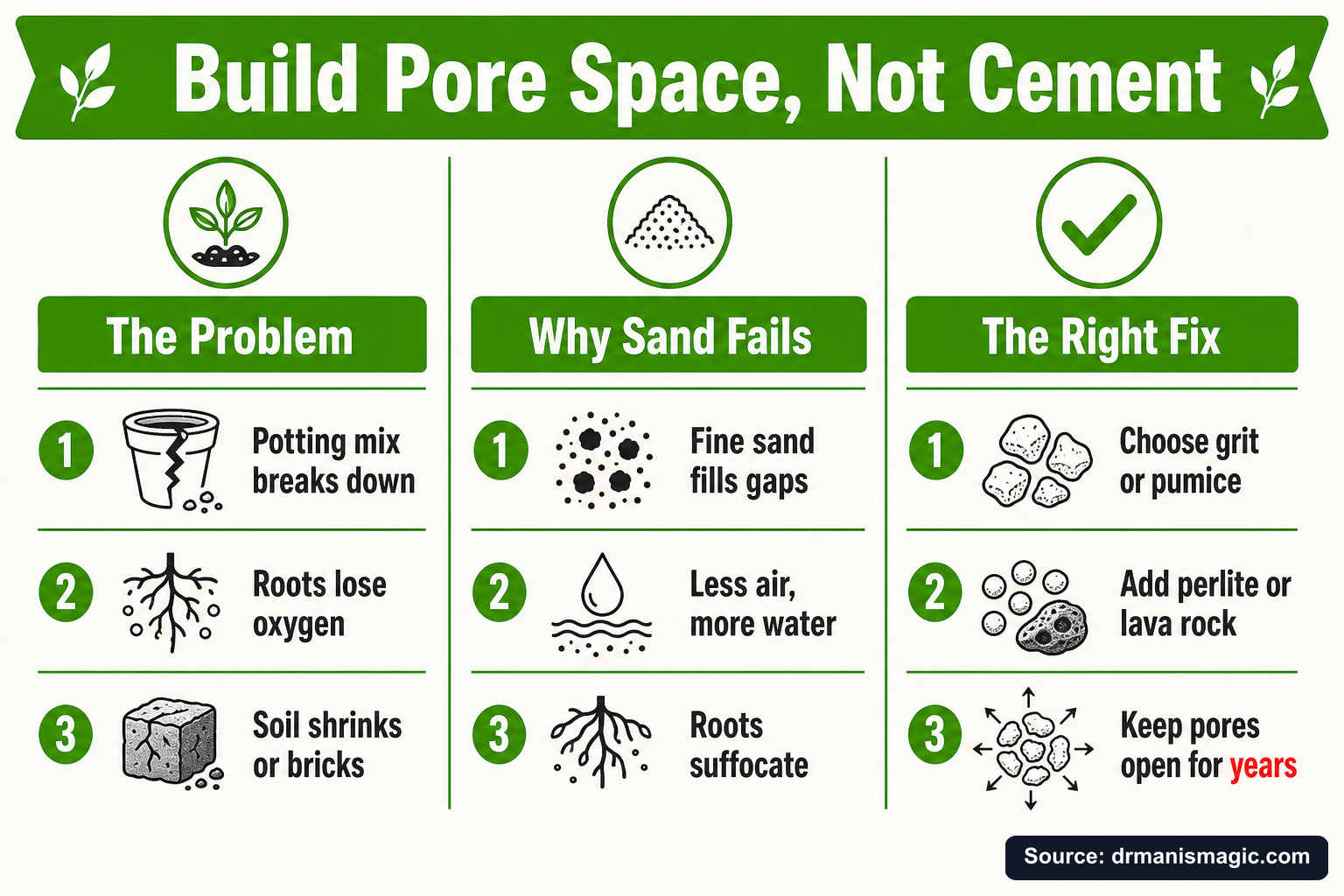
- Potting mix is mostly pine bark sawdust. It decomposes. Decomposition steals oxygen from roots. That is the root cause of most container plant failure.
- Adding sand to organic matter can help or hurt depending on the particle size of the sand you use.
- Fine play sand fills pore spaces and makes a mix wetter and more suffocating. Coarse horticultural sand or grit opens pore spaces and improves drainage.
- The goal is not drainage alone. The goal is air-filled pore space that stays open season after season.
- Mineral-based soil components like coarse sand, pumice, lava rock, and perlite do not decompose and do not steal oxygen.
- Perennial container plants like citrus, fruit trees, and large houseplants need a mix that stays structurally open for years, not weeks.
- The Three Plant Pillars framework, developed by Dr. Mani Skaria across 250,000+ trees, starts with mineral-based soil as the non-negotiable foundation.
Why Does Adding Sand to Potting Mix Sometimes Make Things Worse?
Quick Answer: Fine sand particles can slip into the gaps between compost or bark particles and fill the pore spaces that air and water need to move through. Instead of improving drainage, fine sand can make your mix denser, wetter, and less oxygenated. The result is closer to cement than to healthy soil.
This is the mistake nobody warns you about. You read online that sand improves drainage. So you buy a bag of play sand from the hardware store and mix it into your potting soil. Done. Problem solved. Except it is not.
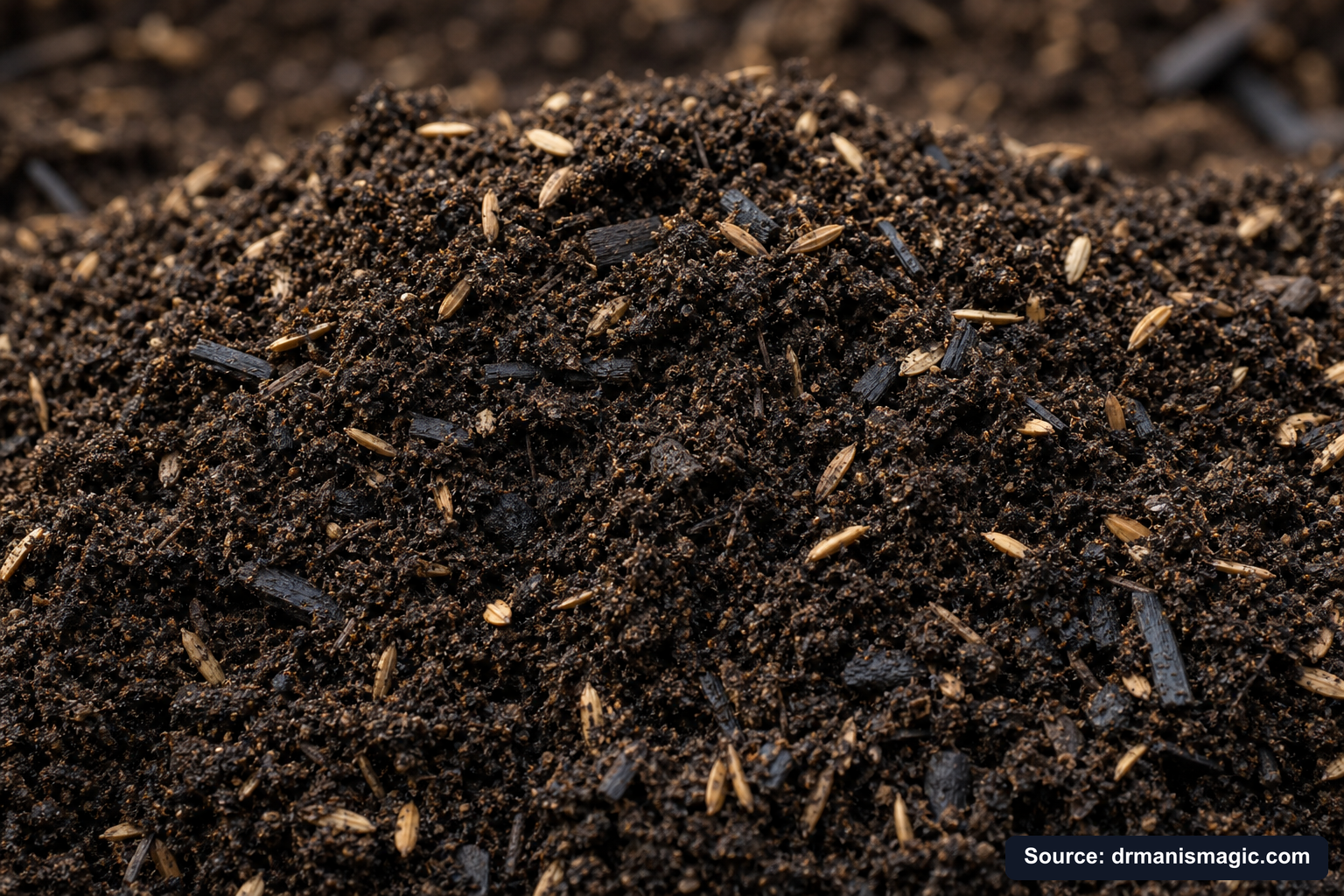
Here is what actually happens. Potting mix is full of tiny, soft, fluffy particles. Bark, peat, compost, sawdust. Those particles have spaces between them. Those spaces are called pores. Pores are where air lives. Pores are where water drains. Pores are where roots breathe.
Now pour fine sand into that mix. Fine sand has very small particles. Those particles are about the same size as the pore spaces between your bark and compost. So instead of creating new pores, the fine sand fills the existing ones. You have now built cement. Literally. Cement is sand plus fine particles packed together. Sound familiar?
USDA Agricultural Research Service studies on pine-bark substrates found that adding sand increased bulk density and container capacity while decreasing air space and total porosity. Fine sand produced the worst results. The mix held more water and less air. Roots suffocated. That research from USDA ARS confirms what we have seen firsthand at our South Texas nursery: not all sand is created equal, and the wrong sand makes everything worse.
This is the failure mode nobody explains. And it is why half the internet says "add sand for drainage" and the other half says "never add sand." Both camps are right about something. Both camps are missing the full picture.
What Is the Real Difference Between Coarse Sand and Fine Sand for Plants?
Quick Answer: Coarse sand has large particles that sit next to each other and leave gaps for air and water. Fine sand has small particles that pack together and fill gaps. For containers, coarse horticultural sand, grit, pumice, or perlite creates macropores. Fine play sand or beach sand destroys them. The difference is everything.
Think about gravel on a driveway versus packed beach sand. Step on gravel and your foot sinks slightly. Water drains right through. Step on wet beach sand and it feels almost solid. Water pools on top. Same mineral, totally different behavior. Same thing happens in your pot.
Particle size is the controlling variable. Here is a simple way to think about it. Coarse particles are like bowling balls stacked in a box. There are big gaps between them. Water flows through fast. Air fills the gaps right after. Roots love this. Fine particles are like marbles in a box. Fewer gaps. Even finer particles, like fine sand, are like ball bearings. Almost no gaps. Water sits. Air disappears. Roots struggle.
| Particle Type | Particle Size | Effect on Drainage | Effect on Air Space | Long-Term Stability | Best Use |
|---|---|---|---|---|---|
| Fine play sand / beach sand | Very small | Clogs pores | Reduces air space | Does not decompose, but fills pores permanently | Avoid in containers |
| Coarse horticultural sand / grit | Medium-large | Improves drainage | Increases macropores | Stable, does not decompose | Good structural fraction in mixes |
| Perlite | Medium | Excellent | High air space | Stable, but can float to surface over time | Excellent in most container mixes |
| Pumice | Medium-large | Excellent | Very high, internally porous | Very stable, highly durable | Outstanding for perennial containers |
| Lava rock / scoria | Medium-large | Excellent | High | Very durable, does not break down | Great for citrus, bonsai, succulents |
Virginia Tech's extension program on container media explains this clearly. Successful container substrates are built around air-filled porosity and container capacity, not just ingredient names. The goal is engineering a structure that lets water drain quickly and lets air refill the pores right after. Particle size determines whether you achieve that goal or destroy it.
Why Do Roots Need Oxygen More Than Most Gardeners Realize?
Quick Answer: Roots breathe oxygen, just like you do. When soil pores fill with water and stay waterlogged, oxygen disappears. Roots begin to suffocate within hours. This is what triggers root rot, not just overwatering. The real problem is anaerobic conditions created by poor soil structure and decomposing organic matter consuming available oxygen.
Here is something that surprises almost everyone the first time they hear it. Plants breathe carbon dioxide above ground. But their roots breathe oxygen below ground. Same plant, opposite needs, depending on which part you are talking about.
This matters enormously when you pick a potting medium. Anything that fills pore spaces or consumes oxygen in the root zone is working against your plant. And here is the part that most potting mix marketing never tells you: organic matter decomposes. When organic matter decomposes, it consumes oxygen. Your pine bark, peat, compost, sawdust potting mix is not just a static medium. It is actively breaking down. And as it breaks down, it is eating the oxygen your roots depend on.
This is why we say at US Citrus Nursery: you are literally planting your trees in other dead trees. And those dead trees are rotting. Around your roots. In your pot. Right now.
The decomposition process also causes the mix to collapse and compact over time. Those big fluffy pores you started with? Six months later they are gone. The mix has turned dense. Drainage slows. Water sits. Fungal pathogens like Phytophthora and Pythium move in. Roots turn brown and slimy. You call it overwatering. But the real problem started with the soil structure, not the watering can.
After growing over 250,000 trees at our South Texas nursery, we learned this the hard way. Then we built our entire system around solving it.
See also: The Hidden Reason Synthetic Fertilizers Cause Root Rot
What Is the Problem With Standard Potting Mix and Why Was It Invented?
Quick Answer: Standard potting mix is mostly pine bark sawdust, a cheap waste product from the timber industry. It was adopted because it is lightweight and inexpensive, not because it is ideal for plants. It decomposes within months, collapses pore structure, steals oxygen from roots, and eventually becomes hydrophobic, repelling the water your plant needs.
Here is a history lesson nobody puts on the bag. After World War II, the American timber industry in the Southeast was booming. Pine forests everywhere. Sawmills everywhere. And with sawmills comes an enormous problem: what do you do with all the leftover bark and sawdust? You can only make so much mulch.
The nursery industry had an answer. Package it up. Call it potting mix. Market it as premium growing medium. And it worked. It is light. It ships cheap. It looks dark and rich and earthy. Plants grow in it for the first few weeks just fine because it has some residual nutrients and decent initial structure.
But here is the chemistry nobody tells you about. Pine trees are chemical factories. They produce a class of compounds called terpenes and terpenoids. You already know some of them by name. Pine-Sol. Turpentine. Yes, that turpentine. The stuff you use to strip paint and clean brushes. Those same compounds live in pine bark sawdust.
To reduce those harsh chemicals, manufacturers let the sawdust pile up in giant heaps and decompose for years. The decomposition breaks down the terpenes. But what does decomposition require? Oxygen. And what does decomposition produce? More decomposition. More oxygen consumption. More structural collapse. You have solved the chemical problem by accelerating the structural problem.
Then to make the dry, hydrophobic wood hold water, manufacturers add surfactants. Chemical wetting agents that force the wood fibers to absorb moisture. Those surfactants wash out after a few months of watering. Once they are gone, old potting mix becomes a water-repelling brick. You pour water on top and it pools and runs down the sides of the pot without reaching the roots at all. Your plant is dying of thirst in a pot full of wet-looking soil.
Big box stores know this cycle. Plants look great in the first few months. Then they decline. You buy a new plant. Repeat. That is not a gardening system. That is a subscription service nobody signed you up for.
| Factor | Standard Potting Mix (Pine Bark / Sawdust) | Mineral-Based Soil (Silica Sandy Loam) |
|---|---|---|
| Base material | Organic carbon (wood, bark, peat) | Inorganic silica (sand, loam, minerals) |
| Decomposition | Yes. Breaks down within months | No. Silica does not decompose |
| Oxygen consumption | High. Decomposition steals oxygen from roots | None. Mineral particles are stable |
| Pore structure over time | Collapses as organic matter breaks down | Stays open season after season |
| Water behavior | Initially absorbs, then becomes hydrophobic | Consistent drainage and retention |
| Root rot risk | High after 3-6 months | Low when properly structured |
| Longevity in container | 6 months before significant decline | Permanent. Does not need replacement |
| Chemical concerns | Terpenes, surfactants, potential synthetic coatings | Steam-sterilized, clean, no added chemicals |
| Best for | Short-cycle annuals only | Perennials, citrus, trees, long-term containers |
When Does Sand Actually Help Organic Matter and When Does It Hurt?
Quick Answer: Sand helps when it is coarse enough that its particles are larger than the pores in your organic fraction. It creates new macropores and adds structural weight. Sand hurts when it is fine enough to fill existing pores. The rule is simple: match or exceed the particle size of your organic fraction, or do not add sand at all.
Let's make this concrete. Imagine you have a mix of aged pine bark. The bark chunks are roughly the size of your thumbnail. There are big air gaps between them. Now you pour in coarse horticultural grit. The grit particles are smaller than the bark chunks but big enough that they nestle between them without filling the gaps completely. You still have macropores. Drainage is good. Air refills the pores after watering. This works.
Now imagine you have the same bark mix. But this time you pour in fine play sand. Those sand particles are tiny. They slide right into every gap between the bark chunks and fill them up. You have just made a dense, slow-draining, poorly aerated brick. Roots will struggle. Fungal pathogens will thrive. You made things worse while thinking you were helping.
NC State Extension recommends a classic nursery-type mix of 60% pine bark, 20% peat, and 20% sand as a starting framework. But that recommendation assumes properly graded coarse sand, not play sand from the hardware store. And it assumes the mix is being used for relatively short-term nursery production, not a perennial citrus tree that will live in the same container for a decade.
The rule of thumb: coarse mineral particles that are larger than your organic particles create pore space. Fine mineral particles that are smaller than your organic particles destroy pore space. Grade your sand before you mix it.
And for long-lived container plants? The better move is to skip the highly organic base altogether and start with a mineral-dominant structure from day one.
You Never Had a Brown Thumb.
You were handed the wrong tools. This free guide hands you the right ones.
You watered it. You fed it. It died anyway.
It was never you. It was the dirt, the salt food, and the bad advice.
This guide shows you what really went wrong, and how to fix it for good.
- Why your plants really died, and why it was never your fault
- The salt hiding in your plant food that quietly burns the roots
- The hidden killer in almost every bag of store soil
- The tiny helpers that grow a whole forest for free
- The rescue trick that brings a half dead plant back to life

What Is the Right Mix Ratio for Sand and Organic Matter by Plant Type?
Quick Answer: There is no single universal recipe. The right ratio depends on plant type, pot depth, climate, and how long the plant will live in the container. Short-term annuals tolerate more organic matter. Long-lived perennials like citrus need a mineral-dominant mix that stays structurally open for years without decomposing.
Here is a practical framework. Think of your mix in two fractions: the organic fraction and the mineral fraction. The organic fraction holds some moisture and nutrients. The mineral fraction holds structure and oxygen. The longer your plant will live in the container, the more you want the mineral fraction to dominate.
Bonsai growers figured this out centuries ago. Traditional Japanese bonsai substrates are almost entirely mineral. Akadama clay, pumice, lava rock. Very little organic matter. Why? Because bonsai trees live in the same small pots for years or decades. The substrate must stay structurally open for the entire life of the tree. Any organic matter that decomposes collapses the structure and kills the tree. Ancient practice, modern validation.
- Short-term annuals and vegetables: Higher organic fraction is acceptable. A mix with 50-60% aged bark or compost, 20-30% perlite or coarse sand, and 10-20% mineral grit works fine for one season.
- Houseplants (medium-term): Balanced approach. Try 40% aged bark or coco coir, 30% perlite or pumice, 30% coarse mineral grit or lava rock. Repot every 1-2 years as organic fraction breaks down.
- Citrus and woody perennials in containers: Mineral-dominant. Aim for 50-60% mineral fraction (coarse sand, pumice, lava rock, perlite), 20-30% stable organic fraction (aged bark, coco coir, rice hulls), and minimal compost. Fertilize separately with organic inputs.
- Succulents and cacti: Very mineral-heavy. 70-80% coarse mineral particles with minimal organic matter. Fast drainage, high air space, almost no water retention.
- Bonsai and rare tropicals: Near-total mineral base. Akadama, pumice, or lava rock dominant with a small stable organic fraction. Fertilize heavily and consistently since the mix holds few nutrients on its own.
One important note for all of these ratios: when you go mineral-heavy, your soil holds fewer nutrients. That means you must fertilize consistently and with the right kind of fertilizer. More on that in a moment.
How Do You Evaluate Your Ingredients Before You Mix Them?
Quick Answer: Check particle size first. Anything that produces dust or fine powder when you handle it will fill pore spaces. Look for particles that feel gritty or chunky, not silky or powdery. Aged bark should smell earthy, not piney or sharp. Sand should be washed and visibly coarse, not fine like powder sugar. Compost should be fully finished, not still hot or smelling of ammonia.
Most people just grab whatever is on the shelf. But spending two minutes evaluating your ingredients before mixing can be the difference between a plant that thrives for years and one that declines in months.
Here is a quick checklist before you mix:
- Squeeze a handful and release it. Does it stay clumped? Too much fine material. Does it fall apart immediately? Good structure. Does it feel gritty and open? Even better.
- Look at the sand particle size. Put some on a white piece of paper. Can you see individual grains clearly? Good. Does it look like powder? Do not use it in a container mix.
- Smell the bark or compost. Earthy smell is good. Strong piney or turpentine smell means it has not aged long enough. Ammonia smell means compost is not finished.
- Check for dust. Pour a handful from one hand to the other. A cloud of dust means fine particles that will fill pore spaces. Minimal dust is what you want.
- Check how water moves through it. Put a small amount in a cup, pour water in. Does it drain in seconds? Good. Does water sit on top? Too much fine material or hydrophobic organic matter.
- Consider the source of your sand. Washed horticultural sand or coarse builder's sand is acceptable. Play sand, beach sand, or any sand described as "fine" is not appropriate for container mixes.
- Check if the organic fraction is fresh or aged. Fresh sawdust and fresh wood chips contain high carbon and will tie up nitrogen as they decompose. They will also decompose fast and steal oxygen. Aged bark that has been composted for 6-12 months is much more stable.
And if you want to skip all of that evaluation work? That is exactly why we engineered Super Soil. It starts with steam-sterilized silica-rich sandy loam from the Rio Grande Valley, the same mineral-rich soil that does not decompose, does not steal oxygen, and does not need to be replaced. We add coco coir, rice hulls, and biochar for stable water retention and microbial housing. Zero PFAS. Zero biosludge. Zero synthetic salts. Every ingredient chosen for long-term structural performance, not short-term appearance.
Coarse Sand vs. Perlite vs. Pumice: Which Mineral Amendment Wins for Container Plants?
Quick Answer: All three improve drainage and air space compared to fine organic mixes. Perlite is lightweight and affordable but can float to the surface. Coarse sand adds beneficial weight and stability but is heavier. Pumice is the long-term champion: durable, internally porous, holds some moisture while draining freely, and never breaks down. For citrus and woody perennials, pumice or lava rock is the top choice.
This is the "vs" question that bonsai enthusiasts, succulent growers, and citrus hobbyists argue about constantly. Here is the honest answer.
Perlite is made from volcanic glass that has been heated and expanded. It is full of tiny internal pores that hold some moisture while the exterior drains freely. It is lightweight, which is great for apartment balconies and rooftop gardens. The downside? It is fragile. It crushes over time. And it floats when you water heavily, migrating to the surface and out of the root zone.
Coarse sand is the classic choice and works well when it is truly coarse. It adds weight, which helps anchor large plants and pots that tip over in wind. It does not float. It does not break down. The downside is that weight can become a problem in large containers you need to move. And as we have covered, particle size matters enormously. Get this wrong and you have built concrete.
Pumice is the underrated champion. It is a naturally occurring volcanic rock that is internally porous at a microscopic level. That means each pumice particle holds some moisture and nutrients inside while the exterior creates macropores between particles. It does not crush like perlite. It does not need to be grade-checked as carefully as sand because pumice sold for horticultural use is almost always appropriately coarse. It does not decompose. It does not float. It is the structural mineral fraction that holds up for years in long-lived containers.
Why Do Perennial Container Plants Fail Faster Than Anyone Expects?
Quick Answer: Perennial plants like citrus, fig, and olive trees can live for decades in the ground. In containers, they depend entirely on the medium you give them. Standard potting mix collapses within 6 months. The roots that took years to establish suddenly have no oxygen, poor drainage, and a compacted environment they cannot escape. The plant declines fast after that, and most people blame themselves instead of the soil.
This is the heartbreaking part of the container gardening story. You invest in a beautiful citrus tree. You imagine picking fruit from it in your backyard. You want to see that tree grow and produce for years. Maybe for the rest of your life. And for the first season, things look great. The plant grows. Maybe you even get some fruit.
But then the potting mix starts to fail. You cannot see it happening. Underground, the bark particles are decomposing. The pore structure is collapsing. The oxygen availability is dropping. The roots that were thriving are now struggling. By the time you see yellowing leaves or stunted growth above ground, the root system below has already been in crisis for weeks.
You water more, thinking the plant is dry. But the collapsed soil is holding water now instead of draining it. The roots get wetter. Less oxygen reaches them. Fungal pathogens move in. Root rot takes hold. And a tree that could have fed your family for twenty years starts circling the drain in year two.
This is why time is the real cost here. You can get money back. You cannot get time back. The number one thing people tell Dr. Mani they want is to see fruit on a tree they planted while they can still enjoy it. Every year that passes with a declining plant in failing soil is a year you will never get back. That is not a small thing. That is the whole point of planting the tree in the first place.
The right soil structure from day one is not a luxury. It is the only way to honor the investment of time you are making when you plant something you intend to grow for years.
See also: Why Most Fertilizers Are Actually Salt in Disguise
What Happens to Nutrients When You Go Mineral-Heavy?
Quick Answer: Mineral-dominant mixes hold very little nutrients on their own. The trade-off for excellent drainage and long-term structure is that you must feed consistently. This is actually a feature, not a bug. You control exactly what your plants get. Use organic slow-release fertilizer to build nutrition without burning roots or harming the living microbes that make the whole system work.
Here is the honest trade-off nobody tells you about mineral-heavy mixes. They drain beautifully. They stay oxygenated. They do not collapse. But they also do not hold much nutrition. Silica does not release nutrients. Pumice holds a little. Lava rock holds almost none. This means you are now in charge of feeding your plants deliberately and consistently.
For most gardeners, that sounds like a burden. But think about it differently. When your soil is decomposing organic matter, you have almost no control over what is happening to your roots. Oxygen is disappearing. Unknown compounds are being released. Pathogens may be moving in. You are a passenger.
When your soil is mineral-based and structurally stable, you are in the driver's seat. You know exactly what is happening below ground. You add organic fertilizer on a schedule. You add live microbials to build a thriving soil ecosystem. You water consistently knowing the drainage is predictable. You are now gardening with precision instead of hope.
The Three Plant Pillars framework that Dr. Mani Skaria developed over 35 years of work at the Texas A&M Citrus Center and US Citrus Nursery is built around this exact insight. Mineral-based soil is Pillar One. Live microbials are Pillar Two. Organic fertilizer is Pillar Three. Pull any one of these out and the system wobbles. Keep all three in sync and your plants become practically bulletproof.
The organic fertilizer piece is especially important when you go mineral-heavy. Salt-based synthetic fertilizers kill the soil microbes that make the whole system work. They create an addiction cycle where plants need more and more fertilizer because the soil biology that should be feeding them has been destroyed. If you want to understand why that happens, see also: How Salt-Based Feeding Quietly Destroys Root Systems.
How Do You Fix a Mix That Has Gone Wrong?
Quick Answer: If your potting mix has compacted, become hydrophobic, or is draining poorly, the best fix is a complete repot into a properly structured mineral-based mix. Partial fixes like adding perlite to existing compacted soil rarely work because the structural damage is already done throughout the root zone. Act early. The sooner you repot, the more root system you can save.
If your plant is already showing signs of root zone trouble, here is a step-by-step recovery process.
- Identify the problem first. Slow drainage, waterlogged soil, yellowing leaves, stunted growth, fungus gnats, and brown slimy roots are all signs of soil structure failure. If you see these, do not just add more fertilizer. The problem is structural, not nutritional.
- Remove the plant from its current container carefully. Gently shake off as much of the old potting mix as possible without tearing healthy roots.
- Inspect the roots. Healthy roots are white or tan and firm. Brown, slimy, or mushy roots are rotted. Trim away all rotted root material with clean, sharp scissors.
- Let the roots air dry briefly. 30-60 minutes of air exposure helps dry out any remaining rot and reduces the chance of fungal spread into the new medium.
- Repot into a properly structured mineral-based mix. Ensure the new mix has excellent drainage and significant mineral fraction. Do not reuse old potting mix.
- Water lightly after repotting. Do not fertilize immediately. Give the plant 1-2 weeks to recover before introducing any fertilizer or microbial products.
- Add live microbials to the root zone. Once the plant has settled into its new medium, applying beneficial bacteria and mycorrhizal fungi helps the root system rebuild and protects against future pathogen attack. Plant Super Boost is a liquid microbial drench you apply monthly to keep the soil ecosystem alive and working.
Prevention is always easier than recovery. The best time to get the soil structure right is before you plant. The second best time is right now.
What Is the Simple Rule That Ties All of This Together?
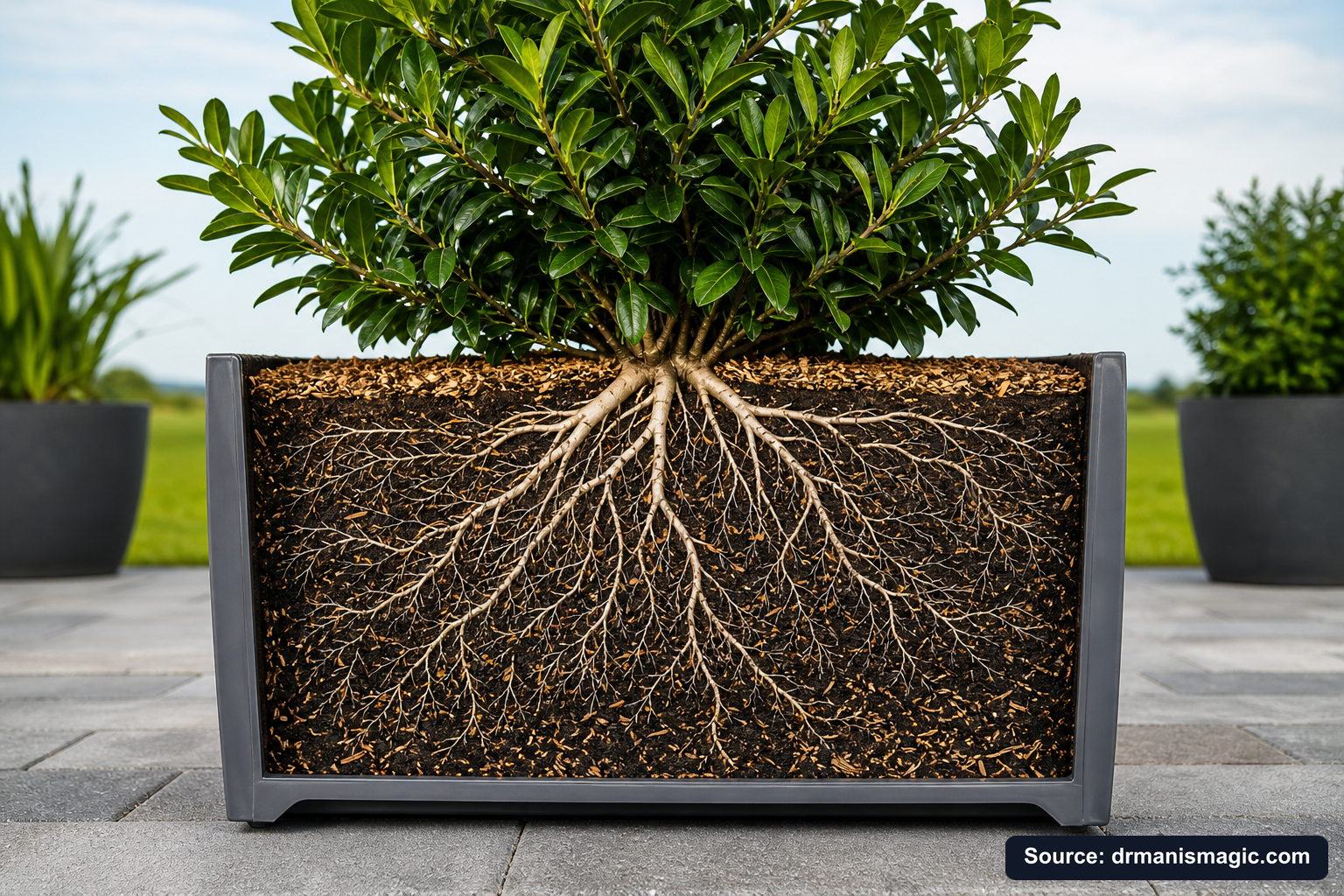
Quick Answer: Build pore space, not cement. Use coarse mineral particles that do not decompose as your structural foundation. Add stable organic matter in limited amounts for moisture retention and microbial housing. Match particle sizes so that minerals create new pores instead of filling existing ones. Feed separately with organic inputs. And never use fine play sand in a container mix.
You have now learned what most gardening content never explains. The goal of combining sand and organic matter is not drainage for its own sake. It is engineering a pore structure that stays open, oxygenated, and biologically alive for the entire life of your plant.
Fine sand makes cement. Coarse mineral particles make macropores. Decomposing organic matter steals oxygen. Stable mineral-based soil stays structurally open for years. Perennial plants need perennial structure. And the right fertilizer, the kind that works with your soil microbes instead of killing them, is what feeds your plants through that structure without burning roots or destroying the living ecosystem you worked to build.
This is what the Three Plant Pillars are all about. Mineral foundation first. Living microbial ecosystem second. Organic nutrition third. Get all three right and gardening stops being a cycle of hope and heartbreak. It becomes something that actually works. Consistently. Season after season.
Dr. Mani Skaria spent 35 years figuring this out. He tested it on 250,000 trees. He built products around it that he uses in his own nursery and grove. And he made them available to anyone who wants to grow something worth growing.
If you want to start with the right foundation, the Free Plant Care Field Guide walks you through the Three Plant Pillars step by step, in plain language, for any plant you are growing. No jargon. No guesswork. Just the foundation that makes plants thrive the way they were designed to.
Your plant is waiting. And unlike money, the time to grow it does not come back. Start with the right soil today.
Frequently Asked Questions
Most gardeners never ask the right questions about soil. They just grab a bag, fill a pot, and hope for the best. These questions come up again and again from real plant owners who want to stop guessing and start growing. The answers below are grounded in what Dr. Mani Skaria learned across 250,000 trees at US Citrus Nursery in South Texas.
Should I mix sand with compost or potting mix?
It depends on the sand. Fine play sand makes things worse. It fills the tiny air pockets between compost particles and turns your mix dense and soggy, like cement. Coarse sand or horticultural grit opens those air pockets up. But even coarse sand mixed with decomposing organic matter is a short-term fix. The compost still breaks down. It still collapses. The Three Plant Pillars start with mineral-based soil that does not decompose at all. That is the real foundation.
What kind of sand should I mix with compost?
Always use coarse horticultural sand, also called sharp sand or builder's grit. Never use fine play sand or beach sand. Fine sand particles are too small. They slip right into the pore spaces of your compost and pack everything tight. Coarse sand keeps those pores open so roots can breathe. Even better, pair coarse sand with a mineral-based soil like Dr. Mani's Magic Super Soil so the structure stays open for years, not just weeks.
Do plants grow better in soil or sand?
Neither alone is the answer. Pure sand drains too fast and holds almost no nutrients. Standard potting soil holds too much water and collapses over time. What plants actually need is structure that stays open, nutrients that release slowly, and living microbes that unlock everything in the root zone. That is the whole idea behind the Three Plant Pillars. Mineral-based soil plus live microbes plus organic fertilizer gives you the best of all worlds without the downsides of either extreme.
Which plants like sandy soil?
Plants that evolved in dry, lean environments do well in fast-draining sandy soil. Think lavender, rosemary, succulents, cacti, carrots, watermelon, and most Mediterranean herbs. Citrus trees also love excellent drainage. At US Citrus Nursery, Dr. Mani built Super Soil around sandy loam from the Rio Grande Valley because citrus roots demand oxygen and drainage above almost everything else. The same principle applies to any plant that hates wet feet.
How do I mix sand and soil the right way?
Use coarse sand only. Start with a ratio of at least 50 percent coarse mineral material to 50 percent other mix. Blend thoroughly so there are no clumps. Add organic matter for nutrients but keep it minimal if your plants sit in containers long-term, because organic matter decomposes and the structure collapses. For perennial container plants like fruit trees and large houseplants, Dr. Mani's Magic Super Soil skips the guesswork entirely. It is already dialed in.
Does sand have organic matter in it?
No. Pure sand is inorganic. It has no nutrients and no organic content. That is actually one of its strengths as a structural ingredient. It does not decompose. It does not compact over time. It does not steal oxygen from roots the way pine bark and sawdust do. The mineral base in Dr. Mani's Magic Super Soil works on this same principle. Silica-rich sandy loam holds its shape season after season while organic fertilizer and live microbes handle the nutrition side.
What should I do if I have too much sand in my mix?
Add live microbes and slow-release organic fertilizer right away. Sand alone cannot feed your plants. It has no nutrients and no biology. But add Dr. Mani's Magic Plant Super Boost and the Crab, Kelp, and Amino Acids fertilizer and suddenly that sandy base becomes a living, feeding system. The microbes unlock nutrients. The organic fertilizer releases slowly without burning roots. You go from a lifeless medium to a thriving root zone fast. That is the Three Plant Pillars working together.
About the Author
Dr. Mani Skaria, PhD
Dr. Mani Skaria, PhD, is a plant pathologist and the scientific founder of Dr. Mani's Magic. He earned his doctorate at Purdue University and spent 48 years studying how plants, soil, and living microbes work together, including his years as Professor Emeritus at Texas A&M and as a member of the USDA NAREEE Advisory Board. He invented micro-budding, a method for growing healthier, stronger trees, and has grown more than 250,000 trees on the family farm in Hargill, Texas - US Citrus Nursery. His life's work takes real lab science and practical experience and turns it into simple, safe, organic plant care anyone can use at home.


