


The Ocean-Born Compound Plants Recognize Instantly | Dr. Mani's Magic
The Ocean-Born Compound Plants Recognize Instantly (And Why Your Soil Has Been Starving for It)
Close your eyes for a second. Picture your backyard on a warm Saturday morning. The coffee is hot. The air smells like fresh earth after rain. You walk outside and look at your fruit tree — and it is loaded. Heavy with fruit. Leaves so dark green they almost glow. You reach up, twist one off, and bite in. Sweet. Juicy. Real.
Now open your eyes. Is that what you have right now? Or do you have something else — yellowing leaves, stunted growth, that same tree you've been feeding bag after bag of fertilizer, wondering why nothing seems to work? Here is the truth nobody at the garden center will tell you: the problem probably isn't your tree. It isn't even your watering schedule. The problem is that your plant is being fed something it does not recognize. Something its roots have never encountered in millions of years of evolution. And it is quietly causing more harm than good.
We have grown over 250,000 trees at our South Texas nursery. We have watched expensive trees thrive and cheap trees die. And the single biggest lesson Dr. Mani Skaria — plant pathologist, Professor Emeritus at the Texas A&M Citrus Center, and the man who built the Clean Citrus Program in Texas — drilled into everything we do is this: plants do not need more fertilizer. They need nutrition their biology actually recognizes. Ocean-born compounds like amino acids, kelp, and crab-shell chitin are exactly that. This article will show you why.

Organic Fertilizer | Crab, Kelp & Amino Acids
Key Takeaways
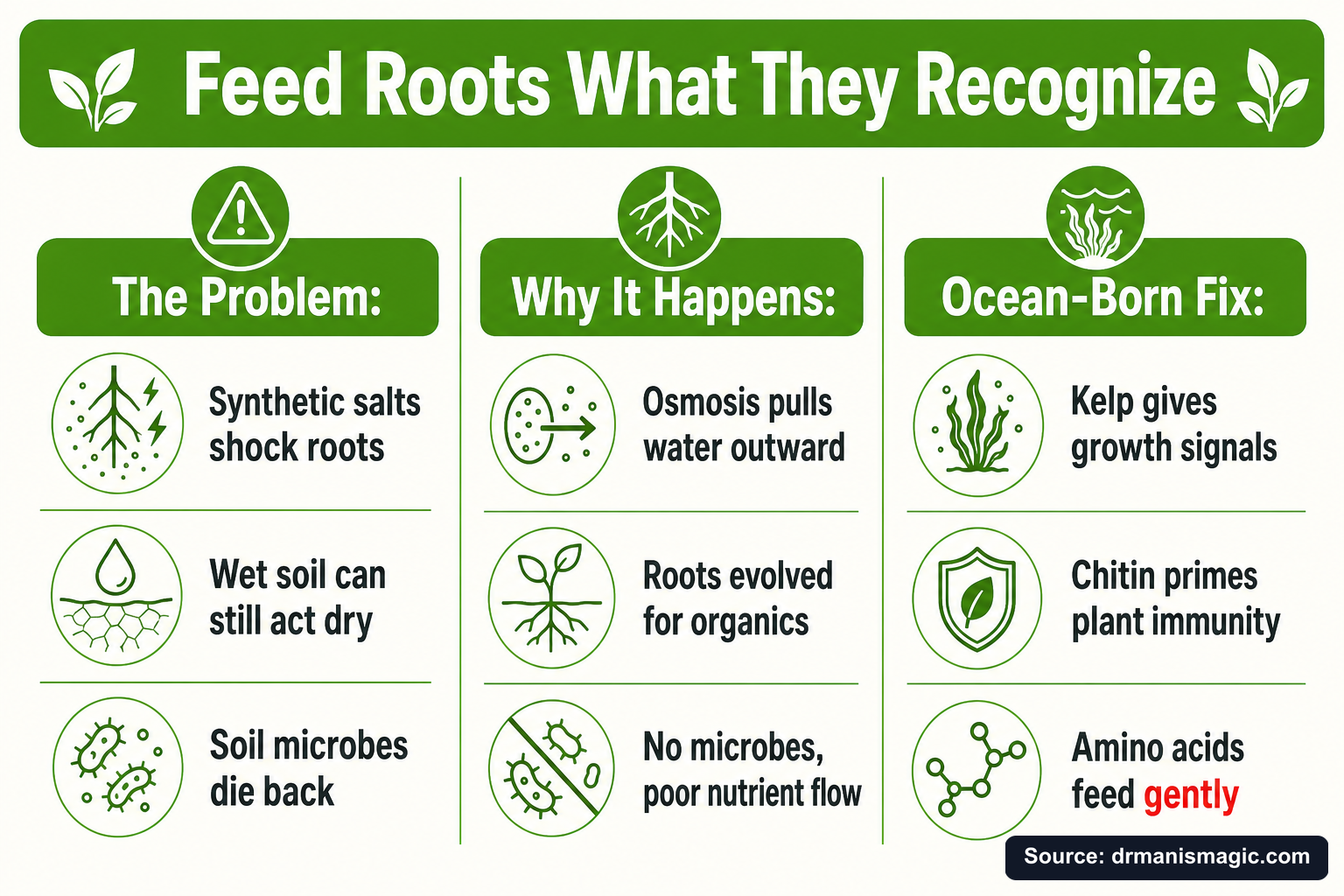
- Plants evolved with ocean-derived and soil-born biological compounds for millions of years — their roots are literally wired to recognize amino acids, chitin, and kelp signals.
- Most synthetic fertilizers are salt-based. Salt draws water out of roots through osmotic stress, causing the same wilting and scorch as a drought — even when you just watered.
- Salt also kills the beneficial microbes in your soil. No microbes means no nutrient cycling, no disease protection, and no long-term plant health.
- Organic fertilizer does not just skip the salt — it actually feeds the microbes first, which then convert nutrients into forms the plant can absorb easily and steadily.
- Chitin from crab shells primes your plant's immune system. Kelp delivers natural growth hormones and stress signals. Amino acids provide ready-to-use nitrogen without the salt.
- PFAS "forever chemicals" can hide inside fertilizers made from biosludge (treated municipal waste). Clean inputs — zero biosludge, zero synthetic salts — matter for your family and your soil.
- The Three Plant Pillars (mineral soil + live microbes + organic fertilizer) work together as a system. Each one amplifies the others.
What Does "Ocean-Born Compound" Actually Mean for Your Plants?
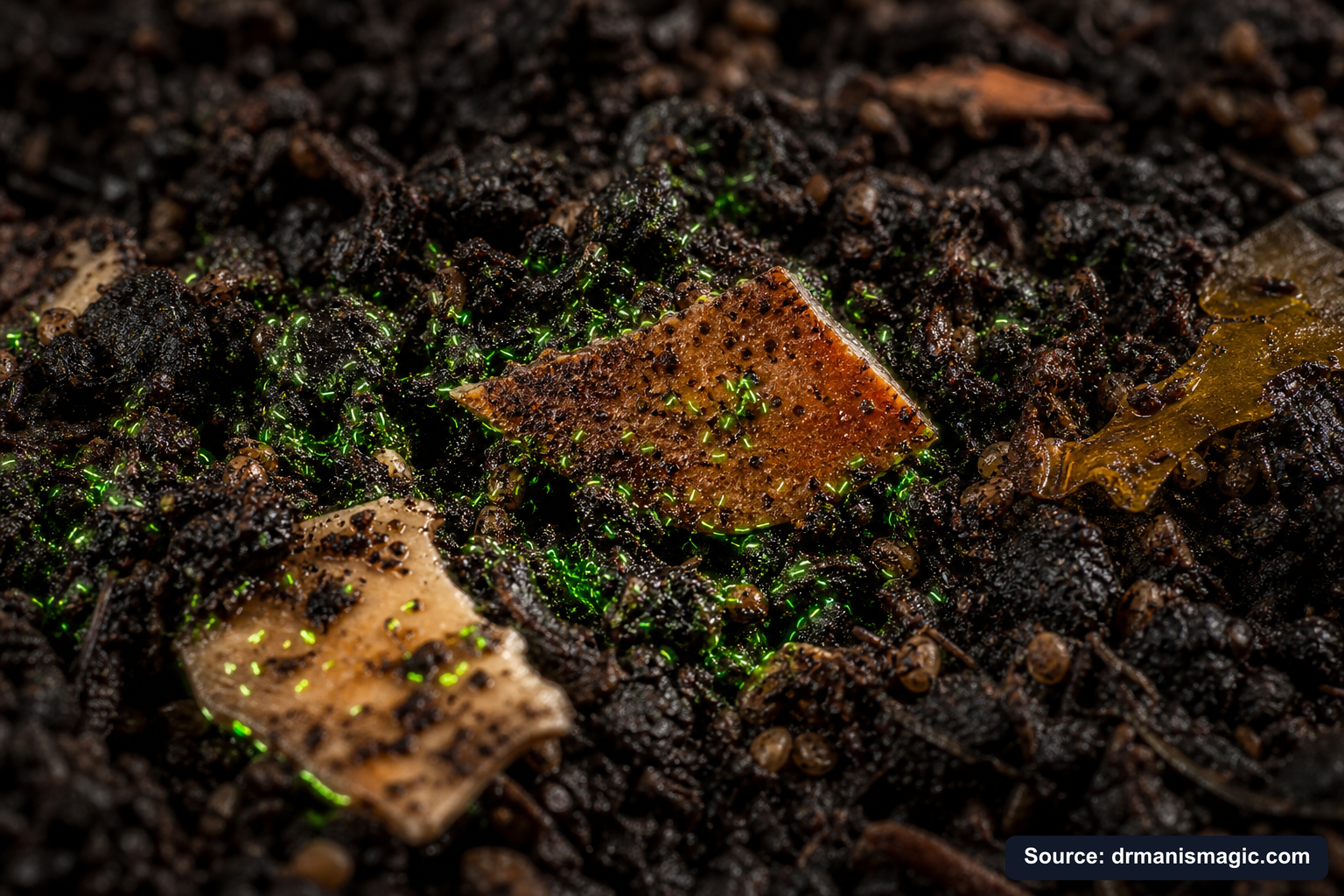
Quick Answer: Ocean-born compounds are naturally derived materials — like kelp extract, crab-shell chitin, and marine amino acids — that plants have co-evolved with over millions of years. Their roots and immune systems have biological pathways specifically built to recognize and respond to these compounds, unlike synthetic salt-based fertilizer molecules.
The ocean has been feeding life on land for a very long time. Seaweed washes ashore. Crabs and fish die and decompose into the soil. Coastal rains carry trace minerals inland. Plants evolved alongside all of it.
That matters because evolution is slow. Your plant's root system, its immune signals, its hormone receptors — they were all shaped by millions of years of exposure to biological compounds from the natural world. Amino acids. Chitin. Kelp polysaccharides. Trace minerals from ancient seabeds.
When you apply a bag of conventional synthetic fertilizer, you are applying concentrated salt. Ammonium nitrate, potassium chloride, superphosphate — these are salts. They dissolve fast. They hit the root zone hard. And your plant's biology looks at them like a stranger at the door. The plant can use some of what they provide, but the delivery system is foreign, aggressive, and damaging.
When you apply crab shell, cold-processed kelp, and amino acids, the plant's root system sees something it recognizes at a deep biological level. It knows how to handle it. It knows how to share it with the microbes in the soil. And the whole root zone comes alive the way it was designed to.
That is what "ocean-born" means. Not a marketing phrase. A description of biological compatibility.
Why Do Salt-Based Fertilizers Cause Root Burn and Osmotic Stress?
Quick Answer: Salt-based fertilizers raise the salt concentration around roots higher than inside the root cells. Water then flows out of the roots by osmosis — the same process that makes ocean water dangerous to drink. The result is physiological drought: roots shrivel, leaves scorch, and the plant can die even when the soil is wet.
Here is the physics, explained simply. Water always moves from where there is less dissolved stuff to where there is more. That is osmosis. Your root cells have a certain concentration of nutrients and sugars inside them. When you dump a heavy load of soluble fertilizer salts around those roots, the concentration outside the roots suddenly spikes higher than inside. Water rushes out of the roots trying to balance things. The roots essentially get dehydrated from the outside in.
University of Maryland Extension describes this as fertilizer burn — a form of osmotic stress where salts draw water out of plant tissue, causing scorch, marginal browning, dieback, and restricted root growth. Their guidance on salt and fertilizer damage to trees confirms this is a widespread problem affecting lawns, ornamentals, and trees — not just one crop.
We call this physiological drought. The plant looks like it needs water. You water more. But the salt concentration just gets worse. The roots keep losing moisture. And the whole system starts to collapse.
It happens on lawns. It happens in containers. It happens to brand-new seedlings and twenty-year-old trees. Any time soluble synthetic fertilizer is overapplied — or even applied correctly in poor soil conditions — osmotic stress is the result.
Ocean-born organic inputs have a near-zero salt index. They do not spike the concentration around roots. They release slowly. The plant takes what it needs, when it needs it. No flood, no drought. Just steady nourishment the root system can actually use.
See also: The Osmotic Shock Your Plants Feel From Synthetic Nutrients
How Do Synthetic Fertilizer Salts Kill the Microbes Your Soil Needs?
Quick Answer: Beneficial soil bacteria and fungi are living organisms with their own cell membranes. High salt concentrations cause the same osmotic dehydration in microbial cells as in plant roots — they lose water, shrink, and die. Without microbes, nutrient cycling stops, disease suppression collapses, and the soil becomes a dead growing medium that depends entirely on chemical inputs.
Your soil is supposed to be alive. Incredibly, wildly alive. The University of Minnesota Extension reports that healthy soil biology supplies roughly 75% of plant-available nitrogen and 65% of available phosphorus through microbial activity alone. Their research on soil biology and plant nutrition frames microbes as the true engine of nutrient cycling — not the fertilizer bag.
Think about that. Three-quarters of the nitrogen your plant needs is supposed to come from living organisms in your soil. Bacteria that fix nitrogen from the air. Fungi that break down organic matter and release minerals. Microbial communities that suppress pathogens like Pythium and Phytophthora — the organisms behind most root rot.
Now you apply a soluble synthetic fertilizer. The salt index spikes. The microbial cells dehydrate just like root cells do. The bacteria die. The fungi retreat. The whole living network that was doing most of the nutrition work quietly collapses.
What happens next? Your plant becomes totally dependent on the next bag of fertilizer. You have to keep buying. Keep applying. Keep chasing results that never quite materialize. The grass greens up for two weeks, then fades. The tree pushes new growth, then stalls. You buy more. The cycle continues.
We have watched this happen on thousands of trees. After growing over 250,000 trees at our South Texas nursery, we know exactly what a salt-damaged root zone looks like — and we know what a biologically healthy one looks like. The difference is not subtle.
See also: How Salt-Based Feeding Quietly Destroys Root Systems
What Is Chitin and Why Does Your Plant's Immune System Wake Up When It Detects It?
Quick Answer: Chitin is a structural compound found in crab shells, shrimp shells, and fungal cell walls. When plant roots detect chitin in the soil, they interpret it as a signal that fungal pathogens or insects may be nearby — and they activate their natural defense systems. This primes the plant to resist disease and pests before an attack ever begins.
Here is one of the most remarkable things happening in your soil that nobody ever told you about.
Crab shells are made of chitin — a tough, fibrous compound. When chitin breaks down in the soil, it sends a specific chemical signal. And your plant has receptors that pick up that signal. What does the plant "think" when it detects chitin? It thinks something with a chitinous exoskeleton — an insect or a fungus — is nearby. So it primes its immune response. It starts producing enzymes that break down fungal cell walls. It thickens its own cell walls. It ramps up its defenses.
This is not guesswork. Research published in Frontiers in Plant Science documents the role of chitin fragments as damage-associated molecular patterns — biological signals that trigger plant immunity without requiring an actual attack. The peer-reviewed literature on seaweed and marine biostimulants confirms that chitin and related compounds activate measurable defense responses in plant tissue.
Crab shell also provides calcium and magnesium — two nutrients that are the backbone of plant cell walls and woody stem structure. Calcium makes up a large portion of the woody mass of any tree or shrub. Getting it from crab shell means getting it in a biologically compatible form that feeds microbes, slowly releases into the root zone, and does not spike salt levels.
On a lawn. In a flower bed. In a container with a lemon tree. On a raised vegetable garden. The chitin response works the same across all of them. It is a universal plant language.
What Does Kelp Extract Actually Do Inside a Plant?
Quick Answer: Kelp extract contains natural plant hormones (auxins and cytokinins), complex carbohydrates, trace minerals, and stress-signaling compounds. These work together to stimulate root branching, improve transplant recovery, help plants handle heat and drought, and support nutrient uptake — effects that go far beyond simple NPK feeding.
Kelp has been used in agriculture for centuries. Coastal farmers composted seaweed into their fields long before synthetic fertilizers existed. There is a reason it worked then, and still works now.
Cold-processed kelp — extracted without high heat that would destroy its active compounds — is a biological treasure chest. Here is what is inside:
- Auxins: Natural hormones that stimulate root initiation and elongation. More root tips mean more surface area for water and nutrient absorption.
- Cytokinins: Hormones that promote cell division and delay leaf aging. Plants with adequate cytokinins stay green and productive longer.
- Polysaccharides: Complex carbohydrates that feed beneficial soil microbes and help soil particles clump together in a structure that holds air and water.
- Betaines and phenolics: Stress-protective compounds that help plants cope with heat, cold, and drought without shutting down growth.
- Trace minerals: Iodine, selenium, and a range of elements that occur naturally in ocean water and are often missing from depleted soils.
The key word in all of this is "cold-processed." Heat destroys hormones and enzymes. A kelp product made with high heat is mostly mineral residue. Cold extraction preserves the full biological profile — the actual reason kelp works in the first place.
When kelp enters a healthy root zone alongside live microbes, the microbes help break it down and make its compounds available in a steady, gradual flow. The plant gets a gentle, ongoing supply of growth signals, stress protection, and trace nutrition — not a spike and a crash.
How Do Amino Acids Deliver Nitrogen Without the Salt Damage?
Quick Answer: Amino acids are the building blocks of protein. When used as a nitrogen source, they deliver nitrogen in a form plants can absorb directly or through microbes — without requiring the high-salt chemistry of synthetic nitrogen fertilizers. This means more usable nitrogen with zero osmotic stress and zero microbial damage.
Nitrogen is the nutrient plants need most. It builds chlorophyll — the green that captures sunlight. It builds amino acids, which become proteins, which become everything from root cell walls to the enzymes that drive photosynthesis. Without enough nitrogen, leaves turn pale and growth slows to a crawl.
So fertilizer companies load up on nitrogen. But here is the problem. Synthetic nitrogen comes as ammonium nitrate, urea, or similar compounds — all salts. Apply them and you get the osmotic stress we already talked about. Kill the microbes. Burn the fine roots. Create dependency.
Amino acid nitrogen works differently. Amino acids are already broken down. They are the middle step between raw protein and plant-ready nutrition. Microbes in the soil recognize them immediately and process them quickly. Some amino acids can even be absorbed directly through root cell membranes without needing microbial conversion at all.
The result is a gentler, faster-acting form of organic nitrogen that does not spike salt levels, does not kill microbes, and delivers the actual building blocks the plant needs — not just the raw nitrogen element.
Sources like feather meal and tankage provide this amino acid profile in a concentrated, dry granular form that releases steadily as soil moisture and microbial activity work on it. No plastic-coated pellets leaching into groundwater. No synthetic chemistry. Just protein-based nutrition the plant and the soil ecosystem both recognize.
Why Does Organic Fertilizer Feed the Microbes Before It Feeds the Plant?
Quick Answer: Organic fertilizer particles are broken down by soil bacteria and fungi before the nutrients become available to plant roots. The microbes eat the organic material first, converting it into plant-available forms. When those microbes die naturally, they release stored nutrition directly into the root zone. This creates a living slow-release system that keeps feeding the plant long after a single application.
This is the mechanism that almost nobody explains clearly. And once you understand it, everything else makes sense.
Picture a crab shell granule sitting in warm, moist soil. A bacterium lands on it. Starts breaking it down. It converts the chitin and amino acids into simpler compounds — ammonium, phosphate, trace minerals. The bacterium uses some of that nutrition for its own growth. It multiplies. More bacteria arrive. The whole microbial community grows and becomes more active around that granule.
Then, naturally, those bacteria complete their life cycle and die. When they die, they release everything they had stored — all the nitrogen, phosphorus, calcium, and trace elements — directly into the root zone in simple, plant-available forms. The plant's root hairs absorb it. Right there. Right when the plant needs it.
This is nature's slow-release system. It is not engineered by a chemical company. It is the system that fed every forest, every prairie, and every ancient orchard before synthetic fertilizer existed.
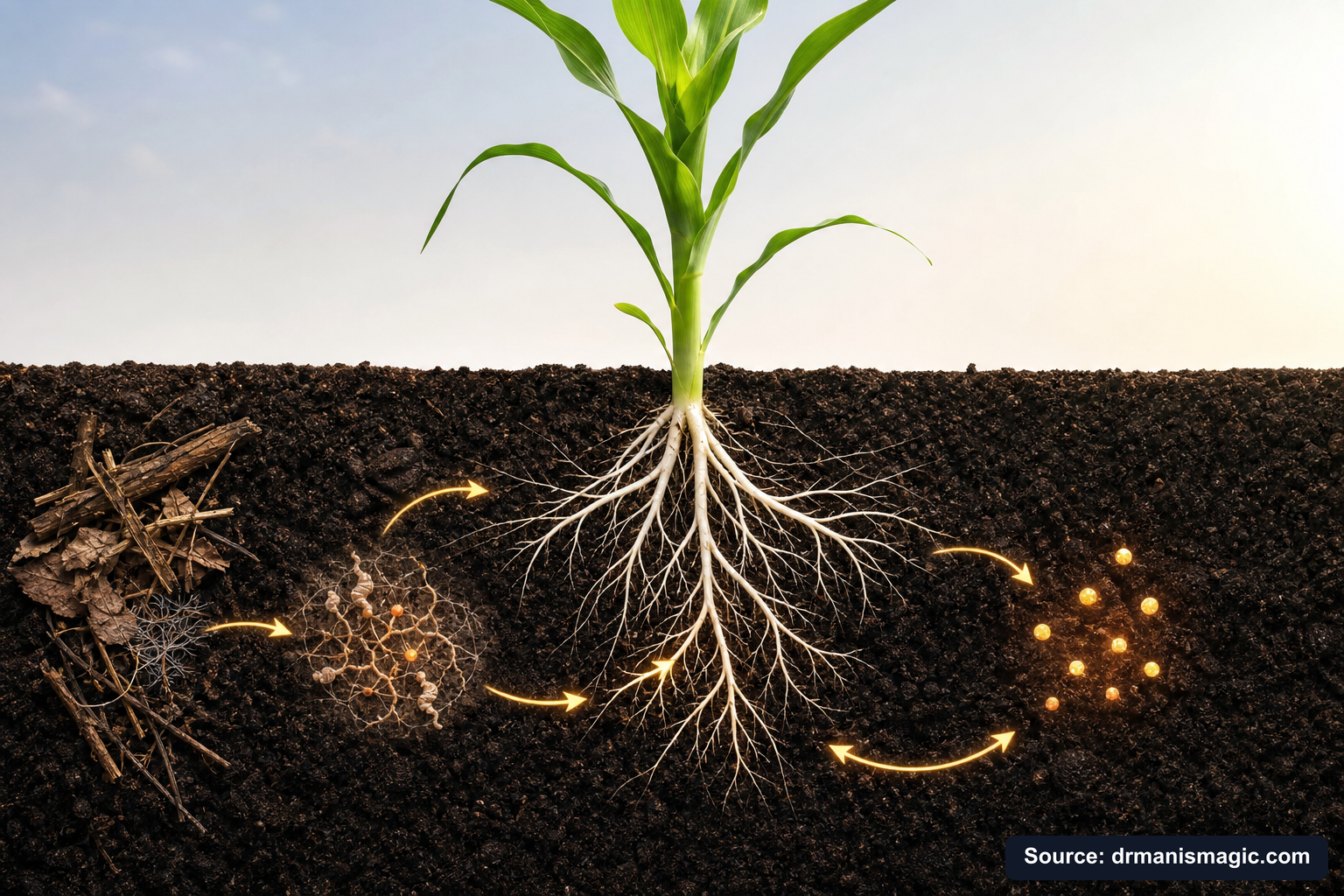
The practical result for you: one application of organic granular fertilizer keeps feeding your plant for weeks. The microbe population grows. The soil ecosystem gets richer. Each application builds on the last. Over months and years, the soil becomes more and more capable of feeding your plant on its own — the opposite of the dependency cycle synthetic fertilizers create.
And remember: organic fertilizer does not just avoid hurting microbes. It actively grows the microbial population. More microbes mean more nutrient cycling, more disease suppression, more root-zone oxygen maintenance. The whole Three Plant Pillars system compounds over time.
See also: Why Most Fertilizers Are Actually Salt in Disguise
You Never Had a Brown Thumb.
You were handed the wrong tools. This free guide hands you the right ones.
You watered it. You fed it. It died anyway.
It was never you. It was the dirt, the salt food, and the bad advice.
This guide shows you what really went wrong, and how to fix it for good.
- Why your plants really died, and why it was never your fault
- The salt hiding in your plant food that quietly burns the roots
- The hidden killer in almost every bag of store soil
- The tiny helpers that grow a whole forest for free
- The rescue trick that brings a half dead plant back to life

What Is the Real Difference Between Synthetic Fertilizer, Organic Fertilizer, and Marine Biostimulants?
Quick Answer: Synthetic fertilizers are salt-based, fast-releasing, and microbially destructive. Organic fertilizers feed microbes first, release slowly, and build long-term soil health. Marine biostimulants like kelp and chitin do not primarily supply NPK — they activate plant hormones, immune responses, and microbial communities, amplifying the effect of everything else you apply.
| Input Type | Salt Index | Microbial Impact | Release Speed | Burn Risk | PFAS / Biosludge Risk | Best Use |
|---|---|---|---|---|---|---|
| Synthetic fast-release (e.g., ammonium nitrate) | Very High | Kills microbes | Instant | High | Low (but plastic-coated slow-release versions exist) | Short-term green-up only |
| Synthetic slow-release (plastic-coated prills) | High | Kills microbes over time | Weeks to months | Medium | Plastic microbeads remain in soil | Convenience at a long-term soil cost |
| Biosludge-based "organic" fertilizer | Low to Medium | Mixed | Moderate | Low | High — PFAS confirmed in municipal biosolids | Avoid — contamination risk |
| Amino acid + chitin + kelp organic (e.g., Crab, Kelp & Amino Acids) | Near Zero | Feeds and grows microbes | Slow (microbe-mediated) | Almost none | Zero — no biosludge, no PFAS | Long-term soil health, all plant types |
The table above shows something important. The category labeled "organic" is not automatically safe. Some fertilizers marketed as organic use biosludge — treated municipal waste that can contain PFAS, the "forever chemicals" linked to serious health concerns. University of Maine Extension has published guidance on PFAS contamination from sludge-based amendments and the risks they pose to home gardens.
Just because a bag says "organic" does not mean it is clean. You have to ask: where did the nitrogen come from? Is there biosludge in the formulation? Are there PFAS concerns?
Our Crab, Kelp & Amino Acids contains zero biosludge, zero synthetic salts, and zero PFAS. The nitrogen comes from crab shell and amino acid sources. The trace minerals come from cold-processed kelp and volcanic ash. Nothing else. No fillers. No municipal waste. No forever chemicals on your lawn where your kids play and your dog runs.
How Do You Know If Your Plant Has Salt Damage, Overwatering, or True Root Rot?
Quick Answer: Salt damage shows as leaf tip scorch and marginal browning in soil that may actually be moist. Overwatering causes yellowing and wilting in consistently wet soil. True root rot — caused by pathogens like Pythium or Phytophthora — produces soft, brown, foul-smelling roots and progressive collapse even after watering and feeding are corrected.
| Symptom | Salt / Fertilizer Damage | Overwatering / Low Oxygen | True Root Rot (Pythium / Phytophthora) |
|---|---|---|---|
| Leaf color | Tip burn, marginal scorch, brown edges | Pale yellow, generalized | Yellow, then brown; rapid decline |
| Soil moisture when symptoms appear | Normal or wet | Consistently wet | Any — once established, rot spreads regardless |
| Root appearance | Shriveled fine roots, brown tips | Pale, mushy, limited oxygen | Soft, dark brown/black, foul smell |
| Recovery speed | Moderate — flush salts, stop fertilizing | Good — improve drainage, reduce water | Slow to none without removing infected roots |
| Underlying cause | High salt index fertilizer, osmotic stress | Poor soil structure, compaction, no oxygen | Pathogen colonization in anaerobic conditions |
| Prevention | Low-salt organic inputs, proper dosing | Mineral-based soil, correct watering | Healthy microbiome, good drainage, no salt damage to roots |
Here is something most gardening content never connects: all three of these problems are linked. Salt damage weakens fine roots. Weakened fine roots cannot take up oxygen efficiently. Low oxygen in the root zone creates the exact anaerobic conditions that Pythium and Phytophthora — the pathogens behind most root rot — thrive in. University of Illinois Extension research on root rot consistently connects saturated, low-oxygen soils to pathogen susceptibility. Salt damage and overwatering are not separate topics. They feed the same disaster.
This is why the Three Plant Pillars work as a system. Mineral-based soil prevents compaction and maintains oxygen. Live microbes suppress pathogens and maintain soil structure. Organic, low-salt fertilizer keeps roots healthy enough to resist infection in the first place.
See also: The Hidden Reason Synthetic Fertilizers Cause Root Rot
How Do You Recover a Plant That Has Been Damaged by Salt Fertilizer?
Quick Answer: Recovery from salt fertilizer damage involves flushing accumulated salts, stopping all synthetic inputs, restoring microbial life, and switching to low-salt organic nutrition. Most plants can recover within weeks if the roots are still alive. The key is stopping the damage first, then rebuilding the biology.
If you suspect salt buildup in your soil — scorch on leaf tips, wilting despite wet soil, slow growth that does not respond to more fertilizer — here is a clear recovery path:
- Stop all synthetic fertilizer immediately. Every additional application makes the salt problem worse. Give the root zone time to stabilize.
- Flush the soil deeply. Water slowly and thoroughly — enough to move water all the way through the root zone and out the bottom. For containers, water until it runs freely from drainage holes. For in-ground plants, a deep, slow soak over several hours helps move salts down past the active root zone.
- Check your soil structure. If the soil is compacted or does not drain well, flushing alone will not fix the problem. Roots need oxygen to recover. A mineral-based soil with good porosity — like our Super Soil — gives roots the air space they need to heal.
- Reintroduce live microbes. The salt damage likely killed a significant portion of your beneficial soil biology. A microbial drench — live bacteria, fungi, and mycorrhizae — helps repopulate the root zone and restart the natural nutrient cycling process. Healthy microbes also help suppress residual pathogen pressure from Pythium and Phytophthora.
- Begin low-salt organic nutrition. Once the root zone is stabilized and microbial life is being restored, apply a slow-release organic fertilizer at normal rates. Do not try to "catch up" with extra applications. The slow, steady feeding pace is exactly what recovering roots need.
- Be patient with new growth. Visible recovery — new leaves, improved color, fresh root tips — typically appears within two to six weeks in warmer conditions. The root zone is healing before the top growth reflects it.
- Stay the course. One application is not enough. The goal is to build a biologically active root zone that maintains itself. Each month of organic nutrition and microbial support makes the system more resilient and less dependent on any input at all.
Why Do Volcanic Ash and Trace Minerals Matter in an Ocean-Derived Fertilizer Formula?
Quick Answer: Volcanic ash provides a natural source of silica and trace micronutrients — including iron, zinc, manganese, copper, boron, and molybdenum — that plants need in small amounts for enzyme function, cell wall strength, and stress resistance. These minerals are often depleted in containerized or heavily farmed soils, and volcanic sources deliver them without synthetic chemistry.
Think about what happens when a volcano erupts near a coastline. Mineral-rich ash falls into the ocean. It dissolves slowly. Marine organisms incorporate those minerals into their bodies over thousands of years. Kelp absorbs them from ocean water. Crustaceans build shells from them. And eventually, through the food web and decomposition, those minerals cycle back into the soil.
That is the natural mineral cycle. And most modern potting mixes and suburban soils are almost completely disconnected from it.
Silica from volcanic ash strengthens cell walls — literally making stems and leaves physically tougher and harder for insects and fungi to penetrate. It also improves drought resistance by reducing water loss through leaf surfaces. Plants with adequate silica stand up straighter, resist lodging in wind, and hold up better during heat stress.
The trace elements — iron for chlorophyll, zinc for hormone production, manganese for enzyme activation, boron for fruit set, molybdenum for nitrogen conversion inside the plant — are needed in tiny amounts, but the Law of the Minimum applies to every one of them. If even one is missing, the whole system slows down. Not because the big nutrients ran out. Because one microscopic link in the chain broke.
Combining volcanic ash with crab shell, cold-processed kelp, and amino acids creates a formula with a complete mineral profile — the kind of broad-spectrum coverage that keeps a plant from hitting a hidden wall you never expected.
How Do the Three Plant Pillars Work Together as a System?
Quick Answer: The Three Plant Pillars — mineral-based soil, live microbes, and organic fertilizer — each do a specific job, but they amplify each other. Mineral soil keeps oxygen in the root zone where microbes need it. Microbes process organic fertilizer into plant-available nutrition. Organic fertilizer feeds the microbes and provides nutrients in forms that do not damage soil structure. Remove any one pillar and the other two underperform.
Dr. Mani spent decades in the field — at the Texas A&M Citrus Center, traveling internationally, testing products on thousands of trees — before he identified this pattern. It is not a marketing framework. It is a first-principles model of how plant growth actually works in nature.
Pillar 1 — Mineral Soil: Most potting mixes are made from pine bark, wood chips, and organic matter that breaks down within six to twelve months. As it decomposes, it compacts. Compacted organic matter blocks oxygen from reaching roots. Roots need oxygen to grow and to absorb nutrients. No oxygen means no growth — and the perfect conditions for root-rot pathogens. Mineral-based soil does not decompose. It holds its structure permanently, maintaining the air pockets roots need to breathe. See also: Why Most Potting Mix Collapses Within 6-12 Months
Pillar 2 — Live Microbes: The microbes are the engine. They process organic matter. They fix nitrogen from the air. They suppress pathogens. They build soil aggregates that maintain structure and porosity. A teaspoon of healthy soil contains more living organisms than there are people on Earth. Without them, the soil is just a medium to hold the plant upright — it cannot actually feed or protect it.
Pillar 3 — Organic Fertilizer and Biostimulants: This is the fuel. Not for the plant directly — for the microbes first. The organic material feeds the microbial community, which grows stronger and more active, which processes more nutrition for the plant, which supports more root growth, which supports more microbial activity. It is a virtuous cycle. Each application builds on the last. Over months and years, the system becomes increasingly self-sustaining.
You can explore how to set up all three pillars together at the Three Plant Pillars bundle page — it is where we lay out the complete system Dr. Mani developed and proved across 250,000+ trees.
Does This Apply to Lawns, Flowers, and Vegetables — or Just Fruit Trees?
Quick Answer: The Three Plant Pillars and ocean-derived nutrition apply to every plant that grows in soil — lawns, ornamentals, vegetables, houseplants, orchards, flower beds, and container trees. The biology of roots, microbes, and organic nitrogen cycling is the same across all of them. We proved it on citrus first, but it works everywhere.
We started with citrus because that is our world. Dr. Mani built his career on it. US Citrus Nursery has shipped 250,000+ trees since 2006 with a 4.9-star rating across over 2,400 reviews. We have tested our inputs on citrus more thoroughly than any other nursery in Texas.
But here is what we learned: the root-zone biology is not citrus-specific. It is plant biology. The same microbes that fix nitrogen for a lemon tree fix it for a tomato plant, a rose bush, a Bermuda grass lawn, and a potted fiddle-leaf fig. The same chitin defense response that activates in a Meyer lemon activates in a pepper plant. The same osmotic stress that burns a citrus root burns a grass blade.
We have seen this work on:
- Backyard vegetable gardens with compacted clay soil
- Container-grown tropical trees on apartment balconies
- Bermuda and St. Augustine lawns recovering from fertilizer burn
- Rose beds that had been chemically treated for years
- Indoor houseplants sitting in decomposing bark-based potting mix
- Orchards transitioning away from synthetic programs
The foundation is the same. The inputs are the same. The results follow the same pattern. Roots breathe. Microbes thrive. Nutrition flows. Plants become — as Dr. Mani likes to say — practically bulletproof.
You can download our complete care approach in the Free Plant Care Field Guide — it covers the full Three Plant Pillars system in plain language for any plant type.
The Real Cost Is Not Money — It Is Time
We can talk about the price of fertilizer bags. We can talk about the cost of replacing a dead tree. But here is the truth that lands differently for most people.
You cannot get time back.
The number one thing people tell Dr. Mani they want — more than anything else — is to see fruit on a tree they planted with their own hands, while they can still enjoy it. Not in theory. Not someday. Now. Before the years pass.
Every month spent using a fertilizer that is quietly burning roots, killing microbes, and creating dependency is a month the tree is not moving forward. It is a month of green-up followed by fade, of hope followed by frustration. And after a few years of that, the tree is not just stalled — it is going backwards. You cannot outwork nature. You cannot spend your way around biology. The only path forward is one that works with the natural order, not against it.
When the Three Plant Pillars are in place — mineral soil, live microbes, ocean-born organic nutrition — things start moving. Roots explore. Color deepens. New growth flushes. The plant builds a foundation that compounds on itself. Months become meaningful progress instead of wasted cycles.
The best time to make this change was years ago. The second best time is right now.
If you want to see what this system looks like in practice — and read what other growers have experienced — the real customer reviews from our nursery community tell that story better than we ever could. And if you want to start with the organic fertilizer piece — the ocean-born compound that feeds microbes, primes defenses, and delivers complete nutrition without a single gram of synthetic salt — our Crab, Kelp & Amino Acids is exactly what we built for that purpose. Zero biosludge. Zero PFAS. Zero synthetic salts. Backed by a 30-day money-back guarantee. Made right here in the USA.
Your plants are waiting. And so is the garden you have been picturing.
Frequently Asked Questions
You just read about ocean-born compounds and why your plants crave them. Now your brain is probably firing off more questions. Good. These are the questions real gardeners ask us every day, and we want to give you straight answers grounded in 30 years of growing over 250,000 trees in South Texas.
What exactly are ocean-born compounds and why do plants respond to them so fast?
Ocean-born compounds are natural materials like kelp extract, crab-shell chitin, and marine amino acids. Plants evolved alongside these materials for millions of years. Their roots have biological pathways built to recognize them instantly. That is why plants respond so fast. When you feed your plant something its biology already knows, it does not have to fight to use it. It just grows. Synthetic salt-based fertilizers are strangers to your plant. Ocean-born compounds are old friends.
How is kelp different from regular fertilizer?
Regular fertilizer is mostly concentrated salt. Kelp is alive with natural growth hormones, trace minerals, and stress signals your plant actually understands. Kelp does not burn roots. It does not kill your soil microbes. It delivers nutrients slowly and steadily, the way nature intended. Dr. Mani tested this on thousands of citrus trees at US Citrus Nursery and the difference in leaf color, root strength, and fruit production was impossible to ignore.
What does crab-shell chitin actually do for my plants?
Chitin is the material that makes up crab shells. When it breaks down in your soil, it signals your plant that a threat is nearby. Your plant responds by turning on its immune system. Roots get stronger. Disease resistance goes up. Beneficial microbes that eat chitin multiply fast and crowd out harmful pathogens. It is like a fire drill for your plant's defenses. Our Crab, Kelp, and Amino Acids fertilizer uses chitin as a core ingredient for exactly this reason.
Can these ocean-born ingredients work for houseplants and lawns, not just fruit trees?
Yes. Every plant has roots. Every root system benefits from clean organic nutrition it can recognize. We tested our Three Plant Pillars system on citrus, tropical trees, houseplants, and container gardens. The same principles apply to your lawn, your flower beds, your vegetable garden, and your potted plants indoors. The biology does not change. Roots want minerals, live microbes, and organic nutrition. Give them that and they thrive no matter what you are growing.
Are there hidden chemicals or PFAS in organic fertilizers I should worry about?
This is a real concern. Some fertilizers labeled as organic are made from biosludge, which is treated municipal waste. Biosludge can carry PFAS forever chemicals and other contaminants. Dr. Mani's Magic uses zero biosludge. Our Crab, Kelp, and Amino Acids fertilizer is built from clean, traceable marine inputs. No synthetic salts. No hidden toxins. No plastic coatings leaching into your soil. You can use it around your kids, your pets, and your food garden without fear.
Why do my plants look worse after I fertilize them with store-bought products?
Because most store-bought fertilizers are salt-based. Salt pulls water out of your roots through a process called osmotic stress. Your plant wilts and scorches even when the soil is wet. Worse, that salt kills the beneficial microbes living in your soil. Dead microbes mean no nutrient cycling, no disease protection, and no long-term health. You are not doing something wrong. You were given the wrong product. That is the core lie Dr. Mani built his entire system to expose and fix.
How do the Three Plant Pillars connect to ocean-born compounds?
The Three Plant Pillars are mineral-based soil, live microbes, and organic fertilizer. Ocean-born compounds like kelp, chitin, and amino acids are the engine inside Pillar Three. But they only work at full power when the other two pillars are in place. Mineral soil gives roots room to breathe. Live microbes from our Plant Super Boost break down those ocean-born nutrients into forms roots absorb easily. All three work together as one system. Pull one out and the whole thing loses power.
About the Author
Ron Skaria, MD
Ron Skaria, MD, is the co-founder of Dr. Mani's Magic and the son of Dr. Mani. He trained as a medical doctor at Baylor College of Medicine, did his residency at UT Health Science Center - San Antonio and fellowship training at Texas Tech University. He now works full time on the family farm at US Citrus and US Citrus Nursery in Hargill, Texas, building Dr. Mani's Magic alongside his dad. He wrote the Brown Thumb Field Guide to put his father's 48 years of plant science into plain words any gardener can use. His belief is simple. You never had a brown thumb. You just never had the right help.


