


The Natural Checks and Balances of Healthy Soil Explained | Dr. Mani's Magic
The Natural Checks and Balances of Healthy Soil: The Invisible System That Makes Plants Thrive (Or Die)
Picture this. You're walking barefoot through a forest. No one planted these trees. No one fertilized them. No one sprayed them with anything. Yet the canopy above you is thick and green. The roots below you are massive. The air smells clean and alive, like rain on warm earth.
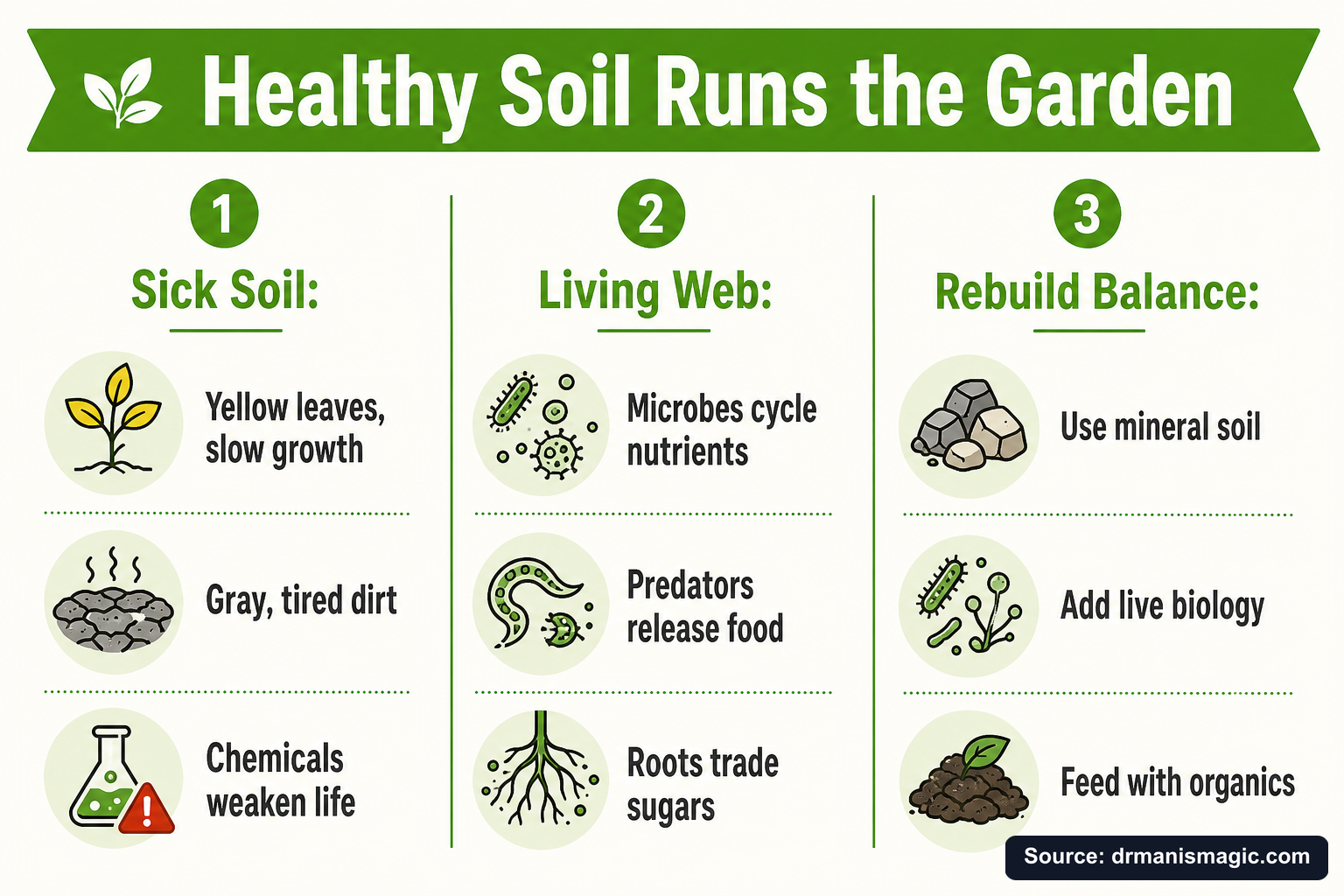
Now picture your backyard. You've spent good money on fertilizer. You've watered faithfully. You've done everything the bag said to do. And still, something just looks... off. The leaves are a little yellow. The growth is slow. The soil looks gray and tired. You're doing more work than that forest, and getting worse results. Why?
The answer is underground. Inside healthy soil, there is a system so precise, so layered, and so alive that it makes any human fertilizer program look like a rough sketch. Bacteria, fungi, tiny animals, and plant roots are all talking to each other. Feeding each other. Protecting each other. Keeping each other in check. This is the natural checks and balances of healthy soil. And once you understand it, you will never look at dirt the same way again.

Organic Fertilizer | Crab, Kelp & Amino Acids
Key Takeaways
- Healthy soil is a living system with billions of organisms that regulate nutrients, fight disease, and build structure — automatically.
- Bacteria, fungi, protozoa, nematodes, arthropods, and earthworms each play a specific role in a food web that feeds your plants.
- University of Minnesota Extension research shows soil biology supplies roughly 75% of plant-available nitrogen and 65% of available phosphorus — without any bag of fertilizer.
- Salt-based synthetic fertilizers and broad-spectrum chemicals destroy this system, leaving plants dependent on you for everything.
- Dead or dried microbial products from most stores don't restore this balance — only genuinely live, full-spectrum biology does.
- Damaged soil can recover, but it takes a deliberate, step-by-step approach — not just one product poured on once.
- The Three Plant Pillars — mineral-based soil, live microbials, and organic fertilizer — are the framework Dr. Mani Skaria developed and proven across 250,000+ trees in South Texas.
What Is the Soil Food Web and Why Does It Run Itself?
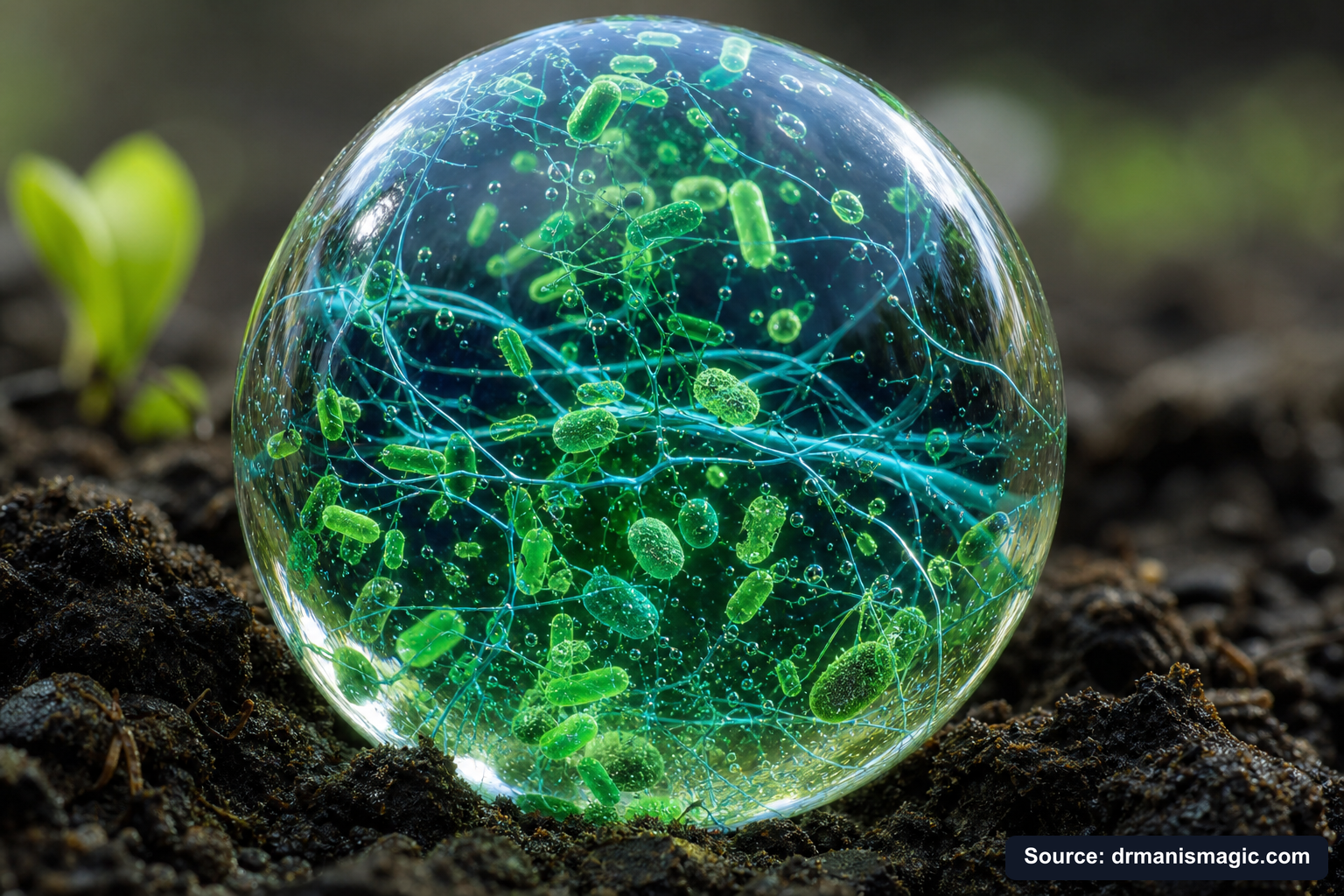
Quick Answer: The soil food web is the full community of living organisms in soil — bacteria, fungi, protozoa, nematodes, arthropods, and earthworms — that cycle nutrients, fight disease, and build soil structure through eating, competing, and cooperating with each other and with plant roots. It is self-regulating because every member keeps the others in check.
The soil food web is not a metaphor. It is a real, functioning system where every organism has a job, and every job keeps the whole thing running.
Think of it like a city. Bacteria are the workers. They break things down, fix nitrogen from the air, and glue soil particles together. Fungi are the roads. Their thread-like bodies connect roots to nutrients far away, moving water and minerals across distances roots could never reach alone. Protozoa are the quality control team. They eat bacteria, and when they do, they release nutrients right next to the plant roots where they are needed most. Nematodes patrol the streets. Some eat bacteria and fungi. Some eat other nematodes. Some even protect roots from harmful species. Earthworms and arthropods are the heavy equipment. They shred organic matter, create tunnels for air and water, and deposit some of the richest fertilizer on earth as they move.
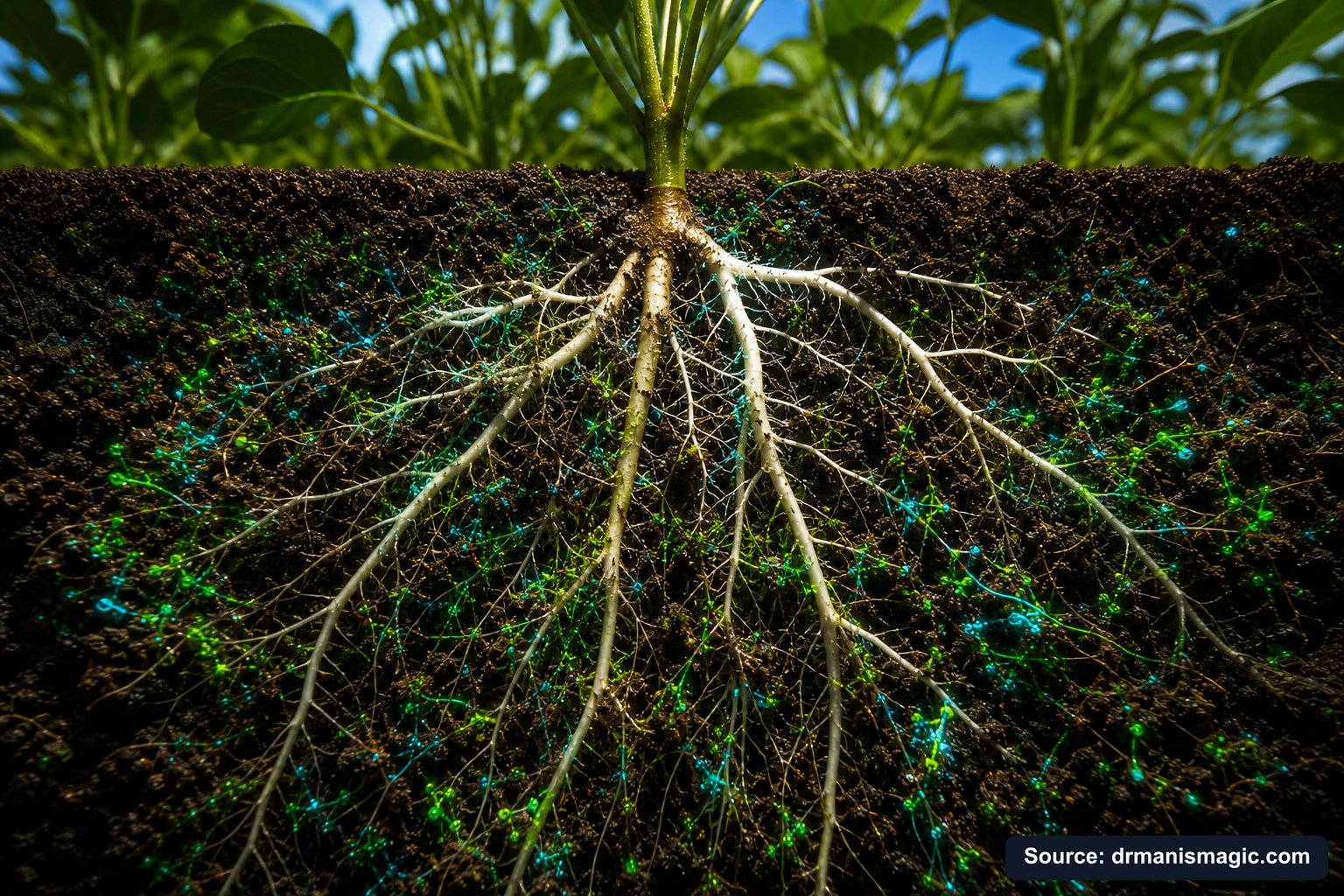
And in the middle of all of it? The plant root. Quietly pumping sugars into the soil to feed the microbes it needs most. Getting nutrients, water, and protection back in return.
According to University of Minnesota Extension, soil biological processes supply roughly 75% of plant-available nitrogen and 65% of available phosphorus. That means the biology in your soil is doing more fertilizing work than almost anything you could ever buy in a bag.
The system runs itself because it is built on checks and balances. Too many bad bacteria? Good bacteria and fungi crowd them out. Too many fungi? Fungal-feeding nematodes pull the numbers back. One group gets too powerful, and another group rises to correct it. This is not magic. This is ecology. And it has been running without human help for millions of years.
| Organism | What It Does | Why Plants Need It |
|---|---|---|
| Bacteria | Break down organic matter, fix nitrogen from air, release nutrients, glue soil particles together, fight pathogens | Supplies most plant-available nitrogen and phosphorus; builds soil structure |
| Mycorrhizal Fungi | Form threads that extend root reach up to 100x; move water and minerals; produce glomalin to bind soil | Dramatically increases nutrient and water uptake; improves drought and disease resistance |
| Other Beneficial Fungi | Decompose tough materials like wood and lignin; fight harmful fungi; cycle nutrients | Keeps organic matter cycling; suppresses root rot pathogens |
| Protozoa | Eat bacteria; release nitrogen and other nutrients near roots as waste | Acts as a nutrient delivery system right at the root zone |
| Beneficial Nematodes | Eat bacteria, fungi, and harmful nematodes; keep microbial populations in balance | Controls harmful species; drives nutrient cycling through predation |
| Earthworms | Shred organic matter; create air channels; produce nutrient-rich castings | Improves drainage, aeration, and fertility all at once |
| Arthropods | Break down large debris; create habitat for bacteria and fungi | Speeds up decomposition and nutrient release |
| Plant Roots | Release sugars and compounds to feed preferred microbes; signal the food web | The anchor and the director of the entire underground system |
How Do Predator-Prey Relationships Release Plant Nutrients?
Quick Answer: When protozoa eat bacteria, or when nematodes eat fungi, they release nutrients locked inside the microbial bodies as waste. This happens right next to plant roots. It is one of the most efficient nutrient delivery systems in nature — far more targeted than pouring fertilizer on top of soil and hoping it reaches roots.
Here is something most gardening advice never tells you. Nutrients do not become available just because they are in the soil. They have to be released. And the main way they get released is through eating.
Bacteria and fungi consume organic matter. They lock nutrients inside their own tiny bodies. This is called immobilization. The nutrients are trapped. But then a protozoan comes along and eats a thousand bacteria in a single pass. It only needs a fraction of those nutrients for its own body. The rest? It releases them as waste. Right there. In the root zone. In a form the plant can absorb immediately.
This is why a teaspoon of healthy soil contains more living organisms than there are people on earth. Every single one of those organisms is part of this cycle. Eating, being eaten, releasing, absorbing. Over and over. Around the clock.
When you strip this system away with chemicals or salts, you break the cycle. The nutrients are still in the soil. But there is no one to release them. Your plant stands in a room full of food it cannot eat.
What Are the Five Natural Controls That Keep Healthy Soil Balanced?
Quick Answer: Healthy soil regulates itself through five biological controls: competition (good microbes crowd out bad ones), predation (organisms eat each other to release nutrients and control populations), symbiosis (roots and fungi cooperate for mutual benefit), decomposition (organic matter breaks down into plant food), and succession (the community rebuilds itself after disturbance).
These five controls are the reason that healthy soil does not need you to manage it. They operate together, all the time, without a schedule.
Competition is the first control. Beneficial bacteria and fungi occupy every surface they can reach. They eat available food. They produce compounds that slow down harmful organisms. When a disease-causing pathogen lands in healthy soil, it finds the neighborhood already taken. There is no room, no food, no opening. This is called competitive exclusion, and it is one of the most powerful forms of disease suppression in nature.
Predation is the second control. As we just covered, protozoa eat bacteria, nematodes eat fungi, and bigger organisms eat smaller ones. This keeps any one group from taking over. It also drives the nutrient cycle by releasing locked-up minerals.
Symbiosis is the third control. The partnership between mycorrhizal fungi and plant roots is one of the oldest relationships on earth. The fungi wrap around or grow inside root cells and extend far out into the soil. The plant feeds them sugar. The fungi bring back water, phosphorus, zinc, copper, and more. Both sides win. Penn State Extension notes that mycorrhizal fungi can extend a root system's effective reach by 10 to 1,000 times, dramatically increasing what a plant can access.
Decomposition is the fourth control. Dead leaves, old roots, animal waste — all of it gets broken down by bacteria and fungi into simple nutrients that cycle back into the system. Nothing is wasted. Everything becomes food again.
Succession is the fifth control. After a disturbance — a fire, a flood, a dose of herbicide — the soil community does not give up. Pioneer microbes move in first. Then more complex organisms follow. Slowly, the food web rebuilds itself. This is why damaged soil can recover. It just needs the right conditions and, often, a helping hand.
What Destroys the Natural Checks and Balances of Healthy Soil?
Quick Answer: Salt-based synthetic fertilizers, broad-spectrum pesticides, fungicides, and herbicides all kill or impair beneficial soil organisms. High salt concentrations from synthetic inputs dehydrate microbial cells. Fungicides kill beneficial fungi alongside harmful ones. Compaction and waterlogged soil suffocate aerobic organisms. Each disruption weakens the self-regulating system and makes plants more dependent on human inputs.
This is the part of the story that most gardening companies do not want you to know. Because if you understood it, you would stop buying what they are selling.
Salt-based synthetic fertilizers are the biggest offender. When you pour a salt-heavy fertilizer onto your soil, you are not just feeding your plant. You are creating an environment that dehydrates and kills the beneficial bacteria and fungi around the roots. Microbial cells lose water in the same way a slug loses water when you sprinkle salt on it. They shrink. They weaken. They die.
The plant gets a short burst of color. You think it worked. But underneath, the soil food web just took a hit. Do it enough times and you are left with biologically dead soil. Now your plant has no invisible workforce. No nutrient cycling. No disease suppression. No drought buffer. Just you, a bag of fertilizer, and a plant that needs more and more of it just to stay alive.
This is not a coincidence. This is a business model. Dead soil creates dependent customers.
Fungicides do the same thing. They are designed to kill fungi. But they cannot tell the difference between the Phytophthora causing root rot and the mycorrhizal fungi extending your plant's root system by a factor of ten. Both get hit. One of them you needed.
See also: The Hidden Reason Synthetic Fertilizers Cause Root Rot
| Input or Practice | Effect on Soil Biology | What Happens to the Plant | Better Alternative |
|---|---|---|---|
| Salt-based synthetic fertilizer | Kills and dehydrates beneficial bacteria and fungi | Short green-up, then weakening; salt accumulation; root damage | Organic, slow-release fertilizer from crab, kelp, and amino acids |
| Broad-spectrum fungicide | Kills beneficial fungi alongside harmful ones | Loss of mycorrhizal network; weaker roots; more disease over time | Restore biology with full-spectrum live microbials |
| Synthetic herbicide (e.g. glyphosate) | Disrupts microbial communities; reduces diversity | Lower resilience; increased disease vulnerability | Mechanical control; targeted spot treatment |
| Broad-spectrum pesticide | Non-selective toxicity harms microbes and soil fauna | Reduced diversity; imbalanced predator-prey cycles | Organic pest control; biological agents |
| Compaction (heavy foot traffic, machinery) | Crushes air pockets; suffocates aerobic organisms | Poor drainage; root suffocation; root rot risk | Aerate; use mineral-based soil with permanent structure |
| Bark-heavy potting mix | Decomposes into dense, oxygen-poor sludge over months | Root suffocation; waterlogging; root rot | Mineral-based, permanent soil that does not decompose |
| Organic fertilizer (no salts) | Feeds microbes; builds soil biology over time | Slow, steady growth; resilient roots; long-term health | This IS the better alternative |
| Live full-spectrum microbial inoculant | Restores bacterial, fungal, protozoa, and nematode populations | Improved nutrient uptake; disease suppression; root development | This IS the better alternative |
You Never Had a Brown Thumb.
You were handed the wrong tools. This free guide hands you the right ones.
You watered it. You fed it. It died anyway.
It was never you. It was the dirt, the salt food, and the bad advice.
This guide shows you what really went wrong, and how to fix it for good.
- Why your plants really died, and why it was never your fault
- The salt hiding in your plant food that quietly burns the roots
- The hidden killer in almost every bag of store soil
- The tiny helpers that grow a whole forest for free
- The rescue trick that brings a half dead plant back to life
Live Microbes vs. Dead Microbes: Why Does the Difference Matter So Much?
Quick Answer: Live microbes can colonize soil, compete with pathogens, release nutrients, and form symbiotic relationships with roots. Dead or dormant microbes cannot do any of that. Most powdered or dried products on store shelves contain microbes that were killed during drying, shipping, or storage — and they show little to no effect in real growing conditions.
This is where most gardeners get burned. And most gardening companies stay very quiet about it.
The microbial inoculant market is booming. Walk into any garden center and you will see dozens of bottles and packets promising billions of beneficial organisms. But here is what the label does not tell you. Most of those organisms are dead before they reach your plant.
After growing and testing plants across more than 250,000 trees at our South Texas nursery, we tried dozens of commercial microbial products. Powders. Liquids. Granules. We tested batch after batch. And again and again, we saw the same result. The plants did not respond. Not because microbes do not matter. They matter enormously. But because the microbes in those products were not alive.
Here is how most commercial microbes are made. A handful of bacterial or fungal strains get grown in a factory. Then they are dried into a powder. The idea is that the spores will wake up when you add water. But between the drying process, the packaging, the warehouse, the shipping truck, the store shelf, and your shed, most of those spores are gone. When you pour the powder into your soil, you are spreading a graveyard.
The second type is liquid compost tea products. These start with real biology from compost or earthworm castings. But by the time the bottle reaches you, it has often gone anaerobic. The microbes ran out of oxygen, started fermenting, and began dying. You can smell it. The bottle sometimes fizzes when you open it. That smell? That is the scent of dying microbes. There is still some value in the humic and fulvic acids left behind. But the living workforce you paid for is mostly gone.
What actually works is fresh, active, genuinely living biology. The kind you find in a steaming hot compost pile that you just turned this morning. The kind that smells like earth after rain, not sewage. The kind you can see moving if you put a drop under a microscope.
That is exactly what Plant Super Boost was built to deliver. Dr. Mani worked with a world-renowned compost expert — a man who had advised royal families and entire governments on farming — to develop an all-natural stabilization technique that keeps the full spectrum of compost microbes alive without going anaerobic. No stench. No dead powder. Just living biology that goes to work the moment it hits your soil. Over 2,000 bacterial species. 400 to 500 fungal species including mycorrhizae. Plus protozoa and nematodes. All alive. All working.
| Product Type | Viability When Applied | Microbial Spectrum | Odor | Real-World Results |
|---|---|---|---|---|
| Dried / powdered lab microbes | Very low — most die in drying and storage | Narrow (a few selected strains) | Low / neutral | Little to no visible plant response in our testing |
| Dry microbes rehydrated into liquid | Very low — same issue as above | Narrow | Low / neutral | Same as above; avoid |
| Compost tea (fresh, under 24 hours) | Moderate when actively aerated | Partial — depends on compost source | Earthy to slightly sour | Good results but extremely time-sensitive and labor-intensive |
| Compost tea (old, over 24 hours) | Low — anaerobic die-off underway | Partial | Strong, foul odor | Reduced effectiveness; some humic/fulvic acid benefit only |
| Fresh active compost (on-site) | High — if applied fresh and not overheated | Broad and natural | Earthy | Excellent — but requires time, space, and physical effort |
| Plant Super Boost (stabilized full-spectrum) | High — stabilized by all-natural technique | 2,000+ bacteria; 400-500 fungi including mycorrhizae; protozoa; nematodes | Earthy — not anaerobic, not stinky | Visible microbial movement under microscope; lab-verified; proven across 250,000+ trees |
Can Damaged or Sterile Soil Come Back to Life?
Quick Answer: Yes, damaged or sterile soil can recover biological activity, but it takes time, the right conditions, and repeated support. Stopping the source of damage is the first step. Restoring organic matter, proper moisture, and living biology through compost and microbial inoculants follows. Recovery is not instant — it is a process, just like healing.
Here is the hopeful part of the story. Soil is not permanently broken just because it has been mistreated. The natural succession process we talked about earlier is always ready to start again. But you have to give it a chance.
We have seen soil that looked like gray dust — compacted, salty, biologically empty — come back to life after a season of consistent biological support. The earthworms return. The roots start reaching deeper. The plants stop looking stressed. It is one of the most satisfying things you can watch in a garden.
But it does not happen from one application of anything. Soil biology rebuilds in layers, just like it builds in nature. And your job is to stop doing the things that damaged it, and start doing the things that help it come back.
Here is a practical recovery checklist you can start today.
- Stop the damage first. Cut out the salt-based fertilizers, broad-spectrum chemicals, and any inputs that have been harming your soil biology. You cannot fill a bucket that still has a hole in it.
- Check your pH, salt levels, and organic matter. Soil biology has a comfort zone. Most beneficial bacteria and fungi prefer a pH between 6.0 and 7.0. High salt levels from years of synthetic feeding will need to be flushed with deep, thorough watering over several cycles.
- Restore moisture and aeration. Microbes need both water and air. If your soil is compacted or waterlogged, neither will happen. Aerate if needed. Make sure your soil drains well. Mineral-based soils with permanent structure do this automatically.
- Add biologically active organic matter. Mature compost introduces organisms and feeds the ones already there. This is the single most reliable way to jumpstart biology in depleted soil.
- Keep the soil covered. Bare soil bakes in the sun and loses moisture fast. Microbes die in those conditions. Mulch, cover crops, or even fallen leaves help protect the community you are trying to build.
- Apply live full-spectrum microbial inoculants consistently. Once conditions are right, reintroduce living biology. One application will not rebuild a food web. Monthly applications give populations a chance to establish, compete, and grow. This is why regular use of a product like Plant Super Boost is part of the Three Plant Pillars program — not a one-time fix, but a consistent practice.
- Feed with organic fertilizer, not salts. Organic, slow-release fertilizer from sources like crab, kelp, and amino acids feeds both the plant and the microbes. It works with the biology you are rebuilding, not against it. Salt-based fertilizers will undo your recovery work every single time.
This process is not complicated. But it does require patience. The soil that has been damaged over years will not heal in a weekend. What you will notice first is that your plants stop declining. Then they start looking steadier. Then, a few months in, something shifts. The growth comes in fuller. The color deepens. The roots hold better in dry spells. That is the food web doing its job again.
How Do the Three Plant Pillars Restore Soil Biology for Any Plant?
Quick Answer: The Three Plant Pillars — mineral-based soil, live microbials, and organic fertilizer — work together to recreate the conditions soil biology needs to thrive. Mineral soil provides permanent structure and aeration. Live microbials restore the food web. Organic fertilizer feeds both plant and microbe without salt damage. Together, they create a self-sustaining growing system for any plant.
Dr. Mani Skaria spent 35 years as a plant pathologist and citrus scientist. He taught at the Texas A&M Citrus Center. He invented micro-budding. He ran the Clean Citrus Program in Texas. And after all of that, after testing every product and technique available, he came back to the same answer every time. The plants that thrived were the ones growing in healthy, biologically active soil. Everything else was a band-aid.
That realization became the Three Plant Pillars — the framework that has guided the growth of over 250,000 trees at US Citrus Nursery in South Texas, and now guides home gardeners growing everything from citrus and tropical trees to lawns, flowers, houseplants, and vegetable gardens.
The first pillar is mineral-based soil. Most potting mixes are made from pine bark and organic materials that decompose. As they break down, they compact, block oxygen, and rob roots of the air they need. Root rot follows. The fix is not a fungicide. The fix is soil that never compacts in the first place. Sandy loam from the Rio Grande Valley is silica-rich, permanent, and provides the drainage and aeration that roots and microbes both need to do their jobs.
The second pillar is live microbials. As we have covered in detail, soil biology is not optional. It is the engine. Without it, your plant is on life support. With it, your plant has an invisible workforce doing the heavy lifting around the clock. Restoring and maintaining that workforce with genuinely living, full-spectrum biology is not a luxury. It is the foundation.
The third pillar is organic fertilizer. Nutrients need to be available, but they need to be delivered in a way that supports the biology, not destroys it. Crab, Kelp and Amino Acids provides a complete array of macronutrients, micronutrients, and biostimulants in slow-release form, with zero synthetic salts, zero biosludge, and zero PFAS. It feeds the plant gently. It feeds the microbes too. And it never undoes the biological work you are building.
Miss any one of the three? You will hit a wall. The soil will fail, or the biology will collapse, or the nutrition will run out. But when all three are in place, something remarkable happens. The system starts taking care of itself. Just like that forest you walked through at the beginning of this story.
See also: Why Most Fertilizers Are Actually Salt in Disguise
What Does This Mean for Your Garden, Your Trees, and Your Lawn Right Now?
Quick Answer: Right now, you can stop the inputs that damage soil biology and start adding the ones that restore it. Healthy soil biology is not something you build once — it is something you maintain, like your own gut health. Monthly microbial applications, organic feeding, and good soil structure are the three habits that keep the natural checks and balances of healthy soil working for you season after season.
There is something that Dr. Mani hears more than almost anything else from the people who reach out to him. They say they just want to see fruit on a tree they planted with their own hands. Not someday. In their lifetime. This season. Next year at the latest.
And here is the hard truth about going the slow way, the trial-and-error way, the big-box-store way. You can always make more money. You cannot make more time. Every season you spend fighting dead soil, chasing yellow leaves, and replacing plants that should have thrived is a season you will never get back.
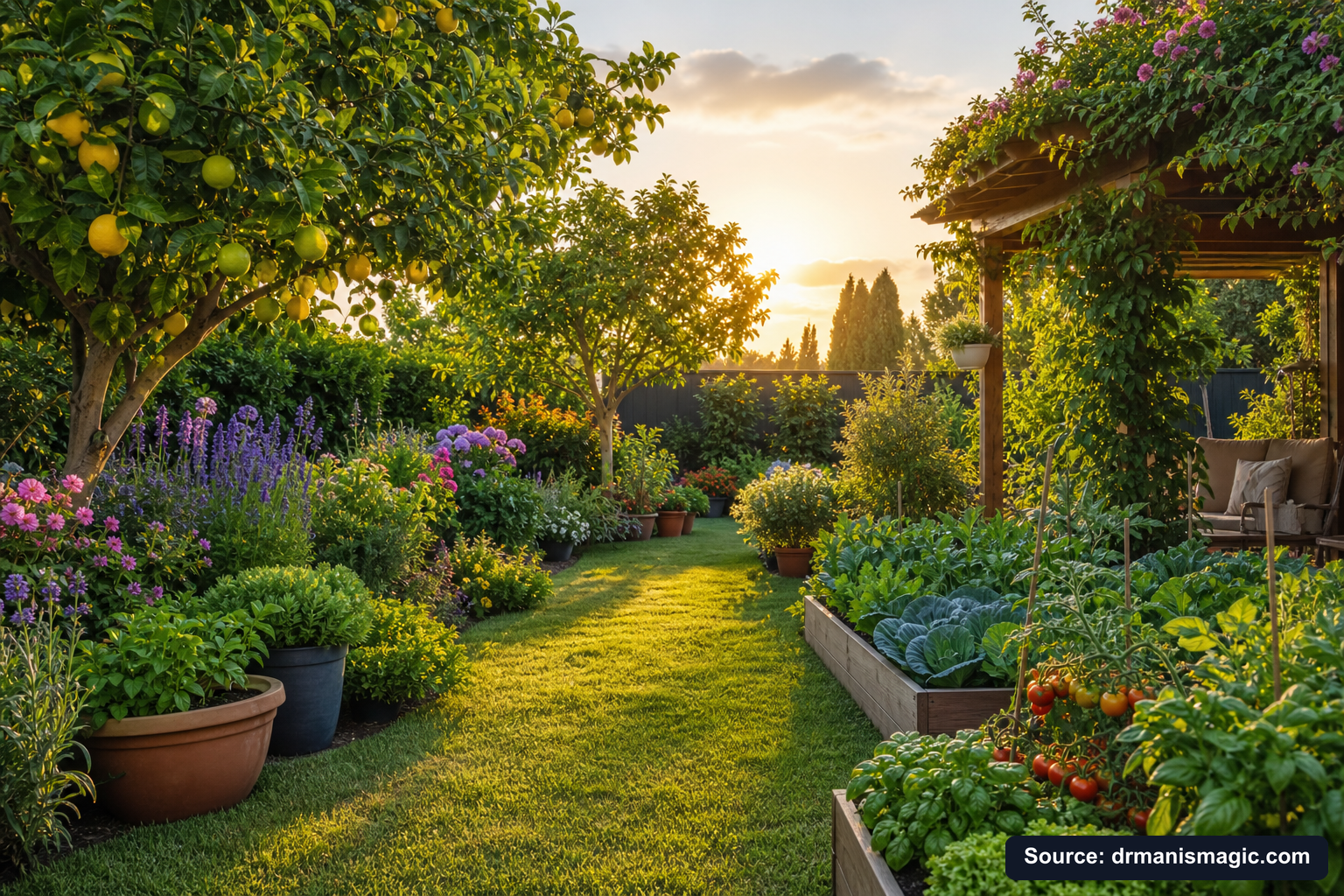
The natural checks and balances of healthy soil have been working perfectly for millions of years. They are not complicated. They are not secret. They just need the right conditions to operate. Mineral-based soil that breathes. Living biology that eats, competes, and protects. Organic nutrition that feeds without burning.
That is the system. That is the Three Plant Pillars. And it works for every plant you grow — from the citrus tree on your patio to the roses in your front yard to the lawn your kids run across barefoot on a summer evening.
You do not need to figure this out from scratch. We already did that work across 250,000 trees in South Texas. We made the products ourselves because nothing on the market was good enough. And we tested everything until it worked — reliably, season after season, for growers from coast to coast.
If you are ready to stop guessing and start building soil that takes care of your plants the way nature intended, download our Free Plant Care Field Guide. It walks you through the Three Plant Pillars step by step, for any plant, in plain language. No jargon. No upsell. Just the system that works — and the science behind why it works.
Your plants are waiting. And the soil beneath them is ready to come alive.
Frequently Asked Questions
Most gardeners never get taught how soil actually works. That gap is exactly why plants die, money gets wasted, and time slips away. These questions get straight to the truth about healthy soil, and how the Three Plant Pillars give your plants the living foundation they were always meant to have.
What are the signs of truly healthy soil?
Healthy soil smells earthy and clean, like rain on warm ground. It crumbles in your hand instead of clumping into hard clods. Water soaks in fast instead of pooling on top. You will see earthworms moving through it. Roots pull out white and fibrous, not brown and mushy. And your plants show it too, with deep color, steady growth, and real resistance to pests and disease. That is what living soil looks like.
What are the signs of unhealthy soil?
Unhealthy soil tells you loud and clear. Leaves turn yellow. Growth stalls or goes backward. Water sits on top instead of soaking in. The soil dries into a hard gray crust. You dig a shovelful and find zero earthworms. It might even smell sour or like something rotten. If any of this sounds familiar, your soil has lost its living biology. Salt-based fertilizers and cheap sawdust potting mixes are usually the culprits.
What are the main characteristics of good soil?
Good soil has structure that lets roots breathe and expand freely. It holds moisture without drowning roots. It drains well. It has a balanced pH so nutrients stay available. And most importantly, it is alive with bacteria, fungi, and other microbes that cycle nutrients and fight disease on their own. Dr. Mani spent 35 years and tested across 250,000 trees to build a soil system that delivers all of this without guesswork. That is what Super Soil was designed to do.
What are the key principles of soil health?
Soil health comes down to three things, and Dr. Mani calls them the Three Plant Pillars. First, you need a mineral-based soil structure that does not break down or choke roots. Second, you need live microbes that unlock nutrients and fight pathogens. Third, you need organic fertilizer that feeds the soil slowly without burning it. When all three work together, your plants stop struggling and start thriving. Take away any one of them and the whole system weakens.
Why do synthetic fertilizers hurt soil health?
Synthetic fertilizers are salt-based. They give plants a quick jolt but wipe out the beneficial bacteria and fungi your soil depends on. Once those microbes are gone, your plant cannot feed itself anymore. It becomes fully dependent on you to pour in the next bag. That is a cycle that costs you money and time, and it quietly poisons your backyard in the process. Organic, slow-release fertilizer like Dr. Mani's Crab, Kelp, and Amino Acids formula feeds the soil without the damage.
What does the soil food web actually do for my plants?
The soil food web is a living network of bacteria, fungi, protozoa, nematodes, and earthworms that all work together underground. Bacteria break down organic matter. Fungi carry water and nutrients to roots from far away. Protozoa eat bacteria and release nutrients right where roots need them. University of Minnesota Extension research shows this biology supplies around 75 percent of plant-available nitrogen and 65 percent of available phosphorus without any bag of fertilizer. Dr. Mani's Plant Super Boost puts this living system back to work in your soil.
Can damaged soil actually recover, and how long does it take?
Yes, damaged soil can recover. But it will not fix itself with one product poured on once. You need the full foundation in place. That means mineral-based soil structure so roots can breathe, live microbials to rebuild the biology, and organic fertilizer to feed it all without burning it back down. Most gardeners start seeing real improvement within 30 days when all three pillars are working together. The longer you wait to fix the foundation, the more time you lose. And time is the one thing you cannot get back.
About the Author
Dr. Mani Skaria, PhD
Dr. Mani Skaria, PhD, is a plant pathologist and the scientific founder of Dr. Mani's Magic. He earned his doctorate at Purdue University and spent 48 years studying how plants, soil, and living microbes work together, including his years as Professor Emeritus at Texas A&M and as a member of the USDA NAREEE Advisory Board. He invented micro-budding, a method for growing healthier, stronger trees, and has grown more than 250,000 trees on the family farm in Hargill, Texas - US Citrus Nursery. His life's work takes real lab science and practical experience and turns it into simple, safe, organic plant care anyone can use at home.


