


The Myth of the Brown Thumb: It's Your Soil Biology, Not You | Dr. Mani's Magic
The Myth of the Brown Thumb: Your Plants Don't Need Magic — They Need a Living Root System
You're standing in your backyard, staring at another dead plant. The leaves are yellow. The soil smells sour. You've watered it. You've fertilized it. You've read the forums. And it still looks like it's giving up on life.
So you think the same thought millions of gardeners think every single year: "I must have a brown thumb." You blame yourself. You assume some people are just born with a gift for growing things, and you weren't one of them. You picture your neighbor's tomatoes — fat, red, bursting with juice — and you wonder what they know that you don't.
Here's the truth nobody told you. The brown thumb isn't real. It never was. What IS real is that you were handed the wrong tools, pointed in the wrong direction, and sold products designed to keep you spending money — not growing plants. After growing over 250,000 trees at our South Texas nursery, we can tell you with total confidence: the secret to a green thumb has nothing to do with talent. It has everything to do with what's happening underground, in a world too small to see.

Plant Super Boost
Key Takeaways
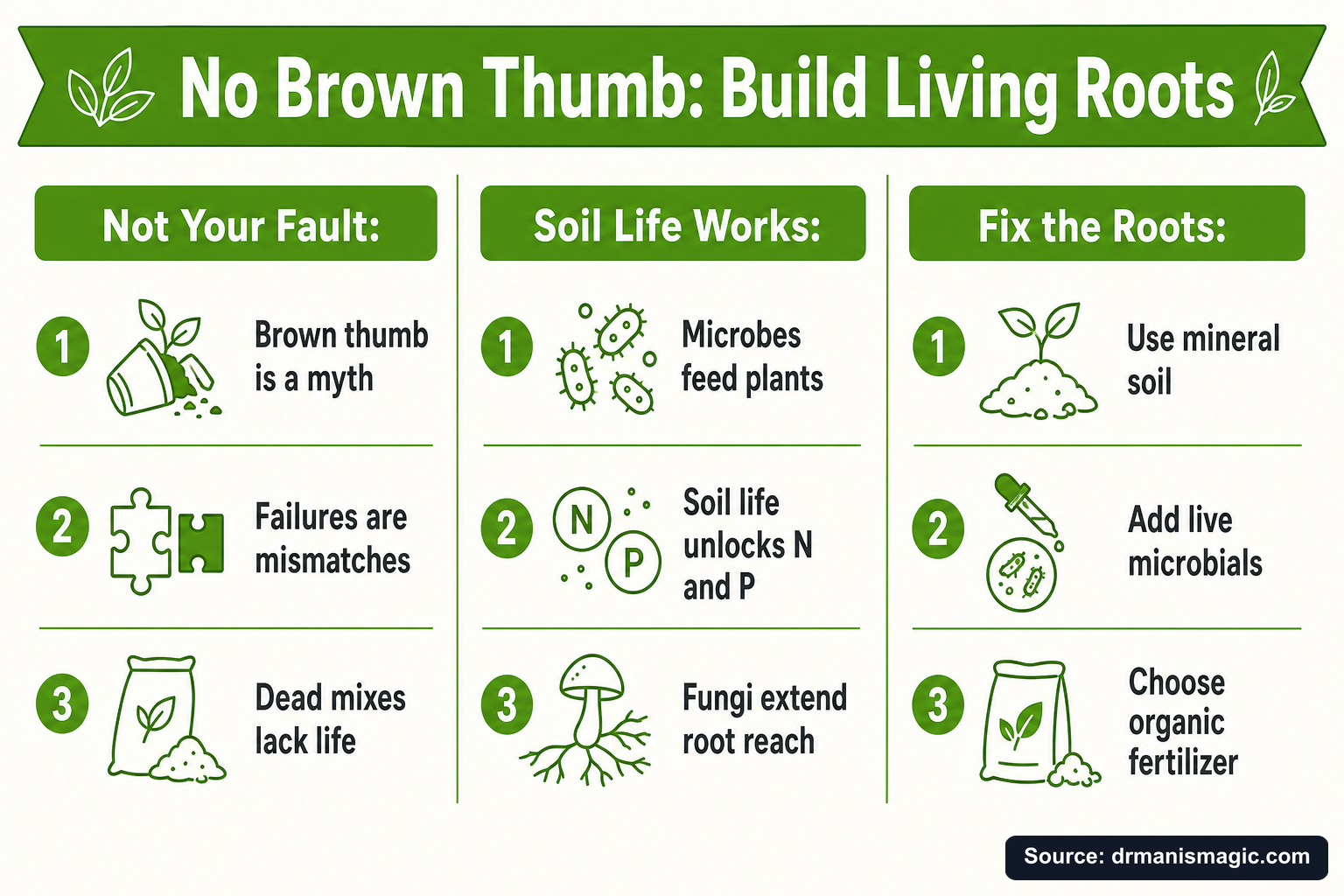
- The "brown thumb" is a myth — plant failure is almost always a fixable mismatch in soil, water, biology, or nutrients, not a personal flaw.
- Roughly 75% of plant-available nitrogen and 65% of available phosphorus come from biological processes in living soil, not from fertilizer bottles.
- Most potting mixes are biologically dead — they have no beneficial bacteria, no fungi, no living ecosystem to support your roots.
- Salt-based synthetic fertilizers actively kill the beneficial microbes your plants depend on, creating a vicious cycle of dependence.
- The Three Plant Pillars — mineral-based soil, live microbials, and organic fertilizer — fix the root cause of most plant failures at once.
- Dead, dried, or foul-smelling microbial products are weak substitutes for genuinely live biology.
- You can reverse years of soil damage with the right approach — and your plants can respond within weeks, not years.
What Does "Brown Thumb" Actually Mean — and Is It Real?
Quick Answer: A "brown thumb" is not a real trait. It's a label people give themselves after repeated plant failures caused by fixable problems — wrong soil, dead biology, salt-based fertilizers, poor drainage, or simply the wrong plant for the environment. It is an ecological fit problem, not a personal flaw.
The phrase "brown thumb" has been around for generations. It means you kill plants. Simple as that. But here's what nobody asks: why do the plants keep dying?
Most people assume the answer is "I don't know enough" or "I'm not a natural." But plant scientists have a very different answer. The University of Minnesota Extension describes soil as a living system packed with bacteria, fungi, protozoa, nematodes, and more — and confirms that biological processes in healthy soil supply roughly 75% of plant-available nitrogen and 65% of available phosphorus. Not fertilizer. Biology.
When that biology is missing or dead, even the most attentive gardener can't compensate. You water correctly. You fertilize on schedule. And the plant still struggles. Because the invisible workforce underground isn't there.
That's not a brown thumb. That's a broken ecosystem.
The big box stores don't tell you this. Neither do the giant chemical companies. Because if you understood this one thing, you'd stop buying bag after bag of the same products that never fix the real problem.
Why Do Plants Thrive in the Wild Without Any Human Help?
Quick Answer: Wild plants thrive because they grow in biologically rich soil teeming with trillions of microbes — bacteria, fungi, protozoa, and nematodes — that recycle nutrients, fight disease, and extend root systems. No bag of fertilizer can replicate what a living soil ecosystem does for free, every single day.
Think about a forest. Nobody fertilizes it. Nobody waters it on a schedule. Nobody sprays it with pesticides. Yet the trees are enormous. The flowers bloom every spring. The roots go deep and strong.
Now think about a potted plant on your patio. You've given it everything the label said to give it. And it's barely hanging on.
The difference isn't sunlight. It isn't water. It's the invisible world under the soil surface.
According to Maryland Extension, a single teaspoon of healthy agricultural soil contains 100 million to one billion bacteria, several meters of fungal threads, thousands of protozoa, and 10 to 20 nematodes. That's not a teaspoon of dirt. That's a city.
In nature, that city is always open for business. It recycles fallen leaves into nutrients. It builds tunnels that let water drain perfectly. It fights off harmful pathogens. It feeds the roots exactly what they need, right when they need it.
In a bag of potting mix from a big box store? That city is a ghost town. Sterilized. Emptied out. Silent.
That's why plants struggle the moment you bring them home. They're being asked to survive without their entire support system.
What Is the Soil Food Web — and Why Should Every Plant Owner Know It?
Quick Answer: The soil food web is the community of living organisms — bacteria, fungi, protozoa, nematodes, and more — that work together underground to feed plants, fight disease, and build healthy soil structure. When this web is intact, plants thrive. When it's broken, even great care can't fully replace it.
You've heard of a food chain. The soil food web is like a food chain, but underground. And it's far more complex.
Here's how it works in plain language:
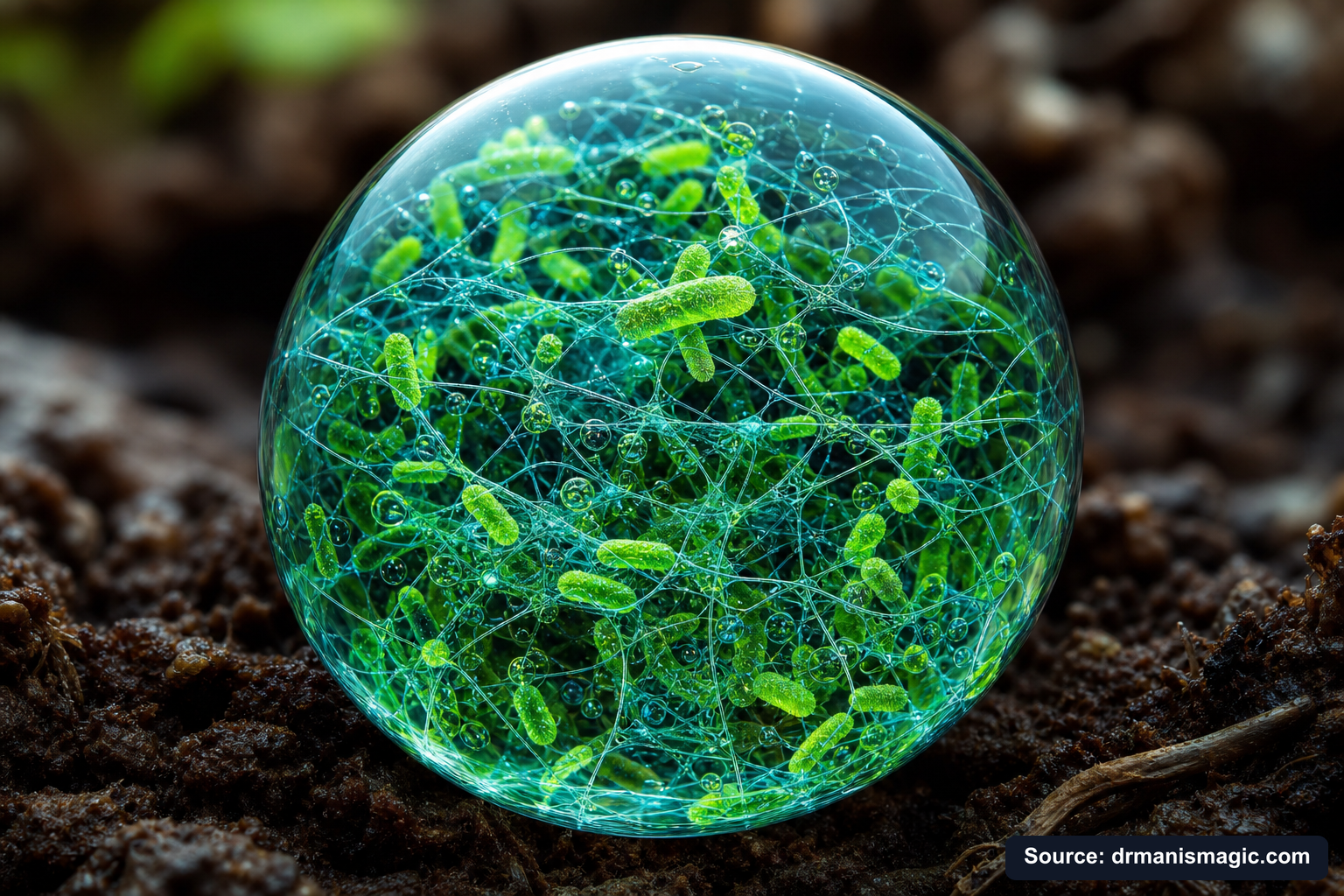
Bacteria are the first responders. They break down organic matter and release nutrients. They fix nitrogen straight from the air. They crowd out harmful pathogens. Think of them as the workers on the ground floor.
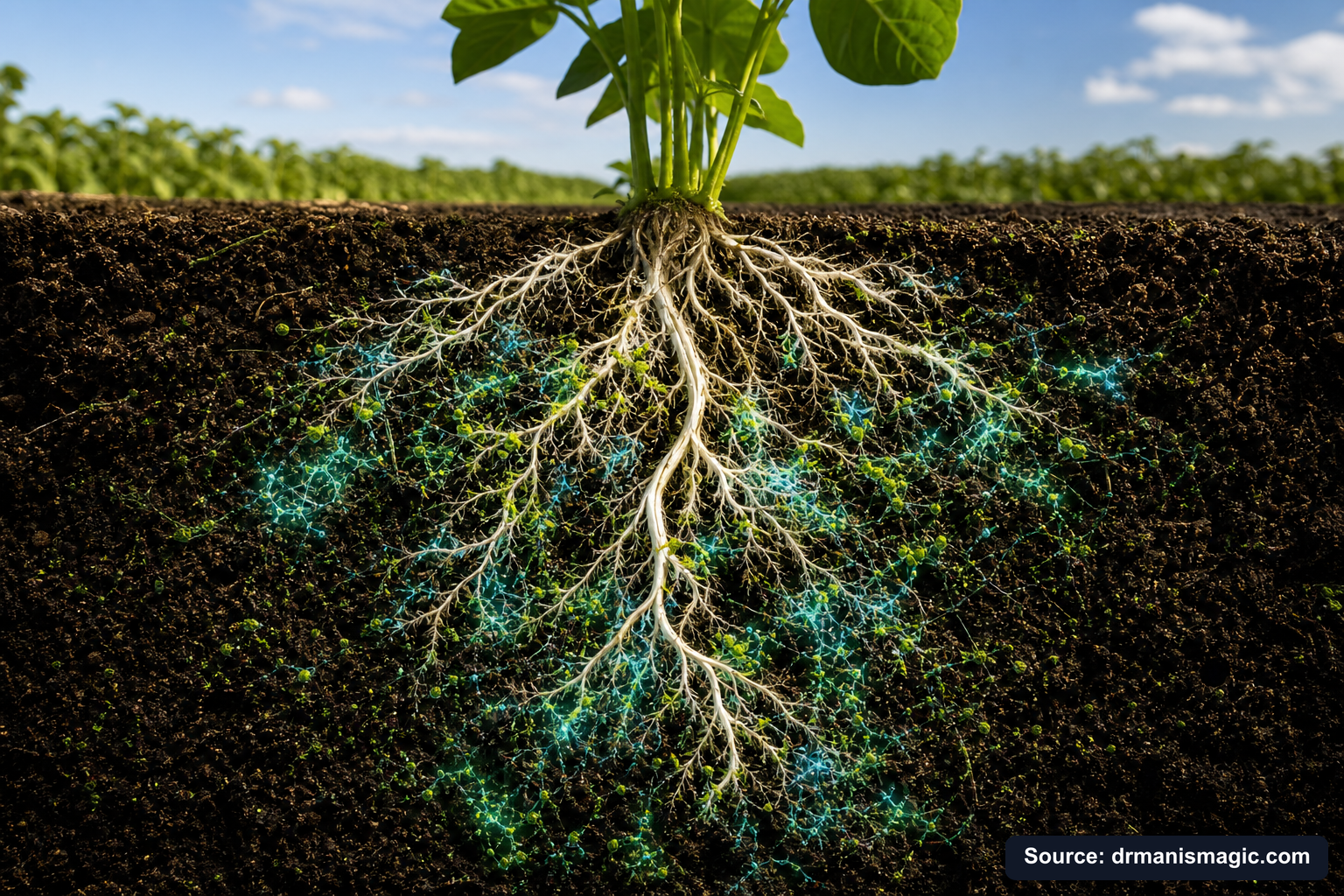
Fungi — especially mycorrhizal fungi — are the highway builders. They grow long, thread-like networks that extend a plant's root system by hundreds of times. They carry water and phosphorus to roots that could never reach it alone. If you've ever pulled a weed and seen white fuzzy threads clinging to the roots, that was mycorrhizae doing their job.
Protozoa eat bacteria. Sounds bad, right? It's not. When protozoa eat bacteria, they release the nutrients locked inside as plant-available nitrogen. They're the nutrient-releasing predators of the soil world. Most gardening content ignores protozoa completely. That's a big mistake.
Nematodes do the same thing at a larger scale — they eat bacteria and fungi and release even more nutrients. They also hunt harmful pathogens. The right nematodes are your plant's invisible bodyguards.
As Penn State Extension explains, these microbes mediate carbon, nitrogen, sulfur, and phosphorus cycling, decompose organic matter, suppress pathogens, improve stress tolerance, and aid soil aggregation. Together, they make the soil a self-sustaining, self-fertilizing, self-defending system.
| Organism | Main Job | What Your Plant Gets |
|---|---|---|
| Bacteria | Break down organic matter, fix nitrogen from the air, crowd out pathogens | Available nitrogen, disease protection, better drainage |
| Mycorrhizal Fungi | Extend root systems, carry phosphorus and water, improve drought tolerance | Bigger root network, more nutrients, stress resistance |
| Protozoa | Eat bacteria and release nutrients in plant-available form | Steady supply of nitrogen right at the root zone |
| Nematodes (beneficial) | Eat bacteria, fungi, and harmful pathogens; release nutrients | Pathogen control, nutrient cycling, soil health |
| Earthworms and Arthropods | Physically break apart organic matter, build tunnels for air and water | Better drainage, aeration, and soil structure |
When all of these players are present and working together, your plant has everything it needs. When they're gone — wiped out by synthetic fertilizers, fungicides, herbicides, or sterilized potting mix — the whole system collapses. And the plant starts to fail.
See also: The Hidden Reason Synthetic Fertilizers Cause Root Rot
Why Do Most Potting Mixes Set Your Plants Up to Fail?
Quick Answer: Most commercial potting mixes are made from bark, peat, and sawdust — materials that start sterile, break down over time, and compact into root-choking sludge. They contain no live microbes, drain poorly as they age, and steal oxygen from roots as they decompose. They are a temporary fix that becomes a long-term problem.
Go to any big box store and grab a bag of potting mix. Smell it. It smells like wood chips, because that's mostly what it is.
Pine bark, wood fiber, peat, sometimes a little fertilizer baked in. The bag looks full and fluffy. And for the first few weeks, your plant does okay.
Then something starts happening that nobody warns you about. That organic material begins to decompose. It breaks down and compacts. The fluffy structure collapses. Drainage slows. Oxygen gets cut off from the roots. The mix goes from light and airy to dense and wet — exactly the conditions that cause root rot.
And because the mix was sterilized to begin with, there are no beneficial microbes to help. No bacteria fighting off pathogens. No fungi extending the root network. No protozoa releasing nutrients. Just decaying organic matter slowly suffocating your plant's roots.
Within six to twelve months, many potting mixes are functionally hostile to plant life.
Dr. Mani Skaria — Professor Emeritus of Plant Pathology, founder of the Clean Citrus Program in Texas, and a plant scientist with over 40 years of research at the Texas A&M Citrus Center — saw this problem in his own nursery. He needed a soil that didn't break down. Something permanent. Something that stayed open and airy for years, not weeks.
The answer was mineral-based soil. Not organic matter that rots. Pure, inorganic sandy loam from the Rio Grande Valley, built on silica-rich sand that doesn't decompose, doesn't compact, and doesn't steal oxygen from roots. That's the foundation of Super Soil — and it's the first of the Three Plant Pillars.
What Are the Three Plant Pillars — and Why Do They Fix the Brown Thumb Problem?
Quick Answer: The Three Plant Pillars are the system Dr. Mani Skaria developed after decades of growing at US Citrus Nursery: mineral-based soil for permanent structure and drainage, live microbials to restore the soil food web, and organic fertilizer to feed plants without destroying their biology. Together, they address the root cause of most plant failures at once.
After 30 years of growing citrus trees — and after testing everything the gardening industry had to offer — Dr. Mani cracked the code on why plants fail and how to fix it at the source.
Not with more products. Not with more chemicals. With three foundational pillars that work together the way nature always intended.
Pillar One: Mineral-Based Soil. Your plant's home has to be permanent and breathable. Mineral-based soil doesn't break down. It doesn't compact. It drains well year after year. Roots can push deep and breathe freely. Without this, everything else is fighting an uphill battle.
Pillar Two: Live Microbials. The invisible workforce. Bacteria, fungi, protozoa, and nematodes working together to unlock nutrients, fight pathogens, and build a living ecosystem around your roots. This is the pillar most gardeners have never even heard of — and it's the one that changes everything.
Pillar Three: Organic Fertilizer. Not salt-based chemicals that burn your soil and kill your microbes. Slow-release, earth-born nutrients from sources like crab, kelp, and amino acids. Food that works with your biology, not against it. No plastic coatings. No PFAS. No biosludge. Just clean, complete nutrition your plant can actually use.
Miss any one of these pillars and you'll see it. Yellow leaves. Wilting after watering. Root rot. Slow growth. Repeated transplant failure. These aren't signs that you have a brown thumb. They're signs that one or more pillars are missing.
Put all three in place — and plants become nearly bulletproof. We've seen it on over 250,000 trees. We've seen it on houseplants, tropical trees, vegetable gardens, lawns, and flower beds. The Three Plant Pillars work for any plant, in any container, in any backyard.
You can explore all three together through our Three Plant Pillars system.
How Do Synthetic Fertilizers Actually Destroy the Soil Food Web?
Quick Answer: Synthetic fertilizers are salt-based. High salt concentrations in the root zone kill or impair beneficial bacteria and fungi — the same microbes that protect roots, unlock nutrients, and build disease resistance. The short-term green-up masks long-term biological collapse, leaving plants increasingly dependent on the next dose of chemicals to survive.
Walk into any garden center and the shelves are lined with blue crystals, white granules, and bright-colored liquid concentrates. The bags promise bigger blooms, faster growth, greener grass. And for a few weeks, they deliver.
Here's what's happening underneath the soil during those weeks.
Most synthetic fertilizers are salt-based. When you pour them into the soil, the salt concentration around the roots spikes. Salt draws water out of cells by osmosis — out of plant roots, and out of microbial cells. Beneficial bacteria and fungi either die or are severely weakened. The soil food web gets disrupted. The invisible workforce starts shrinking.
The plant looks green on top. But underground, the foundation is crumbling.
A few months later, the plant starts struggling again. So you add more fertilizer. The same thing happens. You're stuck in a cycle — feeding the symptom, never fixing the cause. And every time you feed, you push the biology a little further toward collapse.
This is not an accident. It's a business model. Big chemical companies profit when your soil stays depleted. They don't make money selling you a system that works once and keeps working. They make money selling you the same product every 90 days until the plant gives up.
See also: Why Most Fertilizers Are Actually Salt in Disguise
You Never Had a Brown Thumb.
You were handed the wrong tools. This free guide hands you the right ones.
You watered it. You fed it. It died anyway.
It was never you. It was the dirt, the salt food, and the bad advice.
This guide shows you what really went wrong, and how to fix it for good.
- Why your plants really died, and why it was never your fault
- The salt hiding in your plant food that quietly burns the roots
- The hidden killer in almost every bag of store soil
- The tiny helpers that grow a whole forest for free
- The rescue trick that brings a half dead plant back to life

Live Microbes vs. Dead Microbes — Why Most Microbial Products on Store Shelves Don't Work
Quick Answer: Most commercial microbial products are either dried powders made from lab-grown spores that rarely reactivate, or stinky liquids that have gone anaerobic and lost their living biology. Neither delivers the full-spectrum, genuinely alive microbes that roots actually need. The difference between a live microbial product and a dead one is the difference between results and disappointment.
The word "microbes" is everywhere in gardening right now. Mycorrhizae. Beneficial bacteria. Soil biology. It's on labels at the hardware store, in ads on social media, in every gardening forum online.
And most of it doesn't work. Here's the honest truth about why.
Type One: The Dry Powder. These are microbes grown in giant factory vats, then dried into a powder. The idea is that the dormant spores will "wake up" when you add water and pour them into soil. We've tested dozens of batches of these products on our own trees over the years. The results? Basically nothing. The spore reactivation rate is too low. The spectrum of organisms is too narrow. And by the time the product reaches your hands, months or years have often passed since it was manufactured.
Type Two: The Smelly Liquid. These are products made from compost or earthworm castings, turned into a liquid. They started as something good — fresh compost is full of live biology. But by the time the product ships, sits in a warehouse, and arrives at your door, the microbes have gone anaerobic. That means they've run out of oxygen and started dying. The telltale sign? The bottle smells like sewage. Sometimes it fizzes when you open it — that's gas from fermentation. The biology is gone. What's left is mostly just humic and fulvic acid from the original compost base. Some benefit, but nothing close to what was promised.
Type Three: Lactobacillus-based products. Yes, like in your yogurt. Easy to make, vigorous, and they stay alive. But lactobacillus bacteria are so aggressive they crowd out the beneficial organisms your plants actually need. It belongs in your gut, not your garden.
None of these deliver what a plant's root zone actually needs: a full spectrum of live bacteria, live fungi including mycorrhizae, live protozoa, and live nematodes — all working together, all active, all genuinely alive when they reach your soil.
| Product Type | Viability When Used | Spectrum of Organisms | Odor | Real-World Results |
|---|---|---|---|---|
| Dry powder (lab-grown) | Very low — spores rarely reactivate | Narrow — a few selected species | Neutral | Little to no measurable benefit |
| Rehydrated dry powder | Very low — same issue | Narrow | Neutral | Little to no measurable benefit |
| Compost tea (fresh, under 24 hours) | Moderate — only if actively aerated | Partial — depends on compost source | Earthy, mild | Good, but time-sensitive and labor-intensive |
| Compost tea (old, over 24 hours) | Low — anaerobic, microbes dying | Partial | Strong sewage smell | Minimal biology; some humic acid benefit only |
| Lactobacillus-based liquid | High — but wrong organisms | Narrow and overpowering | Mild | Crowds out beneficial biology; not recommended |
| Plant Super Boost (stabilized, full-spectrum) | High — genuinely alive | 2,000+ bacteria species, 400-500 fungi including mycorrhizae, plus protozoa and nematodes | Earthy — not foul | Visible under microscope; multiple lab analyses confirm live biology |
The difference at Dr. Mani's Magic came from a remarkable partnership. A world-famous compostologist — someone who had advised the farming practices of royal families and governments around the world — discovered a natural, proprietary method to stabilize the full spectrum of microbes from fresh compost. Not lab-grown. Not dried. Harvested from real, active compost and kept alive through an all-natural stabilization process that prevents the biology from going anaerobic.
He was eventually blacklisted by the big chemical industry when citrus groves using his method started showing dramatic results. Years later, through what can only be described as a fortunate turn of events, he joined forces with Dr. Mani at US Citrus Nursery. Together, they created Plant Super Boost.
If you take a drop of Plant Super Boost and look at it under a microscope, you can watch the microbes moving. That's what alive looks like. And because the microbes are stabilized rather than dying and fermenting, Plant Super Boost smells like earth — not sewage. That matters more than it sounds. You actually want to use something that doesn't clear the room when you open it.
What Does a "Brown Thumb" Diagnosis Actually Look Like? Symptoms and Root Causes
Quick Answer: Most "brown thumb" symptoms — yellow leaves, wilting after watering, white salt crust on soil, sour-smelling media, root rot, stunted growth, or repeated transplant failure — trace back to one or more of three root causes: dead or disrupted soil biology, salt buildup from synthetic fertilizers, or structurally failing soil that blocks oxygen and drainage.
You don't need a degree in plant pathology to figure out what's going wrong. You just need to know what to look for.
Here's a quick translation guide — symptoms you can see, and what they're really telling you about what's happening underground:
| What You See | What It Usually Means | What's Missing or Wrong |
|---|---|---|
| Yellow leaves despite regular feeding | Nutrients are present but locked up — roots can't access them | No beneficial microbes to unlock nutrients; or salt damage blocking uptake |
| Wilting even after watering | Root rot or compacted soil blocking water movement | Poor drainage; decomposing potting mix; anaerobic root zone |
| Crispy brown leaf tips | Salt burn — fertilizer salts drawing moisture out of leaf tissue | Salt accumulation from synthetic fertilizers |
| White crust on soil surface | Salt deposit from evaporating fertilizer or tap water | Salt-based inputs; poor flushing |
| Sour or sewage smell from soil | Anaerobic conditions — roots suffocating in stagnant, airless media | Compacted organic potting mix; overwatering; no drainage |
| Slow or no growth despite care | Biological starvation — no microbes to cycle nutrients to roots | Dead soil biology; no live microbials |
| Fungus gnats hovering around soil | Wet, decomposing organic media attracting larvae | Wrong soil type; overwatering; no biological competition |
| Repeated transplant failure | Root zone shock in biologically dead, structurally poor media | Missing all three pillars at once |
| Plant thrives briefly then declines | Initial fertilizer boost wearing off as salt damage accumulates | No sustainable biology; no organic slow-release nutrition |
Look at that list. Not one of those symptoms points to a personal failing. Every single one points to a fixable system problem. Soil that's wrong. Biology that's missing. Nutrients that are burning instead of feeding.
That's the myth of the brown thumb, dismantled symptom by symptom.
How Do You Recover From Years of Dead Soil — A Step-by-Step Protocol
Quick Answer: Recovering dead or depleted soil takes consistent action over several months. The process involves flushing accumulated salts, replacing structurally failing media, reintroducing genuine live microbials, switching to organic slow-release nutrition, and repeating microbial applications monthly as biology rebuilds. Most plants show visible improvement within four to six weeks of starting this protocol.
Here's the good news. Damaged soil is not dead forever. Biology can come back. Roots can recover. Plants that looked like lost causes can surprise you.
We've watched it happen hundreds of times on our own trees in South Texas. Here's the recovery protocol we've refined over decades:
- Flush accumulated salts first. Water deeply and thoroughly — let water run through the pot or bed multiple times. This washes out the salt crust that's been blocking nutrient uptake and stressing your roots. Do this before anything else.
- Assess your soil structure. Is the potting mix compacted, smelly, or waterlogged? If it's been in the pot for more than a year, it's likely decomposing. Repot into mineral-based soil with genuine drainage. Structure is the foundation. Without it, everything else is patching a leak.
- Introduce live, full-spectrum microbials immediately. Mix two ounces of Plant Super Boost into a gallon of water and drench the root zone. You're not just adding microbes — you're restarting the entire underground ecosystem. Do this the same day you repot if possible.
- Switch to organic slow-release fertilizer. Stop the salt-based feeding cycle. Organic fertilizer from sources like crab, kelp, and amino acids feeds plants gently without disrupting the biology you just introduced. The microbes and the fertilizer work together. Salt-based fertilizer would undo step three immediately.
- Repeat microbial applications monthly. Microbes multiply, but they also face ongoing pressure from environmental stress, tap water chlorine, and the remnants of old chemical inputs. Monthly applications keep the soil food web strong and growing.
- Be patient with the timeline. Most plants show visible improvement — new growth, brighter color, better water uptake — within four to six weeks. Full biological recovery in heavily damaged soil can take three to six months of consistent care. The roots are rebuilding their entire support system from scratch.
- Stop reaching for the quick fix. Every time you apply a synthetic pesticide, herbicide, or salt-based fertilizer, you reset the clock on biological recovery. The Three Plant Pillars work because they're a system, not a one-time treatment.
For a complete walkthrough of everything your plant needs, download our Free Plant Care Field Guide — it covers every plant type, every season, and every common problem in plain language.
What Is the Real Cost of the "Brown Thumb" Belief — and Why Does Time Matter More Than Money?
Quick Answer: The real cost of accepting the brown thumb myth isn't money — it's time. Every year spent repeating the wrong approach is a year your plants aren't growing, your garden isn't producing, and you're not experiencing what thriving plants actually feel like. Money can be replaced. Time cannot. The best moment to fix the foundation was last year. The next best moment is right now.
You can buy another plant. You can buy more fertilizer. You can buy more potting mix.
You cannot buy back the time you spent watching plants fail.
The number one thing people tell Dr. Mani they want — more than anything else — is to see fruit on a tree they planted with their own hands while they still can. Not in some distant future. Now. While they can smell it. Taste it. Share it with their family.
That desire is ancient. It's wired into us. We were built to tend a garden, to nurture living things, to see what we've grown bear fruit. Every person reading this feels that pull — whether it's a lemon tree on the patio, tomatoes in a raised bed, or a rose bush that just won't bloom.
And every year you spend doing it the old way — the big-box way, the salt-fertilizer way, the sterile-potting-mix way — is a year you don't get back.
The Three Plant Pillars aren't just about healthier plants. They're about reclaiming that time. About finally having the foundation in place so plants respond instead of struggling. So that the effort you put in actually produces something you can see, smell, taste, and touch.
John, an overworked doctor with no time and a history of failed plants, started using the Three Plant Pillars. Within months he had fruit trees producing, a garden that was actually growing, and grass so green his neighbors started asking questions. Not because he suddenly became a master gardener. Because he finally had the right foundation.
That's not a fluke. That's what happens when the system is right.

What Can You Do Right Now to Start Growing Like You Always Wanted?
Quick Answer: Start with the Three Plant Pillars — mineral-based soil, live microbials, and organic fertilizer — applied together. This addresses the root causes of most plant failures at once. Most people see visible improvement within four to six weeks. You don't need to fix everything at once, but you do need to start with the right foundation.
You've read this far. That means something. It means you're not someone who gives up. It means you still believe your garden can be what you imagined it could be.
Here's what to do first.
Stop blaming yourself. The brown thumb isn't yours. It belongs to a system that was never designed to make you succeed — only to make you keep spending. Now you know better.
Start building the foundation. Mineral-based soil that doesn't decompose. Live microbes that genuinely work. Organic fertilizer that feeds your plants without burning their biology. These three things, working together, are what every thriving plant has in common — whether it's growing in a forest or in a pot on your back porch.
And know this: you're not doing it alone. At US Citrus Nursery, we've grown over 250,000 trees using this exact system. We've tested it on citrus, on tropical trees, on houseplants, on lawns, on vegetable gardens. We've seen it work for busy doctors, for first-time gardeners, for people who had given up entirely on ever having a green thumb.
Our products carry a 30-day money-back guarantee — zero biosludge, zero PFAS, zero synthetic salts. Real people answer the phone. Real nursery experts who have grafted and cared for these trees personally are available when you have questions.
You've already spent enough time wondering why your plants keep struggling. The answer isn't more willpower. It isn't more research. It isn't a better brand of fertilizer from the same shelf that's been failing you for years.
The answer is a living root system. And it starts today.
If you're ready to see what your garden is actually capable of, explore the Three Plant Pillars system at Dr. Mani's Magic and get everything you need in one place — soil, microbes, and organic nutrition, all working together, all made right here in the USA.
Your plants are waiting. And so is the gardener you were always meant to be.
Frequently Asked Questions
Millions of gardeners blame themselves when plants die. They call it a brown thumb and walk away. But after growing over 250,000 trees in South Texas, Dr. Mani knows the real reason plants fail — and it has nothing to do with talent. These questions get straight to the truth.
What does it mean if someone has a brown thumb?
A brown thumb just means your plants keep dying. But here is the part nobody tells you: it is not your fault. It is not a gift you were born without. It is a soil problem. Most plants fail because the soil is dead, the fertilizer is salt-based, and there are zero living microbes underground doing the real work. Fix those three things and the brown thumb disappears. Dr. Mani calls this the Three Plant Pillars — mineral soil, live microbes, and organic fertilizer. That is the whole game.
Why do plants thrive in the wild without any fertilizer or help?
Wild plants sit in living soil packed with billions of bacteria and fungi. Those tiny microbes break down nutrients, fight disease, and feed roots around the clock for free. No bag of fertilizer can copy that. When you plant in dead potting mix and pour on salt-based chemicals, you wipe out that whole underground army. Your plant is now fighting alone. That is why it struggles. Bring the microbes back and watch what happens.
What is the opposite of a green thumb?
People call it a brown thumb or a black thumb. Both mean the same thing — your plants die and you feel helpless about it. But the label is a lie the big chemical companies love. When you keep buying fertilizer that burns your soil and potting mix that rots and chokes roots, of course things die. The opposite of a green thumb is not bad luck. It is bad inputs. Change the inputs and you change the results. That is what Dr. Mani's Three Plant Pillars do.
Is it brown thumb or black thumb?
Both phrases mean the same thing — a person whose plants keep dying. The color does not matter. What matters is that neither one is a real condition. They are labels people put on themselves after years of being sold the wrong products. Synthetic fertilizers burn roots. Sawdust-based potting mixes compact and rot. Dead microbial products do nothing. Once you understand those three problems, the brown thumb or black thumb goes away for good.
Why do salt-based fertilizers hurt plants over time?
Salt-based synthetic fertilizers give plants a quick jolt, then do serious damage underground. They kill the beneficial bacteria and fungi your roots depend on. Without those microbes, your plant cannot absorb nutrients properly, no matter how much you feed it. So you buy more fertilizer. The plant gets worse. You buy more again. It is a cycle designed to keep you spending. Dr. Mani proved this over decades growing citrus in South Texas. Organic, slow-release fertilizer from crab, kelp, and amino acids feeds plants without destroying the soil life that makes everything work.
Can you reverse years of soil damage and actually grow healthy plants again?
Yes. And it can happen faster than you think. When you give your soil the Three Plant Pillars — a mineral-based foundation that drains and breathes, live microbes that rebuild the underground ecosystem, and organic fertilizer that feeds without burning — plants respond quickly. Dr. Mani has seen trees bounce back within weeks after years of struggling. The soil is not broken forever. It just needs the right living inputs to wake back up.
How do I know if a microbial product actually has live biology in it?
Most microbial products on the shelf are dead before you open them. They dried out in a warehouse or cooked in a shipping truck. A good live microbial product smells earthy, not foul. It should not smell like fish or rotting sewage. Dr. Mani's Plant Super Boost uses a special stabilization process that keeps the bacteria, fungi, and mycorrhizae alive right up until you pour it on your plants. That living biology is what your roots have been missing. Dead microbes in a bottle do nothing for your soil.
About the Author
Dr. Mani Skaria, PhD
Dr. Mani Skaria, PhD, is a plant pathologist and the scientific founder of Dr. Mani's Magic. He earned his doctorate at Purdue University and spent 48 years studying how plants, soil, and living microbes work together, including his years as Professor Emeritus at Texas A&M and as a member of the USDA NAREEE Advisory Board. He invented micro-budding, a method for growing healthier, stronger trees, and has grown more than 250,000 trees on the family farm in Hargill, Texas - US Citrus Nursery. His life's work takes real lab science and practical experience and turns it into simple, safe, organic plant care anyone can use at home.


