


The Microbial Web That Protects Plants From Disease | Dr. Mani's Magic
The Microbial Web That Protects Plants From Disease
Picture this. You walk outside on a Saturday morning, coffee in hand, and you stop cold. Your favorite tree — the one you planted with your own hands, the one you imagined one day dripping with fruit — is dropping leaves. The edges are brown. The stem looks soft near the base. Something is wrong, and you have no idea what.
You Google it. Root rot. Fungal blight. Bacterial wilt. The list goes on. You try a fungicide. Then a pesticide. Then a different fertilizer. You spend money. You spend weekends. And still — the plant looks worse. Here is what nobody told you: the real problem was not what was on your plant. The real problem was what was missing underneath it. Invisible. Microscopic. And more powerful than any spray you can buy at a big box store.
There is a living web in healthy soil. Billions of tiny organisms — bacteria, fungi, protozoa, nematodes — working together around your roots every single day. They fight off disease. They unlock food. They build shields. When that web is alive, your plants are nearly bulletproof. When it is gone, plants struggle, stall, and slowly die. This is the story of that web, why it disappears, and exactly how to bring it back.
Key Takeaways
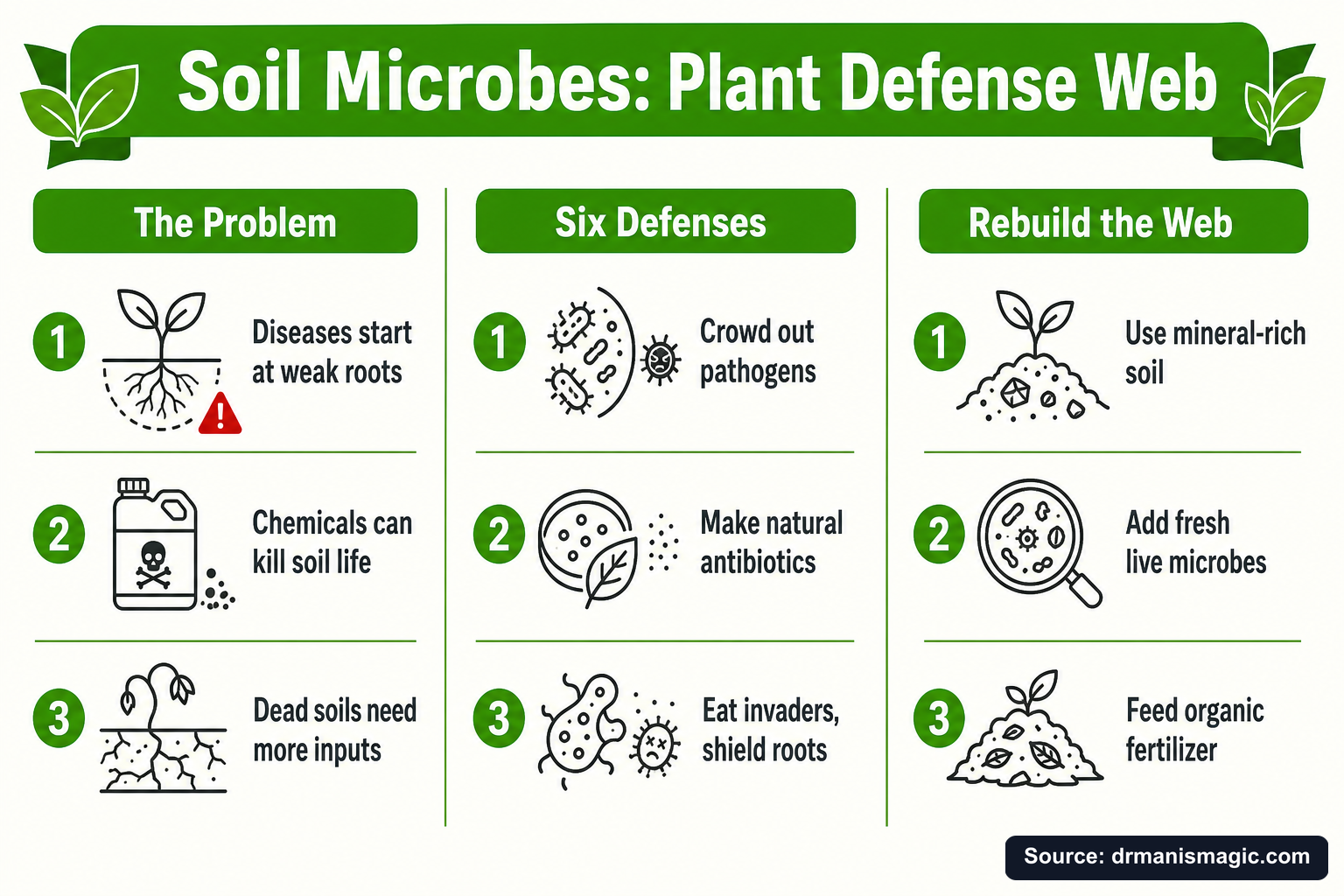
- Healthy soil holds a living web of bacteria, fungi, protozoa, and nematodes that protect plant roots from disease — naturally.
- This microbial web works through six overlapping mechanisms: competition, antibiosis, predation, parasitism, induced resistance, and physical root shielding.
- Synthetic salt-based fertilizers, fungicides, herbicides, and pesticides destroy this web — leaving roots defenseless and soils dependent on chemical inputs forever.
- Most commercial microbial products fail because the microbes are dead before you open the bottle — dried powders and anaerobic liquids rarely colonize roots.
- Soil damaged by chemicals, fumigation, or compaction can be rebuilt — but it takes staged, intentional restoration, not just a one-time treatment.
- The Three Plant Pillars — mineral soil, live microbes, and organic fertilizer — work together as a complete system to restore and sustain this living web.
- Dr. Mani's Magic Plant Super Boost delivers genuinely live, full-spectrum microbes harvested from fresh compost — verified under a microscope.
How Do Soil Microbes Actually Protect Plants From Disease?
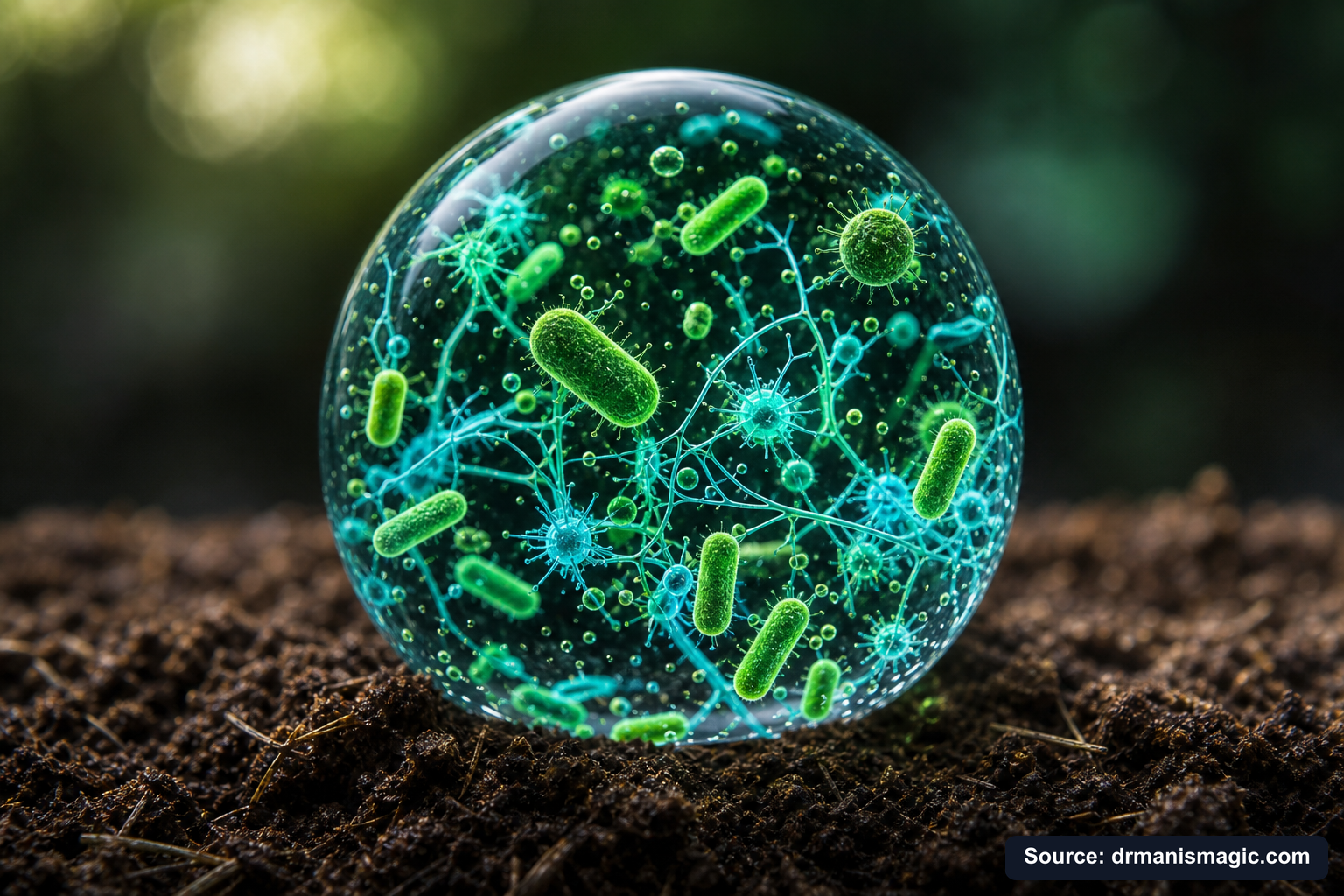
Quick Answer: Soil microbes protect plants by crowding out harmful pathogens, producing natural antibiotics, eating disease-causing organisms, triggering the plant's own immune system, and wrapping roots in a dense physical shield of fungal threads. No single microbe does it all — the whole web works together.
Beneficial soil microbes do not protect plants in just one way. They use six overlapping strategies at the same time. Think of it like a castle with six layers of defense. Each layer stops what the others miss.
Layer 1: Competition. Beneficial bacteria and fungi rush to root surfaces first. They eat the same sugars and minerals that harmful pathogens need to grow. No food, no invasion. The good guys win simply by being there in massive numbers.
Layer 2: Antibiosis. Many beneficial bacteria produce natural antibiotics and antifungal compounds. These are not man-made chemicals. They are substances that have been evolving for hundreds of millions of years, precision-made to target specific pathogens. Bacillus species, for example, are well documented by university extension researchers at UC Agriculture and Natural Resources for suppressing Pythium and Rhizoctonia — two of the most common causes of root rot and damping-off in home gardens.
Layer 3: Predation and Parasitism. Certain fungi directly attack and parasitize pathogenic nematodes and fungal invaders. Protozoa and beneficial nematodes eat harmful bacteria. This is a war being fought in a tablespoon of healthy soil every single minute of every day.
Layer 4: Induced Resistance. When beneficial microbes colonize roots, they send chemical signals up into the plant. The plant reads those signals and activates its own immune system. This is called Induced Systemic Resistance (ISR). The plant becomes primed — ready to fight — before any disease even arrives.
Layer 5: Better Nutrition. A well-fed plant is a harder target. When microbes unlock nutrients from the soil, the plant builds thicker cell walls, stronger stems, and more resilient leaves. Nutrient-deficient plants, on the other hand, are easy prey for pathogens that target weak tissue.
Layer 6: Physical Root Shielding. Mycorrhizal fungi weave a dense mat of threads, called hyphae, around and through root cells. This mesh is both a physical barrier and a communication network. It is so dense that many pathogens literally cannot reach the root surface to start an infection.
Miss even two or three of these layers, and your plant's defenses collapse. That is exactly what happens when you sterilize soil, drench it in synthetic fungicides, or feed it salt-based fertilizer. You strip away the army your plant was counting on.
What Is the Soil Food Web and Why Does It Matter for Your Garden?
Quick Answer: The soil food web is the interconnected community of living organisms in healthy soil — bacteria, fungi, protozoa, nematodes, arthropods, and earthworms — that cycle nutrients, build soil structure, and suppress plant diseases. When this web is intact, plants grow stronger and need far fewer interventions.
Most people think of soil as dirt. Just something to hold roots in place. But healthy soil is alive in a way that would astonish you.
According to research from USDA Natural Resources Conservation Service, a single teaspoon of healthy forest soil contains up to one billion bacteria, several yards of fungal threads, thousands of protozoa, and hundreds of nematodes. All of them working. All of them connected.
Here is how the web flows — from root to microbe and back again:
- Roots release sugars. Your plant pushes liquid sugar through its roots into the soil. This is called root exudate. It is the plant feeding the microbes on purpose.
- Bacteria and fungi flood in. They eat the sugars. In exchange, they break down minerals and organic matter into forms the plant can actually absorb. They also produce compounds that repel pathogens.
- Protozoa and nematodes arrive. They graze on bacteria and fungi. When they do, they release stored nitrogen directly into the root zone — plant-available nitrogen, at exactly the right spot, at exactly the right time. No bag of fertilizer can match that precision.
- The cycle sustains itself. Organic matter feeds bacteria. Bacteria feed protozoa. Protozoa release nutrients. Nutrients feed plants. Plants feed roots. Roots feed bacteria again.
This is what happens in every wild forest, every untouched prairie, every natural meadow on earth. Plants have been thriving inside this web for 450 million years. No fertilizer bag. No fungicide spray. Just the web, working.
| Organism | What It Does for Your Plant | Disease Protection Role |
|---|---|---|
| Beneficial Bacteria | Break down organic matter, fix nitrogen from air, produce plant growth hormones | Compete with pathogens, produce natural antibiotics, trigger plant immune response (ISR) |
| Mycorrhizal Fungi | Extend root surface area up to 700x, unlock phosphorus and minerals | Physically shield roots, block pathogen entry, improve plant nutrition and stress tolerance |
| Other Beneficial Fungi | Decompose tough organic matter, produce glomalin for soil structure | Parasitize harmful nematodes, compete with disease fungi like Fusarium |
| Protozoa | Graze on bacteria, releasing plant-available nitrogen into root zone | Regulate bacterial populations, support nutrient-driven plant immunity |
| Beneficial Nematodes | Graze on bacteria and fungi, cycle nutrients | Prey on harmful nematodes, parasitize soil-dwelling insect larvae |
| Earthworms | Aerate soil, create channels for water and roots | Distribute microbes through soil, improve drainage that suppresses anaerobic pathogens |
What Is the Rhizosphere and Why Is It the Most Important Place in Your Garden?
Quick Answer: The rhizosphere is the thin zone of soil directly around plant roots — roughly the width of a few grains of sand. It is the most biologically active place on earth, where roots feed microbes, microbes protect roots, and the exchange of nutrients and defense signals happens constantly. This is where plant disease is won or lost.
The rhizosphere is not a big place. It is the narrow ring of soil within a few millimeters of each root tip. But the microbial density there is staggering — up to 100 times higher than in the surrounding soil. Why? Because roots are pumping out sugar, amino acids, and vitamins. It is an all-you-can-eat buffet for microbes.
And the microbes pay rent. They surround the root in a living shield. They intercept pathogens before those pathogens can touch root tissue. They produce chemical signals that travel up through the plant and turn on its internal defense genes.
Here is the part most gardeners never hear: the plant chooses which microbes to feed. Roots release different sugars depending on what the plant needs. Need more phosphorus? The root feeds phosphorus-unlocking bacteria. Under pathogen attack? The root releases compounds that attract bacteria known to fight that exact pathogen. This is not random. This is communication. This is intelligence in the soil.
When you sterilize your potting mix, drench your garden with broad-spectrum fungicides, or pour synthetic salt fertilizer into the root zone, you are not just killing bad things. You are silencing this entire conversation. You are cutting the lines of communication your plant has been relying on since the beginning of life on earth.
After 30 years of growing at our South Texas nursery — after testing our system on over 250,000 trees — we can tell you with certainty: the rhizosphere is where the game is won or lost. Feed it right, and your plants become nearly bulletproof. Ignore it, and no amount of spraying will save you long-term.
Are All Nematodes Bad for Plants? Understanding the Beneficial Side
Quick Answer: No. Most nematodes in healthy soil are beneficial. They graze on bacteria and fungi, cycling nutrients directly into the root zone. Some species actively hunt and kill the harmful root-knot nematodes that destroy crops. The problem is not nematodes — it is the absence of a balanced soil food web that keeps harmful species in check.
The word "nematode" scares most gardeners. Understandably. Root-knot nematodes destroy vegetable gardens. They are real, and they are damaging. But here is what most people never learn: those harmful species are kept in check by predatory nematodes and other food-web organisms in healthy soil.
When you have a thriving soil food web, harmful nematodes rarely reach damaging population levels. There are simply too many things eating them, outcompeting them, and parasitizing them. It is only when the web collapses — through sterilization, fumigation, heavy pesticide use, or salt-based fertilizer damage — that harmful nematodes explode in number. There is no longer anything keeping them in check.
This is a theme you will see again and again in plant disease. The problem is almost never one bad organism. The problem is the collapse of the system that was keeping that bad organism controlled.
What Destroys the Microbial Web in Your Soil?
Quick Answer: Synthetic salt-based fertilizers, broad-spectrum fungicides, herbicides like glyphosate, fumigation, soil sterilization, compaction, and bare soil all damage or destroy the microbial web. Even one heavy application of the wrong input can wipe out years of biological rebuilding. The damage is invisible but the consequences show up fast: root rot, disease outbreaks, and stalled growth.
Here is the honest truth about most commercial gardening products: they were not designed to build a living soil. They were designed to be easy to sell.
Salt-based synthetic fertilizers push a quick green-up. But the salts that dissolve in water and rush nutrients into the plant are the same salts that create a hostile environment for bacteria and fungi. High salt concentrations pull water out of microbial cells through osmosis — the same way road salt kills grass. The microbes shrink, shut down, and die. Every time you pour salt fertilizer on your soil, you are choosing short-term color over long-term biology.
Fungicides are even more direct. A broad-spectrum fungicide cannot tell the difference between Fusarium — the bad guy — and mycorrhizal fungi — your plant's most important ally. It kills both. Repeatedly. Until the beneficial fungal web is gone and only the fastest-reproducing pathogens — the ones that recover quickest — are left.
Herbicides like glyphosate have been shown in multiple research studies to disrupt microbial community balance in the rhizosphere. And compacted soil — whether from heavy foot traffic, over-watering, or organic potting mix that has broken down into sludge — squeezes out the oxygen that beneficial aerobic bacteria need to survive. When oxygen disappears, anaerobic pathogens like Pythium move in. Root rot follows.
See also: The Hidden Reason Synthetic Fertilizers Cause Root Rot
| Practice or Input | Effect on Soil Biology | What to Do Instead |
|---|---|---|
| Salt-based synthetic fertilizers | Osmotic stress kills bacteria and fungi in root zone | Use organic, slow-release fertilizer with no synthetic salts |
| Broad-spectrum fungicides | Kill beneficial fungi alongside pathogens | Use targeted biological controls; re-inoculate with live microbes |
| Glyphosate and herbicides | Disrupt microbial community balance and diversity | Mechanical weeding; targeted organic options |
| Soil sterilization or fumigation | Wipes out all soil biology — good and bad | Allow recovery time; staged re-inoculation with full-spectrum microbes |
| Organic potting mix breakdown | Creates compaction and anaerobic zones where pathogens thrive | Use permanent mineral-based soil that does not decompose |
| Bare soil for extended periods | Destroys microbial habitat; UV kills surface bacteria | Mulch, cover crops, or living ground cover |
| Compaction from heavy traffic | Removes oxygen; kills aerobic beneficial bacteria | Aerate; improve drainage; use mineral-based soil |
You Never Had a Brown Thumb.
You were handed the wrong tools. This free guide hands you the right ones.
You watered it. You fed it. It died anyway.
It was never you. It was the dirt, the salt food, and the bad advice.
This guide shows you what really went wrong, and how to fix it for good.
- Why your plants really died, and why it was never your fault
- The salt hiding in your plant food that quietly burns the roots
- The hidden killer in almost every bag of store soil
- The tiny helpers that grow a whole forest for free
- The rescue trick that brings a half dead plant back to life

Live Microbes vs. Dead Microbes: Why Most Microbial Products on Shelves Simply Do Not Work
Quick Answer: Most commercial microbial products deliver dead or dormant microbes that never colonize your roots. Dried powders are made in bulk factories and rarely reactivate. Anaerobic liquid products stink because the microbes are dying. Genuinely live, full-spectrum microbials — stabilized without going anaerobic — are rare and far more effective. If the bottle smells like sewage, the microbes are already gone.
This is the part of the story that the microbial product industry hopes you never figure out.
Walk into any garden center today and you will see shelves of mycorrhizal powder, probiotic soil inoculants, and liquid biology products. The labels look impressive. The claims sound amazing. But after growing over 250,000 trees at our South Texas nursery and testing dozens of commercial microbial products over the years, we found the same result over and over: most of them simply do not work.
Here is why.
The Dried Powder Problem. Most commercial microbial products are made in large industrial fermentation tanks. The bacteria or fungi are grown in bulk, then spray-dried into a powder. The idea is that the dormant spores will "wake up" when you add water and pour them on soil. But the drying process, storage time, heat during shipping, and exposure to light and oxygen damage the cells. By the time that powder reaches your garden, the survival rate is extremely low. We tested batch after batch. The plants showed no improvement.
The Smelly Liquid Problem. Some companies harvest microbes from compost or worm castings and bottle them as a liquid. This sounds better. And it is — for about 24 hours. After that, the liquid goes anaerobic. The oxygen runs out. The beneficial aerobic microbes die. Anaerobic bacteria take over and the bottle starts producing gas and a foul, sulfur-like odor. If your microbial product smells like rotten eggs or sewage, the biology you paid for is already dead. The only value left is residual organic compounds like humic acid — which have some benefit, but nothing close to live microbiology.
The Lactobacillus Trap. Some products use lactobacillus bacteria — the same culture in yogurt. It is easy to grow and stays alive. But lactobacillus is so aggressive that it crowds out the other beneficial species you actually need. It belongs in your gut, not your soil. We do not include it in Plant Super Boost for exactly this reason.
The solution Dr. Mani discovered — through a providential meeting with a world-famous compostologist who had advised royal families and governments before being blacklisted by large chemical companies — was a natural stabilization technique. A way to keep a full spectrum of microbes harvested from fresh, active compost alive in a bottle, without going anaerobic, without the stench, without the factory floor shortcuts.
The result is Plant Super Boost — a liquid microbial formula you can actually see working under a microscope. Real movement. Real life. Backed by lab analysis. And it smells like fresh earth, not a sewage pond, because the microbes are alive and stable — not dying and fermenting.
| Product Type | Microbe Viability at Use | Spectrum of Organisms | Odor | Our Recommendation |
|---|---|---|---|---|
| Dried/powdered lab microbes | Very low — most cells damaged in drying | Narrow (1-5 species) | Odorless | Avoid — we saw no results across dozens of batches |
| Rehydrated dried powder | Very low — same damage as above | Narrow | Odorless | Avoid |
| Compost tea (fresh, under 24 hours, aerated) | Moderate — depends on aeration and freshness | Partial — depends on compost quality | Earthy, mild | Good if made fresh on-site; impractical for most gardeners |
| Compost tea (older than 24 hours) | Low — anaerobic conditions kill beneficials | Partial | Strong foul odor | Not recommended |
| Fresh active compost (on-site) | High — teeming with biology | Broad, natural | Earthy | Excellent — but requires time, space, and labor |
| Plant Super Boost (stabilized, full-spectrum) | High — visible under microscope, lab verified | 2,000+ bacteria species; 400-500 fungi including mycorrhizae; protozoa; nematodes | Earthy, mild | Recommended — harvested from compost, not lab-grown; stable without going anaerobic |
How Do You Restore Biologically Dead or Damaged Soil?
Quick Answer: Restoring damaged soil biology takes multiple steps and consistent effort over weeks to months. You cannot fix it with one product in one weekend. Stop the inputs that caused the damage first. Then rebuild systematically: improve soil structure, add organic matter, reintroduce live microbes, plant diverse roots, and maintain moisture and aeration. Avoid re-sterilizing once recovery begins.
Maybe you inherited a garden that was fumigated. Maybe you used a heavy fungicide program for years. Maybe you bought a tree from a big box store, potted it in sterile sawdust mix, and fed it synthetic fertilizer until the roots gave up. Maybe you just had a brown thumb and are finally ready to understand why.
Whatever got you here, the good news is: biology comes back. But it needs help. And it needs the right sequence.
Here is the Sterile Soil Recovery Plan we have developed over 30 years of growing:
- Stop the damage first. Before you add anything beneficial, stop adding what is destroying it. No more synthetic salt-based fertilizers. No more broad-spectrum fungicides unless there is a genuine, specific disease emergency. No more herbicides near root zones. This is the most important step and the most overlooked one.
- Fix the physical foundation. Biology cannot thrive in compacted, oxygen-starved soil. If you are growing in a container, switch to a permanent mineral-based soil that does not decompose and collapse. If you are in a garden bed, aerate and top-dress with clean organic matter. Roots need to breathe. So do microbes. Our Super Soil was engineered for exactly this: a mineral-based, permanent growing medium from the Rio Grande Valley that drains well, stays aerated, and does not rot into sludge over time.
- Add clean organic matter. Compost (not synthetic fertilizer) feeds the first wave of returning microbes. It gives them something to eat while they rebuild populations. Use compost without biosludge or PFAS contamination — zero biosludge, zero synthetic salts, zero forever chemicals.
- Inoculate with genuinely live, full-spectrum microbes. This is where most people start — but it is actually step four, not step one. Introducing live microbes into a soil that is still compacted, still salted, and still being drenched in fungicide is like releasing fish into a chlorinated swimming pool. Fix the environment first. Then inoculate monthly with a full-spectrum product.
- Keep living roots in the soil. Roots feed microbes. Bare soil starves them. Plant something — anything — as quickly as possible. Diverse plant roots feed a more diverse microbial community. Diversity equals resilience.
- Maintain moisture and aeration together. Aerobic beneficial bacteria need oxygen. They also need moisture. The balance is consistent, even watering in a well-draining medium — not soggy, not bone dry. This is another reason organic potting mix that breaks down and compacts is so damaging: it swings between waterlogged and bone dry, killing microbes on both ends.
- Be patient, and be consistent. Rebuilding a food web takes weeks to months, not days. Expect to see improvement within 30 days of doing all of this correctly. Full recovery — the kind where your soil feels alive and your plants stop struggling — takes a full growing season in most cases. Monthly applications of live microbes dramatically speed this up.
This is not theory. We rebuilt microbially depleted soils at our nursery. We watched trees that had been in sterile potting mix, fed synthetic fertilizer, and treated with fungicide for years come back to life when we switched them to the Three Plant Pillars system. The turnaround is real. But you have to stop doing the things that caused the damage first.
Should You Buy Mycorrhizal Fungi Products? A Practical Decision Guide
Quick Answer: Mycorrhizal inoculants are most valuable when soil has been sterilized, fumigated, compacted, or repeatedly treated with fungicides. They are less necessary when healthy native mycorrhizal communities already exist. The key question is not whether to use them — it is whether the product you buy actually contains living, viable fungal propagules or just dead spores in expensive packaging.
Mycorrhizal fungi are one of the most important organisms in the soil food web. They form a direct physical partnership with plant roots, weaving threads through and around root cells and extending the root system's effective reach by up to 700 times. They unlock phosphorus. They block pathogens. They improve drought tolerance. They are, in many ways, the keystone organism of the microbial web.
But not all mycorrhizal products deliver what they promise. Here is a practical decision guide:
When mycorrhizal inoculants are most valuable:
- Sterile growing media — potting mixes, raised beds, greenhouse benches
- Recently fumigated or solarized soil
- Transplants going into disturbed or compacted ground
- Mined or graded soils with no biological history
- Low-phosphorus growing conditions
- Container trees and perennials with long growing cycles
When mycorrhizal inoculants add less value:
- Healthy native soil with intact existing mycorrhizal networks
- Brassica family plants (cabbage, broccoli, kale) — they do not form mycorrhizal relationships
- High-phosphorus soil — excess phosphorus suppresses mycorrhizal colonization
- When the product label cannot confirm viable propagule counts or has passed its shelf life
The single most important question to ask about any mycorrhizal product is: are the spores alive? Mycorrhizal spores are more durable than bacteria, but they still degrade with heat, age, and improper storage. A product that sat in a warehouse at 110 degrees Fahrenheit during a summer shipment may have zero viable propagules left by the time it reaches your door.
This is exactly why Plant Super Boost includes mycorrhizal fungi as part of a broader, full-spectrum living system — not as isolated dried spores in a packet, but as part of a stabilized, verified-live community of over 2,000 bacterial species, 400 to 500 fungal species including mycorrhizae, plus protozoa and nematodes. The entire web, in one bottle.
How Does the Three Plant Pillars System Rebuild the Microbial Web?
Quick Answer: The Three Plant Pillars work together as a complete system. Mineral-based soil provides oxygen and drainage so microbes can breathe and thrive. Live microbials re-establish the food web around roots. Organic fertilizer feeds both the plant and the microbes without the salt damage that kills biology. All three pillars must be in place — none of them work as well alone.
After 35 years of research and teaching at the Texas A&M Citrus Center, Dr. Mani Skaria — Professor Emeritus of Plant Pathology, inventor of micro-budding, and founder of the Clean Citrus Program in Texas — had seen every soil problem imaginable. Root rot. Fungal blight. Bacterial wilt. Nutrient lockout. Trees that cost hundreds of dollars and died within a year.
The common thread in every failure was not bad luck. It was a broken foundation. Missing one, two, or all three of the pillars that healthy plant life depends on.
Pillar 1: Mineral-Based Soil. Most potting mixes are made from pine bark, wood chips, or peat. They feel light and fluffy when you first open the bag. But within six to twelve months, they start breaking down. They compact. They hold water in pockets while leaving roots dry in others. They steal oxygen from the root zone as they decompose. And when oxygen disappears from the root zone, anaerobic pathogens like Pythium — the most common cause of root rot — move in.
Mineral-based soil does not decompose. It does not compact into sludge. It drains perfectly and stays aerated permanently. This creates the oxygen-rich environment where beneficial aerobic bacteria and fungi thrive — and where Pythium and other anaerobic pathogens cannot survive. See also: Why Most Potting Mix Collapses Within 6-12 Months
Pillar 2: Live Microbials. Once the soil structure is right, you need to populate it with the right organisms. Not dried powders. Not anaerobic liquids. Genuinely live, full-spectrum biology. This is the invisible workforce that protects roots, cycles nutrients, and activates the plant's own immune system.
Pillar 3: Organic Fertilizer. The final piece is food — but food that works with the biology, not against it. Salt-based synthetic fertilizers kill microbes at the same time they force-feed the plant. Organic fertilizers from crab meal, kelp, and amino acids release nutrients slowly, in harmony with microbial activity. They feed the plant and the microbes simultaneously, building a self-sustaining system over time.
All three pillars are available together through the Three Plant Pillars system at Dr. Mani's Magic. It is the same system we use at our nursery. The same one that produced over 250,000 healthy trees. The same one that works on lawns, flower beds, houseplants, orchards, raised vegetable gardens, and container trees across every climate in America.
And if you want to go deeper on exactly what happens to your plant when salt fertilizer meets soil biology, read: See also: How Salt-Based Feeding Quietly Destroys Root Systems

What Can You Do Right Now to Start Protecting Your Plants?
Quick Answer: Start with three immediate actions: stop using synthetic salt-based fertilizers and broad-spectrum fungicides, fix your soil structure so roots can breathe, and introduce genuinely live microbes monthly. These three steps alone will begin rebuilding the microbial web your plant has been waiting for.
You do not need a PhD. You do not need to spend a weekend mixing compost tea at 6 in the morning. You do not need to parse through contradictory advice on a Facebook gardening group until your eyes cross.
Here is what you do right now, today:
- Look at what you are currently feeding your plants. If it is a synthetic salt-based fertilizer, it is damaging the biology your plant needs to fight disease. Swap it for an organic, slow-release option with no synthetic salts, no biosludge, and no PFAS.
- Look at your soil. If it is an old organic potting mix that has been in the pot for more than a year, it has likely decomposed into an oxygen-starved sludge. This is the perfect environment for root rot and pathogens. Replace it with a permanent mineral-based growing medium.
- Add live microbes monthly. Not a dried powder. Not a smelly anaerobic liquid. A genuinely live, full-spectrum microbial product that you can verify is active before you open it. Soil that has been damaged by chemicals, sterilization, or poor inputs needs consistent biological reinforcement — not a one-time dose.
That is the whole system. Three things. Mineral soil. Live microbes. Organic fertilizer. The Three Plant Pillars that Dr. Mani spent 40 years proving at the Texas A&M Citrus Center and then in our own nursery across a quarter million trees.
People tell us all the time that the number one thing they want is to see their tree bear fruit while they still can. To taste something they grew with their own hands. To walk out into the garden they imagined when they first picked up that little sapling. The heartbreak is not just losing the plant. It is losing the months and years it took to get there. Time you cannot get back.
The good news? When the foundation is right — when the soil breathes, when the microbes are alive, when the fertilizer works with biology instead of against it — plants stop struggling and start thriving. Fast. The web does the work. You just have to let it.
If you want to see what the right microbial foundation looks like — and see the difference between genuinely live biology and the dead powders on most store shelves — explore the Free Plant Care Field Guide and read what thousands of real growers have experienced at our customer reviews page. Your plants are waiting for what they were always meant to have.
Frequently Asked Questions
If your plants keep getting sick no matter what you try, you are not alone. Most gardeners are fighting disease the wrong way because nobody ever told them about the living web under the soil. These questions get right to the heart of what is really going on down there, and what you can do about it starting today.
How do soil microbes protect plants from disease?
Healthy soil is packed with billions of bacteria, fungi, and other tiny organisms that work like a security team for your roots. They crowd out harmful pathogens, produce natural antibiotics, and even trigger your plant's own immune system. Dr. Mani's Magic Plant Super Boost delivers genuinely live microbes straight to your roots. We proved this system works across more than 250,000 trees at US Citrus Nursery. When the microbial web is alive, plants become nearly bulletproof against common diseases like root rot and fungal blight.
What destroys the protective web in my soil?
Synthetic salt-based fertilizers are the biggest culprit. They wipe out beneficial bacteria and fungi every time you use them. Chemical fungicides, herbicides, and pesticides add to the damage. Big box store products feel like quick fixes, but they leave your roots completely defenseless over time. That is the trap. The Three Plant Pillars from Dr. Mani's Magic rebuild what those chemicals destroy, starting with live microbes, mineral soil, and clean organic fertilizer.
Why do most microbial products from stores fail?
Most products on the shelf are already dead before you open them. Dried powders and poorly stored liquid microbes lose their potency fast. They cannot colonize your roots because there is nothing alive left to do the work. Dr. Mani's Magic Plant Super Boost uses a special stabilization method developed by a master compost expert. The microbes stay alive and ready to work the moment they hit your soil. You can even smell the difference. It smells like fresh earth, not something rotting.
Can damaged soil actually recover from years of chemical use?
Yes, but it takes the right approach. A one-time treatment will not cut it. Soil that has been hit hard by chemicals, compaction, or synthetic fertilizers needs staged, intentional restoration. That means getting the foundation right first. Start with mineral-based soil like Dr. Mani's Magic Super Soil, which does not break down or compact like sawdust-based potting mixes. Then add live microbes and organic fertilizer. Most gardeners see real improvement within the first 30 days when all three pillars are in place.
How do plants fight disease on their own?
Plants have built-in defenses. They use tough outer layers to block invaders. They produce toxic compounds to kill pathogens. When one part of the plant is attacked, it sends warning signals so the rest of the plant can prepare. But here is the key thing most people miss. These natural defenses work best when the microbial web in the soil is strong and healthy. Microbes and plant defenses work together as a team. Weaken one and you weaken both.
Is there a natural way to protect plants from bacteria and fungal disease without harsh chemicals?
Absolutely. Beneficial microbes produce their own natural antifungal and antibacterial compounds that have been evolving for hundreds of millions of years. They are far more targeted than anything in a spray bottle. Bacillus bacteria, for example, are well documented for suppressing Pythium and Rhizoctonia, two of the most common causes of root rot. Dr. Mani's Magic Plant Super Boost is loaded with these living defenders. No toxic labels, no re-entry warnings, no fear of it splashing on your skin or your kids running through the yard.
How long does it take to see results when rebuilding the microbial web?
Most gardeners notice a real difference within 30 days. Plants look stronger. New growth comes in greener. Disease pressure drops. The key is using all three pillars together, not just one product alone. Mineral soil gives roots room to breathe. Live microbes go to work immediately in the root zone. Organic fertilizer from crab, kelp, and amino acids feeds everything slowly and cleanly without burning or disrupting the microbial team you just built. Time is the one thing you cannot get back. The best day to start was yesterday. The second best day is right now.
About the Author
Ron Skaria, MD
Ron Skaria, MD, is the co-founder of Dr. Mani's Magic and the son of Dr. Mani. He trained as a medical doctor at Baylor College of Medicine, did his residency at UT Health Science Center - San Antonio and fellowship training at Texas Tech University. He now works full time on the family farm at US Citrus and US Citrus Nursery in Hargill, Texas, building Dr. Mani's Magic alongside his dad. He wrote the Brown Thumb Field Guide to put his father's 48 years of plant science into plain words any gardener can use. His belief is simple. You never had a brown thumb. You just never had the right help.


