


The Microbial Shield That Keeps Roots Alive and Healthy | Dr. Mani's Magic
The Microbial Shield That Keeps Roots Alive: How Invisible Allies Protect Every Plant You Grow
Picture this. You walk outside on a Saturday morning, coffee in hand, and you stop dead in your tracks. Your tree looks wrong. The leaves are yellowing at the edges. A few branches droop like they gave up overnight. You watered it. You fertilized it. You did everything the bag said to do. And yet here you are, watching something you love slowly fall apart.
You kneel down and press your fingers into the soil near the base. It smells off. Musty. Maybe even a little like something rotting. You pull back some of the top layer and the roots underneath look pale, soft, and wrong. Not the firm, white, healthy roots you remember seeing when you first planted it. Something killed them. And here is the part nobody ever tells you: it probably was not what you think.
The real culprit is invisible. It lives in the soil, or rather, it used to. There is an entire living army that surrounds healthy roots and keeps them safe. Billions of bacteria. Hundreds of species of fungi. Tiny protozoa. Microscopic nematodes. Together, they form what scientists call the rhizosphere microbiome. The rest of us can just call it what it is: the microbial shield that keeps roots alive. When that shield is intact, plants are nearly bulletproof. When it collapses, even the best watering schedule in the world cannot save them.
Key Takeaways
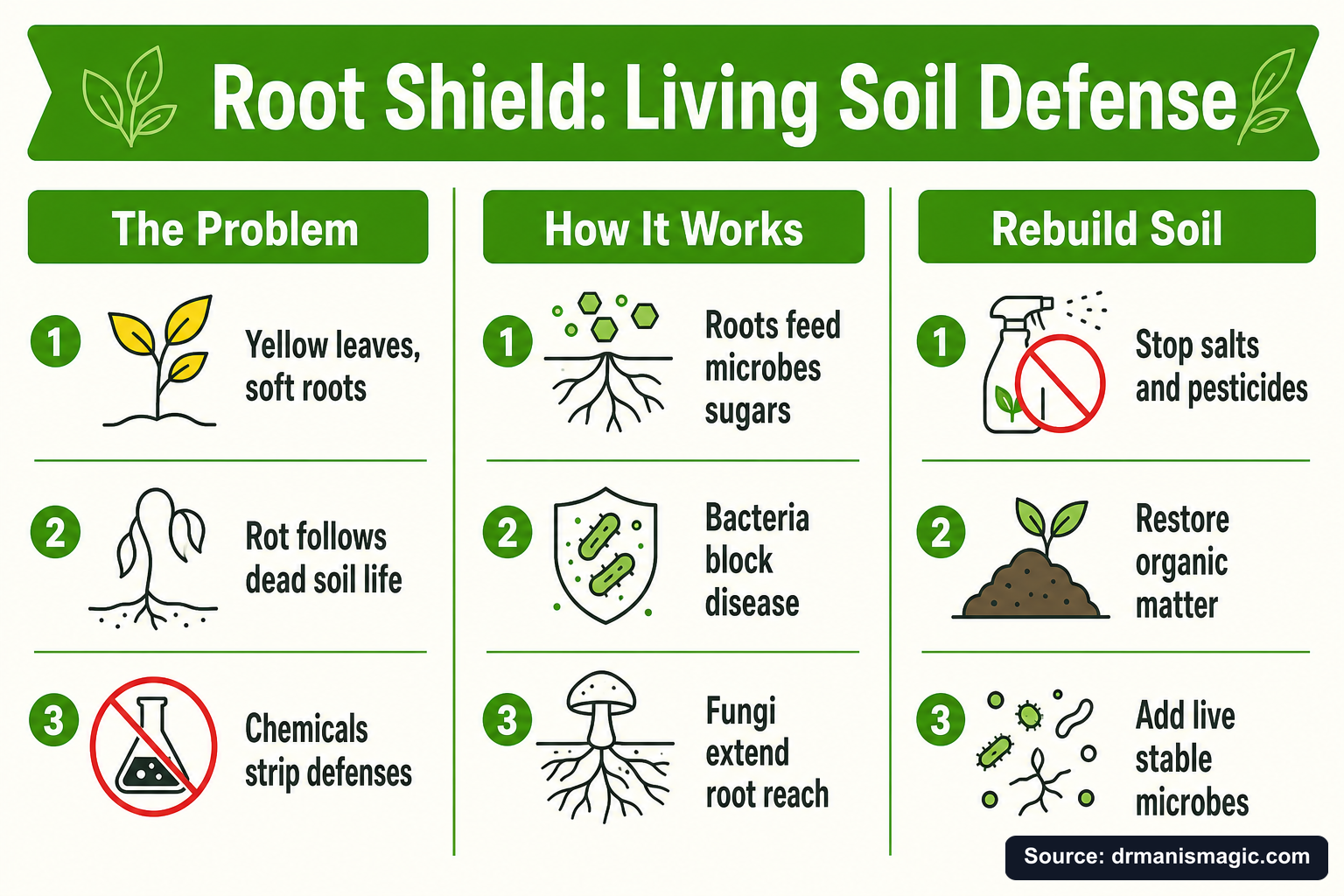
- Healthy roots are surrounded by a living shield of bacteria, fungi, protozoa, and nematodes that block disease, unlock nutrients, and extend the root system far beyond what roots could reach alone.
- Mycorrhizal fungi can expand the effective root surface area by up to 1,000 times, according to Colorado State Extension research.
- Salt-based synthetic fertilizers, herbicides, fungicides, and pesticides all destroy the microbial shield, leaving roots naked and vulnerable to rot and disease.
- Most store-bought microbial products use dried, lab-grown spores or anaerobic liquids that smell foul and deliver weak, if any, results.
- After growing over 250,000 trees at US Citrus Nursery in South Texas, Dr. Mani Skaria built a three-pillar system around live, stabilized microbes that stay biologically active from bottle to root zone.
- Sterile or damaged soil can be rebuilt, but it takes stopping the damage, restoring organic matter, and reintroducing genuinely live biology in the right order.
- The Three Plant Pillars, mineral-based soil, live microbials, and organic fertilizer, work together as a complete system, not a collection of separate fixes.
What Exactly Is the Microbial Shield Around Your Roots?
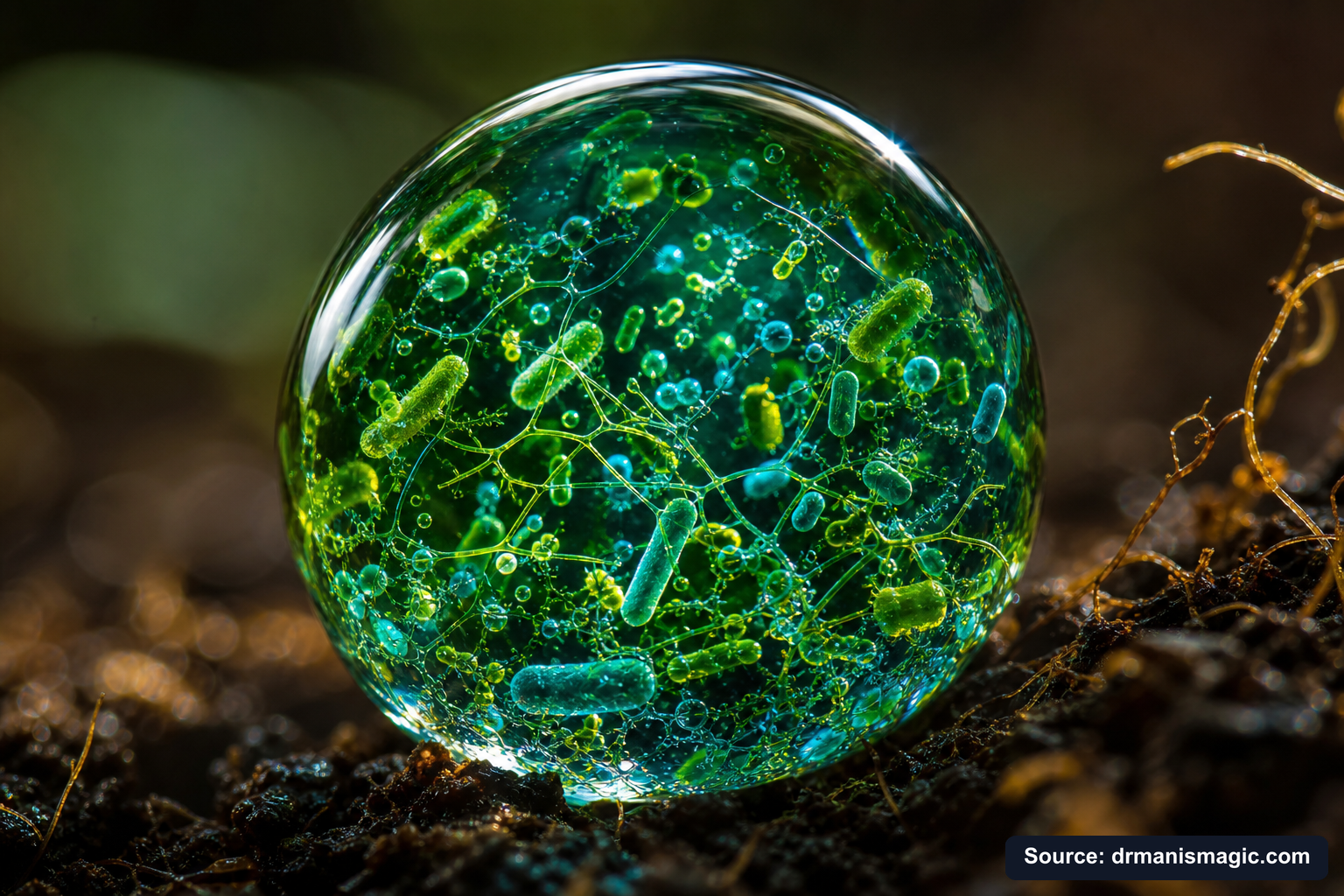
Quick Answer: The microbial shield is the dense living community of bacteria, fungi, protozoa, and beneficial nematodes that naturally colonizes the soil zone directly around plant roots. These organisms physically occupy root surfaces, compete with pathogens for space and food, and supply plants with nutrients, water access, and disease resistance around the clock.
Scientists call it the rhizosphere. It is the thin zone of soil that clings directly to your roots. And it is nothing like the dead brown dirt you see in most potted plants or depleted backyard beds.
In a healthy rhizosphere, the soil is absolutely alive. Teeming. Buzzing with invisible activity every second of every day. The University of Florida's IFAS Extension describes beneficial rhizosphere microbes as forming a protective barrier over root surfaces that limits pathogen access while simultaneously supplying nitrogen, phosphorus, micronutrients, and stress tolerance the plant cannot get any other way.
Here is the simple version. Your roots leak sugar. On purpose. Plants pump a steady stream of sugary compounds called root exudates out through their root tips. This is not a mistake. It is the plant's way of recruiting help. Those sugars attract bacteria, fungi, and a whole ecosystem of tiny organisms. They rush in to feed. And in return, they go to work for the plant.
It is one of the most elegant deals in all of nature. The plant feeds the microbes. The microbes feed and protect the plant. And this partnership has been running for hundreds of millions of years, long before humans ever picked up a watering can.
The problem is that modern gardening breaks this deal almost every single time.
Who Are the Players Inside the Microbial Shield?
Quick Answer: The microbial shield is built by four main groups working together: beneficial bacteria that decompose organic matter and fix nitrogen, mycorrhizal fungi that physically extend the root system, protozoa that graze on bacteria and release plant-ready nutrients, and beneficial nematodes that regulate the food web and suppress harmful organisms.
Most gardening advice lumps all "soil life" together like it is one thing. It is not. There is a whole cast of characters here, and each one has a specific job.
Think of it like a hospital. You have surgeons, nurses, pharmacists, janitors, and security guards. Remove any one group and the whole system starts breaking down. The microbial shield works the same way.
| Organism Group | Main Job | What Your Plant Gets |
|---|---|---|
| Beneficial Bacteria | Break down organic matter, fix nitrogen from the air, solubilize phosphorus, produce antibiotics against pathogens | Steady nitrogen supply, disease suppression, improved soil structure |
| Mycorrhizal Fungi | Extend root reach with hyphal threads, trade water and minerals for plant sugars, block pathogen entry points | Up to 1,000x more absorbing surface, drought resistance, phosphorus, trace minerals |
| Protozoa | Graze on bacteria, releasing nitrogen and other nutrients in plant-available forms, regulate bacterial populations | Mineralized nitrogen delivered right at the root zone |
| Beneficial Nematodes | Feed on bacteria, fungi, and harmful nematodes, cycle nutrients through the food web, help regulate pest populations | Nutrient release, pest suppression, food web balance |
| Saprophytic Fungi | Decompose dead plant material into humus, build soil aggregates using a sticky protein called glomalin | Better soil structure, aeration, long-term organic matter |
| Nitrogen-Fixing Bacteria | Pull nitrogen gas directly from the air and convert it into forms roots can absorb | Free nitrogen fertilizer without a single bag from a store |
Notice that protozoa and beneficial nematodes are on that list. Most gardening content skips right over them. But they are essential. Without protozoa grazing on bacteria, the nutrients locked inside those bacterial cells never get released to the plant. It is like having a warehouse full of food with no delivery driver. The protozoa are the delivery drivers.
Oklahoma State Extension notes that mycorrhizal fungi form beneficial relationships with roughly 80 to 90 percent of all plant species on Earth. That means almost every plant you own, from your lawn grass to your fruit trees to the fiddle-leaf fig in your living room, is built to run on this fungal partnership. When the fungi are missing, the plant is running at a fraction of its potential.
Why Do Mycorrhizal Fungi Matter So Much for Root Survival?
Quick Answer: Mycorrhizal fungi attach to roots and send out thin threads called hyphae that reach far into the soil where roots cannot go. Colorado State Extension reports these fungi can increase the effective absorbing area of roots by 100 to 1,000 times, delivering water, phosphorus, and micronutrients while physically blocking pathogen invasion routes.
Next time you pull a weed from your garden, look at the roots before you toss it. Do you see fine white fuzz clinging to them? That is mycorrhizae. That is why weeds grow so aggressively. They have a full fungal network working for them. Their roots reach water and nutrients you did not even know were there.
Now think about your fruit tree in a pot. Or your roses in raised beds. Or your vegetable garden in fresh bagged soil from the hardware store. That soil was sterilized. It was heat-treated, fumigated, or processed in a way that killed virtually everything living in it. There are no mycorrhizal networks waiting for your plant's roots. There is nothing for those roots to partner with.
So the roots are on their own. Alone in sterile media. Reaching as far as root hairs can stretch. Which is nowhere near as far as fungal hyphae can go.
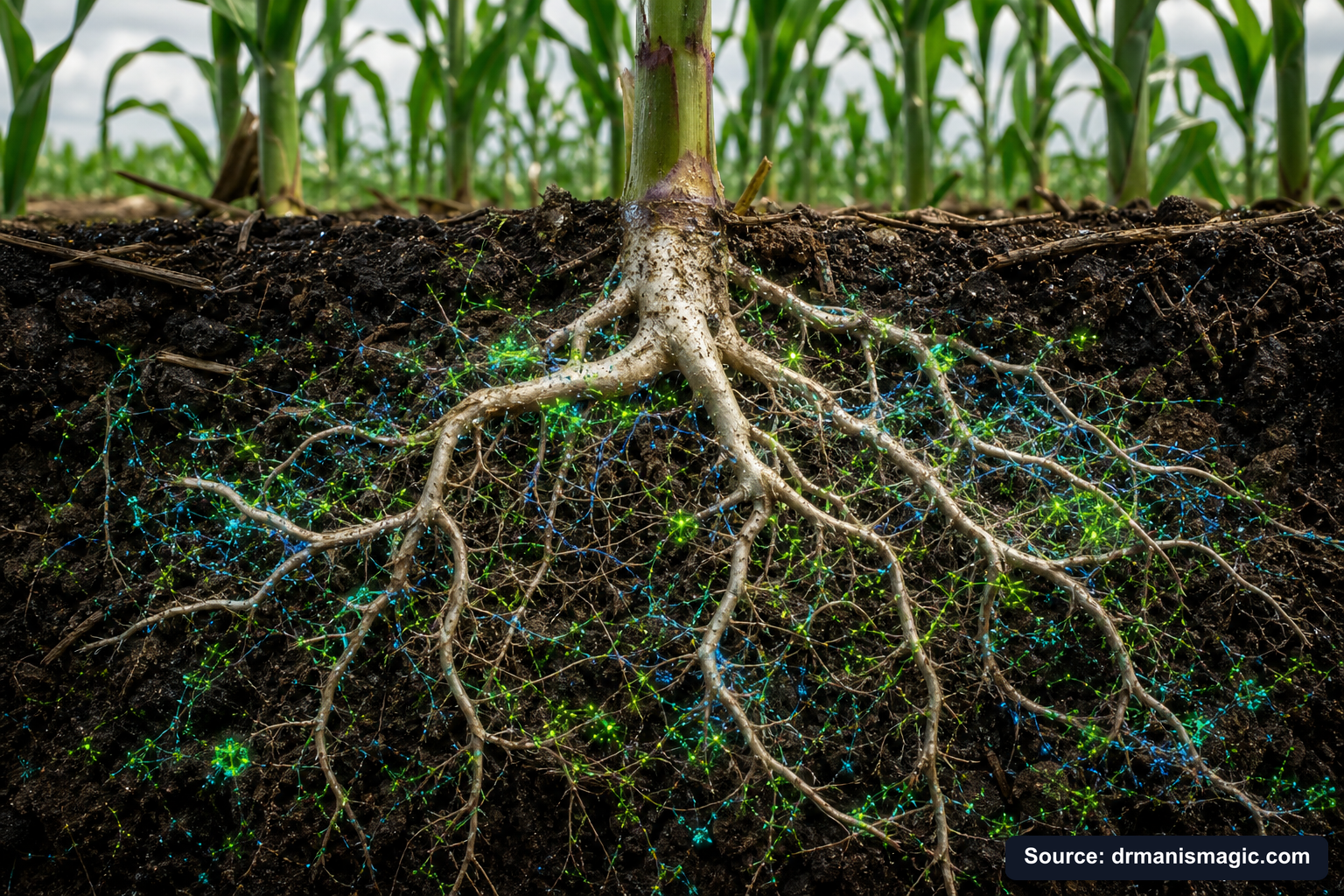
Colorado State Extension reports that mycorrhizal fungi can enlarge the absorbing area of roots by 100 to 1,000 times. Read that again. One thousand times. That is not a small upgrade. That is the difference between a plant that struggles through every dry week and one that seems almost unfazed by drought. It is the difference between pale, thin leaves and deep, waxy, dark green ones bursting with color.
Penn State's soil health research also confirms that mycorrhizae suppress pathogens through multiple mechanisms at once: blocking physical infection sites, improving plant nutrition so the plant's own defenses are stronger, and altering the chemistry of the root zone in ways that make it harder for disease organisms to get a foothold.
This is not one drug fighting one germ. This is a layered immune system built over millions of years of co-evolution. And most gardeners are growing plants without it.
What Destroys the Microbial Shield in Your Soil?
Quick Answer: Salt-based synthetic fertilizers, herbicides like glyphosate, broad-spectrum pesticides, synthetic fungicides, and over-watering that causes anaerobic conditions are the most common killers of beneficial soil biology. Even a single application of some of these inputs can wipe out microbial communities that took years to establish.
Here is the part that stings a little. Because most of the things that destroy the microbial shield are the things the gardening industry has been selling you for decades.
Walk into any big box store and look at the gardening aisle. Salt-based synthetic fertilizers. Broad-spectrum fungicides. Herbicides. Systemic pesticides. Every single one of those products, used regularly, dismantles the microbial shield piece by piece.
Salt-based fertilizers are the worst offenders. They are cheap to make, easy to market, and they give you a fast green-up that feels like success. But the salt in those products does something terrible to the soil biology around your roots. It creates osmotic stress. It pulls water out of microbial cells the same way it pulls water out of a slug. Beneficial bacteria and fungi die in the presence of high salt concentrations. The rhizosphere empties out. And once it is empty, the pathogens move in because there is nobody left to stop them.
This is not an accident. The same companies selling synthetic fertilizers often also sell the fungicides you need when your roots start rotting. The business model works better when your plants stay sick.
See also: The Hidden Reason Synthetic Fertilizers Cause Root Rot
| Shield Killer | How It Damages Soil Biology | What You Lose | Better Approach |
|---|---|---|---|
| Salt-based synthetic fertilizers | High salt concentration kills bacteria and fungi through osmotic shock | Nutrient cycling, disease suppression, mycorrhizal networks | Organic slow-release fertilizer with no synthetic salts |
| Synthetic herbicides (glyphosate) | Disrupts microbial community structure, chelates minerals microbes need | Nitrogen fixers, phosphorus solubilizers, food web balance | Mechanical weeding, targeted organic control, re-inoculate microbes |
| Broad-spectrum pesticides | Non-selective toxicity wipes out beneficial organisms alongside pests | Predatory nematodes, protozoa, beneficial bacteria | Targeted organic pest control, biological alternatives |
| Synthetic fungicides | Suppresses helpful fungi as thoroughly as harmful ones | Mycorrhizal networks, saprophytic decomposers, soil structure | Build microbial diversity as natural disease resistance |
| Sterile potting mixes | No biology present from the start; roots have no partners | All microbial functions from day one | Inoculate immediately with live, full-spectrum microbials |
| Waterlogging and poor drainage | Anaerobic conditions kill aerobic beneficial microbes | Aerobic bacteria, mycorrhizae, root health | Mineral-based soil with real drainage structure |
The pattern here is clear. Almost every common gardening shortcut trades long-term root health for a short-term visual result. The plant looks greener for a few weeks. Then it stalls. Then it starts going backward. Then you buy more product to fix the problem the last product created.
After 30 years and over 250,000 trees grown at US Citrus Nursery in South Texas, Dr. Mani Skaria watched this cycle play out again and again. The trees that thrived were not the ones that got the most fertilizer. They were the ones with the richest, most active biology in the root zone.
Why Do Most Store-Bought Microbial Products Fail?
Quick Answer: Most commercial microbial products are either dried lab-grown spores with poor survival rates or anaerobic liquids that have already gone rotten by the time they reach you. Neither delivers the broad, living, active microbial community that roots actually need. The product you smell before you open the bottle tells you everything you need to know.
The microbial product market has exploded in the last decade. Walk into any garden center or scroll through any online retailer and you will see dozens of bottles, bags, and powders claiming to deliver billions of beneficial microbes to your soil.
Most of them do not work. Here is why.
The first type is the dry powder. These are microbes grown in large commercial vats, then dried into spores and packaged. The idea is that when you add water, the spores reactivate. In theory, that sounds reasonable. In practice, after testing dozens of different batches on citrus trees, houseplants, and tropical trees at US Citrus Nursery, the results were consistently disappointing. The dried spores either do not reactivate effectively, or they represent such a narrow slice of the full microbial community that the real-world impact is minimal.
The second type is the liquid that smells bad. You know the one. You open the bottle and it hits you like a wave of rotting vegetation. That smell is not evidence that the product is "natural." It is evidence that the product has gone anaerobic. The microbes inside have used up the available oxygen, started fermenting, and are dying or dead. You are essentially pouring a corpse onto your plant's roots and hoping for the best.
The third type is lactobacillus-based products. Yes, the same bacteria in yogurt. These are vigorous and do stay alive. But they are so aggressive that they crowd out the very microbes your roots need. They belong in fermented food, not in your soil.
None of these approaches deliver what a genuinely healthy rhizosphere actually contains: thousands of bacterial species, hundreds of fungal species including mycorrhizae, protozoa, and beneficial nematodes, all active and in balance.
That gap is exactly what Dr. Mani set out to close.
You Never Had a Brown Thumb.
You were handed the wrong tools. This free guide hands you the right ones.
You watered it. You fed it. It died anyway.
It was never you. It was the dirt, the salt food, and the bad advice.
This guide shows you what really went wrong, and how to fix it for good.
- Why your plants really died, and why it was never your fault
- The salt hiding in your plant food that quietly burns the roots
- The hidden killer in almost every bag of store soil
- The tiny helpers that grow a whole forest for free
- The rescue trick that brings a half dead plant back to life

Live vs. Dead: The Microbial Product Comparison That Changes Everything
Quick Answer: The single most important factor in any microbial product is whether the microbes are genuinely alive at the moment they reach the root zone. Alive means biologically active, diverse, and capable of colonizing roots. Dead means dried, fermented out, or anaerobic, which delivers little to no root protection regardless of what the label claims.
There is a simple test you can do with any liquid microbial product you own right now. Open the bottle and smell it. Truly smell it.
If it smells foul, like sewage, rotten eggs, or vinegar gone wrong, the microbes are dead or dying. You are holding an anaerobic liquid. Some residual compounds from the original organic base may still provide minor benefits, like humic or fulvic acids, but the living biology is gone.
If it smells earthy, clean, like fresh forest soil after rain, the microbes are alive. That is what you want.
| Product Type | Microbial Viability | Spectrum of Organisms | Smell | Real-World Results |
|---|---|---|---|---|
| Dry lab-grown powder | Low (dormant spores, poor reactivation) | Narrow, 1-5 species | Neutral | Minimal; inconsistent |
| Dry powder added to liquid | Low (same spore issue) | Narrow | Neutral to slightly off | Minimal; inconsistent |
| Compost tea (fresh, under 24 hours, aerated) | Moderate to high | Broad but variable | Earthy | Good if used immediately; time-sensitive |
| Compost tea (old, over 24 hours) | Anaerobic, microbes dying | Degraded | Strong foul odor | Poor; not recommended |
| Lactobacillus-based liquids | High (but wrong organisms) | Dominantly lactobacillus | Sour | Displaces beneficial microbes; not recommended |
| Plant Super Boost (stabilized, full-spectrum) | High, genuinely alive | 2,000+ bacteria species, 400-500 fungi including mycorrhizae, plus protozoa and nematodes | Clean, earthy | Visible under microscope; multiple lab analyses confirm live organisms |
The story behind Plant Super Boost is one of those tales that sounds too good to be true until you see the results firsthand. The stabilization method was not invented by Dr. Mani. It was developed by a world-renowned compost expert who had advised the farming practices of royal families and governments. When large citrus groves started seeing remarkable results using his methods, the big chemical companies took notice. He was effectively blacklisted. He feared for his safety and stopped production entirely.
Years later, a chance meeting brought him to US Citrus Nursery in South Texas. He joined the team. And the result is Plant Super Boost: a product that carries the full spectrum of compost biology, stabilized through a proprietary all-natural technique so the microbes stay alive and active without going anaerobic. It smells like earth. It does not smell like a swamp. And if you put a drop under a microscope, you can watch the microbes moving.
Zero PFAS. Zero biosludge. Zero synthetic salts. Backed by a 30-day money-back guarantee.
How Do You Rebuild a Dead or Damaged Microbial Shield?
Quick Answer: Rebuilding starts by removing the stressors that killed the biology in the first place, then restoring organic matter, improving drainage and aeration, and reintroducing genuinely live microbes into a root zone that can actually support them. This is a process, not a one-time fix, and the order of steps matters.
Good news and honest news. The good news is that soil biology is remarkably resilient. Given the right conditions, microbial communities can recover. The honest news is that "right conditions" is the key phrase. Pouring a bottle of microbes onto compacted, salt-saturated, poorly drained soil is like releasing fish into a swimming pool. The environment cannot support life no matter how good the biology is.
Here is the practical recovery plan, built from what Dr. Mani learned over three decades of restoring root health in trees, gardens, houseplants, and tropical specimens across South Texas.
- Stop the stressor first. If you are using salt-based fertilizers, stop. If you have been applying broad-spectrum fungicides or herbicides regularly, pause. The biology cannot recover while the thing that killed it is still being applied.
- Fix the drainage. Waterlogged, anaerobic soil kills aerobic beneficial microbes faster than almost anything else. If your soil is heavy, compacted, or based on a decomposing bark mix, this is your most urgent problem. Mineral-based soil with genuine drainage structure, like Super Soil, gives microbes the oxygen-rich environment they need to survive and multiply.
- Add mature organic matter. Compost or organic mulch gives the recovering microbial community food and habitat. Keep the soil surface covered. Bare soil exposed to sun and wind loses biology rapidly.
- Check your pH. Most beneficial soil microbes thrive in a pH range of 6.0 to 7.0. Soil that is too acidic or too alkaline suppresses microbial activity regardless of what else you do. A simple soil pH test costs a few dollars and tells you a lot.
- Let living roots grow. Roots pump exudates that recruit and feed microbes. Cover crops, companion planting, or even leaving existing plant roots in place between seasons helps maintain microbial populations.
- Reintroduce genuinely live biology. Only after the habitat is ready. This is where a full-spectrum, genuinely alive microbial product makes the difference. Monthly applications rebuild diversity over time. Expect improvement within weeks for fast-responding organisms like bacteria, and several months for full mycorrhizal network establishment.
- Feed the biology, not just the plant. Switch to organic fertilizer that does not carry synthetic salts. Organic slow-release formulas like those built around crab, kelp, and amino acids feed the microbial community and the plant simultaneously, without the osmotic damage that salt-based products cause.
Recovery is not instant. But it is real. And once the biology is restored, the maintenance is far simpler than the cycle of buying product after product to fix the problems the last product created.
What Are the Three Plant Pillars and Why Does the Microbial Shield Depend on All Three?
Quick Answer: The Three Plant Pillars are mineral-based soil for permanent drainage and aeration, live microbials for root protection and nutrient access, and organic fertilizer for steady nutrition without salt damage. The microbial shield can only stay alive and active when all three are in place because each pillar supports the conditions the others need to function.
Here is a truth that took Dr. Mani years of hard trials to fully understand. Microbes alone are not enough. You can pour the best living biology in the world onto roots that are sitting in waterlogged, oxygen-starved, salt-saturated potting mix and watch it fail. Not because the microbes were bad. Because the environment could not support them.
This is why the Three Plant Pillars are a system, not a menu. Each one creates the conditions the others need.
Pillar One is the mineral foundation. Most potting mixes are built on bark, sawdust, and other organic materials that decompose. As they break down, they compact. They steal oxygen from the root zone. They hold too much water in the wrong way. Waterlogged soil is anaerobic soil. Anaerobic soil kills the aerobic beneficial microbes that form the shield. Mineral-based soil does not decompose. It maintains structure permanently. Roots can breathe. Water drains. The microbial community has the oxygen-rich habitat it needs to thrive.
Pillar Two is the living microbial community. This is the shield itself. Full-spectrum, genuinely alive bacteria, fungi, mycorrhizae, protozoa, and beneficial nematodes working in concert around every root. Not dried spores. Not a foul-smelling anaerobic liquid. Alive and active biology delivered in a stable form that works from the moment it hits the root zone.
Pillar Three is organic fertilizer. Salt-based synthetic fertilizers destroy the biology you just worked to establish. Organic slow-release fertilizer built from crab meal, kelp, and amino acids feeds the plant and the microbial community simultaneously. No osmotic shock. No salt accumulation that strips water from microbial cells. Just steady, gentle nutrition that works with the shield instead of against it.
Miss any one pillar and the system wobbles. Miss two and you are back to square one, fighting the same problems with the same products that caused them in the first place.
See also: Why Most Fertilizers Are Actually Salt in Disguise
Why Does Time Matter More Than Money When It Comes to Root Health?
Quick Answer: When roots fail because the microbial shield was not in place from the start, the plant loses months or years of growth that cannot be recovered. You can always buy more fertilizer, but you cannot buy back the growing season your tree spent struggling instead of thriving. The most expensive mistake in gardening is not the wrong product. It is the wasted time that comes with it.
The number one thing people tell Dr. Mani they want is to see fruit on a tree they planted with their own hands. Not just a green plant. Actual fruit. Something they grew. Something they could pick and taste and share.
That is not a small desire. It is one of the oldest human instincts there is. We were built to tend things and watch them bear fruit. And the heartbreak of watching that not happen, year after year, because the foundation was wrong from the start, is something no amount of refunded fertilizer money can fix.
You can get money back. You cannot get time back.
The trees that have the full microbial shield in place from day one grow differently than trees without it. Their roots establish faster. They access nutrients that would otherwise be locked in the soil. They resist the first disease pressure that comes along instead of collapsing under it. They fruit sooner. They taste better. They look like the trees you imagined when you planted them.
The old approach, the synthetic fertilizer and sterile soil approach, works against the natural order. It might produce a fast green-up. Then a stall. Then a slow decline. Then a dead plant and a new purchase and the cycle repeats. More money spent. More time lost. More seasons without fruit.
When the Three Plant Pillars are all working together, when the roots can breathe, when the microbial shield is alive and intact, when the nutrition is gentle and compatible with the biology, plants flourish the way nature intended them to. Not because of clever chemistry. Because the conditions that life evolved in for hundreds of millions of years have been restored.
What Can You Do Right Now to Start Building the Shield?
Quick Answer: Start by stopping the inputs that kill soil biology, then reintroduce living microbes into a root zone with proper drainage and organic nutrition. Monthly applications of full-spectrum live microbials, combined with mineral-based soil and organic fertilizer, rebuild the shield progressively and make your plants increasingly resilient over time.
You do not need to do everything at once. Start where you are.
If you are potting a new plant or transplanting anything right now, this is your cleanest starting point. Use a mineral-based soil that will not compact or go anaerobic. Inoculate the root zone with genuinely live, full-spectrum biology immediately at planting. Follow with an organic fertilizer that does not carry synthetic salts. You have just given that plant every advantage nature built into the system.
If you have existing plants that are struggling, start by reading the roots. Pale, mushy, or dark roots in wet soil almost always point to anaerobic conditions and collapsed microbial protection. Improve drainage first. Then begin monthly microbial applications to start rebuilding the shield layer by layer.
If your lawn, garden beds, or orchard have been on a synthetic fertilizer program for years, the biology is depleted. Stop the synthetic inputs. Add compost or organic mulch. Start monthly applications of living biology across the entire area. It will take several months to see the full shift, but the direction changes quickly once the stressors are removed.
None of this requires a chemistry degree. None of it requires hours of research or a shelf full of incompatible products. The system that Dr. Mani spent thirty years refining across 250,000 citrus trees, houseplants, tropical specimens, and garden plots in South Texas comes down to three principles working in harmony.
Mineral-based soil that lets roots breathe. Living microbes that form the shield. Organic nutrition that feeds the system without destroying it.
That is the foundation. Everything else, the pruning, the watering, the art of gardening, becomes far simpler once the foundation is right. Your plants stop being fragile. They stop needing emergency rescues. They start doing what plants are designed to do when the conditions are right: grow, flourish, and bear fruit.
If you want to see how the full system works together, the Free Plant Care Field Guide walks you through every step in plain language, from soil setup to feeding schedules to building the kind of root zone that keeps plants thriving for years. It is the same knowledge that built one of the most successful citrus nurseries in the country, and it is yours to use on any plant you grow, from a single potted lemon tree on a balcony to an acre of fruit trees in the ground.
The microbial shield is not a luxury. It is the foundation. And once you build it right, gardening starts feeling less like a battle and a lot more like magic.
Frequently Asked Questions
Your roots are fighting a battle you cannot see. The questions below come up again and again from real plant owners who watched their trees and gardens slowly decline despite doing everything "right." These answers are grounded in over 30 years of hands-on growing and the lessons Dr. Mani learned testing his Three Plant Pillars system across more than 250,000 trees at US Citrus Nursery in South Texas.
How do you keep soil microbes alive and thriving?
Stop feeding your soil salt-based synthetic fertilizers. That is the single biggest killer of beneficial microbes. Salt-based chemicals act like a scorched-earth weapon in your root zone. Instead, use mineral-based soil that drains well and does not compact, feed with slow-release organic fertilizer made from real ingredients like crab, kelp, and amino acids, and add live microbials like Dr. Mani's Magic Plant Super Boost directly to the root zone. That is the complete Three Plant Pillars approach, and it keeps your soil alive season after season.
What fungus helps plant roots absorb nutrients from the soil?
Mycorrhizal fungi are the heavy lifters here. They attach to your roots and send out tiny thread-like structures called hyphae that reach deep into the soil, far beyond where your roots could ever go on their own. Research from Colorado State Extension shows mycorrhizae can expand the effective root surface area by up to 1,000 times. Dr. Mani's Magic Plant Super Boost contains live mycorrhizal fungi along with beneficial bacteria, so your roots get this army working for them right away.
Do you put mycorrhizae directly on the roots?
Yes, and direct contact is the key. The closer the mycorrhizae gets to the root surface, the faster it colonizes and starts working. When you plant or repot, apply Plant Super Boost directly to the root ball before it goes into the soil. You can also mix it into your watering routine for established plants. The live microbes in Plant Super Boost are stabilized so they stay biologically active from the bottle all the way to your root zone, not dead spores sitting in a bag on a shelf.
Which nutrients help plants grow strong roots?
Phosphorus and potassium are the two big ones for root development. But here is what most people miss: synthetic fertilizers dump those nutrients as salt-based compounds that can actually burn your roots and wipe out the microbes your roots depend on. Dr. Mani's Magic Crab, Kelp, and Amino Acids fertilizer delivers phosphorus, potassium, and nitrogen in slow-release organic forms your plant can actually use, without the toxic burn. Strong roots need the right nutrients delivered the right way.
What is the fungal partner that helps plants absorb nitrogen?
Mycorrhizal fungi form a partnership with plant roots where the plant trades sugar for nutrients. The fungi's hyphae network mines the soil for nitrogen, phosphorus, and trace minerals, then shuttles them back to the plant. Without this partnership, plants are on their own, working much harder for far less reward. Dr. Mani built Plant Super Boost around keeping these fungi genuinely alive in the bottle, not freeze-dried or weakened, so the partnership starts the moment you water your plant.
What is the best soil for protecting plant roots from rot?
Most store-bought potting mixes are made from pine bark and wood byproducts that break down fast. As they decompose, they compact around your roots, block oxygen, and hold too much water. That is a recipe for rot. Dr. Mani's Magic Super Soil is built on a mineral base of sandy loam from the Rio Grande Valley. It does not decompose. It drains perfectly. Roots can breathe and push deep without fighting through suffocating sludge. It is the foundation of Pillar One of the Three Plant Pillars for good reason.
What protects the tip of a growing root?
At the very tip of every root is a structure called the root cap. It shields the delicate growing cells as the root pushes through soil. But here is what the textbooks leave out: the root cap works best when the surrounding soil is loose, well-aerated, and full of beneficial microbes. When soil compacts or fills with pathogens, even a healthy root cap cannot protect what is behind it. That is why the microbial shield and the right soil structure are not extras. They are the environment that lets your roots do their job.
About the Author
Dr. Mani Skaria, PhD
Dr. Mani Skaria, PhD, is a plant pathologist and the scientific founder of Dr. Mani's Magic. He earned his doctorate at Purdue University and spent 48 years studying how plants, soil, and living microbes work together, including his years as Professor Emeritus at Texas A&M and as a member of the USDA NAREEE Advisory Board. He invented micro-budding, a method for growing healthier, stronger trees, and has grown more than 250,000 trees on the family farm in Hargill, Texas - US Citrus Nursery. His life's work takes real lab science and practical experience and turns it into simple, safe, organic plant care anyone can use at home.


