


The Microbial Difference Between Weak and Vigorous Citrus Trees | Dr. Mani's Magic
The Microbial Difference Between Weak and Vigorous Citrus (And Every Other Plant You've Ever Grown)
Picture this. Two lemon trees. Same backyard. Same sun. Same watering schedule. Same bag of fertilizer from the big box store down the road.
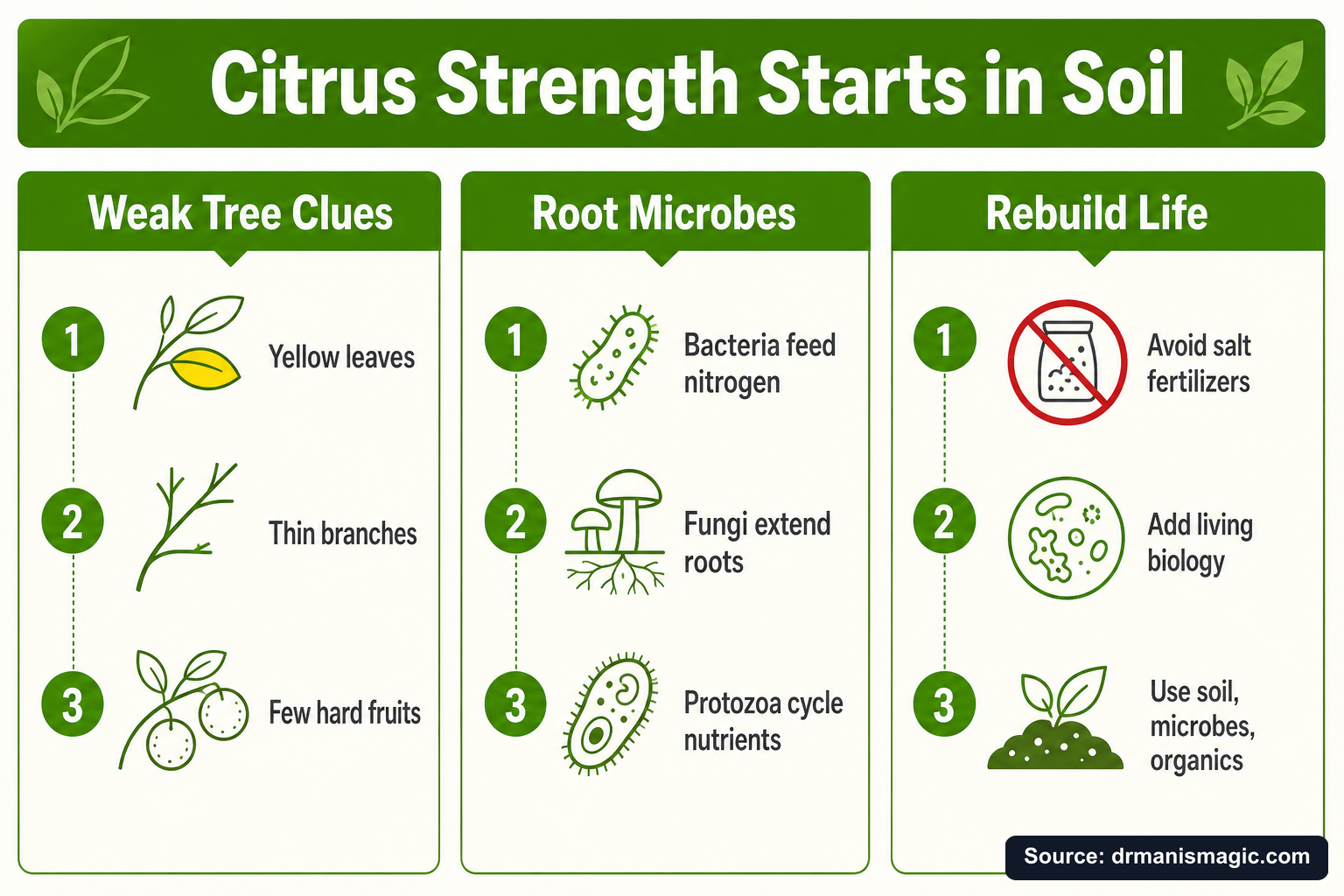
One tree is bursting. Dark green leaves. Fragrant white blossoms. Fruit so heavy the branches droop. You walk past it and you can smell it from three feet away. The other tree? Pale yellow leaves. Thin branches. A few hard, sad little fruits that never seem to ripen right. You've fed it, watered it, talked to it. Nothing works. You start to wonder if something is wrong with you.
Here's what nobody told you. The difference between those two trees has almost nothing to do with what's happening above the soil. The real battle is invisible. It's happening in the dark, just below the surface, in a living world most gardeners never even think about. After growing more than 250,000 trees at our South Texas nursery, we can tell you with complete confidence: the single biggest difference between a weak citrus tree and a vigorous one is the microscopic ecosystem living around its roots. Get that ecosystem right, and your tree practically takes care of itself. Get it wrong, and no amount of fertilizer, spraying, or praying will save it.

Organic Fertilizer | Crab, Kelp & Amino Acids
Key Takeaways
- Vigorous citrus trees maintain a rich, diverse community of beneficial bacteria, fungi, protozoa, and nematodes in the root zone. Weak trees don't.
- Arbuscular mycorrhizal fungi are one of the most important microbes for citrus. They extend the root system dramatically and unlock phosphorus and water the roots can't reach alone.
- Salt-based synthetic fertilizers quietly kill beneficial soil microbes, creating a cycle of dependency and decline that gets worse every season.
- Most microbial products on store shelves are either dried powders with low viability or smelly liquids where the microbes are already dying. Dead microbes do nothing for your tree.
- You can rebuild a damaged soil food web, but it takes the right biology, the right soil, and repeated applications over time.
- The Three Plant Pillars (mineral soil, live microbes, organic fertilizer) form the foundation that makes any plant, not just citrus, genuinely resilient.
- The fastest way to close the gap between a weak tree and a vigorous one is to restore living biology to the root zone immediately.
What Is the Soil Food Web, and Why Does Your Citrus Tree Depend on It?
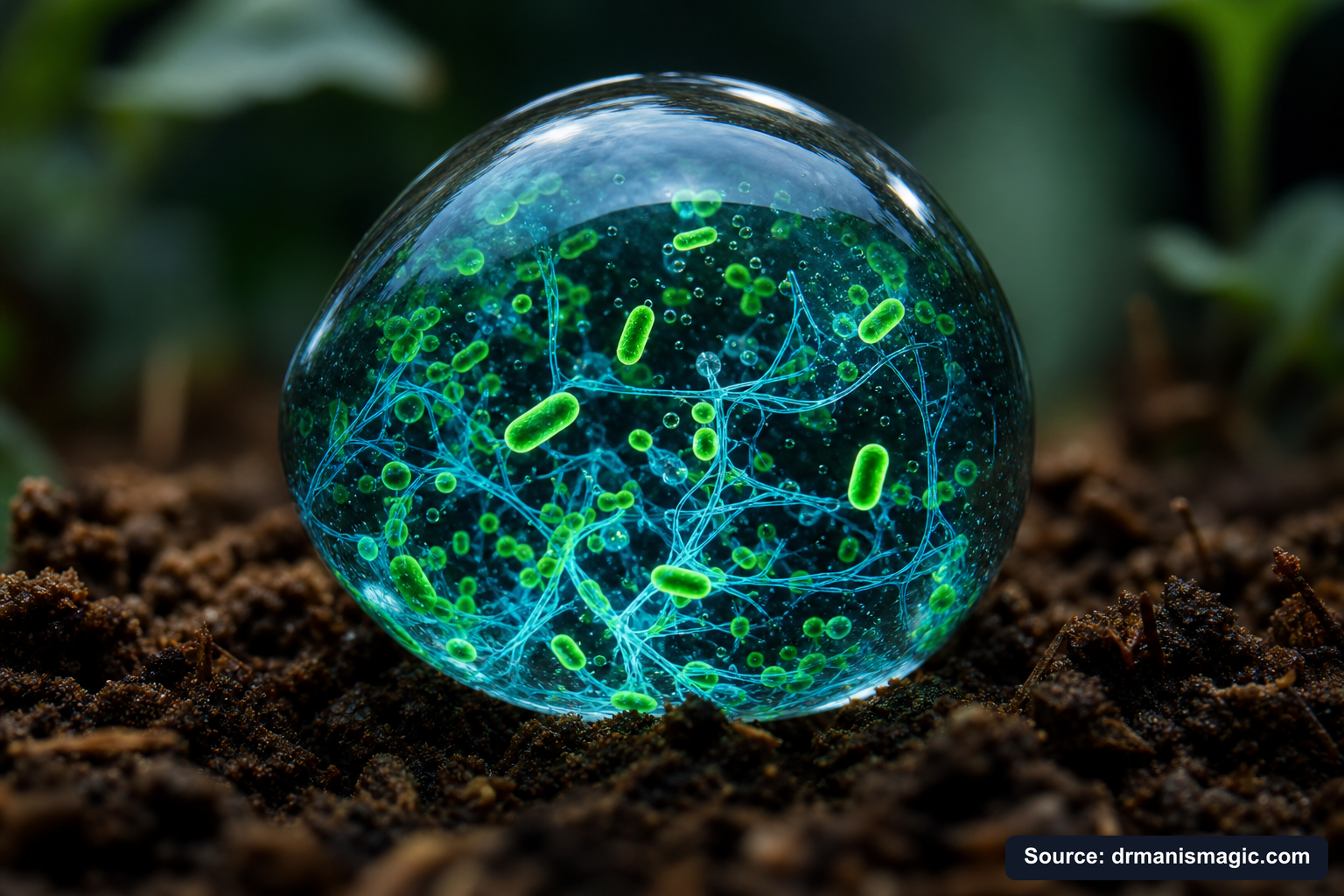
Quick Answer: The soil food web is the community of living organisms around plant roots, including bacteria, fungi, protozoa, and nematodes, that work together to feed plants, suppress disease, and build healthy soil. Without it, even well-watered and well-fertilized citrus trees struggle to thrive because they are missing the invisible workforce that makes nutrients available and keeps pathogens in check.
Think of the soil around a healthy citrus tree as a city. A buzzing, productive city with millions of workers doing different jobs every single minute.
Bacteria break down organic matter and convert nitrogen from the air into forms the tree can actually use. Fungi thread through the soil like a web, connecting the roots to nutrients far beyond where any root could reach on its own. Protozoa eat bacteria and, in doing so, release nitrogen right next to the roots in a form the tree absorbs immediately. Beneficial nematodes (the good kind, not the plant-parasitic ones) do the same thing one level up, eating protozoa and cycling nutrients through the system.
Every organism feeds another. Every organism protects another. The root sits at the center of all of it, releasing sugars to feed the bacteria and fungi, and the bacteria and fungi deliver nutrients and protection in return. It is one of the most elegant partnerships in all of nature.
Now picture that same city after a disaster. Buildings collapsed. Roads broken. Most of the workers gone. That is what the root zone of a weak citrus tree looks like under a microscope. The food web is disrupted. The workers are missing. And the tree is left trying to survive alone in dead dirt.
Research from the University of California Agriculture and Natural Resources citrus research program confirms that the rhizosphere, the zone of soil directly around citrus roots, hosts a core community of microbes whose functions are directly tied to how well the tree grows, handles drought, resists disease, and takes up nutrients. This isn't fringe science. It's the foundation of plant health.
| Organism | Primary Job | What the Tree Gets | What Disrupts Them |
|---|---|---|---|
| Beneficial Bacteria | Break down organic matter, fix nitrogen from air, suppress pathogens | Available nitrogen, disease protection, improved root signaling | Salt-based fertilizers, herbicides, fungicides |
| Mycorrhizal Fungi | Extend root reach, unlock phosphorus and water, improve soil structure | Better phosphorus uptake, drought tolerance, stronger roots | High phosphorus fertilizers, fungicides, soil sterilization |
| Saprotrophic Fungi | Decompose mulch and organic matter into plant-usable nutrients | Steady nutrient release, improved soil texture | Fungicides, compacted or waterlogged soil |
| Protozoa | Eat bacteria, release nitrogen right next to roots | Concentrated nitrogen delivery at the root zone | Pesticides, soil fumigation, lack of bacteria to eat |
| Beneficial Nematodes | Eat protozoa and other organisms, cycle nutrients through the system | Deeper nutrient mineralization, predator control of harmful nematodes | Nematicides, fumigation, sterile soil |
| Actinobacteria | Produce antibiotics that suppress soil pathogens | Natural disease suppression, that earthy soil smell | Salt-based inputs, compaction, low oxygen |
What Does a Vigorous Citrus Tree's Root Zone Actually Look Like?
Quick Answer: A vigorous citrus tree's root zone is alive with diverse bacteria actively cycling nitrogen and phosphorus, mycorrhizal fungi extending root reach, protozoa mineralizing nutrients close to the roots, and predator organisms keeping harmful pathogens in check. The key is not just high microbial numbers but a resilient, interconnected community that keeps functioning even under drought, heat, or stress.
Vigorous citrus doesn't just have more microbes. It has the right microbes, working together in balance.
Studies on citrus rootstocks and drought stress consistently show the same pattern. Tolerant, vigorous trees maintain more complex bacterial networks. They recruit more beneficial fungi like Trichoderma, Penicillium, and especially arbuscular mycorrhizal fungi (AMF). Their roots show active nutrient cycling right up close, where it counts. And when stress hits, their microbial community bounces back faster because it has depth.
Think of it like a sports team. A great team doesn't just have one star player. It has specialists at every position who back each other up. When one player goes down, the others cover. That's what a healthy rhizosphere looks like. Redundancy. Cooperation. Resilience.
A weak tree's root zone is the opposite. Low diversity. Disrupted function. Gaps where critical nutrient-cycling organisms should be. And into those gaps, pathogens like Phytophthora (which causes root rot) and Fusarium (which causes wilting and decline) move in because there's nothing left to compete with them.
The tree doesn't look sick because it needs more fertilizer. It looks sick because it lost its army.
Why Are Mycorrhizal Fungi So Important for Citrus Specifically?
Quick Answer: Citrus roots are naturally dependent on mycorrhizal fungi, especially arbuscular mycorrhizal fungi (AMF), to access phosphorus, water, and minerals in sandy, dry, or low-nutrient soils. AMF threads extend the effective root area by up to 700 times, making them irreplaceable for citrus grown in containers, poor soils, or after transplanting.
Here's something most citrus growers never learn. Citrus roots are short and stubby compared to many other trees. They don't naturally explore wide areas of soil on their own. They need help.
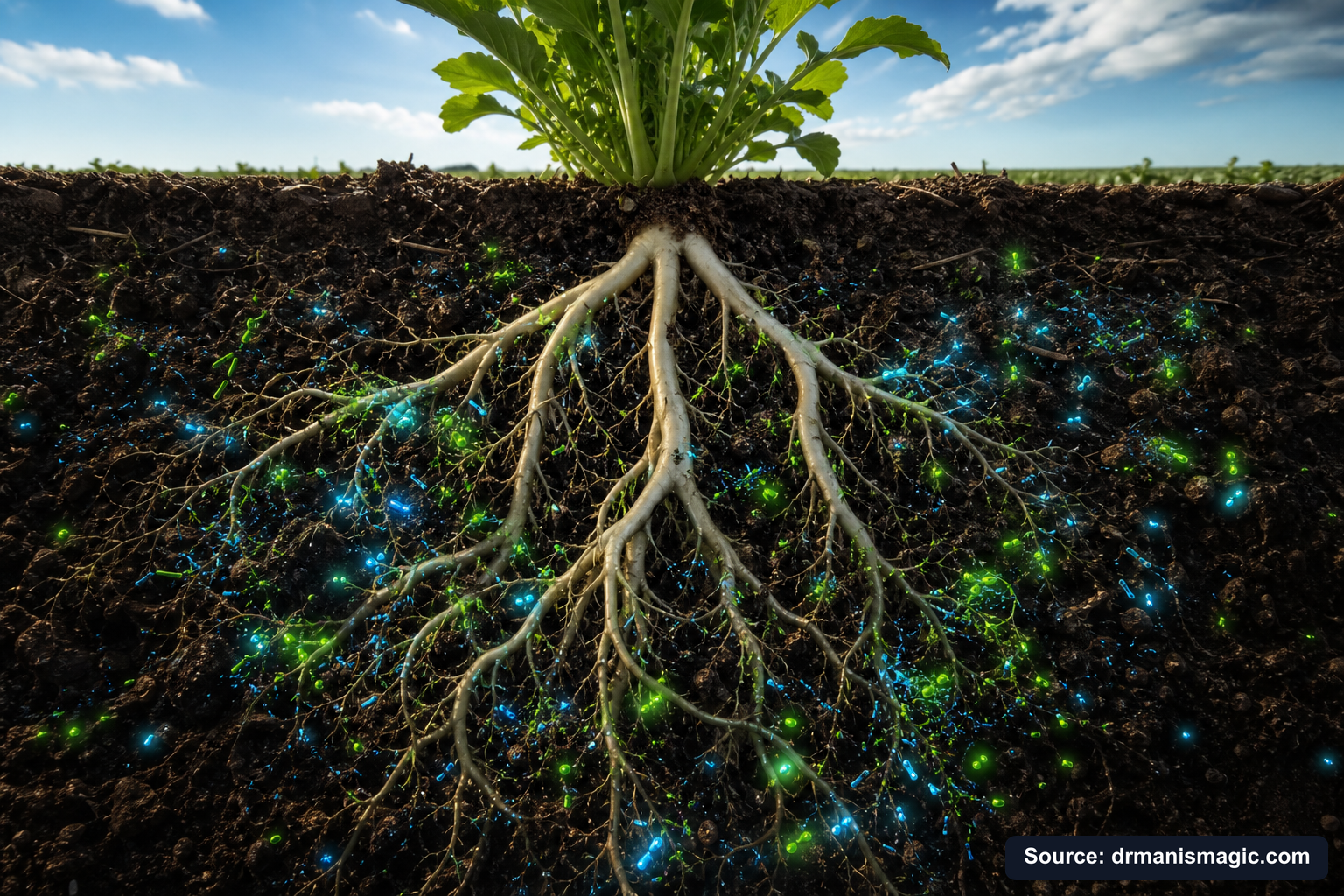
That help comes from mycorrhizal fungi. These fungi form a partnership directly with the root, threading out into the surrounding soil like an extension of the root system itself. The fungal threads, called hyphae, are so thin they can reach into tiny pockets of soil that roots could never access. They pull out phosphorus, zinc, iron, and water, and deliver it all straight to the root.
Research from the University of Florida IFAS Extension highlights how AMF benefit is especially pronounced in sandy, low-phosphorus, droughty, or saline soils. Sound familiar? That describes almost every citrus-growing environment in the southern United States.
When AMF are present, citrus trees handle salinity better. They recover from transplant shock faster. They maintain function during drought because the fungal network keeps pulling water even when the soil surface is dry. And when a tree is planted into sterile potting mix or fumigated soil, where AMF are completely absent, it loses all of these advantages immediately.
That's why we include mycorrhizal fungi directly in Plant Super Boost. Not as a dried powder. As living, stabilized fungi ready to colonize the root zone and get to work.
How Do Salt-Based Fertilizers Destroy the Microbial Difference Between Weak and Vigorous Citrus?
Quick Answer: Salt-based synthetic fertilizers raise the salt concentration in the soil to levels that damage or kill beneficial bacteria and fungi. Over time, this collapses the soil food web, forcing the tree into total dependency on chemical inputs while leaving it defenseless against pathogens, nutrient lockup, and stress. The tree may green up briefly but weakens season after season.
Here's the trap most gardeners fall into. And it's not their fault. They were set up for it.
You buy a bag of fertilizer. The label promises green leaves and big fruit. You sprinkle it on. The tree greens up. You feel like a genius. Then three months later it yellows again. So you buy more. And more. And more.
What the bag never tells you is that salt-based fertilizer, which is what almost every synthetic fertilizer is, raises the salt concentration in the soil. And salt kills beneficial microbes. Bacteria. Fungi. Protozoa. All of it.
Every time you feed with synthetic fertilizer, you're doing two things at once. You're giving the tree a short-term hit of nutrients. And you're killing the very organisms that would have delivered those nutrients naturally, sustainably, and without the burn. You're making the tree more dependent and more fragile with every application.
Dr. Mani Skaria, founder of our nursery and Professor Emeritus of Plant Pathology from the Texas A&M Citrus Center, watched this pattern destroy thousands of trees over decades. The trees didn't fail because of bad weather or bad luck. They failed because the soil food web was systematically dismantled, season by season, one bag of synthetic fertilizer at a time.
See also: The Hidden Reason Synthetic Fertilizers Cause Root Rot
Vigorous vs. Weak Citrus: The Side-by-Side Microbial Profile
Quick Answer: Vigorous citrus trees show active, diverse microbial communities with functioning nutrient cycles, mycorrhizal colonization, and pathogen suppression. Weak citrus trees show disrupted biology, reduced fungal activity, lower beneficial bacteria diversity, and increased vulnerability to root rot, nematode damage, and disease. The table below shows the key differences.
Let's make this real concrete. Side by side.
| Factor | Vigorous Citrus Tree | Weak Citrus Tree |
|---|---|---|
| Bacterial diversity | High diversity, active nutrient-cycling species present | Low diversity, simplified community dominated by stress-tolerant or pathogenic types |
| Mycorrhizal colonization | Active AMF colonization in feeder roots, visible white fungal threads | Little or no AMF colonization, especially in sterile or fumigated soil |
| Beneficial fungi (Trichoderma, Penicillium) | Present and active, suppressing soil pathogens | Absent or suppressed by fungicide use |
| Protozoa and beneficial nematodes | Present, cycling nitrogen near root zone | Absent or replaced by plant-parasitic nematodes |
| Pathogen pressure | Low, suppressed by competitive beneficial community | High, Phytophthora, Fusarium, citrus nematode often present |
| Nutrient cycling | Continuous, biology-driven, self-sustaining | Dependent on chemical inputs, collapses without them |
| Root condition | White, firm feeder roots with fungal threads | Brown, mushy, or sparse roots with little visible biology |
| Drought and salinity response | Resilient, maintains function under stress | Rapid decline under stress, leaf drop, fruit loss |
| Soil structure | Well-aerated, glomalin-rich, water moves freely | Compacted, low oxygen, poor drainage |
| Disease recovery | Faster recovery due to competitive exclusion and plant immunity signals | Slow or no recovery, progressive decline |
Look at that table carefully. Notice that almost every difference on the right side, the weak tree side, can be traced back to one thing: disrupted soil biology. Fix the biology, and most of those problems begin to correct themselves.
You Never Had a Brown Thumb.
You were handed the wrong tools. This free guide hands you the right ones.
You watered it. You fed it. It died anyway.
It was never you. It was the dirt, the salt food, and the bad advice.
This guide shows you what really went wrong, and how to fix it for good.
- Why your plants really died, and why it was never your fault
- The salt hiding in your plant food that quietly burns the roots
- The hidden killer in almost every bag of store soil
- The tiny helpers that grow a whole forest for free
- The rescue trick that brings a half dead plant back to life

Why Do Most Microbial Products Fail to Make the Difference?
Quick Answer: Most microbial products sold in stores are either dried powders with low-viability spores that don't reactivate well in soil, or liquids where microbes have already gone anaerobic and died. Dead or dormant microbes cannot colonize roots, cycle nutrients, or suppress disease. The only way to get results is from genuinely live, full-spectrum biology delivered in a stable, viable form.
Walk into any garden center today and you'll find a shelf full of products claiming to have beneficial microbes. Bags of powder. Dark bottles of liquid. Labels with impressive-sounding bacterial names and colony-forming unit counts.
Most of them don't work. And after growing 250,000 trees at US Citrus Nursery, we've tried most of them.
Here's what's actually happening inside those bottles.
The dried powder problem. A handful of beneficial species are grown in giant factory vats, then dried into a powder. The hope is that dormant spores will "reactivate" when they hit wet soil. In our testing, batch after batch, we saw little to no improvement in our trees. The reactivation rate is low. The species selection is narrow. And the organisms that actually survive don't represent the full, complex community a root zone needs.
The smelly liquid problem. Other products take organic material like compost or worm castings and brew it into a liquid. This sounds good in theory. But by the time that liquid reaches you, it has usually gone anaerobic. That means the oxygen ran out. The beneficial aerobic microbes died. What's left is fermenting. You can tell because the bottle smells terrible. Sometimes it fizzes when you open it. That fizz is gas from decomposing, dying microbes. You're pouring dead biology onto your roots.
The lactobacillus trap. Some products use lactobacillus bacteria. Yes, like in yogurt. It's easy to produce and stays alive. But lactobacillus is so aggressive it crowds out the beneficial microbes your roots actually need. It belongs in your gut, not your soil.
None of these approaches come close to what a tree gets from genuinely live, full-spectrum biology. And that gap is exactly why the microbial difference between weak and vigorous citrus is so hard for most gardeners to close with off-the-shelf products.
| Product Type | Viability at Use | Spectrum of Organisms | Odor | Our Assessment |
|---|---|---|---|---|
| Dried powder (lab-grown) | Very low, spores often don't reactivate | Narrow, a few selected species | Low | No results in our testing. Avoid. |
| Dried powder rehydrated into liquid | Very low | Narrow | Low | Same issue as powder. Avoid. |
| Compost tea, fresh under 24 hours | Moderate if actively aerated | Partial, depends on compost quality | Earthy | Good if you can do it. Time-sensitive. |
| Compost tea, old over 24 hours | Low, anaerobic die-off | Partial | Strong foul smell | Not recommended. Microbes dying. |
| Lactobacillus-based products | High, but wrong organisms | Very narrow, outcompetes beneficials | Sour | Belongs in yogurt, not soil. |
| Plant Super Boost (stabilized, full-spectrum) | High, live microbes confirmed by microscopy and lab analysis | 2,000+ bacteria, 400-500 fungi including mycorrhizae, plus protozoa and nematodes | Earthy, not foul | Harvested from compost, stabilized naturally. The real thing. |
What Is the Dr. Mani's Magic Approach to Keeping Microbes Alive?
Quick Answer: Dr. Mani's Magic Plant Super Boost uses a proprietary, all-natural stabilization technique developed with a world-renowned compost expert to keep the full spectrum of living microbes, bacteria, fungi, mycorrhizae, protozoa, and beneficial nematodes, alive and active in the bottle without going anaerobic. The result is live biology you can actually see moving under a microscope, with no foul smell, zero PFAS, zero biosludge, and zero synthetic salts.
The story behind Plant Super Boost is one of the most unusual in all of American agriculture.
Dr. Mani Skaria spent years watching what fresh compost did to his citrus trees. When he applied compost that was truly active, still steaming from the biological heat inside it, the trees responded in ways that no fertilizer ever matched. Faster growth. Darker leaves. Better fruit set. More resistance to stress. The results were undeniable.
The problem was obvious. Making and maintaining a proper compost pile is hard work. Turning it into a liquid compost tea and using it within 24 hours before it goes anaerobic is harder still. Most gardeners simply can't do it.
Then, through what Dr. Mani describes as a providential meeting, he connected with a world-famous compost expert who had spent decades advising governments and royal families on sustainable farming practices. This expert had developed a natural technique to stabilize the full spectrum of compost microbes without letting them die or go anaerobic. He had been blacklisted by large chemical companies after his methods started showing dramatic results in major citrus-growing operations. He had even feared for his life and stopped his work for a period of time.
When he joined the US Citrus Nursery team, everything changed. That stabilization technique became the foundation of Plant Super Boost. The result is a living liquid that smells like fresh earth, not sewage. A product where you can literally take a drop and see the microbes moving under a microscope. A product backed by multiple lab analyses confirming live biology. No PFAS. No biosludge. No synthetic salts. No shortcuts.
That's the difference. And it's why the trees at our nursery don't just survive. They thrive.
How Do You Know If Your Citrus Tree Has Weak Soil Biology vs. Something Else?
Quick Answer: Weak soil biology often looks like nutrient deficiency, root rot, slow growth, or chronic yellowing that does not respond fully to fertilizer. The key diagnostic clue is that the symptoms persist or cycle despite adequate watering and feeding. True microbial collapse often accompanies poor root condition, compacted or waterlogged soil, and a history of synthetic inputs, pesticides, or soil sterilization.
This is where it gets practical. Because weak soil biology can look like a lot of other problems. And if you're treating the wrong cause, you'll never fix the tree.
Here's a quick framework to help you think through it.
If the leaves are yellow but new growth is green, you may have an iron or magnesium deficiency. These are often tied to high soil pH, which itself is often worsened by synthetic fertilizer salt accumulation. Soil biology helps regulate pH naturally.
If the roots are brown, mushy, or sparse, you likely have root rot caused by Phytophthora or Fusarium. These pathogens thrive when beneficial biology is absent. A living microbial community suppresses them competitively.
If the tree is just... stuck. Not dying, not thriving. Just sitting there season after season. That's classic microbial collapse. The nutrient cycling stopped. The tree is surviving on whatever it can pull from the soil with no help, and it's running on empty.
If the tree was recently transplanted into fresh potting mix, it is almost certainly in biologically sterile soil. Commercial potting mixes are steam-sterilized. No microbes. No mycorrhizae. No food web. The tree is on its own from the moment it goes into the pot.
If you've been using synthetic fertilizer for years, you have very likely depleted your soil's biological diversity. The salt has done its damage over many applications, and the food web needs to be rebuilt from the ground up.
How Do You Rebuild the Microbial Difference Between Weak and Vigorous Citrus in Your Own Yard?
Quick Answer: Rebuilding citrus soil biology takes the right biology delivered in a live form, the right soil conditions to let that biology survive and multiply, and repeated monthly applications because soils damaged by synthetic inputs, fumigation, salt accumulation, or pesticides do not recover overnight. The recovery checklist below gives you a clear starting sequence.
Here is the honest truth about soil recovery. It takes time. A damaged food web doesn't come back in a week. But the good news is that it does come back, and faster than most people expect, when you follow the right sequence.
This is the approach we use at US Citrus Nursery, refined over decades and 250,000 trees.
- Stop the damage first. Cut out salt-based synthetic fertilizers. Stop broad-spectrum fungicide applications unless you have a confirmed disease emergency. Every application of those products sets the biological recovery back. You cannot fill a leaking bucket.
- Get the soil right. If your tree is in a container with compacted, decomposing potting mix, the soil itself is the problem. Organic potting mixes break down into root-choking sludge. They steal oxygen from the roots as they decompose. Our Super Soil uses mineral-based sandy loam from the Rio Grande Valley that does not decompose, does not compact, and does not steal oxygen. It is a permanent foundation that lets biology actually take hold.
- Introduce live biology at planting or as a soil drench. Apply a full-spectrum live microbial product directly to the root zone. For transplanting, apply it at the moment of planting so the microbes make direct contact with the roots immediately. For established trees, drench the soil around the root zone monthly.
- Feed with organic fertilizer that works with the biology, not against it. Our Crab, Kelp and Amino Acids fertilizer is a slow-release organic blend that feeds microbes and plant roots together. No synthetic salts. No PFAS. No biosludge. The microbes break it down and deliver nutrients in the exact form the roots need.
- Add organic matter to the surface. A layer of wood chip mulch around the tree's drip line feeds saprotrophic fungi and creates the kind of moist, oxygen-rich environment where beneficial bacteria thrive. Keep it a few inches away from the trunk.
- Repeat monthly and be patient. Biology does not recover from one application. Keep applying live microbes every month. Keep feeding with organic fertilizer. Give the food web time to rebuild its layers. Most growers start seeing meaningful improvement within four to eight weeks of starting the full Three Plant Pillars program.
- Watch the roots, not just the leaves. When the biology is recovering, you'll start to see white, healthy feeder roots and, if you look closely, white fuzzy threads of mycorrhizal fungi around them. That fuzzy white growth is not mold. It is your tree's new workforce arriving for duty.
You can learn more about building this complete foundation by exploring the Three Plant Pillars system that Dr. Mani developed at our nursery over 30 years.
Can Living Microbes Help With Citrus Greening, Root Rot, or Nematode Damage?
Quick Answer: Living microbes cannot cure citrus greening (HLB), but they can support the tree's resilience and slow decline by maintaining root function and nutrient uptake during stress. For root rot and pathogen pressure, a healthy microbial community provides genuine competitive suppression. For plant-parasitic nematodes, a balanced food web with predatory nematodes and protozoa helps keep harmful nematode populations in check naturally.
These are the hardest situations a citrus grower faces. And we want to be straight with you about what biology can and cannot do.
Citrus greening (HLB). This bacterial disease, spread by the Asian citrus psyllid, causes severe root degeneration as one of its first effects. The tree's ability to take up water and nutrients collapses from the roots up. A robust microbial community, especially mycorrhizal fungi, can help maintain some root function and nutrient access longer than a tree with depleted biology. It does not cure the disease. But it can buy time and support better tree condition during management.
Root rot. This is where biology makes the clearest difference. Phytophthora root rot thrives in soils with low microbial diversity and poor oxygen. Beneficial bacteria and Trichoderma fungi directly compete with and suppress Phytophthora. A living soil with strong biology is dramatically more resistant to root rot than sterile or depleted soil. This is not theory. It's what we've seen in our grove and at our nursery, confirmed by decades of observation.
Citrus nematode (Tylenchulus semipenetrans). Most of what you read about nematodes in citrus focuses on this harmful species. But the soil food web includes beneficial predatory nematodes and protozoa that naturally suppress plant-parasitic nematode populations by keeping the entire community in balance. When the food web collapses, plant-parasitic nematodes face no competition. They explode. Restoring the food web restores that natural check.

What Can You Do Right Now to Start Closing the Gap?
Quick Answer: Start by stopping the inputs that kill soil biology, then introduce live microbes directly to the root zone this month. Pair with mineral-based soil and organic fertilizer to give the biology a place to live and food to work with. Repeat monthly. The Three Plant Pillars give you the complete foundation, proven on 250,000 trees, to move your tree from weak to vigorous over a single growing season.
We know what it feels like to have a tree that just won't respond. You've spent money. You've spent time. And time, unlike money, doesn't come back.
The number one thing people tell Dr. Mani when they reach out to us is some version of the same wish. They want to see fruit hanging from a tree they grew themselves, in their own yard, before too much time slips away. That is a deeply human thing to want. We were put on this earth to tend gardens. That desire never leaves us.
But here's what we've learned from 30 years and 250,000 trees. You cannot go against nature and win. You can slow things down. You can spend more money on more chemicals. You can watch the seasons pass while the tree circles the drain. Or you can get in harmony with the way plants were designed to grow, with living soil, living microbes, and food that works with the biology instead of destroying it.
The gap between a weak citrus tree and a vigorous one is not mysterious. It is not bad luck. It is not a brown thumb. It is a disrupted soil food web. And a disrupted soil food web can be rebuilt.
Start with the biology. Add live microbes to your root zone this month. Pair them with mineral-based soil that breathes and drains. Feed with organic fertilizer that works with the microbes, not against them. Give it time and repeat the process monthly.
If you want to see what this looks like in a complete system, visit our Free Plant Care Field Guide. It walks you through the Three Plant Pillars step by step in plain language, no jargon, no guesswork.
Your tree is not broken. It's just waiting for the right conditions to do what it was always meant to do. Give it living soil, and watch what happens.
See also: Why Dead Microbe Products Fail in Real Gardens
Frequently Asked Questions
After growing more than 250,000 citrus trees in South Texas, Dr. Mani has heard every question about what makes citrus thrive or fail. The answers almost always point back to the invisible world living in your soil. Here are the questions we hear most often, answered straight.
What is the real difference between a weak citrus tree and a vigorous one?
The difference lives underground. A vigorous citrus tree has a rich, active community of bacteria, fungi, and other microbes wrapped around its roots. Those microbes unlock nutrients, fight off disease, and feed the tree around the clock. A weak tree is missing that living workforce. You can water it and feed it all day long, but without the right biology in the soil, the tree simply cannot absorb what it needs to thrive.
Do synthetic fertilizers hurt the microbes in my citrus tree's soil?
Yes, and this is one of the biggest secrets the big chemical companies do not want you to know. Synthetic fertilizers are salt-based. Salt kills beneficial soil microbes. Every time you pour that stuff on your tree, you wipe out a little more of the living ecosystem your roots depend on. Then the tree gets weaker. So you buy more fertilizer. The cycle repeats. It is not a solution. It is a trap. Dr. Mani's organic fertilizer feeds your tree without torching your soil biology.
What are mycorrhizal fungi and why does my citrus tree need them?
Mycorrhizal fungi are microscopic threads that attach to your tree's roots and extend outward like a second root system. They reach water and phosphorus that your roots could never touch on their own. Think of them as a free delivery service working 24 hours a day for your tree. Dr. Mani's Plant Super Boost contains live mycorrhizae that go to work the moment you apply them. Dead powder products from the store cannot do this. Only live microbes can.
Can I rebuild damaged soil biology around a struggling citrus tree?
Yes, you can. But you have to use all Three Plant Pillars together. First, stop using salt-based fertilizers that keep killing your microbes. Second, give the roots a mineral-based soil that drains well and lets them breathe. Third, apply live microbes like Plant Super Boost so the biology can rebuild. It takes consistent effort over several weeks, but gardeners who follow this system see real changes fast. We have watched it happen on trees that looked nearly gone.
Why do most microbial products at garden stores not seem to work?
Because most of them are dead by the time you buy them. Dried powders lose viability on the shelf. Smelly liquid products mean the microbes have already gone anaerobic and rotted. Dead microbes do nothing for your tree. Dr. Mani spent years finding a way to keep live microbes stable in a bottle without the rot or the stench. Plant Super Boost smells like clean earth because the microbes inside are alive, stable, and ready to work the moment you apply them.
Does the type of soil I use really matter that much for citrus?
It matters more than almost anything else. Most potting mixes are loaded with pine bark and wood that break down into a soggy, oxygen-stealing sludge. Roots cannot breathe in that mess. Dr. Mani's Super Soil is built on sandy loam from the Rio Grande Valley. It is mineral-based, so it does not decompose. It drains fast, stays loose, and lets roots push deep and wide. That is Pillar One of the Three Plant Pillars, and without it, even great microbes and great fertilizer cannot do their best work.
How long does it take to see results when I start using the Three Plant Pillars system?
Most people notice a real difference within 30 days. Leaves get darker and greener. New growth appears. The tree looks alive in a way it did not before. The longer you stay consistent, the better it gets. Time is the one thing you cannot buy back. Every month you spend using the wrong products is a month your tree is not growing toward the fruit you want to see. The second best time to get this right is right now.
About the Author
Ron Skaria, MD
Ron Skaria, MD, is the co-founder of Dr. Mani's Magic and the son of Dr. Mani. He trained as a medical doctor at Baylor College of Medicine, did his residency at UT Health Science Center - San Antonio and fellowship training at Texas Tech University. He now works full time on the family farm at US Citrus and US Citrus Nursery in Hargill, Texas, building Dr. Mani's Magic alongside his dad. He wrote the Brown Thumb Field Guide to put his father's 48 years of plant science into plain words any gardener can use. His belief is simple. You never had a brown thumb. You just never had the right help.


