


The Living Layer That Determines Plant Success | Dr. Mani's Magic
The Living Layer That Determines Plant Success: What's Really Happening Beneath Your Roots
Close your eyes for a second. Picture your favorite plant. Maybe it's a lemon tree sitting on your back patio, the one you've been nursing along for two years. Or the rose bush you planted by the front walkway. Or even that fiddle-leaf fig in the living room corner that keeps dropping leaves no matter what you do.
You've watered it. Fed it. Moved it into better light. Googled every symptom. Bought three different fertilizers from the big box store. And still, something is off. The leaves aren't quite right. Growth is slow. The whole plant just looks tired. You're starting to wonder if you have a brown thumb. If it's just your luck.
Here's what nobody at that big box store will ever tell you. The real reason your plant is struggling has almost nothing to do with what you can see. It has everything to do with what you can't. About one inch below the soil surface, there is a living, breathing, buzzing world of invisible life. Scientists call it the rhizosphere. We call it the living layer. And whether that layer is thriving or dying is the single biggest factor that determines whether your plant succeeds or fails. Not your watering schedule. Not the brand of fertilizer on the shelf. The living layer. Let us show you exactly what it is, why it matters more than anything else in your garden, and how to bring it back to life.
Key Takeaways
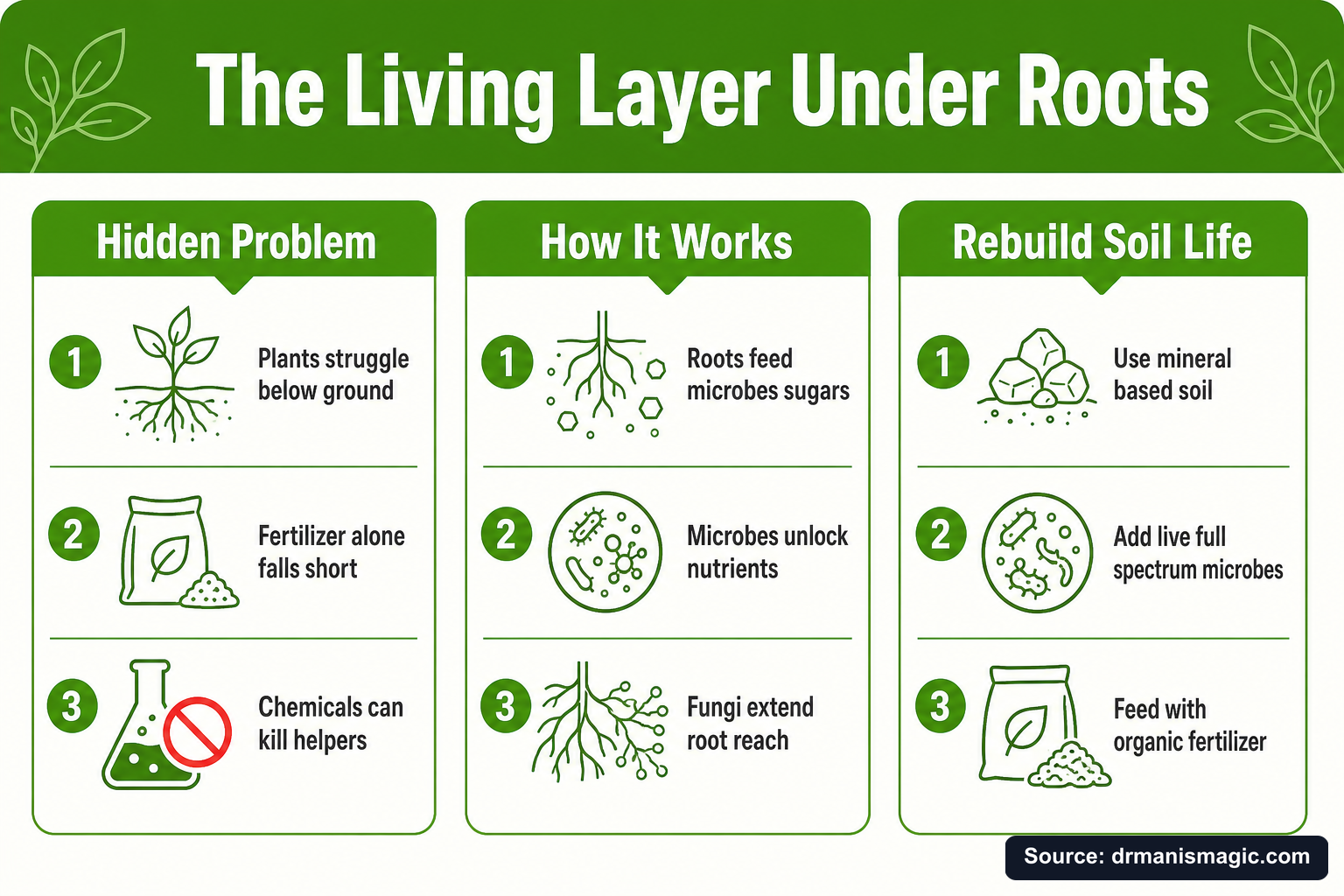
- The rhizosphere is a thin, biologically active zone around your roots where billions of bacteria, fungi, protozoa, and nematodes live and work together to feed and protect your plant.
- Plants cannot fully access nutrients without this living soil food web, no matter how much fertilizer you pour on top.
- Synthetic salt-based fertilizers, herbicides, and fungicides quietly destroy this invisible workforce, leaving roots defenseless against disease and drought.
- Most microbial products on the market are either dried powders with dead organisms or smelly liquids that have already gone anaerobic before you open the bottle.
- Genuinely live, full-spectrum microbes can be stabilized without going foul, and you can actually see them moving under a microscope.
- The Three Plant Pillars — mineral-based soil, live microbials, and organic fertilizer — work together to rebuild and sustain the living layer for any plant you grow.
- Rebuilding damaged soil biology takes time and repeated applications, but the results compound in your favor every single month.
What Is the Rhizosphere and Why Does It Run the Show?
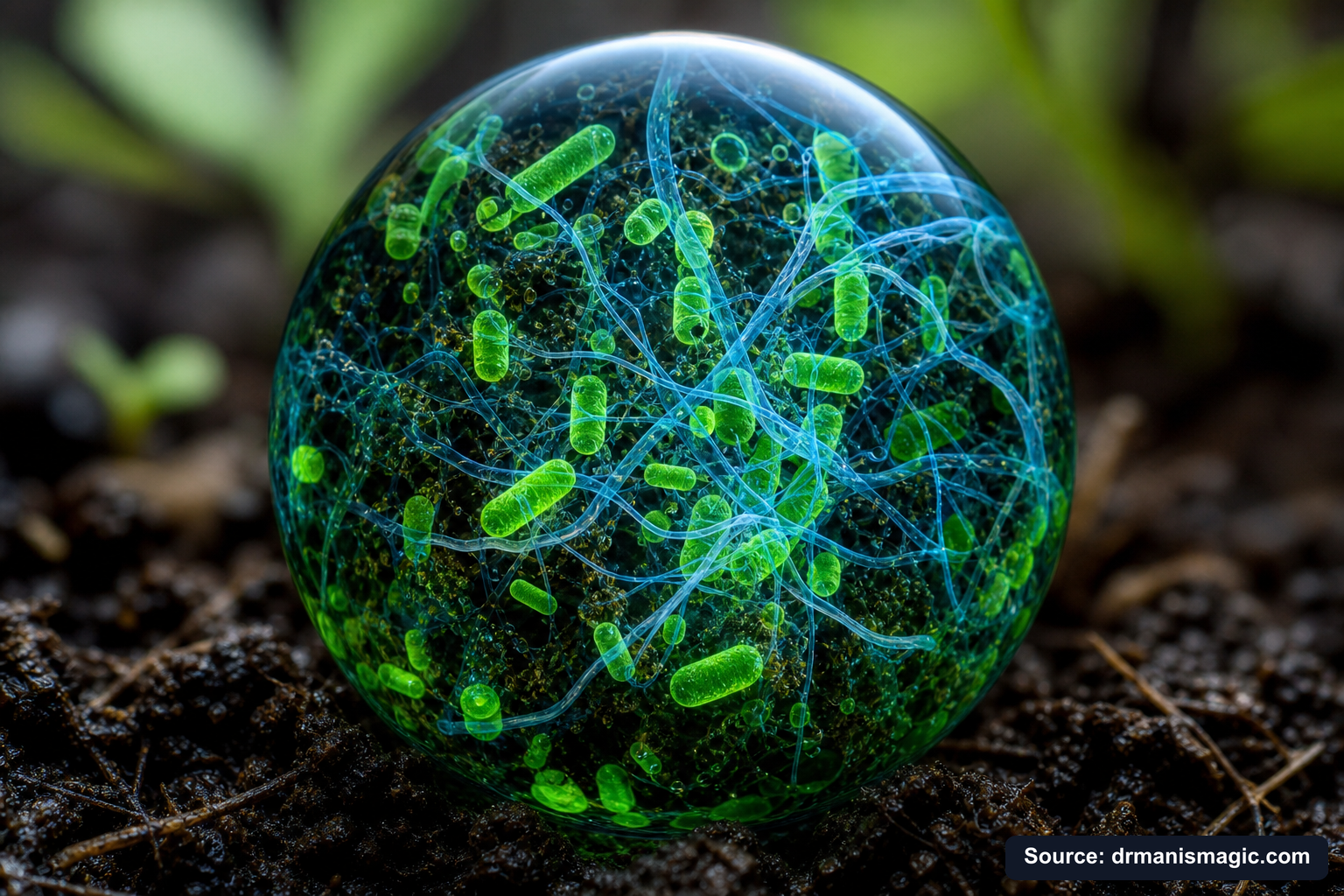
Quick Answer: The rhizosphere is the thin zone of soil surrounding plant roots. It is packed with billions of bacteria, fungi, protozoa, and nematodes that trade nutrients and protection with your plant in real time. Without a healthy rhizosphere, even well-fertilized plants stay weak, disease-prone, and slow to fruit or flower.
The rhizosphere is the living layer. It is not the whole soil. It is a narrow band, sometimes just a few millimeters thick, that wraps around the root surface like a living glove. Researchers at Penn State Extension describe it as one of the most biologically dense environments on Earth. The root zone of a healthy plant can contain more living organisms in a single teaspoon of soil than there are people on the planet.
Think about that for a moment. An entire civilization of invisible life, living right beneath your feet, right now.
Your plant is not passive in this relationship. Its roots actively pump sugars and proteins into the soil through tiny pores. This is called root exudate. It is basically a plant feeding its workers. In return, those workers, bacteria, fungi, protozoa, and nematodes, break down organic matter, unlock locked-up minerals, fight off pathogens, and deliver nutrients right to the root surface in forms the plant can actually absorb.
This is how forests grow without a bag of Miracle-Gro in sight. This is how ancient orchards bear fruit year after year with no human intervention. The living layer does the work. When the living layer is healthy, the plant is healthy. When the living layer is gone, the plant is on its own. And it will lose that fight, slowly but surely.
After growing over 250,000 trees at our South Texas nursery, we can tell you from hard experience: the living layer is not optional. It is the whole game.
How Does the Soil Food Web Actually Feed Your Plant?
Quick Answer: The soil food web is a chain reaction of life. Bacteria and fungi break down organic matter. Protozoa and nematodes eat the bacteria and release nutrients into forms your plant can use. Roots pick up those nutrients. Each organism plays a role. Remove any link and the chain weakens. This is why biology, not just chemistry, determines plant health.
The soil food web is a team, and every player has a specific job. It is not just bacteria doing all the work. It is a whole community operating together, layer by layer.
Here is how it works in plain language. Bacteria and fungi show up first. They break down dead leaves, old roots, and organic matter in the soil. As they do that, they hold nutrients inside their tiny bodies. Then come the protozoa and beneficial nematodes. They eat the bacteria. When they eat them, those locked-up nutrients get released into the soil water right around the roots. The plant drinks them up. University of Minnesota Extension describes this process as the primary engine behind natural nutrient cycling in healthy soils.
And then there are the fungi. Specifically, mycorrhizal fungi. These are the ones that form white fuzzy threads around healthy roots. If you have ever pulled a weed and noticed that cottony white fuzz clinging to the root ball, that is mycorrhizae at work. Those threads extend the root system hundreds of times farther than the root can reach on its own. They pull in water during drought. They gather phosphorus from deep in the soil. They even talk to other plants through underground networks researchers now call the wood wide web.
Every organism in the soil food web earns its place.
| Organism | Primary Job | Plant Benefit |
|---|---|---|
| Beneficial Bacteria | Break down organic matter, fix nitrogen from air, fight pathogens | Nutrient release, disease resistance, soil aggregation |
| Mycorrhizal Fungi | Extend root surface area, gather water and phosphorus | Drought tolerance, better nutrient uptake, stronger roots |
| Other Beneficial Fungi | Decompose tough organic matter, compete with pathogens | Soil structure, disease suppression |
| Protozoa | Eat bacteria and release nutrients | Nutrient cycling, keep bacterial populations balanced |
| Beneficial Nematodes | Eat bacteria, fungi, and harmful pests | Pest control, nutrient release |
| Earthworms | Shred and mix organic matter, create passages for air and water | Aeration, drainage, soil structure |
| Plant Roots | Feed the whole web with sugar exudates | The engine that drives microbial activity around the root zone |
Remove any one of these players and the system gets shaky. Remove several of them, which is exactly what happens when synthetic chemicals hit the soil, and the whole system collapses. The plant is left standing alone in what is now essentially dead dirt, trying to survive on whatever bag of synthetic fertilizer you pour on it next month.
What Silently Destroys the Living Layer in Your Garden?
Quick Answer: Synthetic salt-based fertilizers, chemical herbicides like glyphosate, broad-spectrum pesticides, and synthetic fungicides are the main killers of soil life. They do not target only pests or weeds. They wipe out the beneficial bacteria, fungi, protozoa, and nematodes your plant depends on. The result is a plant that looks fed but is biologically alone and increasingly fragile.
Here is the part that stings a little. A lot of the products sitting in American garages and garden sheds right now are quietly killing the living layer. Not on purpose. Not because the people using them are bad gardeners. But because the system was never set up to tell you the truth about what these products actually do underground.
Synthetic fertilizers are salt-based. That is not a scare story. That is chemistry. High salt concentrations in soil pull water away from microbial cells the same way salt pulls water out of a slug. Beneficial bacteria and fungi die off. Roots get stressed. The plant responds to the chemical nutrient hit, turns briefly green, and the gardener thinks it worked. But the biology underneath is worse than before. You feed the plant. You starve the living layer. Next month you need more fertilizer because the natural system that used to do the feeding for free is gone.
It is a cycle that benefits exactly one party. And it is not you.
Chemical herbicides like glyphosate are even more damaging to soil biology than most people realize. They were originally patented as a chelating agent, meaning they bind to minerals and make them unavailable. When they enter the soil, they disrupt microbial communities and interfere with the same biological pathways that beneficial soil bacteria use to cycle nutrients.
Broad-spectrum pesticides and synthetic fungicides do not check ID before they kill. They hit beneficial fungi and bacteria right alongside the harmful ones. Every application is a reset button on soil biology. And the pathogens come back faster than the beneficials do, because pathogens are generalists built for survival. Your helpful mycorrhizae are specialists that take time to reestablish.
The result? Soil that looks like soil but functions like sand. Roots that are defenseless. A plant that is one bad week away from collapsing.
See also: The Hidden Reason Synthetic Fertilizers Cause Root Rot
Are Mycorrhizal Fungi and Beneficial Bacteria Products Worth Buying?
Quick Answer: It depends entirely on whether the microbes in the product are actually alive when you use them. Most products on the market contain dried, lab-grown spores that show little to no real-world benefit, or liquids that have already gone anaerobic and smell foul. Genuinely live, full-spectrum microbes stabilized from real compost are a completely different category and genuinely work.
This is the question we get more than almost any other. And it deserves an honest answer.
Walk into any garden center and you will find shelves full of microbial products. Bags of mycorrhizal powder. Bottles labeled with long lists of bacteria species. Products promising to transform your soil in one application. Most of them do very little. Not because the organisms listed are bad, but because by the time you open that container, most of the life inside is gone.
Here is how most of these products are made. A handful of bacteria species are grown in giant factory vats. Then they are dried into a powder. The idea is that the spores will "wake up" when water is added. In theory, this sounds reasonable. In practice, after testing dozens of batches on our citrus trees in South Texas, we found they simply do not move the needle for plant health. The dormancy rate is too high. The spectrum is too narrow. And the organisms that do survive are not adapted to the complex community your soil actually needs.
Then there are the liquid products brewed from compost or earthworm castings, sold as "compost tea." Some of these have real biology in them when they leave the production facility. But here is the problem. The microbes in those liquids are alive. And alive things consume oxygen. Once the oxygen in that bottle runs out, the microbes switch to anaerobic fermentation. They start dying. The liquid goes foul. You know this type of product the moment you open it. The smell hits you like a wave. Rotting, sulfurous, wrong. That smell is not a side effect. It is the evidence that the biology has died and is decomposing.
Some gardeners still see benefits from these products because the humic and fulvic acids from the original organic material remain. But the living workforce is mostly gone.
| Product Type | Viability When Used | Microbial Spectrum | Smell | Our Verdict |
|---|---|---|---|---|
| Dried / powdered lab microbes | Very low | Narrow (few species) | Neutral | Avoid. We saw no plant response after dozens of trials. |
| Dry microbes rehydrated in liquid | Very low | Narrow | Neutral to slightly off | Avoid. Same issues as above. |
| Compost tea (fresh, under 24 hours) | Moderate | Broad but variable | Earthy | Works if used immediately. Not practical for most gardeners. |
| Compost tea (older than 24 hours) | Very low (anaerobic) | Partial | Strong stench | Avoid. Biology is dying or dead. |
| Lactobacillus-based products | High (survives well) | Very narrow | Sour / fermented | Avoid for soil. Lactobacillus crowds out beneficial organisms. |
| Fresh hot compost (on-site) | High | Broad and natural | Earthy, rich | Excellent if you have the time and space to maintain it. |
| Plant Super Boost (stabilized full-spectrum) | High | 2,000+ bacteria, 400-500 fungi including mycorrhizae, plus protozoa and nematodes | Earthy, not foul | Our recommendation. Harvested from real compost. Stabilized to stay alive. Visible under a microscope. |
The difference with Plant Super Boost comes down to one thing: how the microbes are kept alive. Dr. Mani's partner, a world-renowned compostologist who has advised royal farming operations and governments across the globe, developed an all-natural stabilization technique that preserves the full spectrum of microbial life from real, hand-crafted compost without letting it go anaerobic. The microbes stay active. The bottle does not stink. And if you take a drop and look at it under a microscope, you can literally watch the organisms move. We have the lab analyses to back it up.
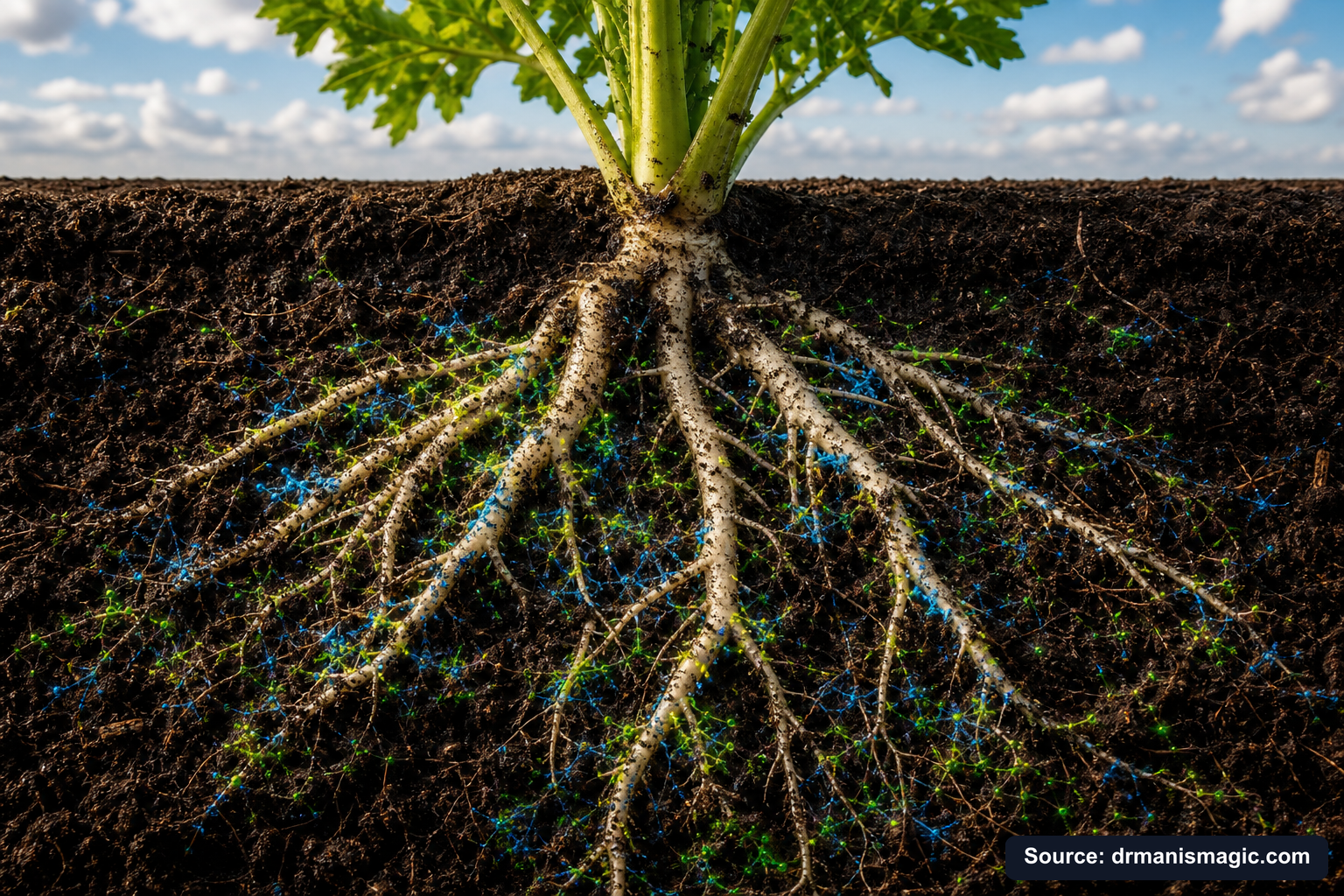
That is not marketing. That is biology you can verify.
You Never Had a Brown Thumb.
You were handed the wrong tools. This free guide hands you the right ones.
You watered it. You fed it. It died anyway.
It was never you. It was the dirt, the salt food, and the bad advice.
This guide shows you what really went wrong, and how to fix it for good.
- Why your plants really died, and why it was never your fault
- The salt hiding in your plant food that quietly burns the roots
- The hidden killer in almost every bag of store soil
- The tiny helpers that grow a whole forest for free
- The rescue trick that brings a half dead plant back to life

What Happens to the Living Layer in Potting Mix and Containers?
Quick Answer: Commercial potting mixes are almost always sterile when bagged. They contain little to no beneficial microbial life. They are also usually made from pine bark and organic matter that breaks down within six to twelve months, compacting around roots and blocking oxygen. This makes container plants especially vulnerable and explains why so many potted trees and houseplants slowly decline despite regular care.
Container gardening has a hidden problem that nobody talks about at the garden center. The soil inside that pot is not alive. It was never meant to be. Commercial potting mixes are sterilized before packaging to prevent mold and contamination during shipping and storage. That sterilization kills every beneficial organism along with the harmful ones.
So your potted plant starts life in biological isolation. No bacteria cycling nutrients. No mycorrhizal fungi extending the root network. No protozoa releasing plant-available minerals. The plant is on its own in a sterile medium, completely dependent on whatever fertilizer you add next.
And then the medium itself starts to fail. Most potting mixes are built around pine bark, sawdust, peat, and other organic materials. These break down over time. As they decompose, they compact. Compaction squeezes out the air pockets roots need to breathe. Drainage slows. Water sits longer. Roots stay wet and oxygen-deprived. Root rot sets in. The plant that looked fine six months ago starts to decline and nobody can figure out why, because the problem is invisible and it started the day the plant went into that pot.
This is why Pillar One of the Three Plant Pillars is mineral-based soil. Mineral soil does not decompose. It does not compact. It does not steal oxygen from roots. The sandy loam we use at US Citrus Nursery comes from the Rio Grande Valley. It is silica-rich and permanent. Add the living layer back through monthly microbial applications and your container plant now has the same biological foundation as a tree growing in a healthy forest floor.
That is a different outcome entirely.
How Do You Rebuild a Dead or Damaged Living Layer?
Quick Answer: Rebuilding soil biology after chemical damage, sterilization, or container failure takes consistent effort over several months. You cannot restore a living ecosystem in one application. But with the right steps, most gardeners see measurable improvement within thirty to sixty days, and the system keeps improving with each monthly treatment.
Here is the honest truth about soil recovery. It is not instant. A living ecosystem that took years to build can be wiped out in one season of synthetic inputs. Bringing it back takes time and repeated applications of real, living biology. But the investment pays off in a way that no bag of fertilizer ever will, because you are rebuilding a system that works for free, every single day, for the rest of that plant's life.
You can never get that time back once it is lost. Every month you spend trying to prop up a plant with synthetic inputs instead of rebuilding the living layer is a month of slow decline instead of real growth. People tell us all the time that the thing they want most is to see fruit on a tree they planted. To taste something they grew. That desire is deeply human. But the old way, the chemical shortcut way, quietly steals the time you have to make that happen.
Here is a practical recovery checklist to start rebuilding the living layer right now.
- Stop the killers first. Reduce or eliminate synthetic salt-based fertilizers, chemical herbicides, and synthetic fungicides. You cannot rebuild a fire in a rainstorm. Every application of these products resets the biology you are trying to restore.
- Flush salt buildup from the soil. If your soil has been on synthetic fertilizers for a while, give it a deep, slow watering to push accumulated salts down and away from the root zone. Do this before your first microbial application.
- Add genuinely live, full-spectrum microbes. Apply a living microbial product that includes bacteria, fungi, mycorrhizae, protozoa, and nematodes. Mix two ounces into a gallon of water and drench the root zone. Do this monthly without skipping.
- Switch to organic, non-salt fertilizer. Organic fertilizers release nutrients slowly and work with the microbial community rather than against it. Crab, kelp, and amino acid formulas provide the full spectrum of macro and micronutrients without the salt that kills your biology.
- Add organic matter to give microbes something to eat. A thin layer of finished compost or biochar worked into the top of the soil gives the microbial community food and habitat. Biochar is especially powerful because it acts like a sponge that holds microbes, water, and nutrients in place.
- Be patient and repeat. After the first month, you will likely notice improved color and some new growth. After two to three months, root health improves visibly. After six months, you have a functioning living layer that starts doing the heavy lifting on its own. Keep applying monthly to maintain and strengthen it.
- Match your soil to the plant's real needs. If you are in a container, consider whether the potting mix has started to break down. If it has been in the same soil for more than a year and is showing signs of compaction or poor drainage, a mineral-based soil that will not decompose gives your rebuilt biology a permanent home to thrive in.
See also: How Salt-Based Feeding Quietly Destroys Root Systems
Live Microbes vs. Dried Powders: Which One Actually Works?
Quick Answer: Live, full-spectrum microbes harvested from real compost and stabilized to stay active outperform dried, lab-grown powders in every meaningful way. Dried powders contain a narrow range of species at very low viability. Live stabilized products contain thousands of species that are actively metabolizing, competing with pathogens, and ready to colonize your root zone the moment they hit the soil.
We have tried them all. Over thirty years of growing citrus, tropical trees, houseplants, and gardens at US Citrus Nursery, we tested batch after batch of the dried powder products. We ran them side by side against trees getting nothing. The results were not encouraging. The trees getting the dried powders performed almost identically to the control group. Sometimes slightly better. Sometimes not at all. The spectrum was too narrow. The viability was too low.
The difference between a dried powder and a genuinely live microbial product is like the difference between a photograph of a meal and the meal itself. One has the form. The other has the function.
What works is biology that is already active. Microbes that are already metabolizing. A community that includes not just bacteria but fungi, mycorrhizae, protozoa, and nematodes, the full food web, not just one or two species someone grew in a factory and freeze-dried. When that living community hits your soil, it hits the ground running. It colonizes the root zone. It starts competing with pathogens. It begins the nutrient cycling process that your plant has been starving for.
And here is one more thing about smell. Stabilized, genuinely live microbes do not stink. When you open a bottle of Plant Super Boost, it smells like healthy earth after rain. That earthy smell is a good sign. It means the biology is aerobic and alive. If a microbial product smells like sewage, fermentation, or something you would rather not breathe near your indoor plants, that is the smell of anaerobic die-off. The microbes are fermenting because they ran out of oxygen. The biological value is largely gone.
Zero PFAS. Zero biosludge. Zero synthetic salts. That matters for the families, children, and pets who share your garden with you.
What Do the Three Plant Pillars Have to Do With the Living Layer?
Quick Answer: The Three Plant Pillars are the system that creates and protects the living layer. Mineral-based soil gives it oxygen and structure. Live microbials rebuild and replenish it every month. Organic fertilizer feeds both the plant and the biology without the salt that kills it. All three work together. Miss one and the living layer weakens. Use all three and it becomes self-sustaining.
After decades of growing at our nursery in South Texas, Dr. Mani Skaria, Professor Emeritus of Plant Pathology and founder of the Clean Citrus Program in Texas, distilled everything he learned into three non-negotiable pillars. Not because it sounds good in marketing copy. Because after growing over 250,000 trees, losing some, saving many, and testing every input combination we could imagine, these three things kept showing up as the difference between plants that thrived and plants that struggled.
Pillar One is mineral-based soil. The living layer needs a home that does not collapse. Organic potting mixes decompose. When they do, they compact, cut off oxygen, and create the wet, airless conditions where root rot pathogens thrive. Mineral-based soil stays open. Roots breathe. Water moves. The microbial community has the structure it needs to function.
Pillar Two is live microbials. This is the living layer itself. Bacteria, fungi, mycorrhizae, protozoa, and nematodes working together as a team, cycling nutrients, suppressing pathogens, extending root reach, and building soil structure. Without this pillar, the other two are doing half a job.
Pillar Three is organic fertilizer. Organic, slow-release nutrients from sources like crab, kelp, and amino acids feed the plant gently without the salt spike that kills the biology you just spent months rebuilding. The microbes also feed on organic matter. Organic fertilizer feeds both the plant and the living layer at the same time. Synthetic fertilizers do the opposite.
All three pillars work together. They are not interchangeable. They are not optional. They are the system. The Three Plant Pillars is the foundation. Everything else, pruning, watering, pest management, is just fine-tuning once the foundation is right.
What Can You Do Right Now to Protect the Living Layer?
Quick Answer: Start by stopping what kills it. Reduce synthetic salt fertilizers and chemical sprays. Then add genuinely live, full-spectrum microbes to the root zone monthly. Pair that with organic slow-release fertilizer and mineral-based soil if you are in a container. This three-part system, built around real biology, is the fastest path to a plant that practically takes care of itself.
You do not need to overhaul your entire garden in a weekend. You need to start the right way today, because the time you have spent growing your plants is the one thing you cannot get back.
Money can be replaced. Time cannot. Every month a plant spends in dead, biologically empty soil is a month of growth that is gone forever. Every year spent fighting the same problems with the same synthetic inputs that caused them is a year closer to giving up on the garden you pictured when you started.
You pictured something. Fruit hanging heavy from a branch you planted with your own hands. A lawn so green and thick it feels like carpet under your bare feet. A garden that fills your kitchen with food you grew yourself. That picture is still possible. It just needs the right foundation.
The living layer is that foundation. It has always been there in nature. It just needs to be invited back into your garden.
Start with the Free Plant Care Field Guide from Dr. Mani's Magic. It walks you through the Three Plant Pillars step by step, plain and simple, for any plant you grow. No chemistry degree required. No expensive consultants. Just the system that has grown over 250,000 trees in South Texas and is now available to any gardener in America who is ready to stop guessing and start growing.
The living layer is waiting. Give it what it needs and watch what happens next.
Frequently Asked Questions
Most gardeners focus on what they can see. But the real action happens underground, in the living layer around your roots. These questions come up again and again, and the answers will change how you think about every plant you own.
What is the most important layer of soil for plant health?
It is not just topsoil. The most important zone is the thin living layer wrapped around your roots called the rhizosphere. This is where billions of bacteria, fungi, and other microbes trade nutrients and protection with your plant. Dr. Mani proved this across 250,000 citrus trees. Without a thriving rhizosphere, even expensive topsoil cannot save a struggling plant.
Which soil layer is richest in plant nutrients?
Topsoil holds the most organic matter, but organic matter alone is not enough. Nutrients locked in soil stay locked unless live microbes unlock them for the roots. That is Pillar Two of Dr. Mani's Three Plant Pillars. Microbes are the delivery crew. No crew means no delivery, no matter how nutrient-rich your soil looks on the surface.
What layer of soil best supports plant roots?
Roots need two things: oxygen and access to nutrients. Most potting mixes are loaded with pine bark and sawdust that rot down into a suffocating sludge. Dr. Mani's Super Soil uses mineral-based sandy loam from the Rio Grande Valley. It does not break down. Roots breathe freely, grow deep, and stay strong. That is Pillar One in action.
What are the layers of a plant ecosystem and why do they matter?
A healthy garden has layers from the canopy down to the ground. But every single layer depends on what happens below the soil surface. The living layer feeds the roots. The roots feed the plant. The plant feeds everything above it. Fix the invisible layer underground first and every layer above it gets stronger. That is the foundation Dr. Mani built his entire system on.
Why do plants fail even when the soil looks fine?
Because looks are deceiving. Soil can look dark and rich but be completely dead underneath. Synthetic salt-based fertilizers wipe out the microbial life in the rhizosphere. Once those microbes are gone, nutrients get locked up and roots go defenseless. Your plant slowly starves and you never know why. This is the exact problem the Three Plant Pillars were designed to fix, permanently.
What is the top layer of earth where plants grow best?
Topsoil is where most roots live, but the quality of that topsoil matters enormously. Cheap potting mixes break down fast and choke roots. Dr. Mani's Super Soil stays stable for years because it is mineral-based, not organic-matter-based. It drains perfectly, holds its structure, and gives roots a clean permanent home. You stop buying soil every season and your plants stop struggling every season.
How do you rebuild the living layer in damaged or depleted soil?
You add live microbes back in. Not dried powders. Not smelly liquids that have already gone bad in the bottle. Dr. Mani's Plant Super Boost contains stabilized live bacteria, fungi, and mycorrhizae that you can actually see moving under a microscope. Mix it with water and pour it on. The living layer starts rebuilding fast. Results compound every month. Your plants feel the difference within weeks.
About the Author
Dr. Mani Skaria, PhD
Dr. Mani Skaria, PhD, is a plant pathologist and the scientific founder of Dr. Mani's Magic. He earned his doctorate at Purdue University and spent 48 years studying how plants, soil, and living microbes work together, including his years as Professor Emeritus at Texas A&M and as a member of the USDA NAREEE Advisory Board. He invented micro-budding, a method for growing healthier, stronger trees, and has grown more than 250,000 trees on the family farm in Hargill, Texas - US Citrus Nursery. His life's work takes real lab science and practical experience and turns it into simple, safe, organic plant care anyone can use at home.


