


The Hidden Partner Behind Heavy Citrus Harvests | Dr. Mani's Magic
The Hidden Partner Behind Heavy Citrus Harvests (And Every Thriving Plant You've Ever Seen)
Picture this. It's a warm Saturday morning. You walk outside with your coffee, barefoot on the grass. You stop in front of your citrus tree. There are blooms. Dozens of them. White, fragrant, almost waxy. The smell hits you first — sweet, clean, like something out of a dream. You reach out and touch a tiny green fruit that has just set. It's real. It's yours.
Now picture the other tree. Same yard. Same sun. Same water. Same fertilizer from the big orange box store. But this one looks tired. Yellow leaves. A handful of dropped blooms on the dirt. A couple of small fruits that never got bigger than a marble before they fell off. You've done everything "right." So why does one tree carry a heavy load while the other one just... struggles?
The answer isn't in the bag of fertilizer you're using. It isn't in your watering schedule. It's underground. Invisible. Alive. And most citrus growers — most plant owners of any kind — never think about it once. After growing over 250,000 trees at our South Texas nursery, we learned that the biggest harvest factor isn't what you put on top of the soil. It's what's living inside it. That hidden partner has a name. It's the soil food web. And once you understand it, everything changes.
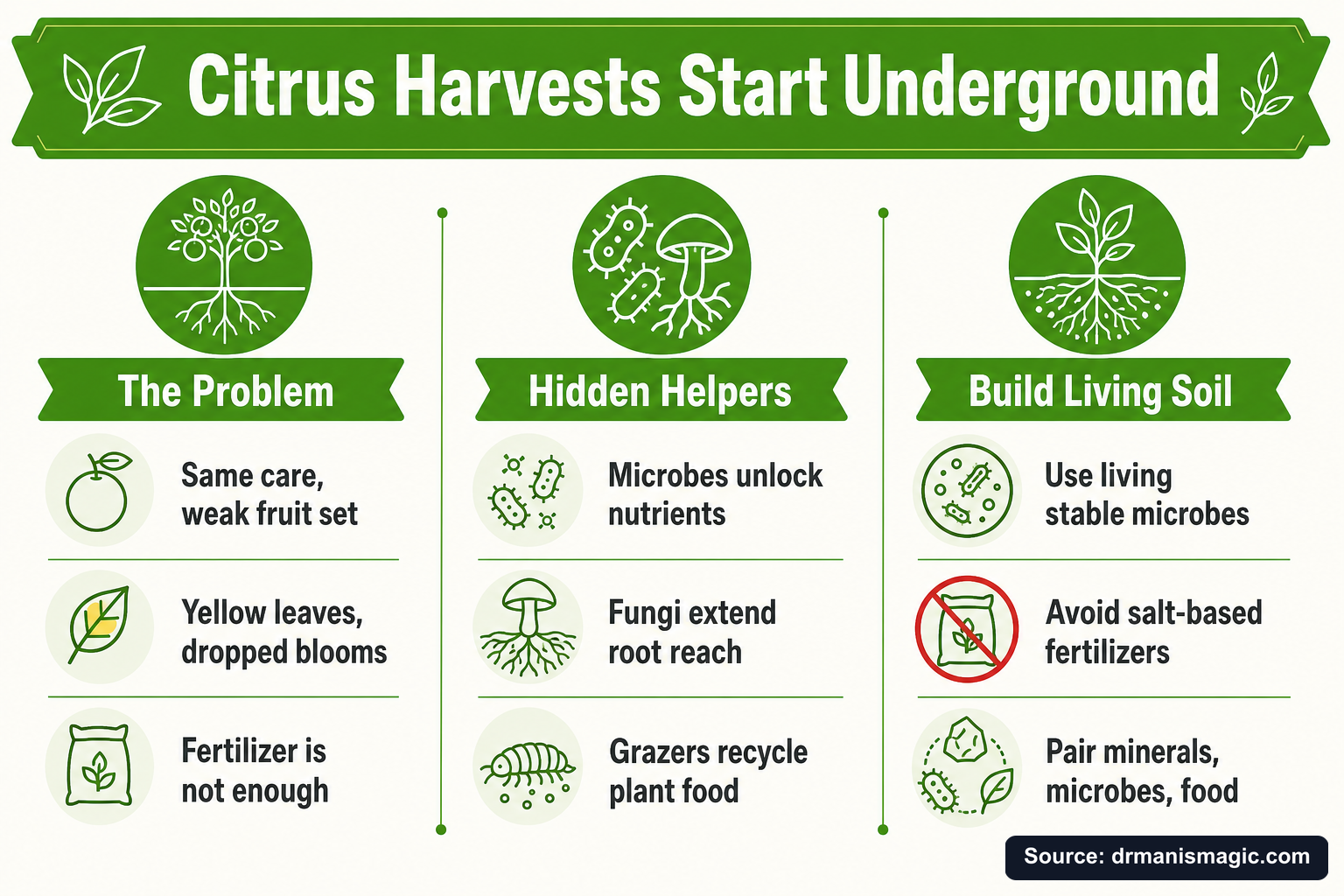
Key Takeaways
- Your citrus tree's harvest size is largely determined by invisible biology living in the soil around its roots — not just fertilizer, sun, or water.
- The soil food web is a team of bacteria, fungi, protozoa, and nematodes that unlock nutrients, extend root reach, and fight disease naturally.
- Mycorrhizal fungi can multiply a citrus tree's effective root surface by hundreds of times, dramatically improving water and nutrient capture.
- Salt-based synthetic fertilizers kill the very microbes that make heavy harvests possible — creating a cycle of dependency with shrinking results.
- Most microbial products on the market are either dried, dead, or going anaerobic and smelling like sewage before they reach your roots.
- Living, stabilized microbes — like those in Plant Super Boost — are the difference between a surviving tree and a thriving one.
- The Three Plant Pillars (mineral soil, live microbes, organic fertilizer) work together as a system — miss one pillar and the whole foundation cracks.
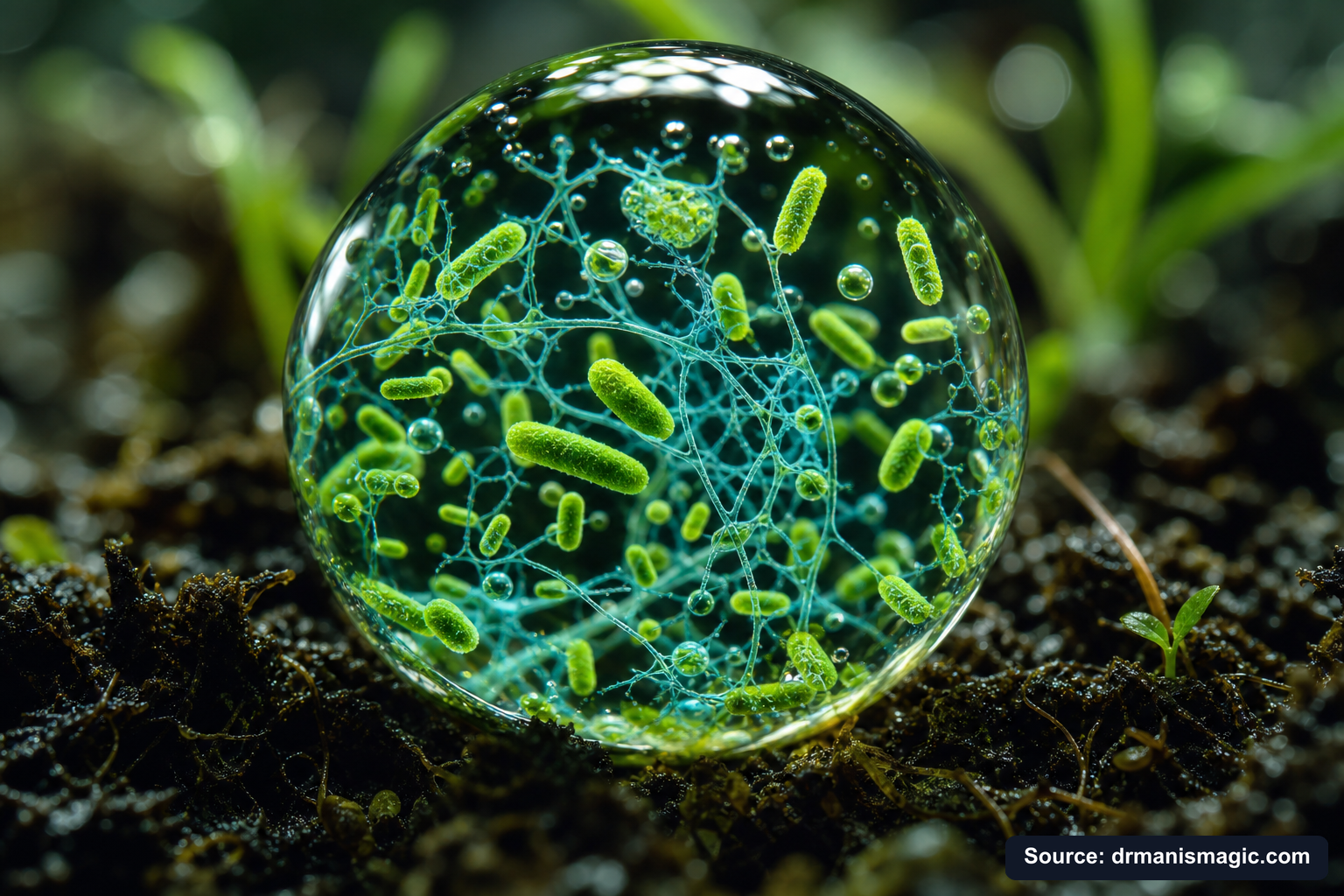
What Is the Soil Food Web and Why Does It Control Your Harvest?
Quick Answer: The soil food web is the living community of bacteria, fungi, protozoa, and nematodes that surrounds plant roots. These organisms break down organic matter, unlock nutrients, extend root reach, and fight off disease — together making the difference between a tree that fruits heavily and one that barely holds on.
The soil food web is the invisible workforce behind every fruit you've ever eaten. It's not a metaphor. It's a real, measurable ecosystem — and university researchers have been studying it for decades. Utah State University Extension describes the soil food web as an interconnected community of organisms that drives nutrient cycling, water retention, disease suppression, and soil structure — all at once.
Think of it like a city. Your tree is the power plant. The microbes are the workers, the engineers, the sanitation crew, and the security guards all rolled into one. When the city is full of life, everything runs. When it's empty — or poisoned — nothing works right. The fertilizer you pour on top is like dropping food into an empty city. Without the workers to process it, much of it just washes away or sits locked in forms the roots can't use.
Here's the part most people never hear: your tree actually feeds those workers on purpose. Citrus roots leak sugars, amino acids, and other compounds into the soil around them. Scientists call this zone the rhizosphere. The tree does this deliberately — because the microbes it feeds come back with gifts. Unlocked phosphorus. Fixed nitrogen. Extended water reach. Disease protection. It's a trade deal that's been running for hundreds of millions of years. And when we interrupt it with chemicals, we break a partnership that nature spent ages perfecting.
What Are the Key Players in the Citrus Soil Food Web?
Quick Answer: Four main groups do the heavy lifting: bacteria unlock and cycle nutrients; mycorrhizal fungi extend root reach and improve drought and salinity tolerance; protozoa and nematodes act as microscopic grazers that release nutrients from dead bacteria; together they form a self-sustaining system that feeds and protects your tree.
Every member of the soil food web has a job. Miss one group and the chain breaks. Here's who lives under your citrus tree — and what each one actually does for your harvest.
Beneficial Bacteria: The First Responders
Bacteria are the most numerous workers in the rhizosphere. Certain strains — including ones in the Pseudomonas, Rhizobium, and Bacillus families — do remarkable things. Some pull nitrogen straight out of the air and convert it into a form roots can absorb. Others dissolve phosphorus that's been chemically locked in the soil for years. Still others produce natural antibiotics that crowd out root pathogens. Research from the University of Florida IFAS Extension shows that beneficial bacteria applied to Florida citrus sandy soils improved plant height, root mass density, stem diameter, leaf nutrients, and soil organic matter — even under reduced fertilizer inputs.
Mycorrhizal Fungi: The Root Multipliers
Here's something that will change how you look at your tree forever. Citrus roots are actually relatively short and limited on their own. They can only reach so far. But mycorrhizal fungi — especially the type called arbuscular mycorrhizal fungi, or AMF — attach to those roots and send out their own thread-like extensions called hyphae. These threads can reach hundreds of times farther than the root alone. Suddenly your tree isn't drinking from a straw. It's drinking from a network.
Studies on citrus rootstocks like Volkamer lemon, sour orange, and trifoliate orange show that AMF improve photosynthesis, root hydraulic conductivity, osmotic adjustment, antioxidant defense, and tolerance to both drought and salt stress. In plain English: the fungi help the tree find more water, absorb more nutrients, handle heat, handle drought, and fight off stress — all at the same time.
Have you ever pulled a weed and seen fuzzy white threads around the roots? That's mycorrhizae. That's why weeds grow so aggressively even in terrible soil. They have a fungal partner doing the heavy lifting. Your citrus tree deserves that same partner.
Protozoa and Nematodes: The Microscopic Grazers Nobody Talks About
This is where it gets really interesting — and almost nobody covers this part. Protozoa and beneficial nematodes are the grazers of the soil food web. They eat bacteria. Thousands of bacteria per minute. And when they digest those bacteria, they release the nutrients locked inside — in a form that plant roots can absorb immediately. Think of them as a slow-release nutrient pump. They eat. They excrete. Your tree eats what they excrete. It's a cycle of abundance running 24 hours a day, right at the root zone.
Extension soil scientists describe protozoa and nematodes as critical nutrient-cycling organisms — yet they are almost completely absent from mainstream citrus care content. Most gardening blogs skip them entirely. That's a big gap. Because without the grazers, the nutrient cycle stalls.
The Full Soil Food Web: Who Does What
| Organism | Primary Job | Harvest Benefit |
|---|---|---|
| Beneficial Bacteria | Fix nitrogen, dissolve phosphorus, suppress pathogens, produce growth hormones | More available nutrients, disease resistance, stronger roots |
| Mycorrhizal Fungi (AMF) | Extend root network via hyphae, improve water and mineral uptake | Bigger root reach, drought tolerance, heavier fruit set |
| Protozoa | Graze on bacteria, release nutrients in plant-available form | Steady nutrient release right at the root zone |
| Beneficial Nematodes | Graze on bacteria and fungi, cycle nutrients, suppress harmful nematodes | Nutrient cycling, pathogen pressure reduction |
| Organic Matter + Fungi | Build soil aggregates via glomalin, improve aeration and water retention | Better root penetration, less compaction, more oxygen |
Why Do Citrus Trees Specifically Depend So Much on Soil Biology?
Quick Answer: Citrus root systems are naturally limited in reach and rely heavily on fungal partnerships to capture water and nutrients across a wider area. Without mycorrhizal fungi and bacteria working at the root zone, citrus trees struggle to hold fruit, resist drought, and recover from stress — no matter how much fertilizer you apply.
Citrus roots are not like corn or grass. They don't spread aggressively on their own. They are relatively dependent on their fungal partners to extend their reach. This is not a weakness — it's a design. Nature built citrus to thrive with a living soil partner. The problem is that most of us are growing citrus in conditions that have no living biology at all.
Container-grown citrus sits in sterile potting mix. Potting mixes are sterilized — deliberately — to prevent mold during shipping. That means your tree arrives with zero microbial partners. None. It's like hiring a brilliant surgeon but giving them no instruments and no team.
Even in-ground citrus often grows in soil that's been treated with synthetic herbicides, salt-based fertilizers, and fungicides for years. Those inputs don't just target weeds and pests. They wipe out the beneficial community in the rhizosphere. The tree survives but it's running on borrowed time — and borrowed nutrients that wash away because there's no living system to hold them.
This is exactly why you can have a citrus tree that flowers beautifully but drops most of its fruit before it matures. Fruit set and fruit hold require a sustained flow of phosphorus, calcium, and other minerals at exactly the right time. When the soil food web is healthy, that flow happens naturally. When it's gone, the tree simply doesn't have enough to hold the load. The fruit drops. You're left wondering what went wrong.
How Do Salt-Based Fertilizers Destroy the Hidden Partner Your Tree Needs?
Quick Answer: Salt-based synthetic fertilizers raise the salt concentration around roots and in the soil, which kills beneficial bacteria and fungi — the very organisms that unlock nutrients and protect your tree. You get a temporary green-up followed by a weakened, dependent plant that needs more and more product to stay alive.
Here's the ugly truth about the fertilizer industry. Most of what's sold in big box stores is salt-based. Synthetic nitrogen, synthetic phosphorus, synthetic potassium — all delivered in salt form. Salts are cheap to make. Easy to ship. They give fast results because they're water-soluble and get into the plant quickly.
But salts are also lethal to microbes. High salt concentration in the soil draws water out of bacterial cells through a process called osmosis. The bacteria shrivel and die. The fungi retreat. The protozoa disappear. The living system you need to sustain a heavy harvest gets gutted — every time you apply.
And here's the trap. When you kill the soil food web, the tree becomes dependent on you for everything. It can no longer unlock nutrients on its own. So you have to keep buying more fertilizer. The tree gets a short burst of green, then fades again. You buy more. The cycle repeats. Meanwhile, the soil gets saltier, the biology gets weaker, and the harvests get thinner year by year.
We've seen this pattern play out across thousands of trees at our South Texas nursery. The trees that get heavy salt-based fertilizer applications look impressive for a season or two. Then they plateau. Then they decline. The trees grown with living biology and organic nutrition just keep getting better. Year after year. Season after season.
See also: The Hidden Reason Synthetic Fertilizers Cause Root Rot
See also: How Salt-Based Feeding Quietly Destroys Root Systems
Why Do Most Microbial Products on the Market Fail to Deliver?
Quick Answer: Most commercial microbial products are either lab-grown and dried into powders that barely reactivate, or they're liquid products that have already gone anaerobic — meaning the microbes are dead or dying and the bottle smells like sewage. Neither type delivers the living biology your soil actually needs.
When Dr. Mani started testing microbial products across our nursery — hundreds of trials, thousands of trees — he kept hitting the same wall. The products looked good on the label. The marketing was impressive. But the trees didn't respond. So he dug into why.
There are basically three kinds of microbial products sold today. Understanding the difference could save you years of wasted effort.
Type 1: Dried Lab-Grown Powder
These are made in industrial factories. A handful of specific microbe strains are grown in vats, then dried into spores and packaged as powder — or stirred into liquid. The idea is that adding water "reactivates" them. In our experience, across dozens of batches and years of testing, these products simply don't move the needle. The strains are narrow. The reactivation is unreliable. The plants don't respond.
Type 2: Compost Tea Gone Anaerobic
These start with a good idea — compost is teeming with real, broad-spectrum microbes. But when compost extract is bottled and shipped, it goes anaerobic. The oxygen runs out. The beneficial microbes die. Fermentation takes over. By the time the bottle reaches you, it smells like sewage. Literally. Some bottles even fizz when you open them — that's fermentation gas escaping. The smell is your signal: the good stuff is gone.
Type 3: Lactobacillus-Based Products
Lactobacillus is the bacteria in your yogurt. It's easy to grow and stays alive. But in soil, it's a bully. It outcompetes and crowds out the beneficial bacteria your roots actually need. We don't include it in our products for exactly this reason. Lactobacillus belongs in your gut. Not your garden.
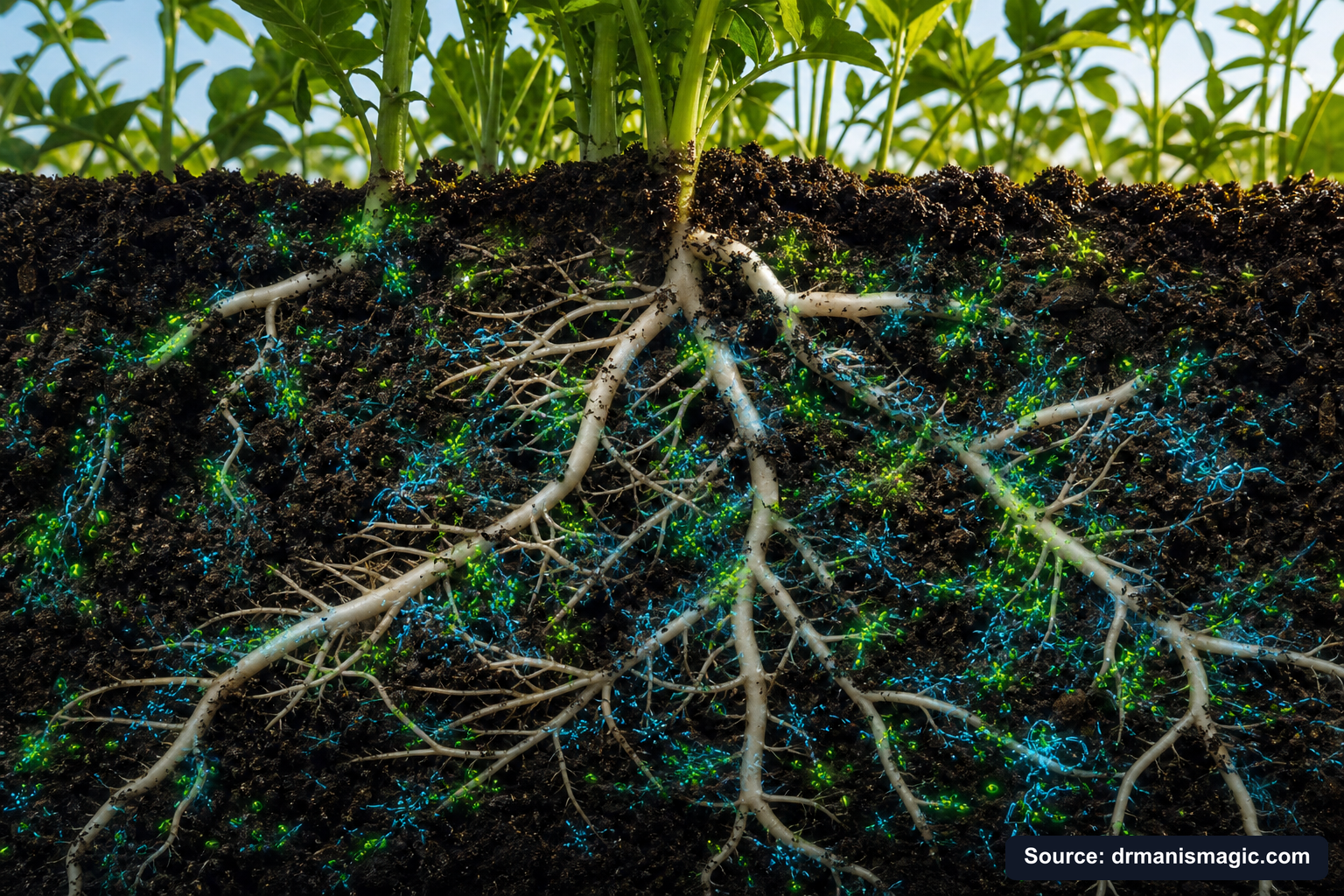
Live vs. Dead: The Microbial Product Comparison
| Product Type | Microbes Alive at Use? | Spectrum of Organisms | Smell | Results We Observed |
|---|---|---|---|---|
| Dried lab powder | Low — spore reactivation unreliable | Narrow (2-5 strains) | Neutral | Minimal to none |
| Dried powder in liquid | Low — same issue | Narrow | Neutral | Minimal to none |
| Compost tea (fresh, under 24 hours) | Moderate — time-sensitive | Broad, natural | Earthy, then sour | Good — if used immediately |
| Bottled compost tea (old) | Low — anaerobic die-off | Partial | Strong sewage odor | Poor — biology is gone |
| Lactobacillus-based | High — but wrong organism | Narrow, aggressive | Sour/fermented | Crowds out beneficials |
| Plant Super Boost (stabilized full-spectrum) | High — naturally stabilized | 2,000+ bacteria, 400-500 fungi including mycorrhizae, protozoa, nematodes | Earthy, not foul | Consistent improvement across 250,000+ trees |
You Never Had a Brown Thumb.
You were handed the wrong tools. This free guide hands you the right ones.
You watered it. You fed it. It died anyway.
It was never you. It was the dirt, the salt food, and the bad advice.
This guide shows you what really went wrong, and how to fix it for good.
- Why your plants really died, and why it was never your fault
- The salt hiding in your plant food that quietly burns the roots
- The hidden killer in almost every bag of store soil
- The tiny helpers that grow a whole forest for free
- The rescue trick that brings a half dead plant back to life

What Makes Plant Super Boost Different From Every Other Microbial Product?
Quick Answer: Plant Super Boost is harvested from real, actively composting material — not lab-grown or dried — and stabilized using an all-natural technique that keeps the microbes alive without going anaerobic. The result is a full-spectrum, living liquid that smells earthy (not foul) and delivers measurable microbial activity you can literally see under a microscope.
The story behind Plant Super Boost is one of the most unusual in gardening history. It starts with a compost expert — a world-renowned specialist who had advised royal families and governments on their agricultural programs. He discovered a natural method to stabilize the full spectrum of microbes from fresh, active compost. Not dry them. Not brew them anaerobically. Stabilize them — so they stayed alive, active, and ready to work.
When large citrus groves started seeing dramatic results with his method, the big chemical companies took notice. He was eventually blacklisted. At one point, he feared for his safety and stopped producing entirely. Then, years later, through what we can only describe as a providential meeting, he connected with Dr. Mani Skaria at US Citrus Nursery in South Texas. He joined the team. And together, they built the Dr. Mani's Magic line — starting with Plant Super Boost.
The goal was simple: take the power of fresh, living compost and put it in a bottle anyone can use. No compost pile required. No 24-hour brewing window. No foul smell. Just living microbes, stabilized naturally, ready to go to work the moment you pour them onto your soil.
If you take a drop of Plant Super Boost and look at it under a microscope, you can see the organisms moving. That's not a marketing claim. That's biology. We have lab analyses to back it up. And we've seen it perform across our grove, our container trees, our houseplants, and our tropical specimens — 250,000 trees and counting.
Plant Super Boost contains no PFAS. No biosludge. No synthetic salts. No lab-grown narrow-spectrum powders. Just the full ecosystem your roots were designed to work with — delivered in an easy liquid you mix with water and pour on your soil once a month.
How Do You Rebuild Dead or Damaged Citrus Soil? A Practical Recovery Plan
Quick Answer: Rebuilding a damaged citrus root zone takes consistent action over several months. The key steps are reducing chemical pressure, improving drainage and aeration, flushing salt buildup, restoring organic matter, and adding living biology repeatedly — because one application is never enough when the ecosystem has been depleted.
If your citrus tree is in sterile potting mix, or if you've been using salt-based fertilizers for years, the soil food web is either absent or severely damaged. Here's how to bring it back. This process works for containers, raised beds, and in-ground trees. It also works for lawns, gardens, and any other plants you're trying to rescue.
- Stop the damage first. Reduce or eliminate synthetic herbicides, salt-based fertilizers, and broad-spectrum fungicides. You cannot rebuild a living ecosystem while continuing to poison it. This is the hardest step for most growers — but it's the most important.
- Flush salt buildup. If you've been using synthetic fertilizers, salts have accumulated in the soil. Water your tree deeply and slowly several times to push accumulated salts down and out of the root zone. Rainwater is better than tap water for this — tap water often contains chlorine and chloramine that harm microbes.
- Improve drainage and aeration. Microbes need oxygen. If your soil is compacted or waterlogged, beneficial aerobic bacteria die and harmful anaerobic organisms take over. For containers, consider repotting into a mineral-based soil like Super Soil that provides permanent structure without breaking down and suffocating roots.
- Add organic matter. Compost, mulch, or aged organic material gives microbes something to eat and a habitat to live in. Even a thin layer of mulch on top of container soil makes a difference — it moderates temperature, retains moisture, and feeds the organisms below.
- Apply live microbes — and keep applying them. A single application of microbial inoculant is a starting point, not a finish line. Environmental pressures, sterile inputs, and past damage mean the community needs repeated support. Apply living biology monthly. Let it build over time.
- Switch to organic nutrition. Feed your tree with slow-release organic fertilizer that works with microbes instead of killing them. Crab, kelp, and amino acid-based fertilizers provide the full spectrum of macronutrients and micronutrients in gentle, non-salt forms that the soil food web can process and deliver to roots over time.
- Be patient — but expect results. Soil biology takes months to rebuild, not days. But the trajectory is clear. Within 30 days you'll often see improved leaf color and vigor. Within a season, the difference in fruit set and hold becomes visible. Within a year, you're growing a fundamentally different tree — one with a living partner underground.
What Are the Three Plant Pillars and Why Can't You Skip Any of Them?
Quick Answer: The Three Plant Pillars are the framework Dr. Mani developed after 40 years of growing citrus and tropical trees: mineral-based soil for permanent structure and root oxygen, live microbes for nutrient cycling and disease defense, and organic fertilizer for complete non-salt nutrition. Skip any one of them and the system breaks — leading to root rot, weak fruiting, and struggling plants.
After decades of research, thousands of experiments, and over 250,000 trees, Dr. Mani Skaria — Professor Emeritus of Plant Pathology, inventor of micro-budding, and founder of Texas's Clean Citrus Program — arrived at a simple truth. Plants don't need complicated programs. They need three things done right. Always.
The system is called the Three Plant Pillars. And it's the foundation behind every product in the Dr. Mani's Magic line.
Pillar 1: Mineral-Based Soil
Most potting mix is made from pine bark and wood byproducts. It looks nice in the bag. But organic-based potting mixes decompose. As they break down, they compact. The air pockets disappear. Roots suffocate. Drainage fails. Root rot follows. And you have to buy new soil every year as the old mix collapses into a soggy, airless sludge.
Mineral-based soil — like the sandy loam from South Texas's Rio Grande Valley — doesn't decompose. It holds its structure permanently. It drains properly. It lets roots breathe and expand freely. It's not about added nutrients. It's about a permanent home that doesn't turn toxic over time. Get this wrong and nothing else can fully compensate.
Pillar 2: Live Microbials
This is the hidden partner. The invisible workforce. The biological ignition switch that turns a surviving tree into a thriving one. Without live bacteria, fungi, protozoa, and nematodes working at the root zone, your tree is flying blind — dependent on you for every nutrient, with no natural disease defense, and no extended water reach. With them, the soil becomes a self-sustaining ecosystem that feeds, protects, and strengthens your plant around the clock.
Pillar 3: Organic Fertilizer
Plants need nitrogen, phosphorus, potassium, calcium, magnesium, and a full spectrum of trace minerals. They also need biostimulants — compounds that signal the plant to grow, flower, and fruit. Organic slow-release fertilizers made from crab meal, kelp, and amino acids deliver all of this in forms the soil food web can process and deliver to roots gently, over time. No salt spikes. No microbial massacre. No burn. Just steady, complete nutrition that works with the biology — not against it.
The Three Pillars at a Glance
| Pillar | What It Provides | What Happens Without It | Dr. Mani's Magic Solution |
|---|---|---|---|
| Mineral-Based Soil | Permanent drainage, aeration, root oxygen, structural stability | Compaction, root rot, oxygen starvation, annual soil collapse | Super Soil |
| Live Microbials | Nutrient cycling, root extension, disease suppression, stress tolerance | Locked nutrients, root disease, poor fruit set, chemical dependency | Plant Super Boost |
| Organic Fertilizer | Complete slow-release nutrition, biostimulants, no salt burn | Deficiencies, microbial die-off, burn, nutrient leaching | Crab, Kelp and Amino Acids |
Live Microbes vs. Salt Fertilizers: Which One Actually Builds a Heavy Harvest?
Quick Answer: Salt-based fertilizers deliver a fast, temporary nutrient hit that weakens soil biology over time. Live microbes build a self-sustaining system that improves with each passing season. The difference shows up clearly in year two and three — when the microbially supported tree carries heavier loads while the salt-fed tree plateaus or declines.
Let's put both approaches side by side — not to be harsh, but to be honest. Because the choice between these two paths is the difference between a tree that performs for a season and one that performs for a lifetime.
The salt fertilizer approach is what most gardeners start with. It's what Miracle-Gro built an empire on starting in the 1950s. Quick green. Fast results. Easy to measure. The problem is what happens next. Salt accumulates. Microbes die. Roots become dependent. The dose has to keep increasing to get the same result. Sound familiar? It's the same cycle you see with any dependency. And the cost isn't just money. The cost is time. Months and years of stalled growth, declining harvests, and a tree that never quite reaches what it could have been.
The living biology approach takes a little longer to show its face. But once it's established, it compounds. The microbes multiply. The fungal network expands. The nutrient cycling speeds up. The tree's immune system strengthens. Harvests get heavier. Not just this year — every year. The soil gets better. Not worse.
At our nursery, we've watched both paths play out across 250,000 trees over three decades. The trees rooted in living biology are simply in a different category. They're not just surviving. They're doing what citrus was born to do: bearing heavy, fragrant, juice-filled fruit — season after season — on a foundation that only gets stronger with time.
We know that one of the deepest desires a gardener carries is the wish to see real fruit hanging from a tree they planted with their own hands. Not someday. Not eventually. Soon enough to actually enjoy it. You cannot get time back. The months and years spent on the wrong approach are gone. But the right foundation — set up now, set up correctly — means the tree you plant today can be bearing heavy loads before you know it. That's not a sales pitch. That's physics. And biology. And 40 years of proven results.

What Can You Do Right Now to Feed the Hidden Partner?
Quick Answer: Start by stopping the inputs that kill soil biology, then add living microbes consistently, switch to organic nutrition, and make sure your soil structure allows oxygen to reach the root zone. These steps can begin today — and the positive changes begin within the first few weeks.
You don't have to overhaul everything at once. Start with one tree. One pot. One corner of your garden. Here's what to do right now:
First, take a breath and let go of the idea that more chemicals equals better results. It doesn't. The system rigged you to believe that. It isn't your fault. The brown thumb is not real. It's a convenient story that keeps you buying products that don't solve the root problem.
Second, check what you're growing in. If it's a standard potting mix from a big box store, it's already breaking down. It's already compacting. It's already oxygen-depleted. The right move is to transition to a mineral-based soil that holds its structure permanently and lets roots breathe.
Third, add living biology to your root zone this week. Not a dried powder. Not a foul-smelling liquid. Living, stabilized, full-spectrum microbes that smell earthy — not rotten — because they're alive, not decomposing. Apply monthly and let the community build.
Fourth, feed the whole system with organic nutrition that doesn't burn the biology you're trying to build. Slow-release, crab, kelp, and amino acid-based fertilizer delivers complete nutrition without the salt that wipes out everything living in the root zone.
Do all three and you've just built the Three Plant Pillars. The foundation that Dr. Mani spent 40 years arriving at. The foundation that 250,000 trees — from our grove in South Texas, to houseplants in apartments, to container trees on patios across America — have been grown on. It's not complicated. It's just the right order of operations.
If you want to see exactly how the system works together — and get the full step-by-step guide for any plant you're growing — the Free Plant Care Field Guide lays it all out in plain language. No jargon. No guesswork. Just the same information we use at our own nursery, handed directly to you.
The hidden partner behind every heavy citrus harvest — and every thriving garden, lawn, and houseplant — has been there all along. Waiting in the soil. Waiting for the right conditions to do what it was designed to do. Your job is simply to stop working against it. And start working with it.
The best time to start was years ago. The second best time is right now. Your tree is waiting. The microbes are ready. Give them a home worth living in — and watch what happens next.
Frequently Asked Questions
After growing over 250,000 citrus trees in South Texas, we hear the same questions again and again. Most of them point to one root cause: the invisible biology living in your soil is either working for you or against you. These answers cut through the noise and give you the truth the big box stores will never tell you.
What is the hidden partner behind heavy citrus harvests?
The hidden partner is the soil food web. It is a living community of bacteria, fungi, protozoa, and nematodes that surrounds your tree's roots. These tiny organisms unlock nutrients, fight disease, and extend root reach far beyond what roots can do alone. At Dr. Mani's Magic, we call this Pillar Two: Microbial Muscle. Without it, even the best fertilizer just sits in the soil doing nothing useful for your tree.
What killed the Florida citrus industry?
A bacterial disease called citrus greening, spread by a tiny insect called the Asian citrus psyllid, devastated Florida's groves after 2005. It attacks the tree from the inside out, starving it slowly. Hurricanes, land development, and other pests made things worse. Here is the hard truth: trees grown in dead, chemical-soaked soil had almost no natural defenses. Healthy microbial communities are nature's first line of protection, and most Florida growers had already wiped them out with synthetic fertilizers long before greening arrived.
What do coffee grounds do for citrus trees?
Coffee grounds slowly release nitrogen, add a touch of acidity, and improve soil texture. They can help, but only as one small piece of a bigger system. The real question is whether your soil has the living microbes to break those grounds down and convert them into something your tree can actually use. Without Pillar Two in place, organic matter like coffee grounds just sits there. With live microbes in the soil, every bit of organic input gets processed and put to work fast.
What does Epsom salt do to citrus trees?
Epsom salt delivers magnesium, which is the mineral at the center of every chlorophyll molecule. If your tree's older leaves are turning yellow while the veins stay green, a magnesium deficiency is a likely cause. Epsom salt can correct that. But use it carefully. Too much blocks calcium absorption and creates new problems. It is also a salt, which means heavy use can harm the very microbes your tree depends on. Think of it as a targeted fix, not a regular feeding routine.
What is the main pest in citrus?
The Asian citrus psyllid is the most destructive pest in citrus today because it spreads citrus greening disease. Beyond that, common threats include citrus leafminers, spider mites, scale insects, and root nematodes. Here is what most growers miss: a tree with a thriving soil food web builds natural resistance. Strong roots, healthy tissue, and a living microbial shield make your tree a much harder target. Chemical pesticides often kill the beneficial microbes that provide that defense, leaving your tree more exposed over time.
What state is the largest producer of citrus in the US?
California now leads the country in citrus production, accounting for roughly 79 percent of total US citrus output as of the 2023 to 2024 season. Florida's historic dominance collapsed under citrus greening and hurricane damage. Texas, where Dr. Mani's Magic is rooted, has a long citrus growing tradition in the Rio Grande Valley. That is exactly where Dr. Mani spent over 30 years perfecting the Three Plant Pillars system that keeps trees healthy, productive, and resilient against disease pressure.
Where does the US get most of its citrus?
Fresh citrus for eating comes mainly from California, Arizona, and Texas. Most orange juice still comes from Florida, though production there has dropped by over 90 percent in recent decades. The US also imports significant amounts from Mexico and Brazil. The lesson here is simple: the healthiest, most productive trees anywhere in the world share one thing in common. They grow in living soil. That is the foundation Dr. Mani built his entire system on, proven across a quarter million trees right here in South Texas.
About the Author
Dr. Mani Skaria, PhD
Dr. Mani Skaria, PhD, is a plant pathologist and the scientific founder of Dr. Mani's Magic. He earned his doctorate at Purdue University and spent 48 years studying how plants, soil, and living microbes work together, including his years as Professor Emeritus at Texas A&M and as a member of the USDA NAREEE Advisory Board. He invented micro-budding, a method for growing healthier, stronger trees, and has grown more than 250,000 trees on the family farm in Hargill, Texas - US Citrus Nursery. His life's work takes real lab science and practical experience and turns it into simple, safe, organic plant care anyone can use at home.


