


The Hidden Biology Behind Juicy, Sweet Citrus Fruit | Dr. Mani's Magic
The Hidden Biology Behind Juicy, Sweet Citrus: From Living Soil to Brix and Flavor
Picture this. You're standing in your backyard on a warm Saturday morning. You reach up, twist a ripe orange from the branch, and bite into it right there in the sun. The juice runs down your chin. It's sweet. It's cold. It tastes like something you can't buy at any grocery store in the world.
Now picture the same tree. Same sunshine. Same water. But the fruit is dry inside. Barely any juice. More rind than pulp. Flavor like cardboard soaked in water. You've seen this. Maybe you've tasted it. And you've probably wondered: what went wrong? The tree looks fine. The leaves are green. But the fruit? Disappointing every single time.
Here's the part most people never hear. The difference between those two oranges wasn't made in the fruit. It was made underground. Weeks before that orange even formed. Deep in the root zone, in the dark, in the dirt, something either happened or it didn't. And whether it happened or not determined everything you tasted. This is the hidden biology behind juicy, sweet citrus. And once you see it, you cannot unsee it.
Key Takeaways
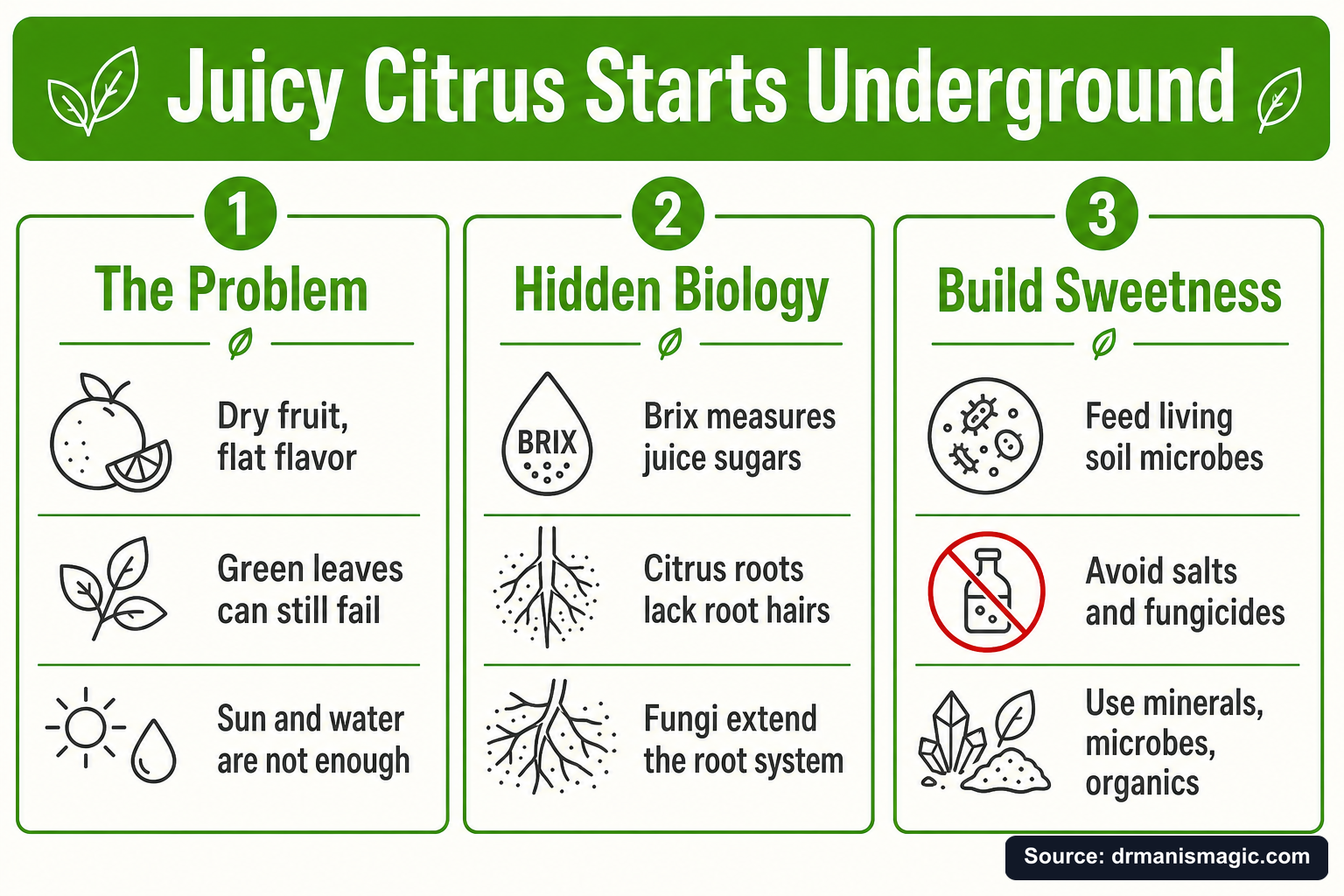
- Citrus flavor, sweetness, and juice content are built underground by living soil biology, not just sunlight and water.
- Citrus roots have almost no root hairs, making them uniquely dependent on mycorrhizal fungi to absorb water and nutrients.
- The soil food web is a tiny predator-prey system that delivers nutrients directly to roots at exactly the right time.
- Salt-based synthetic fertilizers and fungicides destroy the very microbes that build fruit quality, wasting both money and time.
- Dead, dried, or foul-smelling microbial products are largely ineffective. Live, stabilized microbes make the real difference.
- The Three Plant Pillars (mineral soil, live microbes, organic fertilizer) are the foundation for flavor, juiciness, and long-term plant health.
- You can recover depleted soil biology, but it takes repeated application and the right inputs in the right sequence.
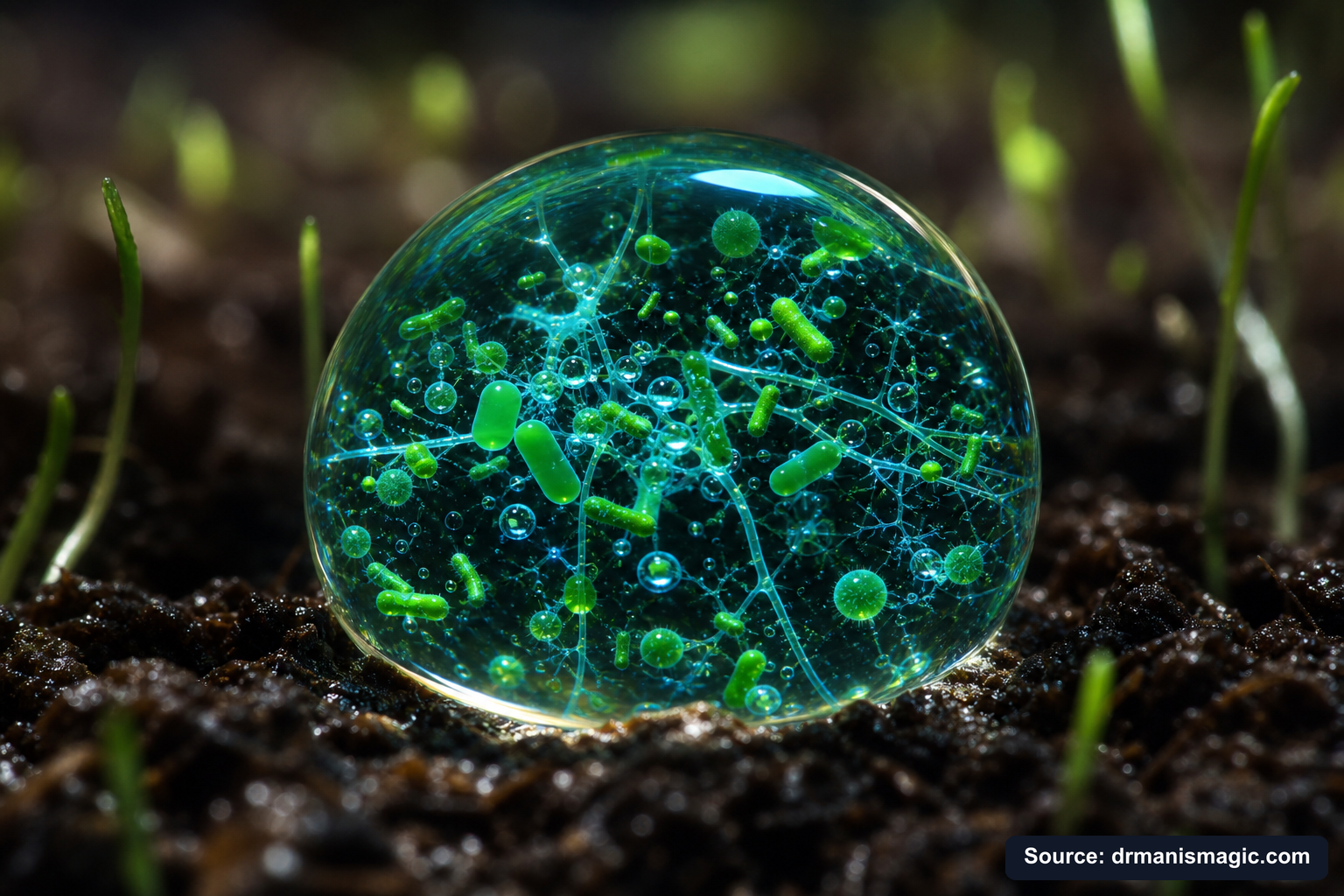
What Is Brix, and Why Does It Tell You If Your Citrus Is Actually Sweet?
Quick Answer: Brix is a simple measure of dissolved sugars in fruit juice. Higher Brix means sweeter, more flavorful citrus. Most grocery store citrus scores 8 to 10 Brix. Fruit grown in biologically rich, mineral-balanced soil regularly scores 12 to 16 or higher. The difference is not luck. It is living soil biology.
Brix is just a number on a scale. Think of it like a sweetness score. You measure it with a small tool called a refractometer. A drop of juice goes on the lens, you hold it up to light, and you read the number. Simple.
A score of 8 means the juice is 8 percent dissolved sugars. That's your average supermarket orange. A score of 14 means nearly twice as many sugars in the same drop of juice. That's the orange that makes your eyes close when you bite it.
But here's what nobody talks about. Brix isn't something you spray onto a tree. It's something the tree builds from the inside out. It's the end result of a chain reaction that starts in the soil, travels through the roots, moves into the leaves, gets cooked by sunlight through photosynthesis, and finally lands inside tiny fluid-filled sacs called juice vesicles inside the fruit.
Break any link in that chain, and Brix drops. Juice drops. Flavor disappears. And the most common link that breaks? The living biology in the soil that nobody can see.
According to research from the University of Florida IFAS Extension, the balance between sugars and acids in citrus is what consumers actually experience as "flavor." High sugar with balanced acid produces that signature burst of sweetness. Low sugar, high acid, or poor water management produces sour, flat, or dry results. And soil health sits at the foundation of that balance.
Why Do Citrus Roots Desperately Need Mycorrhizal Fungi?
Quick Answer: Citrus roots have almost no root hairs, the tiny structures most plants use to absorb water and nutrients. This makes citrus unusually dependent on mycorrhizal fungi, which act as a massive invisible extension of the root system. Without these fungi, citrus trees struggle to absorb phosphorus, water, and key minerals, directly limiting fruit sweetness and juice content.
Most plants grow tiny hairs along their roots. These hairs are how they drink. They dramatically increase the surface area of the root so the plant can pull in more water and nutrients.
Citrus trees barely have any.
This is not a flaw. It is a design. Citrus evolved in environments where mycorrhizal fungi were always present. The tree made a deal with the fungi millions of years ago. The fungi would do the absorbing. The tree would do the feeding. It worked perfectly.
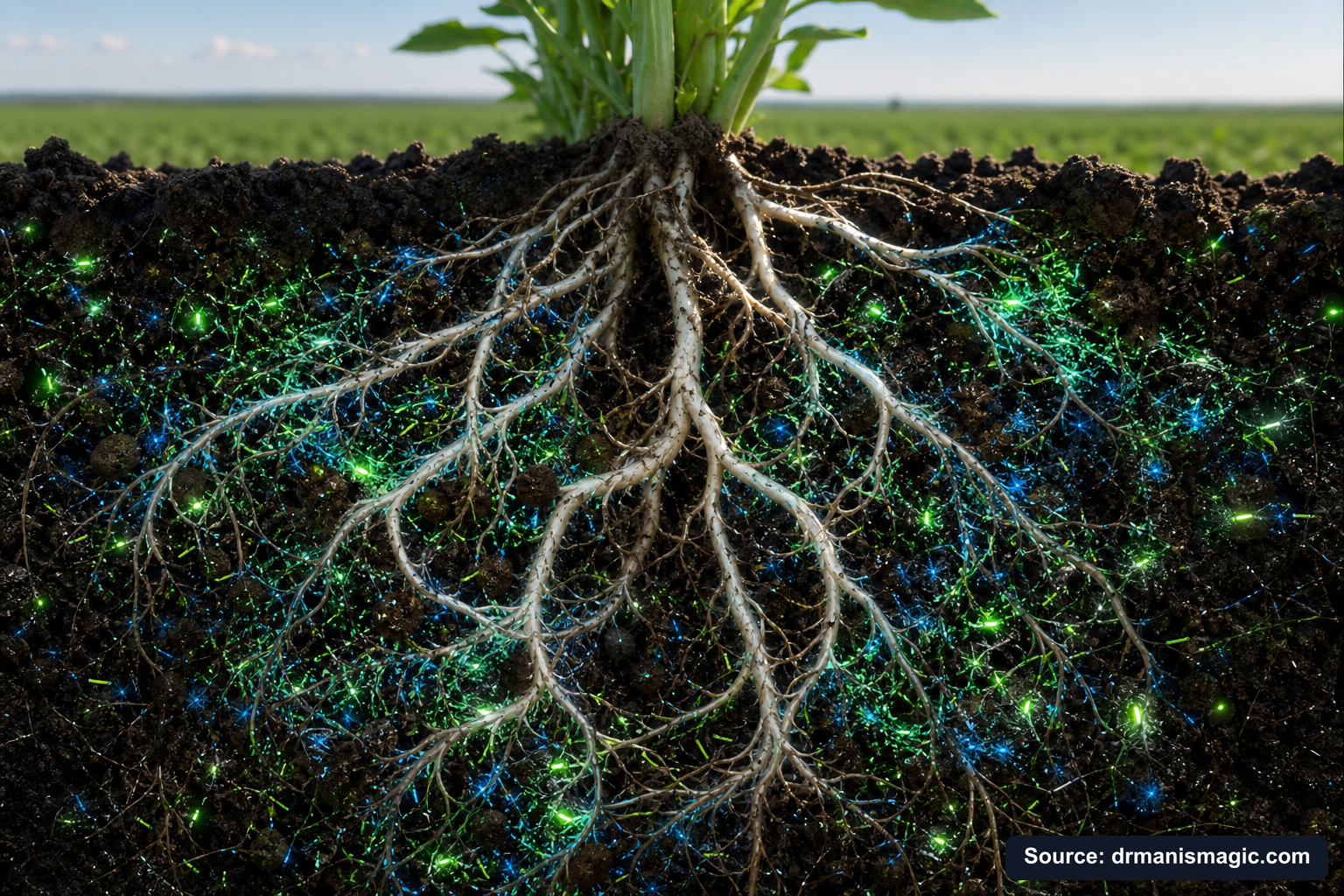
Mycorrhizal fungi grow thread-like structures called hyphae that are far thinner than roots. They snake through the soil in every direction, reaching spaces no root can enter. A single tablespoon of healthy forest soil can contain miles of these threads. They pull phosphorus, water, zinc, and other minerals back to the root. The tree then feeds the fungi with sugars it makes through photosynthesis.
When this partnership is working, citrus trees absorb dramatically more of everything they need. Research from Texas A&M AgriLife Extension confirms that mycorrhizal colonization can increase phosphorus uptake by 40 to 60 percent in some citrus rootstocks, directly supporting stronger growth and higher fruit quality.
When the fungi are gone, the tree is essentially a person trying to drink through a straw with holes punched in it. Some water gets through. Not nearly enough.
And what kills mycorrhizal fungi? Synthetic fungicides. High-phosphorus chemical fertilizers. Sterilized potting mixes. Soils that have been blasted with herbicides or pesticides for years. In other words: most conventional gardening practices strip away the one biological system citrus depends on most.
What Is the Soil Food Web, and How Does It Build Citrus Flavor?
Quick Answer: The soil food web is a living predator-prey system in your soil. Bacteria and fungi eat organic matter and lock nutrients inside their bodies. Then protozoa and nematodes eat those bacteria and fungi, releasing plant-available nutrients directly at the root zone. This biological timing system delivers minerals to citrus trees at exactly the right moment, which is what fills the fruit with sugar and juice.
Think of the soil food web like a tiny city that never sleeps.
At the bottom, bacteria and fungi break down dead plant material. They consume it and lock those nutrients inside their own bodies. The nutrients are stored, not wasted.
Then protozoa arrive. These are single-celled creatures that eat bacteria the way a whale eats krill. When a protozoan eats a bacterium, it releases the nutrients the bacterium was holding. Right there, next to the root. At that exact moment, the root can absorb them.
Beneficial nematodes do the same thing at a larger scale. They graze on bacteria and fungi, releasing nitrogen and other minerals in forms the plant can immediately use.
This is not random. This is a precision nutrient delivery system. It runs 24 hours a day when the biology is alive and healthy. And it costs nothing to operate once it's established.
Now compare that to a bag of synthetic fertilizer. You dump it on. The plant gets a fast hit of salt-based nutrients. Some roots absorb a little. A lot washes away. The salts damage root tips. The beneficial microbes that were there? They die or retreat. And the next time you need nutrients delivered to the root, there is no living system to do it. So you buy more fertilizer. And the cycle repeats.
After growing and studying more than 250,000 citrus trees at our South Texas nursery, we learned that the soil food web is not a bonus feature. It is the engine. When it runs, fruit is heavy, sweet, and juicy. When it stops, the tree survives but the fruit disappoints.
| Organism | What It Does | Direct Impact on Fruit Quality |
|---|---|---|
| Bacteria | Break down organic matter, fix nitrogen from air, solubilize minerals | Steady nitrogen and mineral supply feeds leaf growth and photosynthesis, which builds sugar in fruit |
| Mycorrhizal Fungi | Extend root surface area, absorb phosphorus and water, produce glomalin to build soil structure | More water and phosphorus uptake directly increases juice content and Brix |
| Protozoa | Eat bacteria, release nutrients at the root zone in plant-available forms | Precision nutrient delivery at the right time supports fruit development and sugar accumulation |
| Beneficial Nematodes | Graze on bacteria and fungi, releasing nitrogen; some species suppress root pathogens | Nitrogen release near roots supports consistent leaf and fruit growth; pathogen suppression protects root function |
| Nitrogen-Fixing Bacteria | Pull nitrogen directly from the air and convert it to plant-usable forms | Free nitrogen supply without salt stress keeps roots healthy and productive |
| Pathogen-Suppressing Bacteria and Fungi | Outcompete harmful organisms, produce natural antibiotics, protect roots | Healthy roots absorb water and minerals without interruption, keeping juice vesicles full |
Why Does Dry, Puffy, or Bland Citrus Mean Something Went Wrong Underground?
Quick Answer: Dry citrus, puffed rinds, and bland flavor are almost always symptoms of root zone problems, not fruit problems. When roots cannot absorb enough water and minerals, the juice vesicles inside the fruit do not fill properly. When microbial activity is low, nutrient delivery is inconsistent. The fruit tells you the story of what happened in the soil weeks before harvest.
That dry, cottony citrus you've bitten into? The juice vesicles collapsed.
Inside every piece of citrus fruit, there are tiny sacs filled with juice. Think of them like miniature water balloons. When everything works right, those sacs are plump, pressurized, and full of sweet liquid. When you bite in, they burst. That's the juice rush you feel.
When water uptake is poor, those sacs never fully pressurize. They form. They grow. But they stay partially empty. The result is a fruit that looks fine on the outside but feels dry and mealy when you bite it.
Puffed rinds happen when the rind grows faster than the internal fruit. This is often a calcium and boron issue at the cellular level, both of which are delivered most efficiently through a healthy, functioning soil food web.
Here are the most common root-zone problems and what they produce in the fruit:
| What You See | Likely Root-Zone Problem | Biology Behind It | What to Do |
|---|---|---|---|
| Dry, mealy fruit with little juice | Poor water uptake, low mycorrhizal activity | Juice vesicles don't pressurize without consistent water and mineral flow | Restore mycorrhizal fungi, improve soil drainage, reduce salt-based inputs |
| Bland, low-Brix fruit | Low microbial activity, nutrient deficiency | Photosynthesis is limited without balanced minerals; less sugar produced | Apply full-spectrum live microbes and organic fertilizer with trace minerals |
| Puffy rind, hollow feel | Calcium and boron deficiency | Rind grows faster than internal fruit; micronutrient delivery is disrupted | Improve soil biology to unlock bound minerals; reduce synthetic inputs |
| Yellow leaves, poor fruit set | Nitrogen deficiency or salt stress | Damaged roots cannot absorb nitrogen; photosynthesis drops; fewer flowers | Flush salts, restore microbes, apply organic slow-release nitrogen |
| Very sour, high-acid fruit | Premature harvest OR poor sugar accumulation | Sugar-acid ratio never balanced due to inconsistent nutrient delivery | Allow full ripening on tree; improve root biology for better sugar transport |
| Fruit drops before ripe | Water stress, root rot, or pathogen pressure | Tree under stress conserves energy by dropping fruit | Improve drainage, restore beneficial biology, eliminate root pathogens |
What Kills the Hidden Biology in Your Soil, and Why Most Growers Don't Know It?
Quick Answer: Salt-based synthetic fertilizers, broad-spectrum fungicides, herbicides like glyphosate, and sterilized potting mixes all destroy or deplete soil biology. Most growers use these products routinely without knowing they are eliminating the very microbes that build fruit quality. The damage is invisible until you see it in the fruit, and by then, months of growing time have been lost.
Here is the part that stings.
Most of the standard gardening advice you have ever received was designed to sell you products. Not to grow healthy plants. The two goals are not the same.
Salt-based synthetic fertilizers give your tree a fast green-up. The leaves look good for a few weeks. But those salts are pulling water away from root tips through a process called osmotic stress. The roots shrink back. The beneficial bacteria near the roots die off because high salt concentrations kill them. The mycorrhizal fungi that were slowly building their network get disrupted. And the next month, the tree is more dependent on you than before. So you buy more fertilizer.
Synthetic fungicides are the same trap in a different bottle. They kill harmful fungi. But they also kill beneficial fungi, including the mycorrhizae your citrus tree needs to survive. You use them once to solve a problem. And you accidentally create a bigger problem underground that won't show up in the fruit for another season.
Glyphosate-based herbicides disrupt microbial communities in the soil even when sprayed on weeds nearby, not directly on the tree. The damage drifts. The biology suffers.
And sterilized potting mixes? They start with zero biology. Completely empty. Then they're made mostly from pine bark, wood chips, and organic matter that breaks down within months, compacting into a root-choking sludge that blocks oxygen and drains poorly. Your tree sits in a biological void from day one.
We've watched this pattern play out across tens of thousands of trees. The growers who struggle most are not doing anything outlandishly wrong. They're following the advice on the bag. And that advice was written by companies that profit when your tree needs another bag.
See also: The Hidden Reason Synthetic Fertilizers Cause Root Rot
You Never Had a Brown Thumb.
You were handed the wrong tools. This free guide hands you the right ones.
You watered it. You fed it. It died anyway.
It was never you. It was the dirt, the salt food, and the bad advice.
This guide shows you what really went wrong, and how to fix it for good.
- Why your plants really died, and why it was never your fault
- The salt hiding in your plant food that quietly burns the roots
- The hidden killer in almost every bag of store soil
- The tiny helpers that grow a whole forest for free
- The rescue trick that brings a half dead plant back to life

Live Microbes vs. Dead Microbes: Why the Difference Changes Everything
Quick Answer: Most commercial microbial products are either dried lab-grown powders with low survival rates, or liquid products that have gone anaerobic and smell like sewage. Neither delivers the living ecosystem your roots need. Genuinely live, stabilized, full-spectrum microbes are rare. They should smell earthy, not foul, and should show visible microbial movement under a microscope.
Not all microbial products are the same. Not even close.
Walk into any garden center and you'll see shelves full of products promising to "restore beneficial bacteria" or "boost soil biology." Most of them don't work. Here is why.
The majority of microbial products on the market are made in large factory vats. Specific strains of bacteria or fungi are selected from a menu, grown in bulk, then dried into a powder. The hope is that those dried spores will "reactivate" when you add water and pour them on soil.
We have tested dozens of these products on our trees. The results were consistently disappointing. The survival rate of dried, lab-grown spores in real soil conditions is far too low to make a meaningful difference.
The second type is liquid products harvested from compost or worm castings. These can be effective, but only if they're fresh. Within 24 hours of being made, compost-derived liquids start going anaerobic. The beneficial microbes begin dying. Harmful fermentation takes over. The telltale sign? The bottle stinks. Sometimes it fizzes when you open it. That smell is not organic earthiness. That is biology dying.
The third common type uses lactobacillus bacteria, the same organism in yogurt. Easy to grow. Very vigorous. But lactobacillus tends to crowd out the other beneficial organisms you actually want in your soil. It belongs in your gut. Not in your root zone.
| Product Type | Microbial Viability | Spectrum of Organisms | Odor | Real-World Results |
|---|---|---|---|---|
| Dried powder, lab-grown | Very low | Narrow (1-5 strains) | None or chalky | Minimal to none in repeated field testing |
| Dry powder rehydrated into liquid | Very low | Narrow | Mild | Same issue as above; avoid |
| Compost tea, fresh under 24 hours | Moderate (if aerated) | Partial, variable | Earthy, pleasant | Good when applied immediately; impractical for most home growers |
| Compost tea, older than 24 hours | Low (anaerobic) | Partial, declining | Strong, foul | Not recommended; microbes are dying |
| Lactobacillus-based | High | Very narrow (one dominant strain) | Sour | Can crowd out beneficial organisms; not recommended for soil |
| Plant Super Boost (stabilized, full-spectrum) | High (living, verified) | Broad: 2,000+ bacteria, 400-500 fungi including mycorrhizae, protozoa, nematodes | Earthy, not foul | Visible microbial movement under microscope; confirmed by lab analysis |
What makes Plant Super Boost different is the stabilization method. It is harvested from real, hand-crafted compost, not grown in a factory vat. Then a proprietary all-natural technique keeps those microbes alive without letting them go anaerobic. The bottle does not stink because the biology is not dying. You can take a single drop, put it under a microscope, and see the microbes moving. We have the lab analyses to prove it. That is not a marketing claim. That is what living biology looks like.
And because it contains 2,000-plus species of bacteria, 400 to 500 species of fungi including mycorrhizae, plus protozoa and beneficial nematodes, you're not adding one organism. You're adding an entire ecosystem.
How Does the Three Plant Pillars System Connect to Citrus Flavor?
Quick Answer: The Three Plant Pillars (mineral-based soil, live microbes, and organic fertilizer) work together as a root-to-fruit system. Mineral soil gives roots oxygen and drainage. Live microbes build the nutrient delivery network. Organic fertilizer feeds both the plant and the microbes without salt damage. All three together create the biological conditions that produce high-Brix, juicy, sweet citrus.
After 30-plus years of growing at our South Texas nursery, Dr. Mani Skaria distilled everything he learned into three pillars. Not ten. Not twenty. Three.
Because three is what nature actually needs.
Pillar One: Mineral-Based Soil. Most potting mixes are made from decomposing organic matter. Pine bark. Wood chips. Sawdust. These break down within months and compact into a dense, poorly draining, oxygen-starved mess. Roots suffocate. Root rot follows. And a suffocated root cannot feed sugar into fruit no matter how many products you pour on top.
Mineral-based soil, built on sandy loam from the Rio Grande Valley, does not decompose. It does not compact. It drains freely. It lets oxygen reach the roots. And healthy, oxygen-rich roots are the foundation of everything that follows. Learn more about our Super Soil and why it is the permanent home your roots deserve.
Pillar Two: Live Microbials. This is the invisible workforce. The bacteria, fungi, protozoa, and beneficial nematodes that run the nutrient delivery system. Without them, the tree is alone. With them, the tree has an underground army working every hour to mine minerals, deliver water, suppress pathogens, and build soil structure. Every benefit we have described in this article flows from this pillar.
Pillar Three: Organic Fertilizer. Salt-based synthetic fertilizers feed the plant while simultaneously killing the microbes that do the real work. That is a contradiction built into every bag of conventional fertilizer. Organic, slow-release fertilizer from sources like crab meal, kelp, and amino acids feeds both the plant and the soil biology. No salt damage. No microbial massacre. No plastic-coated pellets leaching toxins into your soil and your family's backyard. Just a steady, complete supply of nutrients in forms that work with nature.
When all three pillars are in place, the root zone becomes what it was meant to be. Alive, aerated, nourished, and protected. And the fruit reflects that from the inside out. High Brix. Full juice vesicles. Rich flavor. Heavy weight in your hand.
You can explore the complete system through the Three Plant Pillars bundle and get everything working together from day one.
Can You Recover Dead or Depleted Soil Biology in a Citrus Tree?
Quick Answer: Yes, you can recover depleted soil biology, but it takes time and repeated application. One dose of microbes is not enough. Beneficial organisms need to re-establish populations, rebuild networks, and compete against any remaining pathogens. Most growers see meaningful improvement within 30 to 60 days, with full biological recovery taking several months of consistent application.
This is the question that matters most to people who have already made the common mistakes.
Maybe you've used synthetic fertilizers for years. Maybe the nursery you bought from grew the tree in sterilized potting mix. Maybe you used a fungicide to deal with a problem and didn't realize it wiped out the beneficial fungi at the same time. Maybe the soil in your pot has never had a single living microbe introduced to it.
The good news: biology recovers. The roots are still there. The structure is still there. You just need to rebuild the invisible workforce.
Here is a practical recovery sequence:
- Stop the damage first. Discontinue synthetic salt-based fertilizers and any broad-spectrum fungicides or herbicides near the root zone. You cannot rebuild biology while continuing to kill it.
- Flush accumulated salts. Water deeply and slowly until water runs freely from the drainage holes. Do this two or three times over a week to push salt buildup out of the root zone. For potted trees, this step is critical.
- Improve soil drainage if needed. If the current potting mix is compacted, waterlogged, or smells sour, consider transitioning to a mineral-based soil that provides oxygen and drainage. Roots cannot recover in an anaerobic environment.
- Apply live, full-spectrum microbes immediately. The sooner you introduce living biology, the sooner the rebuilding begins. Apply monthly as a soil drench. Consistency matters more than quantity.
- Feed with organic, non-salt fertilizer. Give the recovering root zone nutrients it can absorb without osmotic stress. Organic slow-release sources support both the plant and the newly introduced microbes.
- Be patient and consistent. Biological recovery is not instant. You are rebuilding a community of living organisms that need to establish, multiply, and begin their work. Most growers see visible improvement in 30 to 60 days. Full recovery can take a full growing season.
- Repeat microbial applications monthly. Environmental pressures, chemical residues, and pathogen competition are ongoing. Regular reintroduction of beneficial biology keeps the system winning.
We have seen trees that looked like they were beyond saving come back with healthy new growth, improved fruit set, and better Brix scores after following this sequence consistently. The biology wants to work. It just needs the right conditions and the right inputs.
What About Container Citrus? Does the Soil Food Web Work in a Pot?
Quick Answer: Yes, the soil food web can function in a container, but it requires intentional setup. Potted citrus in standard sterilized potting mix starts with zero biology and poor long-term structure. Mineral-based soil, combined with regular live microbial applications, creates a functioning biological ecosystem even in a small pot. Container citrus actually benefits more from microbial support because there is no surrounding soil community to draw from.
Container citrus is everywhere. Patios in Texas. Balconies in California. Sunrooms in Michigan. Apartment decks in Florida. Millions of people are trying to grow citrus in pots, and most of them are fighting a battle they don't fully understand.
Here is the core problem with container growing. In the ground, your tree's roots connect to a vast underground network. Mycorrhizal threads extend outward for feet in every direction. Billions of microbes cycle nutrients from fallen leaves, decomposing organic matter, and the soil itself. The tree is plugged into a living system.
In a pot, there is no network. The tree is isolated. Whatever biology exists in that container is all it has. And if that container was filled with sterilized commercial potting mix, it started with nothing.
Then add in the fact that most potting mixes compact and degrade within six to twelve months. The drainage disappears. Oxygen disappears. Root rot begins. And now the tree is in a biological desert inside a collapsing structure.
This is why the Three Plant Pillars matter even more in a container than in the ground. Mineral-based soil that does not decompose gives the roots a permanent, oxygen-rich home. Live microbial applications every month rebuild and maintain the tiny ecosystem inside the pot. And organic fertilizer feeds both plant and biology without salt damage.
When those three things are in place, a potted citrus tree can produce fruit that rivals anything grown in the ground. We have seen it happen repeatedly at our nursery. The biology does not care whether it is in an acre of orchard or a fifteen-gallon container. It just needs the right conditions to do its work.
For a deeper dive into building the right foundation for any plant, read through our Free Plant Care Field Guide. It walks you through the same system we use for every tree that leaves our nursery.

What Can You Do Right Now to Build Sweeter, Juicier Citrus?
Quick Answer: Start with biology. Stop the inputs that kill microbes. Introduce live, full-spectrum microbes to the root zone. Switch to organic slow-release fertilizer. Improve drainage if the soil is compacted. Then repeat the microbial application every month. You will not taste the results overnight, but you will taste them. And the tree you are building today will produce fruit worth waiting for.
Here is the honest truth about time.
You can get money back. You cannot get time back. Every season you spend feeding a tree with inputs that kill its underground biology is a season of fruit quality you never recover. The tree keeps growing. But the fruit keeps disappointing. And one day you realize that months and years have passed, and you are still waiting to bite into something that actually tastes like it came from your own tree.
The number one thing people tell Dr. Mani when they reach out is that they want to see fruit from their own tree while they still have the chance to enjoy it. Not next decade. Not eventually. They want to taste it. They want to hand it to their kids and say, "I grew that."
That moment is real. It is possible. But it only happens when the biology underground is working the way nature designed it to work.
The path forward is not complicated. It is just different from what most people have been told.
Stop the inputs that kill the biology. Start the inputs that rebuild it. Use mineral-based soil that gives roots oxygen. Use live, stabilized microbes that actually survive to do their job. Use organic fertilizer that feeds the plant without burning the biology. Be consistent. Be patient. And trust the system that has been working since long before any fertilizer company existed.
We built the Three Plant Pillars system by testing it on more than 250,000 trees across three decades in South Texas. We use it on our own citrus grove, our houseplants, and every tree that leaves our nursery. It works because it works with nature, not against it. Zero synthetic salts. Zero PFAS. Zero biosludge. Backed by a 30-day money-back guarantee because we believe in what we built.
If you're ready to see what your citrus tree is actually capable of producing, start with what's underground. That's where the flavor is made. And we'd love to help you build it. Explore everything we make at Dr. Mani's Magic and take the first step toward fruit that actually tastes like something worth growing.
Frequently Asked Questions
You have questions about why your citrus tastes flat, dry, or just plain disappointing. You are not alone. After 30 years of growing and testing on over 250,000 trees at US Citrus Nursery, Dr. Mani has heard every question in the book. Here are the ones that matter most right now.
What actually makes citrus taste sweeter and juicier?
Sweetness is built underground, not in the fruit itself. When your soil has the right live microbes, mineral structure, and organic nutrition working together, your tree absorbs more water and more nutrients at exactly the right time. That chain reaction ends inside the fruit as higher sugar content and more juice. No living soil biology means flat, dry, disappointing citrus. It really is that simple. Dr. Mani calls this the Three Plant Pillars, and it is the same system proven on 250,000 trees in South Texas.
What is Brix and why should citrus growers care about it?
Brix is your fruit's sweetness score. It measures dissolved sugars in the juice. Grocery store citrus usually scores 8 to 10. Fruit grown in biologically rich, mineral-balanced soil can hit 14 or higher. That gap is not luck. It is the direct result of living soil microbes unlocking nutrients and delivering them to the roots at the right moment. You taste the difference in every single bite.
What is the sweetest citrus you can grow at home?
Varieties like Cara Cara oranges, Honey Tangerines, and Moro Blood Oranges are famous for jaw-dropping sweetness. But here is the truth most nurseries will not tell you. The variety matters far less than the soil biology underneath it. Even the sweetest variety will taste like cardboard if the Three Plant Pillars are missing. Get the foundation right first, then chase the exotic varieties you have always dreamed about.
Does Epsom salt actually help citrus trees?
Epsom salt delivers magnesium, which helps leaves stay green and supports photosynthesis. It can correct a specific magnesium deficiency. But here is the problem. Epsom salt is still a salt-based input. Salt damages the beneficial microbes in your soil over time. Those microbes are what actually unlock magnesium and other nutrients naturally. Fix your soil biology first with live microbes and organic fertilizer, and your tree will pull the magnesium it needs without the risk of microbial damage.
What is the biology of a citrus tree that most growers miss?
Citrus roots have almost no root hairs. That means they are uniquely dependent on mycorrhizal fungi to absorb water and nutrients. Without those fungi alive and thriving in your soil, your tree is essentially going hungry no matter how much fertilizer you pour on it. Dr. Mani's Plant Super Boost delivers live bacteria, fungi, and mycorrhizae directly to the root zone. This is the hidden biology that separates a tree dripping with juice from one that barely survives.
Why do salt-based synthetic fertilizers hurt citrus fruit quality?
Synthetic fertilizers are salt-based. Salt kills the beneficial microbes your roots depend on. When those microbes die, your tree loses its ability to absorb nutrients naturally. You end up buying more fertilizer to compensate, the soil gets worse, and fruit quality drops every season. It is a cycle designed to keep you spending money. Organic, slow-release fertilizer from sources like crab, kelp, and amino acids feeds your tree without wiping out the living biology that makes great fruit possible.
What is the healthiest and most rewarding citrus fruit to grow yourself?
Any citrus you grow yourself in living soil beats anything from a grocery store. Homegrown citrus picked at peak ripeness delivers more vitamin C, more antioxidants, and flavor that store fruit simply cannot match. Oranges give you fiber and immune support. Lemons and limes help prevent kidney stones. Grapefruits are loaded with lycopene. But none of that potential is unlocked without healthy soil biology underneath. Build the Three Plant Pillars first, and every variety becomes a nutritional powerhouse you grew with your own hands.
About the Author
Dr. Mani Skaria, PhD
Dr. Mani Skaria, PhD, is a plant pathologist and the scientific founder of Dr. Mani's Magic. He earned his doctorate at Purdue University and spent 48 years studying how plants, soil, and living microbes work together, including his years as Professor Emeritus at Texas A&M and as a member of the USDA NAREEE Advisory Board. He invented micro-budding, a method for growing healthier, stronger trees, and has grown more than 250,000 trees on the family farm in Hargill, Texas - US Citrus Nursery. His life's work takes real lab science and practical experience and turns it into simple, safe, organic plant care anyone can use at home.


