


The Geological Advantage Modern Gardens Forgot | Dr. Mani's Magic
The Geological Advantage Modern Gardens Forgot (And Why Your Plants Are Paying the Price)
Picture yourself standing in your backyard on a Saturday morning. Coffee in hand. The air smells like cut grass and possibility. You've got a beautiful fruit tree in a big pot near the patio. Or maybe a raised garden bed full of tomatoes. Or a stretch of lawn that should be thick and green but keeps turning patchy and yellow no matter what you do.
You've fed it. You've watered it. You've Googled at midnight. You've bought the stuff in the bright orange bag at the hardware store. Maybe you've bought it three times. And still — something is off. The leaves look tired. The roots look thin. The plant looks like it's surviving, not thriving. Here's the thing nobody told you: you didn't fail the plant. The system you were handed failed you. Because somewhere along the way, modern gardening forgot something ancient. Something geological. Something alive.
Millions of years ago, there were no fertilizer bags. No N-P-K ratios on a label. No salt-based quick-fix pellets. And yet — forests grew taller than buildings. Soil fed entire civilizations. Fruit trees produced without a single human hand mixing chemicals. How? Rock turned into soil. Soil filled with microbes. Microbes fed roots. Roots built plants. It was a slow, staggering, beautiful system. And almost everything we do in modern gardening works against it. This article is about getting it back.

Organic Fertilizer | Crab, Kelp & Amino Acids
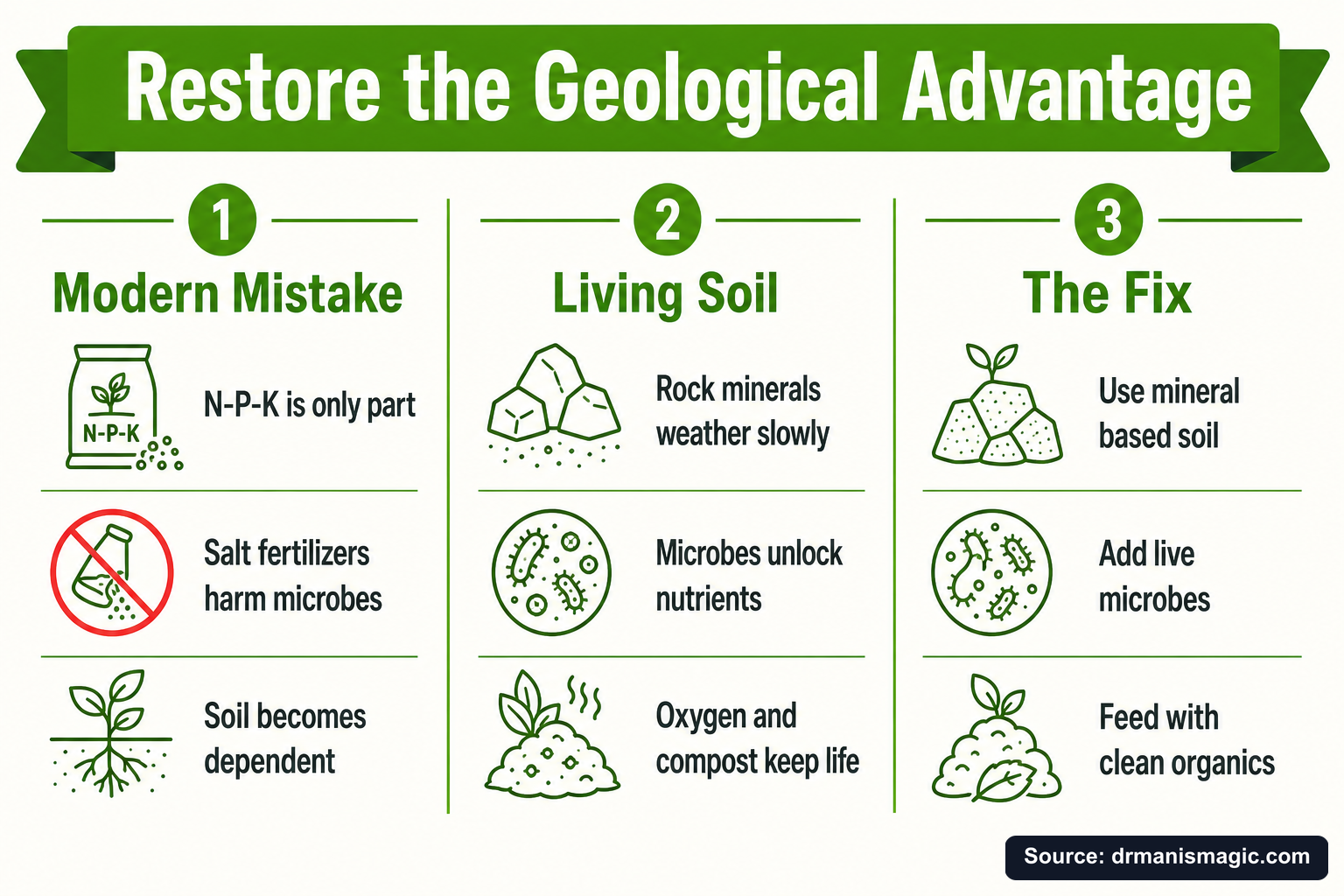
Key Takeaways
- Fertile soil starts with geology — parent rock breaks down over time into minerals, and those minerals only become useful to plants when microbes, oxygen, water, and organic matter work together.
- Modern N-P-K fertilizers are salt-based. Salt kills beneficial microbes, causes root burn, and creates a cycle of dependency that starves the living soil system plants evolved to rely on.
- According to the University of Minnesota Extension, soil biology supplies roughly 75% of plant-available nitrogen and 65% of available phosphorus — meaning microbes do most of the feeding, not the bag.
- Salt damage, overwatering, and true root rot look almost identical. Knowing the difference can save a plant (and months of wasted time).
- Organic fertilizers made from crab, kelp, and amino acids feed microbes first — and those microbes convert nutrients into a slow, steady stream the plant absorbs naturally.
- Some "organic" fertilizers still contain biosludge, municipal waste, and PFAS forever chemicals. Clean inputs matter as much as organic inputs.
- The Three Plant Pillars — mineral-based soil, live microbes, and organic fertilizer — are the framework Dr. Mani Skaria developed and tested on over 250,000 trees at US Citrus Nursery in South Texas. They work for every plant, not just citrus.
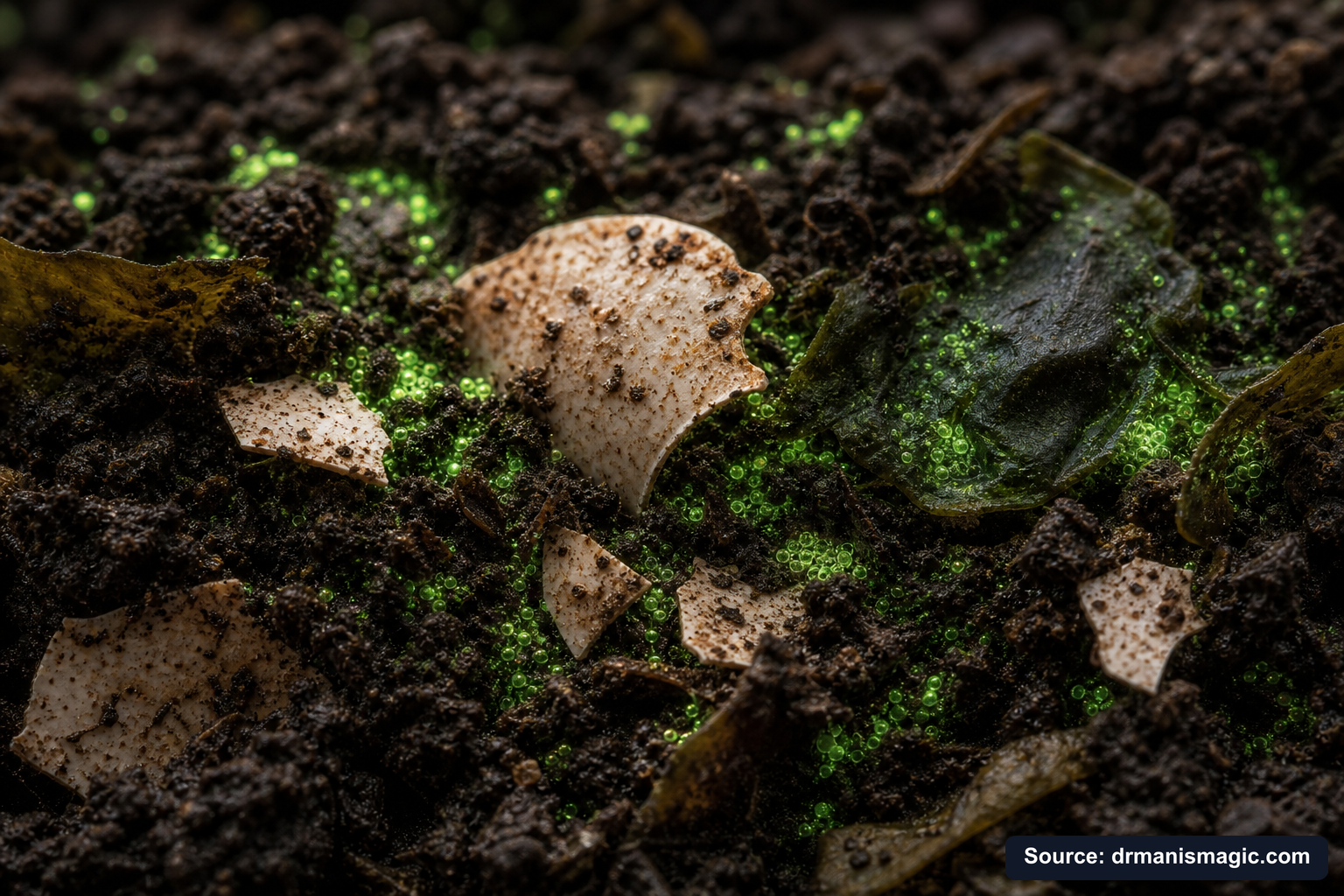
What Is the Geological Advantage and Why Did Modern Gardens Lose It?
Quick Answer: The geological advantage is the natural system where minerals from parent rock slowly break down, get processed by microbes, and become food for plant roots. Modern gardening lost this by replacing that slow, biology-driven process with fast, salt-based synthetic fertilizers that skip — and often destroy — the living soil system.
Go back far enough and every garden started as rock.
Volcanic eruptions. Glaciers grinding across continents. Rivers carrying mineral-rich sediment for thousands of miles. That rock — basalt, granite, volcanic ash, glacial till — slowly broke apart over millennia. Rain, frost, root acids, and bacteria got into the cracks. They released minerals. Calcium. Potassium. Magnesium. Iron. Zinc. Dozens of trace elements that plants need to build strong cells, activate enzymes, and produce food.
But here's the part that matters most. The minerals didn't feed plants directly. They couldn't. A plant root can't bite a chunk of granite. The minerals had to be processed first. And the processors were microbes.
Bacteria dissolved minerals with acids. Fungi wrapped around roots and traded nutrients for sugar. Organic matter decomposed and released its chemistry back into the soil. Oxygen moved through pore spaces in the ground and kept the whole system running aerobically — meaning alive, not rotting. That system — rock to mineral to microbe to root — is what we call the geological advantage. And it built every naturally fertile piece of ground on Earth.
Then came the 1950s. A company decided to sell soluble nitrogen salts to American gardeners. It worked fast. Grass turned green in days. Crops responded overnight. The whole country got hooked. And slowly, quietly, the geological system got pushed aside. Replaced by a bag of salt.
As Penn State Extension notes in their soil microbiome research, soil organisms drive not just nutrient cycling but also water infiltration, disease suppression, root-zone resilience, and organic matter breakdown. When you disrupt the microbes, you don't just lose nutrients. You lose the entire engine.
See also: Why Most Fertilizers Are Actually Salt in Disguise
Why Is N-P-K Not Enough for Healthy Plants and Soil?
Quick Answer: N-P-K covers three nutrients out of at least twelve your plant needs. It also ignores the microbes, soil structure, oxygen levels, pH, and organic matter that control whether those three nutrients ever reach the root in the first place. N-P-K is a fraction of the answer, not the whole one.
N-P-K stands for nitrogen, phosphorus, and potassium. Those three numbers on every fertilizer bag. And yes, plants need all three. But they also need calcium, magnesium, sulfur, iron, zinc, manganese, copper, boron, and molybdenum. Miss even one of those and growth stalls. That's the Law of the Minimum: a plant grows only as well as its most deficient nutrient allows, no matter how much of everything else you throw at it.
But here's what the bag never tells you. Even if all twelve nutrients are present in your soil, your plant may not be able to use a single one of them if the biology is broken.
The University of Minnesota Extension has found that soil biological processes supply roughly 75% of plant-available nitrogen and 65% of available phosphorus. Read that again. Three quarters of the nitrogen your plant uses in a natural system comes from microbes — not from a bag. When you wipe out the microbes with salt-based fertilizers, you don't just reduce the living soil. You eliminate your plant's primary nutrient supplier. Then you have to keep buying more bags to make up for what the biology used to do for free.
That is the cycle. That is why Big Box stores love it.
The geological advantage was never just about minerals. It was about mineral-biological coupling. Minerals become available when roots release acids, when bacteria secrete enzymes, when fungi extend their networks into the tiniest soil pores. Separate the mineral from the biology and you're left with chemistry on paper but starvation in the ground.
How Does Salt-Based Fertilizer Actually Damage Roots and Soil?
Quick Answer: Salt-based fertilizers pull water out of root cells through osmotic pressure — the same way salt pulls moisture out of meat. This causes physiological drought, root tip burn, microbial die-off, and long-term soil damage even when the plant looks green at first. The University of Maryland Extension calls this osmotic stress.
Here's the physics of why salt hurts plants, explained simply.
Water always moves from where there is less dissolved stuff to where there is more. That's osmosis. Your root cells have a certain concentration of dissolved material inside them. When you pour a high-salt fertilizer into the soil around those roots, the concentration outside the root suddenly becomes higher than inside. So water flows out of the root cells and into the salty soil. The root dehydrates. Even if you just watered.
That is physiological drought. The plant wilts even in wet soil. The leaves scorch at the tips and edges. The roots shrink and die back. The plant looks thirsty when it is actually being poisoned by salt. University of Maryland Extension and Iowa State Extension both flag this pattern: overapplication of water-soluble fertilizers causes marginal leaf scorch, restricted root growth, wilting in moist soil, and fewer blooms — across lawns, trees, shrubs, ornamentals, vegetables, and container plants alike.
And while that's happening to the roots, it's also happening to the microbes. The same osmotic pressure that dehydrates root cells dehydrates bacterial and fungal cells. A heavy salt application can crash the microbial population in your soil within days. That means less nutrient cycling, less disease suppression, less aggregation — less of everything the geological system was built on.
Then the plastic. Many synthetic slow-release fertilizers are coated pellets. The coating is often plastic. That plastic breaks into microplastics and stays in your soil. In your garden. In the food you grow. In the ground your kids and pets walk on.
See also: The Hidden Reason Synthetic Fertilizers Cause Root Rot
Salt Damage vs. Overwatering vs. True Root Rot: What Is Actually Killing Your Plant?
Quick Answer: These three problems look nearly identical — wilting, yellowing, brown roots — but have different causes and different fixes. Salt damage comes from fertilizer burn. Overwatering drowns roots by removing oxygen. True root rot is a fungal or oomycete infection, often caused by Pythium or Phytophthora, that usually starts with one of the first two problems. Here's how to tell them apart.
This is the question that trips up even experienced gardeners. Your plant is wilting. The leaves are yellowing. The roots look brown and mushy. You might think it's thirsty. Or overwatered. Or diseased. And the truth is, it might be all three at once — because one problem leads directly to the next.
Here is a simple diagnostic table to help you figure out what you're actually dealing with:
| Symptom | Salt / Fertilizer Burn | Overwatering / Oxygen Deprivation | True Root Rot (Pythium / Phytophthora) |
|---|---|---|---|
| Leaf wilting | Yes — in moist or dry soil | Yes — soil stays wet | Yes — soil may be wet or look normal |
| Leaf edge / tip scorch | Yes — brown crispy margins | Possible but rare | Rare early on |
| Overall yellowing | Yes — especially new growth | Yes — older leaves first | Yes — progresses rapidly |
| Root appearance | Brown tips, fine roots missing | Brown, soft, may smell mild | Dark brown to black, mushy, sour smell |
| Soil smell | No strong smell | Slightly sour | Strong sour or rotting smell |
| White salt crust on soil | Often visible | No | No |
| Primary cause | High salt index from synthetic fertilizer | Poor drainage, compacted soil, organic potting mix that collapsed | Oomycete pathogens (Pythium, Phytophthora) in wet, oxygen-deprived root zone |
| Fix | Flush soil, stop salt inputs, switch to organic fertilizer | Improve drainage, switch to mineral-based soil, reduce watering frequency | Remove infected roots, rebuild soil structure, add beneficial microbes, improve drainage |
Notice something. All three problems are made worse by the same root cause: soil that can't drain, biology that's been destroyed, and inputs that work against the plant instead of with it. Root rot pathogens like Pythium and Phytophthora don't just appear randomly. They thrive in exactly the conditions that salt damage and poor drainage create: wet soil, dead microbes, no oxygen, and stressed roots. As Missouri Extension and University of Kentucky plant pathology resources both explain, saturated soils that lack oxygen favor these oomycete pathogens almost every time.
The fix isn't more fertilizer. The fix is rebuilding the foundation.
What Is the Right Way to Fix a Struggling Plant? (A Recovery Checklist)
Quick Answer: Recovery starts with stopping the damage, then restoring oxygen, drainage, and biology in that order. Nutrients come last. Pouring more fertilizer onto a plant with salt-burned, oxygen-starved roots is like pouring gasoline on a fire and calling it warmth.
If your plant is struggling right now, here's a step-by-step path forward:
- Stop all synthetic fertilizer immediately. Let the salt pressure drop. If there's a white crust on the soil surface, that is salt accumulation. Flush the container with clean water two or three times to push it out of the root zone.
- Check your soil structure. Squeeze a handful. If it compacts into a tight ball and doesn't release, it's probably collapsed organic potting mix. That material has lost its air pockets and is suffocating the roots. It needs to be replaced, not amended.
- Improve drainage and oxygen. Roots breathe oxygen. If water sits in the pot or garden bed for more than a few hours after watering, the roots are running out of air. Mineral-based soil with real pore structure — not sawdust and bark — fixes this at the source. See Super Soil for what that looks like in practice.
- Reintroduce living microbes. Once the root zone has oxygen and drainage, beneficial bacteria and fungi can move back in. They suppress root rot pathogens, cycle nutrients, and re-establish the biological system the plant needs. Plant Super Boost delivers live bacteria, fungi, and mycorrhizae directly to the root zone in liquid form.
- Check pH and salinity before adding any fertilizer. High pH locks up iron and zinc. High salinity from previous synthetic feeding blocks water uptake. A simple soil test from your local extension office costs a few dollars and tells you what you're actually working with.
- Feed with a clean, slow-release organic fertilizer. One that feeds the microbes first, has no biosludge, no PFAS, and no synthetic salt index. Feed gently and regularly rather than in large spikes.
- Be patient. Root systems rebuild from the inside out. The first sign of recovery is new root growth you can't see. Then you'll notice new leaf buds. Then color returns. Give it four to six weeks before you judge.
How Does Organic Fertilizer Actually Feed Plants — and Why Does It Work Better Long-Term?
Quick Answer: Organic fertilizer doesn't go straight into the plant. It feeds the microbes first. The microbes digest it, convert it into plant-available forms, and then release those nutrients slowly as they live and die in the root zone. It's a natural, self-regulating time-release system that mirrors how geology fed plants for millions of years.
Here is the mechanism most people never hear, explained as simply as possible.
When you apply a salt-based synthetic fertilizer, the nutrients dissolve immediately in soil water and flood into the root zone all at once. The plant can grab some. But a lot washes away. And the salt concentration spikes, which causes all the damage we just talked about. It's a sugar rush. Fast, then crashing.
When you apply an organic fertilizer — say, one made from crab shells, kelp, and amino acids — something different happens. The granules don't dissolve into salts. They are protein-based, carbon-based, mineral-based material. The microbes in your soil recognize it as food. They move toward it. They start breaking it down with enzymes, the same way your stomach digests a meal.
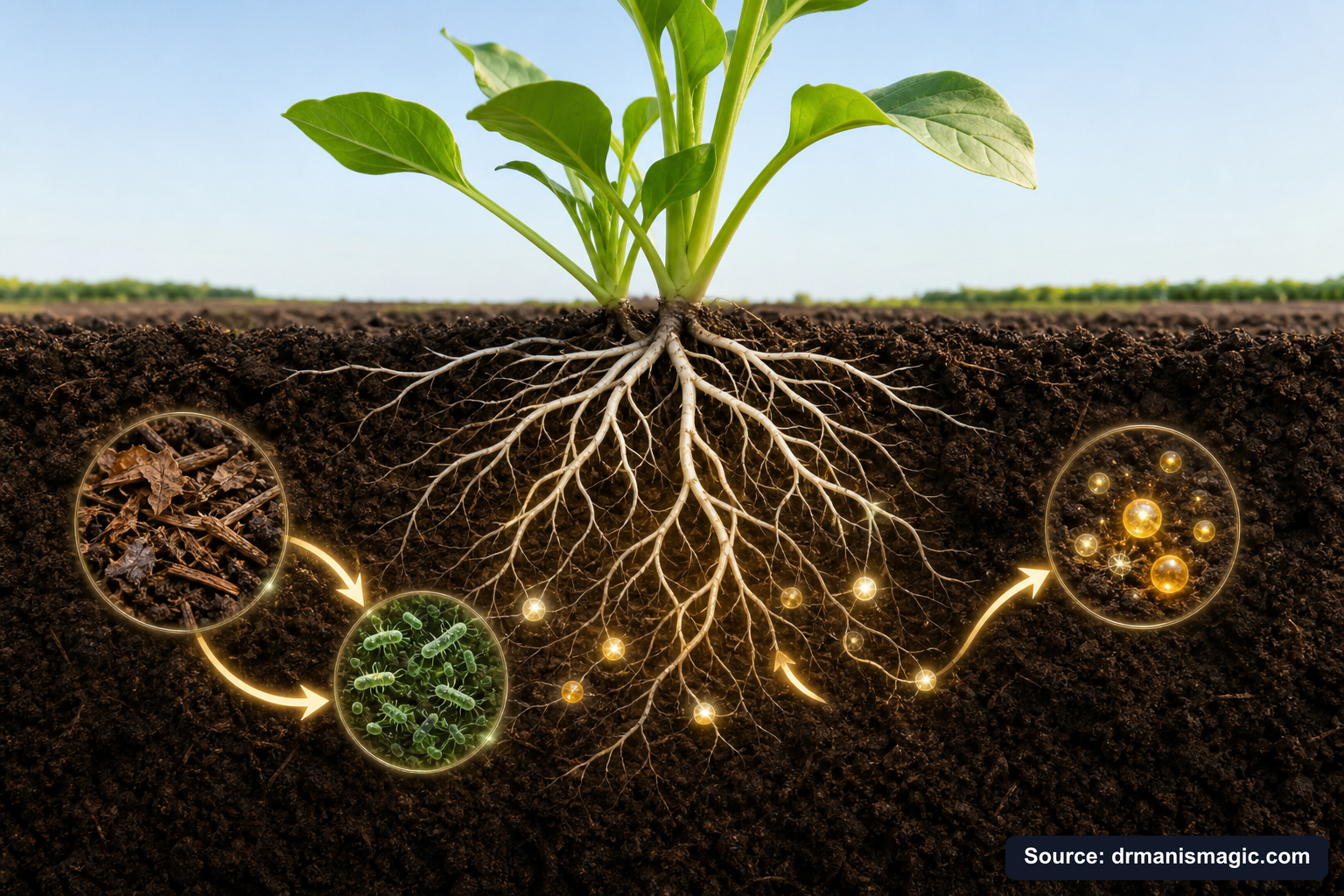
As the microbes eat the organic material, they release nutrients in small, steady amounts. Nitrogen from amino acids becomes ammonium, then nitrate — exactly the form roots prefer. Phosphorus from chitin and mineral sources gets solubilized slowly. Calcium and magnesium from crab shells become available as the shell structure breaks down. The plant gets fed at a pace it can actually use.
Then the microbes die naturally — as all living things do. And when they die, every nutrient stored in their tiny bodies releases directly into the root zone. It's a second feeding, weeks after you applied the first. No extra cost. No extra effort. Just biology doing what it has always done.
This is not a new idea. This is how the geological system worked before the first bag of synthetic fertilizer was ever sold. After growing over 250,000 trees at our South Texas nursery, we can tell you plainly: plants fed this way grow stronger, resist stress better, and stay productive longer than plants fed on synthetic salt spikes. Every time.
You Never Had a Brown Thumb.
You were handed the wrong tools. This free guide hands you the right ones.
You watered it. You fed it. It died anyway.
It was never you. It was the dirt, the salt food, and the bad advice.
This guide shows you what really went wrong, and how to fix it for good.
- Why your plants really died, and why it was never your fault
- The salt hiding in your plant food that quietly burns the roots
- The hidden killer in almost every bag of store soil
- The tiny helpers that grow a whole forest for free
- The rescue trick that brings a half dead plant back to life

What Makes Crab, Kelp, and Amino Acids Different From Other Organic Fertilizers?
Quick Answer: Most organic fertilizers are one-dimensional. Crab, kelp, and amino acids are three completely different biological inputs working together — chitin from crab shells activates plant immunity, kelp delivers hormones and trace minerals that regulate growth, and amino acid nitrogen feeds both the plant and the microbes directly. Together they rebuild the geological system in one application.
Let's go through each ingredient and explain what it actually does.
Crab Shells and Chitin: The Immunity Trigger
Crab shells are rich in a substance called chitin. Chitin is the same structural material found in the exoskeletons of insects and the cell walls of certain fungi — including many of the root rot pathogens that destroy gardens. When you add chitin to your soil, something remarkable happens. The microbes that eat chitin start to multiply. And those same microbes also eat the chitin-containing cell walls of harmful fungal pathogens like Pythium and Phytophthora. You are essentially training your soil's immune system to recognize and destroy the enemy. Crab shells also bring calcium and magnesium into the soil slowly — the same minerals that were originally delivered by geological weathering over thousands of years.
Cold-Processed Kelp: Growth Hormones From the Ocean
Kelp is a marine plant that has been feeding coastal soils for as long as oceans have existed. Cold-processed kelp — meaning it was never heated to destruction — delivers something synthetic fertilizers can never provide: natural plant hormones called auxins and cytokinins. These hormones tell plant cells when to divide, when to elongate, and when to set fruit. They also carry dozens of trace minerals that came from the ocean — the same ocean that was fed by rivers, and those rivers were fed by the slow geological weathering of rock. Kelp closes a loop that modern agriculture broke wide open.
Amino Acids: The Shortcut Nitrogen Plants Love
Amino acids are the building blocks of protein. When you apply amino acid nitrogen to your soil, the plant can absorb some forms directly through its roots — without waiting for a microbe to convert it first. This is the fastest, gentlest form of organic nitrogen available. No salt spike. No osmotic shock. No microbial massacre. Just clean, ready-to-use nitrogen that supports leaf growth, chlorophyll production, and enzyme function right away. And the amino acids that microbes absorb first? Those feed the biology and come back to the plant through the slow-release cycle we described above. One input. Two delivery pathways. Zero salt damage.
Volcanic Ash: The Geological Thread That Ties It All Together
Volcanic ash is one of the most mineral-rich substances on Earth. It contains silica, which strengthens cell walls and makes plants more resistant to drought, pests, and disease. It contains dozens of trace elements that most soils — especially depleted suburban soils — have never had or lost long ago. Adding volcanic ash to your fertilizer brings back a piece of the geological system directly. It is slow to release. It does not spike salt. And it feeds the same mineral-biological coupling that built fertile soils in the first place.
These four ingredients together — crab, kelp, amino acids, volcanic ash — are what we formulated into Crab, Kelp & Amino Acids. It's a 7-4-4 NPK ratio with 6% calcium and 2% magnesium. No biosludge. No PFAS. No synthetic salts. No plastic-coated pellets. Zero forever chemicals. Backed by our 30-day money-back guarantee. Tested on 250,000 trees before it ever reached your doorstep.
What Is the PFAS and Biosludge Risk in Modern Fertilizers?
Quick Answer: Some fertilizers — both synthetic and certain "organic" ones — are bulked out with treated municipal waste called biosludge. Biosludge can carry PFAS, which are synthetic chemicals that don't break down in soil or in your body. These are called forever chemicals for a reason. Clean inputs, verified free of biosludge and PFAS, are not optional if you care about your family, your pets, and your food.
This is the part of the conversation that makes people uncomfortable. But it needs to be said.
Municipal wastewater treatment produces a byproduct. It's called biosolids or biosludge. It contains treated human waste. And it has been used as a cheap filler in some fertilizer products — including some marketed as "organic" — for decades. The problem is that biosludge concentrates PFAS compounds. PFAS stands for per- and polyfluoroalkyl substances. They are man-made chemicals used in nonstick coatings, firefighting foam, food packaging, and hundreds of other industrial products. They accumulate in soil. They move into groundwater. They accumulate in plant tissue. And they accumulate in the human body.
University extension systems across the country have flagged this issue in recent years. The concern is not hypothetical. PFAS-contaminated biosolids have been detected in agricultural soils in multiple states, and the EPA has moved to regulate them more tightly as a result.
The solution is not to avoid all organic fertilizer. It is to know your source. Ask where the inputs come from. Ask specifically whether biosolids are used. Demand a clean product that can answer that question clearly.
Our answer is simple: Dr. Mani's Magic Crab, Kelp & Amino Acids contains zero biosludge, zero PFAS, and zero synthetic salts. Every ingredient is sourced from the USA. Crab shells. Cold-processed kelp. Feather meal and animal tankage for amino acid nitrogen. Volcanic ash for trace minerals. That's it. You can walk barefoot in your garden. Your dog can sniff around the base of your trees. Your kids can eat the tomatoes. That is what clean inputs look like.
How Do the Three Plant Pillars Rebuild the Geological Advantage in Your Garden?
Quick Answer: The Three Plant Pillars — mineral-based soil, live microbes, and organic fertilizer — each restore one layer of the geological system. Mineral soil gives roots oxygen and structure. Microbes restore the biological cycling that converts minerals into plant food. Organic fertilizer feeds both the microbes and the plant without the salt damage that breaks the system down.
Dr. Mani Skaria spent over 40 years as a Professor of Plant Pathology at the Texas A&M Citrus Center. He invented the micro-budding technique. He led Texas's Clean Citrus Program. He has tested more growing systems, more soil inputs, and more fertilizer combinations than most people will encounter in a lifetime.
And after all of that, the system he came back to — the one he built for his own nursery of 250,000 trees — is built on three ideas so simple a child can understand them. Ideas that mirror exactly what geology and biology have been doing together since before human beings existed.
Pillar One: Mineral-Based Soil
Most potting mix is made from pine bark, wood chips, and peat. Organic material. It feels light and fluffy when it's new. But organic material decomposes. Within six to twelve months, it compacts down. The air pockets collapse. The drainage fails. Roots suffocate. And because decomposing organic material consumes oxygen as it breaks down, it steals the very thing roots need to breathe. That is why plants that start strong in a new bag of potting mix start declining a year later. The soil itself is dying and taking the plant with it.
Mineral-based soil doesn't decompose. Sandy loam from the Rio Grande Valley is silica-rich. It stays porous. It drains. It holds its structure for years. Roots can breathe. Water moves through. Oxygen circulates. This is Pillar One: give the roots the physical conditions they need to survive. Without this, nothing else works.
See also: Why Most Potting Mix Collapses Within 6-12 Months
Pillar Two: Live Microbes
Once the roots can breathe, they need biology. Live bacteria, fungi, and mycorrhizae don't just make nutrients available. They protect roots from pathogens. They create sticky compounds that bind soil particles into aggregates — improving structure and drainage even further. They produce hormones that stimulate root growth. They suppress Pythium and Phytophthora by competing for space and resources in the root zone. They are the geological advantage made microscopic. And without them, the most fertile mineral soil in the world will underperform.
Pillar Three: Organic Fertilizer and Biostimulants
Mineral soil gives structure. Microbes give life. Organic fertilizer gives the fuel that keeps both running. And as we've shown above, it does so without the salt index, without the osmotic stress, without the microbial massacre that synthetic fertilizers bring. It feeds the biology. The biology feeds the plant. The plant thrives. Slowly. Steadily. The way it was always meant to.
Here is how the Three Plant Pillars compare to the conventional approach side by side:
| Factor | Conventional Approach | Three Plant Pillars Approach |
|---|---|---|
| Soil type | Bark and peat potting mix — decomposes, compacts, loses drainage in 6-12 months | Mineral-based sandy loam — permanent, porous, drains freely, never compacts |
| Fertilizer type | Salt-based synthetic — fast spike, osmotic stress, microbial die-off | Organic crab, kelp, amino acids — slow release, feeds microbes, zero salt damage |
| Microbial population | Reduced or absent after repeated synthetic applications | Active, diverse, continually reinforced with live bacteria, fungi, mycorrhizae |
| Root oxygen | Blocked by compacted, decomposed organic material | Freely circulating through mineral pore structure |
| Disease risk | High — Pythium and Phytophthora thrive in oxygen-deprived, microbe-poor soil | Low — chitin from crab activates microbial defenses against root pathogens |
| PFAS / biosludge risk | Present in many synthetic and some "organic" products | Zero — all inputs verified clean, USA-sourced |
| Long-term soil health | Declining — salt accumulates, biology decreases, inputs must increase | Improving — biology builds, structure holds, less input needed over time |
| Time to see results | Fast green-up, then stall or decline | Steady improvement, compounding gains month after month |
Does This Work for Lawns, Flowers, Vegetables, and Houseplants — or Just Fruit Trees?
Quick Answer: The Three Plant Pillars work for every plant that grows in soil — lawns, flower beds, raised vegetable gardens, container houseplants, ornamental shrubs, and fruit trees alike. The geological system didn't distinguish between plants. Neither do microbes. The same biology that fed ancient forests feeds your potted fiddle-leaf fig.
We get this question a lot. Because our roots are in citrus. US Citrus Nursery. South Texas. 250,000 trees. That's where Dr. Mani Skaria tested everything. That's where the Three Plant Pillars were proven under real conditions, not a laboratory.
But the system doesn't care what you're growing. The microbes that cycle nitrogen in a citrus root zone are the same species that cycle nitrogen in a lawn or a tomato bed or a window box full of basil. The salt that burns a citrus root is the same salt that burns a rose root or a grass blade. The chitin that triggers disease resistance in a fruit tree triggers it in an ornamental shrub too. The physics of osmosis, the chemistry of amino acid nitrogen, the structure of volcanic ash minerals — none of it is species-specific.
If you have a lawn that goes yellow every summer no matter how much you feed it — the geological advantage applies. If you have a houseplant that slowly declines in the same pot year after year — the geological advantage applies. If you have a vegetable garden that produces for one season and then struggles — the geological advantage applies. OSU Extension and WSU Extension both confirm that soil health, microbial diversity, aeration, and organic matter are the engine of nutrient release across all plant systems, not just commercial orchards.
The platform we built at US Citrus Nursery was the testing ground. The Three Plant Pillars are the result. And they are for every plant you have ever tried to grow.
The Real Cost of Getting This Wrong Is Not Money — It's Time
Quick Answer: You can always earn more money. You cannot get back the seasons you spent watching a plant struggle on the wrong system. The real loss from salt-based conventional gardening is not the price of a bag of fertilizer. It's the years of growth, the harvests, the flowers, the moments in your garden that never happened because the foundation was wrong from the start.
The most common thing Dr. Mani hears from new customers — doctors, business owners, retirees, people who have been gardening for years — is some version of the same sentence. They want to see fruit on a tree they planted with their own hands. They want to walk outside and pick something. They want to feel what it feels like to grow something real. Before too much time passes.
That desire is ancient. It is not vanity. It is the oldest human instinct we have — to tend something living and watch it flourish. And the tragedy is not the money spent on the wrong products. The tragedy is the seasons lost. The years where the tree sat in collapsed potting mix, starved of oxygen and biology, slowly declining. The years where the lawn burned every summer under salt applications. The years where the garden produced less and less and nobody could explain why.
You cannot get those seasons back. That is the real cost of the conventional system.
But here is the other side of that. When the foundation is right — when the soil drains, when the microbes are alive, when the fertilizer feeds the biology instead of killing it — plants respond fast. Not overnight. But within weeks you see the difference. New roots. New leaf buds. Color returning. Flowers setting. Fruit forming. The compounding effect of a healthy living soil builds month after month. And it keeps building.
The best time to switch was the day you planted. The second best time is today. And the Free Plant Care Field Guide at Dr. Mani's Magic will walk you through exactly how to start — no jargon, no guesswork, no late-night Googling required.
The geological advantage is not lost. It's waiting in your soil, ready to come back to life the moment you stop working against it. We've seen it happen on 250,000 trees. We've seen it happen in backyard gardens, apartment balconies, and living rooms with a single potted tree in the corner. The system works. It worked for millions of years before we tried to replace it with a bag of salt. And it will work for you.
If you're ready to rebuild that foundation — with clean soil, live biology, and organic nutrition that feeds the system instead of breaking it — start with what we've been using in our own nursery for over 30 years. Explore the full Three Plant Pillars system and see what your garden was always capable of growing.
Frequently Asked Questions
These are the questions real gardeners ask after they realize their soil has been working against them. The answers below are grounded in over 30 years of hands-on testing at US Citrus Nursery in South Texas, where Dr. Mani Skaria grew and studied more than 250,000 trees. Read these before you buy another bag of anything.
What is the geological advantage that modern gardens forgot?
It is the ancient system where minerals from rock slowly break down, get processed by soil microbes, and turn into food for plant roots. This process built the richest soils on earth without a single fertilizer bag. Modern gardening broke this system by replacing it with salt-based synthetic fertilizers that skip the microbes entirely and slowly destroy them. No microbes means no natural feeding system. That is why your plants look tired no matter what you do.
Why do salt-based fertilizers hurt my plants over time?
Salt pulls water out of roots and kills the beneficial bacteria and fungi living in your soil. Those microbes are the real feeders. According to the University of Minnesota Extension, microbes supply roughly 75 percent of plant-available nitrogen and 65 percent of available phosphorus. When you wipe them out with synthetic fertilizers, your plant becomes totally dependent on you for every meal. Miss a feeding and everything stalls. That is not gardening. That is a trap.
What are the Three Plant Pillars and why do they matter?
The Three Plant Pillars are the framework Dr. Mani Skaria built after decades of trial and error growing citrus, tropicals, and houseplants. Pillar One is mineral-based soil that drains well and never compacts. Pillar Two is live microbes that fight disease and unlock nutrients. Pillar Three is organic fertilizer that feeds slowly and safely without burning roots. Together they rebuild the geological system your plants evolved to rely on. They work for every plant, not just citrus.
What types of gardens benefit from this approach?
All of them. Container gardens with fruit trees or herbs. Raised beds full of tomatoes and peppers. In-ground flower beds. Backyard lawns. Indoor houseplants. The Three Plant Pillars are first-principles gardening, meaning they apply to any plant in any setup. Dr. Mani tested this system on over 250,000 citrus trees at US Citrus Nursery, and it works just as powerfully on grass, vegetables, tropical trees, and flowers in pots on an apartment balcony.
How is Dr. Mani's Magic Super Soil different from regular potting mix?
Most potting mixes are made from pine bark and wood that rot over time. As they break down, they compact around roots and choke off oxygen. Super Soil is built on sandy loam from the Rio Grande Valley. It is mineral-based, meaning it does not decompose or compact. Roots breathe freely, water drains fast, and you never have to replace it. It is a permanent foundation, not a temporary fix you buy again every spring.
What makes Plant Super Boost different from other microbial products?
Most bottled microbials are dead by the time they reach you. Plant Super Boost uses a special stabilization method to keep the bacteria, fungi, and mycorrhizae alive inside the bottle. That means you pour living microbes directly onto your roots, not dead powder. It does not smell bad either, because the microbes are stabilized, not rotting. Just mix with water and apply. Your soil wakes up fast, and your roots start absorbing nutrients the way nature intended.
Why should I use organic fertilizer instead of the fast stuff from the hardware store?
Fast fertilizers are salt-based. They give a quick green flush, then damage the microbes that do the real feeding. Some slow-release synthetics are coated in plastic that leaches into your soil and water. Dr. Mani's Crab, Kelp, and Amino Acids fertilizer feeds microbes first. Those microbes then release nutrients slowly and steadily into the root zone. No burn. No plastic. No chemical smell. Just clean, earth-born fuel that builds long-term plant health instead of creating a dependency you can never escape.
About the Author
Ron Skaria, MD
Ron Skaria, MD, is the co-founder of Dr. Mani's Magic and the son of Dr. Mani. He trained as a medical doctor at Baylor College of Medicine, did his residency at UT Health Science Center - San Antonio and fellowship training at Texas Tech University. He now works full time on the family farm at US Citrus and US Citrus Nursery in Hargill, Texas, building Dr. Mani's Magic alongside his dad. He wrote the Brown Thumb Field Guide to put his father's 48 years of plant science into plain words any gardener can use. His belief is simple. You never had a brown thumb. You just never had the right help.


