


The Chemistry Behind Fertilizer Burn Explained Simply | Dr. Mani's Magic
The Chemistry Behind Fertilizer Burn Explained Simply: Why Your Plants Look Thirsty Even When the Soil Is Wet
You walk outside on a Tuesday morning with your coffee. The sun is already warm. You look at your potted lemon tree — or your raised bed tomatoes, or the patch of lawn you just fed last week — and something is wrong. The leaves are curling at the edges. The tips are brown and crispy. The soil is still damp from the last watering. You scratch your head. You gave it fertilizer. You watered it in. You did everything the bag said to do.
So why does it look like it's dying of thirst?
Here is the thing almost nobody tells you. Fertilizer burn has nothing to do with chemicals burning your plant like acid. It is a water problem. A hidden one. The dissolved fertilizer salts in the soil actually steal water away from your roots — even when the ground looks perfectly moist. Your plant can be surrounded by water and still be dehydrating. That is the cruel trick of fertilizer burn. And once you understand the simple chemistry behind it, you will never look at a bag of granules the same way again. We spent thirty years and over 250,000 trees at our South Texas nursery figuring this out. Let us show you what we found.

Plant Super Boost
This is the chemistry behind fertilizer burn explained simply — and it might just be the most important thing you learn all year as a plant owner.
Key Takeaways
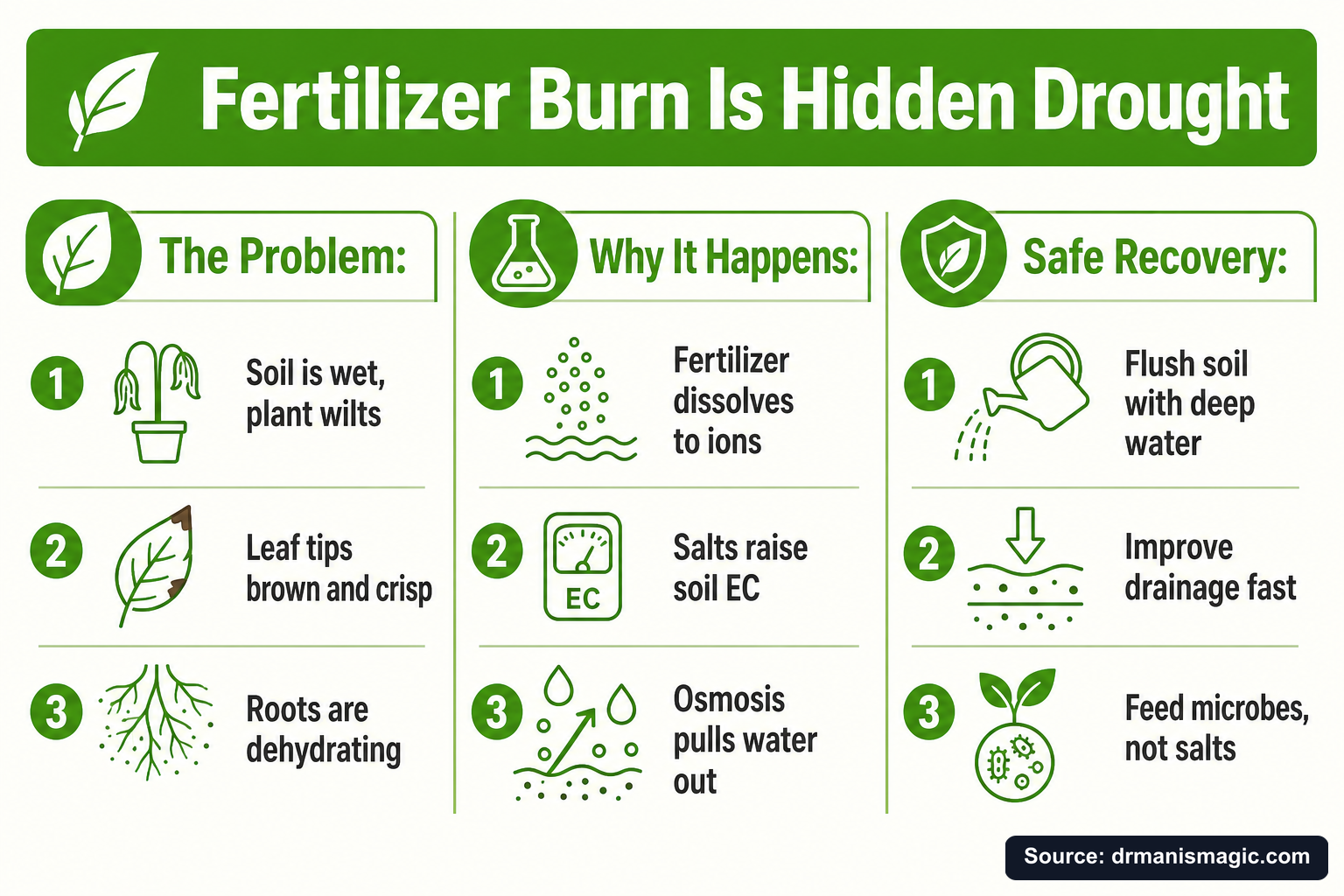
- Fertilizer burn is root dehydration caused by too many dissolved salts in the soil, not a chemical poison reaction.
- When fertilizer dissolves, it releases ions that raise the soil's electrical conductivity and create osmotic stress — pulling water away from roots instead of toward them.
- Seeds, seedlings, and container plants are the most vulnerable because salts concentrate fast in small volumes of soil.
- Salt-based synthetic fertilizers also kill the beneficial microbes that your plant depends on to absorb nutrients in the first place.
- Organic fertilizers like those built from crab, kelp, and amino acids feed the soil's microbial life first — which then slowly and gently releases nutrition to the roots the way nature intended.
- Recovery from fertilizer burn is possible with deep watering, improved drainage, and a switch to biology-friendly nutrition.
- The safest long-term strategy is building the Three Plant Pillars: mineral soil, live microbes, and organic fertilizer that works with your roots — not against them.
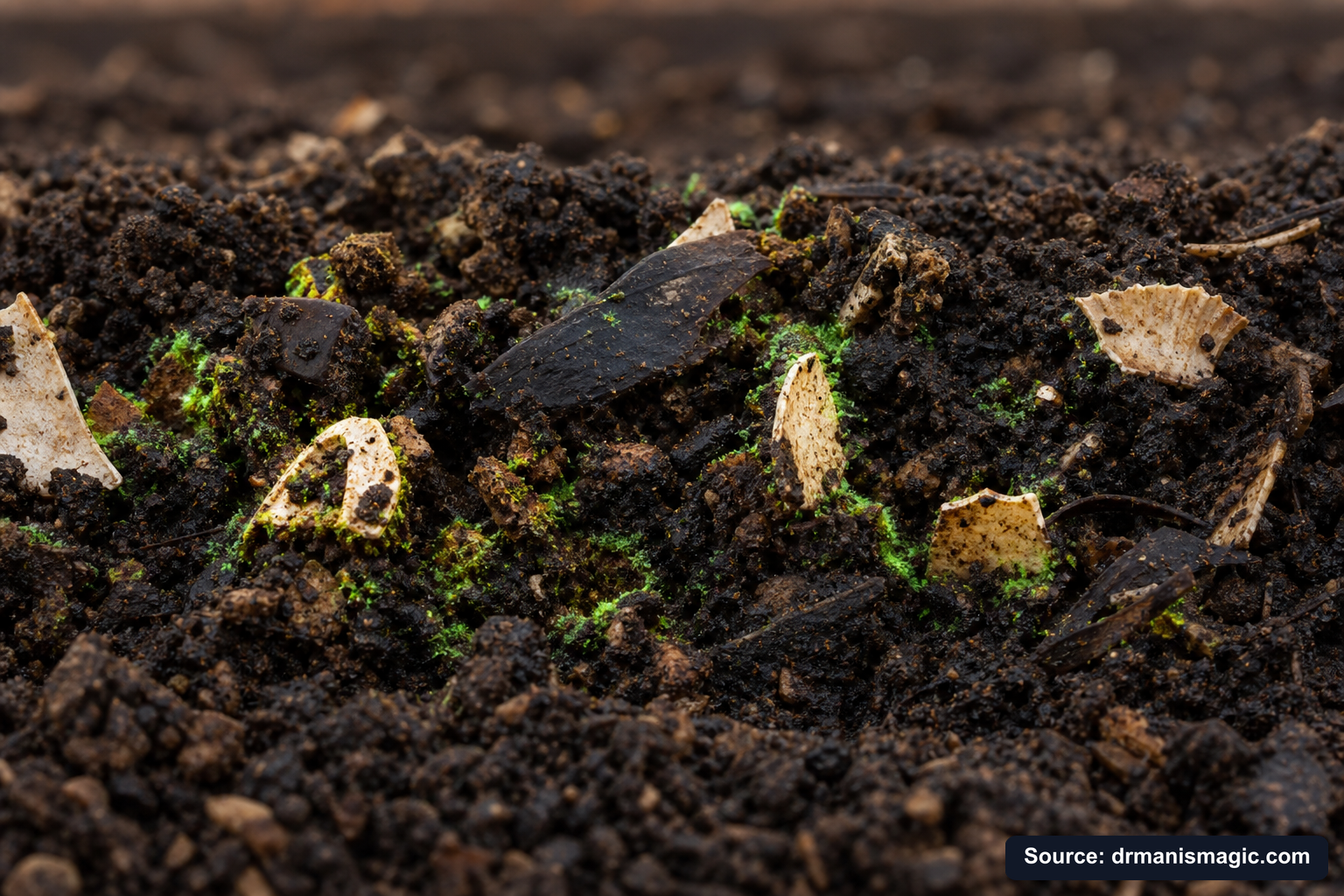
What Is Fertilizer Burn and Why Does It Happen to Healthy-Looking Plants?
Fertilizer burn happens when dissolved fertilizer salts in the soil create osmotic stress, making it harder for roots to pull in water. Even in moist soil, roots begin to dehydrate. Leaves curl, tips turn brown, and the plant wilts — symptoms that look exactly like drought but are caused by too much dissolved fertilizer, not too little water.
Fertilizer burn is your plant experiencing a kind of invisible drought. The soil has water in it. But the roots cannot reach it.
Here is why. When you pour fertilizer onto soil, it dissolves. As it dissolves, it breaks apart into tiny charged particles called ions. Those ions float freely in the soil water. And here is the chemistry that changes everything: the more ions dissolved in water, the harder that water is to absorb.
Think of it like this. Imagine two cups of water side by side. One cup is plain water. The other cup has a mountain of sugar stirred into it until it is thick and syrupy. Now imagine trying to sip through a straw. The plain water comes up easily. The thick sugar water fights you.
Your roots work the same way. Roots absorb water through a process called osmosis. Water naturally moves from where there are fewer dissolved particles to where there are more. In healthy soil, the water inside the root has more dissolved nutrients than the water outside — so water flows in. But when you dump too much fertilizer into the soil, you flip that equation. Now the soil water has MORE dissolved particles than the water inside the root. So instead of water flowing into the root, it gets pulled out of the root and into the soil. Your plant is literally losing moisture to the ground beneath it.
That is fertilizer burn. Not a burn at all. A drought. Caused by chemistry.
University of Wisconsin Extension calls this osmotic stress, and it is the same mechanism that makes ocean water dangerous to drink. The salt concentration outside your cells is too high, so your body loses water instead of gaining it. Your roots face the exact same crisis.
What Does "Salt" Actually Mean in Fertilizer Chemistry?
In fertilizer chemistry, "salt" does not just mean table salt. It means any compound that dissolves into ions in water. Most fast-release synthetic fertilizers are salts by this definition. When they dissolve, they raise the soil's electrical conductivity and create the osmotic imbalance that dehydrates roots and kills beneficial microbes.
When we say synthetic fertilizers are salt-based, we do not mean they taste like your french fries. In chemistry, a salt is any compound that dissolves and separates into positive and negative ions. Ammonium nitrate. Potassium chloride. Superphosphate. These are all salts in the chemical sense. And they are the backbone of most fast-release commercial fertilizers.
Scientists measure how much salt is dissolved in soil water using a number called electrical conductivity, or EC. The more dissolved ions, the higher the EC. And the higher the EC, the harder it is for roots to pull in water.
Every fertilizer has what is called a salt index — a number that tells you how much it raises EC per unit of nutrient delivered. Colorado State University Extension notes that high-salt-index fertilizers applied too close to seeds or roots are one of the most common causes of plant damage in home gardens.
Here is what most bags of fertilizer will never tell you. Salt does two things that hurt your plant at the same time. First, it dehydrates the roots through osmotic stress. Second, it kills the living microbes in your soil. Those microbes are the invisible crew that unlocks nutrients, fights disease, and keeps the whole system running. Wipe them out with a salt blast and your plant loses its whole support system. Not just today. For weeks or months afterward.
After growing more than 250,000 trees at our South Texas nursery, we can tell you this from hard experience: the plants that struggled most were almost always the ones that had been hit with high-salt synthetic fertilizers. The salt did not just burn the leaves. It quietly destroyed the underground world the plant depended on.
What Does Fertilizer Burn Look Like on Different Plants?
Fertilizer burn shows up as brown leaf tips, scorched leaf edges, wilting, yellowing, or dead patches — even in moist soil. Lawns get yellow or brown streaks. Trees and shrubs show marginal leaf scorch. Seedlings collapse. Container plants decline fast. The common thread is that damaged roots cannot deliver water, so leaves show drought symptoms first.
Fertilizer burn wears many disguises. That is why it gets misdiagnosed so often. Here is what to look for across different plants.
| Plant Type | Fertilizer Burn Symptoms | Recovery Likelihood | First Action |
|---|---|---|---|
| Lawn / Turf | Yellow or brown streaks, dry-looking patches, dead grass in lines matching spreader paths | Good if caught early | Water deeply for several days to leach salts |
| Trees and Shrubs | Marginal leaf scorch (brown edges), wilting, leaf drop, dieback of new growth | Good to moderate | Stop fertilizing, deep water, improve drainage |
| Citrus and Fruit Trees | Leaf curl, brown tips, fruit drop, pale yellowing, root damage visible if unpotted | Moderate (depends on root damage) | Flush soil with water, switch to organic inputs |
| Vegetables | Wilting despite moist soil, tip burn, poor germination, seedling collapse | Moderate for mature plants; low for seedlings | Leach with water, wait before re-fertilizing |
| Seedlings | Damping off, collapse at soil line, failure to germinate | Low — seedlings are extremely sensitive | Do not apply high-salt fertilizer near seeds |
| Houseplants and Containers | White crusty deposits on soil surface or pot rim, brown leaf tips, stunted growth | Good if flushed quickly | Flush pot with water until it runs clear; repot if needed |
| Ornamentals and Evergreens | Needle scorch, marginal burn on leaves, dieback on outer branches | Moderate | Flush soil, remove dead tissue only after new growth appears |
The pattern is always the same at the root level. Salt raises EC. Osmotic stress dehydrates roots. Damaged roots cannot move water upward. Leaves show drought symptoms. The plant looks thirsty even though the soil is wet.
Seeds and seedlings are the most fragile. They have no established root system to buffer the shock. A little extra fertilizer that a mature tree might shrug off can wipe out an entire tray of seedlings overnight.
How Do You Tell Fertilizer Burn Apart From Drought, Overwatering, or Root Rot?
Fertilizer burn and drought both cause wilting and brown tips, but fertilizer burn happens in moist soil right after feeding. Overwatering causes yellowing and soft stems with soggy roots. Root rot causes dark, mushy roots and a foul smell. Checking the soil moisture and your recent fertilizing history is usually enough to figure out which one you are dealing with.
This is the part where most homeowners get stuck. The symptoms overlap. Here is a simple comparison to help you sort it out.
| Symptom or Clue | Fertilizer Salt Burn | True Drought Stress | Overwatering / Root Rot |
|---|---|---|---|
| Soil condition | Moist or wet | Dry, pulls away from pot edges | Soggy, waterlogged, may smell |
| When it appeared | Shortly after fertilizing | During heat or missed waterings | After heavy rain or overwatering |
| Leaf symptoms | Brown tips and edges, crispy margins | Wilting, curling, dull color | Yellow leaves, soft and mushy feel |
| Root appearance | Brown root tips, damaged fine roots | Dry, white or tan roots | Black, mushy, foul-smelling roots (Pythium, Phytophthora pathogens often present) |
| Soil surface clues | White crusty deposits, visible granules | Cracked dry surface | Algae, mold, or standing water |
| Recovery with watering | Improves if you leach the salts | Improves quickly with water | Gets worse with more water |
| Pet urine or deicing salts | Looks similar — brown patches in lawn, dead rings | No | No |
One pattern worth knowing: salt-injured roots and waterlogged soil often show up together. Here is why. Salt damage weakens and kills root tips. Damaged roots cannot take up oxygen from the soil. When the soil stays wet at the same time, oxygen levels drop even further. That creates the perfect environment for root-rot pathogens like Pythium and Phytophthora to move in. What started as fertilizer burn turns into root rot. Two problems layered on top of each other. This is one of the most common failure patterns we see, and almost nobody connects the dots between the original salt application and the fungal infection that follows weeks later.
See also: The Hidden Reason Synthetic Fertilizers Cause Root Rot
What Is the Difference Between Salinity and Sodicity, and Why Does It Matter?
Salinity means too many dissolved salts in soil water, which reduces the water roots can absorb. Sodicity means too much sodium relative to calcium and magnesium, which damages soil structure itself — causing compaction, crusting, and poor drainage. Both come from salt-heavy fertilizers and both hurt plants, but they damage different things.
There are actually two separate problems that salt creates in soil. Most people only hear about one of them.
Salinity is the water problem we have been talking about. Too many dissolved ions raise EC, create osmotic stress, and make water harder for roots to absorb. You can measure it with an EC meter.
Sodicity is a soil structure problem. When sodium builds up in the soil relative to calcium and magnesium, it disrupts the way soil particles stick together. Healthy soil has a crumbly, open structure with lots of tiny air pockets. Roots breathe through those spaces. Water flows through them. Microbes live in them. When sodium takes over, the soil collapses. It crusts on the surface. It compacts into a dense layer. Water cannot infiltrate. Roots cannot breathe. Even if you fix the salinity problem, a sodic soil will keep suffocating your plants.
This is one reason why the first of our Three Plant Pillars is mineral-based soil. Sandy loam from the Rio Grande Valley does not compact. It does not break down. It keeps its structure even under pressure. Organic potting mixes made from pine bark or sawdust collapse over time — and when they do, you get compaction plus poor drainage plus salt buildup all at once. That is a recipe for dead plants.
You can learn more about how soil structure protects your roots at our Super Soil page.
You Never Had a Brown Thumb.
You were handed the wrong tools. This free guide hands you the right ones.
You watered it. You fed it. It died anyway.
It was never you. It was the dirt, the salt food, and the bad advice.
This guide shows you what really went wrong, and how to fix it for good.
- Why your plants really died, and why it was never your fault
- The salt hiding in your plant food that quietly burns the roots
- The hidden killer in almost every bag of store soil
- The tiny helpers that grow a whole forest for free
- The rescue trick that brings a half dead plant back to life

How Do Synthetic Fertilizers Kill Beneficial Soil Microbes?
Synthetic fertilizers are salt-based. When dissolved in soil water, the high salt concentration dehydrates and kills bacteria, fungi, and mycorrhizae the same way it dehydrates plant roots. Wipe out the microbes and you remove the living system that unlocks nutrients, fights disease, and keeps soil alive. The plant becomes dependent on more fertilizer to survive, and the cycle gets worse.
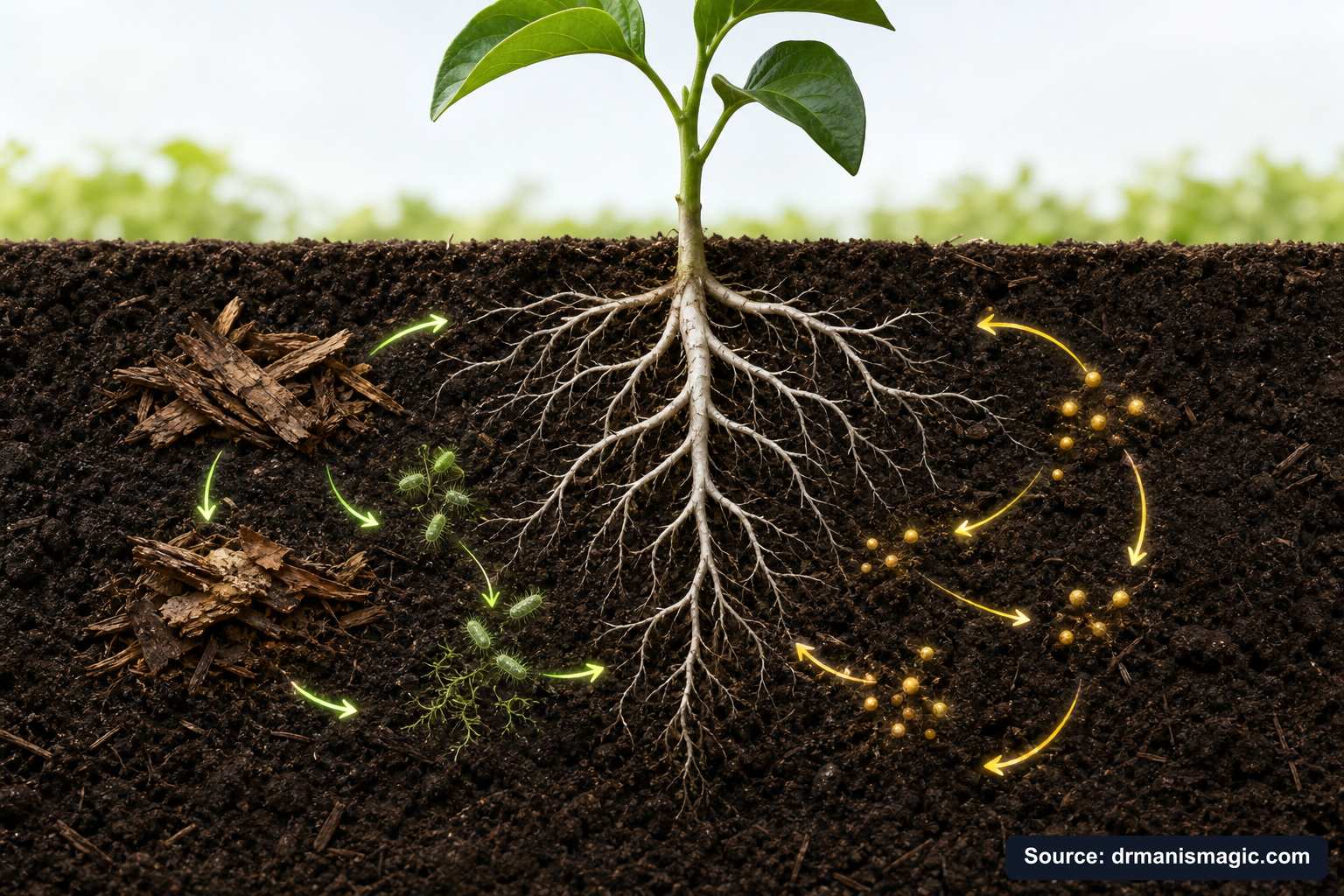
Here is the part the big chemical companies do not want you to think about too hard.
Your soil is alive. A tablespoon of healthy garden soil contains more living organisms than there are people on Earth. Bacteria. Fungi. Mycorrhizae. Tiny nematodes. These microscopic creatures form a web that does everything from unlocking bound-up nutrients to fighting off disease pathogens to literally feeding sugars back to your plant roots. They are the invisible engine under every healthy garden.
Synthetic fertilizer salts walk into that engine and start breaking things.
High EC in the soil solution dehydrates microbial cells the same way it dehydrates root cells. Beneficial bacteria die off. Fungal networks collapse. Mycorrhizal connections — the underground pipelines that extend a plant's root reach by hundreds of times — get severed. What is left is biologically dead soil that cannot hold nutrients, cannot fight disease, and cannot support healthy roots.
Now here is the trap. Your plant looks green for a few weeks because the fast-release nitrogen gave it a quick hit. But the soil is emptier than before. So next time, the plant needs more fertilizer to get the same response. You buy more. You apply more. The salt level creeps up. More microbes die. More root tips get damaged. More money spent. More time lost.
This is not an accident. It is a business model. We are not saying it with anger. We are saying it because after thirty years of watching plants grow and die, we know the pattern. The system profits when your plants struggle. We decided a long time ago that we were going to build something different. That decision became the Three Plant Pillars.
See also: How Salt-Based Feeding Quietly Destroys Root Systems
Why Does Organic Fertilizer Not Burn Plants the Way Synthetic Fertilizer Does?
Organic fertilizers are not salt-based. Instead of dissolving immediately into ions that spike EC, they are broken down slowly by soil microbes over days and weeks. The microbes eat the organic material first, convert it into plant-available nutrients, and release it in small, steady amounts. The plant gets fed gradually, EC stays low, and roots never face osmotic stress.
Picture a campfire versus a gasoline explosion. Both release energy. But one does it slowly and usefully. The other does it all at once and burns everything near it.
That is the difference between organic and synthetic fertilizer.
Organic fertilizer does not dissolve into a flood of ions when it hits wet soil. It stays in its complex, protein-bound form. Soil microbes find it and start eating it. As they digest it, they release nutrients in small, steady amounts — a gentle trickle that mirrors the way plants get fed in nature. The EC stays low. The osmotic balance stays stable. The roots absorb water freely.
But here is the part that most people miss, and it is the most important thing in this entire article.
Organic fertilizer does not just avoid killing the microbes. It feeds them first. The microbes eat the organic material and thrive. They multiply. Their populations grow. When those microbes eventually die — and they do, because that is the natural cycle — they release all the nutrition they stored directly into the root zone in easy-to-absorb forms. The whole system becomes a natural time-release machine. You apply it once and the soil keeps feeding your plant for weeks. Long after a synthetic fertilizer would have spiked and crashed.
This is how forests feed themselves. No one is out there dumping ammonium nitrate on the redwoods. Lightning fixes nitrogen from the atmosphere. Bacteria in the soil convert it into forms plants can use. Fungi break down organic matter and release minerals. The plant feeds the microbes sugar through its roots in return. It is a living exchange, millions of years old, built into the DNA of every plant on Earth.
When you use organic fertilizer, you plug back into that system instead of fighting it.
What Makes Crab Shells, Kelp, and Amino Acids Different From Regular Fertilizer?
Crab shells provide chitin, calcium, and magnesium. Kelp delivers natural plant hormones, trace minerals, and carbohydrates that wake up root growth. Amino acids supply nitrogen in a form that is gentle on microbes and easy for roots to absorb. Together they feed the plant, feed the soil, and strengthen natural defenses — all without synthetic salts, biosludge, or PFAS.
Let us talk about what is actually in an organic fertilizer built from these three ingredients, and why each one matters.
Crab shells and chitin. Chitin is the fibrous material that makes up crab shells. When soil microbes break it down, something interesting happens. The microbes that eat chitin are the same microbes that attack the protective coatings of fungal pathogens and pest eggs. Feeding chitin to your soil is like recruiting an army of defenders. On top of that, crab shells are rich in calcium — which builds cell walls, strengthens stems, and is the single largest mineral component of a plant's woody mass — and magnesium, which sits at the center of every chlorophyll molecule. No magnesium, no photosynthesis.
Cold-processed kelp. Kelp from the ocean is packed with naturally occurring auxins and cytokinins — plant growth hormones that signal roots to grow deeper and faster. It also contains dozens of trace minerals that most soils are missing, plus complex carbohydrates that feed microbial populations. Cold processing matters because heat destroys those hormones. You want them alive and active when they reach your roots.
Amino acids. Amino acids are the building blocks of proteins. They are also a direct, gentle source of nitrogen that plants can absorb without waiting for microbial conversion. They support microbes instead of harming them. And because the plant can regulate how much it takes in, there is almost no risk of the overload that causes osmotic stress.
Put all three together and you have a fertilizer that feeds the plant, feeds the microbes, defends against pathogens, delivers trace minerals, activates root growth hormones, and builds long-term soil health. All with a low salt index. All without the osmotic stress that causes fertilizer burn.
Our Crab, Kelp & Amino Acids (7-4-4) was developed and tested on over 250,000 trees at US Citrus Nursery in South Texas. It works on citrus. It works on vegetables. It works on lawns, ornamentals, houseplants, flowers, and fruit trees. Any plant that breathes and grows benefits from the same biology.
What About Biosludge and PFAS in Fertilizers — Should You Be Worried?
Some fertilizers — both synthetic and some labeled "organic" — use biosludge fillers made from treated municipal waste. Biosludge can contain PFAS, which are synthetic "forever chemicals" that do not break down in soil or in your body. If your fertilizer does not explicitly state it is biosludge-free and PFAS-free, you should ask. Clean inputs matter for your family, your pets, and your soil.
This is the part of the fertilizer conversation that almost nobody wants to have. But we are going to have it anyway because it matters for your health, your children's health, and your pets.
Some fertilizer companies use what is called biosludge as a filler. Biosludge is treated municipal wastewater — essentially processed human waste — that gets dried and added to fertilizer products. It is legal. It is cheap. And it can contain PFAS, which are per- and polyfluoroalkyl substances. You may have heard them called "forever chemicals." They do not break down. They accumulate in soil, in groundwater, and in the bodies of people and animals who are exposed to them.
The EPA has raised serious concerns about PFAS in biosolids used in agriculture. If you are growing vegetables in your garden, or letting your children play on a fertilized lawn, or letting your dog roll in the grass — this is worth knowing.
Our Crab, Kelp & Amino Acids contains zero biosludge, zero PFAS, and zero synthetic salts. We say that plainly because we believe you deserve to know exactly what you are putting into your soil and near your family.
We also make everything in the USA. Every ingredient is sourced domestically. We know where it comes from. We can stand behind it. In a world where fertilizer supply chains run through countries we cannot control, that peace of mind is worth something.
How Do You Rescue a Plant That Has Already Been Burned by Fertilizer?
Stop applying fertilizer immediately. Remove any visible granules from the soil surface. Water deeply and slowly to flush dissolved salts downward and out through drainage holes. Let the soil drain fully before watering again. Wait for new growth before applying any nutrition. Then switch to a slow-release organic fertilizer to avoid repeating the cycle.
The good news is that most plants can recover from fertilizer burn if you act quickly and do the right things in the right order. Here is the recovery checklist we use.
- Stop all fertilizing immediately. More fertilizer will make it worse, even if the plant looks hungry.
- Remove visible granules. If you can see undissolved granules on the soil surface or pot rim, scoop them off carefully.
- Water deeply and slowly. For containers, water until it runs freely out the drainage holes. Repeat two or three times over the next few days. This leaches dissolved salts downward and out. For in-ground plants, deep watering over several days is the equivalent.
- Make sure drainage is working. If the pot or bed stays waterlogged, you are trading salt stress for oxygen stress. Good drainage is not optional. This is exactly why mineral-based soil matters — it drains freely and does not compact.
- Do not prune the damaged tissue right away. The brown tips and scorched leaves look bad, but they are protecting the living tissue behind them. Wait until you see new green growth before cutting anything.
- Wait before reapplying any fertilizer. Give the plant two to four weeks to recover its root function. Patience here saves the plant.
- Reintroduce nutrition with a slow-release organic source. When you are ready to feed again, use something that will not spike EC or harm the recovering microbial population. Start low and build gradually.
For houseplants and containers that have white crusty buildup on the pot rim or soil surface, that crust is crystallized salt. Flushing with water will dissolve and remove it. If the buildup is heavy and the roots are visibly damaged, repotting into fresh mineral-based soil may be the fastest path to recovery.
Synthetic vs. Slow-Release vs. Organic: Which Fertilizer Is Actually Safer for Roots?
Fast-release synthetic fertilizers have the highest salt index and the greatest risk of fertilizer burn. Slow-release coated synthetics reduce burn risk but leave plastic residues in soil. Organic fertilizers built from natural proteins and marine sources have low salt index, feed soil microbes, and almost never cause fertilizer burn when used at normal rates.
Here is the honest comparison most fertilizer companies will not show you.
| Fertilizer Type | Salt Index | Risk of Fertilizer Burn | Effect on Soil Microbes | Release Speed | Other Concerns |
|---|---|---|---|---|---|
| Fast-release synthetic (granular, liquid) | High | High — especially in heat, containers, and near seeds | Damages and kills beneficial bacteria and fungi | Immediate spike, then crash | Salt accumulation in soil over time; possible biosludge/PFAS fillers |
| Slow-release coated synthetic | Moderate | Lower than fast-release, but still salt-based inside | Still damages microbes as it releases | Weeks to months depending on coating | Plastic polymer coatings remain in soil; microplastic concern |
| Organic (crab, kelp, amino acids, feather meal) | Low | Very low — almost no osmotic stress at recommended rates | Feeds and supports microbial populations | Slow and steady — mirrors nature | Some organic brands use biosludge; choose PFAS-free, biosludge-free sources |
The slow-release coating on synthetic fertilizers sounds like a solution. And it does reduce the immediate salt spike. But the coating itself is often a plastic polymer that stays in your soil long after the nutrients are gone. And the fertilizer inside is still salt-based. Still harmful to microbes. Still capable of accumulating over time.
Organic fertilizer works differently at a fundamental level. It is not a slower version of the same thing. It is a different system entirely — one built on biology instead of chemistry.
See also: Why Most Fertilizers Are Actually Salt in Disguise
Can You Prevent Fertilizer Burn Completely With the Right Foundation?
Yes. When your soil drains freely, your microbial population is healthy, and your fertilizer is organic and slow-release, the conditions that cause fertilizer burn almost never develop. The Three Plant Pillars — mineral soil, live microbes, and organic fertilizer — work together to keep EC low, keep roots healthy, and keep the whole system self-correcting.
Here is what thirty years of growing taught Dr. Mani Skaria, plant pathologist, inventor of the microbudding technique, and founder of US Citrus Nursery.
The plants that never burned were the ones with three things in place. First, they were in soil that drained freely and never compacted — mineral-based sandy loam that kept oxygen flowing to the roots. Second, they had living microbial populations that processed nutrition slowly and naturally, and fought off the pathogens that move in when roots are stressed. Third, they were fed with organic inputs that worked with that biology instead of against it.
When all three pillars are in place, fertilizer burn becomes almost impossible. Not because you are being more careful with dosing. But because the whole system operates at low EC, high biological activity, and steady gentle nutrition. There is no salt spike to cause osmotic stress. There is no microbial die-off to leave the roots defenseless. There is no plastic coating leaching into your backyard.
This is the foundation we built the Dr. Mani's Magic line on. Mineral soil. Live microbes in our Plant Super Boost. And organic fertilizer from crab, kelp, and amino acids that feeds the soil first and the plant second — the way nature designed it.
We tested it on 250,000 trees. We tested it in our grove. We tested it on houseplants, tropical trees, lawns, and gardens. The results were not subtle. When the Three Plant Pillars are in sync, plants do not just survive. They push through. They fruit. They green up. They stop needing to be rescued and start just growing.
That is what we want for your plants. Whether you have a single lemon tree on a patio, a raised bed in a small backyard, a quarter acre of lawn, or a full orchard — the chemistry is the same. The roots need water. The microbes need to live. The nutrition needs to arrive slowly and gently. Get those three things right and you will never spend another Tuesday morning wondering why your plant looks thirsty in wet soil.
For a complete guide to building this foundation for any plant you own, visit our free Plant Care Field Guide. It walks you through the whole system, step by step, without jargon or guesswork.
You can get money back. You cannot get time back. The best time to build the right foundation was when you planted. The second best time is right now.
Frequently Asked Questions
Fertilizer burn confuses a lot of good gardeners. You did everything right, and your plant still looks terrible. These questions come up again and again from real plant owners who want straight answers. We have grown over 250,000 trees at our South Texas nursery, and we have seen fertilizer burn destroy good plants that never had to suffer. Here is what you need to know.
How does fertilizer burn actually work?
Most fertilizers are salt-based. When you add too much to the soil, those salts dissolve in the water around your roots. Now the water outside the root has more dissolved particles than the water inside the root. So instead of water flowing into your plant, it flows out. Your plant dehydrates even when the soil looks wet. That is the hidden trick of fertilizer burn. It is not acid damage. It is a water problem caused by too many salts stealing moisture from your roots.
Can a plant recover from fertilizer burn?
Yes, but the brown and crispy parts will not come back green. Recovery means stopping the damage and giving the plant a fresh start. Flush the soil with deep, slow watering to push the salts down and away from the roots. Stop adding any fertilizer. Trim the dead leaves so the plant can focus on new growth. For potted plants, repotting in clean mineral-based soil like Dr. Mani's Magic Super Soil gives roots a truly fresh start with no leftover salt buildup.
Will a balanced fertilizer like 12-12-12 burn my grass?
It can, yes. Any salt-based fertilizer can burn grass if you use too much or skip watering it in right away. The granules can stick to grass blades and cook them in the heat. Always apply to dry grass and water it in immediately. But here is the bigger problem nobody talks about. Even when you use it correctly, synthetic salt-based fertilizers kill the beneficial microbes in your soil over time. Dead microbes mean weaker grass that needs more and more fertilizer just to survive.
What does fertilizer burn look like on a lawn?
Look for yellow or brown streaks that follow your spreader paths. You may see patchy areas of dry, crispy grass that look scorched. The edges of the damaged spots are often sharp and defined, not soft and spreading like a fungal problem. The grass feels brittle and straw-like when you touch it. If the damage follows straight lines across your yard, that is almost always fertilizer burn from an uneven or heavy application.
How long does fertilizer burn take to show up?
Fast-release synthetic fertilizers can show damage within 24 to 48 hours, especially in hot weather. Slow-release products may take several weeks before you see the signs. That delay is actually dangerous because you may add more fertilizer thinking the first application did not work. Then the salt load doubles and the damage gets much worse. If your plant or lawn looks off a week or two after feeding, excess fertilizer is one of the first things to check.
Does watering help with fertilizer burn?
Yes, and it is the first thing you should do. Deep, slow watering pushes the dissolved salts down through the soil and away from the root zone. For potted plants, run water through the pot several times and let it drain fully. For lawns, soak the area thoroughly. The faster you flush the soil after noticing damage, the better the plant's chances. This is also why good drainage matters so much. Dr. Mani's Magic Super Soil is mineral-based, so it drains fast and does not trap salts around roots.
Are brown leaf tips always a sign of fertilizer burn?
Not always, but salt buildup is one of the most common causes. When salts concentrate in the soil, the tips of leaves are often the first place to show stress because they are the farthest from the root. You may also see brown tips from underwatering, low humidity, or fluoride in tap water. The difference with fertilizer burn is that the browning usually shows up shortly after feeding. Switching to a slow-release organic fertilizer made from crab, kelp, and amino acids, like the one in Dr. Mani's Magic line, feeds gently and does not spike salt levels in your soil.
About the Author
Dr. Mani Skaria, PhD
Dr. Mani Skaria, PhD, is a plant pathologist and the scientific founder of Dr. Mani's Magic. He spent 48 years studying how plants, soil, and living microbes work together, including his years as Professor Emeritus at Texas A&M and as a member of the USDA NAREEE Advisory Board. He invented micro-budding, a method for growing healthier, stronger trees, and has grown more than 250,000 trees on the family farm in Hargill, Texas - US Citrus Nursery. His life's work takes real lab science and turns it into simple, safe, organic plant care anyone can use at home.


