


The Case for Cleaner, Simpler Plant Nutrition | Dr. Mani's Magic
The Case for Cleaner, Simpler Plant Nutrition: Feed the Soil, Protect the Roots, Skip the Hidden Stressors
Picture this. You're standing in your backyard on a Saturday morning. Coffee in hand. The air smells like cut grass and something sweet from the garden bed near the fence. You walk over to your lemon tree. And you stop.
The leaves are yellow. The edges are brown and crispy. You fertilized two weeks ago. You did everything the bag said. And yet here you are, watching your tree look worse than before you fed it. You start Googling. An hour later you've got fifteen tabs open, three different opinions, and zero answers. Sound familiar? You are not alone. And here is the thing nobody is telling you: the fertilizer might be the problem, not the solution.
After growing over 250,000 trees at our South Texas nursery, we learned something that changed everything. Healthy plants are not about adding more. They are about stopping the damage first. The fertilizer most people reach for is salt-based. And salt, at the root level, is quietly burning your plant from the inside out. This article is going to show you exactly what is happening underground, why cleaner and simpler nutrition works better, and what a plant that is truly fed, not just force-fed, actually looks like.

Organic Fertilizer | Crab, Kelp & Amino Acids
Key Takeaways
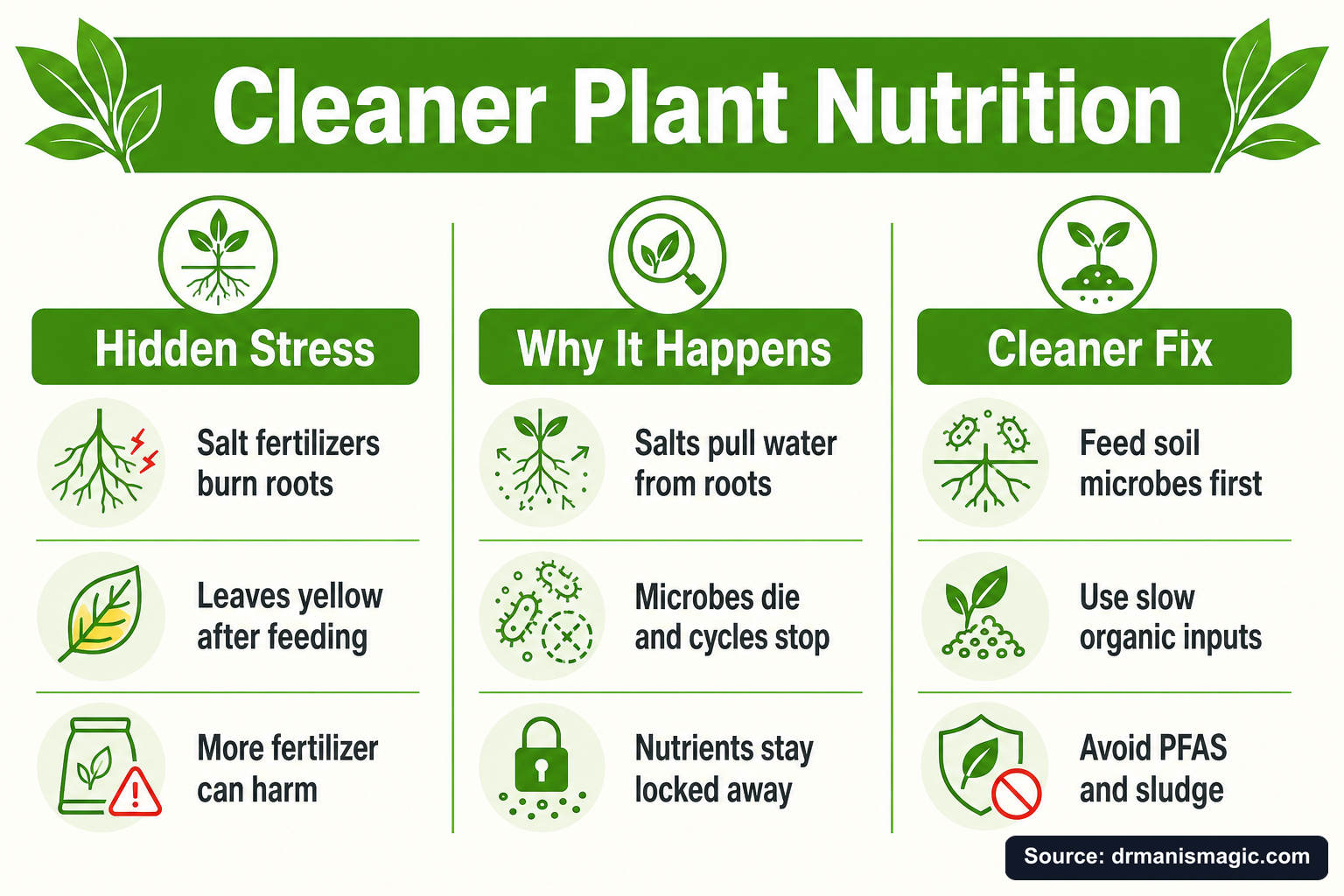
- Most common fertilizers are salt-based. Salt damages roots, kills beneficial microbes, and can make your plant look deficient even after feeding.
- Organic, slow-release fertilizers feed the soil's microbes first. The microbes then convert nutrients into a form plants absorb easily and steadily.
- Salt stress, root rot, and overwatering share overlapping symptoms. Knowing the difference saves your plant and your time.
- PFAS "forever chemicals" and biosludge fillers hide in many fertilizers, including some labeled organic. Label transparency matters.
- Chitin from crab shells, hormones from kelp, amino acid nitrogen, and trace minerals from volcanic ash each do something distinct and valuable for your plant.
- The Three Plant Pillars, mineral-based soil, live microbes, and organic fertilizer, work together as a system. Miss one and the other two underperform.
- Cleaner nutrition is not just safer. It is smarter, slower, and far more effective over time for lawns, gardens, houseplants, orchards, and trees.
Why Do Salt-Based Fertilizers Hurt Plants Instead of Helping Them?
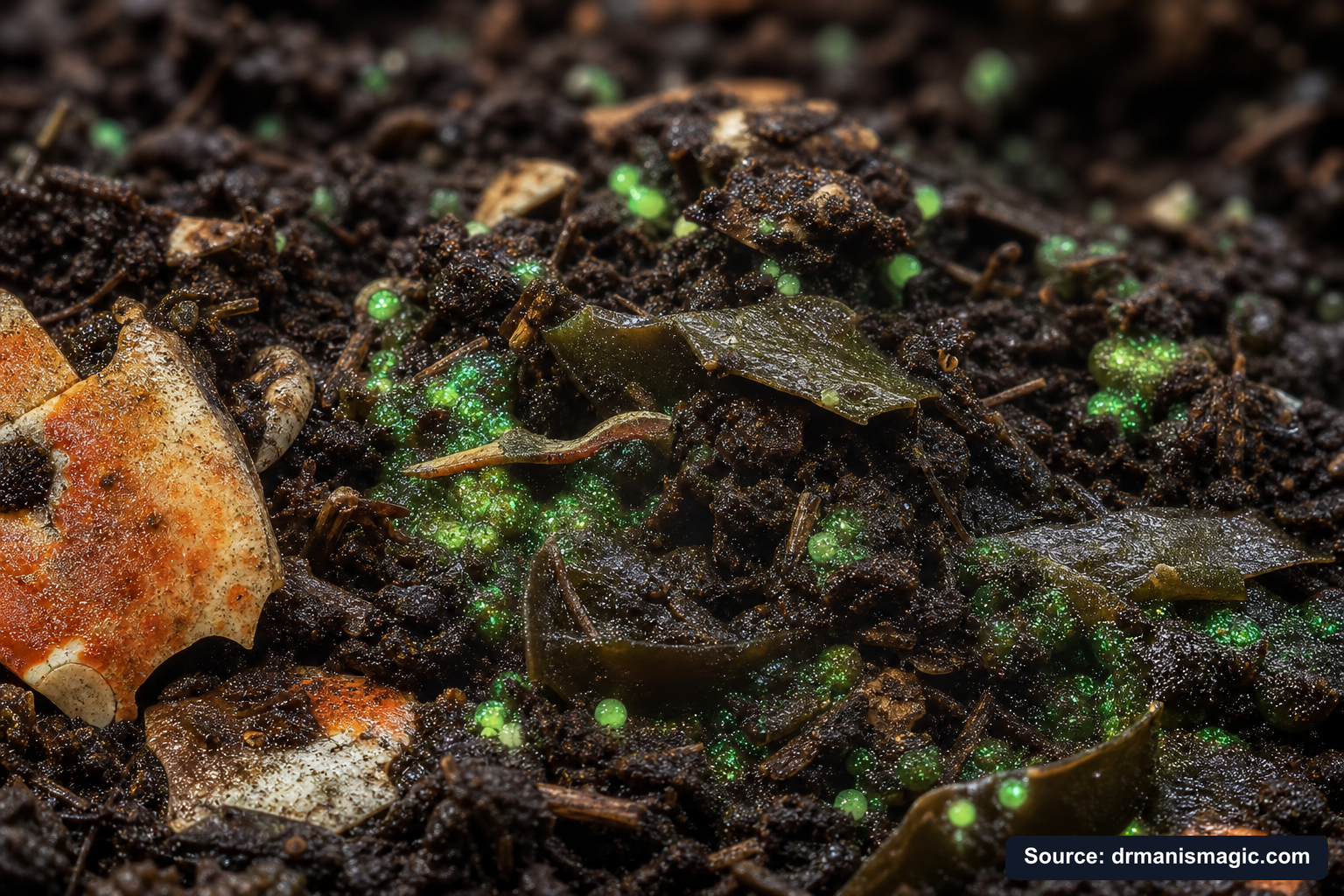
Quick Answer: Salt-based fertilizers dissolve into ions that raise the salt concentration around your roots. When that concentration gets too high, water is pulled out of the root cells instead of into them. Roots burn, shrink, and stop absorbing nutrients. Your plant looks starved, even though you just fed it. This is called osmotic stress.
Here is a picture that makes it click. Imagine your root tips are tiny sponges. They absorb water by pulling it in from the surrounding soil. That works beautifully when the soil water is clean and low in dissolved salts. But when you pour a salt-heavy fertilizer on top, the soil water gets thick and salty. Now the sponge cannot pull water in. Worse, the water inside the root actually gets pulled outward, into the salty soil. The root dries out. It burns. It shrivels.
Scientists call this osmotic stress, and it is well documented. University of Wisconsin Extension explains that soluble fertilizers dissociate into salts, and when those salts accumulate, they create a condition where roots struggle to absorb water at all. In sandy soils, containers, or dry conditions, the problem is even worse because there is nowhere for the salt to drain.
You might see white crust forming on top of your pot. That is the salt literally crystallizing out of the soil. You might see brown leaf margins, scorched tips, or wilting even after you watered. You might see seedlings collapse for no obvious reason. All of it points back to the same root cause. Salt.
The plant looks like it is starving. But feeding it more of the same fertilizer makes it worse. You are not solving a deficiency. You are adding to the damage.
And here is the part the big chemical companies never mention. That salt does not just hurt the roots. It kills the microbes too. And without microbes, your soil is just expensive dirt.
See also: How Salt-Based Feeding Quietly Destroys Root Systems
What Are Soil Microbes and Why Do They Matter for Plant Nutrition?
Quick Answer: Soil microbes are bacteria and fungi living in and around your roots. They break down organic matter, unlock bound nutrients, fix nitrogen from the air, and protect roots from disease. Without them, nutrients sit in the soil but never reach your plant. They are the real engine of plant nutrition, not the fertilizer bag.
Think about a forest. Nobody fertilizes a forest. No one shows up with a bag of 10-10-10 and sprinkles it around the old-growth trees. And yet those trees grow massive, live for centuries, and stay healthy through droughts, storms, and cold snaps. How?
The answer is underground. A single teaspoon of healthy forest soil contains more living organisms than there are people on Earth. Bacteria, fungi, nematodes, and mycorrhizal networks weave through the soil like a living internet. They break down fallen leaves and dead roots. They pull nitrogen out of the air. They dissolve locked-up phosphorus and carry it straight to the root tips. They fight off pathogens. They build the crumbly, spongy soil structure that holds water and lets air flow.
Penn State Extension describes soil microbes as the engine of nutrient cycling, nitrogen mineralization, phosphorus solubilization, disease suppression, and water infiltration. In other words, microbes do almost everything we credit the fertilizer with doing.
So what happens when you pour salt-based fertilizer on soil full of living microbes? The salt burns them. The microbial population crashes. The natural nutrient cycle breaks. The plant loses its underground support team. And now it truly is dependent on the next bag of fertilizer to survive. That is not gardening. That is an addiction cycle. And the companies selling you bag after bag are perfectly fine with that.
Dr. Mani Skaria saw this pattern during his 40 years of plant pathology research at the Texas A&M Citrus Center. He watched chemical inputs mask problems while destroying the very biology that plants depend on. That is what pushed him to build a different system entirely.
How Does Organic Fertilizer Actually Feed a Plant?
Quick Answer: Organic fertilizer does not go straight into the plant. It feeds the soil microbes first. The microbes eat it, break it down, and convert it into simple forms the plant can absorb through its roots. When those microbes die, they release even more nutrition. It is a natural, slow time-release system that keeps working long after you apply it.
This is the mechanism most people never hear about. And once you understand it, everything changes.
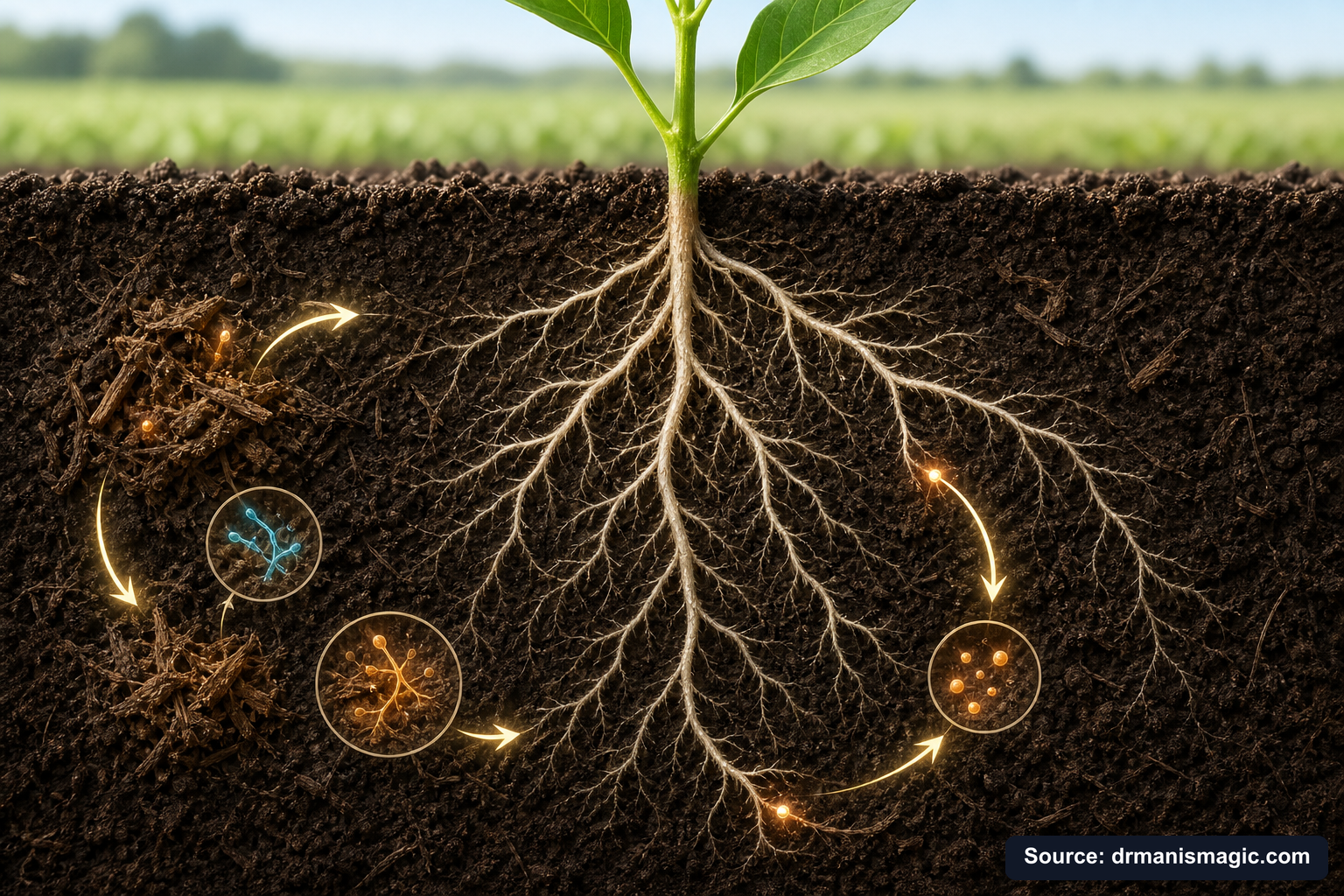
When you spread an organic granular fertilizer on your soil, it does not dissolve and rush into the root like a salt-based product does. Instead, it sits in the root zone. The bacteria and fungi in the soil start eating it. They use the carbon, nitrogen, and minerals to grow and multiply. As they digest the organic material, they release nutrients in simple, plant-ready forms. Ammonia becomes nitrate. Phosphorus gets solubilized. Micronutrients get chelated, which means attached to tiny organic molecules that carry them right to the root surface.
Then something else happens. Those microbes eventually die. And when they do, their bodies break down and release everything they stored, right into the soil around the roots. It is like a slow drip. Week after week, the plant gets a steady, gentle trickle of exactly what it needs.
Compare that to a salt-based synthetic fertilizer. It hits the root zone all at once. The concentration spikes. The roots either absorb it in a rush or get burned by the excess. A week later, the soil is empty again and the plant is hungry. So you feed it again. And the cycle continues.
The organic system mirrors what happens in nature. It is the pace plants evolved with. It is the pace their root systems and cellular machinery are built for. Slow, steady, and biological.
The best part? You almost cannot overfeed with a well-formulated organic fertilizer. The microbes act as a buffer. They hold the nutrition, release it gradually, and the plant takes only what it needs. No burn. No spike. No crash.
See also: Why "Instant Green-Up" Comes With a Cost
What Does Chitin from Crab Shells Actually Do for Your Plant?
Quick Answer: Chitin is a natural compound found in crab shells. When it breaks down in soil, it triggers the plant's immune system and feeds specific beneficial bacteria. Those bacteria produce enzymes that dissolve the outer shells of harmful fungi and root-attacking pests. It is a natural defense layer, built right into the fertilizer.
Crab shells sound like an unusual ingredient for plant food. But there is real science behind this choice, and it is one of the reasons we built our organic fertilizer around them.
Chitin is the structural material that makes up the shells of crustaceans, insects, and many fungal cell walls. When chitin from crab meal breaks down in your soil, two things happen. First, it feeds a group of bacteria called chitinase-producing bacteria. These bacteria thrive on chitin. And as a side effect of eating it, they produce enzymes called chitinases. Those enzymes dissolve the cell walls of harmful fungi, including some of the root rot pathogens that destroy plants in wet or poorly draining soils.
Second, chitin acts as a signal to the plant itself. When plant roots detect chitin in the soil, they interpret it as a sign that insects or pathogens may be nearby. The plant responds by ramping up its own natural immune defenses. It produces more protective compounds. It strengthens its cell walls. It becomes harder to attack.
So chitin does two jobs at once. It feeds the good guys and wakes up the plant's own defenses. And on top of that, crab meal is naturally rich in calcium and magnesium, two nutrients that support cell wall strength, root tip growth, and woody stem development. It is a remarkably complete ingredient.
This is exactly why our Crab, Kelp & Amino Acids fertilizer leads with crab meal as a primary ingredient. It is not a filler. It is doing real, measurable biological work in your soil every time you apply it.
What Does Kelp Do That Regular Fertilizer Cannot?
Quick Answer: Kelp is a biostimulant, not just a fertilizer. It contains natural plant hormones called auxins and cytokinins that speed up root growth, trigger flower and fruit set, and help plants handle drought and temperature stress. It also carries dozens of trace minerals and complex carbohydrates that feed soil microbes and strengthen plant cells.
Kelp has been used in coastal farming for centuries. Farmers near the sea would drag piles of seaweed onto their fields and watch their crops explode with growth. They did not know why. Now we do.
Cold-processed kelp, meaning kelp that is dried and ground without high heat that would destroy its active compounds, contains several powerful classes of biological molecules. The most important are natural plant growth hormones called auxins and cytokinins. Auxins drive root elongation. They push roots deeper and wider. Cytokinins trigger cell division and support flower and fruit development. These are the same hormones the plant produces internally, just delivered in an extra dose from the outside.
Kelp also carries alginic acid, a complex carbohydrate that feeds soil microbes and helps soil particles clump together into stable aggregates. Better soil structure means better water infiltration, better air movement, and better root penetration. All from a marine plant.
Then there are the trace minerals. Kelp absorbs dozens of minerals from the ocean as it grows. Iodine, iron, zinc, copper, manganese, and many others come along for the ride. These micronutrients are needed in tiny amounts, but they are critical. They activate enzymes, support chlorophyll production, and keep the plant's internal chemistry running smoothly.
The combination of hormones, carbohydrates, and trace minerals makes kelp something different from a fertilizer. It is a biostimulant. It does not just feed the plant. It wakes it up and tells it to grow.
Why Do Amino Acids Make Nitrogen Easier for Plants to Use?
Quick Answer: Amino acids are pre-built nitrogen molecules. Instead of forcing the plant to build them from scratch, amino acid fertilizers deliver nitrogen in a form the plant can absorb and use immediately. This reduces energy waste, speeds nutrient uptake, and is gentle on soil microbes because it carries no salt load.
Nitrogen is the nutrient plants need most. It builds chlorophyll, amino acids, proteins, and enzymes. Without enough nitrogen, leaves turn pale yellow, growth slows, and the plant starts cannibalizing its older leaves to feed the new ones.
But here is what most people do not know. Not all nitrogen is equal. The form nitrogen comes in determines how easy it is for the plant to use and how much damage it does getting there.
Synthetic fertilizers deliver nitrogen as ammonium nitrate or urea salts. They dissolve fast. They hit the root zone all at once. And the salt load they carry is what causes osmotic stress and microbial damage. The plant gets a burst of nitrogen, but at a cost.
Amino acids are different. They are essentially pre-made nitrogen. When plants absorb amino acid nitrogen, they skip an entire metabolic step. They do not have to convert inorganic nitrogen into amino acids first. The building blocks arrive ready to use. The plant spends less energy on digestion and more energy on growth.
Amino acids also feed soil microbes directly. Microbes love amino acids. They use them for their own cellular growth and in return release more nutrients around the root zone. It is a cooperative system. The amino acids feed the microbes. The microbes feed the plant. Everyone wins.
Our fertilizer uses amino acids derived from natural animal sources including feather meal and tankage. High in nitrogen and phosphorus. No synthetic salts. No smell. Just clean, bioavailable nutrition that works with your soil biology instead of against it.
What Do Volcanic Ash Minerals Do for Soil and Roots?
Quick Answer: Volcanic ash is rich in silica and dozens of trace minerals. Silica strengthens plant cell walls, making stems more rigid, leaves more resistant to pests, and roots more drought-tolerant. Trace minerals from volcanic sources are in a natural form that microbes can access and transfer to plants over time.
Volcanic regions are famous for growing exceptional crops. The soil around volcanoes, whether in Hawaii, Sicily, or the slopes of Mount Etna, produces some of the richest, most mineral-dense food on the planet. There is a reason for that.
When volcanic rock weathers over time, it releases a broad spectrum of minerals in forms that soil microbes can work with. Silica is the most abundant. And silica does something remarkable for plants. It deposits in the cell walls and epidermis, making them physically stronger. Pests have a harder time penetrating. Fungal spores have a harder time gaining a foothold. Stems stand more upright. Leaves hold water better under drought stress.
Silica also appears to amplify the effect of other nutrients. Plants that have adequate silica uptake tend to use nitrogen and phosphorus more efficiently. They need less of both to achieve the same growth outcome. That is the kind of efficiency that saves you money and reduces the risk of overfeeding.
Volcanic ash also carries iron, zinc, copper, manganese, boron, molybdenum, and other micronutrients in their natural mineral forms. These are not chelated synthetically in a lab. They are weathered slowly by soil microbes and delivered to plant roots through the biological pathways that have existed for millions of years.
Adding volcanic ash to a fertilizer blend is like adding a long-term mineral bank to your soil. It keeps releasing trace elements slowly as microbes process it. And for plants that live in containers or raised beds with limited soil volume, that mineral bank is especially valuable.
You Never Had a Brown Thumb.
You were handed the wrong tools. This free guide hands you the right ones.
You watered it. You fed it. It died anyway.
It was never you. It was the dirt, the salt food, and the bad advice.
This guide shows you what really went wrong, and how to fix it for good.
- Why your plants really died, and why it was never your fault
- The salt hiding in your plant food that quietly burns the roots
- The hidden killer in almost every bag of store soil
- The tiny helpers that grow a whole forest for free
- The rescue trick that brings a half dead plant back to life

What Is Biosludge, and Why Should You Read Your Fertilizer Label Carefully?
Quick Answer: Biosludge is treated municipal waste, including human sewage solids, used as a cheap filler in some fertilizers, including some labeled organic. It can carry PFAS "forever chemicals" that do not break down in soil or in your body. Clean fertilizers declare their ingredient sources clearly and contain zero biosludge and zero PFAS.
This is the part of the fertilizer conversation that almost nobody wants to have. But you deserve to know it.
A significant portion of the fertilizers sold in the United States, including some that carry an organic label, use treated municipal biosolids as a nitrogen source or filler. Biosolids is the official term. Biosludge is the honest one. It is the solid material left over after municipal sewage is processed at a wastewater treatment plant.
Now, biosolids do contain nitrogen and organic matter. So from a raw nutrient standpoint, they are not useless. But here is the problem. Sewage sludge is also a concentration point for PFAS, the class of synthetic chemicals used in nonstick coatings, waterproof fabrics, firefighting foam, and hundreds of industrial processes. PFAS stands for per- and polyfluoroalkyl substances. They are called "forever chemicals" because they do not break down. In soil. In water. In your body.
University of Maine Extension has published guidance specifically for home gardeners on understanding PFAS risk from fertilizers and compost, noting that biosolid-derived products are a primary pathway for PFAS entering home garden soil.
If your fertilizer bag lists "biosolids," "sewage sludge," "municipal waste," or "composted municipal waste" as an ingredient, PFAS contamination is a real risk. And the scary part is that many bags do not list it clearly at all.
Dr. Mani's Magic Crab, Kelp & Amino Acids contains zero biosludge. Zero PFAS. Zero synthetic salts. Every ingredient is declared. Crab meal. Kelp. Amino acids from feather meal and tankage. Volcanic ash. That is it. Nothing hiding in the fine print. Nothing you would not want on your vegetable garden or near your children and pets.
When you are choosing a fertilizer for your food garden, your lawn where your kids play barefoot, or your houseplants sitting in your living room, ingredient transparency is not a bonus feature. It is the baseline.
How Can You Tell If Your Plant Has Salt Damage, Root Rot, or a True Nutrient Deficiency?
Quick Answer: Salt damage causes brown leaf tips and margins with the rest of the leaf still green. Root rot causes wilting even when soil is wet, plus dark and mushy roots. True nutrient deficiency causes uniform yellowing or specific color patterns depending on which nutrient is missing. Diagnosing correctly saves your plant from the wrong treatment.
This is where most gardeners go wrong. They see a sick plant and reach for more fertilizer. But if the problem is salt damage or root rot, adding fertilizer makes it worse. Not better.
Here is a diagnostic table to help you read what your plant is telling you.
| Symptom | Salt Damage / Osmotic Stress | Root Rot / Low Oxygen | True Nutrient Deficiency |
|---|---|---|---|
| Leaf color | Brown tips and margins, rest of leaf still green | Yellow, pale, or bronze all over | Yellow patterns specific to nutrient (old leaves vs new) |
| Wilting | Wilts despite watering; soil may look moist | Wilts despite wet soil; does not recover after watering | Rarely wilts; may be slow or stunted |
| Roots | Dry, shrunken, brown tips | Dark, mushy, foul smell; Phytophthora or Pythium present | Roots usually white or light tan; normal texture |
| Soil surface | White crust on top of soil or pot edges | Soggy, stays wet for days; may smell sour | Normal appearance; drains properly |
| Recent fertilizer? | Usually yes; symptoms appeared after feeding | Usually no recent fertilizer; overwatering or poor drainage | No fertilizer for a long time, or wrong type used |
| Fix | Flush soil with clean water; switch to low-salt organic inputs | Improve drainage; reduce watering; repot with mineral-based soil; use microbes | Apply complete, balanced organic fertilizer; check soil pH |
Colorado State Extension explains that roots need oxygen for water and nutrient uptake, and that saturated or compacted soils reduce oxygen diffusion, slow root growth, and favor root decay pathogens like Phytophthora. So root rot is not just a watering problem. It is an oxygen problem. And it is made worse when salt-damaged roots are already weakened and vulnerable to attack.
If you suspect root rot, the fix is not more fertilizer. The fix is better soil structure that holds less water, more air, and supports the microbial community that fights off pathogens naturally.
See also: The Hidden Reason Synthetic Fertilizers Cause Root Rot
Recovery Checklist: If You Suspect Salt Damage or Root Rot
- Stop all synthetic fertilizer immediately. Do not add more salt to an already stressed root zone.
- Flush the soil. For containers, pour clean water through until it runs clear from the drainage holes. This dilutes and moves accumulated salts out.
- Check your drainage. If water sits in the pot or bed for more than a few minutes, your soil structure is the real problem.
- Inspect the roots. Gently remove the plant from its container. Healthy roots are white or tan and firm. Rotten roots are dark, mushy, and may smell sour. Trim away any dead root tissue with clean scissors.
- Repot or amend with mineral-based soil. Organic potting mix compacts and holds too much water. Mineral-based, sandy loam soil drains freely and keeps the root zone oxygenated.
- Reintroduce live microbes. Live bacteria and mycorrhizal fungi help recolonize the root zone, fight remaining pathogens, and restart the natural nutrient cycle.
- Feed gently with an organic, low-salt fertilizer. Once roots are recovering, a slow-release organic fertilizer gives the plant steady nutrition without the osmotic shock that started the problem.
Synthetic Fertilizer vs. Slow-Release Organic: Which One Actually Works Better Long-Term?
Quick Answer: Synthetic fertilizers work fast but damage roots, kill microbes, and require constant reapplication. Slow-release organic fertilizers work through soil biology, build long-term soil health, and become more effective over time as microbial populations grow. For any plant you plan to keep, organic wins by a wide margin.
Let's put them side by side so you can see exactly what you are choosing between.
| Feature | Synthetic Fast-Release | Synthetic Slow-Release (Coated) | Organic Slow-Release (Crab, Kelp, Amino Acids) |
|---|---|---|---|
| Salt content | Very high. Burns roots and kills microbes. | High. Still salt-based inside the coating. | Zero synthetic salts. Roots stay healthy. |
| Release speed | Immediate. Spike then crash. | Timed by coating, but still salt when released. | Slow, biology-mediated. Steady trickle for weeks. |
| Microbial impact | Kills beneficial bacteria and fungi. | Still damages microbes when salt releases. | Feeds and multiplies microbes. Gets better over time. |
| PFAS and biosludge risk | Some products use biosolid fillers with PFAS. | Plastic coating fragments remain in soil. | Zero PFAS. Zero biosludge. Clean declared ingredients. |
| Overfeed risk | Very high. Easy to burn plants. | Moderate. Hard to calibrate. | Very low. Microbes buffer excess naturally. |
| Long-term soil health | Degrades. Soil needs more inputs every season. | Leaves plastic residue. Microbiome stays suppressed. | Improves. Soil becomes richer and more self-sufficient each year. |
| Works for containers? | Risky. Salts accumulate with no place to go. | Still risky. Salt load builds up over time. | Excellent. Safe for containers, lawns, gardens, trees. |
One more thing worth saying. Slow-release coated synthetics are often marketed as a safer middle ground. But they are still salt inside that plastic shell. When the coating breaks down, the salt releases. And those plastic shells? They fragment into microplastics that stay in your soil indefinitely. That is not a trade-off that makes sense for a backyard you walk through barefoot or a vegetable garden you harvest from.
The organic approach gets more effective over time, not less. As the microbial population grows, as the soil structure improves, as the biological cycling speeds up, each application of fertilizer does more work. You are building something. Not just buying time until the next bag runs out.
How Do the Three Plant Pillars Work Together as a Complete Nutrition System?
Quick Answer: The Three Plant Pillars are mineral-based soil for drainage and root oxygen, live microbes for biological nutrient cycling and disease protection, and organic fertilizer for steady, complete nutrition. Each pillar supports the others. Remove one and the whole system weakens. Together they create a plant that is nearly self-sustaining and genuinely hard to kill.
Think of it like a three-legged stool. You can have the most expensive organic fertilizer in the world, but if your soil is dense and waterlogged, the roots cannot breathe and the microbes cannot survive. You can add live microbes every month, but if the fertilizer you use is salt-based, you are killing them as fast as you add them. And you can have perfect soil and thriving microbes, but if there are no nutrients in the system, the plant still starves.
All three legs have to be there. And they have to work together.
Dr. Mani Skaria developed the Three Plant Pillars framework after decades of watching growers chase individual fixes. Buy a new fertilizer. Try a different soil. Add some mycorrhizae. And still struggle. The problem was never one missing ingredient. It was a broken system. A system that could not function because one or two of the foundational elements were missing or actively harmful.
The Three Plant Pillars system works for any plant. We proved it on 250,000 citrus trees in South Texas. We have seen it work on houseplants, flowering gardens, lawns, tropical trees, vegetable beds, and small orchards. The biology is the same. The principles are the same. When the roots can breathe, when the microbes are thriving, and when nutrition is clean and steady, plants do what they are designed to do. They grow.
You do not need to be a scientist to use this system. You need three things that work together. That is it.
See also: Why Most Fertilizers Are Actually Salt in Disguise
Is Cleaner, Simpler Nutrition Actually Simpler to Use?
Quick Answer: Yes. Organic slow-release fertilizer requires less frequent application, carries almost no risk of burning your plants, and works across all your plants, lawn, gardens, trees, and houseplants, without mixing schedules, re-entry waiting periods, or chemical safety warnings. One clean input. Broad results. No guesswork.
Here is what complicated nutrition looks like. Three different fertilizers for three different plants. A liquid for the lawn. Granules for the trees. A different one for the vegetables. Do not mix this one with that one. Do not apply in temperatures above 85 degrees. Wait 24 hours before letting your dog outside. Do not harvest vegetables within seven days of application. Re-enter the area only after the spray has dried completely.
That is not gardening. That is a chemistry lab in your backyard. And most people eventually give up, which is exactly what happens when complexity becomes the product.
Simpler nutrition means one well-formulated organic fertilizer that works for all your plants. You scatter the granules. You water them in. The soil biology does the rest. No timing puzzles. No safety gear. No fear of accidentally burning your prize rose bush because you misread the rate on the label.
Our Crab, Kelp & Amino Acids formula works on citrus trees, tropical houseplants, lawns, flower beds, raised vegetable gardens, and fruit orchards. Same product. Same application. The soil microbes in each environment adapt and use what they need. The plant takes what it needs. The excess does not burn. It waits.
And because the inputs are clean, there is no warning label telling you to keep children and pets off the lawn. No harvest restriction on your tomatoes. No gloves required. You can kneel in the garden, get soil on your hands, and not think twice about it. That peace of mind is worth something real.
What is real wealth? It is not just a bank balance. It is the capability to walk through your own backyard without wondering what invisible chemicals are soaking into your feet. It is picking a lemon off your own tree and handing it to your kid without a second thought.
How Long Does It Take to See Results from Cleaner, Organic Nutrition?
Quick Answer: Most plants show visible improvement within two to four weeks of switching to a clean, slow-release organic fertilizer paired with live microbes. The improvement continues and accelerates over months as the soil biology rebuilds. Salt-damaged plants may need a flush first. But the trajectory is consistently upward, not boom-and-bust.
This is the honest conversation about time. And it matters more than most people realize.
You can get money back. You can never get time back. The number one thing people tell Dr. Mani they want is to see fruit on a tree they planted with their own hands, in their lifetime. Not from a store. Not from a farm they visited once. From their own tree, in their own yard, grown with their own care.
When you spend seasons chasing the wrong fertilizer, using salt-based inputs that burn the roots and collapse the microbiome, you are not just wasting money. You are wasting the growing seasons you cannot get back. A tree that should have fruited in three years takes six because the root system never fully developed. A lemon tree that should have given you a hundred fruits this summer gives you twelve because the soil biology was never allowed to build.
The organic system does not give you the instant green-up that synthetic fertilizers deliver. That fast green is just nitrogen pushing chlorophyll without building anything real. But within a month of using a clean, biology-friendly fertilizer and live microbes together, you will see something different. Not just green leaves. Thicker stems. Deeper color. New growth that holds instead of softening and dropping. Roots that, when you check them, are white and dense instead of sparse and brown-tipped.
And then it keeps getting better. Because you are building something. Not just buying another season.
The Free Plant Care Field Guide we put together walks you through exactly how to set this foundation up for any plant you are growing, step by step, without guesswork.
Every review we have received from the over 10,000 growers who have trusted our products carries the same theme. They tried everything else first. They found us. And then their plants finally did what they were supposed to do all along. Not because of magic. Because of biology that was allowed to work the way it was designed.
That is what cleaner, simpler nutrition looks like in practice. Less chaos. Less heartbreak. More growth. And the quiet satisfaction of knowing exactly what is in the soil under your feet and exactly why it is working.
If you are ready to stop guessing and start building, explore the Crab, Kelp & Amino Acids fertilizer and the full Three Plant Pillars system. We back every product with a 30-day money-back guarantee. Zero PFAS. Zero biosludge. Zero synthetic salts. Just clean nutrition that works with your soil, your roots, and your plants, the way nature always intended.
Frequently Asked Questions
If you have ever stared at a yellowing plant and wondered what went wrong, you are not alone. These are the questions we hear most from real gardeners who are tired of wasting money and time on things that do not work. The answers below are grounded in over 30 years of growing more than 250,000 trees in South Texas.
Why does my plant look worse after I fertilize it?
Most store-bought fertilizers are salt-based. When salt builds up around your roots, it pulls water out of the root cells instead of letting them drink. Your plant looks starved even though you just fed it. That is called osmotic stress. The fix is switching to a slow-release organic fertilizer that feeds your soil first, not one that burns your roots with a salt spike.
What is the difference between organic fertilizer and synthetic fertilizer?
Synthetic fertilizers are made from salt compounds that dissolve fast and hit your plant hard. They wipe out the good microbes in your soil and create a cycle where your plant becomes dependent on the next dose. Organic fertilizers like Dr. Mani's Crab, Kelp, and Amino Acids release nutrients slowly. They feed the living organisms in your soil, and those organisms feed your plant steadily and safely over time.
What are the Three Plant Pillars and why do they matter?
The Three Plant Pillars are the foundation Dr. Mani built after decades of trial and error with citrus trees. Pillar One is mineral-based soil that drains well and never compacts. Pillar Two is live microbes that protect roots and unlock nutrients. Pillar Three is organic fertilizer that fuels growth without burning anything. Miss one pillar and the other two underperform. Use all three and your plants become nearly bulletproof.
Can I use these products on plants other than citrus trees?
Yes. The Three Plant Pillars work for any plant. Lawns, houseplants, vegetable gardens, flower beds, tropical trees, and fruit orchards all respond to the same foundation. Dr. Mani's Magic was tested on over 250,000 citrus trees at US Citrus Nursery, but the science behind mineral soil, live microbes, and organic nutrition applies to every single plant that grows in soil.
Why does potting mix from the store cause problems?
Most potting mixes are packed with pine bark and wood chips. Those materials break down over time and compact into a soggy, airless sludge. Roots need oxygen to grow. When the soil compacts, roots suffocate and rot sets in. Dr. Mani's Super Soil uses mineral-based sandy loam from South Texas that does not break down. It stays loose, drains perfectly, and keeps roots breathing for years.
How do live microbes help my plants grow faster?
Microbes are tiny living organisms in the soil that act like a support crew for your roots. They break down organic matter into nutrients your plant can actually absorb. They fight off harmful pathogens. They build a living ecosystem around your roots that makes every drop of water and every bit of fertilizer work harder. Dr. Mani's Plant Super Boost delivers these live microbes straight to your soil in a stable, odor-free formula.
How soon will I see results after switching to cleaner plant nutrition?
Most gardeners notice a real difference within 30 days. Roots get healthier first, then you see it above ground in stronger growth, deeper color, and leaves that stop dropping. The longer you stick with the Three Plant Pillars system, the better it gets. Unlike synthetic fertilizers that give a quick green flush and then fade, organic nutrition builds lasting strength that keeps improving season after season.
About the Author
Dr. Mani Skaria, PhD
Dr. Mani Skaria, PhD, is a plant pathologist and the scientific founder of Dr. Mani's Magic. He spent 48 years studying how plants, soil, and living microbes work together, including his years as Professor Emeritus at Texas A&M and as a member of the USDA NAREEE Advisory Board. He invented micro-budding, a method for growing healthier, stronger trees, and has grown more than 250,000 trees on the family farm in Hargill, Texas - US Citrus Nursery. His life's work takes real lab science and turns it into simple, safe, organic plant care anyone can use at home.


