


The Biological Insurance Policy Beneath Your Plants | Dr. Mani's Magic
The Biological Insurance Policy Beneath Your Plants (And Why Most Gardeners Don't Know It Exists)
Picture this. You're standing in your backyard on a warm Saturday morning. Coffee in hand. You're staring at a plant that should be thriving. The neighbors' gardens look lush and green. Yours looks tired. You've fed it. You've watered it. You've Googled every symptom at midnight. And still — nothing.
Here's what nobody told you. The real reason that plant is struggling has almost nothing to do with what's happening above the soil. It's what's happening beneath it. Right now, under a healthy forest floor or a rich garden bed, there are trillions of invisible workers running a 24-hour operation. They're cycling nutrients. They're building soil structure. They're fighting off disease. They're even pulling nitrogen right out of the air and handing it to the roots. This isn't a metaphor. This is biology. And it's been happening for 400 million years — long before fertilizer was invented, long before potting mix was ever sold in a bag.
That underground workforce is your biological insurance policy. When it's alive and thriving, your plants are practically bulletproof. When it's gone — killed off by salt-based fertilizers, synthetic herbicides, or sterile potting mix — you're flying without a net. Every drought, every pest, every nutrient shortage hits harder. Every dollar you spend on fertilizer does less. You keep buying. Your plants keep struggling. And the clock keeps ticking. Because you can always get money back. You can never get time back.

Plant Super Boost
Key Takeaways
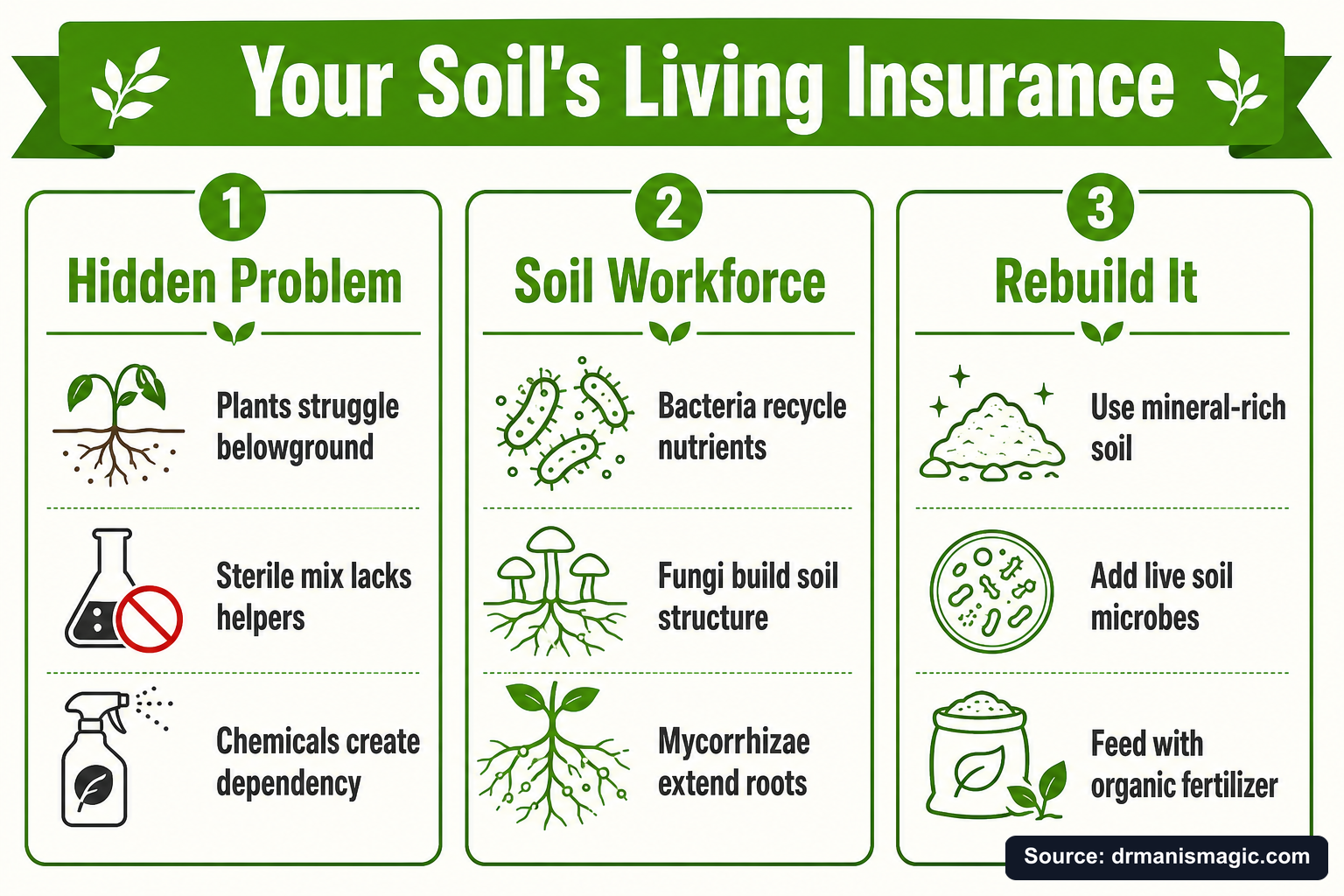
- Living soil is a full ecosystem — bacteria, fungi, mycorrhizae, protozoa, and nematodes all play different roles in keeping your plants healthy.
- University of Minnesota Extension research shows soil biology supplies roughly 75% of plant-available nitrogen and 65% of available phosphorus — without a single bag of fertilizer.
- Salt-based synthetic fertilizers, herbicides, and fungicides quietly kill the microbes your plants depend on, creating a cycle of dependency that benefits chemical companies, not your garden.
- Most microbial products on store shelves are either dried-out powders that don't reactivate or smelly liquids full of dying, anaerobic microbes — neither works well.
- Sterile soil (fresh potting mix, fumigated ground, or salt-damaged beds) can take months to recover without active help.
- Dr. Mani's Magic Three Plant Pillars — mineral soil, live microbes, and organic fertilizer — rebuild this biological insurance policy from the ground up.
- You don't need to be a scientist. You just need to stop killing what's already trying to help you.
What Is Actually Living Under Your Plants Right Now?
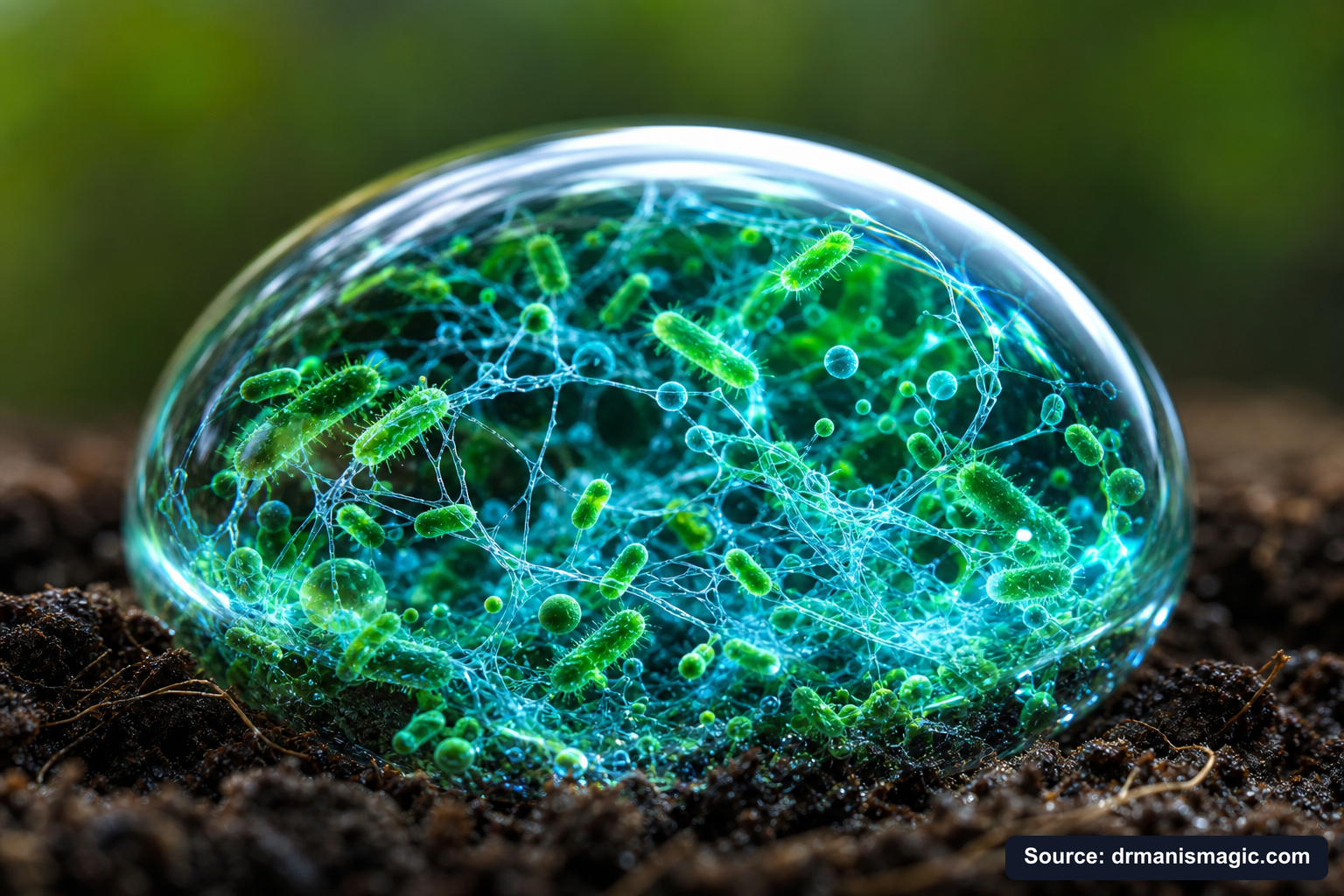
Quick Answer: Healthy soil contains billions of bacteria, fungi, mycorrhizal networks, protozoa, nematodes, and earthworms all working together. This soil food web recycles nutrients, builds structure, suppresses disease, and extends your plant's root system — acting as a living support system beneath every healthy plant.
Most people think of soil as dirt. Just something to hold the roots in place. But healthy soil is one of the most complex ecosystems on earth. A single teaspoon of rich garden soil contains more living organisms than there are people on the planet.
Here's who's on your team — if you let them be.
Bacteria: The Rapid Recyclers
Bacteria are the fastest workers in the soil. There can be hundreds of millions of them in a single gram of healthy earth. They break down organic matter, release nutrients from dead leaves and roots, fix nitrogen from the air, and produce compounds that help bind soil particles together. They are the first responders. When a root tip releases a tiny drop of sugar into the soil, bacteria swarm toward it within minutes.
Fungi: The Infrastructure Builders
Fungi grow long, thread-like structures called hyphae that weave through the soil like a fiber-optic network. They physically connect soil particles, improving drainage and aeration. They also break down tough organic material — woody stems, bark, dead roots — that bacteria can't handle alone. And they produce a sticky protein called glomalin that literally glues soil aggregates together. Without fungi, soil crumbles and compacts.
Mycorrhizal Fungi: The Root Extenders
Here's where it gets remarkable. A special group of fungi called mycorrhizae actually grow into plant roots and form a true partnership. The plant feeds the fungi sugar. The fungi extend the plant's root system by up to 700 times its original surface area. More root surface means more water. More phosphorus. More minerals the roots never could have reached alone.
Ever pulled a weed and noticed fuzzy white threads clinging to its roots? That's mycorrhizae. That's why weeds grow so aggressively. They've been plugged into the biological grid. Your garden plants deserve the same advantage.
Protozoa: The Nitrogen Releasers
This is the part most gardening articles skip entirely. Protozoa are microscopic single-celled organisms that graze on bacteria. They eat bacteria by the millions. And when they do, they release excess nitrogen as waste — right next to the root zone, right when the plant needs it. University of Minnesota Extension describes this predator-driven release as the reason soil biology can supply roughly 75% of a plant's nitrogen needs without any added fertilizer. Protozoa are the reason the soil food web functions like a biological slow-release fertilizer. No factory required.
Nematodes: The Regulators
Beneficial nematodes are microscopic roundworms that graze on bacteria and fungi, similar to protozoa. They also regulate populations of harmful nematodes and soil pests. They are part of the checks-and-balances system that keeps the whole underground ecosystem from tipping out of balance. When nematode diversity collapses — from repeated pesticide use, for example — pest pressure often spikes in response.
Earthworms: The Heavy Equipment
Earthworms are the bulldozers of the soil world. They pull organic matter deep into the profile, create channels for water and air, and produce castings that are loaded with plant-available nutrients and beneficial microbes. A soil with healthy earthworm populations is physically different from one without them. It smells different. It feels different. It drains differently. Their presence is a visible sign that the deeper biology is healthy too.
| Organism | Primary Role | Key Benefit to Your Plant | Destroyed By |
|---|---|---|---|
| Bacteria | Rapid recyclers, nitrogen fixers | Release nutrients, suppress pathogens, build soil aggregates | Salt-based fertilizers, herbicides, fungicides |
| Fungi | Infrastructure builders, decomposers | Improve drainage, bind soil, break down tough organic matter | Synthetic fungicides, tillage, compaction |
| Mycorrhizal fungi | Root extenders, mineral miners | Expand root surface area up to 700x, boost phosphorus and water uptake | Synthetic phosphorus fertilizers, fungicides, bare soil |
| Protozoa | Bacterial grazers, nitrogen releasers | Release plant-available nitrogen near roots on demand | Pesticides, soil sterilization, compaction |
| Beneficial nematodes | Regulators, grazers | Balance microbial populations, suppress harmful nematodes and pests | Broad-spectrum pesticides, fumigation |
| Earthworms | Physical aerators, nutrient cyclers | Create drainage channels, produce nutrient-rich castings | Pesticides, compaction, bare soil, salt accumulation |
Why Do Plants in Nature Never Need Fertilizer?
Quick Answer: Plants in nature are plugged into a living soil food web that continuously recycles nutrients, fixes nitrogen, and extends root systems through mycorrhizal networks. No bag of fertilizer can replicate what this ecosystem does for free — and it has been running without interruption for hundreds of millions of years.
Walk into any old-growth forest. Look at the size of those trees. Nobody fertilized them. Nobody sprayed them. Nobody repotted them in fresh potting mix every spring. Yet they are enormous, disease-resistant, and deeply rooted.
The secret is the living ecosystem beneath their roots.
Leaves fall. Branches drop. Animals leave waste. All of it becomes food for bacteria and fungi. Those organisms process the organic matter and release nutrients back into the soil. Protozoa graze on bacteria and release nitrogen near the roots. Mycorrhizal networks connect trees to each other, sharing nutrients across hundreds of feet. The whole system is self-sustaining.
Now look at a typical container plant sitting in bagged potting mix. Or a lawn that's been blasted with synthetic fertilizer for ten years. Or a garden bed where herbicide has been sprayed every season. The biology is gone. The soil is either sterile or damaged. The plant has no support system. It is completely dependent on whatever you pour on it from a bottle or a bag. And when you skip a feeding? It struggles. When drought hits? It wilts fast. When a pathogen shows up? There's nothing to fight it off.
This is not bad luck. It's not a brown thumb. It's the predictable result of gardening without biology. And it is exactly what the big chemical companies built their business model on.
After growing more than 250,000 trees at our South Texas nursery, we learned this lesson the hard way before we learned it the right way. The trees that thrived long-term were always the ones with healthy root-zone biology. The ones that struggled were always the ones in dead, sterile, or salt-damaged soil.
What Kills the Biological Insurance Policy in Your Soil?
Quick Answer: Salt-based synthetic fertilizers, herbicides, fungicides, broad-spectrum pesticides, soil fumigation, and sterile potting mixes all damage or destroy soil biology. Even chlorinated tap water and repeated tilling can reduce microbial populations significantly over time. The damage is often invisible until plants start declining.
Here's the part that makes us angry on your behalf.
Most of the products sold at big box garden centers — the ones in the bright, cheerful packaging with the smiling tomatoes on the label — are quietly destroying the very biology your plants need to survive.
Salt-based synthetic fertilizers are the biggest offenders. They flood the root zone with soluble salts. Those salts are osmotically toxic to beneficial bacteria and fungi. The microbes die. The soil becomes more dependent on artificial inputs. So you need to buy more fertilizer. And more. And more. It's a cycle that profits the chemical companies every single season. University of Wisconsin Soil Science notes that soil biological communities are highly sensitive to chemical inputs, and repeated exposure leads to measurable declines in microbial diversity and function.
Herbicides like glyphosate don't just kill weeds. Research has shown they disrupt microbial enzyme systems in the soil. Synthetic fungicides — used to fight leaf diseases or root rot — kill beneficial fungi along with the harmful ones. Broad-spectrum pesticides reduce nematode and protozoa populations. Soil fumigation, used commercially and sometimes in landscaping, sterilizes everything. Potting mix starts sterile and stays that way unless biology is added back.
Even chlorinated tap water, poured on soil day after day, suppresses microbial activity over time. The chlorine is there to kill organisms in the water supply. It does not stop working when it hits your plant's roots.
The damage is cumulative. It is quiet. And most gardeners don't recognize what's happening until their plants have been struggling for months or years.
See also: The Hidden Reason Synthetic Fertilizers Cause Root Rot
How Long Does It Take for Damaged Soil Biology to Recover?
Quick Answer: Recovery timelines depend on how severely the biology was damaged. Light disturbance can recover in weeks with help. Fumigated, sterilized, or heavily salt-damaged soil can take six months to two years to rebuild meaningful diversity and function — especially without active microbial inoculation and organic matter inputs.
This is the question almost nobody answers online. So let's answer it honestly.
Soil biology does not bounce back overnight. Here is what actually happens after a major disruption — whether that's fumigation, heavy pesticide use, salt damage, or starting in fresh sterile potting mix.
The Sterile Soil Recovery Timeline
- Day 0 — Disturbance: The biological community is wiped out or severely reduced. The soil has no living buffer. Nutrients are not cycling. Disease suppression is gone. The plant is on its own.
- Days 1-7 — First Arrivals: Airborne bacteria and fungal spores begin to colonize the surface. But these are random colonizers — not a curated team. Pathogenic organisms often arrive just as fast as beneficial ones. The competition is wide open.
- Weeks 2-6 — Rhizosphere Recruitment: If the plant's roots are alive and releasing sugars, they start attracting microbes. But without diversity already present in the soil, this is slow. The plant is essentially advertising a job opening with no applicants.
- Months 2-6 — Organic Matter and Predator Recovery: If organic inputs are being added, bacteria populations start building. Protozoa and nematodes follow once there's enough bacterial biomass to graze on. Nutrient cycling slowly resumes.
- Months 6-18 — Aggregate and Suppression Rebuilding: Soil structure starts improving as fungi produce glomalin. Disease-suppressive capacity returns as diverse microbial communities re-establish. Mycorrhizal networks begin forming if host plants are present.
- Season 2 and Beyond — Full Function: A truly balanced soil food web with strong nutrient cycling, disease suppression, and aggregate stability takes one to two full growing seasons to rebuild from scratch — without shortcuts.
The shortcut? Add live, full-spectrum microbes. Skip the months of waiting for random colonization. Give the plant a real workforce from day one.
You Never Had a Brown Thumb.
You were handed the wrong tools. This free guide hands you the right ones.
You watered it. You fed it. It died anyway.
It was never you. It was the dirt, the salt food, and the bad advice.
This guide shows you what really went wrong, and how to fix it for good.
- Why your plants really died, and why it was never your fault
- The salt hiding in your plant food that quietly burns the roots
- The hidden killer in almost every bag of store soil
- The tiny helpers that grow a whole forest for free
- The rescue trick that brings a half dead plant back to life

Live Microbes vs. Dead Microbe Products: What's Really on Store Shelves?
Quick Answer: Most store-bought microbial products are either dried lab-grown powders that fail to reactivate in soil, or liquid compost teas that have gone anaerobic and smell foul by the time you receive them. Neither delivers the live, diverse, active biology your plant's root zone actually needs.
This is where we need to have a very honest conversation.
The microbial product market has exploded. Walk into any garden center and you'll find shelves full of products claiming to have beneficial bacteria and fungi. Some of them have impressive-looking labels with scientific names. Some of them have high price tags.
Most of them don't work the way you hope.
Here's why.
The Dried Powder Problem
The most common type of microbial product is a dried powder. These are made in large industrial fermentation facilities. Specific strains of bacteria or fungi are grown in giant vats, then dried into a powder. The idea is that the dormant spores will "wake up" when they hit moist soil.
We have tried dozens of these products over years of testing at our nursery. The results were consistently disappointing. The species list looks impressive on the label. But the actual survival rate of those organisms after drying, shipping, sitting on a shelf at room temperature, and then being poured into soil is extremely low. We simply did not see the results we expected. And we were looking very carefully.
The Smelly Liquid Problem
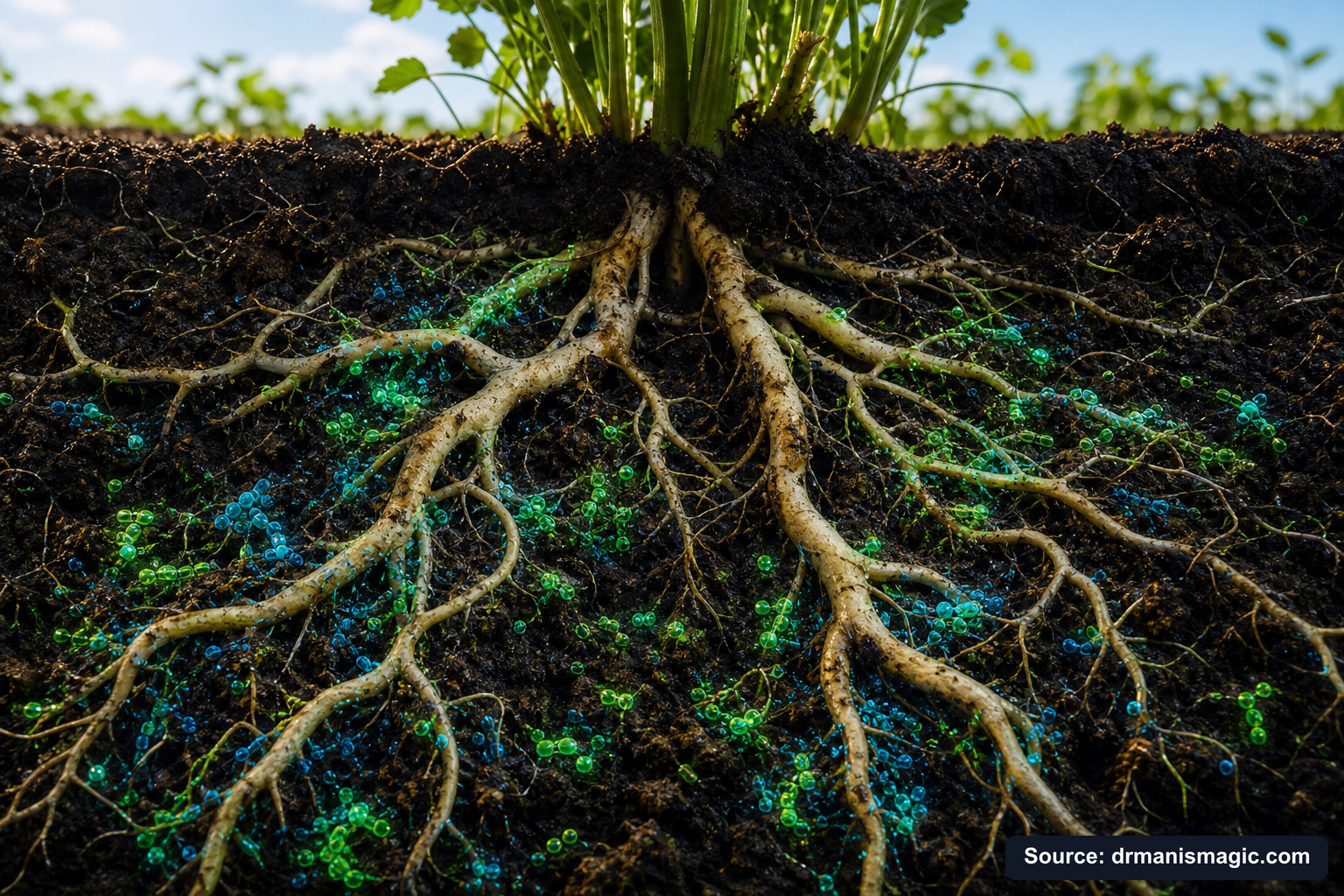
The second common type is a liquid microbial product made from compost or earthworm castings. These start with real, living organisms. But by the time the product is bottled, shipped, and delivered to your door, the microbes have often consumed all available oxygen in the liquid and gone anaerobic. The telltale sign? The bottle smells terrible. Sometimes it fizzes when opened. That fizzing is fermentation gas. The microbes are dying. Some organic compounds remain and provide minor benefits, but the living workforce you paid for is largely gone.
The Lactobacillus Problem
Some products use lactobacillus bacteria — yes, the same organism in yogurt — because it is vigorous and easy to keep alive. It sounds appealing. But lactobacillus is so aggressive it actually outcompetes and suppresses the beneficial soil organisms you're trying to establish. It belongs in your gut, not your garden soil.
After testing all of these approaches over decades at US Citrus Nursery, we knew there had to be a better way. And we found it.
| Product Type | Viability at Use | Spectrum of Organisms | Odor | Real-World Results |
|---|---|---|---|---|
| Dried powder (lab-grown) | Very low — spores rarely reactivate effectively | Narrow, 3-12 strains | Minimal | Little to no measurable improvement in our testing |
| Dried powder rehydrated into liquid | Very low — same issue | Narrow | Minimal | Same — avoid |
| Compost tea (fresh, under 24 hours) | Moderate — must use immediately | Broad but inconsistent | Earthy, then sour | Good if you make it yourself and apply immediately |
| Compost tea (bottled, shipped) | Low — gone anaerobic in transit | Partially degraded | Strong foul odor | Minor benefit from humic/fulvic acids only |
| Lactobacillus-based liquid | High — but wrong organism | Single dominant strain | Mild | Outcompetes beneficial organisms — not recommended |
| Plant Super Boost (stabilized, full-spectrum) | High — verified by microscopy and lab analysis | 2,000+ bacteria species, 400-500 fungi including mycorrhizae, plus protozoa and nematodes | Earthy, not foul | Consistent visible results across 250,000+ trees tested |
What Makes Plant Super Boost Different From Every Other Microbial Product?
Quick Answer: Plant Super Boost contains genuinely live, full-spectrum microbes harvested from real compost and stabilized through a proprietary all-natural process that keeps organisms alive without refrigeration or anaerobic decay. You can literally see the microbes moving under a microscope. It does not smell bad because it is not dying.
The story behind Plant Super Boost is one of the most unusual in the gardening world.
Fresh compost works like magic. Every experienced gardener knows this. When you add hot, steaming compost to your beds, plants respond visibly within weeks. That's because fresh compost is absolutely teeming with living organisms. A well-managed compost pile can hit temperatures over 140 degrees Fahrenheit. That heat is pure biological activity — billions of organisms consuming, processing, and recycling organic matter at full speed.
The problem is that the magic disappears fast. Turn that compost into a liquid — a compost tea — and you have maybe 24 hours before the organisms run out of oxygen and start dying. Most people can't make their own fresh compost tea. And nobody can bottle it and ship it across the country.
That's exactly what we thought too. Until we met someone who had cracked the code.
A world-renowned compost expert — someone who had advised farming programs for royal families and governments across multiple continents — had discovered a natural method to stabilize the full spectrum of compost microbes without killing them or letting them go anaerobic. His results in citrus groves were so dramatic that large chemical companies took notice. He was eventually blacklisted. At one point, he feared for his safety and stopped his work entirely.
Years later, through what we can only describe as a providential meeting, he connected with Dr. Mani Skaria and the team at US Citrus Nursery. He joined the company. And together, they built Plant Super Boost.
The result is a liquid microbial product that contains over 2,000 species of bacteria, 400 to 500 species of fungi including mycorrhizae, plus protozoa and beneficial nematodes — the complete soil food web in a bottle. The microbes are alive. You can take a single drop and see them moving under a microscope. Lab analyses confirm their presence and activity. And the bottle smells like healthy earth because the organisms are thriving, not decomposing.
Zero PFAS. Zero biosludge. Zero synthetic salts. Proudly made in the USA.
If you've ever tried a microbial product and felt underwhelmed, this is why. You were likely using dead biology. There's a difference you can feel in your garden.
Do You Need to Buy Microbial Products, or Can You Just Feed the Microbes Already There?
Quick Answer: In truly healthy, undisturbed native soil with rich organic matter, feeding existing microbes with compost and organic inputs may be enough. But in containers, damaged soil, lawns, or any bed that has received synthetic fertilizers, herbicides, or pesticides, the native biology is likely compromised. Active inoculation with live microbes dramatically speeds up recovery and results.
This is a fair question. And the honest answer is: it depends on what you're starting with.
If you have rich, undisturbed garden soil that has never been treated with synthetic chemicals, has earthworms throughout, smells deeply earthy, and drains well — your biology is probably in decent shape. Adding organic mulch, compost, and organic fertilizers will feed and protect what's already there.
But let's be realistic about most gardening situations in America today.
Container plants live in sterile potting mix. That mix starts with zero biology and gradually accumulates random colonizers — not a curated, diverse, functional community. Most lawns and garden beds have received decades of synthetic fertilizer, herbicide, or pesticide applications. New construction sites are essentially biological wastelands — the topsoil has often been scraped away entirely during building.
In these situations — which describes most of the plants most people are actually trying to grow — waiting for biology to recover on its own is like waiting for a rain forest to grow back in a parking lot. It will happen eventually. But you'll be waiting a very long time.
The most effective and time-efficient approach is to combine both strategies. Protect existing biology by removing harmful inputs. Feed the microbes with organic matter and organic fertilizer. And actively inoculate with a live, full-spectrum product to establish a complete community immediately.
This is exactly why the Three Plant Pillars work as a system rather than as individual products. Mineral-based soil provides the physical structure that lets biology thrive. Live microbes establish the workforce. Organic fertilizer feeds both the plant and the microbes without the salt-based damage that wipes the community out again. Each pillar supports the others. Remove any one of them and the whole system weakens.
How Do You Rebuild Biological Insurance in Your Own Soil Right Now?
Quick Answer: Start by removing inputs that kill biology — especially salt-based fertilizers and broad-spectrum pesticides. Add organic matter. Inoculate with genuinely live, full-spectrum microbes monthly. Switch to organic fertilizer that feeds microbes rather than burning them. Results are typically visible within 30 days and compound over each growing season.
Enough theory. Here's what you actually do.
Your Soil Recovery Checklist
- Stop the damage first. Remove or replace salt-based synthetic fertilizers. Stop applying herbicides and broad-spectrum pesticides to the root zone. Switch to organic or targeted pest control. You cannot rebuild what you keep destroying.
- Check your soil structure. If you're growing in containers or fresh potting mix, understand that you are starting with zero biology. If your ground soil is compacted, grey, or smells like nothing, it is likely biologically depleted. Good soil smells rich and earthy — that smell is actually microbial activity producing a compound called geosmin.
- Add organic matter. Compost, mulch, and organic surface cover feed soil biology. Even a one-inch layer of compost worked into the top few inches of soil provides enormous food and habitat for recovering microbial communities.
- Inoculate with live, full-spectrum microbes. Apply a genuinely live microbial product monthly. Mix two ounces into a gallon of water and drench the root zone. For larger areas like lawns or garden beds, pour a full bottle into a hose-end sprayer and cover the whole area. This delivers the complete soil food web directly to the root zone — bacteria, fungi, mycorrhizae, protozoa, and nematodes.
- Feed with organic fertilizer. Organic, slow-release fertilizers feed both the plant and the microbes simultaneously. They don't spike salt levels. They don't burn roots. They work with soil biology instead of against it. Look for crab, kelp, and amino acid-based formulas that deliver a full spectrum of macronutrients, micronutrients, and biostimulants. See the Crab, Kelp & Amino Acids fertilizer we've developed and use in our own nursery.
- Be consistent. Soil biology builds over time. Monthly microbial applications compound on each other. After one season, you will notice better drainage, richer color in your plants, improved stress recovery, and reduced disease pressure. After two seasons, the difference is dramatic.
- Be patient but not passive. Recovery takes time. But with the right inputs, you are not waiting passively — you are actively building an ecosystem. Every application moves you forward. Every week without salt damage is a week the biology has to strengthen.
See also: How Salt-Based Feeding Quietly Destroys Root Systems
The Three Plant Pillars vs. The Conventional Approach: A Direct Comparison
Quick Answer: The conventional approach uses sterile potting mix, salt-based fertilizers, and no living biology — creating dependency, fragility, and a cycle of repeat purchases. The Three Plant Pillars approach uses mineral-based permanent soil, live microbes, and organic fertilizer to build a self-reinforcing biological system that improves over time instead of degrading.
Let's put the two approaches side by side. No opinion. Just outcomes.
| Factor | Conventional Approach | Three Plant Pillars Approach |
|---|---|---|
| Soil base | Bark-heavy potting mix that compacts and decomposes within 6-12 months | Mineral-based sandy loam that is permanent and never compacts |
| Soil biology | Sterile or damaged — no living workforce | Full-spectrum live microbes actively cycling nutrients and suppressing disease |
| Fertilizer | Salt-based synthetic — fast green-up, kills microbes, creates dependency | Organic slow-release — feeds plant and microbes, no salt damage |
| Drought response | Wilts quickly — no mycorrhizal network, no aggregate structure | Resilient — mycorrhizae extend water uptake, aggregates hold moisture |
| Disease pressure | High — no biological competition against pathogens | Suppressed — diverse microbial community outcompetes harmful organisms |
| Nutrient efficiency | Low — soluble nutrients leach away, require constant reapplication | High — biology holds and releases nutrients in sync with plant demand |
| Long-term trajectory | Declining — soil degrades, plant becomes weaker each season | Improving — biology compounds, plant becomes more resilient each season |
| Cost over time | High — repeat purchases, replacement plants, pest and disease treatments | Lower — system becomes more self-sustaining over time |
| Safety | Chemical exposure risks for family, pets, and water supply | Zero PFAS, zero biosludge, zero synthetic salts — safe for family and pets |
The conventional approach is not designed to make your plants thrive long-term. It is designed to keep you buying. We've watched it play out on thousands of trees. The biology always wins eventually — one way or another. Either you build it intentionally, or the absence of it slowly defeats you.
What Does All of This Mean for Your Plants Right Now?
Quick Answer: Every plant you own — lawn grass, houseplants, fruit trees, vegetable gardens, flowers in containers — is either supported by living soil biology or struggling without it. The good news is that rebuilding that biology is simpler than most people think, and the results compound every single season you stay consistent.
Think about the plants in your life right now.
Maybe it's a fruit tree you planted two years ago that still hasn't produced anything. Maybe it's a lawn that greens up briefly after feeding but always fades. Maybe it's a houseplant that seems to be slowly declining no matter what you do. Maybe it's a garden bed that produces less every year.
In almost every one of those cases, the root cause — literally the root cause — is biological. Not the plant variety. Not your watering schedule. Not bad luck. The underground workforce is either missing, damaged, or overwhelmed.
The number one thing people tell Dr. Mani they want is to see their own trees bear fruit while they still can. That desire is deeply human. We were made to tend gardens. We were wired to nurture living things and see them produce. But if you keep gardening the old way — the salt-fertilizer, sterile-potting-mix, spray-and-pray way — that harvest keeps getting pushed further away. Months become years. Years become a decade of struggle. And all that time is gone forever.
The biological insurance policy beneath your plants is not a luxury. It is the foundation. It is the difference between a plant that barely survives and one that genuinely thrives. It is the difference between spending your weekends fighting your garden and spending them enjoying it.
We built the Plant Super Boost because we needed it ourselves — for 250,000 trees, for our own grove, for the houseplants and tropical trees we grow in South Texas. We tested it on everything. We watched the biology work in real time. We saw the difference between trees with a living root zone and trees without one. And we wanted to make that difference available to every gardener in America — not just the ones with science labs and compost piles.
The soil beneath your plants is either an asset or a liability right now. With the right inputs — mineral soil, live microbes, and organic fertilizer working together — you can transform it into the most powerful tool in your garden. One that works for you every hour of every day, invisible and tireless, asking for nothing but a chance to grow.
If you want to understand the full Three Plant Pillars system and how to apply it to whatever you're growing — grass, trees, flowers, vegetables, or houseplants — the Free Plant Care Field Guide walks you through the whole approach in plain language. No jargon. No complicated chemistry. Just a clear path from where your plants are now to where you want them to be.
Your plants are waiting. The biology is ready to work. The only question is whether you give it the chance.
Frequently Asked Questions
Most gardeners never think about what is happening beneath the soil. But that invisible world is the difference between plants that thrive and plants that slowly die. These questions get straight to the point so you can stop guessing and start growing.
What is the biological insurance policy beneath your plants?
It is the living ecosystem of bacteria, fungi, and mycorrhizae that lives in healthy soil. These tiny workers cycle nutrients, fight disease, and feed your roots around the clock. When this ecosystem is alive and active, your plants can handle drought, pests, and stress far better. When it is dead, every problem hits harder and costs you more money and more time to fix. Dr. Mani's Magic Plant Super Boost puts live microbes back into your soil so this protection is always working for you.
What is actually living under your plants right now?
Healthy soil holds bacteria, fungi, mycorrhizae, protozoa, nematodes, and earthworms all working together. A single teaspoon of rich garden soil contains more living organisms than there are people on the planet. These organisms recycle nutrients, build soil structure, and extend your root system deep into the earth. Most store-bought potting mix is sterile. That means this entire workforce is missing from the start, and your plant is left to fight alone.
Why do salt-based fertilizers hurt your plants over time?
Salt-based synthetic fertilizers give plants a quick burst but quietly kill the beneficial microbes in your soil. Once those microbes are gone, your plant loses its natural support system. You have to keep buying more fertilizer just to keep things alive. It is a cycle that benefits the chemical companies, not your garden. Dr. Mani saw this firsthand over 35 years of growing citrus trees. That is why every product in the Dr. Mani's Magic line is designed to feed your soil, not strip it.
How does biological protection help your garden without chemicals?
Beneficial microbes act as a natural defense team. They crowd out harmful pathogens, break down toxins, and strengthen root systems so plants can resist pests and disease on their own. This is not a new idea. It has been happening in healthy forests for 400 million years. Dr. Mani's Magic Plant Super Boost delivers live bacteria, fungi, and mycorrhizae straight to your roots so your plants get this protection from day one, without spraying anything dangerous near your kids, your pets, or your food.
Why do most microbial products at the store not work?
Most products on shelves are either dried-out powders that never fully reactivate or smelly liquids full of dying microbes that have already gone anaerobic. Dead microbes cannot help your plants. Dr. Mani's Magic Plant Super Boost uses a special stabilization process developed by a master compost expert. The microbes stay alive in the bottle, they do not smell bad, and they go to work the moment you water them in. This was tested on over 250,000 citrus trees before it ever reached your door.
What are the Three Plant Pillars and why do they work together?
The Three Plant Pillars are the foundation Dr. Mani built after 35 years of growing citrus and tropical trees in South Texas. Pillar One is mineral-based soil that drains well and never compacts. Pillar Two is live microbes that protect and feed your roots. Pillar Three is organic fertilizer that fuels growth without burning your soil. Each pillar supports the others. Take one away and the whole system weakens. Use all three together and your plants become practically bulletproof, whether you are growing grass, houseplants, fruit trees, or a full backyard garden.
How long does it take to see results when you restore your soil biology?
Most gardeners using Dr. Mani's Magic products start seeing real improvement within 30 days. Roots get stronger, leaves look greener, and plants stop struggling. But here is what matters most. Every month you wait with dead soil is a month you will never get back. You can always spend more money on plants. You cannot buy back the seasons you lost watching something slowly die. The best time to fix your soil was last year. The second best time is right now.
About the Author
Dr. Mani Skaria, PhD
Dr. Mani Skaria, PhD, is a plant pathologist and the scientific founder of Dr. Mani's Magic. He earned his doctorate at Purdue University and spent 48 years studying how plants, soil, and living microbes work together, including his years as Professor Emeritus at Texas A&M and as a member of the USDA NAREEE Advisory Board. He invented micro-budding, a method for growing healthier, stronger trees, and has grown more than 250,000 trees on the family farm in Hargill, Texas - US Citrus Nursery. His life's work takes real lab science and practical experience and turns it into simple, safe, organic plant care anyone can use at home.


