


The Biological Advantage of Gentle Nutrition for Plants | Dr. Mani's Magic
The Biological Advantage of Gentle Nutrition: Why Plants Grow Better When You Stop Force-Feeding Them
Picture this. You're standing in your backyard on a Saturday morning. Coffee in hand. You've just sprinkled the lawn with that blue fertilizer from the big box store. The kind that promises "instant green-up" in bold letters on the bag. You water it in. You wait.
Three weeks later, the edges of your grass are brown. The tips of your lemon tree's leaves look like they've been scorched with a match. Your tomato plants are wilting even though the soil feels wet. You've done everything right. Or so you thought. What went wrong? The answer isn't what most people expect. The problem isn't that you didn't feed your plants enough. The problem is how you fed them. And more importantly, what that feeding did to the invisible world living in your soil.
At our South Texas nursery, after growing over 250,000 citrus trees and testing on gardens, lawns, houseplants, and tropical trees, we learned something that changed everything. Plants don't want to be force-fed. They want to be supported. There's a massive difference. And once you understand it, you'll never look at a bag of fertilizer the same way again.

Organic Fertilizer | Crab, Kelp & Amino Acids
Key Takeaways
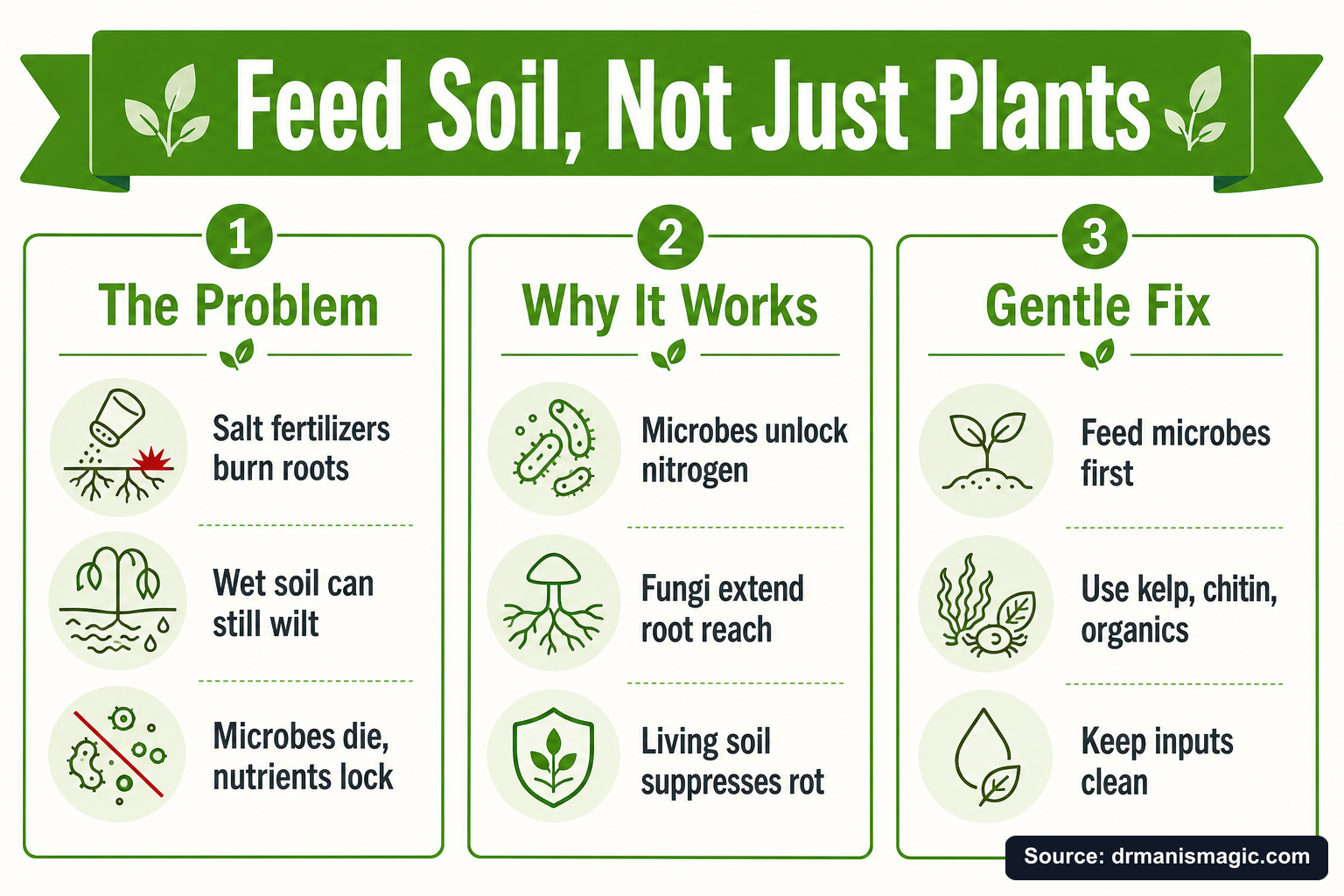
- Salt-based synthetic fertilizers can burn roots, kill soil microbes, and cause fertilizer damage that looks like drought stress or root rot.
- Soil microbes drive roughly 75% of plant-available nitrogen and 65% of available phosphorus, according to University of Minnesota Extension research.
- Organic fertilizer feeds the microbes first, and the microbes then convert nutrients into easy-to-absorb forms for the plant — a natural slow-release system.
- Chitin from crab shells activates plant immune defenses and supports beneficial soil biology.
- Kelp provides plant hormones, trace minerals, and biostimulants that help roots grow and plants handle stress.
- Some fertilizers contain biosludge (treated municipal waste) and PFAS "forever chemicals" — clean inputs matter for your family, your pets, and your soil.
- The Three Plant Pillars — mineral soil, live microbes, and organic fertilizer — are the foundation that makes every plant, lawn, tree, and garden nearly bulletproof.
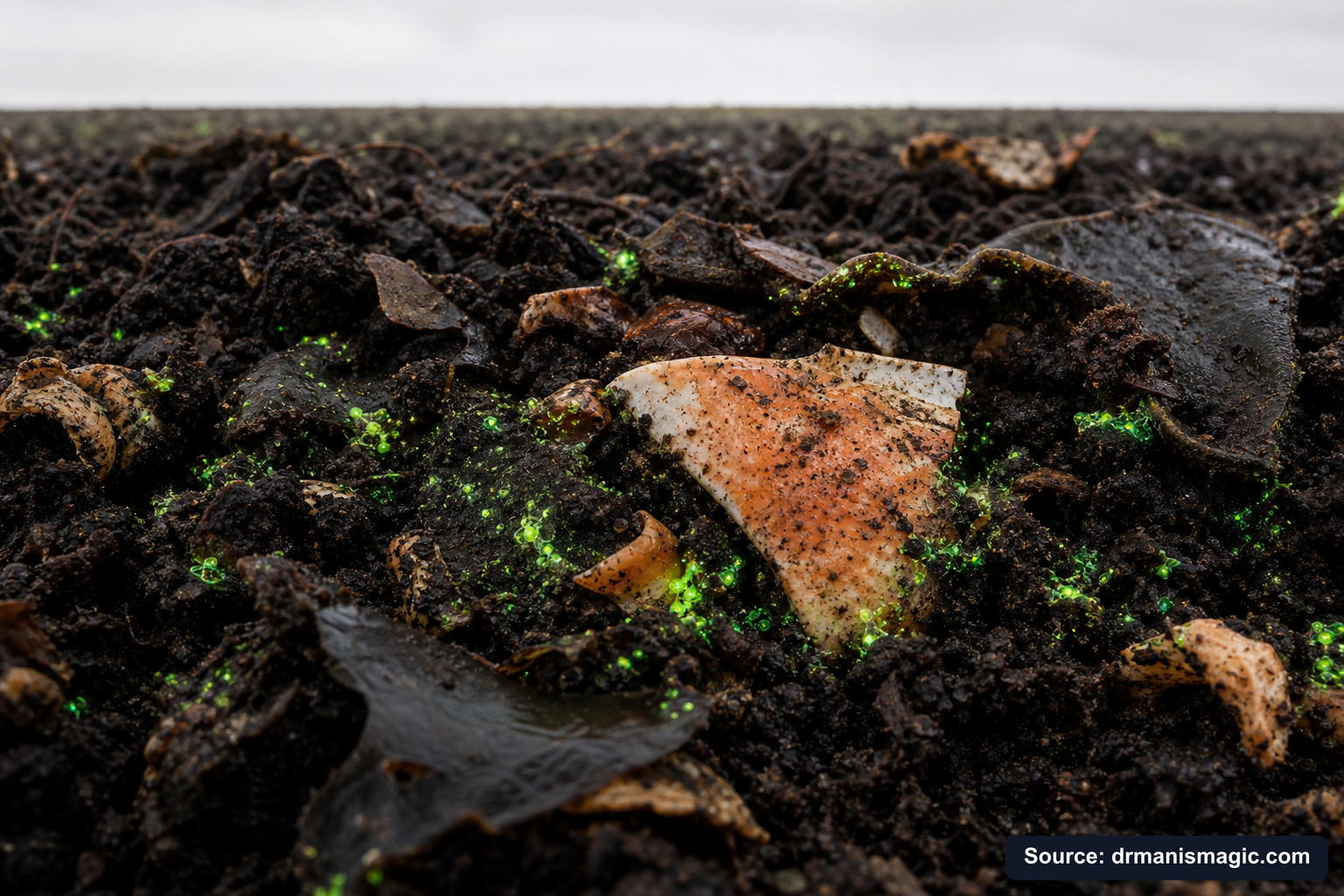
Why Do Salt-Based Fertilizers Hurt Plants Even When They're Supposed to Help?
Quick Answer: Most synthetic fertilizers are made from salt compounds. When salt concentrations around the roots get too high, they pull water out of the root cells instead of letting water in. This is called osmotic stress, and it causes root tissue damage, wilting, brown leaf tips, and reduced growth — even when the soil is wet.
Here's the ugly truth nobody puts on the bag. Salt and water follow a law of nature. Water always moves toward the higher salt concentration. That's osmosis. When you dump a high-salt fertilizer around your roots, you flip the natural flow. Instead of water moving into the plant, it moves out. The roots get dehydrated from the outside in. Scientists call this osmotic stress. Gardeners call it fertilizer burn.
Maryland Extension, Colorado State Extension, and Iowa State Extension all document the same pattern. High soluble salts from repeated fertilizer applications cause reduced water uptake, root tissue toxicity, marginal leaf scorch, wilting, restricted root growth, and lower yields. University of Minnesota Extension confirms that soluble salt buildup is one of the most common causes of plant stress in managed landscapes.
And here's what makes it worse. Salt doesn't just hurt the roots directly. It kills the microbes in the soil. Those microbes are not optional. They are the engine that runs the whole system. Wipe them out, and you've pulled the spark plug on everything. Your soil goes silent. Nutrients lock up. Roots lose their defenders. The plant is now truly on its own.
We saw this pattern over and over at our nursery in Hargill, Texas. Trees fed with salt-based synthetics would green up fast, then crash. The initial surge was real. But it was borrowing against the future. The bill always came due.
See also: How Salt-Based Feeding Quietly Destroys Root Systems
What Are Soil Microbes Actually Doing Down There in the Root Zone?
Quick Answer: Soil microbes — bacteria, fungi, and mycorrhizae — break down organic matter, unlock bound nutrients, cycle nitrogen, protect roots from disease, and build soil structure. University of Minnesota Extension research shows they supply roughly 75% of plant-available nitrogen and 65% of available phosphorus. Without them, plants struggle no matter how much fertilizer you apply.
Think of your soil as a city. A living, breathing, working city. The microbes are the workers. They run the water lines. They process the waste. They build the roads nutrients travel on. They guard the gates against invaders.
Bacteria fix nitrogen right out of the air. Certain fungi wrap around roots and extend their reach by hundreds of times, pulling in phosphorus and water from soil pockets the roots could never reach alone. Other microbes break down organic matter, turning dead material into a buffet of easy-to-absorb nutrition. Some produce natural antibiotics that suppress root pathogens like Pythium and Phytophthora — the two most common culprits behind serious root rot.
Penn State Extension describes soil biological processes as the foundation of plant health, explaining that microbes drive nutrient cycling, water infiltration, soil aggregation, disease suppression, and even pollutant degradation.
When you pour salt-based fertilizer on your soil, you are not feeding your plants. You are poisoning the workers. You are shutting down the city. And a city with no workers falls apart fast.
Dr. Mani Skaria, Professor Emeritus of Plant Pathology at Texas A&M Kingsville and founder of the Clean Citrus Program in Texas, spent 40 years watching this play out in citrus groves and research plots. His conclusion was simple. Protect the microbes. Feed the microbes. Everything else follows.
How Does Organic Fertilizer Actually Feed a Plant? (The Slow-Release Secret Most People Miss)
Quick Answer: Organic fertilizer feeds the microbes first. Microbes eat the organic material and convert it into simple, plant-ready nutrient forms. When those microbes die, they release everything they've stored directly into the root zone. This creates a natural, continuous slow-release system that keeps feeding your plant long after you apply it — with no salt spike, no burn risk, and no microbial massacre.
This is the part that most gardening content never explains. And it's the most important thing to understand about gentle nutrition.
When you apply an organic fertilizer like crab meal, kelp, or amino acids, the plant doesn't absorb it directly. Not at first. The microbes in the soil eat it. They love it. They multiply. They process it and convert those complex organic molecules into simple, plant-ready nutrients like ammonium ions and phosphate. The plant's roots pick those up easily.
Then here's the bonus round. When those microbes eventually die — and they cycle through their lifespan just like everything alive does — they release all of the nutrition stored in their tiny bodies straight into the root zone. It's a second feeding. Automatic. No work required. The whole system becomes a self-sustaining nutrient bank that pays out slowly and steadily over time.
This is exactly how nature feeds plants. Decomposing organic matter. Microbial cycling. Slow, steady, buffered nutrition. No spikes. No crashes. No burns.
Compare that to the salt-based approach. You get a fast green-up. The plant looks great for a few weeks. Then the microbes that were doing the real long-term work are gone. The salt accumulates. The roots start to suffer. And within a few months, you're back at the store buying more fertilizer, wondering why nothing lasts.
That cycle is not an accident. It's a business model.
See also: Why Most Fertilizers Are Actually Salt in Disguise
What Is Chitin and Why Does Crab Shell Fertilizer Help Plants Fight Disease?
Quick Answer: Chitin is the structural material in crab and shrimp shells. When it breaks down in soil, it feeds a specific group of bacteria that also happen to attack the outer coating of harmful root pathogens. At the same time, chitin signals the plant's own immune system to activate defenses. It's natural pest and disease resistance built right into your fertilizer.
When you hear "crab shell fertilizer," you might picture something that smells like a seafood market. It doesn't. Not when it's properly processed. But here's what it does to your soil that nothing else quite replicates.
Crab shells are made mostly of chitin. Chitin is a long-chain carbohydrate. It's tough, fibrous, and incredibly useful. When chitin enters the soil, a specific group of bacteria called chitinase-producing bacteria wake up and start eating it. These bacteria are the same ones that attack the outer shells of harmful soil pathogens. Many disease-causing fungi and nematodes have chitin in their protective coatings. The bacteria that eat chitin eat those too. Naturally. Without chemicals.
At the same time, the plant's own immune system detects chitin as a signal. It activates what researchers call systemic resistance — a kind of internal alarm system that tells the plant to strengthen its cell walls and prepare defenses. The plant becomes more resistant to disease without any spray, any chemical, or any intervention.
Crab shells are also rich in calcium and magnesium. Calcium is the primary structural nutrient in woody plant tissue. More calcium means stronger stems, better fruit firmness, and more resilient cell walls. This is nutrition and defense wrapped into one natural ingredient.
What Does Kelp Actually Do for Plants Beyond Just Adding Nutrients?
Quick Answer: Kelp is a biostimulant, not a primary fertilizer. It delivers natural plant hormones called auxins and cytokinins that regulate root growth, cell division, and stress response. Cold-processed kelp also carries trace minerals, carbohydrates, and complex compounds that help plants handle drought, cold, and soil stress better than nutrients alone ever could.
Kelp is one of the most misunderstood inputs in all of gardening. Most people think of it as a fertilizer. It isn't. Not exactly. Its NPK numbers are small. Its real power is in the biology.
Kelp contains plant hormones. Natural ones, produced by the seaweed as it grows in cold ocean water. The two most important are auxins and cytokinins. Auxins tell roots to grow. They stimulate root branching, root elongation, and root tip development. More roots means more surface area to absorb water and nutrients. Cytokinins regulate cell division. They help plants push new growth and recover from stress faster.
Cold-processed kelp retains these hormones. Heat-extracted kelp destroys most of them. This is why processing method matters enormously for kelp products.
Beyond hormones, kelp delivers a broad spectrum of trace minerals harvested from the ocean. It brings carbohydrates that feed soil microbes directly. It contains natural compounds that help plant cells handle osmotic stress, drought, and cold snaps better. Think of kelp as the adaptogen of the garden world. It doesn't just feed. It strengthens.
When you combine kelp with crab shell chitin and amino acids, you have a trinity of gentle, biology-friendly nutrition that works at the root level, the microbial level, and the hormonal level all at once.
What Are Amino Acid Fertilizers and Why Are They Gentler Than Synthetic Nitrogen?
Quick Answer: Amino acids are the building blocks of protein. As an organic nitrogen source, they deliver nitrogen in a form that is easy for both microbes and plants to use immediately, without the salt load of synthetic nitrogen sources. Amino acid nitrogen has a low salt index, meaning it won't burn roots or disrupt the microbial balance in the soil.
Nitrogen is the nutrient plants crave most. It drives leaf growth, chlorophyll production, and overall vigor. The problem is not nitrogen itself. The problem is the delivery vehicle.
Synthetic nitrogen sources — ammonium nitrate, urea, ammonium sulfate — are all salt-based compounds. They have high salt index values. That means they raise the salt concentration in the soil solution significantly when applied. They can produce fast results, but the osmotic stress and microbial damage they cause is real and measurable.
Amino acids are different. They are the pre-assembled building blocks that proteins are made of. When amino acids enter the soil, microbes and plant roots can absorb them directly. The nitrogen is already in an organic, pre-digested form. There is no salt spike. No osmotic shock. No microbial disruption. The plant gets what it needs at the pace it can handle.
In nature, this is how most nitrogen enters plants. Not as a synthetic salt, but as organic nitrogen processed through microbial activity. Amino acid fertilizers mimic that natural pathway. They work with the biology instead of against it.
The amino acids in Dr. Mani's Magic formulas come from feather meal and tankage — animal-derived sources high in both nitrogen and phosphorus. They break down steadily. They feed the microbes along the way. And they leave no salt residue behind.
What Is Physiological Drought and How Does Fertilizer Cause It?
Quick Answer: Physiological drought happens when a plant wilts even though there is plenty of water in the soil. High salt concentrations around the roots reverse the normal flow of water, pulling moisture out of root cells instead of letting it in. The plant is literally thirsty while sitting in wet soil. This is osmotic stress caused by salt buildup, often from synthetic fertilizer overuse.
This is the scenario that confuses most plant owners. Your soil is moist. You've been watering consistently. But the plant is wilting. The leaves are drooping. Something is clearly wrong.
What's happening is not a water shortage. It's a water blockage. Salt in the root zone has raised the osmotic pressure of the soil solution higher than the pressure inside the root cells. Water flows from low concentration to high concentration. So instead of moving into the roots, water moves out. The plant dehydrates from within. In wet soil.
Iowa State Extension calls this "physiological drought." It's one of the most common and least recognized consequences of salt fertilizer overuse. The symptoms — wilting, leaf scorch, brown edges, stunted growth — look identical to actual drought stress. So the well-meaning gardener waters more. Which makes everything worse because the saturated soil also drives out oxygen, adding a new layer of root stress on top of the salt damage already in progress.
This is how one mistake cascades into a full plant collapse. Salt stress leads to physiological drought, which leads to root oxygen deprivation, which opens the door for Pythium and Phytophthora root rot fungi to move in for the kill. What started as a bag of blue fertilizer ends with a dead plant in wet soil.
See also: The Osmotic Shock Your Plants Feel From Synthetic Nutrients
What Is the Difference Between Salt Damage, Overwatering, and True Root Rot?
Quick Answer: Salt damage, overwatering, and true root rot can look almost identical above the soil. The key differences are in the roots, the soil smell, and the history of inputs. Salt damage shows brown, dried root tips with dry soil. Overwatering shows soft, pale roots with soggy soil. True root rot shows black, mushy roots with a sour smell, often combined with poor drainage and low oxygen.
Most gardeners spend months trying to fix the wrong problem. Here is a simple diagnostic framework.
| Symptom | Salt / Fertilizer Burn | Overwatering | True Root Rot (Pythium / Phytophthora) |
|---|---|---|---|
| Leaf tips and edges | Brown, crispy, scorched margins | Yellow, soft, drooping | Yellow to brown, wilting even in wet soil |
| Root appearance | Brown, dry root tips; outer roots intact | Pale, soft, waterlogged but not black | Black, mushy, slipping outer cortex |
| Soil smell | Normal or slightly chemical | Earthy but damp | Sour, sulfur-like, rotten smell |
| Soil surface | White salt crust visible | Consistently wet, no crust | Wet, compacted, poor drainage |
| Plant wilts in wet soil? | Yes (osmotic / physiological drought) | Yes (oxygen deprivation) | Yes (root tissue destroyed, can't uptake water) |
| Main cause | High salt index inputs, accumulation over time | Watering frequency, poor drainage | Oxygen exclusion + pathogen pressure; often preceded by salt or waterlogging |
| Recovery difficulty | Moderate — flush salts, switch inputs | Moderate — improve drainage, reduce watering | Difficult — roots must regrow; soil biology must be rebuilt |
Penn State Extension's guidance on woody ornamental root rot explains that when soil pore spaces stay filled with water, oxygen is excluded and roots cannot respire. Without oxygen, roots cannot take up water or nutrients even if both are present. This oxygen-exclusion pathway is why root rot is not just a "wet soil" problem. It is a soil structure and biology problem.
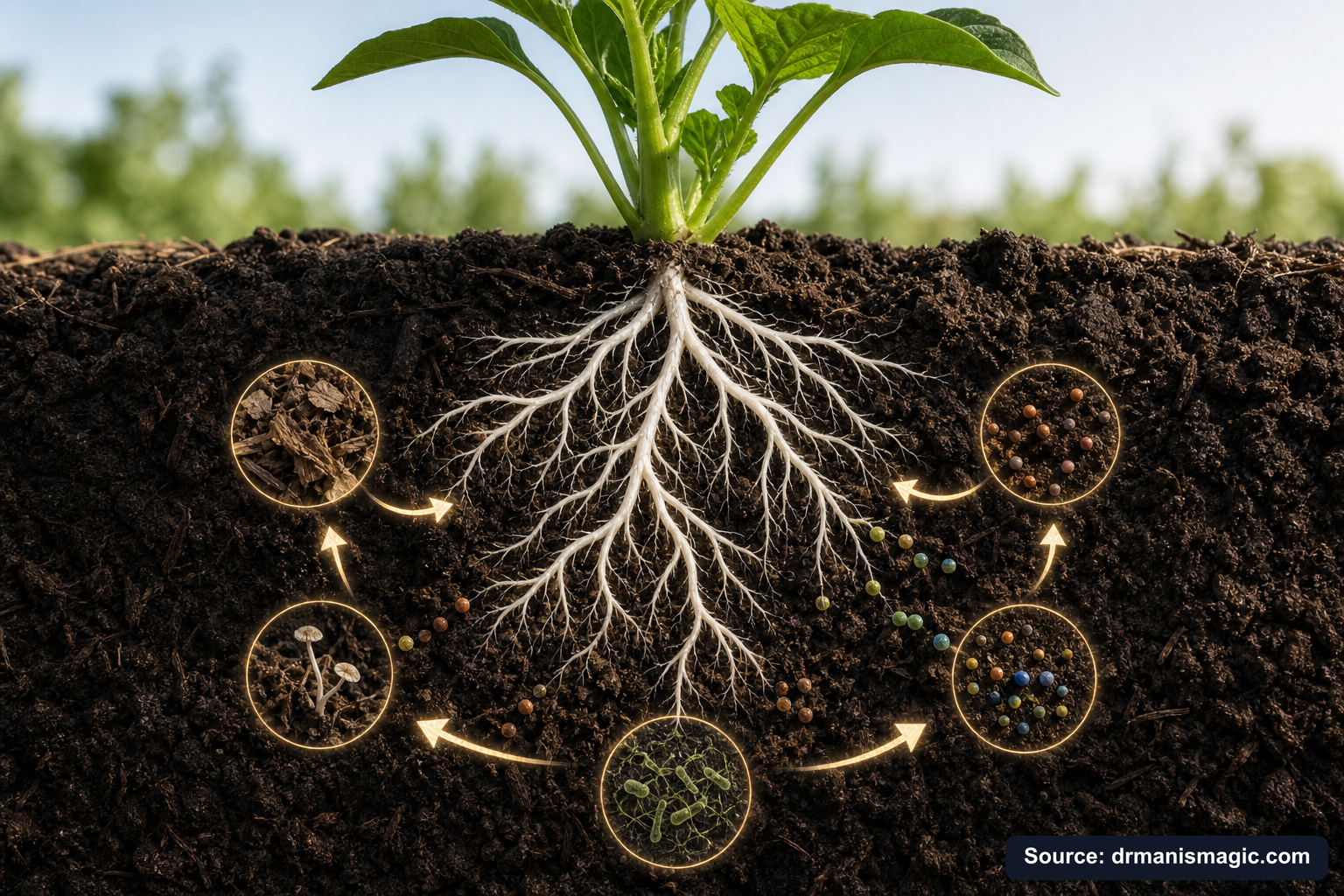
This is why mineral-based soil is Pillar One of the Three Plant Pillars. Soil that drains, aerates, and stays open at the pore level protects roots from all three of these failure modes at once.
You Never Had a Brown Thumb.
You were handed the wrong tools. This free guide hands you the right ones.
You watered it. You fed it. It died anyway.
It was never you. It was the dirt, the salt food, and the bad advice.
This guide shows you what really went wrong, and how to fix it for good.
- Why your plants really died, and why it was never your fault
- The salt hiding in your plant food that quietly burns the roots
- The hidden killer in almost every bag of store soil
- The tiny helpers that grow a whole forest for free
- The rescue trick that brings a half dead plant back to life

If You Think You Have Salt Damage or Early Root Rot, Here Is a Recovery Checklist
Quick Answer: Recovery from salt damage or early root rot requires removing the salt source, flushing the root zone, restoring oxygen, rebuilding microbial populations, and switching to a biology-friendly nutrition program. The faster you act, the more root tissue you can save.
- Stop the salt input immediately. Remove any remaining synthetic fertilizer from the soil surface. Do not apply more until the plant stabilizes.
- Flush the root zone thoroughly. Water deeply and slowly two to three times over a few days to dilute and drain accumulated salts. Use clean water, not water softened with sodium-based systems.
- Check drainage. If water sits on the surface for more than a few minutes, your soil structure is the problem. Compacted or decomposed potting mix blocks oxygen. Consider repotting into mineral-based soil.
- Reintroduce live microbes. Apply a liquid microbial drench containing bacteria, fungi, and mycorrhizae to the root zone. Living microbes suppress root pathogens, rebuild soil biology, and restore the nutrient-cycling engine.
- Switch to a low-salt organic fertilizer. Once the plant shows new growth, begin a gentle feeding program using amino acid-based, chitin-containing, kelp-supplemented organic fertilizer. No salt spikes. No microbial disruption.
- Be patient with watering. Until drainage is confirmed and roots are recovering, water only when the top inch of soil is dry. Consistent moisture without saturation is the goal.
- Watch for new leaf growth. New leaves emerging are the first sign the root zone is recovering. Hold off on heavy feeding until you see consistent new growth over two to three weeks.
Synthetic Fertilizer vs Slow-Release vs Organic: How Do They Compare?
Quick Answer: Synthetic fast-release fertilizers deliver nutrients instantly but carry high salt loads that burn roots and kill microbes. Slow-release synthetics reduce the spike but still involve plastic coatings and salt compounds. Organic fertilizers like crab, kelp, and amino acids have near-zero salt index, feed microbes first, and create a self-sustaining nutrient cycle with no burn risk and no plastic residue.
| Feature | Synthetic Fast-Release | Synthetic Slow-Release (Coated) | Organic (Crab / Kelp / Amino Acids) |
|---|---|---|---|
| Salt index | High — osmotic stress risk | Moderate — still salt-based core | Very low — no osmotic burn risk |
| Release speed | Immediate spike then crash | Controlled but still synthetic | Slow, biology-mediated, continuous |
| Microbial impact | Harmful — kills beneficial microbes | Moderately harmful | Beneficial — feeds microbes, supports cycling |
| Root burn risk | High with overuse or in containers | Lower but still present | Near zero — plant self-regulates uptake |
| Plastic residue | None | Yes — polymer coating fragments remain in soil | None |
| PFAS / biosludge risk | Possible with biosolid-sourced products | Possible | Zero — if sourced clean (verify with brand) |
| Long-term soil health | Degrades over time — dependency cycle | Neutral to slightly negative | Builds over time — compounding benefit |
| Works for containers? | Risky — salt accumulates fast | Better but imperfect | Excellent — steady feed, no accumulation |
The comparison is not close. When you lay them out side by side, the organic approach wins on every criterion that matters for long-term plant health, soil biology, and human safety.
What Are PFAS and Biosludge, and Why Should Plant Owners Care?
Quick Answer: Biosludge is treated municipal wastewater waste used as a filler in some fertilizers, both synthetic and organic. It can contain PFAS — "forever chemicals" that accumulate in soil, plants, and bodies and do not break down. Clean organic fertilizers should contain zero biosludge, zero PFAS, and zero synthetic salt fillers. Always verify the source of your inputs.
This one surprised a lot of people when we first started talking about it. But it's real, and it matters.
Some fertilizers — including some marketed as "organic" — use biosludge as a filler. Biosludge is treated municipal wastewater solids. In plain language, it includes processed human waste from city sewer systems. When this material is used in fertilizer, it carries with it whatever was in the water supply — including PFAS compounds.
PFAS stands for per- and polyfluoroalkyl substances. They are called "forever chemicals" because they do not break down in the environment or in human tissue. They accumulate. They have been linked in research to immune disruption, hormonal interference, and other long-term health concerns. Once PFAS enter your soil, they stay there. They move into plants. They move into water. They move into bodies.
If you are growing food — tomatoes, citrus, herbs, vegetables, anything you eat — this is not a theoretical concern. It is a real input question you should be asking every time you buy a bag of fertilizer.
Dr. Mani's Magic Crab, Kelp & Amino Acids contains zero biosludge, zero PFAS, and zero synthetic salt fillers. That is not a marketing line. It is a sourcing decision made by a plant scientist who has spent 40 years watching what inputs do to living soil systems over time.
What you put in your soil ends up in your fruit, your vegetables, your lawn where your kids and pets walk barefoot. That deserves a clean answer.
What Does Volcanic Ash Do for Plants and Soil?
Quick Answer: Volcanic ash delivers silica and a broad range of trace minerals that strengthen plant cell walls, improve drought tolerance, and support overall resilience. Silica is not listed as an essential nutrient, but research consistently shows that plants supplied with silica are more resistant to physical stress, disease pressure, and environmental fluctuation.
Silica is one of the most underappreciated inputs in modern gardening. It doesn't show up on the NPK label. It's not listed as a primary nutrient. But plants that have adequate silica are measurably tougher. Their cell walls are thicker and harder to penetrate. Their stems are stronger. Their leaves resist physical damage and pathogen entry better.
Volcanic ash is one of the richest natural sources of silica and trace minerals available. When it breaks down slowly in the root zone, it releases a range of micronutrients — iron, manganese, zinc, copper, boron, molybdenum — in forms that soil microbes can process and plants can absorb. These are the nutrients that most fertilizer programs miss entirely, yet they are essential for enzyme activation, immune function, and reproductive growth.
Think of trace minerals as the vitamins in your fertilizer. The macronutrients — nitrogen, phosphorus, potassium — are the big meals. But without vitamins, the body breaks down. The same law applies to plants. The Law of the Minimum says that if even one essential nutrient is deficient, the whole plant's growth is limited to the level of that deficiency. No matter how much of everything else you add.
Volcanic ash, when included in a complete organic fertilizer blend, covers that trace-mineral base quietly, steadily, and safely.
Do These Principles Apply to Lawns, Houseplants, Flowers, and Vegetable Gardens Too?
Quick Answer: Yes, completely. The Three Plant Pillars — mineral soil, live microbes, and organic fertilizer — apply to every plant that grows. Grass, flowers, vegetables, ornamentals, fruit trees, houseplants, and hedges all follow the same biological rules. The root zone needs oxygen, microbes, and low-salt nutrition regardless of what is growing above it.
We get this question a lot. People find us through citrus trees. That's where we built our foundation — 250,000 trees tested at our South Texas nursery over three decades. But the Three Plant Pillars are not a citrus-specific doctrine. They are a first-principles framework for how all plant life works.
Grass roots are roots. They need oxygen. They need microbes. They hate salt. A lawn fed with repeated applications of high-salt synthetic fertilizer will look great in spring and struggle or thin out by summer. The salt accumulates. The microbial life depletes. The soil compacts. The grass becomes dependent on the next application to survive, rather than building a self-sustaining root system.
Houseplants in containers are the most vulnerable of all. They have a limited root zone. Salts accumulate fast in containers. You see the white crust on the rim of the pot. That's salt. And every time you water, more dissolves into the root zone. Gentle, organic nutrition in containers is not optional. It's the only safe long-term approach.
Vegetable gardens, flower beds, ornamental trees, tropical houseplants — they all run on the same biological engine. The microbes in the soil are the same characters. The root physiology is the same. The damage from salt is the same. The benefit of chitin, kelp hormones, amino acids, and volcanic minerals is the same.
When Dr. Mani first discovered the power of stabilized live microbes through the compost expert he partnered with, he tested it on citrus first because that was his expertise. But the results showed up equally in tropical trees, flowering plants, and vegetable gardens on the property. The biology doesn't care what's growing above it. Feed the system, and the system feeds the plant.
You can explore the full Three Plant Pillars framework here to see how the complete system works together across any plant type.
What Does Gentle Nutrition Actually Look Like in Practice? Harsh Feeding vs Biological Feeding
Quick Answer: Harsh feeding means high-salt, fast-release inputs applied on a calendar schedule regardless of what the soil or plant needs. Biological feeding means low-salt, microbe-friendly, slow-release organic nutrition that mirrors the way nutrients move in nature — steadily, buffered through biology, and calibrated to the plant's actual uptake pace.
The phrase "gentle nutrition" is not about feeding plants less. It is about feeding them differently. In a way their biology is designed to receive.
Nature never delivers a salt spike. Lightning converts atmospheric nitrogen into nitrate slowly, storm by storm. Nitrogen-fixing bacteria in the root zone convert nitrogen gas into ammonium at a pace the plant can absorb. Fungi break down organic matter in a steady, continuous process that keeps nutrients moving through the soil in small, bioavailable fractions. The whole system is buffered, modulated, and self-regulating.
Harsh feeding bypasses all of that. It dumps a concentrated salt solution directly into the root zone and forces the plant to deal with a nutrient flood it was never designed to handle. The plant responds with a visible surge. Then the biology crashes. Then the surge is gone. Then you have to do it again.
Gentle, biological nutrition works the other way. You apply it. The microbes eat it. They multiply. They convert it. They cycle it. The plant absorbs steadily. When the microbes die, they release a second round of nutrition. The soil biology strengthens over time. The plant becomes more resilient, not more dependent. You apply less over time, not more. The system compounds in your favor.
This is what the Crab, Kelp & Amino Acids formula was built to do. Crab chitin feeds the biology and activates plant immunity. Cold-processed kelp delivers hormones and trace minerals that strengthen roots and stress response. Amino acids provide nitrogen in a form microbes and plants both love, with zero salt load. Volcanic ash fills in the trace mineral gaps that most fertilizers ignore entirely. All of it working together. All of it working with your soil, not against it.
See also: The Hidden Reason Synthetic Fertilizers Cause Root Rot
Why Does Time Matter More Than Money When It Comes to Plant Nutrition?
Quick Answer: You can buy new plants. You can buy more fertilizer. You cannot buy back the months and years you lose when a plant fails and has to be restarted. The real cost of the wrong nutrition approach is time — time watching a plant circle the drain instead of thrive, time waiting to finally harvest something you planted years ago.
Here is the most honest thing we can tell you. We hear this from plant owners every single week. Some version of the same quiet wish. "I just want to see fruit on this tree while I still can." Not in an abstract someday way. In a real, urgent way. A way that has weight to it.
That feeling is not small. It's connected to something deep. The desire to nurture. To grow something with your own hands. To walk out your back door and pick something that your family can taste. That drive has been in humans since the beginning. And it deserves to succeed.
The tragedy of the wrong approach is not just the money wasted on the wrong fertilizer. It's the months of watching your plant limp along. The year of stunted growth while the salt damage slowly rebuilt. The restart after a plant died that could have been saved. That's time. And you cannot get time back.
When the Three Plant Pillars are in place — mineral soil that breathes, live microbes that cycle nutrients, and gentle organic nutrition that works with the biology — plants don't limp. They build. Month after month, the system strengthens. The roots deepen. The growth compounds. The fruit comes faster than you expected because the plant is finally working the way it was designed to work.
You can read real stories from growers who made the switch at our customer reviews page. Their experiences say it better than we can.
The Bottom Line on Gentle Nutrition: What Your Plants Have Always Preferred
Here is the simple truth at the center of all of this. Plants are not machines that need fuel. They are living systems that need support. They evolved over millions of years in a world where nutrients arrived slowly, buffered through biology, modulated by microbes, and calibrated by the chemistry of living soil. Their roots, their cells, their immune systems, their hormonal signals — all of it developed in that gentle, steady, biological context.
Salt-based synthetic fertilizers are a recent invention. A few decades old. And in that short time, they have caused more root damage, more soil degradation, more microbial loss, and more frustrated gardeners than any pest or disease ever has. Not because nutrients are bad. But because salt delivery at high concentrations is exactly the opposite of how plant biology expects to be fed.
The biological advantage of gentle nutrition is not a marketing phrase. It is the mechanism by which every healthy plant that has ever grown in healthy soil has received its food. Through microbes. Through slow release. Through biology-mediated buffering. Through the elegant, self-sustaining system that Dr. Mani Skaria spent 40 years studying and that we built the entire Dr. Mani's Magic line to replicate.
Your plants — whether they are citrus trees on a sunny patio, tomatoes in a raised bed, a lawn your kids run on barefoot, or a fiddle-leaf fig by your living room window — all want the same thing. Oxygen in the roots. Living microbes in the soil. Gentle, clean, biology-friendly nutrition that feeds the system and lets the system feed them.
If you're ready to stop guessing and start building that foundation, the Free Plant Care Field Guide is the best place to start. It walks you through everything — soil, microbes, nutrition, and watering — in plain language you can use today. No jargon. No guesswork. Just the system that has worked on over 250,000 trees and counting.
Frequently Asked Questions
You just read about why force-feeding your plants with salt-based fertilizers is hurting them. Now you probably have some questions. Good. These are the exact questions we hear from gardeners every single day, and we want to give you straight, honest answers based on over 30 years of growing more than 250,000 trees right here in South Texas.
What does "gentle nutrition" mean for plants?
Gentle nutrition for plants means feeding the soil first, not blasting the plant with a flood of synthetic salts. When you use slow-release organic fertilizer made from crab, kelp, and amino acids, the nutrients break down gradually. The plant pulls in what it needs, when it needs it. No burning. No shock. Just steady, natural growth that builds on itself over time.
Why do salt-based fertilizers burn plants even when you follow the directions?
Salt pulls water out of root cells instead of letting water in. That is just how nature works. Even at the right dose, repeated salt fertilizer use builds up in your soil over time. Roots get stressed. Leaf tips turn brown. Plants wilt even when the soil is wet. We watched this happen over and over with citrus trees at our nursery in Hargill, Texas. The directions on the bag do not warn you about what happens to your soil biology underneath.
What do soil microbes actually do for my plants?
Microbes are tiny living organisms in your soil that act like a delivery crew for your plants. They break down nutrients into forms roots can actually absorb. They fight off disease. They help roots grow deeper and stronger. Research from the University of Minnesota shows microbes drive roughly 75 percent of plant-available nitrogen. Kill the microbes with synthetic fertilizers, and your plants lose their entire support system. That is why Pillar Two of the Three Plant Pillars is live microbial activity.
How is organic fertilizer different from the fertilizer at the big box store?
Most big box fertilizers are salt-based synthetic compounds. They give a quick green-up, then damage your soil microbes and create a cycle where you need more and more product to see results. Dr. Mani's Magic Crab, Kelp, and Amino Acids fertilizer is slow-release and earth-born. It feeds microbes first, and those microbes feed your plant. No plastic-coated pellets. No biosludge. No forever chemicals. Just clean, USA-made nutrition your whole yard can feel.
Can I use gentle organic nutrition on any plant, not just citrus trees?
Absolutely. The Three Plant Pillars work for every plant you own. Lawns, houseplants, vegetable gardens, flower beds, tropical trees, fruit trees in containers. We developed and tested this system on over 250,000 citrus trees at US Citrus Nursery, but the same foundation of mineral soil, live microbes, and organic fertilizer applies to anything that grows. The pillars are built on how nature actually works, not on what one crop needs.
How long does it take to see results with gentle nutrition?
Most gardeners start seeing a real difference within 30 days. Leaves look greener. Roots get stronger. New growth appears. The key is that you are building something that lasts. Synthetic fertilizers give you a fast flash of green that fades and leaves damage behind. The Three Plant Pillars build a living soil system that keeps working for you month after month, season after season, without you having to chase it with more products.
Is gentle nutrition safe for my kids, my pets, and my soil long-term?
That is one of the biggest reasons Dr. Mani built this whole system. You should be able to walk barefoot in your grass, let your dog run through the garden, and pick fruit off your tree without worrying about what you are touching or eating. Our fertilizer has no harsh chemical warnings on the label. No re-entry wait times. No cancer-risk fine print. Just clean, organic inputs that are safe for your family and good for your soil for years to come.
About the Author
Ron Skaria, MD
Ron Skaria, MD, is the co-founder of Dr. Mani's Magic and the son of Dr. Mani. He trained as a medical doctor at Baylor College of Medicine, did his residency at UT Health Science Center - San Antonio and fellowship training at Texas Tech University. He now works full time on the family farm at US Citrus and US Citrus Nursery in Hargill, Texas, building Dr. Mani's Magic alongside his dad. He wrote the Brown Thumb Field Guide to put his father's 48 years of plant science into plain words any gardener can use. His belief is simple. You never had a brown thumb. You just never had the right help.


