


Structural Amendments vs. Plant Food: What Roots Actually Need | Dr. Mani's Magic
Structure Is Not Food: The Difference Between Structural Amendments and Food for Your Plant's Roots
Picture this. You just repotted your favorite container plant. Fresh bag of potting mix, smells like a forest floor, looks dark and rich and promising. You water it in. You fertilize it. You do everything the bag says to do.
And three months later, the leaves start yellowing. Six months later, the roots look like brown, slimy shoelaces. You add more fertilizer. Nothing changes. You add different fertilizer. Still nothing. You Google "why is my plant dying" at 11 p.m. and fall down a rabbit hole of contradicting advice that leaves you more confused than when you started. Sound familiar? Here is the thing nobody told you: the fertilizer was never the problem. The soil was never really soil. And the reason your plant is struggling has nothing to do with hunger. It has everything to do with suffocation.
At our South Texas nursery, after growing and testing over 250,000 trees, we learned one rule that changes everything. Roots need a home before they need a meal. Structure comes first. Food comes second. Mixing those two jobs up is the reason most container plants quietly fail, and why most gardening advice keeps you stuck on a treadmill of buying products that never quite fix the real problem.

Plant Super Boost
Key Takeaways
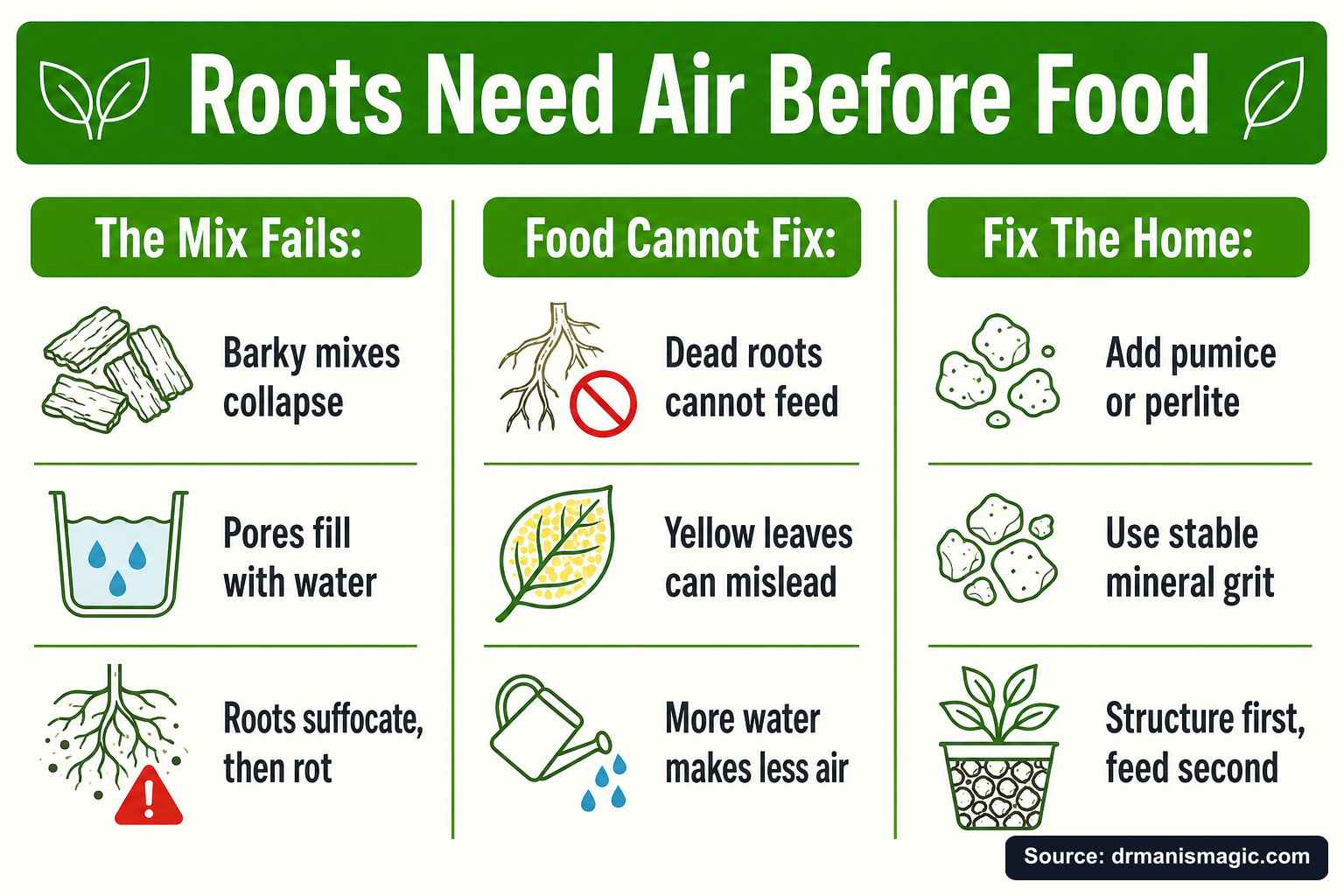
- Structural amendments (like pumice, perlite, lava rock, coarse sand, and pine bark) build pore space, drainage, and oxygen flow. They are architecture, not food.
- Fertilizer and compost supply nutrients. That is their job. They cannot replace physical structure.
- Roots need oxygen to survive. When dense, decomposing media fills pore spaces with water, roots suffocate and rot, even if you fertilize perfectly.
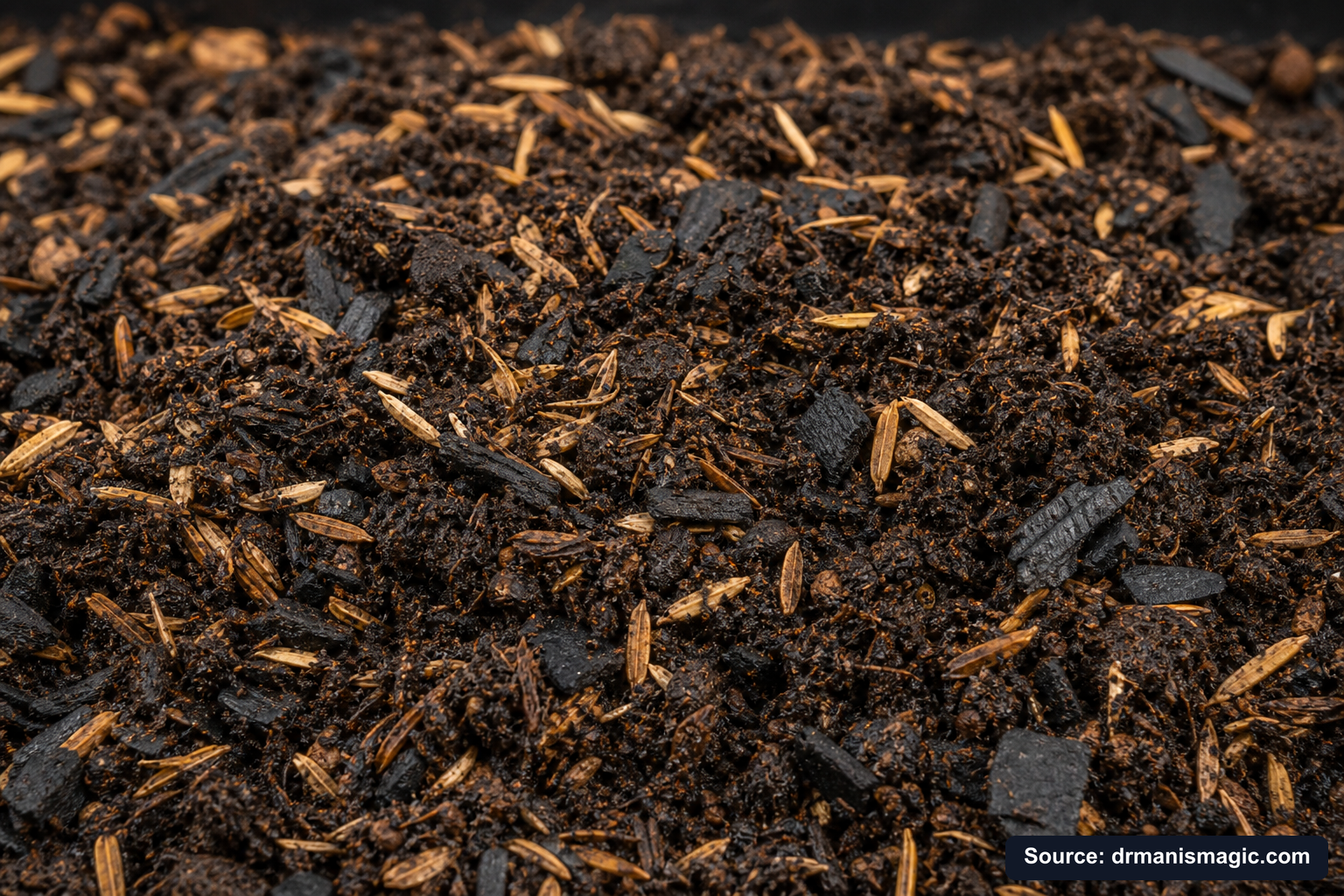
- Most potting mix is pine bark sawdust. It decomposes, collapses, and steals oxygen from roots within months.
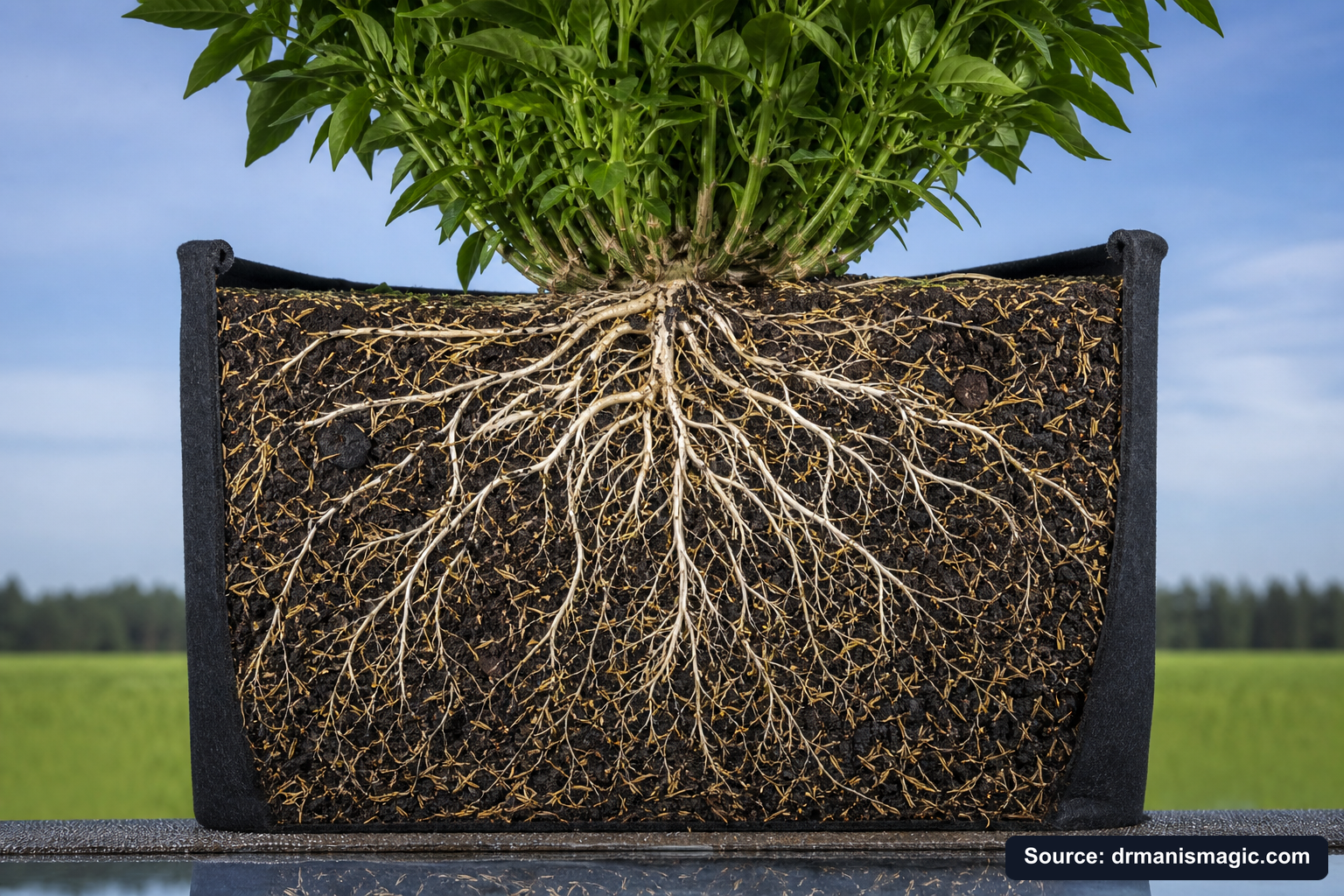
- Mineral-based, silica-rich soil does not decompose. It holds its structure for years, keeping pores open and roots breathing.
- Yellowing leaves after fertilizing are often a structural problem, not a nutrient problem. Roots cannot absorb food they cannot breathe around.
- The Three Plant Pillars (mineral soil, live microbes, organic fertilizer) work in sequence. Get the structure right first, then feed.
What Is the Real Difference Between Structural Amendments and Plant Food?
Quick Answer: Structural amendments like pumice, perlite, coarse sand, lava rock, and pine bark create the physical architecture roots live inside, including pore space, drainage channels, and oxygen pathways. Plant food and fertilizer supply dissolved nutrients. These are completely different jobs, and one cannot replace the other.
Think of it this way. Your house has two separate systems. The frame, walls, and foundation hold everything up. The electricity and plumbing deliver what you need to live. You cannot run wiring through air. You need the structure first, then the services.
Your plant's root zone works exactly the same way.
Structural amendments are the frame. They create the physical gaps, channels, and cavities that roots grow through. They determine how water moves, how air flows, and how much oxygen actually reaches the root tips. Pumice does this. Perlite does this. Coarse grit, lava rock, calcined clay, and coarse pine bark all do this, at least temporarily.
Fertilizer is the electricity. It delivers nitrogen, phosphorus, potassium, calcium, and trace minerals that roots absorb and use to build leaves, flowers, and fruit. Compost, worm castings, kelp meal, crab shell, and synthetic granules all play this role.
The confusion happens because some ingredients do both jobs at once, at least for a while. Compost, for example, adds nutrients and also creates loose, open texture. Pine bark adds some structure and holds a little water. But here is the problem: organic materials decompose. When they do, the structure collapses. The pore spaces shrink. The air disappears. And roots start to suffocate, even though there may be plenty of nutrients in the mix.
This is why plants often decline in rich, dark, "premium" potting mixes after six to twelve months. The nutrition was never the issue. The architecture fell apart.
Why Do Roots Need Oxygen, and What Happens When They Do Not Get It?
Quick Answer: Roots breathe oxygen just like you do. When dense or waterlogged media fills all the pore spaces, roots cannot get air and begin to die within hours. Dead roots cannot absorb water or nutrients, which is why plants in wet, collapsed media show drought and deficiency symptoms even when the soil is soaking wet.
Here is the part most gardening advice skips entirely, and it is the most important part of this whole conversation.
Your plant's leaves absorb carbon dioxide. Everyone knows that. But your plant's roots absorb oxygen. Most people do not know that. And those two systems are completely separate.
Roots are living tissue. They burn energy. They respire. They need a constant supply of oxygen to function, and they get that oxygen from air pockets in the soil, not from the atmosphere above. When those pockets disappear because the growing medium has collapsed, compacted, or become waterlogged, the roots start dying within hours.
Researchers at Purdue and the University of Illinois Extension have documented this process clearly: when excess water fills soil pore spaces and displaces air, root cells shift from aerobic (oxygen-using) respiration to anaerobic fermentation. That produces toxic compounds inside the root tissue. The roots turn brown. They turn slimy. They stop working.
And here is what makes it so confusing for gardeners. A plant with dead, rotting roots looks exactly like a plant that is starving or drought-stressed. Yellowing leaves. Wilting. Slow growth. Leaf drop. So you add fertilizer, and nothing happens, because the roots are not there to absorb it. You water more, and the plant gets worse, because more water means less oxygen. You have been treating a structural problem with a nutritional solution, and it will never work.
Oregon State University nursery research found that air-filled porosity above roughly 30 percent in container media significantly reduces the risk of root pathogens like Phytophthora, one of the most destructive root rot organisms in container gardening. That 30 percent threshold is a structural target. You cannot achieve it with fertilizer.
What Is a Perched Water Table, and Why Does It Matter in Your Container?
Quick Answer: Every container holds a zone of permanently saturated media at the bottom, called the perched water table, regardless of how many drainage holes you have. Fine, dense, or collapsed media raises this zone higher, drowning more roots. Coarse, well-structured media keeps this zone low and small, protecting the majority of the root system.
This is one of the most misunderstood facts in all of container gardening.
Gravity pulls water down. But surface tension pulls water back up into tiny spaces. In a container, these forces meet at a point called the perched water table. Below that point, water stays. Air cannot get in. Roots in that zone are always oxygen-deprived.
The size of your perched water table depends almost entirely on particle size. Fine particles, like the tiny fibers in decomposed potting mix, create tiny pores. Tiny pores hold water much more tightly through capillary action. The perched water table rises. More roots suffocate.
Coarse particles, like pumice, perlite, lava rock, or coarse pine bark, create large pores. Large pores drain freely. The perched water table stays low. Roots stay in air.
This is why Rutgers NJAES Extension, Cornell greenhouse media guidelines, and NC State Extension all frame container success around particle size distribution and drainage before nutrition. The physics of water movement must be addressed structurally. You cannot fertilize your way to good drainage.
And here is the cruel irony. The more a potting mix decomposes, the finer its particles become. The finer the particles, the higher the perched water table. The higher the perched water table, the more roots die. The more roots die, the less the plant can absorb the fertilizer you keep adding. The plant declines. You add more fertilizer. Nothing changes.
You were not doing anything wrong. The structure failed you.
Why Is Most Potting Mix Basically Decomposing Sawdust, and Why Is That a Problem?
Quick Answer: Most commercial potting mix is made primarily from pine bark, a cheap waste product from the timber industry. Pine bark is organic and carbon-based, meaning it decomposes. As it breaks down, it collapses into fine particles, loses pore space, consumes oxygen, and can release pine chemistry compounds that are harsh on root zones. Most mixes lose functional structure within six to twelve months.
Here is a question nobody asks in the garden center. Why is it called potting mix and not potting soil?
Because it is not soil. It is shredded and processed pine bark, sometimes mixed with peat, coir, perlite, and a little fertilizer charge. It looks like soil. It feels like soil. It smells like a forest. But structurally, it is a carbon-based, decomposing organic material with a built-in expiration date.
Why pine bark? Because the Southeast United States has enormous pine forests. The timber industry generates massive amounts of pine bark as a byproduct. It is cheap. It is lightweight. It is easy to bag and ship. It is perfect for nursery economics and big-box store margins.
It is not perfect for your plant.
First, pine chemistry. Pine bark contains a family of compounds called terpenes and terpenoids. You have heard of some of them. Pine-Sol is a pine terpene cleaner. Turpentine is a pine terpene solvent. These compounds are not what you want saturating your plant's root zone. To reduce their harshness, manufacturers age the bark in enormous piles, letting it decompose for months or years. That decomposition is what makes the mix less chemically harsh. But it is also what starts the structural collapse.
Second, the oxygen problem. All organic material decomposes. Decomposition is an oxygen-consuming process. Bacteria and fungi breaking down carbon material need oxygen to do it. They are competing directly with your plant's roots for the same resource. The more organic material in your mix, the more decomposition, the more oxygen competition, and the more your roots struggle.
Third, the surfactant problem. Raw pine bark repels water. It is wood. Wood is hydrophobic. Manufacturers add surfactants, which are wetting chemicals, to make the mix absorb water reliably. These chemicals wash out within a few months. After that, dried potting mix becomes nearly impossible to re-wet. Water runs straight off the top and down the sides of the pot without ever reaching the roots. You water and water and the plant is still thirsty. This is not overwatering or underwatering. It is a structural chemistry failure.
By month six, that bag of "premium potting mix" has decomposed enough to lose meaningful pore space. By month twelve, it may be approaching the density of compacted clay. And you are still adding fertilizer, wondering why nothing is working.
You are literally planting your tree in other dead trees. And those dead trees are slowly suffocating the living one.
Organic Material vs. Mineral Material: Which One Lasts in a Container?
Quick Answer: Organic materials like pine bark, peat, coir, and compost are carbon-based and decompose over time, losing structure, consuming oxygen, and collapsing into fine particles. Mineral materials like pumice, perlite, lava rock, coarse sand, and silica-rich sandy loam are inorganic and do not decompose. They hold their structure and pore architecture for years, sometimes permanently.
This comparison is the heart of the whole article, so let us make it completely clear.
| Ingredient | Type | Primary Job | Does It Decompose? | Long-Term Structure? | Adds Nutrients? |
|---|---|---|---|---|---|
| Pine bark / potting mix | Organic | Coarse structure (short-term) | Yes, rapidly | No, collapses within 6-12 months | Minimal |
| Peat moss | Organic | Water sponge | Yes, slowly | No, compacts and becomes hydrophobic | No |
| Coco coir | Organic | Water retention, light structure | Yes, slowly | Moderate, better than peat | No |
| Compost / worm castings | Organic | Nutrients and biology | Yes, continuously | No, fine particles worsen drainage | Yes, primary job |
| Pumice | Mineral | Drainage and air pores | No | Yes, permanent | No |
| Perlite | Mineral (volcanic glass) | Drainage and aeration | No | Yes, though can float to surface | No |
| Lava rock / scoria | Mineral | Drainage, aeration, microbial habitat | No | Yes, permanent | Trace minerals only |
| Coarse silica sand | Mineral | Pore modification, weight, drainage | No | Yes, permanent | No |
| Sandy loam (silica-rich) | Mineral | Structural base, anchorage, drainage | No | Yes, permanent | No |
| Biochar | Mineral / carbon hybrid | Microbial habitat, nutrient holding | Extremely slowly | Yes, centuries-stable | Indirect (holds nutrients) |
| Fertilizer (organic or synthetic) | Chemical (nutrient) | Food | N/A | No structural role | Yes, primary job |
The pattern is clear. Mineral materials last. Organic materials decompose. Both have roles to play, but only mineral materials can provide permanent, reliable structural architecture in a container.
Bonsai growers figured this out centuries ago. Traditional Japanese bonsai media is built almost entirely from mineral materials: akadama, pumice, and lava rock. Zero pine bark. Zero peat. The trees live in those mixes for decades, sometimes generations. The structure never collapses. The roots stay healthy. And here is the part that surprises people: those trees still get fertilized regularly, because structure and food are separate jobs, and the bonsai masters never confused the two.
You Never Had a Brown Thumb.
You were handed the wrong tools. This free guide hands you the right ones.
You watered it. You fed it. It died anyway.
It was never you. It was the dirt, the salt food, and the bad advice.
This guide shows you what really went wrong, and how to fix it for good.
- Why your plants really died, and why it was never your fault
- The salt hiding in your plant food that quietly burns the roots
- The hidden killer in almost every bag of store soil
- The tiny helpers that grow a whole forest for free
- The rescue trick that brings a half dead plant back to life

Potting Mix vs. Mineral-Based Soil: A Direct Comparison
Quick Answer: Standard potting mix is a temporary, decomposing, organic media that loses its structure within months. Mineral-based soil built from silica-rich sandy loam, pumice, coir, rice hulls, and biochar holds its structure permanently, maintains open pore space, and supports healthy roots for years without collapsing or going hydrophobic.
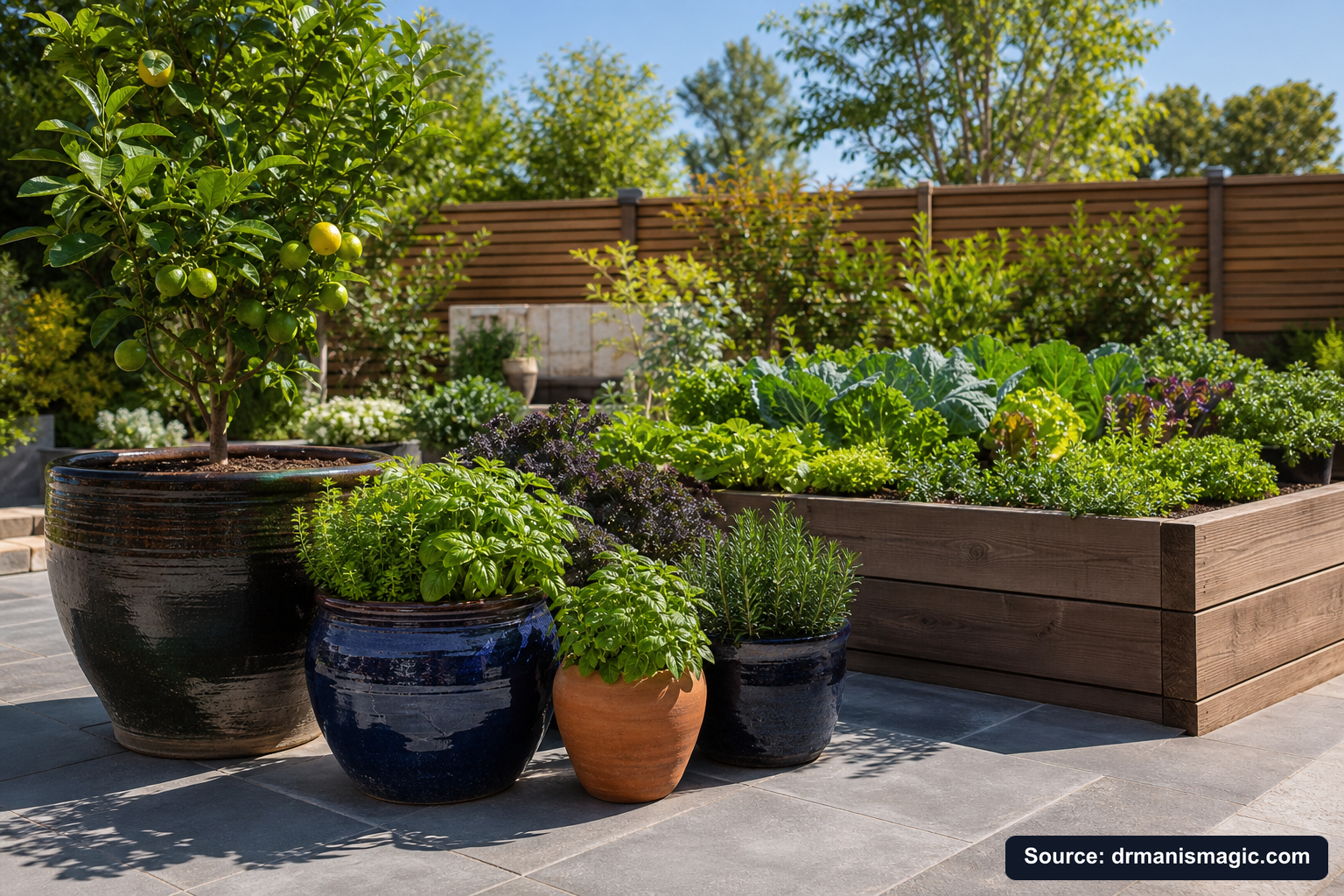
Let us put the two systems side by side so you can see exactly what you are choosing between.
| Property | Standard Potting Mix (Pine Bark Based) | Mineral-Based Soil (Silica-Rich Sandy Loam Base) |
|---|---|---|
| Primary ingredient | Pine bark / sawdust (organic) | Silica-rich sandy loam (inorganic) |
| Decomposes over time? | Yes, within 6-12 months | No, structure is permanent |
| Pore space over time | Shrinks as bark breaks down | Stays open and consistent |
| Oxygen delivery to roots | Declines rapidly as it compacts | Maintained long-term |
| Drainage after 12 months | Poor to very poor | Consistent and reliable |
| Rewetting when dry | Difficult, often hydrophobic | Easy and consistent |
| Root rot risk | High (anaerobic conditions develop) | Low (aerobic conditions maintained) |
| Pine chemistry in root zone | Yes (terpenes, terpenoids) | No |
| Need to repot / replace? | Every 1-2 years | Rarely or never |
| Sterilization | Varies by manufacturer | Steam-sterilized (when sourced from Dr. Mani's Magic) |
| Cost over 5 years | High (repeated replacement) | Low (one-time investment) |
After growing over 250,000 trees at our South Texas nursery, we stopped using potting mix entirely. Not because it is bad for a week or two. But because it fails perennial plants. Container citrus, tropical trees, woody perennials, and long-lived houseplants all need structure that lasts as long as they do. Potting mix simply cannot do that job.
That is why the first of our Three Plant Pillars is mineral-based soil. Not enriched soil. Not premium potting mix. Mineral-based, silica-rich, inorganic structure that does not decompose, does not collapse, and does not steal oxygen from the roots you are trying to protect.
Does Sand Actually Improve Drainage in Pots, or Is That a Myth?
Quick Answer: Coarse, silica-rich sand improves drainage and pore architecture when it makes up a significant portion of the mix. But adding a small amount of fine sand to potting mix can actually worsen drainage by filling the existing pore spaces. Particle size and proportion both matter enormously. Fine sand in an organic mix creates a concrete-like compaction problem.
This is one of the most persistent myths in gardening, and it trips up even experienced growers.
Adding a cup of sand to your potting mix will not improve drainage. It may actually make it worse. Here is why.
Drainage in a container is controlled by pore size. Large pores drain. Small pores hold water through capillary action. When you add fine sand to a loose, fluffy potting mix, the fine sand particles fall into the existing large pores and fill them in. You have just traded large, draining pores for small, water-retaining ones. You have made concrete, not drainage.
For sand to improve drainage, it needs to be coarse, silica-rich sand used in high proportions (think 30 to 50 percent of the mix volume), and it needs to be combined with other coarse particles so that the overall pore architecture stays open. This is what traditional sandy loam soil provides naturally. The Rio Grande Valley in South Texas has exactly this kind of silica-rich, coarse-grained soil, which is why Dr. Mani chose it as the base for Super Soil from the very beginning.
The rule is simple. Coarse particles in high proportions improve structure. Fine particles in low proportions fill in gaps and destroy structure. Particle size is not just a detail. It is the whole game.
What Job Does Each Soil Ingredient Actually Do?
Quick Answer: Every ingredient in a container mix has a specific job: structure, water retention, nutrient supply, microbial habitat, or chemistry modification. Mixing these jobs up, or expecting one ingredient to do all of them, is why most container mixes underperform. Understanding the job of each ingredient lets you build a mix that works for years, not months.
Here is the plain-language breakdown of what each common ingredient actually does. No jargon. No mystique. Just the job.
Pine bark (potting mix): Coarse organic structure in the short term. Decomposes into oxygen-stealing sludge in the long term. Good for annuals. Bad for perennials.
Peat moss: Water sponge. Holds a lot of moisture. No structural value. Collapses over time. Becomes hydrophobic when dry.
Coco coir: Better water sponge than peat. Holds moisture without going hydrophobic as easily. Still organic, still decomposes, but more slowly. Good water-holding ingredient when used in proportion.
Compost and worm castings: Nutrients and biology. Fine particles. No structural value. In high proportions, they worsen drainage. Use them as food, not framework.
Pumice and perlite: Durable drainage and aeration. They create air pockets that stay open. Pumice is heavier and holds a little more water in its pores. Perlite is lighter and can float to the surface over time. Both are excellent structural amendments.
Lava rock / scoria: Drainage, aeration, and excellent microbial habitat due to its porous surface area. Long-lasting. One of the best structural amendments available.
Coarse silica sand: Weight, pore modification, and drainage when used in the right proportions and particle size. Must be coarse. Fine sand is counterproductive.
Biochar: Microbial habitat and nutrient holding. Think of it as a tiny apartment building for beneficial microbes. It holds water and nutrients at the microscopic level without collapsing. Extremely stable. Lasts centuries in soil.
Rice hulls: Silica-based natural spacers that improve aeration and drainage. They last much longer than organic amendments before breaking down and can even be used as a top dressing to suppress weeds. Another ingredient Dr. Mani includes in Super Soil for exactly this reason.
Fertilizer (organic or synthetic): Food. Nutrients. That is the entire job. No structural function. Cannot replace structure.
Lime and gypsum: Chemistry modifiers. They adjust pH and calcium availability. No structural function, though gypsum can improve clay aggregation in ground soil.
Why Do Yellow Leaves Keep Coming Back Even After You Fertilize?
Quick Answer: Yellowing leaves in a container plant are often caused by structural failure in the root zone, not nutrient deficiency. When roots are suffocating in collapsed, waterlogged, or anaerobic media, they cannot absorb the nutrients you apply. Adding more fertilizer into a structurally broken system is like putting gasoline in a car with a clogged fuel line. The gas is not the problem.
This is the symptom that sends gardeners down endless rabbit holes. Yellow leaves. You fertilize. They stay yellow. You switch fertilizers. Still yellow. You add iron. Still yellow. You try a different brand. Nothing.
Here is what is actually happening.
When roots are in anaerobic conditions, which means conditions without oxygen, they begin to die. Dead roots cannot absorb anything. So even if your fertilizer is perfect, even if the nutrients are sitting right there in the water around the roots, there are no functional root tips to pull them in. The plant shows deficiency symptoms because it is deficient. But the deficiency is caused by root death, not by a lack of nutrients in the media.
The fix is structural, not nutritional. You need to restore oxygen to the root zone. That means removing decomposed, collapsed media and replacing it with something that holds open pore space. It means checking that your container drains freely and is not sitting in a saucer of standing water. It means understanding that the perched water table at the bottom of your pot may be drowning the lowest roots regardless of how carefully you water.
Clemson University citrus extension materials specifically connect visible root flare and oxygen access with crown rot prevention, noting that roots denied oxygen become vulnerable to fungal pathogens that finish the job. Structure protects roots. Roots absorb food. Food grows plants. The chain starts with structure.
See also: The Hidden Reason Synthetic Fertilizers Cause Root Rot
How Do the Three Plant Pillars Separate Structure, Biology, and Food?
Quick Answer: The Three Plant Pillars treat structure, living microbes, and organic nutrition as three separate, non-interchangeable jobs. Pillar One is mineral soil that provides permanent physical architecture. Pillar Two is live microbial biology that protects and feeds the root zone. Pillar Three is organic fertilizer that supplies slow-release nutrients. All three must be present for plants to truly thrive.
After decades of trial and error at US Citrus Nursery, Dr. Mani Skaria identified the three things that every thriving plant has in common, and the three things that every dying plant is missing at least one of.
He called them the Three Plant Pillars.
Pillar One: Mineral Foundation. This is structure. Permanent, non-decomposing, silica-rich soil that maintains pore space, delivers oxygen to roots, anchors the plant, and drains freely. This is not about nutrients. This is about architecture. The soil does not feed the plant. It houses the root system that feeds the plant.
Pillar Two: Microbial Muscle. This is biology. The living ecosystem of bacteria, fungi, and mycorrhizae that surrounds healthy roots in nature. These organisms unlock bound nutrients, protect against pathogens, extend the root system's effective reach, and create the biological complexity that synthetic systems cannot replicate. Without microbes, roots are defenseless. With them, roots become nearly bulletproof.
Pillar Three: Organic Fertilizer. This is food. Slow-release, salt-free, biologically compatible nutrients derived from crab shell, kelp, and amino acids. This is what feeds the plant. But it only works if the first two pillars are in place. Roots cannot absorb food they cannot breathe around. Microbes cannot thrive in a media drenched in salt-based synthetic chemicals. The food only works when the structure and the biology are already healthy.
This is the sequence that matters. Structure first. Biology second. Food third. Skip the sequence and you are back on the treadmill of products that never quite work.
We built our Super Soil around this exact principle. It is a mineral-based blend of silica-rich sandy loam from the Rio Grande Valley, coco coir, rice hulls, and biochar, steam-sterilized to eliminate pathogens, engineered to hold its structure permanently. It is not potting mix with a new label. It is an entirely different approach to what soil is supposed to do.
See also: Why Most Fertilizers Are Actually Salt in Disguise
What Does a Root Recovery Plan Look Like When Structure Has Already Failed?
Quick Answer: If your plant is in collapsed, waterlogged, or anaerobic media, the most important step is restoring oxygen to the root zone by transitioning to a mineral-based, well-draining growing medium. Fertilizing a structurally broken system will not fix it. Recovery requires physical intervention first.
If your plant is already showing signs of structural failure, here is a step-by-step recovery process we have used with our own trees at the nursery.
- Stop fertilizing immediately. Adding nutrients to a root system that cannot absorb them adds salt stress without benefit. Pause all feeding until the root zone is healthy.
- Check the roots. Gently remove the plant from its container. Healthy roots are white or cream-colored and firm. Rotten roots are brown, slimy, and smell like decay. Trim away all visibly rotten root material with clean, sterile scissors.
- Let the root ball breathe. Set the trimmed plant in a shaded, dry location for a few hours before repotting. This allows cut surfaces to callous slightly and reduces the risk of infection.
- Transition to mineral-based, well-draining media. Replace collapsed potting mix with a coarse, mineral-rich growing medium. Structural amendments like pumice, perlite, lava rock, and silica-rich sandy loam should make up the majority of the new mix. Organic water-holding ingredients like coco coir should be present in proportion, not dominance.
- Add live microbial support. Reintroduce beneficial bacteria and fungi to the new root zone using a live microbial product like Plant Super Boost. These organisms help protect healing roots from pathogens and begin rebuilding the biological ecosystem the roots need.
- Water carefully and monitor drainage. After repotting, water once and watch how quickly the media drains. Water should flow freely from the drainage holes within seconds. If it pools or drains slowly, the structural issue is not resolved.
- Resume gentle feeding after four to six weeks. Once the plant shows new growth, indicating that root function has been restored, reintroduce organic fertilizer at half the normal rate. Build back up slowly as the plant demonstrates recovery.
Recovery takes time. Roots take time. But the biggest mistake most gardeners make after root rot is adding more fertilizer the moment they see new leaves, before the root system has fully recovered. Be patient. Structure before food. Always.
The Real Cost of Getting This Wrong: It Is Not Just Money
Here is the thing nobody likes to say out loud.
You can always get your money back. A bag of potting mix costs twenty dollars. A bottle of fertilizer costs thirty. You lose those, you earn them back. No big deal.
But you cannot get time back.
The number one thing people tell Dr. Mani when they first come to us is that they want to see fruit on their tree while they are still here to enjoy it. They want to pick something off a branch they planted with their own hands. They want that moment. And they are afraid, in a quiet way, that they might run out of time before their plant gets there.
That fear is real. And it is exactly what happens when a plant sits in collapsing potting mix for two years, getting fertilized faithfully, slowly declining instead of growing, looking just sick enough that you keep trying but never quite thriving. Two years gone. The plant is back to square one. And you are two years older.
This is the real cost of confusing structure with food. Not twenty dollars. Not thirty. Two years of your life spent watching a plant struggle when it should have been growing toward the day you finally get to taste something it made for you.
Get the structure right first. Build the mineral foundation. Bring in the biology. Then feed it. That is the sequence nature designed. That is the sequence Dr. Mani proved across 250,000 trees in South Texas. And it is the sequence that gets you to that moment, the one you have been imagining, faster than anything else we have ever found.
If you want a clear, simple starting point, our Free Plant Care Field Guide walks you through the Three Plant Pillars from the beginning, in plain language, with no products required to read it. Start there. Understand the system. Then build your plant's foundation the right way, and let the years ahead be full of the growth and harvest you have been waiting for.
Frequently Asked Questions
Most plant owners never learn the difference between structure and food. That one gap causes more dead plants, wasted money, and lost time than almost anything else in gardening. These questions cut straight to what matters so you can stop guessing and start growing.
What is the difference between a structural amendment and plant food?
A structural amendment builds the physical home your roots live inside. Think of it as the frame of a house. It creates air pockets, drainage channels, and room for roots to breathe and spread. Plant food, or fertilizer, delivers nutrients like nitrogen and potassium that roots absorb to grow leaves, flowers, and fruit. One builds the house. The other turns on the lights. You need both, but structure always comes first. Fertilizer cannot fix a root that is suffocating.
Why does fertilizer stop working even when I keep adding more?
This is one of the most common traps gardeners fall into. When your soil is too dense or waterlogged, roots cannot breathe. A root that cannot breathe cannot absorb food, no matter how much you pour on. At our South Texas nursery, we tested this across more than 250,000 trees. The answer was always the same. Fix the structure first. Once roots have oxygen and room to move, fertilizer actually works. Without that foundation, you are just spending money and losing time.
What happens to potting mix after a few months?
Most store-bought potting mix is made from pine bark and wood sawdust. It looks rich and dark when you open the bag. But organic material decomposes. As it breaks down, it collapses on itself. The air pockets disappear. Water sits instead of draining. Roots get squeezed and starved of oxygen. That is when you see yellowing leaves and brown, slimy roots. This is why Dr. Mani built Super Soil on a mineral base from South Texas. Silica-rich sandy loam does not decompose. It holds its structure for years.
What makes mineral-based soil better than regular potting mix?
Regular potting mix is mostly organic matter that breaks down fast. Mineral-based soil is built from inorganic materials like silica-rich sandy loam that do not decompose. That means the pore spaces stay open. Roots keep breathing. Drainage stays consistent. Dr. Mani's Super Soil uses this mineral base, steam-sterilized and sourced right from the Rio Grande Valley. It is the first of the Three Plant Pillars because nothing else works right without it. You plant once and the structure lasts.
Can compost or fertilizer replace a structural amendment?
No. Compost adds some texture and nutrients at the same time, which makes it feel like a two-in-one fix. But compost is organic. It decomposes. When it breaks down, the structure it created disappears with it. Fertilizer delivers nutrients but has zero ability to create physical pore space. You cannot feed your way out of a suffocation problem. The Three Plant Pillars are built in order for a reason. Mineral soil first. Live microbes second. Organic fertilizer third. Skip the first step and the other two cannot do their job.
What are the best structural amendments for container plants?
The best structural amendments create lasting pore space without decomposing. Pumice, lava rock, coarse silica sand, perlite, rice hulls, and biochar all do this well. Dr. Mani uses rice hulls and biochar in Super Soil because they are made in the USA, last a long time, and support the live microbes in Plant Super Boost. Rice hulls create drainage channels. Biochar acts like a sponge that holds water and nutrients right where roots can reach them. Together they keep the structure open and alive.
How do the Three Plant Pillars connect structure and feeding?
The Three Plant Pillars are the framework Dr. Mani built after 30 years of growing citrus, tropical trees, and houseplants. Pillar One is mineral-based soil that gives roots a permanent, breathable home. Pillar Two is live microbes from Plant Super Boost that protect roots and unlock nutrients already in the soil. Pillar Three is organic fertilizer from crab, kelp, and amino acids that feeds plants slowly without burning or poisoning the microbes. Each pillar depends on the one before it. Get all three right and your plants stop struggling and start thriving.
About the Author
Ron Skaria, MD
Ron Skaria, MD, is the co-founder of Dr. Mani's Magic and the son of Dr. Mani. He trained as a medical doctor at Baylor College of Medicine, did his residency at UT Health Science Center - San Antonio and fellowship training at Texas Tech University. He now works full time on the family farm at US Citrus and US Citrus Nursery in Hargill, Texas, building Dr. Mani's Magic alongside his dad. He wrote the Brown Thumb Field Guide to put his father's 48 years of plant science into plain words any gardener can use. His belief is simple. You never had a brown thumb. You just never had the right help.


