


Soil Conditions That Separate Average Citrus From Incredible Citrus | Dr. Mani's Magic
The Soil Conditions That Separate Average Citrus From Incredible Citrus
Picture this. You bite into a slice of homegrown citrus and your eyes close. The juice hits your tongue. It's sweet, bright, and alive with that smell that makes you think of warm mornings and fresh air. You grew that. Right in your own backyard.
Now picture the other tree. Same yard. Same sun. Same water. Same fertilizer bag from the big box store. But the fruit is dry. Pale. Barely worth peeling. You've been feeding it for two years and it still looks like it's just barely hanging on. Yellow leaves. Small fruit. A tree that survives but never truly lives. You wonder what you're doing wrong. You wonder if you just don't have the touch for this.
Here's the truth nobody told you. The difference between those two trees has almost nothing to do with what's above the soil. It's what's happening underneath that tells the whole story. The living, breathing, invisible world in the root zone is either working for your tree or it isn't. And after growing over 250,000 citrus trees at our South Texas nursery, we can tell you exactly what separates a good tree from an incredible one. It starts in the dirt.

Plant Super Boost
Key Takeaways
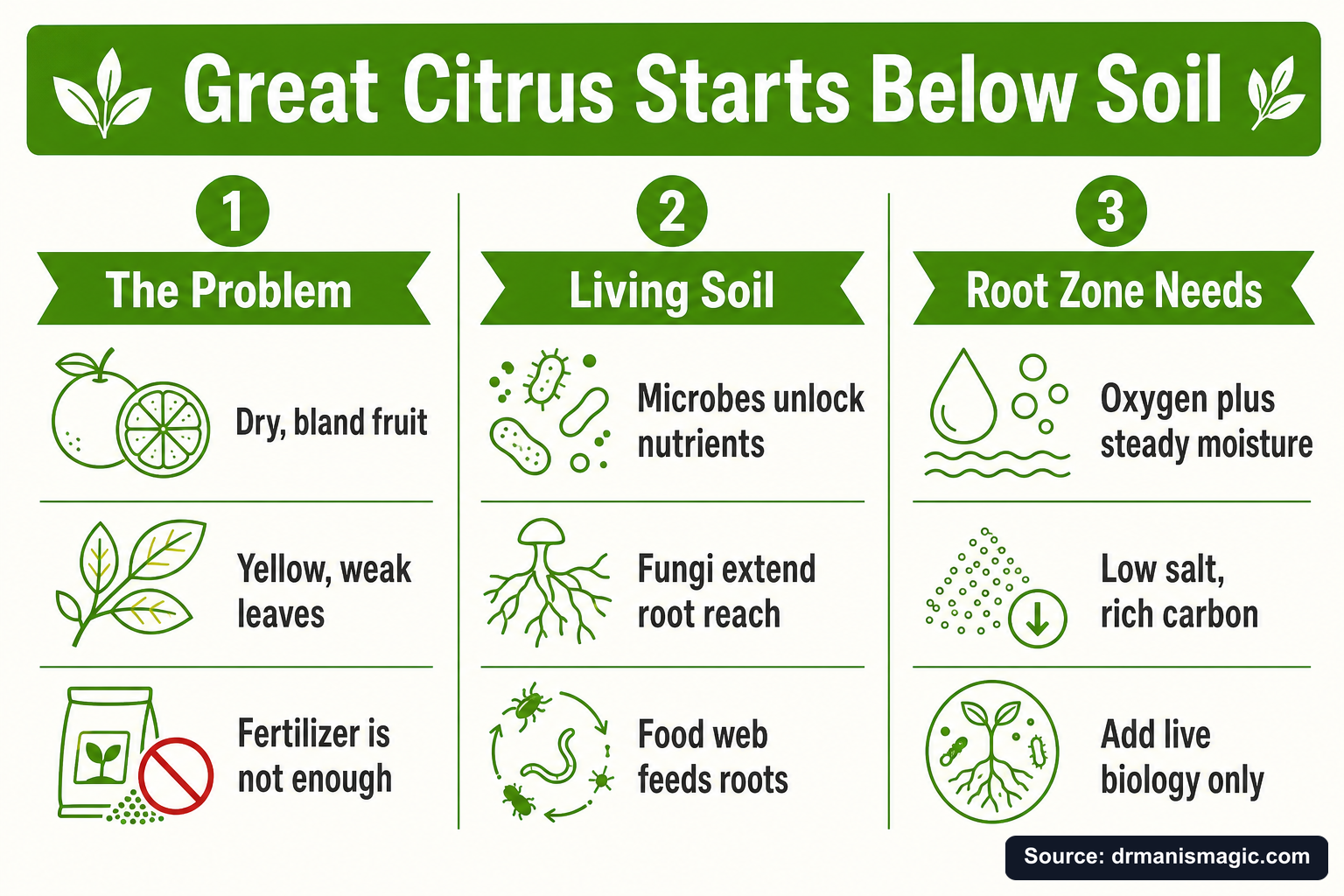
- Incredible citrus grows in a living root zone, not just fertilized soil. Biology drives flavor, health, and fruit size.
- The soil food web, including bacteria, fungi, protozoa, and nematodes, supplies up to 75% of plant-available nitrogen and 65% of phosphorus naturally.
- Oxygen, moisture stability, low salt, organic carbon, and active microbes are the five root-zone conditions that matter most.
- Salt-based synthetic fertilizers kill the beneficial microbes your citrus needs most, setting off a slow downward spiral.
- Mycorrhizal fungi can extend root surface area by 100 to 1,000 times, but only when soil conditions support them.
- Most bottled microbe products on the market are either dead on arrival (dried powders) or dying in the bottle (smelly anaerobic liquids). Live biology requires live delivery.
- The Three Plant Pillars, developed and proven by Dr. Mani Skaria at US Citrus Nursery, give your tree the complete foundation it needs to thrive long-term.
Why Does Soil Biology Control Citrus Flavor, Not Just Fertilizer?
Quick Answer: Soil biology drives citrus flavor because living microbes unlock and deliver nutrients in forms roots can actually use. Salt-based fertilizers push simple nutrients fast but miss the dozens of trace minerals, organic acids, and slow-release compounds that build sweetness, juice content, and fruit aroma. Flavor is a biology problem, not just a feeding problem.
Most growers think fruit quality comes from a bag of fertilizer. Pour it on, wait, harvest. Simple, right?
Not quite.
The flavor in a great piece of citrus, that perfect balance of sweet and acid, that burst of aroma when you peel it, that juice that runs down your wrist, all of that comes from a complex chain of events that starts underground. Trace minerals. Organic compounds. Plant hormones. All of it flows through the root zone, and most of it is unlocked not by chemicals but by living organisms in the soil.
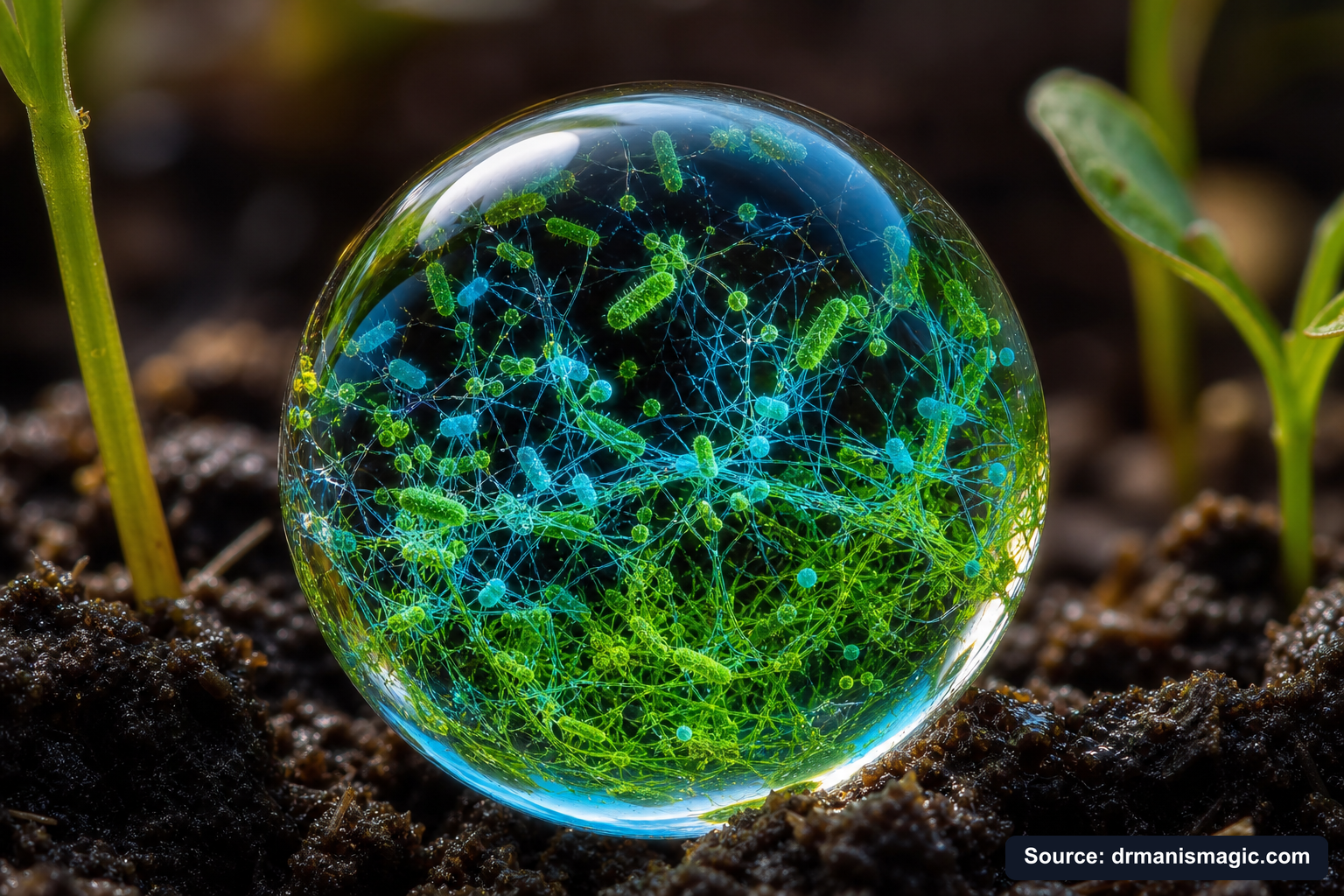
According to the University of Maryland Extension, a single teaspoon of healthy agricultural soil can contain 100 million to 1 billion bacteria, several meters of fungal threads, thousands of protozoa, and 10 to 20 nematodes. That's an invisible city working 24 hours a day for your tree.
The University of Minnesota Extension reports that soil biology contributes roughly 75% of plant-available nitrogen and 65% of available phosphorus. Think about that. The majority of what your tree eats doesn't come from your fertilizer bag. It comes from the living world in the soil.
When that world collapses, your tree survives on scraps. It grows. It fruits. But it never hits its potential. The fruit is thin. Dry. Bland. You wonder why. The answer is underground.
This is the root of the problem, literally, and it's why the Three Plant Pillars, developed by Dr. Mani Skaria after decades of research and 250,000+ trees, start with biology and soil structure, not just fertilizer.
What Is the Soil Food Web and Why Should Citrus Growers Care?
Quick Answer: The soil food web is the chain of living organisms in your root zone, from bacteria and fungi up to protozoa, nematodes, and tiny arthropods, that work together to break down organic matter, release nutrients, and protect roots from disease. When this web is active, your citrus gets fed naturally and stays healthy. When it's broken, problems pile up fast.
Here's a story most people have never heard. Every healthy tree in nature, growing wild, with no fertilizer, no pest spray, no one to water it, is being fed by an underground army. That army has been there for millions of years. And it works like this.
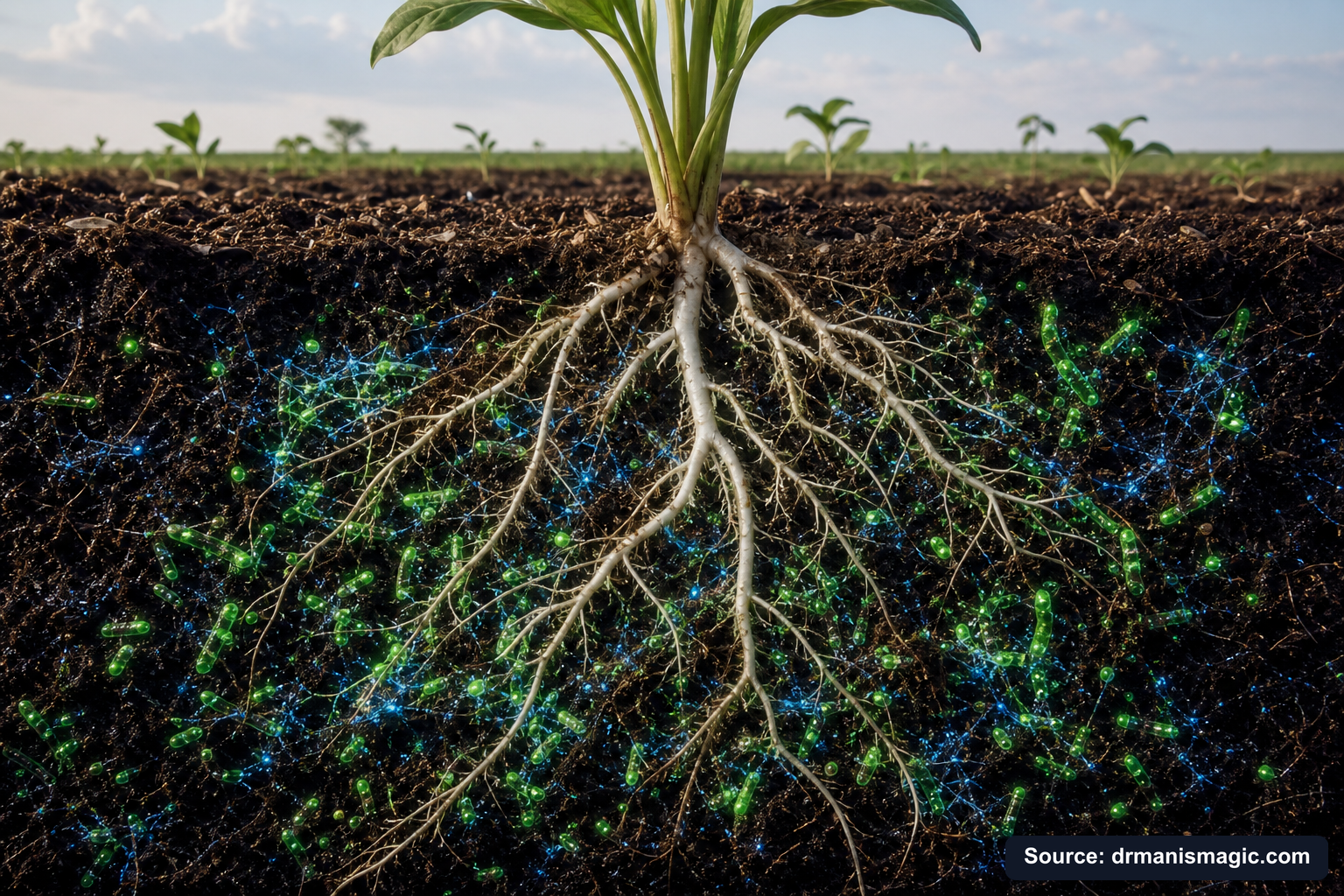
Bacteria and fungi break down organic matter in the soil, turning dead leaves and carbon into food. Protozoa and nematodes then eat the bacteria and fungi. When they do, they release nutrients right next to the roots, exactly where the plant can grab them. Meanwhile, mycorrhizal fungi stretch out from the roots like invisible fingers, reaching water and minerals that roots alone could never find. The plant feeds the fungi sugar. The fungi feed the plant minerals. It's a trade deal that's been running since before humans existed.
Your citrus tree evolved inside this system. It expects it. It needs it. Take it away and you have a tree that's like a fish out of water, technically alive, but not thriving the way nature intended.
| Organism | What They Do | Benefit to Your Tree |
|---|---|---|
| Bacteria | Break down organic matter; fix nitrogen from the air; fight pathogens | Releases nitrogen and minerals; suppresses root disease |
| Fungi (non-mycorrhizal) | Decompose tough carbon materials; produce glomalin to bind soil particles | Improves soil structure, aeration, and water retention |
| Mycorrhizal Fungi | Extend root surface area 100-1,000x; mine phosphorus, zinc, iron | Massive nutrient and water uptake boost; drought resistance |
| Protozoa | Eat bacteria; release nutrients near roots as waste | Delivers nitrogen and minerals exactly where roots can use them |
| Beneficial Nematodes | Graze on bacteria and fungi; hunt pest larvae | Nutrient cycling; natural pest control underground |
| Arthropods (soil insects) | Shred organic matter into smaller pieces for bacteria to finish | Speeds up decomposition; improves soil texture |
When all of these players are present and working together, your citrus tree has access to everything it needs. Flavor. Size. Resilience. A tree that doesn't need babying because the soil is doing the heavy lifting.
When they're gone, you're trying to replace a complex living system with a bag of salts. And that's a losing battle.
What Are the 9 Soil Conditions That Create Incredible Citrus?
Quick Answer: The nine conditions are root-zone oxygen, stable moisture, low salinity, organic carbon, an active soil food web, balanced pH, fungal-friendly management, disease-suppressive biology, and rootstock-soil compatibility. Miss even two or three of these and your citrus will underperform no matter how much you fertilize.
Let's walk through each one. These aren't theories. These are the conditions we've tested on over a quarter million trees in South Texas.
1. Root-Zone Oxygen
Citrus feeder roots breathe. They need oxygen just like you do. When soil compacts, when organic potting mix breaks down into sludge, when water sits too long, the oxygen disappears. Roots suffocate. They rot. And a rotting root system can't feed a tree no matter what you pour on top.
Most commercial potting mixes are made from pine bark and wood materials. They feel light and fluffy when you first open the bag. But within six to twelve months, they break down. They compact. They steal oxygen from the very roots they were supposed to protect. This is one of the biggest hidden killers in container gardening.
Mineral-based soil, like the kind we use in our Super Soil, is built from silica-rich sandy loam that doesn't decompose. It stays open. Roots breathe. Water drains. That's Pillar One of the Three Plant Pillars: a mineral foundation that never collapses.
2. Stable Moisture
Citrus roots don't like to dry out completely. But they also hate sitting in water. The sweet spot is consistent, moderate moisture. Think of a wrung-out sponge. Damp but not dripping. When moisture swings wildly from bone dry to waterlogged, roots stress out. Stress opens the door to disease. Disease opens the door to decline.
3. Low Salinity
Salt is the silent killer in citrus soil. It comes from two main sources. Tap water that carries dissolved minerals. And synthetic fertilizers, which are almost entirely salt-based. When salt builds up in the root zone, water flows the wrong way. Instead of moving into the roots, it moves out. The tree gets thirsty even when you water it. Leaves yellow. Fruit shrinks. The tree looks like it has a deficiency but what it actually has is salt poisoning.
The Florida IFAS Extension confirms that many citrus soils, especially in warm climates, are already prone to rapid organic matter loss and need careful salt management to stay productive.
4. Organic Carbon
Carbon is food for microbes. Without it, the soil food web has nothing to eat. Bacteria and fungi starve. The whole system slows down. In warm climates, organic matter breaks down fast. Citrus groves in Florida often stabilize at just 1% to 2% organic matter without active management. That's a hungry soil. A struggling soil. Adding compost, mulch, and organic fertilizer feeds the biology that feeds your tree.
5. Active Soil Food Web
Already covered above. This is the engine. If it's running, everything else works better. If it's dead or depleted, you're pushing a car uphill. Restoring it takes live microbes applied consistently over time, not a one-time treatment.
6. Balanced pH
Citrus prefers a soil pH between 6.0 and 7.0. Outside that range, nutrients get locked up. The tree can't absorb iron, manganese, zinc, and other trace minerals no matter how much you add. Microbes also work best in that balanced range. High pH from hard water or over-liming is one of the most common causes of yellowing leaves in citrus.
7. Fungal-Friendly Management
Beneficial fungi, especially mycorrhizae, are fragile. They hate being disturbed. They hate synthetic fungicides. They hate high-phosphorus fertilizers applied in excess. Managing for fungi means going easy on the chemicals, using organic inputs, and avoiding aggressive soil tilling that rips apart fungal networks.
According to Colorado State University Extension, mycorrhizal hyphae can extend the root absorbing area by 100 to 1,000 times. That's a superpower. But only if you don't kill the fungi first.
8. Disease-Suppressive Biology
A healthy soil food web fights disease on its own. Beneficial bacteria and fungi crowd out pathogens. They produce natural antibiotics. They outcompete harmful organisms for space and food. A biologically dead soil has no defense. Every pathogen that lands in it finds an open door. Phytophthora root rot, for example, spreads fastest in soils with poor drainage and no competing biology.
9. Rootstock-Soil Compatibility
Different citrus rootstocks perform very differently in different soil types. Some handle clay better. Some handle sand better. Some are more resistant to nematodes or Phytophthora. Matching your rootstock to your soil conditions is a factor most home growers never think about, but it makes a big difference in long-term performance.
How Do Salt-Based Fertilizers Destroy the Very System That Feeds Your Citrus?
Quick Answer: Salt-based synthetic fertilizers kill beneficial bacteria and fungi in the root zone by drawing water out of microbial cells through osmotic pressure. This collapses the soil food web, leaves the tree dependent on artificial inputs, and creates a cycle of increasing fertilizer use with decreasing results. Over time, the soil goes biologically dead.
Here's the story nobody at the garden center tells you.
When you pour a synthetic fertilizer on your citrus, you're applying dissolved salts. Your tree gets a quick green-up. It looks good for a few weeks. You feel like you've done something right.
But underground, something else is happening. Those salts are pulling moisture out of microbial cells the same way salt draws water out of a slug. Bacteria die. Fungi shrink back. The living network that was building your soil collapses a little more each time.
After a few seasons, you need more fertilizer to get the same result. Your tree becomes dependent. It can't feed itself naturally anymore because the biology that made that possible is gone. You're not growing a tree. You're running a life support machine.
Then the root rot starts. Because now there's no competing biology to stop the pathogens. And the roots are already weakened by salt stress. And the soil structure is degrading because the fungi that built it are gone.
This is why Dr. Mani Skaria, after 40 years of research, built the Three Plant Pillars around organic fertilizer as the third pillar. Our Crab, Kelp & Amino Acids fertilizer is slow-release, organic, and completely salt-free. It feeds the tree AND feeds the microbes. No damage. No dependency. No dead soil.
See also: The Hidden Reason Synthetic Fertilizers Cause Root Rot
You Never Had a Brown Thumb.
You were handed the wrong tools. This free guide hands you the right ones.
You watered it. You fed it. It died anyway.
It was never you. It was the dirt, the salt food, and the bad advice.
This guide shows you what really went wrong, and how to fix it for good.
- Why your plants really died, and why it was never your fault
- The salt hiding in your plant food that quietly burns the roots
- The hidden killer in almost every bag of store soil
- The tiny helpers that grow a whole forest for free
- The rescue trick that brings a half dead plant back to life

Do Citrus Trees Really Need Mycorrhizal Fungi, or Is That Just Marketing?
Quick Answer: Mycorrhizal fungi genuinely help citrus under specific conditions: low phosphorus, drought, disturbed soil, iron deficiency, and when trees are young or newly transplanted. But if phosphorus is already high in your soil, the fungi may provide less benefit and can even cost the tree energy. The smarter move is to create conditions where fungi thrive naturally rather than just pouring on inoculants.
Let's be honest here. The word "mycorrhizae" has been turned into a marketing term. Every product on the shelf has it now. Bags of potting mix. Fertilizer tablets. Little capsules you bury near roots. And most of them don't work.
But the fungi themselves? Absolutely real. Absolutely powerful. Let us explain both sides.
When phosphorus in the soil is low, mycorrhizal fungi become incredibly valuable. They reach into tiny pores that roots can't enter and extract phosphorus, zinc, and iron. They also extend the root's water-gathering range dramatically. For a young citrus tree in a disturbed container environment with no existing fungal network, adding live mycorrhizae makes a real difference.
However, research from Penn State found that when phosphorus is already sufficient in the soil, mycorrhizae can actually impose a carbon cost on the tree. The tree feeds the fungi sugar but gets little benefit in return because it doesn't need what the fungi are offering. So the relationship changes based on conditions.
The takeaway is this. Don't just dump mycorrhizal products on a tree and hope for magic. Instead, create the conditions where fungi can thrive and earn their place. That means organic matter in the soil. Low disturbance. Moderate phosphorus. Consistent moisture. And live, viable fungi that can actually establish on the roots.
That last part is where most products fail completely.
Why Do Most Bottled Microbe Products Fail to Deliver Results?
Quick Answer: Most bottled microbe products either contain dried, dormant organisms that never fully reactivate in soil, or they're liquid products that have gone anaerobic during shipping, meaning the microbes are already dying or dead. A product that smells bad is a product where microbes are suffocating. Live biology requires live delivery, and very few products on the market actually deliver that.
Walk down the garden aisle of any big box store. You'll see dozens of products promising living microbes. Mycorrhizae. Beneficial bacteria. Soil activators. The labels are impressive. The results, for most of them, are not.
Here's what's actually inside most of those bottles and bags.
The majority of commercial microbial products are made in large industrial vats. Scientists grow specific strains of bacteria or fungi in bulk, then dry them into powder form. The idea is that the spores will reactivate when you add water and pour them into soil. Sometimes they do. Mostly they don't. We've tested dozens of these products on our own trees. The results were consistently disappointing.
The liquid versions are often worse. Many are essentially compost tea, a liquid made from organic material that was once teeming with life. But by the time it ships to you and sits on a shelf, it has gone anaerobic. The microbes are dying without oxygen. The giveaway is the smell. Open the bottle and it hits you like a wall of rotting sewage. That smell isn't character. That's death.
Some companies add lactobacillus bacteria, the same kind in yogurt. It's vigorous and stays alive. But it doesn't belong in soil. It outcompetes the beneficial microbes you actually want and takes over the root zone like an invasive weed.
| Product Type | Are Microbes Alive at Use? | Smell | Spectrum of Organisms | Our Assessment |
|---|---|---|---|---|
| Dried powder (lab-grown) | Low, spores often fail to reactivate | Neutral | Narrow (1-5 species) | Avoid. We saw no results across dozens of tests. |
| Rehydrated dry powder in liquid | Low to moderate | Neutral to mild | Narrow | Same issues as above. Not recommended. |
| Compost tea (fresh, under 24 hours) | Moderate, only if aerated | Earthy, then sour fast | Broad but unpredictable | Great if you make it yourself and use it immediately. Not practical for most growers. |
| Compost tea (old, over 24 hours) | Anaerobic, microbes dying | Strong foul odor | Declining | Do not use. Microbes are suffocating. |
| Lactobacillus-based products | High but wrong organisms | Sour/fermented | Narrow (yogurt bacteria) | Avoid. Crowds out beneficial microbes. |
| Plant Super Boost (stabilized, full-spectrum) | High. Visibly alive under microscope. | Earthy, not foul | 2,000+ bacteria, 400-500 fungi including mycorrhizae, protozoa, nematodes | Harvested from active compost. Stabilized by an all-natural technique. The only product we trust on our own 250,000+ trees. |
The reason Plant Super Boost works differently comes down to a story that starts with a compost expert who was blacklisted by big chemical companies for getting results that threatened their market. He developed a proprietary, all-natural way to stabilize a full spectrum of microbes harvested from living compost, without killing them and without letting them go anaerobic. Years later, through what Dr. Mani calls a providential meeting, that expert joined the US Citrus Nursery team. That stabilization technique is at the heart of Plant Super Boost. You can literally take a drop of it, look at it under a microscope, and see the organisms moving. That's what alive looks like.
Zero PFAS. Zero biosludge. Zero synthetic salts. Backed by our 30-day money-back guarantee.
What Does a Citrus Soil Symptom Really Mean, and How Do You Know What's Wrong?
Quick Answer: Yellow leaves, leaf drop, small fruit, and canopy thinning in citrus can all come from very different root-zone problems, including salt injury, Phytophthora root rot, nematode damage, overwatering, and herbicide carryover. The symptoms look almost identical. A diagnostic approach based on root-zone conditions is far more reliable than guessing and spraying.
This is where most growers lose months of time. Maybe years.
Your tree looks yellow. You add more fertilizer. It stays yellow. You try a different fertilizer. Still yellow. You spray for pests. Nothing changes. Meanwhile, the real problem is underground and getting worse.
UC IPM specifically notes that Phytophthora root rot symptoms can be nearly impossible to distinguish from nematode damage, salt injury, flooding stress, or herbicide carryover without laboratory testing. They all show up the same way above ground. Yellow leaves. Leaf drop. Small fruit. A tree that looks sick but won't tell you why.
Here's a simple framework for narrowing it down.
| Symptom | Likely Root-Zone Cause | How to Confirm | First Step to Fix It |
|---|---|---|---|
| Yellow leaves with green veins | Iron or zinc lockup from high pH or salt | Test soil pH; check for salt crust on top of soil | Flush soil with clean water; correct pH; add organic fertilizer |
| General yellowing, leaf drop | Root rot (Phytophthora), overwatering, or salt buildup | Dig carefully and check root color (brown = rot, white = healthy) | Improve drainage immediately; stop synthetic fertilizer; add live microbes |
| Small fruit, poor juice | Low soil biology, salt stress, or moisture swings | Check watering consistency; check fertilizer type | Switch to organic fertilizer; stabilize moisture; rebuild biology |
| Canopy thinning, stubby roots | Nematode damage or herbicide carryover | Lab soil test for nematodes; check herbicide history of site | Add organic matter; apply live microbials; avoid soil disturbance |
| Wilting despite watering | Salt injury or root rot blocking water uptake | Check root zone moisture; check for salt crust | Deep flush with clean water; check drainage; rebuild root zone biology |
| Poor new growth flush | Low nitrogen availability or dead soil biology | Check fertilizer type; check for recent chemical use | Apply organic nitrogen; restore microbes; avoid synthetic inputs |
The pattern you'll notice is that almost every problem points back to the same root causes. Bad soil structure. Dead biology. Salt accumulation. Poor drainage. Fix those four things and you fix most citrus problems at the source instead of chasing symptoms forever.
How Do You Rebuild Dead or Damaged Citrus Soil, Step by Step?
Quick Answer: Rebuilding damaged citrus soil means restoring oxygen flow, flushing accumulated salts, adding organic carbon, and reintroducing live beneficial microbes through repeated applications over several months. It cannot be done in one treatment. The soil took time to degrade and it takes time to recover. But the results, once they come, are lasting.
Here is the thing about time. You can get money back. You can buy more fertilizer. You can try another product. But you cannot get back the seasons you spent watching a tree struggle that could have been thriving. The best time to fix your soil was last year. The second best time is right now.
Here is a practical recovery checklist you can start today.
- Stop all synthetic fertilizer immediately. Every bag of salt-based fertilizer you add makes the biology problem worse. The tree may look worse before it looks better as the microbial system rebuilds. That's normal. Stay the course.
- Flush the root zone with clean water. If you have salt buildup from tap water or synthetic fertilizers, give the soil a long, deep soak with the best water you have. Let it drain fully. Repeat two or three times over a week. This dilutes and moves salt down and away from the feeder roots.
- Check and correct your drainage. If water pools for more than an hour after watering, your oxygen problem is structural. In containers, consider repotting into a mineral-based soil that doesn't compact. In the ground, check if you need to raise the planting area or create drainage channels.
- Add organic carbon. Layer two to four inches of organic mulch or compost on top of the root zone. Keep it a few inches away from the trunk. This feeds the microbes, moderates soil temperature, and holds moisture steadily instead of letting the soil dry out and rewet in extremes.
- Apply live, full-spectrum microbials monthly. This is not optional in damaged soil. The biology needs to be reintroduced and reinforced repeatedly because the conditions that killed it are often still present. Think of it like rebuilding your gut after antibiotics. One dose isn't enough. Consistent application over months rebuilds a stable, self-sustaining community.
- Switch to organic, slow-release fertilizer. Once the biology starts recovering, feed it with inputs that work with it, not against it. Crab meal, kelp, and amino acid-based fertilizers release nutrients slowly as microbes break them down, which is exactly how nature intended it.
- Be patient and observe. New healthy root growth is the first sign of recovery. Then you'll see stronger new leaf flushes. Then better fruit set. The tree tells you when things are working. Trust the process.
See also: How Salt-Based Feeding Quietly Destroys Root Systems
What Is the Simple System That Ties All of This Together?
Quick Answer: The Three Plant Pillars, developed by Dr. Mani Skaria and proven across 250,000+ trees at US Citrus Nursery in South Texas, give every citrus tree (and every plant) the complete root-zone foundation it needs: mineral-based soil for oxygen and structure, live microbials for biology and nutrient cycling, and organic fertilizer for clean, slow-release nutrition that feeds both tree and microbes.
You've probably noticed that every problem we talked about today connects to the same three missing pieces. Soil that can breathe. Soil that's alive. And food that works with the biology instead of against it.
Dr. Mani Skaria didn't invent these ideas. Nature invented them. He just spent 40 years figuring out how to rebuild them for modern gardeners who've been sold a system that quietly works against everything a plant actually needs.
The first pillar is mineral-based soil. Sandy loam that doesn't compact. Roots that can breathe. Drainage that actually drains.
The second pillar is live microbials. A full-spectrum, living biological community that unlocks nutrients, fights pathogens, extends root reach, and builds soil structure from the inside out.
The third pillar is organic fertilizer. Slow-release. Salt-free. Built from crab, kelp, and amino acids. Food that feeds the tree and the microbes at the same time, with no burning, no dependency, and no long-term damage.
When all three are in place, something shifts. The tree stops struggling and starts thriving. The fruit gets heavier. Sweeter. More aromatic. The kind of citrus that makes you close your eyes when you bite into it.
That's not luck. That's not a green thumb. That's what happens when the root zone is doing what nature designed it to do.
What Can You Actually Do Right Now to Start Growing Incredible Citrus?
You don't need a perfect yard. You don't need a degree in soil science. You don't need to spend hours researching on gardening forums or arguing with the kid at the garden center who just learned what a pH meter is.
You need a foundation that works. And you need living biology in your root zone that's actually alive when it reaches you.
The growers who get the most out of their citrus trees, whether it's one tree in a pot on a patio or a small backyard orchard, are the ones who stop chasing symptoms and start building the right environment. Mineral soil that breathes. Microbes that are genuinely alive. Organic nutrition that feeds the system.
If you want to see what that looks like in practice, and get the step-by-step guidance that makes this simple from day one, our Free Plant Care Field Guide walks you through exactly how to set up the Three Plant Pillars for any plant you're growing. No jargon. No guesswork. Just what works, backed by 250,000 trees and 30 years in the field.
The tree you've been imagining, loaded with fragrant, juicy fruit you grew yourself, is not out of reach. It just needs the right soil underneath it. And the right invisible army working for it every single day.
Frequently Asked Questions
After growing over 250,000 citrus trees in South Texas, we get the same questions over and over. People want to know why their tree looks tired, why the fruit is bland, and what they can actually do about it. These answers cut straight to the truth so you can stop guessing and start growing.
What do coffee grounds do for citrus trees?
Coffee grounds add small amounts of nitrogen and can slightly lower soil pH, which citrus trees enjoy. But here is the catch. Fresh grounds clump together and block water and air from reaching roots. If you use them, compost them first or apply a very thin layer at the drip line. Never pile them near the trunk. The bigger truth is this: no kitchen scrap fixes soil that is missing live microbes and proper mineral structure. That is where the real magic happens.
What does Epsom salt do for citrus trees?
Epsom salt delivers magnesium, which helps leaves stay green and supports chlorophyll production. If your older leaves are yellowing between the veins, a magnesium deficiency could be the culprit. Mix two tablespoons per ten liters of water and apply at the drip line monthly during the growing season. But do not lean on this alone. Too much magnesium blocks calcium uptake. Epsom salt is a band-aid, not a foundation. A living soil with active microbes unlocks magnesium naturally without the risk of throwing other nutrients out of balance.
Are eggshells good for citrus trees?
Eggshells are a natural source of calcium, which strengthens cell walls and supports fruit development. The problem is they break down very slowly in raw form. To speed things up, grind them into a fine powder and mix with a little white vinegar or lemon juice. This converts the calcium into a form roots can actually use. Then dilute it in water and apply at the drip line. It is a smart kitchen trick, but it works best when your soil already has the live microbial activity to process and deliver nutrients to the root zone.
Are banana peels good for citrus trees?
Banana peels are rich in potassium, which helps citrus trees push out bigger and juicier fruit. Never bury fresh peels directly in the soil because they attract pests and can grow fungus fast. Instead, dry and grind them into a powder or soak chopped peels in water for two to three days and pour that liquid around the base of your tree. These are helpful additions, but potassium alone will not save a tree sitting in dead, compacted soil. The Three Plant Pillars give your tree the full foundation it needs first.
What is the best fertilizer for a citrus tree?
Citrus trees are hungry for nitrogen, potassium, and trace minerals like iron, zinc, and magnesium. Most fertilizers on store shelves are salt-based synthetics that push a quick green flush but quietly kill the beneficial microbes in your soil. Over time, that sets off a slow spiral downward. The best fertilizer is a slow-release organic blend made from real inputs like crab, kelp, and amino acids. That is exactly what Dr. Mani's Magic Crab, Kelp, and Amino Acids fertilizer delivers. No salt burn. No microbial massacre. Just steady, natural feeding that builds long-term health.
Can you put mulch around citrus trees?
Yes, and you should. Mulch holds moisture, suppresses weeds, and feeds the soil as it breaks down. Apply two to three inches of organic mulch like wood chips or straw out to the drip line of the tree. Always leave a six to twelve inch gap around the trunk so bark can breathe and rot stays away. One important note: mulch works best when the soil underneath is alive. If your root zone is full of active bacteria and fungi, decomposing mulch becomes extra food for those microbes, which then feed your tree around the clock.
What causes citrus fruit to split?
Fruit splitting happens when the inside of the fruit grows faster than the peel can stretch. The main trigger is uneven watering. A long dry stretch followed by heavy rain or irrigation causes the flesh to expand suddenly and burst the skin. Low calcium and potassium also weaken the peel and make it less flexible. The fix starts underground. Consistent soil moisture, strong microbial activity, and steady organic nutrition keep fruit development even and the peel strong from the inside out. Mulching around the tree also helps buffer the root zone against sudden moisture swings.
About the Author
Ron Skaria, MD
Ron Skaria, MD, is the co-founder of Dr. Mani's Magic and the son of Dr. Mani. He trained as a medical doctor at Baylor College of Medicine, did his residency at UT Health Science Center - San Antonio and fellowship training at Texas Tech University. He now works full time on the family farm at US Citrus and US Citrus Nursery in Hargill, Texas, building Dr. Mani's Magic alongside his dad. He wrote the Brown Thumb Field Guide to put his father's 48 years of plant science into plain words any gardener can use. His belief is simple. You never had a brown thumb. You just never had the right help.


