


The Silent Stress Synthetic Fertilizers Create Underground | Dr. Mani's Magic
The Silent Stress Synthetic Fertilizers Create Underground (And Why Your Plants Pay the Price)
You just fertilized. The bag said "feeds for 3 months." You followed the directions. You watered it in. You stepped back, wiped your hands on your jeans, and felt like you'd done something good for your plants.
Two weeks later, something is wrong. The leaves look okay. Maybe even a little greener than before. But there's a brown streak in the lawn. A wilted branch on your lemon tree. Your tomato seedlings look stunned, not happy. You crouch down and pull one out of the soil. The roots are brown. Mushy at the tips. You stare at them, confused. You fed the plant. Why does it look like it's dying?
Here's the thing nobody tells you at the garden center. The real damage from synthetic fertilizer doesn't happen above ground. It happens in the dark, right where you can't see it. Underground, something quiet and destructive is unfolding every time a salt-based fertilizer dissolves into the soil. It's not dramatic. There's no smell, no smoke, no warning label. But after growing more than 250,000 trees at our South Texas nursery, we've watched it happen over and over. And once you understand what's actually going on down there, you can never un-see it.

Plant Super Boost
Key Takeaways
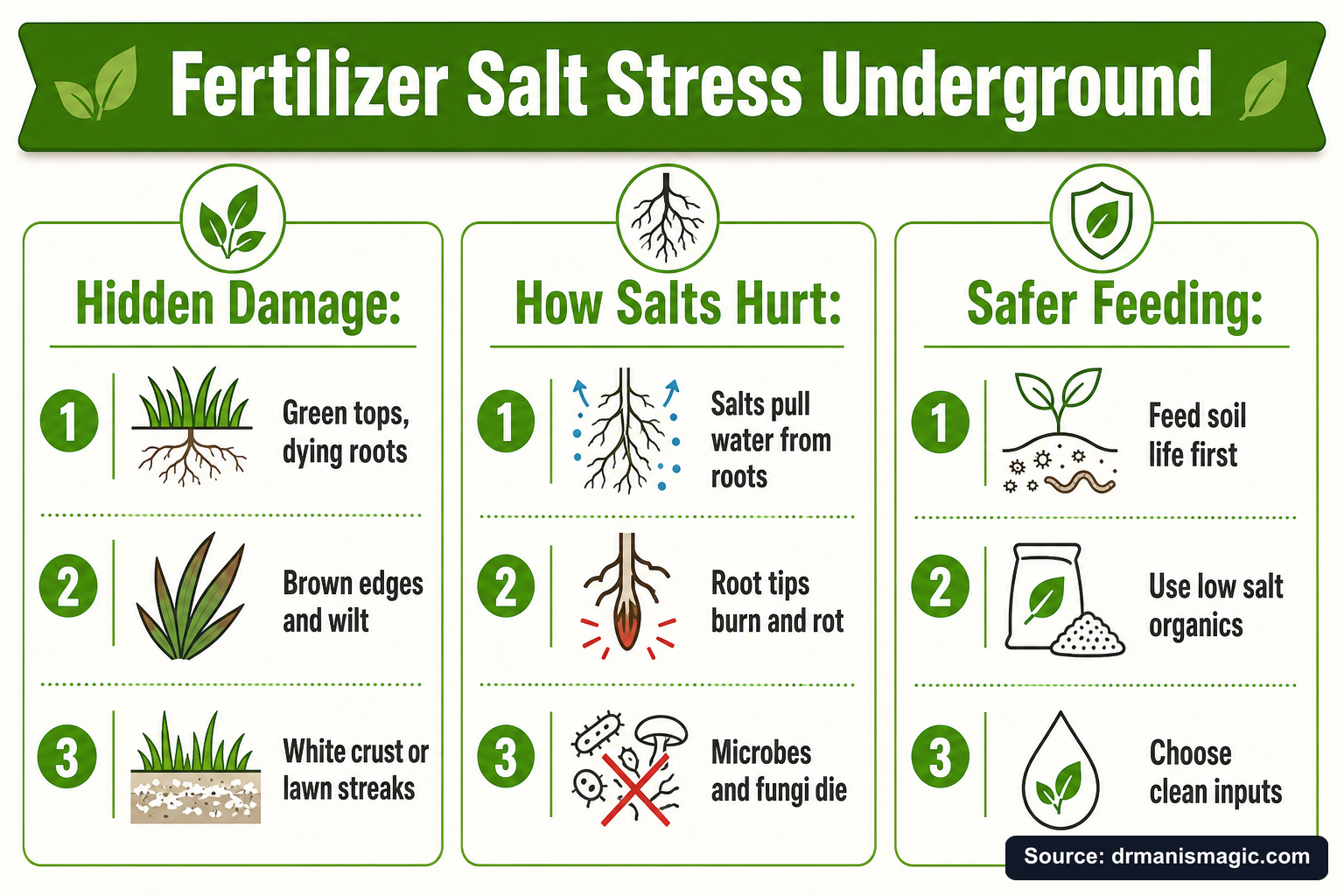
- Most conventional fertilizers are made of soluble salts. Those salts pull water out of roots instead of feeding them, a process called osmotic stress.
- Salt buildup in soil kills the beneficial microbes your plant depends on to absorb nutrients. No microbes means no real nutrition, no matter how much you fertilize.
- Damaged roots lose their ability to take up oxygen and water, creating conditions where root rot pathogens like Pythium and Phytophthora thrive.
- Plants can look temporarily green after synthetic feeding while their roots are quietly dying underground.
- Organic fertilizers like those made from crab, kelp, and amino acids feed the soil biology first, creating a natural slow-release system that mirrors how plants eat in nature.
- PFAS "forever chemicals" from biosludge fillers have been found in some fertilizers, both synthetic and organic. Clean inputs matter.
- The Three Plant Pillars framework, built on mineral soil, live microbes, and organic nutrition, breaks the salt-damage cycle entirely.
What Does "Salt-Based Fertilizer" Actually Mean?
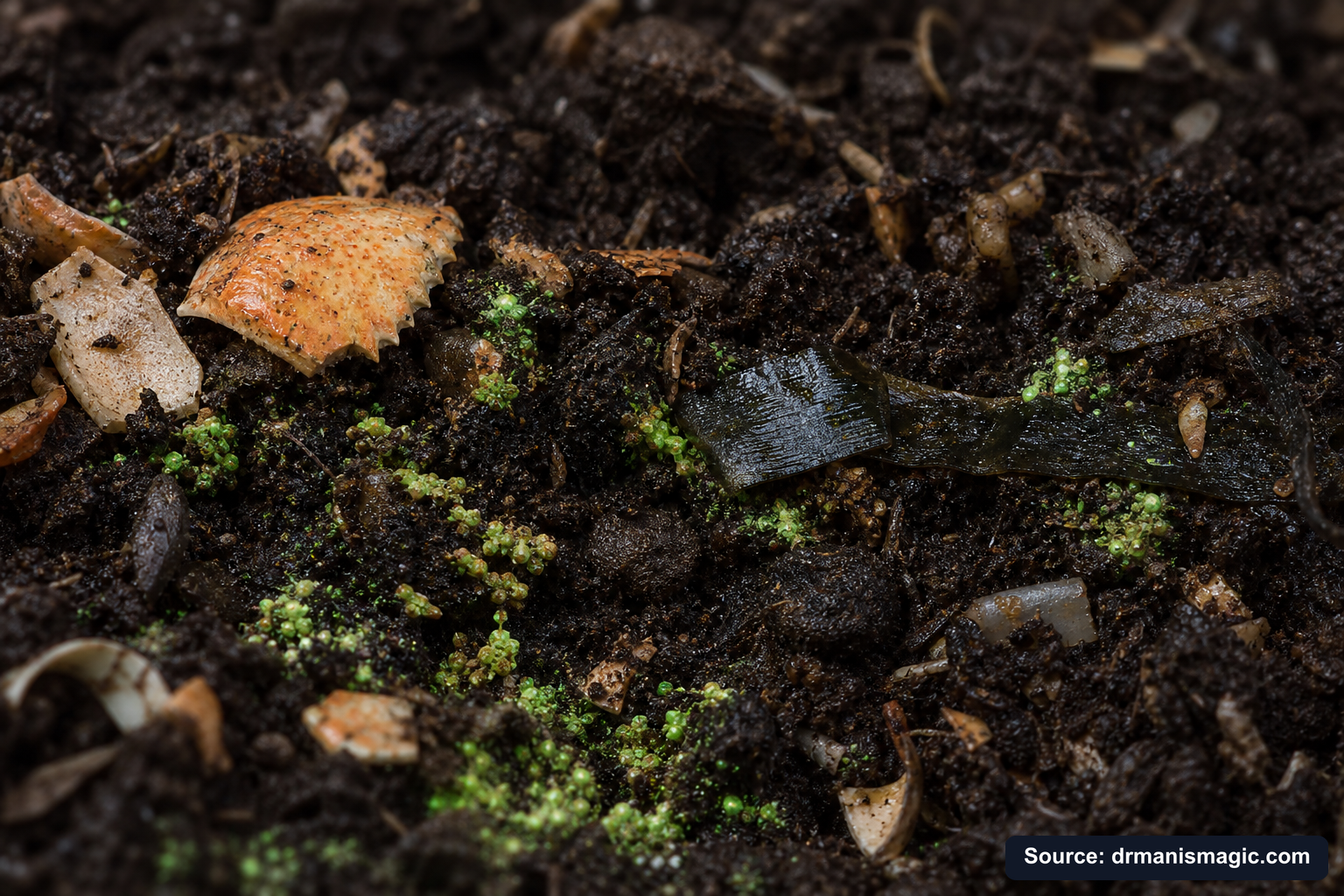
Most synthetic fertilizers are made of mineral salts that dissolve quickly in water. Just like table salt draws moisture out of a slug, these fertilizer salts pull water out of plant roots through a process called osmosis. This dehydrates and burns the root tips, even when you follow the directions on the bag.
Salt is not just the stuff on your kitchen table. In chemistry, a "salt" is any compound formed when an acid and a base are combined. Most synthetic fertilizers are exactly that: ammonium nitrate, potassium chloride, monoammonium phosphate. Salts, all of them.
When you pour these into the soil, they dissolve fast. The water around the roots suddenly has a much higher concentration of dissolved particles than the water inside the roots. Nature tries to balance that out. So water moves from inside the root cells, where there is less salt, to the outside, where there is more. This is called osmotic stress, and it is the same mechanism that makes ocean water dangerous to drink. Your roots are literally losing water even as you water the plant.
The University of Maryland Extension describes this as "physiological drought," meaning the plant acts like it's thirsty even when the soil is wet. University of Maryland Extension notes that salt-injured plants often show symptoms that look exactly like drought stress: wilting, leaf scorch, and brown edges. This confuses gardeners into watering more, which can make things even worse if drainage is poor.
The salt index of a fertilizer measures how much it raises the salt concentration in the soil. High salt index fertilizers, which include most fast-release synthetic products, create the biggest osmotic pressure spikes. Low salt index inputs, including amino acid-based organic fertilizers, create almost none.
See also: The Osmotic Shock Your Plants Feel From Synthetic Nutrients
How Does Fertilizer Salt Damage Show Up? Signs to Look For
Salt damage looks a lot like drought, disease, or overwatering. The most common signs are brown leaf edges, burnt root tips, wilting after you just watered, white crust on top of the soil, stunted seedlings, and a plant that seems to need more and more water to stay alive. In lawns, you often see streaks of brown where the granules sat too long.
This is where most gardeners get lost. The symptoms of fertilizer salt stress look like a dozen other problems. That is why diagnosing underground stress is so hard without knowing what to look for.
Here is what salt damage looks like on the surface:
- Brown or scorched edges on leaves, especially on the outer tips
- Wilting even when the soil feels moist
- White or crusty residue on the soil surface or on the outside of clay pots
- Streaks of brown or dead grass after granular fertilizer application
- Seedlings that germinate but immediately stall or collapse
- Roots that are brown, brittle, or mushy when you pull the plant out
- A plant that seems to perk up after heavy rain, as if the rain "washed" something away (it did)
And here is what it looks like underground, where you cannot see it:
- Fine root hair death at the tips, where most nutrient absorption happens
- Root cell membrane damage that reduces water and oxygen uptake
- A sharp drop in beneficial microbial populations in the root zone
- Compaction of beneficial fungal networks called mycorrhizae
Colorado State University Extension explains that roots need a steady supply of oxygen to grow and to absorb water and nutrients. When root tips are damaged by salt stress, they cannot pull in oxygen properly. That low-oxygen zone becomes an ideal home for root rot pathogens like Pythium and Phytophthora, two of the most common killers of container plants, citrus, lawn grass, and garden vegetables. Colorado State University Extension
See also: How Fertilizer Salts Block Water Instead of Helping Plants
Salt Damage vs. Overwatering vs. True Root Rot: How to Tell the Difference
Salt damage, overwatering, and root rot all look similar from above ground. The key is to check the roots and the soil. Salt damage shows white crust and brown root tips with firm roots. Overwatering shows soggy soil and yellowing. True root rot shows mushy, dark, foul-smelling roots. Often all three happen together after chronic synthetic fertilizer use.
| Symptom | Fertilizer Salt Damage | Overwatering Stress | True Root Rot (Pythium/Phytophthora) |
|---|---|---|---|
| Leaf symptoms | Brown tips and edges, scorch pattern | Yellow leaves, general pallor | Wilting, collapse, sudden death |
| Soil surface | White or gray crust visible | Soggy, dark, compacted | Soggy, may have white fungal threads |
| Root appearance | Brown tips, firm body | Pale, soft, waterlogged | Dark brown, mushy, foul smell |
| Timing | Days to weeks after fertilizing | Ongoing with poor drainage | Weeks to months, often follows root damage |
| Plant's response to water | Temporarily improves after heavy rain | Gets worse with more water | Does not respond to water at all |
| Common cause | High salt index fertilizer, too close to roots | Poor drainage, no oxygen in soil | Damaged roots in wet, low-oxygen zone |
| Recovery possible? | Yes, if caught early | Yes, if drainage improves | Difficult; prevention is far better |
Here is the brutal truth. These three problems are not separate events. They form a chain. Salt damages roots. Damaged roots cannot handle normal watering. The waterlogged, low-oxygen zone invites Pythium and Phytophthora. The plant that looked green two weeks ago is now in a full-blown root rot spiral. And the gardener is still standing there wondering why the fertilizer did not work.
Why Do Synthetic Fertilizers Starve Your Soil Microbes?
Soil microbes are living creatures. Salt kills them the same way it kills root cells. When you pour high-salt fertilizer into the soil, you wipe out the bacterial and fungal populations that your plant depends on to cycle nutrients, fight disease, and build healthy soil structure. Without microbes, the plant becomes completely dependent on the next dose of synthetic fertilizer to survive.
This is the part of the story most fertilizer companies really do not want you thinking about.
Your soil is not just dirt. A single teaspoon of healthy garden soil contains more microbes than there are people on Earth. Billions of bacteria, fungi, and other tiny organisms are down there working every single day. Penn State Extension and the University of Minnesota Extension both describe how these microbes perform essential jobs: they break down organic matter, they convert nitrogen into forms plants can absorb, they dissolve locked-up phosphorus from soil particles, they suppress disease-causing pathogens, and they glue soil particles together into the crumbly, well-drained structure that roots love.
These microbes are the real nutrient-delivery system. Not the fertilizer bag.
When soluble synthetic salts flood into the root zone, the osmotic pressure kills microbial cells just like it damages root cells. The colony shrinks. The fungal networks, called mycorrhizae, that connect roots to far-off nutrients get disrupted. The nitrogen-fixing bacteria that pull free nitrogen from the air slow down or stop entirely. The disease-suppressing organisms that keep Pythium in check disappear.
And here is the cruel irony. Without microbes, the plant cannot access the nutrients that are already in the soil. So it looks deficient. So the gardener adds more fertilizer. Which adds more salt. Which kills more microbes. Round and round it goes, creating what Dr. Mani Skaria calls a vicious feeding cycle, where the plant becomes addicted to the next synthetic hit just to stay alive.
Washington State University's soil science resources caution against oversimplifying this issue. Synthetic nitrogen does not automatically destroy all organic matter overnight. The more defensible and honest story is this: a fertilizer-only program that adds no carbon, no biology, and no organic matter gradually hollows out the soil food web. The microbes starve. The soil structure degrades. The plant becomes fragile.
At our nursery in South Texas, after growing over 250,000 trees, we watched this happen with conventional feeding programs. Trees that received only synthetic fertilizers looked great for a season or two, then plateaued, got weaker, and became magnets for pests and disease. The soil under them was compacted and lifeless. Trees on our Three Plant Pillars system kept improving year after year.
What Is the Underground Stress Chain and Why Does It Matter?
The underground stress chain is the sequence of damage that starts with one dose of high-salt fertilizer and ends with root rot, disease, and a plant that cannot recover. Salt raises osmotic pressure, burns root tips, kills microbes, reduces oxygen in the root zone, invites pathogens, and creates fertilizer dependency. Understanding this chain is how you break it.
Let us walk through it step by step, because once you see it, it becomes obvious why the standard advice is not working for so many gardeners.
- You apply a high-salt synthetic fertilizer. It dissolves quickly. The salt concentration around the roots spikes.
- Osmotic stress begins. Water moves out of root cells toward the high-salt zone outside. Root tips experience physiological drought even in moist soil.
- Root tip cells are damaged or killed. The fine root hairs, where 90% of nutrient and water absorption happens, die back. The plant's intake system is compromised.
- Microbial populations crash. Salt kills bacteria and fungi in the root zone. The natural nutrient-cycling workforce disappears.
- Oxygen availability drops. Damaged roots cannot maintain the same gas exchange. If drainage is poor or you are watering frequently to manage the wilting, the root zone becomes waterlogged and low in oxygen.
- Pythium, Phytophthora, and other root rot pathogens move in. They love low-oxygen, wet environments. They colonize the already-damaged roots. Rot spreads.
- The plant becomes dependent. Without microbes, the plant cannot access stored soil nutrients. It needs the next synthetic dose to show any green. You apply more. The chain restarts.
This is the silent stress. It is quiet. It is invisible. And it is happening underground in millions of lawns, gardens, container plants, and orchards right now.
See also: The Hidden Reason Synthetic Fertilizers Cause Root Rot
How Does Organic Fertilizer Actually Feed a Plant? The Microbe-First System Explained
Organic fertilizer does not go straight into the plant. It feeds the microbes in the soil first. The microbes eat it, digest it, and convert it into simple forms of nutrients the plant can absorb through its roots. When those microbes eventually die, they release even more nutrition directly into the root zone. This creates a natural, ongoing slow-release feeding system that keeps working long after you apply it.
This is the mechanism most gardening content completely skips over. And it is the single most important thing to understand about the difference between synthetic and organic nutrition.
Picture it this way. You sprinkle organic granules around the base of your plant. They sit in the warm, moist soil. The bacteria in the root zone start breaking them down. They eat the proteins and carbohydrates in the granules. As they digest them, they release nitrogen, phosphorus, potassium, and trace minerals in simple ionic forms that root hairs can drink in directly.
Then those microbes live their short lives and die. And when they die, every nutrient stored inside their tiny bodies is released right there in the root zone. Their bodies become food for the next generation of microbes, which in turn feeds the plant again. It is a living, self-renewing feeding cycle. It is what happens naturally on a forest floor, in a meadow, under healthy prairie grass. No bag required. No salt spike. No osmotic stress.
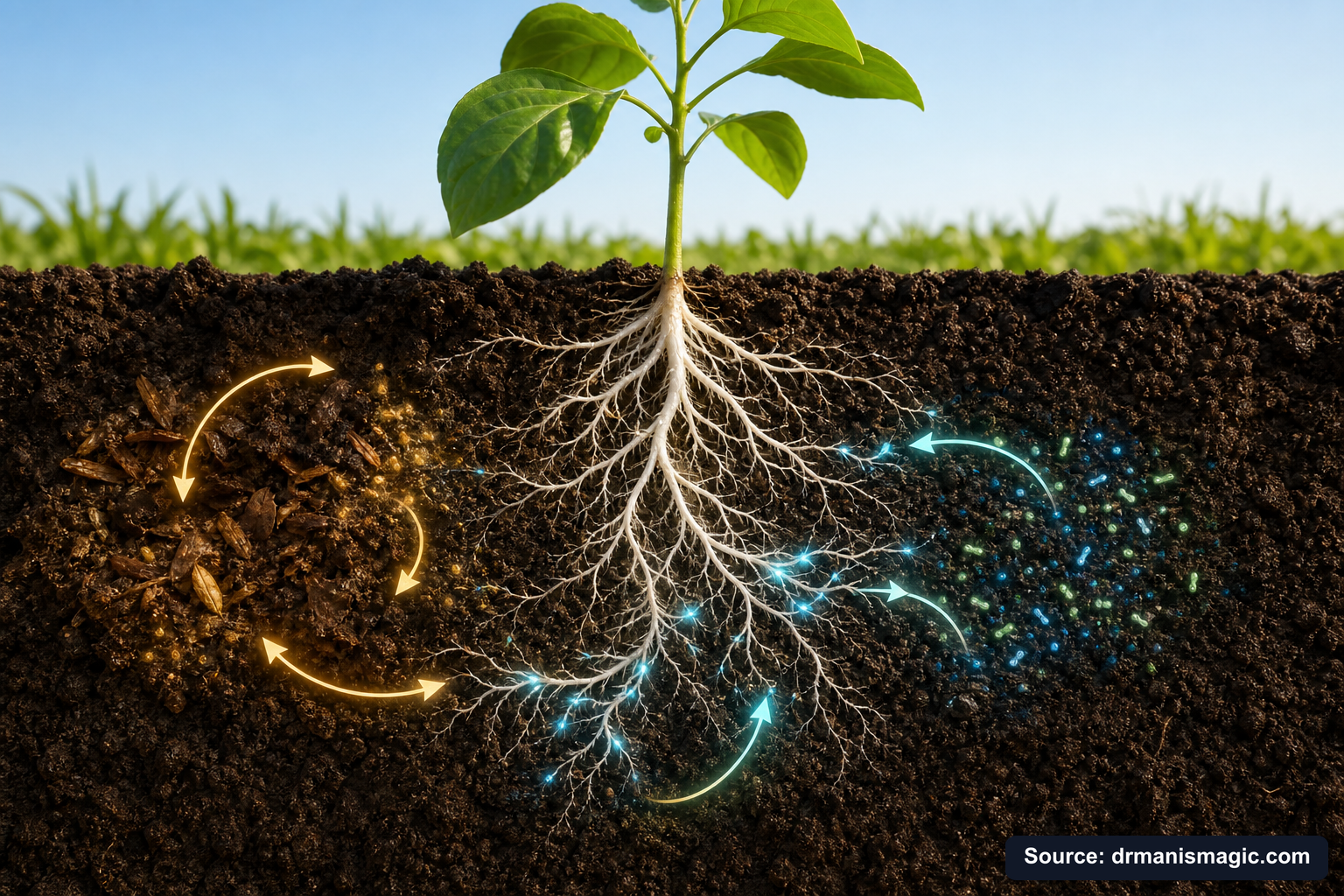
This is why plants fed with organic nutrition develop stronger, deeper root systems over time. The roots are not damaged by salt. The microbes are thriving. The soil structure improves. And the plant builds genuine resilience instead of chemical dependency.
Amino acids are a key part of this story. When a fertilizer contains amino acids, the plant does not have to spend energy converting complex nitrogen compounds into usable forms. Amino acids are already the building blocks of protein. The plant can absorb them directly or use them as immediate nitrogen sources. This is gentle, efficient nutrition that works with the plant's biology, not against it.
Chitin from crab shells adds another layer. Chitin is the tough structural material that makes up crab and shrimp shells. When chitin breaks down in the soil, it stimulates a specific group of microbes called chitinase-producing bacteria. These bacteria are also natural enemies of fungal pathogens, including the cell walls of Pythium and Phytophthora. So feeding your plant with crab-based organic fertilizer also quietly primes your soil's immune system. It is nutrition and defense in one.
Kelp brings something different again. Cold-processed kelp is rich in natural plant growth hormones called auxins and cytokinins, plus a broad spectrum of trace minerals, carbohydrates, and biostimulants. Auxins promote root elongation. Cytokinins stimulate cell division. The carbohydrates in kelp feed soil microbes directly, boosting their populations. And the trace minerals fill in nutritional gaps that macronutrient fertilizers always miss.
This combination, crab chitin plus kelp biostimulants plus amino acid nitrogen, is the philosophy behind our Crab, Kelp & Amino Acids formula. Zero synthetic salts. Zero PFAS. Zero biosludge. Just clean, biologically intelligent nutrition that works the way nature intended.
You Never Had a Brown Thumb.
You were handed the wrong tools. This free guide hands you the right ones.
You watered it. You fed it. It died anyway.
It was never you. It was the dirt, the salt food, and the bad advice.
This guide shows you what really went wrong, and how to fix it for good.
- Why your plants really died, and why it was never your fault
- The salt hiding in your plant food that quietly burns the roots
- The hidden killer in almost every bag of store soil
- The tiny helpers that grow a whole forest for free
- The rescue trick that brings a half dead plant back to life

What Is the Fertilizer Type Comparison? Synthetic vs. Organic vs. Biological Inputs
Not all fertilizers carry the same risks. Fast-release synthetic fertilizers have the highest salt index and the most microbial damage potential. Slow-release synthetics are better but still contain plastic coatings and salt compounds. Organic inputs based on chitin, amino acids, and kelp have near-zero salt risk and actively feed soil biology. The right choice depends on your soil goals, not just your NPK numbers.
| Fertilizer Type | Salt Risk | Microbial Impact | Nitrogen Speed | PFAS/Biosludge Risk | Best Use | Key Caution |
|---|---|---|---|---|---|---|
| Fast-Release Synthetic (e.g., ammonium nitrate, urea) | Very High | Damages and kills microbes | Immediate | Low direct risk, but no biology support | Emergency green-up only | Burns roots, causes osmotic stress, creates dependency |
| Slow-Release Synthetic (coated prills) | Moderate | Less acute damage, still salt-based | Weeks to months | Plastic coating residue in soil | Turf, large-scale use | Plastic shell fragments accumulate; still no biology support |
| Compost / Aged Manure | Very Low | Feeds and builds microbial populations | Very slow | Biosolid-sourced compost may contain PFAS | Soil amendment, top dressing | Check source; biosolid compost carries PFAS risk |
| Amino Acid / Protein Hydrolysate | Very Low | Feeds microbes; directly absorbed by roots | Fast to moderate | Depends on source; animal-derived is clean | All plants, containers, lawns | Choose animal-derived, not biosludge-derived |
| Chitin (Crab/Shrimp Shell) | None | Stimulates beneficial bacteria; suppresses pathogens | Slow, biology-mediated | None | Disease suppression, root health, all plants | Works best with active microbial population |
| Kelp Meal / Extract | None | Feeds microbes with carbohydrates; stimulates populations | Slow; biostimulant effect is fast | None | Stress recovery, root growth, all plants | Cold-processed retains hormones; heat-processed loses them |
| Volcanic Ash / Rock Dust | None | Provides mineral habitat for microbes | Very slow; mineral release over years | None | Long-term trace mineral supply, cell wall strength | Works as a complement, not a standalone nitrogen source |
What Is the PFAS and Biosludge Problem in Fertilizers?
Some fertilizers, both synthetic and organic, use "biosludge" as a filler. Biosludge is treated municipal sewage waste. Research has found that biosludge can contain PFAS, known as forever chemicals, that do not break down in soil or in the human body. If you are growing food, feeding children, or walking barefoot on your lawn, clean fertilizer inputs are not optional. They are essential.
This is the part of the fertilizer conversation that almost nobody wants to have. But you deserve to know it.
PFAS stands for per- and polyfluoroalkyl substances. They are called forever chemicals because they do not break down. They accumulate in soil. They move into groundwater. They get taken up by plant roots. They have been found in human blood samples across the country.
Here is the uncomfortable part. Some fertilizers, including products marketed as "organic," use treated municipal waste, called biosolids or biosludge, as a cheap nitrogen filler. This material can contain PFAS from all the industrial and pharmaceutical compounds that flow through sewage systems. When you spread that fertilizer in your garden, you may be depositing forever chemicals into the soil where your vegetables grow and your children play.
This is not a scare tactic. It is a real and documented concern that the EPA is currently investigating. And it affects home gardeners, not just industrial farms.
The Dr. Mani's Magic formulas contain zero biosludge and zero PFAS. Every ingredient is traceable and clean. Crab shells from seafood processing. Cold-processed kelp. Animal-derived amino acids. Volcanic ash for trace minerals. That is it. No fillers. No sewage. No forever chemicals.
What is it worth to walk barefoot on your lawn without wondering what is soaking into your skin? What is it worth to let your kids play in the garden without worrying about what is on their hands? That peace of mind has a real value. And it starts with knowing exactly what is in your fertilizer.
How Do the Three Plant Pillars Fix the Underground Stress Problem?
The Three Plant Pillars, mineral-based soil, live microbes, and organic fertilizer, address the root cause of underground stress at every level. Mineral soil provides drainage and oxygen so roots never suffocate. Live microbes rebuild the biological workforce that salt destroyed. Organic fertilizer feeds the whole system without salt spikes. Together, they stop the underground stress chain before it starts.
Dr. Mani Skaria spent 40 years as a plant pathologist and professor at the Texas A&M Citrus Center. He has seen root rot, fertilizer burn, salt accumulation, and microbial collapse up close in commercial orchards, university research plots, and home gardens. What he concluded was simple. You cannot out-fertilize bad soil. You cannot out-water salt damage. You cannot spray your way out of a root rot caused by poor biology.
You have to fix the foundation.
That is what the Three Plant Pillars are. A foundation, not a fix. Here is how each pillar addresses the underground stress chain directly.
Pillar One: Mineral-Based Soil. Most potting mixes are made from pine bark, wood chips, or peat. These materials decompose. When they break down, they compact. Compacted soil has no air pockets. No air pockets means no oxygen for roots. No oxygen means root cells suffocate and become vulnerable to Pythium and Phytophthora, the exact pathogens that cause root rot. Our Super Soil is built on silica-rich sandy loam from the Rio Grande Valley. It does not decompose. It stays open and draining permanently. Roots can breathe. Water moves through. Oxygen stays available. The underground stress chain cannot even begin.
Pillar Two: Live Microbes. Rebuilding a destroyed microbial population after years of synthetic fertilizer use takes time. But introducing live bacteria, fungi, and mycorrhizae directly into the root zone through a liquid drench like Plant Super Boost jumpstarts the process immediately. These microbes colonize the root zone, start cycling nutrients, suppress pathogen populations, and begin rebuilding the underground ecosystem that makes plants genuinely resilient.
Pillar Three: Organic Fertilizer Without Salt. When you remove the salt and replace it with biology-friendly nutrition, the whole dynamic changes. Roots are no longer under osmotic stress. Microbes are no longer being killed off. The soil food web can function. Plants stop being addicted to the next synthetic hit and start building real, lasting health.
We have tested this system on over 250,000 citrus trees. On houseplants. On tropical trees. On grass and garden beds. The results are consistent. When all three pillars are in place, plants become, as Dr. Mani says, practically bulletproof.
See also: Why Most Fertilizers Are Actually Salt in Disguise
How Do You Recover From Fertilizer Salt Damage? A Step-by-Step Checklist
Recovery from fertilizer salt damage is possible if you act quickly. The key steps are to stop synthetic feeding, leach the salt from the soil with deep watering if drainage is good, improve organic matter and microbial life, and avoid fertilizing again until the plant shows recovery. Full recovery can take several weeks to a few months depending on how severe the damage was.
If you recognize the signs from earlier in this article, here is what to do right now.
- Stop all synthetic fertilizer immediately. Do not add more salt to an already-stressed root zone. Give the plant time to stabilize.
- Water deeply once, only if your drainage is good. A slow, deep soak helps leach dissolved salts down and away from the root zone. Do not do this if your soil drains poorly or you will create a waterlogged, low-oxygen environment that makes root rot worse.
- Remove visible granules from the soil surface. If you can see undissolved fertilizer, gently rake it away from the plant base.
- Improve soil drainage if needed. If water sits on the surface for more than a few minutes after watering, your drainage is inadequate. Mixing in perlite, rice hulls, or transitioning to a mineral-based soil blend can help.
- Introduce live microbes. Apply a liquid microbial drench to help repopulate the root zone with beneficial bacteria and fungi. This is one of the fastest ways to help damaged roots begin recovering.
- Add a thin layer of clean organic matter. A light top dressing of clean compost (not biosolid-sourced) helps feed recovering microbes and buffer the root zone.
- Resume feeding only when the plant shows new healthy growth. When you do resume, choose a low salt index, biology-friendly organic fertilizer. Start with a half-rate application and watch the plant's response before returning to a full program.
The most important thing to know about recovery is this. You can always get your money back. You cannot get your time back. A plant that spends six months in a synthetic salt death spiral is six months you will never see again. A fruit tree that spent two years struggling to recover is two years further from the day you taste fruit from your own branches.
That is the real cost of the old way. Not just the fertilizer bag. The time.
Does Any of This Apply to Lawns, Houseplants, and Gardens? Or Just Trees?
The underground stress chain from synthetic fertilizer salts applies to every plant on the planet. Lawn grass, raised garden beds, container houseplants, flowering shrubs, vegetable gardens, and orchards all depend on the same root biology. Salt stress, microbial loss, oxygen depletion, and root rot do not discriminate by plant type.
We built our system around citrus because that is where Dr. Mani Skaria spent 40 years of his career. Citrus roots are sensitive, demanding, and brutally honest. When something is wrong underground, a citrus tree tells you fast. That made our nursery the perfect testing ground.
But here is what we have learned. Every plant root system operates by the same biological rules. Grass roots suffocate in compacted, low-oxygen soil the same way a lemon tree does. A potted orchid on your kitchen windowsill gets osmotic stress from high-salt fertilizer the same way a backyard peach tree does. Your vegetable garden's microbial population gets wiped out by synthetic fertilizer spikes the same way a commercial orchard's does.
The Three Plant Pillars are not a citrus-only system. They are a first-principles approach to plant biology. Mineral soil for drainage and oxygen. Live microbes for nutrient cycling and disease suppression. Organic nutrition that feeds the biology instead of burning it. Those three things apply whether you have a mansion with two acres of lawn or a single pot of basil on a studio apartment balcony.
After 250,000 trees and more than 10,000 growers, we have the track record to say that with confidence.
For a complete guide to applying these principles to your specific plants, visit our Free Plant Care Field Guide.
Bringing It All Together: What the Underground Is Telling You
Your plants are honest. They always tell the truth. Brown tips, wilting after watering, roots that crumble when you touch them, soil that smells wrong, a plant that just never seems to thrive no matter what you do. These are not mysteries. They are messages from underground.
The silent stress synthetic fertilizers create is not about one bad application or one unlucky season. It is about a system that was never designed to work with soil biology in the first place. Soluble salts were developed to deliver nitrogen fast and cheaply. They do that. But they do it at the expense of the root system, the microbial workforce, and the long-term fertility of your soil.
The good news is that once you understand the underground stress chain, you can break it. Mineral-based soil that never compacts. Live microbes that rebuild the biological workforce. Organic nutrition from crab, kelp, amino acids, and volcanic minerals that feeds the whole system without a single gram of salt.
That is the foundation Dr. Mani Skaria built over four decades of plant pathology research and 250,000 trees. It is the same foundation that turned a struggling plant into a thriving one for thousands of gardeners across the country. Lawns that stayed green without burning. Container trees that fruited when conventional feeding had failed. Gardens that produced year after year without the annual crash and restart cycle.
You were not born with a brown thumb. You were handed the wrong tools. The right tools exist. And they work with nature instead of against it.
If you are ready to see what your soil is truly capable of, explore the Three Plant Pillars system and take the first step toward growing something you will be proud of for a long, long time.
Frequently Asked Questions
You just fertilized your plants and something still feels off. You are not alone. After growing over 250,000 trees in South Texas, Dr. Mani has seen the same silent damage play out underground again and again. These are the questions every plant owner deserves honest answers to.
What are the real downsides of synthetic fertilizer?
Synthetic fertilizers are salt-based. They pull water out of your roots instead of feeding them. Over time, they wipe out the beneficial bacteria and fungi in your soil. No microbes means your plant cannot absorb nutrients no matter how much you pour on. You end up in a cycle of spending more money while your soil gets weaker and your plants get more dependent. That is the trap Dr. Mani spent 35 years trying to solve.
Why do my plants look green at first but then decline after I fertilize?
Synthetic fertilizers give a quick burst of nitrogen that turns leaves green fast. But underground, the salt is stressing your roots and killing your soil life. The green color is a trick. Roots are quietly losing moisture and beneficial microbes are dying off. A few weeks later the plant starts struggling and most gardeners never connect it back to the fertilizer they used. Dr. Mani calls this the salt damage cycle.
Does synthetic fertilizer hurt the soil over time?
Yes, and the damage builds up slowly. Salt accumulates in the soil. The pH shifts. Beneficial microbes get wiped out. The soil compacts and drains poorly. Roots stop breathing. At Dr. Mani's nursery, they saw this pattern destroy tree after tree before the Three Plant Pillars gave them a way out. Mineral-based soil, live microbes, and organic fertilizer work together to rebuild what synthetic inputs destroy.
Is synthetic fertilizer bad for the environment and my family?
Yes. Runoff from synthetic fertilizers pollutes waterways and creates dead zones in lakes and oceans. They release nitrous oxide, a greenhouse gas far more potent than carbon dioxide. Some fertilizers also contain PFAS forever chemicals and heavy metals that end up in your soil and food. Dr. Mani built his product line around clean, USA-sourced ingredients so you never have to worry about what is splashing on your skin or what your kids are walking through barefoot.
Do organic fertilizers actually work as well as synthetic ones?
They work better over time. Organic fertilizers made from crab, kelp, and amino acids feed your soil biology first. The microbes then release nutrients slowly in forms your plant can actually use. There is no salt burn, no microbial massacre, and no toxic buildup. Dr. Mani tested this approach across 250,000 trees. The results showed stronger roots, healthier growth, and plants that kept thriving instead of stalling out after a few months.
What are the long-term effects of using synthetic fertilizers on my plants?
Over months and years, synthetic fertilizer use creates a dead soil environment. Roots become shallow and weak. Plants need more and more fertilizer to show any response. Pest and disease pressure increases because the natural microbial defense system is gone. Dr. Mani watched this happen in nurseries across the country. That is why Pillar Two of the Three Plant Pillars focuses entirely on restoring live microbes to your soil before it is too late.
What is a safe alternative to synthetic fertilizer for any type of plant?
The Three Plant Pillars give you a complete, natural foundation for any plant you grow. Start with mineral-based soil that drains well and does not compact. Add live microbes through Plant Super Boost to rebuild your soil biology. Feed with a clean organic fertilizer made from crab, kelp, and amino acids. No harsh chemicals, no salt burn, no smell. Just the same system Dr. Mani used to grow over 250,000 trees right here in South Texas.
About the Author
Dr. Mani Skaria, PhD
Dr. Mani Skaria, PhD, is a plant pathologist and the scientific founder of Dr. Mani's Magic. He spent 48 years studying how plants, soil, and living microbes work together, including his years as Professor Emeritus at Texas A&M and as a member of the USDA NAREEE Advisory Board. He invented micro-budding, a method for growing healthier, stronger trees, and has grown more than 250,000 trees on the family farm in Hargill, Texas - US Citrus Nursery. His life's work takes real lab science and turns it into simple, safe, organic plant care anyone can use at home.


