


Root Zone Secrets of Productive Citrus Trees Revealed | Dr. Mani's Magic
The Root Zone Secrets of Productive Citrus Trees: What's Really Happening Under Your Feet
Picture this. You're standing in your backyard on a warm Sunday morning, coffee in hand, staring at your citrus tree. The leaves look a little pale. Maybe yellowing at the edges. You fertilized last month. You watered on schedule. You did everything the bag told you to do. And yet something is clearly wrong.
You kneel down. You touch the soil. It feels hard. Crusty on top, maybe a little soggy underneath. You can't see anything wrong. No bugs. No obvious rot. Just a tree that looks tired, like it's slowly giving up. And here's the thing nobody told you: the real problem isn't above the ground. It never was. The real drama — the life-or-death battle that decides whether your tree thrives or slowly fades — is happening in a world you can't see. About six inches below the surface. In a place scientists call the root zone.
What's down there will surprise you. It's not just dirt. It's a living city. Billions of bacteria. Miles of fungal threads. Tiny hunters called protozoa. Microscopic worms. An entire underground ecosystem that either works for your tree or works against it. And once you understand what's really going on down there, everything changes. Your tree changes. The way you garden changes. And you stop guessing forever.
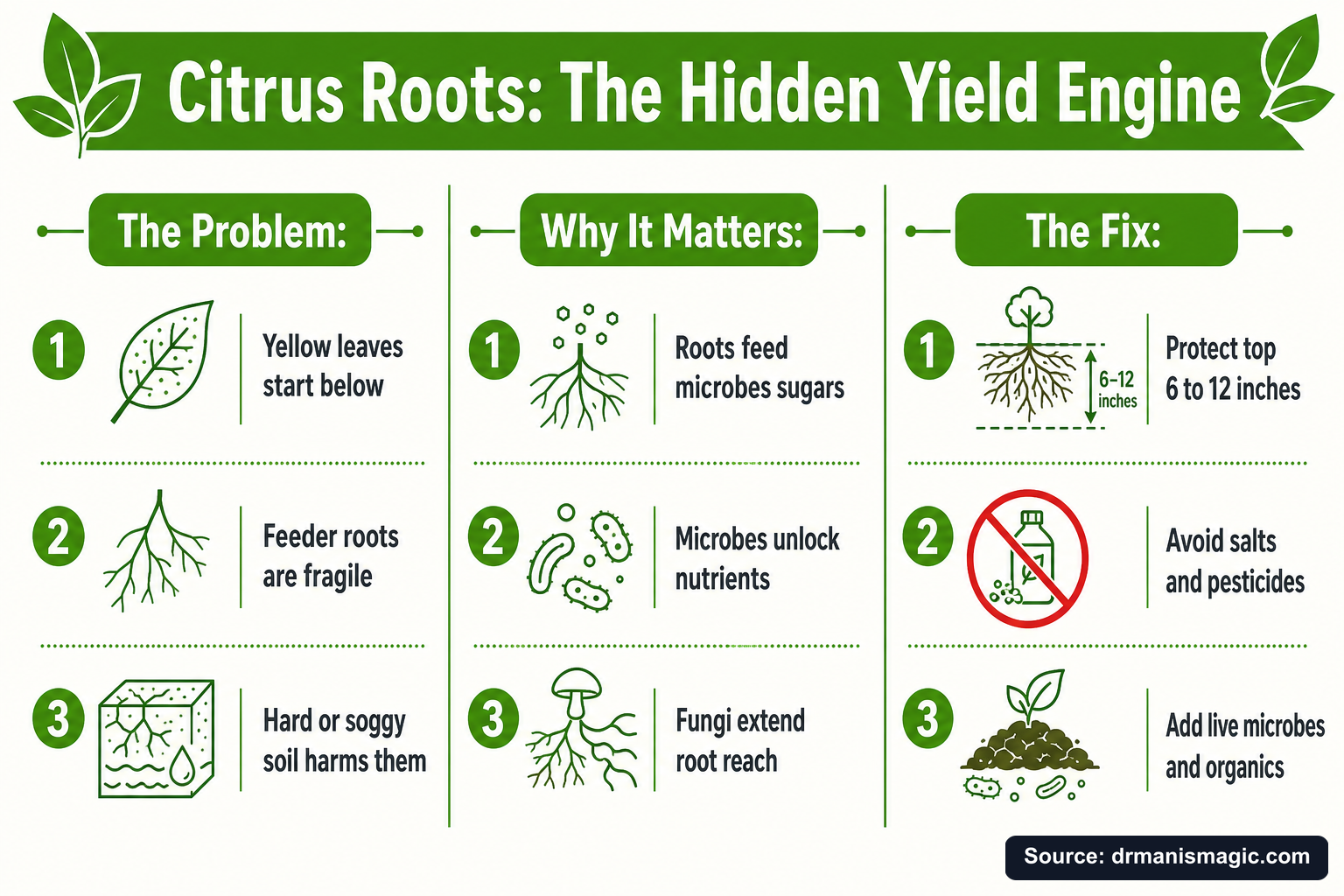
Key Takeaways
- Citrus roots are fragile, shallow, and completely dependent on a living soil ecosystem to absorb water and nutrients.
- The rhizosphere — the thin layer of soil hugging the roots — is the most biologically active place on your property.
- Bacteria, fungi, protozoa, and nematodes all play specific roles in feeding your tree and protecting its roots.
- Salt-based synthetic fertilizers and pesticides quietly destroy this living ecosystem, leaving roots defenseless.
- Dead or dried microbial products from big factories rarely work — live, stabilized microbes are what actually move the needle.
- The Three Plant Pillars — mineral soil, live microbes, and organic fertilizer — give you the complete foundation your tree needs.
- You can rebuild a damaged root zone, but it takes the right inputs, patience, and repeated microbial application.
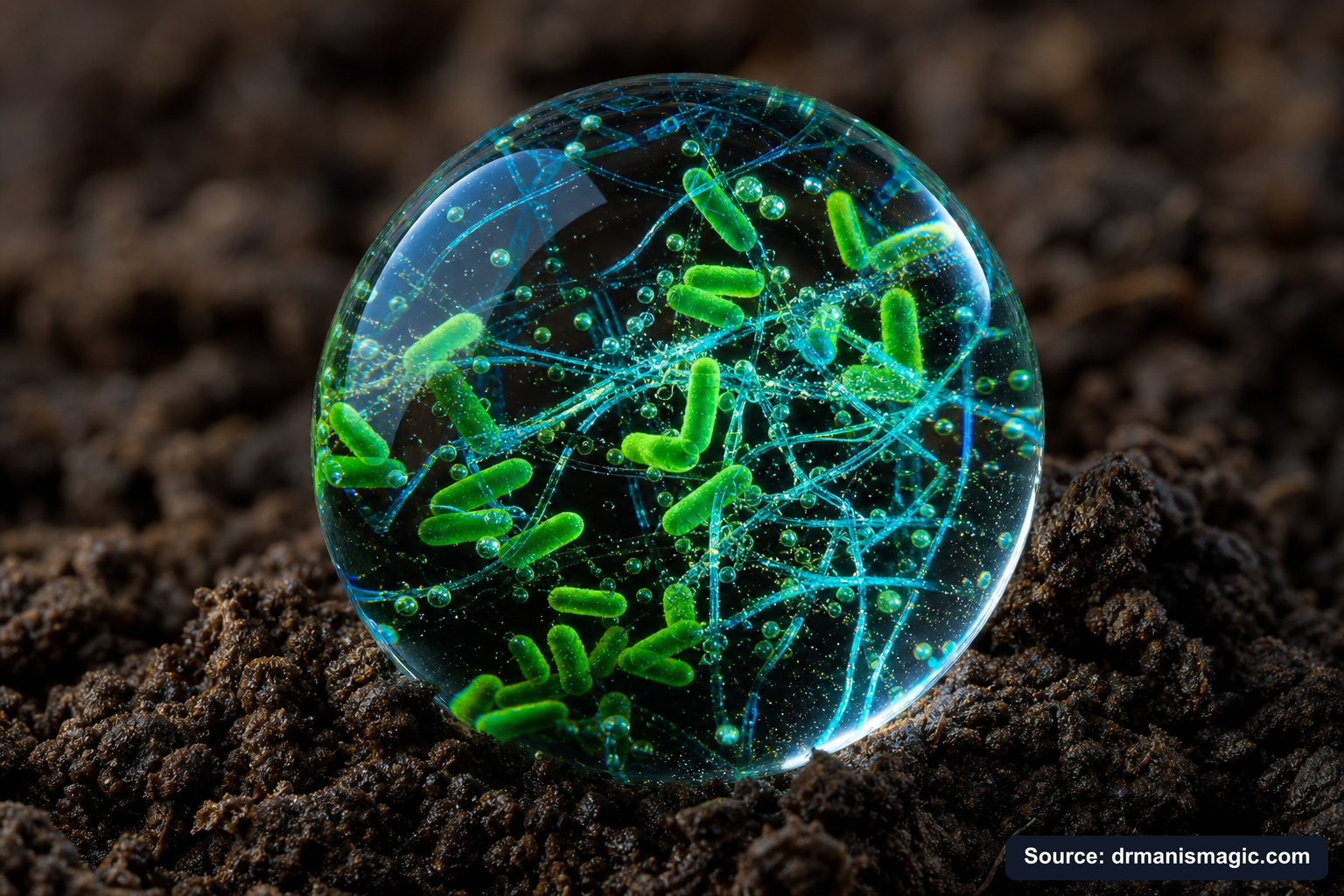
What Are Citrus Feeder Roots and Why Are They So Fragile?
Quick Answer: Citrus feeder roots are tiny, hair-thin roots in the top 6-12 inches of soil near the drip line of the tree. They do 90% of the work of absorbing water and nutrients. They are extremely fragile and can be killed by compaction, waterlogging, salt buildup, herbicides, and even aggressive digging.
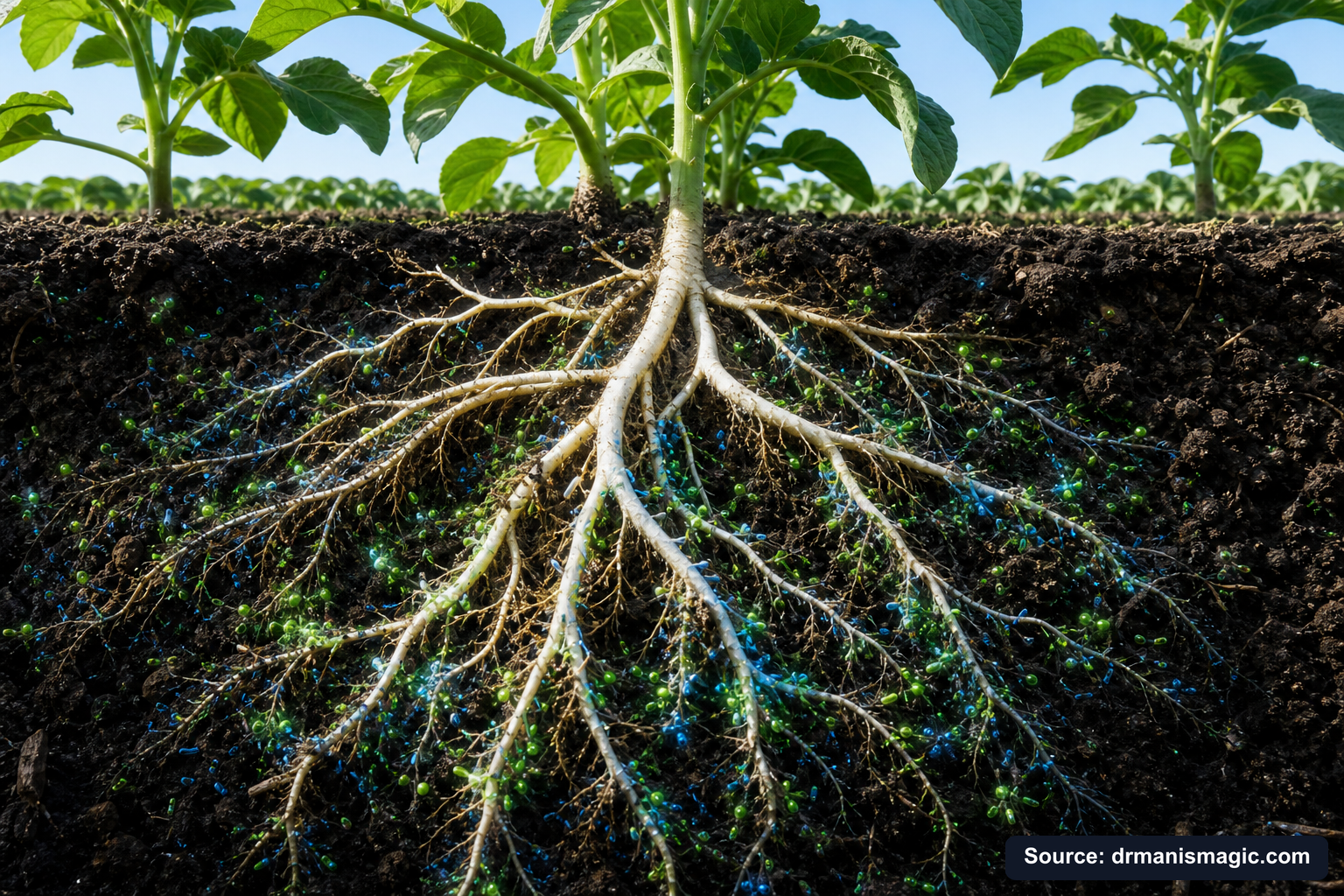
Citrus trees do not pull water and nutrients from deep, thick anchor roots. The big roots are just for stability. The real workers are the feeder roots — thousands of tiny, delicate threads that live near the surface, right where the rain falls from the outer edge of the canopy.
These feeder roots are so thin you can barely see them. And they are completely exposed to everything happening in that top layer of soil. When the soil gets compacted, they suffocate. When it stays waterlogged, they rot. When salt from synthetic fertilizers builds up, they shrink back like someone burned them. When herbicides drift over or soak in, they die within days.
University of California IPM research confirms that tillage — even simple raking or hoeing — can destroy these feeder roots and set your tree back weeks or months. The University of Florida IFAS extension notes that because salt stress, root rot, nematode damage, and overwatering all look similar from the outside, most growers never even know the real cause of the problem.
This is why the first step to a productive citrus tree is protecting and feeding these fragile roots. Not from above. From below. By building the right soil environment around them.
What Is the Rhizosphere and Why Does It Matter for Citrus Health?
Quick Answer: The rhizosphere is the thin zone of soil directly surrounding the roots of your citrus tree. It is the most biologically active spot in your entire garden. Roots release sugars there to attract beneficial microbes, and those microbes deliver nutrients, fight disease, and extend the root's reach far beyond its physical tip.
Most people think of soil as passive. Just dirt that holds a plant upright. But the rhizosphere is anything but passive. It is a battlefield, a trading post, and a factory all at once.
Here is what is actually happening right now, at this moment, around every healthy citrus root:
The root is leaking sugar. On purpose. Up to 40% of everything the tree produces through photosynthesis gets released through the roots as sugary exudates. The tree is literally paying microbes to come work for it. And they show up by the billions.
Bacteria arrive first. They eat the sugars and break down organic matter. They release nutrients in forms the root can actually absorb. They produce compounds that make the root grow faster and branch more. Then fungi arrive. Their thin threads — called hyphae — push out into the soil in every direction, finding water and minerals the root tip could never reach on its own. Then come the protozoa, the tiny single-celled hunters that eat bacteria. When a protozoan eats a bacterium, it releases a burst of nitrogen right next to the root — in exactly the form the plant needs.
This is the soil food web. And when it is working, your citrus tree barely needs your help. When it is broken, nothing you do from the outside fixes the problem for long.
What Is the Soil Food Web and How Does It Feed Your Citrus Tree?
Quick Answer: The soil food web is the living community of bacteria, fungi, protozoa, nematodes, and other organisms that cycle nutrients, fight pathogens, and build soil structure around your roots. Every member plays a specific role. Together they do the work that no bag of fertilizer can fully replicate.
Think of the soil food web like a kitchen crew. Everyone has a job. When the whole crew shows up, dinner gets made. When half the crew is missing, things fall apart fast.
Here is the full crew and what each member does for your citrus tree:
| Soil Food Web Member | Primary Role | Benefit to Citrus Tree |
|---|---|---|
| Bacteria (general) | Break down organic matter, release nutrients | Delivers nitrogen, phosphorus, and trace minerals to feeder roots |
| Nitrogen-fixing bacteria | Pull nitrogen from the air and lock it into soil | Free nitrogen fertilizer, no bag required |
| Phosphate-solubilizing bacteria | Unlock phosphorus that is chemically bound in soil | More flowering, better fruit set |
| Mycorrhizal fungi | Extend root surface area up to 700 times | Dramatically improved water and nutrient uptake |
| Protozoa | Eat bacteria, release nutrients in plant-available form | Concentrated nitrogen delivery right at the root tip |
| Beneficial nematodes | Eat harmful bacteria, fungi, and pest larvae | Natural pest and pathogen suppression underground |
| Glomalin-producing fungi | Glue soil particles together into aggregates | Better drainage, better aeration, less compaction |
Here is the part that blows most gardeners' minds: protozoa are almost never mentioned in gardening content. Yet they are one of the most important members of the whole crew. When protozoa graze on bacteria, they release a burst of plant-available nitrogen directly into the rhizosphere. It is like having a tiny nitrogen delivery truck pulling up to your roots every single day. No bag. No chemical. Just biology doing what it was designed to do.
After growing and studying more than 250,000 citrus trees at our South Texas nursery over 30 years, we can tell you with certainty: the trees that thrive are the trees with a living, diverse, full-spectrum soil food web. The trees that struggle have dead or depleted biology.
It really is that simple.
Do Citrus Trees Really Need Mycorrhizal Fungi?
Quick Answer: Yes. Citrus trees form a specific type of mycorrhizal relationship called arbuscular mycorrhizae. These fungi extend the root's reach dramatically, improve water uptake, and help trees tolerate drought, salt stress, and transplant shock. In sterile or disturbed soils — including most potting mixes — mycorrhizal inoculation is not just helpful, it is essential.
You have probably seen those white fuzzy threads on the roots of weeds you have pulled from the ground. That fuzz is mycorrhizae. And it is the reason weeds grow like they own the place while your citrus tree struggles in the same patch of earth.
Mycorrhizal fungi attach to feeder roots and send their own threads — called hyphae — out into the soil in every direction. These threads are far thinner than roots, so they reach into tiny spaces roots never could. They find water during drought. They find phosphorus and zinc and iron locked in the mineral particles. They bring it all back and trade it to the root for sugar.
According to research from the University of California, citrus is among the plants that form these endomycorrhizal (internal) associations, meaning the fungus actually grows inside the root cells to create the exchange. This is not a surface-level partnership. It is deep biological integration.
But here is the catch. Most commercial potting mixes are steam-sterilized. No mycorrhizae. Most soils treated with synthetic fungicides? The fungi are gone. Most citrus in containers? Completely without this partnership unless you put it back intentionally.
That is why we built mycorrhizal fungi into Plant Super Boost — alongside 2,000+ strains of beneficial bacteria, 400-500 fungal species, protozoa, and beneficial nematodes. Because one species of mycorrhizae from a lab is not the same as a full-spectrum biological community harvested from living compost.
What Kills the Living Biology in Your Citrus Root Zone?
Quick Answer: Salt-based synthetic fertilizers, synthetic herbicides, broad-spectrum pesticides, and antifungal chemicals are the four biggest killers of beneficial soil biology. Each one damages a different part of the soil food web. Used together or repeatedly, they can leave your root zone biologically dead within a single growing season.
Here is something the bag does not tell you. Every time you reach for a fast-acting, synthetic fertilizer, you are choosing salt. All conventional fertilizers are salt-based. And salt, even in small concentrations, damages the fragile microbial communities living around your roots.
It works like this. Salt pulls water out of cells through a process called osmosis. It does this to your tree's feeder roots. It does it to the beneficial bacteria in the soil. It does it to the mycorrhizal fungi. High salt concentration around the root zone is like walking through a desert — everything that needs moisture to survive starts dying.
See also: The Hidden Reason Synthetic Fertilizers Cause Root Rot
And then there is the herbicide problem. Glyphosate, the active ingredient in many common weed killers, has been shown in multiple studies to disrupt microbial communities in soil. Broad-spectrum pesticides kill beneficial insects and soil organisms along with the target pests. Synthetic antifungal drenches knock out the mycorrhizal fungi along with the pathogenic fungi they were meant to stop.
The result? A root zone that looks like a war zone. Sterile. Depleted. Unable to cycle nutrients or fight off the next pathogen that shows up.
| Input or Practice | What It Destroys | What You Lose | Better Alternative |
|---|---|---|---|
| Salt-based synthetic fertilizers | Bacteria, mycorrhizae | Nutrient cycling, root protection | Organic slow-release fertilizer with no synthetic salts |
| Synthetic herbicides (glyphosate) | Broad microbial community | Disease suppression, soil structure | Mechanical weeding, targeted organic options |
| Broad-spectrum pesticides | Beneficial nematodes, protozoa | Natural pest control, nutrient release | Organic pest management, re-inoculate after treatment |
| Synthetic antifungals | Mycorrhizal fungi | Extended root reach, drought tolerance | Biological fungal support, reduce standing water |
| Compaction and tillage | Fungal hyphae networks | Soil structure, aeration | Mulching, minimal disturbance, mineral-based soil |
The hard truth is that most gardening advice out there is built around selling more products. Not around building healthy roots. When your tree struggles, the store benefits. When your soil dies, the fertilizer company profits. We have watched this cycle play out for three decades, and it is exactly why Dr. Mani built the Three Plant Pillars as an alternative to the whole broken system.
You Never Had a Brown Thumb.
You were handed the wrong tools. This free guide hands you the right ones.
You watered it. You fed it. It died anyway.
It was never you. It was the dirt, the salt food, and the bad advice.
This guide shows you what really went wrong, and how to fix it for good.
- Why your plants really died, and why it was never your fault
- The salt hiding in your plant food that quietly burns the roots
- The hidden killer in almost every bag of store soil
- The tiny helpers that grow a whole forest for free
- The rescue trick that brings a half dead plant back to life

How Do You Diagnose Root Zone Problems Without Digging Up the Tree?
Quick Answer: Yellowing leaves, slow growth, dropped fruit, and wilting despite adequate water are all root zone distress signals. But overwatering, salt burn, Phytophthora root rot, nematode damage, herbicide injury, and nutrient deficiency all look nearly identical from the outside. A root-zone triage checklist helps you find the real cause before spending money on the wrong fix.
The leaves are telling you something. But they are not always telling you the truth about the cause.
Yellowing leaves can mean your tree is hungry. Or it can mean the roots are rotting and cannot deliver what they absorb. Or it can mean salt has burned the feeder roots. Or it can mean nematodes have damaged the root system. All four look almost identical from the outside. That is why most growers keep treating the symptom and never fix the actual problem.
Here is a root-zone triage checklist to help you find the real cause:
- Check your watering pattern first. Stick your finger six inches into the soil. If it is wet and smells sour or like mildew, overwatering and possible root rot are your first suspects.
- Test for salt buildup. Look for a white crusty residue on the soil surface or on the inside of terra cotta pots. Salt buildup happens fast with synthetic fertilizers. Flush with clean water deeply and repeatedly.
- Look at where the yellowing starts. Yellowing that starts at the tips of the oldest leaves first points toward salt burn. Yellowing between the leaf veins on young leaves points toward micronutrient deficiency — often because the biology is gone and nutrients are locked up.
- Check drainage. Pour a gallon of water on the soil. If it pools on the surface for more than 30 seconds, your soil structure has collapsed. Organic potting mixes break down within months and start holding water like a sponge instead of draining like healthy soil.
- Look at the roots if you can. Healthy citrus feeder roots are white or cream-colored. Roots that are brown, mushy, or smell bad have rot. Roots with small bumps or galls may have nematode damage.
- Ask what went into the soil recently. Herbicide nearby? Synthetic fertilizer? Antifungal drench? Any of these can wipe out biology and cause symptoms within days to weeks.
- Add biology and observe. After ruling out active rot or flooding, apply a full-spectrum live microbial inoculant and organic fertilizer. If the tree responds within two to four weeks with new growth, biology was the missing piece.
University of Florida IFAS extension notes that because citrus root decline from different causes looks so similar, lab testing of soil and roots is the definitive way to distinguish Phytophthora, nematodes, and other pathogens. But for home growers, this checklist gets you 80% of the way there before spending a dollar on product.
Live Microbes vs. Dead Powders: Why Most Microbial Products Fail in Your Garden
Quick Answer: Most commercial microbial products are dried powders made from a handful of lab-grown species that rarely survive long enough to colonize living soil. Smelly liquid products made from compost often go anaerobic and lose their potency before they reach you. Only genuinely live, stabilized, full-spectrum microbes from real compost deliver the results you see described in the research.
This might be the most important section in this entire article. Because the microbial product market is booming right now. And most of it is hype.
Walk into any garden center and you will find shelves full of bags and bottles claiming to be packed with billions of beneficial organisms. Mycorrhizae. Bacillus. Trichoderma. The labels look impressive. The claims are bold. And after growing and testing dozens of these products at our South Texas nursery, we can tell you plainly: most of them do not work.
Here is why.
The first problem is the powder products. These are made by growing specific microbial species in giant factory vats. The organisms are then dried into a powder. The idea is that the spores will reactivate when you add water. In theory, it sounds reasonable. In practice, we have seen almost no measurable benefit to trees treated with these products compared to untreated controls. The species are too few. The survival rate through drying, shipping, and storage is poor. And the organisms that do survive often cannot compete in a complex living soil environment.
The second problem is the smelly liquid products. These are made by steeping compost or earthworm castings in water — essentially compost tea. The problem is that within 24 to 48 hours, the microbes in these liquids start dying and going anaerobic. Anaerobic means the oxygen runs out and the organisms start fermenting. That is what causes the strong, sewage-like smell. By the time the bottle reaches your door, much of the biology is dead. You might get some benefit from the humic acid and other organic compounds in the liquid. But the microbes themselves? Largely gone.
See also: Why Dead Microbe Products Fail in Real Gardens
The third problem is lactobacillus-based products. Yes, the same bacteria in your yogurt. They are easy to grow, they survive well, and they are cheap to produce. But lactobacillus is so aggressive that it crowds out the beneficial organisms you actually want. It belongs in your gut, not in your root zone.
| Product Type | Microbial Viability | Spectrum of Organisms | Odor | Our Assessment |
|---|---|---|---|---|
| Dried powder (lab-grown) | Very low | Narrow (3-12 species) | Minimal | We have seen no measurable benefit. Avoid. |
| Dry powder rehydrated in liquid | Very low | Narrow | Minimal | Same problem as above. Avoid. |
| Compost tea (fresh, under 24 hours) | Moderate if aerated | Broad but inconsistent | Earthy, turning sour | Works if made and used immediately. Not practical for most growers. |
| Compost tea (old, over 24 hours) | Low (anaerobic) | Partial | Strong, sewage-like | Biology largely dead. Some humic acid benefit only. |
| Lactobacillus-based liquid | High, but wrong organism | Very narrow | Sour/fermented | Crowds out beneficial organisms. Not recommended. |
| Plant Super Boost (stabilized, full-spectrum) | High — verified by lab analysis | 2,000+ bacteria, 400-500 fungi including mycorrhizae, plus protozoa and nematodes | Earthy, not foul | Harvested from real compost, stabilized by proprietary natural method. Visible under microscope. |
What makes Plant Super Boost different is not the marketing. It is the source and the method. Our microbes are harvested from real, hand-crafted, hot compost — the kind of steaming, teeming biological material that gardeners everywhere describe as magical. Then they are stabilized using a proprietary all-natural technique that keeps them alive without going anaerobic. You can actually put a drop under a microscope and watch them move. We have the lab analyses to prove it.
And because the microbes are stable and not fermenting, the product does not stink. That earthy smell is the smell of living soil. Not sewage. Not rot. Just life.
How Do the Three Plant Pillars Rebuild a Damaged Root Zone?
Quick Answer: The Three Plant Pillars — mineral-based soil, live microbials, and organic fertilizer — work together to restore what chemically damaged or biologically depleted soil has lost. Mineral soil provides drainage and oxygen. Live microbes rebuild the food web. Organic fertilizer feeds the tree and the microbes without the salt that kills them. Together, they create conditions where roots can actually recover.
Think about what a root needs to do its job. It needs to breathe. Roots need oxygen just like you do. It needs space to grow without being choked by compacted or waterlogged soil. It needs a living community of microbes to help it absorb nutrients. And it needs food that does not poison the biology it depends on.
Most conventional gardening setups fail on at least two of those four requirements. Here is how the Three Plant Pillars address every single one:
Pillar One: Mineral-Based Soil. Standard potting mixes are made from pine bark, wood chips, and other organic matter. They feel fluffy when new. But within six to twelve months, that organic matter starts breaking down. It compacts. It holds water like a sponge. It steals oxygen from the root zone as it decomposes. The roots suffocate. Our Super Soil is built on a mineral base — silica-rich sandy loam from the Rio Grande Valley — that does not decompose, does not compact, and drains perfectly year after year. It is a permanent investment in the root environment.
Pillar Two: Live Microbials. Once the soil structure is right, you need to repopulate the biological community that chemicals have stripped away. This takes time and repeated application. The microbial community does not rebuild overnight, especially in soils that have been treated with herbicides, fungicides, or salt-based fertilizers for years. Monthly applications of a full-spectrum live microbial inoculant rebuild the food web layer by layer — bacteria first, then fungi, then the protozoa and nematodes that make the whole system hum.
Pillar Three: Organic Fertilizer. Feeding the tree with organic, slow-release nutrients does two things at once. It gives the tree the macro and micronutrients it needs without the osmotic shock of salt-based feeding. And it feeds the microbial community, because the organic compounds in a crab, kelp, and amino acid formula are food for bacteria and fungi, not poison. Zero synthetic salts. Zero biosludge. Zero PFAS. Just nutrients that work with the biology instead of against it.
When all three pillars are in place, something remarkable happens. The root zone becomes self-sustaining. The microbes cycle nutrients. The fungi extend the root's reach. The protozoa release nitrogen. The tree stops struggling and starts producing. Juicy fruit. Strong new growth. Deep green leaves. The smell of citrus blossom drifting across your backyard on a warm evening. That is what a living root zone feels like from the outside.

What Can You Do Right Now to Improve Your Citrus Root Zone?
Quick Answer: Stop using salt-based fertilizers. Stop disturbing the soil around the drip line. Add a layer of organic mulch to protect feeder roots. Apply live, full-spectrum microbials monthly. Switch to organic slow-release fertilizer. Give it 30 to 90 days. A living root zone does not rebuild in a week, but the first signs of recovery come faster than most people expect.
You now know more about what is happening under your citrus tree than most professional gardeners ever learn. So let us talk about what to do with that knowledge.
Here is the honest truth about timing. We get money back when we overspend. We order the wrong thing and return it. We try a product and get a refund. Money comes back.
Time does not.
The number one thing people tell us they want — more than anything else — is to see their own tree bear fruit while they can still enjoy it. Not someday. Not eventually. Now. In their lifetime. In their backyard. Picked with their own hands and eaten at their own table.
And here is the brutal truth about the old way of gardening: salt-based fertilizers and sterile soils and dead microbial products will give you a burst of green for a few months. Then things stall. Then they go backward. Because you cannot go against the laws of nature. The tree needs living biology. Without it, everything you do from the outside is a band-aid on a wound that keeps reopening.
The good news is that the fix is not complicated. After three decades of testing on over 250,000 trees, we have reduced it to three things done consistently. Mineral soil that breathes. Live microbes applied monthly. Organic food that does not poison the biology.
That is it. That is the whole secret of the root zone.
And once those three pillars are in place, something shifts. The tree stops being a source of worry and starts being a source of joy. You walk past it and notice new growth. You smell the blossoms. You watch the fruit swell. You pick it, peel it, and taste it — sweet, tart, alive — and you realize the whole thing was working underground the entire time. You just needed to let it.
If you are ready to stop guessing and start building a root zone that actually works, the Free Plant Care Field Guide is a good place to start. It walks you through the Three Plant Pillars in plain language, step by step, without the jargon. Because gardening should feel like magic. And now you know exactly why it does.
Frequently Asked Questions
Your citrus tree is trying to tell you something. Most of the time, the answer is hiding right below the soil surface. These are the questions real growers ask when their trees stop performing, and the answers come straight from over 30 years of hands-on experience growing more than 250,000 citrus trees in South Texas.
Does Epsom salt actually help citrus trees grow better fruit?
Epsom salt gives your tree magnesium and sulfur, two nutrients that help build chlorophyll and support fruit production. It can help in the short term if your tree is truly deficient. But here is the catch: if your root zone is full of dead soil and no live microbes, your tree cannot absorb what you give it. Fix the root zone first with the Three Plant Pillars, then add targeted nutrients like magnesium on top of a living foundation.
What does magnesium deficiency look like on a citrus tree?
You will see yellow blotches starting near the center of the leaves. They spread outward over time. The tree starts dropping leaves and fruit production falls off fast. New leaves may look green at first, but in bad cases they turn yellow before they are even a year old. This usually means your soil microbes are not unlocking the magnesium already in your soil. Live microbes like those in Plant Super Boost help roots actually absorb what is already there.
How much magnesium does a citrus tree really need?
A citrus tree needs around 200 milligrams of magnesium per month during the growing season. That sounds small, but it is critical. Magnesium is the engine behind chlorophyll, which is what makes your leaves green and your fruit juicy. The problem most growers face is not a lack of magnesium in the soil. It is a lack of the right microbes to unlock and deliver it to the roots. Healthy soil biology makes every nutrient work harder.
When is the best time to spray citrus trees for pests?
Start spraying when new growth is about 4 centimeters long. Keep spraying every 5 to 14 days until those young leaves toughen up. That window protects against citrus leaf miner, aphids, and other common threats. But here is something most people miss: trees with strong root zones and live soil microbes build natural resistance from the inside out. A tree rooted in mineral soil with active microbes is far harder for pests to attack in the first place.
Can coffee grounds help a citrus tree in a pot or garden?
Coffee grounds bring nitrogen, phosphorus, and a little magnesium to the soil. They can be a helpful addition. But they break down slowly and work best when your soil already has active microbes to process them. Without live bacteria and fungi in the root zone, organic matter just sits there. Pair coffee grounds with Plant Super Boost and you give your tree the microbial workforce it needs to actually turn those grounds into food it can use.
Are eggshells a good source of calcium for citrus trees?
Eggshells do contain calcium, and citrus trees love calcium for strong cell walls and better fruit. Outdoor citrus trees benefit more than houseplants because outdoor conditions break the shells down faster. The key is that calcium needs to be unlocked by soil microbes before roots can absorb it. That is why our Three Plant Pillars approach works so well together. Mineral soil, live microbes, and organic fertilizer create the exact conditions your tree needs to use every bit of nutrition you give it.
Do banana peels really work as fertilizer for citrus trees?
Banana peels are rich in potassium, which citrus trees use for fruit development and overall strength. Soaking peels in water and pouring it into the soil is a simple, low-cost trick that many growers swear by. It works even better when your soil is alive with microbes that can break down that potassium and deliver it to the roots. Think of banana peels as bonus fuel. The Three Plant Pillars are the engine that makes that fuel actually burn.
About the Author
Ron Skaria, MD
Ron Skaria, MD, is the co-founder of Dr. Mani's Magic and the son of Dr. Mani. He trained as a medical doctor at Baylor College of Medicine, did his residency at UT Health Science Center - San Antonio and fellowship training at Texas Tech University. He now works full time on the family farm at US Citrus and US Citrus Nursery in Hargill, Texas, building Dr. Mani's Magic alongside his dad. He wrote the Brown Thumb Field Guide to put his father's 48 years of plant science into plain words any gardener can use. His belief is simple. You never had a brown thumb. You just never had the right help.


