


Why Real Soil Is Built From Sand and Stone, Not Wood | Dr. Mani's Magic
Mineral-Based Soil Explained: Why Real Soil Is Made of Stone, Not Wood
The root-science truth about why most potting mixes fail long-lived plants — and what to use instead.
Author Section
Dr. Mani Skaria, PhD
Plant Pathologist • Professor Emeritus, Texas A&M University–Kingsville • USDA NAREEE Advisory Board Member
Over 250,000 trees grown using the biology-first approach.
Key Takeaways
- Real soil is roughly 45% mineral particles, 5% organic matter, and 50% pore space for air and water movement.
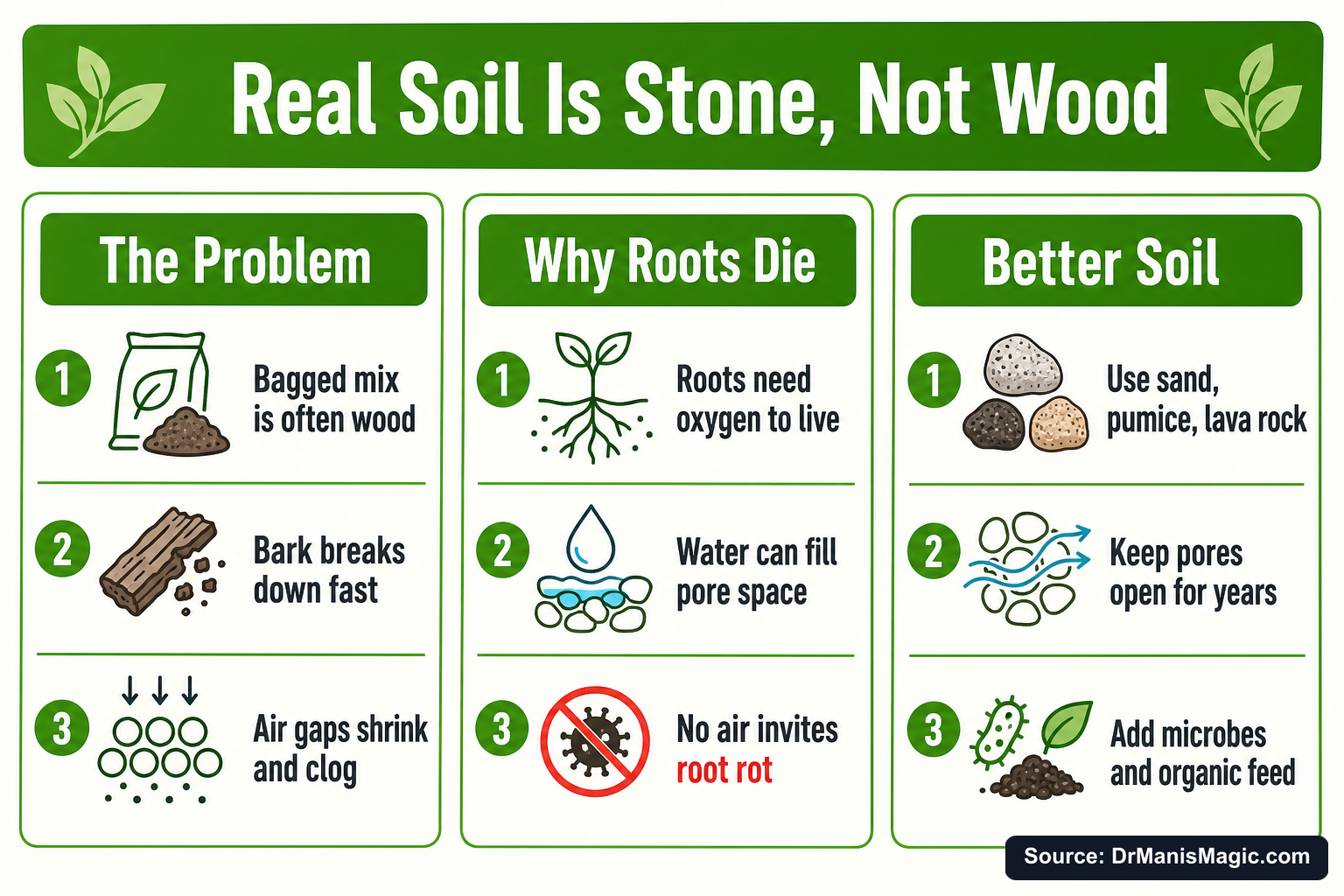
- Roots need oxygen to survive. When water displaces air in soil pores, roots suffocate and root rot follows.
- Most bagged potting mix is pine bark sawdust that decomposes and collapses pore space within 6–12 months.
- Sand, pumice, lava rock, and other mineral particles do not decompose, maintaining root-zone structure for years.
- Bonsai masters have used mineral media for over 1,000 years — the science isn't new, just buried by marketing.
- The Three Plant Pillars — mineral soil, live microbes, organic fertilizer — work as one system. Missing any pillar weakens the others.
What Is Real Soil Actually Made Of?
Definition: Real soil is approximately 45% mineral particles (sand, silt, clay), 5% organic matter, and 50% pore space filled with air and water. The mineral fraction provides permanent structure, while organic matter drives biological activity.
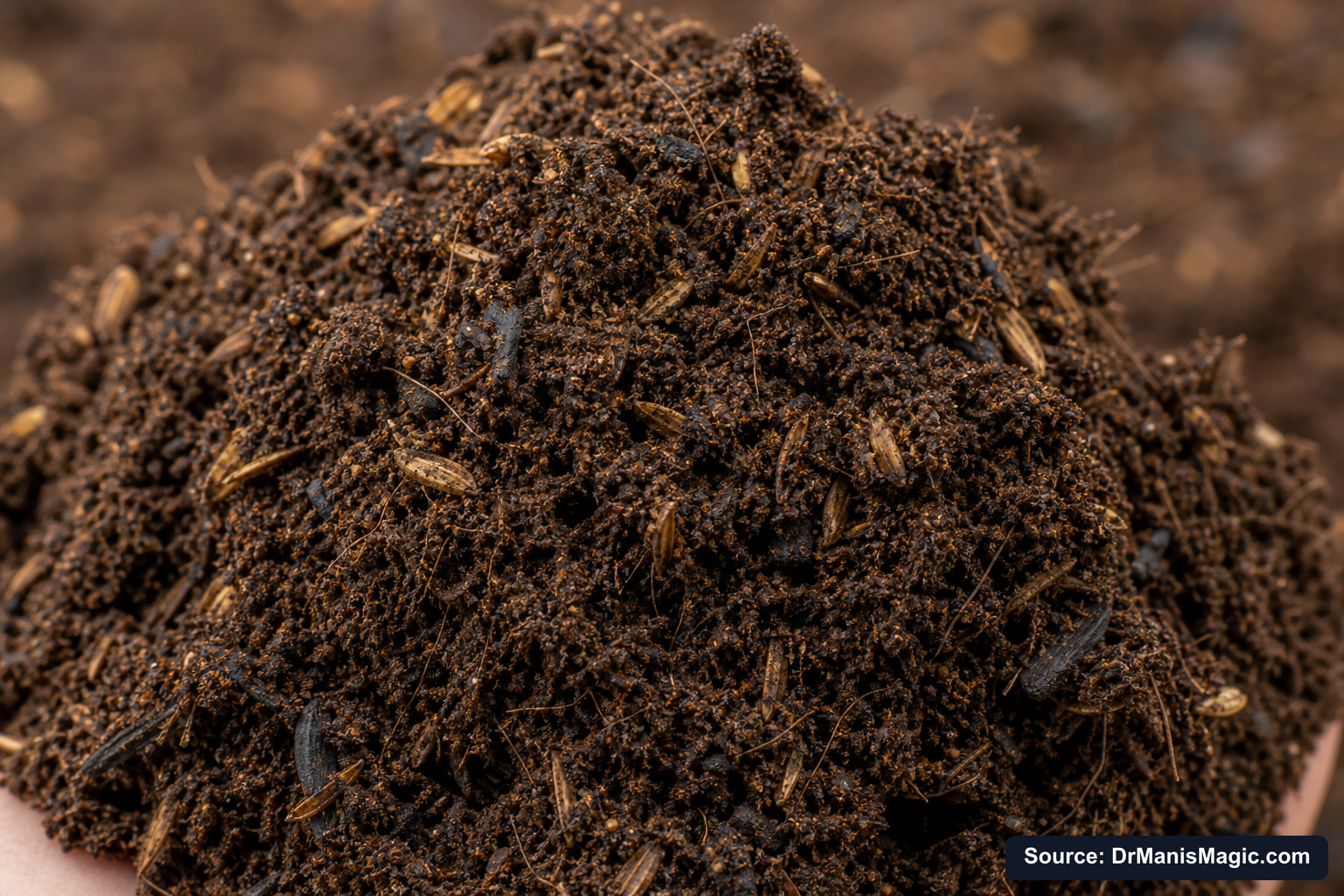
Soil scientists at Rutgers, Purdue, Oregon State, and NC State all describe natural mineral soil with the same composition framework:
| Soil Component | Percentage | Function |
|---|---|---|
| Mineral particles (sand, silt, clay) | ~45% | Permanent structural skeleton |
| Pore space (air + water) | ~50% | Root respiration and water movement |
| Organic matter | ~5% | Nutrient cycling and microbial activity |
The mineral skeleton is the permanent part. Sand, silt, clay, and weathered rock do not decompose. They hold their shape for thousands of years. Organic matter is the living, breathing layer that activates the mineral skeleton — but it is not the foundation.
The principle: Mineral structure carries the load. Organic matter sparks the biology.
Why Do Plant Roots Need Oxygen?
Quick Answer: Plant roots need oxygen for cellular respiration — the process of burning sugars to produce energy. Without oxygen, root cells die within hours, and pathogens like Phytophthora invade the damaged tissue, causing root rot.
How Roots Use Oxygen
While leaves absorb carbon dioxide for photosynthesis, roots perform a completely different function:
- Roots burn sugar produced by photosynthesis to power growth
- Burning sugar requires oxygen — this is cellular respiration
- Oxygen comes from soil pore spaces, not from water
- When water fills pore spaces, oxygen is displaced
- Without oxygen, root cells die within hours
- Damaged roots invite pathogens like Phytophthora root rot
The Truth About "Overwatering"
Overwatering does not kill plants directly. Lack of oxygen kills plants. Water is simply the substance that displaces the air roots need. This distinction matters because the solution isn't always "water less" — sometimes it's "improve drainage and pore structure."
What Is Potting Mix, Really?
Quick Answer: Most commercial potting mix is processed pine bark sawdust — an industrial byproduct of southeastern US timber milling. It is legally classified as "potting mix" rather than "soil" because it is a manufactured organic material, not a true mineral soil.
Why Pine Bark Dominates the Industry
| Factor | Why It Matters to Manufacturers |
|---|---|
| Cheap raw material | Bark is timber mill waste |
| Lightweight | Reduces shipping costs |
| Easy to package | Compressible, baggable |
| Quick turnover | Decomposes within one growing season |
The economic reality: Pine bark serves manufacturers and short-cycle nursery production. It does not serve homeowners growing long-lived plants.
The Decomposition Problem
Pine bark is carbon-based organic material. All organic material decomposes. Decomposition consumes oxygen — the same oxygen your roots need to survive. You are essentially planting your tree in a material that competes with your roots for air.
What Does Pine Chemistry Do to Roots?
Quick Answer: Pine bark contains natural terpenes and terpenoids — the same biologically active compounds found in Pine-Sol cleaner and turpentine paint stripper. These chemicals are harsh in the root zone and require months of aging to partially break down before bark can be used as growing media.
Pine-Derived Compounds You Already Know
- Pine-Sol — cleaning power comes from pine terpenes
- Turpentine — distilled directly from pine resin, used to strip paint
- Rosin — sticky pine resin used in industrial applications
These compounds are biologically active. They are not gentle, neutral substances suitable for plant roots. Nurseries age pine bark in outdoor piles for months or years to allow the harshest chemicals to break down — but that aging process is itself decomposition, which depletes the structural integrity of the material before it ever reaches your container.
Why Does Potting Mix Fail After 6 Months?
Quick Answer: Potting mix fails because pine bark particles decompose and shrink over time. As particles get smaller, they pack more tightly together, eliminating the pore spaces roots need for oxygen. By 6–12 months, most potting mixes have collapsed into compacted, oxygen-poor sludge.
The Six-Month Decomposition Cycle
| Timeline | What Happens to Pine Bark Mix |
|---|---|
| 0–2 months | Loose, chunky texture; good drainage |
| 3–4 months | Particles begin breaking down; pore space shrinks |
| 5–6 months | Significant compaction; water sits longer |
| 6–12 months | Structure collapses; roots suffocate |
| 12+ months | Functionally dead media requiring repotting |
Why you don't notice: The collapse happens slowly. By the time the plant is failing, the soil failure is invisible to the eye. Most gardeners blame themselves, change watering routines, or buy more fertilizer — never suspecting the medium itself.
Why Do Sand and Stone Work Better?
Quick Answer: Mineral particles like coarse sand, pumice, lava rock, and granite grit are silica-based and do not decompose. The pore spaces they create today will still exist in 5, 10, or 20 years. This permanence is essential for plants meant to live longer than one season.
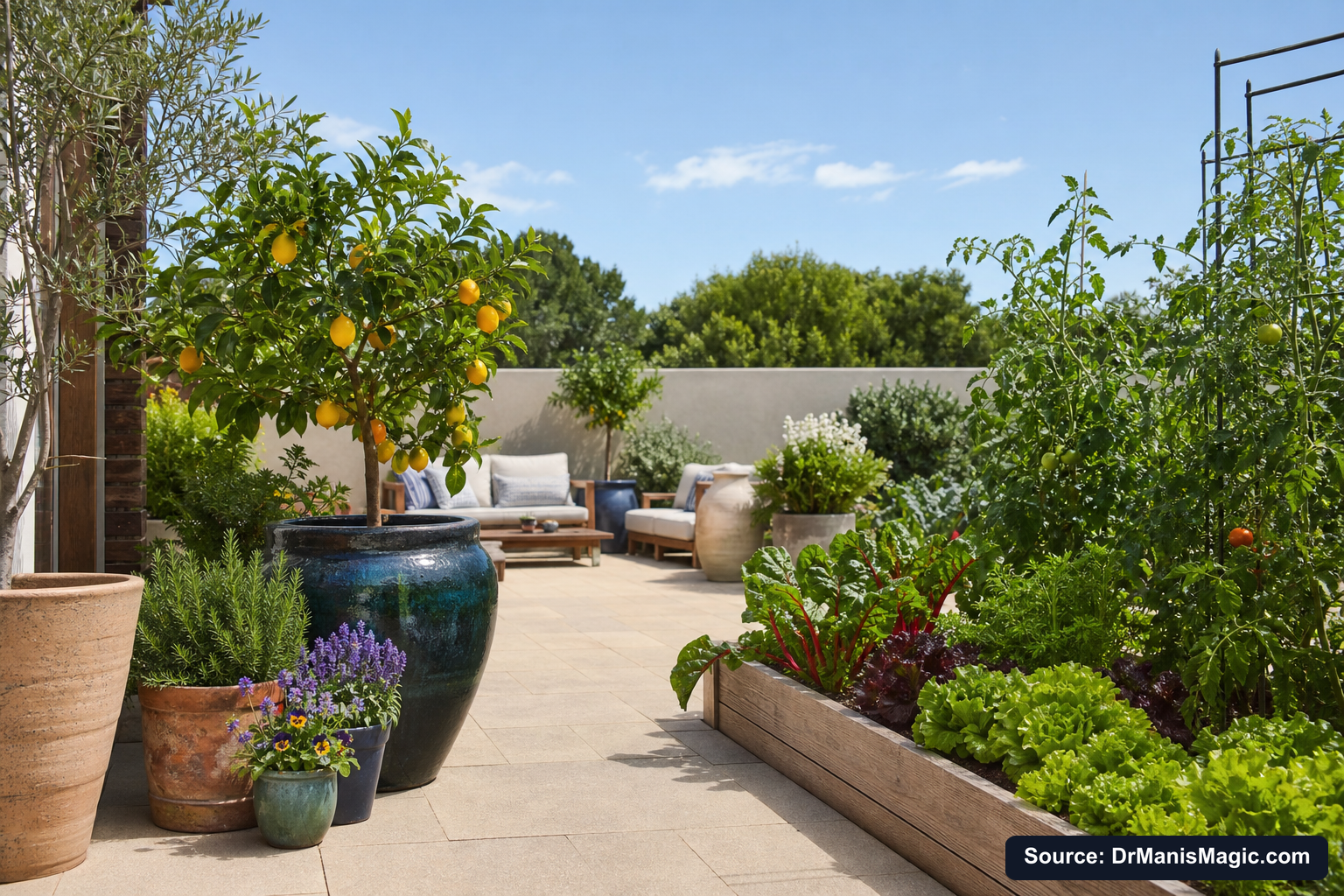
Mineral Materials That Build Permanent Structure
| Mineral | Origin | Key Property |
|---|---|---|
| Coarse sand | Weathered quartz/silica | Permanent pore space |
| Pumice | Volcanic rock | Lightweight, porous, retains air |
| Lava rock | Volcanic basalt | Durable, excellent drainage |
| Expanded shale | Heat-treated shale | Lightweight, stable structure |
| Granite grit | Crushed granite | Sharp, drainage-promoting |
| Decomposed granite | Weathered granite | Mineral-rich, stable |
After growing 250,000+ citrus trees at US Citrus Nursery in South Texas, the team at Dr. Mani's Magic confirmed through repeated trials that mineral-based sandy loam media outperforms organic-heavy mixes in every long-term metric — survival, growth rate, fruit production, and disease resistance.
Comparing Soil Types: Field Soil vs. Potting Mix vs. Mineral Media
| Type | Main Ingredients | Decomposition Risk | Pore Space Longevity | Best Use |
|---|---|---|---|---|
| Natural Field Soil | Sand, silt, clay, organic matter | Low | Decades | In-ground planting |
| Bagged Potting Mix | Pine bark, peat, perlite | High | 6–12 months | Annual flowers, short-season vegetables |
| Bonsai/Gritty Mix | Pumice, lava rock, calcined clay | Very low | Many years | Bonsai, succulents, orchids |
| Mineral Container Media | Sandy loam, coarse sand, coco coir, biochar | Very low | Many years | Citrus, tropical trees, figs, roses, houseplants |
| Compost/Organic Mix | Decomposed plant matter | Very high | 2–4 months | Garden bed amendment only |
Is Organic Matter Bad for Soil?
Quick Answer: Organic matter is essential for healthy soil — but it should not be the structural material in containers. In a confined root zone, organic matter decomposes and collapses pore space. The correct approach is mineral particles for permanent structure plus a small organic fraction for biological activity.
The Right Role for Organic Matter
In field soil, organic matter:
- Binds mineral particles into healthy aggregates
- Acts as a nutrient reservoir
- Feeds soil microbes
- Holds positively charged nutrients (cations)
In container media, organic matter should:
- Stay below 30% of total volume
- Use slow-decomposing forms (coco coir, biochar, rice hulls)
- Support biology without carrying structural load
Mineral skeleton + organic spark plug — never the reverse.
Why Have Bonsai Masters Always Used Mineral Media?
Quick Answer: Bonsai practitioners have grown trees in containers for over 1,000 years using exclusively mineral-based media — Akadama (fired Japanese clay), pumice, lava rock, and decomposed granite. Some bonsai specimens are older than the United States, proving mineral media supports tree life for centuries.
Traditional Bonsai Growing Media
- Akadama — hard-fired Japanese clay granules
- Pumice — volcanic stone for aeration
- Lava rock — durable, drainage-promoting
- Decomposed granite — mineral-rich grit
This isn't new science. It's ancient observed wisdom that the bagged potting mix industry has obscured with marketing. Bonsai masters figured out through generations of practice what soil scientists later confirmed: mineral structure outlasts organic structure in containers.
What Is the Perched Water Table?
Quick Answer: A perched water table is a saturated zone of water that pools at the bottom of every container, regardless of drainage holes. It exists because of capillary force — water clinging to fine particles. Coarser mineral particles dramatically reduce this saturated zone, allowing roots to breathe.
How the Perched Water Table Damages Roots
- Water clings to fine soil particles through capillary force
- In fine potting mix, this saturated zone can extend several inches up from the bottom
- Roots in this zone have zero access to oxygen
- Drainage holes alone cannot solve this — the limiting factor is pore size, not hole size
- Coarser mineral particles create larger pores that allow gravity to overcome capillary force
The fix: Larger mineral particles = smaller perched water table = healthier roots.
Can You Use Backyard Dirt or Hardware Store Sand?
Quick Answer: Backyard soil and bulk sand carry serious risks for container use, including high clay content that destroys drainage and pathogenic organisms (fungi, nematodes, viruses) that can devastate roots. If used, these materials must be sterilized first through solarization or steam treatment.
Risks of Untreated Field Soil in Containers
| Risk | Why It Matters |
|---|---|
| Clay content | Compacts, drains poorly, suffocates roots |
| Fungal pathogens | Phytophthora, Fusarium, Pythium thrive in containers |
| Plant viruses | Spread through soil contact with roots |
| Harmful nematodes | Attack root systems |
| Weed seeds | Compete for nutrients and space |
Sterilization Options
- Solarization — Cover soil with clear plastic in full sun for 2–3 weeks, reaching 140–160°F
- Steam sterilization — Professional treatment used in commercial nursery production
- Pre-sterilized commercial media — Skip the labor entirely with products like Super Soil that arrive ready to use
What Are the Three Plant Pillars?
Quick Answer: The Three Plant Pillars are the foundational requirements for plant health: mineral-based soil for permanent structure, live microbial communities for biological function, and organic fertilizer for clean nutrition. Developed from 40+ years of plant pathology research, these three elements work as a single integrated system.
The Three Pillars Explained
Pillar One: Mineral-Based Soil
- Provides permanent pore structure
- Maintains oxygen access for roots
- Resists decomposition and compaction
- Foundation for everything else
Pillar Two: Live Microbials
- Beneficial bacteria cycle nutrients
- Mycorrhizal fungi extend root reach 10x or more
- Protozoa and nematodes release plant-available nutrients
- Beneficial fungi suppress root pathogens
Pillar Three: Organic Fertilizer
- Slow-release nutrition from natural sources
- No salt damage to microbes
- Sources include crab meal, kelp, and amino acids
- Feeds plant and biology together
The principle: Remove any pillar and the other two cannot compensate. The system works as a whole or it weakens as a whole.
Design Principles for Long-Lived Container Media
For container media that lasts years instead of months, follow these research-backed principles:
- Lead with mineral particles — Coarse sand, pumice, lava rock, expanded shale, or granite grit should make up the majority of the mix by volume
- Use slow-decomposing organic fractions — Coco coir, rice hulls, and biochar last far longer than pine bark
- Avoid fine sand — Fine sand fills pore spaces rather than creating them; always use coarse, gritty sand
- Skip wood fiber and sawdust entirely — These decompose fastest and create the worst long-term outcomes
- Sterilize any field-sourced material — Eliminate pathogens before placing in containers
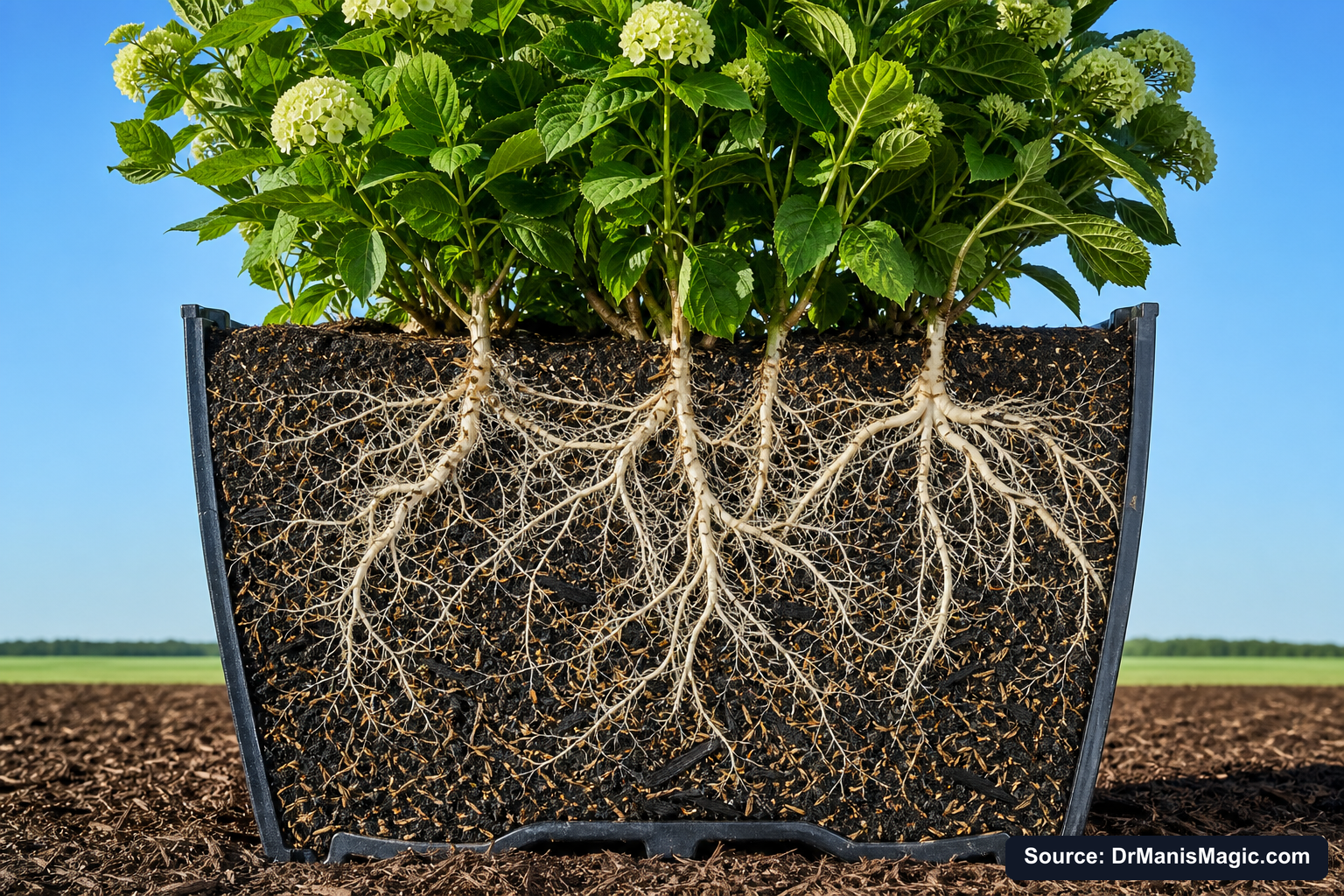
- Design for permanence — The goal is media you never need to replace
Why Does Big Box Potting Mix Keep Selling?
Quick Answer: Short plant lifespans drive repeat sales. A plant that fails in 6 months means a new plant purchase, a new potting mix bag, and often a new fertilizer to "fix" the problem. The retail nursery business model profits from turnover, not from plants that thrive for decades.
The economic incentive structure benefits everyone in the supply chain — except the customer who wanted a tree that lasts. Pine bark is cheap raw material sold at premium garden-center prices. Failing plants generate replacement sales. Confused gardeners buy more products to troubleshoot problems caused by the medium itself.
You can replace money. You cannot replace time. A tree planted in the wrong medium today is a year of growth lost.
Frequently Asked Questions
What is mineral-based soil?
Mineral-based soil is a growing medium where the majority of structure comes from non-decomposing mineral particles like coarse sand, pumice, lava rock, or granite grit. These particles maintain pore space for years or decades, providing permanent oxygen access for roots, unlike organic-based potting mixes that decompose within months.
Why does my potting mix get hard and compacted?
Pine bark and other organic potting mix ingredients decompose over time. As particles break down into smaller pieces, they pack tightly together, eliminating the pore spaces that hold air and allow drainage. This compaction typically becomes severe between 6 and 12 months after planting.
Is overwatering really what kills plants?
Not directly. What kills plants is oxygen deprivation. Water itself isn't harmful — it's the displacement of oxygen from soil pores that suffocates roots. Coarser mineral media drains faster and holds less water in the root zone, making "overwatering" much harder to do.
What is the best soil for citrus trees in containers?
Citrus trees thrive in mineral-based, well-draining media. A blend of sandy loam, coarse sand, coco coir, rice hulls, and biochar provides permanent structure, adequate water retention, and biological habitat. Avoid pure pine bark mixes, which decompose and cause root issues in long-lived trees like citrus.
How long does pine bark potting mix last?
Most pine bark-based potting mixes maintain adequate structure for 6–12 months. After that, decomposition collapses pore space, drainage worsens, and roots begin suffocating. For annual plants this may be acceptable; for perennials, trees, and houseplants, it leads to slow decline.
Can I mix sand into my regular potting soil?
Adding coarse sand can help, but fine sand makes drainage worse by filling existing pores. The better approach is to start with a mineral-dominant mix rather than trying to amend organic potting mix. Aim for at least 50% coarse mineral content for long-term container plants.
What is Akadama and why do bonsai growers use it?
Akadama is a hard-fired clay from Japan used as a primary bonsai growing medium. It maintains structure for years, holds moisture without saturating, and provides excellent drainage. Bonsai masters have used mineral media like Akadama for over 1,000 years because they outlast any organic alternative.
What causes root rot in container plants?
Root rot is caused by pathogenic fungi like Phytophthora and Pythium that thrive in saturated, low-oxygen conditions. The root cause is rarely the pathogen itself — it's the oxygen-poor environment that allows the pathogen to attack damaged or stressed roots. Better drainage prevents most root rot.
Are pine terpenes harmful to plants?
Pine terpenes are biologically active compounds — the same chemicals that give Pine-Sol its cleaning power and turpentine its solvent properties. Fresh pine bark contains harsh terpenes that nurseries age out before sale. However, the aging process itself depletes the bark's structural integrity.
What is a perched water table in a pot?
A perched water table is the saturated zone of water that remains at the bottom of a container after watering, held in place by capillary force regardless of drainage holes. Fine media create deep perched water tables that drown roots. Coarse mineral media reduce this saturated zone dramatically.
Should I add gravel to the bottom of my pots?
No. Adding gravel actually raises the perched water table, making drainage worse. Instead, use a mineral-based growing media throughout the entire container so capillary action and gravity work together to drain water properly.
Can I use sand from the beach in my pots?
Beach sand is generally too fine and contains salt that damages roots and microbes. If you want sand for container use, choose coarse construction sand or horticultural grit, and rinse thoroughly. Pre-sterilized commercial mineral media is safer and more reliable.
Why do bonsai trees live for hundreds of years?
Bonsai trees survive for centuries because they grow in mineral-based media that maintains pore structure indefinitely. Combined with regular root pruning and quality care, the permanent soil structure allows trees to thrive in small containers across multiple human generations.
What is biochar and why is it used in soil?
Biochar is a stable form of charcoal produced by burning organic material in low-oxygen conditions. It is essentially permanent in soil, provides habitat for beneficial microbes, holds nutrients, and improves water retention without decomposing or compacting like fresh organic matter.
How do I know if my container soil has failed?
Signs of failed container soil include water sitting on the surface and draining slowly, plants showing stress despite proper watering, soil pulling away from container edges when dry, hard or compacted texture, and visible decomposition of original particles. These usually appear 6–12 months after planting in pine bark mixes.
What's the difference between coco coir and peat moss?
Coco coir is processed coconut husk fiber that decomposes slowly and resists compaction. Peat moss decomposes faster and becomes hydrophobic (water-repellent) when fully dry. Coco coir is also more sustainable, harvested from coconut byproducts rather than mined from peat bogs.
Do I need to repot if I use mineral-based media?
Mineral-based media itself does not need replacement, but plants may still need repotting as they grow larger. The advantage is that you can refresh the top inch or two and add fertilizer rather than replacing the entire growing medium every year or two.
What microbes should I add to mineral soil?
A complete microbial inoculant should include diverse beneficial bacteria, mycorrhizal fungi, protozoa, and beneficial nematodes. Single-species products provide limited benefit compared to full-spectrum biological products that recreate the natural soil food web.
Can I grow vegetables in mineral-based soil?
Yes. Vegetables benefit from mineral-based media just like long-lived plants, especially in containers and raised beds. Combine mineral structure with organic fertilizer and live microbes for excellent vegetable production without the soil-collapse problems of pure organic mixes.
Where can I buy ready-made mineral-based soil?
Pre-blended mineral-based soils designed for long-term container growing include Dr. Mani's Magic Super Soil, which combines steam-sterilized Rio Grande Valley sandy loam with coco coir, rice hulls, and biochar. These products eliminate the work of sourcing and sterilizing individual mineral components.


