


Why Rock Dust Feeds Plants for Decades: The Mineral Bank Explained | Dr. Mani's Magic
Why Rock Dust Feeds Plants for Decades: The Microbe-Powered Mineral Bank Explained
Picture your backyard five years from now. The soil is deep and dark. Your fruit trees are heavy with fruit. Your lawn is thick and green. You reach down and grab a handful of soil, and it smells alive. Rich. Earthy. Like something good is happening down there.
Now picture what most people do to get there. They buy a bag of fast-release fertilizer. They dump it on. Things green up for a few weeks. Then the plant stalls. Then it gets worse. The roots got burned. The microbes got killed. And the soil is a little more dead than it was before. They buy another bag. The cycle repeats. Months pass. Years pass. The plant never really thrives. And somewhere in the back of their mind, a quiet fear grows: Will I ever actually get to enjoy what I planted?
Here is what nobody at the garden center ever told you. Beneath your feet, there is a mineral bank. It has been there for millions of years. Rocks break down slowly, releasing calcium, magnesium, potassium, iron, zinc, and dozens of other minerals that plants crave. When the soil is alive, with the right microbes and the right chemistry, that bank stays open. Nutrients keep flowing. Plants keep growing. That is what rock dust does. It reloads the bank. And when you pair it with a living soil system, it can keep feeding your plants for decades. This article explains exactly how. No hype. Just the real science, told plainly.

Plant Super Boost
Key Takeaways
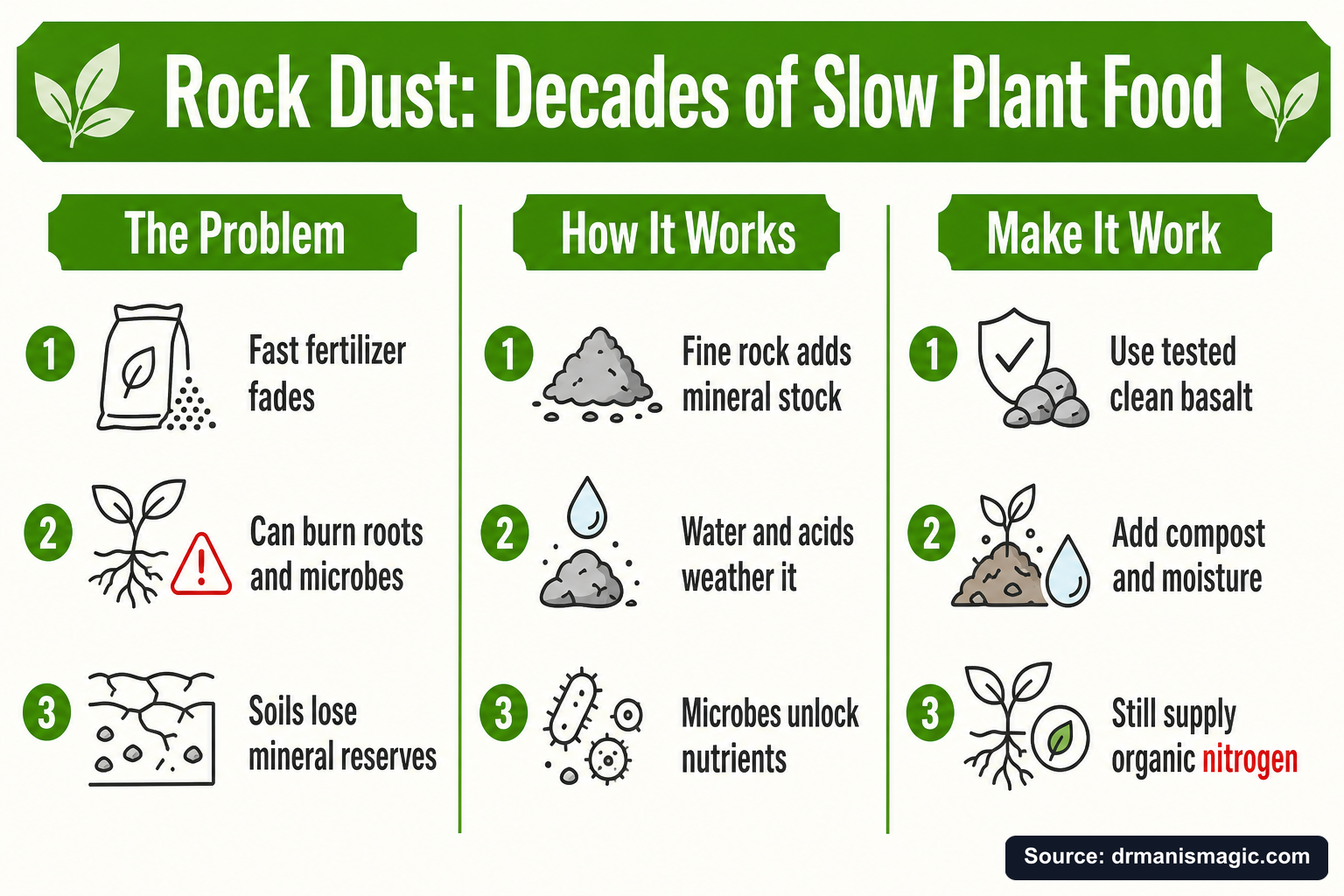
- Rock dust is a long-term mineral reservoir, not a quick fertilizer. It works slowly over months and years.
- The "decades" claim is real but only happens when soil microbes, moisture, organic matter, and pH are working together.
- Basalt and other silicate rock powders release calcium, magnesium, potassium, silicon, iron, zinc, manganese, and other trace minerals through a process called slow mineral weathering.
- Rock dust does NOT supply meaningful nitrogen. It is not a complete fertilizer replacement. You still need organic nitrogen inputs.
- Particle size matters enormously. Finer dust means more surface area, which means faster mineral release.
- Microbes, root exudates, carbonic acid, and moisture all work together to unlock minerals from rock particles. Without these, rock dust just sits there.
- Safety matters. Not all rock dust is garden-safe. Heavy metals, nickel, arsenic, and lead are real concerns. Always choose a tested, clean source.
What Is Rock Dust and Why Does It Matter for Your Garden?
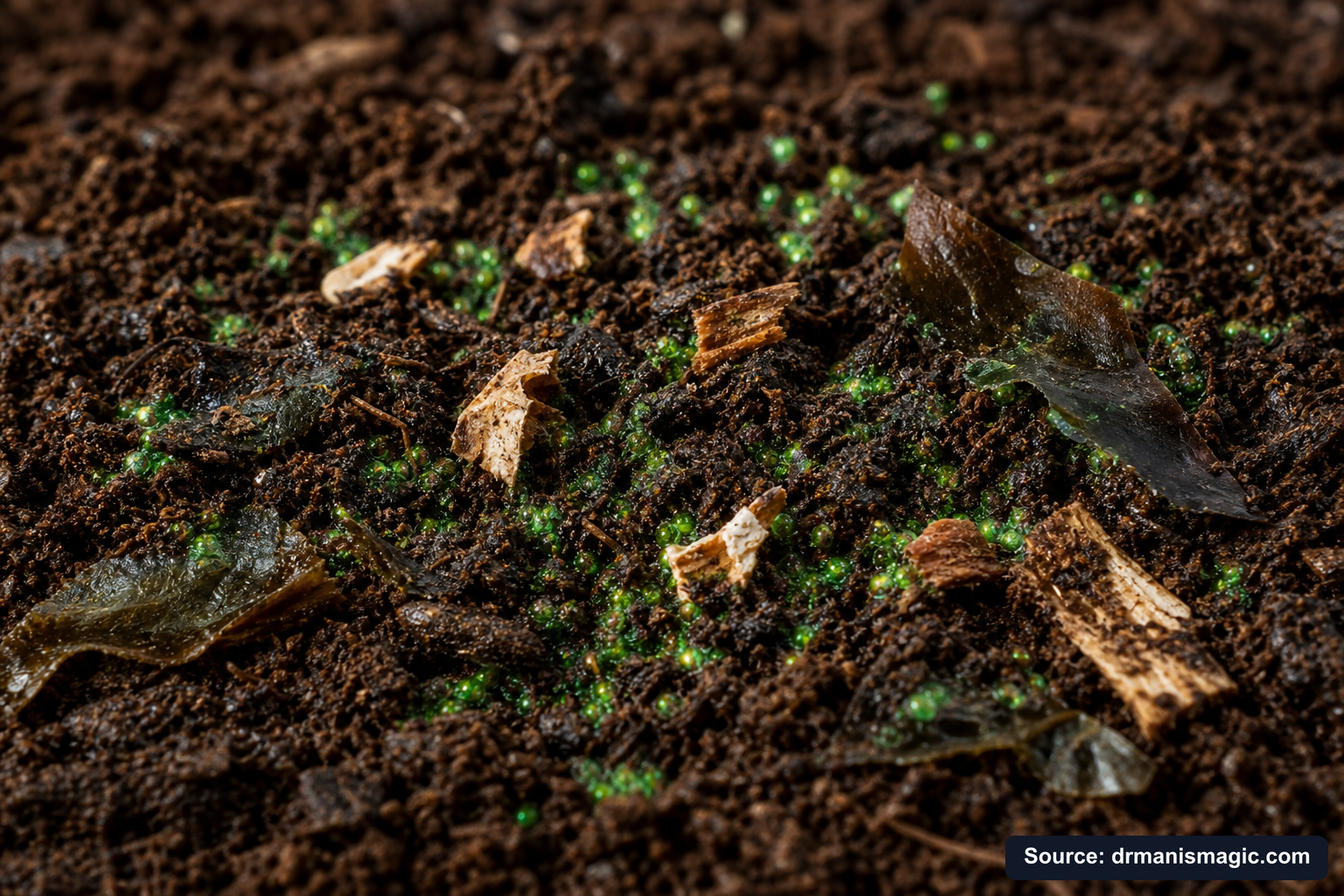
Quick Answer: Rock dust is finely ground mineral rock, usually basalt or glacial material, that releases calcium, magnesium, potassium, silicon, and trace minerals slowly into your soil over years or even decades. It rebuilds the mineral foundation that intensive growing, leaching rain, and synthetic fertilizers slowly strip away from tired, depleted soils.
Rock dust is exactly what it sounds like. Someone takes hard volcanic or glacial rock, grinds it into a very fine powder, and bags it up. When you spread that powder on your soil, it starts a slow process of breaking down. Over months and years, it releases minerals that your plants need.
But here is the part most people miss. Rock is not fertilizer in the traditional sense. You cannot spread rock dust on a lawn and expect it to turn green in a week. That is not how it works. Rock dust is more like a savings account. You deposit the minerals now. You draw on them slowly over time. And if your soil is healthy and alive, those deposits keep paying out for years.
Think about old-growth forests. Nobody fertilizes them. Nobody adds lime or gypsum or synthetic nutrients. Yet those trees grow massive. They live for centuries. How? Because the mineral cycle underneath them has never been broken. Rocks weather. Microbes process the minerals. Roots absorb them. Trees grow. When they fall and decompose, the minerals go back into the bank. That cycle is what rock dust is trying to restore in gardens and soils that have been stripped down by years of chemical shortcuts.
At US Citrus Nursery, where Dr. Mani Skaria and his team have grown over 250,000 trees in South Texas, they saw firsthand what happens when that mineral foundation erodes. Trees stop thriving. Leaves turn yellow. Fruit gets small and flavorless. The fix was not always a bag of synthetic fertilizer. Sometimes the fix was rebuilding the mineral bank from the ground up.
How Does Rock Dust Actually Release Minerals Into Soil?
Quick Answer: Rock dust releases minerals through a slow chemical process called mineral weathering. Water, carbonic acid from soil microbes and roots, root exudates, and microbial acids all attack the surface of rock particles and pry minerals loose. The finer the particle, the faster this happens because more surface area is exposed to those acids and moisture.
This is the part most rock dust articles skip. They say "it releases minerals slowly" but they never explain the actual mechanism. Here is the plain-English version.
When rain falls through the atmosphere, it picks up carbon dioxide. That turns it into a weak carbonic acid. Not strong enough to hurt you. But strong enough to slowly dissolve minerals out of rock particles over time. This is the same chemistry that carves limestone caves over thousands of years. Just much, much slower in your garden bed.
Then there is the rhizosphere. That is a fancy word for the zone right around plant roots. It is one of the most chemically active places on earth. Plant roots release compounds called root exudates. Think of them as tiny chemical keys. These exudates acidify the soil around the root, which helps dissolve and unlock minerals from nearby particles. The root is essentially mining for what it needs.
Then there are the microbes. Bacteria and fungi in healthy soil produce their own acids as part of their normal metabolism. Those acids attack rock surfaces the same way carbonic acid does. Certain fungi, especially mycorrhizal fungi, are particularly good at this. They wrap around rock particles and dissolve minerals directly. Research from university extension programs confirms that mycorrhizal fungi can significantly speed up the weathering of silicate minerals in soil, making nutrients available to host plants much faster than purely chemical weathering alone. (University of Minnesota Extension: Microbes and Soil Health)
Once those minerals are freed from the rock surface, they attach to soil particles called clay or organic matter. This is called the cation exchange capacity of your soil, or CEC. Think of it as a holding rack. The minerals park there until a plant root comes along and picks them up. This is why rock dust does not leach away quickly the way soluble fertilizers do. The minerals get captured and held in the soil.
The key point is this: the whole system depends on living biology. No microbes, no acids. No root exudates, no chemical keys. No moisture, no movement. Rock dust in a dead, dry, compacted soil just sits there. Rock dust in a living, moist, biologically active soil becomes a mineral engine that runs for decades.
What Minerals Does Rock Dust Contain and Which Plants Need Them?
Quick Answer: Basalt rock dust typically contains calcium, magnesium, potassium, silicon, iron, manganese, zinc, copper, molybdenum, and other trace minerals. These are exactly the secondary and micronutrient elements that plants burn through over time and that synthetic NPK fertilizers almost never replace, leaving soils increasingly mineral-depleted with each growing season.
Most gardeners know about nitrogen, phosphorus, and potassium. NPK. It is on every bag of fertilizer at the hardware store. But plants need much more than those three. They need a full orchestra of minerals to run all their internal chemistry.
Look at what rock dust typically provides:
| Mineral | What It Does for Plants | Deficiency Signs |
|---|---|---|
| Calcium (Ca) | Builds cell walls, supports root tip growth, prevents fruit cracking | Stunted roots, blossom-end rot, weak stems |
| Magnesium (Mg) | Central atom in chlorophyll, drives photosynthesis | Yellow patches between green veins on older leaves |
| Potassium (K) | Regulates water use, sugar transport, disease resistance | Leaf scorch at edges, weak stems, poor fruit flavor |
| Silicon (Si) | Strengthens cell walls, improves drought and pest resistance | Soft, floppy growth, increased pest pressure |
| Iron (Fe) | Chlorophyll synthesis, energy production | New leaves yellow with green veins (iron chlorosis) |
| Manganese (Mn) | Chloroplast formation, enzyme activation | Yellowing between veins on middle-aged leaves |
| Zinc (Zn) | Hormone production, shoot elongation, fruit formation | Small stunted leaves, poor shoot growth |
| Copper (Cu) | Cell wall strength, reproductive growth, disease protection | Soft stems, dieback on new growth |
| Molybdenum (Mo) | Converts nitrate into usable nitrogen inside the plant | Pale leaves resembling nitrogen deficiency |
Notice what is missing from that list. Nitrogen. Rock dust provides almost none. This is the most important thing to understand before you buy a bag of rock dust and expect it to replace your fertilizer program. It will not green up your lawn. It will not push a flush of new growth. That is nitrogen's job, and rock dust cannot do it.
What rock dust can do is rebuild the trace mineral and secondary nutrient bank that decades of synthetic fertilizing, intensive cropping, and rain leaching have drained away. And for plants that are struggling with yellowing, poor fruit flavor, weak cell walls, or low disease resistance, those missing minerals are often the missing piece.
This is why the Three Plant Pillars system developed by Dr. Mani Skaria addresses mineral nutrition as part of a complete soil-first program, not as a single-product fix.
Why Does Rock Dust Feed Plants for Decades Instead of Weeks?
Quick Answer: Rock dust feeds plants for decades because silicate minerals dissolve incredibly slowly. Fine particles increase surface area, which speeds things up, but even then the process takes months to years. Minerals released from rock attach to soil exchange sites rather than leaching away, creating a slow, steady supply that outlasts any bag of soluble fertilizer by years or even decades.
Here is a number that will change how you think about mineral nutrition. A single gram of very fine rock dust powder can have a surface area larger than a football field when you account for all its microscopic pores and edges. That is an enormous amount of surface exposed to soil acids, moisture, and microbial activity.
But silicate minerals are tough. They do not dissolve fast even with all that surface area exposed. The release rate is measured in years, not days. And that slowness is exactly the point.
Think about what happens when you pour a soluble fertilizer on your soil. The nutrients are immediately available. The plant gets a spike. Then the nutrients leach out with the next rain or watering. Gone. You have to apply again. And again. And again. The plant becomes dependent on you showing up with the next bag.
Rock dust works the opposite way. It loads the soil with a slow-dissolving mineral reserve. Every rain, every microbial acid, every root exudate frees a tiny fraction of those minerals. They attach to clay particles and organic matter and park there, waiting. Roots pick them up as needed. The system keeps running quietly in the background, season after season, without you doing anything at all.
Research from Penn State Extension confirms that fine-ground silicate rock materials can continue releasing measurable quantities of calcium, magnesium, and trace minerals for many years after a single application, particularly in biologically active soils with good organic matter content. (Penn State Extension: Soil pH and Nutrient Availability)
The phrase "feeds plants for decades" is not marketing language. It is a real, documented property of slow silicate weathering. But it is only true when the biology underneath is alive and working. A dead soil with no microbes, compacted structure, and wrong pH will slow that weathering to almost nothing.
This is the single most important thing the internet gets wrong about rock dust. They sell you the mineral. They never tell you that without living biology, that mineral just sits there.
What Is the Difference Between Rock Dust, Fertilizer, Compost, Lime, and Gypsum?
Quick Answer: Rock dust rebuilds the long-term trace mineral bank but does not supply nitrogen. Fertilizer provides immediately available NPK. Compost feeds biology and adds organic matter. Lime raises soil pH. Gypsum adds calcium and sulfur without changing pH. Each does something different. Healthy soil usually needs several of these over time, not just one magic amendment.
One of the biggest mistakes gardeners make is treating all soil amendments as interchangeable. They are not. Here is a plain-English breakdown of what each one actually does.
| Amendment | Primary Job | What It Does NOT Do | Best Use Case |
|---|---|---|---|
| Rock Dust (Basalt) | Slowly releases trace minerals, calcium, magnesium, silicon over years | Does not supply meaningful nitrogen, does not fix pH quickly | Depleted soils, long-term mineral banking, new garden beds, orchards |
| Synthetic Fertilizer | Fast spike of NPK | Does not feed biology, does not improve soil structure, kills microbes with salt | Emergency rescue feeding only (not recommended long-term) |
| Organic Fertilizer (like Crab, Kelp & Amino Acids) | Feeds microbes first, then provides slow steady NPK and trace minerals to plants | Does not replace rock dust mineral bank, not as concentrated as synthetic | All plants, all seasons, as the primary ongoing feeding program |
| Compost | Feeds soil biology, improves water retention and structure, adds organic matter | Low mineral concentration, variable nutrient content, not a substitute for fertilizer | Any soil needing improved biology and structure |
| Lime | Raises soil pH, adds calcium and sometimes magnesium | Does not feed biology, does not supply trace minerals, can lock up nutrients if over-applied | Acidic soils below pH 6.0 |
| Gypsum | Adds calcium and sulfur without changing pH, improves compacted clay soils | Does not raise pH, does not supply nitrogen or potassium | Compacted clay soils, high-sodium soils, need for calcium without pH change |
The takeaway is simple. No single amendment does everything. Rock dust fills the long-term mineral bank. Organic fertilizer handles the ongoing NPK and biology. Compost builds the living ecosystem. Together they create a soil that runs on its own and stays rich year after year.
See also: Why Most Fertilizers Are Actually Salt in Disguise
Does Soil pH Affect How Well Rock Dust Works?
Quick Answer: Yes, soil pH is one of the biggest factors controlling how fast rock dust releases its minerals. Slightly acidic soils between pH 5.5 and 6.5 tend to weather silicate minerals faster because more natural acids are present. Neutral to alkaline soils above pH 7.0 slow the weathering process considerably, and many released minerals can get locked up and become unavailable to roots.
Soil pH is like the volume knob on your mineral bank. Turn it too high, and the whole system slows down. Many minerals that rock dust releases, including iron, manganese, and zinc, become chemically locked in alkaline soils. They are there. The plant just cannot get to them. It is like having money in a bank account with a frozen card.
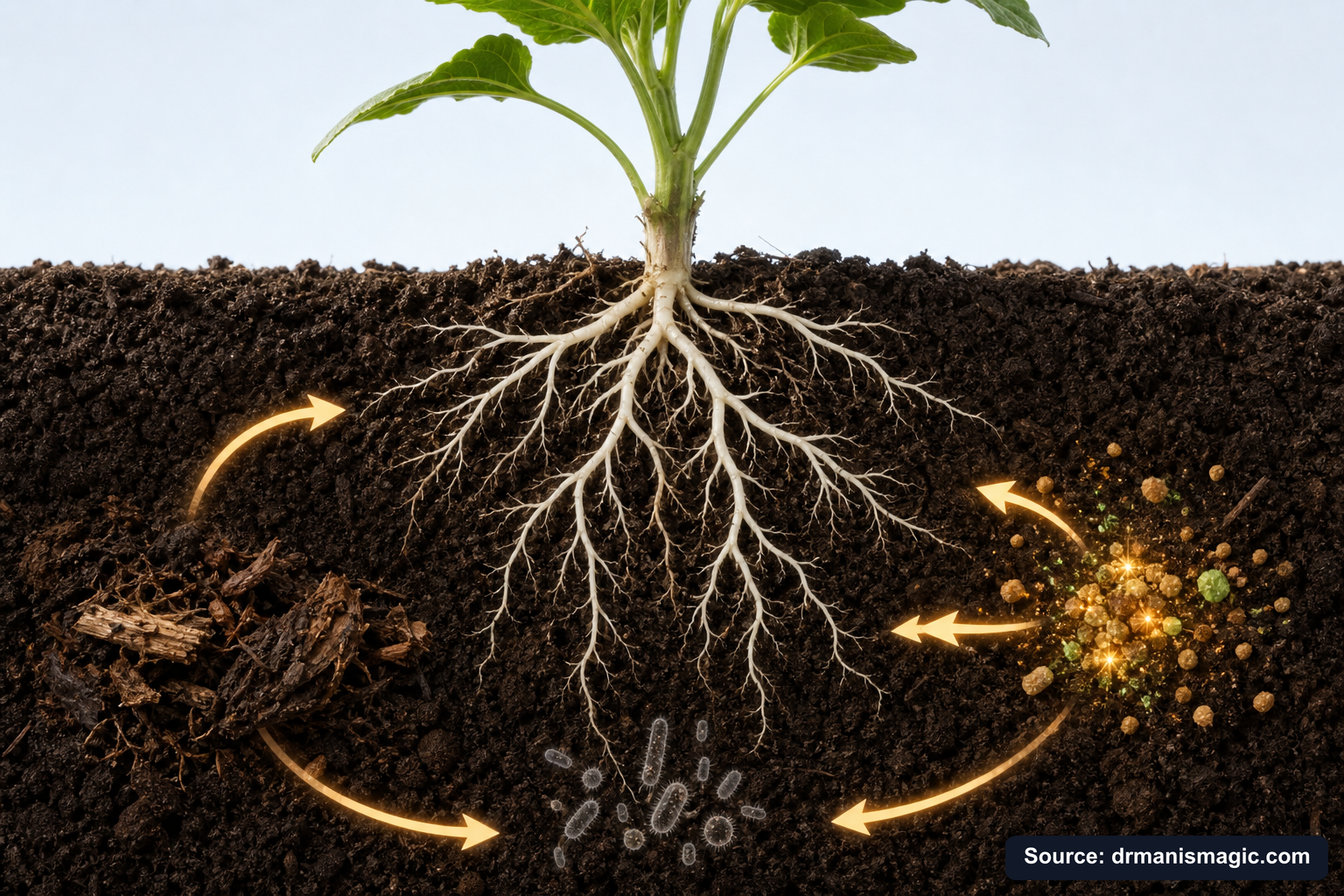
Slightly acidic soil accelerates weathering chemistry. More hydrogen ions are present, which attack mineral surfaces more aggressively. Root exudates become more effective. Microbial acid production increases. The whole system runs faster.
This is why university extension recommendations consistently emphasize doing a soil test before adding any amendment, including rock dust. If your soil is already pH 7.5 or above and loaded with calcium and magnesium, adding more basalt rock dust may show very little benefit. You would be depositing into a bank that is already full, while the frozen card problem keeps your plant from spending what is there.
On the other hand, if you have a sandy, leached, acidic, or intensively cropped soil, rock dust can make a dramatic long-term difference. Those soils have low CEC, poor mineral reserves, and fast leaching. Rock dust slowly refills what rain and cropping have stripped away.
The practical rule: get a soil test first. It costs almost nothing and tells you exactly what your soil needs. Then use rock dust as part of a complete soil-building strategy, not as a standalone miracle amendment.
You Never Had a Brown Thumb.
You were handed the wrong tools. This free guide hands you the right ones.
You watered it. You fed it. It died anyway.
It was never you. It was the dirt, the salt food, and the bad advice.
This guide shows you what really went wrong, and how to fix it for good.
- Why your plants really died, and why it was never your fault
- The salt hiding in your plant food that quietly burns the roots
- The hidden killer in almost every bag of store soil
- The tiny helpers that grow a whole forest for free
- The rescue trick that brings a half dead plant back to life

Is Rock Dust Safe for Vegetables, Lawns, Trees, and Ornamentals?
Quick Answer: Properly sourced and lab-tested rock dust is generally safe for vegetables, lawns, fruit trees, ornamentals, and gardens. The safety concern comes from untested quarry fines that may contain elevated levels of heavy metals like nickel, arsenic, lead, or cadmium. Basalt in particular can carry nickel. Always choose rock dust that has been tested and certified safe for edible garden use.
This is the section most rock dust articles skip. And it matters, especially if you are growing food.
Rocks are natural. But natural does not always mean safe in concentrated form. Basalt, one of the most popular rock dust materials, is volcanic in origin. Volcanic rocks can carry elevated levels of nickel. Some quarry sources also carry arsenic, lead, or cadmium depending on the geology of the region.
When rock dust is applied to vegetable gardens, those minerals can move into the soil, into water, and eventually into plants and the people who eat them. A small amount of nickel is actually a plant micronutrient. A large amount is toxic. The difference between medicine and poison is always the dose.
The three things to look for before you buy rock dust:
- Ask for a full mineral analysis. A reputable supplier will provide one. It should show all major and trace mineral concentrations including heavy metals.
- Confirm the source geology. Not all basalt is the same. Some volcanic regions produce cleaner rock than others. Glacial rock dust from glacially ground granite or mixed silicate deposits often has a different heavy metal profile than basalt.
- Check for PFAS and biosludge contamination. Some soil amendments, including certain composts and fertilizers, are made from municipal biosolids that contain PFAS "forever chemicals." Rock dust itself does not contain PFAS, but if it is blended with other materials or processed through contaminated equipment, cross-contamination is possible. Always ask.
At Dr. Mani's Magic, clean inputs are a core value. The Crab, Kelp & Amino Acids organic fertilizer contains zero biosludge, zero PFAS, and zero synthetic salts. The volcanic ash included in that formula for silica and trace mineral delivery comes from a verified, clean source. That is the standard every amendment in your garden should be held to.
Rock Dust vs Synthetic Fertilizer: Which Actually Builds Better Soil Over Time?
Quick Answer: Rock dust builds long-term mineral reserves without harming soil biology. Synthetic fertilizers deliver a fast NPK spike but are salt-based, which burns fine roots, kills beneficial microbes, and leaves soil more depleted over time. Rock dust and organic fertilizer work together as a long-term system. Synthetic fertilizers work alone and usually create dependency cycles that weaken soil health year by year.
Let us be honest about what synthetic fertilizers actually are. They are salts. The nitrogen, phosphorus, and potassium in most conventional fertilizers are chemically bonded to salt molecules. When you dissolve them in water and pour them on your soil, you get a fast green-up. You also get osmotic stress on your roots, a salt spike that burns the fine root hairs responsible for water and nutrient uptake, and a wave of chemical shock that kills the beneficial microbes living in your root zone.
Healthy soil microbes are what make rock dust work. They produce the acids that weather mineral particles. They hold nutrients in their bodies and release them slowly when they die. They wrap around roots and extend the plant's reach for minerals by hundreds of times. When synthetic salt fertilizers kill those microbes, the whole mineral weathering system breaks down. Rock dust just sits there. The mineral bank stops paying out.
See also: The Hidden Reason Synthetic Fertilizers Cause Root Rot
Here is the cycle that most gardeners do not see until it is too late. They apply synthetic fertilizer. The plant greens up. The microbes die. The soil compacts. The plant becomes dependent on the next application. After a few seasons, the soil is dead, compacted, and increasingly mineral-depleted because nothing is weathering the minerals anymore. More fertilizer is needed just to maintain the same results. Sound familiar?
Rock dust breaks that cycle. It reloads the mineral bank. But it only works if you also rebuild the biology. That is why Dr. Mani Skaria built the Three Plant Pillars around mineral foundation, live microbials, and organic fertilizer working together. Remove any one pillar and the whole system weakens.
How Do Microbes Unlock Rock Dust Minerals for Plant Roots?
Quick Answer: Soil bacteria and fungi produce organic acids and enzymes that chemically dissolve mineral surfaces on rock dust particles. Mycorrhizal fungi extend root reach by hundreds of times, directly contacting mineral particles and pulling calcium, iron, zinc, and other elements into the plant. Without active soil biology, rock dust weathering slows dramatically and minerals stay locked in the powder instead of moving into plants.
Here is a picture that might change how you think about soil forever.
Imagine your plant's root system is a city. The roots are the main roads. But the microbes around those roots are millions of tiny delivery trucks. They go places roots cannot reach. They carry things roots cannot carry. They break down things roots cannot break down.
Mycorrhizal fungi, in particular, are extraordinary mineral miners. Their thread-like structures called hyphae extend out from roots into the surrounding soil. They are far thinner than any root hair. They can squeeze into tiny pores in rock dust particles that roots could never access. And they produce acids and enzymes specifically designed to dissolve mineral bonds and free elements like phosphorus, calcium, iron, and zinc.
Bacteria contribute too. Certain species of soil bacteria produce gluconic acid and other organic acids as part of their metabolism. Those acids attack mineral surfaces the same way plant root exudates do, just from a different angle. The combined chemical attack from roots, bacteria, and fungi is far more powerful than any one of those forces alone.
This is why Dr. Mani Skaria's system always includes live microbials as Pillar Two. The Plant Super Boost liquid microbial formula is packed with living bacteria, fungi, and mycorrhizae. When those microbes thrive in your soil, they activate the mineral weathering chemistry that makes rock dust and natural soil minerals actually useful to your plants. Without them, you are just spreading powder on dead dirt.
After growing over 250,000 trees at the US Citrus Nursery in South Texas, Dr. Mani saw this pattern over and over again. Trees planted in biologically active soil with proper mineral inputs grew faster, fruited sooner, and stayed healthier longer. Trees planted in dead, compacted, or salt-damaged soil struggled even when the mineral inputs were perfect on paper. The biology is the engine. The minerals are the fuel. You need both.
What Types of Rock Dust Work Best and What Is the Difference Between Basalt and Glacial Rock Dust?
Quick Answer: Basalt rock dust comes from volcanic rock and is rich in calcium, magnesium, iron, silicon, and a broad range of trace minerals. Glacial rock dust comes from glacially ground mixed minerals and may have a different trace element profile depending on the geology of the source region. Both can be effective, but basalt is more studied and more widely available. Particle fineness matters more than rock type for weathering speed.
Basalt is the most common and most studied rock dust type. It is volcanic in origin, which means it formed from magma cooling rapidly. That rapid cooling creates a fine crystalline structure that weathers relatively faster than coarse-grained granite. Basalt is typically rich in calcium, magnesium, iron, and silicon, with a decent supply of manganese, zinc, copper, and molybdenum.
Glacial rock dust is ground by glacial action over thousands of years. The source rock varies by region. Some glacial deposits are rich in silicate minerals similar to basalt. Others are more granite-based with different trace element profiles. The benefit of glacial rock dust is that glacial grinding can produce very fine particles with high surface area, which speeds up weathering.
Here is the bottom line on choosing between them. Check the mineral analysis for the specific product, not the rock type. A low-quality basalt from a contaminated quarry is worse than a clean glacial deposit. A very coarse basalt with low surface area will release minerals more slowly than a superfine glacial powder. The analysis and the particle size tell you more than the rock name on the label.
What matters most for any rock dust:
- Particle size: finer is faster. Look for products where most particles are under 200 microns.
- Mineral breadth: you want calcium, magnesium, silicon, iron, zinc, manganese, and trace elements all present.
- Heavy metal safety: always ask for a lab analysis showing nickel, arsenic, lead, and cadmium levels.
- Source transparency: a reputable company tells you exactly where the rock came from and what is in it.
How and When Should You Apply Rock Dust to Your Garden, Lawn, Trees, and Raised Beds?
Quick Answer: Apply rock dust once every one to three years for established gardens and lawns, or as a one-time foundation amendment when building new beds or planting new trees. Spread it evenly, water it in well, and apply it alongside a live microbial inoculant and organic fertilizer for best results. Do not expect visible results in weeks. Rock dust is a multi-season investment, not a quick fix.
The application guidance varies by where and what you are growing. Here is a practical breakdown.
Vegetable gardens and raised beds: Apply before planting in spring or fall. Mix it into the top several inches of soil rather than just leaving it on the surface. Raised beds with high-turnover intensive cropping benefit most because they deplete minerals faster than in-ground beds.
Lawns: Spread rock dust in early spring or fall when the grass is actively growing and when rain is expected to help move the powder into the soil. Do not apply to dry, dormant grass and expect anything to happen. The biology needs to be active.
Fruit trees and ornamental trees: Spread rock dust in a ring around the drip line of the tree, which is the outer edge of the canopy. Scratch it lightly into the surface. Apply in spring before new growth begins. Trees are long-term investments and respond beautifully to multi-year mineral programs.
New construction soils: This is one of the highest-value uses for rock dust. Construction strips topsoil and leaves subsoil that is compacted, mineral-poor, and biologically dead. Rock dust combined with compost and microbial inoculants can begin rebuilding that mineral foundation from scratch.
Houseplants and containers: A small amount of rock dust mixed into container soil provides a long-term trace mineral reserve. Because containers have no mineral weathering from natural soil, plants become dependent entirely on what you add. Rock dust is a clean, gentle way to supply trace minerals without risking fertilizer burn.
One important reminder. Rock dust does not supply nitrogen. Whatever your growing situation, you still need an ongoing organic nitrogen program. That means regular applications of a complete organic fertilizer that feeds your soil biology as well as your plants.
What Happens If Your Soil Is Already Depleted? A Recovery Checklist
Quick Answer: Depleted soil can be rebuilt, but it takes a systematic approach. You cannot fix dead soil with one amendment. You need to address structure, biology, mineral reserves, and nutrition together. The good news is that soil responds quickly when you give it what it needs. Many gardeners see visible improvement within one growing season when they address all the root causes at once.
If your plants are struggling, your lawn is thin, your trees are yellowing, or your soil looks gray and lifeless, here is a step-by-step recovery plan.
- Stop the bleeding first. If you are using synthetic salt-based fertilizers, stop. Every application is killing more of the biology you are trying to rebuild. Switch to organic inputs immediately.
- Get a soil test. Before adding anything, know what you have. A basic test shows pH, macro and secondary nutrient levels, and sometimes CEC. Most university extension services offer soil testing for a small fee. This tells you whether rock dust, lime, gypsum, or something else is the right first move.
- Fix the structure. Compacted soil blocks the oxygen, water movement, and root penetration that rock dust weathering depends on. Add compost, aerate if needed, and consider a mineral-based soil for containers and raised beds. Dead, compacted soil is the enemy of every amendment you try to use.
- Inoculate with live microbes. Before you add rock dust or organic fertilizer, put living biology back in the soil. Without microbes, the mineral weathering system cannot run. A quality liquid microbial drench applied to the root zone is the fastest way to restart the biological engine.
- Apply rock dust as a mineral foundation amendment. Once biology is active, rock dust starts working. Spread it, water it in, and let the weathering begin. Be patient. This is a multi-season process.
- Feed with a complete organic fertilizer on a regular schedule. Rock dust handles the trace mineral bank. Organic fertilizer handles the ongoing NPK and the biological feeding cycle. You need both running together.
- Monitor and adjust. Watch your plants. Greener leaves, stronger growth, better fruit flavor, and fewer pest problems are all signs that the mineral bank is paying out and the biology is working. Retest soil every two to three years and adjust accordingly.
This is the system Dr. Mani Skaria spent decades refining at US Citrus Nursery. It works on citrus trees. It works on roses. It works on lawns, vegetable gardens, houseplants, and ornamental trees. The plant species changes. The three-pillar principle does not.
You can get the complete plant care foundation in one place with the Free Plant Care Field Guide from Dr. Mani's Magic. It walks you through the Three Plant Pillars system step by step, plain and simple, no guesswork.
The Real Reason Most Gardeners Never See the Results They Want
Here is the truth nobody wants to say out loud.
Most gardening failures are not about the wrong plant, the wrong climate, or bad luck. They are about broken soil. Soil that has been stripped of its minerals by years of synthetic fertilizers. Soil that has been sterilized of its biology by salt-based inputs. Soil that has been compacted into an airless slab where roots cannot breathe and water cannot move.
Rock dust is one piece of the solution. A very important piece. It reloads the mineral bank that all those shortcuts emptied out. But it only works when the biology is alive to weather it, when the structure is open enough for roots to reach it, and when an organic nutrition program is running alongside it to provide what rock dust cannot.
This is the system. Mineral foundation. Live biology. Organic nutrition. All three working together. That is the Three Plant Pillars framework that Dr. Mani Skaria developed after 40 years of plant science and over 250,000 trees grown in South Texas. It is not complicated. It is not expensive. It just works, because it follows the laws of nature instead of fighting them.
You planted that tree for a reason. You put those seeds in the ground for a reason. You want to see something grow. You want to taste fruit you grew yourself. You want to walk out your back door and feel proud of what is there. That is not too much to ask. But it does require building on a foundation that is actually solid.
Time is the one thing you cannot get back. Every season spent fighting depleted soil, dead biology, and mineral starvation is a season of growth you never get to enjoy. The best time to rebuild your soil was a few years ago. The second best time is right now.
If you want to start rebuilding your mineral foundation the right way, the complete Dr. Mani's Magic system gives you everything in one place. Clean inputs. Live biology. Organic nutrition. No biosludge, no PFAS, no synthetic salts, and a 30-day money-back guarantee so you can try it without any risk. See how the Three Plant Pillars work together and find the right starting point for your garden.
Frequently Asked Questions
Rock dust is one of the most misunderstood tools in gardening. People either expect it to work like a bag of fertilizer, or they ignore it completely. These questions come up again and again from real growers, and the answers below cut straight to what actually matters when you want your soil to feed your plants for years, not just weeks.
How long does rock dust last in soil?
Rock dust can feed your soil for years, sometimes decades. The finer the grind, the faster it gets to work. Coarser particles last longer but release minerals more slowly. Here is the key most people miss: rock dust only keeps releasing minerals when living microbes are present. That is why Dr. Mani built the Three Plant Pillars system. Mineral foundation plus live microbes plus organic fertilizer. Without the microbes, rock dust just sits there doing nothing.
Is rock dust good for plants?
Yes, when it is used correctly. Rock dust slowly releases calcium, magnesium, potassium, silicon, iron, zinc, and dozens of trace minerals your plants crave. Think of it as reloading a mineral bank your soil has been slowly draining for years. Dr. Mani tested this principle across more than 250,000 citrus trees at US Citrus Nursery. The results were clear. Plants with a strong mineral foundation grew faster, fought off disease better, and produced more fruit than plants without it.
How often should I apply rock dust?
For most home gardens and container plants, one good application every one to two years is enough. Spread about a small handful per square foot into your soil or mix it into your potting blend. If your soil already has strong microbial life, the minerals will unlock steadily over time. If your soil is dead from synthetic fertilizers, you need to fix the microbe problem first. Rock dust without microbes is like loading a gun with no firing pin.
What do traditional farmers use instead of synthetic fertilizer?
Smart farmers have always leaned on what nature provides. Composted manure, cover crops, wood ash, and mineral-rich materials like rock dust have fed soil for generations. The Amish still use many of these methods today. The common thread is building long-term soil health instead of chasing short-term green-ups. That is exactly what Dr. Mani's Three Plant Pillars are built on. Mineral soil, living microbes, and slow-release organic fertilizer. No salt bombs. No chemical shortcuts. Just nature doing what it does best.
What are the disadvantages of rock dust?
Rock dust is not a fast fix. It will not green up your lawn in a week. It also does not supply nitrogen, so you still need an organic fertilizer to complete the picture. The other real concern is safety when handling dry dust. Never breathe it in. Wear a mask when spreading it dry. Fine silica particles can damage your lungs with repeated exposure. Once it is in the soil and wet, you are completely fine. Just be smart during application and you have nothing to worry about.
Is rock dust harmful to use in the garden?
In the ground, rock dust is safe and beneficial. The only real danger is inhaling dry rock dust before it hits the soil. Fine rock particles can carry crystalline silica, which causes serious lung damage over time if you breathe it repeatedly. Wear an N95 mask when spreading dry rock dust. Work outside where air moves freely. Once it is mixed into your soil and watered in, the risk disappears completely. Your plants, your kids, and your pets are all safe around it.
Should I use rock dust or mulch around my plants?
They do different jobs. Rock as a mulch controls weeds and lasts forever, but it does nothing to feed your soil. Organic mulch like wood chips breaks down and adds carbon, but it can rob nitrogen from the soil as it decomposes. Rock dust goes into the soil, not on top of it. It rebuilds the mineral base from the inside out. Used together with Dr. Mani's Super Soil, live Plant Super Boost microbes, and organic fertilizer, you get a complete growing system that keeps working season after season.
About the Author
Dr. Mani Skaria, PhD
Dr. Mani Skaria, PhD, is a plant pathologist and the scientific founder of Dr. Mani's Magic. He earned his doctorate at Purdue University and spent 48 years studying how plants, soil, and living microbes work together, including his years as Professor Emeritus at Texas A&M and as a member of the USDA NAREEE Advisory Board. He invented micro-budding, a method for growing healthier, stronger trees, and has grown more than 250,000 trees on the family farm in Hargill, Texas - US Citrus Nursery. His life's work takes real lab science and practical experience and turns it into simple, safe, organic plant care anyone can use at home.


