


Protein Nutrition vs. Chemical Fertilizers: What Plants Actually Use | Dr. Mani's Magic
Protein Nutrition vs. Chemical Fertilizer: What Plants Actually Use (And Why It Changes Everything)
Picture this. You're standing in the fertilizer aisle at a big box store. Rows and rows of bright bags. Bold promises on every label. "Feeds plants instantly!" "Triple action!" "Results in days!"
You grab one. It feels like the right move. You go home, mix it up, pour it on your tomatoes, your potted lemon tree, your struggling lawn. And for a week or two? Things look pretty good. Green. Perky. You feel like a gardening genius.
Then something shifts. The leaves start to curl at the edges. The tips turn brown and crispy. The roots, if you could see them, look like they've been scalded. You did everything the bag said. So what went wrong? Here's what nobody in that store told you: what you poured on those roots wasn't plant food. It was salt. And salt, at the root level, is not a helper. It's a slow killer. There's a completely different way to feed a plant. A way that works with nature instead of against it. And once you understand the difference, you'll never look at a bag of fertilizer the same way again.

Organic Fertilizer | Crab, Kelp & Amino Acids
Key Takeaways
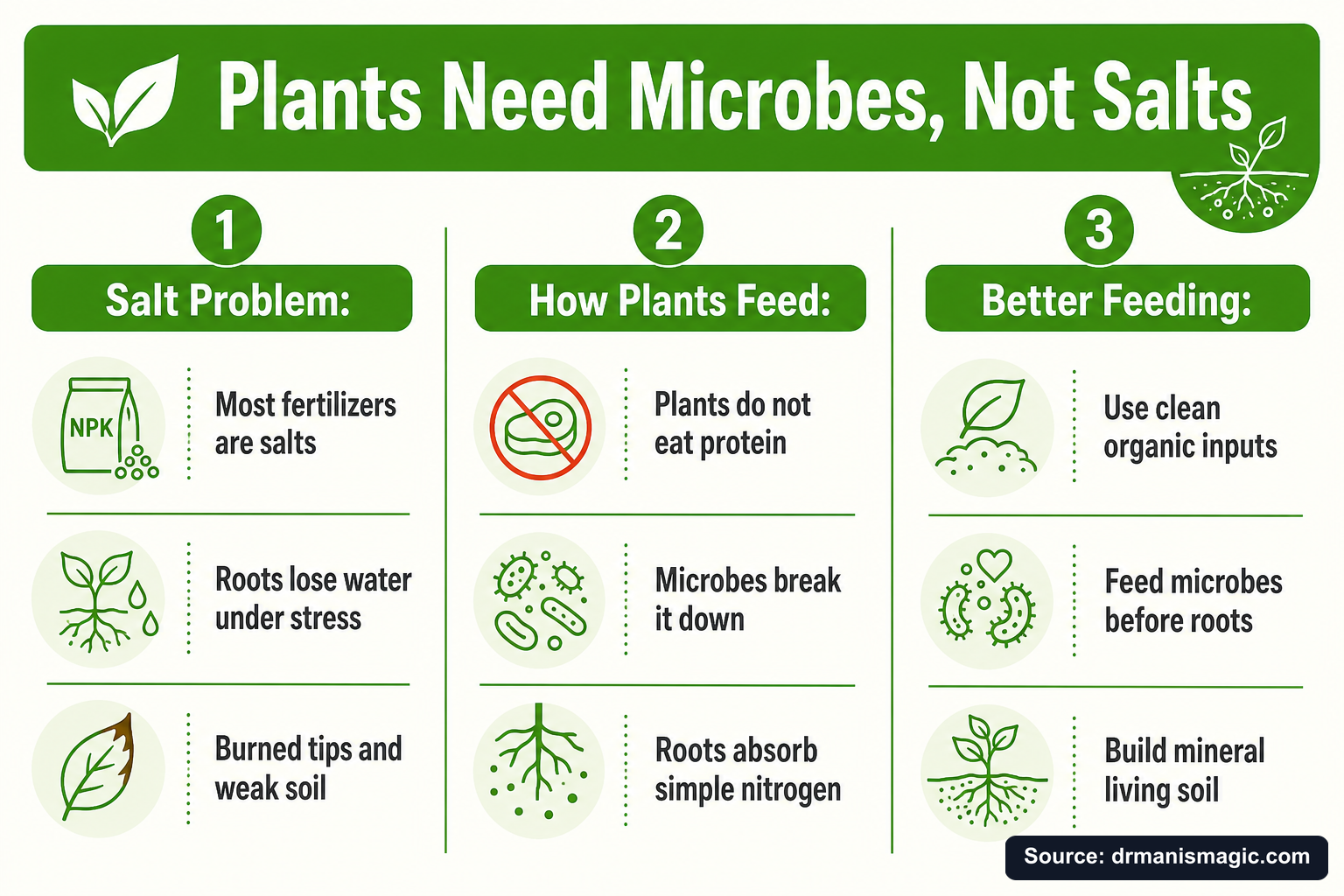
- Plants do not "eat" protein the way animals do. Proteins must be broken down by soil microbes first before plants can use the nutrients inside.
- Most common fertilizers are salt-based. High salt around roots causes osmotic stress, which means water gets pulled out of the plant instead of in.
- Organic protein-based fertilizers (like crab meal, amino acids, and kelp) feed the microbes first. The microbes then release nutrients slowly into the root zone.
- Salt-based fertilizers kill the beneficial microbes your soil needs to stay healthy long-term.
- Chitin from crab shells, hormones from kelp, and trace minerals from volcanic ash each do specific, powerful jobs in the soil that synthetic fertilizers simply cannot replicate.
- PFAS "forever chemicals" and biosludge (treated municipal waste) hide in many fertilizers, both synthetic and some organic brands. Clean inputs matter.
- The Three Plant Pillars — mineral soil, live microbes, and organic fertilizer — form the only complete foundation for any plant to truly thrive.
What Does "Protein Nutrition" Actually Mean for a Plant?
Quick Answer: Plants cannot absorb protein directly the way animals do. Instead, proteins and amino acids in organic fertilizers are broken down by soil microbes into simpler nitrogen compounds. The plant then absorbs those compounds through its roots. It's a natural, two-step process that results in steady, gentle feeding.
Here's a fact that surprises most gardeners. Plants do not eat protein.
Animals eat protein. Your body breaks it into amino acids. Those amino acids rebuild your muscles, your enzymes, your skin. That's animal biology.
Plants work differently. A plant's real "food" is sunlight, water, and carbon dioxide. Through photosynthesis, the plant makes its own sugars. Those sugars are the actual fuel that powers growth, flowering, and fruit.
So what is fertilizer for? Think of it like vitamins for a human. You don't eat vitamins for energy. You eat them because your body needs specific building blocks — things it cannot make on its own — to run its internal systems properly. Plants are the same way. They need nitrogen to build chlorophyll and amino acids. They need phosphorus to move energy around. They need potassium to regulate water and sugar transport.
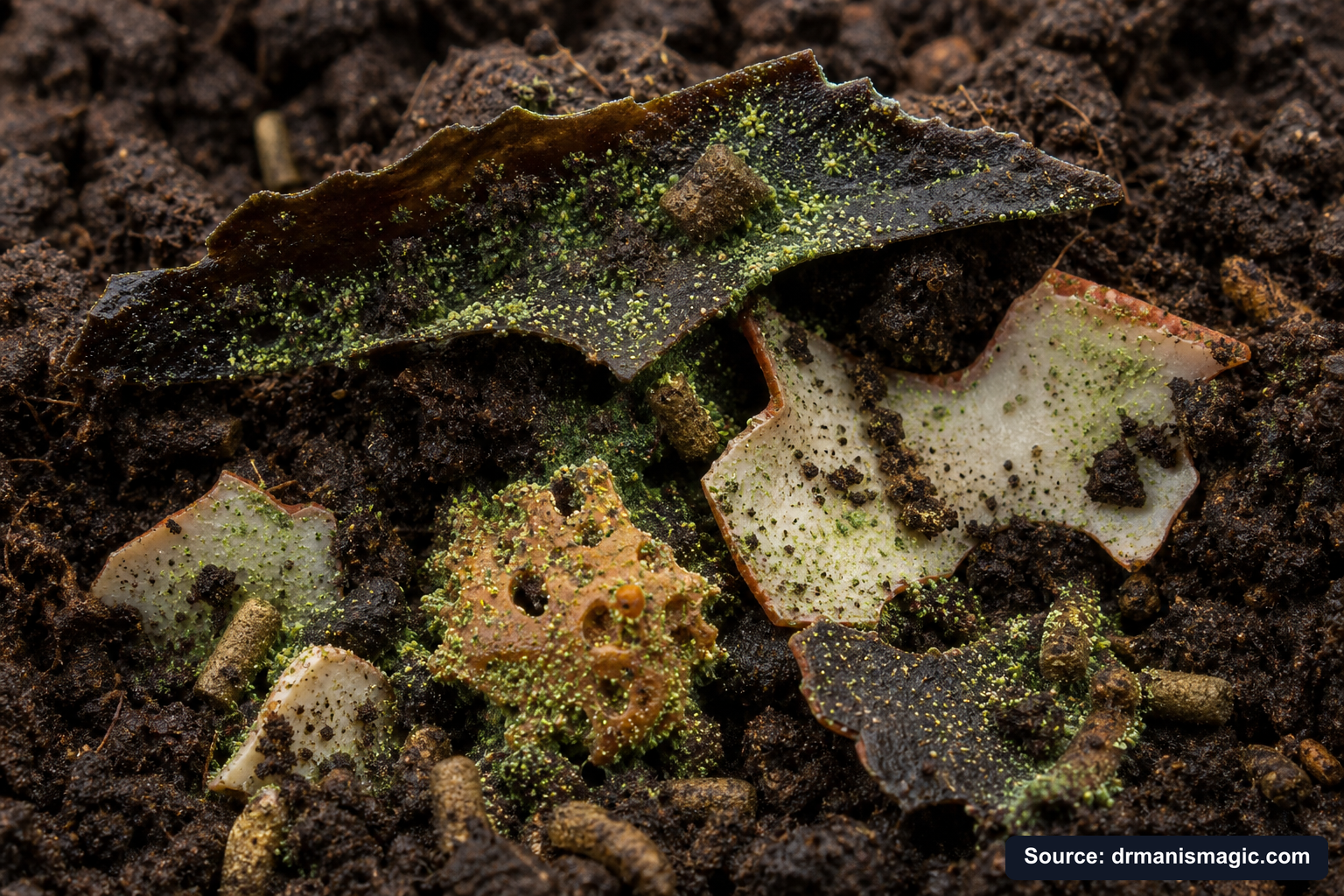
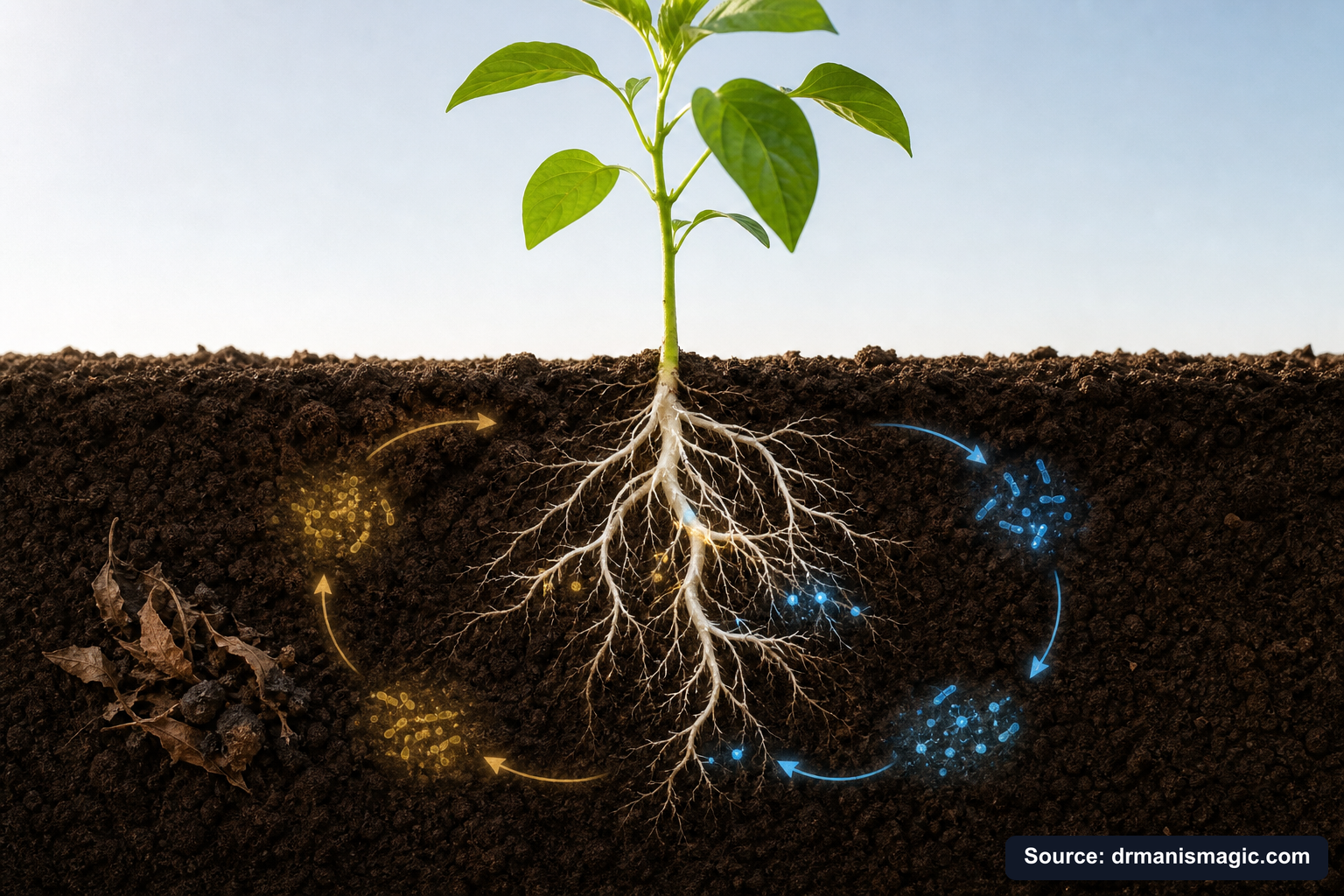
When we say "protein nutrition" for plants, we mean this: organic materials like crab shells, feather meal, and kelp contain proteins and amino acids. When those materials hit your soil, the microbes — bacteria and fungi — start eating them. They break the proteins apart, step by step, into smaller and smaller pieces: proteins become peptides, peptides become amino acids, amino acids become ammonium, ammonium becomes nitrate. That nitrate is what the plant's roots finally pull in.
The whole journey looks like this:
- Protein-based fertilizer goes into the soil.
- Bacteria and fungi break it apart.
- Nutrients become available slowly over time.
- Plant roots absorb what they need, when they need it.
- When those microbes die, their own bodies release even more nutrients back into the root zone.
It is a living, self-renewing system. And it has been running without human help for hundreds of millions of years. According to research from the University of Maryland Extension, organic nitrogen sources cycle through the soil food web in exactly this way, releasing nutrients gradually as microbial activity increases with warmth and moisture — the same conditions that make plants want to grow.
That timing is not an accident. It is nature's slow-release system.
Why Are Most Fertilizers Just Salt in Disguise?
Quick Answer: Conventional fertilizers like ammonium nitrate, ammonium sulfate, and urea are salt-based compounds that dissolve immediately in water. When concentrated around plant roots, they create osmotic stress, pulling water out of root cells instead of letting it in. This is the direct cause of fertilizer burn.
This is the part the fertilizer industry does not advertise.
Walk into any garden center and you'll see cheerful bags covered in pictures of giant tomatoes and lush lawns. What you won't see is a clear explanation of what's actually inside. Most conventional fertilizers are synthesized mineral salts. Ammonium nitrate. Ammonium sulfate. Urea. Potassium chloride. These are all salts in the chemical sense.
Here's what salt does to a root. Roots absorb water through a process called osmosis. Water moves from areas of low salt concentration to areas of high salt concentration. In healthy soil, the salt concentration inside the root is higher than in the surrounding water. So water flows in. That's how plants drink.
Now dump a heavy dose of salt-based fertilizer around those roots. Suddenly the concentration outside the root is higher than inside. The water reversal happens. Water is pulled out of the root cells. The plant experiences what scientists call osmotic stress — or physiological drought. The plant is sitting in moist soil and literally dying of thirst. This is fertilizer burn. Not too much nitrogen. Salt.
The University of Minnesota Extension describes fertilizer burn as the result of excess soluble salts around roots, and notes that the damage can appear within days of application, especially in containers where salts have nowhere to drain.
After growing and testing more than 250,000 trees at our South Texas nursery, we saw this pattern over and over. Growers would apply a well-known synthetic fertilizer, watch their plants green up for two weeks, then wonder why the roots were rotting and the leaves were dropping three months later. The salt was accumulating. The microbes were dying. And nobody connected the dots.
See also: How Salt-Based Feeding Quietly Destroys Root Systems
How Does Salt Kill the Microbes Your Soil Needs?
Quick Answer: Soil microbes — bacteria, fungi, and mycorrhizae — live in the water films around soil particles. High salt concentrations pull water out of microbial cells the same way they damage plant roots. A single heavy application of synthetic fertilizer can crash the microbial population that took years to build.
Your soil is alive. Or it should be.
A single teaspoon of healthy garden soil contains more living organisms than there are humans on Earth. Bacteria. Fungi. Protozoa. Nematodes. Each one plays a role in breaking down organic matter, unlocking nutrients, and protecting roots from disease-causing pathogens like Pythium and Phytophthora — the organisms responsible for true root rot.
These microbes live in thin films of moisture around soil particles. When the salt level in that moisture spikes, the same osmotic reversal that hurts plant roots hurts microbial cells too. Water rushes out. The microbial cell shrivels. It dies.
This is what Dr. Mani Skaria, Professor Emeritus of Plant Pathology and founder of the Clean Citrus Program in Texas, discovered through decades of research. Salt-based fertilizers don't just stress the plant in the short term. They slowly gut the living ecosystem that the plant depends on for long-term health. You get a quick green-up, then a slow collapse. The plant becomes dependent on more and more synthetic inputs because the natural system that used to support it is gone.
We call it the vicious cycle. Salt fertilizer kills microbes. Without microbes, nutrients lock up in the soil. Plant looks sick. Grower adds more fertilizer. More salt. More dead microbes. More lockup. And so it goes — until the plant dies or you start over.
Organic protein-based fertilizers break this cycle completely. They don't just avoid killing microbes. They feed them. The microbes thrive. The microbes mineralize nutrients. The plant eats. The cycle becomes self-sustaining.
See also: The Hidden Reason Synthetic Fertilizers Cause Root Rot
Protein Nutrition vs. Chemical Fertilizer: A Side-by-Side Look
Quick Answer: The key differences between protein-based organic fertilizers and salt-based synthetic fertilizers come down to five things: release speed, salt load, impact on microbes, contamination risk, and long-term soil health. Protein-based inputs win on every measure except one — immediate speed.
Here is an honest comparison. No ideology. Just how each type actually behaves in your soil.
| Fertilizer Type | Examples | Release Speed | Salt Risk | Microbial Impact | Contamination Risk | Best For |
|---|---|---|---|---|---|---|
| Synthetic Fast-Release | Ammonium nitrate, ammonium sulfate, urea | Immediate | Very High | Kills microbes with salt | Low direct, but plastic-coated prills leave residue | Fast green-up; not for long-term health |
| Synthetic Slow-Release (Coated) | Polymer-coated urea, sulfur-coated urea | Slow (weeks to months) | Moderate | Still salt-based; damages microbes over time | Plastic coating fragments remain in soil | Reduces burn risk vs. fast-release but still salt |
| Compost / Manure | Aged compost, chicken manure, cow manure | Very Slow | Low | Feeds microbes | Possible PFAS if sourced from treated waste | Soil building; not a complete nutrient source alone |
| Biosolids (Biosludge) | Treated municipal wastewater solids | Slow | Low | Adds organic matter | High PFAS risk — "forever chemicals" | Not recommended for food gardens or family spaces |
| Protein-Based Organic (Crab, Kelp, Amino Acids) | Crab meal, feather meal, kelp, amino acid hydrolysates | Slow (microbe-mediated) | Near Zero | Feeds and supports microbes | Zero if sourced cleanly (no biosludge, no PFAS) | Long-term health, containers, lawns, gardens, trees |
Notice something important in that table. "Slow-release" synthetic fertilizers are still salt-based. The coating just delays the salt release. The salt is still coming. The microbes still take the hit. The damage still happens. It is a slower version of the same problem.
The real solution is not slow-release synthetic. The real solution is protein-based organic, where the release mechanism is biological — powered by living microbes — not a dissolving plastic shell.
What Does Chitin From Crab Shells Actually Do in the Soil?
Quick Answer: Chitin is a tough, fibrous material found in crab and shrimp shells. When added to soil, it triggers a specific microbial response that produces chitinase enzymes. Those enzymes break down chitin, and in the process, they also attack the chitin-based exoskeletons of soil-dwelling pests and disease organisms. It is a natural defense system built right into the fertilizer.
Most people think crab shell meal is just a source of calcium. It is that. But it is also something far more interesting.
Chitin is the same material that makes up the outer shells of insects and the cell walls of many harmful fungi. When you add chitin to your soil, certain bacteria and fungi — the beneficial kind — wake up and start producing enzymes designed to break chitin apart. These are called chitinase enzymes.
Here is the clever part. Those same enzymes that break down the crab shell chitin also attack the chitin-based exoskeletons of soil pests and the cell walls of pathogenic fungi. So a crab-shell-based fertilizer essentially trains your soil's microbial army to recognize and fight the kind of organisms that cause root disease and pest damage.
This is not a chemical pesticide. There is no spray, no warning label, no re-entry period, no "keep children and pets off the lawn for 48 hours." It is biology doing what biology has always done — building a system of checks and balances underground that protects your plant from the inside out.
Crab shells also deliver calcium — one of the highest-proportion nutrients in the woody mass of any plant — and magnesium, which sits at the center of every chlorophyll molecule. Without enough magnesium, leaves cannot photosynthesize properly. They yellow between the veins in a pattern called interveinal chlorosis. Crab meal addresses this quietly, without you ever having to diagnose it.
Why Does Kelp Do More Than Just Feed Plants?
Quick Answer: Kelp contains natural plant hormones called auxins and cytokinins, plus complex carbohydrates called alginates and a wide spectrum of trace minerals. These compounds act as biostimulants — they don't just provide nutrients, they signal the plant to grow stronger roots, set more fruit, and handle stress from heat, drought, or cold more effectively.
Kelp is one of the most misunderstood ingredients in the gardening world. Most people treat it as a micronutrient supplement. A little something extra. Nice to have but not essential.
That undersells it significantly.
Cold-processed kelp — meaning it was dried at low temperatures to preserve its biological activity — contains natural plant hormones. Auxins help roots elongate and branch out, so your plant can explore more soil and find more water and nutrients. Cytokinins promote cell division, which means faster growth at the growing tips. These are the same hormones plants produce internally, but kelp delivers them from outside, giving the plant an extra signal to push harder.
Kelp also contains alginic acid, a complex carbohydrate that acts as a soil conditioner. It helps soil particles bind together into aggregates — little clumps that create space for air and water to move through. Healthy soil structure means better drainage, better root oxygen, and less compaction. That matters for every plant you own: your lawn, your garden beds, your potted fig tree on the patio, your Meyer lemon in the kitchen window.
Beyond hormones, kelp carries more than 60 naturally occurring trace minerals. These include things like iodine, selenium, and vanadium that you will not find on a standard NPK fertilizer label. Plants need these in tiny amounts, but the Law of the Minimum applies: if even one essential nutrient is missing, growth stalls to the level of that deficiency, no matter how much of everything else you supply.
You Never Had a Brown Thumb.
You were handed the wrong tools. This free guide hands you the right ones.
You watered it. You fed it. It died anyway.
It was never you. It was the dirt, the salt food, and the bad advice.
This guide shows you what really went wrong, and how to fix it for good.
- Why your plants really died, and why it was never your fault
- The salt hiding in your plant food that quietly burns the roots
- The hidden killer in almost every bag of store soil
- The tiny helpers that grow a whole forest for free
- The rescue trick that brings a half dead plant back to life

What Are Amino Acids and Why Do They Help Plants Absorb Nutrients?
Quick Answer: Amino acids are the individual building blocks that proteins are made of. When applied to soil, they are rapidly processed by microbes and can be absorbed directly by plant roots in small amounts. They are a highly efficient, low-salt form of nitrogen that also chelate — or unlock — bound minerals in the soil so plants can access them more easily.
Remember the protein breakdown pathway we described earlier? Protein becomes peptides, peptides become amino acids, amino acids become ammonium, ammonium becomes nitrate.
When you apply amino acids directly — already at that third step in the chain — the process speeds up. The microbes still process most of it. But some amino acids can be absorbed directly through the root membrane or even through leaf surfaces. This is why amino acid-based foliar sprays show results faster than most soil-applied organic fertilizers.
But the real benefit is what amino acids do to minerals already locked in your soil.
Many soils are rich in iron, zinc, manganese, and other micronutrients. But those minerals are often bonded to soil particles in a form plants cannot absorb. Amino acids act as chelating agents — they wrap around a mineral ion and essentially carry it to the root in a form the plant can take in. This is why iron chlorosis (yellowing of new leaves despite iron being present in the soil) often improves with amino acid application even without adding more iron.
Amino acids are also a gentler form of nitrogen. They carry a near-zero salt index, meaning they will not cause osmotic stress or fertilizer burn, even in containers where salts tend to concentrate. You can apply them regularly without fear of overdoing it.
That last point matters more than most gardeners realize. Fear of burning plants with fertilizer causes many people to underfeed. They apply less than the plant needs, the plant grows slowly, they assume that's just how plants are. In reality, they were overcautious because past fertilizers were genuinely dangerous to overuse. Amino acid-based organic fertilizers remove that fear.
What Does Volcanic Ash Add That Nothing Else Can?
Quick Answer: Volcanic ash and volcanic mineral dust deliver silica and a dense array of trace minerals in a form that dissolves slowly over time. Silica strengthens cell walls, increases drought resistance, and helps plants stand up to physical and environmental stress. Most fertilizers contain zero silica.
Silica is the most abundant mineral on Earth. It is also almost completely absent from most fertilizer formulas.
That is a problem. Silica builds stronger cell walls. Plants with high silica content stand more upright, have thicker leaves that resist insect damage, and tolerate heat and drought better. Silica also helps plants manage heavy metal uptake, reducing the impact of contaminated soils.
Volcanic ash delivers silica in a naturally weathered, bioavailable form. It also carries a broad spectrum of trace minerals — the kind that come from deep in the earth's crust and never appear in a standard NPK fertilizer. These include minerals involved in enzyme function, hormone production, and disease resistance that most growers never think about because they can't see a deficiency until it's already severe.
At our nursery in South Texas, where we have grown and tested more than 250,000 trees over the past 30-plus years, we consistently observed that trees fed with trace-mineral-rich organic sources showed deeper color, more resilient root systems, and better resistance to environmental stress than trees fed with conventional synthetic fertilizers — even when the NPK numbers looked identical on paper.
Numbers on a bag tell you three things. Living soil chemistry tells you everything.
How Do You Know If Your Plant Has Salt Damage, Overwatering, or True Root Rot?
Quick Answer: Salt damage shows as brown leaf tips and edges on otherwise healthy plants, often after recent fertilization. Overwatering causes yellowing and wilting with consistently wet soil. True root rot from Pythium or Phytophthora fungi produces dark, mushy roots and often a foul smell from the soil. Each requires a different fix.
This is where most gardeners get stuck. The symptoms overlap. Yellowing leaves could mean a dozen different things. Wilting could be too much water or too little. Crispy edges could be heat, salt, or drought. And guessing wrong means applying the wrong fix, which usually makes things worse.
Here is a quick diagnostic table to help you sort it out.
| Symptom | Salt Damage (Osmotic Stress) | Overwatering (Oxygen Deprivation) | True Root Rot (Pythium / Phytophthora) |
|---|---|---|---|
| Leaf edges / tips | Brown, crispy, scorched edges; tips burn first | Yellow, then brown; soft not crispy | Rapid yellowing and drop; not just edges |
| Soil moisture | Can be dry or moist; not the direct cause | Consistently waterlogged | Often waterlogged; poor drainage |
| Root appearance | Roots may look dry, thin, or sparse | Roots pale, soft, may smell musty | Roots dark brown or black, mushy, foul smell |
| Recent activity | Fertilizer applied recently; especially synthetic | Frequent watering; poor drainage container or soil | Wet soil + compacted organic potting mix |
| Plant overall | Looks okay except for leaf edges | Wilts even when soil is wet | Rapid decline; collapse despite normal care |
| Primary fix | Flush soil with water; switch to organic fertilizer | Improve drainage; reduce watering frequency | Remove affected roots; improve drainage; add beneficial microbes |
If you suspect salt damage, here is a simple recovery checklist:
- Stop all synthetic fertilizer immediately.
- Water the plant deeply — two to three times the pot volume — to flush accumulated salts through the drainage holes.
- Wait 48 hours, then water normally once.
- Apply a dose of live beneficial microbes to begin rebuilding the soil biology that the salt killed.
- Wait two full weeks before applying any fertilizer again.
- When you do fertilize again, switch to a protein-based organic fertilizer with near-zero salt index.
- Monitor new leaf growth — healthy new leaves within four to six weeks confirm recovery.
The worst thing you can do after salt damage is add more fertilizer hoping to "fix" the yellowing. The yellowing is from salt stress. More fertilizer means more salt. It accelerates the decline.
What Is PFAS and Why Should Every Gardener Care About It?
Quick Answer: PFAS — per- and polyfluoroalkyl substances — are synthetic chemicals known as "forever chemicals" because they do not break down in the environment or in the human body. They have been found in some fertilizers that use biosolids (treated municipal wastewater solids, sometimes called biosludge) as a filler. They are linked to health risks and have no place in a food garden or family backyard.
This is the part of the fertilizer conversation that makes most companies uncomfortable.
Biosludge — the polite industry term for treated human sewage waste — is used as a cheap filler in many fertilizers, both synthetic and some labeled "organic." Biosolids are regulated under EPA standards that were written before the PFAS problem was fully understood. Those standards do not screen for PFAS chemicals. And PFAS chemicals, once in your soil, do not leave. They accumulate. They move into groundwater. They can be absorbed by plant roots and end up in the fruit or vegetables you grow.
The Environmental Protection Agency has flagged PFAS as an emerging concern in agricultural soils. Independent university research has documented PFAS uptake in crops grown in biosludge-amended soils. This is not a fringe concern. It is a documented, growing issue.
At Dr. Mani's Magic, our Crab, Kelp & Amino Acids fertilizer contains zero biosludge, zero PFAS, and zero synthetic salts. Every ingredient is sourced from identifiable, clean inputs: crab shell meal, cold-processed kelp, amino acids from animal protein sources, and volcanic mineral ash. All sourced in the USA.
When you walk barefoot on your lawn, when your kids roll in the grass, when your dog digs in the garden bed, what was in that fertilizer matters. You cannot get that exposure time back. Clean inputs are not a luxury. They are the baseline.
Why Does Slow Release Match the Way Plants Actually Grow?
Quick Answer: Plants do not absorb nutrients at a constant, steady rate. They surge during warm weather and active growth, and slow down during cold or stress. Slow-release organic fertilizers mirror this rhythm because the microbes that process them also slow down in the cold and speed up in the warmth — perfectly matching the plant's own appetite.
Think about a thunderstorm. Every gardener has noticed it: plants look greener and more alive the day after a good rain than after any amount of hand watering. Part of that is the nitrogen that lightning fixes from the atmosphere. Part of it is the gentle delivery — rainwater has no salt, no sudden concentration shock, just a slow, even soaking that the roots can absorb at their own pace.
That is what slow-release organic fertilizer mimics. The microbes processing protein-based fertilizers are temperature-sensitive. In spring, as soil warms, they become more active. They break down more organic nitrogen. More ammonium becomes available. The plant, also waking up from winter dormancy, is ready to use it. The timing matches.
In the heat of summer, microbial activity peaks. The plant is growing fast, fruiting, demanding nutrition. The microbes deliver more. In fall, both slow down together. In winter, almost no activity from either side. The system is in sync.
Synthetic fertilizers have no such intelligence. You apply them on a schedule that you decide — Valentine's Day, Memorial Day, Labor Day, the classic in-ground fertilization calendar. But the plant's needs don't follow a calendar. They follow temperature, moisture, and growth stage. A fast-release synthetic applied at the wrong moment delivers a flood of salt when the plant can only handle a trickle. The excess does not wait. It leaches into groundwater or accumulates as damaging salt in the root zone.
Organic, protein-based feeding is the only approach that naturally adjusts to what the plant actually needs, when it actually needs it.
Why Does This Apply to Every Plant You Own, Not Just Citrus Trees?
Quick Answer: The Three Plant Pillars — mineral soil, live microbes, and organic fertilizer — are not citrus-specific. They describe the conditions every plant evolved to grow in. Whether you're growing roses, grass, tomatoes, houseplants, or tropical trees, the same biological principles apply.
We test everything at our South Texas nursery on citrus trees. More than 250,000 of them over 30-plus years. Citrus is a demanding crop. It shows problems fast and clearly. If a soil approach, a microbial product, or a fertilizer formula hurts the tree, you know within weeks. If it helps, you see it in root mass, leaf color, and fruit set.
That is why citrus is such a useful test case. But the biology underneath is universal.
Your lawn grass is dealing with the same soil microbe dynamics. Your rose bush is susceptible to the same salt-driven root stress. Your indoor fiddle-leaf fig is suffering from the same oxygen deprivation that comes from compacting organic potting mix. Your vegetable garden is either building or destroying microbial life with every fertilizer application you make.
The Three Plant Pillars framework applies to all of them. Mineral-based soil that doesn't compact and steal oxygen from roots. Live microbes that unlock nutrients and protect against pathogens. And organic fertilizer that feeds those microbes first, then releases nutrition slowly and safely into the root zone.
Once those three pillars are in place, the art of gardening opens up. You can focus on pruning, training, planting design, variety selection. The foundation handles itself. Plants become, as Dr. Mani says, practically bulletproof.
People often tell us their number one wish is to see fruit on their own tree — to pick something they grew with their own hands. That is one of the deepest human drives there is. We were made to tend a garden. But you cannot get back the years spent fighting a system that was working against you from the start. The time you invest in getting the foundation right is not a delay. It is the only path that actually leads somewhere.
See also: Why Most Fertilizers Are Actually Salt in Disguise
For a deeper look at how soil structure affects everything above, read our complete Free Plant Care Field Guide — it walks you through the Three Plant Pillars from the ground up, in plain language, for any plant you're growing.
The Bottom Line: Which Approach Actually Builds a Healthy Plant?
Here is the honest summary of what you now know.
Salt-based synthetic fertilizers deliver nutrients fast. Too fast. The plant gets a spike, not a steady supply. The microbes that protect the root zone get burned. The soil structure degrades. Over months and years, the plant becomes more dependent and more fragile. You spend more. You get less. And you lose time — the one thing you genuinely cannot buy back.
Protein-based organic fertilizers — built from sources like crab shell, kelp, and amino acids — work with the soil's biology instead of against it. They feed the microbes first. The microbes convert the nutrition into plant-ready forms at exactly the pace the plant can use. When those microbes complete their life cycle, they release their own stored nutrients directly into the root zone. The system compounds. It gets richer and more productive with every passing season, not poorer.
No PFAS. No biosludge. No plastic-coated synthetic prills fragmenting in your soil. No salt burning the very roots you're trying to help.
Just clean, slow, biology-powered nutrition. The way plants have eaten for hundreds of millions of years.
If you want to see what that looks like in a complete, ready-to-use formula — one that covers the organic fertilizer pillar with crab, kelp, amino acids, and volcanic minerals in a single granular product with zero synthetic salts and zero PFAS — our team at Dr. Mani's Magic is happy to walk you through it. Start with our Free Plant Care Field Guide, or explore the full Three Plant Pillars system at drmanismagic.com. Your plants will show you the difference within the first growing season.
Frequently Asked Questions
Most gardeners never find out why their plants keep struggling. They buy the right-looking products and still end up with brown tips, curling leaves, and wasted money. These questions get to the heart of what is really going on in your soil, and why the difference between protein nutrition and chemicals changes everything about how your plants grow.
What is the difference between protein nutrition and chemical fertilizers for plants?
Chemical fertilizers are salt-based. They go straight to the root zone and shock the plant into a quick burst of green. But that salt pulls water out of roots and kills the beneficial microbes your soil needs. Protein-based organic fertilizers like crab meal, kelp, and amino acids work differently. Soil microbes break the proteins down slowly. The plant gets a steady, gentle feed. No burning. No microbial massacre. Just real growth that lasts. Dr. Mani proved this on over 250,000 citrus trees at US Citrus Nursery.
Can plants actually absorb protein directly through their roots?
No. Plants cannot eat protein the way your body does. When organic fertilizer hits your soil, bacteria and fungi go to work breaking it down step by step. Proteins become amino acids. Amino acids become ammonium. Ammonium becomes nitrate. That nitrate is what the root finally drinks in. It is a two-step process. Skip the microbes and the whole system breaks down. That is exactly why Pillar Two of the Three Plant Pillars, live microbial muscle, is not optional.
Why do salt-based fertilizers hurt plants over time?
Salt around a root pulls moisture out of the plant instead of in. Imagine trying to drink through a straw while someone is sucking from the other end. That is osmotic stress. On top of that, synthetic salt fertilizers wipe out the beneficial bacteria and fungi in your soil. Once those microbes are gone, your plant has no defense system. No nutrient recycling. No disease protection. You end up buying more fertilizer just to keep the plant alive. It becomes a trap.
What makes crab meal, kelp, and amino acids better than synthetic fertilizers?
Each ingredient does a specific job. Crab shells contain chitin, which triggers your plant's natural immune response and helps fight off harmful pathogens. Kelp carries natural hormones that signal the plant to grow stronger and faster. Amino acids deliver nitrogen in a form that microbes can process quickly and cleanly. Together, they feed the soil food web first. The soil then feeds your plant. That is how nature designed it. Dr. Mani's Magic Crab, Kelp, and Amino Acids fertilizer is built on exactly this science.
Are there hidden toxins in common fertilizers I should know about?
Yes, and this is one of the ugliest secrets in gardening. Many synthetic fertilizers contain PFAS, which are called forever chemicals because they never break down. Some organic brands use biosludge, which is treated municipal waste that can carry heavy metals and pharmaceutical residue. Dr. Mani's Magic uses only clean, USA-sourced inputs. No biosludge. No mystery chemicals. No plastic-coated slow-release pellets leaching toxins into your soil. You should be able to walk barefoot in your garden without worrying what you are stepping on.
How do live microbes in Plant Super Boost help where chemical fertilizers fail?
Chemical fertilizers skip the microbes entirely and force-feed the plant with salts. Plant Super Boost does the opposite. It delivers live bacteria, fungi, and mycorrhizae straight to your root zone. These microbes unlock nutrients already sitting in your soil that your plant could not reach before. They also build a living shield around the roots that fights off disease. The result is a plant that feeds itself more efficiently, grows stronger, and does not need a chemical crutch to survive.
What is the Three Plant Pillars system and why does it matter for feeding plants correctly?
The Three Plant Pillars are the foundation Dr. Mani developed after 35 years of plant science and testing on over 250,000 trees. Pillar One is mineral-based soil that drains well and never compacts. Pillar Two is live microbial life that runs the nutrient cycle in your soil. Pillar Three is organic fertilizer that feeds those microbes with clean, slow-release protein nutrition. Get all three working together and your plant has everything it needs. Miss one and the whole system wobbles. That is the difference between a plant that merely survives and one that truly thrives.
About the Author
Dr. Mani Skaria, PhD
Dr. Mani Skaria, PhD, is a plant pathologist and the scientific founder of Dr. Mani's Magic. He earned his doctorate at Purdue University and spent 48 years studying how plants, soil, and living microbes work together, including his years as Professor Emeritus at Texas A&M and as a member of the USDA NAREEE Advisory Board. He invented micro-budding, a method for growing healthier, stronger trees, and has grown more than 250,000 trees on the family farm in Hargill, Texas - US Citrus Nursery. His life's work takes real lab science and practical experience and turns it into simple, safe, organic plant care anyone can use at home.


