


The PFAS Fertilizer Problem Just Coming to Light | Dr. Mani's Magic
The PFAS Fertilizer Problem Just Coming to Light: Is There Sewage Sludge in Your Lawn or Garden Products?
Picture this. You're out in your backyard on a Saturday morning. Coffee in hand. The sun is just coming up. You're proud of yourself. You did everything right. You bought the bag of fertilizer from the big box store. The one with the bright green label and the cheerful tagline. You spread it on your lawn, your garden beds, maybe even around your fruit trees. You felt like a responsible plant parent.
Now here's what nobody told you. That bag might have contained treated municipal sewage sludge. Processed human waste. Spread by the millions of tons across American lawns, gardens, farms, and parks every single year. And inside that sludge? Something called PFAS. "Forever chemicals." They don't break down. They don't wash away. They build up in your soil, your water, your food, and your body. And the regulatory rules that were supposed to protect you from this were written in 1993, long before scientists even had the tools to detect PFAS in wastewater. This problem is not old news. It is just now coming to light.
We've been growing trees at our South Texas nursery for over 30 years. We've tested our system on more than 250,000 citrus trees. And when we started digging into what's really inside most commercial fertilizers and bagged composts, what we found made us build our own clean inputs from scratch. No biosludge. No synthetic salts. No forever chemicals. This article is us pulling back the curtain so you can make the best choice for your family, your soil, and every plant you care about.
Key Takeaways
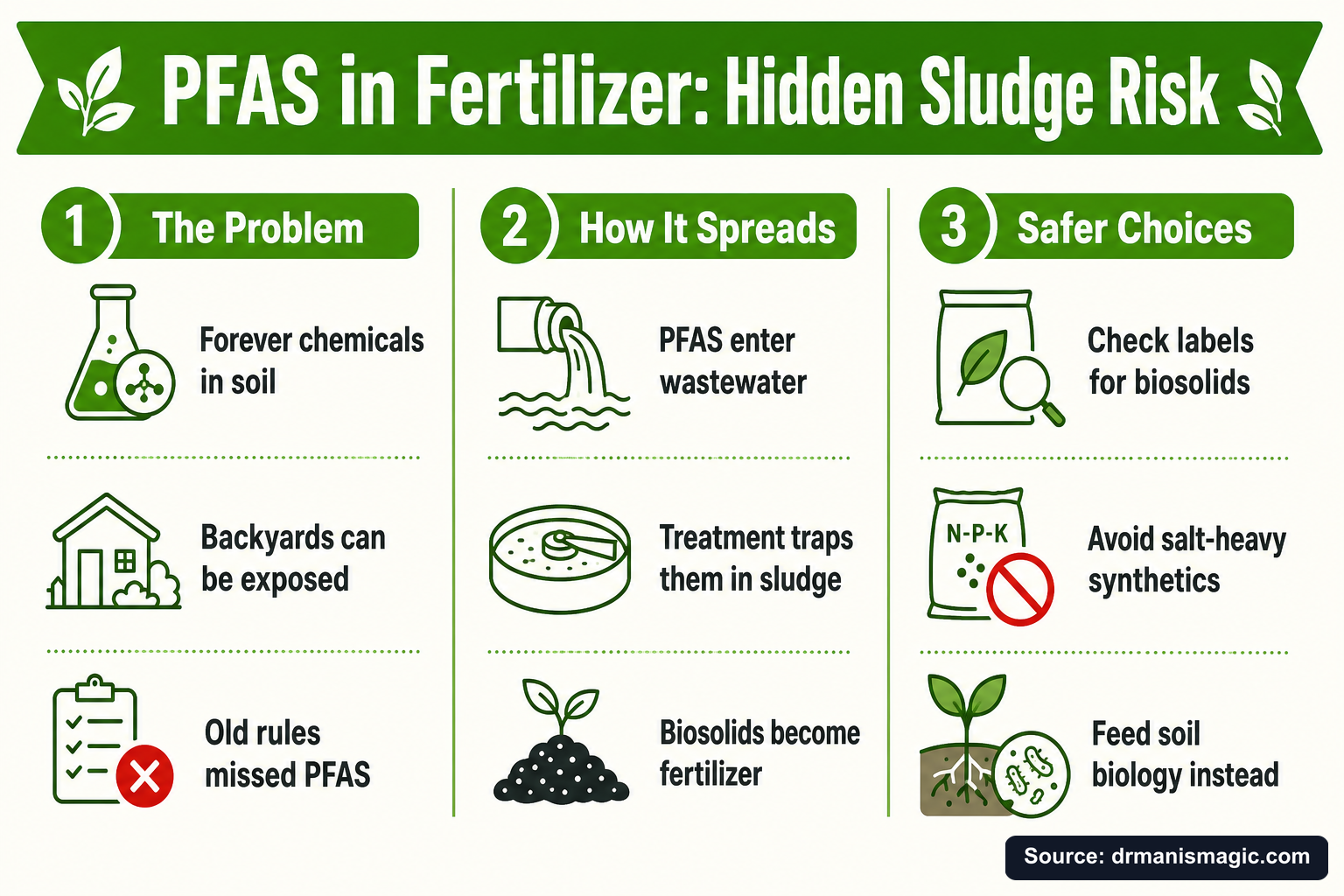
- PFAS "forever chemicals" enter fertilizer through biosolids, which is the industry term for treated municipal sewage sludge used as a soil amendment.
- The EPA's framework for biosolids was written in 1993 and did not include PFAS rules. A new draft risk assessment released in January 2025 showed that even tiny PFAS concentrations in land-applied sludge can exceed safe health thresholds.
- This is not just a farm problem. Homeowners, gardeners, and landscapers use biosolids-containing products on lawns, garden beds, fruit trees, ornamentals, and compost piles without knowing it.
- Certain label terms signal sewage sludge or biosolids. Knowing how to read a label is your first line of defense.
- Synthetic salt-based fertilizers carry a separate but equally serious risk: they burn roots, kill beneficial soil microbes, and set up a cycle of dependency that slowly destroys your soil's living ecosystem.
- Clean, biology-friendly nutrition built from crab, kelp, amino acids, and volcanic minerals feeds your plants without biosludge, PFAS, or salt damage.
- The Three Plant Pillars framework gives every plant owner a clear, proven path to healthy soil and safe nutrition from the ground up.
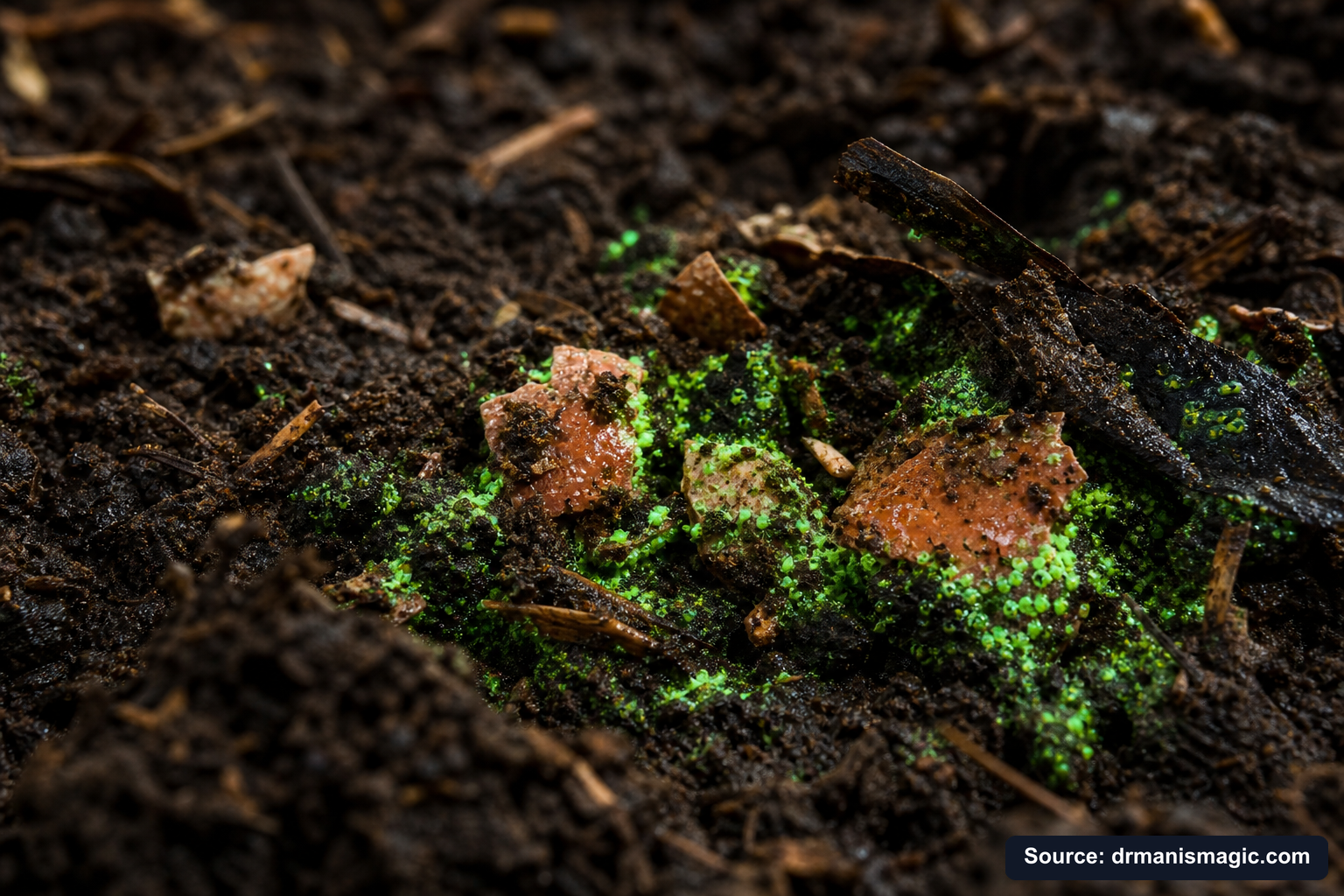
What Are PFAS and Why Are They Showing Up in Fertilizer?
Quick Answer: PFAS are man-made chemicals that never fully break down in the environment or in the human body. They enter fertilizer through biosolids, which is treated sewage sludge applied to land as a nutrient source. They survive wastewater treatment, concentrate in sludge, and then get spread on soil through fertilizer products.
PFAS stands for per- and polyfluoroalkyl substances. There are thousands of them. You've been exposed to them your whole life through nonstick cookware, food packaging, water-resistant clothing, firefighting foam, and hundreds of industrial products. When those chemicals wash off, they flow into drains, then into wastewater treatment plants. And here is the critical piece that most people miss: wastewater treatment does not destroy PFAS. It concentrates them in the solid material that gets filtered out of the water.
That solid material is called sewage sludge. When it gets processed and treated to reduce pathogens, it becomes "biosolids." And for decades, biosolids have been marketed as a cost-effective, nutrient-rich fertilizer for farms, parks, lawns, forests, and reclamation sites. The PFAS came along for the ride.
According to Penn State Extension, accurate detection of PFAS in wastewater and biosolids was not even possible until the early 2000s. The EPA's Part 503 rules that govern biosolids were written in 1993. PFAS were simply not on the radar. That is the core reason this problem is just now coming to light. The rules protecting your soil were built before anyone knew what to look for.
In January 2025, the EPA released a draft sewage sludge risk assessment that changed the conversation from theoretical concern to modeled human health risk. The EPA found that land-applied sewage sludge containing even 1 part per billion of PFOA or PFOS, two of the most studied PFAS compounds, can exceed acceptable risk thresholds. Exposure pathways they studied included milk, beef, fish, eggs, crops, and drinking water. For homeowners with vegetable gardens, fruit trees, or edible landscapes, that is not an abstract policy detail. That is your backyard.
What Are Biosolids and How Do They End Up in Bags at the Garden Center?
Quick Answer: Biosolids are treated sewage sludge from municipal wastewater plants. They are legally sold and used as fertilizer and soil amendments. Some bagged compost, lawn fertilizers, and soil products contain biosolids. They are not always clearly labeled, and most homeowners have no idea they are buying processed human waste.
Here is what most people picture when they hear "sewage sludge": something that would never end up in a garden center. They picture industrial waste. They picture warning signs and hazmat suits. But biosolids are regulated, processed, and legally sold as fertilizer and soil amendments across the United States. They get blended into bagged compost, lawn fertilizer, topsoil mixes, and soil conditioners. Sometimes the labeling is clear. Often, it is not.
The reason biosolids spread so widely is simple economics. Municipalities generate enormous amounts of sewage sludge. Disposing of it in landfills or incinerators is expensive. Land application is cheap. Farmers and land managers get a free or low-cost nitrogen and phosphorus source. The system recycled a waste product into a useful one. That was genuinely the intention. The problem is that the waste product also contained PFAS, heavy metals, pharmaceuticals, microplastics, and other compounds that were never part of the original nutrient-recycling logic.
According to Michigan State University Extension, PFAS contamination from biosolids has now been documented in farm soils, surface water, groundwater, and food crops in multiple states. Maine became the first state to ban biosolids land application after widespread PFAS contamination was discovered on farms that had been receiving municipal sludge for years. The farmers did everything right. They followed the rules. The rules just did not protect them.
That story matters to you as a home gardener. Because the same materials that went to those farms also went into bagged products at your local garden center.
How Can You Tell If a Fertilizer or Compost Contains Biosolids?
Quick Answer: Look for specific terms on the bag or label. Words like "biosolids," "sewage sludge," "municipal compost," "Class A biosolids," or "exceptional quality biosolids" are your clearest signals. "Organic" on the label does not mean sludge-free. When in doubt, contact the manufacturer directly and ask for a certificate of analysis.
This is the practical question. You are standing in the garden center. You want to know if what is in the bag is safe. Here is a plain-language guide to what you are looking for.
| Label Term | What It Means | Risk Level |
|---|---|---|
| Biosolids | Treated municipal sewage sludge. Direct disclosure. | High |
| Sewage Sludge | Raw or treated waste from wastewater plants. | High |
| Class A Biosolids / Exceptional Quality (EQ) | Processed to reduce pathogens. Still contains PFAS. | High |
| Municipal Compost | May include biosolids depending on the facility's feedstock. | Medium to High |
| Organic | Only means it is carbon-based. Does NOT mean sludge-free. | Varies. Ask for documentation. |
| Compost / Soil Amendment | May or may not contain biosolids. Source matters. | Unknown without verification |
| Green-Waste Compost | Made from plant material only. Lower risk if verified. | Lower if verified |
| PFAS-tested / Sludge-free / Biosolids-free | Explicit clean claim. Ask for the test certificate. | Low if documented |
Here is a hard truth. The word "organic" on a fertilizer bag does not mean what most people think. It simply means the nutrients come from a carbon-based source rather than a fully synthetic one. Biosolids qualify as organic under that definition. So does fish emulsion, blood meal, bone meal, feather meal, and crab shell. The word organic tells you almost nothing about whether PFAS is present. You have to ask specifically.
When Dr. Mani developed our Crab, Kelp & Amino Acids fertilizer, he started with a non-negotiable: zero biosludge. Zero PFAS. Zero synthetic salts. Every ingredient has a clean, traceable source. Crab shells. Cold-processed kelp. Amino acids from animal-derived proteins. Volcanic ash for trace minerals. Nothing that came from a municipal wastewater plant. That was not a marketing decision. It was a scientific one, built on 30-plus years of watching what happens to soil and roots when dirty inputs go in.
Who Is Most at Risk: Vegetable Gardens, Fruit Trees, Lawns, or Ornamentals?
Quick Answer: Edible gardens carry the highest risk because PFAS can move from soil into plant tissue and ultimately into food. Fruit trees, berry beds, and root vegetables are especially worth protecting. Lawns and ornamentals carry lower direct food-chain risk but still matter for soil health, pets, children playing outdoors, and runoff into water.
Not all uses carry the same level of concern. Here is how to think about risk by use case.
| Use Case | PFAS Concern Level | Why It Matters |
|---|---|---|
| Vegetable garden (root crops, leafy greens) | Very High | PFAS uptake into edible tissue is well documented. Eaten directly. |
| Fruit trees and citrus (backyard orchard) | High | Long-lived trees accumulate soil inputs over years. Fruit is consumed. |
| Berry beds (strawberries, blueberries) | High | Shallow root zone. Fruit eaten fresh. Children often eat directly from plant. |
| Herb garden (basil, mint, parsley) | High | Used fresh in food. Leaves are the harvested part. |
| Turfgrass / Lawn | Medium | Children and pets play on it. Runoff carries PFAS to water. Not eaten but absorbed through skin contact. |
| Ornamental trees and shrubs | Lower but not zero | Soil biology still matters. PFAS accumulates over time and can move to groundwater. |
| Houseplants | Low direct risk | Depends entirely on the potting mix and fertilizer used. Controlled environment. |
| Pasture / Livestock grazing | Very High | Animals graze contaminated grass. PFAS concentrates in milk and meat. Direct food chain exposure. |
If you are growing anything you eat, this matters to you right now. Not someday. Now. A fruit tree you plant today may still be producing fruit 20 years from now. The inputs you choose today are literally building the soil that tree will grow in for decades. Every handful of biosludge-contaminated fertilizer you apply is a deposit into an account you cannot easily close.
We have watched people wait years to see fruit on a tree they planted. Years of hope, watering, fertilizing, and waiting. The number one thing people tell Dr. Mani they want is to see fruit come off a tree they planted themselves, while they still have the health and energy to enjoy it. Time is the one thing money cannot buy back. Every season you spend on the wrong inputs is a season you cannot get back. That truth drives everything we do.
Why Are Salt-Based Synthetic Fertilizers a Separate but Related Problem?
Quick Answer: Synthetic fertilizers are made from salt-based compounds. High salt levels in soil pull water away from roots through osmotic stress, essentially causing physiological drought even when the soil is wet. Salt also kills the beneficial bacteria and fungi that plants depend on for nutrient cycling, disease protection, and root health.
PFAS from biosolids is not the only fertilizer problem. It is not even the oldest one. The salt problem has been quietly destroying home gardens and landscapes since Miracle-Gro introduced synthetic fertilizers to American consumers in the 1950s. And here is the thing: most people have no idea it is happening.
When you pour a fast-dissolving synthetic fertilizer onto your soil, you are dumping a concentrated salt solution into the root zone. Salt pulls water toward itself through a process called osmosis. When the salt concentration outside a plant's roots is higher than the concentration inside the roots, water moves the wrong direction. Out of the roots. Into the soil. Your plant is surrounded by water but dying of thirst. Scientists call this osmotic stress or physiological drought. It looks exactly like underwatering, even when the soil is soaking wet.
Then the salt kills the microbes. And here is why that matters more than most fertilizer guides ever explain.
The living microbes in healthy soil are not just passengers. They are the engine. Bacteria and fungi break down organic matter and convert nutrients into forms plant roots can actually absorb. Nitrogen-fixing bacteria pull nitrogen directly from the atmosphere and deliver it to plant roots in exchange for sugars. Mycorrhizal fungi extend the root system by factors of ten or a hundred, reaching water and minerals the roots alone could never access. When you pour salt-based fertilizer into that system, you are not just feeding the plant. You are burning down the factory that was doing most of the work.
After the microbes are gone, the plant becomes completely dependent on whatever nutrients you put in by hand. Every application. Every season. The big chemical companies understood this perfectly. A plant that cannot feed itself is a customer for life. See also: The Hidden Reason Synthetic Fertilizers Cause Root Rot
You Never Had a Brown Thumb.
You were handed the wrong tools. This free guide hands you the right ones.
You watered it. You fed it. It died anyway.
It was never you. It was the dirt, the salt food, and the bad advice.
This guide shows you what really went wrong, and how to fix it for good.
- Why your plants really died, and why it was never your fault
- The salt hiding in your plant food that quietly burns the roots
- The hidden killer in almost every bag of store soil
- The tiny helpers that grow a whole forest for free
- The rescue trick that brings a half dead plant back to life

How Does Organic Fertilizer Actually Feed Plants Differently?
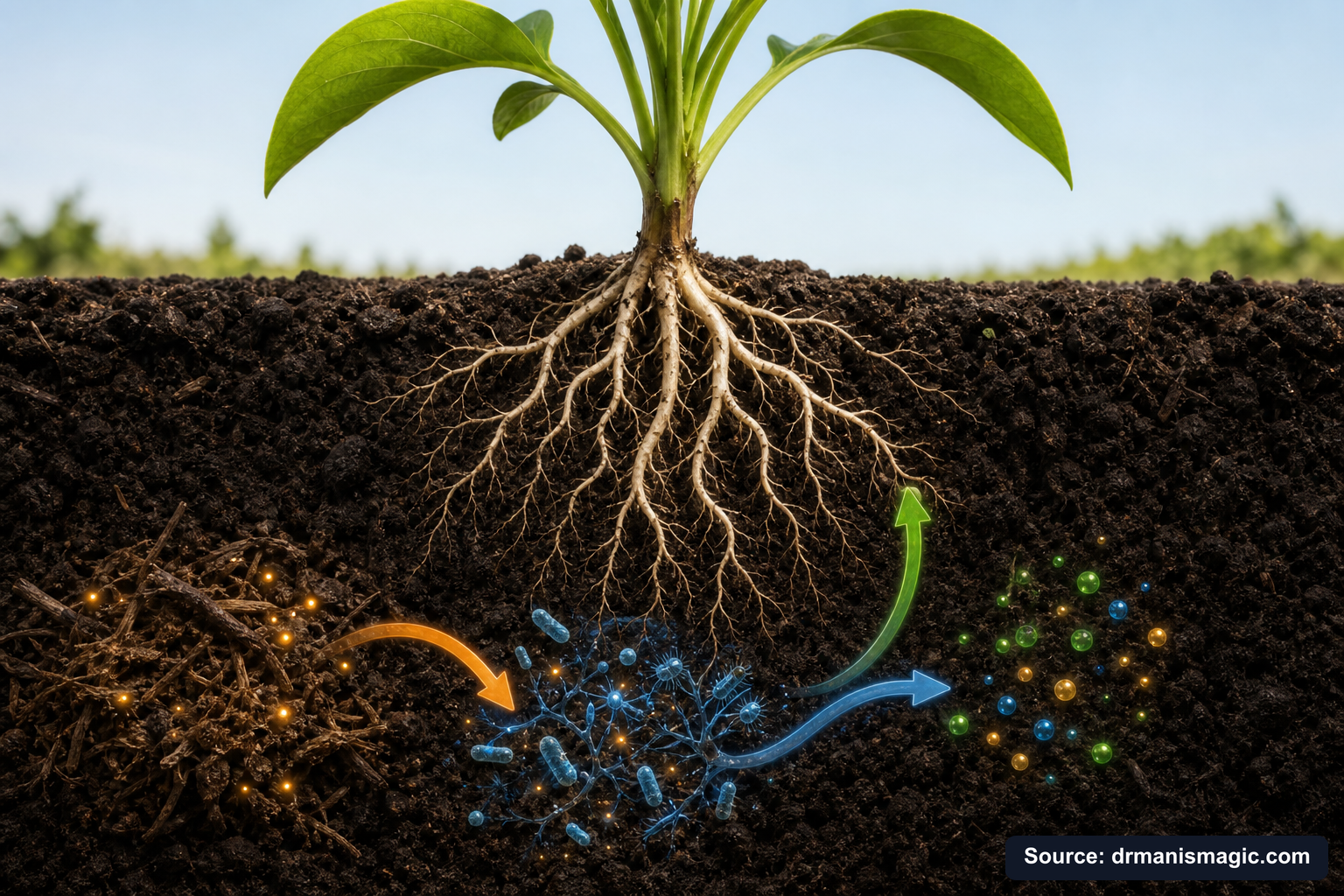
Quick Answer: Organic fertilizer works through the soil food web, not around it. Microbes eat the organic material first, converting it into plant-available nutrients. When those microbes die, they release a second wave of nutrition directly into the root zone. This creates a natural slow-release system that mirrors how plants have eaten in nature for millions of years.
This is the part that most gardening guides completely skip over. And it changes everything once you understand it.
When you apply an organic fertilizer like crab shell, kelp, and amino acids to your soil, the plant does not eat it directly. The microbes eat it first. Bacteria and fungi in the soil break down the crab shell chitin, the kelp carbohydrates, and the amino acid proteins. As they digest these materials, they release nitrogen, phosphorus, potassium, calcium, magnesium, and dozens of trace minerals in forms that plant roots can absorb. That is the first feeding.
Then those microbes die. And when they die, every nutrient that was locked inside their tiny bodies releases directly into the soil around the roots. That is the second feeding. A slow, steady, continuous trickle of nutrition that keeps coming long after you applied the fertilizer.
Picture a campfire that burns all night from one big log versus a pile of newspaper that flares up and burns out in three minutes. Synthetic fertilizer is the newspaper. Organic fertilizer fed through living soil is the log. One keeps you warm all night. The other sends you scrambling every few minutes for more fuel.
This is why the Three Plant Pillars work together as a system and not as three separate products. Pillar One is mineral-based soil that drains well, stays open, and never compacts into root-choking sludge. Pillar Two is live microbials, the bacteria and fungi that run the nutrient-cycling engine. Pillar Three is organic fertilizer that feeds the microbes and, through them, feeds the plant. Remove any one pillar and the system weakens. Keep all three and your plants become, as Dr. Mani says, practically bulletproof.
What Makes Crab Shell, Kelp, and Amino Acids Better Than Conventional Fertilizer Ingredients?
Quick Answer: Crab shell brings chitin, calcium, and magnesium that activate natural pest and disease resistance. Kelp delivers growth hormones, trace minerals, and carbohydrates that stimulate root development and stress tolerance. Amino acids provide immediately available organic nitrogen that microbes love. Volcanic ash adds silica and micronutrients that build cell wall strength. None of them are salt-based. None of them contain biosludge or PFAS.
Let's go ingredient by ingredient so you can feel why each one earns its place.
Crab Shell and Chitin. Chitin is the structural material in crab shells. When chitin enters soil, certain beneficial bacteria that love to eat it multiply rapidly. As a side effect of digesting chitin, these bacteria produce enzymes that dissolve the outer shells of fungal pathogens and insect pests. Your soil essentially develops a natural immune response. Chitin also delivers calcium, which is the primary building material for plant cell walls and woody tissue. Strong cell walls mean stronger stems, better fruit set, and more resistance to physical damage and disease entry.
Cold-Processed Kelp. Kelp is one of the fastest-growing organisms on the planet. It is packed with natural plant growth hormones called auxins and cytokinins. Auxins drive root elongation. Cytokinins stimulate cell division and new shoot growth. Kelp also carries a dense array of trace minerals from the ocean that most land soils have long since lost to erosion and cropping. And because it is cold-processed rather than heat-extracted, the delicate hormones and carbohydrates stay intact and active.
Amino Acids. Amino acids are the building blocks of protein. When you feed amino acid nitrogen to soil, the microbes and the plant both have an easier time using it than they do with raw mineral nitrogen. The plant can absorb certain amino acids directly through root membranes. Others feed the nitrogen-cycling bacteria that convert them into plant-ready nitrate and ammonium. Either way, the nitrogen gets where it needs to go efficiently, without the osmotic salt load that comes with synthetic nitrogen sources.
Volcanic Ash. Soil that has been cropped, watered, and leached for years loses its trace mineral profile. Volcanic ash replenishes silica and a broad spectrum of micronutrients in a slow-release mineral form that does not spike, does not burn, and does not require microbial conversion. Silica strengthens cell walls, increases drought tolerance, and helps plants resist both physical and biological stress.
And here is the other thing. Our fertilizer does not smell bad. If you have ever used fish emulsion or certain manure-based fertilizers, you know the smell. It clears a room. It brings the neighbors' dogs running. It makes you question every decision that led to that moment. Our crab, kelp, and amino acids formula is stable. It smells like earth. That is what a properly formulated, non-rotting organic fertilizer should smell like.
Synthetic vs. Slow-Release vs. Clean Organic: What Is the Real Difference?
Quick Answer: Synthetic fertilizers release fast, carry a high salt load, and kill soil microbes. Slow-release synthetic fertilizers use plastic coatings that reduce burn but still add salt over time and leave microplastic residue. Clean organic fertilizers like crab, kelp, and amino acids feed through the soil food web, carry no meaningful salt load, contain no PFAS or biosludge, and build long-term soil health instead of depleting it.
| Fertilizer Type | Salt Load | PFAS / Biosludge Risk | Microbial Impact | Release Speed | Long-Term Soil Effect |
|---|---|---|---|---|---|
| Synthetic Fast-Release (granule or liquid) | Very High | Low direct risk but often blended with biosolid fillers | Burns and kills microbes | Immediate spike, then crash | Soil degradation over time. Creates dependency. |
| Synthetic Slow-Release (polymer-coated) | Medium to High | Low PFAS directly, but plastic coating leaves microplastic residue in soil | Less burn but still inhibits soil biology | Weeks to months depending on coating | Plastic accumulation. Salt still builds in containers. |
| Biosolids-Based "Organic" | Low to Medium | High. PFAS, pharmaceuticals, heavy metals, microplastics documented | May support biology short-term but PFAS disrupts long-term | Moderate, microbe-mediated | PFAS accumulation in soil, water, and food chain over time |
| Clean Organic (Crab, Kelp, Amino Acids) | Very Low | Zero. No biosludge. No PFAS. | Feeds and supports microbes actively | Slow, continuous, microbe-mediated | Builds soil biology and structure over time. Self-reinforcing. |
Look at that table and think about what you are really buying when you pick up a bag at the garden center. You are not just buying nutrients. You are buying a downstream consequence. Fast-release synthetics give you a green lawn for three weeks and a weaker soil ecosystem than you started with. Clean organic inputs give you a living soil that keeps improving every season you use it.
See also: Why Most Fertilizers Are Actually Salt in Disguise
How Do You Start Rebuilding After Years of Salt-Based or Biosolids-Contaminated Inputs?
Quick Answer: Stop the damaging inputs first. Then rebuild soil biology with live microbials. Then feed the recovering ecosystem with clean, slow-release organic nutrition. The soil can recover, but it takes consistent right inputs over multiple seasons. The Three Plant Pillars give you the exact sequence to follow.
If you have been using conventional fertilizers or bagged composts for years and you are just now learning what might have been in them, take a breath. Panic does not grow better plants. A clear plan does. Here is a recovery checklist you can start this week.
- Stop the salt inputs immediately. Set aside the fast-release granules and the liquid synthetic fertilizers. Every application adds more salt load to the root zone and kills more of the soil biology you are trying to rebuild.
- Flush containers if possible. For potted plants, water deeply and thoroughly three to four times in a row, letting the water drain completely each time. This helps move accumulated salt out of the root zone and through the drainage holes.
- Introduce live microbials. Your soil biology has been depleted. Reintroduce it directly with a live microbial drench. Bacteria, fungi, and mycorrhizae need to be re-established before the organic fertilizer cycle can work properly. Plant Super Boost is the microbial product we use on every tree at our nursery, and it is the one we ship to home growers across the country.
- Evaluate your soil structure. If your potting mix is more than 12 to 18 months old and made from bark or wood fiber, it is likely breaking down and compacting. Compacted soil blocks oxygen from roots, and roots without oxygen become sitting targets for root rot pathogens like Pythium and Phytophthora. Mineral-based soil does not decompose. Super Soil is our permanent mineral-based mix built for exactly this purpose.
- Begin clean organic fertilization on a regular schedule. Monthly applications of a slow-release, sludge-free organic fertilizer keep the microbial engine running and the nutrient supply steady. No spikes. No crashes. No salt accumulation.
- Be patient with edible gardens in previously contaminated soil. If you are concerned about PFAS in existing in-ground garden beds, contact your state extension service about soil testing options. For raised beds and containers, starting with clean inputs and clean soil gives you a fresh start you can control.
- Download the Free Plant Care Field Guide and use it as your reference from here forward. It gives you the full Three Plant Pillars approach in plain language, without the guesswork.
The soil is not ruined forever. Nature is incredibly good at recovering when you stop fighting it and start working with it. The microbes come back. The root systems rebuild. The plants respond. We have seen it happen thousands of times across more than 250,000 trees at our South Texas nursery. The biology wants to work. Your job is just to stop blocking it.
Why Did Regulators Allow This and What Is Changing Now?
Quick Answer: The EPA's biosolids rules were written in 1993 before scientists could accurately detect PFAS. PFAS were assumed to be safe or were simply unknown. A January 2025 EPA draft risk assessment now shows that even low PFAS concentrations in land-applied sludge can exceed safe health thresholds. Regulatory change is coming, but it is slow. Consumers who want protection today need to choose their inputs carefully.
This is not a story of malicious intent. The people who wrote the 1993 biosolids rules were genuinely trying to solve a real problem: what to do with the enormous volume of sewage sludge that wastewater plants produce every day. Land application seemed like a reasonable solution. Sludge contains nitrogen, phosphorus, and organic matter. Farms and gardens need those things. The logic was sound given what was known at the time.
The problem is that PFAS were not known as a threat in 1993. They were not detectable in wastewater at meaningful concentrations until the early 2000s. And the regulatory framework has not caught up. As Penn State Extension notes, the existing Part 503 rules focus on pathogens and heavy metals. PFAS was never part of the equation.
The January 2025 EPA draft risk assessment changed that. For the first time, the federal government modeled real human health exposure scenarios using biosolids-contaminated soil and found that even 1 part per billion of PFOA or PFOS in land-applied sludge can exceed acceptable cancer and non-cancer risk thresholds through multiple pathways. That is an extremely low concentration. And most biosolids-amended soils contain far more than that.
Regulatory change will eventually follow. Several states have already moved ahead of the federal government. Maine banned biosolids land application entirely. Other states are implementing testing requirements and notification rules. But federal regulation moves slowly. The gap between what the science says and what the rules require can be years or decades wide. You cannot afford to wait for that gap to close if you are growing food for your family right now.
This is exactly why Dr. Mani built clean inputs from the start. Not because the law required it. Because the science demanded it. And because after 30-plus years of growing trees and watching what inputs do to soil over time, there was no other honest choice.
The Bigger Picture: Three Threats to Your Soil, One Clean Framework
Quick Answer: Home gardeners face three distinct but related soil threats: PFAS contamination from biosolids-based fertilizers, salt damage and microbial destruction from synthetic fertilizers, and root suffocation from decomposing bark-heavy potting mixes. The Three Plant Pillars address all three with mineral soil, live microbes, and clean organic nutrition.
Most gardening content talks about one problem at a time. PFAS articles talk about PFAS. Fertilizer burn articles talk about salt. Root rot articles talk about overwatering. But these problems do not live in separate boxes. They reinforce each other. And if you only fix one, the others will still bring your plants down.
Here is how the three threats interact. You apply a synthetic salt fertilizer. It kills the soil microbes. Without microbes, the organic matter in your potting mix does not break down properly, so nutrients are not cycling. You apply more fertilizer to compensate. More salt. More microbial death. Meanwhile, the bark-based potting mix you used is slowly decomposing and compacting, cutting off oxygen to the roots. Oxygen-starved roots become prime targets for Pythium and Phytophthora, the water mold pathogens behind most root rot. Now your plant looks like it has a watering problem. You water more. The anaerobic conditions in the compacted soil get worse. More root rot. More stress. You apply more fertilizer to green it back up. The cycle accelerates.
Add biosolids-contaminated compost to that mix and you have also been depositing PFAS into your soil every season, building up in the soil profile, in your groundwater, and potentially in the food you are growing for your family.
The Three Plant Pillars break this cycle at every point. Mineral-based soil stays open and well-drained indefinitely, so roots always have oxygen. Live microbials rebuild the nutrient-cycling engine so the soil feeds itself. Clean organic fertilizer with no salt, no biosludge, and no PFAS feeds the microbes and the plant without adding any of the three threats back into the system. It is not three separate fixes. It is one integrated solution, proven on 250,000 trees, applicable to every plant you own.
Whether you are growing citrus in a container on a patio, vegetables in a backyard raised bed, ornamental trees along your driveway, or grass where your kids play barefoot on summer evenings, the same three principles apply. Healthy soil. Living microbes. Clean nutrition. Everything else follows from that foundation.
You now know more about what might be in your fertilizer than most professional landscapers do. That knowledge is worth something. But knowledge without action is just worry. And you have enough of that already.
The practical next step is simple. Look at what you are currently using. Check the label. Ask the questions in this article. And if you want to start fresh with inputs you can trust, built by a plant scientist who spent 40-plus years proving what actually works in the soil, explore the Three Plant Pillars system and see how it applies to every plant in your care. Your soil, your plants, your family, and your time are all worth protecting.
Frequently Asked Questions
People are waking up to the PFAS fertilizer problem, and they have real questions. These are the ones we hear most often. We answer them straight, because your family, your soil, and every plant you care about deserve the truth.
How long do PFAS chemicals stay in soil?
A very long time. We are talking hundreds to thousands of years. PFAS have carbon-fluorine bonds that almost nothing in nature can break. They do not wash away. They do not fade. They just keep building up. That is exactly why we built our Three Plant Pillars system around clean, mineral-based soil with zero biosolids. Once PFAS get into your soil, you cannot un-ring that bell. Prevention is the only real answer.
What is the biggest source of PFAS getting into people?
Food and water are the top two. PFAS from contaminated farms, grease-resistant food packaging, and polluted water supplies are the main ways these chemicals get inside the human body. Here is the part most gardeners miss: fertilizers made from sewage sludge spread PFAS directly onto the soil where your food grows. That is a source you can control right now by choosing clean inputs with no biosolids.
How long do PFAS stay in the human body?
The body does remove PFAS, but slowly. Common types take two to eight years just to drop by half. Some stick around even longer. The best move is cutting off new exposure as fast as possible. That means being very careful about what you put on your lawn and garden soil, because PFAS from fertilizer can move into your food, your water, and then into you.
Can the body get rid of PFAS naturally?
Yes, but it takes time and the right habits. Your body removes PFAS mostly through urine, and for women, through menstruation and breastfeeding. Eating more soluble fiber like oats and chia seeds helps bind PFAS in the gut so they leave through stool. Drinking plenty of clean filtered water supports your kidneys. Healthy gut bacteria also help. But none of that works well if you keep adding new PFAS exposure from your garden products.
Why are synthetic fertilizers a problem beyond just PFAS?
Even fertilizers that skip the sewage sludge can still wreck your soil. Most synthetic fertilizers are salt-based. They burn roots. They wipe out the beneficial bacteria and fungi your plants depend on. Then your plants get weaker, you buy more fertilizer, and the cycle repeats. We watched this happen on thousands of trees before we built our own clean system. Our Crab, Kelp, and Amino Acids fertilizer feeds your plants with slow-release organic nutrition and zero salt burn.
How do I know if a fertilizer bag contains sewage sludge?
Read the label carefully. Words like biosolids, Class B biosolids, treated sewage sludge, or municipal compost are your warning signs. Some bags hide it behind vague terms like organic amendment or recycled organic material. The safest move is to know exactly where your inputs come from. Every product in the Dr. Mani's Magic line is built from clean, traceable ingredients with no biosolids and no mystery materials.
What is the safest way to fertilize my garden and lawn right now?
Start with the Three Plant Pillars. First, use a mineral-based soil that does not rot or compact. Second, add live microbes that protect roots and unlock nutrients naturally. Third, feed with a clean organic fertilizer made from real ingredients like crab, kelp, and amino acids. That is the exact system we tested on over 250,000 citrus trees at our South Texas nursery. No PFAS. No synthetic salts. No sewage sludge. Just plants that thrive the way nature intended.
About the Author
Dr. Mani Skaria, PhD
Dr. Mani Skaria, PhD, is a plant pathologist and the scientific founder of Dr. Mani's Magic. He spent 48 years studying how plants, soil, and living microbes work together, including his years as Professor Emeritus at Texas A&M and as a member of the USDA NAREEE Advisory Board. He invented micro-budding, a method for growing healthier, stronger trees, and has grown more than 250,000 trees on the family farm in Hargill, Texas - US Citrus Nursery. His life's work takes real lab science and turns it into simple, safe, organic plant care anyone can use at home.


