


How Natural Calcium Differs From Synthetic Sources in Soil | Dr. Mani's Magic
How Natural Calcium Differs From Synthetic Sources (And Why Your Soil Pays the Price Either Way)
You walk out to your tomato plants on a warm Saturday morning. Coffee in hand. The air smells like damp earth and possibility. You planted those tomatoes with care. You watered them. You fed them. And now the bottoms of the fruit are turning black and rotting right on the vine.
Blossom-end rot. You Google it. Every result says the same thing: calcium deficiency. So you drive to the big box store, grab a bottle of calcium spray, drench the leaves, and wait. A week later? Still rotting. Still losing fruit. Still confused. Here is the thing nobody told you: your soil probably has plenty of calcium. The problem was never a shortage of calcium. The problem was that your roots could not move it. And the reason your roots could not move it? That is a much bigger story. One that involves salt, microbes, and a choice between two very different ways of feeding your plants.
We have grown over 250,000 citrus trees at our South Texas nursery. We have watched this exact scenario play out thousands of times. And what we learned changed everything about how we think about plant nutrition. Not just calcium. All of it. So let us break it down for you the right way.

Plant Super Boost
Key Takeaways
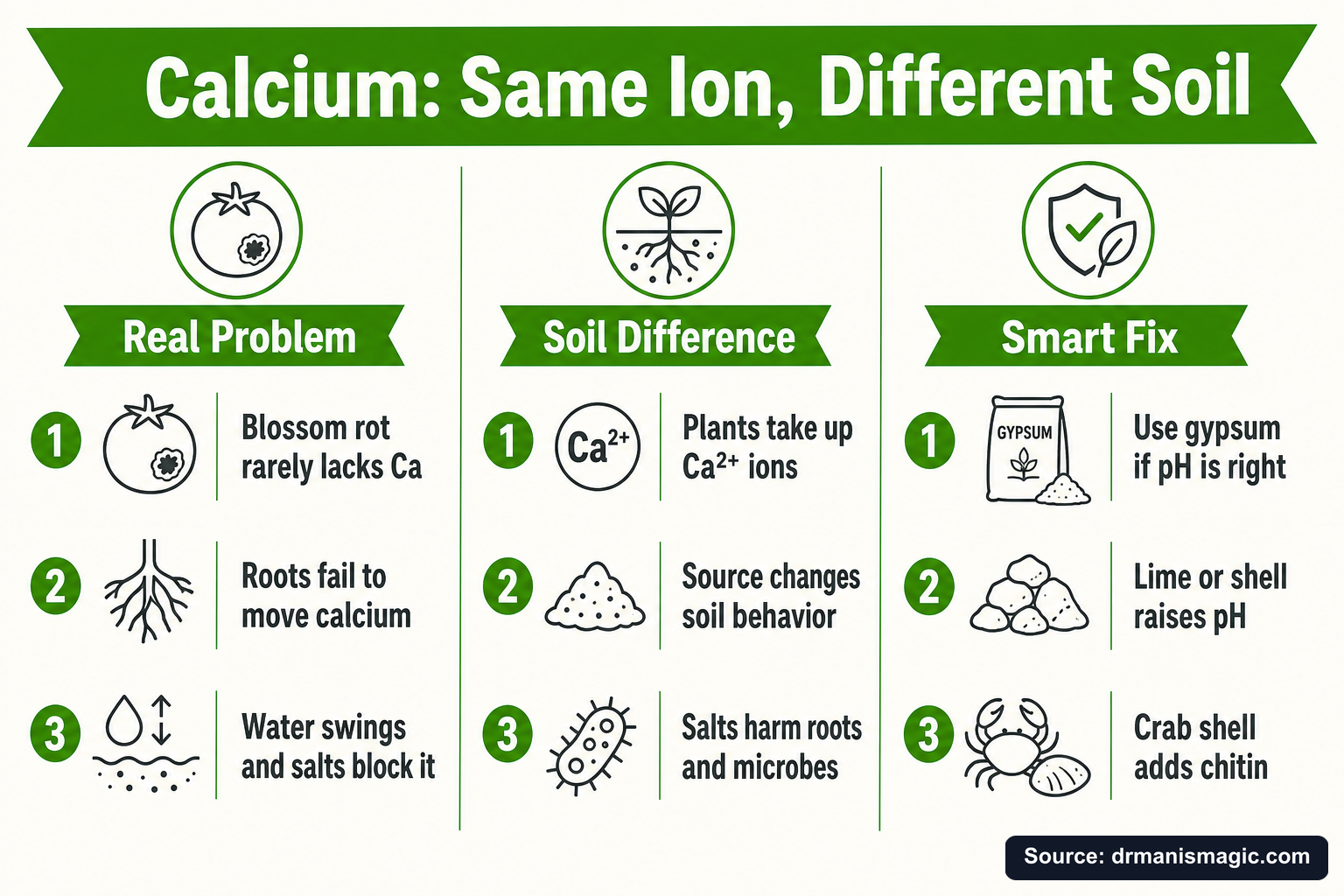
- Plants absorb calcium as a Ca2+ ion, and that ion is chemically the same whether it came from oyster shell, bone meal, or a synthetic bottle. The plant cannot tell the difference at the root level.
- The real differences between natural and synthetic calcium are release speed, salt load, pH effect, companion nutrients, microbial interaction, and contaminant risk. Those differences matter enormously for your soil.
- Synthetic calcium sources often carry a high salt index, which raises soil salinity, stresses roots, and kills the beneficial microbes your plant depends on.
- Natural calcium sources like crab shell, oyster shell, and bone meal release calcium slowly, feed soil biology, and bring along companion nutrients that support the whole plant system.
- Blossom-end rot, yellowing, and poor fruiting are rarely caused by a simple calcium shortage. Inconsistent watering, salt buildup, compaction, root damage, and poor drainage are far more common culprits.
- Chitin from crab shells does double duty: it provides calcium AND activates natural disease resistance in the soil.
- Clean calcium inputs with zero PFAS, zero biosludge, and zero synthetic salts protect your family, your microbes, and your long-term soil health.
Do Plants Actually Know the Difference Between Natural and Synthetic Calcium?
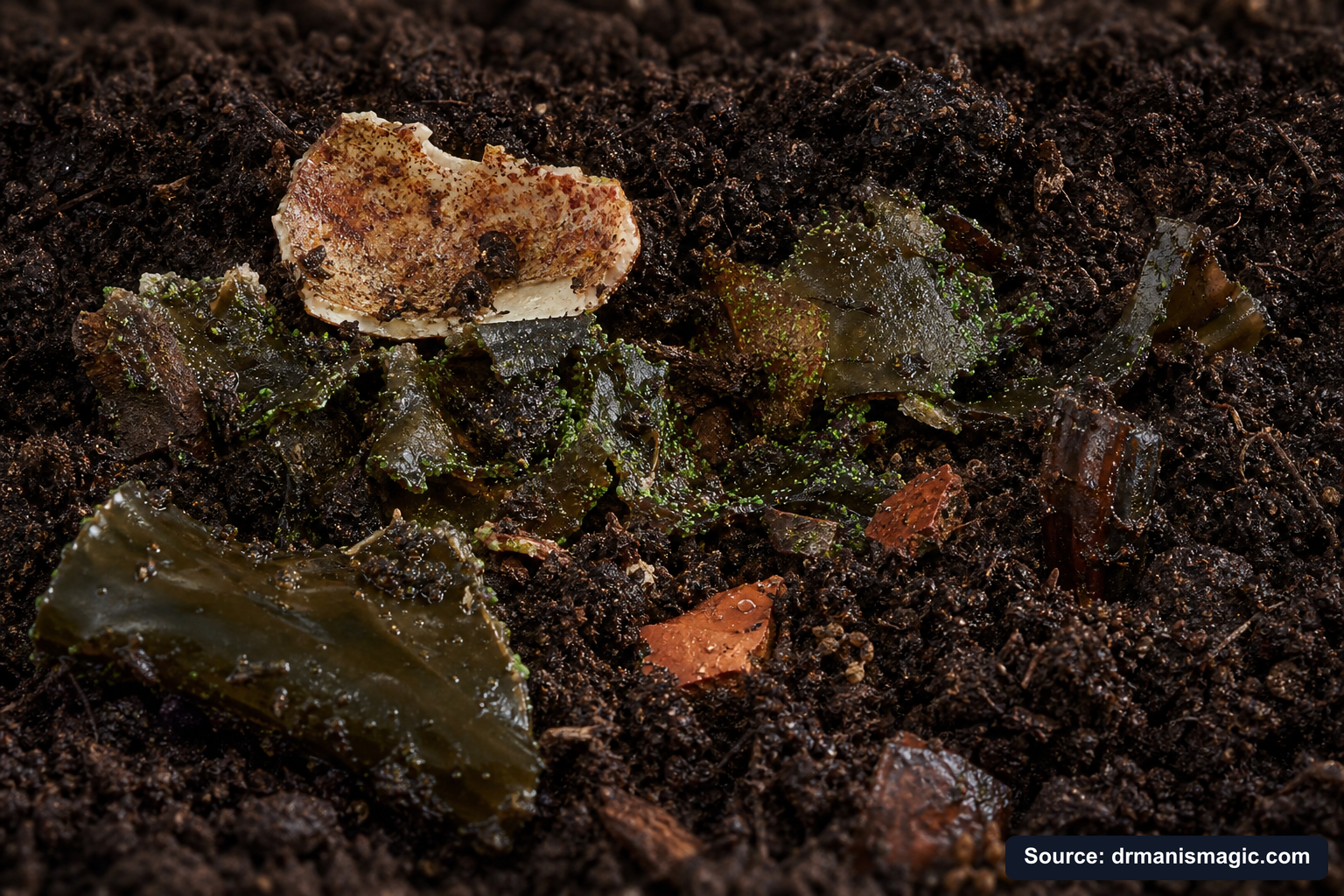
Quick Answer: At the root level, no. Plants absorb calcium as a Ca2+ ion regardless of where it came from. Limestone, gypsum, oyster shell, bone meal, and calcium nitrate all eventually deliver the same ion. But the soil system around that ion behaves very differently depending on the source, and that is where it matters.
Penn State Extension puts it plainly: once nutrients are converted into available inorganic forms, plants use them similarly whether they originated from organic matter, inorganic fertilizer, or mineral weathering. The ion is the ion.
So why does source matter at all? Because the journey that calcium takes to reach your roots shapes everything around it. Speed of release. Salt load. pH shift. Microbial activity. Companion nutrients. Contaminant risk. These are the real differences. And some of them can quietly wreck your soil for years before you ever notice.
Think of it like this. You need vitamin C. You could eat an orange or take a synthetic pill. Your body absorbs ascorbic acid either way. But the orange also brings fiber, flavonoids, water, and enzymes that help the whole system work. The pill brings ascorbic acid and a coating. The destination is the same. The journey is very different.
Calcium works the same way in your soil.
What Is Natural Calcium, Really? (It Is Not One Thing)
Quick Answer: Natural calcium is not a single product. It is a category that includes calcium carbonate from lime and oyster shell, calcium sulfate from gypsum, calcium phosphate from bone meal, and calcium plus chitin from crab shell. Each one behaves differently in soil, with different release speeds, pH effects, and microbial interactions.
Most gardening content lumps all natural calcium into one bucket. Eggshells. Lime. Bone meal. Gypsum. "Just use one of these," they say. But that advice skips the most important part. Here is what each source actually does.
Calcitic lime and oyster shell are mostly calcium carbonate. They dissolve slowly. They raise soil pH. They are best when your soil is too acidic and your calcium is also low. They are not the right tool if your pH is already fine.
Dolomitic lime adds calcium AND magnesium carbonate. It raises pH. Good when both nutrients are low and soil is acidic. Overuse can push magnesium too high and crowd out other minerals.
Gypsum is calcium sulfate. It adds calcium and sulfur without changing pH much. It is the right tool when you need calcium but your pH is already where you want it. It also helps displace sodium from high-salt soils. Useful for lawns and clay-heavy beds.
Bone meal and fish bone meal add calcium with phosphorus and organic nitrogen. The release is slow and microbe-dependent. Great when you also need phosphorus for root development and flower set.
Crab and shrimp shell add calcium plus chitin. Chitin is a compound that activates natural disease-fighting responses in the soil. It feeds a specific group of microbes that break down fungal pathogens. This is not just a fertilizer. It is a soil health tool. More on chitin in a moment.
Volcanic rock dust contributes calcium along with a broad range of trace minerals. It weathers very slowly. It is best as a long-term soil builder, not a fast fix.
Eggshells are mostly calcium carbonate. They are so slow to break down in most garden conditions that they provide almost no measurable calcium within a single growing season. They are not a reliable calcium source for your plants.
| Natural Calcium Source | Calcium Form | Release Speed | pH Effect | Companion Nutrients | Salt Risk | Microbial Role | Best Use Case |
|---|---|---|---|---|---|---|---|
| Calcitic Lime | Calcium carbonate | Slow | Raises pH | None | Very low | Indirect (pH balance) | Acidic soil correction |
| Dolomitic Lime | Calcium + magnesium carbonate | Slow | Raises pH | Magnesium | Very low | Indirect (pH balance) | Acidic soil + Mg deficiency |
| Oyster Shell | Calcium carbonate | Very slow | Raises pH gently | Trace minerals | Very low | Feeds microbes slowly | Long-term pH and Ca support |
| Gypsum | Calcium sulfate | Moderate | Minimal change | Sulfur | Low | Low direct role | Ca without pH change; sodium soils |
| Bone Meal | Calcium phosphate | Slow | Slight raise | Phosphorus, N | Low | Microbe-dependent release | Root development + Ca |
| Crab / Shrimp Shell | Calcium + chitin | Slow | Neutral to slight raise | Chitin, N, Mg | Very low | Feeds chitin-eating microbes | Soil biology + Ca + disease resistance |
| Volcanic Rock Dust | Calcium silicate + trace minerals | Very slow | Slight raise | Silica, trace minerals | None | Slow trace mineral release | Long-term trace mineral building |
| Eggshells | Calcium carbonate | Extremely slow | Minimal | None significant | None | Minimal | Not reliable for season results |
What Makes Synthetic Calcium Different in Soil?
Quick Answer: Synthetic calcium products like calcium nitrate dissolve fast and deliver Ca2+ quickly, which is useful in acute deficiency situations. But they carry a higher salt index, which raises soil salinity, draws water away from roots through osmotic stress, and can kill or suppress the beneficial microbes your plant needs to stay healthy long-term.
Speed is the selling point. And sometimes speed is exactly what you need. A fast-growing crop showing acute calcium deficiency during critical fruit set? A soluble calcium product can bridge that gap.
But here is what the bag does not tell you.
Synthetic calcium fertilizers are salt-based. And salt in the soil creates a problem called osmotic stress. Here is how it works in plain language. Roots move water from soil into the plant by creating a higher concentration of dissolved minerals inside the root than outside. When you flood the soil with synthetic salts, the equation flips. Now the outside has more dissolved minerals than the inside. Water moves OUT of the root instead of in. The plant is sitting in wet soil and still dying of thirst. This is called physiological drought.
CSU Extension, Utah State Extension, and University of Nevada Extension all confirm this: high soluble salts reduce water uptake, restrict root growth, cause leaf burn, and damage seedlings. The problem is especially severe in containers, raised beds, compacted soils, and areas with poor drainage, because salts have nowhere to go. They just build up.
And then there is the microbial massacre. Your soil is alive with bacteria, fungi, and mycorrhizae that unlock nutrients, protect roots from pathogens like Pythium and Phytophthora, and create the living ecosystem your plant evolved to thrive in. Salt-based fertilizers burn those microbes. Not dramatically. Not all at once. Quietly, over time. Feeding session by feeding session. Until the soil goes quiet and your plant is defenseless.
See also: The Hidden Reason Synthetic Fertilizers Cause Root Rot
Why Does Calcium Move Slowly in Plants, Even When the Soil Has Plenty?
Quick Answer: Calcium moves through plants almost entirely through the transpiration stream. Water enters the roots, travels up through the stems, and pulls calcium along with it. If watering is inconsistent, roots are damaged, soil is compacted, or salt stress is creating physiological drought, that water flow slows or stops. Calcium stalls. Deficiency symptoms appear even when calcium in the soil is abundant.
This is the part that trips up almost everyone.
Calcium is what plant scientists call a "low mobility" nutrient. Iron, manganese, and zinc are similar. They do not move freely from old leaves to new growth the way nitrogen or potassium do. They travel almost exclusively with the flow of water moving up through the plant. Roots pull water in. Water carries calcium up. New growth gets fed.
Cut off the water flow and you cut off calcium delivery. Period.
This is why blossom-end rot in tomatoes and tip burn in lettuce happen most often when watering is inconsistent. Not because the soil is calcium-poor. Because the water flow stuttered. The fruit grew faster than the calcium could move into it.
The same thing happens when roots are damaged. Salt damage. Root rot from Pythium or Phytophthora. Compaction. Waterlogging. Anything that reduces root function reduces calcium delivery. No matter how much calcium is in your soil or your spray bottle.
This is why Dr. Mani always says: fix the root before you fix the nutrient. A healthy root system in a healthy soil moves calcium efficiently. A damaged root system in a salty, biology-dead soil cannot move it at all.
What Is the Salt Index and Why Does It Matter for Calcium Fertilizers?
Quick Answer: The salt index is a measurement of how much a fertilizer raises soil salinity compared to the same weight of sodium nitrate. A high salt index means higher osmotic stress risk. Natural calcium sources like crab shell, oyster shell, and gypsum have very low salt indexes. Synthetic calcium nitrate has a much higher one. For containers, seedlings, and drought-stressed plants, this difference is critical.
You have probably never seen the words "salt index" on a fertilizer bag. That is not an accident.
The salt index tells you how much electrical conductivity a fertilizer adds to the soil solution. The higher the number, the more osmotic stress it creates at the root zone. Researchers at university extension programs use this measurement to predict fertilizer burn risk, especially in sensitive situations.
Here is why it matters for calcium specifically. If you are reaching for a calcium source because your plant is already stressed, adding a high-salt-index product can make things dramatically worse. You give calcium with one hand and take away water uptake with the other.
Natural calcium sources almost universally carry a low salt index. Crab shell, oyster shell, bone meal, and gypsum all release calcium slowly, with minimal osmotic impact. The soil solution stays balanced. Roots keep drinking. Microbes keep working.
See also: How Salt-Based Feeding Quietly Destroys Root Systems
What Does Chitin From Crab Shell Actually Do for Your Soil?
Quick Answer: Chitin from crab and shrimp shells is a structural compound that feeds a specific group of soil microbes called chitinase-producing bacteria. These microbes eat chitin and, in the process, actively break down the cell walls of many fungal pathogens. Adding chitin to your soil is like hiring a standing army against root rot organisms, nematodes, and soil-borne diseases.
This is one of our favorite things to talk about. Because almost nobody knows this.
When you add crab shell to your soil, you are not just adding calcium and magnesium. You are adding chitin. Chitin is the same structural compound that makes up the shells of insects, the cell walls of many fungi, and the exoskeletons of crustaceans. It is tough. It is carbon-rich. And certain soil microbes absolutely love to eat it.
When those chitinase-producing bacteria wake up and start consuming chitin, something remarkable happens. Their population explodes. And as they multiply, they start going after other chitin sources in the soil. Including the cell walls of fungal pathogens like Pythium, Phytophthora, and the eggs of root-knot nematodes.
You are not just feeding your plant. You are feeding its defenders.
This is one of the core reasons our Crab, Kelp & Amino Acids fertilizer uses crab shell as a foundational ingredient. The calcium is real. The chitin benefit is real. And neither of them require synthetic salts to work.
After growing 250,000+ citrus trees at our South Texas nursery, we watched crab-shell-based nutrition consistently outperform synthetic calcium inputs in long-term soil health and disease resistance. The trees did not just look better. The soil felt alive in a way that salt-fed soil never does.
Natural vs. Synthetic Calcium: A Complete Side-by-Side Comparison
Quick Answer: Natural calcium sources release slowly, carry low salt indexes, support soil biology, and bring companion nutrients. Synthetic calcium sources deliver Ca2+ fast but raise soil salinity, suppress microbes with repeated use, and do nothing for long-term soil structure. The right choice depends on your situation, but for ongoing plant health, natural wins every time.
| Factor | Natural Calcium (Crab, Oyster, Bone, Gypsum) | Synthetic Calcium (Calcium Nitrate, Cal-Mag Soluble) |
|---|---|---|
| Ion delivered to plant | Ca2+ | Ca2+ |
| Release speed | Slow to moderate | Fast (immediately soluble) |
| Salt index | Very low | Moderate to high |
| Osmotic stress risk | Very low | Moderate to high, especially in containers |
| Microbial impact | Feeds and supports soil biology | Suppresses microbes with repeated use |
| Companion nutrients | Sulfur, phosphorus, chitin, trace minerals, nitrogen | Nitrate nitrogen (can cause imbalance if overused) |
| pH effect | Varies by source (lime raises, gypsum neutral) | Slight acidifying with some products |
| PFAS / contaminant risk | Low when sourced cleanly; avoid biosludge-derived | Low for Ca specifically; risk depends on full formula |
| Soil structure benefit | Improves aggregate stability over time | Minimal to none |
| Best for | Long-term soil building, containers, lawns, trees, food gardens | Fast correction of acute deficiency in-season |
You Never Had a Brown Thumb.
You were handed the wrong tools. This free guide hands you the right ones.
You watered it. You fed it. It died anyway.
It was never you. It was the dirt, the salt food, and the bad advice.
This guide shows you what really went wrong, and how to fix it for good.
- Why your plants really died, and why it was never your fault
- The salt hiding in your plant food that quietly burns the roots
- The hidden killer in almost every bag of store soil
- The tiny helpers that grow a whole forest for free
- The rescue trick that brings a half dead plant back to life

Is Your Plant Actually Calcium Deficient, or Is Something Else Going On?
Quick Answer: Most blossom-end rot, tip burn, and calcium-related symptoms are caused by impaired calcium movement, not a true shortage of calcium in the soil. Before adding any calcium product, check watering consistency, soil drainage, root health, salt buildup, soil pH, and compaction. Fix those first.
Here is the diagnostic mistake most gardeners make. They see a symptom. They Google it. They buy the product. They apply it. Nothing improves. They buy a stronger product. Still nothing. Weeks pass. Money spent. Frustration builds.
The symptom told them what was happening. It did not tell them why.
Blossom-end rot on tomatoes or peppers looks like a calcium deficiency. Sometimes it is. But more often it is a water-flow problem caused by inconsistent irrigation, salt-damaged roots, Pythium or Phytophthora infection in the root zone, or compacted soil that does not drain properly. Adding calcium spray to a plant with broken roots is like pouring water into a cracked bucket.
Work through this checklist before you reach for any calcium product.
- Check watering consistency. Are you watering on a regular schedule? Calcium moves with water. Irregular watering equals irregular calcium delivery.
- Check drainage. Is water sitting in the pot or bed? Waterlogged roots cannot function. They cannot move calcium or anything else.
- Check for salt buildup. White crust on the soil surface or pot edges is a warning sign. Flush with clean water and reduce synthetic fertilizer use.
- Check pH. Calcium availability drops sharply when pH is too low or too high. The ideal range for most plants is 6.0 to 7.0.
- Check root health. Gently remove the plant from its container or dig near the roots. Healthy roots are white or cream-colored and firm. Brown, mushy, or slimy roots signal root rot from Pythium, Phytophthora, or salt damage.
- Check fertilizer history. Have you been using salt-based synthetic fertilizers regularly? Salt accumulation is often the invisible culprit behind symptoms that look like nutrient deficiency.
- Do a soil test. If everything else checks out, measure actual calcium levels in the soil. You may find plenty is there already.
The Free Plant Care Field Guide walks through this kind of root-cause diagnosis in plain language for any plant, not just citrus.
How Do Synthetic Salt Fertilizers Damage Roots Over Time?
Quick Answer: Synthetic fertilizers are salt-based. Repeated applications raise soil salinity and create osmotic stress, where roots lose water to the soil instead of gaining it. This physiological drought weakens roots, makes them vulnerable to Pythium and Phytophthora infection, and kills the beneficial bacteria and fungi that protect and feed the plant. The damage is cumulative and often invisible until the plant crashes.
Picture your roots as tiny straws. Their job is to pull water and dissolved minerals from the soil into the plant. They do this because the concentration of minerals inside the root is higher than outside. Water naturally flows toward higher concentration. That is osmosis.
Now pour a salt-based fertilizer into that soil. Suddenly the concentration outside the root shoots up. The gradient reverses. Water flows out of the root. The plant wilts even though the soil is wet. This is osmotic stress. This is physiological drought. And it is happening inside your container or raised bed every time you overfeed with synthetic products.
The fine root hairs, which do most of the actual nutrient absorption, are especially vulnerable. They burn and die back. The plant looks like it needs water. You water more. The extra moisture creates ideal conditions for Pythium and Phytophthora, the root rot pathogens that thrive in wet, low-oxygen soil. Now you have a root rot problem on top of a salt problem.
Meanwhile, the beneficial bacteria and mycorrhizal fungi that would normally fight off those pathogens? The salt killed them too. Quietly. Over weeks and months of regular synthetic feeding.
This is the cycle the big chemical companies do not want you to understand. Your plant struggles. You buy more products. It struggles more. You buy again. We have been watching this happen since Miracle-Gro turned salt-based fertilizer into the American standard in the 1950s. And we decided to build something different.
See also: Why Most Fertilizers Are Actually Salt in Disguise
What About PFAS and Biosludge in Calcium Fertilizers?
Quick Answer: Some fertilizers, both synthetic and organic, use biosludge as a filler. Biosludge is treated municipal waste that can contain PFAS, also called forever chemicals, which do not break down in soil and can accumulate in food crops. Always check inputs for biosludge content. Dr. Mani's Magic products contain zero biosludge and zero PFAS.
This one matters for your family. Especially if you are growing food.
PFAS stands for per- and polyfluoroalkyl substances. They are called forever chemicals because they do not break down in soil, water, or the human body. They have been linked to health concerns including hormone disruption and certain cancers. They enter garden soil most commonly through one route: biosludge-derived fertilizers.
Biosludge is a polite word for treated municipal waste. Human sewage sludge that has been processed and sold as a fertilizer ingredient. It is used in both some organic-labeled products and some conventional fertilizers. And it carries PFAS from all the pharmaceuticals, personal care products, industrial chemicals, and other materials that flow through municipal water systems.
The label will not always tell you. "Biosolids" is the industry term. Some products use it as a cheap filler and never mention it prominently.
When you are choosing a calcium source for your vegetable garden, your fruit trees, your lawn where kids and pets play, this is not a small consideration. It is the reason we built our entire fertilizer line around clean, transparent inputs. Crab shell. Kelp. Amino acids from feather meal and tankage. Volcanic ash. Nothing from the municipal waste stream. Zero PFAS. Zero biosludge. Zero synthetic salts.
That is not just a marketing claim. It is the reason Dr. Mani was willing to put his name on the product.
How Does Organic Calcium Feed Microbes First, Then Plants?
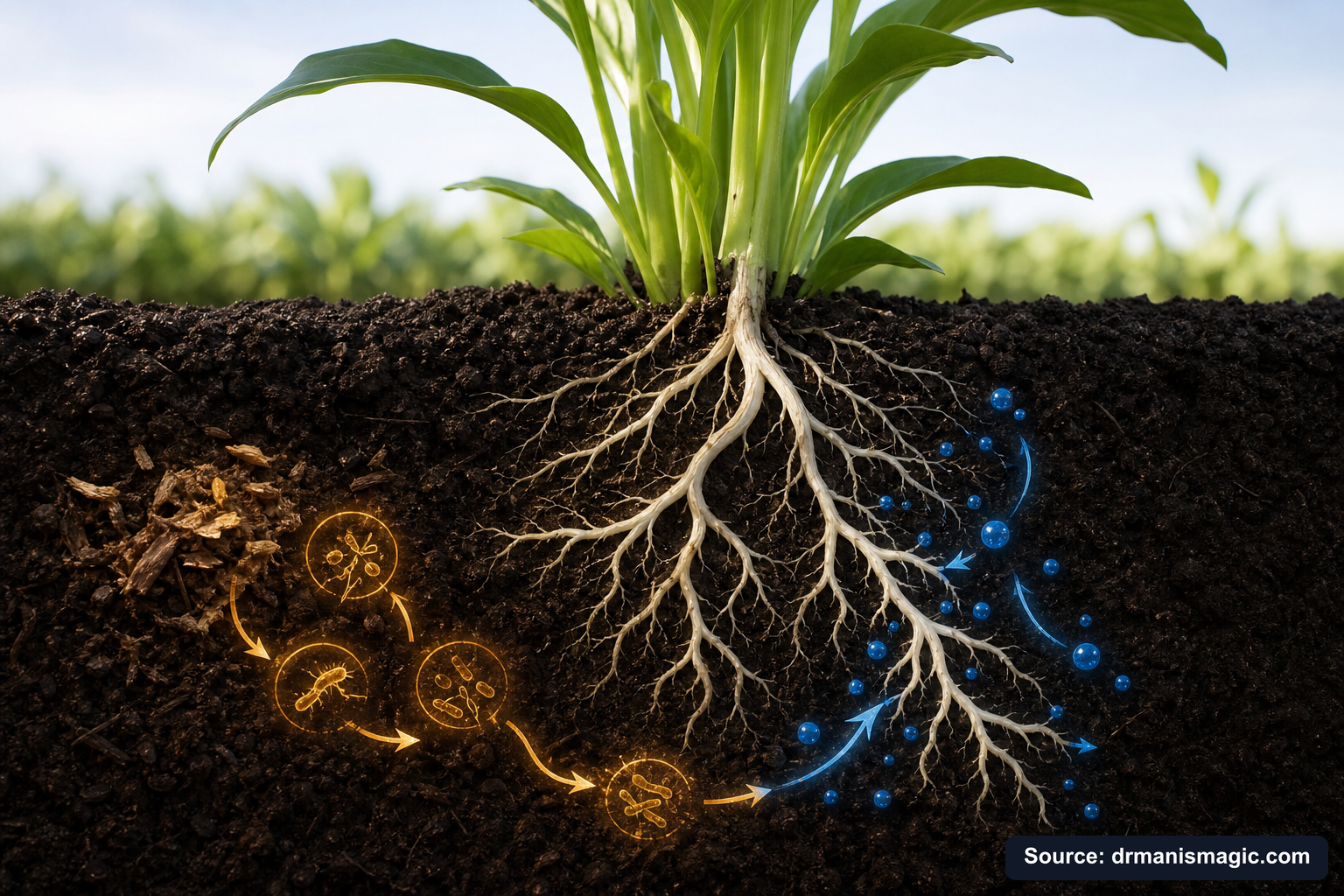
Quick Answer: Organic calcium sources like crab shell require microbial activity to release their calcium into plant-available form. Microbes eat the organic material, convert it, and release Ca2+ into the root zone gradually. When those microbes die, they release additional stored nutrients directly into the soil. This creates a natural slow-release system that keeps feeding the plant long after you apply it.
This is the mechanism most gardening content completely skips over. And it is the most important thing to understand about why organic calcium works differently at the soil level.
When you apply a synthetic calcium product, it dissolves immediately. The Ca2+ is available right now. That sounds good. But your plant can only use so much at once. The rest sits in the soil solution, raising salinity, until it leaches away or accumulates into a salt problem.
When you apply crab shell or bone meal, nothing dramatic happens on day one. The organic material sits in the soil. Microbes find it. They start eating it. Bacteria and fungi break down the calcium compounds, releasing Ca2+ slowly and steadily into the root zone. At the pace the plant actually needs it.
But here is the part that really is like magic.
When those microbes die, they do not disappear. Their bodies contain all the calcium and other nutrients they absorbed while they were alive. That nutrient-rich microbial biomass becomes food for the next generation of microbes, and then the next. The calcium cycles through living organisms over and over, releasing a little into the plant each time. It is a slow-release system powered entirely by biology. No plastic coating required.
This is why plants fed with organic sources tend to look increasingly healthy over months and years instead of spiking and crashing. The soil is building. Not depleting.
This is the heart of the Three Plant Pillars. Mineral foundation. Living microbes. Organic nutrition that feeds both the plant and the biology around it. When all three work together, the system becomes almost self-sustaining. The plant becomes nearly bulletproof.
What Is the Right Calcium Source for Your Specific Situation?
Quick Answer: Use lime when soil pH is too low and calcium is needed. Use gypsum when calcium is needed without raising pH or when sodium displacement is required. Use oyster shell for slow long-term support. Use bone meal when phosphorus is also needed. Use crab shell when soil biology and disease resistance matter. Use soluble synthetic calcium only for fast correction of a confirmed acute deficiency.
No single calcium source is right for every situation. Here is the decision framework we use after three decades of growing in South Texas.
Your soil is too acidic and calcium is also low. Use calcitic lime or dolomitic lime. You need both the calcium and the pH correction. Apply according to a soil test result.
Your calcium is low but pH is already fine. Use gypsum. It delivers calcium and sulfur without pushing pH higher. Especially useful in clay soils or soils with high sodium content.
You want slow, long-term calcium support without changing much else. Use oyster shell flour. Incorporate it into the soil. It will work quietly over many months.
You are building root mass and need calcium plus phosphorus. Use bone meal or fish bone meal. The phosphorus supports root development. The calcium supports cell wall strength. Both release slowly.
You want calcium AND want to wake up soil biology AND want natural disease resistance. Use crab or shrimp shell. The chitin activates your microbial defense system. This is our preferred calcium source for ongoing soil maintenance.
You have a confirmed acute calcium deficiency mid-season and cannot wait for slow release. Use a soluble calcium product as a short-term bridge. But address the root cause simultaneously or the problem will return.
You are growing in a container. Avoid high-salt-index calcium sources entirely. Containers have no buffering capacity. Salts accumulate fast. Stick to low-salt organic sources and flush containers with clean water periodically.
Can Too Much Calcium Actually Hurt Your Plants?
Quick Answer: Yes. Excess calcium in soil can bind to phosphorus and make it unavailable. It can also compete with magnesium and potassium for root uptake, causing deficiencies in those nutrients even when they are present in the soil. Over-liming is the most common cause of calcium excess in home gardens.
More is not always better. This applies to calcium as much as anything else in gardening.
Over-liming is the classic calcium excess scenario. A gardener reads that their soil needs more calcium. They apply lime. Then more lime the next season. pH climbs past 7.5. Now phosphorus starts binding to calcium and becoming unavailable to roots. Iron and manganese become locked up too. The plant starts showing deficiency symptoms for those nutrients, even though the soil test shows them present. You chased a calcium problem and created three more.
Excess calcium also competes directly with magnesium and potassium at root uptake sites. Roots have a limited number of pathways for mineral absorption. When calcium floods those pathways, magnesium and potassium get crowded out. Magnesium deficiency shows up as yellowing between the leaf veins on older leaves. Potassium deficiency shows up as leaf edge burn and weak stems.
The Law of the Minimum works in both directions. Deficiency of one nutrient limits growth. Excess of one nutrient can lock out others. Balance is the goal. And balance comes from building healthy soil biology, not from chasing individual nutrients with heavy applications of isolated products.
How the Three Plant Pillars Solve the Calcium Problem Permanently
Quick Answer: The Three Plant Pillars create a soil system where calcium and all other nutrients move efficiently. Mineral-based soil provides drainage and root oxygen. Live microbes unlock and deliver nutrients including calcium to roots. Organic fertilizer feeds both the plant and the biology without salt damage. When all three work together, nutrient deficiencies become rare instead of routine.
We did not develop the Three Plant Pillars as a marketing concept. We developed them because we were growing 250,000 citrus trees in South Texas and we needed something that actually worked. Every time. In heat. In drought. In containers. In ground. For citrus, tropical trees, houseplants, lawns, and garden beds.
The calcium problem we have been talking about in this entire article? It almost never shows up in a Three Pillar system. Here is why.
Pillar One: Mineral Foundation. Our Super Soil is built on silica-rich sandy loam from the Rio Grande Valley. It does not compact. It does not decompose into sludge. Water drains through it properly. Roots get oxygen. And roots that breathe are roots that can move calcium efficiently through transpiration flow.
Pillar Two: Live Microbes. Our Plant Super Boost contains living bacteria, fungi, and mycorrhizae. These organisms protect roots from Pythium and Phytophthora. They unlock bound minerals. They help roots extend further into the soil to find calcium and other nutrients. A root zone full of life is a root zone that functions. And a root that functions moves calcium where it needs to go.
Pillar Three: Organic Fertilizer. Crab, kelp, and amino acids feed the soil biology first. The microbes convert organic nutrients into plant-available forms at the pace the plant needs. Calcium from crab shell releases slowly. Chitin activates disease defense. Kelp brings natural growth hormones and over sixty trace minerals. Amino acids provide nitrogen in a form that does not require energy-expensive conversion by the plant. No salt. No burn. No microbial massacre.
When the roots can breathe, when the biology is alive, when the nutrition comes in clean and slow, your plant does not struggle for calcium. It simply grows.
You can learn more about how Plant Super Boost activates the living root zone that makes all of this possible.
See also: The Osmotic Shock Your Plants Feel From Synthetic Nutrients

The Bottom Line on Natural vs. Synthetic Calcium
Here is the honest answer to the question you came here with.
Your plant absorbs calcium as Ca2+. That ion is the same whether it came from a crab shell or a synthetic bag. At the root surface, the plant cannot tell the difference.
But the soil can.
Natural calcium sources release slowly. They carry low salt indexes. They bring companion nutrients. They feed soil biology. They build soil structure over time. They do not contaminate your food with PFAS. They do not create the osmotic stress that leads to physiological drought and root rot. They do not kill the microscopic army that keeps your plant healthy and your roots protected from Pythium and Phytophthora.
Synthetic calcium sources deliver fast. Sometimes that is what you need. But used repeatedly, they quietly salt the earth. They suppress the microbes. They damage the fine roots. They create the conditions for the very problems you were trying to solve.
The goal is not to find the perfect calcium product. The goal is to build a soil system where calcium moves efficiently, biology thrives, and your plant rarely needs emergency intervention. That is what the Three Plant Pillars do. That is what we have proven across 250,000 trees and counting.
Time is the one thing you cannot get back. Every season you spend chasing symptoms with the wrong tools is a season your plants are not growing the way they should. The best time to build healthy soil was last year. The second best time is right now.
If you are ready to stop chasing deficiencies and start building a system that works, explore the Three Plant Pillars and see how mineral soil, live microbes, and clean organic nutrition work together. Your roots will thank you. And so will every fruit, flower, and blade of grass that grows from them.
Frequently Asked Questions
You just read about how calcium moves through your soil and why the source matters more than most gardeners ever realize. These are the questions people ask most after learning that truth. The answers below will help you make smarter choices for your plants starting today.
Does it matter whether calcium comes from a natural source or a synthetic bottle?
Yes, it matters a lot. Your plant absorbs calcium as the same ion either way. But synthetic calcium often carries a high salt load. That salt kills the beneficial microbes in your soil. Dead microbes mean your roots cannot move nutrients properly. Natural calcium sources like crab shell release slowly, feed soil biology, and bring along companion nutrients. We proved this across 250,000 citrus trees in South Texas. The source shapes everything around that ion.
What is the best form of calcium for garden soil?
For your soil, slow-release natural sources win every time. Crab shell is one of the best. It delivers calcium and also contains chitin, which activates your soil's natural disease-fighting biology. Oyster shell and bone meal are strong choices too. These feed your microbes while they release calcium. That is Pillar Two of the Three Plant Pillars at work. Healthy microbes unlock nutrients your roots can actually use.
What is blocking calcium from reaching my plants?
Most of the time the calcium is already in your soil. The real blockers are salt buildup from synthetic fertilizers, compacted or waterlogged soil, poor drainage, and dead or depleted soil microbes. Inconsistent watering is also a huge culprit. Blossom-end rot on tomatoes is a perfect example. The soil has calcium. The roots just cannot move it. Fix the soil system and the calcium moves freely.
Why do synthetic calcium fertilizers sometimes make things worse?
Synthetic calcium fertilizers carry a high salt index. Salt draws water away from roots and stresses them. Worse, it wipes out the beneficial bacteria and fungi living in your soil. Those microbes are the delivery system for every nutrient your plant needs. Once they are gone, nutrients lock up and stop moving. You end up pouring more product on a broken system. That is the cycle big chemical companies profit from.
What foods or inputs block calcium absorption in soil plants?
In soil, the biggest blockers are excess sodium from synthetic fertilizers, soil compaction that cuts off oxygen to roots, and pH that is too high or too low. Overwatering drowns the microbes that help move calcium. Heavy phosphorus applications can also compete with calcium uptake. The fix is simple: build living soil with the right mineral base, live microbes, and organic fertilizer. That is exactly what the Three Plant Pillars are designed to do.
Is crab shell calcium safe for edible gardens and around children and pets?
Yes. Crab shell is one of the cleanest calcium inputs you can use. There are no synthetic salts, no PFAS, no biosludge, and no chemical coatings. You can use it around your vegetables, fruit trees, and flowers without worry. One of our core promises at Dr. Mani's Magic is that you should be able to walk barefoot in your garden and let your kids and pets play freely. Clean inputs make that possible.
How long does it take to see results after switching to natural calcium sources?
Most gardeners notice improvement within 30 days. Soil biology starts rebuilding quickly when you remove synthetic salts and feed it with organic inputs. Roots begin moving nutrients more freely as microbial activity picks up. Full soil recovery takes longer if salt damage was heavy, but the turnaround begins fast. We back this with a 30-day satisfaction guarantee. If you are not happy with your results, we refund your money. No runaround.
About the Author
Ron Skaria, MD
Ron Skaria, MD, is the co-founder of Dr. Mani's Magic and the son of Dr. Mani. He trained as a medical doctor at Baylor College of Medicine, did his residency at UT Health Science Center - San Antonio and fellowship training at Texas Tech University. He now works full time on the family farm at US Citrus and US Citrus Nursery in Hargill, Texas, building Dr. Mani's Magic alongside his dad. He wrote the Brown Thumb Field Guide to put his father's 48 years of plant science into plain words any gardener can use. His belief is simple. You never had a brown thumb. You just never had the right help.


