


Natural Signals vs. Synthetic Hormones: What Plants Actually Need | Dr. Mani's Magic
Natural Signals vs. Synthetic Hormones: How Plants Really Read the Soil, the Stress, and the Chemistry You Put in the Ground
Picture this. You're standing at the garden center, holding two bags of fertilizer. One bag promises "instant green-up." The other says "organic slow-release." They look almost the same. They cost about the same. But one of them is about to quietly destroy the very roots you're trying to feed.
You pour it on. The plant surges green for a few weeks. You feel like a genius. Then, slowly, things go sideways. The leaves yellow. The roots go soft. The plant you waited months to grow starts circling the drain. You blame the weather. You blame yourself. You wonder if you just have a brown thumb. But here's what nobody told you: the plant didn't fail. The chemistry failed the plant. Because plants don't just eat fertilizer. They read signals. And when you flood the root zone with synthetic salts instead of natural biological cues, the plant can't hear anything at all.
After growing over 250,000 citrus trees at US Citrus Nursery in South Texas, Dr. Mani Skaria — Professor Emeritus of Plant Pathology at Texas A&M and founder of Texas's Clean Citrus Program — cracked this code wide open. What he discovered changed everything. And it applies to every plant you will ever grow. Your lawn. Your tomatoes. Your houseplants. Your fruit trees. Every single one.

Organic Fertilizer | Crab, Kelp & Amino Acids
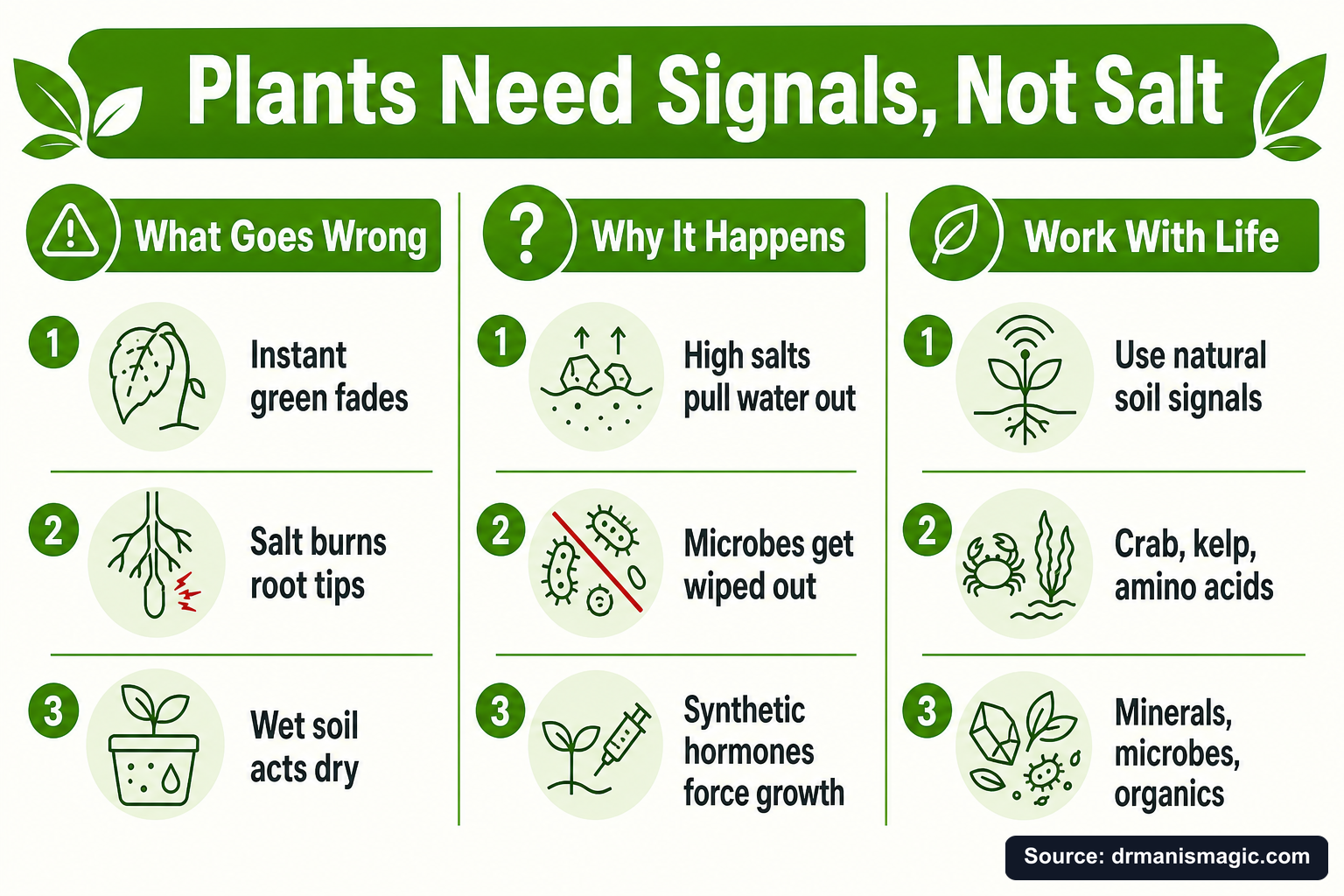
Key Takeaways
- Plants communicate through biological signals — natural compounds that tell roots, microbes, and growth systems what to do next.
- Synthetic hormones and salt-based fertilizers force a response instead of requesting one, often burning roots and killing the microbes that make nutrients available.
- Organic inputs like crab shell, kelp, and amino acids feed the microbes first — the microbes then convert those nutrients into forms the plant can easily absorb.
- Salt accumulation from synthetic fertilizers creates osmotic stress, which is physiological drought even when the soil is wet.
- Chitin from crab shells, natural auxins from kelp, and amino acid nitrogen all work by supporting the plant's own biology rather than overriding it.
- Biosludge and PFAS "forever chemicals" hide inside many popular organic fertilizers — clean inputs matter as much as the NPK ratio.
- The Three Plant Pillars — mineral soil, live microbes, and organic fertilizer — create the foundation where natural signals can actually work.
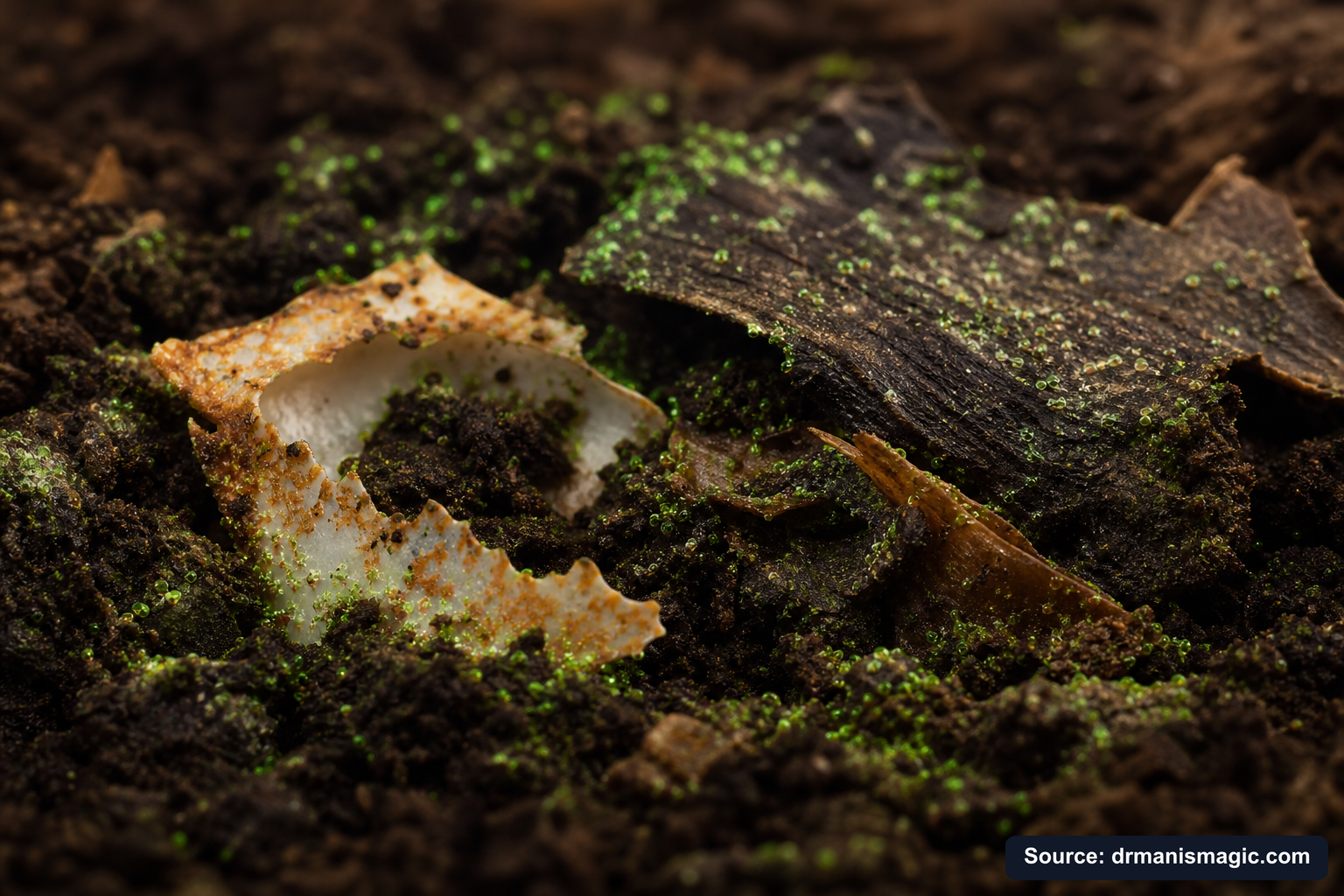
What Is the Difference Between Natural Signals and Synthetic Hormones in Plants?
Quick Answer: Natural signals are biological cues that plants, microbes, and roots produce to communicate with each other — compounds like auxins from kelp, chitin from crab shells, and amino acids from decomposed organic matter. Synthetic hormones force a specific plant response without that conversation. One works with the plant's biology. The other overrides it.
Think about the difference between a gentle tap on the shoulder and a shove. Both get your attention. But one respects your balance. The other knocks you over.
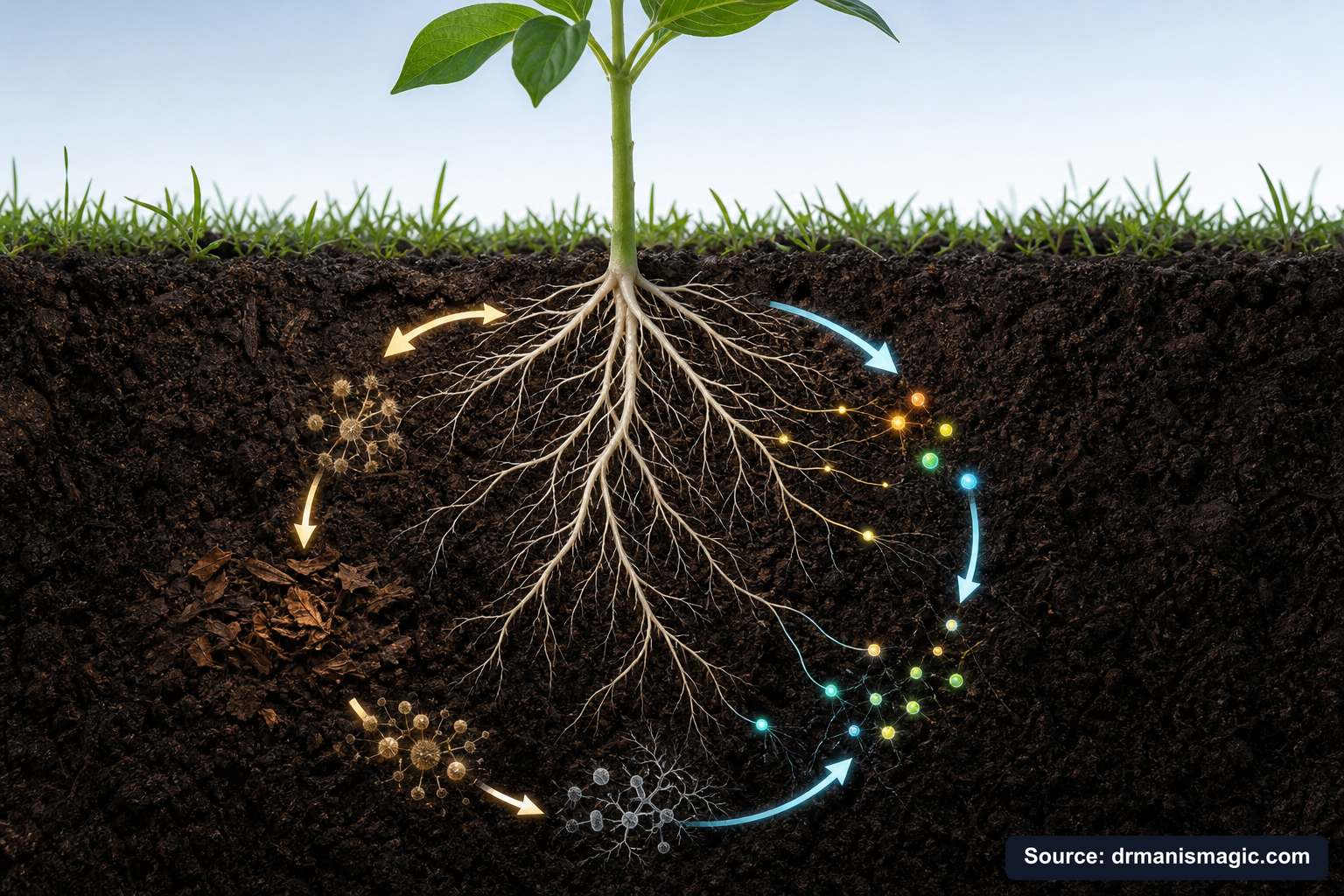
Plants are not passive. They are constantly reading their environment. They sense light, water, temperature, and chemistry. They release root exudates — tiny sugar and acid signals — into the soil to recruit microbes. Those microbes respond by unlocking nutrients, fighting pathogens, and feeding information back to the roots. The whole root zone is a conversation.
Natural signals fit into that conversation. Kelp extract, for example, contains naturally occurring auxins. Auxins are plant hormones that regulate root growth, cell elongation, and stress response. When you apply cold-processed kelp, you are handing the plant a message in a language it already speaks. The plant reads it and responds appropriately — growing more roots, adapting to stress, setting more fruit.
Synthetic plant growth regulators work differently. They are engineered molecules that bind to plant receptors and trigger a response regardless of what the plant actually needs. Gibberellins, synthetic cytokinins, and other plant growth regulators can produce dramatic visible results. But they bypass the plant's own sensing systems. The plant gets an order instead of a suggestion. And when the chemical wears off, the plant has no internal foundation to stand on.
The same principle applies to fertilizer. Synthetic salt-based fertilizers dump a flood of soluble ions into the root zone. The plant can absorb some of it quickly. But there is no biological conversation happening. The microbes are not involved. The slow-release timing system that nature built is not engaged. And the salt that carries those nutrients? That stays in the soil and causes damage long after the nutrients are gone.
Why Do Synthetic Fertilizer Salts Hurt Roots and Kill Microbes?
Quick Answer: Synthetic fertilizers are salt-based. High salt concentration in the root zone pulls water out of roots through osmosis — the opposite of what you want. This is called osmotic stress or physiological drought. It also destroys the beneficial microbes that plants depend on to access nutrients, fight disease, and stay resilient.
Here is the science in plain English. Water always moves toward higher salt concentration. That is osmosis. When you pour synthetic fertilizer around your roots, you raise the salt level in the soil. The water inside the root cells — which has lower salt — moves outward to try to balance things. The roots actually lose water. They shrink. They burn. They die back from the tips inward.
This is why fertilizer burn looks exactly like drought stress. Yellow leaf edges. Crispy tips. Wilting even when the soil is wet. Your plant is thirsty in a soaking wet pot. The technical term is physiological drought. The University of Minnesota Extension describes this as "salt stress" that reduces water and nutrient uptake even when both are present in the soil.
Now add the microbial damage. Your soil is supposed to be alive. Every tablespoon of healthy garden soil contains billions of bacteria, fungi, and other organisms. These microbes are not passengers. They are the engine. They break down organic matter, fix nitrogen from the air, solubilize phosphorus locked in mineral form, and produce compounds that protect roots from pathogens like Pythium and Phytophthora — the two most common culprits behind root rot.
Synthetic salts are hostile to these organisms. A study from Utah State University Extension confirms that excessive soluble salts reduce microbial populations and disrupt soil biological activity. When you kill the microbes, you lose the nutrient cycling, the pathogen protection, and the natural signaling network all at once. The plant is left naked in a salty desert, even if it looks green for a few more weeks.
And here is the part that really stings. Most gardeners never connect the root collapse to the fertilizer they applied two months earlier. They think it is root rot from overwatering. They cut back on water. The plant gets worse. They add more fertilizer to "help" it recover. The cycle continues. The plant dies. And the bag of fertilizer sits there, blameless, on the shelf.
See also: The Hidden Reason Synthetic Fertilizers Cause Root Rot
How Do Natural Inputs Like Kelp, Chitin, and Amino Acids Work as Biological Signals?
Quick Answer: Kelp provides natural auxins that guide root and shoot development. Chitin from crab shells triggers the plant's immune system and feeds beneficial fungi. Amino acids provide nitrogen in a form plants and microbes can use immediately, without the salt that damages roots. Together, they communicate with the plant's biology instead of overriding it.
Let's walk through each one. Because this is where the real magic lives.
Kelp: The Ocean's Plant Hormone Factory
Kelp is one of the fastest-growing organisms on earth. It produces a full library of natural plant hormones — primarily auxins and cytokinins — along with dozens of trace minerals, complex carbohydrates, and stress-response compounds. When you apply cold-processed kelp extract, you are not just adding nutrients. You are adding a biological intelligence package.
Auxins tell roots to elongate and branch. More root tips mean more surface area for nutrient absorption. Cytokinins stimulate cell division and delay leaf aging. The trace minerals in kelp — many of them missing from depleted garden soils — plug the nutritional gaps that standard NPK fertilizers never address. And because kelp is processed cold (not heat-treated), those fragile hormone molecules survive intact and arrive at your root zone ready to work.
Chitin: The Crab Shell That Wakes Up Your Plant's Immune System
Crab shells are rich in chitin (say it: KY-tin). Chitin is a structural compound that also happens to be the outer shell of most garden pests and fungal pathogens. When plants and soil microbes detect chitin, they recognize it as a threat signal. The plant activates its immune response. The beneficial fungi in the soil multiply rapidly to outcompete harmful fungi.
This is not a pesticide. It is a biological alarm that wakes up the system that was already there. Research from UC Davis Sustainable Farm & Garden shows that chitin amendments increase populations of chitin-degrading bacteria and actinomycetes, which are organisms strongly associated with suppression of soil-borne diseases. You are not fighting pests with chemicals. You are training the soil to defend itself.
Chitin also adds calcium and magnesium — two nutrients that are critical for cell wall strength, root tip health, and fruit development. Calcium is actually the largest mineral component of a plant's woody structure. You cannot build a strong trunk, stem, or branch without it.
Amino Acids: Nitrogen That Speaks the Plant's Language
Most fertilizers deliver nitrogen as synthetic nitrate or ammonium salts. The plant can absorb these, but only after the soil microbes process them — and only when salt levels are not so high that they block uptake. Amino acid nitrogen is different. Amino acids are the building blocks of proteins. Plants and microbes both recognize and absorb them directly.
When amino acid nitrogen enters the root zone, the microbes use it first. They break it down, multiply, and release the nitrogen in organic forms that plant roots absorb gently and steadily. No spike. No crash. No salt burn. Just a slow, steady conversation between soil life and plant roots — exactly the way it works in a healthy forest floor where no one ever poured a bag of synthetic fertilizer.
What Is Osmotic Stress and How Does It Cause Physiological Drought?
Quick Answer: Osmotic stress happens when salt concentration around the roots is higher than the salt concentration inside the root cells. Water moves out of the roots instead of in. The plant wilts and scorches even when the soil is wet. This is physiological drought — the plant is surrounded by water it cannot drink.
This is one of the most misdiagnosed problems in home gardening. The symptoms look like drought. They look like overwatering. They sometimes look like disease. But the root cause is salt chemistry in the soil.
Here is a quick reference to help you tell the difference:
| Symptom | Salt Damage / Osmotic Stress | Overwatering / Wet Soil | True Root Rot (Pythium / Phytophthora) |
|---|---|---|---|
| Leaf edges and tips | Brown, crispy, scorched edges | Yellow, soft, mushy edges | Yellow to brown, wilted even when cool |
| Soil feel | May be moist or dry; white crusty residue possible | Wet, soggy, waterlogged | Often wet but may be normal moisture |
| Root appearance | Brown tips, fine roots absent | Soft, brown, mushy roots | Brown, slimy, smell of decay |
| Onset speed | Gradual; weeks after fertilizer application | Days to weeks after watering change | Rapid collapse, especially in warm weather |
| Most common cause | Synthetic fertilizer overapplication, salt buildup | Poor drainage, compacted soil | Oxygen-starved roots, often triggered by compaction or overwatering first |
| Fix | Leach with water, switch to low-salt organic inputs | Improve drainage, reduce watering | Improve drainage, add live microbes, allow roots to recover |
Notice that root rot is almost always triggered by oxygen starvation before the pathogens like Pythium and Phytophthora move in. The fungi did not cause the problem. They arrived after the roots were already weakened by poor drainage or salt damage. This is the part that most gardening advice skips entirely — and why fungicide treatments rarely solve the real issue.
See also: How Salt-Based Feeding Quietly Destroys Root Systems
How Does Organic Fertilizer Actually Feed Plants Through Microbes?
Quick Answer: Organic fertilizer feeds the microbes first. The microbes eat the organic material, multiply, and convert it into plant-available nutrients at a steady pace. When those microbes die, they release all of that nutrition directly into the root zone. The plant gets a slow, continuous feed that mirrors the natural soil cycle — without the salt spike that synthetic fertilizers deliver.
This is the mechanism that most gardeners never hear about. And it changes everything about how you think of fertilizer.
Imagine your soil microbes as a kitchen crew. You give them raw ingredients — crab shell, kelp, amino acids, feather meal. They cook it. They process it. They serve it to the plant roots in the exact portions and forms the plant can use. The plant does not get slammed with a huge salty meal all at once. It gets a steady, gentle flow of exactly what it needs.
Then the kitchen crew dies — as microbes do, constantly, in a healthy soil. And when they die, their bodies decompose right there in the root zone, releasing another wave of nutrients. This is the slow-release mechanism. Not a plastic coating around a synthetic prill. Not a chemical trick. Just biology doing what it has always done.
This is why organic fertilizer works better over time. The first application feeds the microbes. The microbes feed the plant. And then the cycle compounds. More microbes. More nutrient cycling. More root protection. More resilience. The opposite of the addiction cycle that synthetic fertilizers create, where you need more and more product just to maintain the same results.
We tested this on more than 250,000 citrus trees at US Citrus Nursery. We watched what happened when we fed the biology instead of bypassing it. The trees grew faster. They stayed healthier through stress. They resisted disease without fungicide applications. The fruit was larger and sweeter. And the results compounded year after year instead of declining.
You Never Had a Brown Thumb.
You were handed the wrong tools. This free guide hands you the right ones.
You watered it. You fed it. It died anyway.
It was never you. It was the dirt, the salt food, and the bad advice.
This guide shows you what really went wrong, and how to fix it for good.
- Why your plants really died, and why it was never your fault
- The salt hiding in your plant food that quietly burns the roots
- The hidden killer in almost every bag of store soil
- The tiny helpers that grow a whole forest for free
- The rescue trick that brings a half dead plant back to life

What Is the Difference Between Synthetic and Organic Fertilizer Inputs?
Quick Answer: Synthetic fertilizers are salt-based and fast-releasing, which can burn roots and kill microbes. Organic inputs like crab shell, kelp, and amino acids are low in salt, slow to release, and supportive of soil biology. The mechanism is completely different: one bypasses the biology, and the other works through it.
| Input Type | Mechanism | Salt Index | Microbial Impact | Release Speed | Best Use | Key Risks |
|---|---|---|---|---|---|---|
| Synthetic Fast-Release (NPK salts) | Dissolves immediately; direct ion uptake | High | Burns and kills microbes | Instant spike, then crash | Emergency correction only | Root burn, osmotic stress, microbial death, salt buildup |
| Synthetic Slow-Release (plastic-coated) | Plastic shell delays release | Medium-High | Still salt-based; less immediate damage | Weeks to months | Lawns, large landscapes | Plastic microbeads in soil, still salt-based inside, PFAS possible |
| Biosludge-Based "Organic" | Municipal waste + composting | Variable | Mixed; can contain pathogens | Moderate | Large-scale non-food use | PFAS contamination, heavy metals, pharmaceutical residues |
| Amino Acid Nitrogen | Microbial processing → plant uptake | Very Low | Feeds and supports microbes | Slow, steady | All plants, containers, food gardens | Minimal; ensure source is clean (no biosludge) |
| Kelp Extract (Cold-Processed) | Natural hormones + trace minerals; signal-based | Very Low | Feeds and stimulates microbes | Gradual; hormonal response immediate | All plants; especially stressed or transplanted | Minimal; quality varies by processing method |
| Chitin / Crab Shell | Immune activation + fungal suppression + Ca/Mg | None | Strongly beneficial; activates disease-suppressive bacteria | Slow; immune response builds over weeks | All plants; especially disease-prone environments | Minimal |
| Volcanic Ash / Rock Dust | Slow mineral weathering; trace element supply | None | Neutral to beneficial; minerals support microbial metabolism | Very slow; years-long reservoir | Long-term soil building; silica for cell walls | Minimal; not a quick fix |
What Are PFAS and Biosludge, and Why Do They Matter for Home Gardeners?
Quick Answer: Biosludge is treated municipal wastewater waste — including human sewage — that is added to some fertilizers as a cheap filler. It often contains PFAS, which are synthetic chemicals that do not break down in soil or in your body. Clean organic fertilizers use none of it. This matters most for food gardens, raised beds, and anywhere children or pets play.
This is the part of the fertilizer industry that almost nobody talks about. And it affects products labeled "organic."
Some fertilizer manufacturers use what the industry calls "biosolids" — treated municipal waste — as a nitrogen and phosphorus source. It is legal. It is cheap. And it is used in products sitting on the shelves of every major garden retailer right now. The problem is that municipal wastewater contains PFAS: per- and polyfluoroalkyl substances. These are man-made chemicals used in cookware coatings, food packaging, firefighting foam, and hundreds of other products. They pass through wastewater treatment plants unchanged. They accumulate in soil. They move into plants. And they do not break down — which is why they are called "forever chemicals."
You cannot see PFAS. You cannot smell it. But you can choose fertilizers that contain zero biosludge, zero sewage sludge, and zero synthetic chemical fillers. Dr. Mani's Magic Crab, Kelp & Amino Acids contains no biosludge, no PFAS, no synthetic salts, and no plastic coatings. What is in the bag is exactly what it says: crab shell, cold-processed kelp, volcanic ash, and amino acids from clean animal protein sources. That is it.
When Dr. Mani was developing this formula, he was not just thinking about NPK ratios. He was thinking about the family standing barefoot in the grass. The kids eating strawberries straight off the plant. The dog sleeping next to the raised bed. Clean inputs are not a luxury. They are the minimum standard for anyone who grows food or tends a space where living things spend time.
Natural Signals vs. Synthetic Hormones: A Direct Comparison
Quick Answer: Natural signals like kelp auxins, chitin, and amino acid nitrogen work with the plant's existing biology to guide growth, immunity, and stress response. Synthetic hormones and salt-based fertilizers force a response without engaging that biology. Natural signals compound over time. Synthetic inputs tend to diminish in effectiveness as soil biology degrades.
Let's put them side by side and be direct about it.
Synthetic plant growth regulators can produce impressive short-term results. More roots in a propagation tray. Faster fruit set. Earlier bloom. But they work by interrupting or overriding the plant's natural hormone balance. The plant does not build internal capacity. It responds to a chemical command. When the command stops, the plant has no new foundation.
Natural signal-based inputs — kelp auxins, chitin immune activators, amino acid nitrogen — work by supporting the systems the plant already has. They add to the conversation instead of replacing it. And because the soil microbes are alive and multiplying, the effect compounds over time. Each application makes the next one more effective. The soil gets richer. The roots get deeper. The plant gets more resilient.
This is not a moral argument about natural versus synthetic. It is a practical argument about mechanism and long-term outcome. Salt-based chemistry can produce fast visible results, but it erodes the biological infrastructure that plants depend on. Signal-based biology takes a few weeks longer to show results, but it builds something that lasts.
After thirty years of growing trees, Dr. Mani did not choose organic inputs because of ideology. He chose them because they worked better over time — and because he could see the difference in root health, disease resistance, and fruit quality across hundreds of thousands of trees.
What Are the Three Plant Pillars and How Do They Create the Right Environment for Natural Signals?
Quick Answer: The Three Plant Pillars are mineral-based soil, live microbes, and organic fertilizer. Together, they create the conditions where natural biological signals can actually work: oxygen reaches the roots, microbes are alive and active, and nutrients arrive in forms the plant can absorb without salt damage.
Here is the honest truth about why most gardeners struggle. They try to fix individual symptoms without addressing the root system that underlies all of them. Yellow leaves. Root rot. Poor fruiting. Weak growth. These are not separate problems. They are the same problem expressed in different ways — a root zone that cannot function because one or more of the three foundational conditions is missing.
Dr. Mani called these the Three Plant Pillars. And after growing over 250,000 trees, he is confident that when all three are in place, almost any plant becomes nearly bulletproof.
Pillar 1: Mineral-Based Soil — The Foundation That Lets Roots Breathe
Most commercial potting mixes are made from pine bark, wood fiber, and other organic materials that decompose over time. As they break down, they compact. Compacted soil blocks oxygen from reaching the roots. And here is something most gardeners never learn: roots need oxygen as much as they need water. When oxygen disappears from the root zone, the roots suffocate. Then the pathogens move in. Then the plant dies. The potting mix killed it — not the watering schedule.
Mineral-based soil — built on a foundation of silica-rich sandy loam — does not decompose. It does not compact. It drains freely and holds its structure for years. Oxygen reaches the roots. Water moves through without pooling. And the root zone stays the kind of place where beneficial microbes want to live.
Pillar 2: Live Microbes — The Biological Engine That Makes Everything Else Work
Without microbes, you have dirt. With microbes, you have soil. The difference is life. Bacteria fix nitrogen from the air. Mycorrhizal fungi extend root reach by hundreds of times. Actinomycetes suppress disease. Protozoa graze on bacteria and release nutrients as they go. The whole system feeds itself, regulates itself, and protects itself — as long as you do not pour salt on it.
This is why synthetic fertilizers create a dependency cycle. The first application kills a portion of the microbes. The next application has to be larger to get the same result. The soil becomes less and less capable of supporting plant life on its own. Eventually, the plant cannot survive without constant chemical inputs. That is not gardening. That is addiction.
Pillar 3: Organic Fertilizer — The Nutrition That Feeds the System, Not Just the Plant
Organic fertilizer is not just "kinder" nutrition. It is structurally different in how it works. It feeds the microbes. The microbes convert it. The plant absorbs the output. And the whole process mirrors the natural nutrient cycling that forests and grasslands have relied on for millions of years — without anyone ever buying a bag of fertilizer.
When crab shell, kelp, amino acids, and volcanic ash work together in an organic slow-release granule, you get chitin for immunity, natural auxins for root and shoot development, amino acid nitrogen for microbial fueling, calcium and magnesium for structural integrity, and trace minerals from volcanic ash for cell wall strength and enzyme function. All of it in one application. All of it compatible with the microbes. None of it salt-based.
See also: Why Most Potting Mix Collapses Within 6-12 Months
How Do You Recover a Plant That Has Salt Damage or Disrupted Soil Biology?
Quick Answer: Recovery starts with removing the salt pressure, restoring oxygen to the root zone, and reintroducing live microbes. Then you transition to low-salt organic nutrition. Most plants respond within four to six weeks when all three conditions are met.
If you have been using synthetic fertilizers and your plant is struggling, here is a practical recovery path.
- Stop all synthetic fertilizer immediately. You cannot rebuild biology while continuing to damage it. Give the root zone a break from salt inputs for at least two to four weeks.
- Flush the root zone with clean water. For container plants, water heavily until water runs freely out the bottom several times. This leaches accumulated salts. For in-ground plants, deep watering over several days helps dilute and move salt down through the soil profile.
- Check the drainage. If the soil is compacted or the container has poor drainage, no amount of good fertilizer will help. Roots need oxygen. If drainage is the problem, repot into mineral-based soil or improve in-ground drainage before doing anything else.
- Reintroduce live microbes. Apply a liquid microbial drench with bacteria, fungi, and mycorrhizae to the root zone. This restores the biological engine. Without it, even organic fertilizer works at a fraction of its potential. You can learn more about how live microbes work at the Free Plant Care Field Guide.
- Apply organic slow-release fertilizer at a reduced rate. Start with half the normal application. Let the microbes establish before you push nutrition. Within two to four weeks, the biological system will be active enough to handle a full feeding rate.
- Wait and observe. Recovery is not instant. New root tips take two to four weeks to grow. New leaf flush takes four to six weeks. If you see new healthy growth, the system is working. Do not rush it with more product.
- Stay consistent. The biggest mistake in recovery is going back to synthetic inputs because progress feels slow. Trust the biology. It compounds. Month three looks dramatically better than month one.

Why Does Time Matter More Than Money When It Comes to Plant Care?
Quick Answer: Money lost on bad fertilizer is recoverable. Time lost waiting for a plant to grow — or watching it die and starting over — is not. The wrong inputs can waste months or years of growth and set you back to zero. The right foundation, built once, compounds in your favor every single season.
Here is something Dr. Mani hears more than anything else from the gardeners who find him after years of frustration. More than any question about fertilizer ratios or watering schedules. More than any question about soil pH or pruning technique. They say: "I just want to see fruit on this tree before it's too late."
That is not a gardening question. That is a human question. It is about time. About the seasons of life. About the primal desire to tend something and see it bear fruit — something we were, as Dr. Mani says, put on this earth to do.
And here is the tragedy of the synthetic fertilizer cycle. It feels like it is saving time because it works fast. But every month you spend fighting salt damage, rebuilding dead roots, and diagnosing mystery yellowing is a month you are not moving forward. A year of synthetic inputs followed by a collapse puts you behind where you started. The tree is stressed. The soil is depleted. The biology is dead. You have to start over.
The right foundation — mineral soil, live microbes, organic nutrition — takes a few extra weeks to show results. But it does not stall. It does not collapse. It does not require you to start over. It builds on itself every single season. And the plant that seemed slow in month one is producing abundantly in month twelve, in year two, in year five.
You can always earn more money. You cannot earn more time. That is why getting the foundation right the first time is not just the smarter choice. It is the only choice that makes sense when you think it through.
If this framework made something click for you — if you finally understand why your plant has been struggling despite everything you have tried — the next step is simple. Everything described in this article: the clean crab shell chitin, the cold-processed kelp, the amino acid nitrogen, the volcanic ash trace minerals, all with zero biosludge and zero PFAS — it is all in one place. Dr. Mani's team at US Citrus Nursery tested it on over 250,000 trees before it ever went in a bag. It works on citrus. It works on lawns. It works on vegetables, flowers, houseplants, and every other living plant in your care. And if you are not happy with your results within 30 days, you get your money back. No arguing. No fine print.
When you are ready to stop guessing and start growing, visit the Three Plant Pillars system and see what it looks like when the biology finally works the way it was always supposed to.
Frequently Asked Questions
Most gardeners never learn why their plants surge green one week and start dying the next. The answer lives in the soil, in the chemistry you pour on your roots, and in whether your plants can actually read the signals you are sending them. These questions cut straight to what matters.
What is the difference between natural signals and synthetic hormones in plants?
Natural signals are biological messages that plants, roots, and soil microbes use to talk to each other. Kelp contains natural auxins. Crab shells contain chitin. Amino acids carry nitrogen in forms roots already recognize. Plants read these cues and respond the right way. Synthetic hormones force a reaction instead of requesting one. They shove the plant instead of tapping its shoulder. One works with your plant's biology. The other overrides it. After growing over 250,000 citrus trees at US Citrus Nursery, Dr. Mani saw this difference play out in the soil every single day.
Why do synthetic fertilizers hurt plants over time?
Synthetic fertilizers are salt-based. Salt pulls water away from roots through osmotic stress. Your plant can look wet and still be dying of thirst. Worse, those salts kill the beneficial microbes in your soil. No microbes means no nutrient conversion, no disease protection, and no living ecosystem. The plant gets hooked on the quick green hit, the soil gets weaker, and after a few months everything stalls. You lose time you can never get back.
What are natural plant signals and where do they come from?
Natural plant signals come from living inputs like kelp, crab shells, and amino acids. Kelp delivers auxins that regulate root growth and stress response. Crab shells deliver chitin that triggers a plant's natural immune system. Amino acids hand the plant nitrogen in a form it already knows how to use. These are the ingredients inside Dr. Mani's Magic Crab, Kelp, and Amino Acids fertilizer. They feed your soil microbes first. The microbes convert everything into signals your plant can actually read.
What is osmotic stress and why does it matter for my garden?
Osmotic stress happens when salt builds up around your roots. The salt draws water out of root cells instead of letting water in. Your plant dries out from the inside even when the soil feels damp. This is what synthetic fertilizers do over time. It is a slow, invisible drain on your plant's health. Dr. Mani's Three Plant Pillars system avoids this entirely by using mineral-based soil, live microbes, and clean organic fertilizer with zero salt buildup.
Are there hidden toxins in popular organic fertilizers I should know about?
Yes. Many fertilizers marketed as organic are made from biosludge, which can carry PFAS forever chemicals. Others use fish emulsion that goes anaerobic in the bottle and smells like rotting sewage. That smell means the biology is already dead. Dr. Mani's Magic fertilizer uses crab, kelp, and amino acids only. No biosludge. No fish emulsion. No harsh smell. Everything is made in the USA and tested on living trees, not formulated in a boardroom for marketing copy.
How do the Three Plant Pillars help natural signals work better?
The Three Plant Pillars create the foundation where natural signals can actually do their job. Pillar One is mineral-based soil that drains well and lets roots breathe. Pillar Two is live microbes that convert organic inputs into plant-ready nutrients. Pillar Three is clean organic fertilizer that feeds those microbes without burning them. When all three work together, your plants stop fighting their environment and start thriving in it. Remove any one pillar and the signals get scrambled.
Can this system work for plants other than citrus trees?
Absolutely. The Three Plant Pillars work for every plant you will ever grow. Lawns, tomatoes, roses, houseplants, fruit trees, hedges, and container gardens all run on the same biological rules. Dr. Mani proved the system on over 250,000 citrus trees at US Citrus Nursery in South Texas. But the microbes, the mineral soil, and the organic fertilizer do not care what plant is sitting above them. They just do their job. Your brown thumb is not real. The wrong chemistry was the problem all along.
About the Author
Dr. Mani Skaria, PhD
Dr. Mani Skaria, PhD, is a plant pathologist and the scientific founder of Dr. Mani's Magic. He earned his doctorate at Purdue University and spent 48 years studying how plants, soil, and living microbes work together, including his years as Professor Emeritus at Texas A&M and as a member of the USDA NAREEE Advisory Board. He invented micro-budding, a method for growing healthier, stronger trees, and has grown more than 250,000 trees on the family farm in Hargill, Texas - US Citrus Nursery. His life's work takes real lab science and practical experience and turns it into simple, safe, organic plant care anyone can use at home.


