


The Lost Knowledge of Living Soil: What Your Plants Are Missing | Dr. Mani's Magic
The Lost Knowledge of Living Soil: What the Earth Knew Before We Forgot
Picture this. You're standing in an old-growth forest. No one has watered these trees in decades. No one has fertilized them. No one has sprayed them with anything. Yet the canopy above you is so thick and green that the sunlight barely reaches the ground. The roots beneath your feet are massive. The trees are ancient. They are thriving.
Now picture your potted lemon tree on the back patio. The one you've fed, watered, worried over, and Googled about at midnight. The one that still looks pale and sad, no matter what you do. You wonder what you're missing. You wonder if you just don't have the touch for this. Maybe you never will.
Here's the truth that nobody in the fertilizer aisle is going to tell you. The forest doesn't need you. It doesn't need bottles or bags or chemicals. It has something far more powerful working underground, something invisible, something alive. And when we started growing plants in pots and treated fields like chemistry sets, we cut ourselves off from that power. We lost the knowledge of living soil. This article is about getting it back.
Key Takeaways
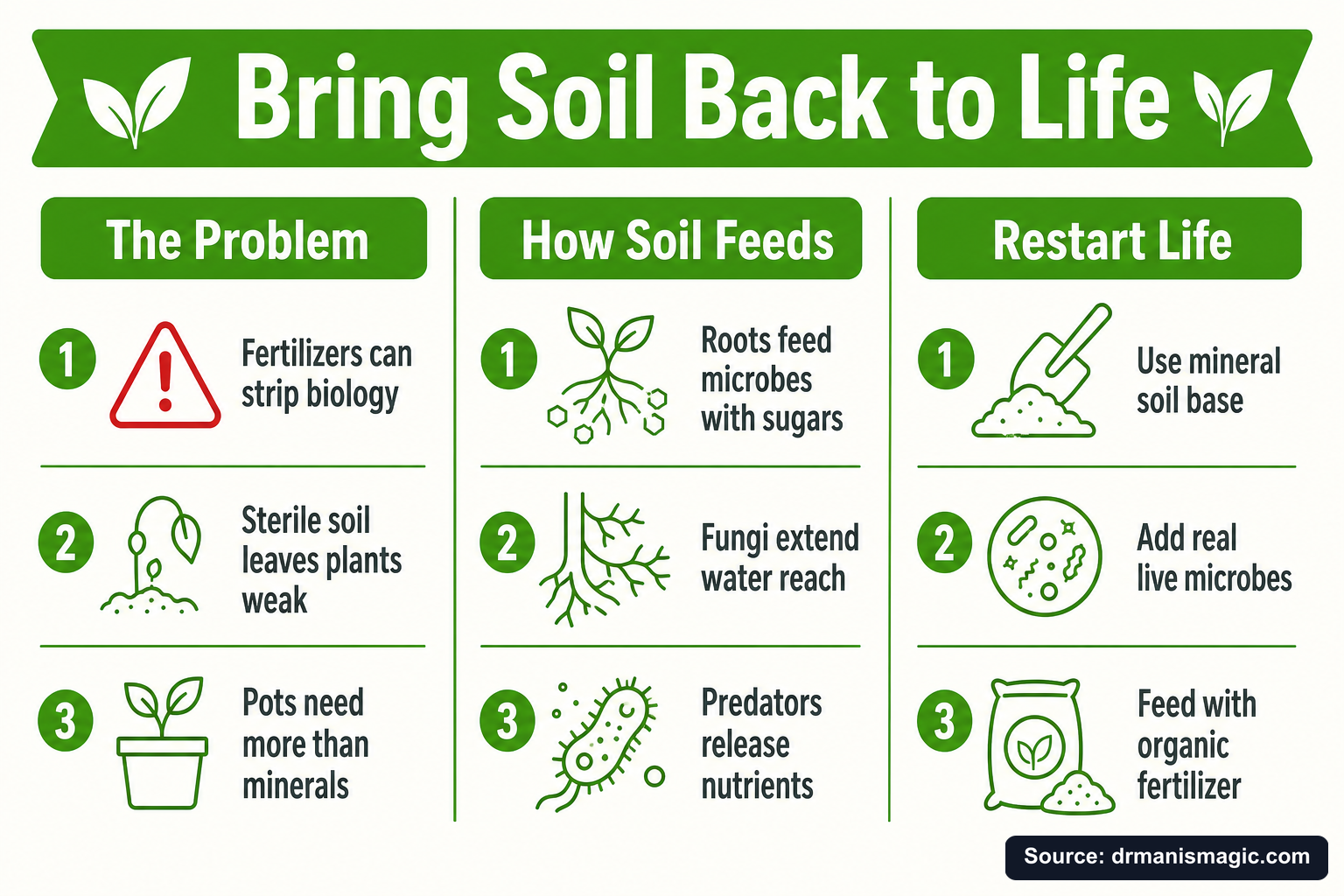
- Healthy soil is not dirt. It is a living ecosystem with billions of organisms working together to feed plants naturally.
- Modern farming and gardening stripped most soil of its biology by using salt-based fertilizers, herbicides, fungicides, and pesticides.
- The soil food web includes bacteria, fungi, protozoa, nematodes, and more. Each one plays a specific role in releasing nutrients that plants can actually use.
- Most bottled microbe products on the market contain dead or dying organisms that deliver little to no benefit at the root zone.
- Genuinely live, full-spectrum microbials can restart the biological engine in damaged or sterile soil and make plants more resilient than any chemical ever could.
- The Three Plant Pillars (mineral soil, live microbes, organic fertilizer) are the proven framework developed at US Citrus Nursery across more than 250,000 trees.
- Restoring living soil is not instant, but with the right approach it starts working within weeks and builds strength for years.
What Is Living Soil and Why Does It Matter for Your Plants?
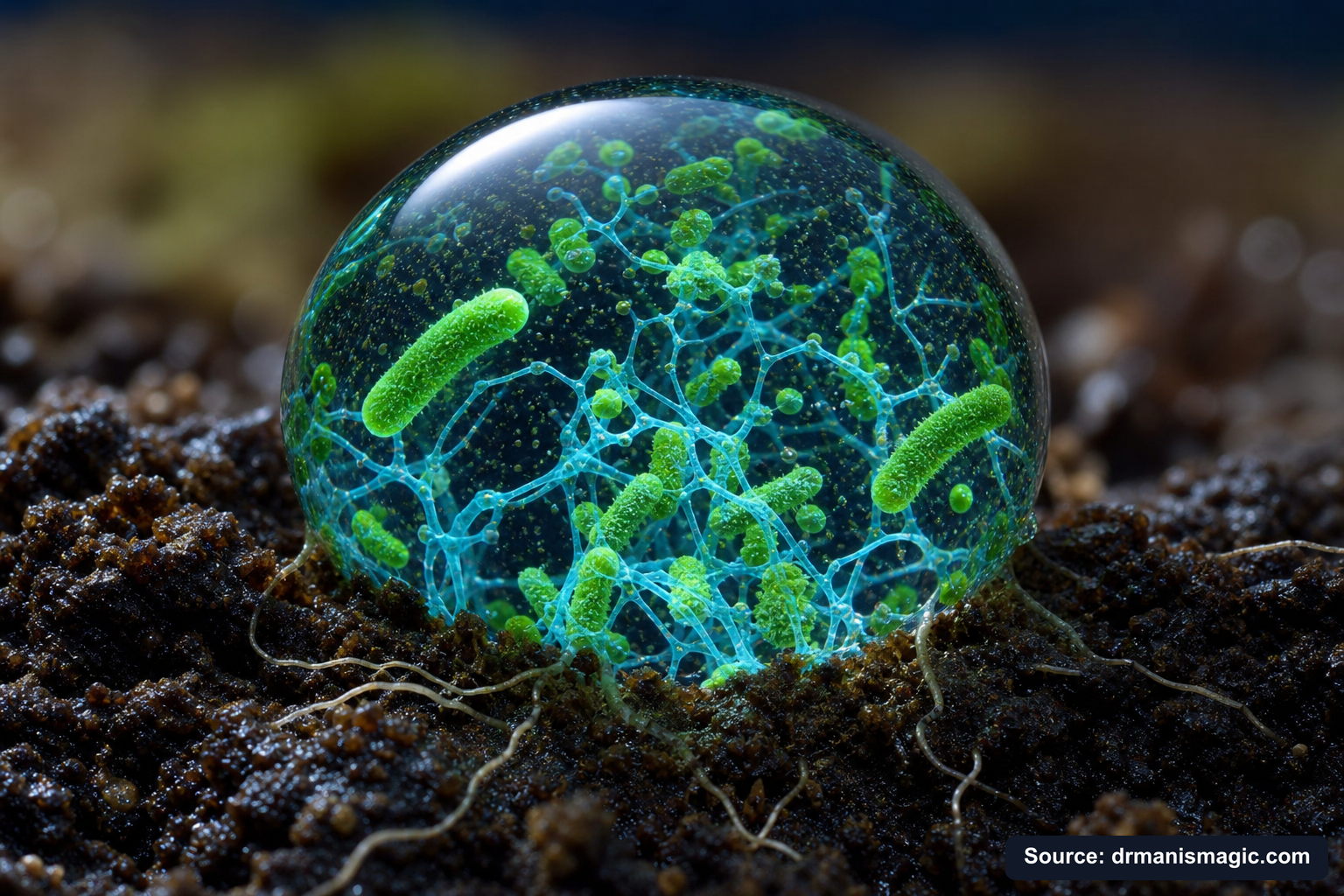
Quick Answer: Living soil is an active ecosystem packed with billions of bacteria, fungi, protozoa, nematodes, and other organisms that work together to break down organic matter, release nutrients, suppress disease, and feed plant roots. Without this biology, soil is just a mineral scaffold that cannot sustain real plant health on its own.
Living soil is not a poetic idea. It is a scientific reality backed by decades of research from institutions like Utah State University Extension, which describes the soil food web as a complex community of organisms whose interactions drive nutrient cycling, water infiltration, disease suppression, and plant health.
Think of it like your gut. Your gut is not just a tube that food passes through. It contains trillions of bacteria that digest, protect, and signal your whole body. Take those away and your health collapses. Soil works the same way. Strip the biology and the plant starves no matter how much fertilizer you pour on it.
One teaspoon of healthy forest soil can contain up to one billion bacteria. It can hold hundreds of yards of fungal threads. It can be home to thousands of protozoa and nematodes all doing invisible work around the clock. That is the living machine beneath a thriving plant. That is what we lost.
The Six Jobs Living Soil Does Every Single Day
- Breaks down organic matter into nutrients plants can absorb
- Releases nitrogen, phosphorus, and trace minerals that are locked in the soil
- Builds soil structure so roots can breathe and water can drain
- Fights off root pathogens by crowding them out
- Stores water and delivers it slowly to roots during dry spells
- Produces plant hormones and growth signals that boost flowering and fruiting
What Is the Soil Food Web and Who Are the Players?
Quick Answer: The soil food web is the feeding chain that moves energy and nutrients through the soil ecosystem. Bacteria and fungi break down organic matter. Protozoa and nematodes eat the bacteria and fungi and release nutrients in plant-available form right at the root zone. Each creature in the chain matters, and removing any one of them weakens the whole system.
Most people have heard of bacteria and fungi. But the soil food web goes much deeper than that. It is a full economy with producers, consumers, and predators all playing a role. The USDA Natural Resources Conservation Service describes the soil food web as the community of organisms living all or part of their lives in the soil, with energy flowing from plants through bacteria and fungi, then up through protozoa, nematodes, and larger organisms.
Here is how the chain actually works in plain language.
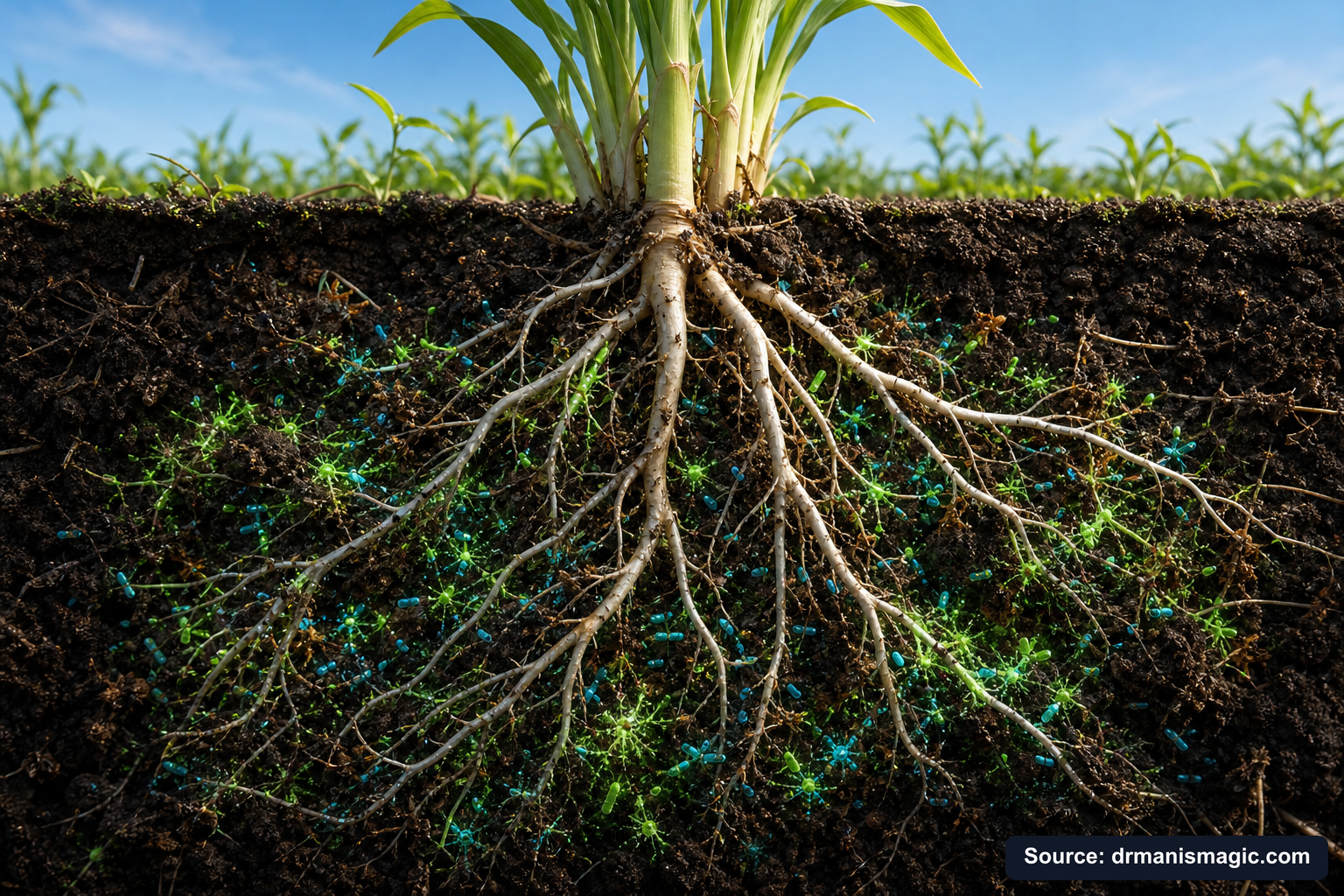
Plant roots push sugars out into the surrounding soil. This is called the rhizosphere, and it is the most active biological zone on earth. Bacteria rush in to feed on those sugars. Fungi spread out in threads called hyphae, exploring soil for water and minerals. Then the predators arrive. Protozoa eat the bacteria. Nematodes eat the fungi and the bacteria both. When they digest and excrete, they release nutrients in plant-ready form. Right there. Right at the root tip. Like a room-service delivery system built into the ground.
| Organism | What It Eats | What It Gives the Plant | What Kills It |
|---|---|---|---|
| Bacteria | Root sugars, organic matter | Nitrogen, minerals, disease protection | Salt-based fertilizers, herbicides |
| Mycorrhizal fungi | Root sugars | Extended water and phosphorus reach, drought resistance | Fungicides, high synthetic phosphorus |
| Protozoa | Bacteria | Nitrogen released when they digest bacteria | Pesticides, soil sterilization |
| Beneficial nematodes | Bacteria, fungi | Mineral nutrients released through excretion | Chemical soil treatments |
| Earthworms | Organic matter, microbes | Aeration, nutrient-rich castings | Compaction, synthetic pesticides |
| Microarthropods | Fungi, bacteria, decaying matter | Nutrient cycling, soil structure | Broad-spectrum pesticides |
Notice something? Almost every organism on that list is killed by the same inputs we've been told to use for seventy years. That is not a coincidence. That is the problem.
What Was the "Lost Knowledge" That Old Farmers Had?
Quick Answer: Before synthetic fertilizers took over in the mid-1900s, farmers and gardeners built soil health through compost, manure, crop rotations, and returning organic matter to the ground. They were unknowingly feeding the soil food web. When mineral-input farming replaced that tradition, the biology died and plants became dependent on chemical inputs to survive.
Before the 1950s, fertility came from the ground up. Farmers composted. They returned crop residues to the soil. They spread manure. They rotated crops so the land could breathe. They did not know they were managing a biological ecosystem. They just knew it worked. Their grandparents did it. Their land stayed rich for generations.
Then came the chemical revolution. After World War II, factories that had been making explosives needed a new market for nitrogen. Synthetic fertilizers were born. They were cheap, fast, and easy to sell. Miracle-Gro launched in the early 1950s and spent decades telling American gardeners that fertilizer was the answer to every plant problem. It was not gardening advice. It was advertising. And it worked. We bought it. All of it. Literally.
The problem is that synthetic fertilizers are salt-based. High salt destroys beneficial bacteria. It burns root tips. It kills mycorrhizal fungi. Every bag of blue granules you pour on your soil is a massacre happening beneath the surface. The plant gets a quick hit of nitrogen. Then the biology collapses. Then the plant gets weaker. Then you buy more fertilizer. The cycle continues and the companies profit while your soil gets sicker every single season.
Dr. Mani Skaria, Professor Emeritus of Plant Pathology and founder of the Clean Citrus Program in Texas, watched this pattern for decades. He grew citrus at his nursery in South Texas. He tested products. He saw plants fail even with expensive inputs. And eventually, through a chance meeting with a world-renowned compost expert, he found the missing piece. Not a chemical. Not a salt. A living ecosystem in a bottle.
How Does Soil Biology Actually Feed Plants? The Root-to-Microbe Exchange
Quick Answer: Plants pump sugars out through their roots to attract bacteria and fungi. Those microbes decompose organic matter and unlock nutrients locked in the soil. Protozoa and nematodes eat the microbes and release those nutrients in plant-available form right at the root tip. This is how nature delivers nutrition without a single bag of fertilizer.
The plant is not passive in this relationship. It is an active investor. Up to 30 percent of the sugar a plant makes through photosynthesis gets pumped out through its roots on purpose. This is called root exudate. The plant is essentially running a currency exchange. It trades sugar for nutrients. Bacteria and fungi come running, drawn by the sugar. They set up camp. They start working.
Mycorrhizal fungi are especially remarkable. Their thread-like hyphae extend far beyond what the root could ever reach on its own, sometimes hundreds of times further. They find water in dry pockets of soil. They pull in phosphorus from minerals that the root could never dissolve alone. In exchange, the plant feeds them. It is a partnership that has existed for over 400 million years. We are not smarter than 400 million years of evolution. But we have been trying to replace it with blue powder since 1951.
The nutrient cycle runs like this. Bacteria eat organic matter and root sugars. Protozoa eat the bacteria. When a protozoan digests a bacterium, it releases nitrogen in a form the plant can absorb instantly, ammonium, right next to the root hair. One protozoan releases enough nitrogen to feed a plant for days. And there are millions of protozoa in every healthy handful of soil. This is the machine. This is what we turned off.
See also: The Hidden Reason Synthetic Fertilizers Cause Root Rot
What Killed the Biology in Your Soil?
Quick Answer: Synthetic herbicides, salt-based fertilizers, broad-spectrum pesticides, and antifungal sprays all damage or destroy beneficial soil organisms. Sterile potting mixes start with zero biology. Compaction cuts off oxygen. Overwatering drowns aerobic bacteria. After decades of these inputs, most managed soils have a fraction of the biological life they once held.
Your soil did not go dead overnight. It happened slowly, season after season, application after application. Each time you used a weed killer it disrupted the microbial community. Each bag of synthetic fertilizer added salt that stressed and killed beneficial bacteria. Each fungicide knocked out not just the bad fungi but the mycorrhizae too. Each pesticide left chemical residue that persisted in the soil long after the target pest was gone.
And if you are growing in a pot or a raised bed, you probably started with potting mix. Here is the ugly truth about potting mix. Most of it is pine bark, sawdust, and wood fiber. It looks fluffy and light when you first use it. But within six to twelve months it starts to decompose. As it breaks down it compacts, suffocates roots, and creates the perfect wet, airless environment for root rot fungi to thrive. There are no beneficial microbes in it because it was sterilized to kill pathogens. So you get the worst of both worlds. No biology to protect the roots and conditions that breed the very diseases that kill them.
At our nursery in South Texas, after growing more than 250,000 trees, we saw this pattern over and over. Trees planted in standard potting mix would look fine for a few months. Then they would stall. Then they would decline. The soil was collapsing under them. The biology was gone. The roots were suffocating. No amount of fertilizer could fix a structural and biological failure in the growing medium itself.
That is why the first of the Three Plant Pillars is mineral-based soil that does not decompose, does not compact, and does not steal oxygen from the roots.
You Never Had a Brown Thumb.
You were handed the wrong tools. This free guide hands you the right ones.
You watered it. You fed it. It died anyway.
It was never you. It was the dirt, the salt food, and the bad advice.
This guide shows you what really went wrong, and how to fix it for good.
- Why your plants really died, and why it was never your fault
- The salt hiding in your plant food that quietly burns the roots
- The hidden killer in almost every bag of store soil
- The tiny helpers that grow a whole forest for free
- The rescue trick that brings a half dead plant back to life
Live Microbes vs. Dead Microbe Products: What Is the Real Difference?
Quick Answer: Live microbes are actively metabolizing organisms that colonize roots, cycle nutrients, and suppress pathogens. Dead or dried microbe products are mostly inert powders that have little to no effect when applied to soil. The difference between a live product and a dead one is the difference between planting a seed and scattering sawdust.
The microbial product market is booming right now. That sounds like good news. It is not. Because most of what is on those shelves is not actually alive when it reaches your plant.
Here is how most commercial microbe products are made. Giant factories brew specific strains of bacteria in vats. The bacteria are then dried into powder. The hope is that the dormant spores will reactivate when you add water and pour them on the soil. We have tested dozens of these products at our nursery. Most of them show zero measurable benefit at the root zone. The organisms either never reactivate or cannot compete with the existing microbial community in the soil.
The second type is compost-based liquid products. These come from worm castings or raw compost steeped in water. When they are fresh and still actively aerated, they can be powerful. But by the time they are bottled, shipped, stored on a shelf, and poured into your watering can, they have gone anaerobic. The bacteria have died. The liquid smells like sewage. Some people mistake that smell for potency. It is not potency. It is decomposition. The microbes are dead.
| Product Type | Microbial Viability | Spectrum of Organisms | Odor | Real-World Result |
|---|---|---|---|---|
| Dried powder (lab-grown) | Very low | Narrow, selected strains | None | Little to no measurable effect |
| Rehydrated dried powder | Very low | Narrow | None | Same as above |
| Old compost tea (over 24 hours) | Dying (anaerobic) | Partial | Strong, foul | Minimal biology; some humic compounds |
| Fresh compost tea (under 24 hours) | Moderate | Broad but variable | Earthy to slightly sour | Good if used immediately; not practical |
| Fresh active compost (on-site) | High | Broad, natural | Earthy | Excellent; labor intensive |
| Plant Super Boost (stabilized, full-spectrum) | High (verified by lab analysis) | 2,000+ bacteria strains, 400-500 fungi including mycorrhizae, protozoa, nematodes | Earthy, not foul | Active colonization at the root zone |
There is a third category of product worth mentioning. Lactobacillus-based products, like the bacteria in yogurt. They are easy to brew, they stay alive, and they smell fine. The problem is that lactobacillus is extremely aggressive. It crowds out the beneficial microbes you actually need. It belongs in your gut, not your garden.
The reason Plant Super Boost works differently is the stabilization method. Dr. Mani's team, working with a world-renowned compost expert who was once blacklisted by large chemical companies for the results he was producing, developed an all-natural technique to keep the full spectrum of compost microbes alive and stable without going anaerobic. You can take a single drop of Plant Super Boost, put it under a microscope, and watch the organisms moving. That is what alive looks like. And it does not stink because it is not rotting. It is thriving.
Can Dead or Damaged Soil Actually Be Brought Back to Life?
Quick Answer: Yes. Damaged soil can be restored, but it takes the right inputs in the right order and consistent applications over time. Biology rebuilds layer by layer. You cannot rush it with one heavy dose, but with repeated applications of live microbes, organic matter, and mineral-friendly growing conditions, even badly depleted soil becomes biologically active again within weeks to months.
The good news is that soil wants to be alive. Given half a chance it will push back toward biology. The bad news is that the damage runs deep and recovering it requires patience and a plan.
Here is what actually works, based on thirty years of growing at our nursery and what we have learned from the science of soil ecology.
Soil Recovery: A Step-by-Step Checklist
- Stop adding salt-based fertilizers. Every application resets the clock on microbial recovery. Switch to an organic slow-release formula that feeds the soil biology instead of burning it.
- Address your growing medium. If you are in potting mix that is over twelve months old, it is collapsing. Move to a mineral-based medium that holds structure long-term and does not steal oxygen from roots as it decomposes.
- Add genuinely live microbes. Not dried powder. Not a smelly bottle of dead compost tea. A stabilized, full-spectrum inoculant with verifiable living organisms. Apply monthly. The biology needs time to establish and compete with resident organisms and ongoing environmental pressure.
- Add organic matter as food for the microbes. Compost, worm castings, or a quality organic fertilizer gives the bacteria and fungi something to eat so they stay active and multiply.
- Stop the chemical disruptions. Herbicides, synthetic fungicides, and broad-spectrum pesticides will keep killing the biology you are trying to restore. Transition to targeted, organic pest management where possible.
- Give the roots room to breathe. Compaction kills aerobic bacteria. Loosen compacted soil. Improve drainage. Roots and aerobic microbes both need oxygen.
- Be consistent and patient. One application is a start. Twelve monthly applications build a living system. The first month you will see stress reduction. Within three to six months you will see genuine growth changes. Within a year the soil is a different organism entirely.
This is not a quick fix. Quick fixes are what the chemical companies sold you for seventy years. This is a foundation. And when a foundation is solid, everything built on it lasts.
Why Do Mycorrhizal Fungi Matter So Much and When Do They Actually Work?
Quick Answer: Mycorrhizal fungi extend root reach up to a hundred times beyond what roots can do alone, pulling in water and phosphorus from far outside the root zone. They work best in low-phosphorus soil with no synthetic fungicide history. In sterile potting mix or high-phosphorus conditions, their colonization is limited. That is why a full-spectrum live inoculant matters more than a single-strain mycorrhizae product.
Mycorrhizae are one of the oldest partnerships on earth. Fossil evidence shows they colonized plant roots over 400 million years ago. Before roots were even complex, fungi were helping plants access minerals from bare rock. They have been doing this job longer than trees have had bark.
The word mycorrhizae comes from the Greek for fungus and root. They literally become part of the root system. Their hyphae, those thin white threads you sometimes see when you pull up a weed, extend through the soil like an extra nervous system. They bring back phosphorus, zinc, copper, and water from places the root tip will never reach. In return the plant feeds them carbohydrates. It is not optional for the plant in a natural ecosystem. It is how nutrient delivery works.
But here is what most gardening advice gets wrong about mycorrhizae. Buying a bag of mycorrhizal spores and dusting it on your roots does not guarantee colonization. Colonization depends on soil conditions. If your phosphorus level is too high from years of synthetic fertilizer, the plant suppresses mycorrhizal growth because it does not need the fungi to find phosphorus. If you have used fungicides, the spores are dead before they start. If you are in sterile potting mix, there is no organic matter for the fungal network to grow through.
This is why the full soil food web matters more than any single organism. Mycorrhizae work best when bacteria have already loosened the soil structure, when protozoa are releasing nitrogen to feed the plant, and when organic matter is present for the fungal network to anchor into. You cannot buy one organism and expect it to do the work of a whole ecosystem. You need the ecosystem.
What Do Salt-Based Fertilizers Actually Do to Your Soil's Biology?
Quick Answer: Salt-based fertilizers raise the salt concentration in the soil solution. This pulls water out of microbial cells through osmosis, killing or weakening beneficial bacteria and fungi. It is called osmotic stress. Over time, repeated applications collapse the biological community in the root zone, leaving plants dependent on synthetic inputs to survive and increasingly vulnerable to disease and root rot.
Here is a simple experiment. Drop a handful of salt on a slug. Watch what happens. The salt pulls the water right out of the slug's body through osmosis. The same process happens at a microscopic scale every time you apply synthetic fertilizer to soil.
Beneficial bacteria live in the thin film of water around soil particles. Their cells are mostly water. When salt concentration in the soil solution rises, osmosis pulls that water out of the bacterial cells. They shrink. They stress. Many die. The ones that survive are weakened and less effective. Do this every few weeks for a few years and you have functionally sterilized your soil through chemistry instead of heat.
The plant gets a short-term boost from the raw nutrients in the synthetic fertilizer. That is the green-up that the commercials show you. But the cost is paid in biology. And without biology, the plant has no immune system. It cannot suppress pathogens on its own. Root rot fungi, which are always present in the environment, find no biological competition at the root zone. They colonize the weakened roots. The plant declines. You buy more fertilizer. The cycle repeats.
After more than thirty years of watching this pattern at US Citrus Nursery, we stopped using synthetic fertilizers entirely. The organic crab, kelp, and amino acids formula we use instead releases nutrients slowly, in forms that feed both the plant and the biology simultaneously. No salt. No osmotic shock. No biological collapse. See also: Why Most Fertilizers Are Actually Salt in Disguise
What Is the Three Plant Pillars System and How Does It Restore Living Soil?
Quick Answer: The Three Plant Pillars are the framework developed by Dr. Mani Skaria at US Citrus Nursery over thirty-plus years and 250,000 trees. Pillar One is mineral-based soil that does not decompose or compact. Pillar Two is live, full-spectrum microbials that restore the soil food web. Pillar Three is organic slow-release fertilizer that feeds both plant and biology without salt damage. Together they rebuild the conditions that living soil depends on.
Dr. Mani did not invent the Three Plant Pillars in a laboratory. He discovered them by watching plants fail and succeed over three decades of growing in South Texas. He eliminated every input that hurt the biology. He doubled down on every input that helped it. Eventually what remained was a system so simple and so effective that he named it and built a product line around it.
The first pillar, mineral-based soil, solves the structural problem. Our Super Soil is built on silica-rich sandy loam from the Rio Grande Valley. It does not decompose. It does not compact. It does not steal oxygen from roots. Roots can breathe. Water drains. The aerobic bacteria that need oxygen to survive can actually do their job.
The second pillar, live microbials, solves the biological problem. Sterile potting mix and chemically damaged soil have no living ecosystem. You have to introduce one. And you have to keep introducing it monthly because environmental pressures, synthetic inputs, and the normal turnover of microbial populations mean the biology needs ongoing support, especially in containers where the normal underground networks of fungi and bacterial colonies do not exist.
The third pillar, organic fertilizer, solves the nutritional problem without poisoning the solution. Our crab, kelp, and amino acids blend releases nutrients slowly in forms that microbes can process and plants can absorb. It contains no synthetic salts. It contains no biosludge or PFAS compounds that contaminate many commercial fertilizers. It feeds the soil food web instead of destroying it. Zero PFAS. Zero biosludge. Zero synthetic salts.
When all three pillars are in place, something remarkable happens. The plant stops struggling. The roots breathe. The microbes multiply. The nutrients flow. The plant does what it was designed to do in nature. It grows. It fruits. It stays healthy through stress because it has a biological immune system working for it.
That is not gardening magic. That is what gardening was always supposed to feel like before someone sold us a bag of blue crystals and called it progress.
What Can You Do Right Now to Start Rebuilding Your Soil's Biology?
Quick Answer: The fastest path to living soil is to stop what is killing the biology, introduce genuinely live microbes monthly, switch to organic nutrition that feeds the food web, and give your roots a growing medium that stays structurally sound. You do not need dozens of products. You need the right three, applied consistently, in the right order.
Here is the part where most gardening articles hand you a list of seventeen things to buy and a spreadsheet of application schedules. We are not going to do that. Simplicity is the actual luxury here. Complexity is what the chemical companies sell you when they want you confused and buying.
You cannot get time back. Every season your plants spend in dead soil, fighting root disease, or stalling from salt damage is a season you will never recover. The people who come to us most often say some version of the same thing. They want to see real growth, real fruit, real flowers from their own plants while they still have the energy to enjoy them. That is not a small thing. That is the whole point of gardening.
The knowledge of living soil was not lost because it stopped working. It was buried under seventy years of advertising from companies that profited when your plants struggled. It is not complicated knowledge. It is ancient knowledge. Feed the biology. The biology feeds the plant. That is the whole system.
We tested this across more than 250,000 citrus trees, our own grove, our houseplants, our tropical trees, and the gardens of thousands of customers across the United States. The results are not anecdotal. They are repeatable. They are consistent. They work for lawns and for lemon trees. For roses and for raised beds. For houseplants and for half-acre gardens. When the biology is right, the plant is right.
If you want a practical starting point, the Free Plant Care Field Guide walks you through exactly how to apply the Three Plant Pillars to whatever you are growing, with no guesswork, no jargon, and no need to piece together advice from a dozen different forums.
And if you want to give your soil its biology back today, start with one monthly application of live, full-spectrum microbials. Not powder. Not something that smells like a drain. Something actually alive. Something you can see moving under a microscope. Something that smells like earth because it is earth, stabilized and bottled and ready to work the moment it hits your soil.
The forest figured this out 400 million years ago. We are just remembering what it knew. Your plants have been waiting for you to remember it too.
Start with the foundation. Build the biology. Let the microbes do the heavy lifting they were born to do. That is the lost knowledge of living soil. And now it is yours again.
If you are ready to put all three pillars in place at once, explore the complete system at Dr. Mani's Magic. Everything your soil needs, made in the USA, backed by three decades of real-world growing, and covered by a 30-day money-back guarantee. No risk. Just roots.
Frequently Asked Questions
Gardeners ask us these questions every single week. And honestly, the answers changed everything for our 10,000-plus growers. If you have ever stared at a struggling plant and wondered what you are missing, these answers are for you.
Is soil technically alive?
Yes and no. The mineral particles in soil are not alive. But healthy soil is packed with billions of living organisms. Bacteria, fungi, nematodes, and protozoa all work together like a tiny underground city. That city feeds your plants, fights off disease, and builds root strength. Without those living organisms, soil is just dead dirt. That is exactly why Dr. Mani built the Three Plant Pillars around live microbes. We proved it across more than 250,000 citrus trees at US Citrus Nursery.
Would soil exist without life?
Not in any useful form. Scientists put it simply: there is no soil without life and no life without soil. Rock breaks down over thousands of years, but it takes living organisms to turn that raw material into something that actually feeds plants. Strip the biology out and you are left with mineral dust. That is why our Plant Super Boost puts live bacteria, fungi, and mycorrhizae back into the root zone. You are not adding a supplement. You are restarting the engine.
Could humans live without soil?
No. Soil is where almost all of our food begins. No soil means no crops, no fruit trees, no vegetables, no grass. It also means no new medicines and no clean water filtration. This is not a scare tactic. It is the reason Dr. Mani spent 35 years protecting soil biology instead of destroying it with salt-based chemicals. When you garden with living soil, you are doing something that actually matters beyond your backyard.
Is soil a living thing, yes or no?
It is a living system, not a single living organism. Think of it like a rainforest. The trees, animals, and insects are all separate, but together they form one living, breathing machine. Healthy soil works the same way. One teaspoon can hold up to one billion bacteria. Hundreds of yards of fungal threads. Thousands of tiny organisms doing round-the-clock work. Our Super Soil is built to support that system, not smother it the way sawdust-based potting mixes do.
Where did all the soil on Earth come from?
Soil starts as parent material, usually bedrock or rock moved by glaciers, rivers, or wind. Over a very long time, weather breaks it down. Then living organisms move in and slowly build layers of rich, biological material. This process takes centuries. That is why Dr. Mani chose sandy loam from the Rio Grande Valley as the base for Super Soil. It is a mineral foundation that does not break down or compact. It gives roots a permanent, stable home from day one.
Are human beings made of soil?
We share the same building blocks. Your body runs on oxygen, carbon, nitrogen, calcium, and phosphorus. So does soil. The Latin root of the word human actually traces back to humus, which means earth. You eat food grown in soil. That food becomes you. This is not just poetic. It is a reminder that what goes into your soil ends up in your body. That is why Dr. Mani uses crab, kelp, and amino acids in our organic fertilizer instead of synthetic salt bombs loaded with plastic coatings and toxins.
Does soil have a lifespan?
Conventional soil absolutely does. Research shows that most managed soils are thinning, and some could be functionally gone within 100 years. Salt-based fertilizers, herbicides, and cheap potting mixes speed that clock up dramatically. But mineral-based soil like our Super Soil does not decompose. The silica-rich sandy loam base stays stable for years. Add live microbes and organic fertilizer and you are not just stopping the clock. You are building something that gets stronger over time, not weaker.
About the Author
Dr. Mani Skaria, PhD
Dr. Mani Skaria, PhD, is a plant pathologist and the scientific founder of Dr. Mani's Magic. He earned his doctorate at Purdue University and spent 48 years studying how plants, soil, and living microbes work together, including his years as Professor Emeritus at Texas A&M and as a member of the USDA NAREEE Advisory Board. He invented micro-budding, a method for growing healthier, stronger trees, and has grown more than 250,000 trees on the family farm in Hargill, Texas - US Citrus Nursery. His life's work takes real lab science and practical experience and turns it into simple, safe, organic plant care anyone can use at home.


