


Long-Term Damage from Salt Accumulation in Soil Explained | Dr. Mani's Magic
The Long-Term Damage Caused by Salt Accumulation in Soil (And Why Your Plants Are Secretly Starving)
Picture this. You walk outside on a Saturday morning, coffee in hand, and something is wrong. Your tomatoes look thirsty. The lawn has brown streaks near the sidewalk. Your potted lemon tree has crispy edges on every leaf. You watered yesterday. You fertilized last week. So why does everything look like it just crossed the Sahara?
You kneel down and touch the soil. It feels damp. Maybe even wet. But your plants are wilting anyway. That right there is one of the strangest and most heartbreaking moments in gardening. Because you did everything right. You showed up. You watered. You fed them. And they're still suffering.
Here is what nobody told you. The problem is not what you left out. The problem is what you put in. Salt. It is hiding in your fertilizer bag, in your tap water, in that bag of "premium plant food" from the big box store. And it has been quietly building up in your soil for months, maybe years. Silently poisoning your roots, killing your microbes, and turning your garden into a slow-motion disaster. We have seen it happen to thousands of growers. After growing over 250,000 trees at our South Texas nursery, we learned that salt accumulation in soil is one of the most widespread and most misunderstood problems in all of gardening. And today, we are going to fix that.

Organic Fertilizer | Crab, Kelp & Amino Acids
Key Takeaways
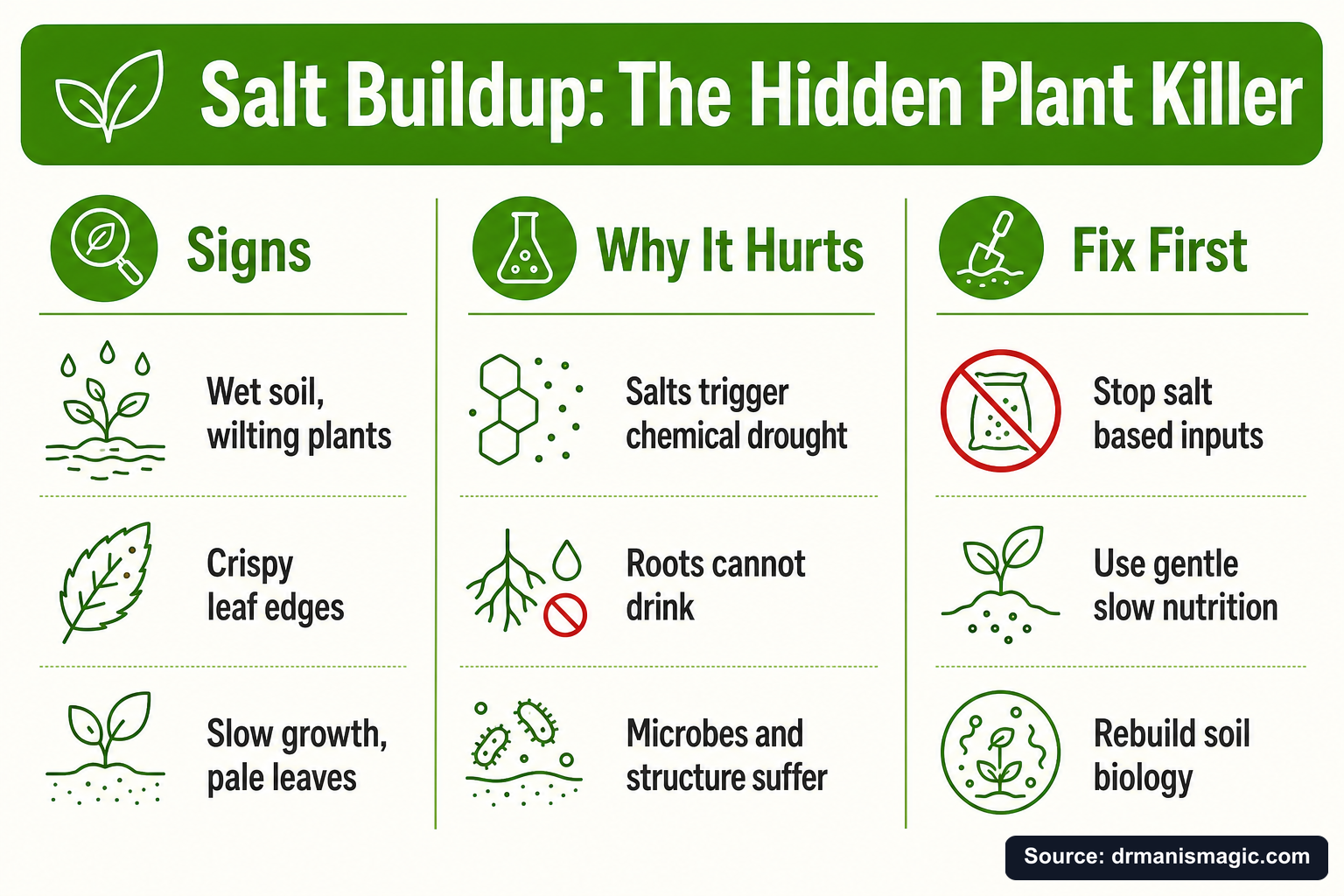
- Salt buildup in soil causes a "chemical drought" — plants cannot pull water from salty soil even when the soil feels wet.
- Most synthetic fertilizers are salt-based and contribute to salt accumulation every single time you apply them.
- Salt does not just stress plants. It kills the beneficial microbes your soil needs to stay alive and productive.
- Sodium specifically destroys soil structure, causing compaction, poor drainage, and root-suffocating oxygen loss.
- The damage builds slowly over months and years, which is why growers often blame the plant instead of the soil.
- Slow-release, biology-friendly nutrition works with your soil microbes instead of burning them to ash.
- You can recover damaged soil, but it takes the right steps in the right order — and it starts with stopping the salt inputs first.
What Exactly Is Salt Accumulation in Soil?
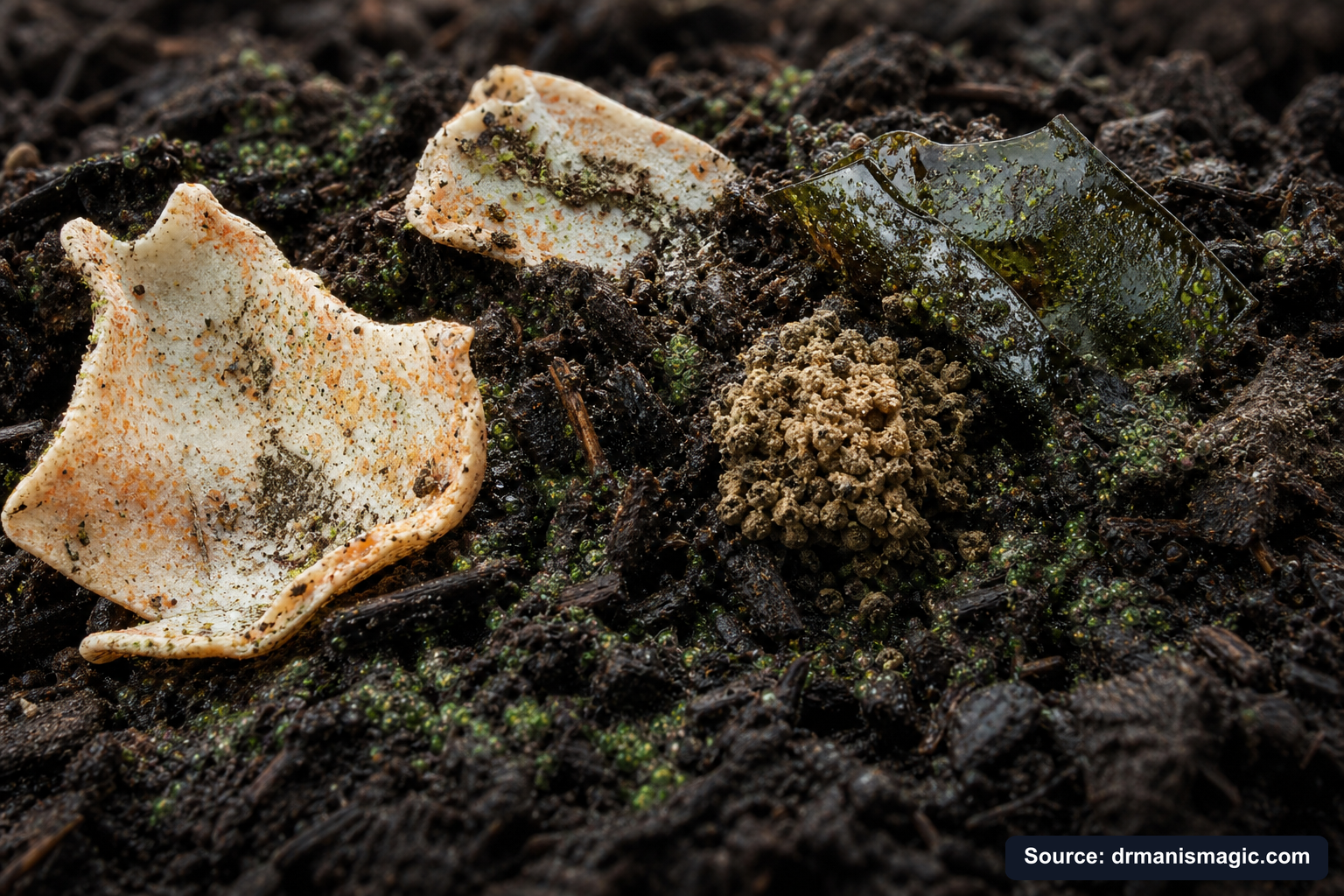
Salt accumulation in soil means that dissolved mineral salts have built up in the root zone to the point where they start hurting your plants. And we are not just talking about table salt from a shaker. We are talking about a whole family of salts that come from fertilizers, tap water, recycled irrigation water, manure, compost, biosolids, and even road de-icing chemicals. According to UC IPM, high concentrations of almost any salt — including fertilizer salts — can injure plant foliage and roots.
Think of salt in soil the way you think of salt in the ocean. Fish can live in slightly salty water. But dump too much salt in that tank, and the fish start to struggle. Your plant roots work the same way. A little mineral content is fine. But when salts pile up over time, the soil becomes a hostile environment that the plant cannot escape.
The sneaky part? This happens gradually. You will not see a sudden crash. You will see slow decline. Leaves that used to be deep green go a little pale. Growth slows. Fruit gets smaller. The plant looks tired all the time. That is salt at work, and most gardeners never connect the dots.
What Is a "Chemical Drought" and Why Should You Care?
A chemical drought happens when salt in your soil pulls water away from plant roots, even when plenty of water is present. Utah State University Extension describes this as water stress caused by osmotic pressure. Here is the plain-English version of that.
Water always moves from areas of low salt concentration to areas of high salt concentration. That is just physics. In a healthy soil, the water in the ground has fewer dissolved salts than the water inside your plant's roots. So water flows naturally into the roots. The plant drinks easily.
But when salt builds up in your soil, that equation flips. Now the soil is saltier than the roots. Water stops flowing in. It might even start flowing out. Your plant is surrounded by water and still dehydrating. It is like being stranded in the ocean with nothing to drink. The water is everywhere. But none of it is usable.
This is why you see wilting, scorching, and drought-like symptoms even after watering. This is why your tomatoes look thirsty on a rainy week. The water is there. But the salt has locked it away.
How Does Synthetic Fertilizer Cause Salt Buildup?
Synthetic fertilizers cause salt buildup because they are literally made of salts. Ammonium nitrate, ammonium sulfate, potassium chloride, urea blends — these are all salt-based compounds. Every time you apply them, you are adding more salt to your soil. A little at first. Then more. Then more again. Season after season, it compounds.
There is a measurement called the fertilizer salt index. It tells you how much osmotic stress a fertilizer creates in the soil. Common synthetic fertilizers score very high on this index. Organic sources like crab meal, kelp, and amino acids score very low. That difference matters enormously to your roots and your soil biology.
The big chemical companies have known this for decades. They designed fast-release, soluble fertilizers because they show quick results. Your grass gets green in three days. Your tree pushes new growth. You feel good and buy more. But underneath the surface, the salt is stacking up. The microbes are dying. The soil structure is breaking down. And six months or two years from now, your plants start circling the drain and you cannot figure out why.
That is not a coincidence. That is a business model. We are not trying to be mean about it. But the system was designed to sell you more product, not to build you a thriving garden. At Dr. Mani's Magic, we were growing our own 250,000 trees and we needed something better. So we built it ourselves.
What Happens to Your Soil Microbes When Salt Builds Up?
When salt builds up in soil, your beneficial microbes — the bacteria, fungi, and other microscopic helpers that make healthy soil work — start to die off in large numbers. This is one of the most important and most underreported pieces of the salt damage puzzle.
Here is why it matters so much. Healthy soil is alive. It is teeming with billions of microorganisms that do critical jobs every single day. They break down organic matter and convert it into nutrients your plant can actually absorb. They fix nitrogen from the air. They protect roots from disease. They build the crumbly, sponge-like soil structure that lets water and oxygen flow freely to your roots.
When salt concentration rises, it creates osmotic stress for microbes just like it does for plant roots. Many beneficial species cannot survive. The microbial community collapses. And when that happens, everything those microbes were doing stops happening too.
Nitrogen stops cycling. Phosphorus gets locked up in forms the plant cannot use. Disease-suppressing microbes disappear, leaving the root zone open to pathogens. Soil stops building itself. It starts falling apart instead. What was once a living, breathing ecosystem becomes a salty, compacted, biologically dead medium. And no amount of watering or spraying will fix it until you fix the salt problem first.
This is Pillar Two of our Three Plant Pillars system — live microbials. Without them, your plant is defenseless. You can have perfect soil and perfect fertilizer, but if the microbes are gone, the system breaks down. Salt is one of the fastest ways to wipe them out.
What Is Sodic Soil and Why Is It Different From Saline Soil?
Saline soil has too much total dissolved salt. Sodic soil has too much sodium specifically. They are different problems and they require different solutions. Understanding both is important if you want to actually fix your soil instead of just treating symptoms.
Saline soil creates the chemical drought we already talked about. The high overall salt concentration pulls water away from roots. Most plants show stress. Germination fails. Growth slows. Leaf edges burn. But the physical structure of the soil can still be okay. If you flush saline soil with enough clean water and stop adding salts, it can recover.
Sodic soil is more serious. When sodium builds up specifically, it disperses the tiny clay particles that normally clump together to form good soil structure. Those clumps are what give healthy soil its crumbly, porous texture. When they fall apart, the soil seals up. It crusts on top. Water cannot get in. Oxygen cannot get in. Roots sit in waterlogged, airless mud. This creates a second wave of damage: root rot and oxygen starvation, which then opens the door for fungal pathogens to move in and finish the job.
Illinois Extension and UC IPM both document how sodium disperses clay particles, destroys aggregates, reduces porosity, and contributes to compaction and crusting. This kind of damage takes much longer to reverse than simple saline conditions. In some cases, gypsum plus sustained leaching is needed. But even then, you cannot skip the step of rebuilding your soil biology afterward.
| Soil Type | Main Problem | What It Looks Like | Primary Fix |
|---|---|---|---|
| Saline Soil | Too much total dissolved salt | Wilting despite watering, leaf scorch, poor germination, crusty white surface | Flush with clean water, stop salt inputs, rebuild biology |
| Sodic Soil | Too much sodium specifically | Crusty/sealed soil surface, poor drainage, compaction, root rot, standing water | Gypsum plus leaching, then rebuild biology and structure |
| Saline-Sodic Soil | Both high total salts and high sodium | Combination of all above symptoms, very slow recovery | Gypsum, sustained leaching, stop all salt inputs, full biology rebuild |
Where Does the Salt Actually Come From?
Salt in your soil comes from more places than most people realize, and synthetic fertilizer is just one of them. UC IPM and CSU Extension identify a long list of common salt sources that affect home gardeners every year.
Synthetic fertilizers are the biggest culprit for most home gardeners. But manure can be surprisingly salty, especially poultry manure applied in large quantities. Some compost can contribute salt too, depending on what went into it. Biosolids — that is treated municipal waste used as a soil amendment — can carry salts, heavy metals, and PFAS "forever chemicals." We never use biosolids in any Dr. Mani's Magic product for exactly that reason.
Recycled irrigation water is another common source, especially in dry climates where water is reused multiple times and mineral content concentrates. Softened water that uses sodium to replace calcium and magnesium adds sodium to your soil with every watering. Shallow wells in arid regions can have naturally high mineral content. Road de-icing salt splashes onto lawns and beds near sidewalks and driveways, which explains those dead brown strips you see every spring.
Even naturally arid soils in places like the Southwest start with higher baseline salinity because low rainfall means salts never get flushed out. If you live in a dry climate and water with tap water, you may be adding small amounts of salt every single watering and never flushing them out. Over years, it compounds.
What Does Salt Damage Actually Look Like on Your Plants?
Salt damage looks different depending on the plant, the salt level, and how long it has been building up. But there are common signs you can learn to spot before the damage becomes permanent.
The most classic sign is leaf scorch — brown, crispy edges on leaves, especially the tips. This happens because salt pulls water out of leaf tissues the same way it pulls it from roots. The leaf edges dry out and die first. On trees and shrubs, you may see this on the outermost branches first. On lawns, you see streaks and patches of brown turf, often near sidewalks, driveways, or anywhere de-icing salt might reach.
Stunted growth is another major sign. Plants that should be pushing new growth just sit there. They look alive, but they are not thriving. They are spending all their energy just trying to pull water from a salty soil. There is nothing left over for growth, flowering, or fruit production.
Poor germination is a red flag in vegetable gardens and lawns. If you plant seeds and they just do not come up, or come up weak and yellow, check your soil salt levels before buying more seeds. Seeds are extremely sensitive to high salt concentrations. Even moderate salinity can drop germination rates dramatically.
Chlorosis — yellowing leaves — often appears as a secondary effect. When salt kills the microbes that make nutrients available, the plant starts showing deficiency symptoms even if the nutrients are technically present in the soil. They are there, but locked up. The plant cannot reach them. This is one of the cruelest tricks salt plays. The nutrients are right there, and the plant is still starving.
Why Do Roots Need Living Microbes to Survive Salt Stress?
Roots need living microbes because microbes are the engine that makes soil work. Without them, your root zone is just mineral particles and water. With them, it is a living system that feeds your plant, protects it from disease, and keeps the soil structure open and breathable.
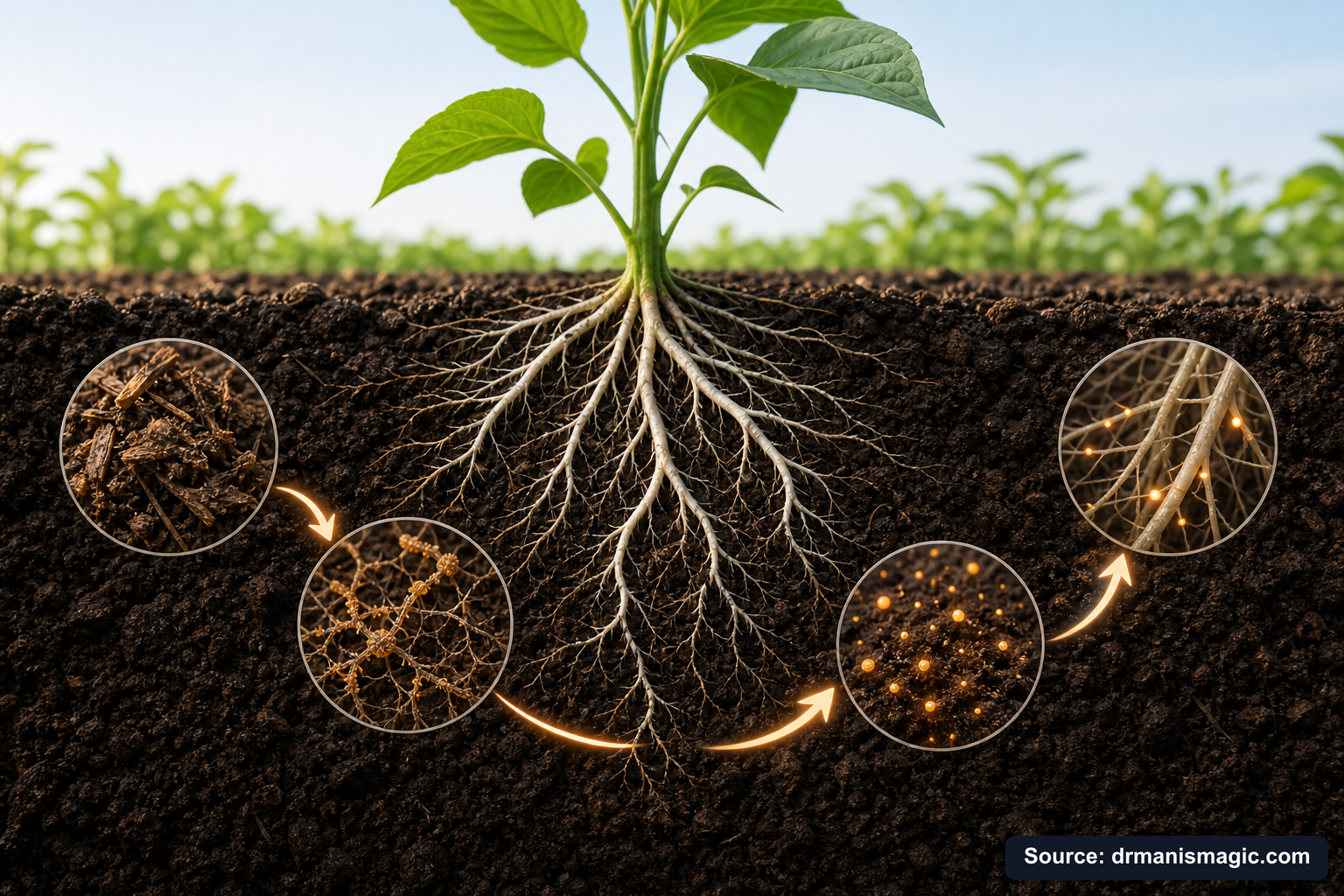
Here is something most gardeners have never been told. Organic fertilizer does not just feed your plant. It feeds your microbes first. When you apply something like crab meal, kelp, or amino acids, the microbes in your soil eat it. They process it and convert it into forms the plant can actually absorb. Then, when those microbes die, all of that stored nutrition gets released directly into the root zone in an easy-to-use form. It is a natural, living slow-release system. The soil does the timed-release work for you.
This is radically different from how synthetic fertilizers work. Synthetics dump a flood of instantly soluble nutrients into the soil. Some of that gets absorbed quickly. But much of it flushes past the roots with watering. And the salt that comes along for the ride burns the fine root hairs and kills the microbes. So you get a burst of growth followed by a crash. Then you have to buy more fertilizer. The cycle repeats. The soil gets worse. The plant gets weaker. And you keep spending money chasing results that never stick.
Organic nutrition works the way nature designed it to work. Lightning, nitrogen-fixing bacteria, and decomposing organic matter have been feeding plants for millions of years without a single bag of ammonium nitrate. The microbes are the middlemen that make the whole system run. Protect them and your plants practically take care of themselves. Kill them with salt and you are fighting nature every single season.
You Never Had a Brown Thumb.
You were handed the wrong tools. This free guide hands you the right ones.
You watered it. You fed it. It died anyway.
It was never you. It was the dirt, the salt food, and the bad advice.
This guide shows you what really went wrong, and how to fix it for good.
- Why your plants really died, and why it was never your fault
- The salt hiding in your plant food that quietly burns the roots
- The hidden killer in almost every bag of store soil
- The tiny helpers that grow a whole forest for free
- The rescue trick that brings a half dead plant back to life

How Does the Root-Zone Spiral Actually Work?
The root-zone spiral is the chain of events that turns a mildly salty soil into a chronically damaged one over time. It rarely happens all at once. It creeps up on you. And by the time most growers notice it, the spiral has been going for months or years.
It starts with salt accumulation from fertilizers, water, or other inputs. The salt raises the electrical conductivity of the soil solution — that is the measurable "saltiness" level. The microbes begin to struggle. The fine root hairs that absorb water and nutrients start to die back. The plant pulls water with more and more effort, spending energy it should be using for growth.
As sodium specifically builds up, the clay particles in the soil disperse. The soil loses its crumbly structure. It starts to compact and seal. Drainage slows. Water pools at the surface or moves through very slowly. The root zone becomes waterlogged in wet periods and rock-hard in dry ones. Oxygen cannot get to the roots.
Roots without oxygen are roots in crisis. They cannot function. They start to rot. Opportunistic fungal pathogens — the ones that cause root rot — move in and colonize the dying tissue. The plant above ground starts showing symptoms that look like drought, nutrient deficiency, or disease. Because at this point, it actually is all three at once. The salt started it. The compaction made it worse. The oxygen loss finished it off.
And here is the painful part about time. You cannot get those years back. Every season you spend fighting salt-damaged soil with more synthetic fertilizer is another season your garden is not producing what it should. The number one thing we hear from growers is that they want to see fruit on their tree — real fruit, real harvests — while they still can. Salt accumulation in soil is one of the primary reasons that dream gets delayed for years and years. You deserve better than that.
How Do You Test Your Soil for Salt Damage?
Testing your soil for salt damage starts with measuring electrical conductivity, which tells you how much dissolved salt is in your soil solution. You can get a simple EC meter online for under thirty dollars. You dissolve some of your soil in distilled water, test it, and compare the reading to standard ranges for your plants. Most vegetables prefer EC below 2 dS/m. Citrus and many ornamentals can tolerate slightly higher levels, but performance drops as EC climbs.
If EC is high, the next step is checking for sodium specifically. A soil test from a lab can measure your sodium adsorption ratio, or SAR. A high SAR tells you that sodium is dominating your soil's chemistry and that you are dealing with sodic conditions, not just general salinity. That changes your remediation plan.
You should also look at your irrigation water. If your tap water has high mineral content, every watering adds a tiny bit more salt. Over years, even low-concentration water can build up to damaging levels. A simple water test from a local lab will tell you the EC and sodium levels in your source water.
Visual diagnosis is your daily tool. White crust on the soil surface is often a salt deposit. Crusty edges around pot drainage holes are a salt flag. Brown leaf margins. Wilting despite wet soil. Poor germination. Slow growth. Yellowing that does not respond to fertilizer. These are all the fingerprints of salt. Learn to recognize them and you will catch the problem before the spiral takes hold.
Can You Flush Salt Out of Soil, and Will That Fix It?
Yes, you can flush salt out of soil with clean water, and for saline conditions it is often the first and most important step. But flushing alone will not fix the full problem. It is the beginning of recovery, not the end.
To flush effectively, you need to apply two to three times the volume of water that your soil or container can hold, slowly, over several hours. This pushes dissolved salts down past the root zone. In containers, you let water run freely out the drainage holes for an extended period. In garden beds, deep, slow watering over multiple sessions works best. In sodic soils, gypsum needs to go in first to replace the sodium on the clay particles and make it possible for water to actually move through the soil. Without gypsum, water just runs off the sealed surface and never reaches the roots.
After flushing, the soil is depleted. The salts are gone, but so is much of the biology and much of the available nutrition. This is when rebuilding begins. You need to reintroduce live microbes to restart the biological engine. You need to feed the soil with low-salt organic nutrition that the microbes can process and convert. You need to give the soil structure time to recover. Skipping any of these steps means the salt will come back as soon as you start fertilizing again with the same products that caused the problem in the first place.
What Makes Organic Fertilizer Different From Salt-Based Synthetic Fertilizer?
Organic fertilizer is different from synthetic fertilizer at the most fundamental level: it is not salt-based. Ingredients like crab shells, cold-processed kelp, amino acids derived from natural protein sources, and volcanic minerals do not spike the electrical conductivity of your soil. They do not create osmotic stress. They do not burn roots or kill microbes. They work with the biology of your soil instead of against it.
Crab shells, for example, are rich in chitin — a natural compound that does something remarkable. When soil microbes break down chitin, it primes your plant's immune system. It tells the plant that something is being broken down in the soil, which triggers a natural defensive response against pests and disease. Chitin also provides calcium and magnesium, the structural nutrients that build strong cell walls and woody plant tissue.
Kelp brings a different kind of magic. Cold-processed kelp retains natural plant growth hormones called auxins and cytokinins. These are the chemical signals that tell your plant to grow roots, push new shoots, and set fruit. Kelp also carries dozens of trace minerals that are almost impossible to replicate in a synthetic formula. And it feeds your microbes with complex carbohydrates they love.
Amino acids are the building blocks of proteins. When you apply them to soil, microbes convert them into plant-available nitrogen almost immediately, but gently, without the salt spike of synthetic nitrogen sources. Amino acid nitrogen is also more efficient — the plant absorbs it in smaller doses over time, which mirrors the way nature delivers nitrogen through decomposing organic matter and nitrogen-fixing bacteria.
Volcanic ash and minerals round out the picture with silica and trace elements that strengthen cell walls, increase drought resistance, and fill in the micronutrient gaps that even good organic fertilizers can miss. Together, these ingredients create something no synthetic bag can match: a complete, living-soil-compatible nutrition system that feeds your plant, feeds your microbes, and builds your soil at the same time.
That is exactly what went into Crab, Kelp & Amino Acids — our 7-4-4 organic granular fertilizer built from these exact ingredients, with no biosludge, no PFAS, no synthetic salts, and no plastic-coated slow-release prills that leach toxins into your soil and waterways.
What About Biosludge and PFAS — Should You Be Worried?
Yes, you should know about this. Some fertilizers — both synthetic and organic — use biosolids as a filler. Biosolids is the industry term for treated municipal waste. Human sewage, processed and sold as a soil amendment. It can carry heavy metals, pharmaceutical residues, and PFAS compounds — the so-called "forever chemicals" that do not break down in soil or in your body.
PFAS have been linked to serious health concerns in ongoing research. They accumulate in soil, get taken up by plants, and can move into groundwater. When you grow food in a garden treated with biosolid-based fertilizers, there is a real question about what ends up in your vegetables and fruit.
We do not use biosolids in any Dr. Mani's Magic product. Period. Everything in our fertilizer line comes from clean, traceable, American-sourced ingredients. We built these products for our own nursery first — for the trees we sell to real families and the grove we tend ourselves. We were not about to put anything in the soil we would not want around our own children. That standard applies to every bag and every bottle we ship to you.
What Is the Three Plant Pillars Approach to Recovering Salt-Damaged Soil?
The Three Plant Pillars approach gives you a systems framework for rebuilding soil that salt has damaged, and it works for any plant — lawns, vegetable gardens, flower beds, ornamental shrubs, fruit trees, houseplants, and container gardens of every kind.
Pillar One is mineral-based soil. Most commercial potting mixes are made from pine bark, wood chips, and other organic matter that breaks down over time, compacts, and seals off oxygen from roots. When that compaction combines with salt damage, you get a root zone that is simultaneously salty, airless, and structurally unstable. Mineral-based soil — the kind built on sandy loam with silica-rich particles that do not decompose — holds its structure indefinitely. It drains. It breathes. It gives roots room to grow without fighting compaction. This is the foundation everything else depends on.
Pillar Two is live microbials. After flushing salt from your soil and correcting sodium with gypsum if needed, the biological engine has to be restarted. That means reintroducing living bacteria, fungi, and mycorrhizae that can re-colonize the root zone, restart nutrient cycling, rebuild disease suppression, and help recreate the crumbly soil structure that good drainage requires. Without this step, recovery stalls. You can have perfect mineral soil and perfect nutrition, but if the biology is not there, the system does not function.
Pillar Three is organic fertilizer and biostimulants. This is where you feed the system without poisoning it. Low-salt, biology-friendly nutrition from sources like crab, kelp, amino acids, and volcanic minerals feeds the microbes first. The microbes convert those ingredients into plant-available nutrition and release it slowly over time. No salt spikes. No microbial crashes. No addiction cycle. Just steady, consistent nutrition that mirrors the way nature has fed plants for millions of years.
When all three pillars are in place at the same time, something shifts. The soil comes alive. The roots breathe. The microbes thrive. The plant gets exactly what it needs, exactly when it needs it. We have watched this happen on 250,000 trees in South Texas. We have watched it happen in container gardens, raised beds, lawns, and orchards. The results are not magic. They are just what happens when you stop fighting nature and start working with it.
How Long Does It Take to Recover Salt-Damaged Soil?
Recovery time depends on how bad the damage is and whether you address all the root causes at once. Mild salinity in a container can improve dramatically within a few weeks of flushing and switching to low-salt organic inputs. Moderate salt accumulation in a garden bed may take a full growing season to stabilize and another season to fully rebuild biology and structure.
Sodic soil with serious structural collapse takes longer. Gypsum needs time to work. Water infiltration improves gradually as sodium is displaced and clay particles re-aggregate. Biology rebuilds in waves as conditions improve. You might see meaningful improvement in three to six months and close to full recovery in one to two years, depending on your inputs, your irrigation water quality, and your climate.
The most important thing you can do right now is stop adding salt. That sounds obvious, but it is the step most growers skip because they are still using the same synthetic fertilizer that caused the problem, hoping this season will be different. It will not be different. The salt keeps stacking. The biology keeps dying. The spiral keeps tightening. Stop the salt inputs first. Everything else follows from that single decision.
Time is the one thing you cannot buy back. Every season spent in a salt cycle is a season without the harvest you were hoping for. We have heard it more times than we can count — growers who just want to see their tree bear real fruit while they can still enjoy it. That is not too much to ask. It is the most human desire in the world. We were made to tend gardens. We were meant to harvest from them. Salt accumulation in soil is one of the most fixable problems standing between you and that moment. And now you know exactly how to fix it.
A Simple Diagnostic Path for Salt-Damaged Soil
| Step | What to Do | What to Look For |
|---|---|---|
| 1. Observe symptoms | Walk your garden and note what you see | Leaf scorch, wilting despite watering, stunted growth, white soil crust, poor germination |
| 2. Review inputs | List all fertilizers, amendments, and water sources used in the past year | Synthetic fertilizers, manure, biosolids, softened water, recycled irrigation water |
| 3. Test soil EC | Use an EC meter or send soil to a lab | EC above 2 dS/m is a warning zone for most vegetables and ornamentals |
| 4. Test for sodium (SAR) | Send soil to a university extension lab for full analysis | High SAR means sodic conditions requiring gypsum plus leaching |
| 5. Check drainage | Dig a hole, fill with water, time how fast it drains | Slow drainage (less than 1 inch per hour) suggests compaction or sodic structure |
| 6. Stop salt inputs | Switch all fertilizers to low-salt organic sources immediately | No more synthetic soluble fertilizers, biosolid-based amendments, or softened water |
| 7. Flush and amend | Leach with clean water; apply gypsum if sodium is high | Improved water infiltration, reduced soil crust over 4 to 8 weeks |
| 8. Rebuild biology | Apply live microbials to restart the soil ecosystem | Improved soil structure, better root growth, healthier color over 4 to 12 weeks |
| 9. Feed with organic nutrition | Use low-salt, slow-release organic fertilizer on a regular schedule | Steady growth, vibrant color, improved fruiting and flowering over one full season |
Start Here: The Simplest Next Step
You do not need to do twenty things at once. You do not need to buy a truckload of products or rebuild your entire garden in a weekend. You just need to start in the right direction.
Stop adding salt. That is step one. Put down the synthetic fertilizer bag and understand that every application is making your long-term problem worse, even if it produces a short burst of green. You are borrowing against the future health of your soil, and the interest rate is brutal.
Then rebuild. Start with the biology. Add live microbes to get the soil ecosystem moving again. Switch to low-salt organic nutrition that feeds your microbes first and lets them do the slow, steady, natural work of feeding your plant. Make sure your soil has the structure and drainage to let oxygen and water move freely. Those three things — mineral foundation, live biology, organic nutrition — are what we call the Three Plant Pillars. And they work for every plant you grow, from a single potted houseplant to a backyard orchard to an acre of lawn.
We built these products for our own nursery. We tested them on 250,000 trees. We put them in the hands of over 10,000 growers who wanted results they could actually see, smell, and taste. And we made them available to you because we believe you deserve a garden that works, a soil that lives, and a harvest you can hold in your hands.
If you want to learn more about how clean, salt-free nutrition fits into the bigger picture of soil health, take a look at how the Three Plant Pillars system works together — it is the clearest path we know from struggling plants to thriving ones, for any garden, any climate, any plant you love.
Frequent Asked Questions (FAQ)
Q1. What is salt accumulation in soil and how does it differ from normal mineral content?
Salt accumulation in soil occurs when dissolved mineral salts build up in the root zone to concentrations high enough to injure plant foliage and roots, originating from sources including fertilizers, tap water, recycled irrigation water, manure, compost, biosolids, and road de-icing chemicals. According to UC IPM, high concentrations of almost any salt, including fertilizer salts, can injure plant tissue regardless of the specific compound involved. A small amount of mineral content in soil is normal and even beneficial, similar to fish tolerating slightly salty ocean water, but when salts accumulate beyond what the soil can buffer, the root zone becomes a hostile environment the plant cannot escape. The accumulation happens gradually rather than as a sudden event, producing slow decline symptoms including paling leaf color, slowed growth, smaller fruit, and a generally tired appearance that most gardeners never connect back to salt buildup because there is no single dramatic moment that signals the cause.
Q2. What is chemical drought and why do plants wilt in soil that feels wet?
Chemical drought is a condition in which salt accumulated in soil pulls water away from plant roots through osmotic pressure, causing dehydration symptoms even when abundant water is physically present in the soil. Utah State University Extension describes this water stress mechanism directly — in healthy soil, the water surrounding roots contains fewer dissolved salts than the water inside root cells, causing water to flow naturally inward so the plant can drink easily. When salt builds up in soil, this relationship reverses: the soil becomes saltier than the root interior, water stops flowing into roots and may begin flowing outward instead, and the plant experiences dehydration while sitting in moist or even saturated ground. This explains why tomatoes can look thirsty during a rainy week or why a recently watered lawn still shows wilting and scorch symptoms — the water is physically present but rendered inaccessible by the salt concentration surrounding the roots.
Q3. How do synthetic fertilizers contribute to salt buildup in garden soil over time?
Synthetic fertilizers contribute directly to salt buildup because their active nitrogen, phosphorus, and potassium sources are chemically formulated as soluble salt compounds — including ammonium nitrate, ammonium sulfate, potassium chloride, and urea blends — meaning every application adds incremental salt load to the soil regardless of how carefully the product is used. This accumulation compounds across seasons because each subsequent application builds on residual salt from previous feedings rather than starting from a clean baseline. The fertilizer salt index, a standardized measurement of how much osmotic stress a given fertilizer creates in soil, shows that common synthetic fertilizers score very high on this scale while organic sources including crab meal, kelp, and amino acids score very low, reflecting their fundamentally different chemical delivery mechanisms. Fast-release, highly soluble synthetic fertilizers are specifically formulated to produce visible green-up within days because rapid visual results drive repeat purchases, even though the underlying salt accumulation, microbial damage, and soil structure degradation accumulate silently beneath that visible surface response.
Q4. How does salt accumulation in soil kill beneficial microbes and disrupt natural nutrient cycling?
Salt accumulation kills beneficial soil microbes through osmotic stress that operates on bacterial and fungal cells the same way it dehydrates plant root cells, causing widespread microbial die-off as soil electrical conductivity rises. Healthy soil functions as a living ecosystem containing billions of microorganisms responsible for breaking down organic matter into plant-available nutrients, fixing atmospheric nitrogen, protecting roots from disease-causing pathogens, and building the crumbly, porous soil structure that allows water and oxygen to move freely to root systems. When salt concentration rises beyond microbial tolerance thresholds, this community collapses, and every function those organisms performed stops simultaneously — nitrogen cycling halts, phosphorus becomes chemically locked in forms roots cannot absorb, disease-suppressing organisms disappear leaving the root zone vulnerable to pathogens, and the biological processes that maintain soil structure cease. This collapse explains why nutrient deficiency symptoms often appear in salt-damaged soil even when adequate nutrients are technically present — the microbial system that would normally convert and deliver those nutrients to roots no longer functions, leaving the plant unable to access nutrition that exists but remains chemically unavailable.
Q5. What is the difference between saline soil and sodic soil and why does it matter for recovery?
Saline soil and sodic soil represent two distinct salt-related problems requiring different remediation approaches, distinguished by whether the issue is total dissolved salt concentration or sodium specifically. Saline soil contains elevated total dissolved salt that creates chemical drought through osmotic pressure, producing wilting, leaf scorch, poor germination, and a crusty white soil surface, while the physical structure of the soil typically remains intact — meaning saline soil can often recover through thorough flushing with clean water combined with stopping additional salt inputs. Sodic soil presents a more serious structural problem because elevated sodium specifically disperses the clay particles that normally clump together to form healthy soil aggregates, causing the soil to seal, crust, and lose porosity entirely. Illinois Extension and UC IPM both document how sodium disperses clay particles, destroys soil aggregates, and contributes to compaction and surface crusting that prevents water and oxygen infiltration, creating waterlogged, airless conditions that lead to root rot and fungal pathogen colonization. Sodic soil typically requires gypsum application combined with sustained leaching before biological recovery can even begin, representing a significantly longer and more complex remediation process than saline conditions alone.
Q6. What are the visible warning signs that indicate salt damage is occurring in garden soil or container plants?
Salt damage produces several recognizable visual indicators that distinguish it from other plant health problems when observed together. Leaf scorch — brown, crispy edges and tips, particularly on the outermost branches of trees and shrubs — is the most classic sign, occurring because salt pulls water out of leaf tissue through the same osmotic mechanism that affects roots. Stunted growth indicates the plant is expending most of its available energy attempting to extract water from salty soil, leaving insufficient resources for new growth, flowering, or fruit production. Poor seed germination is a significant red flag in vegetable gardens and lawns, since seeds are extremely sensitive to elevated salt concentrations and even moderate salinity can substantially reduce germination rates. Chlorosis, or yellowing leaves, frequently appears as a secondary symptom when salt-induced microbial collapse locks essential nutrients into chemically unavailable forms, causing the plant to display deficiency symptoms despite adequate nutrient presence in the soil. A visible white crust on the soil surface or around container drainage holes is a direct physical indicator of salt precipitation confirming that concentrations below the surface have reached damaging levels.
Q7. How do you test soil for salt damage and what EC and sodium levels indicate a problem?
Testing soil for salt damage begins with measuring electrical conductivity, the standard metric for total dissolved salt concentration in the root zone, using an EC meter available for under thirty dollars that provides readings when soil is dissolved in distilled water and tested directly. Most vegetables prefer EC levels below 2 dS/m, while citrus trees and many ornamentals tolerate somewhat higher concentrations before performance noticeably declines. If EC readings indicate elevated salt levels, the next diagnostic step is testing specifically for sodium through a laboratory analysis measuring sodium adsorption ratio, or SAR — a high SAR result indicates sodic soil conditions requiring a fundamentally different remediation approach than general salinity. Irrigation water quality should also be tested, since tap water with high mineral content contributes incremental salt load with every watering cycle, and even low-concentration water sources can build to damaging levels over years of repeated application. Visual diagnosis remains a valuable daily monitoring tool — white soil surface crust, crusty deposits around container drainage holes, brown leaf margins, wilting despite moist soil, poor germination, and yellowing that does not respond to fertilizer application are all consistent fingerprints of salt accumulation that allow early detection before the damage spiral becomes severe.
Q8. What is the root-zone spiral and how does salt accumulation progress into root rot over time?
The root-zone spiral describes the sequential chain of biological failures through which mild soil salinity progresses into chronic, severe soil damage over months or years rather than occurring as a single event. The spiral begins with salt accumulation from fertilizer, irrigation water, or other inputs raising the electrical conductivity of the soil solution, which stresses and begins killing beneficial soil microbes while simultaneously damaging the fine root hairs responsible for water and nutrient absorption. As sodium specifically accumulates within this process, it disperses soil clay particles, destroying the crumbly structure that allows proper drainage and causing the soil to compact and seal at the surface. This structural collapse slows water infiltration dramatically, creating soil that becomes waterlogged during wet periods and rock-hard during dry periods, eliminating oxygen availability in the root zone. Roots deprived of oxygen enter physiological crisis and begin to fail, creating ideal conditions for opportunistic fungal pathogens to colonize the weakened, dying root tissue and cause root rot. By this stage, the plant displays symptoms that simultaneously resemble drought stress, nutrient deficiency, and disease — because at this point in the spiral, all three conditions are genuinely present at once, each one compounding the others.
Q9. What is the step-by-step process for flushing and recovering salt-damaged soil?
Recovering salt-damaged soil requires a sequenced process beginning with immediately stopping all salt-contributing inputs, since continuing the same synthetic fertilizer program that caused the damage prevents any recovery regardless of other steps taken. For saline soil, flushing with two to three times the soil or container's water-holding volume, applied slowly over several hours, pushes dissolved salts down past the root zone — in containers this means allowing water to run freely through drainage holes for an extended period, while garden beds require deep, slow watering across multiple sessions. For sodic soil where sodium has dispersed clay structure, gypsum must be applied first to displace sodium from clay particles and restore water permeability, since water simply runs off a sealed sodic surface without gypsum treatment rather than penetrating to the root zone. Following successful flushing, the depleted soil requires biological rebuilding through live microbial inoculation to restart nutrient cycling, followed by feeding with low-salt organic nutrition that microbes can process and convert into plant-available forms. Skipping the biological rebuilding step after flushing leaves the soil vulnerable to the same salt accumulation recurring as soon as fertilization resumes with the products that caused the original problem.
Q10. How long does salt-damaged soil typically take to fully recover and what factors affect recovery time?
Salt-damaged soil recovery time varies significantly based on damage severity, soil type, and whether all underlying causes are addressed simultaneously rather than partially. Mild salinity in a container growing medium can show dramatic improvement within a few weeks following thorough flushing and a switch to low-salt organic fertilizer inputs. Moderate salt accumulation in an in-ground garden bed typically requires a full growing season to stabilize, with an additional season needed to fully rebuild soil biology and structural integrity. Sodic soil with significant structural collapse from sodium-driven clay dispersion requires substantially longer recovery, since gypsum treatment needs time to displace sodium and allow water infiltration to gradually improve as clay particles re-aggregate, with biological recovery occurring in stages as soil conditions improve incrementally — meaningful improvement is typically visible within three to six months, with close to full recovery taking one to two years depending on irrigation water quality, climate, and consistency of remediation inputs. The single most important factor determining recovery timeline across all severity levels is whether salt inputs are stopped completely and immediately, since continuing to apply the same synthetic fertilizer that caused the original damage prevents recovery from beginning regardless of how much time passes.
About the Author
Ron Skaria, MD
Ron Skaria, MD, is the co-founder of Dr. Mani's Magic and the son of Dr. Mani. He trained as a medical doctor and now works full time on the family farm in Hargill, Texas, building Dr. Mani's Magic alongside his dad. He wrote the Brown Thumb Field Guide to put his father's 48 years of plant science into plain words any gardener can use. His belief is simple. You never had a brown thumb. You just never had the right help.


