


How Synthetic Inputs Shrink Root Systems Over Time | Dr. Mani's Magic
How Synthetic Inputs Shrink Root Systems Over Time (And What to Do About It)
Picture this. You just spent a Saturday afternoon in your backyard. You raked. You watered. You sprinkled that bright blue granular fertilizer all over your lawn and around your favorite fruit tree. It looked so satisfying going down. The bag said "fast-acting." You felt like you were doing something good.
But three months later, something feels off. The leaves look a little pale. The tree isn't pushing new growth the way it used to. You water more. You fertilize more. And still, the plant just... stalls. You pull back the mulch and peek at the roots near the surface. They look brown. Sparse. Almost shrunken. You scratch your head. You followed the directions. What went wrong?
Here is what most people never get told. That bright blue fertilizer? It is made of salts. And salts, over time, can quietly strangle the very roots you are trying to feed. Not in one dramatic moment. Slowly. Invisibly. Season after season. At our South Texas nursery, after growing over 250,000 trees, we watched this happen again and again — until we finally understood the full story. We are going to walk you through it right now, plain and simple, so it never happens to your plants again.

Plant Super Boost
Key Takeaways
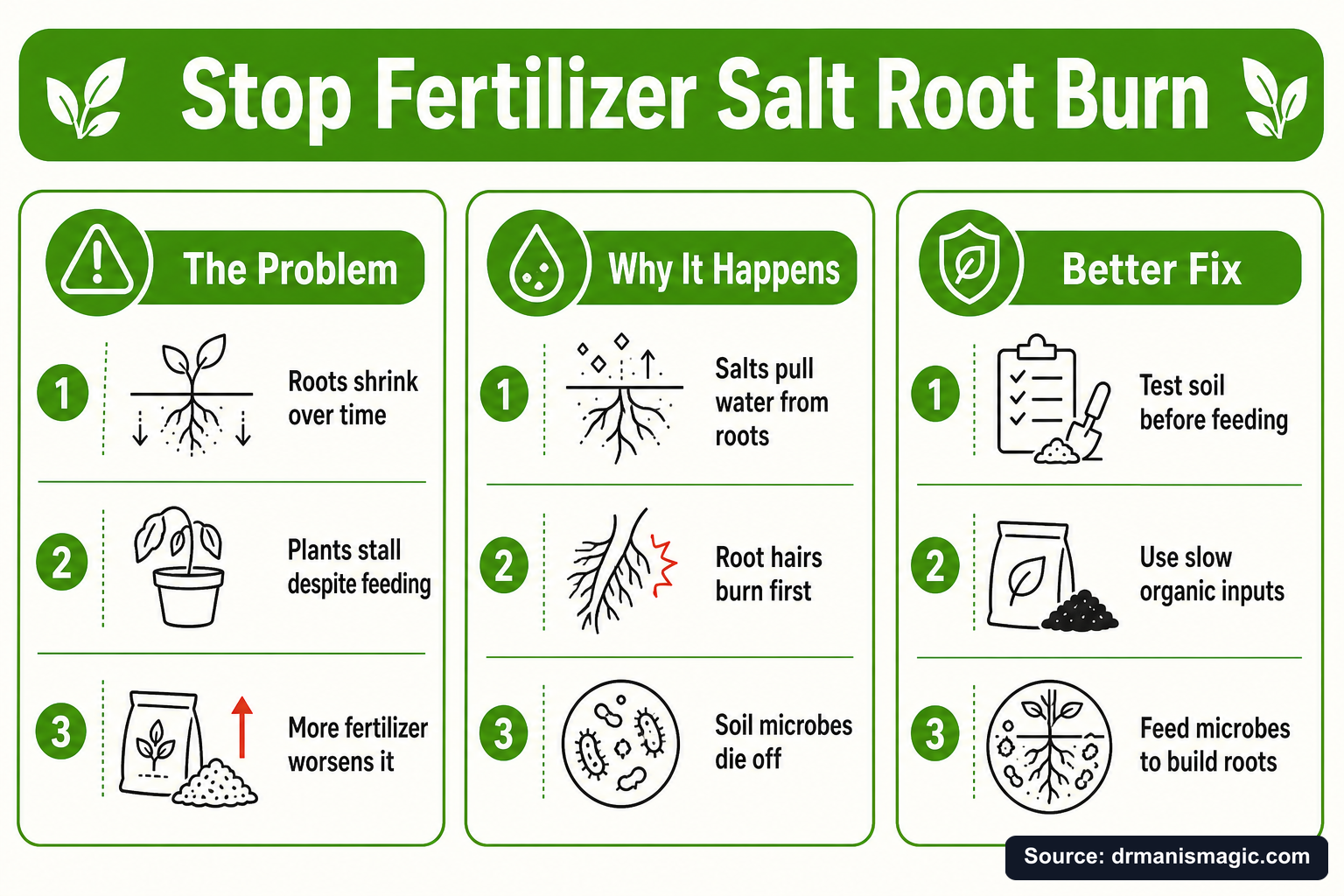
- Soluble, salt-based fertilizers can pull water OUT of roots through a process called osmotic stress, shrinking and damaging root hairs over time.
- Repeated high-salt feeding kills the beneficial soil microbes that plants depend on to absorb nutrients naturally.
- When roots shrink and microbes die, plants become dependent on more and more fertilizer just to survive — a vicious cycle.
- Excess nitrogen from synthetic inputs can push leafy top growth while actually starving the root system below.
- Weakened roots invite root rot pathogens like Pythium and Phytophthora, turning a nutrition problem into a disease problem fast.
- Organic, slow-release inputs feed the microbes first, and the microbes feed the plant — a natural time-release system that builds roots instead of burning them.
- The Three Plant Pillars — mineral soil, live microbes, and organic fertilizer — work together to break the salt cycle and rebuild a healthy, deep root system.
What Actually Happens to Roots When Salt-Based Fertilizers Build Up in Soil?
Salt-based fertilizers raise the electrical charge in the soil water around roots. When that salt concentration gets higher than the water concentration inside the root cells, water flows OUT of the roots instead of in. Roots shrink, dry out from the inside, and lose their ability to absorb anything — even when the soil is wet.
Imagine your root as a tiny drinking straw. It sucks water and nutrients up from the soil. Now pack salt all around that straw. The salt is thirsty too. And salt is stronger. It pulls the moisture right out of the straw itself. Scientists call this osmotic stress, and university researchers describe it as one of the primary ways fertilizer salts damage trees, shrubs, lawns, and garden plants alike.
According to the University of Maryland Extension, fertilizer salts can draw water out of roots, damage root cells, restrict root growth, and even cause plant death when salt levels get high enough. This is not a rare event. It is what happens when soluble fertilizers are applied repeatedly without testing the soil first.
The fine root hairs — the tiny, fuzzy tips that actually do the drinking — are the first to go. They are fragile. They burn. Once they are gone, the plant loses its most efficient water and nutrient intake system. What is left behind is a coarser, smaller, less functional root system. The plant looks okay on top for a while. But underground, things are getting worse every season.
Here is the part that really stings. Most people respond to a struggling plant by adding more fertilizer. But more salt-based fertilizer makes the salt problem worse. The cycle tightens. The roots shrink more. The plant becomes weaker. And all of that time you spent caring for it — gone. You cannot get that time back.
Why Do Synthetic Fertilizers Kill the Soil Microbes Your Roots Depend On?
Soil microbes are living things, and high salt concentrations dehydrate and kill them the same way they dehydrate roots. Without microbes, the natural nutrient-delivery system in the soil shuts down. The plant loses its underground partners and becomes totally dependent on whatever you pour from a bag or bottle.
Your soil is supposed to be alive. Teeming. Buzzing with billions of bacteria, fungi, and other microscopic workers that have been partnering with plant roots since before humans existed. The University of Minnesota Extension explains that soil organisms contribute to nutrient cycling, water infiltration, disease suppression, and biological diversity — and that biological processes supply a huge share of the nitrogen and phosphorus that plants actually use.
When you dump a salt-heavy synthetic fertilizer into that living system, it is like pouring bleach into an aquarium. The microbes die. Not because fertilizer is inherently evil. But because the salt concentration spikes to a level that living things cannot survive.
And here is what those microbes were doing for you that the fertilizer bag never mentions. They were breaking down organic matter and releasing nutrients slowly. They were forming partnerships with roots — especially mycorrhizal fungi — that extended the root system's reach by hundreds of times. They were fighting off disease-causing organisms like Pythium and Phytophthora. They were making the whole underground neighborhood safe, productive, and self-sustaining.
Kill the microbes, and all of that stops. The plant is now on its own. And a plant on its own, with shrinking roots and no biological backup, is a plant that is slowly losing the fight.
This is exactly why the Three Plant Pillars treat living microbes as non-negotiable. Not a bonus. Not a nice-to-have. A pillar. Because without them, the other two pillars cannot reach their full potential.
Does Too Much Nitrogen Actually Shrink Roots by Stealing Energy From Below?
Yes. When a plant gets a sudden flood of soluble nitrogen, it rushes energy into making leaves and shoots — the visible, above-ground growth. But root development slows. The plant stops investing in its underground infrastructure because it does not need to go searching for nutrients. Over time, the root system stays shallow and small.
Think of it like this. A child who gets everything handed to them never learns to work for it. A plant that gets a flood of ready-made nitrogen never has to grow its roots deeper to go find food. So it doesn't. The roots stay near the surface. Shallow roots mean less drought tolerance, less stability, and less ability to survive any stress — heat, disease, or even a week without watering.
In contrast, when a plant is fed slowly and consistently — the way nature intended — it keeps exploring. It keeps growing root hairs. It keeps deepening and widening its underground network. That root system becomes a fortress.
This is why the rate and form of nitrogen matters as much as the amount. Slow-release organic nitrogen, like the amino acid nitrogen in Crab, Kelp & Amino Acids, trickles into the soil at a pace the plant and its microbial partners can actually use. No flood. No crash. No root-starving spike.
What Is the Full Root-Decline Cycle — And How Does It Spiral Into Root Rot?
Salt stress shrinks root hairs, killing the plant's water intake. The gardener waters more to compensate. Waterlogged soil loses oxygen. Oxygen-starved roots become easy targets for Pythium, Phytophthora, Fusarium, and other root rot pathogens. The root system gets smaller, the plant gets weaker, and the spiral accelerates with every season.
Here is the full chain, laid out plain and simple:
- You apply a soluble, salt-based fertilizer.
- Salt raises the electrical charge in the soil — what scientists call high electrical conductivity (EC).
- Osmotic stress pulls water out of root hairs. Root hairs shrink and die.
- The plant struggles to absorb water even when the soil is wet. This is sometimes called physiological drought — the plant is thirsty in a wet soil.
- You water more. The soil stays wet longer.
- Wet, oxygen-poor soil creates the perfect home for Pythium and Phytophthora — two of the most destructive root rot pathogens in gardening.
- Root rot destroys what is left of the root system.
- The plant looks yellow, wilted, or stunted. You add more fertilizer, thinking it is hungry.
- More salt. More stress. More rot. The cycle repeats — tighter each time.
We watched this pattern in citrus trees, in container houseplants, in backyard lawns, and in vegetable gardens. The symptoms look different on the surface. But the underground story is the same every time.
See also: The Hidden Reason Synthetic Fertilizers Cause Root Rot
How Do You Tell the Difference Between Salt Damage, Overwatering, and True Root Rot?
Salt damage usually shows up as leaf scorch at the tips and edges, with roots that look brown and dry. Overwatering causes yellowing and mushy roots in wet soil. True root rot from Pythium or Phytophthora shows dark, slimy roots with a foul smell and rapid plant collapse — often after a period of both salt stress and excess moisture.
Most gardeners lump these three problems together. But they have different root causes and different fixes. Getting the diagnosis right is everything.
| Problem | What You See Above Ground | What Roots Look Like | Soil Conditions | Most Likely Fix |
|---|---|---|---|---|
| Salt / Fertilizer Damage | Brown leaf tips and edges, wilting despite watering | Brown, dry, shrunken root hairs; fewer fine roots | Often dry-ish; crusty white deposits possible | Flush soil with clean water; switch to organic, low-salt inputs |
| Overwatering (Oxygen Stress) | Yellow leaves, drooping, slow growth | Pale, soft, waterlogged; no rot smell yet | Consistently wet; poor drainage | Let soil dry; improve drainage and aeration; mineral-based soil helps enormously |
| Root Rot (Pythium / Phytophthora) | Rapid wilting, dark stems near soil line, plant collapse | Dark brown or black, slimy, foul-smelling | Wet and warm; often follows salt stress | Remove affected roots; repot in mineral soil; introduce beneficial microbes to fight pathogens |
| True Drought | Crispy brown leaves, leaf drop, curling | Dry and light-colored; soil pulls away from pot edges | Bone dry | Deep, slow watering; mulch; check root health before fertilizing |
The tricky part? Salt damage and overwatering often happen at the same time. Salt stress causes physiological drought. The gardener waters more. The soil gets waterlogged. Pythium moves in. By the time the plant is visibly sick, all three problems are layered on top of each other. That is why starting with clean inputs and biology-friendly soil matters so much from the very beginning.
You Never Had a Brown Thumb.
You were handed the wrong tools. This free guide hands you the right ones.
You watered it. You fed it. It died anyway.
It was never you. It was the dirt, the salt food, and the bad advice.
This guide shows you what really went wrong, and how to fix it for good.
- Why your plants really died, and why it was never your fault
- The salt hiding in your plant food that quietly burns the roots
- The hidden killer in almost every bag of store soil
- The tiny helpers that grow a whole forest for free
- The rescue trick that brings a half dead plant back to life

Synthetic vs. Slow-Release vs. Organic — Which Fertilizer Actually Builds Roots?
Synthetic fast-release fertilizers deliver a spike of soluble salts that stress roots and kill microbes. Slow-release coated synthetics are better but still contain salts and plastic shells. Organic fertilizers like crab, kelp, and amino acids feed the microbes first, and the microbes feed the plant — building roots and biology at the same time with zero salt damage.
| Feature | Synthetic Fast-Release | Coated Slow-Release Synthetic | Organic (Crab, Kelp, Amino Acids) |
|---|---|---|---|
| Salt Content | Very high salt index | Moderate (still salt-based inside the coating) | Very low — no synthetic salts |
| Effect on Microbes | Kills beneficial bacteria and fungi | Less damaging but still disrupts biology over time | Feeds and supports microbes |
| Effect on Roots | Can cause osmotic stress and root hair death | Reduced burn risk, but root issues possible with buildup | Supports root hair growth and mycorrhizal networks |
| Release Speed | Immediate — a spike, then a crash | Weeks to months — steadier but still synthetic | Slow and steady — microbe-mediated, mirrors nature |
| Plastic / PFAS Risk | Some coated products leave plastic prills in soil | Plastic coating shells remain in soil; PFAS possible | Zero plastic, zero PFAS, zero biosludge |
| Long-Term Soil Health | Degrades soil biology over time | Neutral to slightly negative on biology | Builds living soil with each application |
| Smell / Safety | Chemical smell; label warnings common | Mild smell; still chemical in nature | Earthy smell; safe for kids, pets, and barefoot lawns |
What Is the PFAS and Biosludge Problem With Some Fertilizers — And Why Does It Matter?
Some fertilizers — both synthetic and marketed as "organic" — use biosludge as a filler. Biosludge is treated municipal waste (sewage). It can carry PFAS, which are called "forever chemicals" because they do not break down in soil or in the human body. These chemicals can accumulate in your garden, your food, and your family's environment.
This is not a conspiracy. It is publicly documented. The concern is real enough that the EPA and multiple university extension programs have issued warnings about PFAS contamination from biosolid-based fertilizers applied to food gardens and lawns.
Here is what makes this extra frustrating. A bag can say "organic" on the front and still contain biosludge. The word organic on a fertilizer label refers to the carbon-based chemistry, not to the purity of the ingredients. You have to read past the marketing to find out what is actually in the bag.
At Dr. Mani's Magic, we made a firm decision from day one. No biosludge. No PFAS. No fillers of any kind. Our Crab, Kelp & Amino Acids fertilizer contains exactly what the name says — crab shell, cold-processed kelp, volcanic ash, and amino acid sources. That is it. Clean inputs for clean results. Safe for your kids to run on the grass. Safe for the dog. Safe to harvest and eat from your garden the same week you apply it.
This matters more now than ever. Theme after theme in the gardening world is moving toward safety — and rightly so. What is the point of a beautiful garden if you are not comfortable in it?
How Does the Organic Fertilizer and Microbe Partnership Actually Work to Feed Roots?
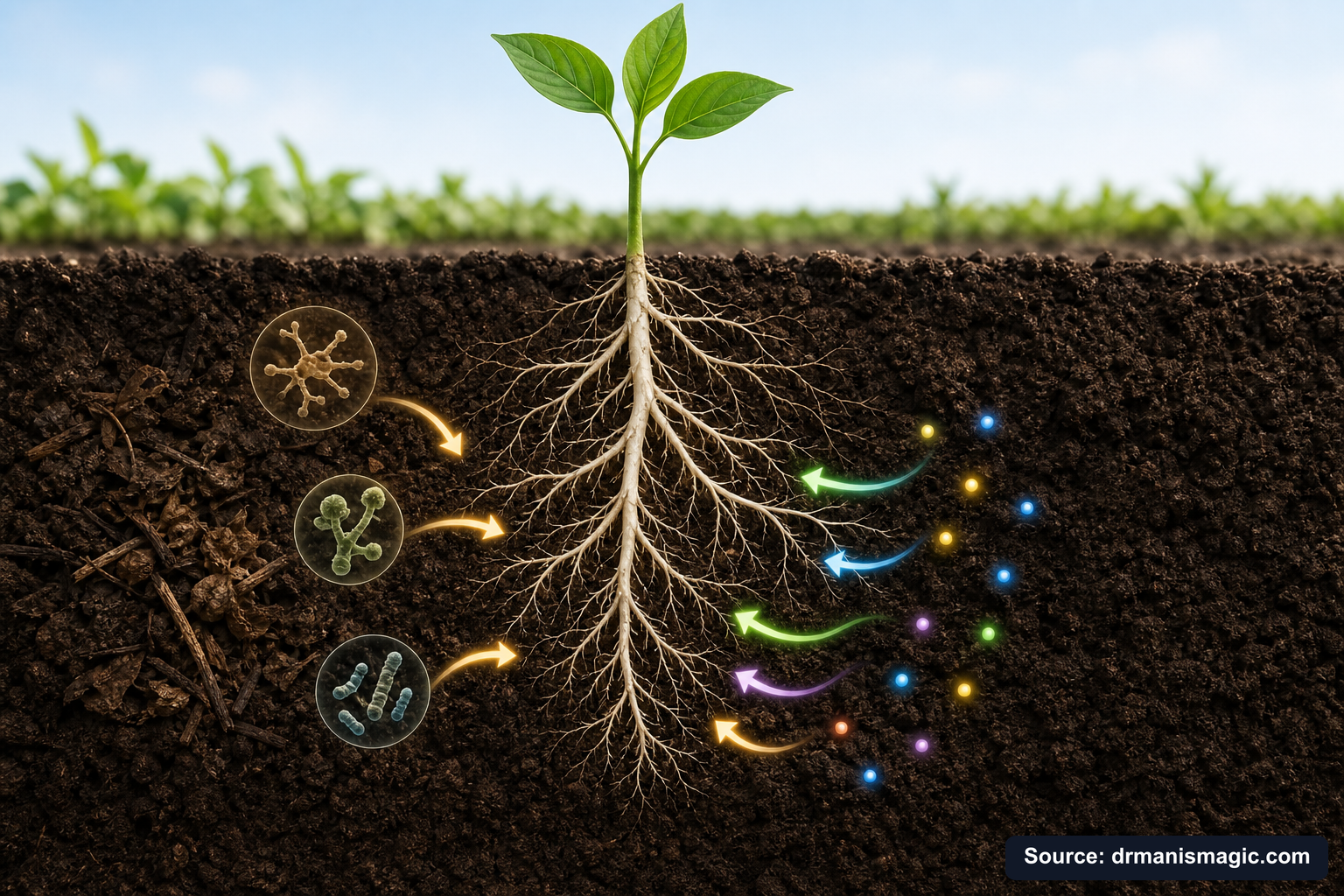
Organic fertilizer does not go straight to the plant. It goes to the microbes first. Bacteria and fungi eat the organic material and break it down into simple, easy-to-absorb nutrients. Then, when those microbes die, they release all of that nutrition directly into the root zone. It is a natural, living time-release system that keeps feeding long after you apply it.
This is the part most fertilizer companies never explain. And it is the most important part.
When you sprinkle an organic granular fertilizer like Crab, Kelp & Amino Acids onto the soil, nothing dramatic happens right away. The granules sit there. They smell earthy. And the microbes in the soil smell dinner.
The bacteria and fungi swarm in. They start breaking down the crab shell, the kelp, the amino acids. They convert the proteins and complex molecules into simple forms of nitrogen, phosphorus, and potassium that plant roots can actually drink. This process takes days to weeks. But it is steady. Consistent. Gentle.
Then — and here is the magic part — when those microbes finish their work and die, their own bodies become food. Every dead microbe is a tiny packet of nutrients that releases right into the root zone. The plant keeps feeding long after you walked away and forgot about it.
Compare that to a synthetic fertilizer. It dumps a flood of soluble nutrients all at once. The plant gets a spike. Then the nutrients either wash away with watering, get locked up by the salt accumulation in the soil, or sit there burning roots with their high electrical charge. There is no self-sustaining system. No living partnership. Just a hit and then a crash.
Nature built the slow way. And nature has been growing forests, prairies, and jungles without a single bag of blue fertilizer for millions of years. We just learned to work with that system instead of against it.
Why Do Crab Shells, Kelp, and Amino Acids Do Things Synthetic Fertilizers Simply Cannot?
Chitin from crab shells activates the plant's natural immune system and suppresses harmful soil pathogens. Kelp delivers natural hormones that trigger root growth and stress resilience. Amino acids give the plant pre-built protein building blocks it can absorb immediately without extra energy. Together, they do things no synthetic salt formula can replicate.
Let us break down each ingredient in plain language.
Crab Shell and Chitin: Nature's Immune Trigger
Crab shells are rich in a substance called chitin. Chitin is the same material found in the outer shells of insects and in the cell walls of harmful fungi. When chitin enters the soil, the plant's biology recognizes it as a signal. A signal that pests or pathogens might be nearby. So the plant activates its defenses. It thickens cell walls. It produces compounds that resist disease. It becomes harder to attack.
At the same time, the microbes in the soil that eat chitin — called chitinase-producing bacteria — happen to be some of the most effective suppressors of root rot pathogens like Pythium and Fusarium. Feeding them chitin builds an army of biological defenders right in your root zone.
Cold-Processed Kelp: Hormones That Wake Up Roots
Kelp is not just a source of trace minerals, though it delivers those too. Cold-processed kelp contains natural plant hormones called auxins and cytokinins. These are the signals that tell roots to grow, branch, and explore. They also help plants manage stress — heat, drought, transplant shock — by keeping cell activity running smoothly even under pressure.
Kelp also carries natural carbohydrates that feed soil microbes directly. So it does double duty: it feeds the biology AND sends growth signals to the plant.
Amino Acids: Pre-Built Protein for Instant Use
Normally, a plant has to take raw nitrogen and build its own amino acids to make proteins. That takes energy. A lot of it. When you supply amino acids directly, the plant can skip several steps. It absorbs the amino acids and uses them almost immediately to build enzymes, chlorophyll, and new tissue. It is like giving someone a meal instead of the raw ingredients and expecting them to cook.
Amino acid nitrogen also has an extremely low salt index. It does not spike EC in the soil. It does not burn roots or kill microbes. It just quietly, efficiently delivers nitrogen in a form the plant loves.
Volcanic Ash: Trace Minerals From the Earth's Core
Volcanic ash brings silica and a broad spectrum of trace micronutrients that most fertilizers simply skip. Silica strengthens cell walls, making plants physically tougher. Trace minerals like zinc, manganese, boron, and molybdenum play critical roles in enzyme activation, hormone production, and fruit development. The Law of the Minimum tells us that if even one nutrient is missing, the whole plant suffers — no matter how much of everything else you give it. Volcanic ash plugs those gaps.
How Do You Rebuild a Root System That Has Already Been Damaged by Salt-Based Inputs?
Stop the salt inputs immediately. Flush the soil to remove salt buildup. Reintroduce living microbes. Switch to low-salt, organic nutrition. Improve drainage with mineral-based soil. Give the plant time, and the roots will regenerate — often faster than you expect when the biology is working for you.
Here is a step-by-step recovery checklist you can start this weekend:
- Stop all synthetic fertilizer immediately. Every additional application adds more salt to an already stressed system. Give the soil a break.
- Flush the root zone with clean water. Water deeply and slowly, several times over a few days, to leach accumulated salts down and away from the root zone. Do not fertilize during this period.
- Check your soil structure. If your plant is in a bark-heavy potting mix, the medium itself may be compacted and oxygen-depleted — a perfect environment for root rot. Consider repotting into a mineral-based soil with true drainage and aeration. See our Super Soil for a permanent mineral-based option that does not break down or compact over time.
- Reintroduce living microbes. Apply a liquid microbial drench containing bacteria, fungi, and mycorrhizae directly to the root zone. Living microbes suppress remaining pathogens, begin rebuilding nutrient cycling, and start re-establishing the plant-root partnership. Our Plant Super Boost is specifically formulated for this — live and active, not dead powder.
- Begin slow-release organic nutrition. Once the soil has been flushed and biology reintroduced, start a gentle organic fertilizer program. Low salt index, microbe-friendly, complete spectrum nutrition.
- Adjust your watering. Water deeply but less frequently. Let the top inch or two of soil dry before watering again. This keeps oxygen in the root zone and discourages the wet conditions that Pythium and Phytophthora love.
- Be patient — but expect faster results than you think. With the right foundation in place, roots regenerate. We have seen struggling container citrus trees push healthy new growth within four to six weeks of switching to this system. Grass and garden plants often respond even faster.
See also: How Salt-Based Feeding Quietly Destroys Root Systems
Why Is Time the Real Cost of Getting This Wrong?
Money can be replaced. Time cannot. Every season spent feeding with salt-based inputs is a season of root decline that has to be undone. The years you spend waiting for a tree to fruit, a lawn to thicken, or a garden to flourish are years that cannot be reclaimed. Starting on the right foundation today is the only shortcut that actually works.
Dr. Mani has heard it thousands of times. People who come to us after years of struggling with the same plants. They tried this fertilizer. Then that one. They followed the advice on the bag. They watched YouTube videos at midnight. They spent real money. And the plant just never really took off.
The deepest wish we hear — more than anything else — is simply this: people want to see their tree bear fruit while they are still here to enjoy it. They want to walk out to the backyard and pick something they grew with their own hands. That is not a small thing. That is one of the most human desires there is. We were put on this earth to tend a garden. That drive never leaves us.
But if you spend year after year feeding salt to your soil, killing your microbes, shrinking your roots, and repeating the same cycle — that dream keeps moving further away. Not because you have a brown thumb. Not because you are bad at gardening. Because the products you were handed were designed to sell, not to grow.
The Three Plant Pillars — mineral soil, live microbes, and organic fertilizer — are the foundation that changes all of that. Not a complicated formula. Not 20 different products with 20 different warning labels. Three things, working together, the way nature designed them.
We tested this system on 250,000 trees in South Texas. On container citrus, tropical trees, houseplants, lawns, and gardens. It works. Consistently. And once the foundation is right, gardening stops being frustrating and starts being genuinely fun.
You can get your money back. You cannot get your seasons back. The best time to fix your soil was last year. The second best time is today.
If you want to see exactly how the Three Plant Pillars work together — and get a complete, step-by-step guide you can follow from day one — grab the free resource at our Free Plant Care Field Guide. No jargon. No upsell. Just the same system Dr. Mani built over 40 years of real growing, handed straight to you.
Frequently Asked Questions
If you have ever wondered why your plants look tired even after feeding them, you are not alone. These are the questions we hear most from gardeners who are doing everything right but still getting the wrong results. The answers below are grounded in over 30 years of growing more than 250,000 trees at our South Texas nursery.
What are the real downsides of using synthetic fertilizer on your plants?
Synthetic fertilizers are salt-based. That means they pull water out of your roots instead of pushing it in. Over time, they wipe out the beneficial bacteria and fungi in your soil. Once those microbes are gone, your plant loses its natural feeding system. You end up buying more and more fertilizer just to keep things alive. It is a trap. The plant gets weaker underground while looking okay on top, until one day it just stalls out completely.
Do synthetic fertilizers actually improve your soil over time?
No. They do the opposite. Repeated salt-based feeding kills off the living organisms that make soil healthy. Your soil slowly turns into a dead growing medium that depends entirely on chemical inputs to function. At Dr. Mani's Magic, we call this the addiction cycle. The fix is rebuilding your soil with Pillar One, a mineral-based foundation, and Pillar Two, live microbes, so your soil becomes self-sustaining again instead of dependent.
What are the long-term effects of synthetic fertilizers on roots?
Root hairs, the tiny tips that actually absorb water and nutrients, are the first to burn. They are fragile. Once they are gone, your plant loses its most efficient feeding system. Season after season, the root system gets smaller and weaker. We watched this happen with tree after tree at our nursery before we cracked the code. Smaller roots mean less water uptake, less nutrient absorption, and a plant that is slowly running out of time.
Are synthetic fertilizers bad for the environment and your family?
Yes, in more ways than most people realize. Salt-based fertilizers leach into groundwater and run off into streams, triggering algae blooms that suffocate aquatic life. They also release nitrous oxide, a greenhouse gas far more potent than carbon dioxide. Closer to home, think about your kids playing barefoot in the grass or your dog rolling around in the yard. Our organic fertilizer uses crab, kelp, and amino acids. No toxins. No warnings on the label. No fear.
What is the best alternative to synthetic fertilizer for long-term plant health?
Slow-release organic fertilizer feeds your soil microbes first, and those microbes feed your plant. That is the natural time-release system plants were designed to use. Our Crab, Kelp, and Amino Acids fertilizer delivers nitrogen, phosphorus, and potassium in forms your plant actually craves, along with trace elements for color and resilience. No salt burn. No plastic-coated granules leaching toxins. Just clean, steady fuel that builds roots instead of shrinking them.
What farming and gardening method avoids synthetic inputs entirely?
Organic growing avoids synthetic fertilizers, pesticides, and growth regulators completely. But at Dr. Mani's Magic, we go one step further with the Three Plant Pillars. Pillar One is mineral-based soil that never compacts or rots. Pillar Two is live microbes that protect roots and unlock nutrients naturally. Pillar Three is organic fertilizer that feeds without burning. Together, these three pillars give you a complete, natural growing system proven across 250,000 trees at our South Texas nursery.
How do you break the synthetic fertilizer cycle and rebuild your soil?
You stop adding salt and start adding life. Begin with a mineral-based soil that drains well and never breaks down into root-choking sludge. Then introduce live bacteria, fungi, and mycorrhizae with Plant Super Boost to rebuild the microbial army in your soil. Finally, switch to our organic fertilizer to feed those microbes and give your plant steady, clean nutrition. Most gardeners start seeing a real difference within 30 days. Your roots will thank you long before your eyes do.
About the Author
Dr. Mani Skaria, PhD
Dr. Mani Skaria, PhD, is a plant pathologist and the scientific founder of Dr. Mani's Magic. He spent 48 years studying how plants, soil, and living microbes work together, including his years as Professor Emeritus at Texas A&M and as a member of the USDA NAREEE Advisory Board. He invented micro-budding, a method for growing healthier, stronger trees, and has grown more than 250,000 trees on the family farm in Hargill, Texas - US Citrus Nursery. His life's work takes real lab science and turns it into simple, safe, organic plant care anyone can use at home.


