


How Soil Microbes Influence Citrus Aroma and Fruit Quality | Dr. Mani's Magic
How Soil Microbes Influence Citrus Aroma (And Why Your Orange Smells Like Nothing)
Picture this. You reach into your fruit bowl, grab an orange, and peel it. That bright, electric burst of citrus smell hits you before you even take a bite. Your eyes close for half a second. You're transported. Fresh. Alive. Summer in your hands.
Now picture a different orange. Same size. Same color. But when you peel it, almost nothing. A faint, flat whisper of what it should be. You eat it anyway. It's fine. But it's not that. You've had both kinds. You know the difference. What you probably don't know is that the difference starts underground — long before the fruit ever forms — in the invisible world beneath the soil surface, teeming with billions of microscopic workers that most growers never think about.
After growing more than 250,000 citrus trees at our South Texas nursery over 30 years, we learned something that changed everything we thought we knew about fruit quality. The aroma in that orange? It doesn't start in the fruit. It starts in the dirt. And the secret is something so small you cannot see it without a microscope. Stick with us. This is the part nobody else is telling you.

Plant Super Boost
Key Takeaways
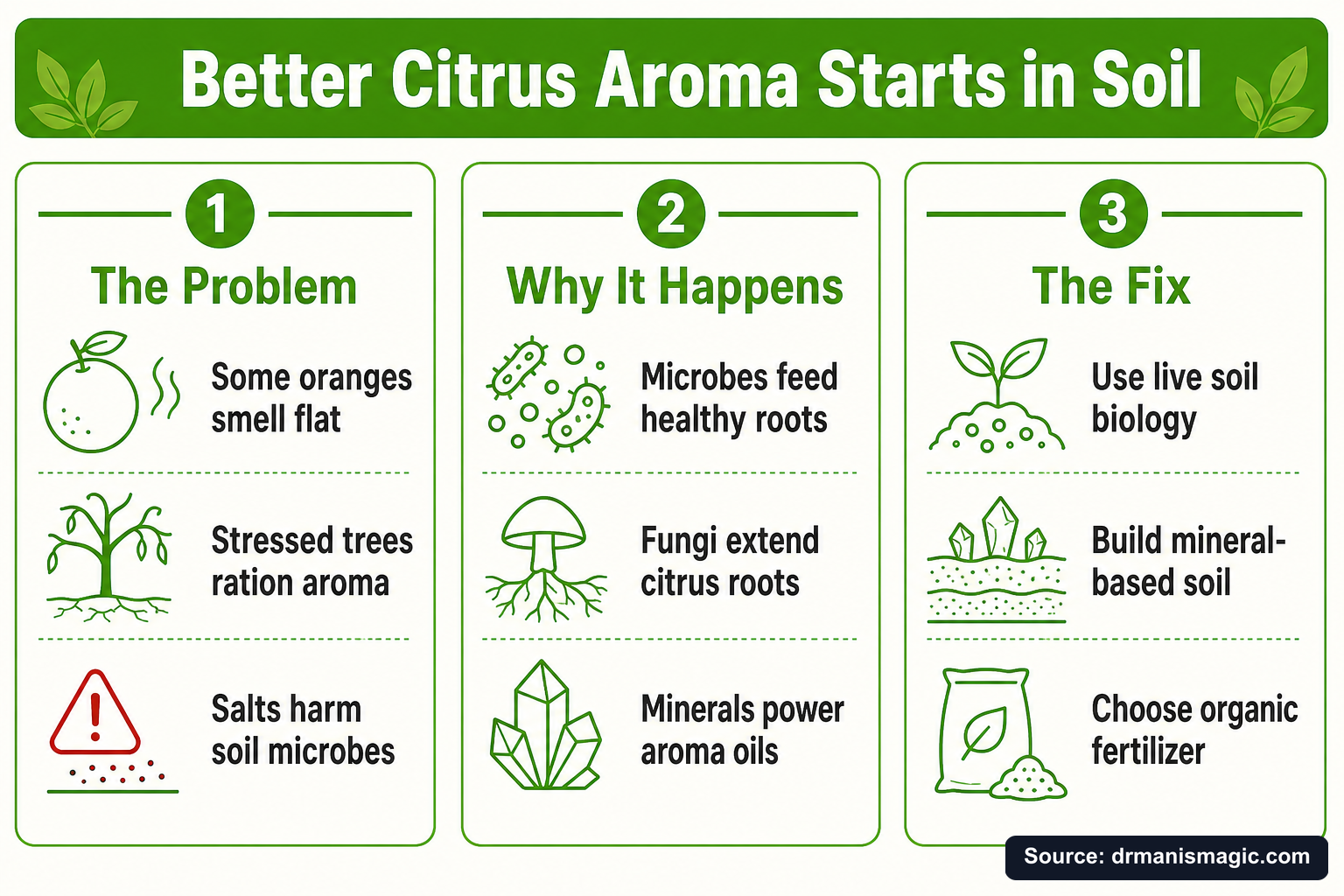
- Soil microbes do not directly manufacture citrus aroma — they shape the root-zone conditions that allow your tree to produce its own fragrant compounds naturally.
- Citrus aroma comes from plant-produced volatile compounds like limonene, valencene, linalool, and nootkatone — and a healthier root system produces more of them.
- Arbuscular mycorrhizal fungi are especially critical for citrus because citrus roots have very few root hairs and depend on fungal threads to gather phosphorus, water, and micronutrients.
- Dead, dried, or foul-smelling microbial products are largely ineffective — live, stabilized, full-spectrum biology is what actually moves the needle in the root zone.
- Salt-based synthetic fertilizers and broad-spectrum fungicides quietly destroy the very microbes your tree needs to produce its best fruit.
- Container citrus growers face extra challenges because potting mix, tap water alkalinity, and salt buildup can wipe out microbial communities fast.
- The Three Plant Pillars — mineral-based soil, live microbials, and organic fertilizer — create the foundation for both root health and fruit-quality aroma.
What Is Citrus Aroma, and Where Does It Actually Come From?
Quick Answer: Citrus aroma comes from volatile organic compounds — mainly terpenes and oxygenated terpenes — produced by the citrus tree itself inside its leaves, peel, and fruit. Soil microbes do not make these compounds directly. Instead, they build the root-zone conditions that allow the tree to produce more of them, more efficiently.
Citrus trees are basically natural perfume factories. Every time you scratch a lemon peel or squeeze an orange, you're releasing a cloud of tiny airborne molecules. Scientists call these volatile organic compounds, or VOCs. The ones that make citrus smell like citrus have names you may recognize — or may not. Here is a quick map.
| Aroma Compound | Sensory Note | Found In |
|---|---|---|
| Limonene | Bright, clean citrus peel | Most citrus, especially orange and lemon peel |
| Valencene | Sweet, deep orange | Valencia oranges, navel oranges |
| Linalool | Floral, soft, slightly sweet | Bergamot, Meyer lemon, mandarin |
| Citral | Sharp, lemony, zesty | Lemon, lime, lemon myrtle |
| Nootkatone | Grapefruit bite, woody depth | Grapefruit, pomelo |
| Octanal / Decanal | Waxy, fresh orange peel | Orange peel, grapefruit |
| Ethyl Butyrate | Fruity sweetness, candy-like | Orange juice, mandarin |
| Myrcene | Earthy, herbal base note | Lemon, lime, some mandarins |
The tree builds these compounds through a process called secondary metabolism — the same biological engine that makes plants produce everything from flower pigments to pest-fighting chemicals. It is not automatic. It is driven by resources: minerals, water, hormones, and energy. When roots are healthy and well-nourished, secondary metabolism runs at full power. When roots are stressed, it gets rationed. The tree prioritizes survival over flavor.
That is the key insight. Healthy roots equal richer aroma. And what keeps roots healthy? The invisible workforce in the soil.
What Is the Soil Food Web, and Why Does It Control Citrus Quality?
Quick Answer: The soil food web is a living community of bacteria, fungi, protozoa, and nematodes that cycle nutrients, protect roots from disease, and connect the tree to resources it cannot reach on its own. When this web is thriving, roots thrive. When it collapses — from synthetic chemicals, salt buildup, or compaction — the tree suffers, and fruit quality drops with it.
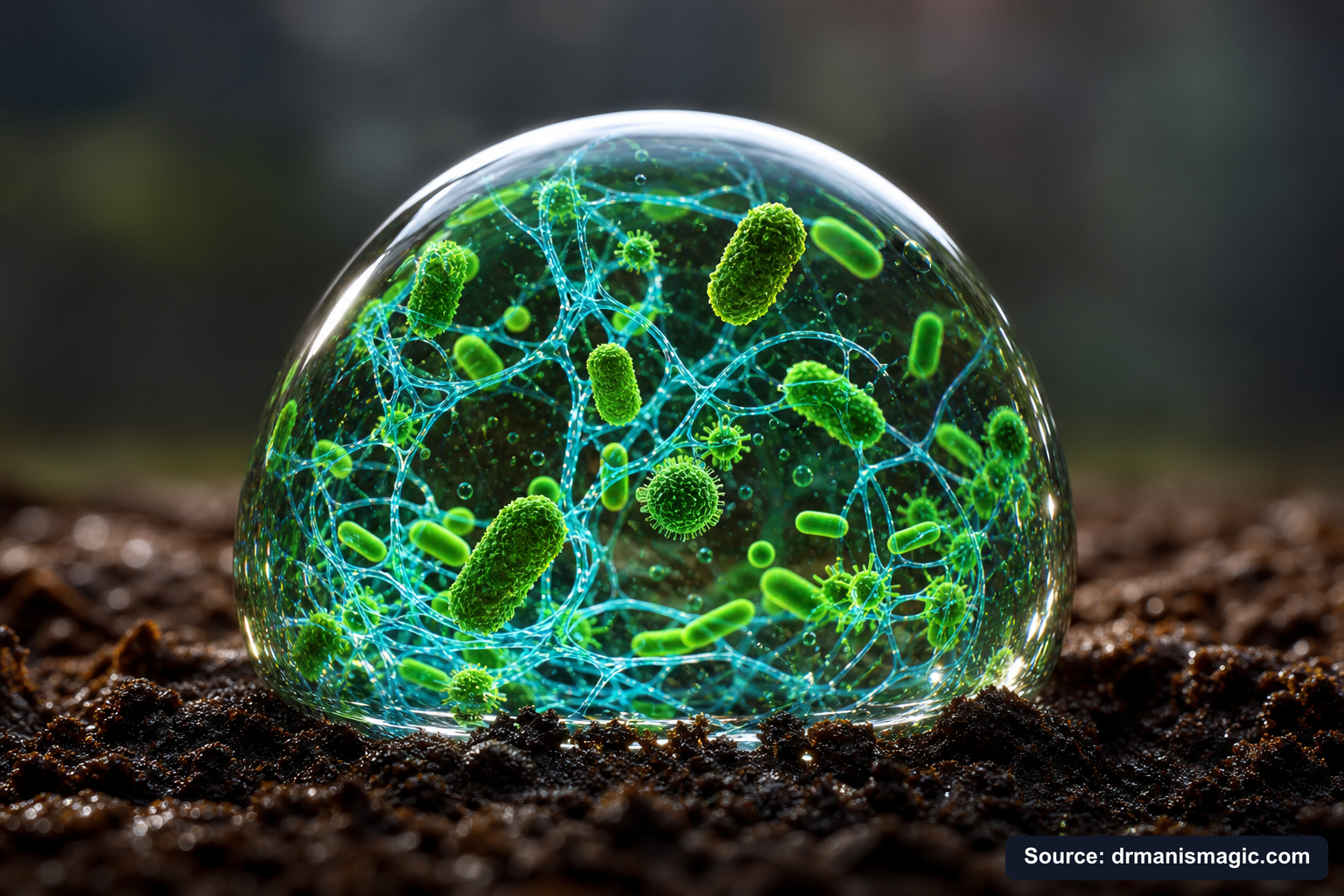
Most people think of soil as dirt. Something plants sit in. But healthy soil is actually a crowded city. Billions of organisms per teaspoon. Bacteria breaking down organic matter. Fungi threading through the soil like underground highways. Protozoa hunting bacteria and releasing nutrients as they go. Beneficial nematodes keeping harmful organisms in check.
This is the soil food web. And it is the reason plants grow without any help in a forest, a prairie, or a jungle. Nobody fertilizes a wild orange tree. Nobody sprays it with fungicide. Yet it produces fruit. The soil community does everything.
Here is how each player contributes to your citrus tree's performance — and ultimately, to the aroma in your fruit.
| Organism | What It Does | Why It Matters for Citrus Aroma |
|---|---|---|
| Beneficial Bacteria | Break down organic matter, fix nitrogen from air, solubilize phosphorus and minerals, suppress pathogens | Deliver the raw mineral building blocks the tree uses to produce terpene and volatile compounds |
| Mycorrhizal Fungi (AMF) | Extend root surface area 10-100x, transport phosphorus and water, improve stress tolerance, produce glomalin to improve soil structure | Citrus has very few root hairs — AMF is its primary nutrient highway; better nutrient flow = more volatile biosynthesis |
| Other Beneficial Fungi | Decompose tough organic material, suppress root pathogens, improve soil aggregation | Keep roots disease-free so energy goes to fruit production, not damage repair |
| Protozoa | Eat bacteria, release nitrogen and minerals in plant-available form (the "microbial loop") | Act as nutrient releasers — their grazing unlocks minerals that drive secondary metabolism |
| Beneficial Nematodes | Hunt and suppress pest nematodes, bacteria feeders cycle nutrients, fungal feeders improve fungal balance | Maintain biological balance so the root zone stays disease-suppressed and productive |
According to research from the University of California Cooperative Extension, arbuscular mycorrhizal fungi (AMF) are especially critical for citrus because citrus roots naturally have very few root hairs compared to other crops. The tree is almost entirely dependent on fungal threads to gather phosphorus, zinc, and water from the surrounding soil. UC ANR research on citrus nutrition consistently shows that phosphorus sufficiency directly influences citrus volatile compound production — which means AMF is not optional for great-smelling fruit. It is the highway the aroma ingredients travel on.
How Do Soil Microbes Influence Citrus Aroma Step by Step?
Quick Answer: Soil microbes influence citrus aroma through an indirect chain: organic matter breaks down into minerals, bacteria and fungi deliver those minerals to roots, healthier roots absorb more phosphorus, nitrogen, and micronutrients, and the tree uses those resources to run the metabolic pathways that produce limonene, valencene, linalool, and other aroma compounds. Better soil biology = better root function = richer, more complex aroma.
Here is the pathway, broken down simply.
- Organic matter enters the soil — compost, mulch, leaf litter, root exudates. This is the food source.
- Bacteria and fungi break it down — they digest organic matter into minerals and simpler compounds the tree can absorb.
- Protozoa graze on bacteria — this releases even more nitrogen and phosphorus in plant-available form. This is the "microbial loop" that most gardening books never mention.
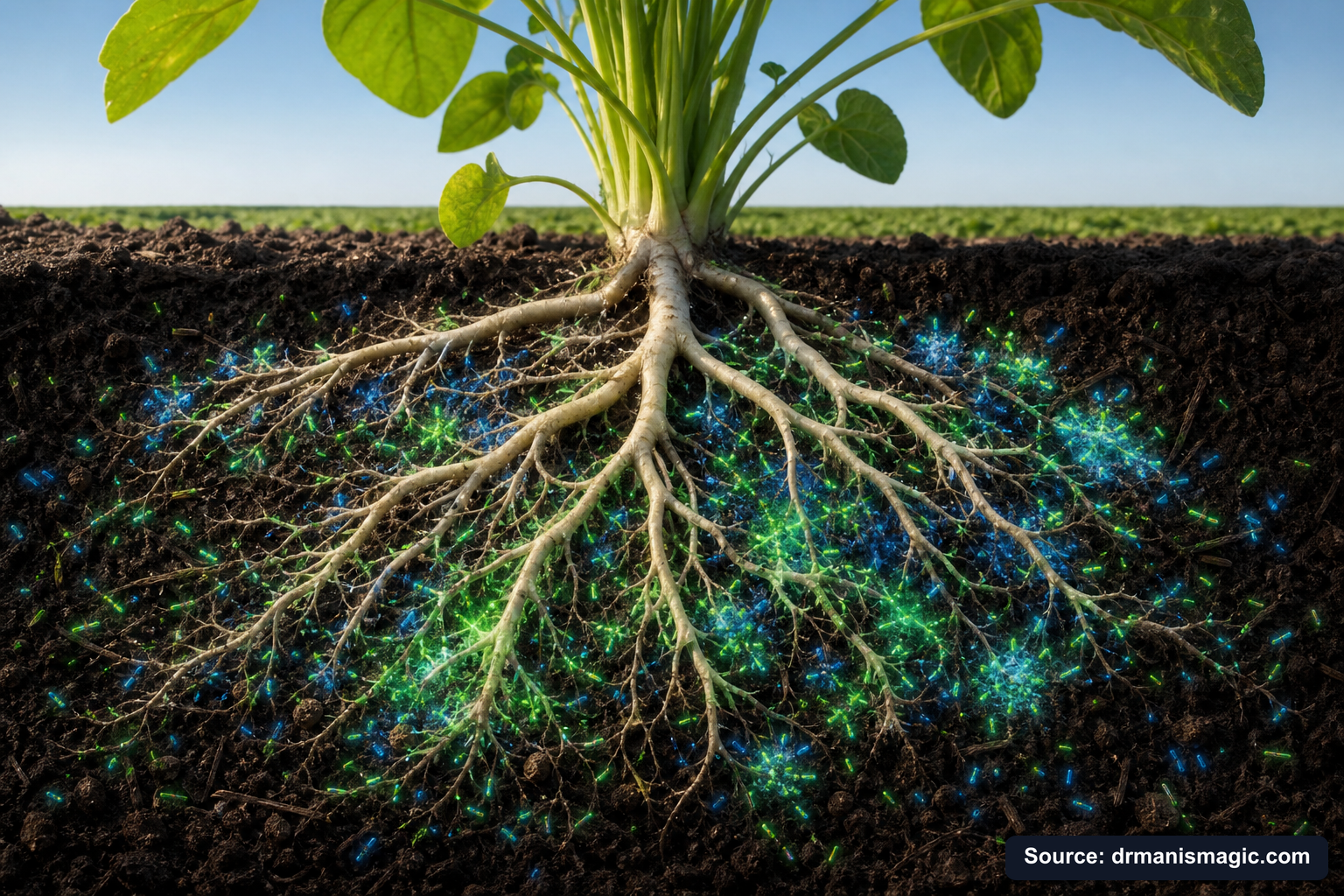
- Mycorrhizal fungi thread outward — they extend the root's reach hundreds of times beyond what the root itself can access. They deliver phosphorus, zinc, copper, and water directly to the root.
- Roots absorb a richer, more balanced mineral load — not just the three or four nutrients in a synthetic fertilizer, but the full spectrum: calcium, magnesium, manganese, iron, boron, and dozens of trace elements.
- The tree runs its secondary metabolic pathways at full power — these are the biological processes that build limonene in the peel, valencene in the juice, linalool in the flowers, and all the other compounds that make citrus smell like citrus.
- You smell and taste the difference — in the peel, in the juice, in the aroma that fills the room when you cut the fruit open.
The chain is real. But it is indirect. Microbes do not inject flavor into fruit. They build the conditions that allow the tree to express its full genetic potential. Think of it like this: a concert pianist playing a beat-up, out-of-tune piano sounds okay. The same pianist on a concert grand sounds extraordinary. The microbes are the piano. The tree is the musician.
Research from Texas A&M AgriLife Extension supports this framework, showing that phosphorus nutrition — heavily mediated by mycorrhizal fungi in citrus — directly affects the metabolic pathways responsible for secondary compounds including terpenes. See Texas A&M AgriLife Extension citrus resources for more on mineral nutrition and citrus physiology.
Why Is Mycorrhizal Fungi Especially Important for Citrus Trees?
Quick Answer: Citrus roots have very few root hairs, so they depend more heavily on arbuscular mycorrhizal fungi (AMF) than most other plants. AMF threads reach far beyond what roots can access alone, pulling in phosphorus, water, zinc, and copper. Without AMF, a citrus tree is nutritionally blind to most of its surrounding soil — and its fruit shows it.
Pull a weed out of a healthy garden bed. Look at the roots closely. See that fuzzy white coating? Those are mycorrhizal threads. Mycorrhizae means "fungus-root" in Greek. And the relationship is one of the oldest partnerships on Earth — plants and fungi have been working together for over 450 million years.
For citrus, this partnership is not a bonus. It is a necessity. A citrus root by itself can only access the soil within a fraction of an inch of its surface. Mycorrhizal threads extend that reach to several inches in every direction — sometimes much farther. That is how citrus mines phosphorus in low-phosphorus soils. That is how it survives drought. That is how it competes with pathogens. And that is how it gets the micronutrients that become aroma compounds in the fruit.
Here is what wipes AMF out in a hurry:
- High doses of synthetic phosphorus fertilizer (the fungus stops growing when phosphorus is abundant — it has no incentive)
- Broad-spectrum fungicides (they kill the good fungi along with the bad)
- Salt-based fertilizers (osmotic stress damages the fungal threads)
- Sterilized potting mix (AMF is simply not present)
- Waterlogged, compacted, or oxygen-starved soil
If you are growing citrus in a container with store-bought potting mix and synthetic fertilizer, there is a very good chance your tree has no meaningful mycorrhizal community at all. And the fruit will tell you — if it fruits at all.
See also: The Hidden Reason Synthetic Fertilizers Cause Root Rot
You Never Had a Brown Thumb.
You were handed the wrong tools. This free guide hands you the right ones.
You watered it. You fed it. It died anyway.
It was never you. It was the dirt, the salt food, and the bad advice.
This guide shows you what really went wrong, and how to fix it for good.
- Why your plants really died, and why it was never your fault
- The salt hiding in your plant food that quietly burns the roots
- The hidden killer in almost every bag of store soil
- The tiny helpers that grow a whole forest for free
- The rescue trick that brings a half dead plant back to life

Live Microbes vs. Dead Microbes: Why Most Products on the Shelf Do Not Work
Quick Answer: Most commercial microbial products are made with lab-grown, dried-powder organisms or compost-tea liquids that go anaerobic (dead and stinking) before they reach you. Live, stabilized, full-spectrum microbes — harvested from active compost and kept alive without going anaerobic — are what actually colonize roots and influence plant biology. Dead microbes do nothing.
This is the part that frustrates us most. Because the market is flooded with products that look like they should work. They have long lists of Latin species names. They promise impressive colony counts. They sell for a lot of money.
And most of them do almost nothing.
We have tested dozens of these products on our citrus trees at US Citrus Nursery. Over and over, the results were the same: powder products showed no measurable benefit. Liquid products that smelled foul — that hissing, fizzing, sewage smell that hits you when you open the bottle — were full of dying, anaerobic organisms. The microbes had already turned on each other. By the time the bottle reached the customer, the biology was mostly gone.
Here is the honest breakdown of how most microbial products are made — and why it matters.
| Product Type | How It's Made | Viability When You Use It | Smell | Our Assessment |
|---|---|---|---|---|
| Dry/powdered lab microbes | Grown in factory vats, dried into powder | Very low — most spores do not reactivate in soil | Neutral / odorless | We saw no plant benefit after repeated trials |
| Dry microbes added to liquid | Same factory source, suspended in water | Very low — same viability problem | Neutral | Looks more alive than it is; avoid |
| Compost tea, old or unrefrigerated | Brewed from compost, but not stabilized | Low — goes anaerobic within 24 hours | Strong rotting smell | Might offer some humic/fulvic acid value, but biology is largely dead |
| Lactobacillus-based products | Easy to brew, yogurt-style bacteria | High viability — but wrong organisms | Slightly sour | Outcompetes beneficial microbes; belongs in yogurt, not soil |
| Fresh active compost (on-site) | Maintained compost pile | High — but requires significant time and effort | Earthy, warm | Excellent if you have the time; most people don't |
| Plant Super Boost (stabilized, full-spectrum) | Harvested from handcrafted compost using natural stabilization method | High — live microbes visible under microscope | Earthy, not foul | The only product we trust for consistent root-zone biology |
The story behind Plant Super Boost is worth knowing. The stabilization technique was not invented by Dr. Mani. It came from a world-renowned compostologist who had advised royal families and governments on farming practices. Big chemical companies eventually blacklisted him when large citrus groves started seeing real results. Years later, through what can only be described as a providential meeting, he joined forces with Dr. Mani Skaria at US Citrus Nursery. Together they brought the power of genuinely live compost biology into a stable, shelf-ready bottle — without the anaerobic stench that ruins every other product in this category.
You can take a drop of Plant Super Boost and look at it under a microscope. The microbes are moving. That is not marketing language. That is biology.
What Kills Soil Biology and Flattens Citrus Aroma Over Time?
Quick Answer: Synthetic salt-based fertilizers, broad-spectrum fungicides, herbicides like glyphosate, compacted or waterlogged soil, and sterilized potting mix are the main killers of soil biology. Each of these disrupts the microbial community that supports root health — and when root health drops, so does the tree's ability to produce rich, complex aroma compounds.
Here is the quiet tragedy that plays out in backyards and orchards all across America. Someone buys a beautiful citrus tree. They want to do everything right. So they head to the big box store and pick up a bag of synthetic fertilizer with a famous name on it. They use it faithfully. The tree pushes out some green growth. They feel good.
But underneath the soil, something else is happening.
Salt-based fertilizers are, at their core, salts. And salt is devastating to microbial communities. It creates osmotic stress — the same way salt dehydrates a slug. Beneficial bacteria shrink and die. Mycorrhizal threads dry up and retract. The living network that was quietly feeding and protecting the roots gets dismantled, application by application, season by season.
After a year or two, the soil is biologically impoverished. The tree becomes dependent on synthetic inputs just to function. Secondary metabolism — the process that builds aroma compounds — gets rationed. The tree is surviving, not thriving. And the fruit? Flat. Thin-skinned. Barely fragrant.
You can get money back. You cannot get time back. And the number one thing people tell Dr. Mani they want is to live long enough to harvest fruit off a tree they planted themselves. Every season spent fighting biology instead of working with it is a season closer to running out of time to enjoy what you planted.
See also: Why Most Fertilizers Are Actually Salt in Disguise
Container Citrus: Why Your Potted Tree Has Almost No Soil Biology
Quick Answer: Standard potting mixes are sterilized and contain almost no beneficial microbes. Add tap water with bicarbonates, salt-based fertilizer, and poor drainage, and you have conditions that actively prevent microbial colonization. Container citrus growers must actively add live biology because it will not arrive on its own.
If you grow citrus in a pot — on a patio, a balcony, a sunroom — you are starting at a biological disadvantage. And it is not your fault. Nobody tells you this at the garden center.
Here is what is actually in most commercial potting mixes: pine bark, peat moss, and maybe some perlite. It is sterilized. It has no living organisms. It breaks down within six to twelve months, compressing into a dense, oxygen-starved sludge that suffocates roots and invites root rot. The structure collapses. Water pools. Roots drown.
Then add tap water, which in most American cities contains chlorine and chloramines that kill microbes on contact. Add bicarbonates that push soil pH up, locking out iron and manganese — two minerals tied to healthy plant metabolism. Add synthetic fertilizer for good measure, and you have built one of the most inhospitable environments possible for the biology your tree needs.
The fix is not complicated. But it requires three things working together — which is exactly what the Three Plant Pillars system was built to address.
- Mineral-based soil that drains well, does not compact, and does not steal oxygen from roots as it decomposes
- Live microbials applied regularly to maintain the biological community that potting mix cannot provide
- Organic, slow-release fertilizer that feeds the tree without burning the microbes it depends on
Miss any one of these, and the other two cannot do their job fully. That is the insight Dr. Mani spent 35 years arriving at. It is not complicated. But it is non-negotiable.
How to Build Aroma-Supporting Soil Biology: A Practical Recovery Checklist
Quick Answer: Rebuilding citrus soil biology takes consistent action over several months. The key steps are: fix drainage and pH, stop using salt-based inputs, add live microbes regularly, feed with organic fertilizer, protect feeder roots, and maintain organic matter. Results compound over time — the biology you build this month pays dividends for years.
Whether you are growing in a container on your porch or managing a small backyard orchard, here is what you can do right now to start building the biological conditions that lead to richer, more aromatic citrus.
- Fix your soil structure first. If you are in a container, consider switching to a mineral-based, well-draining soil. Organic potting mixes that have been in a pot for over a year have likely collapsed. You cannot build biology in a swamp. Roots need oxygen.
- Test and adjust your soil pH. Citrus prefers a pH between 6.0 and 7.0. Outside that range, minerals get locked up and microbes struggle. A simple soil test kit from your local extension office can tell you where you stand.
- Stop or reduce salt-based synthetic fertilizer. If you have been using conventional synthetic fertilizer, flush the soil with clean water to leach out accumulated salts before switching to an organic, slow-release alternative.
- Add live microbials monthly. Not a powder. Not a smelly liquid. A genuinely live, full-spectrum product that can actually colonize the root zone. Apply it consistently — biology takes time to establish, and soils damaged by years of synthetic inputs need repeated inoculation.
- Feed with organic fertilizer that works with microbes, not against them. Crab meal, kelp, and amino acid-based fertilizers deliver a full spectrum of nutrients in slow-release form that microbes can process and deliver to roots without osmotic salt damage.
- Add mulch or compost to the top of the soil. In the ground, a two-to-three inch layer of wood chip mulch feeds the soil food web over time, maintains moisture, and moderates temperature. Microbes need organic matter as food.
- Protect feeder roots. The tiny, hair-like feeder roots near the surface are where most nutrient uptake happens. Avoid deep cultivation or tillage near the drip line. Feeder roots are delicate. Damage them and you damage the biological interface where microbes and roots meet.
This is not a one-week fix. Soils that have been stripped of biology by synthetic inputs can take one to two full growing seasons to rebuild meaningful microbial communities. But every month you invest in this system, the returns compound. The biology you build today will still be working for your tree three years from now — if you stop poisoning it.
The Three Plant Pillars: The Foundation Behind Healthy Roots and Richer Fruit
Quick Answer: The Three Plant Pillars — mineral-based soil, live microbials, and organic fertilizer — work together as a system. Each pillar supports the others. Remove one and the system weakens. Together, they create the root-zone conditions that allow citrus trees to express full flavor and aroma potential, the same system proven across 250,000 trees at US Citrus Nursery in South Texas.
Dr. Mani Skaria did not invent the Three Plant Pillars from a textbook. He discovered them through failure — through watching trees struggle under conventional inputs, through years of testing and retesting in the subtropical heat of South Texas, through the slow accumulation of what actually works when you grow at scale.
The pillars are not complicated in concept. They mirror what nature already does in healthy ecosystems.
- Pillar One — Mineral Foundation: A stable, mineral-based soil that does not break down, does not compact, and does not steal oxygen from roots. Structure comes first. Without it, nothing else works.
- Pillar Two — Microbial Muscle: Live, full-spectrum beneficial microbes applied consistently to maintain the invisible workforce that feeds, protects, and connects your tree to its environment.
- Pillar Three — Organic Fuel: Slow-release, salt-free organic fertilizer that nourishes the tree without disrupting the microbial community — crab, kelp, and amino acids that deliver the full mineral spectrum plants evolved to use.
This system was tested on over 250,000 citrus trees. It was tested on houseplants, tropical trees, and container gardens. It was tested in the field at the US Citrus Nursery grove. The results were consistent: when all three pillars are in place, plants are healthier, more resilient, and more productive. And the fruit — the aroma, the juice, the flavor — reflects the health of the biology beneath the surface.
You can explore the Free Plant Care Field Guide for a practical, step-by-step walkthrough of how to apply the Three Plant Pillars to your own trees, gardens, and houseplants — no jargon, no guesswork.
What You Can Do Starting Today
You now know something most citrus growers never learn. The aroma in a great orange is not an accident. It is not luck. It is not even just genetics. It is the downstream result of a thriving, invisible community of bacteria, fungi, protozoa, and nematodes working in the root zone — building the nutrient pathways and biological conditions that allow a tree to produce its full spectrum of volatile compounds.
You also know that most of what is sold as "soil biology" in a bag or a bottle is either dead before it arrives, going anaerobic in the bottle, or simply the wrong organisms for the job. The difference between a flat, forgettable orange and one that fills your kitchen with fragrance when you peel it is not a mystery. It is biology. And biology can be restored.
The system that works is the same one Dr. Mani developed over 35 years, tested on a quarter million trees, refined through real failure and real success: mineral soil, live microbes, organic fertilizer. The Three Plant Pillars. Not three separate products you have to research and hope are compatible. One complete system, made in South Texas, built for exactly this purpose.
If your citrus tree has been on synthetic inputs, or sitting in store-bought potting mix, or producing flat, weakly aromatic fruit — there is still time. The biology can come back. The roots can recover. The tree can produce the fruit you pictured when you planted it.
The best time to plant a tree was ten years ago. The second best time is today. And the best time to start feeding the invisible workforce that makes everything else possible? Right now.
If you are ready to start building real soil biology under your citrus tree — or any plant you care about — take a look at what we have put together at Plant Super Boost. It is the simplest way to put genuinely live, full-spectrum biology back in the root zone — and start the chain that ends with the kind of aroma you can smell from across the room.
Frequently Asked Questions
You just read about how soil microbes shape the aroma in your citrus fruit. Now you probably have questions. Good. These are the exact questions we hear from growers every week, and the answers come straight from 30 years of growing over 250,000 citrus trees in South Texas.
Do soil microbes really affect how my citrus smells and tastes?
Yes, and this is the part most growers never hear. Microbes do not make the aroma themselves. Instead, they build the root-zone conditions your tree needs to produce its own fragrant compounds. When the right bacteria and fungi are alive and working in your soil, your tree gets more phosphorus, more water, and more minerals. That means more limonene, more valencene, and that electric burst of citrus smell you remember from the best orange you ever tasted.
What does the rhizosphere have to do with fruit quality?
The rhizosphere is the thin zone of soil right around your tree's roots. It is packed with billions of microbes. Research shows that the makeup of that microbial community can directly affect sugar concentration and overall fruit quality. At Dr. Mani's Magic, we tested this on our own citrus grove and nursery trees. Trees fed with live microbes through Plant Super Boost consistently showed better root development and richer fruit than trees grown in dead, compacted soil.
Why does my store-bought orange smell like almost nothing?
Two big reasons. First, commercial growers often use salt-based synthetic fertilizers that wipe out the beneficial microbes in the soil. No microbes means weaker roots. Weaker roots means the tree cannot pull enough minerals and water to produce strong aromatic compounds. Second, the fruit is picked early and shipped far. The aroma compounds never fully develop. When you grow your own tree on the Three Plant Pillars, you control all of that.
What is the most important microbe for citrus trees?
Mycorrhizal fungi are at the top of the list for citrus. Here is why. Citrus roots have very few root hairs compared to other plants. They depend heavily on fungal threads called hyphae to reach phosphorus, water, and trace minerals they cannot grab on their own. Without mycorrhizae, your citrus tree is essentially gardening with one hand tied behind its back. Plant Super Boost contains live mycorrhizae along with beneficial bacteria to cover all the bases.
Will synthetic fertilizer hurt the microbes in my soil?
Yes. Salt-based synthetic fertilizers are one of the fastest ways to destroy your soil's microbial community. The salts pull water out of microbial cells, essentially burning them. Once those microbes are gone, your tree loses its natural defense system and its ability to unlock nutrients from the soil. That is why Pillar Three of the Three Plant Pillars calls for organic, slow-release fertilizer made from crab, kelp, and amino acids. It feeds your tree without torching the living ecosystem underneath it.
Can eating citrus fruit affect my own gut health and mood?
Research suggests citrus flavonoids can support beneficial gut bacteria, which in turn help your body produce serotonin and dopamine. One study found citrus consumption was linked to a 22 percent lower risk of depression. That is a powerful reason to grow your own clean citrus at home. When you grow fruit without synthetic chemicals, you get the full benefit of those natural compounds. Your backyard tree can literally feed your body and your mood.
I grow citrus in a container. Is it harder to keep microbes alive in a pot?
Container growing is one of the toughest environments for soil microbes. Tap water alkalinity, salt buildup from synthetic fertilizers, and most commercial potting mixes that break down into root-choking sludge all work against you. That is exactly why Dr. Mani created Super Soil. It is built on mineral-based sandy loam from South Texas that never breaks down, never compacts, and stays aerated so microbes can thrive. Pair it with Plant Super Boost and your container citrus has a fighting chance to produce real aroma and real flavor.
About the Author
Dr. Mani Skaria, PhD
Dr. Mani Skaria, PhD, is a plant pathologist and the scientific founder of Dr. Mani's Magic. He earned his doctorate at Purdue University and spent 48 years studying how plants, soil, and living microbes work together, including his years as Professor Emeritus at Texas A&M and as a member of the USDA NAREEE Advisory Board. He invented micro-budding, a method for growing healthier, stronger trees, and has grown more than 250,000 trees on the family farm in Hargill, Texas - US Citrus Nursery. His life's work takes real lab science and practical experience and turns it into simple, safe, organic plant care anyone can use at home.


