


How Soil Life Regulates Water Naturally in Your Garden | Dr. Mani's Magic
How Soil Life Regulates Water Naturally: The Living Soil Guide to Infiltration, Storage, and Drought Resilience
Picture this. It rained last night. A real soaker.
You walk outside barefoot in the morning. The grass is wet but firm under your feet. The garden beds smell like dark chocolate and fresh earth. You push a finger into the soil near your favorite tree. It goes in easy. Soft. The ground drank every drop of that rain, held it, and is slowly releasing it to the roots. No puddles. No runoff. No mud river flowing down your driveway. The soil just... handled it. Like it knew exactly what to do.
Now picture the other yard. Same rain. Same neighborhood. But that soil is hard, pale, and cracked. The water pooled on top, ran off into the street, and took topsoil with it. By afternoon, it's dry and cracked again. The plants are stressed. The owner is confused, spending money on irrigation, wondering why nothing thrives. Here is the truth nobody told that person: the difference between those two yards has almost nothing to do with the amount of rain, the type of plants, or even the fertilizer. The difference is life. Invisible, microscopic, utterly essential life living inside the soil itself. And once you understand how that life regulates water, you will never look at a handful of dirt the same way again.

Plant Super Boost
Key Takeaways
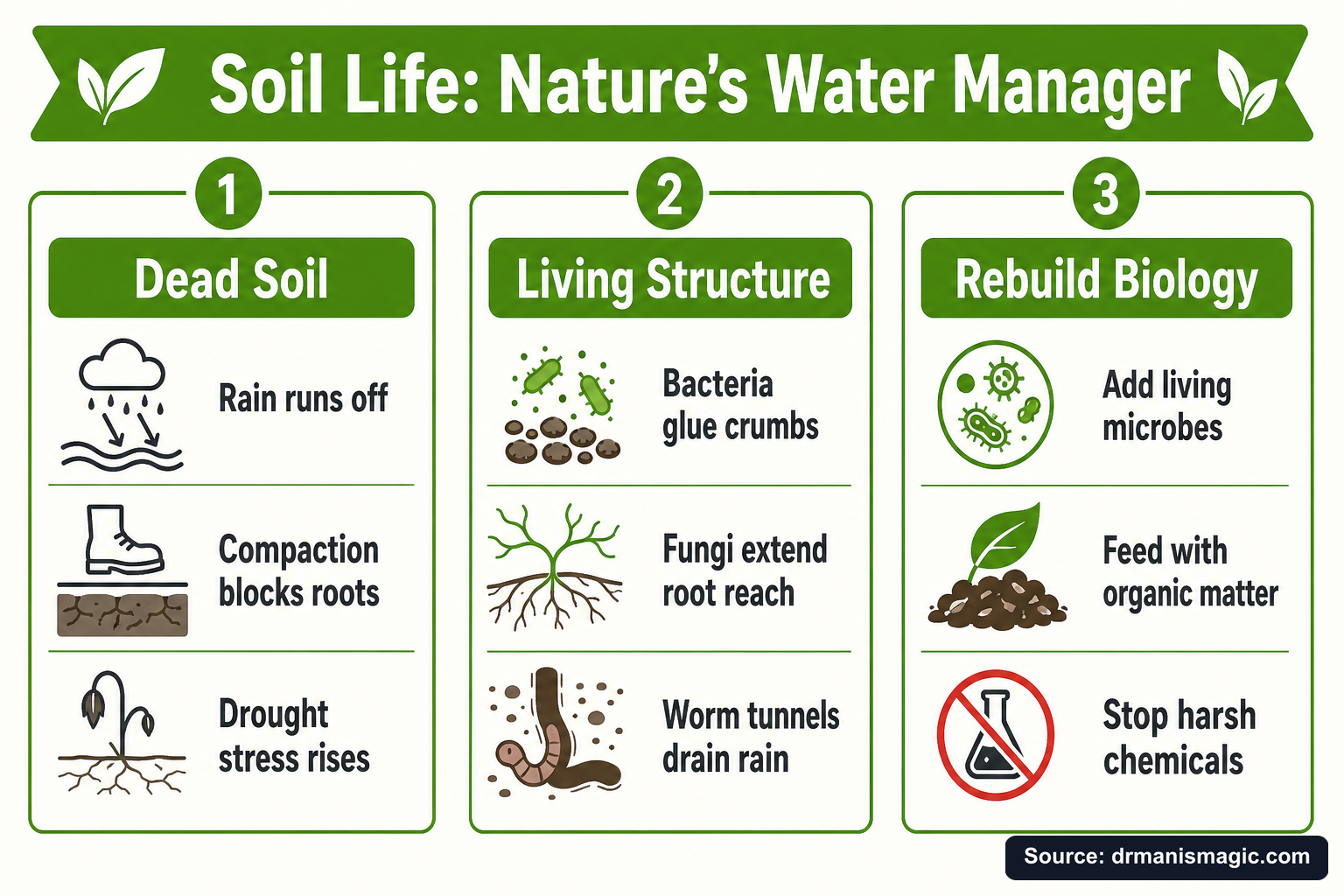
- Healthy soil is a living system, and the organisms inside it physically build the pores, channels, and structure that control how water moves through the ground.
- Beneficial bacteria produce sticky substances that glue soil particles into clumps called aggregates, which create the pore spaces water needs to enter, drain, and be held for plant roots.
- Mycorrhizal fungi extend roots far beyond what the plant could grow alone, stitching the soil together with thin threads that also hold moisture near the root zone.
- Earthworms, insects, and other larger organisms drill channels that act like tiny drainage pipes, letting rain soak in fast instead of running off.
- Synthetic fertilizers, fungicides, herbicides, and sterilized potting mixes destroy soil biology, which collapses water regulation and leads to drought stress, root rot, and compaction.
- Damaged soil can be rebuilt by adding live, full-spectrum microbes, organic matter, and stopping the inputs that kill biology.
- The Three Plant Pillars, developed and proven across more than 250,000 trees at US Citrus Nursery in South Texas, give any plant the biological foundation it needs to thrive.
What Is the Soil Food Web and Why Does It Control Water?
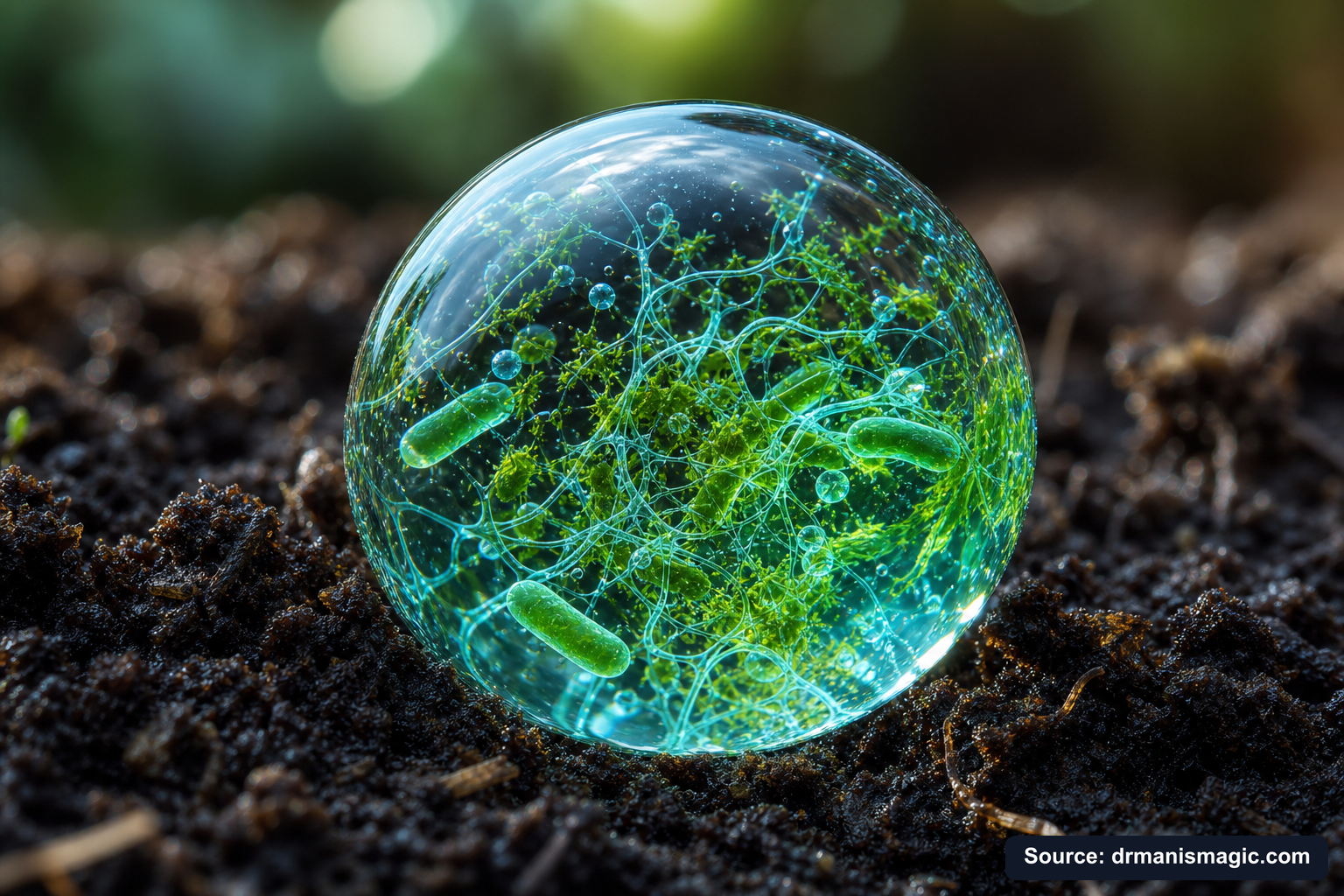
Quick Answer: The soil food web is the community of living organisms in the ground, from bacteria and fungi to worms and insects, that work together to build soil structure. That structure creates the pores and channels water needs to soak in, drain properly, and stay available to plant roots. Without it, soil acts like pavement.
Soil is not just a pile of dirt. It is a living city.
In one teaspoon of healthy garden soil, you will find anywhere from one hundred million to one billion bacteria. Thousands of different fungal species. Tiny animals called protozoa. Nematodes, which are microscopic worms. Larger creatures like mites, springtails, and beetles. And of course, earthworms threading their way through the whole system.
Every single one of these organisms plays a role. They eat, they move, they build, they die. And as they do all of that, they change the physical structure of the soil around them.
That structure is everything when it comes to water.
Soil scientists at the University of Maryland Extension describe healthy soil as a physical-biological system where organisms and structure work together. The biology builds the structure. The structure controls water. The water feeds the biology. It is one continuous loop.
Break the loop, and you break the water cycle in your soil.
Here is how each part of that community does its job.
How Do Beneficial Bacteria Regulate Water in the Soil?
Quick Answer: Beneficial bacteria regulate water by producing sticky substances that glue mineral particles together into aggregates, creating the pore spaces soil needs to absorb rain, drain excess water, and hold moisture for plant roots. More aggregates mean better infiltration, better drainage, and better drought resistance.
Bacteria are the glue factory of the soil.
When beneficial bacteria eat organic matter, they produce something called extracellular polysaccharides. That is a big term. Here is the simple version: they make a sticky biological glue.
That glue coats tiny mineral particles, sand grains, silt, and clay, and sticks them together into little clumps called soil aggregates. Think of it like the bacteria building thousands of tiny pebbles out of dust. Those pebbles do not pack tightly against each other. They leave space between them.
Those spaces are the pores.
Large pores between aggregates let water rush in quickly during a rainstorm. Smaller pores inside the aggregates hold that water slowly, like a sponge, releasing it gradually to plant roots.
Without bacteria, those aggregates fall apart. The particles settle flat against each other. The pores disappear. Water cannot enter, so it runs off. What little does enter cannot drain, so roots drown. And between rains, there is nothing holding moisture for the plant.
That is compaction. That is drought stress. That is root rot. And it all starts with losing the bacteria.
The University of Minnesota Extension confirms that soil aggregation driven by microbial activity is one of the primary factors controlling water infiltration and water-holding capacity in managed soils.
After growing more than 250,000 trees at the US Citrus Nursery in South Texas, our team saw this play out over and over. Trees in biologically active soil handled drought and heavy rain with almost no intervention. Trees in sterilized or chemically damaged soil struggled through both. Same weather. Same watering schedule. Completely different results.
What Do Mycorrhizal Fungi Actually Do for Water in the Soil?
Quick Answer: Mycorrhizal fungi grow threadlike structures called hyphae that extend far beyond the root zone, pulling in water and nutrients the plant could never reach alone. They also stitch soil particles together, improving structure and drought resilience. They are essentially a second root system made of living threads.
Have you ever pulled a weed out of the ground and noticed white fuzzy threads clinging to the roots?
That white fuzz is mycorrhizal fungi. And those threads are doing something extraordinary.
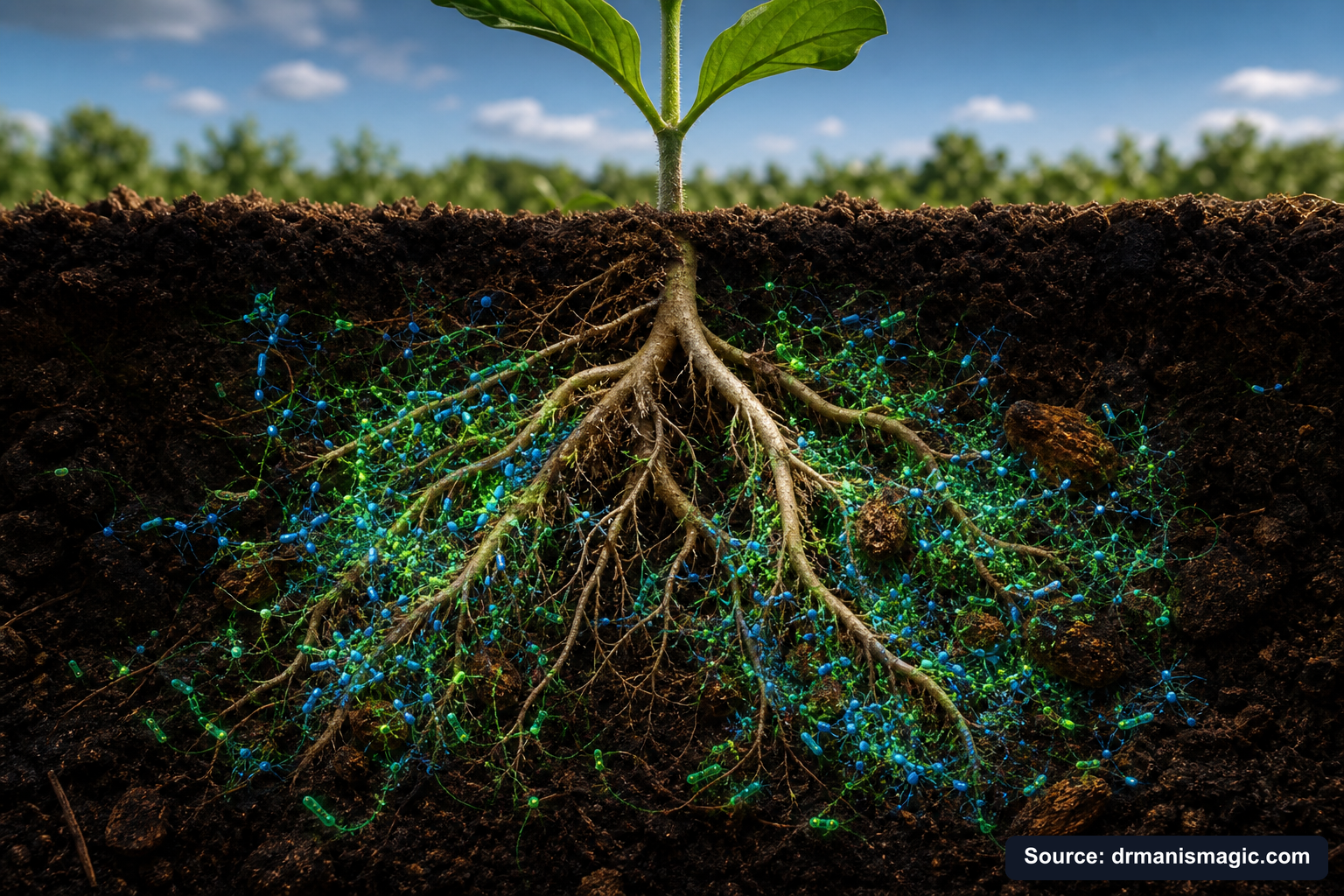
A plant's roots can only reach so far. But fungi grow threads called hyphae that are far thinner than a root hair. They thread through soil pores that roots cannot enter. They spread outward in every direction, sometimes extending ten times farther than the roots themselves.
Those threads pull in water. They pull in phosphorus, zinc, and other minerals locked up in soil particles. They bring all of it back to the root and trade it for sugar that the plant produces through photosynthesis.
It is a direct trade. Water and minerals for sugar. Every day. Silently.
And those same fungal threads, hyphae, physically wrap around soil particles and stitch them together. They act like a net holding the soil structure in place. This makes the soil more resistant to erosion. It keeps aggregates stable even when rain hits hard.
Mycorrhizae also produce a sticky protein called glomalin. Glomalin coats soil particles the way bacteria's polysaccharides do, adding another layer of aggregate glue. Together, bacteria and fungi build a soil structure that holds water like a living sponge.
This is why weeds grow so aggressively. They have full access to the fungal network. Your potted plant, stuck in sterilized potting mix, has none of it. That is not fair. And it is fixable.
What Roles Do Protozoa, Nematodes, and Larger Organisms Play in Soil Water?
Quick Answer: Protozoa and nematodes graze on bacteria, releasing nutrients in the thin water films around soil particles where plant roots can absorb them. Earthworms and insects drill channels through soil, creating drainage pathways that let water enter fast and move freely without flooding the root zone.
Bacteria and fungi get a lot of credit. But the rest of the team matters too.
Protozoa are single-celled animals that eat bacteria. When they eat bacteria, they release the nutrients locked inside those bacterial cells as plant-available minerals, right there in the thin film of water clinging to soil particles near the root. This is called the microbial loop. It is how nutrients get from organic matter to plant roots in a form the plant can actually use.
Nematodes are microscopic worms. Some are plant parasites, the bad kind. But many are beneficial. They eat bacteria and fungi, releasing the same kind of nutrient flush that protozoa do. They also eat harmful nematodes, helping protect roots.
Then come the bigger players.
Earthworms are the engineers of the soil world. As they move, they eat organic matter, pass it through their bodies, and leave behind cast material that is incredibly rich in aggregated, biologically active soil. Their tunnels, called burrows or macropores, are large enough to let water rush in during a rainstorm at a rate many times faster than water can move through compacted soil. One study found that soils with active earthworm populations can absorb rainfall four to ten times faster than soils without them.
Beetles, ants, and other insects do the same thing on a smaller scale. Their tunnels and chambers create a network of pathways. Rain enters those pathways, moves quickly through the soil profile, and either drains away or gets held in micropores where roots can reach it later.
Every organism has a job. Together, they build the infrastructure that makes water behave the way you want it to.
| Organism | Primary Water-Related Function | How It Helps Your Plants |
|---|---|---|
| Beneficial bacteria | Produce aggregate-forming glues (polysaccharides) | Creates pore structure for infiltration and water retention |
| Mycorrhizal fungi | Extend root reach via hyphae; produce glomalin | Access distant water; stitch soil into stable structure |
| Protozoa | Graze bacteria; release nutrients in water films | Feed roots in the moisture layer around particles |
| Beneficial nematodes | Graze bacteria and fungi; suppress plant-parasitic nematodes | Cycle nutrients; protect roots in moist soil zones |
| Earthworms | Drill macropores; produce aggregated castings | Rapid infiltration; drainage channels; rich aggregate deposits |
| Arthropods (beetles, ants, mites) | Shred organic matter; build tunnels | Speed decomposition; add infiltration pathways |
| Plant roots | Pump carbon into soil as exudates; create root channels | Feed the whole microbial community; leave pores when roots die |
What Kills Soil Biology and Wrecks Water Regulation?
Quick Answer: Salt-based synthetic fertilizers, herbicides, fungicides, pesticides, fumigation, solarization, and sterilized potting mixes all kill or strip away the soil biology responsible for water regulation. Without that biology, soil loses its aggregate structure, pores collapse, and water either runs off or drowns roots instead of feeding them.
Here is something nobody in a big box store will ever tell you.
Most of the inputs sold to gardeners, the synthetic fertilizers, the broad-spectrum fungicides, the herbicides, the pre-packaged sterilized potting mixes, are doing something to your soil that the label never mentions. They are killing the biology that regulates water.
Salt-based fertilizers are the biggest offender. When you pour a high-salt fertilizer into your soil, the salt pulls water out of microbial cells the same way it pulls water out of a slug. The bacteria and fungi die. The aggregate structure they built starts to fall apart. The pores collapse. Now your soil is more compact, less able to absorb rain, and more prone to both drought and waterlogging.
And here is the cruel irony. The plant looks green for a few weeks because the salt forced a quick nutrient response. Then the biology crashes. Then the roots struggle. Then you buy more fertilizer to fix the problem the first fertilizer created.
Synthetic fungicides are another quiet killer. They do not just kill the pathogenic fungi you are targeting. They hit mycorrhizal fungi too. Suddenly the plant loses its extended root network. Water uptake drops. Drought stress appears even when you water regularly. You water more. That overwatering, combined with collapsed pore structure, leads straight to root rot.
Herbicides like glyphosate disrupt microbial communities in the soil. The research on this continues to grow. The practical result is the same: less biology, less aggregate structure, worse water regulation.
And sterilized potting mix? That is a blank slate with zero biology. The water holds, then holds, then holds until roots drown because there is no living structure to move it where it needs to go.
See also: The Hidden Reason Synthetic Fertilizers Cause Root Rot
See also: How Salt-Based Feeding Quietly Destroys Root Systems
You Never Had a Brown Thumb.
You were handed the wrong tools. This free guide hands you the right ones.
You watered it. You fed it. It died anyway.
It was never you. It was the dirt, the salt food, and the bad advice.
This guide shows you what really went wrong, and how to fix it for good.
- Why your plants really died, and why it was never your fault
- The salt hiding in your plant food that quietly burns the roots
- The hidden killer in almost every bag of store soil
- The tiny helpers that grow a whole forest for free
- The rescue trick that brings a half dead plant back to life

Live Microbes vs. Dead Microbe Products: What Is the Real Difference?
Quick Answer: Live microbes actively colonize roots, produce aggregate-building compounds, extend hyphae, and suppress pathogens. Dead or dried microbes, even if the label looks impressive, cannot do any of that. A product that smells foul has likely gone anaerobic, meaning the microbes are dying or dead. Visible, active biology is what actually moves the needle in your soil.
Not all microbial products are the same. Not even close.
Walk into any garden center and you will see shelves of products claiming to add beneficial microbes to your soil. Powders, capsules, liquids, granules. Big claims. Long ingredient lists.
Most of them do not work. Here is why.
The majority of commercial microbial products are made in large industrial facilities. The microbes are grown in vats, then dried into a powder. The hope is that the dormant spores will reactivate when water is added. But after years of testing dozens of these products on our own trees, we found that they simply do not perform. The reactivation rates are too low. The spectrum of organisms is too narrow. The plants do not respond.
The second type is liquid products made from compost tea or earthworm casting extracts. These can be excellent when fresh. But by the time they are bottled, shipped, and sitting on a shelf, they have often gone anaerobic. The microbes start dying. The liquid ferments. You can tell because it smells terrible. Sometimes the cap fizzes when you open it. That smell is not a sign of potency. It is the smell of biology dying.
The third type is lactobacillus-based products, the same bacteria in yogurt. They are hardy and easy to keep alive. But they crowd out the beneficial microbes you actually need. They belong in your gut, not your garden.
What actually works is a full-spectrum living microbial product harvested from genuine compost, stabilized through a natural process that keeps the organisms alive without them going anaerobic. That means it smells like earth, not sewage. It means you could put a drop under a microscope and see the microbes moving. It means the product delivers what it promises.
That is what Dr. Mani discovered through a remarkable partnership with a world-renowned compost expert. A man who had advised royal families and governments on farming practices before being blacklisted by large chemical companies when his methods started showing extraordinary results in citrus groves. Through what Dr. Mani describes as a providential meeting, that expert joined the team at US Citrus Nursery, and together they created Plant Super Boost, a stabilized, full-spectrum living microbial product that carries bacteria, fungi including mycorrhizae, protozoa, and nematodes in a form that is genuinely alive when it reaches your roots.
| Product Type | Microbial Viability | Spectrum | Odor | Real-World Result |
|---|---|---|---|---|
| Dry powder (lab-grown, dormant spores) | Very low | Narrow (1-3 species) | Minimal | Little to no observable benefit after repeated testing |
| Dry powder rehydrated into liquid | Very low | Narrow | Minimal | Same result as dry powder |
| Compost tea, fresh under 24 hours | Moderate when aerated | Broad but variable | Earthy | Good when truly fresh; requires immediate use |
| Compost tea, old over 24 hours | Low to none (anaerobic) | Declining | Strong foul odor | Microbes mostly dead; some residual organic benefit only |
| Lactobacillus-based liquid | High (stays alive easily) | Very narrow (1 type) | Sour | Crowds out beneficial microbes; not recommended for soil |
| Plant Super Boost (stabilized, full-spectrum, compost-harvested) | High (stabilized, not anaerobic) | Very broad: 2,000+ bacteria species, 400-500 fungi including mycorrhizae, plus protozoa and nematodes | Earthy, not foul | Visible microbial movement under microscope; lab-verified; observed results across 250,000+ trees |
What Happens to Water Regulation When Soil Is Sterile or Damaged?
Quick Answer: Sterile or biologically damaged soil loses its aggregate structure, pore network, and fungal threads. Water cannot infiltrate, drains too fast or not at all, and cannot be held near roots. Plants show drought stress even when watered, and root rot becomes common because standing water cannot drain through collapsed pore spaces.
Let's be honest about what most potting mix actually is.
It is sterilized. Steam-treated or chemically treated to kill everything living in it. No bacteria. No fungi. No protozoa. Zero biology. And the physical base is usually pine bark, sawdust, or wood fiber that breaks down within months, collapsing the structure that holds pores open.
So you plant your beautiful new tree in biologically dead material that is also slowly rotting and compacting. The water has nowhere to go. It pools around the roots. Root rot begins. You water again because the leaves look dry because the roots cannot take up water even though water is sitting right there. It is a trap.
The same thing happens in garden beds that have been fumigated or heavily treated with fungicide. And in lawns that have been sprayed with herbicides season after season. The biology that held the soil structure together is gone. The soil behaves like pavement, and then like a swamp, depending on the weather.
Recovering from this is possible. But it takes time and the right inputs. And it requires stopping the things that caused the damage in the first place.
How Do You Rebuild Soil Biology After It Has Been Damaged?
Quick Answer: Rebuilding damaged soil biology requires stopping the inputs that kill microbes, adding full-spectrum live microbes, feeding them with organic matter, and giving the system time to recolonize and build new aggregate structure. Most soils begin showing improvement within 30 to 90 days of consistent biological support.
The good news is that soil wants to be alive. Given the right conditions, biology comes back.
Here is a practical recovery checklist you can start today.
- Stop the killers first. Reduce or eliminate salt-based synthetic fertilizers, broad-spectrum fungicides, and herbicides. Every application sets back the biology you are trying to rebuild. You cannot fill a bucket with the drain open.
- Add genuinely live, full-spectrum microbes. Not dried powder. Not foul-smelling liquid. A stabilized, living microbial product applied to the root zone monthly. This reseeds the biological community your soil is missing. Apply as a soil drench or through a hose-end sprayer for larger areas.
- Feed the microbes with organic matter. Microbes eat organic material. Compost, mulch, and organic fertilizer give them the food they need to multiply and build aggregate structure. Without organic matter, even live microbes cannot sustain a thriving community.
- Improve the physical structure of your growing medium. In containers, switch from bark-based potting mix to a mineral-based, permanent soil that does not decompose and collapse. For in-ground beds, add compost and avoid compaction from foot traffic or heavy equipment.
- Use organic fertilizer instead of salt-based products. Organic slow-release fertilizers feed the plant and the soil biology at the same time without the salt spike that kills microbes. Ingredients like crab meal, kelp, and amino acids feed the soil food web while supplying the plant with the full spectrum of nutrients it needs.
- Be consistent and patient. Biology takes time to reestablish. Monthly microbial applications, regular organic feeding, and reduced chemical inputs for 60 to 90 days will begin showing measurable changes in water behavior, drainage, and plant response.
- Protect what you rebuild. Once biology is active again, minimize soil disturbance. Tilling breaks fungal networks. Compaction crushes aggregate structure. Mulching protects both moisture and the microbial community living near the surface.
You can explore the full Three Plant Pillars framework, the system Dr. Mani developed and tested across a quarter million trees, at our Three Plant Pillars bundle page.
The Three Plant Pillars: Why Water Problems Are Really Biology Problems
Quick Answer: The Three Plant Pillars are mineral-based permanent soil, live full-spectrum microbes, and organic slow-release fertilizer. Together they rebuild and maintain the biological infrastructure that regulates water naturally. Missing any one pillar leads to root rot, drought stress, nutrient lockup, or compaction regardless of how much you water or fertilize.
After 35 years of growing plants and testing every input imaginable, Dr. Mani Skaria, Professor Emeritus of Plant Pathology, inventor of micro-budding, and founder of the Clean Citrus Program in Texas, arrived at a framework he calls the Three Plant Pillars.
It is not complicated. In fact, the simplicity is the point.
Pillar One is mineral-based soil. Not bark. Not sawdust. Permanent, inorganic sandy loam that does not decompose, does not compact, and does not steal oxygen from roots as it breaks down. Roots can breathe. Water drains properly. The physical structure stays stable for years, not months.
Pillar Two is live microbials. The full spectrum of bacteria, fungi, mycorrhizae, protozoa, and nematodes that build aggregate structure, extend root reach, suppress pathogens, and regulate how water moves through the root zone. This is the invisible workforce. Without it, Pillars One and Three cannot deliver their full benefit.
Pillar Three is organic fertilizer. Slow-release, salt-free nutrition from sources like crab meal, kelp, and amino acids. It feeds the plant and the microbial community simultaneously. No salt spikes. No microbial massacre. No synthetic coatings leaching into the environment. Zero PFAS. Zero biosludge. Zero synthetic salts.
When all three pillars are in place, something remarkable happens. The soil starts behaving the way the soil in that first backyard behaved after the rain. It drinks. It holds. It releases. It supports.
That is not magic. It is biology doing what it has always been designed to do.
We have seen this work on citrus, mangoes, avocados, roses, lawns, houseplants, vegetable gardens, and container trees. We have seen it work for doctors, small business owners, and first-time gardeners who thought they had a brown thumb. The thumb was never the problem. The soil biology was.
If you want to go deeper on getting your soil, microbes, and nutrition dialed in together, our Free Plant Care Field Guide walks through the entire system step by step, plant type by plant type.

What Can You Do Right Now to Help Your Soil Regulate Water Better?
Quick Answer: Start by adding live, full-spectrum microbes to your soil monthly, switch to organic fertilizer, and reduce or eliminate salt-based and broad-spectrum chemical inputs. If growing in containers, consider whether your potting mix is still structurally sound or has collapsed into a root-choking sludge. Small changes to soil biology show up quickly in plant health and water behavior.
You do not need to overhaul your entire yard this weekend.
Start with one thing. The most important thing.
Get living biology back into your root zone. One monthly soil drench with a genuine, full-spectrum live microbial product will begin reseeding the invisible workforce your soil has been missing. Within weeks, you may notice water soaking in faster. Leaves looking more resilient. Plants recovering from stress more quickly.
Then stop what is killing the biology. Even reducing synthetic fertilizer applications by half while switching to an organic option gives the microbial community breathing room to rebuild.
Then look at your soil structure. If your potted plants are in bark-heavy mix that is more than a year old, that mix has likely broken down into a compacted, oxygen-stealing sludge. That is not a soil problem you can fertilize your way out of. That is a physical problem that requires a physical solution, a permanent mineral-based growing medium that stays open and aerated for years.
The number one thing people tell Dr. Mani they want is to actually see fruit on a tree they planted. Not someday. While they can still taste it. While the grandkids are still small enough to pick it together. That desire is real and it is urgent. And the path to it is not more products, more chemicals, or more complexity. It is a living, biologically active soil that does the heavy lifting for you.
Time is the one thing money cannot replace. Every season spent in biologically dead soil is a season the plant cannot give back. The biology is the shortcut. The Three Plant Pillars are the shortcut.
If you are ready to see what genuinely live soil biology can do for your plants, start with the Plant Super Boost. It is the same microbial product we use monthly across our own nursery, our grove, and every tree we have shipped to more than 10,000 growers across the United States. It smells like earth. It works like the forest floor. And it comes with a 30-day money-back guarantee, because we are confident enough in the biology to put that in writing.
Your soil is not dead. It is just waiting to be woken up.
Frequently Asked Questions
Most gardeners water their plants faithfully and still watch them struggle. The real problem is almost never the water itself. It is what is happening inside the soil before the water even reaches the roots. These questions get straight to the truth about how living soil controls water, and what you can do right now to fix it.
How does soil regulate water naturally?
Healthy soil regulates water through living biology. Beneficial bacteria produce sticky compounds that glue soil particles into clumps called aggregates. Those clumps create tiny pores and channels. Water flows in fast, drains properly, and stays available to roots. Fungi and earthworms build even more of those channels. The result is soil that drinks rain like a sponge and releases it slowly to your plants. Dead, compacted soil cannot do any of that. It just sheds water like a parking lot.
What can I add to soil to help it retain water the right way?
The best thing you can add is live microbial life. Bacteria and fungi physically build the soil structure that holds water near the root zone. At Dr. Mani's Magic, we proved this across more than 250,000 trees at US Citrus Nursery. Our Plant Super Boost delivers live bacteria, fungi, and mycorrhizae straight to your soil. Pair that with Super Soil, our mineral-based sandy loam blend, and your soil holds moisture without drowning roots. That combination beats any polymer crystal or peat product on the shelf.
How does a plant regulate water on its own?
A plant pulls water up through its roots and releases it through tiny pores in its leaves called stomata. When the soil is dry, the plant closes those pores to slow water loss. When roots are healthy and surrounded by active microbes, they absorb water far more efficiently. Mycorrhizal fungi act like an extension cord for the root system, reaching moisture the roots could never find alone. Strong biology in the soil means the plant spends less energy fighting for water and more energy growing fruit, flowers, and leaves.
What is the ability of soil to hold water called, and why does it matter?
It is called water holding capacity or field capacity. It describes how much water soil can store after excess drains away. Sandy soil drains too fast and holds almost nothing. Clay holds too much and suffocates roots. The sweet spot is mineral-based loam with active biology. That is exactly why Dr. Mani built Super Soil around silica-rich sandy loam from South Texas. It drains well, holds just enough moisture, and never breaks down or compacts the way organic potting mixes do.
What is the relationship between soil life and water movement?
Soil life and water movement are completely tied together. Bacteria build the structure that lets water in. Fungi hold moisture near the roots. Earthworms drill channels that act like tiny drainage pipes. When that biology is alive and thriving, rain soaks in fast, sits at the right depth, and feeds your plants steadily. When the biology is dead, from synthetic fertilizers or sterilized potting mix, the soil collapses. Water either pools on top or runs straight off. That is not a watering problem. That is a biology problem.
What makes soil repel water, and how do you fix it?
Soil repels water when it dries out completely and loses its biological life. Decomposing organic matter leaves behind waxy residues that coat soil particles and push water away instead of absorbing it. Most commercial potting mixes made from pine bark or peat moss do exactly this after a few months. The fix is to rebuild the biology. Add live microbes like Plant Super Boost, stop using synthetic inputs that kill microbial life, and switch to a mineral-based soil that does not break down and go hydrophobic in the first place.
Do synthetic fertilizers hurt soil water regulation?
Yes, and this is the part nobody in a big box store will tell you. Synthetic, salt-based fertilizers kill the very bacteria and fungi that build soil structure. No biology means no aggregates. No aggregates means no pores. No pores means water cannot soak in or stay put. Your soil turns hard and dry between waterings no matter how much you irrigate. Dr. Mani saw this pattern across decades of citrus research. That is why every product in the Dr. Mani's Magic line is organic and designed to feed the biology, not destroy it.
About the Author
Dr. Mani Skaria, PhD
Dr. Mani Skaria, PhD, is a plant pathologist and the scientific founder of Dr. Mani's Magic. He earned his doctorate at Purdue University and spent 48 years studying how plants, soil, and living microbes work together, including his years as Professor Emeritus at Texas A&M and as a member of the USDA NAREEE Advisory Board. He invented micro-budding, a method for growing healthier, stronger trees, and has grown more than 250,000 trees on the family farm in Hargill, Texas - US Citrus Nursery. His life's work takes real lab science and practical experience and turns it into simple, safe, organic plant care anyone can use at home.


