


How Soil Life Buffers Plants From Stress and Drought | Dr. Mani's Magic
How Soil Life Buffers Plants From Stress: The Living Shock Absorber Under Your Roots
Picture this. It hasn't rained in three weeks. The sun is hammering your backyard. You walk outside with your morning coffee and notice your favorite tree — the one you paid good money for, the one you've been dreaming about seeing loaded with fruit — its leaves are curling. Drooping. Going pale at the edges. You watered it yesterday. You fed it last month. And still, it looks like it's giving up.
Here's what nobody told you. The real fight wasn't happening above the soil. It was happening below it. Deep in the root zone, something invisible was either saving your plant or letting it die. A living army of bacteria, fungi, and microorganisms that either existed in your soil — or didn't. When that army is healthy and present, your plant shrugs off heat, drought, disease, and stress like a champion. When that army is gone? Every hard day becomes a crisis.
After growing over 250,000 trees at our South Texas nursery, we learned one thing that changed everything: the difference between a plant that survives stress and one that collapses under it almost always comes down to what's alive in the soil. This is the story of how soil life buffers plants from stress — and what you can do to get that protection working for every plant you own, starting today. Keep reading, because what you're about to learn is the reason your plants have been struggling, and nobody told you.
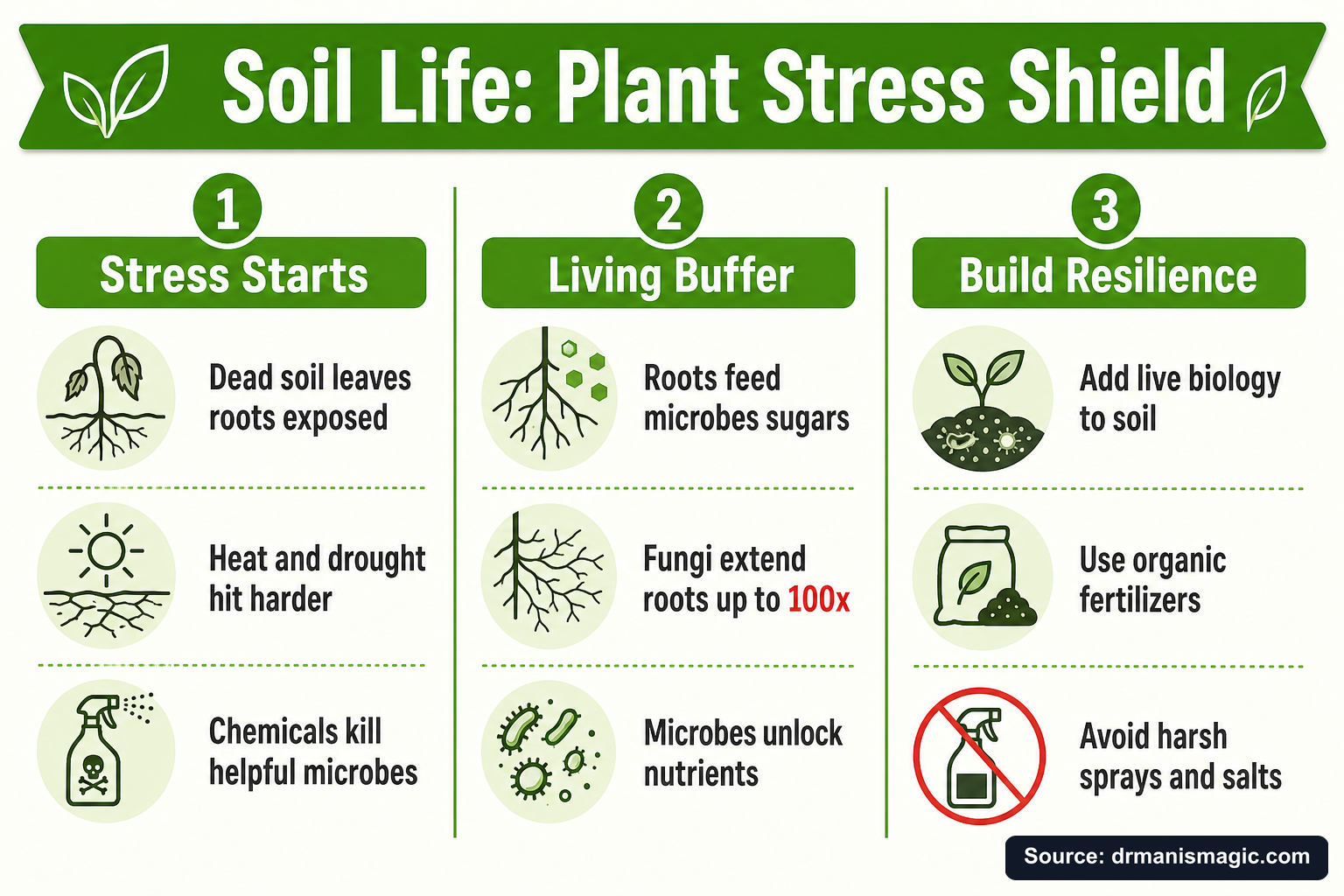
Key Takeaways
- Living soil is a biological shock absorber — bacteria, fungi, protozoa, and nematodes work together to protect plants from drought, salt, disease, and chemical damage.
- The root zone (called the rhizosphere) is where the stress-buffering magic happens — plants feed microbes sugars, and microbes return nutrients, hormones, and protection.
- Mycorrhizal fungi can extend a plant's root system up to 100 times, dramatically improving drought tolerance and nutrient access.
- Synthetic salt-based fertilizers, herbicides, fungicides, and pesticides wipe out beneficial soil life — leaving plants defenseless against the next stressor.
- Most commercial microbial products are dried-out, lab-grown, or already dying in the bottle — only genuinely live microbes deliver real results.
- Sterile soil (potting mix, fumigated ground, heavily treated soil) needs active biology reintroduced through stabilized live microbial products.
- The Three Plant Pillars — mineral-based soil, live microbes, and organic fertilizer — work together to create a plant that is nearly bulletproof against everyday stress.
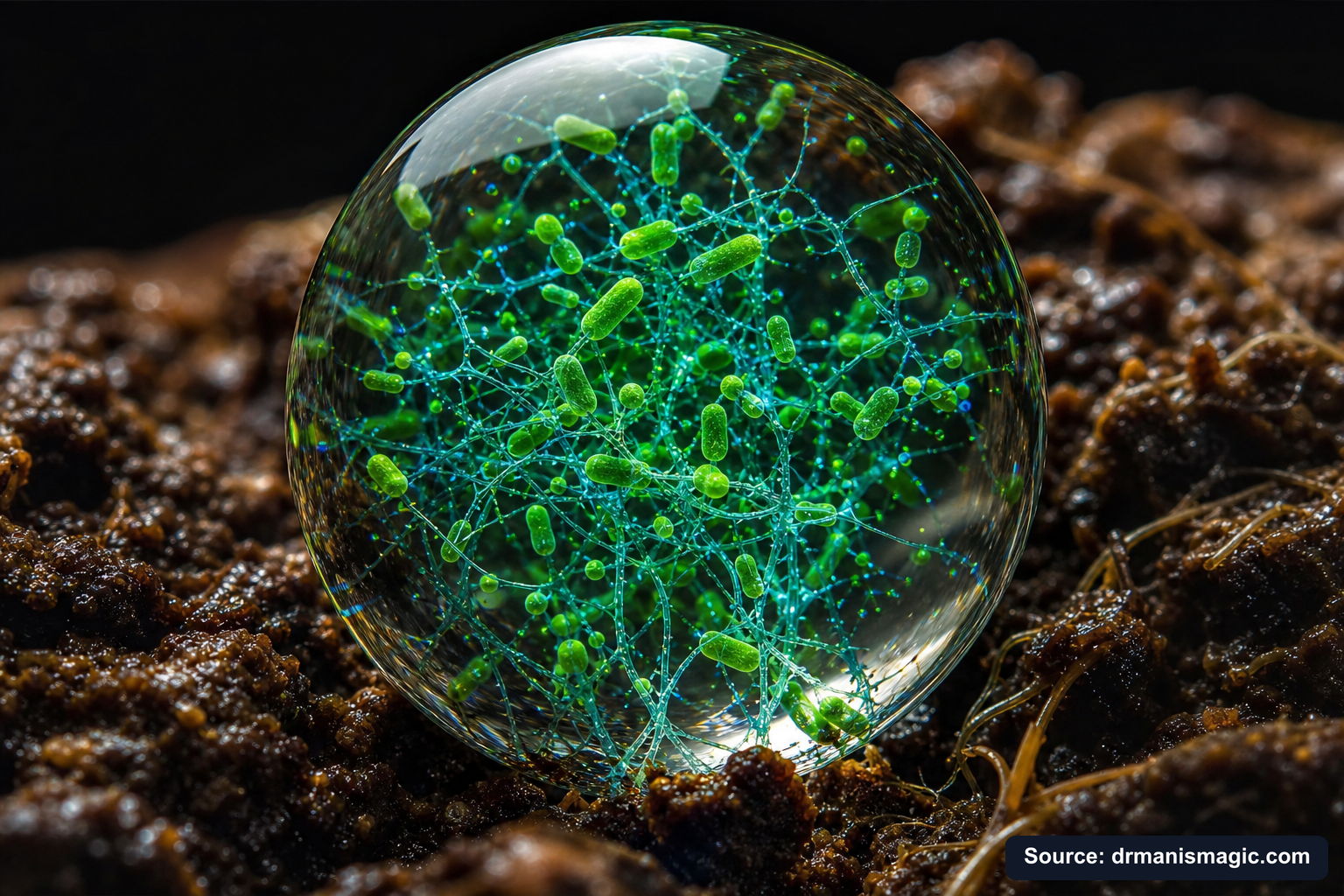
What Is the Soil Food Web and Why Does It Matter for Stressed Plants?
Quick Answer: The soil food web is the community of living organisms — bacteria, fungi, protozoa, nematodes, arthropods, and earthworms — that work together underground to feed plants, fight disease, and hold soil together. When this web is healthy, plants handle stress far better. When it's damaged or absent, every stressor hits harder and recovery takes longer.
Think of your soil as a city. A living, breathing city. Not just dirt.
In one teaspoon of healthy garden soil, there can be over a billion bacteria. Thousands of species of fungi. Protozoa. Nematodes. Mites. Springtails. Earthworms. Each one doing a specific job. Together, they form what scientists at Colorado State University Extension call the soil food web — an underground economy where every organism earns its place by contributing to the health of everything around it.
Here is the thing that blew our minds when Dr. Mani Skaria first started digging into this. Plants are not passive. They actively manage this city. Plant roots pump out sugars and carbohydrates — called exudates — specifically to feed the microbes they want nearby. It's not an accident. Plants evolved over millions of years to build this relationship. And in return, the microbes bring back gifts: unlocked nutrients, protective compounds, hormones that reduce stress, and a physical barrier against disease.
This is why plants in a living forest never need fertilizer. Nobody is out there sprinkling Miracle-Gro on the redwoods. The soil food web handles everything.
The problem is that modern gardening has spent decades doing exactly the things that destroy this web. Salt-based fertilizers. Synthetic herbicides. Broad-spectrum pesticides. Fungicides. Sterile potting mixes. All of them either kill the microbes outright or strip away the conditions they need to survive. And then we wonder why our plants look stressed.
| Organism | What It Does for Plants | Why It Matters Under Stress |
|---|---|---|
| Beneficial bacteria | Fix nitrogen from air, solubilize phosphorus, produce plant hormones, crowd out pathogens | Help plants tolerate drought and salt; reduce transplant shock |
| Mycorrhizal fungi | Extend root system up to 100x, deliver water and nutrients from far away | Critical for drought survival; improve water uptake dramatically |
| Protozoa | Eat bacteria and release nitrogen in plant-available form; regulate bacterial populations | Drive the nutrient cycling engine; keep the food web in balance |
| Beneficial nematodes | Graze on bacteria and fungi, releasing nutrients; prey on harmful nematodes and soil pests | Keep pest populations from exploding; recycle nutrients continuously |
| Earthworms | Physically break up soil, improve drainage, deposit nutrient-rich castings | Prevent compaction; create channels for water and oxygen to reach roots |
| Mites and springtails | Shred organic matter, spread fungal spores, eat harmful organisms | Speed up decomposition; distribute beneficial fungi through the root zone |
How Do Soil Microbes Actually Help Plants Survive Drought?
Quick Answer: Soil microbes help plants survive drought in three powerful ways: mycorrhizal fungi extend the root system to reach water far beyond normal range, beneficial bacteria produce compounds that help roots absorb water more efficiently, and certain bacteria trigger the plant's own stress-response genes to reduce water loss. Together they act like a drought insurance policy built into the soil.
Drought is the single most common stress most gardeners watch destroy their plants. And here's what's really happening underground when the rain stops.
Without soil life, a plant's roots can only reach the water that sits within a few millimeters of each root tip. That's a tiny zone. When that zone dries out, the plant starts shutting down. Leaves curl. Stomata close. Growth stops. The clock starts ticking.
Now add mycorrhizal fungi to that picture.
Mycorrhizae — the white fuzzy threads you might have noticed clinging to healthy roots when you've ever pulled up a weed — form a secondary root system that extends far beyond where the plant's own roots could ever reach. Research from University of Minnesota Extension confirms that mycorrhizal networks can increase a plant's effective root surface area by up to 100 times. One hundred times. That is not a rounding error. That is the difference between a plant that wilts and dies in a dry week and one that stays green and growing.
But fungi are only part of the story.
Beneficial bacteria in the rhizosphere — especially a group called plant-growth-promoting rhizobacteria (PGPR for short, but just think of them as your plant's personal bodyguards) — do something remarkable under drought stress. They produce sticky, gel-like compounds called exopolysaccharides. These glue soil particles together around the roots, creating tiny water-holding pockets. They also produce an enzyme called ACC deaminase that literally intercepts your plant's stress signal before the plant can fully activate its emergency shutdown mode. Less shutdown means more growth, even when it's dry.
Here's the part that really sticks with us at the nursery. We have watched trees side by side — same variety, same pot size, same watering schedule. The trees with healthy soil biology make it through a dry stretch looking good. The trees in sterile potting mix start wilting within days. Same drought. Different soil life. Completely different outcome.
The drought didn't change. The soil did.
Can Soil Life Reduce Salt Stress and Fertilizer Burn?
Quick Answer: Yes. Beneficial bacteria and mycorrhizal fungi help plants handle salt stress by improving how roots manage ion balance, producing protective compounds, and physically shielding roots from salt damage. But there's a cruel irony here — the salt-based fertilizers most gardeners use to "help" their plants are also the exact thing that destroys the soil life protecting them from salt stress.
Salt stress is more common than most gardeners realize. And it doesn't just come from coastal air or salty irrigation water. It comes from the bag in your garage labeled "plant food."
Most conventional fertilizers are salt-based. We're not being dramatic. The technical term is "soluble salts," and when you pour them around your plant roots, you are creating an osmotic problem. The salt concentration outside the root becomes higher than inside the root. Water moves the wrong direction. Instead of flowing into the plant, it flows out. The plant desiccates from the inside even when the soil is wet. That is fertilizer burn. That burning at the leaf tips, that yellowing, that sudden wilting — that's osmotic shock, plain and simple.
Now here is the double betrayal. Those same salts also kill the beneficial bacteria and fungi that would otherwise help your plant manage salt stress naturally. You've removed the very defense system your plant had, then added the exact thing it needed defending against.
When living soil biology is intact, beneficial bacteria produce compounds called osmolytes — protective molecules that help plant cells maintain their water balance under high-salt conditions. Mycorrhizal fungi physically filter some of the sodium ions before they enter the root. The plant doesn't eliminate the stress, but it can handle it without collapsing.
This is one of the core reasons the Three Plant Pillars at Dr. Mani's Magic are built the way they are. Organic fertilizer that doesn't carry salt. Live microbes that restore the soil's buffering capacity. Mineral-based soil that drains properly so salts don't build up. Each pillar protects against the damage the other two would cause if you used conventional products instead.
See also: How Salt-Based Feeding Quietly Destroys Root Systems
How Does Living Soil Suppress Disease and Root Rot?
Quick Answer: Healthy soil life suppresses plant disease through competition, antibiosis, and predation. Beneficial bacteria and fungi physically crowd out pathogens, produce compounds that kill harmful organisms, and eat disease-causing microbes before they can establish. Soils with rich biology have far lower rates of root rot, fungal disease, and bacterial infections — not because of chemicals, but because the good organisms outnumber and outcompete the bad.
Here is a fact that changed the way we think about gardening. Pathogenic fungi and bacteria — the ones that cause root rot, wilts, and leaf blights — are almost always present in soil. They're not visitors. They live there. What determines whether they destroy your plant is not their presence. It's whether the beneficial organisms outnumber and outcompete them.
In a living soil, the beneficial bacteria and fungi are like a standing army. They occupy every available surface on the root. They produce natural antibiotics — compounds that either kill harmful organisms or prevent them from colonizing. Certain bacteria in the genus Bacillus and Pseudomonas, for example, are well-documented pathogen fighters that occur naturally in healthy rhizospheres. Protozoa and predatory nematodes eat harmful bacteria and fungi before they can multiply into damaging populations.
Root rot — the number one killer of container plants and trees — almost always begins in sterile, oxygen-starved, microbe-depleted soil. When there's no living competition, the pathogens win by default. It's not even a fight. It's an empty city with the gates left open.
This is why we always say: root rot is a symptom, not the root cause. The root cause is a dead soil ecosystem. Fix the biology, restore the competition, and root rot becomes rare instead of inevitable.
At our South Texas nursery, we have watched this play out in tree after tree. The ones in living soil — inoculated with full-spectrum microbes, fed with organic fertilizer that doesn't burn the biology — almost never develop the root rot we constantly see in trees grown in standard sterile potting mix. The biology is doing the work. It just needs to be alive.
Do Fungicides, Herbicides, and Pesticides Harm Beneficial Soil Biology?
Quick Answer: Yes, significantly. Synthetic fungicides don't distinguish between harmful fungi and beneficial mycorrhizae. Herbicides like glyphosate directly disrupt bacterial communities in the root zone. Broad-spectrum pesticides reduce the diversity of the entire soil food web. Each application chips away at the living protection system your plant depends on, often leaving it more vulnerable to the exact problems these chemicals were meant to solve.
This is the cycle that keeps the big chemical companies in business. And once you see it, you can't unsee it.
You spray a fungicide for root rot. It kills the harmful fungus — but it also wipes out your mycorrhizal fungi. Now the plant's drought tolerance drops. The roots shrink back. Nutrient uptake suffers. The plant gets weaker. Next season, root rot returns, often worse. You buy more fungicide. The cycle repeats. The company profits. Your plant slowly loses the war.
The same story plays out with herbicides. Research shows that glyphosate — the active ingredient in the world's most popular weed killer — directly affects the bacterial communities in the rhizosphere, reducing populations of beneficial bacteria and giving pathogenic organisms a competitive advantage. You killed the weeds. You also cracked open the door for disease.
Pesticides follow the same pattern. Many soil-dwelling beneficial insects, mites, and springtails that regulate harmful pest populations are killed alongside the target pest. With the regulators gone, pest populations often rebound faster and harder than before.
We're not saying never use pest control. Sometimes you have no choice. But the smarter path is to build soil biology strong enough that your plants resist most problems without needing chemical intervention in the first place. Prevention through biology beats reaction through chemistry every time.
| Input or Practice | How It Damages Soil Biology | What to Use Instead |
|---|---|---|
| Salt-based synthetic fertilizers | High soluble salts kill beneficial bacteria and burn roots | Organic slow-release fertilizer (crab, kelp, amino acids) |
| Synthetic fungicides | Kill beneficial mycorrhizal fungi alongside pathogens | Restore biology with full-spectrum live microbials; improve drainage |
| Glyphosate / synthetic herbicides | Disrupt rhizosphere bacterial communities; reduce diversity | Mechanical weed control; targeted organic options; re-inoculate after use |
| Broad-spectrum pesticides | Reduce beneficial insect and microbe diversity; release pest populations | Organic pest management; build biological resistance through soil health |
| Sterile potting mix | Contains zero living biology; pathogens colonize by default | Mineral-based soil + live microbial inoculant from day one |
| Overwatering / compaction | Creates anaerobic (no-oxygen) zones where beneficial aerobic microbes die | Mineral-based soil with proper drainage; avoid compaction |
You Never Had a Brown Thumb.
You were handed the wrong tools. This free guide hands you the right ones.
You watered it. You fed it. It died anyway.
It was never you. It was the dirt, the salt food, and the bad advice.
This guide shows you what really went wrong, and how to fix it for good.
- Why your plants really died, and why it was never your fault
- The salt hiding in your plant food that quietly burns the roots
- The hidden killer in almost every bag of store soil
- The tiny helpers that grow a whole forest for free
- The rescue trick that brings a half dead plant back to life

What Makes the Rhizosphere the Stress-Buffering Hotspot Under Your Plant?
Quick Answer: The rhizosphere is the thin layer of soil directly surrounding plant roots — and it's the most biologically active spot on Earth. Plant roots feed microbes sugars and acids here, and microbes return nutrients, hormones, and disease protection. This is where drought tolerance, nutrient access, and pathogen suppression are either won or lost, making the rhizosphere the command center for everything that happens to your plant above ground.
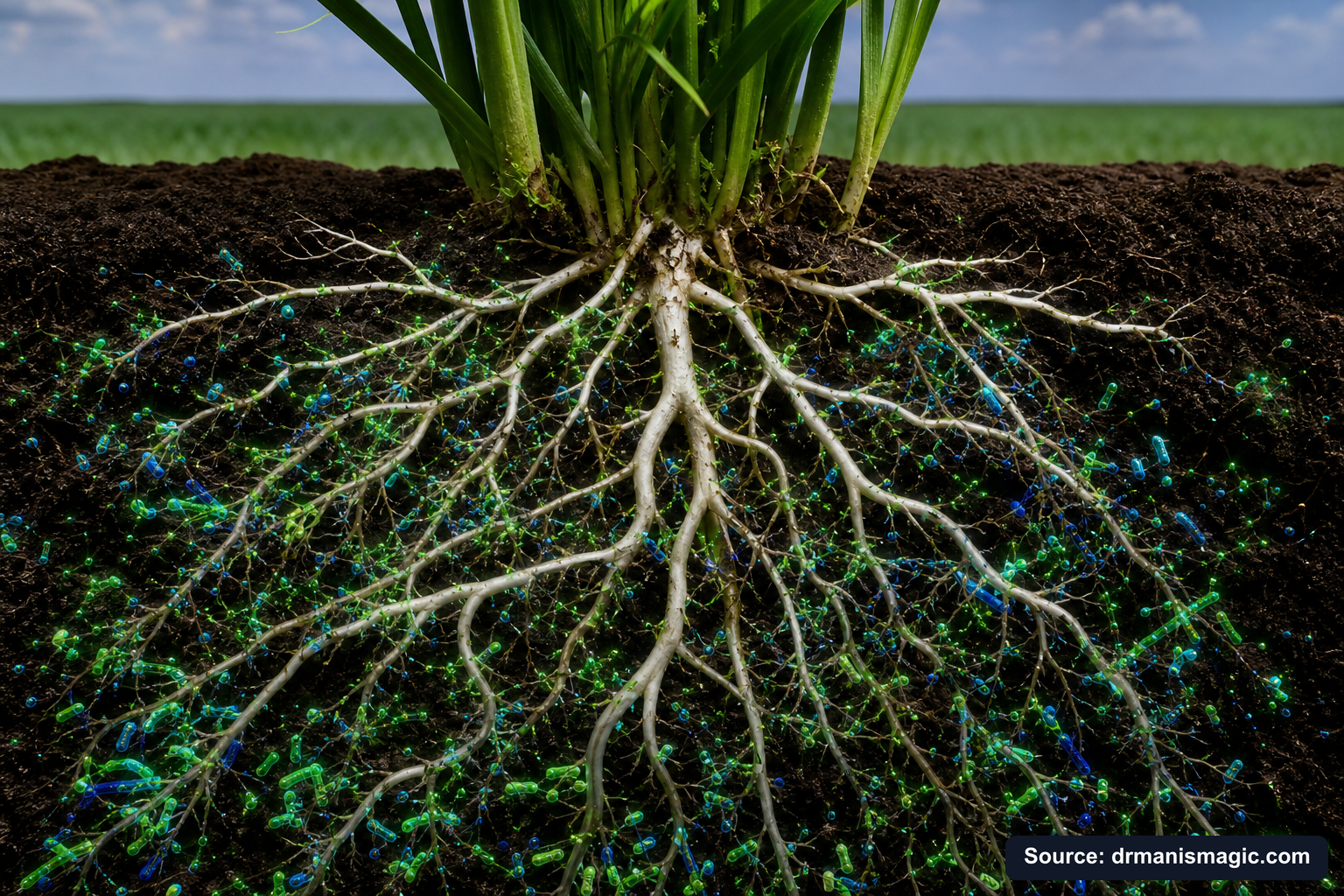
You can't see it. It's only a few millimeters wide. But the rhizosphere — the living sleeve of soil wrapped around every root tip — is where your plant's entire fate gets decided.
Think of it as a trading post. Your plant sends sugars, amino acids, and carbohydrates through the root wall into this zone. It does this on purpose, investing a significant portion of its total energy budget — sometimes 20 to 40 percent — specifically to feed the microbes it wants nearby. In return, those microbes produce compounds that change everything about how the plant experiences the world above ground.
Bacteria in the rhizosphere produce indole-3-acetic acid — a natural plant hormone that stimulates root branching. More root branches mean more surface area to absorb water and nutrients. Fungi produce glomalin — a sticky protein that glues soil particles together into clumps, creating air pockets and water channels right where roots need them most. Other bacteria produce siderophores — tiny molecular hooks that grab iron and other minerals locked in the soil and hand them directly to the root.
When the rhizosphere is full of life, your plant is essentially plugged into a living support network that anticipates its needs. When the rhizosphere is sterile — from synthetic inputs, compaction, or poor soil structure — the plant is on its own. Every drought, every salt surge, every pathogen spore lands without any biological defense to meet it.
This is why we say at Dr. Mani's Magic: feed the soil, not just the plant. The soil feeds the plant far better than you ever could from a bag.
Are Live Microbial Products Worth It? And What Actually Makes One Work?
Quick Answer: Live microbial products are absolutely worth it — but only if the microbes in the bottle are genuinely alive at the time of application. Most commercial products fail because the microbes are either dried into powder and never fully reactivate, or they've gone anaerobic (meaning they're dying in the bottle and the product smells foul). A truly live, stabilized, full-spectrum product with visible biological activity is in a completely different category.
This is the part of the story most people don't know. And it's the reason so many gardeners have tried microbial products, seen no results, and concluded that microbes are just marketing hype.
They're not hype. But most of the products on the shelf are.
Here's how the industry actually works. Most microbial products are made in large factory vats. Specific bacterial or fungal strains are grown at scale, then dried into powder. The hope is that these dried spores will "wake up" when water is added and poured into soil. We have tested dozens of these products on our trees at US Citrus Nursery. The results were consistently disappointing. The plants showed no meaningful response. The microbes either didn't reactivate or didn't establish in the rhizosphere in meaningful numbers.
The second common type is liquid compost-tea products. These start with real biology — earthworm castings, compost, organic material. That's a good start. But by the time they're bottled, shipped, and sitting on a shelf, they've often gone anaerobic. The microbes are dying. Fermentation is happening. The telltale sign? The bottle fizzes when you open it. The product smells like sewage. We have seen gardeners describe this smell in online forums as unbearable. That stench is not "earthy goodness." That is the smell of dead and dying biology.
Some products benefit you slightly from the organic compounds — humic acid, fulvic acid — that remain after the microbes die. But you're not getting what the label promised. You're getting a ghost of it.
Then there's a third category: lactobacillus-based products. Yes, the same bacteria in yogurt. Easy to grow, stays alive. But in soil, lactobacillus overtakes the beneficial species you actually need. It doesn't belong in your root zone.
The standard nobody talks about is genuinely stabilized, full-spectrum biology from a compost source — kept alive through a natural process, shelf-stable without going anaerobic, with no foul odor because the microbes aren't dying. If you put a drop of that product under a microscope, you would see movement. Living organisms, visibly active.
That is the standard Plant Super Boost was built to meet. It doesn't smell bad because it isn't rotting. It contains over 2,000 species of bacteria, 400 to 500 species of fungi including mycorrhizae, plus protozoa and nematodes — the full web, not a handful of factory strains. And the microbes are visible under a microscope, with lab analysis to back it up. Zero PFAS. Zero biosludge. Zero synthetic salts. That is not a marketing claim. That is what living biology looks like in a bottle.
| Product Type | Viability at Use | Spectrum of Organisms | Odor | What We've Seen in Practice |
|---|---|---|---|---|
| Dried / powdered lab microbes | Low — spores often don't reactivate | Narrow (a few factory strains) | Minimal | No measurable results across dozens of tests |
| Rehydrated dry microbes in liquid | Low — same reactivation problem | Narrow | Minimal | Essentially the same as dry — avoid |
| Compost tea — fresh under 24 hours | Moderate (if actively aerated) | Broad but incomplete | Earthy to slightly sour | Good when made and used immediately; impractical for most gardeners |
| Compost tea — over 24 hours old | Low — anaerobic die-off | Partial | Strong, foul odor | Biology mostly dead; some residual organic benefit only |
| Lactobacillus-based products | High — stays alive | Single dominant species | Sour (yogurt-like) | Outcompetes beneficial species; not appropriate for soil use |
| Plant Super Boost (stabilized full-spectrum) | High — verified under microscope | 2,000+ bacteria; 400-500 fungi; protozoa; nematodes | Earthy — no foul odor | Consistent results across 250,000+ trees; visible microbial activity |
How Do You Recover Soil That Has Been Damaged or Sterilized?
Quick Answer: Recovering damaged or sterile soil requires stopping what's hurting the biology, restoring physical conditions that microbes need (oxygen, moisture, organic matter), and then reintroducing living biology through a quality microbial inoculant. It takes repeated applications because environmental pressures keep working against recovery, and a single dose rarely establishes a full thriving community.
Maybe your soil has been hammered by years of synthetic fertilizers. Maybe you're starting with fresh potting mix that has zero living biology in it. Maybe you used a fungicide program last season and now your mycorrhizae are gone. Whatever happened, the path back to a living soil follows the same steps.
The recovery is not instant. We want to be honest about that. Damaged soil biology took time to degrade, and it takes time to rebuild. But the plants start responding faster than most people expect. Within weeks of restoring biology, you typically see better color, firmer leaves, and more resilient growth. Within months, the difference is dramatic.
Here is the recovery protocol we use and recommend:
- Stop the damage source. Identify what has been killing your soil biology — synthetic fertilizer, fungicides, herbicides, compaction, waterlogging — and stop it. You cannot rebuild while the wrecking ball is still swinging.
- Fix the physical conditions. Microbes need oxygen, moisture, and organic matter. If your soil is compacted, waterlogged, or bone dry, the microbes cannot survive even if you introduce them. This is where mineral-based soil matters enormously — it maintains the drainage and aeration that beneficial aerobic microbes need to thrive.
- Add organic matter. Compost, worm castings, or organic mulch provide the food source that fuels microbial populations. Microbes need something to eat. Bare, depleted soil starves them.
- Reintroduce living biology. Apply a full-spectrum live microbial product. Not dried powder. Not a foul-smelling liquid. Genuinely alive, full-spectrum biology. Apply it directly to the root zone, not just the soil surface.
- Feed with organic fertilizer — not salt-based products. Organic fertilizer feeds both the plant and the soil food web without burning the biology you just worked to restore. Slow-release nutrition from sources like crab meal, kelp, and amino acids keeps the rhizosphere community nourished and active.
- Keep applying microbes monthly. A single application is a start, not a finish. In container gardening especially, the decomposition cycle is incomplete and the vast underground fungal networks found in nature don't exist. Regular monthly applications keep the beneficial populations strong enough to outcompete the pathogens.
- Be patient — and stop disturbing the soil. Every time you till or over-cultivate, you break the fungal networks being rebuilt. Let the biology establish. Work with it, not against it.
See also: The Hidden Reason Synthetic Fertilizers Cause Root Rot
Why Do Most Container Plants Struggle Even When Watered and Fed Correctly?
Quick Answer: Most container plants struggle because standard potting mix is biologically dead from the moment you open the bag. It's also made of bark and wood fibers that break down within months, compacting around roots and cutting off oxygen. Without living biology and proper soil structure, no amount of correct watering or feeding can replicate what a living soil does automatically for plants in nature.
This is the secret the potting mix industry doesn't want you to figure out. Open any bag of standard potting mix and smell it. That earthy smell you associate with "good soil"? Part of that is decomposition already in progress. The bark, pine chips, and wood fibers in most potting mixes are actively breaking down. Within six to twelve months, that fluffy mix collapses into a dense, oxygen-blocking sludge that suffocates roots and creates the exact anaerobic (no-oxygen) conditions where root rot pathogens thrive.
And it starts sterile. No living biology at all.
So you have a plant sitting in a suffocating medium with no microbial protection, being fed salt-based fertilizer that burns what little root function remains. Every stress event — a hot day, a missed watering, a cold snap — hits with nothing to buffer it. The plant limps along. You water more. You feed more. Nothing seems to work. You start to think maybe you just don't have a green thumb.
You do have a green thumb. You just haven't had the right foundation.
Dr. Mani Skaria spent decades watching this exact pattern at US Citrus Nursery, across 250,000 trees. The solution wasn't a better fertilizer. It wasn't a better pesticide. It was a mineral-based soil that doesn't decompose and doesn't steal oxygen, combined with living microbes that replicate the natural soil ecosystem, and organic fertilizer that feeds the plant and the biology together. That combination — the Three Plant Pillars — is what makes the difference between a plant that just survives and one that thrives.
You can read more about the soil side of this equation at our Super Soil page, where we explain exactly why mineral-based soil changes the game for roots.
How Quickly Can You See Results When You Restore Soil Biology?
Quick Answer: Most gardeners notice improved leaf color and more resilient growth within two to four weeks of restoring living soil biology. Fuller recovery of the soil food web takes several months of consistent monthly applications. The speed depends on how depleted the soil was, whether organic matter is present, and whether the stressors that damaged the biology have been removed.
Here's the honest answer. You are not going to transform dead soil into a thriving ecosystem overnight. Anyone who tells you otherwise is selling you something that doesn't exist.
What you will see quickly is your plant starting to look like it has a reason to live again. The leaves firm up. The color deepens. New growth appears where things had stalled. Within a month, most gardeners who switch from dead inputs to living biology see a noticeable change — not because the microbes instantly solved every problem, but because even partial restoration of the root zone support system makes a measurable difference to how the plant experiences every day.
Over three to six months of monthly microbial applications, combined with organic feeding and proper soil structure, the change becomes dramatic. We have seen trees that were headed toward the compost pile come back with strong new growth, healthy root systems, and — yes — fruit. Real fruit. On trees that looked like they were giving up.
Time is the one thing you cannot get back. The money you spend on bad inputs doesn't sting as much as the years you spend watching a plant struggle when it should have been thriving. The best time to fix your soil biology was when you first planted. The second best time is right now.
We hear this from gardeners constantly. Their deepest wish isn't just a pretty plant. It's to see that tree loaded with fruit — to walk outside, reach up, and pick something they grew. That wish is completely achievable. But not with dead soil and salt-based fertilizer. It takes living biology, the right foundation, and the patience to let nature do what it does when you stop fighting it.
What Can You Do Right Now to Start Buffering Your Plants From Stress?
You don't need to overhaul everything at once. Start with the thing that has the most leverage: get living biology into your root zone.
If your plants are in standard potting mix, you are working against them every day that passes without adding live microbes. If you've used synthetic fertilizer recently, you've been burning the very biology that should be protecting your roots. If you've used a fungicide or herbicide in the last season, your mycorrhizal network has likely taken a serious hit.
The good news is that soil biology is resilient. Given the right conditions and the right inputs, it comes back. And when it does, your plants feel it almost immediately.
The path forward is simple. Not easy — simple. Mineral-based soil that doesn't collapse and steal oxygen. Live microbes that replicate what nature put in healthy ground. Organic fertilizer that feeds the plant and the biology together without salt damage. That is the Three Plant Pillars. That is what we built every product in the Dr. Mani's Magic line to deliver, tested on over 250,000 trees before we offered it to anyone else.
If you want to see what a properly supported plant looks like — what YOUR plant could look like — the Free Plant Care Field Guide is a great place to start. It walks you through the Three Plant Pillars in plain language, step by step, so you know exactly what to do and in what order. No guesswork. No chemistry degree required. Just the foundation that nature uses, delivered to your door.
Your plants are trying to thrive. Give the invisible army under their roots a chance to help them do it.
Frequently Asked Questions
You just learned how living soil acts like a shock absorber for your plants. Now you probably have some real questions. These are the ones we hear most often from gardeners who are tired of watching their plants struggle and want straight answers fast.
How does soil actually sustain plant life?
Healthy soil is not just dirt. It is a living system packed with bacteria, fungi, and other microbes that unlock nutrients, fight disease, and feed your roots. At Dr. Mani's Magic, we call this the second of the Three Plant Pillars. We proved this system works by growing over 250,000 trees in South Texas. When the biology is right, plants get everything they need from the ground up.
Does soil have a lifespan?
Most bagged potting mixes break down fast. They are made from pine bark and wood that rot, compact, and choke roots within a year or two. That is exactly why Dr. Mani built Super Soil differently. It uses mineral-based sandy loam from the Rio Grande Valley that does not decompose. It stays open, airy, and alive for years. You stop buying bags every season and your roots keep breathing.
How do you improve soil life?
Stop using synthetic salt-based fertilizers. They wipe out the very microbes your plants depend on. Instead, add live microbes back into your soil with a product like Plant Super Boost. It contains real, stabilized bacteria, fungi, and mycorrhizae that go to work immediately. Pair that with mineral-based soil and slow-release organic fertilizer and you have all Three Plant Pillars working together to build soil life fast.
Does soil ever run out of nutrients?
Yes, and it happens faster than most people think. Every plant you grow pulls minerals out of the ground. Rain washes more away. Synthetic fertilizers lock nutrients into forms roots cannot absorb. The fix is not more chemicals. It is getting the right microbes back into your soil. Microbes break nutrients loose and deliver them directly to roots. Our Crab, Kelp, and Amino Acids fertilizer slowly feeds both the plant and the biology doing the real work underground.
Is potting soil good forever?
Standard potting mix is not. It breaks down, compacts, and becomes a root-choking mess. But Super Soil is built on silica-rich sandy loam that does not rot or compress over time. The structure stays open so roots can breathe and grow deep. This is the First Plant Pillar in action. A permanent mineral foundation means you stop replacing soil every year and your plants stop suffering through the transition every time you do.
How long does it take for soil to bounce back?
With conventional methods, rebuilding dead soil takes years. But when you introduce live, stabilized microbes like those in Plant Super Boost, you can start seeing real biological shifts within weeks. We watched it happen across thousands of citrus trees in our South Texas nursery. The key is using genuinely live microbes, not dried-out powders that are already dead in the bottle. Living inputs create living soil, and living soil protects your plants from stress starting now.
What are the biggest benefits of healthy soil for your plants?
Healthy soil does five big things. It anchors roots so plants stand strong. It holds and filters water so plants survive dry spells. It feeds roots with slow, steady nutrition. It protects against disease and pests naturally. And it builds long-term resilience so your plants stop being fragile. The Three Plant Pillars from Dr. Mani's Magic are designed to deliver all five of these benefits together, for any plant you grow, in any yard or home.
About the Author
Ron Skaria, MD
Ron Skaria, MD, is the co-founder of Dr. Mani's Magic and the son of Dr. Mani. He trained as a medical doctor at Baylor College of Medicine, did his residency at UT Health Science Center - San Antonio and fellowship training at Texas Tech University. He now works full time on the family farm at US Citrus and US Citrus Nursery in Hargill, Texas, building Dr. Mani's Magic alongside his dad. He wrote the Brown Thumb Field Guide to put his father's 48 years of plant science into plain words any gardener can use. His belief is simple. You never had a brown thumb. You just never had the right help.


