


How Soil Knowledge Was Lost in the Chemical Age (And How to Restore It) | Dr. Mani's Magic
How Soil Knowledge Was Lost in the Chemical Age (And How to Get It Back)
Picture this. You're standing in an old-growth forest. No one planted it. No one fertilized it. No one sprayed it. And yet the trees are massive. The leaves are deep green. The fruit is heavy on the branches. The soil under your feet feels soft and alive, almost like it's breathing.
Now picture your backyard. The potted lemon tree that won't fruit. The garden bed that always gets root rot. The lawn that turns yellow every summer no matter how much you feed it. You've tried the bags from the big box store. You've tried the blue powder you mix in a watering can. You've followed the instructions on the label. And still, something is missing. That something has a name. And for the last 80 years, we've been told it doesn't matter.
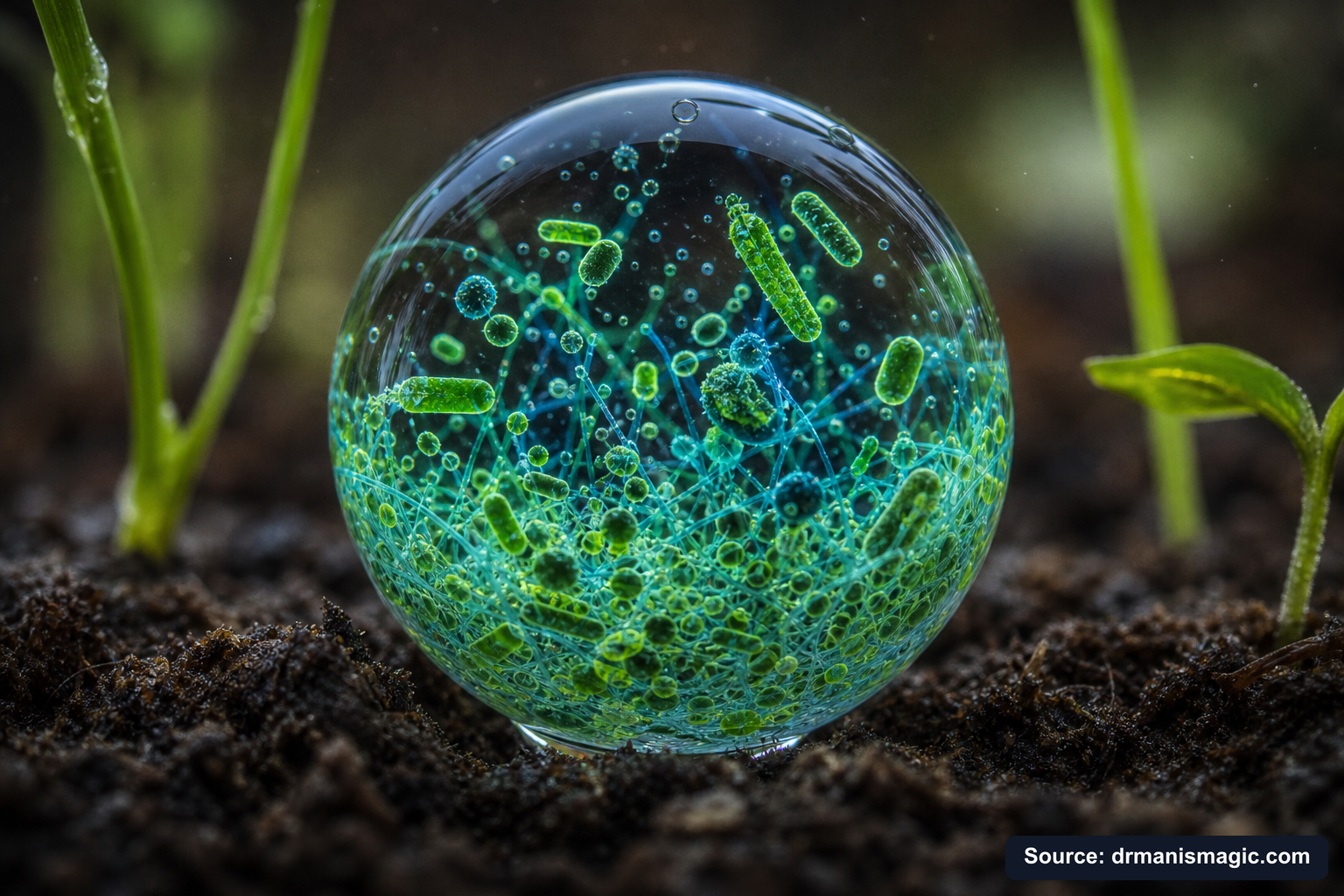
Here's what the chemical companies never told you: the forest feeds itself because its soil is alive. Billions of invisible workers live in every handful of healthy dirt. Bacteria. Fungi. Protozoa. Nematodes. They break down dead leaves, mine nutrients from deep in the earth, and deliver them straight to plant roots. It's a system that took millions of years to build. And in less than a century, we nearly broke it. This is the story of how soil knowledge was lost in the chemical age, and exactly what you can do to bring it back.

Plant Super Boost
Key Takeaways
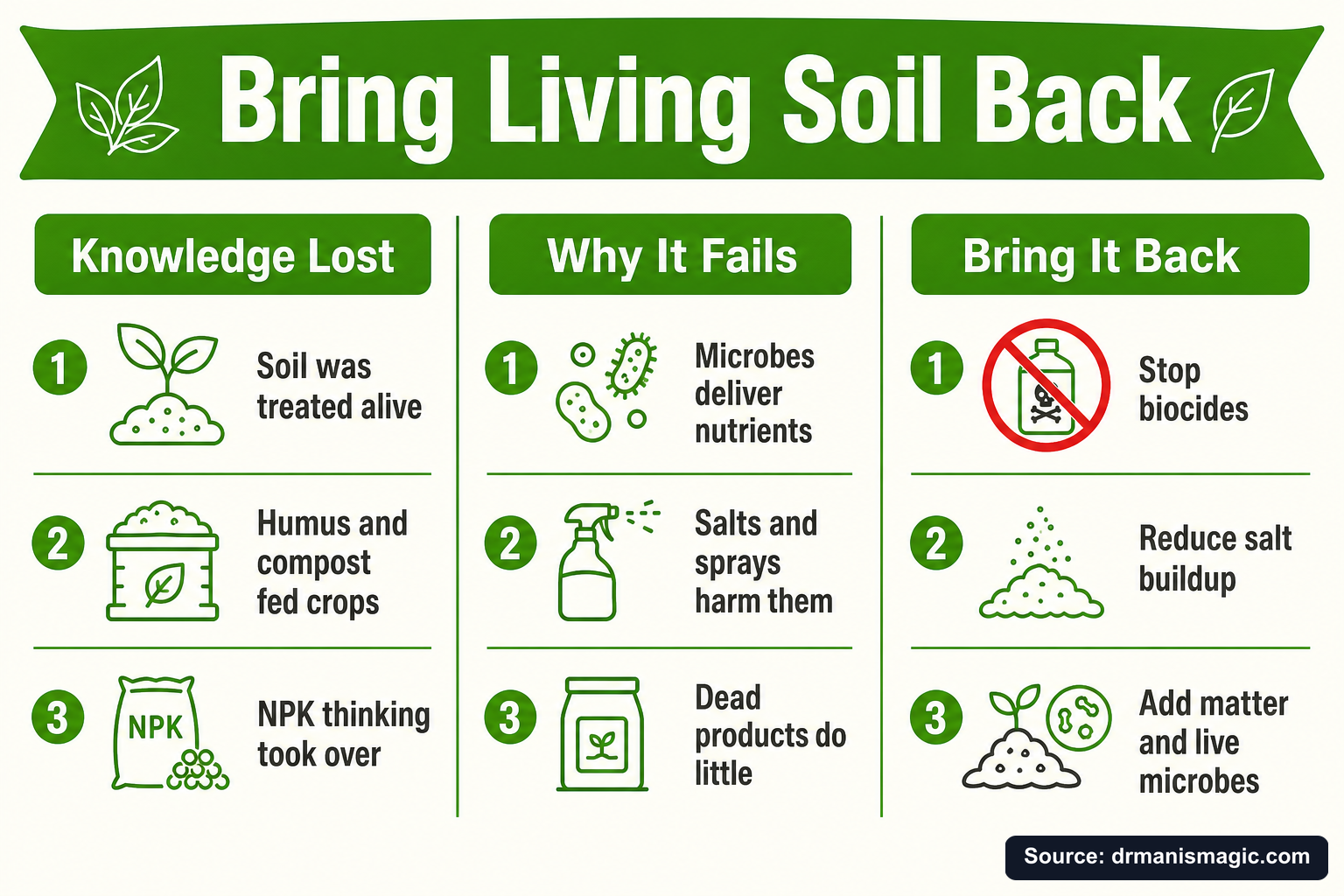
- Healthy soil is a living ecosystem, not just a material that holds roots in place.
- Before the 1840s, farmers understood soil fertility through manure, compost, crop rotation, and humus. That knowledge was slowly abandoned after synthetic chemistry arrived.
- The soil food web includes bacteria, fungi, protozoa, and nematodes working together to cycle nutrients. Most gardening content ignores the last two.
- Salt-based synthetic fertilizers, fungicides, herbicides, and pesticides all damage or destroy beneficial soil microbes.
- Dead or dried microbial products and smelly compost teas often deliver little real benefit. Live, stabilized microbes are what plants actually need.
- Damaged soil can be restored with the right steps: stop the biocides, reduce salt buildup, add organic matter, and reintroduce full-spectrum live biology.
- The Three Plant Pillars framework, developed and tested on over 250,000 trees at US Citrus Nursery in South Texas, gives any plant owner a proven path back to living soil.
What Was Soil Knowledge Like Before the Chemical Age?
Quick Answer: Before synthetic fertilizers existed, farmers kept soil alive through manure, compost, crop rotation, and legumes. They didn't call it the "soil food web," but they understood that living, rich soil was the foundation of every healthy crop. That understanding was quietly replaced by a simpler but incomplete model: just add N, P, and K.
For most of human history, farmers knew something important. Soil was not just dirt. It was alive.
Ancient farmers in China, India, and Egypt returned animal manure to their fields every season. Medieval European farmers rotated crops, letting legumes like clover and beans replenish the ground between grain harvests. American settlers learned from Indigenous farming traditions that placed fish under corn mounds, feeding the soil as the fish decomposed.
No one called it "microbiology." But they felt the results. Fields fed with compost and manure grew better crops. Land that was rested and rotated stayed productive for generations. Soil that felt dark, crumbly, and rich with earthworms simply worked better than pale, hard-packed ground.
Scientists at the time described this richness as "humus," the dark organic matter left behind when plants and animals break down. The prevailing view, which researchers now call the "humic period" of soil science, held that humus was the source of plant fertility. Feed the soil, and the soil feeds the plant. That idea was correct. And then it was almost completely replaced.
According to ScienceDirect's history of soil organic matter concepts, this humic period lasted until roughly 1840. What came next changed farming, gardening, and soil science for the next 180 years.
How Did Justus von Liebig and Mineral Theory Change Everything?
Quick Answer: German chemist Justus von Liebig proposed in 1840 that plants feed on minerals, not humus. His mineral nutrition theory was a breakthrough in plant science, but it also started a long drift away from thinking about soil as a living system. The focus shifted from feeding the soil to feeding the plant directly with soluble chemicals.
In 1840, a German chemist named Justus von Liebig published a book that rewrote the rules of agriculture.
Liebig was brilliant. He proved that plants absorb nitrogen, phosphorus, and potassium from the soil as dissolved minerals. He showed that you could measure what a crop removed from the soil and replace those specific elements. He called this the "law of the minimum." If one nutrient is missing, growth stops. Replace it, and growth resumes.
This was a genuine scientific advance. Liebig's mineral nutrition theory explained why some crops failed and others thrived. It gave farmers a language for soil fertility they had never had before.
But something important got lost in the translation from laboratory to farm.
Liebig's model treated soil as a reservoir of chemicals. The plant was a machine that absorbed those chemicals through its roots. Humus, manure, compost, crop rotation, and the trillions of living organisms in the soil were reduced to delivery vehicles for N, P, and K. The living part of the soil became an afterthought. What mattered was the mineral content. And if the minerals were gone, you could just add them back in soluble form.
Liebig himself later warned that his ideas were being oversimplified. He argued that organic matter and living processes in soil still mattered. But his warnings were largely ignored. The industrial age had found something it could package, ship, and sell.
What Role Did Haber-Bosch Nitrogen Play in the Loss of Soil Biology?
Quick Answer: The Haber-Bosch process, invented around 1909, made synthetic nitrogen fertilizer cheap and abundant by pulling nitrogen from the air. This breakthrough meant farmers no longer needed legumes, manure, or crop rotation to restore soil nitrogen. The biological systems that had maintained soil fertility for thousands of years became optional, then forgotten.
In the early 1900s, two German chemists named Fritz Haber and Carl Bosch solved a problem that had limited agriculture for all of human history: how to turn atmospheric nitrogen into a form plants could use.
Before Haber-Bosch, nitrogen came from manure, compost, legume crops, and the trillions of nitrogen-fixing bacteria living in healthy soil. These sources worked well, but they required time, land, and knowledge to manage.
Haber-Bosch made synthetic nitrogen from thin air. Literally. The process forces atmospheric nitrogen gas to react with hydrogen at high pressure and temperature, producing ammonia. That ammonia becomes fertilizer. It is cheap, concentrated, and fast-acting.
The impact on food production was staggering. Synthetic nitrogen fertilizer fed billions of people through the 20th century. The Green Revolution of the 1950s and 1960s, which used high-yield crops and heavy synthetic inputs, is credited with preventing widespread famine.
But there was a cost that almost no one talked about at the time.
When farmers could pour nitrogen from a bag, the old knowledge became irrelevant. Why plant a cover crop of clover when you can spread ammonium nitrate? Why return manure to the field when liquid nitrogen is cheaper and faster? Why worry about the living biology in your soil when a bag of 10-10-10 will green things up in a week?
Slowly, generation by generation, the knowledge of living soil management faded. Farmers, gardeners, and growers were handed a simpler story: plants need N, P, and K. Buy this bag. Problem solved.
How Did Postwar Pesticides and Fungicides Damage the Soil Food Web?
Quick Answer: After World War II, chemical companies repurposed wartime chemistry into agricultural pesticides, herbicides, and fungicides. These products were designed to kill living organisms. The problem is they don't only kill the target pest. They also harm or destroy beneficial bacteria, fungi, protozoa, and nematodes in the soil food web, leaving plants defenseless and soil biologically impoverished.
World War II ended in 1945. The factories that had been making nerve agents and chemical weapons needed new customers. The solution was agriculture.
Organochlorine compounds like DDT, developed as insecticides during the war, were rushed to market for farm use. Herbicides based on similar chemistry followed. Fungicides that killed broad classes of soil fungi became standard practice. By the 1950s and 1960s, the American farm had become a chemical operation.
These products worked. Pest losses dropped. Weed pressure declined. Fungal diseases were controlled. Yields went up. The results were visible and immediate.
What was invisible was the damage happening underground.
Every broad-spectrum pesticide applied to a field also hit the soil. Every herbicide like glyphosate that drifted into a garden bed or was tilled under disrupted the bacterial communities in the root zone. Every synthetic fungicide that killed powdery mildew on a leaf also killed mycorrhizal fungi in the soil below. University of Minnesota Extension and Colorado State Extension have both documented how mycorrhizal fungi, which can expand a plant's effective root absorbing area by 100 to 1,000 times, are highly sensitive to synthetic fungicide applications.
The result was what scientists now call a biologically impoverished soil. The chemistry was there. The minerals were there. But the living workforce that processed those minerals, cycled nutrients, and protected roots from disease was gone or severely weakened.
And nobody noticed for decades. Because the synthetic inputs kept working. At least for a while.
What Is the Soil Food Web and Why Does It Matter to Your Plants?
Quick Answer: The soil food web is the living community of bacteria, fungi, protozoa, nematodes, and other organisms that work together to cycle nutrients, suppress disease, and support plant roots. When this web is intact, plants get everything they need naturally. When it's broken, plants become dependent on chemical inputs just to survive.
Let's talk about the invisible workforce. The one that's been doing this job since before humans existed.
In every tablespoon of healthy forest soil, there are more living organisms than there are people on Earth. Most of them are doing one job: keeping plants alive. Here's how the system works, from the ground up.
Bacteria: The First Responders
Bacteria are the most numerous organisms in healthy soil. They break down organic matter, releasing nutrients that plants can absorb. Some bacteria fix atmospheric nitrogen directly in the root zone, providing a free source of this critical nutrient. Others produce compounds that suppress disease-causing pathogens. They are the foundation of everything else in the soil food web.
Fungi: The Underground Highway
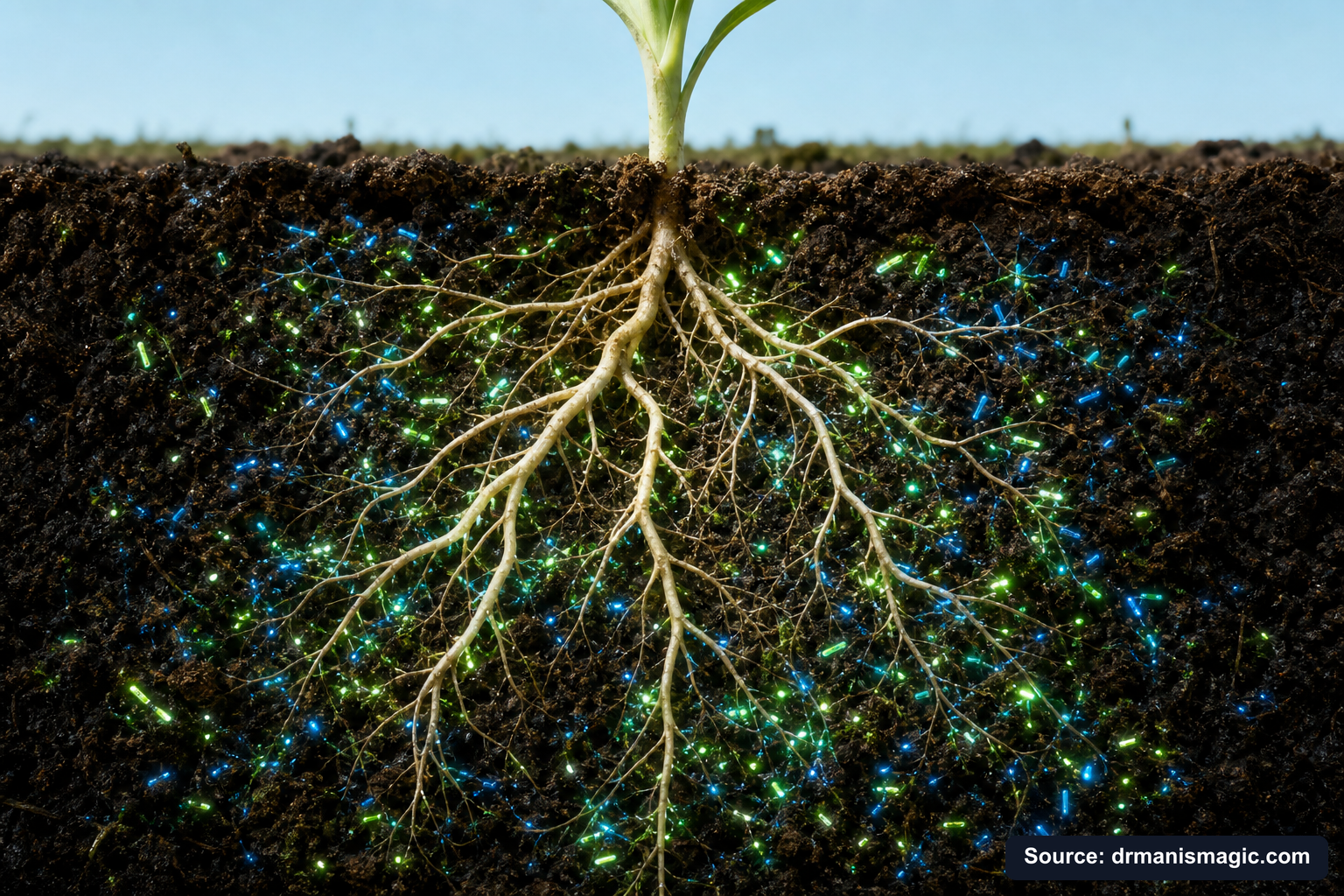
Mycorrhizal fungi form one of the most important partnerships in all of nature. They wrap around and even grow inside plant roots, extending their thread-like strands, called hyphae, far beyond where roots can reach. Colorado State Extension reports that this extension can increase a plant's effective root absorbing area by 100 to 1,000 times. These fungi bring back phosphorus, water, and trace minerals from untapped zones of the soil. In exchange, the plant feeds them sugars. It is a trade that has been happening for 450 million years.
Protozoa: The Nutrient Releasers
This is where most soil health content stops. But it shouldn't. Protozoa are single-celled organisms that graze on bacteria. When a protozoan eats a bacterium, it releases the nitrogen locked inside that bacterium as ammonium, a plant-available form of nitrogen. This predator-prey cycle is one of the primary ways nitrogen moves from organic matter into plant roots. Without protozoa, the system slows down dramatically.
Nematodes: The Biological Indicators
Nematodes are tiny roundworms. Most are beneficial. Bacterial-feeding nematodes graze on soil bacteria, releasing more nitrogen just as protozoa do. Fungal-feeding nematodes do the same with fungal biomass. According to UC Davis NemaPlex, the composition of nematode communities in soil is one of the most reliable indicators of overall soil health. A diverse nematode population means a thriving food web. A nematode community dominated by plant-parasitic species means the soil biology is broken and plants are under stress.
| Organism | What It Does | Why Plants Need It | What Kills It |
|---|---|---|---|
| Bacteria | Decompose organic matter, fix nitrogen, suppress pathogens | Releases plant-available nutrients, crowds out disease | Salt-based fertilizers, herbicides, fumigation |
| Mycorrhizal fungi | Extend root system, deliver phosphorus and water, improve disease resistance | Up to 1,000x more root surface area for nutrient and water uptake | Synthetic fungicides, high phosphorus fertilizers, tillage |
| Protozoa | Graze on bacteria, release nitrogen as ammonium | Key driver of nitrogen mineralization in the root zone | Pesticides, herbicides, soil compaction |
| Nematodes (beneficial) | Graze on bacteria and fungi, release nutrients, indicate soil health | Nutrient cycling and biological health indicator | Fumigation, synthetic chemicals, soil disturbance |
| Earthworms | Physically mix soil, create channels for air and water, excrete nutrient-rich castings | Improve soil structure and drainage | Pesticides, compaction, tillage |
Does Synthetic Fertilizer Kill Soil Microbes?
Quick Answer: Yes. Salt-based synthetic fertilizers create high-salt conditions in the root zone that harm or kill beneficial bacteria and mycorrhizal fungi. High phosphorus inputs from synthetic fertilizers also suppress mycorrhizal colonization by signaling to the plant that it doesn't need the fungal partnership. Over time, regular synthetic fertilizer use degrades the living biology your plant depends on.
Here's the part the fertilizer companies left off the label.
Synthetic fertilizers are salt-based. The nitrogen, phosphorus, and potassium in them are attached to salt molecules. When you pour them on your soil, the salt concentration around the roots spikes. Plants can absorb some of those nutrients quickly, which is why you see a fast green-up. But the salt also pulls water out of microbial cells through osmosis, essentially dehydrating and killing the beneficial bacteria and fungi living in your root zone.
It's like pouring ocean water on a meadow. The plants might absorb some water initially. But the salt damages everything living in the soil around them.
After years of testing at our US Citrus Nursery in South Texas, growing over 250,000 trees, we watched what happened when growers used salt-based fertilizers on their trees. The trees would green up fast. Then they'd stall. Then they'd develop root problems. Then they'd crash. The biology in the root zone had been destroyed, and without that biology, no amount of fertilizer could save the tree.
That's why Pillar 3 of our Three Plant Pillars system uses organic, slow-release fertilizer instead. Our Crab, Kelp & Amino Acids fertilizer delivers nutrients in a form that works with microbes, not against them. No synthetic salts. No PFAS. No biosludge. Just slow-release nutrition that feeds the living system your plant actually runs on.
See also: The Hidden Reason Synthetic Fertilizers Cause Root Rot
You Never Had a Brown Thumb.
You were handed the wrong tools. This free guide hands you the right ones.
You watered it. You fed it. It died anyway.
It was never you. It was the dirt, the salt food, and the bad advice.
This guide shows you what really went wrong, and how to fix it for good.
- Why your plants really died, and why it was never your fault
- The salt hiding in your plant food that quietly burns the roots
- The hidden killer in almost every bag of store soil
- The tiny helpers that grow a whole forest for free
- The rescue trick that brings a half dead plant back to life

Do Fungicides Kill Mycorrhizae?
Quick Answer: Yes. Most broad-spectrum synthetic fungicides cannot distinguish between harmful fungal pathogens and beneficial mycorrhizal fungi. Regular use of synthetic fungicides suppresses or destroys the mycorrhizal network in your soil, eliminating one of the most powerful root-support systems your plant has. Penn State Extension has documented that mycorrhizal fungi suppress pathogens through multiple pathways, all of which are lost when the fungi are killed.
This is one of the cruelest ironies of the chemical age.
You see a fungal problem on your plant. You reach for a fungicide. You spray. The visible problem goes away. You feel like you won.
But underground, the fungicide doesn't know the difference between the bad fungus on your leaf and the mycorrhizal fungi wrapped around your roots. Both are fungi. The fungicide hits both. Penn State Extension explains that mycorrhizal fungi protect plants from pathogens through four separate mechanisms: better nutrition, tougher root cell walls, stress reduction, and shifts in the microbial community around the root. Kill the mycorrhizae, and all four of those protections disappear.
Now your plant is more vulnerable to the very pathogens you were trying to stop. So you spray again. The cycle deepens. The biology gets worse. The plant gets weaker. The chemical use increases.
This pattern is not a coincidence. It is the logical outcome of treating soil like a chemical substrate rather than a living system. When you break the biology, you create dependency. And dependency is very profitable for the companies selling the chemicals.
Can Sterile or Damaged Soil Become Alive Again?
Quick Answer: Yes, damaged or biologically depleted soil can recover, but it takes deliberate steps and time. You have to stop the inputs that are causing the damage, reduce salt buildup, add organic matter, reintroduce live biology, and keep living roots in the ground. The process works. We've seen it happen on thousands of trees at our nursery, and in backyards across the country.
The good news is that soil biology is resilient. Given half a chance, it wants to come back.
The bad news is that most gardeners keep doing the same things that broke it in the first place. They keep spraying. They keep using salt-based fertilizers. They keep using sterile potting mixes that start with zero biology and get none added. And then they wonder why their plants keep struggling.
Here is what we've learned after 30 years of growing in South Texas, through drought, heat, hurricanes, and every pest and disease you can imagine. Soil recovery is possible. But you have to follow the steps in order.
A Practical Soil Recovery Protocol
- Stop the biology killers first. Reduce or eliminate synthetic herbicides, broad-spectrum pesticides, and synthetic fungicides. Every application resets the biological clock back to zero.
- Test your pH and salt levels. High soil salinity from synthetic fertilizer buildup is one of the most common hidden killers of soil biology. If your soil has been heavily fertilized, leach it with deep, slow watering to flush excess salts. Aim for a pH between 6.0 and 7.0 for most plants.
- Stop feeding the plant and start feeding the soil. Switch from salt-based synthetic fertilizers to a gentle, slow-release organic fertilizer that microbes can work with. The plant will get its nutrients through the biology, the way nature intended.
- Add stable organic matter. Compost, aged wood chips used as mulch, and biochar all provide food and habitat for beneficial microbes. Organic matter is the fuel the soil food web runs on.
- Keep living roots in the ground. Living roots release sugars called exudates that feed bacteria and mycorrhizal fungi in the root zone. A bare, rootless soil has nothing feeding the biology. Cover crops, companion plants, and even weeds help keep the food web active.
- Reduce disturbance. Every time you till or dig, you break apart fungal hyphae networks that took months to build. Minimize tillage whenever possible, especially in established beds.
- Reintroduce full-spectrum live biology. In most managed gardens, containers, and lawns, the biology has been so depleted that natural recolonization is too slow to help your plants in any meaningful timeframe. Monthly applications of a genuinely live, full-spectrum microbial product give your soil the workforce it needs to recover and maintain itself.
Why Are Most Microbial Products on Store Shelves Not Working?
Quick Answer: Most commercial microbial products either contain dried, lab-grown bacteria that fail to reactivate in real soil conditions, or they are compost-derived liquids that have already gone anaerobic and smell terrible by the time they reach you. Neither delivers the live, diverse biology that healthy soil actually needs. The difference between a live microbial product and a dead one is the difference between a full workforce and an empty promise.
Walk down the garden aisle of any big box store and you'll see dozens of products with words like "beneficial bacteria," "mycorrhizal fungi," and "probiotic soil amendment" on the label.
Most of them don't work. Here's why.
The majority of commercial microbial products are made in large factories that brew specific bacterial or fungal species in giant vats, then dry them into a powder. The idea is that the dormant spores will reactivate when you add water and put them in soil. We've tested dozens of these products on our trees. We have not seen meaningful results from any of them. The species diversity is too narrow, and the survival rate of dried spores in variable soil conditions is too low.
The second type is liquid compost teas or worm casting extracts. These can be good, but only if they reach you within 24 hours of being made, still actively aerated. After about 24 hours, they go anaerobic. The beneficial microbes die off. Fermentation takes over. The bottle starts to fizz when you open it. And the smell is exactly what you'd expect from something that's been rotting in a sealed bottle since it left the factory.
Some people still see minor benefits from these products because of the humic acids and fulvic acids in the base material. But the live biology? Gone before it ever reached your roots.
There is also a third type: lactobacillus-based products, similar to the bacteria in yogurt. These are vigorous and easy to grow, which is why they're popular. But they crowd out the beneficial microbes your soil actually needs. Lactobacillus belongs in your yogurt, not your root zone.
| Product Type | Are Microbes Alive at Use? | Species Diversity | Odor | Real-World Results |
|---|---|---|---|---|
| Dry/powdered lab microbes | Low (dormant spores, poor reactivation) | Narrow (1-5 species) | Minimal | Weak. We've tested dozens. No meaningful results. |
| Rehydrated dried powder | Low | Narrow | Minimal | Same issues as dry powder. |
| Compost tea (fresh, under 24 hours) | Moderate (active aeration required) | Broad but variable | Earthy, pleasant | Good if used immediately. Not practical for most growers. |
| Compost tea (old, over 24 hours) | Very low (anaerobic, dying) | Partial | Strong, foul, sour | Minimal biology. Some humic acid value remains. |
| Lactobacillus-based products | High | Very narrow (one species) | Sour | Crowds out beneficial microbes. Not recommended. |
| Plant Super Boost (stabilized, full-spectrum) | High (stabilized, stays alive) | 2,000+ bacteria species, 400-500 fungi including mycorrhizae, plus protozoa and nematodes | Earthy, not foul | Visible microbial movement under microscope. Lab-confirmed live biology. Proven on 250,000+ trees. |
What Makes Plant Super Boost Different From Every Other Microbial Product?
Quick Answer: Plant Super Boost starts with real compost, not a factory vat. It contains over 2,000 bacterial species, 400 to 500 fungal species including mycorrhizae, plus protozoa and nematodes. A proprietary all-natural stabilization technique keeps the microbes genuinely alive without going anaerobic. The result is a product that smells like healthy earth, not sewage, and shows visible microbial movement under a microscope.
The story behind Plant Super Boost starts with a chance meeting.
Years ago, Dr. Mani Skaria, a Professor Emeritus of Plant Pathology and the founder of the Clean Citrus Program in Texas, met a world-renowned compost expert. This man had developed a technique to stabilize the living microbes in fresh compost without letting them die or go anaerobic. He had advised royal families and governments on farming practices across the world. And he had been blacklisted by large chemical companies after his work helped major citrus groves achieve results that made synthetic inputs look unnecessary.
He and Dr. Mani eventually joined forces at US Citrus Nursery. Together, they built what became the Dr. Mani's Magic line, with Plant Super Boost at its center.
Plant Super Boost is not brewed in a factory. It is harvested from real, active compost using that proprietary all-natural stabilization process. That's why it contains not just a handful of bacterial species, but over 2,000. Not just one or two fungal strains, but 400 to 500, including mycorrhizae. And it includes protozoa and nematodes, the nutrient-cycling organisms that most microbial products ignore entirely.
Take a drop of Plant Super Boost and look at it under a microscope. You will see movement. That's not marketing. That's life.
And because the microbes are stabilized rather than fermenting, the product smells like earth. Not sewage. Not vinegar. Not the inside of a gym bag. Just clean, healthy soil. That matters more than you might think. If your microbial product smells bad, it's because the biology inside it is dying.
Zero PFAS. Zero biosludge. Zero synthetic salts. Made in the USA, right here in South Texas. And backed by our 30-day money-back guarantee.
How Do the Three Plant Pillars Rebuild What the Chemical Age Destroyed?
Quick Answer: The Three Plant Pillars framework, developed and proven at US Citrus Nursery over 30 years and 250,000 trees, addresses the three root causes of plant failure: dead soil structure, absent biology, and chemical nutrition. Mineral-based soil gives roots room to breathe. Live microbials restore the invisible workforce. Organic fertilizer feeds the system without burning it. Together, they recreate the conditions of a healthy, living ecosystem in any pot, bed, or backyard.
Here is what the forest has that your potted lemon tree doesn't.
The forest floor has mineral-rich soil that drains freely and never compacts into sludge. It has billions of living microbes in every handful of dirt. And it has slow-release nutrition from decomposing leaves, bark, and organic matter, fed gently and continuously over decades.
Most potted plants and garden beds have none of these things. They sit in bark-based potting mix that compacts and goes toxic within 6 to 12 months. They have no meaningful microbial life because the soil started sterile and nothing was ever added. And they get fed with salt-based synthetic fertilizers that spike nutrients fast, burn the root zone, and destroy whatever biology was trying to establish itself.
The Three Plant Pillars fix all three problems at once.
Pillar 1: Mineral-Based Soil. Our Super Soil is built on silica-rich sandy loam from the Rio Grande Valley. It doesn't decompose. It doesn't compact. It doesn't steal oxygen from roots the way bark and wood-based potting mixes do. Roots can breathe, expand, and absorb water efficiently. This is the physical foundation everything else depends on.
Pillar 2: Live Microbials. Plant Super Boost delivers the full-spectrum living biology that healthy soil needs. Bacteria. Fungi. Mycorrhizae. Protozoa. Nematodes. The whole workforce, alive and active, delivered to your roots every month. Not dried. Not dead. Not fermenting in a smelly bottle.
Pillar 3: Organic Fertilizer. Our Crab, Kelp & Amino Acids fertilizer provides slow-release nutrition from natural sources. No synthetic salts. No PFAS. No biosludge. The nutrients are released gradually as microbes process the organic matter, mimicking the way a forest floor feeds its trees. The biology and the nutrition work together instead of fighting each other.
Miss any one of these three pillars, and the system has a hole in it. That hole is where root rot, yellowing leaves, weak fruit, and pest problems enter. But when all three are in place, something remarkable happens. The system becomes self-sustaining. The plant stops struggling and starts thriving. Just like the forest.
See also: Why Most Fertilizers Are Actually Salt in Disguise
How Much Time Have You Already Lost to the Old Way?
Quick Answer: The most honest answer is: probably years. Every season spent using salt-based fertilizers, sterile soil, and dead microbial products is a season where your plants were working against biology instead of with it. You can get money back. You cannot get time back. The second best time to start doing this right is today.
People contact us from all over the country. And the number one thing we hear, more than any other question, more than any specific plant problem, is some version of this: "I just want to see my tree fruit before it's too late."
Not before the season ends. Not before the weather turns. Before it's too late for them, personally. That's how much this matters to people. That's how deep the desire to nurture and grow something goes. Dr. Mani hears it at every event, in every email, from every customer who has been trying and failing for years.
And the tragedy is not that they failed. The tragedy is why they failed. They were given the wrong information from the start. Salt-based fertilizers. Bark-filled potting mixes. Sterile soil with no biology. Chemical sprays that wiped out the very organisms that would have made everything work.
It was not their fault. The deck was stacked against them before they ever planted the first seed.
You can get your money back from a bad fertilizer purchase. You cannot get back the three years you spent watching a tree stall and struggle before you figured out what was wrong. Time is the one currency that doesn't refill. And every season you spend using the old approach is a season your plant is not doing what you brought it home to do.
The best time to start with living soil was years ago. The second best time is right now, today, before another season slips by.
Get the Free Plant Care Field Guide and start with a foundation that actually works. If you want to see what's possible, read what thousands of growers have already experienced at our customer reviews page.
The forest doesn't need your help to grow. But your backyard does. And now you know exactly what it's been missing.
Frequently Asked Questions
Soil knowledge did not disappear by accident. It was slowly replaced by a system built on chemicals, shortcuts, and profit. These are the questions gardeners are asking right now, and the answers point back to something the old farmers already knew.
How much topsoil has been lost because of chemical farming?
About half of the world's topsoil has been lost in the last 150 years. In the US Midwest alone, over 57 billion metric tons are gone. Chemical fertilizers kill the microbes that hold soil together. Without those microbes, the soil falls apart and washes away. That is not a small problem. That is the foundation of your garden disappearing one season at a time.
Is the soil in the USA depleted of nutrients?
Yes, in most places it is. Decades of synthetic fertilizers, pesticides, and herbicides have wiped out the bacteria and fungi that naturally move nutrients to plant roots. You can pour fertilizer on dead soil all day long and your plants will still struggle. The nutrients are there, but nothing is alive to deliver them. That is exactly what Dr. Mani's Three Plant Pillars are designed to fix, starting with live microbes in the soil.
Which US state has the richest soil?
Iowa and the Midwest Corn Belt are famous for deep, dark topsoil. But here is something most people do not know. The Rio Grande Valley in South Texas has its own remarkable soil story. Dr. Mani built his Super Soil formula using the silica-rich sandy loam from that region. It drains perfectly, never compacts, and does not break down like the pine bark mixes sold at big box stores. It is the mineral foundation that makes everything else work.
Who is considered the father of soil chemistry?
J. Thomas Way is recognized as the father of soil chemistry for his work on ion exchange in 1850. His research helped explain how soil holds and releases nutrients. But here is the twist. The scientists who came after him focused almost entirely on chemistry and left out the biology. That one blind spot is why we ended up with salt-based fertilizers that feed plants for a season but slowly destroy the living system underneath.
What are the main branches of soil science?
Soil science breaks into four main areas. Pedology studies how soil forms and is classified. Edaphology looks at how soil supports plant growth. Soil physics covers water movement and aeration. Soil chemistry deals with nutrients and pH. Most commercial gardening advice only touches soil chemistry. Dr. Mani's Three Plant Pillars go further. They bring in the biology, the mineral structure, and the organic feeding that the other three branches miss entirely.
What does a soil scientist actually do?
A soil scientist studies the physical, chemical, and biological properties of soil to help plants grow, protect land, and clean up pollution. Dr. Mani spent 35 years as a plant scientist at the Texas A&M Citrus Center and tested his findings on over 250,000 trees at US Citrus Nursery. He is not guessing. He watched what worked and what failed up close, in real soil, with real trees, for decades. That is where the Three Plant Pillars came from.
Can damaged soil actually be brought back to life?
Yes, and faster than most people think. You do not need 1,000 years. You need to stop the chemicals killing your microbes, flush out the salt buildup from synthetic fertilizers, add real organic matter, and reintroduce live biology. Dr. Mani's Plant Super Boost delivers stabilized live bacteria, fungi, and mycorrhizae straight to your roots. Gardeners using the full Three Plant Pillars system start seeing results within 30 days. The soil wakes up because you gave it what it was always missing.
About the Author
Dr. Mani Skaria, PhD
Dr. Mani Skaria, PhD, is a plant pathologist and the scientific founder of Dr. Mani's Magic. He earned his doctorate at Purdue University and spent 48 years studying how plants, soil, and living microbes work together, including his years as Professor Emeritus at Texas A&M and as a member of the USDA NAREEE Advisory Board. He invented micro-budding, a method for growing healthier, stronger trees, and has grown more than 250,000 trees on the family farm in Hargill, Texas - US Citrus Nursery. His life's work takes real lab science and practical experience and turns it into simple, safe, organic plant care anyone can use at home.


