


How Soil Biology Replaces Guesswork in Gardening | Dr. Mani's Magic
How Soil Biology Replaces Guesswork in Gardening (And Why Your Plants Keep Struggling Without It)
Picture this. You're standing in your backyard on a Saturday morning, coffee in hand, staring at a plant that should be thriving. You watered it. You fertilized it. You followed the directions on the bag. And yet here it is, yellowing at the edges, drooping slightly, looking like it gave up on life sometime around Tuesday.
You've been down this road before. You Googled the symptoms. You got seventeen different answers. You tried a new fertilizer. Maybe a different potting mix. Maybe you even asked someone at the garden center, and they handed you another product with a bright label and a cheerful promise. More money. More hope. Same result. The plant limps along, or it dies outright, and somewhere in the back of your mind a little voice whispers: "Maybe I just don't have a green thumb."
Here's the truth nobody at the garden center will tell you. The problem is almost never the plant. And it's almost never you. The problem is the soil. Not the texture of it, not the color of it, but the invisible world living inside it. Or more accurately, the invisible world that should be living inside it but isn't. Once you understand what's actually going on beneath the surface, gardening stops feeling like a lottery. It starts feeling like a system. And that system has a name: soil biology. After growing and testing more than 250,000 trees at our South Texas nursery, we can tell you with complete confidence that understanding this one thing changes everything.

Organic Fertilizer | Crab, Kelp & Amino Acids
Key Takeaways
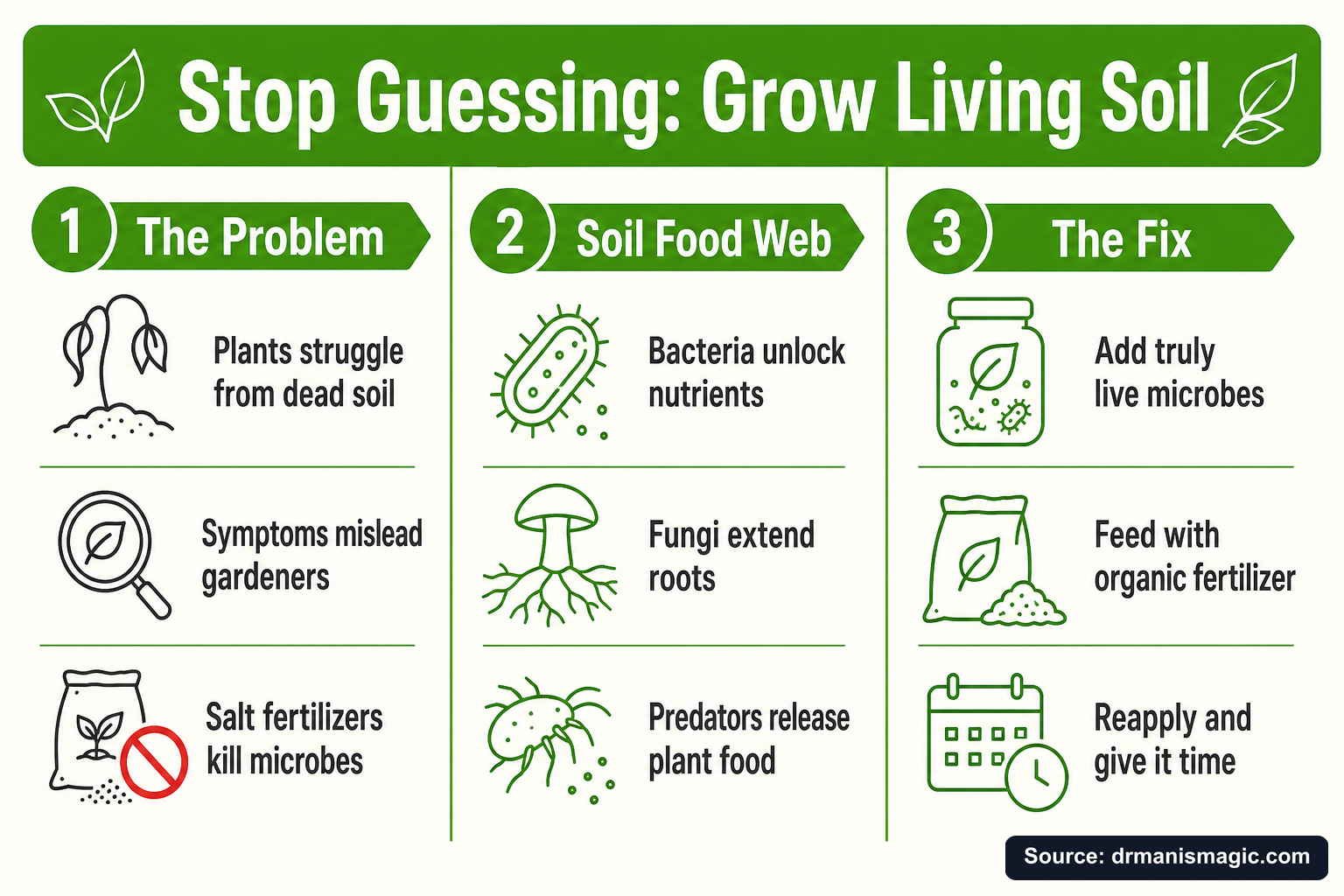
- Healthy soil is a living ecosystem packed with bacteria, fungi, protozoa, nematodes, and more. When that ecosystem collapses, plants struggle no matter how much you water or fertilize.
- Most plant problems, including yellowing, wilting, root rot, and stunted growth, trace back to a broken soil food web, not bad luck or a brown thumb.
- Salt-based synthetic fertilizers actively kill the beneficial microbes your plants depend on, creating a cycle that gets worse over time.
- You can diagnose most soil problems using simple home tests before spending another dollar on products that may not help.
- Live microbials, organic fertilizer, and mineral-based soil work together as the Three Plant Pillars, a system proven across 250,000+ trees at US Citrus Nursery in South Texas.
- Most store-bought microbial products contain dead or dying organisms. Genuinely live, full-spectrum microbes behave completely differently in your soil.
- Restoring damaged soil biology takes repeated application and time, but the payoff is a plant that essentially defends and feeds itself.
What Is Soil Biology and Why Does It Replace Gardening Guesswork?
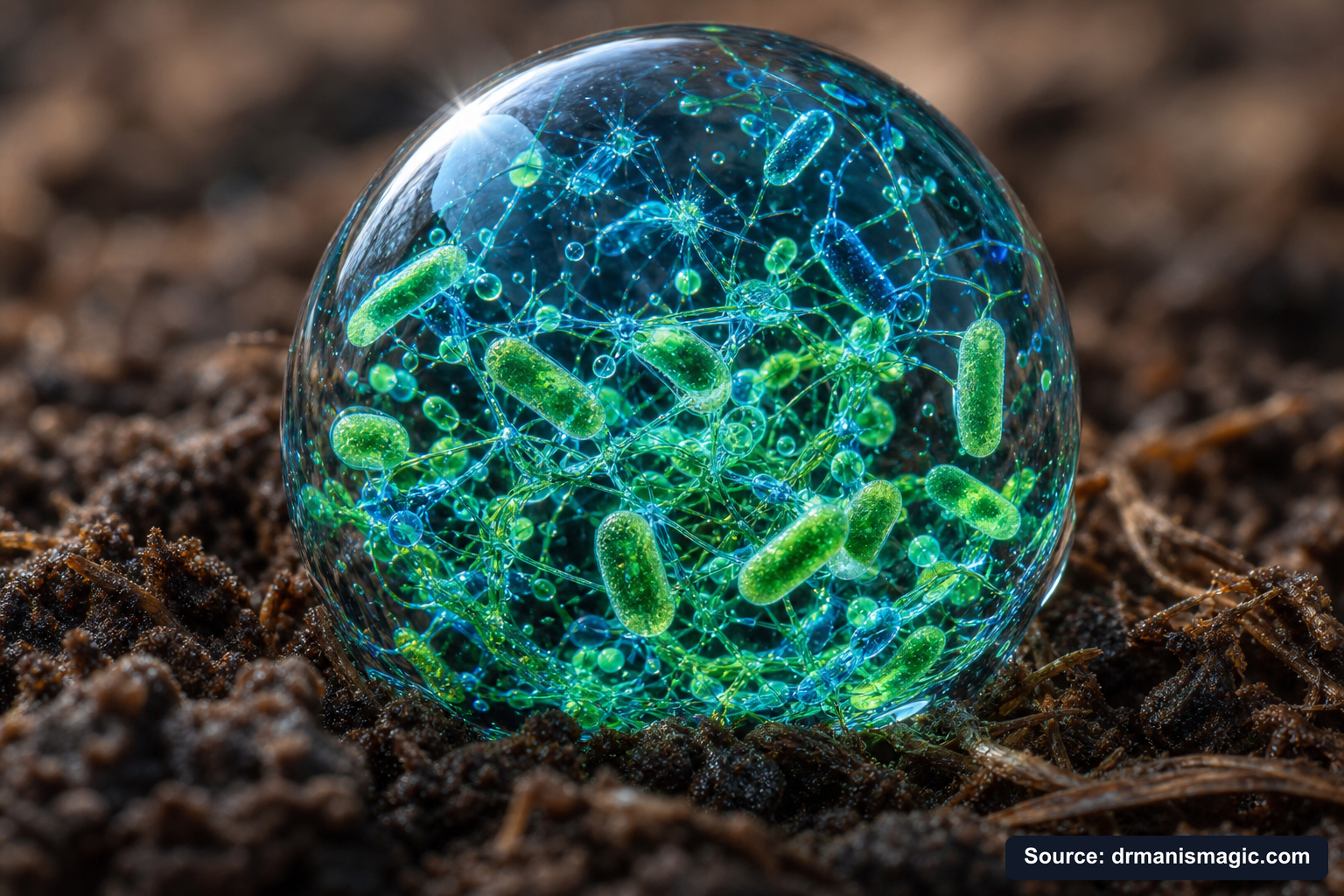
Quick Answer: Soil biology is the living community of bacteria, fungi, protozoa, nematodes, and other organisms inside your soil. When this community is healthy and active, it cycles nutrients, moves water, suppresses disease, and grows roots for you automatically. When it collapses, no amount of fertilizer or watering fully compensates, and every plant decision becomes a guess.
The USDA Natural Resources Conservation Service defines healthy soil as a living ecosystem where microbes drive water regulation, nutrient cycling, disease buffering, and plant productivity from the ground up. (USDA NRCS Soil Health) That isn't poetic language. That is a practical description of what actually keeps plants alive.
Think about a forest. Nobody fertilizes a forest. Nobody waters it on a schedule. Nobody sprays it with fungicide. Yet enormous trees grow, fruit, seed, and live for hundreds of years. How? Because the soil beneath a forest floor is teeming with trillions of living organisms working in organized shifts, around the clock, to feed and protect every root they touch.
Now think about your backyard. Chances are the soil has been disrupted. Maybe by years of synthetic fertilizer. Maybe by herbicide. Maybe by compaction from foot traffic. Maybe by potting mix that started sterile and stayed that way. The invisible workforce is gone, or it is severely weakened. And when the workforce disappears, the plant is on its own. That is when guesswork starts. That is when you start buying products.
Soil biology replaces guesswork by turning invisible processes into observable, testable patterns. Once you know what healthy biology looks like, smells like, and does for a plant, you can diagnose problems at the root level instead of chasing symptoms at the leaf level. You stop treating yellowing leaves and start asking why the nutrient cycle broke down in the first place.
Who Actually Lives in Your Soil? The Soil Food Web Explained Simply
Quick Answer: The soil food web is a community of organisms each doing a specific job. Bacteria break down simple compounds and fix nitrogen. Fungi break down tough material and extend roots. Protozoa and nematodes eat bacteria and release nutrients plants can absorb. Arthropods and earthworms shred and mix everything. Together they run a nutrient recycling factory inside your soil, 24 hours a day, for free.
Most gardeners have heard of bacteria and fungi. Fewer have heard of protozoa and beneficial nematodes. Yet the USDA Soil Biology Primer identifies all of these as essential functional members of a working soil food web, each performing different and non-replaceable roles. (USDA NRCS Soil Biology Primer)
Here is what each member of the team actually does, in plain language.
| Organism | What It Does | Why You Care |
|---|---|---|
| Bacteria | Break down simple organic compounds, fix nitrogen from air, solubilize locked-up minerals | Fast nutrient cycling. Nitrogen plants can actually use. Unlocks minerals already in your soil. |
| Fungi (including mycorrhizae) | Break down complex carbon, extend root systems with thread-like hyphae, build soil aggregates with glomalin | Root reach multiplied by 100x or more. Better drought resistance. Better soil structure. |
| Protozoa | Eat bacteria and release nutrients as waste right next to roots | They are the nutrient delivery system. Without them, nutrients stay locked in bacteria and never reach the plant. |
| Beneficial nematodes | Eat bacteria, fungi, and pest larvae; regulate microbial populations | Natural pest control and population balance in the soil food web. |
| Earthworms | Shred organic matter, mix soil layers, create channels for water and air | Natural tilling and drainage. Their castings are rich in plant-available nutrients. |
| Arthropods | Shred leaves and organic debris into smaller pieces bacteria and fungi can process | They start the decomposition chain that ends in plant food. |
Here is the part that most people never hear. Protozoa are often the missing link between bacteria doing their job and nutrients actually reaching your plant. Bacteria absorb nutrients. Protozoa eat bacteria. When protozoa digest those bacteria, they release the nutrients as waste right in the root zone, in a form the plant can immediately absorb. Remove the protozoa, and that loop breaks. Nutrients pile up in bacteria but never transfer to the plant. You add more fertilizer. Nothing seems to help. The guessing continues.
If you pull a weed from your garden and see white fuzzy threads clinging to the roots, that is mycorrhizal fungi doing exactly this work. Those threads are extending the root system far beyond what the plant could reach alone. Weeds are incredibly hard to kill partly because they have this fungal partnership working for them. Your garden plants deserve the same advantage. That is precisely why Plant Super Boost includes mycorrhizal fungi along with the full spectrum of bacteria, protozoa, and nematodes, stabilized alive so they arrive ready to work.
How Do You Diagnose Soil Problems Without Guessing?
Quick Answer: You diagnose soil problems by matching visible symptoms to testable causes. Yellowing in wet soil usually means salt damage or root oxygen loss, not a nutrient shortage. Wilting despite watering often signals compaction or poor drainage. Stunted growth with healthy color can mean herbicide carryover or pH trouble. Each symptom points to a specific, testable root cause you can fix.
This is where soil biology turns guesswork into a process. Instead of staring at a sick plant and buying something random, you follow the clues the soil is already giving you.
Simple Home Observations That Tell You a Lot
Smell your soil. Healthy soil smells earthy and slightly sweet, like a forest floor after rain. That smell comes from a compound called geosmin, produced by active bacteria. If your soil smells sour, swampy, or like rotten eggs, you have an anaerobic problem. The biology has gone wrong. Oxygen is blocked. Roots are struggling.
Do the water test. Pour a cup of water slowly into your pot or garden bed. Count how many seconds it takes to drain away. If water sits on top for more than a few seconds or pools and never moves, you have a drainage and compaction problem. Roots need oxygen just as much as they need water. Soggy, airless soil is where root rot starts.
Check your soil structure. Pick up a handful. Does it crumble apart easily, almost like chocolate cake? That is aggregated, biologically active soil. Does it pack into a hard clump or feel like wet cement? That is compacted, biologically dead soil. Mycorrhizal fungi produce a substance called glomalin that literally glues soil particles into those crumbly aggregates. No fungi, no aggregates, no structure.
Look at your roots. When you repot or transplant, take a close look. Healthy roots are white or cream-colored, firm, and spread outward. Brown, mushy, or slimy roots are a sign of root rot, usually caused by poor drainage combined with pathogen pressure. A healthy microbial community actively suppresses the pathogens that cause root rot. When the biology is gone, pathogens win.
The Soil Biology Troubleshooting Matrix
| What You See | Likely Cause | Biological Connection | First Step |
|---|---|---|---|
| Yellowing leaves despite watering and feeding | Salt accumulation from synthetic fertilizer, or pH locking nutrients | Salts kill beneficial bacteria; locked pH prevents microbial nutrient release | Flush soil with plain water; switch to organic fertilizer; reintroduce live microbes |
| Wilting in wet soil | Root rot, compaction, or salt-induced osmotic stress | Dead biology allows pathogens to colonize roots; no fungi to improve structure | Check drainage; inspect roots; add mineral-based soil; apply live microbials |
| Stunted growth despite fertilizing | Compaction, herbicide carryover, nutrient cycling breakdown | No protozoa means nutrients stay locked in bacteria, never reaching the plant | Test for herbicide history; aerate; add full-spectrum microbes |
| Crusty, hard soil surface | Low organic matter, low microbial aggregation, possible sodicity | No glomalin from fungi means no soil aggregates; water runs off instead of soaking in | Add compost or mulch; reintroduce fungal inoculants; reduce compaction |
| Recurring fungal disease | Low microbial competition, poor airflow, overwatering | Healthy bacteria and fungi crowd out pathogens; without them, disease wins | Improve drainage; add beneficial fungi and bacteria; reduce leaf wetness |
| Poor germination in new beds | Sterile soil, herbicide residue, or salt toxicity | Seedlings depend on immediate microbial support for nutrient access | Check herbicide history; use mineral-based soil; drench with live microbes before planting |
| Good color but no fruit or flowers | Nutrient imbalance, especially phosphorus; low microbial activity in root zone | Mycorrhizae are the primary movers of phosphorus; without them, fruiting stalls | Apply mycorrhizal fungi; use organic fertilizer with balanced nutrients |
Each of these symptoms is a clue, not a death sentence. The biology in your soil can be rebuilt. We have seen it happen in container trees, backyard gardens, and large citrus groves alike. It takes time and consistency, but the results are plants that stop needing emergency rescues and start simply thriving.
Why Do Salt-Based Fertilizers Make Soil Biology Problems Worse Over Time?
Quick Answer: Salt-based synthetic fertilizers create high salt concentrations in the root zone that damage or kill beneficial bacteria and fungi. Each application weakens the microbial community more. Over months and years, the biology collapses, nutrient cycling breaks down, and plants become entirely dependent on the next application of fertilizer to survive, which is exactly how that cycle was designed to work.
This is the part of the story that nobody at the garden center will walk you through. Synthetic fertilizer companies have been selling the same salt-based formulas since the 1950s, when a marketing company decided to capitalize on cheap imported nitrogen made available by wartime industrial chemistry. The product worked fast, looked impressive on the shelf, and created a repeat customer. The fact that it was slowly destroying soil biology was either not understood or not advertised.
Here is what actually happens. When you pour a salt-based fertilizer into your soil, the high salt concentration draws water out of microbial cells through a process called osmosis. Beneficial bacteria and fungi dry out and die. The ones that survive are often the hardier, less helpful species. Over time, diversity collapses. The soil food web simplifies. Nutrient cycling slows. The plant can no longer feed itself between applications. You apply more fertilizer. The remaining biology weakens further. The cycle repeats.
This is not a theory. The University of Maryland Extension has documented how repeated synthetic fertilizer applications reduce soil microbial biomass and diversity, leading to compaction, reduced water infiltration, and long-term fertility decline. The biology was the engine. The fertilizer was the fuel that also corroded the engine.
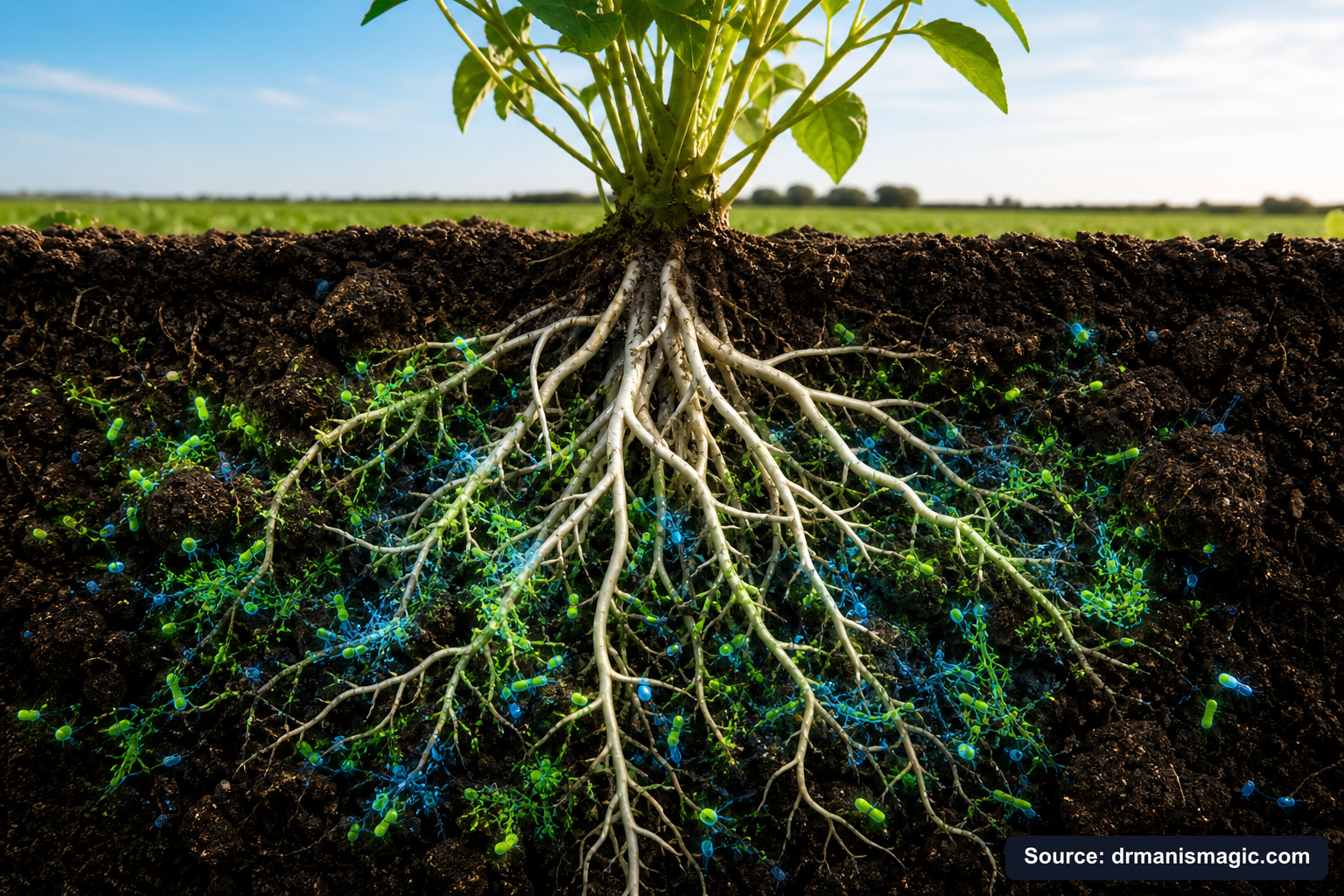
We have seen this play out across decades of growing at US Citrus Nursery. Trees grown in biologically active soil with organic fertilizer develop robust root systems, resist pests and disease with far less intervention, and continue improving year over year. Trees grown in salt-heavy synthetic programs often look fine for a season or two, then plateau, then decline. By the time the problem is obvious, years of growing time have been lost.
You can get money back. You cannot get time back. That is the real cost of the old approach.
See also: The Hidden Reason Synthetic Fertilizers Cause Root Rot
You Never Had a Brown Thumb.
You were handed the wrong tools. This free guide hands you the right ones.
You watered it. You fed it. It died anyway.
It was never you. It was the dirt, the salt food, and the bad advice.
This guide shows you what really went wrong, and how to fix it for good.
- Why your plants really died, and why it was never your fault
- The salt hiding in your plant food that quietly burns the roots
- The hidden killer in almost every bag of store soil
- The tiny helpers that grow a whole forest for free
- The rescue trick that brings a half dead plant back to life

Live Microbes vs. Dead Microbes: Why Most Products on the Shelf Do Not Work
Quick Answer: Most commercial microbial products contain microbes that are either dead from the drying and packaging process, or dying in an anaerobic liquid that smells like sewage. Live, stabilized, full-spectrum microbes from a real biological source behave completely differently. The difference between them is like the difference between a living army and a jar of dust.
Walk into any garden center today and you will see shelves of products promising beneficial bacteria, mycorrhizal fungi, and microbial inoculants. The market for these products is booming. But here is what most of those products have in common: the microbes inside are not alive, or they are barely hanging on.
After testing dozens of products over years of growing at US Citrus Nursery, here is what we found about how these products are made and why most of them fall short.
| Product Type | How It's Made | Microbial Viability When You Use It | Smell | Our Experience |
|---|---|---|---|---|
| Dry powdered lab microbes | Grown in industrial vats, dried into spores, packaged | Low. Spores may or may not reactivate in your specific soil conditions. | Neutral | We tested dozens of batches. Plants showed no measurable response. |
| Dry microbes added to liquid | Same lab-grown process, suspended in water | Low. Harder to identify, but same underlying problem. | Neutral | Essentially the same result as dry powder. |
| Compost tea or liquid extract (fresh, under 24 hours) | Harvested from compost, aerated, applied immediately | Moderate to high if truly fresh and aerated | Earthy to slightly sour | Works well, but requires your own compost setup and immediate use. |
| Compost tea (bottled, sitting on shelf or in transit) | Same as above but packaged and shipped | Very low. Gone anaerobic. Microbes are dying. | Strong, foul odor. Sometimes fizzes. | The smell tells the whole story. These are rotting, not living. |
| Lactobacillus-based products | Easy to produce; same organism as yogurt cultures | High viability, but wrong organisms | Sour, fermented | Lactobacillus crowds out beneficial soil microbes. It belongs in your yogurt, not your soil. |
| Plant Super Boost (stabilized, full-spectrum) | Harvested from hand-crafted compost using a proprietary all-natural stabilization technique | High. Microbes remain alive and visible under a microscope. Lab-verified. | Earthy. No foul odor. | Consistent, observable results across citrus, houseplants, tropical trees, lawns, and gardens. |
The story behind Plant Super Boost is worth telling. Dr. Mani, after decades of growing citrus at US Citrus Nursery, met a world-renowned compost expert who had developed a natural technique to stabilize the full spectrum of microbes found in fresh, active compost. Not narrow lab-grown strains. Not dried spores. The real thing: over 2,000 species of bacteria, 400 to 500 fungal species including mycorrhizae, plus protozoa and beneficial nematodes, all alive and stable in a bottle.
This expert had been effectively blacklisted by large chemical interests after citrus groves using his methods showed dramatic results. Through a fortunate meeting, he joined the team at US Citrus Nursery and became the foundation of the Dr. Mani's Magic line. The technique keeps microbes alive without letting them go anaerobic. That is why Plant Super Boost smells earthy instead of foul. And that is why, under a microscope, you can actually see the microbes moving.
Zero biosludge. Zero synthetic salts. Zero PFAS. Just living biology in a bottle, with a 30-day money-back guarantee if you do not love the results.
When Should You Buy Microbial Products vs. Feed the Ones Already There?
Quick Answer: Buy microbial inoculants when your soil is sterile, has been treated with herbicides or fungicides, is new potting mix, or has a documented history of chemical damage. Feed existing microbes with compost, organic mulch, cover crops, and living roots in established outdoor beds with healthy biological history. In most real-world situations, both approaches together produce the fastest results.
This is a question more gardeners should ask, and almost nobody answers it honestly. The short version is this: if your soil has living biology that has not been severely disrupted, you can support and feed those organisms through habitat building. If your soil has been sterilized, chemically treated, compacted, or repeatedly dosed with synthetic inputs, you need to reintroduce the organisms first, then build the habitat to keep them there.
Habitat Building: What Feeds the Microbes You Already Have
- Compost: Fresh, active compost introduces both organisms and the organic matter they feed on. Use it as a top dressing or mix it into the top few inches of soil.
- Mulch: A layer of wood chip or leaf mulch on the soil surface creates a moist, protected zone where fungi thrive. It mimics the forest floor.
- Living roots: Plant roots feed microbes by releasing sugars into the soil. The more plant diversity, the more microbial diversity. Bare soil is biologically starving.
- Cover crops: In garden beds between seasons, a cover crop planted and then turned under feeds biology while protecting soil structure.
- Reduced tillage: Every time you deeply till, you break apart fungal networks that took months to build. Shallow surface work is far less damaging than deep turning.
- Stop broad-spectrum chemicals: Herbicides, fungicides, and synthetic pesticides are not selective. They damage beneficial biology alongside the targets. The more you use, the harder it becomes to maintain a healthy soil food web.
When to Use a Microbial Inoculant
- Any new container or potting mix, which starts completely sterile.
- Any soil that has received herbicide, especially glyphosate, in the past two to three years.
- Newly established garden beds in areas that were previously lawn treated with chemicals.
- After repotting a tree or transplanting a plant, when root disruption creates a window for pathogen invasion.
- Any soil that smells wrong, drains poorly, or has a history of repeated plant failure.
- Monthly maintenance in containers, which lack the natural recolonization that happens in open ground.
The combination of the Three Plant Pillars was designed for exactly this reality. Mineral-based soil that does not compact and rob oxygen from roots. Live full-spectrum microbes that restore what chemical use destroyed. Organic fertilizer that feeds the plant and the biology together, without the salt that undoes all the microbial work you just invested in.
How Do You Recover Soil That Has Been Killed by Chemicals, Salt, or Compaction?
Quick Answer: Recovering damaged soil is a process, not a single product application. It requires removing the source of damage, reintroducing biology, rebuilding organic matter, improving physical structure, and giving the system repeated inputs over time. Most damaged soils show meaningful improvement within one growing season with consistent effort, and continue improving for years.
This is one of the most under-covered topics in gardening content, and it is one of the most common situations real gardeners face. You bought a house. The previous owner sprayed everything. The lawn looks patchy and the garden beds grow nothing well. Or you have been using the same potting mix and the same fertilizer for five years, and your containers have slowly gotten worse. You are not imagining it. The biology is gone, and it needs to be rebuilt deliberately.
Soil Recovery Checklist: 6 Steps in Order
- Stop the damage first. Remove all synthetic herbicides, salt-based fertilizers, and broad-spectrum fungicides from your routine. You cannot rebuild biology while continuing to kill it. Switch to organic inputs immediately.
- Test your drainage. Pour water and time it. If it does not drain freely within a few seconds in a container, or within a minute in a garden bed, address structure before biology. Waterlogged, airless soil cannot support beneficial aerobic microbes.
- Add organic matter. Compost, leaf mold, or aged wood chip mulch on the soil surface gives microbes something to eat. Without organic matter as fuel, even the best inoculant will struggle to survive. Aim for a two to three inch layer as a top dressing.
- Reintroduce full-spectrum live microbes. Apply a biologically complete inoculant that includes bacteria, fungi, protozoa, and beneficial nematodes. Apply monthly. One application is not enough because your environment will keep challenging the new biology until populations stabilize.
- Feed with organic fertilizer. Organic slow-release nutrients like those from crab, kelp, and amino acid sources support both the plant and the microbial community. Avoid anything salt-based during recovery. The biology is fragile and salts will set you back.
- Give it time and consistency. Soil biology responds to repeated inputs and reduced disturbance. After 30 days you should see a difference. After 90 days the improvement is usually striking. A full recovery in heavily damaged soil can take one to two full growing seasons of consistent care.
We have watched this process play out hundreds of times. Trees that looked nearly dead, sitting in compacted, biologically dead soil, transformed into healthy, fruiting plants within a single season once the biology was restored and the Three Plant Pillars were in place. The plant was never the problem. The invisible ecosystem around its roots was.
See also: How Salt-Based Feeding Quietly Destroys Root Systems
What Are the Three Plant Pillars and How Do They Apply to Any Plant, Not Just Citrus?
Quick Answer: The Three Plant Pillars are mineral-based soil, live microbials, and organic fertilizer. Together they replicate the conditions under which plants evolved in nature: structured, well-draining soil that does not compact; a full ecosystem of living organisms at the roots; and slow-release nutrients that feed without burning. These principles apply equally to grass, houseplants, vegetables, flowers, fruit trees, and ornamental shrubs.
Dr. Mani Skaria, Professor Emeritus of Plant Pathology and founder of the Clean Citrus Program in Texas, did not develop these principles for home gardeners first. He developed them out of necessity, growing 250,000 citrus trees in South Texas where the heat, the soil, and the pest pressure are relentless. What worked at that scale, in those conditions, is not specific to citrus. It is specific to how plants work, which has not changed since the first plant grew in the first soil on this planet.
Pillar One: Mineral-Based Soil. Most potting mixes are made from pine bark and organic matter that breaks down within months. As it decomposes, it compacts, blocks oxygen to roots, and creates the waterlogged conditions where root rot thrives. Mineral-based soil made from sandy loam does not decompose. It maintains structure, drains freely, and keeps roots breathing for years. This matters for every plant in every container or raised bed.
Pillar Two: Live Microbials. Every plant that evolved on this earth evolved with a microbial community at its roots. Remove that community and the plant is operating at a fraction of its potential, vulnerable to every pathogen and nutrient deficiency that comes its way. Restoring that community with genuinely live, full-spectrum microbes is not an add-on. It is the foundation.
Pillar Three: Organic Fertilizer. Plants need nutrients. But the form those nutrients arrive in matters enormously. Slow-release organic nutrition from crab meal, kelp, and amino acids feeds the plant gently and continuously, in harmony with the microbial community. It does not burn. It does not salt. It does not destroy the biology you just worked to rebuild. The Crab, Kelp and Amino Acids formula carries zero biosludge, zero synthetic salts, and zero PFAS. Just clean, complete nutrition.
When all three pillars are in place, the questions change. You stop asking "why is my plant dying?" You start asking "what should I plant next?" That is the shift from guesswork to confidence. That is what soil biology actually delivers.

What Can You Do Right Now to Start Building Better Soil Biology?
Quick Answer: Start by stopping what is hurting your biology: swap salt-based fertilizers for organic ones, reduce broad-spectrum chemical use, and check your soil drainage. Then add organic matter and introduce live, full-spectrum microbes monthly. These steps alone will produce visible results within 30 days and compound in your favor every season after that.
You do not need to overhaul everything at once. Start with what you can observe and test today.
Smell your soil. Taste a leaf if you grow food, noticing how vibrant or flat the flavor is. Watch how water moves. Look at the roots when you repot. These sensory clues are your soil telling you its story. Once you learn the language, you will never garden blind again.
The single most impactful thing most gardeners can do right now is stop adding salt-based fertilizer and start adding living biology. Not dried spores from a factory. Not a smelly, anaerobic liquid. Genuinely alive, full-spectrum microbes that arrive ready to work and that you can verify are living under a microscope.
After more than 30 years of growing, after testing this system on 250,000 trees, Dr. Mani Skaria and the team at US Citrus Nursery in Hargill, Texas developed the Dr. Mani's Magic line for one reason: because they needed it themselves, and nothing on the market did what they needed. The products are made in the USA, tested in the field, and backed by a 30-day money-back guarantee.
The number one request we hear from gardeners is some version of: "I just want to see fruit on my tree while I still can." We understand that deeply. Every season you spend guessing is a season you are not growing. The best time to get your soil biology right was years ago. The second best time is today.
If you want the step-by-step system that covers everything from soil to microbes to feeding, the Free Plant Care Field Guide lays it all out in plain language, no jargon, no guesswork. It is the same foundation we use for every plant we grow. Download it, read it once, and you will never look at your soil the same way again.
Frequently Asked Questions
If your plants keep struggling no matter what you try, the answers below will change how you see gardening forever. These are the real questions behind the guesswork, and they all point back to one thing: what is actually happening inside your soil. Dr. Mani spent 35 years and 250,000+ trees figuring this out so you don't have to.
Why does soil biology replace guesswork in gardening?
When your soil is full of living bacteria and fungi, those organisms automatically cycle nutrients, fight disease, and feed your roots around the clock. You stop guessing because the system runs itself. Without that living biology, no fertilizer or watering schedule fully compensates. Dr. Mani proved this across 250,000+ trees at US Citrus Nursery. Healthy soil biology is the difference between a plant that thrives and one that slowly gives up.
Why is soil biology so important for plants?
Soil biology supplies roughly 75 percent of the nitrogen and 65 percent of the phosphorus your plants actually absorb. Those nutrients don't come from a bag. They come from living microbes breaking down organic matter and unlocking minerals in the soil. Kill those microbes with salt-based synthetic fertilizers and your plants go hungry no matter how much product you pour on. That is why Dr. Mani's Three Plant Pillars start with live microbial muscle, not a chemical shortcut.
What is soil biology and what does it actually do?
Soil biology is the community of bacteria, fungi, protozoa, nematodes, and other tiny organisms living in your soil. They decompose organic matter, recycle nutrients, suppress harmful pathogens, and help roots absorb water more efficiently. Think of them as a full-time crew working underground for free. When that crew is wiped out, your soil becomes dead dirt. When it is thriving, your plants practically take care of themselves.
Can soil biology have harmful effects too?
Yes, but only when the balance is broken. Healthy soil has far more beneficial organisms than harmful ones, and the good ones keep the bad ones in check. Problems start when synthetic fertilizers and chemical pesticides wipe out the beneficial microbes. That leaves harmful bacteria and pathogens with no competition. The fix is not more chemicals. The fix is restoring the living ecosystem with live microbials like Dr. Mani's Magic Plant Super Boost, which brings that balance back fast.
What is the 3-year rule for gardening and does soil biology change it?
The old saying goes: year one it sleeps, year two it creeps, year three it leaps. That timeline assumes poor, depleted soil with little biology working for your plant. When you start with Dr. Mani's Three Plant Pillars, meaning mineral-based soil, live microbes, and organic fertilizer, you compress that timeline dramatically. Roots establish faster, nutrients are available sooner, and your plant skips the long sleep. Time is the one thing you cannot get back, so starting right matters more than most people realize.
What is the 5-4-3-2-1 gardening method and how does soil biology support it?
The 5-4-3-2-1 method is a simple planning framework: five vegetables, four herbs, three fruiting plants, two flowers, and one wildcard crop. It is a smart way to organize what you grow. But the method only works if the soil underneath it is alive and ready. Plant any of those in dead, compacted, microbe-starved soil and you will still struggle. Build the Three Plant Pillars foundation first, then use any planning method you like. The biology does the heavy lifting no matter what you plant.
What is the best time to fix your soil biology and start seeing results?
Right now. There is a saying Dr. Mani shares often: the best time to plant a tree was ten years ago. The second best time is today. Every season you wait with broken soil biology is another season of slow growth, wasted money, and lost time. Money can be replaced. Time cannot. With Plant Super Boost, Super Soil, and Dr. Mani's organic fertilizer working together, most gardeners start seeing real improvement within the first 30 days. Your plants are waiting on you to make the move.
About the Author
Ron Skaria, MD
Ron Skaria, MD, is the co-founder of Dr. Mani's Magic and the son of Dr. Mani. He trained as a medical doctor at Baylor College of Medicine, did his residency at UT Health Science Center - San Antonio and fellowship training at Texas Tech University. He now works full time on the family farm at US Citrus and US Citrus Nursery in Hargill, Texas, building Dr. Mani's Magic alongside his dad. He wrote the Brown Thumb Field Guide to put his father's 48 years of plant science into plain words any gardener can use. His belief is simple. You never had a brown thumb. You just never had the right help.


