


How Plants Adapt When Soil Is Alive: The Underground Story | Dr. Mani's Magic
How Plants Adapt When Soil Is Alive: The Underground World That Changes Everything
Picture this. You're kneeling in your backyard, staring at a plant that should be thriving. You watered it. You fertilized it. You did everything the bag said to do. And yet the leaves are pale. The roots look thin and sad. The whole thing feels like it's barely hanging on.
Now picture the forest at the edge of your neighborhood. Nobody waters it. Nobody fertilizes it. Nobody sprays it with anything. But those trees? They're massive. Roots like fists. Leaves so dark green they almost look painted. Fruit dropping to the ground faster than anything can eat it. What does that forest know that your backyard doesn't?
The answer is underneath your feet. It's invisible. And once you understand it, you will never look at a bag of blue fertilizer crystals the same way again. When soil is truly alive, plants don't just grow. They adapt. They change their roots, their chemistry, their immune system, and their entire strategy for survival. This is the underground story nobody told you. Until now.

Plant Super Boost
Key Takeaways
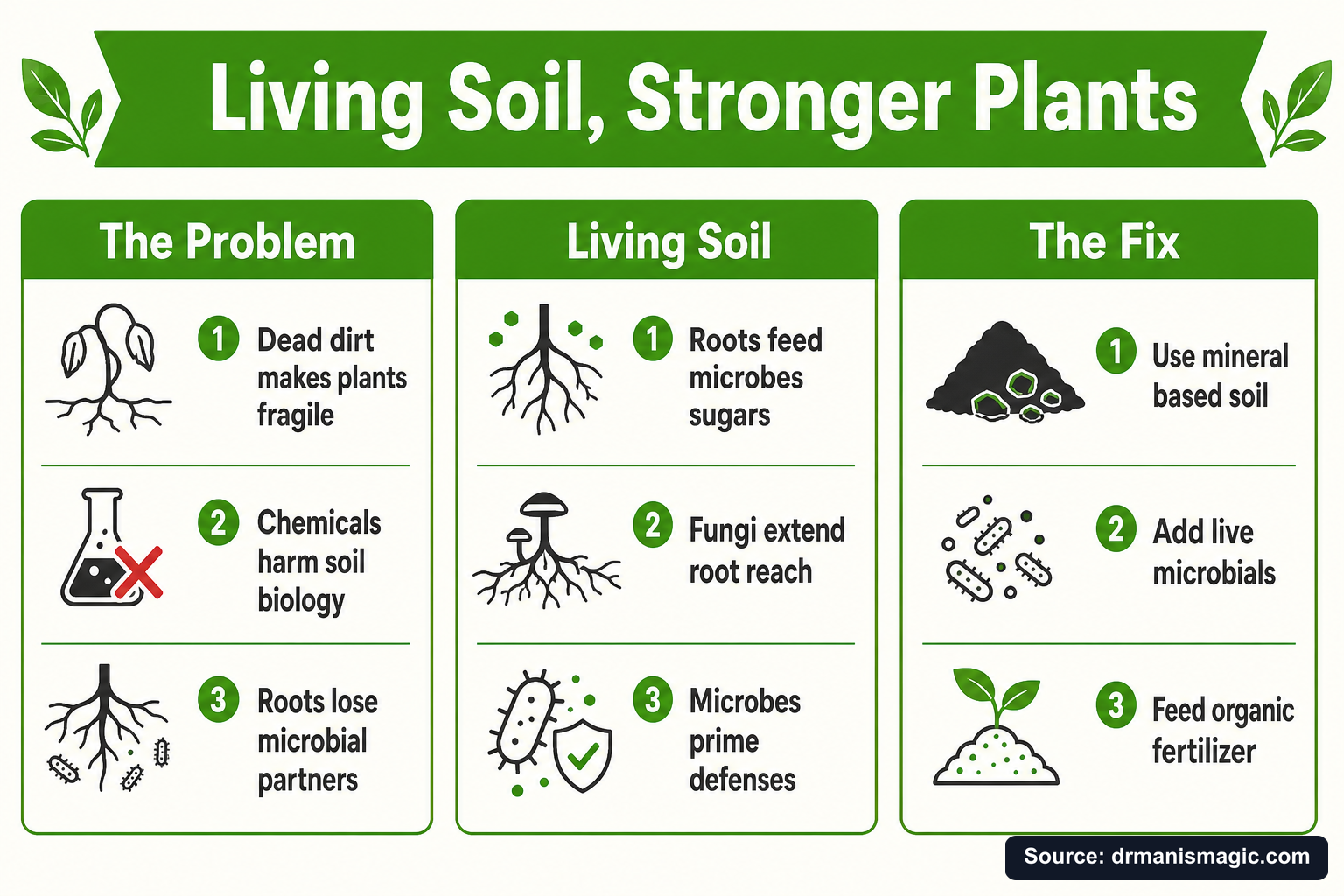
- When soil is alive, plants grow more responsive roots, feed microbes through their roots, and partner with fungi and bacteria to capture nutrients.
- The soil food web acts like a timed-release nutrition system: bacteria and fungi hold nutrients, then tiny predators called protozoa and nematodes release those nutrients right where roots can grab them.
- Mycorrhizal fungi extend a plant's root system up to 100 times its normal reach, dramatically improving access to water, phosphorus, and micronutrients.
- Living soil primes a plant's immune system so it can fight disease and pests with less outside help.
- Salt-based fertilizers, pesticides, fungicides, and herbicides damage or destroy soil biology, forcing plants into a more fragile, chemically dependent survival mode.
- Dead, dried, or foul-smelling microbe products are weak substitutes for genuinely live biology. The difference between a fresh compost tea and a dead powder is the difference between an army and a pile of uniforms.
- The Three Plant Pillars (mineral-based soil, live microbials, organic fertilizer) give any plant the foundation it needs to tap into these natural adaptations.
What Actually Happens in the Soil When Biology Is Present?
Quick Answer: When soil is biologically active, it hosts trillions of bacteria, fungi, protozoa, and nematodes that break down organic matter, unlock nutrients, extend root reach, fight pathogens, and communicate with plant roots through chemical signals. Plants respond by changing how they grow, what they secrete, and how they defend themselves.
Most people think soil is just dirt. A place to hold roots upright. Something to pour water into.
It is so much more than that.
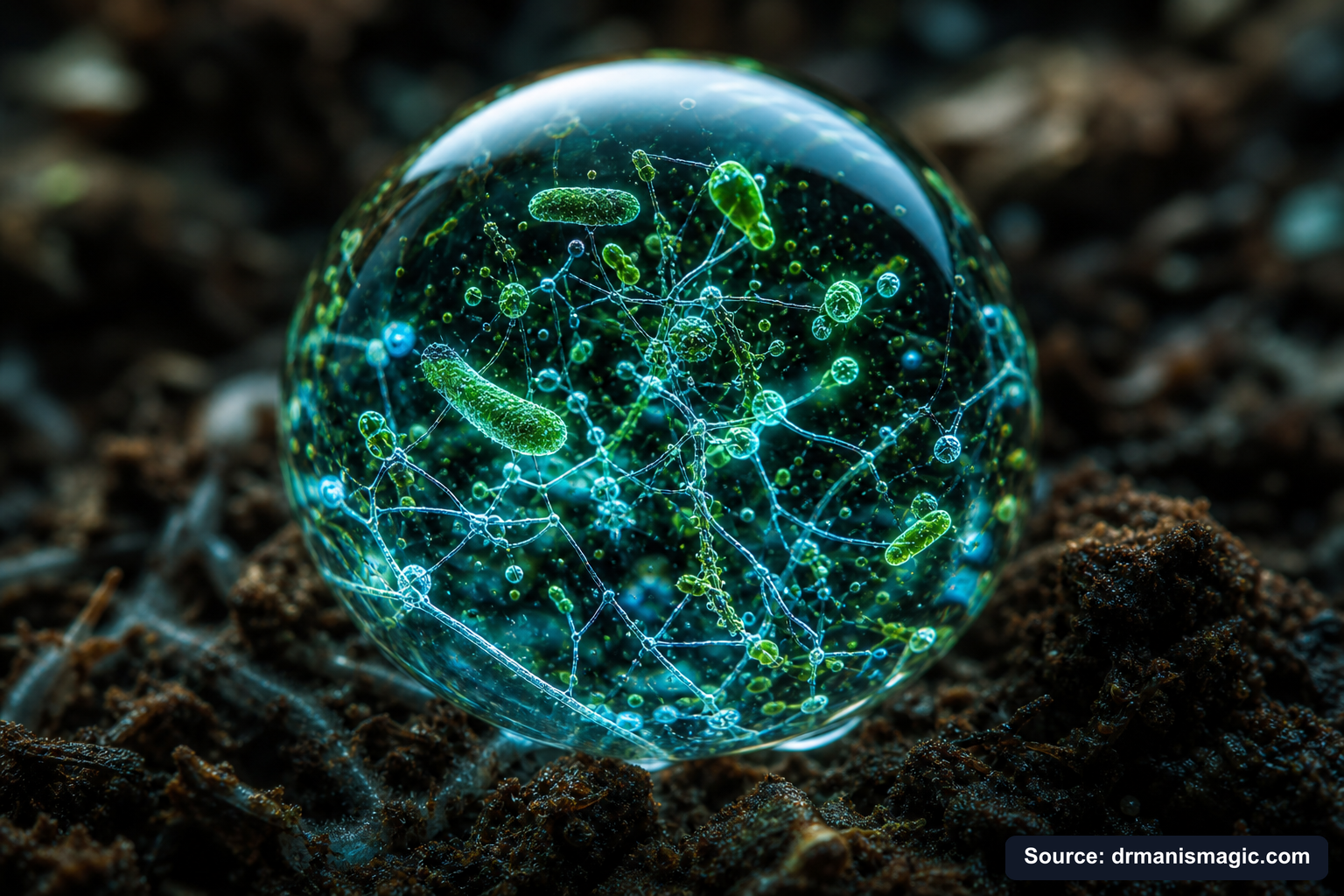
A single teaspoon of healthy living soil can hold up to one billion bacteria. Hundreds of yards of fungal threads. Thousands of protozoa. And a cast of other microscopic creatures too small to see but powerful enough to change how your plant grows from the ground up.
This is what scientists call the soil food web. Think of it like a tiny city under your feet. Each organism has a job. Each job feeds the next. And at the center of it all is your plant's root system, both directing the show and benefiting from every performance.
When Dr. Mani Skaria, founder of US Citrus Nursery and the creator of the Dr. Mani's Magic line, started studying why some trees thrived while others struggled, this underground world kept coming up. After growing and observing over 250,000 citrus trees in South Texas, the pattern became impossible to ignore. The trees with living soil around their roots were different in every measurable way.
The roots branched more. The leaves were deeper green. The fruit came faster and tasted better. And those trees were tougher. Drought, pests, disease — they handled it all with less intervention.
The trees in dead or chemically managed soil? They needed constant attention just to stay alive.
How Do Plants Feed the Microbes Living in Their Soil?
Quick Answer: Plants intentionally release sugars, proteins, and other compounds through their roots into the surrounding soil. This is called the rhizosphere effect. They do it on purpose to feed and recruit specific microbes that help them grow, absorb nutrients, and fight disease. It is a partnership, not an accident.
Here is something that will blow your mind.
Plants give away up to 40 percent of the sugar they make through photosynthesis. On purpose. Through their roots. Straight into the soil.
Why would a plant do that? That sounds like a waste, right?
It is the opposite of waste. It is strategy.
Those sugary secretions are called root exudates. They are the plant's way of placing a grocery order from the underground kitchen. The plant releases specific chemical compounds to attract specific types of bacteria and fungi. The microbes show up, eat the sugars, multiply like crazy, and in return do things the plant cannot do on its own.
They break down minerals. They fix nitrogen from the air. They fight off harmful organisms. They produce hormones that tell roots where to grow. They even send chemical signals that prime the plant's immune system.
This is not random. This is one of the most sophisticated communication systems on the planet. And it only works when the soil is alive.
According to research from UC Davis Extension, the rhizosphere — the thin zone of soil right around a plant's roots — can have up to 1,000 times more microbial activity than the surrounding soil. That zone is the engine room of plant health. And the plant is the one running it.
When soil is dead or damaged, there is nobody home to receive the signal. The plant keeps broadcasting. But nothing answers. The plant is left to survive on its own, with no backup, no partners, no underground army. That is when things start to go wrong.
What Is the Soil Food Web and Why Does It Feed Your Plants Better Than Fertilizer?
Quick Answer: The soil food web is a chain of organisms where bacteria and fungi capture nutrients from organic matter, protozoa and nematodes graze on those bacteria and fungi near plant roots, and the nutrients locked inside the grazed microbes are released right where roots can absorb them. It is a precision nutrient delivery system built by nature.
Think about this image.
A farmer in an ancient field, before any synthetic fertilizer existed. His crops grow. His orchards fruit. His soil stays rich year after year. Not because he sprays blue salt crystals on it. Because the soil is alive and doing the feeding for him.
Here is how the chain works, explained as simply as possible.
Step 1: Bacteria and fungi eat organic matter. Dead leaves, old roots, compost. They break it down and store the nutrients inside their own bodies. The nutrients are locked up. Not available to plants yet.
Step 2: Protozoa and nematodes eat the bacteria and fungi. These tiny predators graze right next to plant roots. When they eat a bacterium, they digest what they need and release the rest. What gets released? Nutrients. Nitrogen, phosphorus, trace minerals. Right next to the root. Ready for the plant to absorb.
Step 3: The plant absorbs the nutrients at the perfect moment. Not all at once in a flood. Not in a form that burns or overwhelms. In a steady, timed-release flow. Exactly when the plant needs it.
This is why living soil feeds plants better than a bag of fertilizer. Fertilizer dumps everything at once in salt form. The soil food web delivers it precisely, gently, continuously.
According to USDA Natural Resources Conservation Service Soil Biology, soil organisms perform functions that no human-made input can fully replicate, including nutrient cycling, disease suppression, and soil structure maintenance.
| Organism | What It Does | Why It Matters to You |
|---|---|---|
| Bacteria | Break down organic matter, fix nitrogen from air, solubilize phosphorus, suppress pathogens | Your plant gets nutrients without you buying a bag of anything |
| Fungi (non-mycorrhizal) | Decompose tough organic material, thread through soil improving structure, suppress some root diseases | Soil stays loose, aerated, and disease-resistant |
| Mycorrhizal Fungi | Extend root reach up to 100x, deliver phosphorus, water, and micronutrients directly to roots | Your plant can access water and food in soil it could never reach alone |
| Protozoa | Graze on bacteria near roots, releasing plant-available nitrogen when they eat | Timed-release nitrogen right at the root zone, no bag required |
| Beneficial Nematodes | Graze on bacteria and fungi, releasing nutrients; some species suppress pest insects and harmful nematodes | More nutrient release, natural pest pressure reduction |
| Earthworms | Physically mix soil, shred organic matter, deposit nutrient-rich castings | Aerated, structured soil that roots can move through easily |
| Arthropods (mites, beetles, etc.) | Shred organic matter for bacteria and fungi to break down further | Speed up the whole nutrient cycle |
How Do Mycorrhizal Fungi Change the Way Plant Roots Work?
Quick Answer: Mycorrhizal fungi attach to plant roots and grow a network of threads called hyphae that extend far beyond the reach of any root hair. This network delivers phosphorus, water, nitrogen, and micronutrients directly to the plant in exchange for sugars. It is like giving your plant a second, much larger root system for free.
Have you ever pulled up a weed and noticed fuzzy white threads clinging to the roots?
That is not mold. That is not rot. That is a mycorrhizal fungus doing its job. And that is exactly why weeds are so hard to kill. They have a biological partnership your fertilized garden plants probably do not have.
The word mycorrhizal comes from the Greek for "fungus" and "root." And the relationship is one of the oldest in the plant world. Scientists believe plants and mycorrhizal fungi have been working together for over 400 million years. Long before humans showed up with bags of blue powder.
Here is what the fungal threads actually do. They are far thinner than root hairs. They can push through soil gaps that roots cannot reach. They cover enormous amounts of ground. One teaspoon of living soil can contain several miles of fungal threads. Those threads find phosphorus, water, and minerals locked in the soil. They carry them back to the plant root. The plant hands over some sugars. The fungus delivers nutrients. Deal done.
The result? Plants with active mycorrhizal partnerships show better drought tolerance, stronger growth, and improved resistance to some root diseases. Research from UC Davis Extension has documented mycorrhizal fungi improving phosphorus uptake efficiency significantly in fruit trees and vegetables.
But here is the catch. Mycorrhizal fungi are fragile. They are wiped out by synthetic fungicides. They are suppressed by excess soluble phosphorus from chemical fertilizers. They are destroyed by soil fumigation. They do not colonize well in sterile potting mix. They struggle in compacted, waterlogged, or salt-damaged soil.
In other words, every standard practice of the big box gardening world is accidentally killing the one organism that extends your plant's root system beyond what it could ever build alone.
That is why Dr. Mani's Magic Plant Super Boost includes mycorrhizal fungi alongside hundreds of bacteria species and other soil organisms. Not lab-grown powder versions that sit dormant in a bag. Genuinely live microbes, stabilized through a natural process developed by a world-class compostologist who joined the US Citrus Nursery team. You can see them move under a microscope.
How Does Living Soil Prime a Plant's Immune System?
Quick Answer: When beneficial microbes colonize the root zone, they trigger a low-level immune alert inside the plant called Induced Systemic Resistance (ISR). The plant does not get sick. It just stays ready. Like a soldier who practices every day, a plant in living soil responds to disease and pest threats faster and more effectively than a plant grown in sterile conditions.
This one surprises most people.
Soil microbes do not just feed your plant. They train it.
When specific beneficial bacteria colonize the rhizosphere, they send chemical signals that travel through the plant from root to leaf. The plant reads those signals and quietly activates its defense systems. Scientists call this Induced Systemic Resistance. The plant is not fighting a disease. It is just getting ready. Staying alert. Building capacity.
Then when a real threat arrives — a fungal pathogen, a bacterial infection, a pest insect — the plant responds faster, harder, and with more precision than a plant that has been growing in dead soil with no microbial coaching.
Think of it like the difference between a person who exercises every day and someone who sits on the couch. Same body. Different readiness. When stress hits, the exerciser handles it. The couch person crumbles.
Plants in living soil are the exercisers. Plants in sterile, chemically managed soil are the couch people.
And here is the cruel twist. When you spray synthetic fungicides or pesticides to "protect" your plant, you are killing the very microbes that were training your plant's immune system. You solve the immediate problem and create a bigger long-term vulnerability. The plant becomes more dependent on chemicals. Not less.
That is the cycle big chemical companies profit from. They do not need you to fail completely. They just need you to keep buying.
What Happens to Plant Roots When Soil Is Dead or Damaged?
Quick Answer: In dead soil, plant roots grow fewer lateral branches and root hairs, cannot form mycorrhizal partnerships, receive no microbial immune training, and must rely entirely on whatever nutrients are dissolved in water. The plant becomes fragile, nutrient-dependent, and far more vulnerable to stress, disease, drought, and root rot.
Imagine trying to build a house with no crew, no tools, and no supply chain. Just you and your bare hands.
That is what a plant faces in dead soil.
In living soil, a plant adjusts its root architecture in response to microbes. It grows more lateral roots and root hairs to increase contact with the biological zone. It pumps out specific exudates to recruit the microbes it needs most. It partners with fungi to extend its reach. It receives hormonal signals from bacteria that tell roots where to grow for maximum benefit.
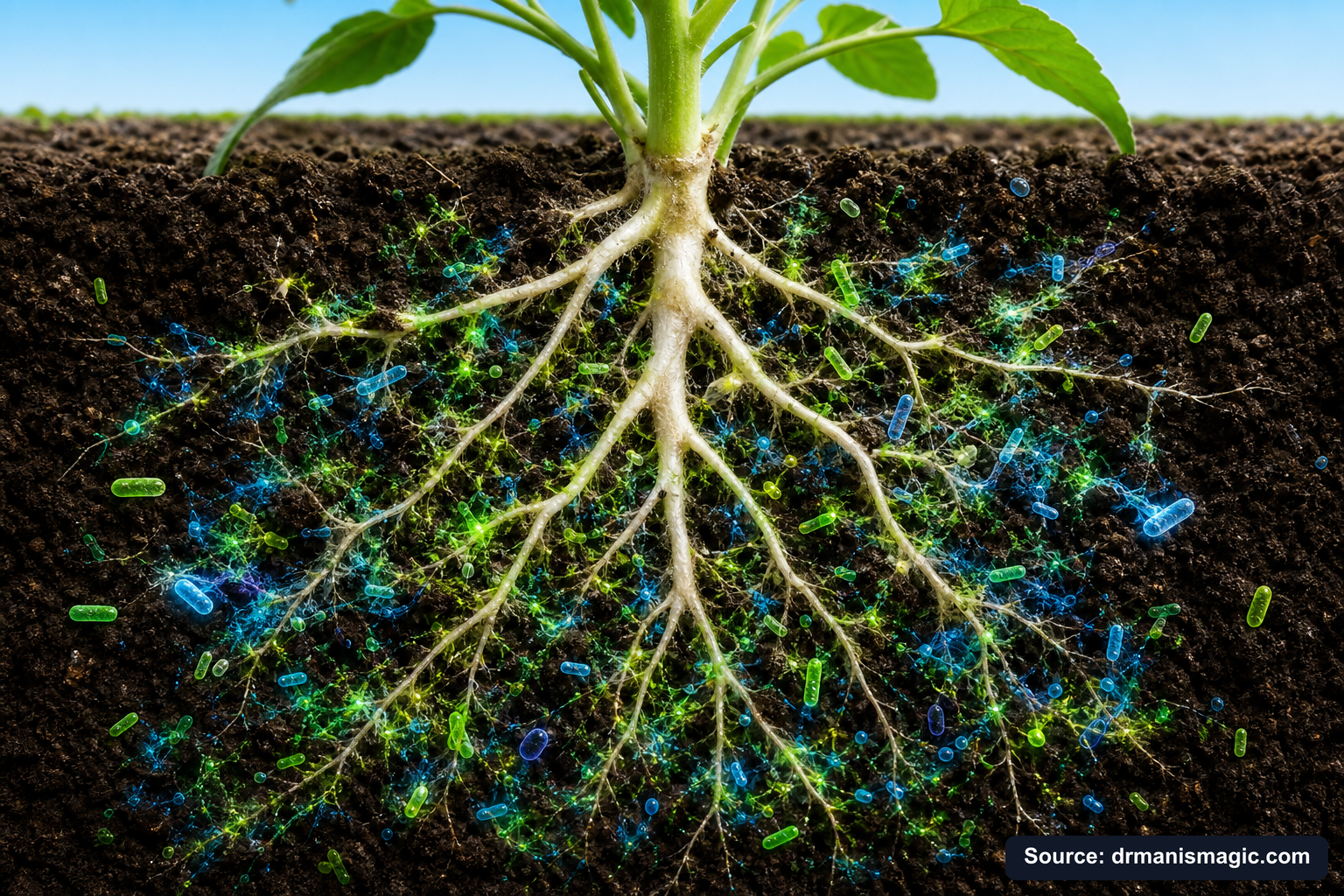
In dead soil, none of that happens. The root system grows in a simpler, less responsive pattern. The plant cannot form fungal partnerships. It cannot recruit bacterial helpers. It cannot prime its own defenses. It is on its own.
This is why so many potted plants struggle. Sterile potting mix starts with no biology. Then the first dose of salt-based fertilizer kills any stray organisms that managed to survive. The plant is left in a biological desert, dependent entirely on whatever you pour into it. Miss a feeding? The plant starves. Water inconsistently? The roots have no fungal network to buffer the stress. Encounter a pathogen? No microbial army to fight it. Just a lone plant trying to survive in dead material.
Most potting mixes make this worse over time. They are built from pine bark and organic materials that decompose. As they break down, they compact. The oxygen channels close. Roots suffocate. Water sits instead of draining. And root rot moves in. This is not bad luck. It is predictable chemistry. See also: The Hidden Reason Synthetic Fertilizers Cause Root Rot
This is exactly why Dr. Mani spent years developing Super Soil — a mineral-based blend built from silica-rich sandy loam from the Rio Grande Valley that does not decompose, does not compact, and does not steal oxygen from roots. It is the foundation that makes living biology possible. Without it, even the best microbes in the world are fighting an uphill battle.
You Never Had a Brown Thumb.
You were handed the wrong tools. This free guide hands you the right ones.
You watered it. You fed it. It died anyway.
It was never you. It was the dirt, the salt food, and the bad advice.
This guide shows you what really went wrong, and how to fix it for good.
- Why your plants really died, and why it was never your fault
- The salt hiding in your plant food that quietly burns the roots
- The hidden killer in almost every bag of store soil
- The tiny helpers that grow a whole forest for free
- The rescue trick that brings a half dead plant back to life

Live Microbes vs. Dead Microbe Products: Why Does It Matter?
Quick Answer: Most commercial microbe products on store shelves contain dried, dormant spores that research and real-world testing show rarely reactivate meaningfully in soil. Liquid products made from compost often go anaerobic in the bottle and smell like sewage because the microbes are dying. Genuinely live, stabilized, full-spectrum microbes are rare and dramatically more effective.
Walk into any garden center and you will see shelves full of "beneficial bacteria" products. Bottles with scientific-sounding names. Labels with impressive organism counts. Price tags that suggest something serious is inside.
Here is what Dr. Mani found after testing dozens of these products on his 250,000 citrus trees. Most of them did nothing. Zero visible improvement. No measurable root response. No difference in plant health.
Why?
Because most commercial microbe products fall into three categories. None of them work the way the marketing suggests.
Category 1: Dried lab-grown powder. These are manufactured in giant factory vats, spray-dried into powder, and sold with impressive species counts on the label. The hope is that when you add water, the dormant spores reactivate. After extensive testing at US Citrus Nursery, Dr. Mani found these products consistently failed to produce meaningful results. The organisms are too stressed, too narrow in spectrum, and too far removed from the living soil ecology they are supposed to join.
Category 2: Liquid compost tea left to sit and ship. These smell. Badly. If you open a bottle of microbe product and it fizzes, stinks, or smells like sewage, what you are smelling is the death of microbes. The product went anaerobic. The organisms suffocated and fermented in the bottle before it ever reached your plant. You may get some benefit from residual humic and fulvic acids, but the living biology is largely gone.
Category 3: Lactobacillus-based products. Easy to produce. Vigorous. But lactobacillus bacteria are aggressive enough to crowd out the beneficial species your plant actually needs. They belong in yogurt, not your garden soil.
The solution Dr. Mani found was not a new synthetic formula. It came through a providential meeting with a world-class compostologist who had developed a completely natural technique to stabilize the full spectrum of microbes from fresh compost without letting them go anaerobic. This expert had advised royal families and governments on their farming practices. Then he was quietly blacklisted by large chemical interests when his methods started showing results that threatened their business model. Eventually, he joined the US Citrus Nursery team. And from that partnership came the Dr. Mani's Magic line.
| Product Type | Microbe Viability | Spectrum | Odor | Real-World Results |
|---|---|---|---|---|
| Dried lab powder (bagged) | Very low — dormant spores rarely reactivate | Narrow (a few selected species) | None | Little to no measurable benefit in Dr. Mani's testing |
| Dried powder rehydrated in liquid | Very low — same issue | Narrow | Mild to none | Same weak results |
| Old compost tea (more than 24 hours) | Low — anaerobic die-off | Partial | Strong and unpleasant | Some humic/fulvic benefit; biology mostly dead |
| Fresh compost tea (under 24 hours, aerated) | Moderate | Partial | Earthy to slightly sour | Good if used immediately — not practical to bottle or ship |
| Lactobacillus-based liquid | High — very vigorous | Extremely narrow (one genus) | Mild | Crowds out beneficial species; not recommended for soil |
| Plant Super Boost (stabilized, full-spectrum) | High — verified live under microscope | 2,000+ bacteria; 400-500 fungi including mycorrhizae; protozoa and nematodes | Earthy, not foul | Visible root response and improved plant health across 250,000+ trees tested |
Plant Super Boost does not smell bad because it is not rotting. The microbes are alive and stable. You can take a drop and look at it under a microscope. You will see movement. That is not a marketing claim. That is biology you can verify with your own eyes. And unlike products that may contain biosludge or PFAS compounds from industrial compost sources, Plant Super Boost is made from clean, natural compost with zero synthetic salts and zero biosludge.
Is Your Soil Alive, Dormant, Damaged, or Hostile? How to Know
Quick Answer: Living soil smells earthy, drains well, supports decomposition, and produces plants with rich color and strong roots. Damaged or dead soil may crust over, drain poorly, smell chemical or sour, show no decomposition, or produce plants with pale leaves, weak roots, recurring disease, or salt burn on leaf edges. Each symptom tells you something specific about what went wrong underground.
Not all soil problems look the same. And not all of them get fixed the same way.
Before you can bring your soil back to life, you need to know where it is starting from. Here is a simple way to think about it.
Living soil: Smells like rain and earth. Water soaks in quickly. You find earthworms when you dig. Organic matter in the soil breaks down over weeks or months. Plants have deep green color, robust branching, and handle stress without drama.
Dormant soil: Not destroyed, just depleted. Fewer organisms than healthy soil. Plants grow, but slowly. They need more inputs to perform. Recovery is possible with consistent biology reintroduction and organic matter.
Damaged soil: Has been exposed to pesticides, herbicides, synthetic fungicides, or repeated salt-based fertilizer applications. The biological community is severely reduced. Plants struggle. Diseases recur. Roots are shallow and poorly branched. Recovery takes longer and requires patience.
Hostile soil: High salt concentration (from fertilizer buildup or road salt), extreme pH imbalance, waterlogging, fumigation, or contamination. Microbes cannot survive in these conditions even if you add them. You must fix the physical and chemical environment before biology can take hold.
How Do You Bring Dead or Damaged Soil Back to Life?
Quick Answer: Rebuilding soil biology is a process, not an event. It requires stopping the inputs that kill microbes, correcting physical and chemical problems first, adding organic matter as food for biology, introducing live microbes in a habitat that can support them, and maintaining moisture and aeration over weeks and months. Expect gradual improvement, not overnight magic.
Here is the honest truth. You cannot pour one bottle of microbes into dead soil on Monday and have living soil by Friday.
Biology takes time. It follows a sequence. It needs habitat before it can build population. But when you follow the right steps, in the right order, the change is real. Measurable. And it keeps improving month after month.
Here is a practical recovery protocol built from what Dr. Mani's team learned over decades in South Texas.
- Stop the damage first. Cut out broad-spectrum pesticides, synthetic fungicides, and salt-based fertilizers. You cannot rebuild a house while someone is still knocking it down.
- Test your soil pH and salinity. Microbes need a pH range of roughly 6.0 to 7.5 to thrive. High salt concentrations from fertilizer buildup will kill biology even if you add it. If salt is high, flush the soil with clean water over several waterings.
- Fix drainage and aeration. Compacted, waterlogged soil is an anaerobic environment. Aerobic bacteria and mycorrhizal fungi cannot survive there. Break up compaction, improve drainage, and make sure roots can breathe.
- Add organic matter as food for microbes. Mature compost, worm castings, or an organic fertilizer with biostimulants like Crab, Kelp and Amino Acids give the biology something to eat and multiply on. No food, no colony.
- Mulch the surface. Mulch keeps moisture steady, moderates temperature, and feeds surface organisms. It is one of the simplest and most powerful things you can do for soil biology.
- Introduce live, full-spectrum microbes. Now that the habitat is ready, add biology. Monthly applications of genuinely live microbes give the colony reinforcements and maintain diversity as environmental pressures continue to thin the population.
- Be consistent and patient. Measure progress in weeks and months, not days. Root branching improves. Color deepens. Disease pressure drops. The improvement builds on itself once the ecosystem has enough momentum.
This is the foundation of the Three Plant Pillars: mineral-based soil that does not collapse, live microbes that actually stay alive, and organic fertilizer that feeds the biology instead of burning it. When all three are in place together, the recovery accelerates dramatically.
See also: Why Most Fertilizers Are Actually Salt in Disguise
Why Do Synthetic Fertilizers and Pesticides Make This Problem Worse Over Time?
Quick Answer: Salt-based synthetic fertilizers create osmotic pressure in the soil that dehydrates and kills beneficial microbes. Pesticides and herbicides, especially broad-spectrum ones, reduce microbial diversity and population. Synthetic fungicides suppress mycorrhizal fungi. Over repeated applications, the soil becomes increasingly sterile and the plant becomes increasingly dependent on chemical inputs just to function.
Here is the cycle nobody talks about at the garden center.
You buy a plant. You pot it in sterile bark-based mix. You feed it with a salt-based fertilizer because that is what the bag recommended. The fertilizer works for a few weeks. The plant greens up. You feel good.
But underneath, the salt is slowly damaging the root zone. The few microbes that were there die off. The plant becomes more dependent on the fertilizer for every nutrient. The soil compacts as the bark breaks down. Oxygen disappears from the root zone. Then root rot moves in.
You spray a fungicide to stop the rot. The fungicide kills the remaining beneficial fungi along with the pathogenic ones. Now the plant has no mycorrhizal partners, no bacterial support, no immune training. It is completely alone.
So you buy more fertilizer. More fungicide. Maybe an insecticide. The plant limps along. You spend more. Nothing fundamentally improves.
That is not your fault. That is the system working exactly as designed. Big chemical companies and big box stores sell you inputs, not outcomes. They benefit when your plant needs more inputs. They do not benefit when your soil is so alive it feeds your plant on its own.
Dr. Mani watched this pattern repeat across the gardening industry for decades. It is why he spent years developing products that work with soil biology instead of against it. Zero synthetic salts. Zero PFAS. Zero biosludge. Just mineral-based soil, genuinely live microbes, and slow-release organic nutrition that feeds the ecosystem instead of burning it.
The time cost of doing it the old way is the part that never shows up on the fertilizer bag. You can get money back. You cannot get time back. The number one thing Dr. Mani hears from gardeners is that they want to see fruit on a tree they planted with their own hands before their time runs out. That is not a small wish. That is deeply human. And it is the clearest reason to stop wasting years on a system that cannot deliver it.
What Can You Do Right Now to Start Building Living Soil?
Quick Answer: Start by stopping the inputs that kill soil biology, then add organic matter, improve drainage, and introduce genuinely live microbes monthly. If you are starting fresh in a pot or raised bed, build the foundation right the first time with mineral-based soil, live microbials, and organic fertilizer working together. Small consistent steps compound into a living system that grows stronger every month.
You do not have to overhaul everything at once.
Start where you are. With what you have. Today.
If your plant is in a compacted, bark-heavy potting mix that is starting to smell sour — that is the first problem to fix. Dead, decomposing soil cannot host the biology your plant needs.
If you have been using salt-based fertilizers, give the soil a flush with clean water over a few watering cycles. Then switch to an organic, slow-release option that will not burn the microbes you are about to add.
Then add live biology. Not a powder that sat on a shelf for eight months. Not a liquid that smells like something crawled into the bottle and died. Genuinely live, full-spectrum microbes from a source you can trust.
And do it monthly. Not as a one-time event. Because the pressures that reduce soil biology — sunlight, temperature swings, dry spells, trace chemical exposure — do not stop. Neither should your reinforcement of the underground workforce that keeps your plant healthy.
The Free Plant Care Field Guide from Dr. Mani's Magic walks you through exactly how to set this up for any plant — trees, flowers, lawns, vegetables, houseplants, or a backyard orchard. It is practical, plain-language, and built on the same Three Plant Pillars system that has been tested on over 250,000 trees in South Texas.
Your plants are capable of so much more than you have seen so far. The biology to make it happen is real. It is proven. And it is waiting underneath your feet, ready to be awakened.
If you want to give your soil the best possible start with genuinely live microbes that have been verified under a microscope, tested on a quarter million trees, and stabilized without any foul smell or synthetic additives, take a look at what Dr. Mani's team built: Plant Super Boost. Thirty days. If you do not love what you see, you get your money back. No drama.
The soil is ready to come alive. The only question is whether you are ready to let it.
Frequently Asked Questions
If you have ever stared at a struggling plant and wondered what you are doing wrong, you are not alone. These are the questions people ask most after learning that living soil changes everything about how plants grow. The answers below are grounded in over 30 years of real growing experience and more than 250,000 trees tested at US Citrus Nursery in South Texas.
How do plants adapt when soil is alive?
When soil is full of live microbes, plants respond fast. Roots branch out more. They grow deeper. The plant starts releasing sugars through its roots to feed the bacteria and fungi around it. In return, those microbes unlock nutrients the plant could never reach on its own. The plant also builds a stronger immune system. It fights off pests and disease with far less outside help. Dead soil means a plant is on its own. Living soil means it has an army behind it.
What are the Three Plant Pillars and why do they matter?
The Three Plant Pillars are the foundation Dr. Mani built after decades of watching plants thrive and fail. Pillar One is mineral-based soil that drains well and never compacts. Pillar Two is live microbials that turn your soil into a living ecosystem. Pillar Three is organic fertilizer that feeds plants slowly and safely without burning roots or killing microbes. Get all three working together and your plants stop struggling. They start adapting the way nature intended.
Why do plants in a forest thrive without any fertilizer or watering?
Forest soil is alive. It is packed with bacteria, fungi, and tiny creatures that break down fallen leaves and dead wood into nutrients plants can use. Mycorrhizal fungi stretch out like a web, pulling in water and minerals from far beyond where roots can reach. No bag of blue crystals can copy that. The forest has the Three Plant Pillars working naturally. Your backyard can have that too, once you stop using products that kill the biology underground.
What do salt-based fertilizers actually do to soil biology?
Salt-based fertilizers are like a bomb dropped on your soil. They give a quick green burst, then wipe out the beneficial bacteria and fungi that your plant depends on. Once those microbes are gone, the plant becomes addicted to chemical inputs. It cannot feed itself anymore. You end up buying more and more product while your plant quietly gets weaker. Dr. Mani saw this pattern repeat across thousands of trees. That is exactly why the Dr. Mani's Magic line uses only organic, slow-release inputs that protect your soil life instead of destroying it.
How do live microbials help plant roots grow stronger?
Live microbials, like the ones in Plant Super Boost, include bacteria, fungi, and mycorrhizae. Mycorrhizal fungi alone can extend a root system up to 100 times its normal reach. That means your plant is pulling in water and nutrients from a much larger area than its roots could cover alone. Bacteria break down organic matter and release nutrients right where roots can grab them. The result is a root system that is wider, deeper, and tougher than anything you can build with chemicals.
Why does the type of soil you use matter so much for plant health?
Most potting mixes are made from pine bark and sawdust. Over time, that material breaks down, compacts, and chokes roots. Roots need oxygen to breathe. When soil compacts, oxygen disappears and root rot moves in. Dr. Mani's Magic Super Soil is built on silica-rich sandy loam from the Rio Grande Valley. It does not break down. It stays loose and airy for years. Roots can push deep and breathe freely. That is the mineral foundation every plant needs to truly adapt and thrive.
What are the five things every plant needs to survive, and how does living soil help provide them?
Every plant needs sunlight, water, air, nutrients, and space. Living soil helps with three of those five directly. It holds water without drowning roots. It stays loose so air reaches deep into the root zone. And it delivers nutrients through microbial activity in a slow, steady, plant-friendly way. When your soil is alive, it acts like a built-in support system. You handle the sunlight and the space. The Three Plant Pillars handle the rest.
About the Author
Dr. Mani Skaria, PhD
Dr. Mani Skaria, PhD, is a plant pathologist and the scientific founder of Dr. Mani's Magic. He earned his doctorate at Purdue University and spent 48 years studying how plants, soil, and living microbes work together, including his years as Professor Emeritus at Texas A&M and as a member of the USDA NAREEE Advisory Board. He invented micro-budding, a method for growing healthier, stronger trees, and has grown more than 250,000 trees on the family farm in Hargill, Texas - US Citrus Nursery. His life's work takes real lab science and practical experience and turns it into simple, safe, organic plant care anyone can use at home.


