


How PFAS Persist in Soil for Decades and What You Can Do | Dr. Mani's Magic
How PFAS Persist in Soil for Decades — And What Every Gardener, Landscaper, and Plant Owner Can Do Right Now
You're out in your backyard on a Saturday morning. Coffee in hand. The sun is just coming up. You're looking at your raised bed, your fruit trees, your lawn. Maybe you've been working on this garden for years. You've spent real money on it. Real time. And it looks pretty good.
Then you read something that stops you cold. A headline about "forever chemicals" in garden soil. PFAS. You've heard the term before, vaguely, but now it feels personal. Because this is your soil. Your vegetables. Your grass where your kids play and your dog runs. And the question hits you like a cold wave: How long have these things been here? And are they going anywhere?
That question deserves a straight, honest answer. Not panic. Not vague reassurances. A real answer, with real science, and a real plan. That's what this article is. We've spent over 30 years growing more than 250,000 trees at our South Texas nursery, and we've seen what healthy soil looks like — and what damaged soil costs you, not just in money, but in the one thing you can never get back: time. So let's talk about PFAS, what they actually do in soil, why they stick around so long, and most importantly, what you can do about it.

Organic Fertilizer | Crab, Kelp & Amino Acids
Key Takeaways
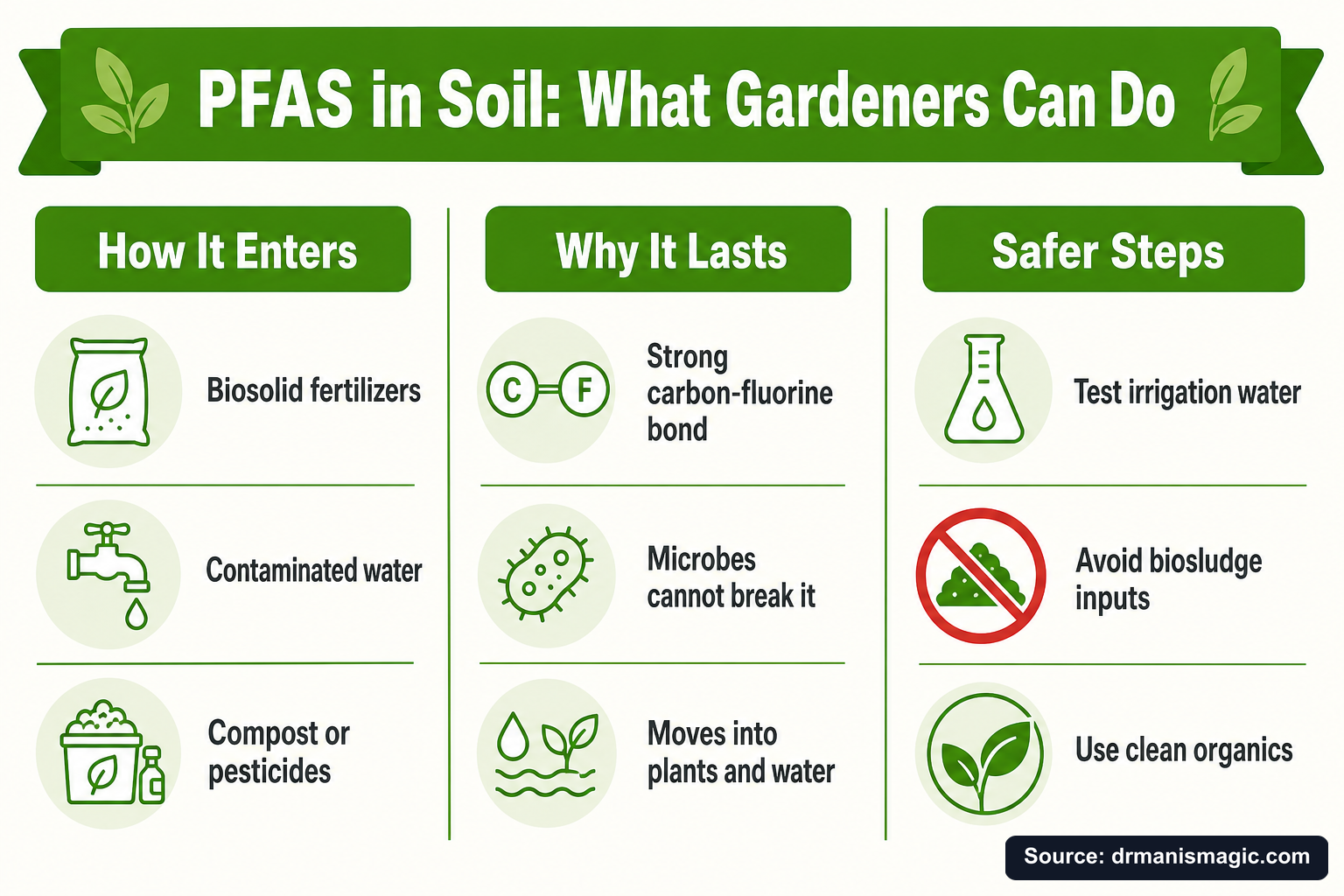
- PFAS are called "forever chemicals" because they contain one of the strongest chemical bonds in nature — the carbon-fluorine bond — which almost nothing in soil can break down.
- Once PFAS enter soil through biosolids, contaminated water, compost, or certain fertilizers, they can remain for decades and continue moving into groundwater and plants.
- Biosolids (treated sewage sludge used as fertilizer) are one of the most common ways PFAS enter garden and farm soil — and wastewater treatment does not destroy them.
- PFAS affect more than vegetables — they can enter lawns, ornamental beds, trees, shrubs, and any plant system irrigated with contaminated water or fed with biosolid-based inputs.
- Your soil's living microbes — bacteria, fungi, and mycorrhizae — are your first line of defense for long-term soil health, and protecting them matters even more in a PFAS-concerned world.
- There are practical steps you can take right now: test your water, audit your inputs, choose clean amendments, and build biology-first soil that reduces your exposure risk.
- Clean, slow-release organic inputs — free of biosludge, synthetic salts, and PFAS — are the foundation of a safer, stronger garden regardless of where you start.
What Are PFAS and Why Do They Stay in Soil for Decades?
Quick Answer: PFAS are man-made chemicals built around an extremely strong carbon-fluorine bond. That bond is so tough that normal soil processes — water, sunlight, heat, and microbes — cannot break it down. This is why PFAS stay in soil for decades instead of breaking apart like ordinary organic matter does.
PFAS stands for per- and polyfluoroalkyl substances. There are thousands of them. They've been used since the 1940s in nonstick cookware, waterproof fabrics, food packaging, firefighting foam, and even some pesticides.
The reason they're called "forever chemicals" is not hype. It's chemistry.
At the heart of every PFAS molecule is a chain of carbon atoms bonded to fluorine atoms. That carbon-fluorine bond is one of the strongest in all of organic chemistry. It resists water. It resists sunlight. It resists heat. And it resists the bacteria and fungi that normally break things down in soil.
Think about how a fallen leaf breaks down. Within months, microbes eat it, digest it, and return its nutrients to the soil. That's normal organic matter doing what organic matter does.
PFAS do not do that. They just sit there. Or they move.
Some PFAS bind tightly to soil particles, especially in soils rich in organic matter. Others — particularly the shorter-chain varieties — are more mobile. They travel with water. They sink into groundwater. They move toward plant roots. And they accumulate.
According to research from Michigan State University Extension, PFAS can partition into sewage sludge during wastewater treatment and then be applied to farmland as biosolids, where they infiltrate soil, move into groundwater, and are taken up by plants. The two most commonly regulated PFAS compounds are PFOA and PFOS, but there are thousands of others that most labs don't even test for.
So the answer to "will these be in my soil decades from now?" is yes — unless something actively moves them out, and even then, you may be trading one problem for another. Clean water can dilute and leach some mobile PFAS over time, but it does not guarantee safety. It may simply move the problem deeper or into a neighboring water source.
How Does PFAS Get Into Garden Soil in the First Place?
Quick Answer: PFAS enter garden soil primarily through biosolid fertilizers (treated sewage sludge), contaminated irrigation water, certain compost products, atmospheric deposition, and some pesticides. You may not even know it happened, because PFAS have no smell, no color, and no visible sign.
This is the part that surprises most people. You didn't do anything obviously wrong. You followed the instructions on the bag. You watered your plants. You maybe bought some compost from the city.
And that's exactly how PFAS got in.
Here are the most common entry points:
Biosolids and Sewage Sludge
Biosolids are what you get after wastewater treatment facilities process human sewage. They look like dark, crumbly material. They contain nitrogen and other nutrients. And for decades, they've been applied to agricultural land and sold as garden fertilizer — sometimes marketed under pleasant-sounding names that don't mention sewage at all.
The problem is that wastewater treatment does not destroy PFAS. It concentrates them. PFAS from household products, industrial discharge, and stormwater all flow into treatment plants. The PFAS don't break down. They bind to the sludge. And then that sludge gets applied to your field, your lawn, or your garden.
MSU Extension notes that biosolids may also carry microplastics, pharmaceuticals, heavy metals, and thousands of PFAS beyond PFOA and PFOS. Most of those are not regulated or even tested.
Contaminated Irrigation Water
If your well, pond, or municipal water supply is downstream from an industrial site, military base, airport, or wastewater discharge point, your irrigation water may already carry PFAS. Every time you water, you're adding a tiny amount more to your soil.
Compost of Unknown Origin
Municipal compost is made from collected yard waste, food scraps, and sometimes biosolids. If you don't know what went into the pile, you don't know what you're spreading.
Atmospheric Deposition
PFAS are in the air. They travel on dust and rainfall. This is called background contamination, and it affects virtually every outdoor surface on Earth to some degree. Rural areas near industrial sources have higher levels.
Certain Pesticides and Treated Materials
Some older pesticide formulations contained PFAS as surfactants (substances that help the chemical spread and stick). Glossy cardboard mulch and some treated landscape fabrics can also be sources.
Does PFAS Contamination Only Affect Vegetable Gardens?
Quick Answer: No. PFAS can enter any plant system — lawns, ornamental beds, street trees, fruit trees, shrubs, sports fields, nursery stock, and houseplants — through contaminated soil, irrigation water, or biosolid-based amendments. The risk is not limited to food crops.
Most of the public conversation about PFAS focuses on vegetables. Leafy greens. Root crops. Things you eat directly from the ground.
But PFAS don't read labels. They don't stop at the edge of your vegetable bed.
Your lawn grass absorbs water and nutrients from the same soil. Your ornamental shrubs do too. Your potted citrus tree on the patio, if you're watering it from a contaminated source or feeding it with a biosolid-based fertilizer, is being exposed too.
And here's something almost no one talks about: PFAS in soil affect the biology of that soil. The bacteria, the fungi, the mycorrhizal networks — the microscopic living world that healthy plant roots depend on. Research is still emerging on exactly how PFAS disrupt soil microbiology, but we know that chemical stress in soil suppresses microbial diversity and activity. When the microbes suffer, the plants suffer. Every plant. Not just the ones on your dinner plate.
At our nursery, after growing and observing more than 250,000 citrus trees, we've learned that healthy soil biology is the single most important factor in long-term plant health. Anything that disrupts that biology — salt-based fertilizers, toxic inputs, PFAS accumulation — costs you growth, resilience, and time.
See also: The Hidden Reason Synthetic Fertilizers Cause Root Rot
Can PFAS Be Washed Out of Soil Over Time?
Quick Answer: Partially, and only for the more mobile, shorter-chain PFAS. Longer-chain PFAS bind tightly to soil organic matter and don't move easily. Even mobile PFAS flushed out of topsoil can migrate into groundwater or deeper soil layers, trading one problem for another rather than truly eliminating the contamination.
It's a reasonable hope. Water washes things away, right?
For some PFAS, yes — to a degree. Shorter-chain PFAS compounds are more water-soluble. They don't bind as tightly to soil particles. Heavy rainfall or deep irrigation can leach some of them downward and eventually out of the root zone.
But here's the catch: where do they go? They go into your groundwater. Into the water table. Into streams and aquifers that feed wells and irrigation systems elsewhere. You haven't eliminated the problem. You've moved it.
Longer-chain PFAS behave differently. They're attracted to organic matter in soil — the humus, the decomposing plant material, the sticky dark stuff that holds nutrients and water. They bind to it. They stay put. And because organic matter is exactly what you're trying to build for healthy soil, there's a real tension here: the very thing that makes soil fertile also tends to hold onto PFAS.
The takeaway is this: do not expect rain or irrigation to solve a PFAS soil problem. The chemistry does not work that way. Prevention and clean inputs are far more powerful than trying to flush your way out.
Do Plants Actually Absorb PFAS from Contaminated Soil?
Quick Answer: Yes. Plants can take up PFAS from soil and water, especially shorter-chain, more mobile compounds. The amount depends on the plant species, the PFAS type, soil conditions, and concentration. Leafy greens and root vegetables typically absorb more than woody trees, but no edible or ornamental plant is fully immune.
Here's what makes this uncomfortable: you can't see it, smell it, or taste it.
PFAS-contaminated vegetables look normal. They taste normal. But research published through university extension systems confirms that certain crops — particularly leafy greens like lettuce and spinach, and root crops like carrots and radishes — can accumulate measurable PFAS concentrations when grown in contaminated soil or irrigated with contaminated water.
Fruit trees and woody plants generally take up less PFAS than leafy crops, partly because of how their root systems work and how nutrients are distributed through the plant. But "less" is not "none."
The Penn State Extension notes that PFAS plant uptake is influenced by soil pH, organic matter content, the specific PFAS compound, and root architecture. Sandy soils with low organic matter tend to have more mobile PFAS. Soils with high organic matter bind more PFAS, which reduces uptake but also makes remediation harder.
For gardeners growing food, this is a genuine concern. For anyone managing lawns, ornamentals, or containers, the concern shifts more to soil biology and long-term ecosystem health. Either way, the answer is the same: reduce your PFAS inputs, protect your soil biology, and make smarter choices about what you put in the ground.
How Do PFAS Harm Soil Microbes and Root Health?
Quick Answer: PFAS can suppress microbial diversity and activity in soil, including the bacteria and fungi that cycle nitrogen, phosphorus, and carbon for plant roots. A disrupted microbiome means weaker nutrient delivery, reduced disease resistance, and slower plant growth — even in soil that looks normal on the surface.
This is the connection almost nobody talks about. And it's the one we care about most.
Healthy soil is alive. Under every square foot of good garden soil, there are billions of bacteria, miles of fungal threads, nematodes, protozoa, and thousands of other organisms. This living community does three enormous things for your plants:
- It cycles nutrients — breaking down organic matter and making nitrogen, phosphorus, and minerals available to roots.
- It protects roots — beneficial microbes outcompete and suppress disease organisms like Pythium and Phytophthora, the fungi responsible for root rot.
- It builds soil structure — fungal networks and bacterial biofilms hold soil particles together, creating the air pockets and drainage channels that roots need to breathe.
PFAS are surfactants by nature. Many of them were designed to disrupt the surface tension of water. In soil, that same property can disrupt microbial cell membranes, alter the way microbes interact with soil particles, and shift the balance of microbial communities in ways that favor pathogens over beneficial organisms.
The result? Nutrient cycling slows. Nitrogen fixation drops. Mycorrhizal connections weaken. Plants that look healthy on the outside start running on fumes. And then a stress event — a heat wave, a dry stretch, a pest pressure — tips them over the edge.
This is why the Three Plant Pillars framework we developed at US Citrus Nursery matters so much in any conversation about PFAS and soil health. Mineral-based soil that drains properly. Live microbials that rebuild biological activity. Organic fertilizer that feeds the microbes without salt, without biosludge, without PFAS. When those three things are in place, your soil has the resilience to handle stress — including the long-term stress of contamination — better than soil that was never properly built in the first place.
Is Biosolid Fertilizer a PFAS Risk? What About Compost and Manure?
Quick Answer: Yes, biosolid-based fertilizers carry a significant PFAS risk because wastewater treatment concentrates PFAS into sludge rather than destroying it. Municipal compost of unknown feedstock is also a risk. Manure from animals fed on PFAS-contaminated crops or water can carry PFAS too. The safest inputs are clean-sourced organic materials with known, transparent supply chains.
Let's be direct here, because there's a lot of confusion in the marketplace.
The word "organic" on a fertilizer label does not automatically mean PFAS-free. It means the nitrogen source is derived from biological material rather than synthesized chemically. But biological material can be biosolids. It can be municipal sewage sludge. It can be composted food waste from industrial processors who use PFAS-containing packaging and equipment.
The table below compares common soil amendments by PFAS risk, salt impact on microbes, and overall soil biology benefit. Use it as a quick reference when evaluating what to put in your garden.
| Amendment Type | PFAS Risk Level | Salt Impact on Microbes | Soil Biology Benefit | Notes |
|---|---|---|---|---|
| Biosolid fertilizer (sewage sludge) | High | Low to moderate | Low — may carry pathogens | Wastewater treatment concentrates PFAS; not destroyed |
| Municipal compost (unknown feedstock) | Moderate to High | Low | Moderate | Feedstock source is the key unknown |
| Conventional synthetic fertilizer | Low (for PFAS) | Very High — salt kills microbes | Harmful — disrupts microbial balance | Salt-based; causes osmotic stress, root burn, microbial die-off |
| Manure (unknown source) | Low to Moderate | Low | Moderate | Risk depends on animal feed and water source |
| Fish emulsion / fish hydrolysate | Low to Moderate | Low | Good | Contaminated ocean sources may carry PFAS; verify origin |
| Crab shell / chitin-based organic fertilizer | Very Low (clean sourced) | Minimal | Excellent — feeds microbes, activates plant immunity | Chitin is a natural soil biology activator |
| Kelp / seaweed extract | Very Low (clean sourced) | None | Excellent — biostimulants, hormones, trace minerals | Cold-processed kelp preserves active compounds |
| Amino acid fertilizer | Very Low (clean sourced) | None | Excellent — easily absorbed, microbe-friendly nitrogen | Plant-ready nitrogen without salt |
| Leaf compost / clean yard waste compost | Very Low | None | Good to Excellent | Know your source; avoid municipal unknowns |
| Volcanic mineral / rock dust | Very Low | None | Excellent — trace minerals, silica, soil structure | Long-term mineral replenishment |
The pattern is clear. The inputs with the highest PFAS risk tend to be the ones that flow through human waste streams. The inputs with the lowest PFAS risk — and the highest biology benefit — are clean-sourced materials derived from marine organisms, amino acids, and minerals.
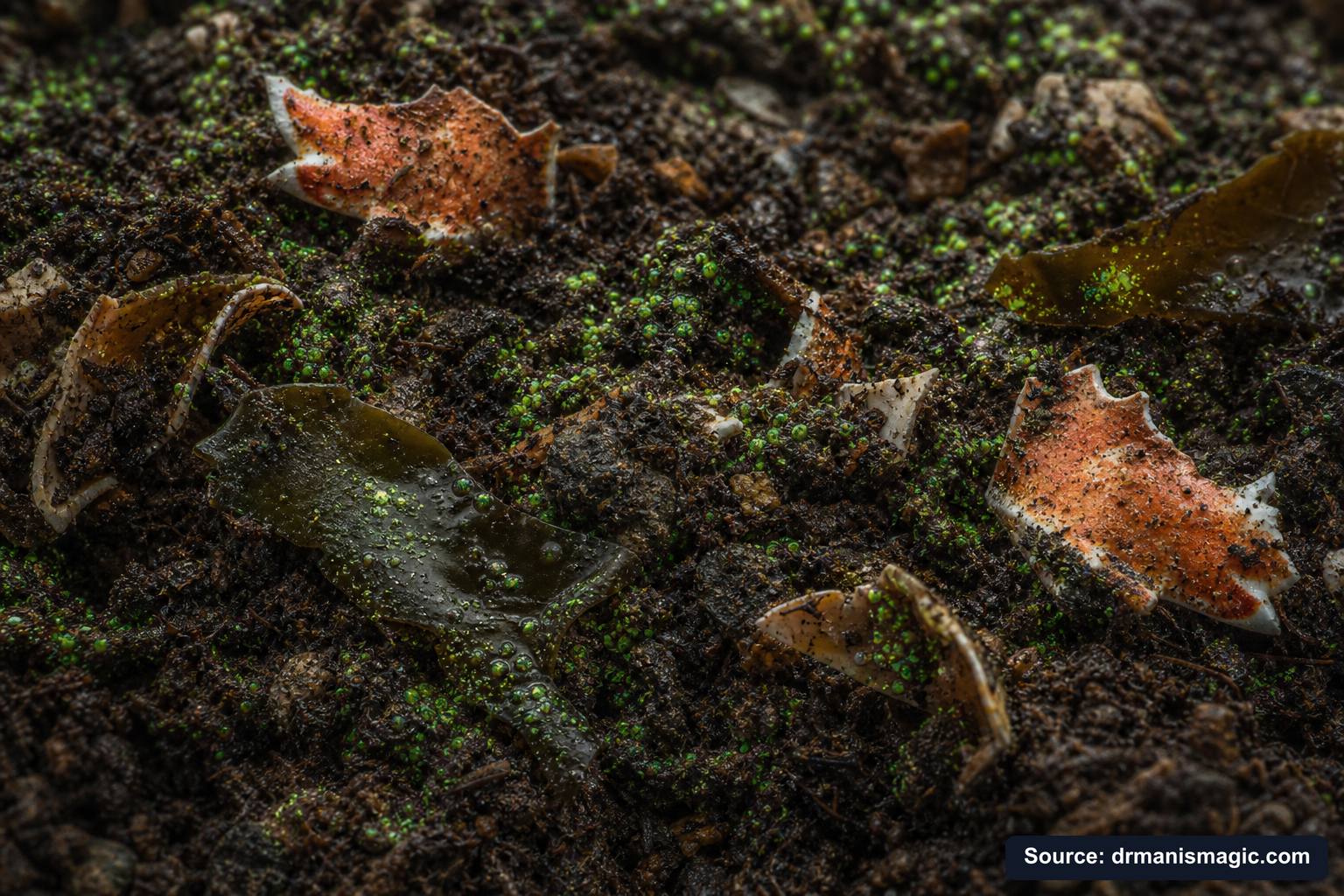
This is not a coincidence. It's exactly why we built our fertilizer program around crab shells, cold-processed kelp, amino acids, and volcanic ash. Zero biosludge. Zero synthetic salts. Zero PFAS. And a complete nutritional profile that feeds your plants the way nature intended.
You Never Had a Brown Thumb.
You were handed the wrong tools. This free guide hands you the right ones.
You watered it. You fed it. It died anyway.
It was never you. It was the dirt, the salt food, and the bad advice.
This guide shows you what really went wrong, and how to fix it for good.
- Why your plants really died, and why it was never your fault
- The salt hiding in your plant food that quietly burns the roots
- The hidden killer in almost every bag of store soil
- The tiny helpers that grow a whole forest for free
- The rescue trick that brings a half dead plant back to life

Synthetic Fertilizer vs. Organic Fertilizer: Which One Is Safer for PFAS-Concerned Gardeners?
Quick Answer: Clean-sourced organic fertilizers are safer on both counts. Conventional synthetic fertilizers are salt-based, which damages soil microbes and causes root stress, but they are low in PFAS. Biosolid-based "organic" fertilizers can be high in PFAS. The safest choice is a clean organic fertilizer with a transparent, verified supply chain — no biosludge, no synthetic salts, no fillers.
This is the "vs" question that matters most for anyone trying to make smart choices in a PFAS-aware world.
Synthetic fertilizers — the fast-acting, bright-blue, water-soluble kind — are generally not a significant PFAS source. Their problem is different. They're salt-based. And salt is the quiet killer of soil biology.
Here's how it works. When you apply a high-salt synthetic fertilizer, the soil around the roots becomes saltier than the water inside the root cells. The plant tries to absorb water from the soil, but the salt pulls water in the opposite direction — out of the roots. This is called osmotic stress, and it's the same principle as physiological drought. The plant is sitting in moist soil but dying of thirst.
At the same time, the salt kills the beneficial microbes in the surrounding soil. Those bacteria and fungi that cycle nutrients, protect roots from Pythium and Phytophthora, and build soil structure — they die. And without them, your soil becomes a dead medium that needs more and more synthetic input just to keep the plant alive. It's a cycle the big chemical companies profit from. But you pay the price in dead plants and wasted time.
See also: Why Most Fertilizers Are Actually Salt in Disguise
Organic fertilizers, on the other hand, don't work like a salt bomb. They work like a cafeteria for microbes. Here's the mechanism most people don't know:
When you apply a good organic fertilizer — say, one made from crab shells, kelp, and amino acids — the microbes in your soil eat it first. They digest it. They convert it into forms the plant can use, like ammonium and nitrate. Then, when those microbes die, they release all of that nutrition directly into the root zone in an easy-to-absorb form. The whole process runs on its own timeline, continuously, like a slow drip IV instead of a flood. The plant gets what it needs, when it needs it, without the shock, the salt burn, or the microbial massacre.
That's not just a nicer way to fertilize. It's how nature actually works. It's what happened in forests and prairies for millions of years before anyone invented a bag of blue crystals.
| Feature | Synthetic Fast-Release Fertilizer | Slow-Release Synthetic (Coated) | Clean Organic (Chitin / Kelp / Amino Acids) |
|---|---|---|---|
| PFAS risk | Low | Low to Moderate (plastic coating residue) | Very Low (clean sourced) |
| Salt index | Very High | Moderate | Very Low |
| Effect on soil microbes | Kills beneficial bacteria and fungi | Less damaging but still suppressive | Feeds and supports microbial populations |
| Risk of root burn / osmotic stress | High | Moderate | Minimal |
| Nutrient release timeline | Immediate spike, then nothing | Weeks to months | Continuous, biology-mediated slow release |
| Soil health over time | Degrades — creates dependency | Neutral to slightly negative | Improves — builds long-term fertility |
| Biosludge / sewage sludge filler | Sometimes | Sometimes | Never (in verified clean products) |
| Plastic shell residue in soil | No | Yes — microplastic accumulation | No |
Can Microbes Break Down PFAS in Garden Soil?
Quick Answer: Not reliably, and not completely. While some specific microbial strains have shown limited ability to break certain PFAS compounds under controlled laboratory conditions, no naturally occurring soil microbiome can fully break down PFAS in garden soil. However, a healthy, diverse microbiome does improve overall soil resilience and may reduce PFAS mobility and plant uptake over time.
This is a question researchers are actively studying. And it's an honest one to ask.
The short answer is that PFAS are so chemically stable — specifically because of that carbon-fluorine bond — that very few living organisms have evolved any meaningful ability to break them apart. The bond is simply too strong. Natural biodegradation, which is how virtually every other organic pollutant eventually breaks down, has almost no power here.
There are some exciting early findings in microbiology labs. Certain bacterial strains can, under specific conditions, partially defluorinate some PFAS molecules. But "partially," "specific conditions," and "laboratory" are three enormous qualifiers. In real garden soil, with all its complexity, temperature swings, pH variation, and competing chemistry, we are nowhere near a microbial PFAS cleanup solution.
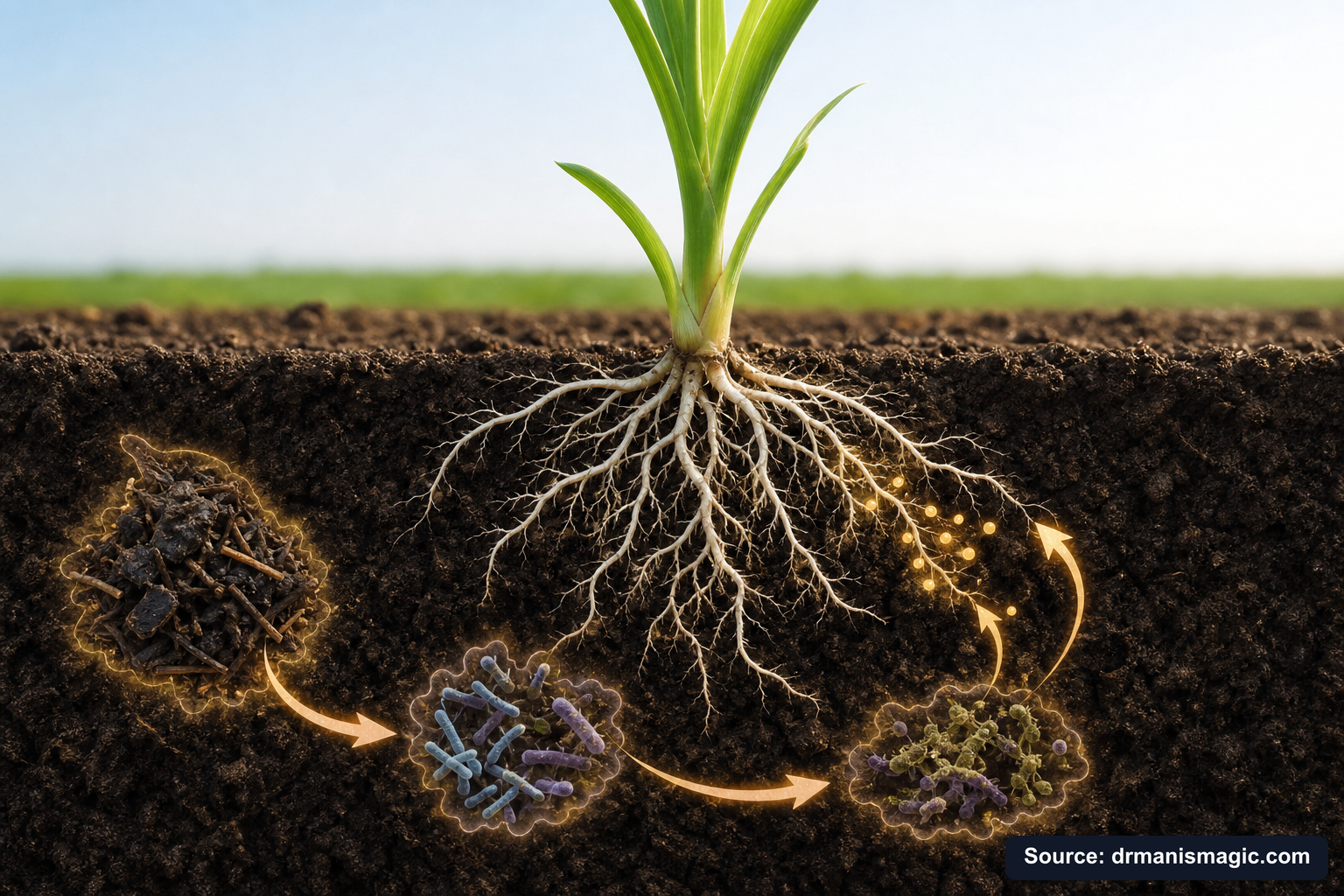
What a healthy microbiome can do is make your soil more resilient overall. Strong microbial communities improve soil structure, which affects how water and PFAS move through the profile. They can help build organic matter that holds certain PFAS in place, reducing the amount that reaches plant roots or groundwater. And they make your plants stronger — better able to tolerate environmental stressors of all kinds.
This is why rebuilding and protecting your soil biology is not just good advice in general. In a PFAS-contaminated world, it's one of the most practical things you can actually do. You can't destroy the PFAS. But you can build a soil ecosystem that is as strong and resilient as possible around them.
The Plant Super Boost we developed at US Citrus Nursery is built around exactly this principle — live bacteria, fungi, and mycorrhizae that rebuild the soil ecosystem from the root zone up. It's what we use on our own trees. It's what we've tested across more than 250,000 plants.
Are Raised Beds Safe If Your Soil Has PFAS?
Quick Answer: Raised beds filled with clean, verified soil are one of the most practical options for growing food in a PFAS-affected area. They separate your plants from contaminated ground soil. But they are not foolproof — PFAS can still enter through contaminated irrigation water, treated wood, or amendments with unknown sourcing. Choose your inputs carefully.
Raised beds are the most common practical solution gardeners reach for, and they're a reasonable one — with some important conditions.
The core logic is sound. If your in-ground soil is contaminated, physically separating your plants from that soil removes a major exposure pathway. A raised bed filled with clean, verified soil and watered with clean, tested water significantly reduces the PFAS your plants encounter.
But raised beds are not a complete solution if:
- Your irrigation water is PFAS-contaminated. Every watering adds more to your clean bed over time.
- You fill the bed with municipal compost or bulk soil of unknown origin. You may be importing the exact contamination you're trying to avoid.
- You use pressure-treated lumber that contains PFAS-based treatments or other preservatives.
- The bed has no liner and sits on contaminated ground where capillary action can pull PFAS upward.
For lawns, ornamentals, street trees, and landscape shrubs — where you're not eating the plant directly — raised beds are less relevant. The focus there shifts to choosing clean amendments, testing irrigation water, and building the strongest possible soil biology to support plant health despite background contamination.
What Practical Steps Can You Take Right Now If You're Concerned About PFAS in Your Soil?
Quick Answer: Start with your water, not your soil. Test irrigation water first, since it's the most common ongoing PFAS input. Then audit your amendments. Switch to clean, verified organic inputs. Consider soil testing if you have a known high-risk source nearby. Build raised beds for edible crops in high-concern areas. Protect your soil biology above everything else.
Here is a numbered recovery and risk-reduction checklist you can follow right now:
- Test your irrigation water first. Your water is the most consistent ongoing source of PFAS into your soil. Contact a certified laboratory that uses EPA Method 1633 for comprehensive PFAS testing. This is more important than soil testing for most home gardeners.
- Audit every amendment you're using. Read labels carefully. If a product lists biosolids, sewage sludge, municipal waste, or does not disclose its nitrogen source, set it aside. Ask manufacturers directly: does this product contain biosolids or PFAS?
- Stop using fertilizers with unknown or biosludge-based nitrogen sources. Switch to clean, transparent organic inputs — chitin from crab shells, cold-processed kelp, amino-acid nitrogen, and volcanic mineral trace elements. These have clear, verifiable supply chains and zero biosludge content.
- If you have a known high-risk source nearby (military base, industrial site, airport, heavy biosolid application history), consider soil testing through a certified lab using EPA Method 1633. Interpret results in parts per trillion (ppt) — concentrations are often very small in number but still meaningful.
- For edible crops in high-concern areas, transition to raised beds filled with clean, mineral-based soil from a verified source. Line the bed with a barrier. Use tested water.
- For lawns, ornamentals, and trees, focus on soil biology. Rebuild microbial life with live microbials. Stop using salt-based synthetic fertilizers that kill the beneficial organisms your plants depend on. A living soil is more resilient to all forms of chemical stress, including PFAS.
- Choose lower-risk crops if you're growing food in uncertain soil. Fruiting crops like tomatoes, peppers, and squash generally accumulate less PFAS than leafy greens or root vegetables. Woody trees and shrubs typically accumulate less than herbaceous plants. This is not a guarantee, but it is a practical risk-reduction strategy while you work on longer-term solutions.
How Do the Three Plant Pillars Protect Your Soil in a PFAS-Concerned World?
Quick Answer: The Three Plant Pillars — mineral-based soil, live microbials, and clean organic fertilizer — build the strongest possible soil foundation regardless of background chemical stress. Proper drainage reduces PFAS pooling in the root zone. Live microbes maximize soil resilience. Clean organic inputs eliminate biosolid and salt risks entirely. Together, they are the most practical biology-first defense available to home gardeners.
We've been talking about PFAS as a chemistry problem. And it is. But it's also a soil health problem. And soil health problems are something we know how to solve.
After 30 years of growing at our South Texas nursery — after testing every kind of soil, every fertilizer approach, every microbial product we could get our hands on — we arrived at three non-negotiable principles. We call them the Three Plant Pillars. And in a world where PFAS contamination is a real, documented risk for gardeners, landscapers, and farmers, those three pillars matter more than ever.
Pillar One: Mineral-Based Soil. Most potting mixes are made from pine bark and wood products that decompose over time. As they break down, they compact, block oxygen from roots, and hold moisture in ways that promote root rot pathogens like Pythium. Our mineral-based soil — built on silica-rich sandy loam from the Rio Grande Valley — doesn't decompose. It drains. It breathes. And better drainage means PFAS are less likely to pool and concentrate in the root zone.
Pillar Two: Live Microbials. Rebuilding your soil's microbial community is the single most practical thing you can do for long-term soil resilience under any kind of chemical stress. Beneficial bacteria, fungi, and mycorrhizae protect roots, cycle nutrients, suppress disease organisms, and create the soil structure that helps water — and water-mobile PFAS — drain away from the root zone rather than accumulate in it.
Pillar Three: Clean Organic Fertilizer. This is where PFAS risk is most directly addressed at the input level. Our Crab, Kelp & Amino Acids fertilizer contains zero biosludge, zero synthetic salts, and zero PFAS. Every ingredient — crab shells rich in chitin, cold-processed kelp packed with natural plant hormones and trace minerals, amino acids that deliver nitrogen in a plant-ready form, and volcanic ash for silica and micronutrients — has a clean, verified source. It feeds your microbes first. The microbes process it and pass the nutrition to your roots in a slow, steady, biology-mediated release. No salt spike. No microbial die-off. No forever chemicals coming along for the ride.
The chitin in crab shells does something remarkable in soil. It activates a plant's natural immune signaling — the same response plants use to resist fungal pathogens. That's not a marketing claim. It's well-documented plant biology. Chitin is recognized by plant immune receptors as a signal of fungal activity, and the plant responds by ramping up its defenses. In a soil system already under stress from contamination, that kind of built-in resilience matters.
The kelp component brings cytokinins, auxins, and other natural plant hormones that regulate cell division, root development, and stress response. Cold processing preserves these active compounds in ways that heat processing destroys.
And the amino acid nitrogen — derived from clean animal sources — skips the long conversion chain that synthetic nitrogen goes through. Amino acids can be absorbed directly by plant roots and by the microbes that serve them. It's the most efficient, microbe-friendly form of nitrogen available.
This is the difference between building a garden and maintaining a chemical dependency. One gets stronger over time. The other keeps you buying bags forever.
A Final Word: The Cost That Never Shows Up on a Receipt
Here's something Dr. Mani hears all the time from people who come to us after years of struggling. It's not "I wasted money." It's "I wasted years."
Money, you can earn back. Time moves in one direction.
The people who ask us the most urgent questions aren't worried about losing a plant. They're worried about watching their garden struggle for another three years before they figure out why. They planted that fruit tree because they wanted to stand in their backyard someday and pick something off of it. To taste it. To feel that particular satisfaction that only comes from growing something alive. That's a primal thing. It's been in us since the beginning.
PFAS are a real concern. Salt-based fertilizers are a real concern. Biosludge inputs are a real concern. We're not here to frighten you. We're here to give you the honest picture so you can make better decisions, starting today. Because the best time to build healthy soil was years ago. The second best time is right now.
Start with clean inputs. Protect your soil biology. Eliminate biosludge and synthetic salts from your program. And if you want to see what a biology-first approach looks like in practice — the same one we've used to grow more than 250,000 trees at our South Texas nursery — take a look at our Free Plant Care Field Guide. It walks you through the Three Plant Pillars from the ground up, in plain language, with no agenda other than helping your plants thrive.
Your soil can be healthier. Your plants can be stronger. And you don't have to spend another season wondering why things aren't working. The information is here. The inputs exist. The only question is when you start.
Frequently Asked Questions
PFAS in your soil is not a small topic. It touches your food, your water, your kids, and your pets. These are the questions gardeners are asking right now, and they deserve straight answers. We have spent over 30 years growing more than 250,000 trees in South Texas, so we know what clean, healthy soil looks like and what it takes to protect it.
How long does PFAS stay in soil?
A very long time. Some PFAS compounds have estimated half-lives of over 1,000 years in soil. That means they do not break down the way leaves or compost do. The carbon-fluorine bond at their core is nearly unbreakable by water, heat, or microbes. This is exactly why building strong, biology-rich soil using clean inputs like Dr. Mani's Magic Plant Super Boost matters so much. Healthy microbes cannot destroy PFAS, but they make your whole soil system more resilient.
What is the biggest source of PFAS exposure for most people?
For most people, diet and drinking water are the top sources. Contaminated fish, produce grown in PFAS-treated soil, and greasy fast-food packaging all carry these chemicals into your body. If your garden soil or irrigation water has been touched by biosolids or synthetic chemical inputs, your homegrown vegetables can become a source too. That is one big reason Dr. Mani's Magic uses only clean, organic, biosludge-free inputs across all three plant pillars.
Can I test my soil for PFAS?
Yes, and you should. The EPA Method 1633 test covers 40 PFAS compounds and is available through certified labs like SimpleLab. You collect a sample at home and mail it in. Knowing what is in your soil is the first step. The second step is switching to clean amendments. Our Super Soil uses mineral-based sandy loam from South Texas, steam-sterilized and free of biosolid contamination, so you know exactly what you are putting around your roots.
Does the human body get rid of PFAS?
Yes, but very slowly. Long-chain PFAS like PFOA and PFOS have half-lives of two to eight years in the human body. Your body removes them through urine, sweat, and other natural processes, but the key word is slowly. Reducing new exposure is the most powerful thing you can do. That starts in your garden. When you stop feeding your soil with synthetic, salt-based fertilizers and biosolid-contaminated compost, you cut off one major entry point for these chemicals.
Will a Brita filter remove PFAS from my water?
Standard Brita filters are not certified to remove PFAS and may only reduce some types by 22 to 66 percent. That is not good enough if you are irrigating a garden you plan to eat from. For real protection, look for reverse osmosis systems or certified carbon block filters that carry NSF Standard 53 certification for PFAS removal. Clean water going into your soil is just as important as clean amendments. Contaminated irrigation water can undo everything else you do right.
Is old potting soil still safe to use?
Two-year-old potting mix is often compacted, depleted of nutrients, and full of dead microbes. Most commercial potting mixes are made from pine bark and wood that breaks down fast, collapses into a dense sludge, and chokes roots of oxygen. This is exactly the problem Dr. Mani's Magic Super Soil was built to solve. Its mineral-based sandy loam base does not decompose, so it stays light, airy, and alive for years. You stop throwing money away on soil that turns to mush.
How do healthy soil microbes help in a world with PFAS concerns?
Microbes cannot destroy PFAS, but they are still your most important defense. Strong microbial populations, including bacteria, fungi, and mycorrhizae, build plant immunity, unlock nutrients, and keep roots healthy enough to resist stress from a compromised environment. Dr. Mani's Magic Plant Super Boost delivers live, stabilized microbes straight to your root zone. We proved this system across 250,000 citrus trees at our South Texas nursery. A biology-first approach gives your plants the best possible foundation no matter what challenges your soil faces.
About the Author
Ron Skaria, MD
Ron Skaria, MD, is the co-founder of Dr. Mani's Magic and the son of Dr. Mani. He trained as a medical doctor and now works full time on the family farm in Hargill, Texas, building Dr. Mani's Magic alongside his dad. He wrote the Brown Thumb Field Guide to put his father's 48 years of plant science into plain words any gardener can use. His belief is simple. You never had a brown thumb. You just never had the right help.


