


How Nature Feeds Plants Without Fertilizer (And What Your Soil Is Missing) | Dr. Mani's Magic
How Nature Feeds Plants Without Fertilizer (And What Your Soil Is Desperately Missing)
Close your eyes for a second. Picture a old-growth forest. Nobody waters it. Nobody fertilizes it. Nobody sprays it with anything. Yet the trees reach 100 feet tall. The canopy is thick and dark green. The soil smells rich, almost sweet. Mushrooms push up through the leaf litter overnight. Roots the size of your arm snake through the dark earth.
Now look at your backyard. You've watered. You've fertilized. You've Googled at midnight. You've hauled bags from the big box store, mixed powders, followed the label. And still — yellow leaves. Stunted growth. That one tree you paid good money for, just sitting there, going nowhere. You start to wonder if maybe you just don't have the touch. Maybe gardening simply isn't for you.
Here's the truth nobody told you: the forest doesn't thrive because it gets lucky. It thrives because of something invisible. Something living. Something happening right now, a few inches underground, in the dark. And once you understand what that something is, everything about gardening changes. We're going to show you exactly what it is — and how to bring it back to your soil, whether you're growing fruit trees, flowers, a lawn, or a single houseplant in a sunny window.

Plant Super Boost
Key Takeaways
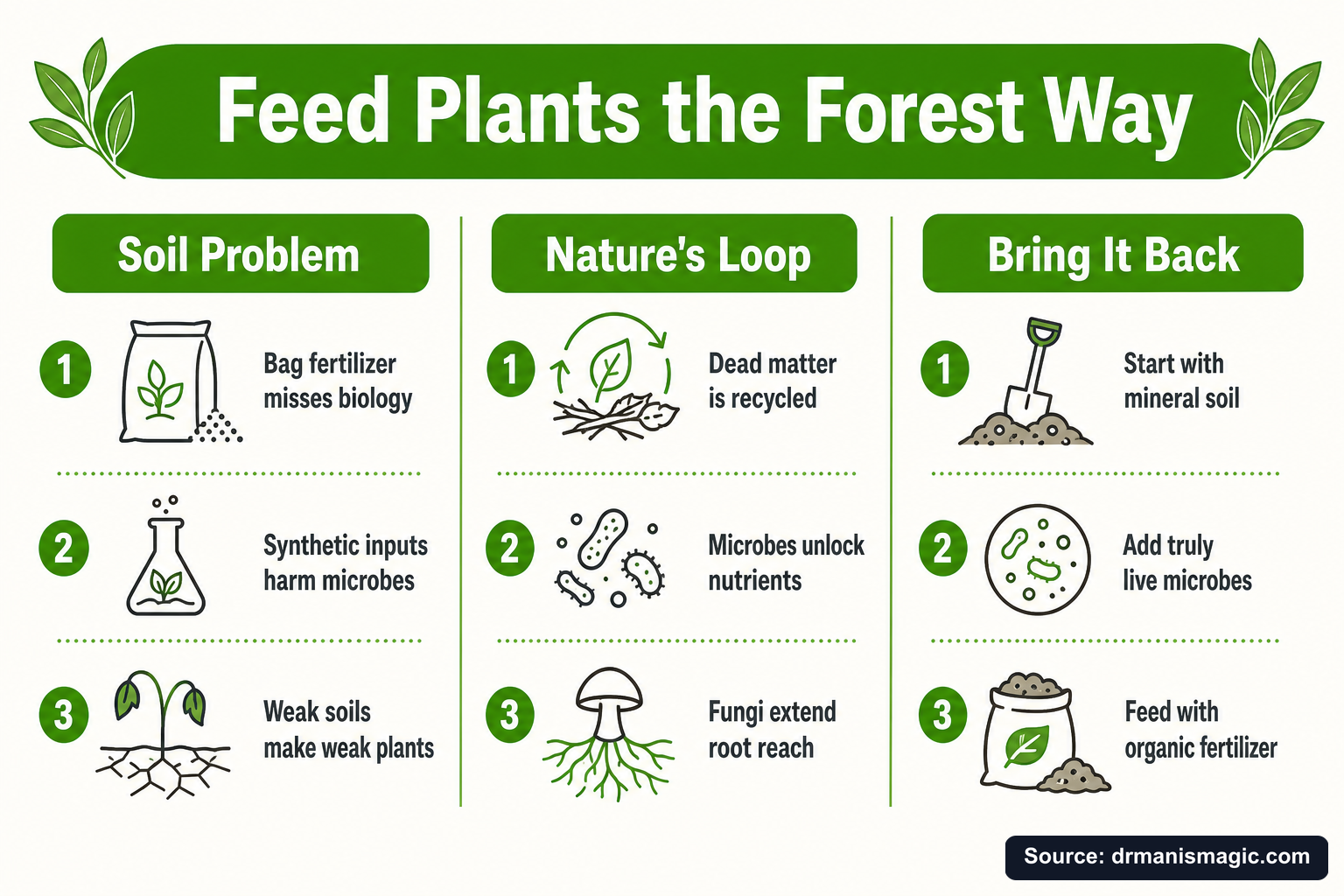
- Nature does not "fertilize" plants. It runs a nutrient recycling loop powered by living microbes in the soil.
- The soil food web — bacteria, fungi, protozoa, nematodes, and more — is the invisible workforce behind every thriving forest, prairie, and orchard.
- Plants actively feed this workforce by leaking sugars through their roots, recruiting microbes the way a farmer recruits workers.
- Most modern soils are badly damaged by synthetic fertilizers, herbicides, and pesticides — which is why plants struggle even when you "do everything right."
- You can restore living biology to your soil, but it takes the right microbes, the right inputs, and consistent effort.
- Dead, dried, or foul-smelling microbial products are weak substitutes. Genuinely live biology is what plants evolved with and what they need.
- The Three Plant Pillars — mineral-based soil, live microbials, and organic fertilizer — are the practical blueprint for bringing nature's system back to your garden.
Why Do Wild Plants Grow Without Fertilizer?
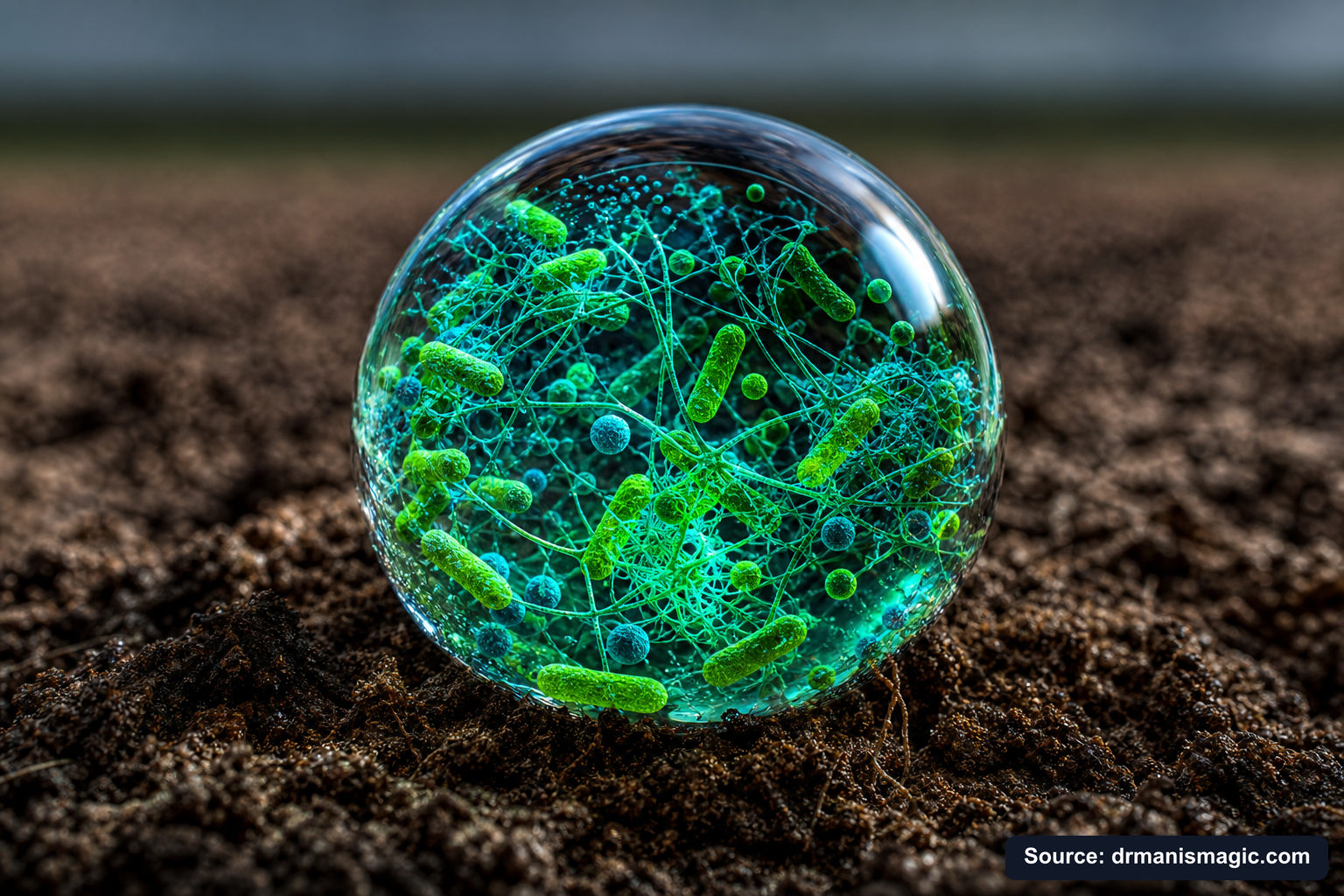
Quick Answer: Wild plants grow without packaged fertilizer because the soil beneath them runs a constant recycling loop. Dead leaves, roots, animal waste, and microbial bodies are broken down by billions of tiny organisms. Those organisms release nutrients in plant-ready forms, right where the roots are waiting. No bag required.
Walk into a forest and pick up a handful of leaves from the ground. That pile of dead leaves is not garbage. It is a slow-release nutrient bank. Bacteria and fungi are already digesting it. In a matter of weeks or months, the nutrients locked inside those leaves will be free again — nitrogen, phosphorus, potassium, calcium, sulfur, and dozens of trace minerals — circling back into the roots of the very trees that dropped them.
This is nutrient cycling. And it is the only "fertilizer program" forests, prairies, and wild orchards have ever used.
The University of Minnesota Extension puts a number on it: soil biological processes supply roughly 75% of the plant-available nitrogen and 65% of the available phosphorus in healthy soil. That means the microbes are doing the heavy lifting. The bag of fertilizer from the hardware store? That is, at best, picking up the remaining 25%.
Nature does not fertilize plants. Nature recycles nutrients through living organisms. That is the whole game. And the moment you understand this, you realize why most gardening advice is pointed in the wrong direction.
What Is the Soil Food Web and Why Should You Care?
Quick Answer: The soil food web is the layered community of living organisms — bacteria, fungi, protozoa, nematodes, earthworms, and more — that live in healthy soil. Each group eats another, and every time they eat, they release nutrients plants can absorb. It is nature's nutrient delivery system, running 24 hours a day for free.
Think of it like a city. Not a ghost town. A busy, living city with workers, managers, and cleanup crews, all doing specific jobs.
Here is how the city works:
Layer 1 — The Decomposers. Bacteria and fungi are first on the scene. They break down dead leaves, dead roots, animal waste, and old organic matter. As they eat, they lock those nutrients inside their own tiny bodies. Scientists call this "immobilization." The nutrients are not lost. They are held safely inside the microbial workforce, waiting.
Layer 2 — The Grazers. This is the part most gardening articles skip entirely. Protozoa and beneficial nematodes graze on bacteria and fungi. They eat them. And when they do, the nutrients that were locked inside those microbial bodies get released as waste — in plant-available forms, right in the zone around the roots. This predator-prey loop is one of the most important nutrient-release mechanisms on the planet. The USDA Natural Resources Conservation Service describes this grazing loop as a core driver of natural fertility.
Layer 3 — The Network Builders. Mycorrhizal fungi (say it: my-cor-RY-zal) form long, thread-like networks that extend a plant's root system by hundreds of times. Where a root can only reach so far, a fungal thread can travel feet in every direction, pulling in water and minerals and ferrying them back to the plant. In return, the plant feeds the fungus with sugars. A fair trade that has been running for 400 million years.
Layer 4 — The Engineers. Earthworms, beetles, and other soil creatures tunnel through the earth. They create channels for air and water. They grind up organic matter and pass it through their bodies, making it easier for bacteria to finish the job. Their castings are among the most nutrient-rich substances on the planet.
When all four layers are working together, you do not need synthetic fertilizer. The system feeds itself.
| Organism | What It Does | Why It Matters for Your Plants |
|---|---|---|
| Bacteria | Break down organic matter; fix nitrogen from air; release nutrients | Primary nutrient recyclers; first responders to root exudates |
| Fungi (general) | Decompose tough materials like woody stems; produce glomalin for soil structure | Improve soil texture, drainage, and water retention |
| Mycorrhizal Fungi | Extend root networks; transport water and minerals to the plant | Massively increase nutrient and water uptake; drought resistance |
| Protozoa | Graze on bacteria; release nitrogen and other nutrients as waste near roots | Critical nutrient-release step most gardeners never hear about |
| Beneficial Nematodes | Graze on bacteria and fungi; some prey on pest insects | Nutrient release plus natural pest control — not all nematodes are bad |
| Earthworms | Tunnel to aerate soil; grind organic matter; produce nutrient-rich castings | Improve structure, drainage, and fertility simultaneously |
| Nitrogen-Fixing Bacteria | Pull nitrogen gas from the air and convert it to plant-usable form | Free nitrogen fertilizer, naturally, no bag needed |
How Do Plants Actually Feed the Microbes That Feed Them?
Quick Answer: Plants leak sugars, amino acids, and other carbon compounds through their roots into the surrounding soil. These root exudates act as food and signals that attract bacteria, fungi, and mycorrhizae. The microbes crowd around the roots, break down nutrients, and deliver them directly where the plant can absorb them. The plant feeds the microbes; the microbes feed the plant.
This blew Dr. Mani Skaria's mind when he first dug into the research decades ago at the Texas A&M Citrus Center. Plants are not passive. They are not just sitting there waiting to be fed. They are actively recruiting their own workforce.
Up to 40% of the energy a plant makes through photosynthesis gets pumped out through the roots as sugars and other carbon compounds. On purpose. Scientists call this zone right around the roots the rhizosphere — and it is the most biologically active few inches of soil on earth.
The NRCS emphasizes this point: living roots are one of the easiest and richest food sources for soil microbes. That is why cover crops work. That is why perennial plants build better soil over time. And that is why bare, lifeless soil — the kind you see in a plowed field or a neglected garden bed — loses its biology fast. No living roots means no microbial food supply. The workforce leaves or dies.
When Dr. Mani started applying this understanding at US Citrus Nursery in South Texas, something remarkable happened. Trees that had been limping along on synthetic fertilizer started to explode with growth once the microbial workforce was restored. Over 250,000 trees later, the pattern holds. Every single time.
Why Is Your Garden Soil Probably Dead Right Now?
Quick Answer: Most garden and potting soils have been damaged or sterilized by synthetic fertilizers, herbicides, pesticides, fungicides, compaction, flooding, drought, or tillage. Salt-based fertilizers are especially damaging because they kill beneficial bacteria and fungi the same way salt kills slugs — osmotic stress. When the biology dies, the nutrient cycling stops and plants become dependent on chemical inputs to survive.
Here is the part nobody at the big box store will tell you.
That bag of blue crystal fertilizer? It is salt. Not table salt, but it works the same way on microbes. High salt concentration pulls water out of bacterial cells the same way it pulls water out of a slug you sprinkle salt on. The microbes die. And when the microbes die, the nutrient cycling stops. The plant becomes dependent on the next application of synthetic fertilizer to eat. You have just created a customer for life — for the fertilizer company.
Dr. Mani calls it the vicious cycle. You pour salt-based fertilizer on. It gives a quick green-up. The microbes take a hit. The soil gets weaker. The plant gets less resilient. It needs more fertilizer next time. Repeat until the plant burns out, gets a disease, or simply stops growing.
And it is not just synthetic fertilizer. Glyphosate (Roundup) disrupts microbial communities. Broad-spectrum pesticides kill beneficial insects and microbes alongside the bad ones. Synthetic antifungals wipe out mycorrhizal fungi. Compaction from foot traffic or heavy equipment squeezes the air pockets out of soil that microbes and roots need to breathe. Flooding drowns aerobic microbes. Drought kills them too.
By the time most gardeners ask "why won't my plants grow?" the soil they are growing in is essentially a sterile growing medium. It has the structure of dirt but none of the life.
See also: The Hidden Reason Synthetic Fertilizers Cause Root Rot
What Happens When You Pour Salt-Based Fertilizer on Living Soil? (The Real Cost)
Quick Answer: Salt-based synthetic fertilizers kill or damage beneficial bacteria and fungi through osmotic stress — the same way salt dehydrates and kills soft-bodied organisms. The short-term result is a green plant. The long-term result is dead soil biology, nutrient lockup, root vulnerability, and a plant that cannot survive without the next application. You lose money. Worse, you lose time.
Time is the thing you cannot get back. Money? You can earn more money. But the months and years you spend watching a plant struggle, stall, and slowly spiral — those do not come back.
The most common thing Dr. Mani hears from people who find him after years of doing it the old way: "I just want to see fruit on my tree while I still can." It breaks your heart a little. Because the answer was always there, underground, waiting. They just needed someone to point them to it.
Here is what salt-based fertilizer actually costs you, beyond the price on the bag:
- Beneficial bacteria and fungi die or are impaired — nutrient cycling slows
- Salt accumulates in the root zone — roots struggle to pull in water even when the soil is wet
- Plants become chemically dependent — they cannot feed themselves without the next application
- Root systems weaken — disease and root rot move in
- Soil structure collapses — compaction, poor drainage, and oxygen loss follow
- You spend more money each season for worse results
- And the clock keeps ticking on the garden you dreamed of
See also: Why Most Fertilizers Are Actually Salt in Disguise
You Never Had a Brown Thumb.
You were handed the wrong tools. This free guide hands you the right ones.
You watered it. You fed it. It died anyway.
It was never you. It was the dirt, the salt food, and the bad advice.
This guide shows you what really went wrong, and how to fix it for good.
- Why your plants really died, and why it was never your fault
- The salt hiding in your plant food that quietly burns the roots
- The hidden killer in almost every bag of store soil
- The tiny helpers that grow a whole forest for free
- The rescue trick that brings a half dead plant back to life

Are All Microbe Products the Same? (Live vs. Dead: The Comparison That Matters)
Quick Answer: No. Most microbial products on the market are either dried lab-grown powders with very low survival rates, or compost-tea liquids that have gone anaerobic and smell terrible because the microbes are dying. Genuinely live, full-spectrum microbials harvested from active compost and stabilized through a natural process are rare — and they are what actually produce results.
This is where the market gets messy. "Microbial product" has become a buzzword. Everybody has one. Most do not work. After growing over 250,000 trees at our South Texas nursery, we tried dozens of these products. Here is what we found.
Walk into any garden center and you will see powders, liquids, and granules all claiming to add "beneficial microbes" to your soil. Most of them fail for one of three reasons.
The Dried Powder Problem. The most common microbial products are manufactured in large industrial facilities. Specific bacterial or fungal species are grown in vats, then dried into a powder. The idea is that the dormant spores will "wake up" when you add water. In our experience, after testing batch after batch: they simply do not produce results. The survival rate is too low and the spectrum is too narrow.
The Smelly Liquid Problem. The second type is a compost-tea style liquid. It starts from an organic base, which is a better idea. But by the time it ships to you and sits on a shelf, it has gone anaerobic. Anaerobic means the oxygen-loving microbes have died and been replaced by bacteria that thrive without oxygen — and produce that unmistakable rotten-sewage smell. You may have experienced this. The bottle hisses when you open it. The smell makes your eyes water. Some people see a few benefits from the humic acid and fulvic acid in the liquid, but the living biology is mostly gone.
The Lactobacillus Trap. Some products use lactobacillus — yes, the same bacteria in yogurt. It stays alive easily. It is vigorous. But it crowds out the beneficial microbes your plants actually need. Lactobacillus belongs in your gut, not your soil.
| Product Type | Microbial Viability at Use | Spectrum of Organisms | Odor | Real-World Result |
|---|---|---|---|---|
| Dried lab-grown powder | Very low | Narrow (1-5 species) | Minimal | Little to no benefit observed |
| Rehydrated powder liquid | Very low | Narrow | Minimal | Same poor results as dry powder |
| Compost tea, fresh under 24 hours | Moderate (if aerated) | Partial | Earthy, turning sour | Good if used immediately — impractical for most |
| Compost tea, old (over 24 hours) | Anaerobic — low | Partial, skewed | Strong sewage odor | Not recommended; biology mostly dead |
| Lactobacillus-based products | High (but wrong species) | Very narrow | Sour | Crowds out beneficial microbes — avoid |
| Plant Super Boost (stabilized, full-spectrum, compost-harvested) | High — visibly alive under microscope | 2,000+ bacteria; 400-500 fungi including mycorrhizae; protozoa; nematodes | Earthy — no stench | Consistent, measurable improvement in root growth and plant health |
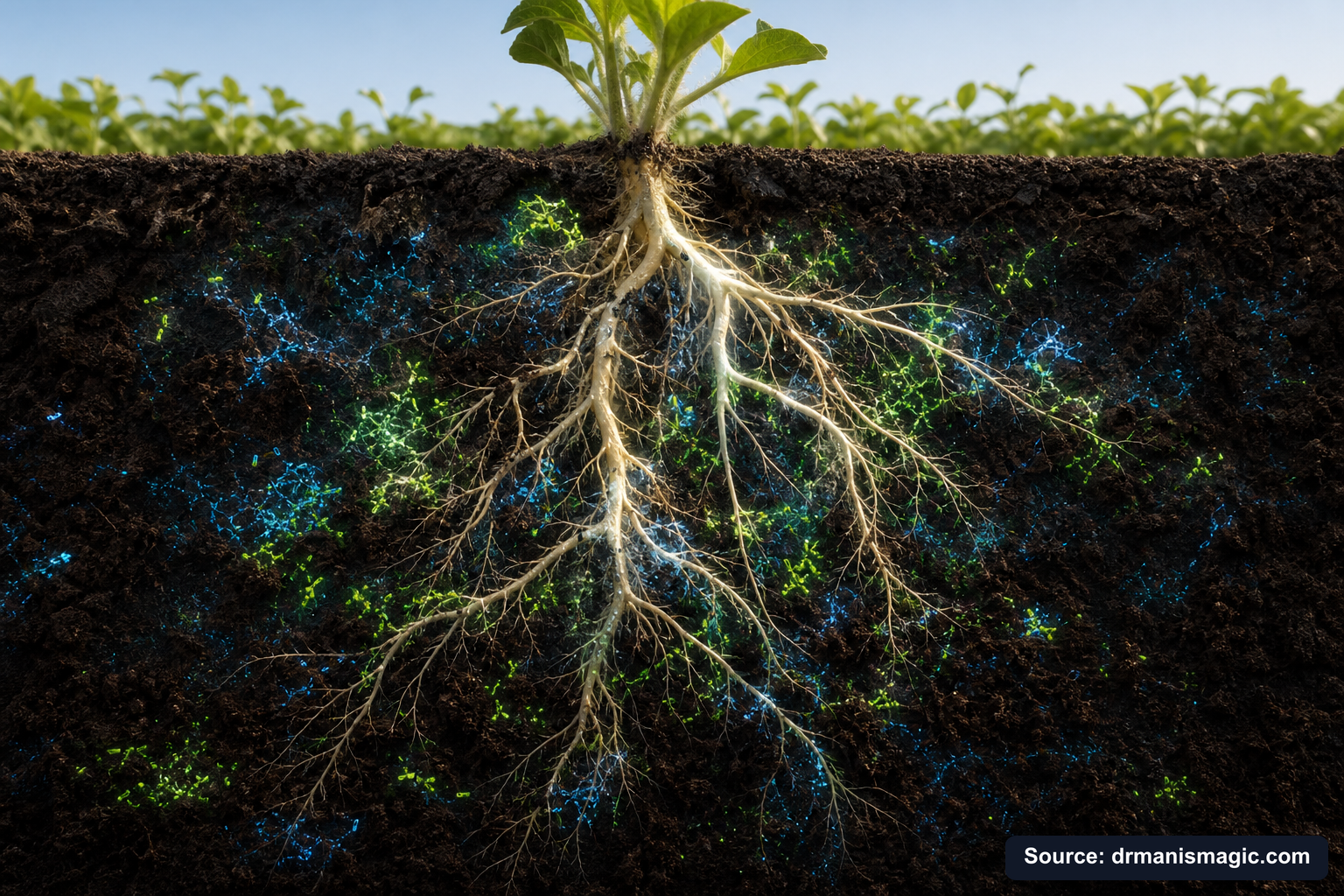
The difference with Plant Super Boost is how it is made. It starts with real, hand-crafted compost — the kind that steams at 140 degrees because the biological activity is so intense. Then a proprietary all-natural stabilization technique keeps those microbes alive without letting them go anaerobic. You can take a drop of Plant Super Boost, look at it under a microscope, and see the microbes moving. That is not marketing language. That is observable, verified biology. Multiple lab analyses confirm it.
No PFAS. No biosludge. No synthetic salts. Zero. And it smells like fresh earth, not sewage — because the microbes are alive and thriving, not rotting.
Can Sterile or Damaged Soil Become Alive Again?
Quick Answer: Yes, but recovery is not instant. Damaged soil goes through stages: recolonization by bacteria, feeding from living roots, decomposition of organic matter, return of protozoa and nematodes, rebuilding of fungal networks, and finally disease-suppressive stability. Each stage takes time and the right inputs. Repeated applications of live microbials, organic matter, and reduced chemical stress are the keys.
The good news is that soil biology is remarkably resilient. Given half a chance, it comes back. The bad news is that it does not come back in one watering. Recovery is a process. Think of it like rebuilding a neighborhood after a flood, not flipping a light switch.
Here is how soil recovery actually unfolds, stage by stage:
- Stop the damage. Reduce or eliminate synthetic herbicides, salt-based fertilizers, and broad-spectrum pesticides. Every application is a setback. You cannot fill a bucket with a hole in the bottom.
- Introduce live biology. Apply a full-spectrum microbial inoculant like Plant Super Boost. Monthly applications give the recovering population consistent reinforcement. The environment has been altered for decades in most gardens — even in-ground soil needs help recolonizing.
- Feed the workforce. Organic matter is the food supply. Mulch your soil surface with wood chips, leaf litter, or compost. Let organic material decompose on top of the soil, the way a forest floor works. Organic fertilizers with carbon-based compounds like crab meal, kelp, and amino acids feed both the plant and the microbes simultaneously — without the salt damage.
- Keep living roots in the ground. Bare soil loses its biology fast. Keep something growing. Cover crops between seasons. Perennials where possible. Even a thick layer of mulch slows the loss.
- Reduce compaction. Aerate compacted areas. Minimize foot traffic in growing zones. Roots and microbes both need oxygen. Compacted soil is like a city with no roads — nothing can move.
- Flush accumulated salts. If you have been using salt-based fertilizers for years, deep watering helps push salts below the root zone. Rain events are nature's flush cycle. Work with them.
- Be patient and consistent. The predator layers — protozoa, beneficial nematodes, larger organisms — return after the bacteria and fungi reestablish. Fungal networks take the longest. Give the system months, not days. Each consistent application moves you further down the road.
After growing trees at US Citrus Nursery for over 30 years, Dr. Mani Skaria has watched this recovery happen over and over. Pots that looked dead. Ground that had been sprayed for years. Trees that had been burning on synthetic programs. When you give the soil what it actually needs, it responds. Sometimes faster than you expect.
What Are the Three Plant Pillars and How Do They Imitate Nature?
Quick Answer: The Three Plant Pillars are the framework Dr. Mani Skaria developed after decades of growing at US Citrus Nursery: Pillar 1 is mineral-based soil that drains and breathes without decomposing; Pillar 2 is live microbials that restore the soil food web; Pillar 3 is organic fertilizer that feeds plants and microbes together without salt damage. Together, they recreate the conditions found in thriving natural ecosystems.
Nature figured this out long before we did. Mineral soil particles provide structure. Organic matter provides food. Living organisms cycle the nutrients. Remove any one of those three elements and the system struggles.
The Three Plant Pillars are not a marketing invention. They are what Dr. Mani observed when he stopped fighting nature and started copying it — tested across 250,000 trees, houseplants, tropical trees, and the US Citrus grove in South Texas.
Pillar 1: Mineral Foundation. Most potting mixes are built on bark, sawdust, and other organic matter that decomposes within months. As it breaks down, it compacts, blocks oxygen, and suffocates roots. That is why roots rot in containers even when you water correctly. The fix is mineral-based soil — permanent, non-decomposing, silica-rich sandy loam from the Rio Grande Valley. It does not break down. It does not steal oxygen. Roots breathe. Roots grow. Water drains the way nature intended. You can read more about Super Soil here.
Pillar 2: Microbial Muscle. This is the forest floor underground. Bacteria, fungi, protozoa, beneficial nematodes, mycorrhizae — the full workforce. Without them, nutrients stay locked. Pathogens move in. Roots are defenseless. With them, the soil becomes self-regulating, self-feeding, and disease-suppressive. This is what nature uses. This is what was there before the herbicides and salt fertilizers arrived.
Pillar 3: Organic Fertilizer. Not a salt bomb. Not a synthetic quick-fix. Slow-release, earth-born nutrition from crab meal, kelp, and amino acids. It feeds the plant in the gentle, graduated way that roots evolved to receive nutrients. And it feeds the microbial workforce at the same time instead of burning it. No PFAS. No biosludge. Made in the USA.
When all three pillars are in place — breathing soil, living biology, gentle nutrition — something shifts. Plants stop struggling and start thriving. The way they do in a forest where nobody does anything at all.
You can explore how all three pillars work together through the Three Plant Pillars bundle.
Natural Nutrient Cycling vs. Synthetic Fertilizer Programs: A Side-by-Side Look
Quick Answer: Natural nutrient cycling builds soil over time, supports a self-sustaining microbial workforce, and produces resilient, disease-resistant plants. Synthetic fertilizer programs produce fast short-term results but degrade soil biology, create chemical dependency, accumulate salts, and leave plants vulnerable to disease and stress. The long-term outcomes are very different.
People often ask: if synthetic fertilizer is so bad, why do plants look green right after applying it? Fair question. Here is the honest answer.
Salt-based fertilizers force nutrients into the plant quickly through osmotic pressure. The plant responds visually — green leaves, fast growth. It looks like health. But underneath the surface, the soil biology is taking damage. The microbial workforce shrinks. Nutrient cycling slows. Salt accumulates around the roots. Roots struggle to pull in water. The plant becomes a dependent — it cannot feed itself without the next application.
Natural organic systems work more slowly at first. But they build. Each season, the soil improves. The microbial population grows. The nutrient cycling accelerates. The plant becomes more resilient, not less. It fights off pests and disease on its own. It handles drought better. It produces more fruit with less intervention over time.
| Factor | Natural Nutrient Cycling (Three Plant Pillars) | Synthetic Fertilizer Programs |
|---|---|---|
| Speed of visible results | Moderate — builds over weeks and months | Fast — often visible within days |
| Long-term soil health | Improves every season | Degrades over time — biology dies off |
| Microbial population | Grows and diversifies | Damaged or killed by salt stress |
| Plant dependency | Plants become self-sufficient | Plants become chemically dependent |
| Root health | Strong, deep, disease-resistant roots | Salt damage, root rot risk increases |
| Disease resistance | High — microbial competition suppresses pathogens | Low — pathogen pressure increases as biology dies |
| Chemical safety | Zero PFAS, zero biosludge, zero synthetic salts | Salt accumulation; some coated synthetics leach plastic compounds |
| Cost over 5 years | Decreasing — system becomes self-sustaining | Increasing — more inputs needed as soil weakens |
| Safety for children and pets | Safe — walk barefoot, let pets roam | Caution warnings on most labels; re-entry intervals required |
What Can You Do Right Now to Bring This System Back to Your Garden?
Quick Answer: Start by stopping the damage — reduce synthetic inputs. Then restore biology with live full-spectrum microbials applied monthly. Add organic matter as mulch or compost. Switch to organic slow-release fertilizer. Keep living roots in the ground. Give the system 30-90 days and watch what happens. The soil food web responds faster than most people expect once you give it what it needs.
You do not need to overhaul everything overnight. You do not need a chemistry degree. You need a direction and a consistent practice. Here is the simplest version:
- Stop feeding the problem. Reduce or cut out salt-based synthetic fertilizers and broad-spectrum pesticides. Every time you pour them on, you are resetting the clock on your soil recovery.
- Add live biology monthly. Apply a full-spectrum microbial inoculant. Not a dried powder. Not a smelly liquid. Genuinely live biology, stabilized and verified. This is the single highest-leverage thing you can do for any plant — container, garden bed, lawn, orchard, or houseplant.
- Feed with organic, not salt. Switch to slow-release organic fertilizer made from carbon-based sources. It feeds your plants gently. It feeds the microbial workforce too. The system starts working with you instead of against you.
- Cover your soil. Mulch bare ground with wood chips, straw, or leaf litter. This insulates the microbial community, retains moisture, and slowly feeds the system as it decomposes. A covered soil is a living soil.
- Keep roots in the ground. Living roots pump sugars into the soil and recruit microbes. The more plant life you have growing, the richer your soil biology becomes. Bare soil is a desert for microbes.
- Test and flush if needed. If you suspect heavy salt buildup from years of synthetic use, do a deep watering flush. Let rain do its job. Give it time.
- Be consistent for 30 to 90 days. Biology recovers in stages. Monthly microbial applications compound. The results you see in month three are better than month one, and month six better than month three.
Dr. Mani has a saying he shares with every new grower who comes to US Citrus Nursery frustrated and ready to give up: "Your soil is not broken beyond repair. It is just hungry for the right thing." After 30 years and 250,000 trees, that has proven true every single time.
The forest does not need your help. But your garden does — because the system that used to run itself there has been disrupted. Your job is not to replace nature. It is to restore it.
If you want to start in the simplest, most complete way possible, the Free Plant Care Field Guide walks you through the Three Plant Pillars step by step — no jargon, no guesswork, just the foundation that makes any plant thrive. And when you are ready to give your soil a living microbial workforce again, Plant Super Boost is where we would start. One monthly application. Watch the difference. Your plants will show you what living soil feels like.
Frequently Asked Questions
You just read about how forests feed themselves without a single bag of fertilizer. Now you have questions. Good. These are the exact questions gardeners ask us every day. The answers might surprise you, and they will change the way you think about your soil forever.
Is it really possible to grow healthy plants without synthetic fertilizer?
Yes, and forests prove it every single day. Plants do not need synthetic fertilizer to grow. They need living soil. When your soil has the right microbes, a strong mineral base, and organic nutrients, it runs its own recycling system. That system feeds your plants around the clock. We proved this across 250,000 trees at US Citrus Nursery without a single salt-based synthetic fertilizer in sight.
What did farmers use before synthetic fertilizer was invented?
For thousands of years, farmers used manure, compost, buried fish, wood ash, and crop rotation. These methods all fed the same invisible workforce underground, the living microbes in the soil. They did not know the science behind it, but they knew it worked. Dr. Mani's Three Plant Pillars bring that same ancient wisdom together with modern plant science, so you get results faster and without the guesswork.
What did Native Americans use to fertilize their crops?
Native Americans buried fish beneath seed mounds, planted beans to fix nitrogen naturally, and used wood ash to enrich the soil. They also rotated plots to let the land recover. Every one of those methods worked by feeding soil biology, not bypassing it. That is the exact principle behind Dr. Mani's Magic. Feed the soil, and the soil feeds your plants.
What do Amish farmers use instead of synthetic fertilizer?
Amish farmers rely on composted animal manure, cover crops, and crop rotation. These are all organic, biology-friendly inputs that build the soil food web instead of burning it down. They have been doing it this way for generations and their soil stays rich and productive. That is not an accident. It is what happens when you work with nature instead of against it.
What is the best natural alternative to synthetic fertilizer for home gardeners?
The best natural alternative is a complete system, not just one product. You need mineral-based soil that drains well and lets roots breathe. You need live microbes that unlock nutrients and fight off disease. And you need slow-release organic fertilizer made from real earth-born ingredients. That is exactly what Dr. Mani's Magic Plant Super Boost, Super Soil, and Crab Kelp and Amino Acids fertilizer deliver together as the Three Plant Pillars.
Why is urea called the king of fertilizers, and should you use it on your plants?
Urea is called the king of fertilizers because it is packed with nitrogen, about 46 percent. It is cheap and it works fast. But here is the problem. It is salt-based. Salt kills the microbes in your soil. Every time you pour it on, you wipe out the invisible workforce your plant depends on. You get a quick green flush, then a slow decline. That is not feeding your plant. That is borrowing against its future.
What can farmers and home gardeners use instead of synthetic fertilizer right now?
Start with live microbial inoculants, organic slow-release fertilizers, and mineral-based soil. These three things mirror what nature does in a healthy forest. Dr. Mani spent 35 years testing this exact approach on citrus trees, tropical trees, houseplants, and gardens in South Texas. The results were so consistent across 250,000 trees that he built the entire Dr. Mani's Magic product line around it. You can start today at drmanismagic.com.
About the Author
Dr. Mani Skaria, PhD
Dr. Mani Skaria, PhD, is a plant pathologist and the scientific founder of Dr. Mani's Magic. He earned his doctorate at Purdue University and spent 48 years studying how plants, soil, and living microbes work together, including his years as Professor Emeritus at Texas A&M and as a member of the USDA NAREEE Advisory Board. He invented micro-budding, a method for growing healthier, stronger trees, and has grown more than 250,000 trees on the family farm in Hargill, Texas - US Citrus Nursery. His life's work takes real lab science and practical experience and turns it into simple, safe, organic plant care anyone can use at home.


