


How Nature Builds Resilience Into Plants Through Soil Biology | Dr. Mani's Magic
How Nature Builds Resilience Into Plants: The Invisible Army Beneath Every Thriving Garden
Picture the oldest tree on your street. Nobody waters it. Nobody fertilizes it. Nobody sprays it with anything. Yet every spring, without fail, it pushes out new leaves. It shrugs off drought. It fights off disease. It just... grows. Meanwhile, the rose bush you planted three months ago is turning yellow and you have no idea why.
What does that old tree know that your rose bush doesn't? Here's the secret nobody at the garden center will ever tell you: the tree isn't surviving on its own. Beneath its roots, right now, there are trillions of invisible creatures working around the clock. Bacteria. Fungi. Tiny predators. A whole underground city buzzing with life. That city is why the tree is bulletproof. And that city is exactly what your struggling rose bush is missing.
We've grown over 250,000 trees at our South Texas nursery. We've watched plants thrive in conditions that should have killed them. We've also watched expensive, well-watered trees slowly die in pots full of dead soil. After all those years and all those trees, we can tell you with total confidence: plant resilience isn't magic. It's biology. And once you understand how nature builds it, you can replicate it anywhere — in a pot on your patio, in your backyard garden, or across an entire orchard.
Key Takeaways
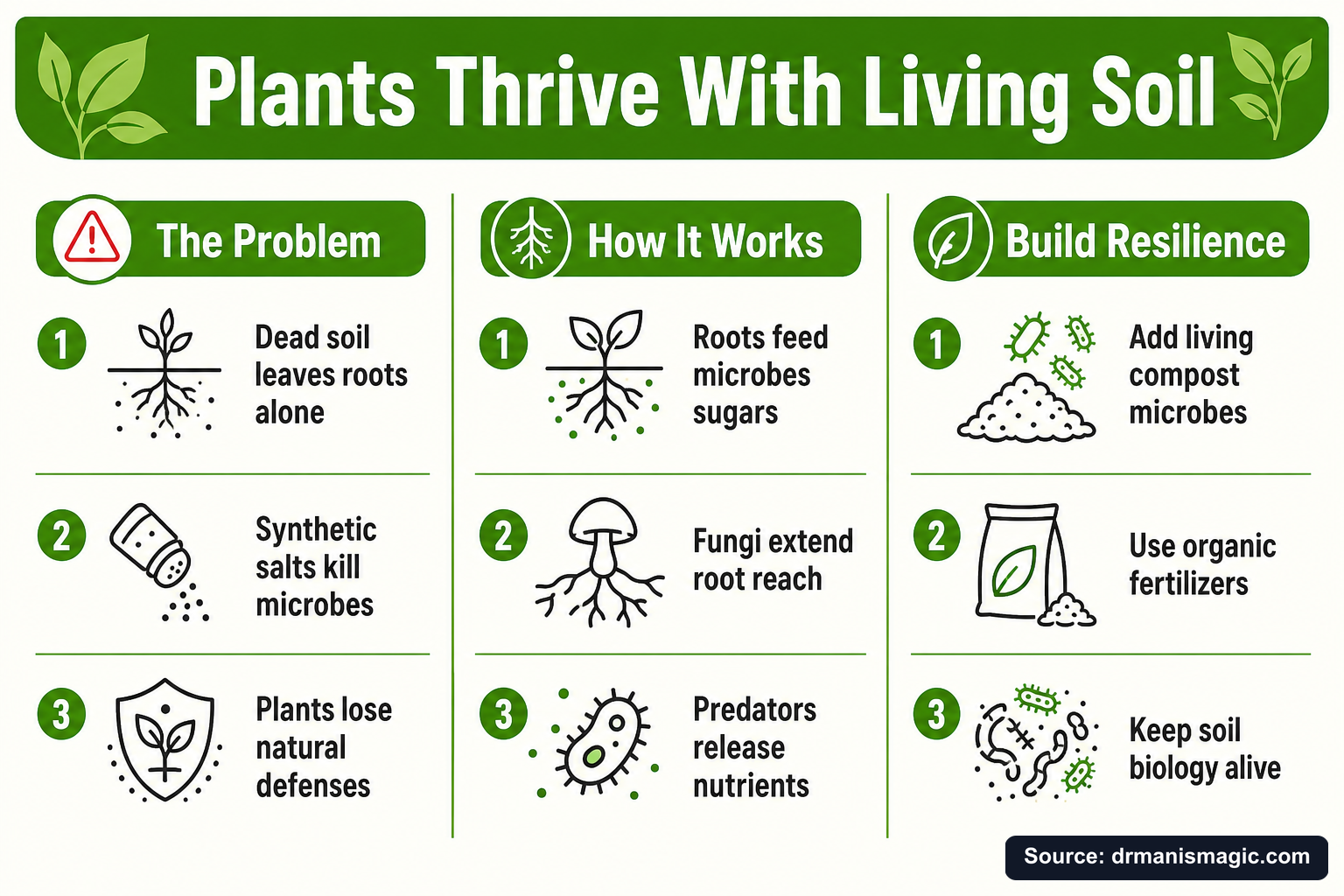
- Plant resilience is built by a living underground community — bacteria, fungi, protozoa, and nematodes — not by any single product or fertilizer.
- The rhizosphere (the zone around your plant's roots) is where the magic happens. Roots actively recruit microbes by feeding them sugar.
- Mycorrhizal fungi extend root reach by up to 100 times, helping plants find water and nutrients they could never reach alone.
- Protozoa and nematodes are the overlooked heroes — they eat bacteria and release plant-available nutrients directly at the root zone.
- Salt-based synthetic fertilizers, herbicides, and fungicides quietly kill your soil's living workforce, leaving plants defenseless.
- Dead or dried commercial microbe products rarely work. Living, stabilized microbes — harvested from real compost — make the difference.
- The Three Plant Pillars (mineral soil, live microbes, organic fertilizer) are the framework that mirrors how nature builds resilience — and you can apply it today.
What Does "Plant Resilience" Actually Mean at the Root Level?
Quick Answer: Plant resilience is a plant's ability to withstand drought, disease, pests, salt stress, and physical damage without collapsing. It isn't a trait the plant is born with — it's built, layer by layer, through a living relationship between roots, soil microbes, fungi, and organic matter working together underground.
Think of it like your immune system. You weren't born with fully developed immunity. You built it. Every time your body met a germ and fought it off, your immune system got smarter and stronger. Plants work the same way — except their immune system lives in the dirt.
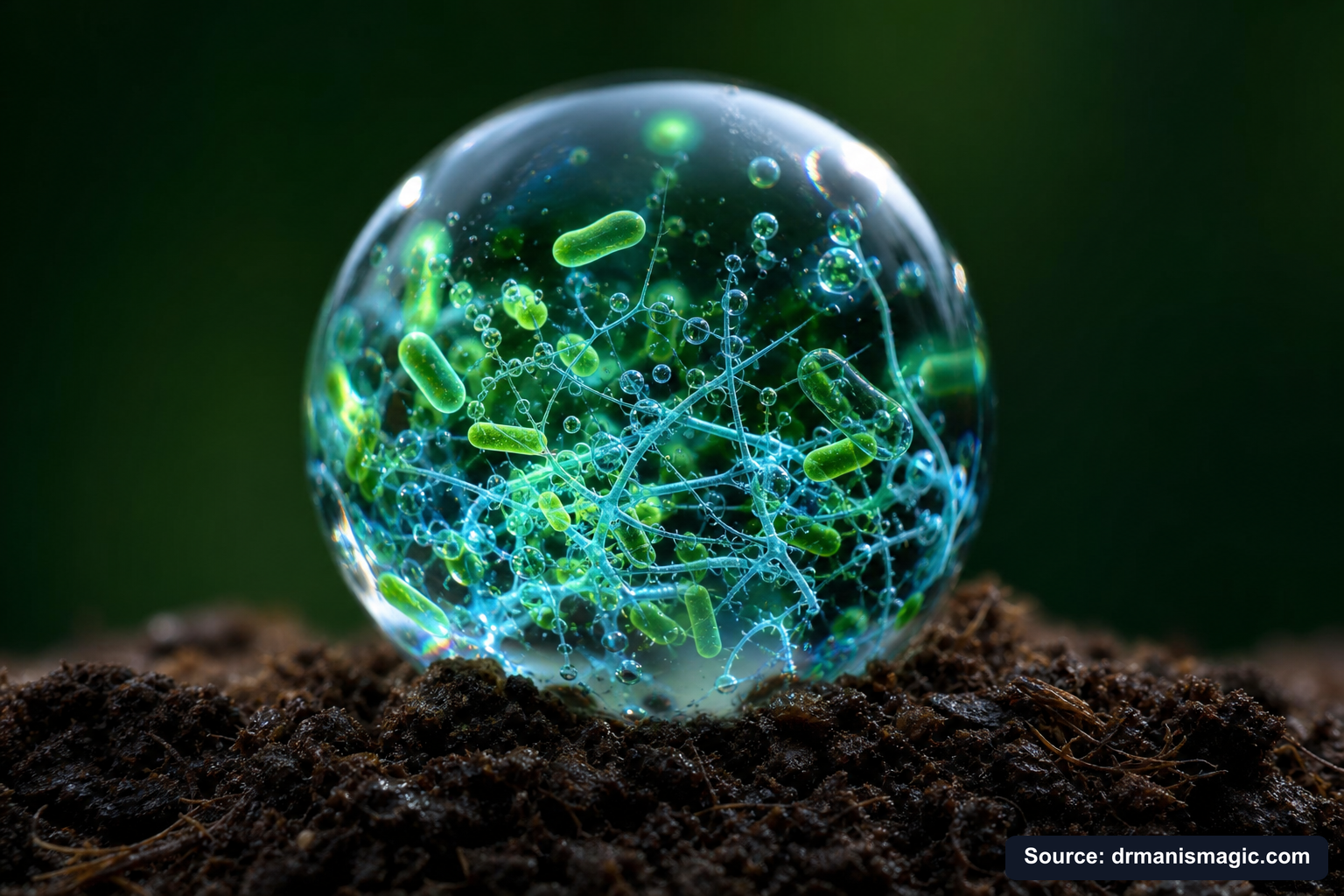
A resilient plant has roots swimming in a rich soup of beneficial bacteria and fungi. Those microbes produce hormones that tell the plant's immune system to stay alert. They crowd out the bad guys before disease can take hold. They dissolve locked-up minerals and deliver them right to the root tips. They even help the plant absorb more water during a drought by extending the root system through fungal threads finer than a human hair.
According to the University of Minnesota Extension, soil biological processes supply approximately 75% of the nitrogen and 65% of the phosphorus that plants actually use. Read that again. Three-quarters of the nitrogen your plant needs doesn't come from fertilizer. It comes from living soil biology. That's how powerful this invisible workforce is.
When that workforce is wiped out — by synthetic salts, herbicides, or dead potting mix — the plant has to fight every battle alone. No backup. No immune priming. No nutrient miners. Just a struggling root system doing its best in a biological desert. That's why your potted tree yellows. That's why your garden goes sideways every summer. Not because you have a brown thumb. Because the living foundation underneath was never there to begin with.
What Is the Rhizosphere and Why Is It the Engine of Plant Resilience?
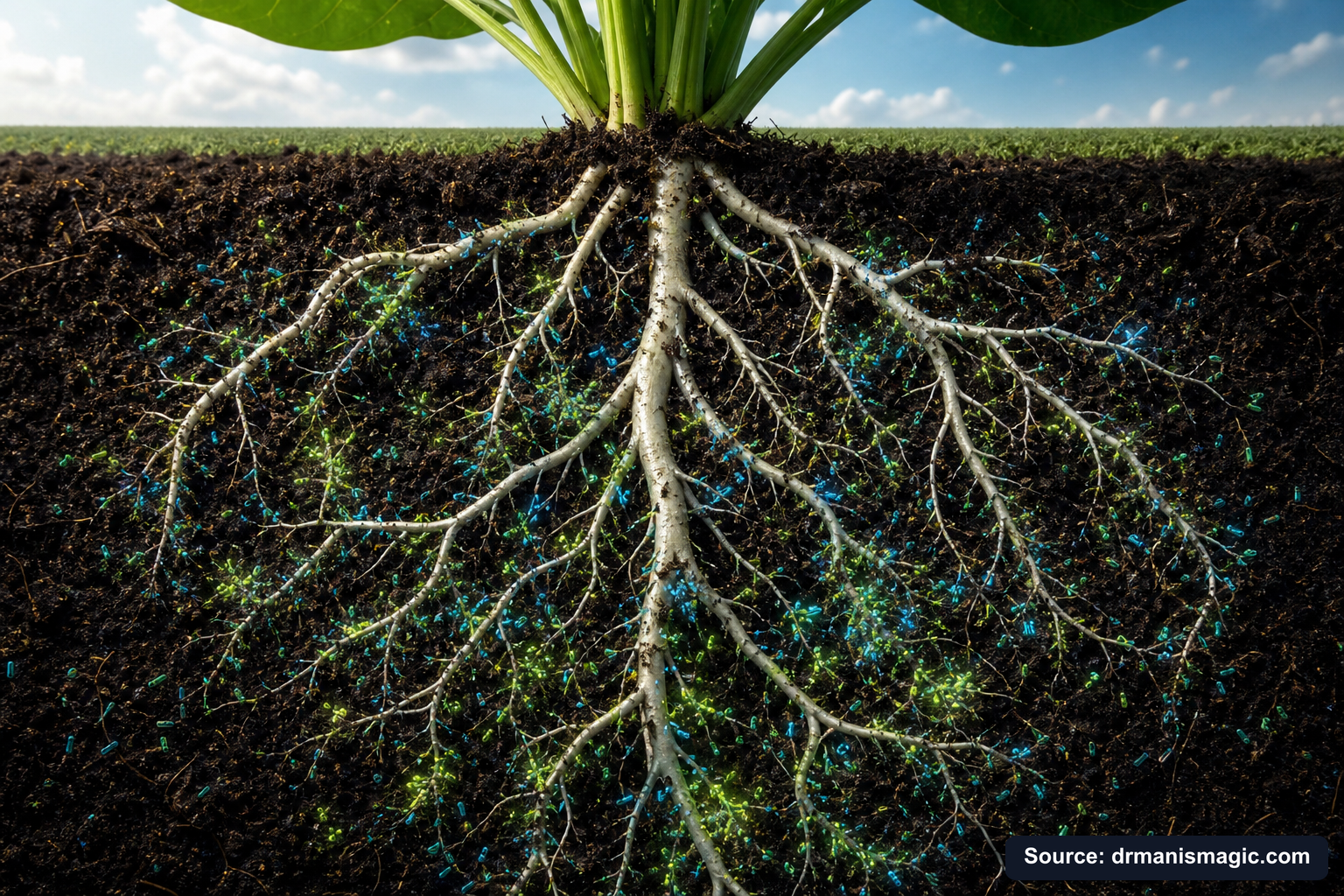
Quick Answer: The rhizosphere is the thin zone of soil directly surrounding plant roots — usually just a few millimeters thick. It is the most biologically active place on Earth. Roots release sugar-rich fluids called exudates into this zone, actively recruiting specific microbes. In return, those microbes protect the plant, unlock nutrients, and trigger its immune defenses. It is not passive. The plant is farming its own microbes.
This is the part that blows people's minds when they first hear it. Your plant is not just sitting there waiting to be fed. It is actively managing its own underground workforce.
Roots release a carefully crafted mix of sugars, amino acids, and chemical signals into the soil around them. Different signals attract different microbes. Drought-stressed plants release different signals than well-watered ones. Plants under pest attack recruit microbes that trigger immune responses. It's a real-time, two-way conversation happening beneath your feet right now.
According to Penn State Extension, microbial biomass and diversity are highest right around roots and organic matter deposits — precisely because roots are actively feeding and recruiting those microbial communities. The rhizosphere can contain up to 1,000 times more microbial activity than the surrounding bulk soil.
Here's the problem. When you plant into dead potting mix — the kind loaded with pine bark sawdust that you find at big box stores — there is almost no microbial community for the roots to recruit. The plant sends out its signals. Nothing answers. It's like hiring a security team and having nobody show up. The plant is on its own.
That's the first crack in the foundation. And it only gets worse from there.
How Do Beneficial Bacteria Make Plants More Resilient?
Quick Answer: Beneficial bacteria help plants by fixing nitrogen from the air, dissolving locked-up minerals, producing growth hormones, crowding out disease-causing pathogens, and triggering the plant's own immune system. Without them, plants spend enormous energy doing tasks that bacteria would do for free — leaving less energy for growth, fruiting, and defense.
Bacteria are the first responders of the soil food web. They are everywhere in healthy soil — billions of them in a single teaspoon of living earth. But not all bacteria are created equal, and the mix matters enormously.
Plant-growth-promoting bacteria (the good guys, often called PGPR) do several remarkable things at once. They fix nitrogen straight from the air and convert it into forms the plant can actually absorb. They produce acids that dissolve phosphorus locked inside soil minerals. They manufacture auxins and gibberellins — the same growth hormones that tell roots to branch and spread. And some of them, when they colonize roots, trigger something called Induced Systemic Resistance — essentially putting the plant's entire immune system on high alert so it can fight off fungal diseases, bacterial infections, and even some insects faster and more effectively.
Think of them as the plant's personal medical team, nutritionist, and security detail all rolled into one microscopic package. And they work for nothing except a little sugar from the roots.
When synthetic salt-based fertilizers get poured into the soil, the salt draws water out of bacterial cells through osmosis. They dry up and die. The security team is gone. The nutritionist is gone. The medical team is gone. And now the plant is dependent on you — and your next bag of fertilizer — for everything it used to get for free. That's not an accident. That's the business model.
What Do Mycorrhizal Fungi Do for Plants That Roots Cannot Do Alone?
Quick Answer: Mycorrhizal fungi attach to plant roots and grow thread-like extensions called hyphae into the surrounding soil, effectively multiplying the root's reach by up to 100 times. They deliver water and nutrients (especially phosphorus) that roots could never reach alone, and they help plants survive drought, high heat, salt stress, and toxic soil conditions that would otherwise be fatal.
If you've ever pulled a weed out of a crack in the sidewalk and seen fuzzy white threads clinging to the roots — that's mycorrhizae. That's why weeds are nearly impossible to kill. They have a fungal partner making them tough.
The word "mycorrhizae" literally means "fungus root." It describes one of the oldest and most successful partnerships in the history of life on Earth. Fossil evidence shows plants and mycorrhizal fungi were working together over 400 million years ago. This relationship is so ancient and so fundamental that approximately 80-90% of all land plants form it naturally when the fungi are present in the soil.
The fungal hyphae are thinner than root hairs and can squeeze into spaces roots can never reach. They tap into pockets of moisture deep in the soil profile during drought. They access phosphorus deposits that are chemically "locked" in ways roots cannot unlock. They even connect neighboring plants in a network sometimes called the "wood wide web" — passing nutrients and chemical signals between plants that may be meters apart.
The University of Wisconsin Extension notes that mycorrhizae can reduce the damaging effects of drought, high temperatures, soil salinity, acidity, and toxic element buildup on host plants. That is a remarkable list of stresses that one fungal partner can buffer against.
The catch? These fungi need to be present in the soil. In natural forest or prairie soil, they're abundant. In sterilized potting mix from a garden center? They're essentially absent. That's why we include mycorrhizal fungi as part of our Plant Super Boost — harvested from living compost, stabilized with a natural method, and delivered alive to your plant's root zone.
Who Are the Overlooked Heroes — Protozoa and Nematodes — and What Do They Do?
Quick Answer: Protozoa and beneficial nematodes are microscopic predators that eat bacteria and fungi in the soil. When they digest those microbes, they release nitrogen and other nutrients in a plant-available form — right at the root zone, right when the plant needs it. They also regulate microbial populations, preventing any one pathogen from taking over. Most gardening advice skips them entirely. That's a mistake.
Here's the part almost nobody talks about. Most articles on soil health stop at bacteria and fungi. They forget the predators. And the predators are where a huge chunk of plant-available nutrition actually comes from.
Picture it like a city. Bacteria and fungi are the workers — breaking down organic matter, fixing nitrogen, building soil structure. Protozoa and nematodes are the managers. They eat the workers. And when they digest them, they excrete nutrients in exactly the form plants can absorb — ammonium ions, phosphates, trace minerals — released directly into the rhizosphere, inches from the root tips.
This is called the "microbial loop" or the "nutrient mineralization cycle." It's one of the main reasons healthy, living soil feeds plants so much more efficiently than any bag of synthetic fertilizer ever could. The nutrients aren't dumped in all at once (like salt-based fertilizers do, often burning roots in the process). They're released steadily, on demand, by a self-regulating biological system that's been refined over hundreds of millions of years.
Beneficial nematodes also patrol the rhizosphere for plant pathogens. They eat harmful fungi and bacteria, keeping disease pressure low. Not all nematodes are bad — in fact, most are beneficial. The bad actors are a small minority. A healthy, diverse soil community keeps those bad actors in check through sheer numbers and competition.
When you wipe out the soil food web with broad-spectrum pesticides or synthetic fungicides, you don't just kill the bad guys. You kill the whole city. The predators that kept pathogens in check are gone. The nutrient loop breaks. The plant starves and gets sick at the same time. It's a slow disaster that looks, from the outside, like "the plant just isn't doing well."
How Does the Full Soil Food Web Work as a Resilience System?
Quick Answer: The soil food web is an interconnected chain of living organisms — bacteria, fungi, protozoa, nematodes, and larger creatures — that cycle nutrients, suppress disease, build soil structure, and regulate water. Together, they create biological redundancy: if one group is weakened, others compensate. That redundancy is what makes plants in healthy ecosystems genuinely tough, not just temporarily green.
Here is the full picture, laid out simply:
| Organism | What It Does for Plants | What Destroys It |
|---|---|---|
| Beneficial bacteria | Fix nitrogen, dissolve phosphorus, produce growth hormones, trigger plant immunity (ISR/SAR), crowd out pathogens | Salt-based fertilizers, herbicides, broad-spectrum pesticides |
| Mycorrhizal fungi | Extend root reach up to 100x, improve water and nutrient uptake, buffer drought and salt stress, build soil aggregates with glomalin | Synthetic fungicides, tillage, phosphorus overloading, soil sterilization |
| Other beneficial fungi | Decompose organic matter, suppress root pathogens (like Trichoderma), cycle nutrients | Synthetic fungicides, repeated disturbance |
| Protozoa | Eat bacteria, release plant-available nitrogen at root zone, regulate microbial populations | Pesticides, soil drying, compaction, fumigation |
| Beneficial nematodes | Eat harmful bacteria, fungi, and pest larvae; mineralize nutrients; regulate soil community balance | Broad-spectrum nematicides, fumigation, salt accumulation |
| Organic matter | Feeds the whole system, holds water, provides habitat for microbes, buffers pH | Tillage, lack of mulch, bare soil, burning |
Every layer in that table depends on the others. Remove one and the whole system gets weaker. Remove several and you have what most garden center pots contain: biologically dead growing media that forces the plant to survive on whatever synthetic inputs you pour in, on whatever schedule you remember to pour them.
Nature never intended plants to live like that. And they don't thrive when they do.
You Never Had a Brown Thumb.
You were handed the wrong tools. This free guide hands you the right ones.
You watered it. You fed it. It died anyway.
It was never you. It was the dirt, the salt food, and the bad advice.
This guide shows you what really went wrong, and how to fix it for good.
- Why your plants really died, and why it was never your fault
- The salt hiding in your plant food that quietly burns the roots
- The hidden killer in almost every bag of store soil
- The tiny helpers that grow a whole forest for free
- The rescue trick that brings a half dead plant back to life

Do Herbicides, Fungicides, and Synthetic Fertilizers Damage Soil Biology?
Quick Answer: Yes — significantly. Salt-based synthetic fertilizers kill bacteria and fungi through osmotic shock. Herbicides like glyphosate disrupt microbial enzyme pathways. Broad-spectrum fungicides kill beneficial fungi alongside harmful ones. The damage accumulates over time, leaving soil progressively more dependent on chemical inputs and progressively less capable of supporting resilient plant growth.
This is the part the big chemical companies don't want you thinking about too hard.
Salt-based fertilizers work through osmosis. When you pour high-salt solution around roots and microbes, water rushes out of living cells toward the salt. Bacteria and fungi dry out and die. The plant may green up temporarily — those nutrients are immediately available — but the biological workforce that would have fed it for months is dead. So you need more fertilizer next month. And the month after that. And the problem gets worse every time.
Herbicides are even more insidious. Glyphosate, the most widely used herbicide in the world, was actually originally patented as an antibiotic. It disrupts the shikimate pathway — a metabolic process that bacteria use just as much as plants. Research has linked glyphosate applications to measurable decreases in beneficial microbial diversity in treated soils. The weeds you killed take a few weeks to come back. The microbial community you damaged can take years to recover.
And synthetic fungicides? They're designed to kill fungi. The problem is they can't tell the difference between the pathogenic fungus attacking your tomatoes and the mycorrhizal fungus that's been feeding your tomato's roots for months. Both die. The disease pressure eventually returns — because pathogens evolve and bounce back fast. The beneficial fungi don't come back nearly as quickly, because there's nothing to bring them back from.
We've seen this play out hundreds of times at our nursery. Trees that were treated with conventional inputs for years — technically alive, but never thriving. Yellow. Slow. Prone to every pest that came along. Then we rebuild the biology. We add living soil, live microbes, organic fertilizer. Within months, the same tree transforms. It's not magic. It's just biology finally being allowed to work.
See also: The Hidden Reason Synthetic Fertilizers Cause Root Rot
Why Do Most Commercial Microbial Products Fail to Deliver Real Results?
Quick Answer: Most commercial microbial products are either dried powders with low-viability spores, or liquid products that have gone anaerobic (oxygen-free) and smell like sewage. In both cases, the microbes are largely dead or dying by the time they reach your plant's roots. A truly effective product delivers a full-spectrum, genuinely living microbial community — not a label full of species names with nothing alive inside.
Walk down the garden aisle of any big box store. Count the products that say "contains beneficial bacteria" or "mycorrhizal inoculant" on the label. There are dozens. So why aren't everybody's plants thriving?
Because dead microbes don't do anything.
Here's what actually happens with most of those products:
The powder problem. Most commercial microbe products are made at giant industrial factories. They grow specific bacterial or fungal species in massive vats, then dry them into powder. The idea is that the dormant spores will "reactivate" when you add water and pour them into soil. We have tested dozens of these products on our own trees over many years. The results? Consistently disappointing. The surviving spore count is low. The species diversity is narrow. And even when some do activate, they struggle to establish in soil that already has a competing microbial community — or soil that's been so damaged by synthetic inputs that conditions can't support them.
The stinky liquid problem. Other products are made from compost tea or earthworm castings — good source material in theory. But by the time the product is bottled, shipped, and sits on a shelf or in a warehouse, it has gone anaerobic. The bottle fizzes when you open it. The smell hits you from across the room. That smell is the bacteria dying and decomposing. Some humic and fulvic acids survive in those products and provide minor benefit, but the living microbial workforce? Gone.
The lactobacillus problem. Some products use lactobacillus bacteria because they're extremely easy to produce and stay alive well. The problem? Lactobacillus is vigorous precisely because it outcompetes other microbes. Pour it into your soil and it crowds out the beneficial bacteria you actually need. It belongs in your yogurt. Not in your garden.
| Product Type | Microbial Viability | Species Diversity | Odor | Effectiveness |
|---|---|---|---|---|
| Dried powder (lab-grown) | Very low | Narrow (checklist species) | None | Consistently poor in our testing |
| Rehydrated powder in liquid | Low | Narrow | None or mild | Poor — same issues as powder |
| Compost tea (fresh, under 24 hours) | Moderate | Broad if from good compost | Earthy | Good — but time-sensitive and labor-intensive |
| Compost tea (old, over 24 hours) | Very low (anaerobic) | Declining | Strong — sewage-like | Poor — microbes dying; some humic/fulvic benefit |
| Lactobacillus-based products | High | Single dominant species | Sour | Harmful — outcompetes beneficial microbes |
| Plant Super Boost (stabilized, full-spectrum) | High — visibly alive under microscope | 2,000+ bacteria species; 400-500 fungi including mycorrhizae; protozoa and nematodes | Earthy — not foul | Strong — harvested from live compost; stabilized by natural method; lab-verified |
The difference with Plant Super Boost comes down to one thing: the microbes are genuinely alive when they reach your plant. They're harvested from real, active compost — not grown in a factory. A proprietary all-natural stabilization technique keeps them from going anaerobic. You can take a single drop, put it under a microscope, and watch the microbes move. We have lab analyses that confirm viability. That's not a marketing claim. That's a biological fact you can see with your own eyes.
What Are the Three Plant Pillars and How Do They Mirror What Nature Does?
Quick Answer: The Three Plant Pillars — mineral-based soil, live microbials, and organic fertilizer — are Dr. Mani Skaria's framework for replicating the conditions that make plants resilient in nature. Mineral soil provides drainage and root oxygen. Live microbes recreate the soil food web. Organic fertilizer feeds both the plant and the microbial community without burning either with salt. Together, they create a self-sustaining growing environment that mimics a healthy forest floor.
Dr. Mani Skaria spent 35 years as a Professor Emeritus of Plant Pathology at the Texas A&M Citrus Center. He traveled the world studying plant health. He saw the same pattern everywhere: plants growing in conditions that matched their evolutionary biology thrived. Plants growing in conditions that worked against that biology struggled, no matter how much money or technology was thrown at them.
The Three Plant Pillars came from asking one simple question: what does nature actually give a plant? The answer is always the same three things.
Pillar 1: Mineral Foundation. Natural soil is mineral-based. It doesn't decompose. It doesn't compact into a suffocating sludge. It drains well and stays aerated so roots can breathe. Most commercial potting mixes are organic-based — pine bark, sawdust, peat — and they break down within months, compacting and cutting off root oxygen. That's why plants in store-bought potting mix look great at first and then slowly decline. The soil is literally rotting beneath them. Our Super Soil is built on silica-rich sandy loam from the Rio Grande Valley — permanent, mineral-based, and engineered for long-term root health.
Pillar 2: Microbial Muscle. Nature's soil is alive. Trillions of microbes cycle nutrients, suppress disease, trigger immunity, and extend root reach. Sterilized potting mixes have none of that. Adding a full-spectrum living microbial community — bacteria, fungi, protozoa, and nematodes — rebuilds the invisible workforce that every plant evolved to depend on.
Pillar 3: Organic Fertilizer. In nature, nutrients come from decomposing organic matter — slowly, steadily, in forms the plant can absorb without burning. Synthetic salt-based fertilizers dump a concentrated chemical hit that damages microbes and can scorch roots. Our Crab, Kelp and Amino Acids organic fertilizer releases nutrients slowly, feeds the soil biology, and delivers the full spectrum of macro and micronutrients in the gentle forms plants were designed to use.
Miss any one pillar and the system cracks. Hit all three and you've created conditions that mirror what the healthiest ecosystems on Earth provide naturally. You can learn more about how the Pillars work together at our Three Plant Pillars page.
How Do You Rebuild Dead or Damaged Soil Biology?
Quick Answer: Rebuilding damaged soil biology takes consistent action over 90 to 180 days. The key steps are stopping what killed the biology, correcting physical conditions like drainage and compaction, adding organic matter, inoculating with genuinely living microbes, and then protecting the new community from further disruption. Patience matters — microbial communities don't restore overnight, but they do restore if you give them what they need.
Maybe you've been using synthetic fertilizers for years. Maybe a previous owner of your property soaked the lawn with herbicides every spring. Maybe you bought a tree from a big box store and it's been slowly declining in dead potting mix for six months. The soil biology is damaged. Maybe severely. Can you fix it?
Yes. Here's how.
- Stop the bleeding. Stop applying salt-based fertilizers, synthetic herbicides, and broad-spectrum fungicides. Every application is another wave of damage to the microbial community you're trying to rebuild. You can't fill a bucket with a hole in the bottom.
- Fix the physical conditions. Check drainage first. Waterlogged soil goes anaerobic and kills beneficial aerobic microbes. If water sits for more than a few hours after rain, improve drainage before doing anything else. Compacted soil also needs to be loosened — microbes need oxygen pathways to thrive.
- Add mature organic matter. Compost — real, finished, earthy-smelling compost — is the fastest way to seed a recovering soil with organic material and partial microbial community. Top-dress with an inch or two. Let it work in naturally.
- Inoculate with living, full-spectrum microbes. This is the step where product quality matters enormously. Use microbes that are genuinely alive, not dried powders or foul-smelling liquids. Apply monthly. Consistency is key because you are rebuilding a community, not just adding a single dose.
- Feed the new biology organically. Switch to organic, slow-release fertilizer. It feeds the microbial community and the plant simultaneously, without the salt shock that would set the recovery back.
- Mulch and protect the soil surface. Bare soil loses moisture fast and heats up in direct sun, killing surface microbes. A layer of mulch keeps the soil cool, moist, and protected — creating the ideal habitat for your new microbial community to establish.
- Be patient and keep going. Microbial communities rebuild over weeks and months, not days. Don't stop after one application. Keep applying live microbes monthly. Keep feeding organically. The improvements compound over time — and once a healthy community is established, it largely maintains itself.
We've walked thousands of growers through this recovery process. The ones who see the most dramatic results are always the ones who commit to all three pillars simultaneously rather than trying to patch one thing at a time. The system works because the pillars reinforce each other.
See also: Why Most Fertilizers Are Actually Salt in Disguise
Live Microbes vs. Dead Products: The Comparison That Changes Everything
Let's be direct about this because it matters. The difference between a live microbial product and a dead one is the difference between hiring a real security team and hanging a picture of a security team on your fence. One actually protects you. One is just for show.
Here's what to look for when evaluating any microbial product:
Smell it. A product with genuinely alive, healthy aerobic microbes should smell earthy — like rich soil or fresh compost. If it smells like sewage, rotten eggs, or anything foul, the microbes have gone anaerobic and are dying. The biological workforce you're paying for is already dead.
Check the form. Dry powders almost universally fail in our experience. The spore reactivation rates are low. The species diversity is narrow. The microbes that do survive struggle to establish against existing soil communities.
Look for real transparency. A quality living microbial product should be able to tell you what's in it — not just a marketing list of species names, but evidence of actual viability. Plant Super Boost has lab analyses confirming live microbial counts. You can verify it yourself by placing a drop under a microscope and watching the movement.
Consider the source. Lab-grown species from industrial vats are monocultures. Real compost contains thousands of species in the complex ratios that evolved together over time. That diversity is the source of redundancy — the biological insurance policy that keeps the system working even when conditions get tough.
Zero PFAS. Zero biosludge. Zero synthetic salts. Those aren't just nice-sounding words. They're the baseline requirements for a product that can actually support living biology without poisoning it in the same breath. And our 30-day money-back guarantee means you can see the results on your own plants before you decide if it's working.
What Can You Do Right Now to Start Building Resilience Into Your Plants?
Quick Answer: Start by feeding the invisible workforce, not just the plant. Switch to organic fertilizer, add genuinely living microbes to your soil, and if you're potting or repotting, use mineral-based soil that won't decompose and suffocate roots. These three moves — the Three Plant Pillars — create the biological foundation that nature uses to build genuinely tough, resilient plants.
You've been given the wrong map for a long time. The garden center told you to buy fertilizer. The bag said "fast-acting." The plant greened up for a few weeks, then yellowed again. You bought more fertilizer. The cycle repeated. Meanwhile, the actual problem — dead soil biology — never got addressed. And your plants never got truly resilient. Just temporarily propped up.
Nature doesn't do it that way. Nature builds from the ground up. Literally. It starts with living soil. It fills that soil with an interdependent community of bacteria, fungi, protozoa, and nematodes. It feeds that community with organic matter that breaks down slowly and completely. And then it lets the plants and the soil talk to each other — that ancient, two-way conversation in the rhizosphere that has been building resilient plants for 400 million years.
You can replicate that. In a pot. In a raised bed. In a garden. In an orchard. We've proven it across 250,000 trees in South Texas. We've seen trees that should have died from drought shrug it off. We've seen citrus in containers stay healthy through conditions that killed their neighbors in dead potting mix. We've seen the Three Plant Pillars turn brown thumbs green — not because of any magic ingredient, but because the biology finally had what it needed to do its job.
Time is the one thing you can't get back. Every month a plant spends in dead soil, fighting alone against drought and disease and nutrient deficiency, is a month of growth lost. A month closer to giving up. The people who come to us after years of struggling with the old approach always say the same thing: "I wish I'd known this sooner."
You know it now.
If you want to see exactly how the Three Plant Pillars work together — and get a step-by-step guide for applying them to whatever you're growing — our Free Plant Care Field Guide walks you through the whole system in plain language. No jargon. No guesswork. Just the same foundation we've built under a quarter-million trees, available for your garden starting today.
Frequently Asked Questions
You just read about the invisible army living beneath every thriving plant. Now the real questions start. These are the ones we hear most from gardeners who are tired of guessing, tired of losing plants, and ready to finally get it right. Read these answers carefully. They could save you months of frustration.
How does nature build resilience into plants?
Nature builds plant resilience through living soil. Bacteria, fungi, and other microbes surround the roots and form a protective shield. They fight off disease. They unlock nutrients the plant cannot reach alone. They even help roots find water during a drought. A plant with a thriving microbial community around its roots is like a person with a strong immune system. It does not collapse when things get hard. We watched this happen across more than 250,000 trees at our South Texas nursery. The science is real. The results are visible.
What is the most resilient thing in nature, and what can gardeners learn from it?
The most resilient living systems in nature are not single organisms. They are communities. A healthy forest floor is nearly impossible to kill because it has thousands of species working together. If one fails, another steps in. Your garden works the same way. When you have live bacteria, live fungi, and live mycorrhizae all working around your plant's roots, you have that same kind of backup system. One microbe fails, ten others cover for it. That is the power of biological diversity in your soil, and it is exactly what Dr. Mani's Magic Plant Super Boost delivers in every bottle.
What are the key pillars of plant resilience?
For plants, resilience rests on three pillars. First, a mineral-based soil that drains well and never compacts, so roots can breathe. Second, live microbes in the soil that fight disease, unlock nutrients, and extend root reach. Third, slow-release organic fertilizer that feeds the plant and the microbes together without burning either one. Dr. Mani spent 35 years testing this framework on citrus, tropical trees, and houseplants. He called it the Three Plant Pillars. When all three are in place, plants stop struggling and start thriving. Miss even one, and the whole system weakens.
Why do some plants survive drought and disease while others die?
The difference almost always comes down to what is living in the soil. A plant with rich microbial life around its roots has fungal threads reaching out far beyond where the roots can go. Those threads find water. They find minerals. They carry both back to the plant. A plant sitting in dead potting mix has none of that. It is completely on its own. When drought hits or disease shows up, it has no backup. That is why expensive, well-watered trees sometimes die in pots while a wild tree down the street survives without any help at all.
Do synthetic fertilizers hurt plant resilience over time?
Yes, and this is the part the big chemical companies do not want you to think about. Synthetic fertilizers are salt-based. Salt kills microbes. Every time you pour a salt-based fertilizer on your soil, you are wiping out part of your plant's invisible defense team. The plant gets a short burst of growth, then it gets weaker. You buy more fertilizer. The cycle repeats. Meanwhile, the soil gets more and more lifeless. Organic, slow-release fertilizers like Dr. Mani's Crab, Kelp, and Amino Acids formula feed the plant and protect the microbes at the same time. That is the difference between a band-aid and a real fix.
What things in nature represent resilience, and how does that apply to my garden?
Think about an old oak tree growing through a sidewalk crack. Nobody planted it. Nobody waters it. It just grows because the soil beneath it is alive. Think about a forest that burns and comes back greener than before. That recovery happens because the soil biology survives underground and rebuilds everything above it. Your garden can work the same way. When you give your plants mineral-based soil, live microbes, and organic nutrition, you are recreating those same natural conditions. You are not fighting nature. You are working with it. And when you work with nature, the results feel like magic.
How long does it take to build real resilience in my plants?
Most gardeners using the Three Plant Pillars start seeing visible changes within 30 days. Leaves get greener. New growth appears. The plant stops looking stressed. But the deeper change, the one that makes your plant truly bulletproof, builds over several months as the microbial community grows stronger. That is why time matters so much here. Every month you spend using the wrong soil or the wrong fertilizer is a month of root damage you cannot get back. The best time to start building real soil biology was years ago. The second best time is right now.
About the Author
Dr. Mani Skaria, PhD
Dr. Mani Skaria, PhD, is a plant pathologist and the scientific founder of Dr. Mani's Magic. He earned his doctorate at Purdue University and spent 48 years studying how plants, soil, and living microbes work together, including his years as Professor Emeritus at Texas A&M and as a member of the USDA NAREEE Advisory Board. He invented micro-budding, a method for growing healthier, stronger trees, and has grown more than 250,000 trees on the family farm in Hargill, Texas - US Citrus Nursery. His life's work takes real lab science and practical experience and turns it into simple, safe, organic plant care anyone can use at home.


