


How Modern Feeding Programs Create Fragile Plants | Dr. Mani's Magic
Green but Weak: How Modern Feeding Programs Create Fragile Plants
Picture this. You walk out to your backyard on a warm Saturday morning. Coffee in hand. The lawn looks green. The tree in the corner has new leaves pushing out. You feel good. You fed everything last month, just like the bag said. Job done.
But then summer hits. The heat cranks up. A dry week rolls through. And something strange happens. The grass goes brown in patches. The tree drops leaves. The garden plants wilt by noon even though you watered that morning. You fed these plants. You did everything right. So why do they look like they're falling apart the moment life gets hard?
Here is the part nobody at the garden center tells you. Those plants were never strong. They just looked strong. The feeding program you trusted built them the wrong way, from the outside in, with a quick green flush and nothing solid underneath. Soft tissue. Shallow roots. Soil so depleted of life it can barely hold water. That is not a thriving plant. That is a fragile plant wearing a disguise. And we have spent over 30 years and 250,000 trees at our South Texas nursery figuring out exactly why this happens, and how to stop it.

Plant Super Boost
Key Takeaways
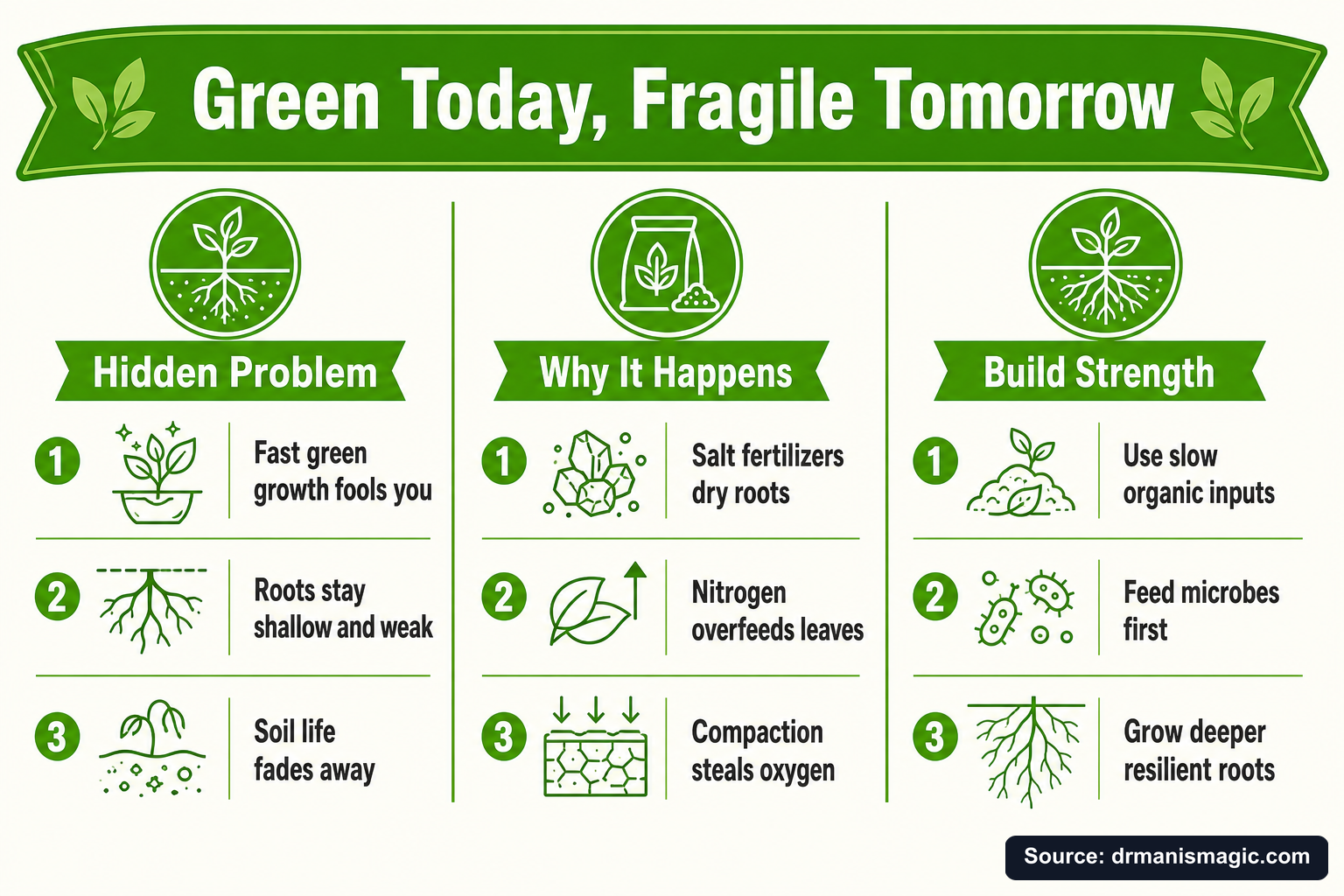
- Modern soluble fertilizers are salt-based, and that salt causes osmotic stress, which is basically a chemical drought inside your plant's roots.
- Salt kills the beneficial microbes your soil needs to cycle nutrients, protect roots, and build long-term plant strength.
- Aggressive nitrogen feeding pushes fast leafy growth but starves the root system, leaving plants vulnerable to heat, drought, pests, and disease.
- Waterlogged, compacted, or biologically dead soil steals oxygen from roots, which is the real cause of most root rot, not just "too much water."
- Some fertilizers and soil amendments contain biosludge, municipal waste, and PFAS "forever chemicals" that contaminate your garden and your family's food.
- Slow-release organic inputs feed the microbes first, and those microbes feed the plant on a gentle, continuous schedule that mirrors nature.
- The Three Plant Pillars, developed and proven by Dr. Mani Skaria at US Citrus Nursery, give any plant a resilient foundation that holds up under real-world stress.
What Does "Feeding Your Plant" Actually Mean?
Quick Answer: Fertilizer does not feed your plant the way food feeds you. Plants make their own food from sunlight, water, and air. Fertilizer provides vitamins and minerals that support that process. The problem is that most fertilizers deliver those minerals as soluble salts, and salt is the enemy of healthy roots and soil life.
Let's clear something up right away, because the whole industry has confused this for decades.
Your plant makes its own food. Sunlight hits the leaves. Carbon dioxide comes in from the air. Water comes up through the roots. The plant combines all three through photosynthesis and creates sugars. Those sugars are the real fuel behind every leaf, every flower, every fruit.
Fertilizer is not food. It is more like vitamins. The plant needs nitrogen, phosphorus, potassium, calcium, magnesium, iron, zinc, and a dozen other elements to run its internal machinery. Enzymes need them. Cell walls need them. Chlorophyll needs them. Without enough of any one of them, the whole system slows down. This is called the Law of the Minimum, and it is why chasing one nutrient at a time rarely works.
So fertilizer matters. But the form it comes in matters even more.
Most fertilizers you find on store shelves are soluble salts. The nitrogen might be urea or ammonium nitrate. The potassium might be potassium chloride. These dissolve fast in water and rush into the soil as a concentrated salt solution. That quick green-up you see? That is a stress response, not a health response. The plant is pulling in nitrogen rapidly because the concentration is suddenly very high. But the soil around the roots is paying a price.
According to Colorado State University Extension, soluble salts in soil create osmotic stress that reduces a plant's ability to absorb water, even when water is present. Roots surrounded by salty soil water have to work against the concentration gradient just to pull moisture in. Instead of drinking freely, the plant is fighting its own growing medium. Researchers at Utah State University Extension call this "chemical drought," and it explains why salt-damaged plants wilt and burn even on a well-watered day.
What Is Osmotic Stress and Why Does It Make Plants Fragile?
Quick Answer: Osmotic stress happens when the salt concentration in the soil is higher than inside the plant's roots. Water moves toward the higher salt concentration, which means water actually pulls away from the roots. The plant experiences drought-like stress even when the soil is wet. This weakens roots, burns leaf edges, and leaves the plant unable to handle heat or real drought.
Think about what happens when you put a cucumber slice in a bowl of salt. Within minutes, water starts pulling out of the cucumber. It shrivels. It goes limp. The salt is drawing moisture out through osmosis.
Now imagine that happening to the tiny hair-like roots on your tree or your lawn grass. Those fine roots are the most important ones. They do most of the water and nutrient absorption. When they are surrounded by salty fertilizer solution, water pulls away from them instead of into them. The root tips get burned. Some die. The plant pulls back, growing fewer fine roots, becoming more dependent on the next fertilizer application just to function.
This is how the addiction cycle starts.
You feed. The plant greens up. The salt burns the fine roots and kills the soil microbes. The plant becomes weaker and more dependent. You feed again. The cycle repeats. Meanwhile, the real infrastructure of your soil, the living biology that was supposed to make all of this self-sustaining, gets wiped out a little more each time.
Oregon State University Extension research documents salt-related injury across lawns, ornamentals, trees, shrubs, vegetables, and container plants. It is not a citrus problem or a lawn problem. It is a universal problem built into the chemistry of how most modern fertilizers are made.
See also: The Osmotic Shock Your Plants Feel From Synthetic Nutrients
How Do Synthetic Fertilizers Kill the Soil Microbes Your Plant Needs?
Quick Answer: Beneficial bacteria and fungi live in the thin zone around plant roots. They unlock nutrients, fight pathogens, build soil structure, and create a living ecosystem that feeds the plant continuously. High-salt fertilizers are toxic to these microbes. When the microbial workforce is gone, the plant loses its immune system, its nutrient-cycling engine, and its ability to survive stress without constant chemical input.
Your soil is not dirt. It is a city.
Under every square inch of healthy ground, there are billions of bacteria, fungi, and other microorganisms doing work that no fertilizer bottle can replicate. They break down organic matter and release nutrients in slow, steady amounts. They form networks around roots that extend the plant's reach for water and minerals. They produce compounds that suppress pathogens like Pythium and Phytophthora, the fungal organisms responsible for most root rot. They glue soil particles into aggregates that keep pore space open so oxygen can reach the roots.
University of Minnesota Extension describes soil microbes as the engine behind nutrient cycling, aggregate formation, and organic matter buffering. Penn State Extension research confirms that this microbial workforce is what separates living soil from dead growing medium.
Salt kills them.
Not slowly. Not gently. High-salt fertilizer applications crash microbial populations in the root zone. The organisms that were doing all of that invisible work disappear. And when they are gone, the soil stops functioning like a living system. It becomes a chemical holding medium. The plant can only get nutrients when you add them directly. The moment you stop feeding, the plant runs out. The moment stress hits, there is no biological buffer to help it cope.
Dr. Mani Skaria, a Professor Emeritus of Plant Pathology and founder of the Clean Citrus Program in Texas, watched this play out across decades of nursery work. He saw plants that looked lush on the outside but had dead soil on the inside. He called it a microbial massacre, and it is exactly what most conventional feeding programs produce.
The plants in our South Texas nursery that thrived the longest, the ones that handled freeze events, drought, pest pressure, and transplant shock the best, were always the ones grown in living soil with active microbial communities. After growing over 250,000 trees, that pattern became impossible to ignore.
Why Does Nitrogen-Driven Growth Create Weak, Disease-Prone Plants?
Quick Answer: High nitrogen pushes fast, lush top growth. But that soft new tissue is low in stored carbohydrates and high in simple sugars, which is exactly what insects and fungal pathogens prefer to attack. Meanwhile, the root system does not grow at the same pace, so the plant has a large canopy it cannot support and shallow roots that cannot handle drought or disease pressure.
Nitrogen is the most important nutrient for plant growth. And it is the most abused.
When you dump a high-nitrogen soluble fertilizer on a lawn or tree, the response is dramatic. New leaves push out fast. Everything looks greener within days. It feels like success. But here is what is actually happening below the surface.
The plant is being pushed to produce new shoot tissue faster than its root system can grow to support it. That new tissue is thin-walled, high in water content, and low in the protective compounds that make plants tough. It is succulent growth, the gardening term for soft, fast-grown tissue that has not had time to harden off.
Aphids love it. Fungal spores love it. Caterpillars love it. Any pest or pathogen that feeds on soft plant tissue has just been handed a buffet.
At the same time, the plant's root-to-shoot ratio gets thrown off. The canopy is growing faster than the roots can keep up with. When a dry week hits, the root system cannot pull enough water to supply all those new leaves. The plant wilts. It burns. It drops leaves. And because the soil biology was already depleted by salt, there is no microbial buffer to help the roots recover.
This is the pattern we see over and over. Plants that get aggressive soluble feeding look spectacular for a season. Then a stressor hits, heat, drought, a pest wave, a transplant, and they collapse in ways that a plant with a strong root system and living soil would easily survive.
See also: Why "Instant Green-Up" Comes With a Cost
What Is the Real Cause of Root Rot and How Does Salt Make It Worse?
Quick Answer: Root rot is not just caused by too much water. It is caused by oxygen starvation in the root zone, combined with pathogens like Pythium and Phytophthora that thrive when roots are stressed. Salt-damaged roots are already weakened and have less resistance to these pathogens. Poor soil structure from dead microbial activity makes drainage worse, which removes more oxygen and accelerates the rot.
Most people think root rot means they watered too much. The real story is more specific, and once you understand it, everything clicks.
Roots need oxygen to survive. They breathe, just like you do, and they pull oxygen from the air spaces in the soil. When soil gets waterlogged, those air spaces fill with water. The roots suffocate. As Utah State University Extension explains, it is oxygen stress that kills roots, not the water itself. The water is just the mechanism that displaces the air.
Now add salt damage to that picture. Salt has already burned and killed many of the fine root tips. The surviving roots are weakened and stressed. The soil microbes that would normally suppress Pythium and Phytophthora are gone, killed by the same salt applications. The physical structure of the soil is degraded because the microbial glue that held aggregates together has broken down, so water pools instead of draining.
Everything that was supposed to protect the roots has been removed by the feeding program itself. The root rot that follows is not bad luck. It is the predictable end result of a system that was undermining root health from the beginning.
This is why at US Citrus Nursery we built the Three Plant Pillars around mineral-based soil structure first. Drainage is not optional. Oxygen in the root zone is not optional. Before any fertilizer or microbial program does any good, the roots need to be able to breathe. You can learn more about building that foundation through our Three Plant Pillars system.
See also: The Hidden Reason Synthetic Fertilizers Cause Root Rot
What Are Biosludge and PFAS and Why Should Every Gardener Know About Them?
Quick Answer: Biosludge is treated municipal wastewater solid, which is a polite way of saying processed human sewage. Some fertilizer companies use it as a cheap filler in both synthetic and organic products. Biosludge frequently contains PFAS, which are synthetic "forever chemicals" that do not break down in soil or the human body and are linked to serious health concerns. Clean organic fertilizers avoid biosludge entirely.
This part of the story does not get told often enough, and it should.
When you buy a bag of fertilizer, especially an inexpensive one, you probably assume the ingredients are what the label says. Nitrogen, phosphorus, potassium. Maybe some trace minerals. What the label does not always tell you is what the filler material is.
Some fertilizer manufacturers, both synthetic and organic, use biosludge as a cheap bulk ingredient. Biosludge is the solid byproduct of treating municipal wastewater. Sewage. Treated and processed, yes. But still carrying contaminants that treatment does not remove, including PFAS.
PFAS stands for per- and polyfluoroalkyl substances. They are synthetic chemicals used in nonstick coatings, food packaging, firefighting foam, and hundreds of other industrial applications. They are called "forever chemicals" because they do not break down. They accumulate in soil, in water, in plant tissue, and in the human body. The health concerns are serious and ongoing.
When you spread biosludge-containing fertilizer on your lawn where your kids play barefoot, or on your vegetable garden, or around your fruit trees, you are potentially depositing PFAS into the soil and into your food.
Dr. Mani's Magic Crab, Kelp & Amino Acids contains zero biosludge, zero PFAS, and zero synthetic salts. Every ingredient is clean, sourced from identifiable natural inputs, and safe for the soil, the food, and the family. That is not a marketing claim. It is a standard we hold because we use these same products on our own nursery, our own grove, and our own land.
Synthetic vs. Slow-Release vs. Organic: Which Fertilizer Actually Builds a Strong Plant?
Quick Answer: Synthetic fertilizers deliver nutrients fast but as salts that damage roots and microbes. Coated slow-release synthetics improve timing but still use salt-based nutrients and plastic coatings that contaminate soil. True organic fertilizers feed the soil microbes first, and those microbes convert nutrients into plant-available forms on a continuous, gentle schedule that mirrors nature and builds long-term plant strength.
Here is the comparison nobody puts on the bag.
| Feature | Synthetic Fast-Release | Coated Slow-Release Synthetic | Organic (Crab, Kelp, Amino Acids) |
|---|---|---|---|
| Nutrient delivery speed | Immediate, soluble rush | Weeks to months via plastic coating | Continuous, microbe-mediated trickle |
| Salt index | High, osmotic stress risk | Moderate to high when coating breaks | Very low, gentle on roots |
| Effect on soil microbes | Kills beneficial bacteria and fungi | Damages microbes when salts release | Feeds and supports microbial populations |
| Root safety | Burns fine root tips | Risk of burn when coat ruptures | Safe, promotes root development |
| Residue concern | None, but soil biology depleted | Plastic microbeads left in soil | None when biosludge-free |
| PFAS / biosludge risk | Possible with some formulations | Possible with some formulations | Zero in clean-sourced products |
| Long-term soil health | Degrades with repeated use | Marginally better, still degrades | Improves with every application |
| Overfeeding risk in containers | High, salts accumulate fast | Moderate | Very low, plant self-regulates uptake |
The coated slow-release synthetic fertilizers deserve a special mention here. They are often marketed as the safer, smarter choice. And the timing is better. But the nutrients inside the plastic shell are still salt-based. When the coating ruptures from heat, soil pressure, or watering, a concentrated salt dose hits the root zone. And those plastic shells? They break down into microplastics that stay in your soil indefinitely.
The organic approach works differently at a fundamental level. The nutrients in crab meal, kelp, amino acids, and other organic inputs are not salts. They are proteins, complex carbohydrates, and mineral compounds that the plant cannot absorb directly. And that is the key insight most people miss.
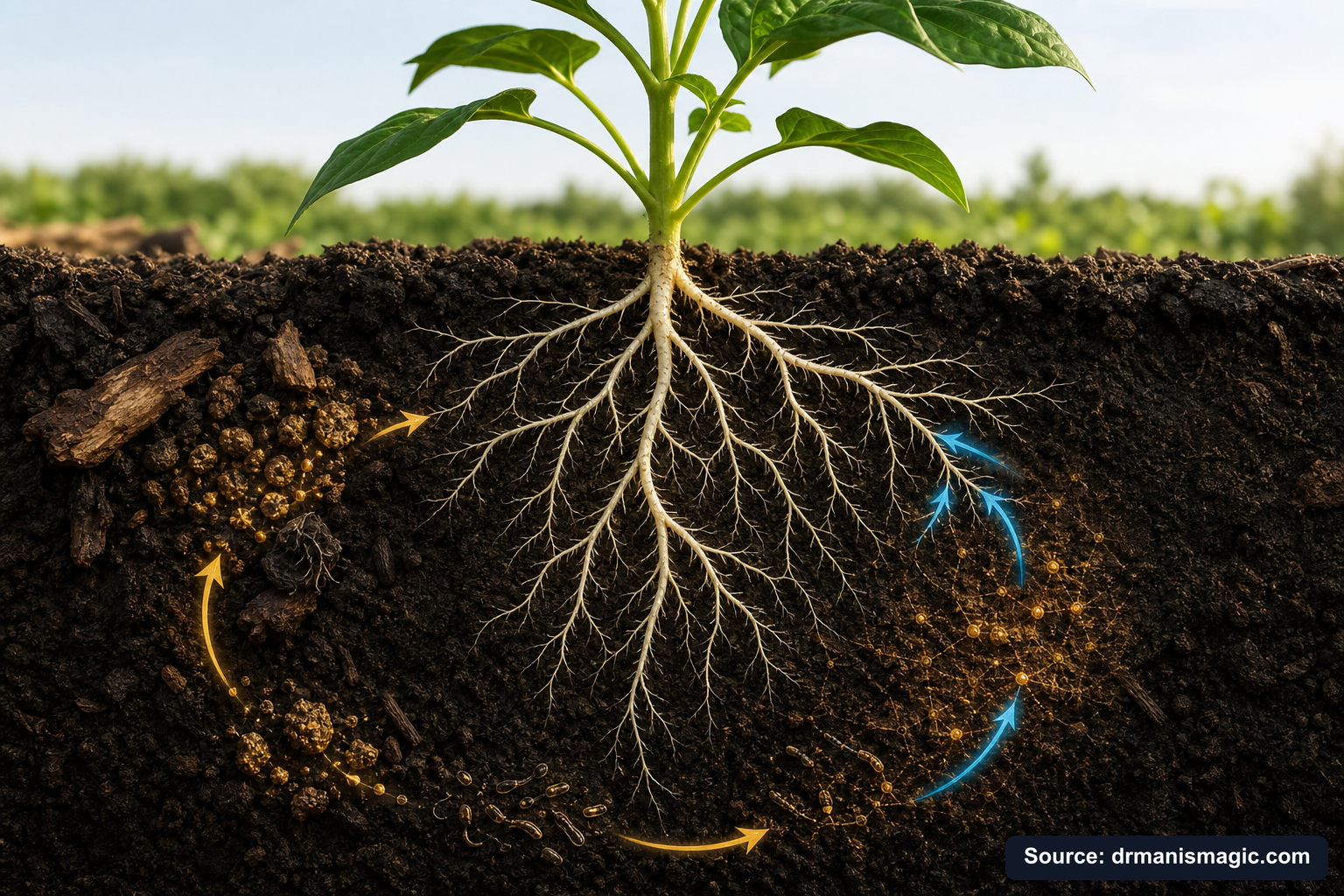
The microbes eat these organic inputs first. They break them down through enzymatic processes and convert them into forms the plant can absorb, like ammonium and nitrate from nitrogen-containing amino acids. As the microbes go through their life cycles and die, they release all of the nutrition they stored directly into the root zone. The plant gets a slow, continuous drip of nutrients in exactly the forms it prefers, on a natural schedule it evolved to expect. There is no spike. There is no crash. There is no salt stress.
That is not just a gentler approach. It is a fundamentally different biological system.
You Never Had a Brown Thumb.
You were handed the wrong tools. This free guide hands you the right ones.
You watered it. You fed it. It died anyway.
It was never you. It was the dirt, the salt food, and the bad advice.
This guide shows you what really went wrong, and how to fix it for good.
- Why your plants really died, and why it was never your fault
- The salt hiding in your plant food that quietly burns the roots
- The hidden killer in almost every bag of store soil
- The tiny helpers that grow a whole forest for free
- The rescue trick that brings a half dead plant back to life

What Does Chitin From Crab Shells Actually Do for Your Plants?
Quick Answer: Chitin is a natural compound found in crab shells. When it breaks down in the soil, it stimulates a class of microbes called chitinases that also attack the cell walls of fungal pathogens and the exoskeletons of soil-dwelling insects. This activates the plant's own defense systems, strengthens cell walls, and helps protect against disease and pest pressure, all without any synthetic chemicals.
Crab shells are not just a calcium source. They are a biological defense trigger.
The outer shell of a crab is made largely of chitin, a tough, fibrous material. When crab meal is incorporated into soil and begins to break down, specific groups of beneficial bacteria called chitinase-producing microbes multiply rapidly to consume it. These same microbes produce enzymes that attack the cell walls of fungal pathogens, including some of the Pythium and Phytophthora species responsible for root rot.
At the same time, the plant's own immune system recognizes chitin breakdown products as a signal that pathogens may be present. It responds by thickening cell walls, increasing production of protective compounds, and ramping up its natural defenses. It is like a fire drill that strengthens the building.
Chitin also contributes calcium and magnesium to the soil as it breaks down. Calcium is the primary structural component of woody plant tissue, cell walls, and fruit. Magnesium sits at the center of every chlorophyll molecule. Without enough of either, even a well-watered, well-lit plant cannot photosynthesize efficiently or build strong structure.
The crab meal in our formulation brings all of these benefits together in a slow, soil-mediated release that never shocks the root zone.
What Does Kelp Do That Regular Fertilizer Cannot?
Quick Answer: Kelp is packed with natural plant hormones called auxins and cytokinins that regulate root growth, cell division, and stress response. It also carries trace minerals, complex carbohydrates, and biostimulants that no salt-based fertilizer contains. These compounds help plants root faster, recover from stress more quickly, and produce better fruit and flower set, independent of basic NPK nutrition.
Kelp is one of the most nutritionally dense organisms on the planet. It grows in cold ocean water where minerals concentrate, and it pulls an enormous spectrum of trace elements, vitamins, and hormones into its tissue.
The most important compounds from a plant-care standpoint are the natural plant growth regulators. Auxins control how roots grow and how roots branch. Cytokinins regulate cell division and help plants recover from stress. These are not nutrients in the traditional sense. They are signaling molecules that tell the plant what to do and when to do it.
When kelp is cold-processed and added to a fertilizer blend, these hormones remain active. They stimulate root initiation, which is especially valuable for transplants and stressed plants. They improve cell division in growing tips. They support fruit set and retention at bloom time. And they help the plant manage drought, heat, and cold stress by regulating internal water balance.
The trace mineral load in kelp is equally valuable. It carries iodine, selenium, boron, molybdenum, iron, zinc, manganese, and dozens of other elements in ocean-concentrated form. These are exactly the micronutrients that salt-heavy soils often lock up or deplete. Kelp delivers them in organic complexes that soil microbes can process efficiently.
No salt-based fertilizer contains auxins. No synthetic formulation contains cytokinins in active form. These are compounds that only come from living ocean biology, and they make a measurable difference in how plants root, fruit, and recover.
How Do Amino Acids Feed Plants Without the Salt Damage?
Quick Answer: Amino acids are the building blocks of protein. When used as a nitrogen source, they do not carry the salt load of synthetic nitrogen compounds like urea or ammonium nitrate. Plants can absorb certain amino acids directly through their roots and leaves. Others are processed by soil microbes into plant-available nitrogen. Either way, the plant gets nitrogen without osmotic stress, and the microbes are supported rather than harmed.
Nitrogen is the nutrient plants need most. It drives leaf growth, chlorophyll production, and protein synthesis. The problem is not nitrogen itself. The problem is how most fertilizers deliver it.
Synthetic nitrogen comes as urea, ammonium nitrate, ammonium sulfate, or similar salts. These dissolve instantly and flood the root zone with a high-concentration nitrogen solution. The quick green-up is real. But the osmotic spike, the microbial damage, and the root stress are just as real.
Amino acid nitrogen works differently. Amino acids are organic molecules, the same building blocks that proteins are made from in all living things. When they are added to soil, microbes break them down and release nitrogen as ammonium and nitrate in small, steady amounts. Some amino acids, especially glycine and glutamine, can be absorbed directly through root cells without any microbial processing at all.
This means the plant gets nitrogen in a form it evolved to handle. No spike. No salt stress. No microbial disruption. And the microbes that do process the amino acids thrive in the process, because amino acids are food for them too.
The feather meal and animal-derived proteins in our organic formulation are high in amino acid nitrogen and phosphorus. They break down slowly, feeding the soil biology continuously and releasing nutrition on the same slow schedule that nature uses. It is the difference between a meal and a sugar crash.
How to Diagnose Whether Salt, Root Rot, or Overwatering Is Hurting Your Plant
Quick Answer: Salt damage, overwatering, and true root rot can look almost identical on the surface. The difference is in the root zone. Salt damage burns leaf edges and tips with dry, papery margins. Overwatering causes limp, yellowed leaves. True root rot shows soft, dark, foul-smelling roots with no white tips. Use the table below to distinguish them and choose the right correction.
One of the most frustrating parts of modern gardening is that several different problems look the same from above. Wilting, yellowing, browning, dropping leaves. The surface symptoms overlap. But the root causes are different, and treating the wrong one makes things worse.
| Symptom / Sign | Salt / Fertilizer Burn | Overwatering (Oxygen Stress) | True Root Rot (Pythium / Phytophthora) |
|---|---|---|---|
| Leaf margins | Brown, dry, crispy edges and tips | Yellow, soft, waterlogged appearance | Yellow to brown, progresses inward |
| Wilting pattern | Wilts midday even when soil is moist | Wilts despite constant moisture | Wilts progressively, does not recover |
| Root appearance | Brown tips, fine roots missing | Pale, waterlogged, no firm structure | Dark brown to black, soft, foul odor |
| Soil smell | No odor, may have white salt crust | Musty, sour, stagnant | Distinctly rotten, sulfur-like |
| Onset speed | Days after fertilizer application | Weeks of consistent overwatering | Rapid once pathogen is established |
| Soil surface | White crust or residue visible | Stays wet for days after watering | Wet, may have mold growth |
| Primary correction | Flush soil, reduce salt inputs, improve drainage | Reduce watering, improve drainage and aeration | Remove affected roots, improve oxygen, add beneficial microbes |
The critical overlap to understand is this: all three conditions often exist together in plants that have been on aggressive soluble feeding programs. The salt damaged the fine roots. The compacted, biologically dead soil stopped draining properly. The oxygen-starved root zone became a perfect environment for Pythium and Phytophthora. What looks like one problem is usually three problems that the feeding program created in sequence.
How Do You Rebuild a Plant That Has Been Damaged by Salt-Based Feeding?
Quick Answer: Recovery starts with removing the stressor, which is the salt-based fertilizer, then flushing accumulated salts, improving drainage and oxygen, and rebuilding the microbial population. This takes weeks to months depending on how damaged the root zone is, but plants respond remarkably well once the biological system is restored and the salt load is reduced.
The good news is that soil biology is resilient. Given the right conditions, microbial populations recover. Roots regenerate. Plants that looked like they were done can come back strong.
Here is the recovery sequence we have used at US Citrus Nursery after plants come to us damaged from conventional programs.
- Stop the salt inputs immediately. Do not apply any soluble synthetic fertilizer to a stressed plant. You cannot fertilize your way out of salt damage. Adding more salt to a burned root zone makes it worse.
- Flush the root zone with clean water. Deep, slow watering pushes accumulated salts down and out of the root zone. Do this two or three times over a week or two. If you are in a container, water until it drains freely from the bottom.
- Check and correct drainage. If water pools or drains slowly, oxygen is not reaching the roots. Fix the drainage before anything else. A mineral-based soil structure, like our Super Soil, allows proper drainage and prevents oxygen starvation at the root zone.
- Reintroduce beneficial microbes. The microbial community is the most important part of the recovery. A liquid microbial drench with live bacteria, fungi, and mycorrhizae applied to the root zone begins repopulating the soil biology and suppressing pathogens. Our Plant Super Boost is formulated for exactly this purpose and does not smell because the microbes are stabilized, not rotting.
- Wait before feeding again. Give the root zone two to four weeks to begin recovering before reintroducing any fertilizer. Feeding a stressed, damaged plant is like asking someone with a stomach injury to eat a large meal. The system is not ready.
- Reintroduce nutrition with a clean, low-salt organic fertilizer. Once new root tips begin forming and the plant shows signs of recovery, begin a gentle organic feeding program. Look for white root tips as the signal that the root zone is alive and ready.
- Maintain the system, do not chase symptoms. The goal is a living soil with active biology, good structure, and slow-release organic nutrition. When all three are in place, the plant becomes self-regulating and stress-resilient. That is what the Three Plant Pillars were designed to create.
The Three Plant Pillars vs. The Conventional Feeding Approach
Quick Answer: The Three Plant Pillars prioritize mineral soil structure, living microbial biology, and clean organic nutrition as the foundation for plant resilience. The conventional approach prioritizes fast soluble nutrients, ignores soil biology, and creates plants that look good briefly but collapse under stress. The difference is root depth, soil life, and long-term health versus surface appearance and chemical dependence.
Here is the honest comparison nobody in the fertilizer industry wants you to see.
The conventional approach, the one that has dominated since the 1950s when synthetic fertilizers became widely available, treats the plant as the system. Feed the plant with soluble nutrients. Get a fast response. Repeat. The soil is just a medium to hold the roots while the chemicals do the work.
The Three Plant Pillars approach, developed and refined by Dr. Mani Skaria across 40 years of plant pathology research and 30 years of nursery production, treats the soil as the system. Build the soil structure so roots can breathe. Populate the soil with living biology that cycles nutrients, suppresses disease, and builds resilience. Then feed that biology with clean organic inputs that nourish the microbes and the plant together.
The plant that grows from Pillar One, mineral-based soil with permanent drainage and aeration, can breathe at the root level. It does not develop the oxygen-starved conditions that favor Pythium and Phytophthora.
The plant that grows from Pillar Two, a living microbial community of bacteria, fungi, and mycorrhizae, has an immune system. It has a nutrient-cycling engine that works around the clock. It has a root extension network that reaches water and minerals that the root alone could never find.
The plant that grows from Pillar Three, slow-release organic nutrition with no synthetic salts, no biosludge, no PFAS, builds real structural tissue. Thick cell walls. Deep root systems. Stored carbohydrate reserves that let it handle a drought week or a heat wave without collapsing.
That plant does not need constant correction. It does not need salt flushing. It does not need a rescue feeding every time the weather gets hard. It thrives because its foundation is right.
You can review our complete Free Plant Care Field Guide to see how the Three Plant Pillars apply to every type of plant you are growing, from lawns to fruit trees to houseplants.
What Does a Resilient Feeding Program Actually Look Like?
Quick Answer: A resilient feeding program starts with soil structure and drainage, adds a living microbial community, and then layers in slow-release organic nutrition that feeds the microbes and the plant together. It does not start with fertilizer. It does not use high-salt soluble inputs. And it produces plants that get stronger over time instead of more dependent on correction.
You do not need twenty products. You do not need a complicated schedule. The most common mistake we see from new gardeners is trying to solve every problem with a new product instead of building the foundation first.
Here is what a real resilient program looks like, in plain language.
Start with structure. The soil your plant lives in needs to drain freely and hold air in the pore spaces around the roots. If it does not drain, nothing else works. Most commercial potting mixes are made from pine bark and wood materials that decompose within six to twelve months, compacting into a root-choking layer that holds water and cuts off oxygen. A mineral-based soil that does not decompose solves this permanently.
Add living biology. Before the first feeding, introduce beneficial microbes. They colonize the root zone, begin building soil structure, and start suppressing the pathogens that cause root rot. A liquid microbial drench applied monthly keeps the population active and growing.
Feed slowly and continuously. Organic granular fertilizer applied on a regular schedule, monthly for containers, seasonally for in-ground plants, provides a continuous low-level release of nutrients that the plant absorbs on its own timeline. No spike. No crash. No salt stress. The plant grows steadily and builds real structural strength.
Observe the plant, not the calendar. A healthy plant with active soil biology will tell you what it needs through its leaves, its new growth, and its root development. Green, upright new leaves with good turgor and consistent stem thickening mean the system is working. Pale older leaves suggest nitrogen is cycling slowly and it may be time to add another round of organic fertilizer. The diagnosis comes from the plant, not from a rigid spray schedule.
Never feed a stressed plant. If a plant is wilting, burning, or showing root damage, adding fertilizer makes it worse. Restore the root zone first. Flush the salts. Improve the drainage. Reintroduce the biology. Then feed once the white root tips tell you the system is ready.
This is not complicated. It is actually simpler than the conventional approach, which requires constant correction, repeated applications, and ongoing troubleshooting. When the foundation is right, the plant does most of the work itself.
See also: Why Overfeeding Is a Modern Gardening Problem
The Clock Is Already Running
There is one thing we hear from gardeners more than anything else at our South Texas nursery. More than questions about varieties or watering schedules or pest control. The one thing people tell us, again and again, is that they want to see fruit on their own tree while they still can. They want to walk out to their backyard and pick something they grew. They want to sit under shade they planted. They want to hand their grandkids a lemon or a peach or a tomato from their own soil.
That is not a gardening goal. That is a life goal. And time is the one thing you cannot buy back.
Every season spent on a feeding program that creates fragile plants is a season where that goal moves further away instead of closer. The plant stalls. The soil gets more depleted. The roots get weaker. You spend money on more products, more corrections, more restarts. And the clock keeps running.
When the Three Plant Pillars are in place, when the soil drains and breathes, when the microbes are alive and working, when the nutrition is clean and continuous, plants do not stall. They build momentum. Month after month, the root system deepens. The canopy strengthens. The fruit set improves. The whole system gets more resilient, not more fragile, with every passing season.
That is the difference between gardening the old way and building it right from the start.
If you are ready to stop wasting seasons and start building plants that actually hold up under real life, our Three Plant Pillars system is the clearest starting point we know. Everything we use in our own nursery, the mineral soil, the live microbes, and the clean organic fertilizer, is available for your backyard, your containers, your lawn, and your garden. No guesswork. No chemistry degree required. Just the foundation that 250,000 trees taught us works.
Frequently Asked Questions
Most gardeners do everything the bag tells them to do. They still end up with weak plants that fall apart when the weather gets tough. These questions get to the heart of why that keeps happening, and what actually fixes it for good.
Why do my plants look great at first but fall apart when summer heat hits?
Soluble salt fertilizers push fast, soft growth. That new flush of green looks healthy, but it is built on shallow roots and dead soil. When heat and drought show up, there is nothing strong underneath to hold the plant together. Dr. Mani saw this pattern across 250,000 trees at US Citrus Nursery. The fix is not more fertilizer. It is building real root strength first through mineral soil, live microbes, and slow-release organic nutrition.
What does salt-based fertilizer actually do to my soil?
Salt pulls water away from roots and kills the beneficial bacteria and fungi living in your soil. Those microbes are the real workers. They unlock nutrients, fight disease, and keep your soil spongy and alive. When salt wipes them out, your plant loses its entire support system. You get a short green flush, then a slow decline. Every bag of synthetic fertilizer you pour on is making the next season harder, not easier.
Is fast leafy growth a sign my plant is healthy?
No. Fast leafy growth often means your plant is stressed. A sudden rush of nitrogen forces the plant to push soft tissue quickly. That tissue is weak. It attracts pests and burns easily in heat. Real health shows up in thick stems, deep color, strong roots, and a plant that stays standing when conditions get rough. That kind of strength only comes when the soil and microbe layers underneath are doing their job.
Why does root rot happen even when I think I am watering correctly?
Root rot is almost never just about water. It is about oxygen. Roots need air to survive. Most potting mixes are loaded with pine bark and wood that break down into a soggy, compacted sludge. That sludge blocks oxygen from reaching the roots. Dr. Mani built Super Soil around mineral-based sandy loam from South Texas specifically because it holds its structure, drains fast, and keeps air moving around roots even after years of use.
Can the fertilizer I buy at a big box store hurt my family or pets?
Some synthetic fertilizers and soil amendments contain heavy metals, biosludge, and PFAS compounds sometimes called forever chemicals. These can build up in your garden soil and in the food you grow. Dr. Mani's crab, kelp, and amino acid fertilizer uses slow-release organic inputs with no synthetic salts, no plastic coatings, and no mystery ingredients. You should be able to walk barefoot in your yard and let your kids play in the garden without reading warning labels first.
What are the Three Plant Pillars and why do they matter for any plant I grow?
The Three Plant Pillars are the foundation Dr. Mani developed after decades of testing. Pillar one is mineral-based soil that drains well and never compacts. Pillar two is live microbes that protect roots and unlock nutrients. Pillar three is organic fertilizer that feeds slowly without burning. Together they work for grass, houseplants, fruit trees, gardens, and flowers. Once these three are in place, your plants stop being fragile and start being practically bulletproof.
How long does it take to see real results when I switch to the Three Plant Pillars system?
Most people notice a difference within the first 30 days. Roots start expanding into healthy soil. Microbes get to work fast. The organic fertilizer begins a slow, steady feed that keeps going for months. The bigger shift happens over the first season as the soil comes alive. Here is the honest truth though. Every week you stay with salt-based fertilizers and dead potting mix is a week your plants are not building the strength they should. Time lost in the garden does not come back.
About the Author
Ron Skaria, MD
Ron Skaria, MD, is the co-founder of Dr. Mani's Magic and the son of Dr. Mani. He trained as a medical doctor and now works full time on the family farm in Hargill, Texas, building Dr. Mani's Magic alongside his dad. He wrote the Brown Thumb Field Guide to put his father's 48 years of plant science into plain words any gardener can use. His belief is simple. You never had a brown thumb. You just never had the right help.


