


How Microbes Turn Dirt Into Food for Your Plants | Dr. Mani's Magic
How Microbes Turn Dirt Into Food: The Invisible Workforce Growing Your Plants
Picture this. You walk outside on a quiet morning, coffee in hand, and you stop at the edge of a forest. No one planted those trees. No one fertilized them. No one watered them. No one added anything. And yet they are enormous. Loaded with life. Green and thick and bursting with energy that you can almost feel in your chest.
Now you walk back inside and look at your potted lemon tree on the patio. Yellow leaves. Stunted. Struggling. You have watered it. You have fertilized it. You have done everything the bag said to do. And it is still dying. So what does the forest know that you do not?
The answer is not more fertilizer. It is not a different spray. The answer is alive. It is invisible. And it is living inside every handful of healthy soil on this planet. It is the soil food web. Trillions of microbes turning ordinary dirt into a non-stop food delivery system for every root in the ground. Once you understand how this works, you will never look at soil the same way again. And you will finally understand why your plants have been struggling, and exactly what to do about it.
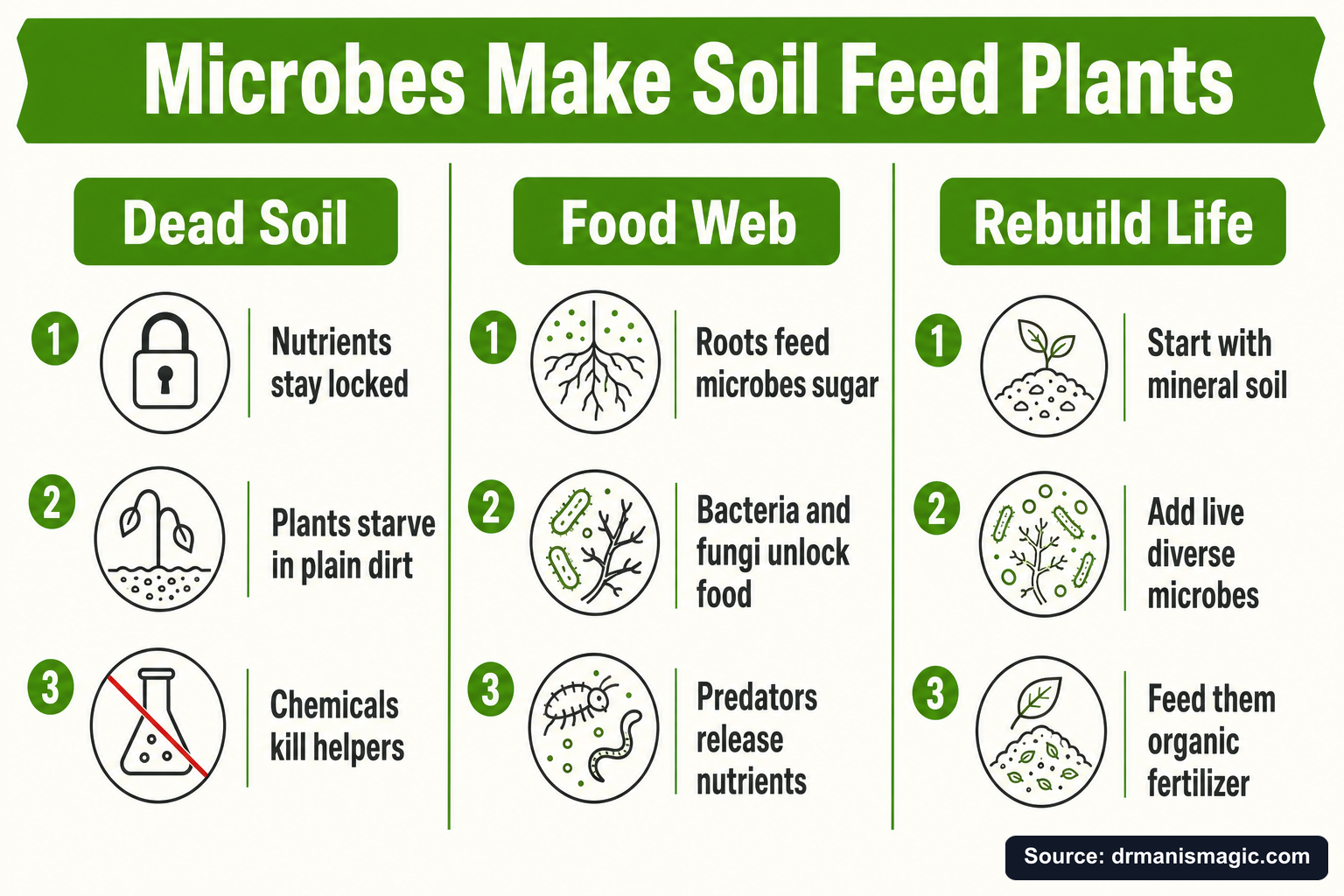
Key Takeaways
- Microbes are the invisible workforce that converts raw dirt and dead organic matter into food plants can actually absorb.
- The soil food web is a chain: sunlight makes plant sugar, roots feed microbes, microbes break down matter, tiny predators release nutrients, and plants absorb them.
- Bacteria, fungi, protozoa, and nematodes all play different roles in this chain. Remove any link and the whole system weakens.
- Salt-based synthetic fertilizers, herbicides, pesticides, and fungicides kill the very microbes your plants depend on, creating a cycle of dependency that benefits chemical companies, not your garden.
- Most commercial microbial products are either dried and dead, or alive but rotting and foul-smelling. Neither works well.
- Rebuilding a living soil after damage takes time and consistent re-inoculation with genuinely live, full-spectrum microbes.
- The Three Plant Pillars (mineral soil, live microbes, organic fertilizer) form the foundation that makes any plant nearly bulletproof.
What Does the Soil Food Web Actually Do for Your Plants?
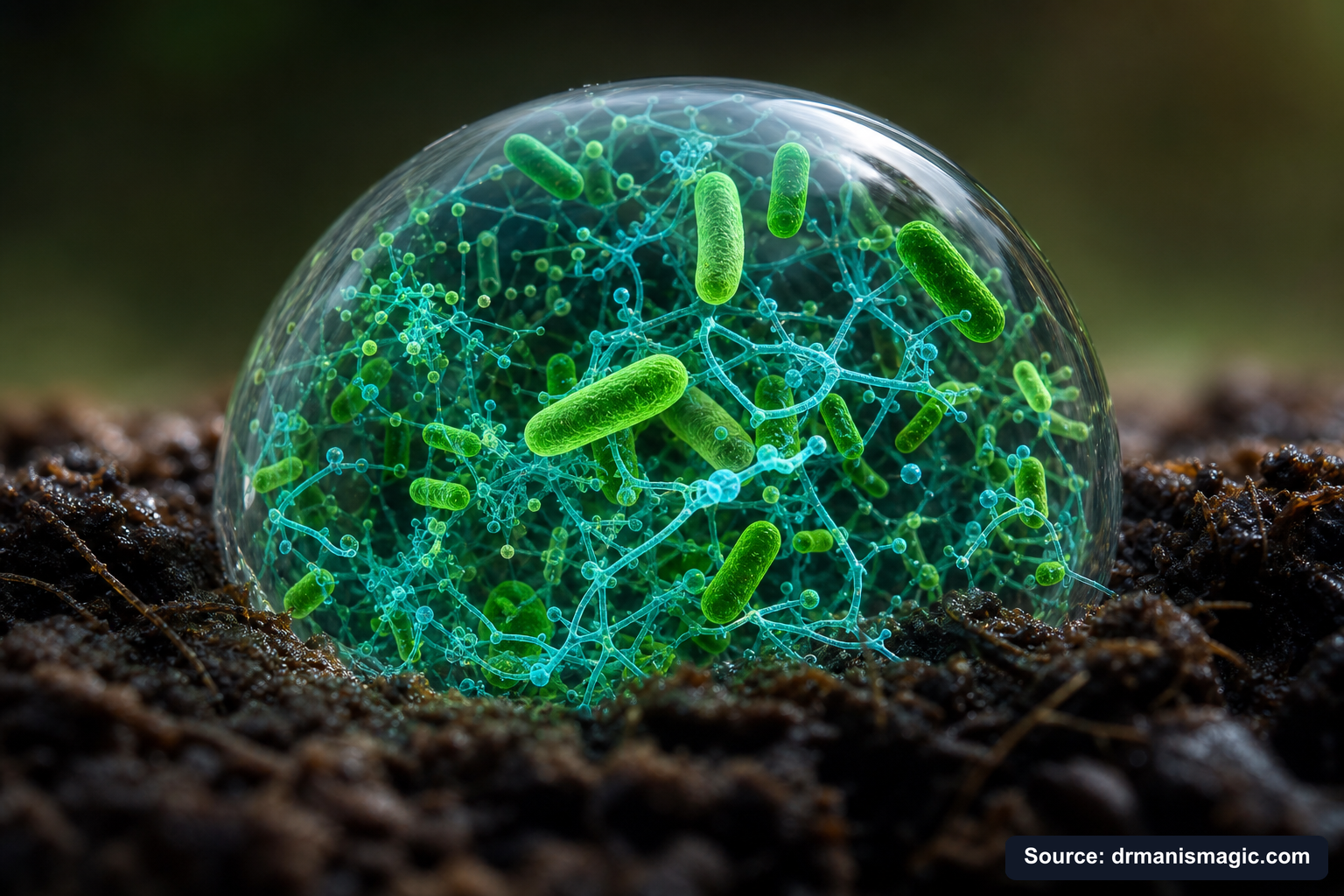
Quick Answer: The soil food web is the living network of bacteria, fungi, protozoa, and nematodes that breaks down organic matter and minerals into forms plant roots can absorb. Without it, nutrients stay locked in the soil and plants slowly starve, even when the raw materials are right there beneath the surface.
Think of soil the way you think of your gut. Your gut is full of bacteria. Those bacteria break down the food you eat into molecules your body can actually use. Without them, you could eat a steak and a salad and still be malnourished, because the nutrients were never released in a form your body could absorb.
Soil works exactly the same way.
Raw dirt contains minerals, organic matter, decomposed leaves, old roots, and gases. But most of that is locked up. Unavailable. Inert. It is like a bank vault full of gold with no key. The microbes are the key.
According to the University of Minnesota Extension, soil biological processes supply roughly 75% of the plant-available nitrogen and 65% of the available phosphorus that plants receive. That means three-quarters of your plant's nitrogen is coming from biology, not from the bag of fertilizer you bought at the hardware store.
The chain looks like this:
- Sunlight hits the leaves. The plant runs photosynthesis and makes sugar.
- The plant pumps some of that sugar down through its roots into the surrounding soil. This is called root exudate. Plants do this on purpose. They are farming the microbes.
- Bacteria and fungi eat the sugar and multiply by the billions. They also attack dead organic matter and start breaking it down.
- Protozoa and beneficial nematodes eat the bacteria. When they eat, they excrete the excess nitrogen right next to the roots in a form the plant can absorb immediately.
- The plant picks up the nutrients. It grows. It makes more sugar. The cycle repeats.
That is the soil food web in plain English. Sunlight powers it. Roots seed it. Microbes run it. And your plant eats the output.
When the web is alive and healthy, the soil feeds itself. When it is dead, nothing works right, no matter how much fertilizer you add.
Who Are the Microbes? A Plain-English Guide to the Invisible Crew
Quick Answer: The main workers in the soil food web are bacteria, fungi, protozoa, and nematodes. Each one plays a different role. Bacteria and fungi break things down and unlock nutrients. Protozoa and nematodes eat the bacteria and release nutrients in plant-ready form. Together they form a complete nutrient delivery system.
Most people picture microbes as germs. Tiny bad things that make you sick. But the microbes in healthy soil are more like a highly organized work crew. Each type has a specific job, and when all of them are present, the whole operation runs like clockwork.
Here is who is on the crew and what they actually do:
| Organism | What It Does | Why It Matters to Your Plant |
|---|---|---|
| Decomposer bacteria | Break down dead plant material, leaves, old roots | Releases trapped nutrients back into the soil cycle |
| Nitrogen-fixing bacteria | Pull nitrogen gas from the air and convert it into plant-usable forms | Free nitrogen fertilizer from thin air |
| Phosphorus-solubilizing bacteria | Break chemical bonds that lock phosphorus in minerals | Unlocks the phosphorus already in your soil |
| Disease-suppressive bacteria | Crowd out and outcompete harmful pathogens in the rhizosphere | Natural disease defense without fungicide sprays |
| Actinomycetes bacteria | Break down tough materials like chitin and cellulose | Recycles the hard stuff; creates that clean, earthy soil smell |
| Mycorrhizal fungi | Extend root system by up to 700 times; trade water and nutrients for plant sugar | Massively expands what your roots can reach |
| Decomposer fungi | Break down woody material and produce glomalin to bind soil particles | Creates soil structure and stops compaction |
| Protozoa | Eat bacteria by the millions; excrete excess nitrogen near roots | The most underrated nutrient releaser in the whole system |
| Beneficial nematodes | Eat bacteria, fungi, and other nematodes; cycle nutrients; suppress pests | Control bad nematodes and release nutrients; often misunderstood as only bad |
The Protozoa Secret Nobody Talks About
Protozoa are the most underexplained part of the soil food web. Most gardening content stops at bacteria and fungi. But protozoa are one of the most important nutrient delivery mechanisms in the entire system.
Here is why. Bacteria eat organic matter and lock nitrogen inside their tiny bodies. That nitrogen is immobilized. Unavailable to the plant. But when a protozoan eats a bacterium, it only keeps what it needs. The excess nitrogen gets excreted right next to the root in a form the plant can absorb instantly.
This is called the microbial loop. And it is one of the main reasons the University of Minnesota Extension can point to biology supplying 75% of plant-available nitrogen. The protozoa are doing a huge part of that work.
No protozoa, no loop. No loop, and a massive percentage of your soil's nitrogen stays locked up in bacterial bodies instead of feeding your plants.
Are Nematodes Good or Bad?
Nematodes have a terrible reputation because the root-feeding species damage crops. But here is what most gardening content misses: the majority of nematodes in healthy soil are beneficial. Bacterial-feeding nematodes, fungal-feeding nematodes, and predatory nematodes all contribute to nutrient cycling and pathogen suppression. The problem is not nematodes. The problem is a dead, unbalanced soil where the bad nematodes have no competition.
When the full food web is intact, the predatory nematodes keep root-feeding nematodes in check naturally. It is a self-regulating system. Which is exactly why restoring the full spectrum of biology, not just one or two species, is so important.
How Do Plant Roots Farm the Soil Microbes Around Them?
Quick Answer: Plant roots actively release sugars, amino acids, and other compounds into the surrounding soil to attract and feed bacteria and fungi. This zone around the root, called the rhizosphere, becomes a hotbed of microbial activity. The plant feeds the microbes, and the microbes feed the plant right back. It is one of nature's most elegant partnerships.
Plants are not passive. They are not just sitting in the ground waiting for nutrients to drift by. They are actively managing the soil around them.
Up to 40% of all the sugar a plant makes through photosynthesis gets pumped out through the roots. Not wasted. Spent on purpose. To feed the bacteria and fungi that the plant depends on for survival.
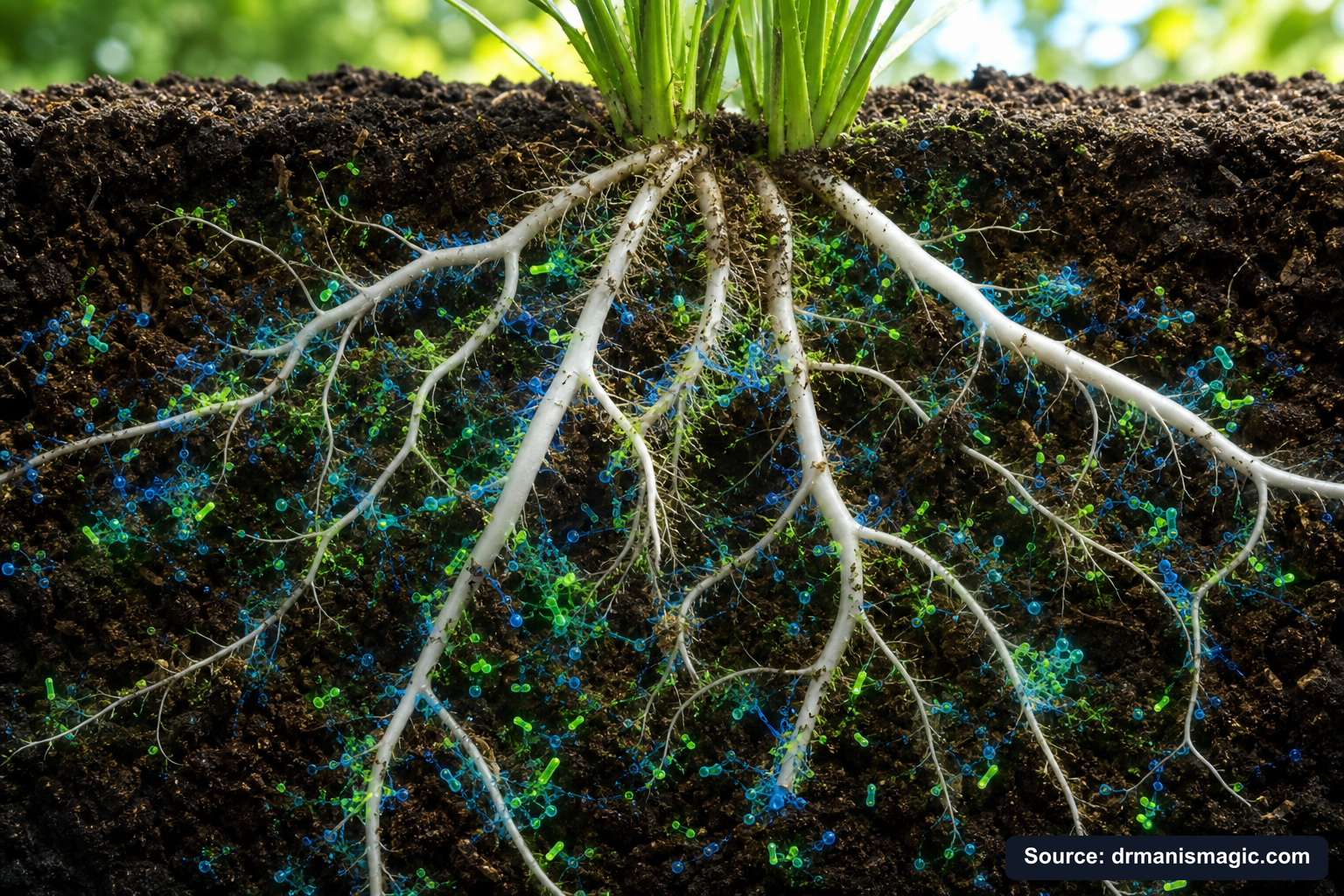
This sugar-rich zone around the root is called the rhizosphere. The word comes from the Greek word for root. And inside the rhizosphere, microbial populations can be 10 to 100 times denser than in the surrounding soil. The plant creates a feeding frenzy on purpose, because the more microbes gather near the root, the more nutrients get unlocked and delivered.
This is also why mycorrhizal fungi are so powerful. They physically attach to the root and extend long, thread-like structures called hyphae deep into the soil. These threads reach minerals, water, and nutrients that the root itself could never reach. The fungi trade those resources back to the plant in exchange for sugar. According to research from Oregon State University Extension, mycorrhizal networks can extend a plant's effective root surface area by up to 700 times.
Seven hundred times.
That is not a marginal improvement. That is the difference between a plant that struggles and a plant that thrives. And it happens invisibly, underground, every single day in a forest, meadow, or healthy garden bed.
Have you ever pulled a weed out of the ground and noticed fuzzy white threads clinging to the roots? That is mycorrhizae. That is why weeds grow so aggressively even in poor soil. They are plugged into the network. Once you start giving your plants the same advantage, the difference is remarkable.
What Kills Soil Microbes and Destroys the Food Web?
Quick Answer: Salt-based synthetic fertilizers, herbicides like glyphosate, broad-spectrum pesticides, synthetic fungicides, and waterlogged or heavily compacted soil all kill or suppress beneficial microbes. Once the food web collapses, nutrients lock up, disease increases, and plants become dependent on chemical inputs just to survive.
Here is the part that stings a little.
Most of what the gardening industry told you to do for the last 70 years has been quietly destroying the very system your plants depend on.
It started in the 1950s when synthetic fertilizers became widely available. Companies like Miracle-Gro were essentially advertising agencies that decided to sell imported salt-based fertilizer to American home gardeners. The marketing was brilliant. The product? Not so much.
Salt-based fertilizers work by pushing nutrients into the plant through osmotic pressure. It looks like growth. The plant greens up fast. But those salts also create an environment that is hostile to beneficial microbes. Bacteria and fungi die off. The food web collapses. And now your plant is completely dependent on the next bag of fertilizer to survive, because the biology that would have fed it naturally is gone.
It is not your fault. The information was hidden from you. The deck was stacked. But now you know.
See also: The Hidden Reason Synthetic Fertilizers Cause Root Rot
| Input or Practice | How It Damages the Food Web | What Happens to Your Plant | What to Do Instead |
|---|---|---|---|
| Salt-based synthetic fertilizers | High salt concentration kills bacteria and fungi; creates osmotic stress in the rhizosphere | Nutrient dependency cycle; weak root zone; eventual decline | Switch to organic, slow-release fertilizer; re-inoculate with live microbes |
| Synthetic herbicides (glyphosate) | Disrupts microbial enzyme pathways; reduces diversity and population | Lower disease resistance; weakened nutrient cycling | Mechanical weeding; targeted spot treatment; re-inoculate after use |
| Broad-spectrum pesticides | Non-selective toxicity; kills beneficial insects and soil organisms alike | Imbalanced soil biology; increased pest pressure over time | Organic pest control; restore biology with full-spectrum inoculant |
| Synthetic fungicides | Kills beneficial fungi including mycorrhizae alongside target pathogens | Loss of root extension network; reduced water and nutrient uptake | Use disease-suppressive biology; restore mycorrhizae with Plant Super Boost |
| Compacted or waterlogged soil | Drives out oxygen; creates anaerobic zones where only bad microbes thrive | Root rot; sulfur smell; yellowing; plant death | Improve drainage; use mineral-based soil; aerate regularly |
| Sterilized potting mix | Contains no living biology at all from the start | Plant is completely dependent on external inputs with no biological backup | Add live microbial inoculant immediately at planting |
| Road salt or de-icing salt | Sodium ions displace calcium and magnesium; destroy soil structure and microbes | Leaf scorch; root damage; plant death near roads or driveways | Flush with water; amend with gypsum; re-inoculate biology |
There is also the issue of biosludge and PFAS contamination in many commercial soil amendments. Some conventional fertilizers and composts contain synthetic forever chemicals that accumulate in the soil and in your food. This is one reason Dr. Mani's Magic products are formulated with Zero PFAS, Zero Biosludge, and Zero Synthetic Salts. Your backyard should not be a chemistry experiment, especially if kids and pets are playing in it.
You Never Had a Brown Thumb.
You were handed the wrong tools. This free guide hands you the right ones.
You watered it. You fed it. It died anyway.
It was never you. It was the dirt, the salt food, and the bad advice.
This guide shows you what really went wrong, and how to fix it for good.
- Why your plants really died, and why it was never your fault
- The salt hiding in your plant food that quietly burns the roots
- The hidden killer in almost every bag of store soil
- The tiny helpers that grow a whole forest for free
- The rescue trick that brings a half dead plant back to life

Live Microbes vs. Dead Microbes: Why Most Products on the Shelf Do Not Work
Quick Answer: Most commercial microbial products are either dried powders made from lab-grown strains that rarely reactivate in soil, or liquid composts that have gone anaerobic and are already dying by the time you open the bottle. Neither delivers the full, living soil food web your plants need. Genuinely alive, full-spectrum microbes harvested from real compost and properly stabilized are the only form that consistently works.
This is where it gets important. And honest.
The market for beneficial microbes and mycorrhizal products has exploded in the last decade. Walk into any garden center and you will find dozens of options. Powders. Liquids. Tablets. Granules. All promising to transform your soil.
Most of them do very little.
After growing over 250,000 trees at the US Citrus Nursery in South Texas, Dr. Mani Skaria and his team tried dozens of commercial microbial products. The results were consistently disappointing. Here is why:
The Three Ways Microbial Products Fail
Method 1: Dried lab-grown powders. A handful of giant factories brew specific bacterial strains in massive vats, then dry them into powder. Companies order species off a checklist and put their label on it. The hope is that the dormant spores will reactivate when water is added and they hit the soil. In our testing, this rarely happens at a meaningful level. The diversity is too narrow. The survival rate is too low. The results are invisible.
Method 2: Compost tea that has gone bad. Some liquid products are made from compost or worm castings. When they are fresh, they can be excellent. But by the time they reach a warehouse shelf, a store, and then your home, the microbes have gone anaerobic. The oxygen is gone. The bacteria are dying and fermenting. The bottle may hiss when you open it. The smell is unmistakable. Like sewage. You might see some benefit from the humic acid and organic compounds that remain, but the living biology is largely gone.
Method 3: Lactobacillus-based products. These are easy to make and extremely vigorous. They stay alive. But lactobacillus is the same bacteria in your yogurt, and it does not belong in soil. It outcompetes the beneficial species you actually want and throws off the whole ecosystem. We do not include it in our products for exactly this reason.
| Product Type | Viability When Used | Species Diversity | Smell | Our Assessment |
|---|---|---|---|---|
| Dry/powdered lab-grown microbes | Very low | Narrow (a few strains) | Neutral | We saw no meaningful results after dozens of trials. Avoid. |
| Dry microbes rehydrated in liquid | Very low | Narrow | Neutral to mild | Same problem as powder. Avoid. |
| Compost tea (fresh, under 24 hours, aerated) | Moderate | Partial spectrum | Earthy, then sour | Works if used immediately. Not practical for most gardeners. |
| Compost tea (old, over 24 hours) | Low to none | Partial | Strong, foul | Anaerobic. Not recommended. |
| Lactobacillus products | High (they survive) | Narrow | Mild | Outcompetes beneficial species. Belongs in yogurt, not soil. |
| Fresh active compost (on-site) | High | Broad, natural | Earthy | Excellent. Requires time, space, and effort to maintain. |
| Plant Super Boost (stabilized, full-spectrum) | High | 2,000+ bacteria; 400-500 fungi including mycorrhizae; plus protozoa and nematodes | Earthy, not foul | Harvested from real compost, stabilized by a natural proprietary method. Verified by lab analysis. Visible living microbes under a microscope. |
The story behind Plant Super Boost is worth telling. The stabilization technique was not developed by Dr. Mani. It was invented by a world-renowned compost expert who had advised royal families and governments on sustainable farming. When large citrus groves started seeing dramatic results using his method, he was blacklisted by major chemical companies. He eventually feared for his life and stopped production. Years later, through a meeting that felt almost like providence, he joined forces with Dr. Mani and the US Citrus Nursery team. Together they brought this technology to everyday American gardeners for the first time.
That is why Plant Super Boost smells earthy, not rotten. The microbes are alive and stable, not fermenting and dying. If you put a drop under a microscope, you can see them moving. Lab analyses confirm the diversity. This is not marketing. This is verifiable biology.
Does Salt-Based Fertilizer Really Cause Root Rot? The Connection Most Gardeners Miss
Quick Answer: Yes. Salt-based fertilizers create high-salt conditions in the soil that kill beneficial bacteria and fungi, especially the species that suppress root-rotting pathogens. Without that biological defense layer, harmful organisms like Phytophthora and Pythium take over the root zone unchecked. The fertilizer appears to help short-term while quietly dismantling your plant's long-term defense system.
Root rot is not just a watering problem. Most gardening content tells you it is about overwatering. That is part of the story. But the deeper cause is biological.
In healthy soil, disease-suppressive bacteria and beneficial fungi form a living shield around the root zone. They crowd out pathogens. They outcompete them for food and space. They produce natural compounds that inhibit harmful organisms. This is how plants in a forest survive without anyone spraying fungicide on them.
When you apply salt-based fertilizer, the high salt concentration in the soil water creates a hostile environment. Beneficial microbes die off or become suppressed. The pathogens that cause root rot, especially water molds like Phytophthora, are more tolerant of these conditions. They move in. The biological defense is gone. And suddenly your plant is vulnerable to rot that it would have been able to fight off naturally if the food web had been intact.
This is one of the most important connections in all of soil science, and almost no one in the gardening industry talks about it. Because the same companies selling you the fertilizer also sell you the fungicide. The cycle is profitable for them. Not for your garden.
See also: Why Most Fertilizers Are Actually Salt in Disguise
How Do You Revive Dead, Damaged, or Depleted Soil?
Quick Answer: Reviving depleted soil requires removing the inputs that are killing biology, adding genuine live microbes, improving soil structure so oxygen can reach the root zone, and feeding the biology with organic matter over time. Recovery takes weeks to months depending on how damaged the soil is. Consistency matters more than any single application.
This is the question most people come to us with. The plant is struggling. The soil feels dead. Nothing is working. What now?
The good news is that soil biology is remarkably resilient. Given the right conditions and the right inputs, it comes back. Here is the recovery framework we use:
Dead Soil Recovery Plan: 6 Steps
- Stop what is killing the biology. This means stopping salt-based synthetic fertilizers, broad-spectrum pesticides, and synthetic fungicides immediately. You cannot rebuild a living system while the inputs destroying it are still being applied. Even if you feel nervous about stopping fertilizer, the microbes need a chance to establish before they can do their job.
- Fix the physical structure first. Compacted, waterlogged, or bark-heavy potting mix cannot support aerobic microbial life. If you are in containers, consider moving to a mineral-based soil that drains properly and does not decompose into a root-choking sludge over time. Roots need oxygen just as much as they need water. The Super Soil we use at the nursery is based on silica-rich sandy loam from the Rio Grande Valley. It does not break down. It does not compact. It gives roots room to breathe and expand.
- Inoculate with genuinely live, full-spectrum microbes. Add a real microbial inoculant that includes bacteria, fungi, mycorrhizae, protozoa, and nematodes. Not a powder. Not a foul-smelling liquid. Something alive. Apply monthly, because many soils have been damaged for years and the biology needs repeated reinforcement to establish and hold.
- Feed the biology with organic inputs. Microbes need organic matter to eat and thrive. Switch to a slow-release organic fertilizer that works with the biology instead of burning it. Crab, kelp, and amino acid-based fertilizers provide the full spectrum of macronutrients, micronutrients, and biostimulants that both the plant and the microbes need. No synthetic salts. No PFAS. No biosludge.
- Be patient with a damaged salt history. If the soil has been heavily treated with salt-based inputs for years, the recovery will take longer. Flush the root zone with clean water several times to help move excess salts through the profile. Then keep adding biology consistently. The turnaround is real, but it is not instant.
- Watch for the signs of recovery. New root growth. Darker, more vibrant leaf color. Improved drought tolerance. Flowers and fruit setting more reliably. These are the signs that the food web is coming back online. They usually start appearing within 30 to 60 days of beginning the right protocol.
We have watched this process play out on hundreds of trees at the nursery. Trees that looked finished. Trees that had been in bad potting mix for years, fed with salt fertilizer, showing all the signs of irreversible decline. With the right three-pillar approach, most of them turned around. Not overnight. But they turned around.
The number one thing people tell Dr. Mani they want is to see fruit on a tree they planted while they can still enjoy it. That is not a small thing. That is primal. We were made to tend a garden. But every month you spend going backward with the wrong inputs is a month you will never get back. Time is the one resource you cannot buy more of. The right foundation now means fruit on the branch sooner than you think.
The Three Plant Pillars: Why Biology Alone Is Not Enough
Quick Answer: Microbes are powerful, but they need the right environment to do their job. Without proper soil structure for drainage and oxygen, microbes suffocate. Without organic fertilizer, both the plant and the microbes go hungry. The Three Plant Pillars, mineral soil plus live microbes plus organic fertilizer, work as a system. All three together create conditions where biology can thrive and plants become nearly self-sustaining.
Here is the thing about biology. It is not magic on its own. It needs a home.
You can add the best microbes in the world to a compacted pot full of decomposing bark mix. Those microbes will die. The anaerobic, oxygen-starved environment kills them faster than you can replace them. The biology needs the right physical structure to survive and thrive.
And the plant needs actual nutrients delivered at the right time. Even with a fully functioning food web, if there is no organic matter in the soil for the microbes to break down, and no slow-release organic fertilizer to provide the raw materials, the system has nothing to work with.
This is what Dr. Mani spent 35 years figuring out. After decades of research at the Texas A&M Citrus Center, after testing on over 250,000 trees at the US Citrus Nursery, after failed experiments with every type of commercial input available, he arrived at what he calls the Three Plant Pillars.
Pillar One is mineral-based soil. Not potting mix. Not bark and peat. Real, silica-based, permanent soil that does not decompose, does not compact, and does not steal oxygen from roots. This is the physical home the microbes and the roots both need.
Pillar Two is live microbials. The full soil food web, bacteria, fungi, mycorrhizae, protozoa, and nematodes, in a genuinely alive and stable form. These are the workers that turn the soil into a food delivery system.
Pillar Three is organic fertilizer. Slow-release, salt-free, made from real organic sources like crab, kelp, and amino acids. This feeds both the plant and the microbes without the destructive salt load that synthetic fertilizers carry.
When all three are in place and working together, something shifts. The plant stops being fragile. It stops needing constant intervention. It becomes, as Dr. Mani puts it, nearly bulletproof. It fights off pests more effectively. It handles stress better. It grows faster. It fruits more reliably. Because it finally has what nature always intended it to have: a complete, living foundation.
You can learn more about building that foundation in our Free Plant Care Field Guide, which walks through the complete three-pillar system in plain language.

What Can You Do Right Now to Feed Your Soil's Invisible Workforce?
Quick Answer: Start by stopping the inputs that kill biology. Then add genuinely live microbes to the root zone. Switch to organic, slow-release fertilizer. Improve soil drainage if needed. Be consistent. The food web rebuilds faster than most people expect when the conditions are right, and the results show up in your plants within weeks.
You do not need a chemistry degree. You do not need a 20-step program. You do not need to buy seven different products from seven different companies and hope they work together.
Here is what the soil food web actually needs from you:
Stop feeding the enemy. Every application of salt-based fertilizer, synthetic pesticide, or broad-spectrum fungicide is a direct attack on the biology you are trying to rebuild. You would not take antibiotics every day and expect your gut microbiome to stay healthy. The same logic applies to your soil.
Add live microbes consistently. Once a month. Mix into water and pour at the root zone. That is it. The microbes do the rest. But they need to be genuinely alive when they reach the root. Not dried powder. Not a foul-smelling liquid that has been sitting on a shelf going anaerobic. Something with verifiable, living biology inside.
Feed the whole system with organic inputs. Slow-release organic fertilizer gives both your plant and your microbes the raw materials they need. No salt spike. No microbial massacre. Just a steady, gentle supply of nutrients that the food web can work with.
Give it time and be consistent. A soil that has been damaged by years of synthetic inputs will not recover in a week. But within 30 to 60 days of the right protocol, you will start seeing it. Darker leaves. New growth. Better vigor. The invisible workforce is coming back online.
After 30 years and 250,000-plus trees grown in South Texas, we have seen what happens when gardeners finally get all three pillars right. It does not matter if you have a backyard orchard, a single houseplant, a container garden on a balcony, or an acre of lawn. The biology works the same everywhere. Give it the right home. Feed it properly. Let it live. And watch what happens.
If you are ready to stop guessing and start growing with a system that is proven in the field, explore the complete Dr. Mani's Magic line. Everything is made in the USA, formulated to work together, and backed by a 30-day money-back guarantee. No risk. No confusion. Just a foundation your plants have been waiting for.
Start with the three pillars. Your soil's invisible workforce is ready to go to work.
Frequently Asked Questions
You just learned how microbes turn dead dirt into a living food factory for your plants. Now you probably have some questions. Good. These are the exact questions that Dr. Mani gets asked most often, and the answers will change the way you look at your soil forever.
How do microbes get into garden soil and actually feed my plants?
In healthy soil, microbes are already there by the billions. They eat the sugars your plant roots release on purpose. Then tiny predators eat those microbes. When that happens, locked-up nutrients get released right where the roots can grab them. That is how nature feeds plants for free. The problem is that most gardeners accidentally kill these microbes with synthetic fertilizers and chemical sprays before this process ever gets started.
Why do most potting mixes kill the microbes that plants need?
Most potting mixes are made from pine bark and sawdust. That stuff breaks down over time and turns into a wet, compacted sludge. Roots cannot breathe in it. Microbes cannot thrive in it either. Dr. Mani built Super Soil around mineral-based sandy loam from the Rio Grande Valley. It does not break down. It stays open and airy. Microbes love it, roots love it, and your plant finally gets the living soil it was designed to grow in.
Do store-bought microbial products actually work?
Most do not. Here is why. Liquid microbial products sitting on a shelf are usually either dead from drying out or alive but rotting, which makes them smell terrible. Dead microbes cannot help your plant. Rotting ones are a mess. Dr. Mani partnered with a compost expert who figured out how to keep live microbes stable in a bottle without the rot or the smell. Plant Super Boost smells like earth because it is alive and healthy, not decaying.
What kills the microbes in my soil and why does it matter?
Salt-based synthetic fertilizers are the main culprit. They give your plant a quick jolt but wipe out the microbial life that your plant depends on long-term. Herbicides, fungicides, and pesticides do the same damage. Once those microbes are gone, your plant becomes totally dependent on whatever you pour on it next. That is exactly the cycle big chemical companies profit from. Without microbes, nutrients stay locked in the soil and your plant slowly starves no matter how much you feed it.
How long does it take for microbes to rebuild a damaged soil?
It takes time, and that is the honest truth. If your soil has been hit hard by synthetic chemicals, you will not fix it overnight. Most gardeners start seeing real improvement within 30 days of using live microbes consistently. But here is the thing that should light a fire under you: every week you wait is a week your plant is not growing. Time lost in gardening is never recovered. The best time to start rebuilding your soil was last year. The second best time is right now today.
Can microbes really replace chemical fertilizers for any type of plant?
Yes, and Dr. Mani proved it across more than 250,000 trees at US Citrus Nursery. The Three Plant Pillars work for citrus, tropical trees, houseplants, vegetables, flowers, and grass. Mineral soil gives roots room to breathe. Live microbes unlock nutrients already in the ground. Organic fertilizer from crab, kelp, and amino acids feeds the whole system slowly and safely. Together they create a foundation that works for any plant, not just citrus.
Why does my plant struggle even when I follow the fertilizer instructions on the bag?
Because the bag is only solving one piece of the puzzle, and it is doing it the wrong way. Salt-based fertilizers push a fast nutrient hit but burn the microbes your plant needs for long-term health. Without living soil underneath it all, your plant gets a short burst and then stalls. It is like eating sugar all day instead of real food. You feel something for a moment, then crash. The Three Plant Pillars fix the root cause, not just the symptom, and that is why plants under this system keep growing stronger month after month.
About the Author
Ron Skaria, MD
Ron Skaria, MD, is the co-founder of Dr. Mani's Magic and the son of Dr. Mani. He trained as a medical doctor at Baylor College of Medicine, did his residency at UT Health Science Center - San Antonio and fellowship training at Texas Tech University. He now works full time on the family farm at US Citrus and US Citrus Nursery in Hargill, Texas, building Dr. Mani's Magic alongside his dad. He wrote the Brown Thumb Field Guide to put his father's 48 years of plant science into plain words any gardener can use. His belief is simple. You never had a brown thumb. You just never had the right help.


