


How Living Soil Prevents Citrus Root Diseases | Dr. Mani's Magic
How Living Soil Prevents Citrus Root Diseases (And Why Most Growers Never Figure This Out)
Picture this. You walk out to your backyard on a Saturday morning, coffee in hand, and something stops you cold. Your citrus tree — the one you planted with your own hands, the one you imagined loaded with fruit — looks wrong. The leaves are yellowing. Some have already dropped. The branches that were full of life six months ago look thin and tired. You kneel down and press your fingers into the soil. It feels wet. Dense. Almost sour.
You've done everything the bag said to do. You watered it. You fertilized it. And still, something underground is quietly winning a war you didn't even know was happening. The roots — those invisible lifelines — are rotting. And here's the part that stings the most: you may have years of gardening left in you, but that tree? It might not. Every season it struggles is a season you'll never get back. Time is the one thing money cannot replace.
Here's what most growers never find out: root diseases don't just appear out of nowhere. They show up when the soil loses something invisible and irreplaceable — its living biology. When the microscopic workforce underground goes quiet, the door swings wide open for pathogens like Phytophthora to move in and take over. After growing and studying over 250,000 trees at our South Texas nursery, we learned one truth that changed everything: healthy roots don't come from a spray bottle of fungicide. They come from living soil. And this article is going to show you exactly why — and what you can do about it today.

Plant Super Boost
Key Takeaways
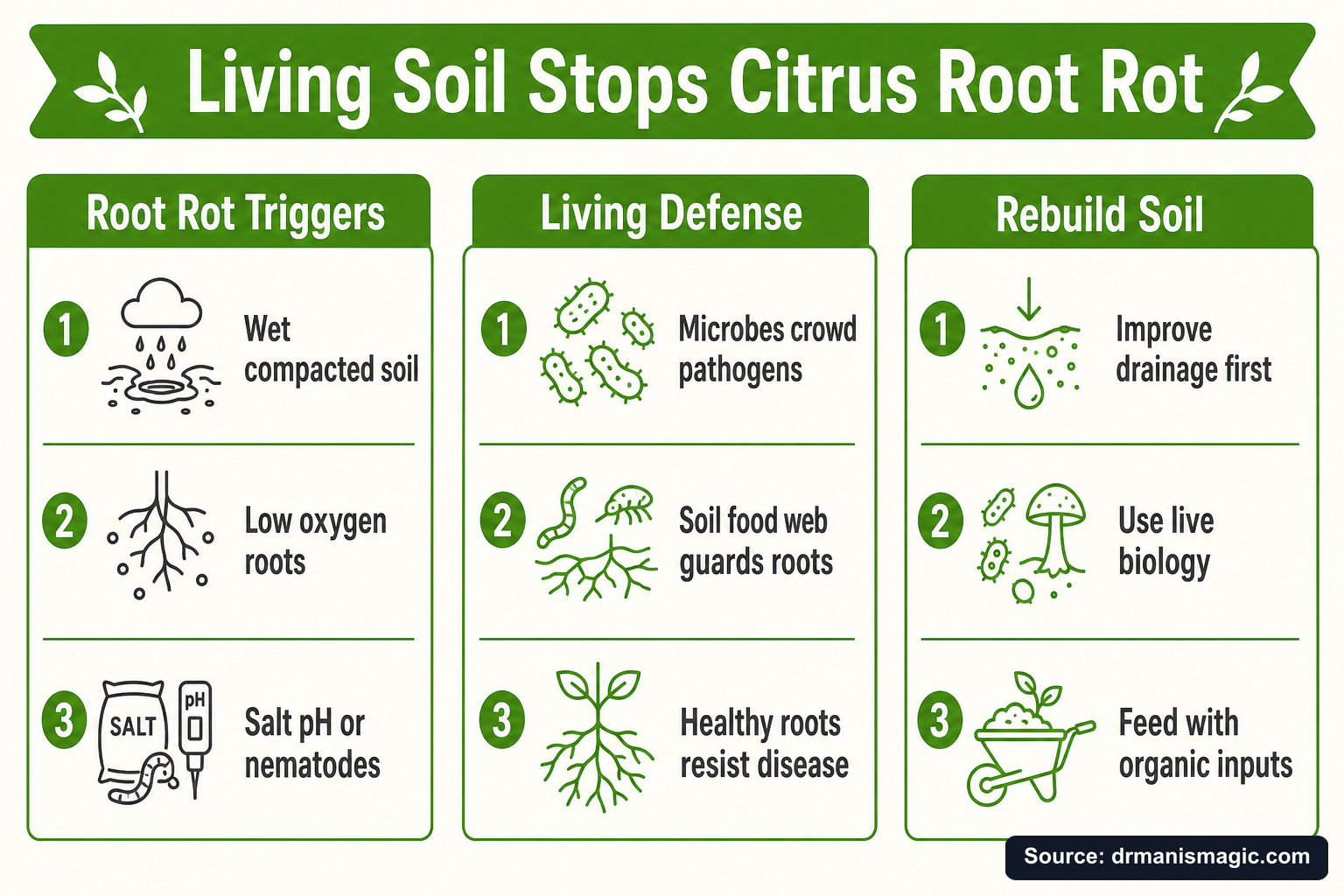
- Living soil prevents citrus root diseases by making the root zone oxygenated, biologically competitive, and hostile to pathogens — not by killing every germ in the ground.
- Phytophthora root rot is a water mold that thrives in wet, compacted, oxygen-starved soil. Fix the environment, and you reduce its power dramatically.
- The soil food web — bacteria, fungi, protozoa, and beneficial nematodes — forms a natural defense team around your roots that no fungicide can fully replicate.
- Dried, powdered microbial products and smelly compost teas often deliver dead or dying microbes. Live, stabilized biology is what actually works.
- The Three Plant Pillars — mineral-based soil, live microbials, and organic fertilizer — work together as a system. Missing one pillar weakens all three.
- Root decline has multiple causes: Phytophthora, nematodes, salt injury, flooding, pH stress, and container suffocation all look similar but require different fixes.
- Restoring living soil takes consistent effort because decades of synthetic fertilizers, fungicides, and herbicides have stripped biology from most home garden soils.
What Actually Causes Citrus Root Diseases?
Quick Answer: Citrus root diseases are almost never caused by a single villain. The real culprits are a combination of saturated soil, poor oxygen flow, pathogens like Phytophthora, plant-parasitic nematodes, salt buildup, pH imbalance, and a root zone stripped of its natural biological defenses. Fix the environment, and you change the outcome.
Most people blame root rot on one thing. One bug. One fungus. One bad watering session. But the truth is more complicated — and more fixable — than that.
According to UC IPM, Phytophthora feeder-root loss can look nearly identical to damage from nematodes, salt stress, and flooding. That's a four-way disguise. A grower who treats for Phytophthora when the real problem is salt buildup is going to lose precious time — and the tree.
And according to UF/IFAS Extension, the most common abiotic (non-living) root stressors in Florida citrus are pH imbalance, soil salinity, and flooding. These conditions don't just hurt roots directly. They create the exact environment where Phytophthora and other pathogens explode in population.
Here's the mental model that changes everything. Think of root disease not as a single attack, but as a triangle:
- A susceptible host (a stressed tree with weakened roots)
- A pathogen under pressure (Phytophthora, nematodes, secondary fungi)
- A favorable environment (wet, compacted, oxygen-poor, biologically dead soil)
Living soil attacks all three sides of that triangle at once. That's why it works when fungicides alone don't.
The Most Common Root Disease Culprits — Compared
| Cause | Visible Symptoms | Root Signs | Soil Conditions | First Corrective Action |
|---|---|---|---|---|
| Phytophthora root rot | Yellowing leaves, leaf drop, gummosis on trunk, slow decline | Brown, soft, rotting feeder roots; no white tips | Wet, poorly drained, compacted soil | Improve drainage immediately; reduce irrigation; restore soil biology |
| Plant-parasitic nematodes | Slow decline, poor growth, pale leaves even with fertilizer | Galled or stubby roots; reduced root mass | Sandy soils; dry or warm conditions | Soil test for nematodes; add organic matter; encourage beneficial nematodes |
| Salt injury | Leaf tip burn, browning edges, leaf drop | Brown root tips; roots look burned | High EC (electrical conductivity); salt buildup from fertilizer or irrigation water | Flush soil with deep irrigation; switch to organic fertilizer; check water quality |
| Flooding / overwatering | Yellowing, wilting, leaf drop; looks like drought stress | Dark, mushy roots; anaerobic smell from soil | Saturated soil; no drainage; standing water | Improve drainage; reduce watering; add mineral-based soil to improve structure |
| Nutrient deficiency | Specific yellowing patterns (interveinal, tip, etc.) depending on nutrient | Roots may look normal or slightly underdeveloped | pH too high or low; locked-up nutrients; low organic matter | Test soil pH; apply organic fertilizer; restore microbial activity to unlock nutrients |
| Container root suffocation | Wilting despite adequate water; stunted growth; sudden collapse | Circling, girdling roots; roots fill entire pot with no room to breathe | Compacted, decomposed potting mix; poor drainage in container | Repot into mineral-based soil; root prune; increase container size |
| HLB-related root loss | Blotchy leaf yellowing (asymmetrical), small bitter fruit, tree-wide decline | Reduced feeder root mass; secondary rots possible | Any soil; stress worsens it | Confirm with lab test; focus on root support, nutrition, and soil biology to slow decline |
Is Phytophthora a Fungus, and Why Does That Matter?
Quick Answer: Phytophthora is not a true fungus. It is an oomycete — a water mold. That's a critical distinction because it moves through water as swimming spores called zoospores. This means saturated, poorly drained soil is its highway. You don't fight Phytophthora primarily with chemicals. You fight it by taking away its transportation system.
Most people call Phytophthora a fungus. Even many garden center employees do. But that label leads growers to the wrong solution.
True fungi have cell walls made of chitin. Phytophthora has cell walls made of cellulose — the same material in plant cell walls. It is genetically closer to algae than to mold. This matters because many traditional antifungal treatments have limited effectiveness against it.
What Phytophthora really needs to thrive is water movement through soil. Its zoospores are literally microscopic swimmers. They need liquid water to travel from infected soil to healthy roots. When soil is compacted, waterlogged, or poorly aerated, those spores can cruise right to your feeder roots and colonize them within hours.
Now here's the living-soil angle. When your soil has great structure — when it drains well, stays oxygenated, and contains millions of competing microbes — Phytophthora zoospores don't get very far. The biological competition around the root zone is fierce. The oxygen level is high. The conditions that allow Phytophthora to swim and infect simply don't exist as often.
This is not about killing Phytophthora. It's about making your soil a bad neighborhood for it to move into.
What Is the Soil Food Web and Why Is It Your Tree's Best Defense?
Quick Answer: The soil food web is the community of living organisms — bacteria, fungi, protozoa, nematodes, arthropods, and more — that work together in healthy soil. They cycle nutrients, compete with pathogens, improve soil structure, and feed plant roots directly. When this web is intact, your root zone is biologically defended. When it's destroyed, pathogens fill the vacuum.
Walk into an old-growth forest. Now smell the soil. Rich. Deep. Almost sweet. That smell? That's biological activity. Trillions of microorganisms working every second, breaking down organic matter, passing nutrients up the food chain, and building a soil structure so perfect that water flows through it like a sponge and roots push through it like butter.
Your citrus tree evolved inside that kind of ecosystem. It didn't evolve in sterilized potting mix. It didn't evolve in salt-based fertilizer. And it certainly didn't evolve in compacted clay with standing water.
The soil food web has several layers, and each one does something specific for your tree's root health:
The Citrus Rhizosphere Defense Team
| Organism | What It Does for Root Health | Disease Prevention Role |
|---|---|---|
| Beneficial bacteria | Break down organic matter; release plant-available nutrients; produce antibiotics against pathogens | Compete with Phytophthora and other pathogens for space and food; produce antibiotic compounds |
| Mycorrhizal fungi | Extend root surface area up to 100x; improve water and phosphorus uptake; stimulate root growth hormones | Create a physical and biological barrier around roots; crowd out pathogenic fungi and oomycetes |
| Saprophytic fungi | Decompose tough organic material; build soil structure through glomalin production | Improve aggregation and drainage — reducing the wet conditions Phytophthora needs |
| Protozoa | Graze on bacteria; release nutrients directly available to roots (the "microbial loop") | Regulate bacterial populations; prevent any single pathogen species from dominating |
| Beneficial nematodes | Graze on bacteria and fungi; release nitrogen near the root zone | Prey on plant-parasitic nematodes and some soil-borne insect larvae; regulate pest nematode populations |
| Earthworms and arthropods | Physically aerate soil; shred organic matter into smaller pieces for microbes to process | Improve drainage channels; reduce compaction that creates anaerobic zones where pathogens thrive |
| Roots themselves | Release sugar-rich exudates that feed beneficial microbes; actively recruit specific microbial species | A healthy root zone with vigorous root growth regenerates faster than pathogens can colonize |
Notice something? The tree doesn't just benefit from microbes passively. It actively recruits them. Citrus roots pump sugars and amino acids into the soil to feed the microbes they want nearby. In return, those microbes deliver nutrients, build protection, and make the soil around the root zone — called the rhizosphere — actively hostile to pathogens.
When that partnership breaks down, roots go silent. And the pathogens move in.
See also: The Hidden Reason Synthetic Fertilizers Cause Root Rot
Why Does Dead or Sterile Soil Create the Perfect Storm for Root Rot?
Quick Answer: Sterile soil has no biological competition. Pathogens like Phytophthora can colonize root zones without anything fighting back. Sterile potting mixes also compact over time, blocking oxygen and trapping water — the exact conditions that water molds need to thrive. Living biology is what keeps soil open, aerated, and disease-suppressive.
Here's something most bag labels will never tell you. That fresh bag of potting mix sitting on a shelf at the big box store? It's biologically dead. Steam-treated. Sanitized to prevent mold during shipping. The microbes that would have competed with pathogens? Gone before you ever open the bag.
And it gets worse. Most commercial potting mixes are built on a base of pine bark, wood chips, or sawdust. These materials decompose. Over six to twelve months, they break down into a dense, compact sludge that chokes oxygen out of the root zone. Roots can't breathe. Water pools. Anaerobic conditions take hold.
Phytophthora zoospores don't need an invitation at that point. The soil is already their perfect habitat.
At US Citrus Nursery, we saw this pattern repeat itself across thousands of container trees. The trees planted in bark-heavy mixes would start strong, then slowly decline right around that six-to-twelve-month mark. Not because of disease. Not because of pests. Because the soil had collapsed beneath them, and there was nothing biological left to hold the line.
That's why the first of our Three Plant Pillars is mineral-based soil. Silica-rich sandy loam from the Rio Grande Valley doesn't decompose. It doesn't compact. It stays open. It keeps oxygen moving through the root zone. And oxygen is the single most effective tool against anaerobic root pathogens.
How Do Beneficial Microbes Physically Suppress Root Diseases?
Quick Answer: Beneficial microbes suppress root diseases through five overlapping mechanisms: competing for space and nutrients, producing antibiotic compounds, physically colonizing root surfaces before pathogens can, predating on harmful organisms, and stimulating the tree's own immune signaling. No single mechanism works alone — the whole community working together is what creates a disease-suppressive rhizosphere.
Let's get specific. Because "microbes help plants" is vague. What actually happens at the root surface is fascinating — and it's the reason we've invested decades building and testing live microbial products.
Competitive exclusion. Beneficial bacteria and fungi colonize the root surface first. They eat the sugars the root exudes. They occupy the attachment points that pathogens would need to invade. It's like having every seat at the table already filled when a bad actor walks in. There's simply no room.
Antibiosis. Many beneficial bacteria — especially species in the Bacillus family — produce natural antibiotics and antifungal compounds. These compounds don't just suppress pathogens. They signal the surrounding microbial community that the territory is defended.
Induced systemic resistance. When beneficial microbes colonize roots, they trigger the tree's own immune system to go on alert. The tree starts producing defensive compounds across its entire body — leaves, stems, and roots — before any pathogen even arrives. It's like a biological early-warning system built right into the root zone.
Predation and trophic regulation. Beneficial nematodes and protozoa prey on populations of plant-parasitic nematodes and some harmful bacteria. They keep the bad actors from overwhelming the system.
Glomalin and soil aggregation. Mycorrhizal fungi produce a sticky protein called glomalin that literally glues soil particles together into aggregates. These aggregates create the air pockets that keep soil oxygenated and draining. Better drainage means fewer zoospores swimming to your roots.
All five of these mechanisms require one thing: living microbes. Not dried spores. Not dead powder. Not a smelly compost tea that went anaerobic in the bottle during shipping. Living, active, full-spectrum biology that starts working the moment it hits your soil.
Are Mycorrhizae Good for Citrus, and How Do They Protect Roots?
Quick Answer: Yes, mycorrhizal fungi are extremely beneficial for citrus. They extend the root system up to 100 times its natural surface area, dramatically increasing water and phosphorus uptake. They also create a biological barrier around feeder roots that pathogens struggle to penetrate. Citrus trees without mycorrhizae are significantly more vulnerable to Phytophthora and other root diseases.
If you've ever pulled a weed out of your garden and seen a fuzzy white web clinging to the roots, you've seen mycorrhizae in action. Those white threads are fungal hyphae — thin filaments that extend far beyond where the root itself can reach.
For citrus, this matters enormously. Citrus feeder roots are small and fragile. They're the primary target for Phytophthora. But when mycorrhizal fungi colonize those feeder roots, something remarkable happens. The fungal network extends outward like a second root system — pulling in water, phosphorus, and micronutrients from a much larger area of soil. The tree grows stronger and better fed. And a well-fed tree regenerates feeder roots faster than Phytophthora can destroy them.
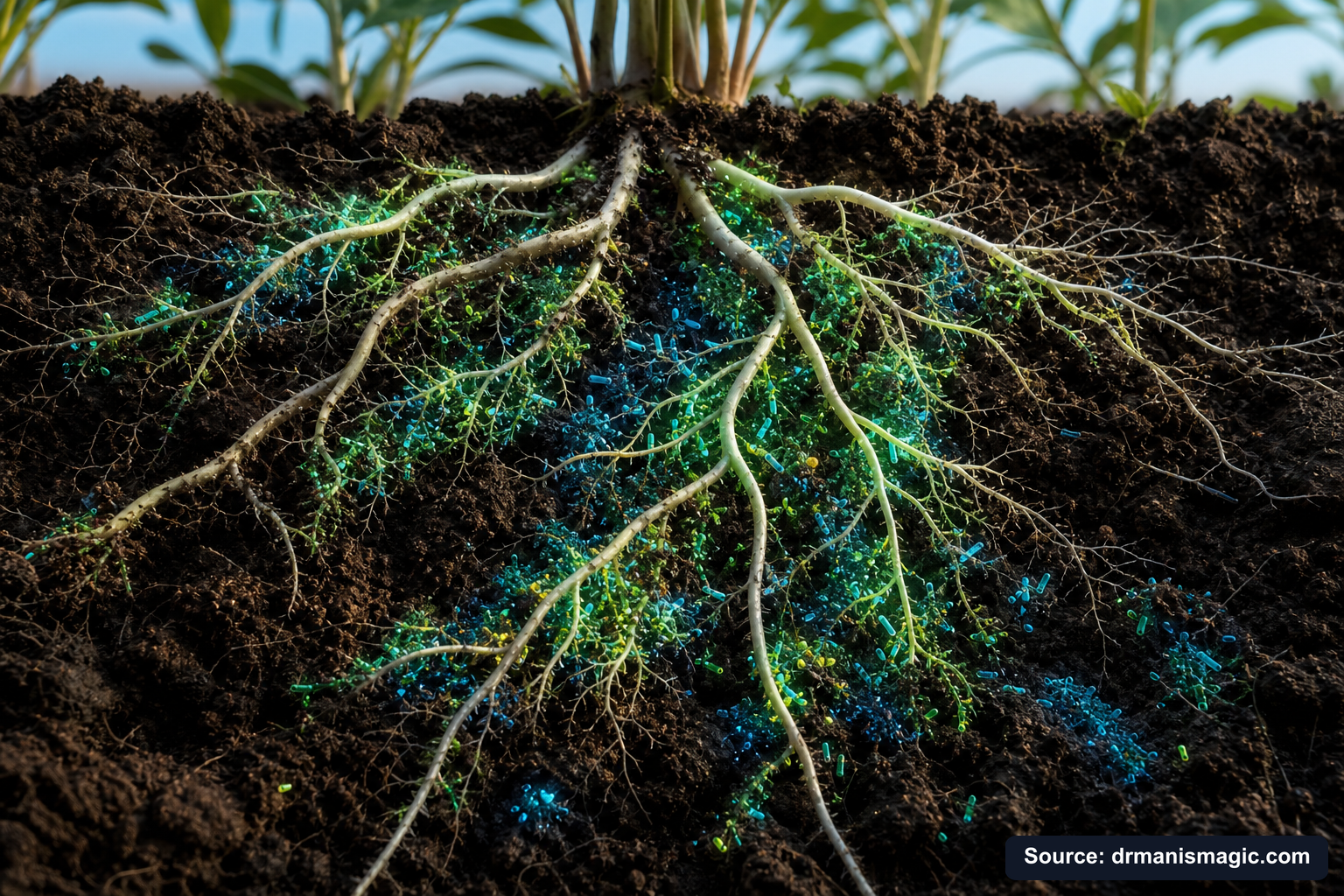
There's also a direct protective effect. The fungal sheath around colonized roots physically blocks some pathogen contact. And mycorrhizal colonization shifts the entire microbial community around the root toward a more disease-suppressive composition.
One important note: mycorrhizal fungi are almost completely absent from commercial potting mixes. They're absent from fumigated orchard soils. They're absent from any soil that's been treated with broad-spectrum fungicides or synthetic fertilizers at high rates. They have to be reintroduced intentionally — which is exactly what a full-spectrum live microbial product like Plant Super Boost is designed to do.
You Never Had a Brown Thumb.
You were handed the wrong tools. This free guide hands you the right ones.
You watered it. You fed it. It died anyway.
It was never you. It was the dirt, the salt food, and the bad advice.
This guide shows you what really went wrong, and how to fix it for good.
- Why your plants really died, and why it was never your fault
- The salt hiding in your plant food that quietly burns the roots
- The hidden killer in almost every bag of store soil
- The tiny helpers that grow a whole forest for free
- The rescue trick that brings a half dead plant back to life

Why Do Most Microbial Products Fail to Protect Citrus Roots?
Quick Answer: Most commercial microbial products fail because they deliver dead or dying microbes. Dried powders rarely reactivate in soil. Liquid products made from compost often go anaerobic during shipping and smell like sewage by the time they arrive. Neither type establishes a functioning biological community in your root zone. You need genuinely live, stabilized, full-spectrum biology.
Walk into any garden center right now and you'll find shelves of microbial products. Bags of powder. Dark bottles of liquid. Labels promising billions of CFUs. It sounds impressive.
But here's what we found after testing dozens of those products on our own citrus trees over three decades. Most of them don't work. And the reason is simple once you understand it.
The dried powder problem. Many microbial products are made in giant factory vats. Specific bacteria are brewed in bulk, then dried into powder form — the hope being that dormant spores will "wake up" when you add water and pour them into soil. In theory, this sounds reasonable. In practice, we have seen no consistent results from these products in our nursery trials. The reactivation rate is low. The species diversity is narrow. And the microbial community that results — if anything results — is too thin to establish and compete.
The smelly liquid problem. Other products harvest microbes from compost or earthworm castings and turn them into a liquid. This is closer to the right idea. But the problem is anaerobic death. Once beneficial microbes are bottled and begin consuming available oxygen, they go anaerobic. They start fermenting. The bottle may even fizz or hiss when you open it. That fizz? That's gas from microbial decomposition. The smell? Rotting sewage. The microbes? Dying or already dead.
You've spent good money on a bottle of compost that's gone bad before it ever reached your tree.
Microbial Product Types Compared
| Product Type | Viability When Applied | Species Diversity | Odor | Results Observed at US Citrus Nursery |
|---|---|---|---|---|
| Dry powdered lab microbes | Very low — spores rarely reactivate fully | Narrow — 3 to 12 species typical | Minimal | No measurable improvement in root health or disease suppression |
| Dry microbes rehydrated in liquid | Low — same reactivation limitations | Narrow | Minimal to slightly earthy | Inconsistent; no reliable results across trials |
| Compost tea (fresh, under 24 hours, actively aerated) | Moderate — viable if used immediately | Broad but variable | Earthy, pleasant | Good results when used fresh; requires significant time and equipment |
| Compost tea (old, over 24 hours) | Low — anaerobic die-off underway | Degraded community | Strong, unpleasant — sulfur or sewage odor | Not recommended; microbial community is dying |
| Fresh active compost (on-site) | High — if compost is hot and active | Broad and natural | Rich, earthy | Excellent; requires ongoing effort and sourcing |
| Plant Super Boost (stabilized, full-spectrum, live) | High — stabilized through all-natural technique; visible movement under microscope | Very broad — 2,000+ bacteria species, 400–500 fungi including mycorrhizae, plus protozoa and nematodes | Earthy — no sewage or fermentation odor | Consistent root improvement; disease suppression; visible tree vigor response |
The difference with our approach comes down to one proprietary all-natural stabilization technique developed by one of the world's most respected compostologists — a man who advised royal families and governments on farming practices before the big chemical companies tried to bury his work. He eventually partnered with Dr. Mani and our team at US Citrus Nursery. Together, we built a product that keeps the full spectrum of compost biology alive in a bottle — without it going anaerobic, without it smelling foul, without it losing its potency on a warehouse shelf.
If you put a single drop of Plant Super Boost under a microscope, you can watch the microbes move. That's what alive looks like.
And it doesn't stink. Because it isn't rotting. That matters more than people realize. You can actually enjoy your garden after you apply it.
How Does Living Soil Create a Disease-Suppressive Rhizosphere Around Citrus Roots?
Quick Answer: A disease-suppressive rhizosphere forms when the root zone has enough biological diversity and activity that pathogens cannot establish at infection levels. Living soil builds this through microbial competition, antibiosis, improved drainage, oxygen maintenance, organic matter cycling, and root vigor. It doesn't eliminate all pathogens — it tilts the environment so strongly against them that disease outbreaks rarely occur.
The word "rhizosphere" sounds technical. But the concept is simple. It's the thin layer of soil immediately surrounding your roots — maybe a quarter inch thick — that is the most biologically active real estate on your entire property.
In that tiny zone, roots are releasing sugars and signals. Bacteria are competing for resources. Fungi are building networks. Protozoa are grazing. Nematodes are hunting. It is a microscopic city that never sleeps.
When this city is thriving, Phytophthora zoospores that swim into the rhizosphere encounter immediate biological resistance. They try to find a root surface to attach to. But every attachment point is already occupied. The antibiotic compounds in the surrounding liquid make the environment chemically hostile. The tree itself is producing defensive signals. The zoospore has nowhere to go.
When this city is dead — when the soil has been stripped by synthetic fertilizers, fumigated, or filled with bark that has compacted and gone anaerobic — the same zoospore arrives to an empty neighborhood. No competition. No resistance. It finds a feeder root and colonizes it within hours.
This is the mechanism. This is why living soil prevents citrus root diseases. Not by being a magic cure. Not by killing every pathogen in the ground. But by building an environment so biologically competitive, so well-oxygenated, and so structurally sound that pathogens simply can't get enough of a foothold to cause disease at meaningful levels.
What Destroys Living Soil Biology and Opens the Door to Root Diseases?
Quick Answer: Synthetic salt-based fertilizers, broad-spectrum pesticides, herbicides like glyphosate, synthetic fungicides, and compacted or waterlogged soils all destroy soil biology. Each of these inputs eliminates the microbial competition that keeps pathogens in check — and many of them directly stress citrus roots at the same time, creating a two-front attack that trees struggle to survive.
Let's talk about something the bag labels never mention. Those blue and white granules you've been pouring around your citrus tree? The ones that promise quick green-up and fast results?
They're salt. Synthetic fertilizer is salt-based. And salt kills microbes. Not some microbes. Not the bad ones. All of them — the beneficial bacteria, the mycorrhizal fungi, the protozoa, everything that was holding the biological defense system together. One application wipes out a portion of the microbial community. Repeated applications over years can leave soil biologically barren.
You can actually feel this in old compacted garden beds. That crusty, pale, lifeless look to the soil surface. The way water just pools and runs off instead of soaking in. That's what years of salt-based inputs look like from the outside. Underneath, the microbial community has been gutted.
And then you add a little too much water one week. Phytophthora zoospores, which are always present in most outdoor soils at low levels, suddenly have a clear swimming lane. No biological resistance. Wet conditions. Oxygen-starved roots that can't regenerate fast enough. The disease triangle closes — and you start seeing yellow leaves and soft, dark roots.
The good news? Soil biology can be rebuilt. It takes consistent effort. It takes removing the inputs that damage it. And it takes actively reintroducing the living organisms that used to be there naturally. That's the whole mission behind the Three Plant Pillars framework that Dr. Mani developed across 40 years of plant pathology research and 250,000 trees grown in South Texas.
See also: Why Most Fertilizers Are Actually Salt in Disguise
Does Living Soil Cure Citrus Root Rot, or Just Prevent It?
Quick Answer: Living soil primarily prevents citrus root diseases by maintaining conditions where pathogens can't thrive. If root rot is already severe, living soil alone cannot reverse advanced damage — you'll need to address drainage, remove affected roots, and sometimes use targeted treatments. But rebuilding soil biology dramatically improves the tree's ability to regenerate healthy feeder roots and resist future infection.
This is the question we get most often. And the honest answer matters — because false promises waste your most precious resource. Time.
If your tree has mild to moderate Phytophthora pressure — yellowing leaves, some root browning, but still has green growth and recoverable root mass — rebuilding living soil biology can absolutely turn things around. The tree regenerates feeder roots. The improved drainage removes the zoospore highway. The returning microbial community crowds out the pathogen. Many trees we've seen at this stage recover fully within one to two growing seasons when the Three Plant Pillars are put in place.
If the damage is severe — most of the root system gone, gummosis on the trunk, major limb dieback — living soil alone is not enough. You need to address the physical causes first. Improve drainage. Remove heavily infected root material. Consider whether the rootstock is appropriate for your conditions. Then rebuild biology from the ground up as part of the recovery.
The honest framing is this: living soil is a prevention system with powerful recovery benefits. It is not a fungicide. It is not a miracle cure. It is the system your tree's roots evolved to live inside — and when you restore it, trees do things that surprise even experienced growers.
What Can You Do Right Now to Build Living Soil and Protect Your Citrus Roots?
Quick Answer: Start with drainage and soil structure, then introduce live microbial biology, then feed with organic fertilizer that supports rather than destroys the microbial community. These three steps — the Three Plant Pillars — work together as a system. Doing one without the others is like building a fire with only two legs on the tripod.
Here is your practical recovery and prevention checklist. Follow this sequence and you change what's possible for your tree.
- Fix drainage first. If water pools around your citrus tree for more than an hour after irrigation, your soil is suffocating your roots. For container trees, check that drainage holes are open and unobstructed. For in-ground trees, consider raising the planting bed or improving soil structure with mineral-based amendments.
- Switch to mineral-based soil. If you're repotting or starting a new tree, use a mineral-based soil that won't compact or decompose. Bark-heavy potting mixes collapse within six to twelve months and create the anaerobic conditions where Phytophthora thrives. Super Soil from Dr. Mani's Magic is built on silica-rich sandy loam from South Texas — it stays open and well-drained permanently.
- Add live microbial biology monthly. Reintroduce the full-spectrum biological community your soil needs. Apply a live microbial product that actually contains viable organisms — not dried powder, not smelly liquid. Look for something that smells earthy, not sour, and that has lab verification of live organisms. Monthly applications matter because soil environments — especially containers — constantly face pressures that reduce microbial populations.
- Stop using synthetic salt-based fertilizers. Every application strips microbial life from your root zone. Switch to an organic, slow-release fertilizer that feeds both the plant and the soil biology without salt stress.
- Mulch correctly — and keep it off the trunk. A 2-to-3-inch layer of organic mulch over the root zone reduces moisture evaporation, moderates soil temperature, and feeds soil organisms as it slowly breaks down. But never pile mulch against the trunk or graft union — that traps moisture and creates a direct Phytophthora entry point.
- Reduce irrigation frequency. More citrus trees die from overwatering than from drought. Let the top two inches of soil dry between waterings. Consistent wet conditions are Phytophthora's fuel source.
- Test your soil if decline continues. If you've addressed drainage, biology, and fertilizer and the tree is still declining, get a soil pathology test. UC Cooperative Extension labs and many state university labs can identify Phytophthora, nematode pressure, pH problems, and salt levels. Knowing what you're actually dealing with is worth every penny of the testing fee.
Every one of these steps works better when combined. That's the whole point of the Three Plant Pillars. Mineral soil gives the roots room to breathe. Live microbes build the biological defense team. Organic fertilizer feeds both the tree and the microbes without destroying what you've built. When all three are in sync, something remarkable happens: the tree stops being fragile and starts being resilient. Practically bulletproof, as Dr. Mani would say.
For a deeper look at all three pillars together, visit our Free Plant Care Field Guide — it walks you through the complete system in plain language, step by step.
Living Soil vs. Sterile Soil: The Real Difference for Your Citrus Tree
We've covered a lot of ground. Let's bring it home with a direct comparison — because sometimes the clearest way to understand something is to see it side by side.
A tree in living soil sits inside a biological ecosystem that has been functioning since before human agriculture existed. Its roots are surrounded by competing organisms. Its nutrient supply is regulated by microbial activity rather than by whatever salts happened to be in the last bag of fertilizer. Its feeder roots regenerate quickly when damaged because the soil environment supports rapid biological recovery. Phytophthora zoospores that enter the rhizosphere face immediate competition, chemical resistance, and structural barriers. Nematode populations are kept in check by predatory biology. The soil drains well because fungal glomalin keeps aggregates intact and oxygen moving.
A tree in sterile or biologically depleted soil sits alone in an inert medium. Its only nutrition comes from whatever inputs you apply. Its feeder roots, when damaged, regenerate slowly because there's no biological support system. Phytophthora zoospores swim freely through saturated, compacted soil to reach those vulnerable roots. Nematode populations are unchecked. The soil compacts over time as the organic matter in the bark base decomposes. The drainage that existed when you first potted the tree is gone within a year.
Same tree. Same water. Same sunlight. Completely different outcomes — based entirely on what's living in the soil around its roots.
That's not a theory. That's what we watched happen across 250,000 trees over three decades in South Texas. And it's why everything we build at Dr. Mani's Magic starts with the question: is the biology alive?
Your Tree Is Waiting — And So Is the Clock
You know what the most common thing people tell Dr. Mani when they first call us? It isn't "my tree has root rot." It isn't "what fertilizer should I use?" It's quieter than that. It's: "I just want to pick fruit off my own tree. While I still can."
That sentence carries a lot of weight. Because every season a tree spends in biologically dead soil, fighting Phytophthora with no microbial allies, stressed by salt-based fertilizer, and suffocating in compacted bark mix — that's a season of your life you don't get back. The money spent on those products? You can earn that back. The time? Gone.
The good news is that living soil isn't complicated. It isn't expensive. And it doesn't require a PhD in plant pathology to implement. It requires understanding three things — mineral-based soil, live microbials, and organic fertilizer — and putting all three in place at the same time.
When those three pillars are working together, the tree changes. The roots push deeper. The leaves go darker green. The feeder roots regenerate faster than pathogens can damage them. The biological defense team shows up for work every single day, invisible but relentless.
If you want to see exactly how to put the Three Plant Pillars into practice for your specific plant — whether it's a citrus tree in a container, a backyard garden, a houseplant, or a full orchard — our team of real nursery experts is ready to help. No bots. No kids reading off a script. Real people who have grafted and grown these trees themselves, backed by 30 years of hard-won knowledge in South Texas soil.
And if you want to start rebuilding your soil biology today, take a look at Plant Super Boost — our live, full-spectrum microbial formula that smells like good earth, not sewage, because the microbes inside it are genuinely alive. Zero PFAS. Zero biosludge. Zero synthetic salts. Made in the USA. Backed by a 30-day money-back guarantee, no questions asked.
The best time to plant a tree was ten years ago. The second-best time is today. And the best time to give that tree a living soil to grow in? Same answer.
Frequently Asked Questions
Root disease is one of the sneakiest killers in the garden. Most growers never see it coming until it is too late. These are the questions we hear most often from real plant owners who are trying to save their trees and take back control of their soil before another season slips away.
Can you save a citrus tree that already has root rot?
Yes, but you have to move fast. If less than half the roots are gone, there is still hope. First, pull the tree from its pot or gently expose the roots. Cut away anything brown, slimy, or soft with clean shears. Then repot into a mineral-based soil with real drainage, like Dr. Mani's Magic Super Soil. Add live microbes from Plant Super Boost to help the remaining healthy roots fight back. Do not fertilize with synthetics. That will burn stressed roots and wipe out the beneficial biology you are trying to rebuild. Prune the canopy by about a third so the tree does not have to support more leaves than its weakened roots can feed. Then water carefully and wait. We have seen trees come back from rough shape once the soil environment was corrected. The Three Plant Pillars give the root zone what it needs to heal itself.
Will fungicide actually stop root rot in citrus trees?
Fungicide can slow the spread, but it cannot bring dead roots back to life. Here is the bigger problem. Most root rot in citrus is caused by Phytophthora, which is technically a water mold, not a true fungus. Standard fungicides often miss it entirely. And even when the right product is used, it does nothing to fix the real cause, which is a wet, compacted, oxygen-starved root zone with no living biology to defend it. At Dr. Mani's Magic, we tested this across more than 250,000 trees. The answer was not more chemicals. It was living soil. When you fill your root zone with active bacteria, fungi, and mycorrhizae from Plant Super Boost, those microbes crowd out pathogens naturally. They compete for space and nutrients. They create an environment where Phytophthora simply cannot get a foothold. Fix the environment first. Then the biology does the defending for you.
Does baking soda or hydrogen peroxide cure root rot?
Baking soda will make things worse. It is alkaline and loaded with sodium, which burns roots and destroys the beneficial microbes your soil needs to heal. Do not use it. Hydrogen peroxide is different. A diluted mix of one part three-percent hydrogen peroxide to two or three parts water can help rinse away fungal spores from exposed roots during repotting. It also releases oxygen, which stressed roots crave. But here is the truth. Neither product fixes the underlying cause. Root rot keeps coming back when the soil stays wet, compacted, and biologically dead. The real fix is mineral-based soil that drains properly, live microbes that protect the root zone, and organic fertilizer that feeds the plant without burning it. That is what the Three Plant Pillars are built around.
How do you fix root rot without replanting the whole tree?
If the tree is in the ground and you cannot move it, you still have options. Start by improving drainage around the base. Pull back mulch from the trunk. Let the soil dry out between waterings. Then drench the root zone with Plant Super Boost mixed in water. Those live bacteria and fungi go to work immediately, breaking down the soggy, decaying matter and rebuilding a healthy biological defense around the roots that are still alive. You can also topdress with Dr. Mani's Magic Super Soil to improve aeration at the surface. The goal is to change the environment so pathogens lose their advantage. Caught early enough, this approach has saved trees without ever pulling them from the ground. Time matters here. Every week you wait is a week the roots cannot get back.
What naturally kills tree roots without chemicals?
This question usually comes up when a dead or unwanted tree keeps sending up new shoots. Rock salt or Epsom salt drilled into the root system will draw out moisture and accelerate decay. You can also smother new growth by cutting it back consistently, which drains the stored energy in the root system over time. Cover the area with thick cardboard and mulch to block sunlight. For roots invading pipes, two pounds of rock salt flushed down a toilet and left to sit overnight can clear small intrusions. One important warning. Salt kills surrounding plants and grass too. Use it only where you do not plan to grow anything else. For trees you want to save, never use salt near the root zone. That is the opposite of what living soil needs.
How do you bring a struggling citrus tree back to life?
Start by removing all the fruit. A tree that is fighting to survive cannot also feed a harvest. Strip it clean. Next, scratch the bark with your fingernail on the trunk and main branches. Green underneath means life is still there. Then soak the soil deeply and let it dry out before watering again. Citrus roots need oxygen just as much as water. If the roots are rotting, follow the steps above. Prune dead wood back to where you see green. Do not take more than a third of the canopy at once. Hold off on synthetic fertilizer entirely. Use Dr. Mani's Crab, Kelp, and Amino Acids organic fertilizer once you see new growth. It feeds slowly and does not shock weakened roots. And drench the root zone with Plant Super Boost to rebuild the living biology underground. That is where the real recovery happens.
How long does it take for living soil to prevent root disease?
You can start seeing results within thirty days. That is not a guess. That is what we observed growing and testing more than 250,000 trees at our South Texas nursery. When you add Plant Super Boost to a proper mineral-based soil like Super Soil, the live bacteria and fungi colonize the root zone quickly. They begin outcompeting pathogens, unlocking nutrients, and building the kind of biological armor that no spray bottle of fungicide can replicate. The full ecosystem takes longer to mature, but the protection begins almost immediately. The key is consistency. One application helps. Ongoing care with all Three Plant Pillars, mineral soil, live microbes, and organic fertilizer, is what makes your tree practically bulletproof for the long run.
About the Author
Ron Skaria, MD
Ron Skaria, MD, is the co-founder of Dr. Mani's Magic and the son of Dr. Mani. He trained as a medical doctor at Baylor College of Medicine, did his residency at UT Health Science Center - San Antonio and fellowship training at Texas Tech University. He now works full time on the family farm at US Citrus and US Citrus Nursery in Hargill, Texas, building Dr. Mani's Magic alongside his dad. He wrote the Brown Thumb Field Guide to put his father's 48 years of plant science into plain words any gardener can use. His belief is simple. You never had a brown thumb. You just never had the right help.


