


How Kelp Supports Plant Recovery Without Stress or Salt Damage | Dr. Mani's Magic
How Kelp Supports Recovery Without Stress: The Gentle Way to Bring Struggling Plants Back to Life
Picture this. You walk out to your garden on a Saturday morning, coffee in hand. The air smells like fresh earth. You are expecting to see green, full leaves and maybe even a little new growth on the tree you planted two months ago.
But instead, the leaves are curling. The edges are brown and crispy. The soil smells a little off. The plant looks tired. Defeated. Like it gave up while you were not watching. You think, "Did I overwater it? Did I use too much fertilizer? Is it too hot? Did I do something wrong?" And that familiar sinking feeling starts to creep in. The one that tells you maybe you just do not have a green thumb.
Here is what nobody tells you. That plant is not dying because of you. It is dying because of what was sold to you. The fertilizer in that bright bag. The potting mix from the big box store. The quick-fix products that promise instant green-up but quietly wreck the soil underneath. After growing over 250,000 trees at our South Texas nursery, we learned something that changed everything. When a plant is already stressed, the last thing it needs is more salt in the root zone. What it needs is a gentle hand. And kelp, real cold-processed kelp, might just be nature's gentlest recovery tool.

Organic Fertilizer | Crab, Kelp & Amino Acids
Key Takeaways
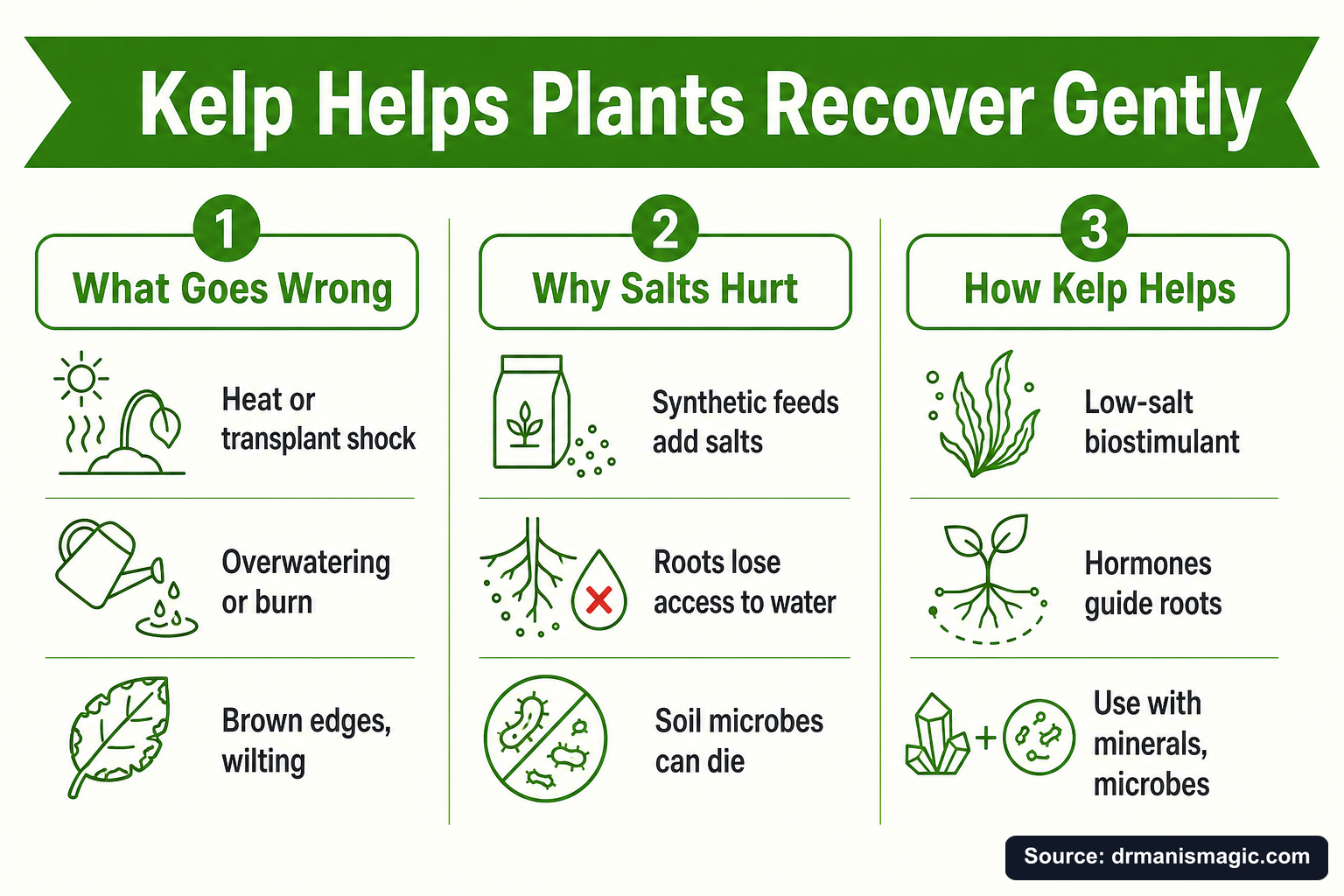
- Kelp is a biostimulant, not a traditional fertilizer. It supports root recovery, hormone signaling, and stress resistance without dumping harsh salts into the soil.
- Salt-based synthetic fertilizers can cause osmotic stress, root burn, and microbial die-off. Kelp works the opposite way by supporting the living soil ecosystem.
- Stressed plants (from heat, drought, transplant shock, fertilizer burn, or overwatering) need low-stress nutrition first. Forcing them with high-nitrogen salts at that moment often makes things worse.
- Kelp contains natural plant hormones, trace minerals, carbohydrates, and protective compounds that help roots signal, recover, and rebuild after stress.
- Kelp works best as part of a complete system: mineral-based soil, live microbes, and organic fertilizer together form the Three Plant Pillars that make plants nearly bulletproof.
- Clean inputs matter. Look for kelp-based fertilizers that are free from biosludge, PFAS, and synthetic salts.
- Recovery is not instant. But with the right foundation, most stressed plants can turn around within weeks, not years.
What Exactly Is Kelp and Why Do Plants Care About It?
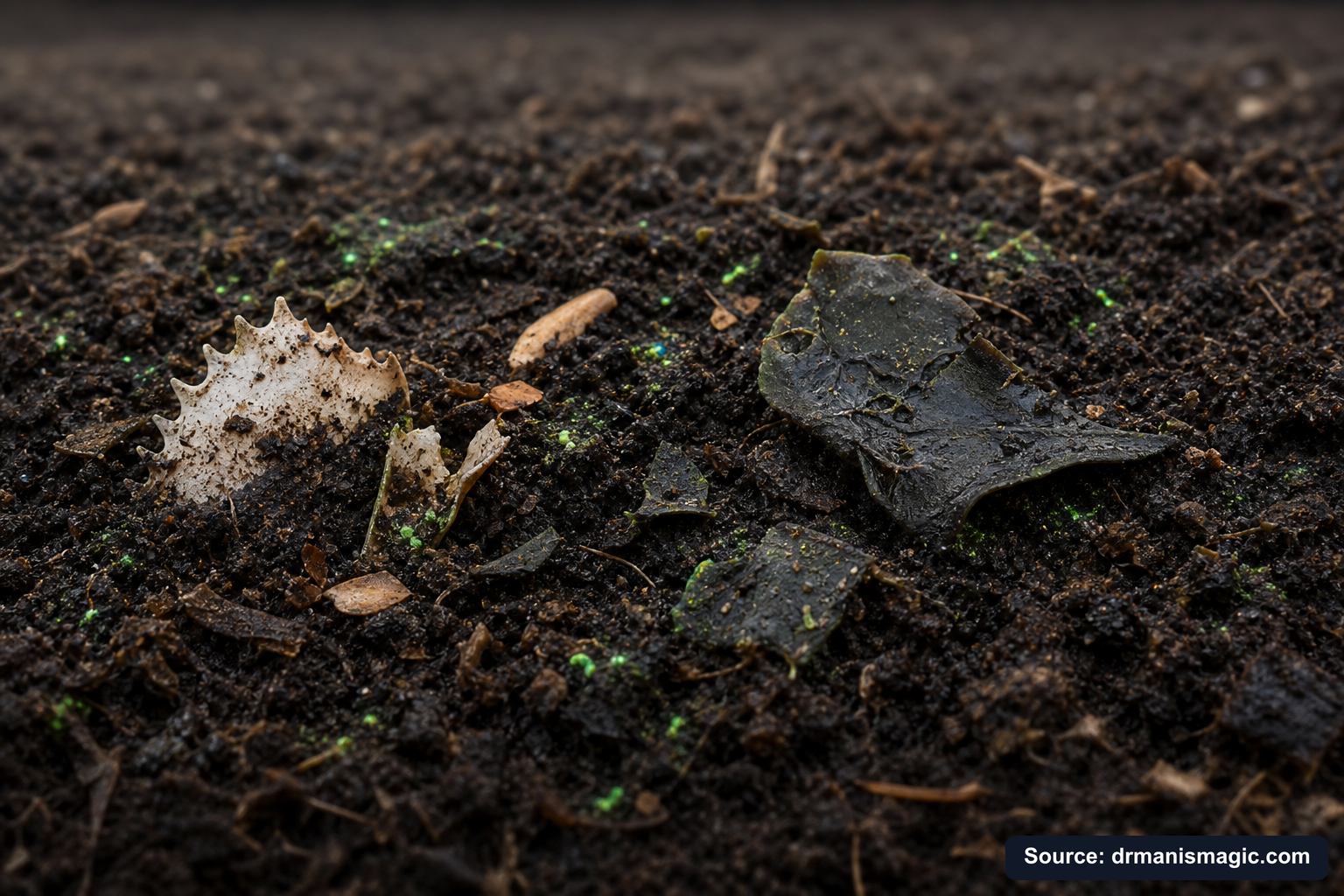
Quick Answer: Kelp is a type of large brown seaweed. When cold-processed into a plant input, it delivers natural plant hormones, trace minerals, carbohydrates, and protective compounds that help roots grow, reduce stress damage, and improve how efficiently plants use nutrients. It is not a traditional fertilizer. It is a biostimulant.
Kelp is not magic on its own. But it contains something close to it.
Cold-processed kelp extract is packed with compounds that most fertilizer bags never even mention. Things like cytokinins and auxins, which are natural plant hormones that tell roots when to grow, when to branch, and when to slow down and repair. Think of them like the body's own healing signals after an injury. You do not need to inject anything foreign. You just need to support what the plant already knows how to do.
Kelp also carries betaines, which are protective molecules that help cells hold water under heat and drought stress. It brings polysaccharides, which feed soil microbes and improve how water moves through the root zone. And it delivers a wide range of trace minerals in organic, chelated forms that are gentle on roots and easy for plants to absorb.
Here is what makes kelp different from most inputs. It does not force anything. It does not spike nitrogen and demand rapid top growth. It does not push the plant when the plant is already exhausted. It supports the root zone quietly, from the ground up, the way nature intended.
According to research from University of Maryland Extension, seaweed extracts have been shown to improve root architecture, chlorophyll content, antioxidant activity, and drought tolerance in a variety of crops. Not by force. By support.
That is the key word. Support.
Why Do Stressed Plants Need Low-Salt Recovery Inputs Instead of More Fertilizer?
Quick Answer: When plants are stressed from heat, drought, transplant shock, or fertilizer burn, their roots are already damaged. Adding high-salt synthetic fertilizer at that moment pulls water away from roots through osmotic stress, making recovery harder. Low-salt inputs like kelp help roots stabilize and rebuild without adding more pressure to an already struggling system.
Here is something most fertilizer companies will never tell you. Salt and roots do not mix well.
Most synthetic fertilizers are salt-based. That is not an opinion. It is chemistry. The fast-release nitrogen, phosphorus, and potassium in those blue crystals or those white granules? They are salts. And when those salts build up in the soil around the roots, something very bad happens.
Water starts moving in the wrong direction.
This is called osmotic stress, and it is the same reason you feel thirsty after eating salty chips. The salt outside the root cells pulls moisture out of the roots instead of letting the roots pull moisture in from the soil. The plant starts experiencing what scientists call physiological drought. Even when the soil is wet, the roots cannot drink. They wilt. They burn. The leaf edges turn brown and crispy. Growth stalls. And the gardener standing there with a watering can thinks, "Why is this still dying? I just watered it yesterday."
According to Colorado State University Extension, excess soluble salts in the root zone can cause wilting, marginal leaf scorch, stunted growth, poor germination, and increased susceptibility to root disease. This is not a rare problem. It is happening in backyards all over America right now.
So what happens when you pour more salt-based fertilizer onto a plant that is already salt-stressed? You make it worse. The roots that were barely hanging on get burned again. The soil microbes that were trying to help get wiped out. The cycle continues.
Kelp breaks that cycle. Because kelp is not salt-based. Its salt index, which is a measure of how much osmotic pressure an input adds to the soil, is extremely low. It can go into the root zone without creating more stress. It can support recovery without demanding anything from a plant that has nothing left to give.
See also: The Osmotic Shock Your Plants Feel From Synthetic Nutrients
How Does Kelp Actually Help Roots Recover After Stress?
Quick Answer: Kelp contains natural plant hormones called auxins and cytokinins that trigger root branching and repair. It also delivers antioxidants that reduce cellular damage from heat and drought, betaines that protect cells from water loss, and polysaccharides that feed soil microbes and improve root-zone oxygen flow. Together, these work like a recovery protocol for the root system.
Think about what happens to your body after a hard workout or a bad sunburn. You do not need someone forcing more stress on you. You need rest, hydration, and the right nutrients to rebuild. Plants are the same way.
When a plant has been through fertilizer burn, drought, heat stress, transplant shock, or waterlogged roots, the damage shows up first in the root tips. Those tiny white root hairs, the ones that actually do most of the absorbing, get singed or suffocated. Without healthy root tips, the whole plant starts to starve, even if there is plenty of nutrition sitting in the soil.
Kelp helps in several ways at once.
The auxins in kelp are hormones that trigger root elongation. More root length means more surface area to absorb water and nutrients. The cytokinins signal cells to divide and branch, building a thicker, more resilient root network. Think of it like rebuilding a road that washed out in a storm. You are not just patching the potholes. You are laying down new lanes.
The antioxidant compounds in kelp reduce oxidative damage. When plants are stressed, they produce what are called reactive oxygen species, basically tiny sparks of cellular damage. Kelp's natural antioxidants help put those sparks out before they spread.
The betaines act like tiny water-retention molecules inside the cells. They help the plant hold onto moisture even when the environment outside is hot and dry. This is one reason kelp is so useful during summer heat stress or drought recovery.
And the polysaccharides, the carbohydrate chains in kelp, feed the beneficial microbes in the soil. More on why that matters in just a moment.
None of this is force-feeding. All of it is support. And that is exactly what a stressed plant needs.
What Is the Connection Between Kelp, Soil Microbes, and Nutrient Recovery?
Quick Answer: Kelp feeds soil microbes through its carbohydrate content. Healthy microbes then break down organic nutrients, cycle nitrogen, solubilize phosphorus, and deliver nutrition to plant roots in a gentle, steady stream. Without microbes, even good nutrients stay locked in the soil. Kelp helps keep that biological pipeline open, especially after stress has disrupted it.
Here is the part that most fertilizer companies do not want you to think about.
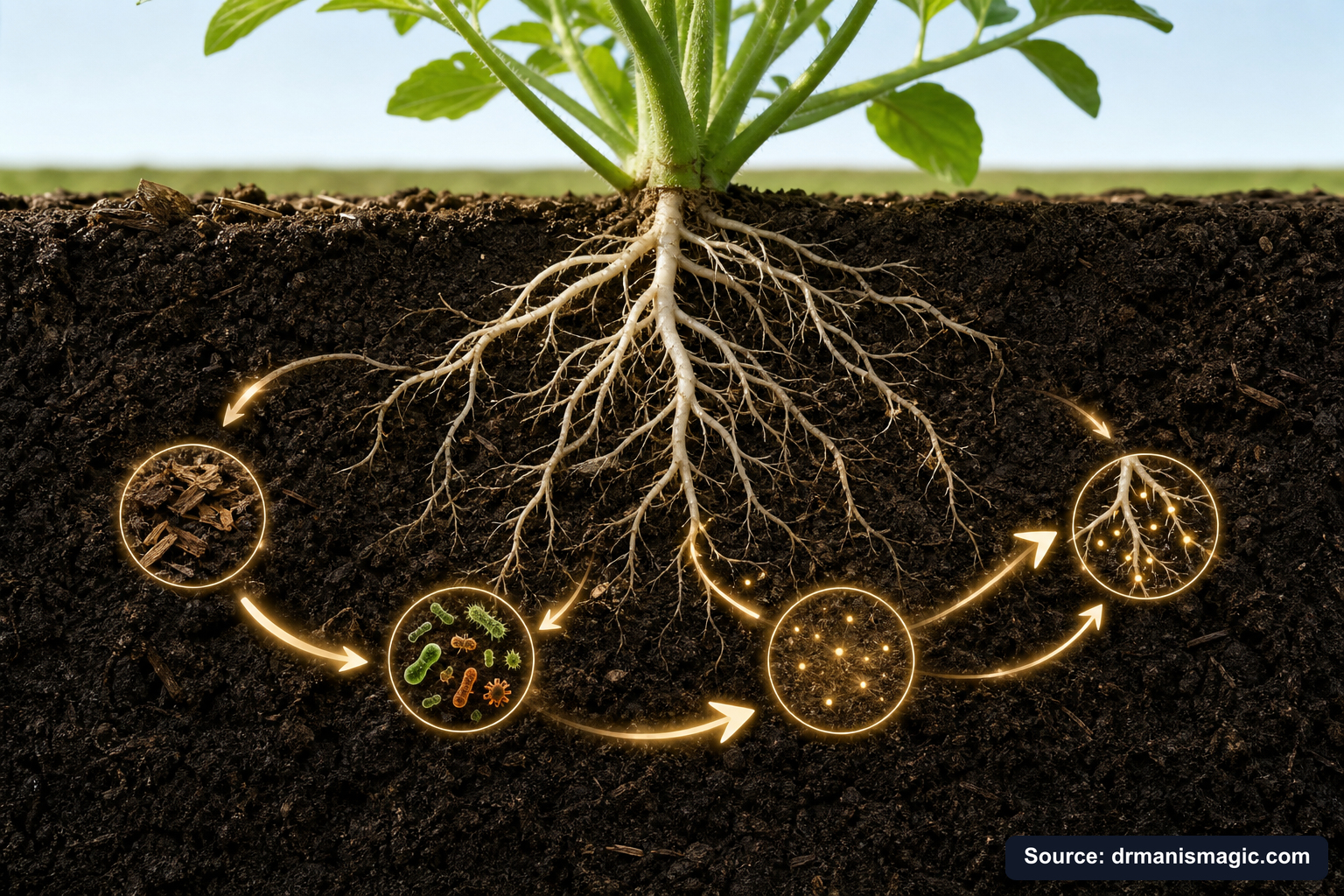
Plants do not actually eat fertilizer directly. Not most of it. The real pipeline between the soil and the plant runs through the microbes. Bacteria, fungi, and mycorrhizae living in the root zone are the ones that break down organic matter, unlock bound-up minerals, and hand nutrients directly to root cells in a form they can easily absorb.
When you dump salt-based synthetic fertilizer into the soil, you are not just feeding the plant. You are also burning those microbes. High salt concentrations pull water out of microbial cells the same way they pull it out of root cells. The microbial community shrinks. The biological pipeline narrows. And the plant, even if it greens up for a week or two from the nitrogen spike, is left more vulnerable than before.
This is why the same lawn that got chemically fertilized every spring starts looking worse by August. The soil is slowly going quiet. The living system is dying. And without it, the plant cannot protect itself from Pythium, Phytophthora, root rot fungi, or any of the other pathogens waiting in the soil for a weakened host.
Kelp works differently. Its polysaccharides and carbohydrates feed the microbial community. A fed microbial community processes organic nitrogen, including the amino acid nitrogen in inputs like our Crab, Kelp and Amino Acids fertilizer, into gentle, plant-ready forms. When those microbes eventually die naturally, they release everything they consumed directly into the root zone. It is a slow, steady, self-regulating delivery system. Nature built it. We just stopped getting in its way.
This is Pillar Two of the Three Plant Pillars. Live microbes are not optional. They are the engine that makes everything else work.
See also: The Hidden Reason Synthetic Fertilizers Cause Root Rot
Kelp vs Salt-Based Fertilizers vs Biosludge Products: What Should You Use on Stressed Plants?
Quick Answer: Kelp-based organic inputs have a low salt index, support microbes, and work gently with stressed roots. Salt-based synthetics can cause osmotic stress and microbial die-off. Biosludge-based products raise concerns about PFAS contamination and should be avoided entirely when clean inputs are a priority.
Let us put these three side by side so you can see exactly what you are dealing with.
| Input Type | Salt Risk | PFAS / Biosludge Concern | Nitrogen Release | Microbial Support | Root Stress | Best Use Case |
|---|---|---|---|---|---|---|
| Synthetic Fast-Release (salt-based) | High | Some products contain biosludge fillers | Immediate spike, then gone | Harmful (burns microbes) | High (osmotic stress) | Avoid on stressed or newly planted material |
| Synthetic Slow-Release (coated prill) | Moderate to High | Plastic coating residue in soil | Slower, but still salt-based inside | Neutral to harmful | Moderate | Not ideal for recovery or container plants |
| Organic Kelp / Crab / Amino Acid Blend | Very Low | None (when sourced cleanly) | Slow, microbe-mediated, steady | Strongly supportive | Very Low | Ideal for recovery, transplant, containers, lawns, all plants |
| Biosludge-Based "Organic" Fertilizer | Low to Moderate | High concern (municipal waste, PFAS) | Variable | Variable | Low to Moderate | Avoid entirely if food safety or soil health is a priority |
The word "organic" on a fertilizer bag does not automatically mean clean. Some so-called organic fertilizers use biosludge, which is treated municipal waste. Processed human sewage. And that material can carry PFAS, the "forever chemicals" that do not break down in soil or in your body. You will not see that on the front of the bag. You have to read the fine print. Or ask the company directly.
At Dr. Mani's Magic, the answer is simple. Our Crab, Kelp & Amino Acids fertilizer contains zero biosludge, zero PFAS, and zero synthetic salts. We tested it on our own trees first. We would not sell anything to you that we would not use in our own nursery.
You Never Had a Brown Thumb.
You were handed the wrong tools. This free guide hands you the right ones.
You watered it. You fed it. It died anyway.
It was never you. It was the dirt, the salt food, and the bad advice.
This guide shows you what really went wrong, and how to fix it for good.
- Why your plants really died, and why it was never your fault
- The salt hiding in your plant food that quietly burns the roots
- The hidden killer in almost every bag of store soil
- The tiny helpers that grow a whole forest for free
- The rescue trick that brings a half dead plant back to life

What Does Kelp Do for Lawns and Turfgrass Recovery?
Quick Answer: Kelp helps lawns recover from summer heat stress, drought, salt exposure, and overfertilization by improving root depth, boosting antioxidant defenses, feeding soil biology, and helping grass hold moisture in the cells. It will not green up a brown lawn overnight, but it builds the biological foundation that allows real, lasting recovery.
The brown lawn is one of the most heartbreaking sights in summer gardening.
You did everything right. You watered. You fertilized. Maybe you even hired a lawn service. And by August, it looks like a hay field. Dead patches. Crispy edges. Bare spots where nothing wants to grow.
Here is what usually happened. The lawn got pushed hard in spring with a high-nitrogen salt fertilizer. It greened up fast, looked great for a month or two, and the microbes in the soil took a hit. Then summer heat arrived. The roots were already shallow because the synthetic nitrogen encouraged fast top-growth instead of deep root development. The microbial community was already struggling. And the lawn had no reserves left to handle the stress.
Kelp cannot undo that damage overnight. But here is what it can do.
The auxins in kelp encourage roots to grow deeper. Deeper roots reach moisture that shallow roots cannot. The betaines help grass cells hold water during peak heat. The polysaccharides wake up the soil biology that helps the lawn feed itself. And the trace minerals support the enzyme systems the grass needs to run its own repair processes.
Used consistently, kelp-based inputs help lawns build the kind of resilience that does not show up until the stress test comes. And when it does, that lawn stays green a little longer, bounces back a little faster, and needs a little less intervention every season after that.
That is not a marketing claim. That is how biology works.
How Do You Know If Your Plant Has Salt Damage vs Root Rot vs Overwatering?
Quick Answer: Salt damage shows as crispy brown leaf edges, wilting despite wet soil, and stunted growth. Root rot causes soft, brown, smelly roots and sudden collapse. Overwatering causes yellowing, soggy soil, and slow decline. All three can look similar above ground but require different recovery approaches below ground.
Before you can help a plant recover, you need to know what it is recovering from. These three problems look similar above ground. But the cause and the fix are different.
| Symptom | Salt Damage / Fertilizer Burn | Overwatering | Root Rot (Pythium / Phytophthora) |
|---|---|---|---|
| Leaf edges | Brown, crispy, scorched margin | Yellow, soft, wilting | Yellow to brown, sudden collapse |
| Soil condition | Normal or dry | Wet, stays wet too long | Often wet or poorly drained |
| Root appearance | Brown tips, fine roots burned off | White but mushy, no structure | Dark brown to black, slimy, foul smell |
| Plant behavior | Wilts even when watered | Wilts, slow growth, yellowing | Rapid decline, may not recover |
| Likely cause | Salt-based fertilizer buildup, road salt, overapplication | Frequency or drainage problem | Pathogen (fungal), enabled by poor drainage and low oxygen |
| Kelp helps? | Yes, strongly | Yes, supports recovery after drainage fixed | Kelp is not a cure. Fix drainage and oxygen first. Kelp supports after. |
One important note. Kelp does not cure Pythium or Phytophthora root rot. These are fungal pathogens, and they need a real solution. That means fixing drainage, improving soil oxygen, and rebuilding the microbial community that naturally suppresses those pathogens. Kelp supports that rebuilding process. It is not the whole answer.
If your soil stays wet and your roots smell like sewage, you have a drainage problem first. Fix that with the right soil structure. Mineral-based soil that drains fast and holds oxygen is the foundation everything else depends on. That is Pillar One for a reason.
See also: How Salt-Based Feeding Quietly Destroys Root Systems
Is Kelp Safe for Houseplants, Container Plants, and Vegetables?
Quick Answer: Yes. Kelp-based inputs have a very low salt index, which makes them especially safe for container plants and houseplants where salt buildup is a serious risk. They are also safe for vegetables and edible gardens because they contain no synthetic chemicals, no biosludge, and no PFAS. They can be used regularly without fear of overfeeding.
Container plants are the most vulnerable of all. And they are the most commonly over-salted.
Here is why. When you grow a plant in a pot, the roots cannot spread out the way they can in the ground. They live in a small volume of soil. Every time you water, some of that water evaporates. But the salts from synthetic fertilizers do not evaporate with it. They stay. They build up. Over weeks and months, the salt concentration in the pot climbs higher and higher until the roots are essentially swimming in a light brine solution.
This is why potted plants look great in spring and start struggling by fall, even when you have been feeding them on schedule. The schedule was the problem.
Kelp-based organic fertilizer behaves completely differently in a container. Because it is processed by soil microbes first, the nutrients are released slowly and steadily. There is almost no risk of salt accumulation. The plant gets fed at the pace it can actually use, not at the pace a marketing team decided sounded impressive on a bag.
For houseplants, indoor trees, vegetables, herbs, or any edible garden, this matters even more. You are growing food you will put in your mouth. Your children might touch those leaves. Your dog might dig in that soil. The last thing you want is PFAS from biosludge or synthetic salt residues working their way into your home food supply.
Clean inputs are not a luxury. They are a baseline.
What Is the Step-by-Step Recovery Protocol for a Stressed Plant?
Quick Answer: Recovery starts by removing the stressor, fixing drainage and oxygen flow, flushing salt buildup if present, and then introducing low-stress biology-friendly inputs including kelp, amino acid nutrition, and live microbes. Do not force rapid growth. Support the root zone and let the plant rebuild on its own timeline.
You found a struggling plant. You know it is stressed. Here is what to do, in order.
- Remove the stressor first. If it is fertilizer burn, stop fertilizing. If it is overwatering, let the soil dry out and check drainage. If it is heat, move the plant or provide shade. You cannot recover a plant while the thing that hurt it is still happening.
- Check the roots. Gently tip out a container plant or dig carefully around an in-ground plant. Healthy roots are white or tan and firm. Salt-burned roots have brown, dead tips. Rotted roots are dark, mushy, and smell bad. Trim off any dead or rotted root tissue cleanly.
- Flush salt buildup if present. For container plants, water slowly and thoroughly until water runs freely from the bottom. Do this two or three times over a few days. This dilutes and drains excess salt from the root zone.
- Improve soil oxygen. If the soil is compacted, heavy, or stays wet, this is the root cause of many problems. Organic potting mixes made from bark and sawdust break down and collapse over time, squeezing oxygen out of the root zone. A mineral-based soil that drains fast and stays open is the permanent fix. See also: Why Most Fertilizers Are Actually Salt in Disguise
- Introduce live microbes. Before anything else, reestablish the biological community in the root zone. Live bacteria, fungi, and mycorrhizae are the recovery team. They help the roots defend against pathogens, process nutrients, and rebuild their support network. This is Plant Super Boost territory. Apply it as a soil drench and let the biology go to work.
- Feed gently with kelp and amino acid nutrition. Once the root zone is stabilized, introduce a low-salt organic fertilizer that includes kelp, amino acids, and crab-based chitin. The chitin from crab shells does something remarkable. It activates the plant's own immune response, the same way a vaccine trains the body's defenses. The plant becomes more resistant to fungal pathogens, pests, and stress. Combined with kelp's hormone support and amino acid nitrogen, this is the gentlest, most effective recovery nutrition you can give a stressed plant.
- Be patient. Recovery is not instant. But it is real. Most stressed plants begin showing visible improvement within two to four weeks when the root zone is properly supported. Some take a full season. The important thing is that you are building something permanent, not buying another temporary spike.
Why Is Chitin From Crab Shells Such a Powerful Companion to Kelp in Recovery?
Quick Answer: Chitin is a natural fiber found in crab shells that activates a plant's own immune defenses when it enters the soil. It signals the plant to produce natural compounds that resist fungal disease, soil pathogens, and pest pressure. Combined with kelp's hormone and mineral support, chitin and kelp together create a whole-plant recovery and resilience system.
Most people have never heard of chitin. That is by design. It does not come from a chemical company. It does not require a patent. And it works in a way that makes synthetic pesticides and fungicides look clumsy by comparison.
Here is the simple version. Chitin is the structural material in crab shells and insect exoskeletons. When chitin enters the soil, certain soil microbes start breaking it down. And as they do, the plant senses those breakdown products and reads them as a warning signal. "Something with an exoskeleton is nearby. Could be a fungus. Could be a pest. Better get ready."
So the plant activates its own defense chemistry. It produces natural anti-fungal compounds, strengthens its cell walls, and becomes harder for pathogens like Pythium and Phytophthora to penetrate. Not because you sprayed something toxic. Because the plant did it itself, prompted by a natural cue in the soil.
Pair that with kelp's auxins rebuilding root architecture, its betaines protecting cells from heat and drought, and its polysaccharides feeding the microbial community, and you have a recovery system that works at every level of the plant. Roots, cells, hormones, immunity. All supported. None of it salt-based. None of it toxic. All of it working with the biology that already exists in healthy soil.
This is why our Crab, Kelp & Amino Acids formula is not just an organic fertilizer. It is a complete recovery and resilience input. Every ingredient has a job. Every job supports the plant's ability to help itself.
How Does This All Connect to the Three Plant Pillars?
Quick Answer: Kelp supports Pillar Three (organic fertilizer and biostimulants) by providing gentle, low-stress nutrition and hormonal support. But kelp works best when Pillar One (mineral-based soil with oxygen and drainage) and Pillar Two (live microbes) are also in place. All three pillars together create the conditions where stressed plants recover fastest and healthy plants stay strong longest.
Dr. Mani Skaria spent 40 years studying plant pathology at the Texas A&M Citrus Center. He watched trees die. He watched them recover. He watched the same mistakes get made over and over across thousands of growers. And he noticed a pattern.
The plants that failed had one thing in common. Their foundation was broken.
It did not matter how much fertilizer they got. It did not matter how often they were watered. If the soil was the wrong kind, if the microbes were dead or absent, if the nutrition was salt-based and hostile to the biology it depended on, the plant was always one hot week or one bad rain away from trouble.
The plants that thrived also had something in common. Three things, actually.
Mineral-based soil that drained fast and held oxygen so roots could breathe. Live microbes that processed nutrients and defended against disease. And organic nutrition that fed the microbes first and let them feed the plant in return, at the pace nature intended.
That is the Three Plant Pillars. It is not a marketing framework. It is the distilled lesson of 250,000 trees, one dedicated nursery in South Texas, and 40 years of watching what actually works versus what gets sold.
Kelp sits inside Pillar Three. But it needs Pillars One and Two to do its best work. A kelp drench on compacted, dead soil is like trying to run a race with broken shoes. You can try. But you will not get far.
Get all three pillars working together and you will be amazed at how forgiving plants become. How fast they recover. How long they thrive. You can download our Free Plant Care Field Guide to see exactly how we apply these principles to any plant, lawn, or garden.
One Last Thing About Time
You can always get more money. You cannot get more time.
That might sound like a gardening cliche. But sit with it for a second. The number one thing people tell Dr. Mani when they call or write to us is this. They want to see fruit on a tree they planted with their own hands. They want to harvest something they grew. They want to walk out to their backyard and feel that quiet, deep satisfaction of a living thing they nurtured coming back to life and producing something real.
That desire is not small. It is ancient. We were made to tend gardens. And that pull never goes away.
But here is the brutal truth. Every season you spend fighting salt damage, root rot, dead soil, and struggling plants is a season you are not spending harvesting, watching, and enjoying. The old way, the salt-fertilizer, dead-soil, quick-fix way, does not just cost you money. It costs you years. Seasons you will never get back.
The right foundation, the right soil, the right microbes, the right clean organic nutrition including kelp, does not just help plants recover. It builds something permanent. Something that gets better every year instead of worse. Something that works with nature instead of against it.
If you are ready to stop fighting your plants and start supporting them the way they were designed to grow, our Crab, Kelp & Amino Acids fertilizer is a simple, clean, no-stress place to start. It is backed by a 30-day money-back guarantee. No fine print. No hassle. Just results, or your money back.
Your plants are waiting. So is the version of you who finally knows what works.
Frequently Asked Questions
When a plant is struggling, you need answers fast. These are the questions we hear most from gardeners who are tired of watching their plants suffer and want to know how kelp fits into a real recovery plan. The answers below are grounded in over 30 years of growing experience and lessons learned from more than 250,000 trees at our South Texas nursery.
What does kelp actually do for a stressed or struggling plant?
Kelp is a biostimulant, not a regular fertilizer. It carries natural plant hormones that tell roots when to grow and when to repair. It also brings trace minerals and protective compounds that help plants hold water during heat and drought. When your plant is already beat up from bad soil or harsh fertilizers, kelp gives it a gentle lift instead of forcing it to perform. That is exactly what a stressed plant needs first.
Why is kelp better than a regular fertilizer when a plant is in recovery?
Most fertilizers are salt-based. When you pour salt onto already-damaged roots, you make things worse. Salt pulls moisture away from roots and kills the beneficial microbes living in the soil. Kelp works the opposite way. It supports the living ecosystem in your root zone instead of destroying it. That is why our Crab, Kelp, and Amino Acids fertilizer was built around kelp as a foundation. It feeds your plant without burning what is left of its recovery system.
How does kelp fit into the Three Plant Pillars?
The Three Plant Pillars are mineral-based soil, live microbes, and organic fertilizer. Kelp lives inside Pillar Three. It is part of the organic fertilizer layer that fuels growth without toxic salt buildup. But kelp works best when the other two pillars are in place. Without clean mineral soil and live microbes, even great kelp cannot do its full job. All three pillars working together is what makes plants practically bulletproof.
Can kelp help a plant recover from fertilizer burn?
Yes, and this is one of the most common situations we see. When synthetic fertilizers scorch roots, the plant shuts down. It stops absorbing nutrients efficiently. Kelp helps restart that process gently. The natural hormones in cold-processed kelp signal roots to begin branching and repairing. The trace minerals support cell function without adding more salt stress. We have seen this play out across thousands of citrus trees at our nursery, and the results are consistent.
How long does it take to see results when using kelp on a struggling plant?
Recovery is not instant, but it is faster than most people expect when the right foundation is in place. With clean mineral soil, live microbes, and kelp-based organic fertilizer all working together, most stressed plants begin showing improvement within a few weeks. New leaf growth, firmer stems, and better color are usually the first signs. Forcing faster results with harsh chemicals at this stage almost always sets the plant back further.
Is the kelp in Dr. Mani's Magic fertilizer clean and safe to use around kids and pets?
Yes. Our Crab, Kelp, and Amino Acids fertilizer is made without biosludge, synthetic salts, or PFAS. It does not carry the scary warning labels you see on chemical fertilizers. You can use it without worrying about what your children or pets are walking through or touching. One of the biggest reasons Dr. Mani built this product line was so families could garden without fear. Real wealth includes being able to enjoy your backyard without reading a hazmat label first.
Does kelp work for all types of plants, or just citrus trees?
Kelp works for any plant with roots, which means everything from your lawn grass and houseplants to vegetable gardens, flowering beds, and fruit trees. We tested our system on over 250,000 citrus trees at US Citrus Nursery because that is where we could see results at scale. But the biology is the same for every plant. Roots respond to natural hormones and trace minerals the same way whether the plant is a lemon tree in Texas or a tomato plant on a balcony in Chicago.
About the Author
Ron Skaria, MD
Ron Skaria, MD, is the co-founder of Dr. Mani's Magic and the son of Dr. Mani. He trained as a medical doctor at Baylor College of Medicine, did his residency at UT Health Science Center - San Antonio and fellowship training at Texas Tech University. He now works full time on the family farm at US Citrus and US Citrus Nursery in Hargill, Texas, building Dr. Mani's Magic alongside his dad. He wrote the Brown Thumb Field Guide to put his father's 48 years of plant science into plain words any gardener can use. His belief is simple. You never had a brown thumb. You just never had the right help.


