


How History Proves Soil Biology Always Wins | Dr. Mani's Magic
How History Proves Soil Biology Always Wins
Close your eyes for a second. Picture a forest. No one planted it. No one fertilized it. No one sprayed it with chemicals or added "potting mix" from a plastic bag. Yet it's lush. It's alive. The trees are massive. The soil smells rich and dark, like something ancient and powerful is happening just beneath your shoes.
Now look at your backyard. Or your patio pot. Or that struggling Meyer lemon you've been nursing for two years. You've watered it. You've fed it. You've Googled it at midnight. And still... it sits there. Pale. Slow. Barely hanging on. Here's the thing nobody told you: the forest isn't doing anything special. It's just working with the invisible army that's been running the show for three billion years. That army lives in the soil. And every time humans have tried to ignore it, sideline it, or kill it off, the results have been catastrophic. We have thousands of years of proof.
This is the story of soil biology. It's older than every empire that ever fell. It's the reason your plants struggle when you do things the modern way. And once you understand it, you'll never look at a bag of synthetic fertilizer the same way again. Keep reading. This gets wild.

Organic Fertilizer | Crab, Kelp & Amino Acids
Key Takeaways
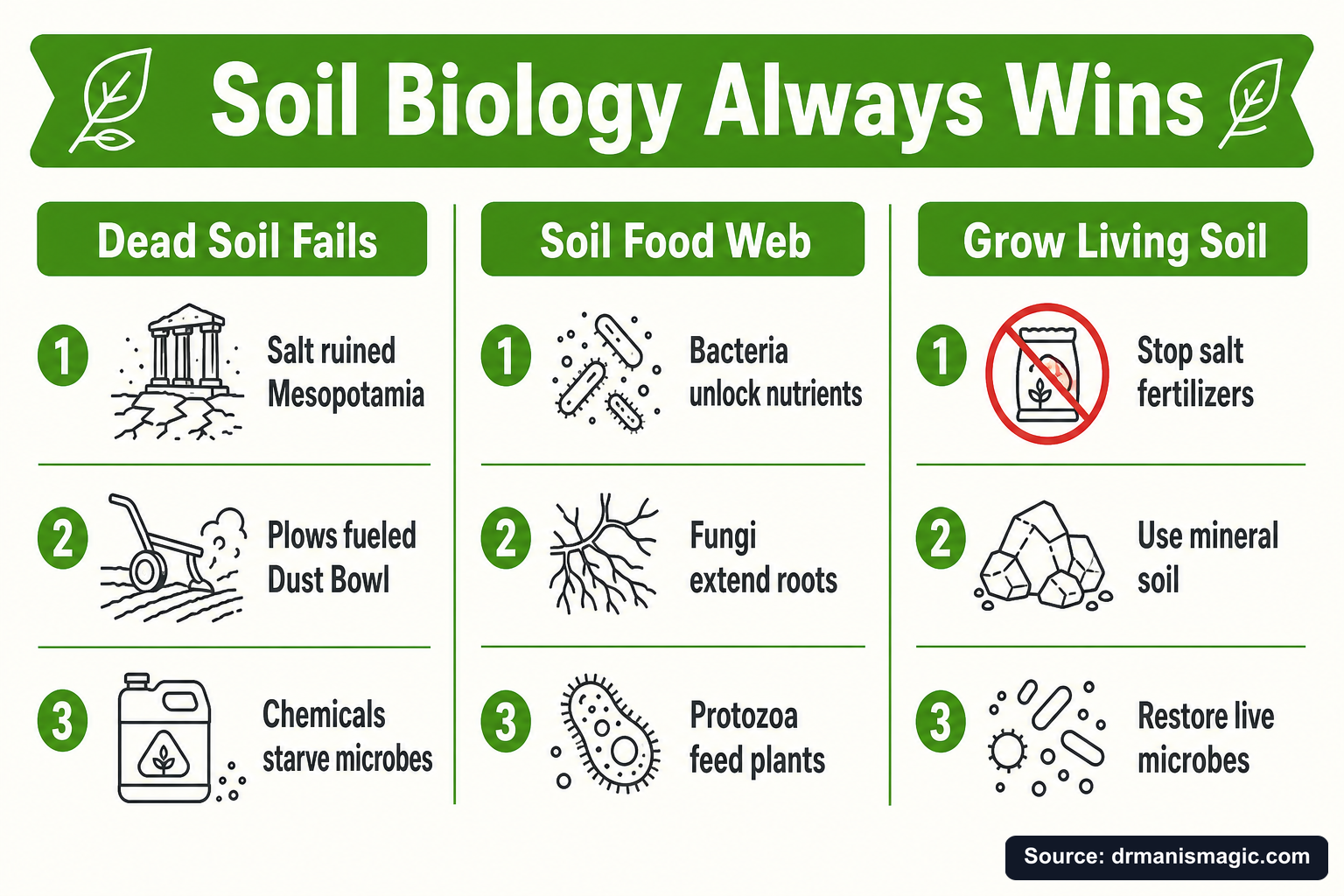
- Soil biology, the living web of bacteria, fungi, protozoa, and nematodes, is the real engine behind every thriving plant on Earth.
- Every major agricultural collapse in history, from ancient Mesopotamia to the Dust Bowl, traces back to the destruction of living soil.
- Salt-based synthetic fertilizers and chemical inputs kill the very microbes your plants depend on.
- Mycorrhizal fungi are an ancient partnership that extends roots, unlocks nutrients, and builds drought resistance, and citrus is especially dependent on them.
- Most commercial microbial products are dead on arrival, either dried into useless powder or rotting in smelly liquid.
- Living soil can recover, but only if you stop the damage and restore the habitat that microbes need to survive.
- The Three Plant Pillars, mineral soil, live microbials, and organic fertilizer, are the practical system Dr. Mani Skaria developed after growing over 250,000 trees in South Texas.
What Happened When Ancient Civilizations Ignored Soil Biology?
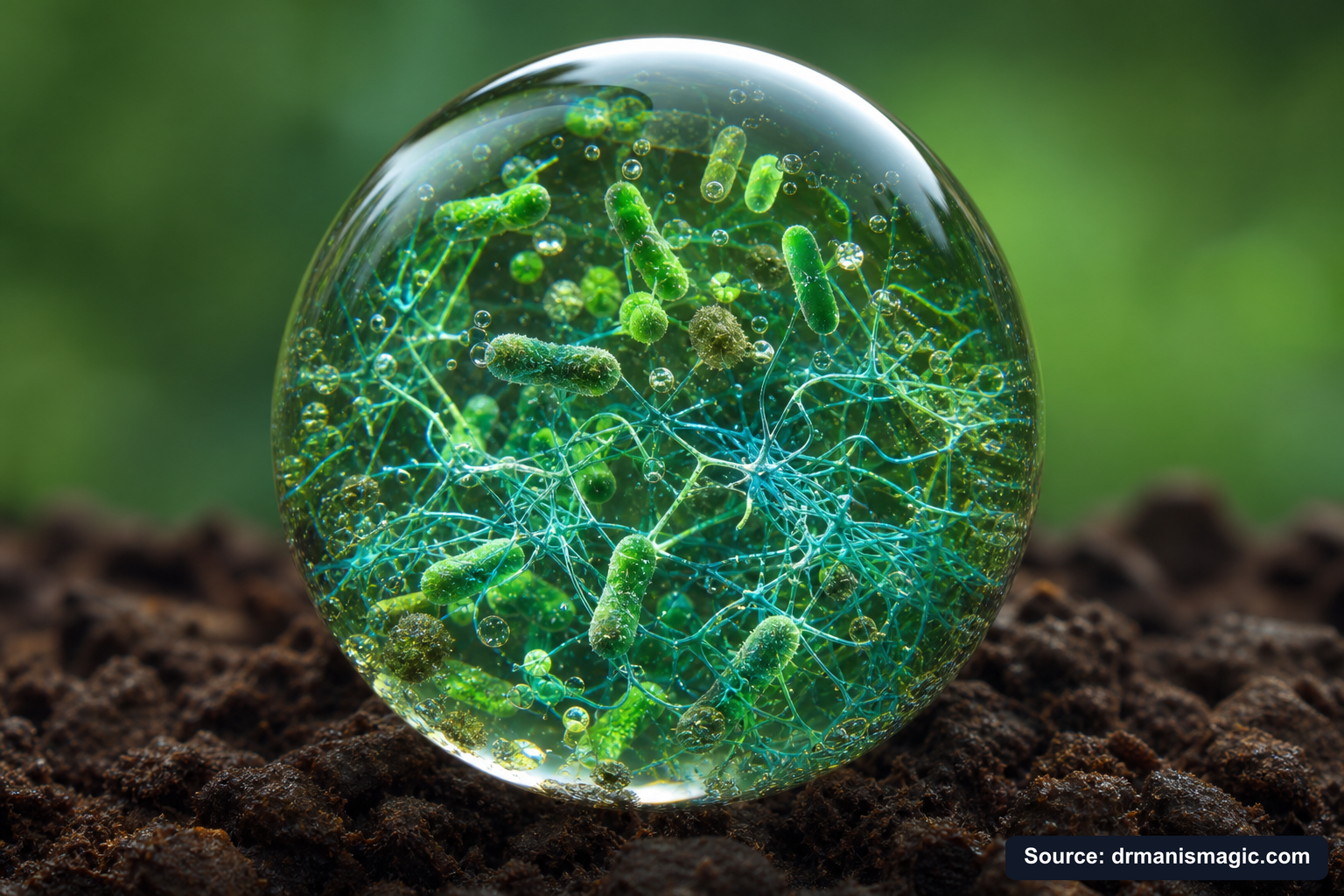
Quick Answer: They collapsed. Mesopotamia, one of the most fertile regions in the ancient world, turned to salt-crusted wasteland because irrigation without drainage pushed minerals to the surface and killed the soil food web. The same pattern appears in every major agricultural failure in history. Ignore living soil long enough, and the land stops producing.
Around 3,500 years ago, the land between the Tigris and Euphrates rivers was the breadbasket of the ancient world. Today we call it Iraq. Back then, people called it paradise. The soil was deep, dark, and alive. Crops grew in abundance. Cities rose.
Then something went wrong. Slowly at first. Then fast.
Farmers irrigated heavily but had no way to drain excess water out. Salts from the water crept upward through the soil. Year after year, the salt load increased. The living organisms in the soil, the bacteria, the fungi, the microscopic creatures that break down organic matter and cycle nutrients, began to die. Without them, the soil became biologically dead. Nutrients locked up. Roots suffocated. Crops failed.
By around 1700 BCE, historical records show that wheat, which is more salt-sensitive than barley, had nearly disappeared from the region entirely. Archaeologists have found ancient Sumerian texts complaining that "the earth turned white." That white crust? Salt. Dead salt. The opposite of living soil.
The civilization didn't just lose their crops. They lost their cities. They lost their empire.
Fast forward about 4,000 years. The American Dust Bowl, 1930s, Great Plains. Farmers had plowed up the native prairie grasses that held the soil together. Those grasses fed a massive underground ecosystem of roots, fungi, bacteria, and earthworms. Without them, the soil structure collapsed. The wind took the topsoil. Literally. Clouds of it. Three hundred million acres of farmland destroyed in a decade.
Two civilizations. Thousands of years apart. Same root cause. The soil food web was destroyed, and the land stopped working.
This is not ancient history. This is a warning.
What Exactly Is the Soil Food Web and Why Does It Matter for Your Plants?
Quick Answer: The soil food web is the underground community of bacteria, fungi, protozoa, nematodes, earthworms, and other tiny creatures that work together to break down organic matter, cycle nutrients, build soil structure, and protect plant roots. Without it, your plant is on its own in dead dirt. With it, your plant has an invisible workforce doing the hard work around the clock.
Think of the soil food web as a city. Every creature has a job. Every job matters. When the whole system works together, your plant thrives without you doing much at all.
Here's how the city runs:
Bacteria are the first responders. They break down dead plant material and release nutrients in forms roots can absorb. Some bacteria pull nitrogen directly out of the air and hand it to plants for free. Literally free fertilizer, made by invisible workers in your soil.
Fungi are the engineers. They build thread-like networks called hyphae that extend far beyond where roots can reach. The most important fungi are mycorrhizae, a word from the Greek words for fungus and root. These ancient partners attach to plant roots and act like a second root system, one that can reach water and minerals the plant could never access alone. According to Colorado State University Extension, mycorrhizal fungi can increase a plant's effective root surface area by 100 to 1,000 times.
Protozoa are the grazers. They eat bacteria. When they digest bacteria and excrete waste, they release nitrogen in a plant-available form right next to the root. This is called the microbial loop, and it is one of the most efficient nutrient delivery systems on the planet.
Nematodes are the hunters. Beneficial nematodes prey on harmful insects and bacteria. They keep the population balance in check so no single bad actor takes over your root zone.
Earthworms are the bulldozers. They shred organic matter, create tunnels for air and water, and deposit nutrient-rich castings wherever they go.
Every single one of these creatures depends on the others. Remove one, and the whole system slows down. Remove several, and your soil becomes what most people in America are growing in right now: biologically dead dirt dressed up with a bag of synthetic salts and called "plant food."
| Organism | What It Does | Why Your Plant Cares |
|---|---|---|
| Bacteria | Break down organic matter, fix atmospheric nitrogen, suppress pathogens | Delivers nutrients in plant-ready forms; keeps disease pressure low |
| Mycorrhizal Fungi | Extend root reach up to 1,000x, transport water and minerals | Drought resistance, phosphorus access, faster growth |
| Other Beneficial Fungi | Decompose tough materials, build soil aggregates with glomalin | Better soil structure, aeration, water retention |
| Protozoa | Graze on bacteria, release nitrogen next to roots | Efficient nutrient delivery right where roots can use it |
| Beneficial Nematodes | Hunt harmful bacteria, insects, and larvae in soil | Natural pest suppression without chemicals |
| Earthworms | Shred residues, create channels, deposit castings | Aeration, drainage, and natural fertilizer in one package |
According to Oklahoma State University Extension, a single teaspoon of healthy soil contains between 100 million and 1 billion bacteria. One teaspoon. The workforce you have access to is staggering. The question is whether you're helping it or hurting it.
Why Does Citrus Prove the Mycorrhizae Story Better Than Any Other Plant?
Quick Answer: Citrus roots are naturally short and sparse, which means they rely on mycorrhizal fungi more than almost any other crop to access water and nutrients. Without that fungal partnership, citrus struggles to pull in phosphorus, fights salt stress poorly, and produces weak fruit. It is one of the clearest examples of a plant that simply cannot thrive without living soil biology.
Here's what most citrus growers don't know. And honestly, most gardening companies don't want you to know it either.
Citrus roots are short. They don't have the long, aggressive root hairs that other plants use to explore soil. This means citrus is one of the most mycorrhizae-dependent plants on earth. The fungal network isn't a nice bonus for citrus. It's essential infrastructure.
At our nursery in South Texas, Dr. Mani Skaria spent decades watching what happened when citrus trees had living biology around their roots versus when they didn't. The difference wasn't subtle. It was dramatic. Trees with healthy mycorrhizal networks grew faster, fruited sooner, handled Texas heat better, and bounced back from stress that killed neighboring trees.
After growing over 250,000 trees at US Citrus Nursery, here's what we learned: you cannot grow great citrus in biologically dead soil. Period. You can pump it full of synthetic fertilizer. You can water it perfectly. You can do everything right on the surface. And it will still struggle. Because the invisible workforce is missing.
Salt stress is the other citrus killer. When salt builds up in soil, especially in potted citrus where there's no rain to flush it through, it does two terrible things at once. First, it pulls water away from roots through osmosis, literally dehydrating the plant from the inside. Second, it kills the very microbes that help the plant cope with that stress. Plant Super Boost was developed specifically to reintroduce that living biology, including mycorrhizal fungi, into soils that have been damaged by salt buildup, chemical inputs, or sterile potting conditions.
See also: How Salt-Based Feeding Quietly Destroys Root Systems
What Kills Soil Biology and How Fast Does the Damage Happen?
Quick Answer: Synthetic salt-based fertilizers, herbicides like glyphosate, broad-spectrum fungicides, and pesticides can begin killing beneficial soil microbes within hours of application. Repeated use creates a biological desert where harmful pathogens fill the vacuum left by dead beneficial organisms. The damage compounds over months and years until the soil stops functioning on its own.
This is the part nobody puts on the fertilizer bag.
When you pour a salt-based synthetic fertilizer into your soil, it does not just feed your plant. It changes the chemistry of the entire root zone. Salt pulls water away from microbial cells the same way it pulls water away from plant roots. Beneficial bacteria and fungi, the ones working hard to unlock nutrients and protect your plant, begin to die.
You see a green-up. Fast, bright, almost exciting. The plant looks great for a few weeks. You feel like a genius.
But underground, the workforce is collapsing. And here's the cruel irony: when beneficial microbes die, harmful pathogens fill the space. Root rot organisms, fungal diseases, bacterial infections, they all move in when the good guys are gone. So you add more fertilizer to fix the struggling plant. More salt. More dead microbes. More pathogens. The cycle tightens.
This is not an accident. This is the business model.
Herbicides like glyphosate don't just kill weeds. Research has shown they disrupt microbial communities in the soil, reducing populations of beneficial bacteria and fungi while some resistant pathogens survive and thrive. Broad-spectrum fungicides don't just kill the bad fungus. They kill mycorrhizal fungi too. Every time you spray, you're taxing the invisible army you depend on.
See also: The Hidden Reason Synthetic Fertilizers Cause Root Rot
You Never Had a Brown Thumb.
You were handed the wrong tools. This free guide hands you the right ones.
You watered it. You fed it. It died anyway.
It was never you. It was the dirt, the salt food, and the bad advice.
This guide shows you what really went wrong, and how to fix it for good.
- Why your plants really died, and why it was never your fault
- The salt hiding in your plant food that quietly burns the roots
- The hidden killer in almost every bag of store soil
- The tiny helpers that grow a whole forest for free
- The rescue trick that brings a half dead plant back to life

Why Do Most Microbial Products Fail to Deliver Real Results?
Quick Answer: Most commercial microbial products are either dried lab-grown powders with low viability, or liquid brews that have gone anaerobic and are essentially rotting by the time you use them. Dead microbes cannot colonize roots or cycle nutrients. Only genuinely live, stable, full-spectrum biology produces the results healthy soil provides.
Walk into any garden center today and you'll find shelves full of "probiotic" soil products. Bottles with pictures of happy plants. Labels boasting specific strain names and colony counts. They look impressive. Most of them are theater.
Here's what's actually happening inside those bottles and bags.
The most common approach: large factories grow specific bacterial or fungal strains in giant vats. They dry the material into powder. The hope is that the dormant spores "reactivate" when you add water and pour them on soil. We have tested dozens of these products on our trees. We have seen almost no meaningful results. The drying process, the storage time, the shelf exposure, by the time that powder reaches your plant, the viable count is a ghost of what the label promises.
The second approach: liquid products brewed from compost or worm castings. These can be genuinely powerful, but only when fresh. After about 24 hours without active aeration, the liquid goes anaerobic. The microbes start dying. The bottle starts to smell. Not "earthy" smell. Sewage smell. Rotting smell. The kind of smell that makes your dog back away. You've probably seen gardeners complain about this in every online forum. That stench is the smell of dead biology.
A third approach that sounds natural but isn't: lactobacillus-based products, the same bacteria in yogurt. Easy to produce, stays alive. But lactobacillus is aggressive. It crowds out the beneficial microbes you actually need. It belongs in your gut, not your garden.
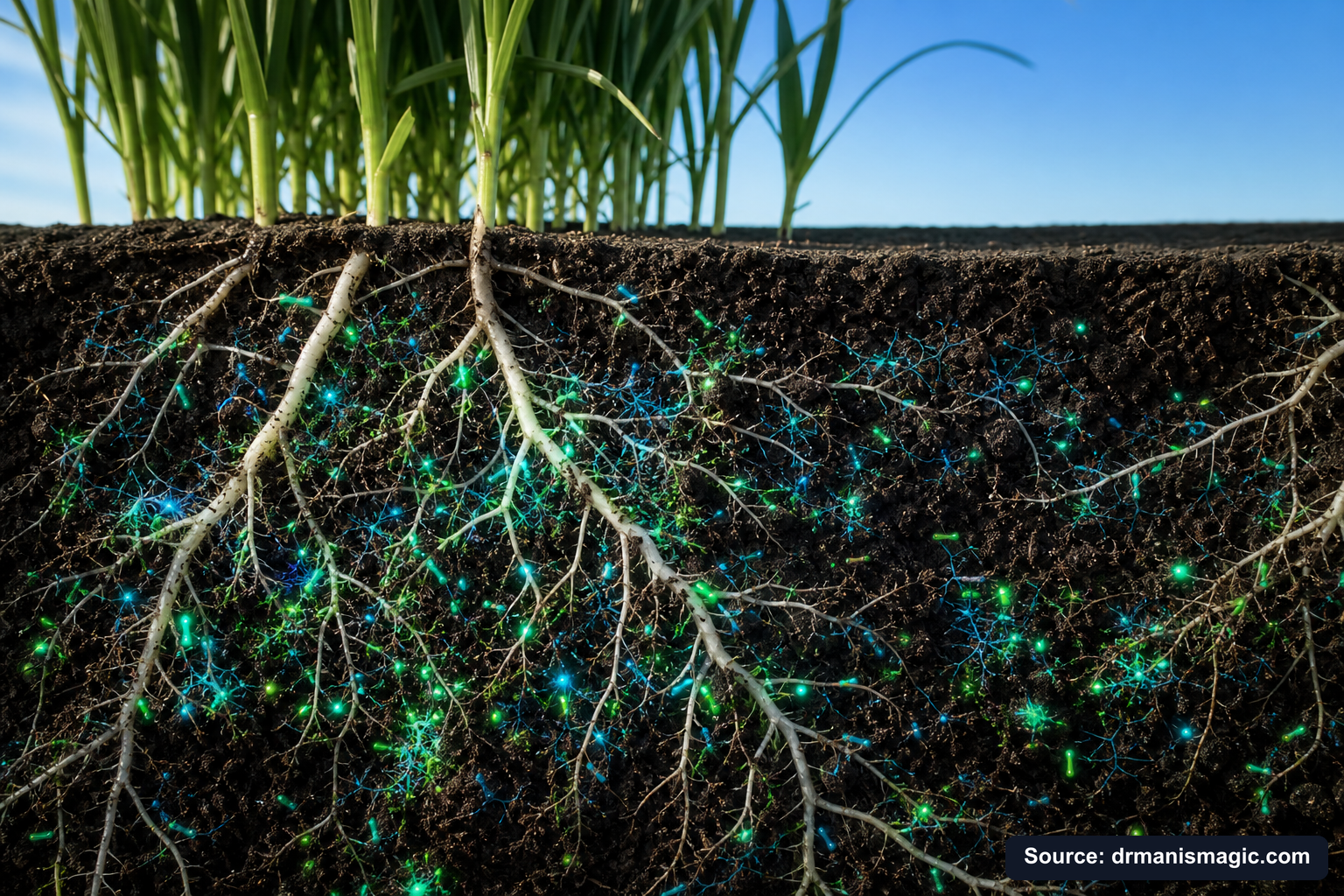
None of these approaches solved the real problem. So Dr. Mani and a world-renowned compostologist who had been working with royal families and governments before being quietly blacklisted by big chemical interests, developed something different. A natural stabilization technique that keeps the full spectrum of compost-harvested microbes alive without going anaerobic. No stench. No dead powder. Real, live, visible biology. You can put a drop of Plant Super Boost under a microscope and watch the microbes move.
| Product Type | Viability at Use | Microbial Spectrum | Odor | Real-World Results |
|---|---|---|---|---|
| Dried lab powder (single or few strains) | Very low | Narrow | Neutral | Minimal; we tested dozens with poor results |
| Rehydrated dry powder | Very low | Narrow | Neutral | Same problem; avoid |
| Compost tea, fresh under 24 hours | Moderate (if aerated) | Broad but variable | Earthy, mild | Good when truly fresh; hard to scale |
| Compost tea, old over 24 hours | Very low (anaerobic) | Degraded | Strong sewage smell | Poor; biology mostly dead |
| Lactobacillus-based products | High | Very narrow | Mild to sour | Crowds out beneficial microbes; avoid |
| Plant Super Boost (stabilized, compost-sourced) | High | 2,000+ bacteria, 400-500 fungi including mycorrhizae, plus protozoa and nematodes | Earthy, pleasant | Proven across 250,000+ trees; visible under microscope |
Can Damaged Soil Biology Actually Recover?
Quick Answer: Yes, soil biology can recover, but only when you stop the damage first and then actively restore the conditions microbes need to survive and multiply. This means fixing drainage, reducing or eliminating chemical inputs, adding organic matter, keeping living roots in the soil, and reintroducing a full-spectrum live microbial product. Recovery takes consistent effort over multiple months, not one application.
Here's the honest truth. You cannot undo years of synthetic fertilizer use, herbicide applications, or sterile potting mix with one bottle of anything. Recovery is a process. But the process is absolutely real, and we've watched it happen hundreds of times with our own trees and with the plants of growers across the country.
The key insight from the research is this: microbes persist when carbon, oxygen, pore space, moisture, and plant hosts are present. They fail when soil is compacted, bare, salty, waterlogged, or repeatedly disturbed. So recovery starts with habitat. You have to make the environment livable before you reintroduce the residents.
Here is the practical recovery sequence we've developed at US Citrus Nursery, based on decades of real-world growing:
- Stop the damage. Reduce or eliminate salt-based synthetic fertilizers, broad-spectrum fungicides, and herbicides. Every application sets the recovery back.
- Fix drainage and aeration. Compacted, waterlogged soil is an anaerobic environment where beneficial microbes cannot survive. If you're in a container, consider mineral-based Super Soil that doesn't compact or decompose. In ground, break up compaction with aeration or organic matter additions.
- Flush accumulated salts. In containers especially, deep watering until water runs freely from the bottom helps leach built-up salts. Rainwater is better than tap water when available.
- Add mature compost or organic matter. This is the carbon food source that fuels microbial populations. No food source, no microbial recovery. The Crab, Kelp and Amino Acids organic fertilizer feeds both your plant and the biology around it, without the salt damage of synthetic alternatives.
- Keep living roots in the soil. Roots feed microbes through root exudates, sugars and compounds the plant releases specifically to attract and feed its microbial partners. Bare soil starves the web.
- Reintroduce full-spectrum live biology. This is where a genuinely live microbial product matters. Apply monthly, consistently. One application is not enough because environmental pressures, residual salts, and competing pathogens will still be pushing back.
- Be patient and monitor. Watch for new leaf color, improved root development, and better fruiting over the following months. Recovery is gradual but visible.
We've watched trees that looked like they were circling the drain come back to life with this sequence. Not because of magic. Because the natural system was allowed to work again.
What Are the Three Plant Pillars and Why Does This Framework Matter More Than Any Single Product?
Quick Answer: The Three Plant Pillars are the framework Dr. Mani Skaria developed after 40 years of plant science research and over 250,000 trees grown in South Texas. The three pillars are mineral-based soil for permanent structure and drainage, live microbials for biological function and root protection, and organic fertilizer that feeds the plant without harming the biology. Miss any one pillar, and the whole system becomes fragile.
Dr. Mani spent decades watching plants struggle. He watched it at the Texas A&M Citrus Center. He watched it at his own nursery. He watched it in the reports coming back from growers across the country who had done everything "right" by the conventional playbook and still lost their trees.
He kept asking the same question: why do plants in nature thrive without any of this? No fertilizer bags. No pesticide sprays. No potting mix in plastic bags. Just thriving, producing, resilient plants everywhere you look.
The answer always came back to three things working together. Structure. Biology. Nutrition. In that order.
Pillar One: Mineral Foundation. Most potting mixes are made from pine bark and wood material that breaks down within months. As it decomposes, it compacts, steals oxygen from roots, and creates the wet, suffocating conditions where root rot thrives. Dr. Mani's Super Soil is built on sandy loam from the Rio Grande Valley, a mineral-based foundation that doesn't decompose, doesn't compact, and doesn't steal oxygen. Roots breathe. Water drains. The foundation is permanent.
Pillar Two: Microbial Muscle. This is the invisible workforce we've been talking about throughout this entire article. Bacteria, fungi, protozoa, nematodes, all working together in the root zone to unlock nutrients, protect against pathogens, extend root reach, and build resilience. Without this pillar, your plant is defenseless and nutrient-starved even when you fertilize heavily.
Pillar Three: Organic Fertilizer. Slow-release. Salt-free. No PFAS. No biosludge. No synthetic coatings that leach microplastics into your soil. The Crab, Kelp and Amino Acids formula feeds the plant with a complete spectrum of nutrients, hormones, and biostimulants in forms that work with the microbial community, not against it. Salt kills microbes. Organic nutrition feeds them.
When all three pillars are in place at the same time, something shifts. The plant stops struggling. It starts thriving. Not because you did something complicated, but because you stopped fighting nature and started working with it.
You can explore the full system at the Three Plant Pillars bundle builder and see exactly how the pieces fit together for your specific situation.
Living Soil vs. Sterile Soil: What Does the Difference Actually Look Like?
Quick Answer: Living soil smells earthy and rich, drains well, holds moisture between waterings, produces vibrant leaf color, supports heavy fruiting, and recovers quickly from stress. Sterile or degraded soil smells flat or slightly sour, drains poorly or too fast, produces yellowing leaves, weak root systems, and chronic disease pressure. The difference is visible, smellable, and touchable.
You can tell a lot about your soil with your senses before you ever buy a test kit.
Pick up a handful. Really smell it. Healthy, biologically active soil has that deep, earthy smell you associate with a forest after rain. That smell comes from a compound called geosmin produced by Streptomyces bacteria. You are literally smelling microbial activity. If your soil smells flat, dusty, or vaguely sour, biology is missing.
Look at it. Healthy soil clumps loosely when you squeeze it and crumbles apart. That structure is built by fungal glomalin, a sticky protein mycorrhizal fungi produce that glues soil particles into aggregates. No fungi, no aggregation. No aggregation, no pore space. No pore space, no oxygen for roots.
Feel it. Biologically active soil has a texture that feels alive. Dense, compacted, hard soil is a sign of structural collapse. In containers, soil that pulls away from the pot walls and shrinks into a hard plug is telling you the organic matter has decomposed and the mineral structure is gone.
Now look at your plant. Yellowing leaves that don't respond to fertilizer are often a nutrient lockup caused by missing microbial activity, not a lack of nutrients in the soil. Slow growth despite regular feeding. Repeated disease problems despite repeated spraying. Fruit that forms but drops early. These are the symptoms of biologically depleted soil playing out above ground in full view.
What Can You Do Right Now to Start Working With Soil Biology Instead of Against It?
Quick Answer: Start by stopping inputs that harm biology, then add organic matter, restore live microbials with a genuinely viable full-spectrum product, and switch to organic slow-release fertilizer that feeds the soil food web instead of salting it. Consistency matters more than intensity. Monthly applications and the right foundation will show visible results within 30 days and compound over time.
You cannot get time back. That's the truth that drives everything we do at Dr. Mani's Magic.
Every season you spend fighting your plants with the wrong inputs is a season you'll never get back. Every year a fruit tree sits struggling in biologically dead soil is a year without fruit you could have been harvesting. The number one thing people tell Dr. Mani when they reach out is that they want to see fruit on their trees while they still can. Not someday. Now. While they're healthy enough to pick it, smell it, share it with their kids.
That urgency is real. And it's exactly why the shortcut of synthetic fertilizer feels so tempting. Fast green-up. Visible results. Until six months later when everything stalls, yellows, and you're back at square one, only older, with less time, and a little more frustrated.
The Three Plant Pillars aren't complicated. They're the simple version of what nature does automatically in every thriving ecosystem on earth. Mineral foundation so roots can breathe. Live biology so nutrients flow and pathogens don't win. Organic nutrition that feeds the system without salting it to death.
Mesopotamia didn't have a second chance. The Dust Bowl took decades to partially recover. But your backyard? Your patio pots? Your garden beds? They can start turning around this month.
History has proven over and over that soil biology always wins in the end. The civilizations that worked with it thrived. The ones that ignored it paid with everything. You don't have to repeat that pattern in your own backyard.
If you want to see what the Three Plant Pillars actually look like in practice, and what it feels like to have a system that works with nature instead of against it, the Free Plant Care Field Guide is a great place to start. No jargon. No guesswork. Just the practical foundation Dr. Mani spent 40 years building, handed to you in plain language.
The forest already knows the secret. Now you do too.
Frequently Asked Questions
You just learned how civilizations crumbled when they ignored soil biology. Now you probably have questions. Good. These are the exact questions Dr. Mani Skaria has spent 35 years answering, tested on over 250,000 trees in South Texas. Get the real answers here.
Why does soil biology matter so much for my plants?
Soil biology is the invisible engine behind every healthy plant on Earth. Bacteria, fungi, and other microbes unlock the nutrients your plants need, fight off disease, and keep roots breathing. Without them, your plant is on its own, defenseless and starving. Dr. Mani's Three Plant Pillars start here, with live microbials as the foundation, because nothing works right without them. No microbes means no real growth, period.
What exactly is soil biology and why should I care about it?
Soil biology is the living community inside your dirt. Bacteria, fungi, protozoa, and nematodes all work together to break down organic matter and feed your plants naturally. Think of it like a tiny city under your feet, working 24 hours a day for free. When that city is alive and thriving, your plants thrive. When it is dead, from chemicals or bad soil, your plants struggle no matter how much you water or feed them.
Can plants actually survive without healthy soil biology?
Technically, plants can survive short term without it. But they will not thrive. They become weak, slow, and easy targets for pests and disease. Ancient Mesopotamia proved this the hard way. Their soil biology died from salt buildup and their entire civilization collapsed with it. In your backyard, dead soil means dead plants, wasted money, and wasted time you cannot get back. Healthy soil biology is not optional. It is everything.
How do synthetic fertilizers hurt my soil biology?
Synthetic fertilizers are salt-based. That salt burns and kills the beneficial bacteria and fungi your plants depend on. It is like pouring bleach on a beehive and then wondering why there is no honey. Worse, your plant gets addicted to the chemical hit, and the moment you stop, it crashes. Dr. Mani watched this pattern destroy trees for decades before he cracked the code with organic, slow-release inputs that feed microbes instead of killing them.
How do I actually improve my soil biology at home?
Start with the Three Plant Pillars. First, use a mineral-based soil like Dr. Mani's Magic Super Soil so roots can breathe and water drains properly. Second, add live microbes with Plant Super Boost, real living bacteria, fungi, and mycorrhizae that go to work immediately. Third, feed everything with an organic fertilizer like Dr. Mani's Crab, Kelp, and Amino Acids blend. That trio, proven on 250,000 trees, is the fastest path to a thriving, living soil.
What are the biggest benefits of living soil for my garden?
Living soil does five big things for you. It anchors your plants and feeds their roots. It filters and holds water so you water less. It fights off disease naturally so you spray less. It recycles dead matter into fresh nutrients on its own. And it builds long-term resilience so your plants get stronger every season instead of weaker. That is the difference between a garden that limps along and one that makes your neighbors stop and stare.
What happens if I keep ignoring soil biology in my garden?
Your plants will stall. Then they will slide backward. You will spend more money chasing the problem with new products that do not fix the root cause. Months turn into years, and that fruit tree you dreamed of harvesting from never quite gets there. History shows this pattern clearly, from the Dust Bowl to ancient collapsed empires. The good news is you can stop the cycle right now. Restore the biology and your soil, and your plants, come back to life fast.
About the Author
Ron Skaria, MD
Ron Skaria, MD, is the co-founder of Dr. Mani's Magic and the son of Dr. Mani. He trained as a medical doctor at Baylor College of Medicine, did his residency at UT Health Science Center - San Antonio and fellowship training at Texas Tech University. He now works full time on the family farm at US Citrus and US Citrus Nursery in Hargill, Texas, building Dr. Mani's Magic alongside his dad. He wrote the Brown Thumb Field Guide to put his father's 48 years of plant science into plain words any gardener can use. His belief is simple. You never had a brown thumb. You just never had the right help.


