


How Healthy Roots Change Citrus Flavor: The Underground Secret | Dr. Mani's Magic
How Healthy Roots Change Citrus Flavor: The Underground Secret to Sweeter, Juicier Fruit
Picture yourself standing in your backyard on a warm afternoon. You reach up and pull a lemon from your tree. It feels heavy in your hand. The skin is bright yellow, almost glowing. You cut it open and the smell hits you first — sharp, floral, alive. You squeeze it over your glass of water and take a sip.
Now picture the opposite. You pull a lemon from the same tree, but something is off. It feels light. Almost hollow. You cut it open and there is barely any juice inside. The smell is faint. The taste is flat and weirdly bitter. You paid good money for that tree. You watered it. You fed it. And it gave you something that belongs in a gas station, not your kitchen.
What went wrong? The answer is not in the branches. It is not even in the fruit. The answer is underground. It starts in the roots — and everything that lives around them. After growing over 250,000 citrus trees at our South Texas nursery, we learned something that almost nobody talks about: the flavor of your fruit is built below the soil line, long before a single drop of juice forms.

Plant Super Boost
Key Takeaways
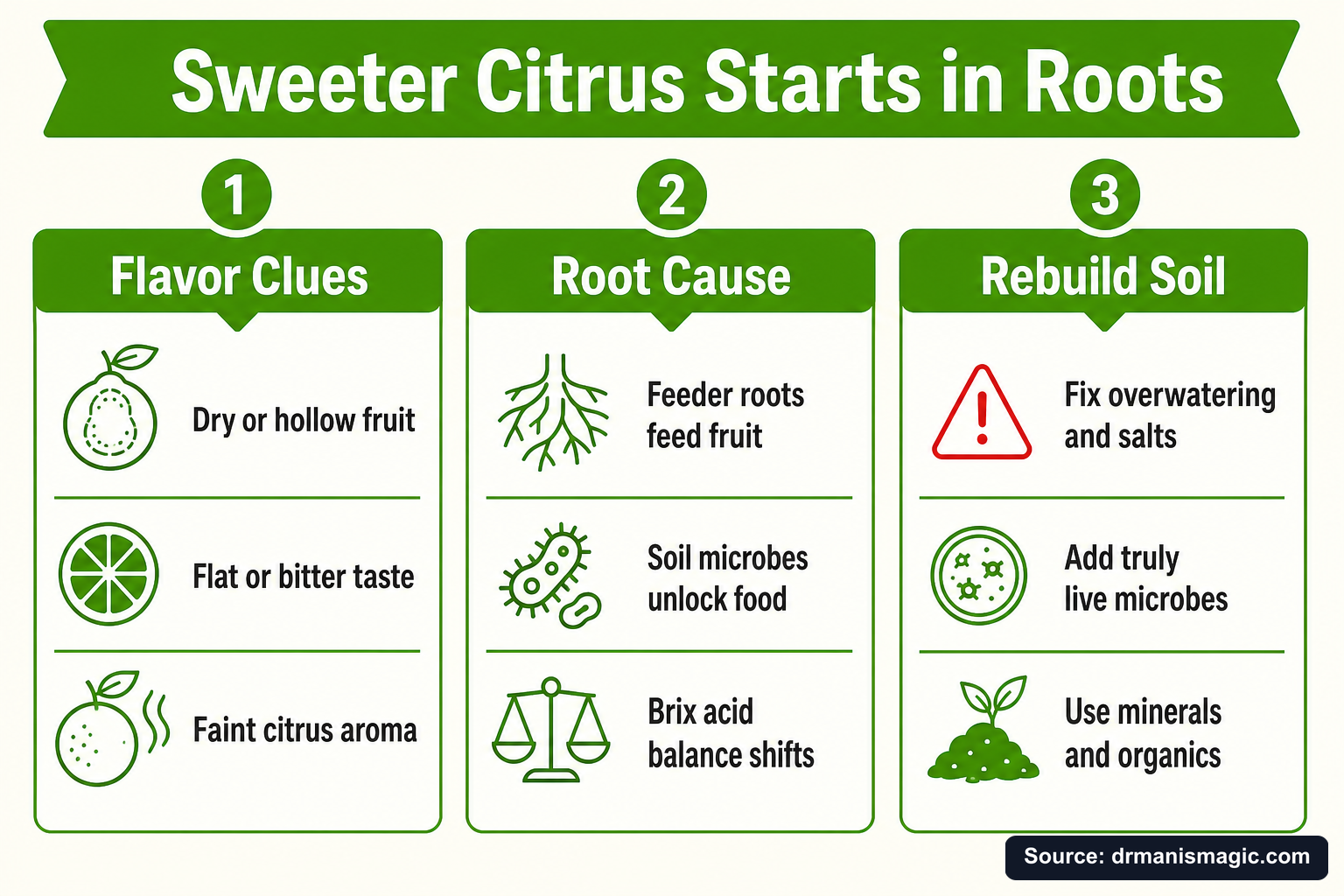
- Healthy roots control how much sugar, acid, juice, and aroma your citrus fruit contains — poor root health means poor flavor.
- The living organisms in your soil (bacteria, fungi, protozoa, nematodes) are the invisible workforce that keeps feeder roots working at full power.
- Root disease, salt buildup, overwatering, and dead soil biology are the most common hidden causes of bland, watery, sour, or dry citrus.
- The Brix-to-acid ratio is the science behind what you taste — healthy roots help maintain the right balance of sugars and acids in your fruit.
- Most store-bought microbial products are either dried and dead, or smelly and dying — genuinely live microbes are rare and make a real difference.
- The Three Plant Pillars — mineral soil, live microbes, and organic fertilizer — work together to rebuild root-zone biology from the ground up.
- You can diagnose why your citrus tastes off by matching your flavor symptom to its most likely root-zone cause.

Why Do Roots Control How Citrus Tastes?
Quick Answer: Your citrus roots are the gatekeeper for everything that ends up in the fruit. They control how much water, sugar, minerals, and aroma compounds reach the developing juice. Damaged or struggling roots send less of everything, which is why stressed trees make fruit that tastes watery, flat, sour, or dry.
Roots do not just anchor the tree. They are the intake system for everything the fruit will ever be made of. Water flows in through feeder roots — the tiny hair-like roots at the tips of the root system. Minerals follow. Nitrogen, phosphorus, potassium, calcium, magnesium, zinc, and dozens of trace elements all enter through those delicate little roots.
Once inside the tree, these raw materials get transformed. The tree uses sunlight to turn carbon dioxide and water into sugars through photosynthesis. Those sugars travel down to the roots and back up into the developing fruit. The tree also produces organic acids — mainly citric acid — which give citrus its signature zing. Volatile compounds form too. These are the aromatic molecules that make a lemon smell like a lemon and an orange smell like an orange.
Here is the key insight that most gardening advice misses entirely: all of that chemistry depends on the root system working properly. If the feeder roots are rotted, choked, burned by salt, or starved of oxygen, the tree cannot regulate any of it. The sugar accumulation falls. The acid balance shifts. The juice content drops. The aroma fades. What you get is fruit that is technically a lemon but tastes like almost nothing.
University research on citrus fruit quality confirms that the Brix-to-acid ratio — the balance between sugar content and acidity — is the central measurement of how citrus tastes to the human palate. Studies from the University of Georgia Cooperative Extension show that this ratio shifts measurably depending on rootstock, soil conditions, and nutrient uptake — all root-zone factors. The roots are not just supporting the tree. They are building the flavor.
What Is the Soil Food Web and Why Does It Matter for Flavor?
Quick Answer: The soil food web is the community of living organisms around your roots — bacteria, fungi, protozoa, nematodes, earthworms, and more. They work together to unlock nutrients, protect feeder roots, and keep the root zone healthy. When this web is alive and thriving, your tree gets exactly what it needs to build great-tasting fruit.
Here is something most people never learn: your citrus tree is not growing alone. It is growing inside a community. Trillions of microorganisms live in the few inches of soil directly surrounding the root tips. Scientists call this zone the rhizosphere. It is the most biologically active place on earth, and it is happening silently beneath your feet right now.
The tree feeds this community on purpose. It pushes sugars and proteins out through its roots — these are called root exudates — and it does this to attract and feed bacteria and fungi. In return, those organisms do something remarkable. They break down organic matter, unlock minerals that were chemically locked in the soil, and deliver those minerals directly to the root surface. They also crowd out pathogens, produce plant hormones, and build the soil structure that lets water and oxygen move freely.
University of Minnesota Extension describes the soil food web as a system where bacteria and fungi break down organic matter, protozoa and nematodes graze on bacteria and release plant-available nitrogen, and predatory organisms suppress harmful pests. Every layer feeds the next. Every organism plays a role. When the web is working, the tree has access to a complete, balanced, continuously replenished supply of nutrients. When the web collapses, the tree is on its own — and the fruit shows it.
| Organism | What It Does for Your Tree | Impact on Flavor |
|---|---|---|
| Beneficial bacteria | Break down organic matter, fix nitrogen, solubilize minerals, suppress pathogens | Better mineral balance means better sugar and acid development |
| Mycorrhizal fungi | Extend root surface area by up to 100x, deliver phosphorus, water, and micronutrients | Improved uptake leads to higher Brix, better juice content, richer aroma |
| Saprophytic fungi | Decompose organic material, recycle carbon and nutrients back into plant-available forms | Supports complete nutrient cycling that feeds flavor chemistry |
| Protozoa | Graze on bacteria, releasing nitrogen in plant-available form right at the root surface | Steady nitrogen supports healthy leaf growth without pushing excess that dilutes fruit |
| Beneficial nematodes | Graze on bacteria and fungi, releasing nutrients; suppress harmful nematodes | Protect feeder roots from parasitic nematode damage that causes watery, low-Brix fruit |
| Earthworms | Aerate soil, create channels for water and oxygen, produce nutrient-rich castings | Better drainage and aeration prevents root rot and stress that ruins flavor |
| Plant-parasitic nematodes (harmful) | Attack and damage feeder roots, reducing uptake capacity | Damaged roots produce low-juice, watery, or undersized fruit |
| Phytophthora (harmful) | Root rot pathogen that destroys feeder roots in wet conditions | Severe reduction in Brix, juice, and overall fruit quality |
What Does Brix, Acid, and Aroma Actually Mean for the Fruit You Pick?
Quick Answer: Brix measures the sugar content of your juice. Titratable acidity measures how sour it is. The ratio between the two determines whether your citrus tastes rich and balanced or thin and off. Volatile compounds create the aroma. All three are directly tied to how well your roots are functioning in the weeks before harvest.
Let us make this simple. When you bite into a great orange, three things happen at once. You taste sweetness. You taste a bright, clean tartness. And you smell something beautiful even before the fruit touches your tongue. Those three sensations are not random. They are the product of months of chemistry happening inside the tree — chemistry that starts with water and minerals pulled in through feeder roots.
Brix is the number that measures dissolved sugars in the juice. A higher Brix means sweeter fruit. Titratable acidity measures citric acid content. Too much and the fruit is harsh. Too little and it tastes flat. The perfect citrus experience comes from the right ratio between the two. A navel orange at peak flavor has a Brix-to-acid ratio that makes it taste bright and sweet at the same time, not one or the other.
Volatile terpene compounds — especially limonene, which gives citrus its signature smell — form in the rind oils. These compounds are affected by mineral nutrition, water stress, and root function. When roots are struggling, the tree cannot allocate enough energy to rind oil development. The fruit smells weak. The flavor feels thin.
Here is what this means practically: if your oranges taste watery, your feeder roots are probably not absorbing enough. If your lemons taste flat with no punch, Brix is too low — often caused by overwatering, excess nitrogen, or poor root biology. If your grapefruit is bitter beyond normal, root stress or rootstock problems may be pushing limonin compounds into the juice. Every flavor symptom has a root-zone cause.
What Flavor Symptoms Tell You About Root Health? (Diagnostic Guide)
Quick Answer: Watery fruit points to overwatering or damaged feeder roots. Flat, low-sugar fruit often means excess nitrogen or poor root uptake. Dry fruit with little juice signals root stress, root rot, or water imbalance. Bitter fruit can mean HLB, rootstock issues, or immature harvest. Each symptom is a clue pointing underground.
Your fruit is telling you something. Most people look at the leaves or the branches when something goes wrong. But the fruit is the most honest report card you will ever get from your tree. Here is how to read it.
| Flavor Symptom | Most Likely Root-Zone Cause | What to Check | What to Do |
|---|---|---|---|
| Watery, bland juice | Overwatering, low Brix, damaged feeder roots, parasitic nematodes | Soil drainage, root inspection, irrigation frequency | Improve drainage, reduce watering, add live microbes to rebuild feeder root health |
| Flat, low-sweetness fruit | Excess nitrogen, poor carbohydrate accumulation, weak root uptake | Fertilizer type and amount, soil biology | Switch to organic slow-release fertilizer, boost root-zone biology |
| Very sour, high-acid fruit | Immature harvest, high-acid rootstock, root stress from salinity | Harvest timing, soil salt levels, rootstock identity | Wait longer before harvest, flush salt from soil, test rootstock |
| Dry fruit with little juice | Root rot (Phytophthora), HLB, freeze damage, water stress | Root health, disease history, irrigation | Improve drainage, treat root rot, restore microbial biology |
| Bitter taste beyond normal | HLB infection, rootstock genetics, immature harvest, stress | Disease testing, rootstock type, harvest timing | Test for HLB, verify harvest maturity, manage root health |
| Small fruit, poor size | Overcropping, root disease, nematode damage, nutrient lockup | Crop load, root condition, soil biology | Thin fruit load, restore root biology, feed with organic nutrients |
| Inconsistent fruit on same tree | Uneven root function, rootstock suckers, salt pockets in soil | Soil uniformity, rootstock sucker growth | Remove suckers, flush soil, apply microbials evenly |
Why Do Mycorrhizal Fungi Specifically Improve Citrus Flavor?
Quick Answer: Mycorrhizal fungi wrap around and grow into feeder roots, extending the root's reach by up to 100 times. This gives the tree access to far more phosphorus, water, and micronutrients. More of these resources flowing in means better sugar accumulation, richer juice, and stronger aroma compound development in the fruit.
Have you ever pulled a weed from the ground and noticed white fuzzy threads clinging to the roots? That is mycorrhizae. Those white threads are fungal filaments called hyphae, and they extend far into the soil — far beyond where the root itself could ever reach. The fungus trades minerals and water to the plant in exchange for sugars. Both sides win.
For citrus specifically, mycorrhizal fungi are critical for phosphorus uptake. Phosphorus does not move easily in soil. It tends to bind to soil particles and just sit there, unavailable to the plant. Mycorrhizal hyphae can reach into pockets of bound phosphorus that root tips cannot access. When the tree gets more phosphorus, it can produce more energy. More energy means more sugar gets loaded into the fruit. More sugar means higher Brix. Higher Brix means better flavor.
Mycorrhizae also improve drought resilience. A tree with a strong fungal network can access water from a much larger volume of soil. During the weeks when fruit is sizing and sugar is accumulating, consistent water access is critical. Trees with weak or absent mycorrhizal networks are at the mercy of whatever moisture happens to be right at the root tip. Trees with a thriving fungal network have a much larger reservoir to draw from. The fruit stays hydrated and juicy even when conditions get dry.
Here is the problem. Most potting mixes are sterile. Most garden soils that have been treated with synthetic fertilizers, herbicides, or broad-spectrum fungicides have severely depleted mycorrhizal populations. The fungi that should be there are gone. The tree is growing alone. And the flavor shows it.
You Never Had a Brown Thumb.
You were handed the wrong tools. This free guide hands you the right ones.
You watered it. You fed it. It died anyway.
It was never you. It was the dirt, the salt food, and the bad advice.
This guide shows you what really went wrong, and how to fix it for good.
- Why your plants really died, and why it was never your fault
- The salt hiding in your plant food that quietly burns the roots
- The hidden killer in almost every bag of store soil
- The tiny helpers that grow a whole forest for free
- The rescue trick that brings a half dead plant back to life

How Does Root Rot Destroy Citrus Flavor Before You Even See the Symptoms?
Quick Answer: Root rot caused by Phytophthora kills feeder roots — the tiny root tips responsible for absorbing water, minerals, and nutrients. The tree loses uptake capacity before you see any yellowing or wilting. The fruit quietly becomes smaller, drier, and lower in sugar. By the time the leaves show stress, the flavor has already suffered for weeks or months.
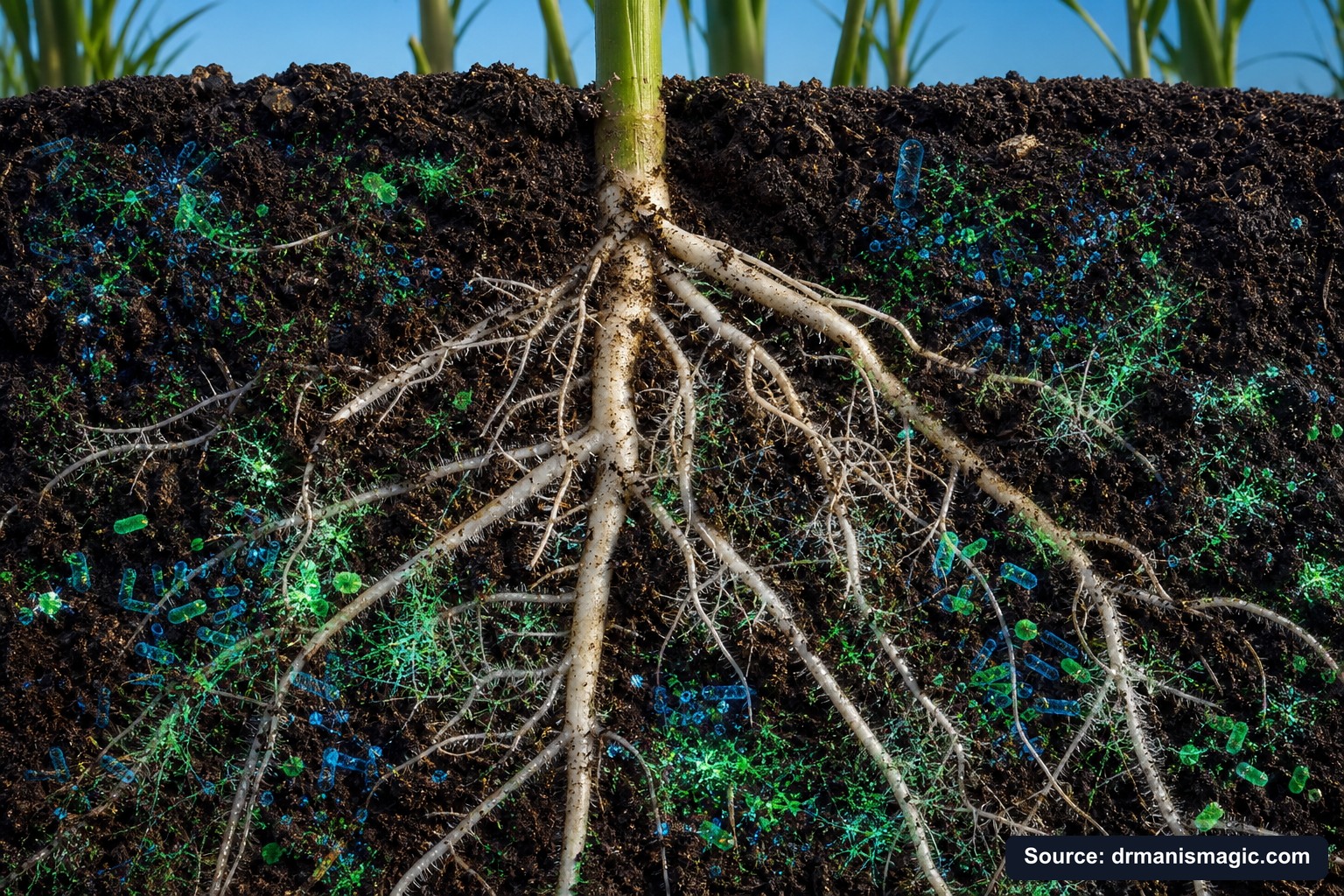
Phytophthora is a water mold pathogen that thrives in wet, oxygen-depleted soil. It attacks feeder roots — the youngest, most active part of the root system. These are the roots doing most of the work. When Phytophthora kills them, the tree loses its ability to absorb water and minerals efficiently. It is like closing most of the valves in a water system. Less gets through.
The tree compensates by pulling resources from other areas. Leaf function drops slightly. Root pressure decreases. The fruit that is developing during this time gets less water, less sugar loading, and fewer minerals. It matures undersized, with low juice content and weak flavor. The Brix drops. The acid balance shifts. You get fruit that is technically ripe but tastes wrong.
What makes this especially frustrating is that you often cannot see it happening. The leaves may look green. The tree may look fine. But underground, the feeder roots are dying. By the time you see yellow leaves or wilting, the root damage has been going on for weeks. The fruit from that season is already compromised.
This is why drainage is not optional. Soil that holds water creates the anaerobic (oxygen-free) conditions that Phytophthora loves. This is also why the mineral-based soil in Pillar One of the Three Plant Pillars matters so much. Soil that drains freely and stays aerated does not give Phytophthora the wet, airless environment it needs to thrive. And a root zone populated with beneficial microbes gives the tree a biological defense system against that pathogen before it ever gets started.
Can Salt-Based Fertilizers Make Citrus Taste Worse?
Quick Answer: Yes. Synthetic fertilizers are salt-based. High salt concentrations in the root zone pull water out of root cells through osmotic pressure, damaging feeder roots and reducing uptake. Salt also kills beneficial microbes that help regulate nutrient delivery. The result is stressed roots, disrupted nutrient balance, and fruit with lower Brix, flattened flavor, and reduced juice content.
This is the part the big fertilizer companies do not want you thinking about. Synthetic fertilizers — the ones in the bright blue bags at every big box store — are made from mineral salts. They dissolve quickly in water and push a burst of nitrogen or other nutrients into the soil. The plant greens up fast. You feel like it is working.
But salt is salt. And high salt concentrations around roots cause osmotic stress. Instead of water flowing into the root, the salt gradient reverses it and water is actually pulled out. The roots struggle. The feeder roots — already the most fragile part of the system — get burned. The beneficial bacteria and fungi that were building your soil food web get wiped out. They cannot survive high-salt environments.
Now the tree is getting its nutrients from a dead, sterile, salt-damaged root zone with no microbial help. It is getting a narrow, imbalanced blast of a few nutrients rather than the complete, steady, biologically mediated nutrition it would get from a living soil. Brix drops. Flavor suffers. And because the microbes are gone, the damage compounds over time. Every application makes the soil a little more dead, a little more dependent on the next synthetic hit.
See also: The Hidden Reason Synthetic Fertilizers Cause Root Rot
See also: How Salt-Based Feeding Quietly Destroys Root Systems
Live Microbes vs. Dead Microbe Products: What Is the Real Difference?
Quick Answer: Live microbial products contain active, functioning organisms that colonize the root zone and start working immediately. Dead or dried products contain inactive microbes that rarely revive and provide little to no benefit. The smell test is one clue: a product that stinks has gone anaerobic, meaning the microbes are dying. A genuinely live product smells earthy and clean.
The microbial product market is crowded right now. Every garden center has shelves full of bottles and bags promising to supercharge your soil. Most of them do nothing. We know this because we spent years testing them at our nursery before developing our own solution.
Here is what is actually happening in most of those products.
The most common type is dried powder. A factory grows specific bacteria or fungi in a vat, then dries them into spores and packages them. The hope is that adding water will reactivate them. In our experience, and after testing dozens of these products on our own trees, they simply do not produce results. The reactivation rate is too low. The organisms that do survive are often weak. And the spectrum of organisms is narrow — a handful of species rather than the thousands of species working together in healthy soil.
The second type is liquid compost tea. This can be excellent if it is fresh and actively aerated. But once it sits for more than 24 hours, the microbes go anaerobic. They start dying and fermenting. The bottle smells like sewage. You might notice it fizzes when you open it. Those are gases from microbial decomposition. Some humic and fulvic acids from the organic base still provide minor benefits, but the living organisms you paid for are mostly gone.
The third type uses lactobacillus bacteria — the same culture in yogurt. Easy to grow, very vigorous. The problem is that lactobacillus dominates and crowds out the beneficial organisms you actually want. It belongs in your gut, not your soil.
| Product Type | Microbe Viability at Use | Spectrum of Organisms | Smell | Results We Observed |
|---|---|---|---|---|
| Dried/powdered lab microbes | Very low — spores rarely reactivate fully | Narrow (a few selected species) | Minimal | No measurable results in our trials |
| Dry microbes rehydrated in liquid | Very low | Narrow | Minimal to none | Same as above — avoid |
| Compost tea (fresh, under 24 hours, aerated) | Moderate | Partial — depends on compost quality | Earthy, then turns sour | Good when fresh; not practical for most growers |
| Compost tea (old, over 24 hours) | Very low — anaerobic | Partial | Strong stench, may fizz | Not recommended |
| Lactobacillus-based products | High — but wrong organisms | Dominated by one species | Mild to sour | Crowds out beneficial organisms — avoid for soil |
| Plant Super Boost (stabilized, full-spectrum) | High — genuinely alive at use | 2,000+ bacteria, 400-500 fungi including mycorrhizae, plus protozoa and nematodes | Earthy and clean — no stench | Visible microbial movement under microscope; consistent results across 250,000+ trees |
What makes Plant Super Boost different is the stabilization process. Dr. Mani partnered with a world-renowned compost expert — someone who had advised royal families and governments on farming practices before being blacklisted by large chemical interests — to develop an all-natural technique that keeps the full spectrum of compost microbes alive without going anaerobic. The product does not stink because it is not rotting. It smells earthy because the microbes inside are alive and stable. You can put a drop under a microscope and watch them move. That is not marketing — we have the lab analyses to prove it.
How Does Root Biology Compare Between a Thriving Tree and a Struggling One?
Quick Answer: A healthy citrus tree has dense, white feeder roots with active mycorrhizal threads extending outward, supported by a thriving microbial community. A struggling tree has brown or rotted feeder roots, depleted microbial populations, and a compressed, oxygen-starved root zone. The difference in fruit quality between these two trees is enormous.
Think of healthy roots as a bustling city. Nutrients flow in from every direction. Microbes work like infrastructure — roads, utilities, communications. The feeder roots are the businesses, actively processing what comes in and sending it up through the tree. Everything is moving, productive, alive.
Now think of a struggling root system as a city after a flood. Roads are blocked. Infrastructure is damaged. Most businesses are closed. A few things still trickle through, but at a fraction of the capacity. The tree is still alive. But it is barely functioning. And the fruit it produces reflects that.
Research on citrus affected by Huanglongbing (HLB), the most destructive citrus disease in the world, shows what happens when feeder roots are severely compromised. In healthy trees, feeder roots live for roughly 9 to 12 months before cycling and being replaced. In HLB-affected trees, University of Florida IFAS research shows feeder root lifespan can collapse to just 1.5 to 4 months. The tree loses uptake capacity dramatically. Fruit quality declines. Brix drops. Juice content falls. The tree looks increasingly stressed. This is what root damage at its most extreme looks like — and it shows exactly why feeder root health is the foundation of fruit flavor.
What Is the Three Plant Pillars Approach and How Does It Fix Root Health?
Quick Answer: The Three Plant Pillars are a system developed and proven at US Citrus Nursery over 30 years and 250,000 trees: Pillar One is mineral-based soil for drainage and oxygen; Pillar Two is live microbials to rebuild soil biology; Pillar Three is organic fertilizer to feed the tree and microbes together without salt damage. Together, they restore root-zone conditions that produce great-tasting fruit.
Dr. Mani Skaria spent four decades as a plant pathologist and Professor Emeritus at the Texas A&M Citrus Center. He is the inventor of the micro-budding technique and the founder of the Clean Citrus Program in Texas. He has seen every kind of root problem that citrus can develop. And after all of that, he landed on a simple truth: when you get the root zone right, everything else follows.
The Three Plant Pillars are the framework he built from that truth.
Pillar One: Mineral-Based Soil. Most potting mixes are made from bark, sawdust, and other organic material that breaks down over time. As it decomposes, it compacts. It loses drainage. It steals oxygen from the root zone. It becomes a slow-motion suffocation. The mineral-based soil in Pillar One is sandy loam from the Rio Grande Valley — silica-rich, inorganic, permanent. It does not compact. It does not decompose and steal oxygen. It drains freely and keeps the root zone aerated, which is the first defense against Phytophthora and root rot.
Pillar Two: Live Microbials. This is the biological reset. When you add genuinely live microbes to the root zone, you are rebuilding the soil food web that synthetic inputs and sterile potting mixes destroyed. Bacteria colonize the root surface and start unlocking minerals. Mycorrhizal fungi extend the root's reach. Protozoa graze and release plant-available nitrogen. The whole system comes alive. Feeder roots get the support they need to function at full capacity — and that function is what builds flavor.
Pillar Three: Organic Fertilizer. The crab, kelp, and amino acids formula used in Pillar Three feeds the tree and the microbes simultaneously. It is slow-release, not salt-based. It does not spike and crash. It does not burn roots. It does not wipe out the biology you just worked to restore. It delivers a complete spectrum of macro and micronutrients in forms the tree can use steadily over time — which is exactly how great flavor chemistry is built.
These three pillars work together. You cannot get full results from just one. Mineral soil without microbes is just clean dirt. Microbes without good drainage will be wiped out by root rot. Organic fertilizer without a living soil to process it is just slow food. Together, they create a self-reinforcing system where the root zone gets better over time, not worse.

What Can You Do Right Now to Improve Your Citrus Flavor?
Quick Answer: Start by diagnosing your flavor symptom, check your drainage and watering habits, eliminate salt-based fertilizers, and begin rebuilding root-zone biology with live microbials and organic nutrition. Recovery takes consistent monthly application — damaged soil biology does not restore overnight, but meaningful improvement can begin within the first 30 days.
You do not have to overhaul everything at once. But you do need to start. Here is a practical recovery checklist you can work through right now.
- Match your flavor symptom to its likely cause. Use the diagnostic table above. Watery fruit, flat fruit, dry fruit, and bitter fruit each point to different root-zone problems. Know what you are dealing with before you do anything else.
- Check your drainage first. Stick your finger two inches into the soil. If it is still wet from watering three days ago, drainage is your immediate problem. Root rot and flavor loss both start here. If you are in a container, make sure the drainage holes are open and unblocked.
- Stop using salt-based synthetic fertilizers. If the bag says "quick release" or the fertilizer is a bright-colored water-soluble powder, it is salt-based. Stop using it now. Flush the soil with clean water to start moving salt out of the root zone. Switch to an organic, slow-release formula.
- Add live microbes to the root zone. Apply a genuinely live, full-spectrum microbial product monthly. This is not a one-time fix. Damaged soil biology takes time to rebuild, and ongoing applications are what sustain the improvement. The organisms you add need to colonize, multiply, and establish — that process takes consistent support.
- Feed with organic nutrition that works with the biology. Slow-release organic fertilizer feeds both the tree and the microbes. It restores the nutrient cycling that makes flavor chemistry possible. Use it on a regular schedule, not in big occasional blasts.
- Be patient with the fruit. The lemons or oranges currently on your tree were built by the root conditions of the past several months. The improvements you make now will show up in the next crop — not this one. That is not a reason to wait. It is a reason to start today.
- Protect the root zone from future damage. Keep herbicides away from the drip line. Avoid heavy tillage that shears root tips. Do not let standing water sit around the base of the tree. Every one of these practices protects the feeder roots and the microbial community you are working to build.
Time is the one thing you cannot get back. The fruit you harvest five years from now is being built in your soil right now. The roots you protect and feed today are the roots that will load sugar, carry water, and deliver aroma compounds into the fruit you will eventually taste. Most people wait until something is visibly wrong before they act. By then, months of flavor have already been lost.
We have spent over 30 years growing citrus in South Texas. We have tested these principles on over 250,000 trees. We have seen bland, struggling trees transform into productive, flavorful ones when the root zone is rebuilt properly. The science is real. The results are real. And the system is simpler than most people expect.
If you want to start rebuilding your root-zone biology with genuinely live, full-spectrum microbes that smell earthy instead of rotten — microbes you can see moving under a microscope — explore our Plant Super Boost and the complete Three Plant Pillars system. Your roots are doing the work. Give them the workforce they need.
For the complete step-by-step care guide developed from our nursery experience, visit the Free Plant Care Field Guide — no guesswork, no jargon, just what works.
Frequently Asked Questions
Your citrus tree's flavor starts underground, not on the branch. After growing over 250,000 citrus trees in South Texas, Dr. Mani learned that roots control everything from sweetness to juice content to aroma. These are the questions we hear most from growers who want better-tasting fruit.
Why does my homegrown citrus taste flat and barely juicy?
Flat, watery citrus almost always points to a root-zone problem. When feeder roots are choked by compacted soil, burned by salt-based fertilizers, or starved of oxygen, the tree cannot pull in the minerals it needs to build sugar and aroma. The fruit forms, but it has nothing good inside it. Fix the root zone first and the flavor follows. That is exactly what the Three Plant Pillars were designed to do.
How do healthy roots change citrus flavor?
Healthy roots act like a high-powered intake system. They pull in water, minerals, and trace elements that the tree converts into sugars, citric acid, and the aromatic compounds that make citrus smell and taste alive. When roots are strong and surrounded by live microbes, the tree maintains the right balance of sweetness to acidity. That balance is called the Brix-to-acid ratio, and it is what separates a fruit that makes your mouth water from one that tastes like nothing.
Do coffee grounds help citrus trees?
Used coffee grounds can give citrus a small nitrogen boost and slightly lower soil pH, which helps feeder roots absorb iron. But coffee grounds alone are not a system. They do not fix compacted soil, they do not add live microbes, and they do not deliver the full spectrum of nutrients your tree needs. Think of them as a minor helper, not a solution. For real root-zone health, you need mineral-based soil, live microbes, and organic fertilizer working together.
How do I fix root rot in my citrus tree?
Root rot usually comes from two things: soil that holds too much water and no live biology to fight off the pathogens that move in. First, get your tree into a mineral-based soil that drains fast and never compacts. Second, introduce live beneficial microbes that wage war on the disease organisms causing the rot. Third, stop using synthetic fertilizers that kill the very microbes trying to protect your roots. Catch it early and your tree can fully recover.
Why does my citrus taste bitter instead of sweet?
Bitterness in citrus fruit is often a sign that the tree is stressed. Salt buildup from synthetic fertilizers disrupts the nutrient balance in the root zone. The tree cannot regulate its acid production properly, and bitter compounds take over. Switching to a slow-release organic fertilizer made from crab, kelp, and amino acids stops the salt damage and lets the tree build natural sweetness the way it was designed to.
What kills the good microbes in my garden soil?
Synthetic, salt-based fertilizers are the number one killer of beneficial soil microbes. They burn the microscopic bacteria and fungi that your roots depend on to unlock nutrients and fight disease. Most store-bought potting mixes also break down into a dense sludge that suffocates microbial life. Once the microbes are gone, your soil becomes a dead growing medium. Rebuilding with live microbes like Plant Super Boost restores the underground ecosystem your citrus needs to thrive.
How long does it take to see better citrus flavor after fixing the root zone?
Most growers using the Three Plant Pillars notice visible improvement in their trees within the first 30 days. Stronger new growth, greener leaves, and better fruit set are usually the first signs. Full flavor improvement in the fruit takes one to two fruiting cycles because the tree needs time to rebuild its internal chemistry from the root up. The good news is that once the root zone is healthy, the results keep getting better season after season.
About the Author
Dr. Mani Skaria, PhD
Dr. Mani Skaria, PhD, is a plant pathologist and the scientific founder of Dr. Mani's Magic. He earned his doctorate at Purdue University and spent 48 years studying how plants, soil, and living microbes work together, including his years as Professor Emeritus at Texas A&M and as a member of the USDA NAREEE Advisory Board. He invented micro-budding, a method for growing healthier, stronger trees, and has grown more than 250,000 trees on the family farm in Hargill, Texas - US Citrus Nursery. His life's work takes real lab science and practical experience and turns it into simple, safe, organic plant care anyone can use at home.


