


How Forever Chemicals Enter Gardens Through Inputs Like Biosolids | Dr. Mani's Magic
How Forever Chemicals Enter Gardens Through Inputs: The Truth About Biosolids, Compost, Manure, and What to Use Instead
You're kneeling in your raised bed on a Saturday morning. Coffee's still warm on the patio table. You just sprinkled in that bag of "all-natural organic fertilizer" you grabbed at the garden center. It smells earthy. The label says it's safe for vegetables. You feel good about this choice.
But here's what nobody told you at checkout. Some of the most popular "organic" and "natural" fertilizers on the market today are made from treated municipal sewage waste. That waste carries something called PFAS. PFAS stands for per- and polyfluoroalkyl substances. Scientists call them "forever chemicals" because they don't break down. Not in soil. Not in water. Not in your body. They just accumulate. And right now, they may be sitting in your garden, your raised beds, your lawn, and possibly working their way toward your vegetables, your groundwater, and your family.
This is not a scare story. It's a wake-up call. Because once you understand exactly how these chemicals enter your garden through the inputs you buy, you can make smarter choices starting today. And the good news is, there are clean alternatives that actually build healthier soil at the same time. Let's walk through all of it together.

Organic Fertilizer | Crab, Kelp & Amino Acids
Key Takeaways
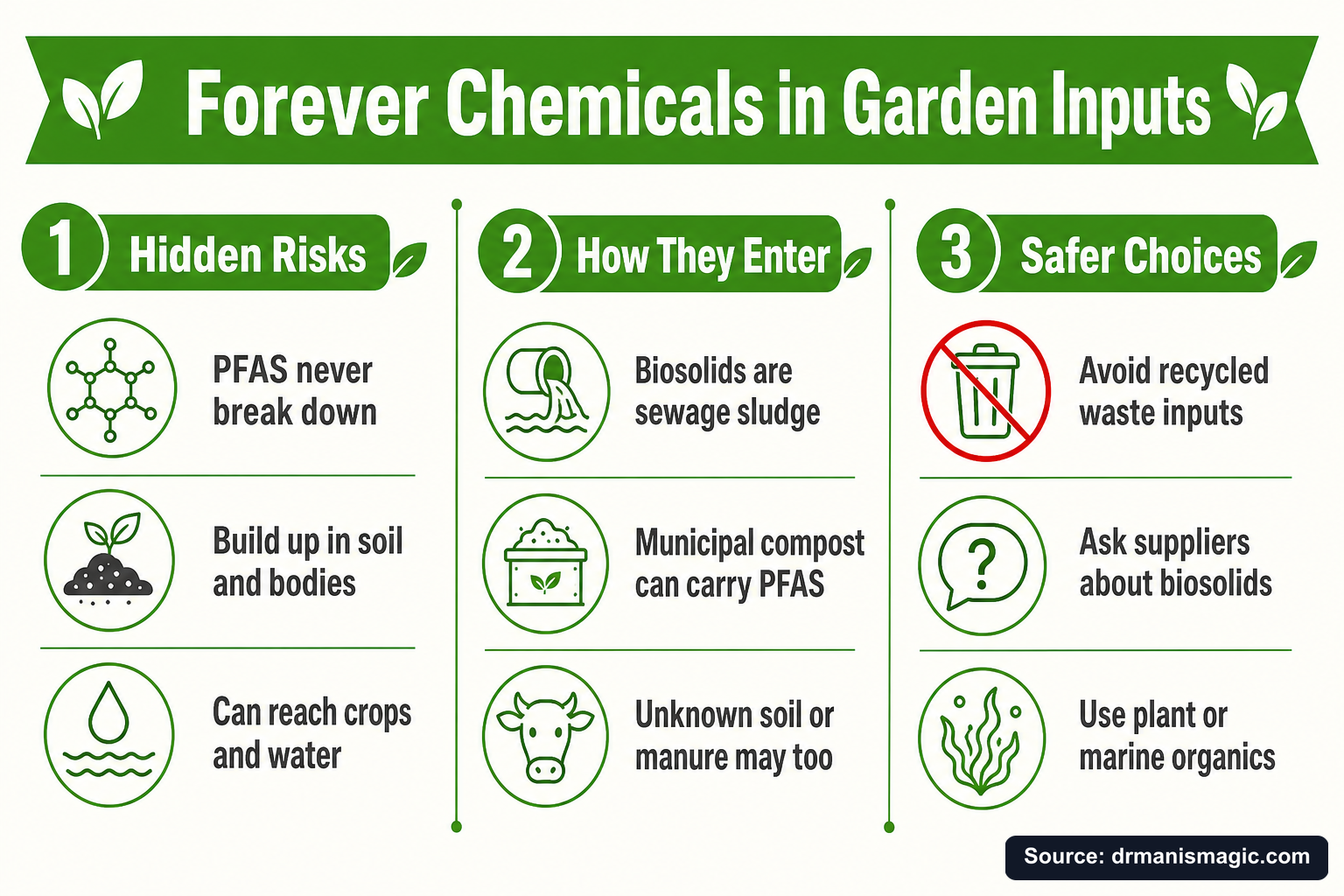
- PFAS "forever chemicals" enter gardens most often through biosolids-based fertilizers, municipal compost, unknown bulk topsoil, and contaminated manure.
- Biosolids are treated sewage sludge. They are legally sold as fertilizer and compost in the USA. Many popular garden products contain them without clearly saying so on the label.
- PFAS do not break down in soil or water. They accumulate over time and can move into plant tissue, groundwater, and food crops.
- Label terms like "Class A biosolids," "heat-dried microbes," "municipal compost," "recycled organics," and "Exceptional Quality (EQ)" can all indicate biosolids-based products.
- Sandy soils with low organic matter allow PFAS to move more quickly toward groundwater, while high-organic-matter soils may hold PFAS longer in the root zone.
- Clean, plant-based or marine-sourced organic inputs (like crab, kelp, and amino acids) carry far lower PFAS risk than recycled-waste inputs.
- After growing more than 250,000 trees at our South Texas nursery, we built a fertilizer with zero biosludge, zero PFAS, and zero synthetic salts — because the inputs you choose define the health of everything above ground.
What Are PFAS and Why Does Your Garden Need to Know About Them?
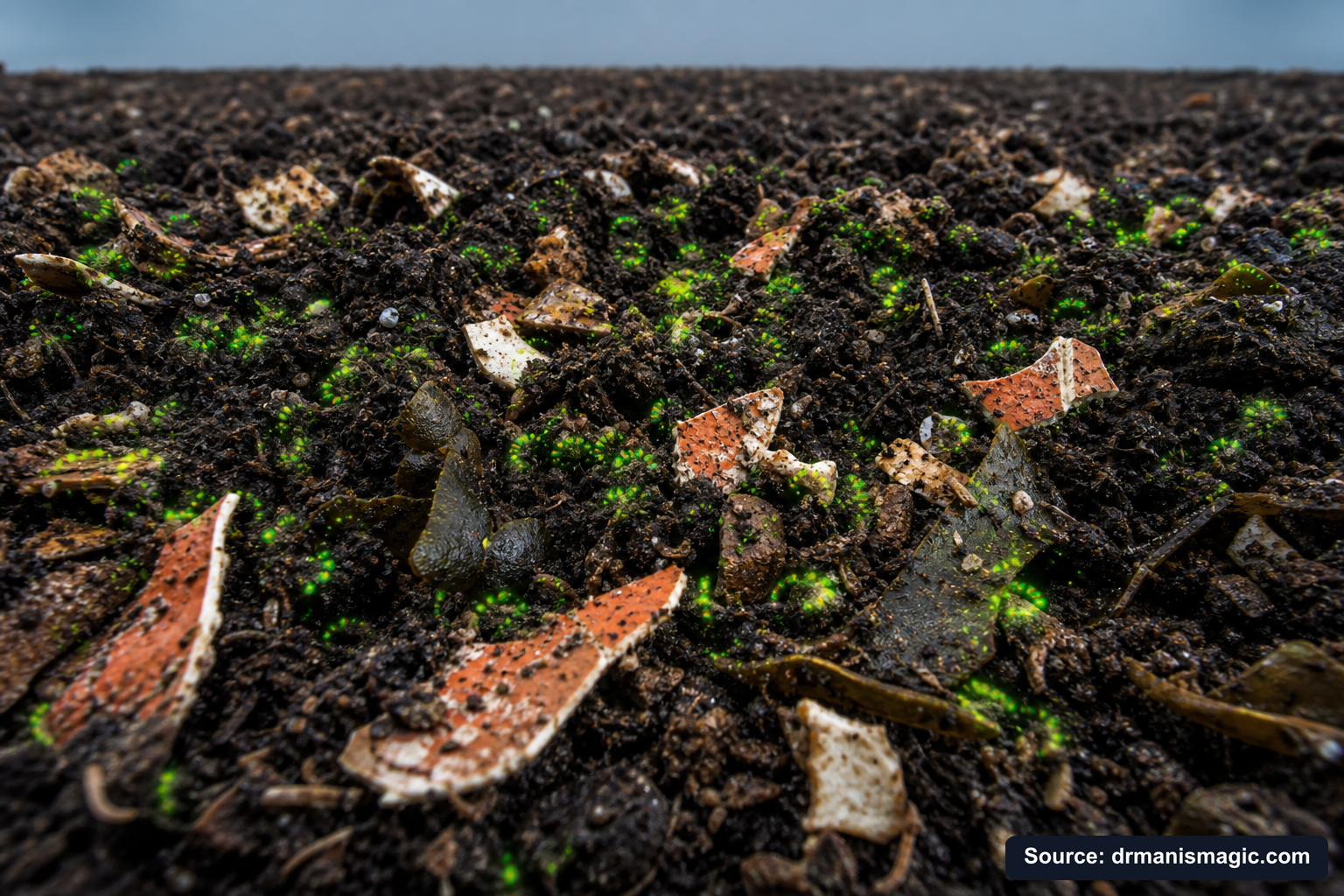
Quick Answer: PFAS are man-made chemicals used in nonstick pans, food packaging, firefighting foam, and hundreds of industrial products. They never fully break down in the environment. When they enter soil through contaminated fertilizers, compost, or water, they can persist for decades and move into crops, groundwater, and human bodies.
PFAS stands for per- and polyfluoroalkyl substances. There are thousands of them. What they share is a carbon-fluorine bond that is one of the strongest bonds in chemistry. Nothing in nature breaks it easily. Not soil bacteria. Not sunlight. Not rain. Not composting heat.
These chemicals were invented to make things slippery, waterproof, or heat-resistant. They show up in fast-food wrappers, pizza boxes, raincoats, carpet treatments, firefighting foam, and industrial manufacturing.
Here is the problem. When these products get used, washed, or thrown away, the PFAS end up in wastewater. That wastewater flows to treatment plants. Treatment plants clean the water, but PFAS are so stable that they concentrate into the solid material left behind. That solid material is called sewage sludge. And sewage sludge gets turned into fertilizer and sold to gardeners.
The University of Maine Extension has specifically flagged sludge-based compost and fertilizer as a top garden-input risk for PFAS contamination. Penn State Extension research shows that in sandy, well-drained soils, PFAS can move quickly downward toward groundwater. In high-organic-matter soils, they may bind to soil particles longer, but that just means they accumulate and build up in the root zone where plants are growing.
Either way, the result is not good. And the scariest part? You may not even know your fertilizer contains any of this.
How Do Biosolids Get Into Garden Fertilizers and Composts?
Quick Answer: Biosolids are the solid material left over after wastewater treatment. The EPA allows them to be processed and sold as fertilizer. They contain real nutrients, which is why they are used. But they also concentrate PFAS and other industrial chemicals from the waste stream. Many popular bagged fertilizers and composts contain biosolids under legal but confusing label terms.
Here is the path, step by step.
Everything that goes down the drain in your city — soap, chemicals from factories, PFAS from food packaging, pharmaceuticals, industrial runoff — flows to a wastewater treatment plant. The plant separates liquid from solid. The liquid gets cleaned and released. The solid material — the sludge — gets processed further.
That sludge is rich in nitrogen, phosphorus, and organic matter. So it has real fertilizer value. The EPA created a classification system to regulate it. "Class A" biosolids have been treated to reduce pathogens. "Exceptional Quality" or EQ biosolids meet the highest EPA standards for pathogen and heavy-metal levels. These can be legally sold directly to homeowners with minimal labeling requirements.
The problem is that EPA regulations for biosolids were written before PFAS were widely understood. The current legal standards do not set PFAS limits. So a product can be "Class A" or "Exceptional Quality" and still carry significant PFAS loads. The label says safe. The chemistry tells a different story.
These biosolids-based products end up in:
- Bagged fertilizers at garden centers and big-box stores
- Municipal compost programs offered by cities and counties
- Bulk topsoil blends sold by landscaping suppliers
- Golf course and athletic field soil amendments
- Some bagged "compost" products on nursery shelves
After more than 30 years growing trees in South Texas and testing hundreds of inputs across our nursery, we learned this the hard way. The system is not designed to protect your garden. It's designed to dispose of a waste product legally while calling it a benefit. That's the gentle villain hiding in plain sight in the fertilizer aisle.
How Do You Read a Label to Spot Biosolids?
Quick Answer: Biosolids rarely appear on labels with that exact word. Look for terms like "Class A biosolids," "Exceptional Quality" or "EQ," "heat-dried microbes," "municipal compost," "recycled organics," "processed sewage sludge," or "organic nitrogen from municipal waste." If the label lists "biosolids" anywhere in the ingredient list, that is sewage sludge.
This is where it gets tricky. And this is where most gardeners get fooled.
The terms below are legal language used on product labels. Some are straightforward. Others are designed to sound clean and natural when they are not.
| Label Term | What It Actually Means | PFAS Risk Level |
|---|---|---|
| Biosolids | Treated sewage sludge | High |
| Sewage sludge | Untreated or minimally treated sludge | High |
| Class A biosolids | Pathogen-reduced sewage sludge; legal for consumer sale | High (no PFAS standard) |
| Exceptional Quality (EQ) | Highest EPA-tier biosolids; still may contain PFAS | Moderate to High |
| Heat-dried microbes | Often a biosolids product; the "microbes" are dead sludge matter | Moderate to High |
| Municipal compost | May or may not include biosolids; source-dependent | Moderate (ask supplier) |
| Recycled organics | Vague term; can include sludge-sourced materials | Moderate (ask supplier) |
| Organic nitrogen | Could be plant-based or sludge-based; source not specified | Unknown without documentation |
| Soil conditioner | Broad term; sometimes biosolids-based | Unknown without documentation |
| Feather meal, crab meal, kelp | Plant or marine animal-sourced organic nitrogen | Low |
| Plant-based compost, leaf mold, arborist chips | Vegetative organic matter only | Very Low |
The safest move is to ask your supplier directly: "Does this product contain biosolids, sewage sludge, or municipal waste?" If they cannot answer, or if the answer is vague, treat it as a risk.
What Is the Garden Input PFAS Risk Ladder?
Quick Answer: Not all inputs carry the same PFAS risk. Biosolids-based fertilizers and municipal compost with sludge are highest risk. Plant-only composts, leaf mold, arborist wood chips, and tested marine or plant-sourced organic fertilizers carry the lowest risk. Knowing where each input falls helps you make better choices for edible gardens, lawns, raised beds, and trees.
Think of it like a ladder. The top rungs carry the most risk. The bottom rungs are where you want to be.
| Risk Level | Input Type | Why It Carries This Risk |
|---|---|---|
| Highest | Biosolids/sewage sludge fertilizers | Directly concentrated from wastewater treatment; PFAS accumulate in sludge fraction |
| Very High | Municipal compost containing biosolids | City composting programs often blend sludge into compost; source is mixed |
| High | Unknown bulk topsoil | May have been sourced from land previously amended with biosolids |
| Moderate to High | Manure from impacted farms | Animals drinking contaminated water or eating contaminated feed pass PFAS into manure |
| Moderate | Recycled irrigation water | Treated wastewater used for irrigation can carry low levels of PFAS |
| Low to Moderate | Paper or cardboard-heavy compost | PFAS used in paper coatings can leach during composting |
| Low | Conventional compost (verified plant-only feedstocks) | Lower risk if source is verified; ask for feedstock documentation |
| Very Low | Leaf mold, arborist wood chips | Pure vegetative material; very low exposure pathway |
| Very Low | Tested mineral amendments | Naturally occurring minerals; no industrial waste pathway |
| Very Low | Marine/plant-sourced organic fertilizers (crab, kelp, amino acids) | Clean feedstocks; no sludge or municipal waste; verifiable sourcing |
Your edible garden deserves to be at the bottom of this ladder. Every single time.
Can PFAS Actually Get Into Vegetables, Fruit Trees, and Groundwater?
Quick Answer: Yes. Research shows plants can absorb PFAS through their root systems. Leafy greens and root vegetables absorb the most. Fruit trees absorb lower amounts, but in heavily contaminated soils, PFAS have been found in fruit tissue. PFAS also leach downward into groundwater, especially in sandy soils with low organic matter, as documented by Penn State Extension researchers.
This is the part that matters most if you grow food.
Plants take up water and dissolved nutrients through their roots. PFAS dissolved in soil water can hitch a ride. Research from multiple university extension programs shows that leafy greens like lettuce, spinach, and kale absorb the most PFAS because they are mostly leaf tissue with high water content. Root vegetables like carrots and radishes are also high-risk because they grow directly in contact with soil.
Fruit trees are somewhat lower risk because the PFAS concentration tends to decrease as it moves up through woody tissue toward the fruit. But "lower risk" does not mean "no risk." In soils with high PFAS loads from repeated biosolids applications, measurable PFAS have been found in fruit.
And then there is the groundwater question. Penn State Extension notes that sandy, low-organic-carbon, well-drained soils allow PFAS to move more quickly downward. If you have a well, and your soil is sandy, and you have been using biosolids-based fertilizer for years, this is worth testing.
The good news is that soil with high organic matter can bind PFAS and slow their movement. This is one more reason why building genuine soil biology with real organic matter — not sludge-based "organic matter" — matters so much. See also: The Hidden Reason Synthetic Fertilizers Cause Root Rot for more on how soil biology protects your entire root zone.
What Other Hidden Input Pathways Damage Gardens Beyond PFAS?
Quick Answer: PFAS are one of three major hidden input damage pathways. The other two are salt injury from synthetic fertilizers and oxygen stress from decomposing organic potting mixes. Salt burns roots and kills beneficial soil microbes. Decomposing bark and wood in cheap potting mix compress over time and suffocate roots. All three pathways can happen at once without obvious symptoms until it's too late.
Here is something most gardening content never connects. The same inputs you are warned about for PFAS often carry a second hidden problem: salt.
Synthetic fertilizers are salt-based. When you pour them on your soil, they dissolve into a salty solution. That salty solution pulls water out of root cells through a process called osmotic stress. The roots try to absorb water, but the salt concentration outside the root is higher than inside, so water actually moves the wrong direction. The roots dry out from the inside. Scientists call this physiological drought. Your plant looks like it needs water even when the soil is wet.
Meanwhile, that same salt is burning the beneficial bacteria and fungi living in your soil. These microbes are not optional. They are the invisible workforce that unlocks nutrients, protects roots from pathogens like Pythium and Phytophthora, and builds the soil structure your plants live in. Kill them, and your soil becomes dead dirt. Dead dirt grows weak plants that need more and more chemical inputs just to stay alive.
The third pathway is physical. Most bagged potting mixes are made from pine bark and wood byproducts. They feel fluffy at first. But over six to twelve months they decompose. As they break down they compact, steal oxygen from root zones, and create the soggy, airless conditions where root rot thrives. Pythium and Phytophthora, the two most common root rot pathogens, love exactly this environment.
So the full picture of "hidden input damage" looks like this:
- PFAS from biosolids-based inputs accumulate in soil and potentially move into plants and water
- Salt from synthetic fertilizers burns roots and kills soil microbes
- Decomposing organic potting mixes collapse, remove oxygen, and invite root rot pathogens
These three problems are usually treated as separate issues in gardening content. They're not. They are connected. And they often hit your garden at the same time.
For a deep look at the salt side of this equation, see also: Why Most Fertilizers Are Actually Salt in Disguise.
You Never Had a Brown Thumb.
You were handed the wrong tools. This free guide hands you the right ones.
You watered it. You fed it. It died anyway.
It was never you. It was the dirt, the salt food, and the bad advice.
This guide shows you what really went wrong, and how to fix it for good.
- Why your plants really died, and why it was never your fault
- The salt hiding in your plant food that quietly burns the roots
- The hidden killer in almost every bag of store soil
- The tiny helpers that grow a whole forest for free
- The rescue trick that brings a half dead plant back to life

Synthetic Fertilizer vs. Organic Slow-Release vs. Clean Marine-Sourced Inputs: Which Actually Feeds Your Soil?
Quick Answer: Synthetic fertilizers deliver nutrients fast but as salt, which burns roots and kills microbes. Standard slow-release synthetics use plastic coatings that leach into soil. Organic fertilizers from clean plant or marine sources feed soil microbes first, then the plant. The microbes process the nutrients and release them slowly and steadily, the way nature intended. No salt spike, no microbial massacre, no PFAS.
Let's put them side by side so you can see exactly what you're choosing between.
| Feature | Synthetic Fast-Release | Synthetic Slow-Release (Coated) | Clean Organic (Crab, Kelp, Amino Acids) |
|---|---|---|---|
| Nutrient release speed | Immediate, large spike | Slow, but from plastic shell | Slow, microbe-mediated, natural pace |
| Salt content | High (salt-based chemistry) | High inside the coating | Very low — protein-based, not salt |
| Effect on soil microbes | Burns and kills beneficial bacteria and fungi | Damages microbes when coating breaks | Feeds and supports microbial life |
| Root safety | Risk of osmotic stress and root burn | Lower burn risk initially, then spike risk | Gentle — roots self-regulate uptake |
| PFAS / biosolids risk | Variable; some synthetic products use biosludge fillers | Plastic coating residue in soil | Zero — clean marine and plant feedstocks |
| Long-term soil health | Degrades soil biology over time | Leaves microplastic residue | Builds soil biology over time |
| Works with live microbes | No — kills them | Partially — spike still damages | Yes — designed to work together |
| Smell | Chemical or neutral | Chemical or neutral | Earthy — no rotting or sewage odor |
Here is the mechanism that most fertilizer companies never explain. When you apply a clean organic fertilizer made from crab shells, kelp, and amino acids, the microbes in your soil eat it first. They process those nutrients and convert them into forms the plant roots can absorb easily. Then when those microbes die, they release everything they were holding directly into the root zone. It's a natural, continuous, slow-release system. The plant gets fed long after you applied the fertilizer. And the soil gets richer with every cycle.
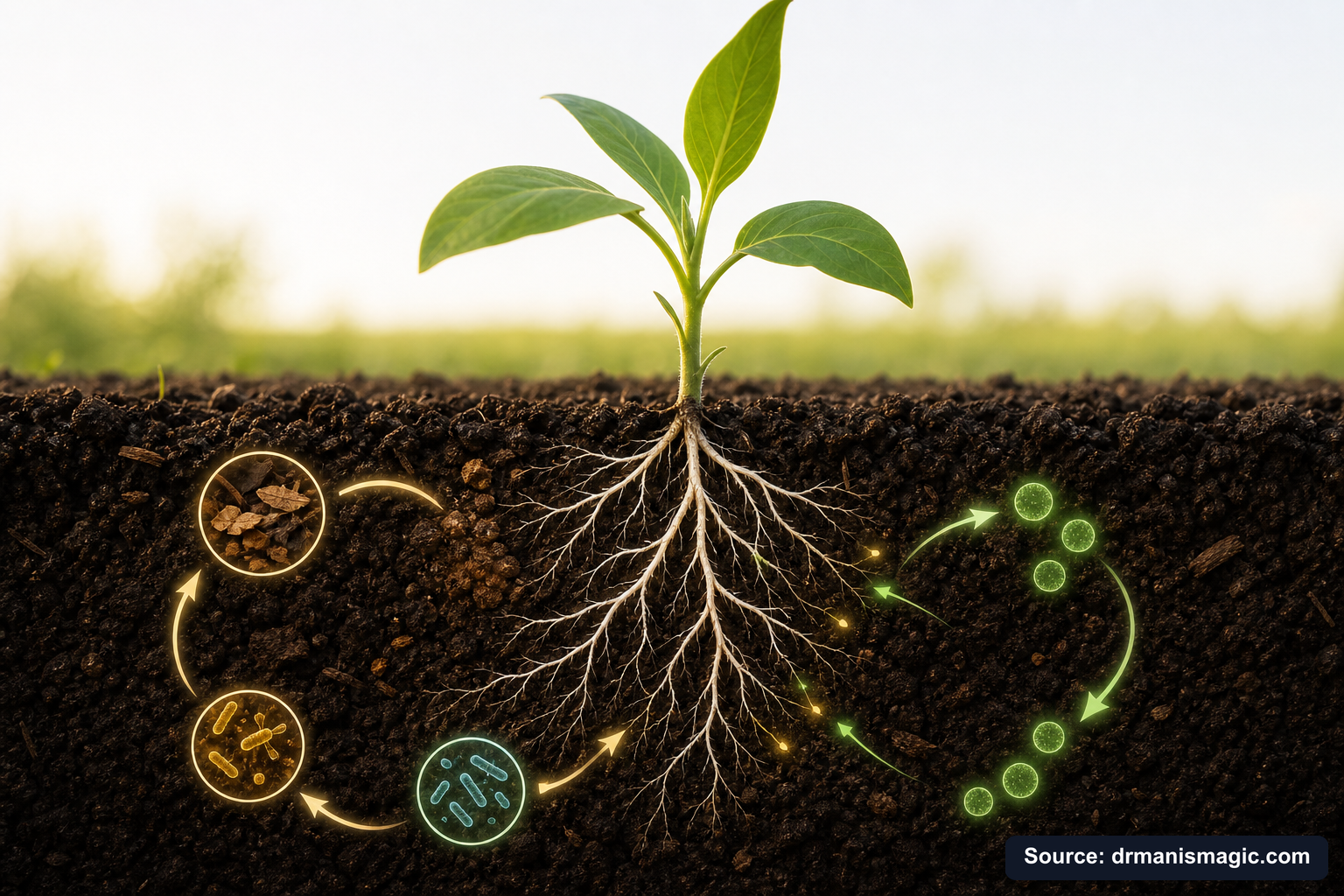
Synthetic fertilizers skip all of that. They dump a salt spike directly into the root zone. The plant gets a rush of nutrients it may not need. The salt burns the fine root hairs that do most of the absorbing. The microbes that would have done all that slow, steady, beneficial work are gone. And in a few weeks, you need to apply more fertilizer because the soil cannot sustain the plant on its own.
That cycle is exactly what the big chemical companies profit from. More product sold, less soil health built. Every season. For decades.
Why Does Chitin From Crab Shells Matter in Your Garden?
Quick Answer: Chitin is the structural material in crab and shrimp shells. When it breaks down in soil, it stimulates a specific group of beneficial soil bacteria called chitinase-producers. These bacteria also happen to attack the outer shells of harmful nematodes and fungal pathogens. Chitin essentially activates your soil's natural immune system against common garden diseases.
Crab shells are not just a nitrogen source. They do something special that most gardeners have never heard of.
When chitin from crab shells enters your soil, certain beneficial bacteria get excited. They produce an enzyme called chitinase to break it down. That enzyme is the same one that degrades the outer coating of root-knot nematodes and harmful soil fungi. So by feeding your soil chitin, you are essentially hiring a biological defense team that protects your roots while simultaneously releasing nitrogen and calcium.
Chitin also delivers calcium and magnesium directly. Calcium is the primary structural mineral in plant cell walls. A large portion of the woody mass of any plant — your fruit trees, your shrubs, your vegetable stems — is built from calcium. Without enough calcium, cell walls are weak. Fruit cracks. Stems bend. Disease gets in easily.
This is why crab meal is not just an ingredient. It is a multi-function tool that delivers nitrogen, unlocks biological disease resistance, and strengthens plant structure all at once. Clean, no sludge, no PFAS, no synthetic salts.
What Does Kelp Actually Do for Plants and Soil?
Quick Answer: Kelp delivers natural plant hormones called auxins and cytokinins, along with carbohydrates and dozens of trace minerals. These hormones signal roots to grow faster and deeper, help plants manage heat and drought stress, and stimulate flowering and fruit set. Cold-processed kelp retains more of these active compounds than heat-processed forms.
Kelp is not just seaweed. It is one of the most nutrient-dense organisms on the planet.
The ocean is full of minerals. Kelp absorbs them all and concentrates them into its tissue. When you apply cold-processed kelp to your soil, you are delivering trace minerals that most fertilizers completely ignore — iodine, selenium, vanadium, and dozens more that plants use in tiny amounts for enzyme activation and stress response.
But the real power of kelp is its hormones. Auxins and cytokinins are natural growth signals. Auxins tell roots to elongate and explore. Cytokinins tell the plant to divide cells and push new growth. When you apply kelp, you are essentially whispering to your plant in its own biological language: grow deeper, grow stronger, set more flowers, hold more fruit.
Kelp also contains carbohydrates that feed soil microbes directly. So it serves double duty — it feeds the plant through hormonal signaling, and it feeds the microbial community that feeds the plant through nutrient cycling. That is a layered system of support that no synthetic fertilizer can replicate.
What Role Do Amino Acids Play as a Nitrogen Source?
Quick Answer: Amino acids are the building blocks of proteins. As a nitrogen source, they are already broken down into small units that plant roots and soil microbes can absorb quickly and efficiently. Unlike salt-based nitrogen, amino acid nitrogen does not raise salt concentration in the soil. It supports microbial growth and helps plants synthesize their own enzymes, chlorophyll, and structural proteins.
Nitrogen is the nutrient plants need most. It drives leaf growth, powers photosynthesis, and builds every protein in the plant's body.
But not all nitrogen is the same. Salt-based synthetic nitrogen comes as a highly soluble salt. It spikes into the root zone fast and hard. The plant gets a quick jolt of green growth. But the salt that came with it damages the fine root hairs, raises soil electrical conductivity (the measure of salt load), and kills the microbes that would have been cycling nutrients slowly and safely.
Amino acid nitrogen is different. Amino acids are already partially broken down. They are one step away from being immediately usable. Plant roots can absorb them directly. Microbes can process them even faster than they can process whole proteins. There is no salt spike. There is no burn. There is just a clean, steady stream of nitrogen that the plant and its microbial partners share and use together.
This is the natural rhythm plants evolved with. Lightning fixes nitrogen from the atmosphere. Bacteria in the soil convert it into ammonia and nitrate. The plant feeds the bacteria sugar in exchange. Everyone wins. No salt. No burning. No dead microbes. Just a living system cycling nutrients the way it has for millions of years.
The Crab, Kelp & Amino Acids formula was built around this exact principle — clean protein-based nitrogen that works with your soil's biology, not against it, with zero biosludge, zero PFAS, and zero synthetic salts. It's the same formula we developed to feed over 250,000 citrus trees at our South Texas nursery, and it works just as well on lawns, roses, vegetable gardens, houseplants, and fruit trees of every kind.
How Does the Three Plant Pillars Framework Protect Against All Three Hidden Input Damage Pathways?
Quick Answer: The Three Plant Pillars — mineral-based soil, live microbials, and clean organic fertilizer — directly address all three hidden damage pathways at once. Mineral soil prevents oxygen loss and root rot. Live microbes rebuild soil biology and protect roots. Clean organic fertilizer feeds the system without salt, sludge, or PFAS. Together they create a self-sustaining root zone that protects itself.
After more than 30 years growing plants in South Texas, Dr. Mani Skaria — Professor Emeritus of Plant Pathology, inventor of micro-budding, and founder of the Clean Citrus Program in Texas — identified the three things that every plant on earth needs to thrive. Not just citrus. Every plant.
He called them the Three Plant Pillars.
Pillar One: Mineral-Based Soil. Most potting mixes are made from pine bark and wood byproducts. They decompose. As they break down, they compact and steal oxygen from roots. Roots need oxygen. They literally breathe. When oxygen disappears from the root zone, beneficial aerobic microbes die and anaerobic pathogens like Pythium and Phytophthora take over. That is root rot. The solution is mineral-based soil that does not decompose — silica-rich sandy loam that holds its structure permanently, drains freely, and keeps roots breathing.
Pillar Two: Live Microbials. The beneficial bacteria, fungi, and mycorrhizae in healthy soil are your plant's immune system, nutrient-delivery network, and structural support crew all at once. Salt kills them. Biosolids-based inputs disrupt them with heavy metals and persistent chemicals. Without them, your plant is defenseless. With them, it is nearly bulletproof. Live microbials unlock bound nutrients, defend against pathogens, and build the soil structure that makes everything else work better.
Pillar Three: Clean Organic Fertilizer. This is where the nutrition comes in — but in a form that works with the microbes, not against them. Slow-release, protein-based, marine-sourced nutrition from crab, kelp, and amino acids. No salt spike. No PFAS. No sludge. Just a continuous, gentle supply of everything the plant needs, delivered at the pace nature prefers.
When all three pillars are in place, something remarkable happens. The soil becomes a living system that feeds itself. You water. You fertilize gently. And the biology does the rest. Roots grow deep. Leaves stay green. Fruit sets. Flowers bloom. Season after season.
Learn more about building this foundation in our Free Plant Care Field Guide.
What Is a Safe Input Recovery Plan if You Have Been Using Biosolids-Based Products?
Quick Answer: If you suspect your garden has been exposed to biosolids-based inputs, you cannot undo past exposure overnight. But you can stop adding PFAS, start building soil biology, and shift to clean inputs going forward. Recovery is about rebuilding the living soil system that filters, binds, and processes contaminants more effectively than dead, salt-damaged dirt.
Do not panic. But do take action. Here is a practical recovery checklist.
- Stop the input. Identify any fertilizers, composts, or soil amendments in your current program that may contain biosolids. Read labels. Ask suppliers. If you cannot verify the feedstock, stop using it.
- Test your soil. Contact your local university extension service for soil testing guidance. Some extension labs now offer PFAS screening. At minimum, test for electrical conductivity (salt load), pH, and major nutrients. High EC readings indicate salt damage alongside any PFAS concern.
- Switch to verified clean inputs only. Move to marine-based or plant-based organic fertilizers with documented feedstock sourcing. Ask for a Certificate of Analysis or feedstock declaration before purchasing any compost or soil amendment.
- Rebuild soil biology. Introduce live beneficial bacteria, fungi, and mycorrhizae. A living microbial community improves the soil's capacity to bind, process, and immobilize contaminants over time. Dead soil cannot do this.
- Improve soil structure. If you are growing in containers, consider whether your current potting mix is decomposing and compacting. Switch to a mineral-based, permanent soil structure that maintains drainage and oxygen flow to roots.
- Use raised beds with verified clean soil for edibles. If you grow food in-ground in a PFAS-suspect area, raised beds with sourced, verified clean growing media provide the most reliable protection for edible crops.
- Be patient and consistent. Soil recovery is not a one-week fix. But every clean input you add and every healthy microbial colony you establish moves your garden further away from the damage and closer to a living, resilient system.
You cannot get time back. That's the hardest truth in gardening. The years you spent unknowingly adding contaminated inputs cannot be undone. But every season from today forward is a choice. And the right choice, made consistently, compounds. The plants you grow next year will be healthier than this year's. The ones you grow in three years will be stronger still. That's what building on the right foundation does. It doesn't just fix one problem. It prevents the next ten.
Does Your Irrigation Water Carry Forever Chemicals Too?
Quick Answer: Yes, in some areas. Irrigation water sourced from contaminated groundwater wells or treated wastewater (recycled water programs) can carry PFAS. The risk is generally lower than biosolids-based fertilizers but is real in areas near industrial sites, military bases, airports, or communities that have historically used biosolids for land application.
Most gardeners never think about what is in their water beyond pH and hardness. But in certain parts of the country, the water itself is a PFAS pathway.
Areas near manufacturing facilities that produced PFAS compounds, military bases that used AFFF firefighting foam, airports, and communities with long histories of land-applied biosolids may have groundwater that carries measurable PFAS. If you irrigate from a private well in one of these areas, testing your water is worth doing.
Municipal tap water in most US cities goes through treatment that reduces but does not eliminate PFAS. The EPA has recently set enforceable maximum contaminant levels for six PFAS compounds in drinking water, which will push water utilities to improve treatment. But this is a new and evolving standard.
For most home gardeners using municipal water or well water in low-risk areas, irrigation water is a lower concern than fertilizer and compost inputs. Focus on the inputs first. But if you are in a known contamination zone, water testing is a smart next step. Your local university extension service can point you to state-certified labs that test for PFAS in water.
What Questions Should You Ask Before Buying Any Compost, Fertilizer, Topsoil, or Soil Blend?
Quick Answer: Ask whether the product contains biosolids, sewage sludge, municipal waste, manure, industrial residuals, or food packaging material. Request documentation of PFAS testing, electrical conductivity, pH, heavy metals, and feedstock sourcing. If the seller cannot provide this information, that is your answer.
You are the last line of defense between your garden and inputs that carry hidden damage. Here is your buyer's checklist.
- Does this product contain biosolids, sewage sludge, or any municipal waste material?
- What are the exact feedstocks used in this compost or fertilizer?
- Has this product been tested for PFAS? Can you provide results?
- What is the electrical conductivity (EC) and salt index of this product?
- Has the source soil or compost feedstock ever been amended with biosolids?
- Does this product contain manure? If so, from what farm and what is that farm's water and feed source history?
- Is there a Certificate of Analysis available that I can review before purchase?
A reputable supplier will welcome these questions. A supplier who cannot answer them is telling you something important with that silence.
At our nursery, we built our own fertilizer line because we could not find commercial inputs we trusted completely. We knew exactly what our trees needed. We knew what they could not tolerate. And we knew that the inputs available on the open market were not designed with the long-term health of the plant or the garden in mind. They were designed to move product. There is a difference. And after 250,000 trees, you can feel that difference in the roots.
A Warm Closing: Your Garden Deserves Clean Inputs and a Living Foundation
You started this article in your raised bed on a Saturday morning, feeling good about a choice that turned out to be more complicated than you knew. That's not your fault. The system was not designed to make this easy. Labels are confusing by design. Terms like "Class A" and "Exceptional Quality" sound reassuring when they are not the full story.
But now you know. You know where PFAS come from. You know how to read a label. You know which inputs carry the most risk and which carry the least. You know the three hidden input damage pathways that hit gardens at the same time. And you know that clean, marine-sourced, biology-friendly nutrition is not just safer — it actually builds richer, more resilient soil with every application.
That knowledge is worth more than any bag of fertilizer you will ever buy. Because the gardeners who build on a clean, living foundation do not just grow plants. They grow confidence. They grow abundance. They grow the kind of garden that rewards them season after season, year after year, with food and flowers and green living things that make a backyard feel like the good life it's supposed to be.
You cannot get those years back if you spend them on the wrong foundation. But you can start building the right one today.
If you want to see exactly how the Three Plant Pillars work together — mineral soil, live microbes, and clean organic nutrition — with zero biosludge, zero PFAS, and zero synthetic salts, and backed by a 30-day money-back guarantee, visit our Free Plant Care Field Guide and see what a clean foundation looks like from the ground up.
Frequently Asked Questions
If you grow anything in soil, these questions matter to you right now. Forever chemicals are showing up in gardens all across America, and most people have no idea how they got there. Here is what you need to know so you can protect your plants, your family, and your soil starting today.
How do forever chemicals get into garden soil in the first place?
The most common path is through fertilizer and compost made from treated sewage sludge. That sludge comes from wastewater treatment plants. PFAS from household products, packaging, and industrial waste concentrate into that sludge. When it gets bagged and sold as "organic" fertilizer or compost, the forever chemicals come along for the ride. Contaminated irrigation water and manure from animals raised near industrial sites are other entry points.
How long do PFAS stay in soil once they get in?
A very long time. The carbon-fluorine bond inside PFAS chemicals is one of the strongest bonds in all of chemistry. Soil bacteria cannot break it. Sunlight cannot break it. Rain does not wash it away. It just moves. Scientists estimate PFAS can persist in soil for hundreds to thousands of years. That is why the choices you make about your inputs today affect your garden for a very long time.
What fertilizer labels should make me stop and think twice?
Watch for these terms on the bag: "Class A biosolids," "heat-dried microbes," "municipal compost," "recycled organics," and "Exceptional Quality (EQ)." These phrases can all point to products made from sewage sludge. The label may say "all-natural" or "safe for vegetables" and still contain biosolids. If the source of the ingredients is not clearly listed, that is a red flag worth paying attention to.
Can PFAS move from soil into the vegetables I eat?
Yes. Research shows that some crops can pull PFAS up through their roots and into their tissue. Leafy greens and root vegetables appear to absorb them more readily than other crops. Sandy soils with low organic matter let PFAS move faster toward groundwater and roots. This is not a small concern. It is one of the main reasons choosing clean inputs matters so much, especially in raised beds and food gardens.
Are all organic fertilizers free of forever chemicals?
No, and this surprises a lot of people. The word "organic" on a fertilizer label is a soil science term. It means the product contains carbon-based material. It does not mean the product is free of PFAS or sewage waste. Biosolids-based products are often marketed as organic fertilizers. The safest inputs come from plant-based or marine-sourced materials like crab, kelp, and amino acids, where the PFAS risk is far lower.
What kind of fertilizer does Dr. Mani's Magic use and why is it safer?
Dr. Mani's Magic Crab, Kelp, and Amino Acids fertilizer is made from marine and plant-based sources with zero biosludge and zero synthetic salts. After growing more than 250,000 trees at the US Citrus Nursery in South Texas, Dr. Mani built this formula because clean inputs are the only way to protect the living microbes in your soil. Synthetic and sludge-based fertilizers wipe out those microbes. Clean organic inputs feed them. That is Pillar Three of the Three Plant Pillars system.
What is the fastest way to start protecting my garden from contaminated inputs?
Start by switching your fertilizer and soil to sources you can trace and trust. Avoid anything that lists biosolids or municipal compost as an ingredient. Pair a clean organic fertilizer with a mineral-based soil that does not break down, and add live microbials to rebuild what past chemical use may have damaged. That is the Three Plant Pillars approach. It is the same foundation Dr. Mani built for over 250,000 trees, and it works for any plant you are growing.
About the Author
Ron Skaria, MD
Ron Skaria, MD, is the co-founder of Dr. Mani's Magic and the son of Dr. Mani. He trained as a medical doctor and now works full time on the family farm in Hargill, Texas, building Dr. Mani's Magic alongside his dad. He wrote the Brown Thumb Field Guide to put his father's 48 years of plant science into plain words any gardener can use. His belief is simple. You never had a brown thumb. You just never had the right help.


