


How Ecosystems Feed Plants Automatically via the Soil Food Web | Dr. Mani's Magic
How Ecosystems Feed Plants Automatically: The Soil Food Web Explained
Walk into any old-growth forest. No bags of fertilizer hanging from the trees. No irrigation timers ticking. No one out there with a spreader on Saturday morning. Yet the trees are massive. The leaves are deep green. The fruit drops heavy and ripe to the ground. Mushrooms push up through the duff. Everything smells alive — rich, earthy, almost sweet.
Now walk back to your yard. You've watered. You've fertilized. You've Googled at midnight. And still, something is just... off. The leaves are a little yellow. The growth is slow. The fruit, if it comes at all, is small. You start to wonder if you have a brown thumb. You don't. The forest isn't getting something you aren't. The forest is running a system you haven't been told about yet.
That system has a name. It's called the soil food web. And once you understand it, gardening will never feel the same. Because plants in healthy ecosystems don't wait for you to feed them. They trigger an invisible, automatic feeding cycle that runs twenty-four hours a day, seven days a week, powered by living organisms smaller than a grain of sand. This article is going to show you exactly how that cycle works — and how you can turn it on in your own backyard, garden, patio pot, or raised bed.
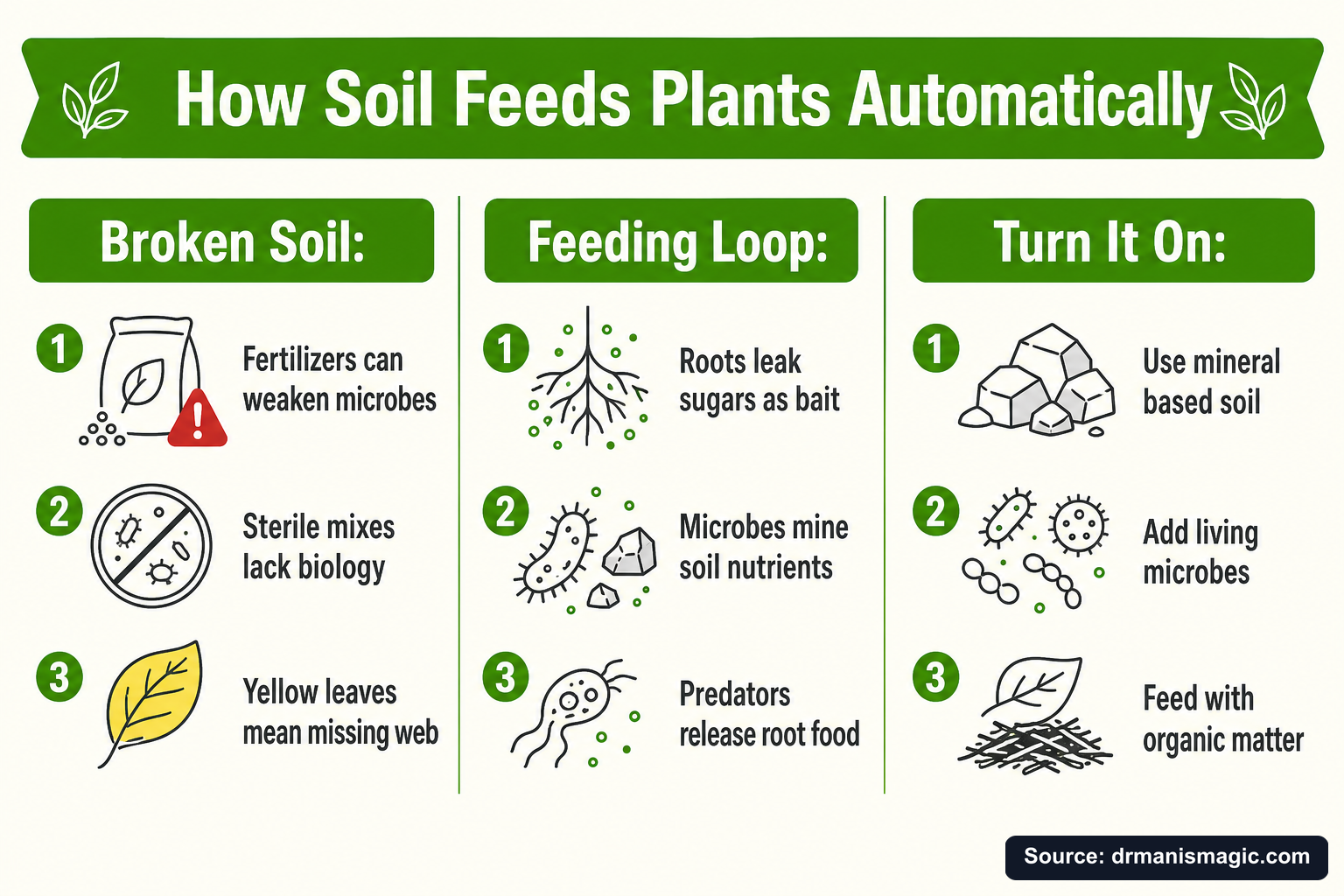
Key Takeaways
- Healthy ecosystems feed plants automatically through a living cycle of bacteria, fungi, protozoa, nematodes, and organic matter — no bottled fertilizer required.
- Plant roots leak sugars into the soil on purpose, recruiting billions of microbes that mine nutrients and deliver them back to the plant in exchange.
- Mycorrhizal fungi can expand a root's absorbing area by 100 to 1,000 times, acting like a biological extension of the root system itself.
- Protozoa and beneficial nematodes are the overlooked heroes of the cycle — they eat bacteria and release plant-available nitrogen right at the root zone.
- Salt-based synthetic fertilizers, herbicides, pesticides, and fungicides kill the very microbes that power this automatic feeding system.
- Most bottled microbe products on the market are either dried and inactive or already dying and smelly — neither delivers what a living soil food web provides.
- The Three Plant Pillars — mineral-based soil, live microbials, and organic fertilizer — are the fastest way to restore and maintain this system in any growing environment.
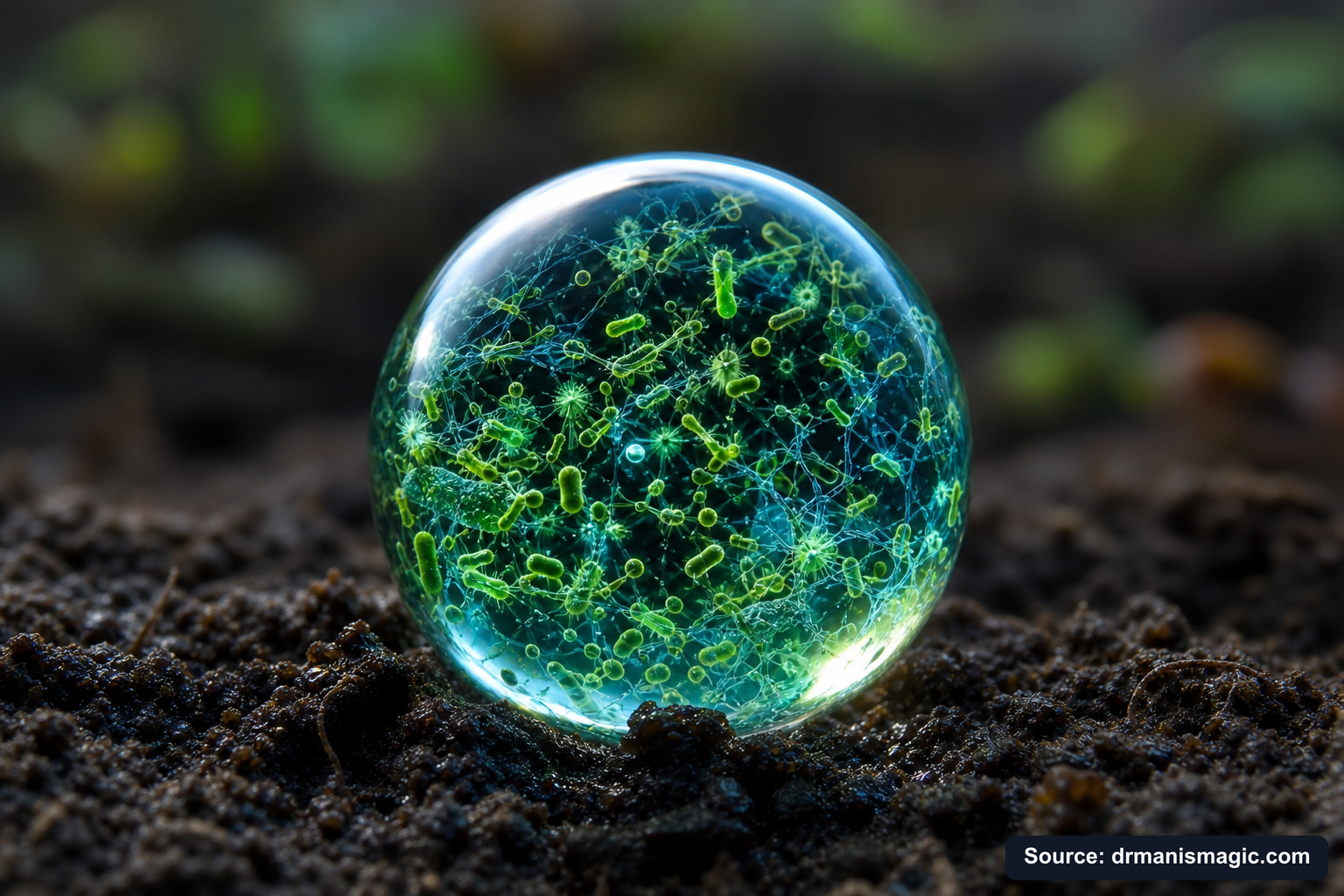
What Is the Soil Food Web and Why Does It Feed Plants Automatically?
Quick Answer: The soil food web is a living community of bacteria, fungi, protozoa, nematodes, and other organisms that break down organic matter, mine nutrients from soil and air, and deliver those nutrients directly to plant roots — all without human intervention. It is the engine behind how forests, grasslands, and wild orchards feed themselves.
The soil food web is not a metaphor. It is a real, measurable, biological network that exists beneath every healthy patch of ground on Earth. Think of it like a city economy. Some organisms are the miners, pulling raw materials out of rock and air. Some are the processors, converting those raw materials into usable forms. Some are the delivery drivers, moving nutrients right to the root. And some are the security guards, keeping pathogens and pests from taking over.
Every organism in that city has a job. Every job benefits the plant. And the plant, in turn, pays the whole city in sugar.
University of Minnesota Extension research confirms that soil biological processes supply roughly 75% of plant-available nitrogen and 65% of available phosphorus in healthy soils. Think about that. Three-quarters of the nitrogen a plant needs is being generated by living organisms in the ground — not by a bag from a store. The forest figured this out long before humans showed up with fertilizer spreaders.
The problem is that most of us are growing plants in soil that has had this city bombed out of it. Salt-based fertilizers. Herbicides. Synthetic pesticides and fungicides. Sterile potting mix with no biology at all. We've been handed tools that looked like help but were actually quietly destroying the invisible workforce our plants depend on.
That's not your fault. That's decades of marketing from companies that profit when your plants struggle and you keep buying more product. We've grown over 250,000 trees at our South Texas nursery, and we learned the hard way that fighting nature is a losing game. Working with it changes everything.
How Do Plant Roots Start the Automatic Feeding Cycle?
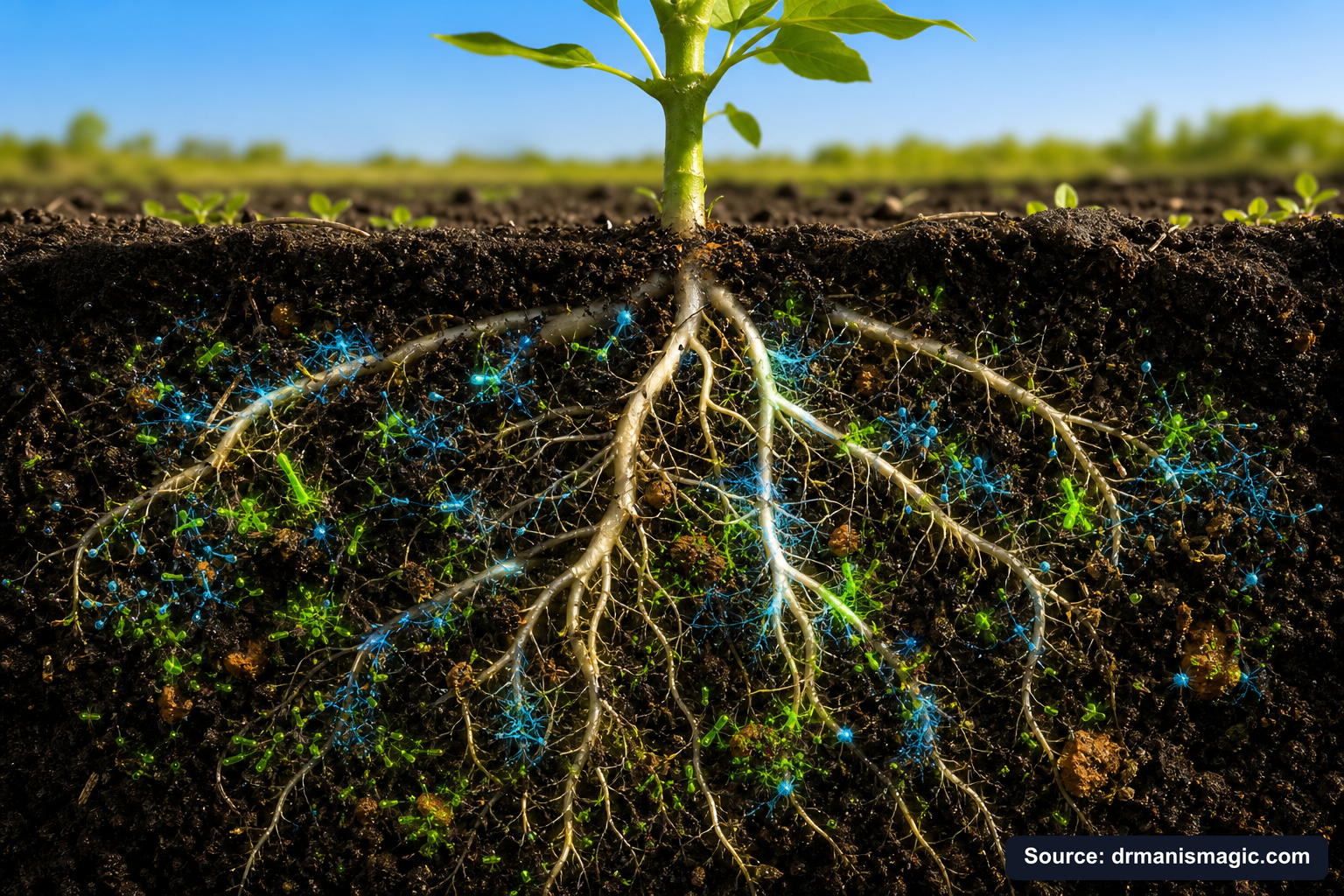
Quick Answer: Living plant roots constantly leak sugars, amino acids, and organic acids into the surrounding soil. This is called root exudate release. Those compounds feed and recruit billions of beneficial bacteria, fungi, and other microbes that then mine nutrients, fix nitrogen, and deliver food back to the plant — creating a self-reinforcing automatic feeding loop.
Here's the part that most gardening content never tells you. Plants are not passive. They are actively running the show underground.
A living root is constantly leaking. Sugars. Amino acids. Vitamins. Organic acids. It looks like waste, but it is anything but. The plant is doing this on purpose. Those compounds are bait. They attract and feed the exact microbes the plant needs most. Scientists call this zone around the root the rhizosphere, and it is one of the most biologically dense places on the planet.
Here is how the loop works, step by step:
- Sunlight hits the leaf. The plant makes sugar through photosynthesis.
- The plant sends some of that sugar down to the root and leaks it into the soil.
- Bacteria and fungi rush in to eat the sugar. Billions of them. Right at the root tip.
- Those microbes start decomposing organic matter — dead leaves, old roots, compost, mulch — and breaking minerals out of soil particles.
- Predators arrive. Protozoa eat the bacteria. Beneficial nematodes eat the bacteria and fungi. When they eat, they excrete — and what they excrete is nitrogen, phosphorus, and other nutrients in forms the plant can absorb immediately.
- The plant absorbs those nutrients. It makes more sugar. It leaks more sugar. The cycle runs again.
This is automatic feeding. No timer. No pump. No bag from a store. Just a living loop that has been running on this planet for hundreds of millions of years.
When you grow in sterile potting mix with no biology, or when you've used chemicals that killed your soil community, this loop stops. The plant is left waiting for you to bring the nutrients manually. And most of the time, what you bring — salt-based synthetic fertilizers — makes the problem worse by killing whatever microbes were left.
See also: The Hidden Reason Synthetic Fertilizers Cause Root Rot
Who Are the Key Players in the Soil Food Web?
Quick Answer: The main players are decomposer bacteria, nitrogen-fixing bacteria, phosphorus-solubilizing bacteria, saprophytic and mycorrhizal fungi, protozoa, beneficial nematodes, and earthworms. Each has a specific role. Together they form a complete nutrient-cycling economy that feeds plants automatically and suppresses disease at the same time.
Let's meet the crew. Most gardening content talks about bacteria and fungi and stops there. But two of the most important organisms in this system — protozoa and beneficial nematodes — almost never get mentioned. That's a big miss, because they're the ones who actually release nutrients in plant-available form.
| Organism | Primary Job | What the Plant Gets |
|---|---|---|
| Decomposer bacteria | Break down organic matter into simpler compounds | Nutrients released from dead material |
| Nitrogen-fixing bacteria | Pull nitrogen gas from the air and convert it to plant-usable form | Free nitrogen fertilizer from the atmosphere |
| Phosphorus-solubilizing bacteria | Dissolve mineral-bound phosphorus locked in soil particles | Accessible phosphorus without added amendments |
| Actinomycetes | Break down tough organic matter; produce natural antibiotics | Disease suppression; slow nutrient release |
| Saprophytic fungi | Decompose woody material; connect organic matter to the food web | Nutrients unlocked from lignin and cellulose |
| Mycorrhizal fungi | Extend root surface area by 100–1,000 times; mine water and minerals | Dramatically increased nutrient and water uptake |
| Protozoa | Graze on bacteria; excrete excess nitrogen as ammonium at the root zone | Nitrogen delivered directly where the plant needs it most |
| Beneficial nematodes | Graze on bacteria and fungi; suppress pest larvae and pathogens | Nutrient release plus natural pest control |
| Earthworms | Physically mix and aerate soil; produce castings rich in bioavailable nutrients | Improved soil structure and concentrated fertility |
The Missing Middle: Protozoa and Beneficial Nematodes
Most people have heard of bacteria and mycorrhizae. Almost no one talks about protozoa. But here's the thing: protozoa are the reason bacteria actually feed the plant.
Here's what happens. Bacteria eat organic matter and lock nutrients inside their own bodies. Those nutrients are not available to the plant yet. They're trapped in bacterial biomass. Then a protozoan comes along and eats the bacteria. The protozoan can only use some of what it ate. The rest — the nitrogen, the phosphorus, the sulfur — gets excreted as waste. And that waste lands right at the root tip in a form the plant can absorb immediately.
Protozoa are the nutrient-release trigger. Without them, the bacteria hoard the nutrients and the plant waits. With them, nutrients flow. Colorado State University Extension describes this as the "microbial loop," and it's one of the most underappreciated mechanisms in all of soil science.
Beneficial nematodes do something similar. They graze on bacteria and fungi, releasing nutrients. They also hunt and kill pest larvae, fungus gnats, and soil-dwelling pathogens. They are predators that make the soil safer and more fertile at the same time.
This is why Plant Super Boost is formulated with over 2,000 species of bacteria, 400 to 500 species of fungi including mycorrhizae, plus protozoa and beneficial nematodes. It's not just bacteria in a bottle. It's the whole crew, stabilized and alive.
What Do Mycorrhizal Fungi Actually Do for Plant Roots?
Quick Answer: Mycorrhizal fungi attach to plant roots and grow a massive network of thin threads called hyphae into the surrounding soil. Colorado State University Extension notes these hyphae can increase a root's absorbing area by 100 to 1,000 times, allowing the plant to access water and nutrients far beyond what the root itself could ever reach.
Pull up a weed sometime. Look at the roots closely. See that white fuzz clinging to them? That's mycorrhizae. And it's one reason weeds can be so hard to kill — they have a biological superpower working for them underground.
Mycorrhizal fungi are not parasites. They are partners. The fungal threads, called hyphae, extend out from the root like a second root system that is far thinner and more far-reaching than the root itself. Those threads can slip into tiny pores in soil particles that roots could never access. They mine water during drought. They pull phosphorus from rock. They connect neighboring plants in a network sometimes called the "wood wide web," allowing nutrients and even chemical signals to pass between trees.
In exchange, the plant feeds the fungus sugar. It is a deal that has been running for roughly 450 million years. Plants and mycorrhizal fungi co-evolved together. Most plants on Earth — including nearly every crop, fruit tree, houseplant, and lawn grass you care about — are hardwired to form this partnership.
The catch: mycorrhizal fungi are destroyed by synthetic fungicides, salt-based fertilizers, and compacted or waterlogged soil. They also do not survive in most commercial potting mixes. If you are growing in a container, raised bed, or any soil that has seen chemical inputs, there is a very good chance this partnership is broken or severely weakened.
Restoring it is one of the highest-leverage things you can do for any plant you are growing.
Why Does Healthy Organic Matter Make Automatic Feeding Possible?
Quick Answer: Organic matter — dead leaves, compost, mulch, wood chips, old roots — is the raw material the soil food web runs on. Microbes decompose it and extract nutrients. Without organic matter as fuel, the microbial community shrinks, the automatic feeding cycle slows, and the plant has to rely on whatever you pour on it from a bottle.
Think of organic matter as the grocery store for the soil food web. Every dead leaf that falls, every bit of mulch you spread, every root that dies and decays — all of it is food for bacteria and fungi. They eat it, break it apart, and extract the nutrients locked inside. Those nutrients then move up the food chain to protozoa and nematodes, and eventually reach the plant in forms it can use.
In a forest, this cycle runs on autopilot. Leaves fall every season. They pile up. Fungi thread through them. Bacteria colonize them. Worms pull them down. Within months, what was a dead leaf is now plant-available fertility.
In most home gardens and containers, this input has been cut off. We use potting mixes made of pine bark and sawdust that break down too fast and turn into a compacted, oxygen-starved mess. We rake up leaves instead of letting them feed the soil. We use bare soil with no mulch layer, letting the sun bake and sterilize the top inch where most of the biological activity happens.
The fix is simpler than you think. Mulch your beds. Add compost. Let some organic matter stay on the surface. Feed the microbes, and they will feed your plants.
And if your soil has been damaged, depleted, or never had biology to begin with — like most container mixes and chemically treated lawns — you need to bring the microbes back in. That's where a full-spectrum live microbial product becomes critical, not optional.
How Is Automatic Ecosystem Feeding Different From Automatic Watering?
Quick Answer: Automatic watering uses timers and pumps to deliver water on a schedule. Automatic biological feeding uses living organisms — bacteria, fungi, protozoa, and nematodes — to continuously cycle nutrients and deliver them to roots without any mechanical system, schedule, or human intervention. One is a machine. The other is a living economy.
When people hear "how ecosystems feed plants automatically," many picture drip irrigation. Timers. Sensors. Technology. That's not what we're talking about.
Biological automation is something entirely different. It doesn't need electricity. It doesn't need a schedule. It doesn't need you to remember anything. It runs because living organisms are doing what they are built to do — eating, reproducing, competing, and in the process, feeding your plant.
| Feature | Biological Automatic Feeding | Mechanical Automatic Watering |
|---|---|---|
| Powered by | Living organisms and sunlight | Electricity, timers, pumps |
| Delivers | Nitrogen, phosphorus, micronutrients, water, disease suppression | Water only |
| Needs replacing? | Self-replenishing when supported | Mechanical parts wear out |
| Cost over time | Low once established | Ongoing electricity and maintenance |
| Can it be killed? | Yes — by chemicals, salt, compaction, sterile inputs | Yes — by mechanical failure |
| Response to plant needs | Dynamic — microbes respond to root signals | Fixed — runs on a timer regardless of plant need |
| Suppresses disease? | Yes — beneficial microbes crowd out pathogens | No |
A drip system is a wonderful tool. But it can't fix yellowing leaves, it can't suppress root rot, and it can't mine phosphorus from a soil particle. Only biology can do those things. The most sophisticated irrigation system in the world is no substitute for a living soil food web.
You Never Had a Brown Thumb.
You were handed the wrong tools. This free guide hands you the right ones.
You watered it. You fed it. It died anyway.
It was never you. It was the dirt, the salt food, and the bad advice.
This guide shows you what really went wrong, and how to fix it for good.
- Why your plants really died, and why it was never your fault
- The salt hiding in your plant food that quietly burns the roots
- The hidden killer in almost every bag of store soil
- The tiny helpers that grow a whole forest for free
- The rescue trick that brings a half dead plant back to life

What Kills the Soil Food Web and Stops Automatic Feeding?
Quick Answer: Salt-based synthetic fertilizers, glyphosate herbicides, broad-spectrum pesticides, synthetic fungicides, compaction, waterlogging, and sterile potting mixes all damage or destroy the microbial communities that power automatic plant feeding. Once the biology is gone, the plant becomes dependent on whatever nutrients you manually apply.
This is the part the big chemical companies don't want on the label.
When you pour a salt-based synthetic fertilizer on your soil, the salts don't just feed the plant. They create an osmotic environment that pulls water out of microbial cells, killing bacteria and fungi the same way salt kills a slug. The plant gets a short burst of nutrients. But the workforce that was doing the long-term feeding — for free, automatically — gets smaller every time.
Glyphosate, the active ingredient in many common herbicides, has been shown in multiple university studies to disrupt soil microbial communities, particularly affecting beneficial fungi and bacteria in the rhizosphere. Synthetic fungicides don't distinguish between harmful fungi and the mycorrhizal fungi your plant depends on. Broad-spectrum pesticides knock out beneficial nematodes and insects along with the pests.
The result is a soil that looks fine on the surface but is biologically dead underneath. And a dead soil cannot feed plants automatically. It can only hold whatever you pour onto it.
See also: Why Most Fertilizers Are Actually Salt in Disguise
After growing over 250,000 trees at our nursery in South Texas, we watched this pattern play out hundreds of times. Trees that were fed with salt-based fertilizers looked green for a season. Then they stalled. Then they started circling the drain. You can fight nature for a while. But you can't fight it forever. And the worst part isn't the money you lose. It's the time. You can always earn more money. You cannot get back the years you spent watching a tree that should have been thriving slowly decline.
Why Do Most Bottled Microbe Products Fail to Restore the Soil Food Web?
Quick Answer: Most commercial microbe products are either dried powders of lab-grown organisms with very low survival rates, or liquid compost teas that have gone anaerobic in the bottle — meaning the microbes are dying and the product smells like sewage. Neither delivers the full-spectrum, living biology that plants in healthy ecosystems actually depend on.
The microbial inoculant market has exploded in the last decade. Walk into any garden center and you'll find dozens of products claiming to supercharge your soil with bacteria and fungi. Most of them don't work. Here's why.
The Three Ways Most Microbe Products Fall Short
Problem 1: Dry powder products. These are made in large industrial vats, then dried into a powder and labeled for dozens of different companies. The idea is that the dormant spores will "reactivate" when you add water and apply them to soil. In our experience testing dozens of batches across our nursery, we have seen no meaningful plant response from these products. The reactivation rate is too low. The species selected are too narrow. And by the time they arrive at your door, they've often been sitting in a hot warehouse for months.
Problem 2: Smelly liquid products. Some companies take organic material — worm castings, compost — and brew it into a liquid. This sounds promising. But without proper stabilization, the microbes quickly use up the available oxygen in the bottle and go anaerobic. They start to die. The bottle fizzes when you open it. The smell is unmistakable — like rotting sewage. Some gardeners still see a benefit because the liquid contains humic acid and other organic compounds. But the living biology is largely gone.
Problem 3: Lactobacillus-based products. These are easy to make — practically just rice water. Lactobacillus bacteria are vigorous and stay alive. But they don't belong in your soil. They can outcompete and displace the beneficial bacteria and fungi your plant actually needs. They belong in yogurt, not in your garden.
| Product Type | Microbe Viability | Spectrum | Odor | Our Assessment |
|---|---|---|---|---|
| Dry/powdered lab microbes | Very low | Narrow (a few species) | Little to none | We've seen no results. Avoid. |
| Rehydrated dry powder | Very low | Narrow | Little to none | Same issue. Avoid. |
| Compost tea, fresh (under 24 hours) | Moderate (if actively aerated) | Partial | Earthy, then sour | Works if you make it yourself and use immediately. |
| Compost tea, old (over 24 hours) | Anaerobic — microbes dying | Partial | Strong and foul | Not recommended. Biology largely gone. |
| Lactobacillus-based products | High — but wrong species | Very narrow | Sour | Crowds out beneficial microbes. Avoid. |
| Fresh active compost (on-site) | High | Broad and natural | Earthy | Excellent. Best source if you can maintain a pile. |
| Plant Super Boost (stabilized, full-spectrum) | High — visibly alive under microscope | 2,000+ bacteria; 400–500 fungi including mycorrhizae; plus protozoa and nematodes | Earthy — not foul | Harvested from compost, not lab-grown. Stabilized by an all-natural method. Our strongest recommendation. |
The Dr. Mani's Magic story starts with a compost pile and a providential meeting. Dr. Mani Skaria — Professor Emeritus of Plant Pathology, inventor of micro-budding, and founder of the Clean Citrus Program in Texas — spent decades looking for a way to bottle the power of fresh, living compost without it going anaerobic. He eventually partnered with a world-renowned compost expert who had developed a natural stabilization method — one that had attracted the hostile attention of large chemical companies before the partnership with our nursery was formed.
The result is Plant Super Boost. It smells earthy, not foul. You can put a drop under a microscope and watch the organisms move. Lab analyses confirm living colony-forming units across a full spectrum of bacteria, fungi, protozoa, and beneficial nematodes. It contains zero PFAS, zero biosludge, and zero synthetic salts. And it comes with a 30-day money-back guarantee because we are confident it works.
Does a Healthy Soil Food Web Mean You Never Need Fertilizer?
Quick Answer: In a mature, undisturbed ecosystem with abundant organic matter, the soil food web can supply most of what a plant needs. But in containers, raised beds, high-yield growing, and soils recovering from chemical damage, organic fertilizer is still needed — especially to supplement nutrients that get removed when you harvest fruit, vegetables, or cut grass and don't return the organic matter to the soil.
This is a fair and important question. If the soil food web feeds plants automatically, why do we still recommend fertilizer?
The honest answer is: it depends on your growing system.
In a forest, fallen leaves return nutrients to the soil. Roots die and decompose in place. Animals contribute organic matter. Nothing leaves the system. The nutrient cycle is closed. Fertilizer is genuinely unnecessary because everything the plant took out comes back in.
In your yard or garden, the cycle is broken. You harvest fruit and carry it inside. You mow the lawn and bag the clippings. You pull weeds and throw them away. Every time you do that, you are exporting nutrients that were once cycling through the system. Over time, that creates a deficit that the food web alone cannot cover.
Containers are even more extreme. A potted plant has a tiny, finite amount of soil. The organic matter gets depleted fast. The biology has nowhere to expand. You must supplement.
The key is what kind of fertilizer you use. Salt-based synthetic fertilizers kill the microbial community you are trying to rebuild. They create dependency. They burn roots at high concentrations. And they often contain plastics — slow-release coatings that leach into your soil and eventually into waterways.
Organic, slow-release fertilizer — like our Crab, Kelp & Amino Acids formula — works with the microbial community instead of against it. It feeds both the plant and the biology at the same time. The microbes break it down gradually. The plant gets a steady, gentle stream of nutrients instead of a salt shock. And the soil gets healthier over time instead of more depleted.
How Do You Restore Automatic Feeding to Damaged or Sterile Soil?
Quick Answer: Restoring the soil food web requires stopping what is killing the biology, adding live microbes, feeding them with organic matter and organic fertilizer, improving soil structure and aeration, and giving the system time to reestablish. This is not a one-time fix. It is a protocol that plays out over weeks and months.
If your soil has been treated with herbicides, synthetic fertilizers, or fungicides — or if you're growing in a commercial potting mix with no biology at all — the automatic feeding cycle is not running. Here is how to turn it back on.
Soil Recovery Protocol: 7 Steps to Restore Living Biology
- Stop the bleeding. Eliminate or dramatically reduce synthetic herbicides, salt-based fertilizers, and broad-spectrum pesticides. Every application sets the recovery back. You cannot build a living soil while continuing to kill it.
- Check your soil structure. Compacted, waterlogged, or extremely sandy soil prevents microbes from thriving. For containers and raised beds, use a mineral-based soil that drains well and holds structure without breaking down. Our Super Soil is built specifically for this — it's a permanent mineral-based blend that doesn't compact into a root-choking sludge the way pine bark mixes do.
- Introduce full-spectrum live microbes. Apply a genuinely living microbial inoculant — not a dried powder, not a smelly liquid — monthly. This jump-starts the biological community and introduces organisms the soil may have lost entirely.
- Add organic matter as food for the microbes. Top-dress with mature compost. Mulch your beds with wood chips or straw. Let leaf litter accumulate where possible. Microbes need to eat, and organic matter is their food supply.
- Fertilize with organic, slow-release inputs. Avoid salt-based products. Use organic fertilizers that feed the biology while nourishing the plant. This builds long-term fertility instead of creating dependency.
- Plant living roots whenever possible. Living roots are what trigger the root exudate loop. Bare soil has no pump running. Cover crops, perennials, and even intentional "weed" cover in bare areas help keep the cycle active.
- Be patient and consistent. Microbial communities take time to reestablish, especially in soils that have been heavily damaged. Apply microbes monthly. Build organic matter consistently. Most people see meaningful improvement within 30 to 90 days. Full recovery of a rich, diverse community can take a season or more.
See also: How Salt-Based Feeding Quietly Destroys Root Systems
How Do the Three Plant Pillars Recreate What Ecosystems Do Naturally?
Quick Answer: The Three Plant Pillars — mineral-based soil for structure and drainage, live microbials for biological nutrition and disease suppression, and organic fertilizer for complete nutrient support — mirror the three conditions that allow wild ecosystems to feed plants automatically: aerated structure, living biology, and steady organic nutrition. Together they create a self-reinforcing growing system for any plant.
After 35 years of growing citrus, houseplants, tropical trees, and everything in between, Dr. Mani Skaria distilled what the best ecosystems do into a framework any gardener can apply. He calls it the Three Plant Pillars. We teach it in our Free Plant Care Field Guide, and it is the foundation of everything we do at Dr. Mani's Magic.
Pillar 1: Mineral Foundation. Most potting mixes are made from pine bark and sawdust. They break down fast. As they decompose, they compact, block oxygen, and create the wet, airless conditions that cause root rot. A true mineral-based soil — like the sandy loam from the Rio Grande Valley that forms the base of our Super Soil — doesn't decompose. It holds its structure permanently. Roots can breathe. Water drains. Microbes have the aerobic environment they need to thrive.
Pillar 2: Microbial Muscle. This is the living workforce we've been talking about throughout this entire article. Bacteria, fungi, mycorrhizae, protozoa, beneficial nematodes — all working together to cycle nutrients, suppress pathogens, extend root reach, and build soil structure. Without this pillar, the other two cannot work at full capacity. With it, your plant has an invisible army working for it around the clock.
Pillar 3: Organic Fertilizer. Not salt. Not synthetic. Slow-release, earth-born nutrition from sources like crab meal, kelp, and amino acids. This feeds the plant gently and steadily, supports the microbial community instead of killing it, and builds soil health over time. Our Crab, Kelp & Amino Acids formula contains no biosludge, no PFAS, and no synthetic salts.
Miss any one of these pillars and you will struggle. Your plants may survive, but they won't thrive. They'll be vulnerable to stress, disease, and slow growth. Get all three working together, and something remarkable happens. The soil comes alive. The roots push deep. The leaves get deep green. The fruit comes heavy and sweet. You start to understand, maybe for the first time, how a forest feeds itself without any help from anyone.
That's not magic. That's nature working the way it was designed to work. We've just figured out how to put it in a bottle, a bag, and a simple three-part system that works for any plant — from a lemon tree on a Texas patio to a fiddle-leaf fig in a Chicago apartment to a half-acre vegetable garden in the middle of Ohio.
What Can You Do Right Now to Start the Automatic Feeding Cycle in Your Garden?
Quick Answer: Start by stopping inputs that kill biology, then introduce full-spectrum live microbes, add organic matter as microbial food, and switch to an organic slow-release fertilizer. Apply microbes monthly. Build organic matter consistently. Within 30 to 90 days, most plants in recovering soil show visible improvement. The full system compounds over time.
You don't have to overhaul everything at once. Start with one plant. One pot. One bed. Apply the Three Plant Pillars there and watch what happens.
Here's the honest thing about time. You can earn more money. You cannot earn more time. The number one thing we hear from gardeners — especially those who have been fighting with the same trees or gardens for years — is that they wish they had started the right way sooner. Not because of the money spent on the wrong products. Because of the time lost watching something they cared about struggle when it didn't have to.
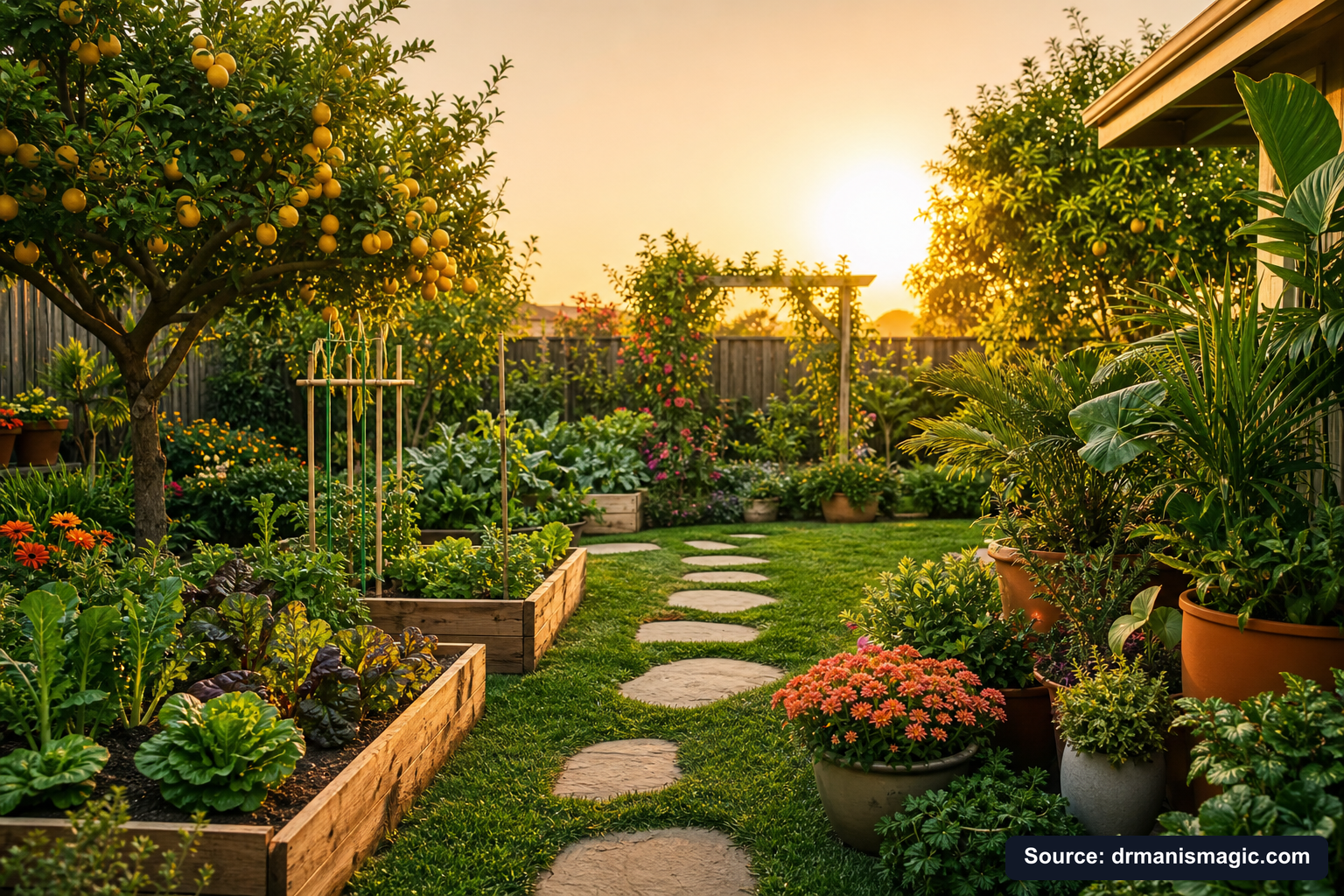
The forest doesn't wait for the perfect moment. It just runs the cycle, day after day, and the plants respond. You can create that same cycle in your backyard, your raised bed, your kitchen windowsill, or your orchard. The biology is ready. It's been waiting. You just have to give it the conditions to run.
If you want to see exactly how the Three Plant Pillars work together — and get a step-by-step plan for any plant you're growing — the Free Plant Care Field Guide walks you through everything in plain language, no jargon, no guesswork. It's the same system we use on our own trees, our nursery, and the 250,000-plus plants we've grown in South Texas. It works. And it's yours, free, whenever you're ready.
Frequently Asked Questions
You just learned how healthy ecosystems feed plants automatically through the soil food web. Now you probably have questions about how to turn that system on in your own yard, garden, or patio pot. These answers cut straight to what matters most, so you can stop guessing and start growing.
How does the soil food web feed plants automatically?
Plant roots leak sugars into the soil on purpose. That sugar attracts billions of bacteria and fungi. Those microbes break down organic matter and pull nutrients out of the soil. Then they deliver those nutrients straight to the root zone. The plant gets fed around the clock without you doing a thing. Dr. Mani proved this system works by testing it on over 250,000 citrus trees at US Citrus Nursery. When the microbes are alive and active, the plant feeds itself.
Why does my soil stop feeding my plants over time?
Most potting mixes are made from pine bark and wood chips. Those materials rot. When they rot, they compact. Compacted soil chokes out oxygen and kills the microbes that run the automatic feeding cycle. No microbes means no automatic feeding. Your plant slowly starves no matter how much fertilizer you pour on top. That is why Dr. Mani built Super Soil on a mineral base of sandy loam from the Rio Grande Valley. It does not break down. It stays open. Roots breathe. Microbes thrive.
What kills the automatic feeding system in my garden?
Salt-based synthetic fertilizers are the number one killer. They wipe out the beneficial bacteria and fungi that power the soil food web. Harsh pesticides and fungicides do the same thing. Once those microbes are gone, the automatic feeding cycle stops. Your plant becomes dependent on whatever you pour on it from a bottle. That is the cycle the big chemical companies want you stuck in. Dr. Mani's Three Plant Pillars break that cycle for good.
How do I restart the automatic feeding cycle in my own yard or pots?
You need three things working together. First, a mineral-based soil that does not compact and lets roots breathe. Second, live microbes that can actually colonize the root zone and start working. Third, an organic fertilizer that feeds the plant and the microbes without burning either one. That is exactly what the Three Plant Pillars are. Super Soil handles Pillar One. Plant Super Boost delivers live bacteria, fungi, and mycorrhizae for Pillar Two. The Crab, Kelp, and Amino Acids fertilizer covers Pillar Three. All three together flip the switch.
Are the microbes in bottled products actually alive and working?
Most are not. Many bottled microbe products on store shelves are dried out, dead, or dying. Some smell awful because they have already gone anaerobic, meaning they are rotting. Dr. Mani partnered with a compost expert who uses a special all-natural stabilization method to keep the microbes in Plant Super Boost alive and active right up until they hit your soil. It does not smell bad. It smells like fresh earth. That is how you know the microbes inside are still doing their job.
How long does it take to see the automatic feeding system working?
Most growers notice a real difference within 30 days. Leaves get greener. Growth picks up. The soil smells alive instead of stale. Within a few months, the system is running on its own. The longer you keep the Three Plant Pillars in place, the stronger and more self-sufficient your plants become. Dr. Mani tested this timeline across citrus trees, tropical houseplants, and garden beds. The biology is consistent. Set up the right foundation and the system rewards you fast.
Does this automatic feeding system work for houseplants, lawns, and gardens too, or just fruit trees?
It works for everything. The soil food web does not care if you are growing a Meyer lemon in a pot, a rose bed in the backyard, a lawn, or a vegetable garden. The same biology applies. Dr. Mani developed the Three Plant Pillars while growing over 250,000 citrus trees at US Citrus Nursery, but the system has been tested on tropical trees, houseplants, grasses, and garden plots with the same results. Healthy microbes plus mineral soil plus organic fertilizer equals plants that feed themselves.
About the Author
Ron Skaria, MD
Ron Skaria, MD, is the co-founder of Dr. Mani's Magic and the son of Dr. Mani. He trained as a medical doctor at Baylor College of Medicine, did his residency at UT Health Science Center - San Antonio and fellowship training at Texas Tech University. He now works full time on the family farm at US Citrus and US Citrus Nursery in Hargill, Texas, building Dr. Mani's Magic alongside his dad. He wrote the Brown Thumb Field Guide to put his father's 48 years of plant science into plain words any gardener can use. His belief is simple. You never had a brown thumb. You just never had the right help.


