


How Compost Changed Civilization and Still Builds Living Soil | Dr. Mani's Magic
How Compost Changed Civilization: The Microbial Technology That Fed Cities, Built Living Soil, and Still Protects Your Garden Today
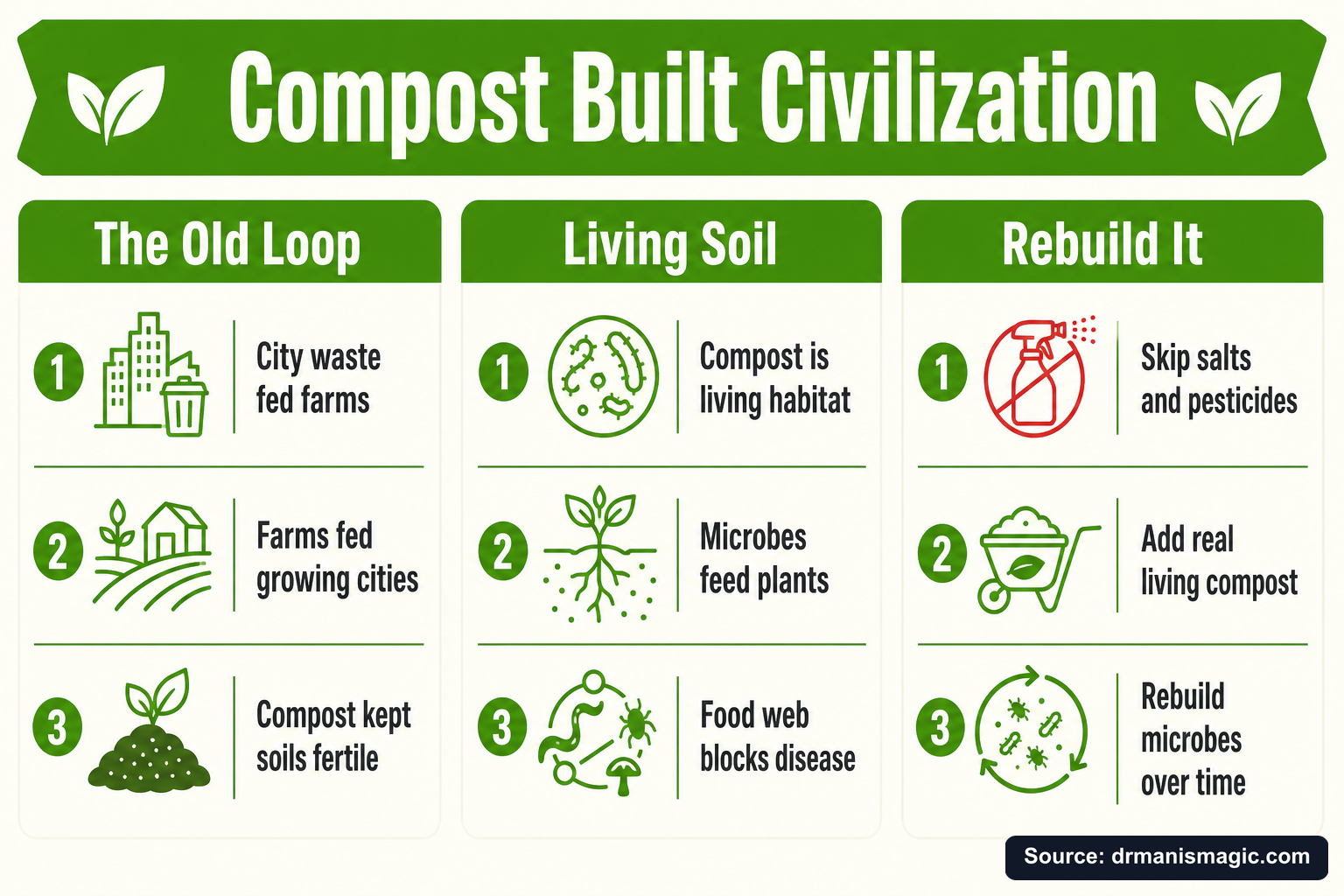
Picture a farmer in China, one thousand years ago. Before sunrise. He's walking through the streets of a city that holds more people than any city in Europe will hold for another five hundred years. He's not there to buy anything. He's there to collect waste. Human waste. Animal waste. Kitchen scraps. He loads it all into clay pots, carries it back to his fields outside the city walls, and works it into the soil. A few months later, his rice paddies are green and heavy with grain.
He doesn't know about bacteria. He doesn't know about fungi or protozoa or the soil food web. He just knows what every farmer before him knew: return what came from the earth back to the earth, and the earth will feed you again. That simple loop, that quiet recycling of life back into life, is how the largest cities in human history kept their populations fed. It is how civilizations rose. And it is how your backyard garden can flourish today, if you understand the invisible world working beneath your feet.
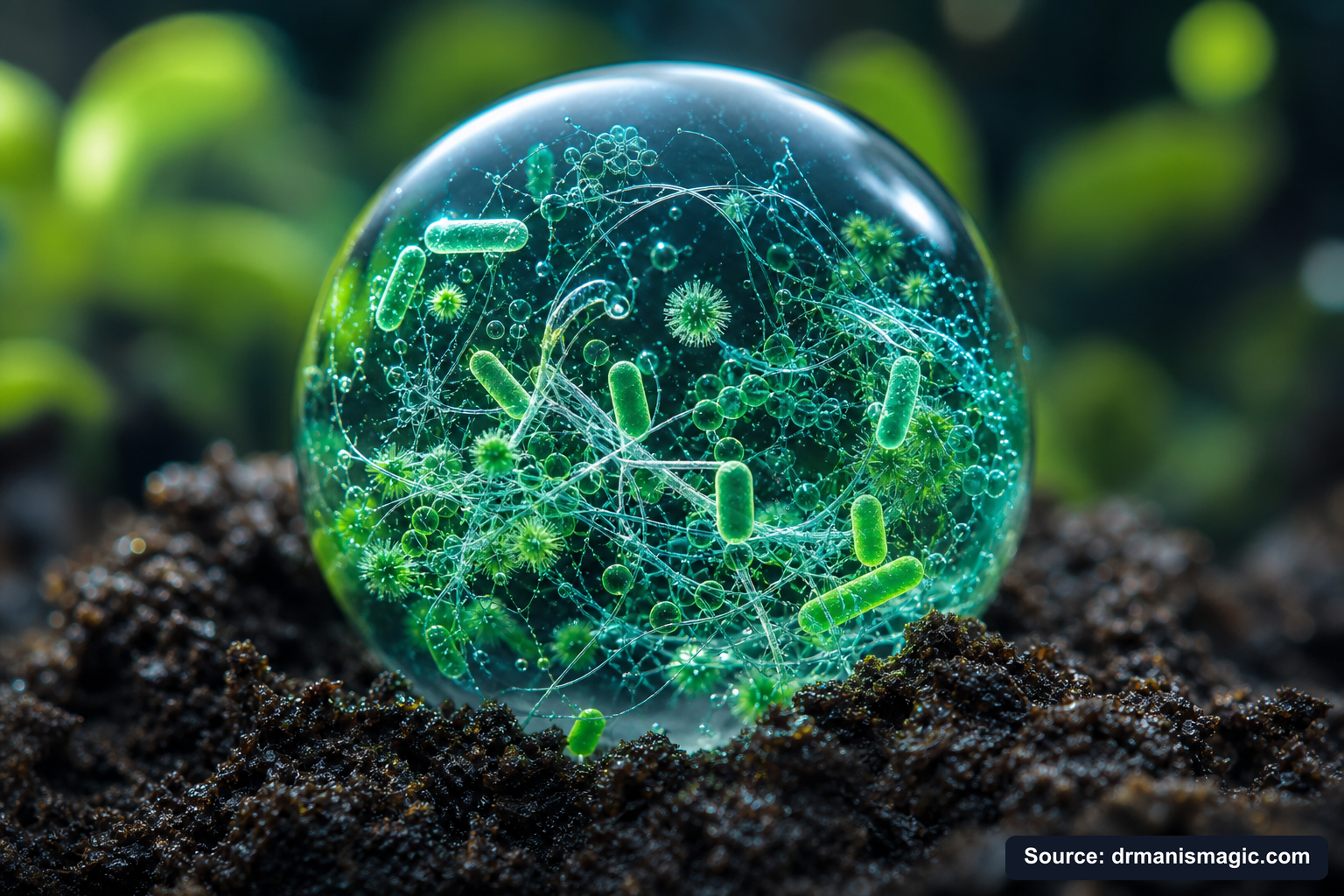
Here's the part most gardening advice skips entirely. Compost is not fertilizer. It is not a bag of nutrients you pour on your plants. It is a living ecosystem. It is a city of microbes, fungi, worms, and tiny predators that transform dead material into the richest growing medium on the planet. When you understand that, everything about growing plants changes. And when that living world is destroyed by synthetic chemicals and salt-based fertilizers, no amount of money can buy it back quickly. Only time, and the right biology, can restore it.

Plant Super Boost
Key Takeaways
- Compost changed civilization by closing the nutrient loop: waste from cities fed farms, farms fed cities, and the cycle kept going for thousands of years.
- Compost is not fertilizer. It is a habitat for billions of living microbes that build soil, unlock nutrients, and suppress disease naturally.
- The soil food web is a cast of characters including bacteria, fungi, protozoa, nematodes, and earthworms, each with a specific job that benefits your plants.
- Synthetic fertilizers and pesticides kill the very microbes that make soil work, and that damage compounds over years, leaving gardens weaker and more dependent on chemicals.
- Most bottled microbial products on the market are either dead powder or dying, foul-smelling liquid. Live, stabilized microbes from real compost are a fundamentally different technology.
- The Three Plant Pillars, developed at US Citrus Nursery after growing over 250,000 trees, give any plant a foundation that mirrors how nature actually works.
- You can start rebuilding your soil biology today. The best time was ten years ago. The second best time is right now.
How Did Compost Build the First Great Cities?
Quick Answer: Ancient civilizations, especially in China, India, and Rome, survived population explosions by systematically composting human and animal waste and returning it to farmland. This nutrient recycling loop prevented soil exhaustion, stabilized food supplies, and allowed dense urban populations to thrive for centuries without synthetic inputs.
Most people think of compost as a modern, green-living trend. A bin behind your garage. Something for people who shop at farmers' markets.
But compost is ancient. And civilizations that figured it out early survived. Civilizations that ignored it eventually collapsed.
During China's Song dynasty, roughly 960 to 1279 AD, cities like Hangzhou held populations of over one million people. That is staggering for a pre-industrial world. How did they feed that many people? They built what historians now call a nutrient economy. Waste collectors moved through the city every morning. Night soil, meaning human waste, was gathered, composted with animal manure and crop residues, and sold back to farmers as fertilizer. The University of California's agricultural history research documents these Chinese composting systems as among the most sophisticated nutrient recycling operations in human history, predating modern agronomy by a thousand years.
Rome had its own version. Roman farmers prized what they called stercus, the composted mix of manure, straw, and kitchen scraps. Roman agricultural writers like Columella and Varro wrote detailed instructions on building compost heaps. The Roman legions carried the practice across Europe. Where they settled, they composted.
In India, traditional farming systems used green manures and composted waste for millennia. It was this tradition that fascinated a British agricultural scientist named Sir Albert Howard, who traveled to India in the early 1900s. What he saw there changed the course of modern agriculture. He watched Indian farmers grow healthy, disease-resistant crops without any synthetic inputs. He studied the soil. He studied the compost piles. He came home and developed the Indore Process, a systematic hot composting method published in 1931, that became the foundation of the entire organic farming movement.
Howard's central argument was radical for his time: healthy soil is a living community, not a chemical formula. Feed the soil life, and the soil life will feed your plants. The plant does not eat nutrients directly. The plant partners with microbes who deliver nutrients in exchange for sugars. It is a negotiated relationship, not a transaction.
That argument is still radical today, because it is still being ignored by most of the fertilizer industry.
What Is the Soil Food Web, and Why Does It Matter for Your Garden?
Quick Answer: The soil food web is the interconnected community of living organisms in healthy soil: bacteria, fungi, protozoa, nematodes, arthropods, and earthworms. Each organism plays a specific role in breaking down organic matter, cycling nutrients, suppressing disease, and building soil structure. When this web is intact, plants thrive without chemical inputs.
If you could shrink yourself down to the size of a grain of sand and walk through a teaspoon of healthy compost-fed soil, you would not be walking through dirt. You would be walking through a city.
The University of Minnesota Extension describes soil as a living ecosystem where every square meter of healthy ground contains billions of organisms interacting in a complex food web. Here is who lives there and what each one does for your plants.
| Organism | What They Do | Direct Benefit to Your Plant |
|---|---|---|
| Bacteria | Rapidly decompose fresh organic matter; fix nitrogen from air; solubilize phosphorus | Release nutrients in plant-available forms; build soil aggregates |
| Fungi (saprophytic) | Break down tough carbon like wood and straw; create sticky threads called hyphae | Improve soil structure; extend nutrient reach |
| Mycorrhizal Fungi | Form a symbiotic network inside and around plant roots; mine water and nutrients from far-reaching soil zones | Massively expand root surface area; improve drought resistance; unlock phosphorus |
| Protozoa | Graze on bacteria; release excess nitrogen as they digest | Act as a nutrient release valve; make nitrogen available right at the root zone |
| Nematodes (beneficial) | Prey on bacteria, fungi, and pest insects; mineralize nutrients | Cycle nutrients; suppress soil-borne pests and root pathogens |
| Actinomycetes | Decompose complex compounds like chitin and lignin; produce natural antibiotics | Suppress plant diseases; create that rich earthy smell in healthy soil |
| Earthworms | Shred and mix organic matter; create tunnels for air and water | Improve drainage; create mineral-rich castings that plants love |
| Arthropods and Mites | Shred larger organic material into smaller pieces for bacteria and fungi | Speed up decomposition; maintain microbial diversity |
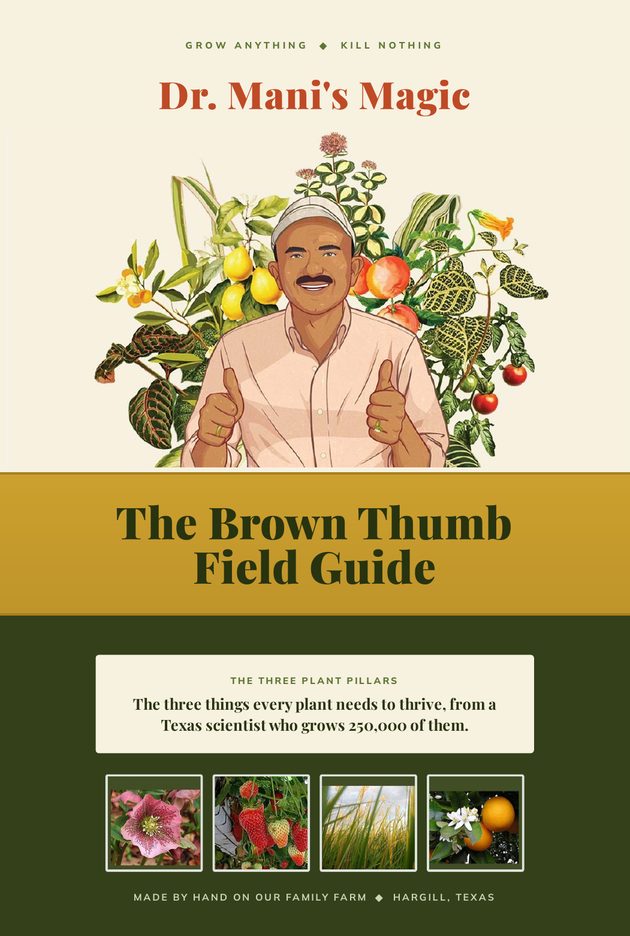
Notice something. Every single organism in that table is doing something for your plant. Not for itself. For your plant. This is the deal that plants struck with soil life over hundreds of millions of years of co-evolution. The plant feeds the microbes sugar through its roots. The microbes feed the plant nutrients, water, and protection in return.
When you uproot a healthy weed and see fuzzy white threads clinging to the roots, that is mycorrhizal fungi. That is the same network that helped ancient forests grow without a single bag of fertilizer. Weeds tap into it naturally. Your garden plants can too, when the biology is healthy.
According to University of Minnesota Extension, soil biology is the foundation of soil health, and organic matter is the primary food source that keeps this entire food web alive and functioning.
What Happens to Soil Biology When Synthetic Fertilizers Take Over?
Quick Answer: Synthetic fertilizers are salt-based. High salt concentrations damage or kill beneficial bacteria and fungi in the root zone, collapsing the soil food web over time. The plant becomes chemically dependent, loses its microbial partners, and grows progressively weaker even as it appears to green up quickly after each application.
Here is the part nobody at the big box store will ever tell you.
When the Green Revolution came in the mid-twentieth century, synthetic fertilizers exploded across American agriculture. Nitrogen, phosphorus, and potassium in concentrated salt form, cheap to produce, fast to show results. Miracle-Gro launched in the 1950s and essentially taught an entire generation of American gardeners that plants eat chemicals, not soil life.
The problem is that synthetic fertilizers are salts. And salts kill microbes.
Think about it this way. You know how salt preserves meat? It kills the bacteria that would decompose it. That same principle is happening in your soil every time you pour on a synthetic fertilizer. You get a quick green-up because the plant is absorbing the dissolved salts directly. But the microbial workforce that was supposed to sustain that plant long-term? Damaged. Depleted. Over years of repeated salt applications, the soil food web collapses. You are left with chemically dependent plants in biologically dead soil.
Then the real problems start. Root rot. Yellowing leaves. Pest infestations. Disease pressure. You buy more products to fight each symptom. More chemicals, more fungicides, more pesticides, each one doing further damage to whatever biology remains.
This is not a conspiracy theory. It is just chemistry. And it is exactly why Dr. Mani Skaria, after forty years of plant pathology research at the Texas A&M Citrus Center and growing over 250,000 trees at US Citrus Nursery, landed on the Three Plant Pillars as the non-negotiable foundation for any plant to thrive. See also: The Hidden Reason Synthetic Fertilizers Cause Root Rot for a deeper look at how this damage unfolds at the root level.
The good news is that soil biology can be restored. But it takes intention, the right inputs, and time. You cannot rush it with more chemicals. You can only feed it with what it actually needs: organic matter, live microbes, and the absence of the things that kill them.
Live Microbes vs. Dead Microbes: Why Most Bottled Products Fail in Real Gardens
Quick Answer: Most commercial microbial products are either dried powders with dormant or dead spores that never properly reactivate, or compost-derived liquids that have already gone anaerobic and smell terrible. Neither delivers the full-spectrum, genuinely live biology that plant roots need. Only stabilized, living microbes harvested from real compost provide the active soil food web that transforms your garden.
Walk down the gardening aisle of any home improvement store and you will see dozens of products claiming to contain beneficial bacteria and fungi. They look impressive. Long ingredient lists. Scientific names. Impressive colony counts on the label.
Most of them do almost nothing.
After years of testing at US Citrus Nursery, on 250,000-plus trees, Dr. Mani's team worked through batch after batch of commercial microbial products. The results were consistently disappointing. Here is why, broken down simply.
| Product Type | Viability at Use | Microbial Spectrum | Smell | Real-World Results |
|---|---|---|---|---|
| Dry/powdered lab-grown microbes | Very low. Spores often do not reactivate properly in soil. | Narrow. A handful of selected species. | Little to none | Minimal benefit observed in repeated testing |
| Dried powder reconstituted in liquid | Very low. Same reactivation problem. | Narrow | Little to none | Minimal benefit. Avoid. |
| Compost tea, old (more than 24 hours) | Low. Gone anaerobic. Microbes dying. | Partial. What survived the die-off. | Strong, foul, sewage-like odor | Some humic/fulvic acid benefit remains but biology is largely gone |
| Compost tea, fresh (under 24 hours, aerated) | Moderate. Time-sensitive. | Partial | Earthy to slightly sour | Good if used immediately. Impractical for most home gardeners. |
| Fresh active compost, on-site | High. Living and active. | Broad and diverse | Earthy, rich | Excellent. The gold standard. Labor and space intensive. |
| Plant Super Boost (stabilized, full-spectrum) | High. Genuinely live microbes, stabilized by an all-natural method. | 2,000+ bacterial species; 400-500 fungal species including mycorrhizae; plus protozoa and nematodes | Earthy. Not foul. Not rotting. | Significant, documented improvements across citrus, houseplants, gardens, and lawns |
The story behind Plant Super Boost is worth knowing. It was not invented in a lab by a chemical company. It was born from a chance meeting with a world-renowned compost expert, a man who had advised the farming practices of royal families and governments across the world. He had been blacklisted by large chemical interests after his methods helped major citrus groves achieve results that threatened the fertilizer industry's business model. At one point, he feared for his life and stopped his work entirely.
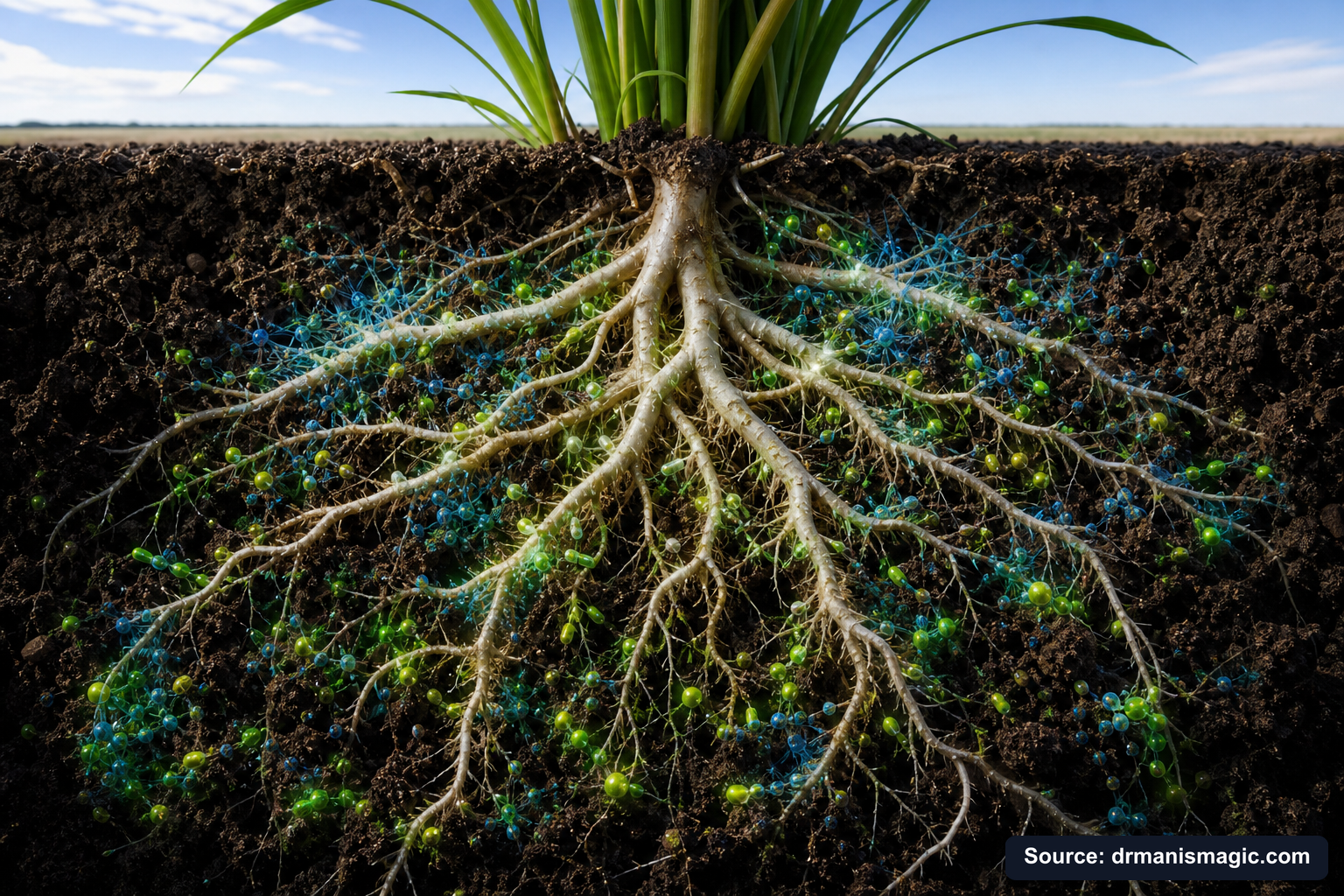
Years later, through what can only be described as a providential meeting, he joined forces with Dr. Mani at US Citrus Nursery. Together, they developed a proprietary, all-natural stabilization technique that keeps the full spectrum of compost microbes alive in a bottle, without going anaerobic, without the foul smell, without the die-off. If you take a drop of Plant Super Boost and put it under a microscope, you can watch the microbes moving. They are alive. Multiple independent lab analyses confirm it.
That is not marketing language. That is the difference between a product built from forty years of plant pathology and a product built in a factory to meet a checklist. Zero PFAS. Zero biosludge. Zero synthetic salts. Made in the USA.
You Never Had a Brown Thumb.
You were handed the wrong tools. This free guide hands you the right ones.
You watered it. You fed it. It died anyway.
It was never you. It was the dirt, the salt food, and the bad advice.
This guide shows you what really went wrong, and how to fix it for good.
- Why your plants really died, and why it was never your fault
- The salt hiding in your plant food that quietly burns the roots
- The hidden killer in almost every bag of store soil
- The tiny helpers that grow a whole forest for free
- The rescue trick that brings a half dead plant back to life
What Did Sir Albert Howard Discover That Changed Modern Agriculture?
Quick Answer: Sir Albert Howard observed that Indian farmers growing crops without any synthetic inputs produced healthier, more disease-resistant plants than farms using chemicals. He concluded that feeding the soil's living community, not the plant directly, was the key to plant health. His 1931 Indore Process formalized hot composting and became the scientific foundation of the organic farming movement.
Howard spent years in India watching farmers work. What struck him most was not what they did. It was what they did not do. No synthetic nitrogen. No chemical pesticides. No fungicides. Yet their crops were strong, their animals were healthy, and their soil kept producing year after year after year.
He dug into the soil. Literally. And he found the answer: organic matter, microbial activity, and a complete nutrient cycle that left nothing wasted. Everything that died went back into the soil. Everything the soil produced fed the next generation of growth.
Howard brought this philosophy back to England and published An Agricultural Testament in 1940. In it, he wrote that the health of soil, plant, animal, and human is one and indivisible. Damage one link, and the whole chain weakens.
J.I. Rodale read Howard's work and brought it to the United States, founding what became the organic farming movement. Howard's ideas were rejected by mainstream agronomy for decades. The fertilizer industry was too profitable, too entrenched, and too effective at lobbying universities and government agencies.
Sound familiar?
According to University of Maryland Extension, compost improves soil structure, increases water-holding capacity, feeds beneficial soil organisms, and suppresses plant diseases. That is Howard's central argument, validated by modern soil science, still being ignored by the products on most store shelves.
Is Compost the Same as Fertilizer, and Can It Replace Chemical Inputs?
Quick Answer: Compost and fertilizer are fundamentally different things. Fertilizer delivers nutrients directly to plants. Compost builds a living soil ecosystem that generates, cycles, and delivers nutrients continuously. Compost cannot always replace fertilizer entirely, but it can dramatically reduce your dependence on it while building long-term soil health that no fertilizer alone can create.
This is one of the most important distinctions in all of gardening, and almost nobody explains it clearly.
When you pour synthetic fertilizer on your plants, you are making a direct deposit into the plant's nutrient account. Fast, measurable, visible. The plant greens up. You feel good. Then the nutrients leach away, the microbes take another hit from the salts, and two weeks later you need to do it again. It is a subscription model for your garden. One that benefits the fertilizer company more than it benefits your plants.
When you add compost or living microbial inputs to your soil, you are doing something different. You are hiring a workforce. You are building a biological system that generates nutrients continuously, holds moisture, suppresses disease, and builds structure over time. The investment compounds. Each month it works, the soil gets better, not worse.
That is the core of the Three Plant Pillars that Dr. Mani developed and battle-tested across 250,000 trees. The Three Plant Pillars are not a product pitch. They are a first-principles framework for how plants actually grow in nature:
- Mineral-Based Soil that does not decompose, compact, or suffocate roots. Permanent structure. Real drainage. Room for roots to breathe.
- Live Microbials that restore the soil food web, unlock nutrients, suppress pathogens, and form the partnerships your plant roots evolved to depend on.
- Organic Fertilizer that feeds the plant gently and slowly, in harmony with the microbes, not against them. No salts. No chemical burn. No plastic-coated slow-release pellets leaching toxins into your soil.
All three together create something that chemical gardening can never replicate: a self-reinforcing living system that gets stronger over time, not weaker.
How Did the Shift to Synthetic Fertilizers Break the Ancient Compost Loop?
Quick Answer: Before synthetic fertilizers, every civilization maintained nutrient cycling by returning organic waste to farmland. Synthetic nitrogen from the Haber-Bosch process, industrialized after World War II, broke that loop. Farmers stopped composting because chemical nitrogen was cheap and easy. The soil food web was neglected for generations, leaving modern soils biologically depleted and structurally fragile.
The Haber-Bosch process changed everything. In the early 1900s, German chemists figured out how to pull nitrogen from the air and turn it into synthetic ammonia. By the mid-twentieth century, that chemistry was feeding the world. The Green Revolution, fueled by synthetic nitrogen, is credited with preventing mass famine as global populations exploded.
But there was a cost nobody calculated at the time.
When synthetic nitrogen became cheap and plentiful, the ancient composting loop broke. Farmers stopped collecting waste and returning it to the fields. Cities stopped managing night soil. The circular economy of nutrients that had sustained civilization for thousands of years was replaced by a linear one: extract, apply, wash away, repeat.
The soil food web, which had been built and sustained by millennia of organic matter cycling, began to collapse under the weight of salt-based inputs, herbicides, fungicides, and bare-soil tillage. The invisible workforce that Howard had written about, that Chinese farmers had fed for a thousand years, was systematically dismantled in a single generation.
The results are now well-documented. Topsoil erosion. Nutrient runoff. Declining yields on heavily farmed land. Increased disease pressure. Greater water requirements. Farms that grow more dependent on chemicals each year, not less. Plants that cannot thrive without constant intervention.
Sound like your backyard?
The good news is that the biology can come back. It is not gone forever. It is just waiting for the right conditions. See also: How Salt-Based Feeding Quietly Destroys Root Systems for a detailed look at how this damage accumulates and what it looks like in your plants.
How Do You Rebuild Dead or Chemically Damaged Soil at Home?
Quick Answer: Rebuilding soil biology after chemical damage requires stopping the inputs that kill microbes, adding organic matter as food for the soil food web, and introducing genuinely live, full-spectrum microbial inoculants repeatedly over time. Recovery is not instant, but within weeks you can see measurable improvements in root health, color, and plant vigor.
This is the practical part. If your soil has been treated with synthetic fertilizers, herbicides, fungicides, or pesticides for years, the damage is real. But it is reversible. Here is a simple recovery checklist based on what actually worked across years of testing at US Citrus Nursery.
- Stop adding what kills microbes. This means stepping away from salt-based synthetic fertilizers, broad-spectrum herbicides, and chemical fungicides. You cannot rebuild a workforce while continuing to poison the job site.
- Add organic matter as microbial food. Compost, aged wood chips, or organic mulch on the soil surface gives the returning biology something to eat. This is the fuel for the food web.
- Drench with live, full-spectrum microbials. Not powdered. Not foul-smelling. Genuinely living. Apply monthly. The biology needs to be reintroduced repeatedly because damaged soils have competing pathogenic organisms, and the beneficial microbes need numbers and consistency to establish and win.
- Switch to organic, slow-release fertilizer. Feed the plant gently with nutrients that work with the microbes, not against them. Crab, kelp, and amino acids deliver a complete spectrum of macro and micronutrients without the salt damage.
- Improve soil structure if needed. In containers, or in ground soil that has been heavily compacted or filled with decomposing bark-based mixes, the physical structure needs to support drainage, aeration, and root movement. Mineral-based soil does not compact, does not decompose, and does not rob oxygen from roots.
- Be consistent and patient. Soil biology rebuilds over months, not days. Each application of live microbes adds to the population. Each feeding of organic matter fuels the food web. Give it time, and the compounding effect becomes visible in your plants.
- Watch for the signs of recovery. New root growth. Deeper green color in leaves. Stronger stems. Resistance to pests that previously caused damage. Earthworms returning to formerly dead soil. These are the signals that the food web is coming back to life.
The Free Plant Care Field Guide walks you through this process step by step, for any plant, in any setting, with zero jargon and zero guesswork.
Compost vs. Synthetic Fertilizer: Which One Actually Builds a Better Garden Long-Term?
Quick Answer: Synthetic fertilizers produce fast, visible short-term results but degrade soil biology, increase salt accumulation, and create chemical dependency over time. Compost-based biology builds slowly but creates self-sustaining, resilient growing systems that improve every season. For any plant you want to thrive for years, not just weeks, compost-based soil biology wins decisively.
Let's lay this out clearly, side by side.
| Factor | Compost-Based Biology | Synthetic Salt-Based Fertilizer |
|---|---|---|
| Speed of visible results | Slower at first; builds momentum | Fast green-up within days |
| Effect on soil microbes | Feeds and multiplies beneficial biology | Damages and kills beneficial bacteria and fungi |
| Water retention over time | Improves with each season | Degrades as soil structure collapses |
| Disease resistance | Increases as food web strengthens | Decreases as microbial protectors die off |
| Nutrient cycling | Self-renewing through biological activity | External dependency; must be reapplied constantly |
| Salt accumulation | None | Builds over time; eventually toxic to roots |
| Chemical safety | Safe for children, pets, barefoot contact | Warnings on labels; re-entry intervals; potential contamination |
| Long-term cost | Decreasing as soil becomes self-sustaining | Increasing as dependency deepens and soil degrades |
| What happens if you stop applying | Soil biology continues functioning | Plants immediately show stress and decline |
There is a reason every civilization that survived for centuries, from the Song dynasty to ancient Rome to the farmers Sir Albert Howard studied in India, used biology rather than chemistry. Not because they were primitive. Because it worked. And it kept working, generation after generation.
The number one thing people tell Dr. Mani they want? To see fruit on a tree they planted. To harvest something they grew. To know their backyard is producing, not just surviving. You cannot get time back. Every month spent on the wrong approach is a month the biology is not building. The plants are not growing toward that harvest. The moment is not getting closer. You can always earn more money. You cannot earn more time. Start building the right foundation now, and let compounding biology do what it has always done: turn patient investment into extraordinary results.
What Can You Do Right Now to Start Growing the Way Nature Intended?
Quick Answer: Start with the Three Plant Pillars. Add mineral-based soil for structure, introduce genuinely live microbials monthly to restore the soil food web, and feed with organic slow-release fertilizer that works with the biology instead of against it. This is the same system proven across 250,000 trees at US Citrus Nursery, and it works for any plant in any setting.
The ancient farmers did not have a PhD in soil science. They did not need one. They just worked with nature instead of against it. They closed the loop. They fed the soil life. They let the invisible world do the heavy lifting.
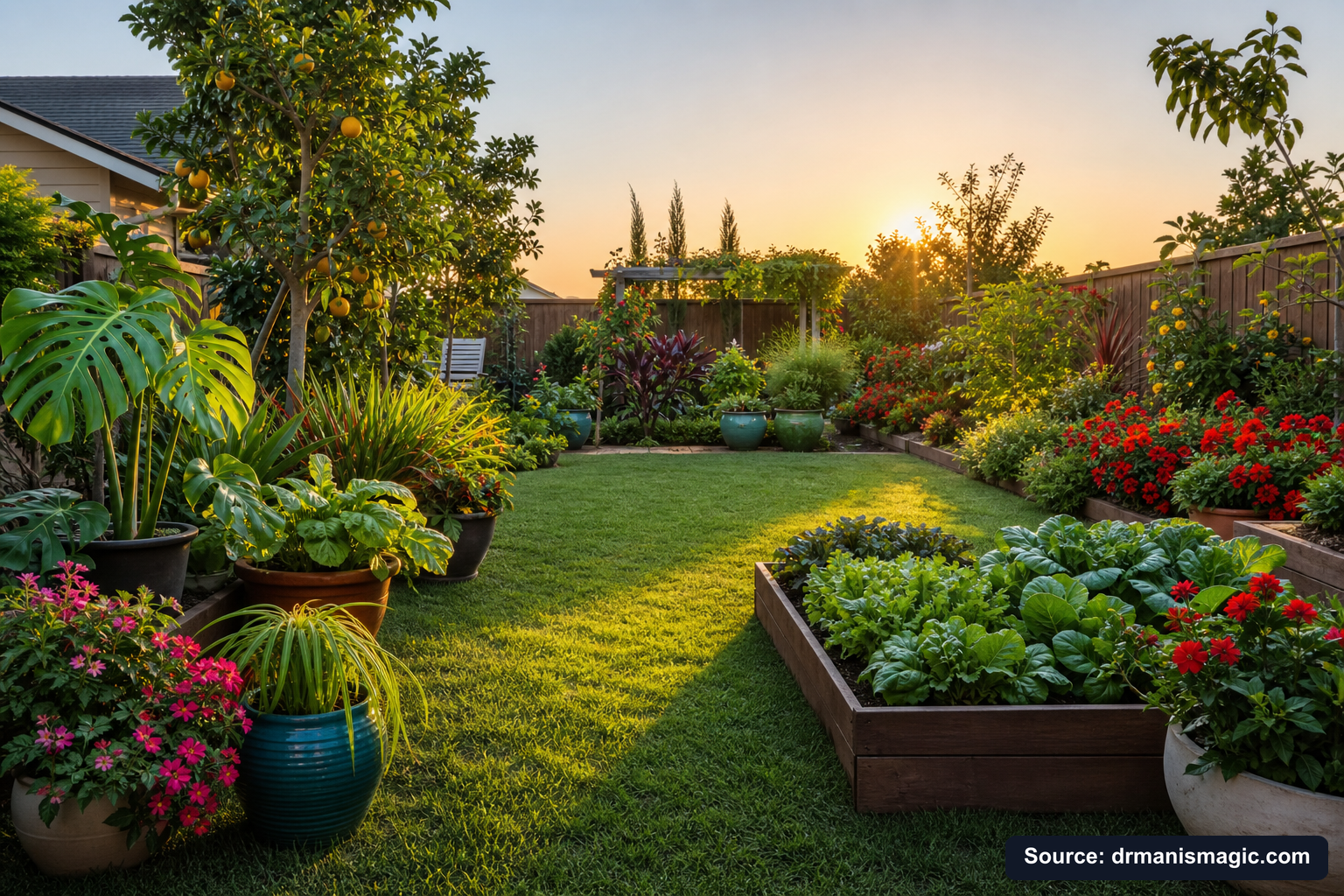
You can do the same thing. Today. In your backyard, your containers, your raised beds, your lawn, your houseplants.
You do not need a compost pile that takes months to build. You do not need to brew compost tea in a five-gallon bucket at midnight. You do not need to piece together ten different products from five different companies and hope they work together.
Dr. Mani spent forty years and 250,000 trees figuring this out so you would not have to. The Three Plant Pillars, mineral foundation, microbial muscle, and organic fuel, are not complicated. They are just honest. They work the way soil actually works. They build on each other. And they get better every month you use them.
Walk barefoot on your grass without wondering what chemicals are soaking into your skin. Let your kids and your pets back into the garden. Harvest something from your own backyard, something you grew, something you can smell and taste and be proud of, without a warning label in sight.
That is what healthy soil makes possible. That is what compost changed about civilization. And that is what it can still change for your garden, starting right now.
If you want to see exactly how the Three Plant Pillars work together for your specific plants, the Free Plant Care Field Guide is the clearest starting point we know of. No guesswork. No jargon. Just the system that actually works, explained in plain language, backed by decades of real growing experience.
Your soil is waiting. The biology wants to come back. Give it what it needs, and it will take care of everything else.
Frequently Asked Questions
Compost changed the world. But most gardeners still don't know why it worked, or why their garden keeps struggling without it. These questions cut straight to the heart of what composting really is, what it does to your soil, and how the living biology behind it connects directly to the Three Plant Pillars that Dr. Mani spent 30 years proving on over 250,000 trees in South Texas.
How has composting changed over time?
Composting started as pure survival. Ancient farmers returned waste to the soil because it worked. Then synthetic fertilizers arrived in the mid-1900s and broke that loop. Soil health crashed. Now composting is making a comeback, with facilities growing 55% between 2016 and 2021. But the real shift is understanding that compost is not just decomposed material. It is a living ecosystem of microbes. That is the same biology behind Dr. Mani's Plant Super Boost, which delivers stabilized, live microbes straight to your roots without the wait or the smell.
What is the history of composting?
Composting goes back over 10,000 years. Early farmers noticed plants grew stronger where organic matter piled up. The Akkadian Empire recorded it on clay tablets around 2300 BC. Chinese farmers built entire city economies around returning waste to farmland. Sir Albert Howard formalized it with the Indore Method in the early 1900s. The pattern is always the same: civilizations that fed the soil thrived. Civilizations that exhausted it collapsed. Dr. Mani built the Three Plant Pillars on that same ancient truth, tested and proven on a quarter million citrus trees.
What are the 5 benefits of composting?
Real compost does five big things. It feeds your soil with slow-release nutrients. It introduces living bacteria and fungi that fight disease naturally. It improves drainage so roots can breathe. It holds moisture so plants survive dry spells. And it cuts your need for chemical fertilizers that actually hurt your soil over time. Every one of those benefits maps directly to the Three Plant Pillars. Mineral-based soil for drainage and aeration. Live microbes for biological defense. Organic fertilizer made from crab, kelp, and amino acids for clean, slow-release nutrition with zero toxic burn.
What are the disadvantages of composting?
Traditional composting is slow, smelly, and hard to get right. You need the right mix of materials. You need to turn the pile. You need to wait months. Most people quit before they see results. Worse, many bottled microbial products on the market are either dead powder or foul-smelling liquid that has already gone anaerobic. That is exactly the problem Dr. Mani solved. Plant Super Boost uses a special stabilization process to keep live microbes alive in the bottle, ready to work the moment you pour them on your plants. No rotting smell. No guesswork. No waiting forever.
Did Native Americans compost?
Yes. Native Americans composted while planting, using fish waste and organic matter directly in the soil alongside seeds. They understood something modern gardeners have forgotten: the soil is alive, and you have to feed it to feed your plants. That is Pillar Two of the Three Plant Pillars. Without live microbes in your soil, your plants are defenseless. They cannot absorb nutrients properly. They cannot fight off disease. Dr. Mani proved this over decades at US Citrus Nursery, and the results show up in every tree that goes out the door.
What are the 14 states that allow human composting?
As of now, 14 states have legalized Natural Organic Reduction, which is the technical term for human composting. Those states include Washington, Colorado, Oregon, Vermont, California, New York, Nevada, Arizona, Maryland, Delaware, Minnesota, Maine, Georgia, and New Jersey. Washington was the first, legalizing it in 2019. The process takes 30 to 45 days and uses natural microbes to break organic material down into rich soil. It is a powerful reminder that microbes are not just a gardening trick. They are the engine that drives all of nature's recycling.
Where did human composting start?
Human composting as a modern practice was first conceived by Katrina Spade in 2011 and developed by a company called Recompose. Washington State made it legal in 2019, becoming the first state in the country to do so. The process mirrors what nature has always done: microbes break down organic material and return it to the earth as living soil. That same principle is at the core of Dr. Mani's Magic. When you give your plants the right microbes, the right mineral soil, and the right organic nutrition, you stop fighting nature and start working with it. That is when your garden finally takes off.
About the Author
Ron Skaria, MD
Ron Skaria, MD, is the co-founder of Dr. Mani's Magic and the son of Dr. Mani. He trained as a medical doctor at Baylor College of Medicine, did his residency at UT Health Science Center - San Antonio and fellowship training at Texas Tech University. He now works full time on the family farm at US Citrus and US Citrus Nursery in Hargill, Texas, building Dr. Mani's Magic alongside his dad. He wrote the Brown Thumb Field Guide to put his father's 48 years of plant science into plain words any gardener can use. His belief is simple. You never had a brown thumb. You just never had the right help.


