


How Citrus Roots Communicate With Soil Life | Dr. Mani's Magic
How Citrus Roots Communicate With Soil Life (And Why That Invisible Conversation Decides Everything)
Picture this. You're standing in your backyard on a warm Saturday morning. Coffee in hand. The sun is just starting to climb. And there's your citrus tree — leaves yellowing, fruit sparse, the whole thing looking tired no matter what you do.
You've tried fertilizer. You've adjusted the watering. You've Googled until your eyes went blurry. But something is still wrong. And here's what nobody told you: the real problem isn't above the soil. It's below it. Right now, under your feet, there is a conversation happening between your tree's roots and billions of invisible living things. When that conversation is healthy, your tree thrives. When it breaks down — when the microbes go quiet and the soil goes dead — the tree slowly loses its grip on life. No fertilizer in the world can fix a broken underground conversation.
This is the story of that conversation. What it is. How it works. And exactly what you can do to bring it back to life — whether you're growing citrus in a backyard orchard, a container on your patio, or a garden plot in your front yard. After growing and shipping over 250,000 trees from our South Texas nursery, we've seen this play out thousands of times. And we want to hand you the knowledge that changes everything.

Plant Super Boost
Key Takeaways
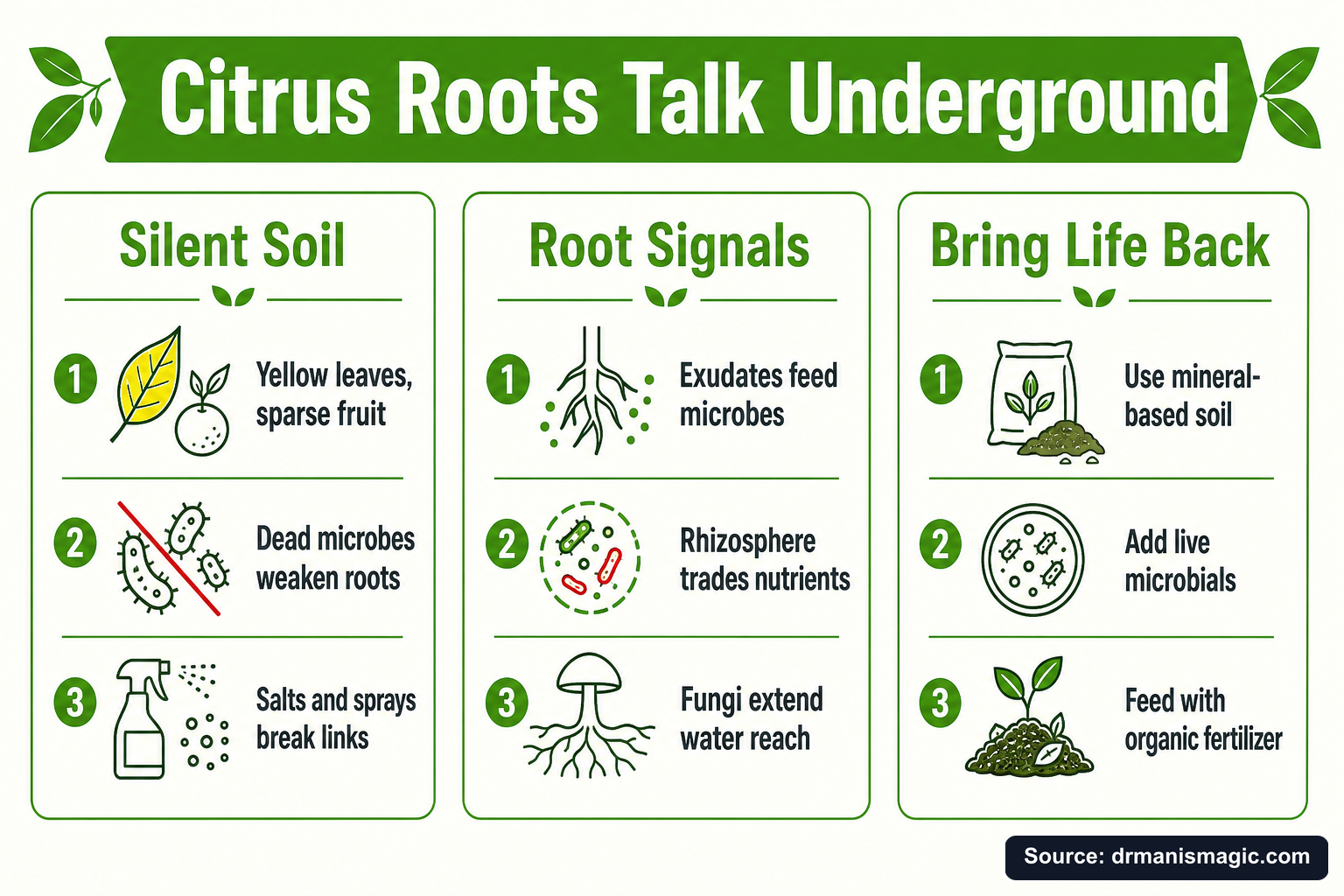
- Citrus roots don't just absorb nutrients — they actively recruit and feed billions of microbes through chemical signals called root exudates.
- The thin zone of living soil around citrus feeder roots (called the rhizosphere) is where nearly all nutrient exchange, disease defense, and water absorption happens.
- Beneficial bacteria, mycorrhizal fungi, protozoa, and helpful nematodes form a complete underground food web that keeps your tree fed, protected, and resilient.
- Salt-based synthetic fertilizers, broad-spectrum fungicides, and herbicides break this conversation apart — silently and progressively.
- Most commercial microbial products are either dead powders or stinking anaerobic liquids — neither delivers real live biology to your roots.
- Sterile potting mixes and container soils have zero living biology — without deliberate inoculation, your potted citrus is growing in silence.
- The Three Plant Pillars — mineral-based soil, live microbials, and organic fertilizer — restore and protect this underground conversation from the roots up.
What Is the Rhizosphere and Why Does It Matter for Citrus?
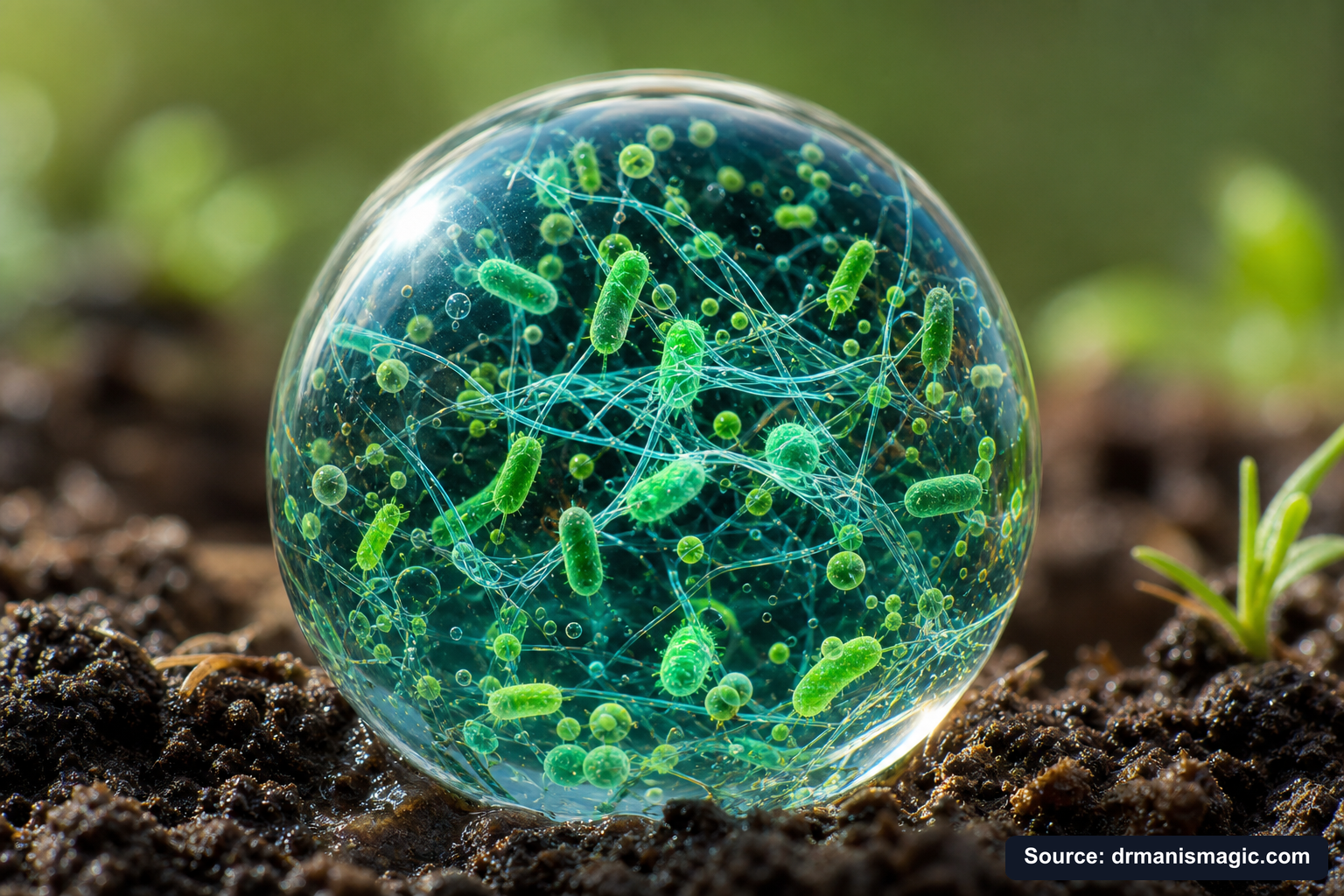
Quick Answer: The rhizosphere is the narrow zone of living soil wrapped around your citrus tree's feeder roots. It is the most biologically active spot in your entire garden — the exact place where roots trade carbon for nutrients, recruit protective microbes, and build disease resistance. Everything important happens here.
The rhizosphere isn't a place you can see. It's thinner than a pencil line. But it is the most important piece of real estate your citrus tree owns.
The word comes from the Greek word for root — "rhiza." It simply means the soil directly influenced by root activity. And according to UF/IFAS Extension, this zone is where roots and microbes communicate in ways that shape everything from nutrient uptake to disease resistance.
Here's why this matters so much for citrus specifically. Citrus trees don't feed through their big, thick structural roots. Those roots are just anchors. The real feeding happens through the finest, most delicate roots — called fibrous feeder roots. These gossamer-thin threads are concentrated in the top few inches of your wetted irrigation zone. They are the true mouth of your tree.
And around those feeder roots? The rhizosphere buzzes with life. Bacteria. Fungi. Protozoa. Nematodes. Tiny creatures so small you need a microscope to see them. All of them living, feeding, competing, and cooperating in a way that directly determines how healthy your tree is.
When the rhizosphere is alive and thriving, your citrus tree:
- Pulls in more phosphorus, zinc, and iron than it ever could alone
- Resists root rot and soil-borne pathogens
- Handles drought and heat stress better
- Produces more flowers and more fruit
- Bounces back from damage faster
When the rhizosphere goes quiet — when the microbes die — your tree is fighting alone. And it will lose. Slowly, steadily, and expensively.
How Do Citrus Roots Actually "Talk" to Soil Microbes?
Quick Answer: Citrus roots release a stream of sugars, acids, and chemical signals into the surrounding soil. These secretions — called root exudates — act like a dinner bell and a recruitment notice at the same time, drawing specific beneficial microbes close and feeding them in exchange for nutrients, protection, and water access.
Your citrus tree is not passive. It is actively managing its underground neighborhood.
Every day, citrus feeder roots leak a cocktail of substances into the soil. These are called root exudates. Think of them as a combination of food, messages, and chemical invitations. They include:
- Sugars — energy food for bacteria and fungi
- Organic acids — these change the pH of the soil right around the root tip, unlocking minerals that would otherwise be chemically locked up
- Enzymes — biological tools that break down complex organic matter into forms the tree can actually use
- Signaling compounds — chemical "words" that attract specific helpful microbes and even warn against harmful ones
In return, the microbes that respond to these signals deliver something extraordinary. Nutrients. Water. Protection. Things the tree cannot get on its own.
It is a negotiation. A trade. A partnership that has been running for hundreds of millions of years.
A healthy citrus tree will send up to 40% of the carbon it makes through photosynthesis down through its roots and out into the soil as exudates. That's not waste. That's an investment. The tree is literally paying the microbes to work for it.
When you pour salt-based synthetic fertilizer on the soil, you flood that zone with mineral salts. Those salts kill bacteria. They damage fungal threads. They disrupt the delicate pH balance the root was carefully engineering. The conversation gets cut off. And the tree ends up more dependent on you — and on more fertilizer — than ever before. That's exactly how the big chemical companies want it.
See also: How Salt-Based Feeding Quietly Destroys Root Systems
What Is the Citrus Soil Food Web and Who Are the Key Players?
Quick Answer: The citrus soil food web is a layered community of organisms — bacteria, fungi, protozoa, and nematodes — each playing a specific role in feeding, protecting, and sustaining your tree. Remove any layer and the whole system weakens. Restore all layers and your tree becomes nearly bulletproof.
Most people think soil is just dirt. Inert stuff. Something to hold the roots in place.
It's not. A single teaspoon of healthy garden soil contains more living organisms than there are people on Earth. And around citrus feeder roots, that number is even higher — because the tree is actively feeding and recruiting those organisms.
Here is a map of the key players in the citrus soil food web and what each one does for your tree:
| Organism | Role in the Food Web | What It Does for Your Citrus Tree |
|---|---|---|
| Beneficial Bacteria | Decomposers, nutrient miners, disease suppressors | Fix nitrogen from air, solubilize phosphorus and minerals, crowd out pathogens, improve soil structure |
| Arbuscular Mycorrhizal Fungi (AMF) | Root extenders, nutrient and water brokers | Extend root reach up to 100x, deliver phosphorus and water, improve drought and disease resistance |
| Saprophytic Fungi | Decomposers | Break down organic matter into plant-available nutrients, build soil structure through glomalin |
| Protozoa | Bacterial grazers, nutrient releasers | Eat bacteria and release nitrogen in plant-available form right at the root zone — like a tiny fertilizer factory |
| Beneficial Nematodes (bacterial-feeding) | Nutrient cyclers | Consume bacteria, release nutrients, keep bacterial populations from becoming imbalanced |
| Beneficial Nematodes (fungal-feeding) | Fungal regulators | Graze on fungi, cycling nutrients and keeping fungal communities balanced |
| Predatory Nematodes | Top-level predators | Control harmful nematode populations, suppress soil-borne pathogens |
| Plant-Parasitic Nematodes | Root damage agents (harmful) | Invade and damage feeder roots, reducing nutrient uptake and creating entry points for disease |
Notice that most nematodes in this list are beneficial. That's something most citrus content gets completely wrong. The internet is full of warnings about nematodes — but those warnings are about a specific subset of parasitic species. A healthy soil food web actually uses beneficial nematodes to suppress the bad ones. It's self-regulating. When you poison the whole system trying to kill the bad guys, you take out the good guys too. And then the bad guys come back harder.
According to Colorado State University Extension, mycorrhizal fungi alone can increase the effective absorbing surface area of a root system by up to 1,000 percent. That means your citrus tree with healthy AMF is not just a little better at finding water and nutrients — it is in a completely different league.
What Is Arbuscular Mycorrhizal Fungi and Do Citrus Trees Really Need It?
Quick Answer: Arbuscular mycorrhizal fungi (AMF) are beneficial fungi that physically grow into citrus feeder roots and extend a web of microscopic threads through the surrounding soil. They trade phosphorus, water, and micronutrients to the tree in exchange for carbon sugars. Citrus trees evolved to depend on this relationship — without it, they work much harder for far less reward.
Let's talk about the most important microbe partner your citrus tree has.
Mycorrhizal fungi — specifically the arbuscular type (AMF) — do something no other organism in the soil can do. They physically grow into your tree's feeder root cells. Not on the outside. Inside. They form a structure called an arbuscule — a tiny branching interface — right inside the root cell wall. This is where the trade happens.
The fungus hands over phosphorus, zinc, copper, and water. The tree hands over carbon sugars. Both walk away richer.
Now here's the part that should stop you cold. Those fungal threads — called hyphae — extend out through the soil in every direction. They can reach places the root itself will never go. Tiny pores in the soil that a root tip is far too large to enter. Mineral surfaces the root acid alone cannot dissolve. Pockets of water the root cannot reach during drought.
Effectively, AMF turns your tree's root system into something vastly larger and more powerful than it is on its own.
But here's where it gets complicated. AMF only works under the right conditions. And most modern growing situations break those conditions without the grower ever knowing it.
When Mycorrhizal Fungi Help — and When They Don't
This is the section most microbial product sellers don't want you to read.
| Situation | Does AMF Help? | Why |
|---|---|---|
| Transplanting into new soil | Yes — critical | Roots are stressed and the new soil has no established AMF network |
| Sterile potting mix or container | Yes — essential | Bagged potting mix has zero living biology — AMF must be introduced |
| Damaged or compacted soil | Yes — very helpful | AMF helps restore nutrient access and soil structure |
| High phosphorus soil or fertilizer | Reduced | Tree has no need to trade for phosphorus when it's already flooded with it |
| Soil treated with broad-spectrum fungicide | Blocked | Fungicide kills AMF along with pathogenic fungi |
| Waterlogged or oxygen-poor soil | Blocked | AMF requires oxygen to survive and colonize roots |
| High soil salinity | Reduced | Salt disrupts root cell function and AMF colonization |
| Mature tree in living native soil | Already present | Existing native AMF network is likely already established — but can be disrupted by inputs |
| Dry or overheated stored product | None | Dead spores provide zero benefit regardless of label claims |
That last row is the one that catches most people. They buy a bag of powdered mycorrhizal product. It's been sitting on a warehouse shelf. The spores are dead. They pour it on their tree and nothing happens. They conclude mycorrhizae don't work. But the truth is simpler: dead microbes don't do anything. Ever.
Are All Nematodes Bad for Citrus Trees?
Quick Answer: No. Most nematodes in a healthy citrus rhizosphere are beneficial. Bacterial-feeding and fungal-feeding nematodes cycle nutrients and keep microbial populations balanced. Predatory nematodes suppress harmful species. Only plant-parasitic nematodes — a specific subset — damage citrus roots, and a thriving soil food web naturally controls their populations.
The word "nematode" causes panic in most citrus growers. That's understandable. Plant-parasitic nematodes like Tylenchulus semipenetrans — the citrus nematode — are real problems. They invade feeder roots, disrupt nutrient flow, and create wounds that fungal pathogens exploit.
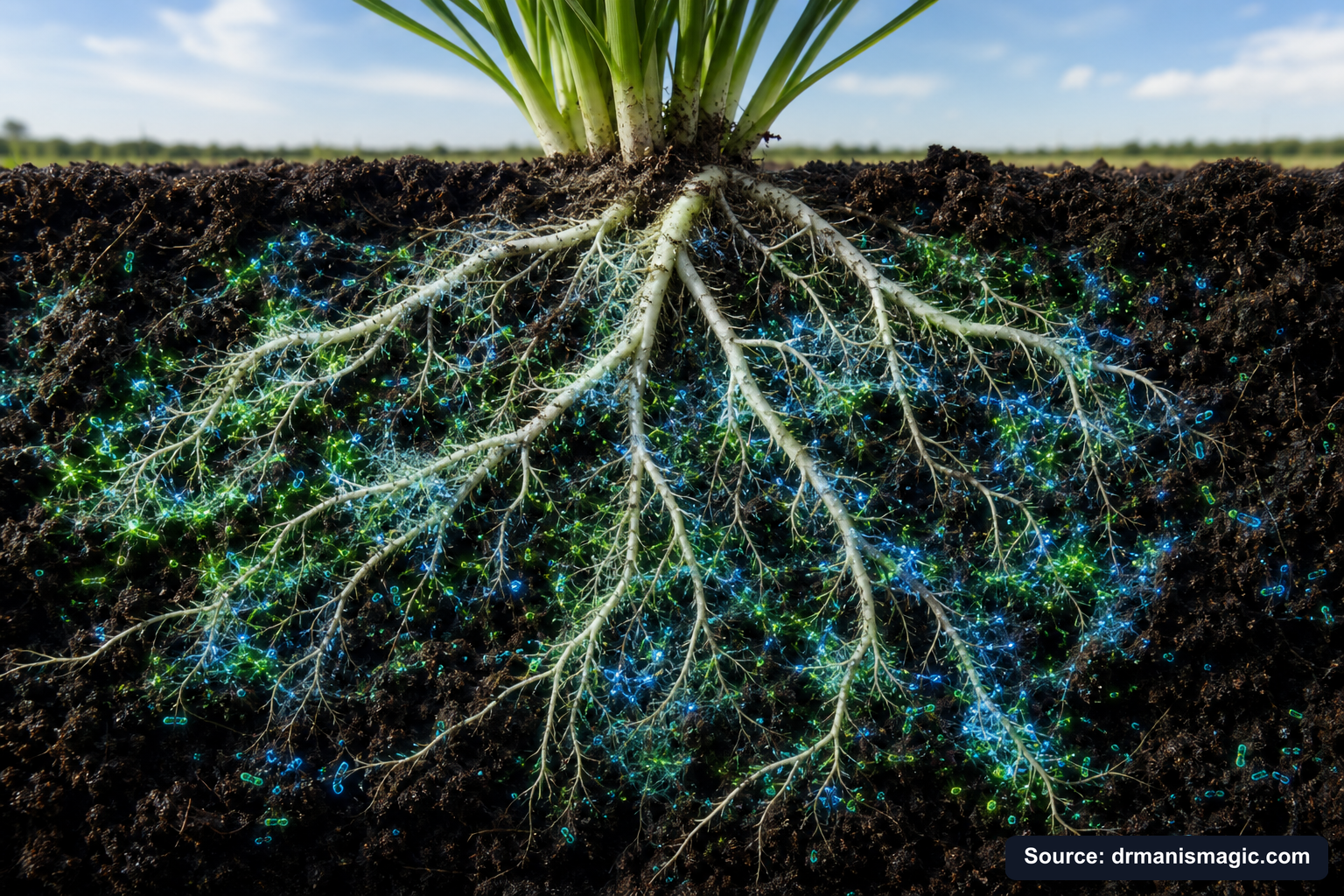
But here's what the pest-control companies don't advertise: a living, diverse soil food web suppresses those harmful nematodes naturally. Predatory nematodes hunt them. Certain bacteria produce compounds that paralyze them. AMF-colonized roots are physically harder to invade.
When you nuke the soil with broad-spectrum nematicides, you kill everything — predators included. The plant-parasitic nematodes then rebound into a vacuum with no natural enemies. You've made the problem worse.
The answer isn't chemical warfare. The answer is rebuilding the community that keeps the bad actors in check.
You Never Had a Brown Thumb.
You were handed the wrong tools. This free guide hands you the right ones.
You watered it. You fed it. It died anyway.
It was never you. It was the dirt, the salt food, and the bad advice.
This guide shows you what really went wrong, and how to fix it for good.
- Why your plants really died, and why it was never your fault
- The salt hiding in your plant food that quietly burns the roots
- The hidden killer in almost every bag of store soil
- The tiny helpers that grow a whole forest for free
- The rescue trick that brings a half dead plant back to life

Why Does Sterile Potting Mix Put Your Citrus in Danger?
Quick Answer: Commercial potting mixes are sterilized during production, which means they contain zero living biology. Your potted citrus is growing in biological silence — no beneficial bacteria, no mycorrhizal fungi, no protozoa, no helpful nematodes. Without deliberate inoculation, the first organisms to colonize that sterile mix are often pathogens.
This is the uncomfortable truth about every bag of potting mix on every shelf in every garden center in America.
It's sterile. Dead. Silent.
The process that kills weed seeds and harmful pathogens also kills every beneficial microbe. What's left is a substrate — something to hold your plant up — but not a living soil ecosystem.
Now here's the part that makes it worse. Most commercial potting mixes are also made primarily from pine bark, sawdust, or wood fiber. These materials decompose. As they break down, they:
- Compact and reduce airflow to roots
- Consume nitrogen in the decomposition process — stealing it from your tree
- Hold water unevenly — waterlogged in some spots, bone dry in others
- Create anaerobic (oxygen-free) pockets that are a perfect home for Phytophthora and other root rot pathogens
Your citrus feeder roots — which need oxygen to function — are sitting in a collapsing, oxygen-starved medium with no microbial allies. And then people wonder why their potted citrus looks terrible.
This is exactly why the first of Dr. Mani's Three Plant Pillars is mineral-based soil. Our Super Soil is built on silica-rich sandy loam from the Rio Grande Valley. It doesn't decompose. It doesn't compact. It stays open, draining, and oxygen-rich for the root zone and the microbes that live there — year after year.
When your soil drains properly and holds oxygen, the right microbes can actually survive and work. That's not a bonus feature. That's the foundation everything else stands on.
Live Microbe Products vs. Dead Powders — What's the Real Difference?
Quick Answer: Live microbial products contain active, metabolizing organisms that immediately begin colonizing root zones and building biological relationships. Dead powders — most of what's on store shelves — contain dormant or dead spores that cannot colonize, cannot communicate with roots, and deliver no measurable benefit to your plant.
Walk into any garden center and count the microbial products on the shelf. There are dozens. Bacteria this, mycorrhizae that. Pretty labels. Scientific-sounding names. Impressive numbers of "colony forming units."
Here's what most of those products actually are: dried powders. Made in a giant factory. Poured into bags or bottles. Sitting on a shelf at room temperature — or in a hot warehouse — for months before you buy them.
Those organisms are dead. Or they never had the capacity to survive storage in the first place.
We've tested dozens of these products at our nursery. We've run the comparisons. Tree after tree. Product after product. The results from dried, lab-grown microbial powders were consistently the same: nothing. No measurable change in root development, no improvement in nutrient uptake, no visible difference in tree health.
Then there are the liquid products made from compost tea. These can work — if they're fresh. Within 24 hours. Actively aerated. Used immediately. But by the time a bottle of smelly brown liquid makes it through shipping and onto your shelf, it's gone anaerobic. The microbes have used up the oxygen, switched to fermentation, and started dying. The telltale sign? It smells like sewage. Literally. That stench is the smell of microbial death.
| Product Type | Microbe Viability | Spectrum of Organisms | Smell | Real-World Results |
|---|---|---|---|---|
| Dry/powdered lab-grown microbes | Very low — dead or dormant spores | Narrow — 1 to 5 species | Minimal | No measurable benefit in our testing |
| Dry microbes added to liquid | Very low — same dead organisms, now wet | Narrow | Minimal | Same issue — avoid |
| Old compost tea (over 24 hours) | Declining — anaerobic die-off | Partial | Strong foul odor | Some humic/fulvic benefit but biology largely gone |
| Fresh compost (on-site) | High — if truly fresh and active | Broad | Earthy | Excellent — but requires time, effort, and space |
| Plant Super Boost (stabilized, full-spectrum) | High — genuinely alive, verified by microscopy | 2,000+ bacteria species, 400-500 fungi including mycorrhizae, plus protozoa and nematodes | Earthy — not foul | Measurable improvement in root zone biology, confirmed by lab analysis |
What makes Plant Super Boost different is the story behind it. Our compost expert — a man who has advised royal families and governments on agricultural biology around the world — developed a proprietary, all-natural stabilization method. A technique that keeps a full spectrum of microbes alive, metabolizing, and active without going anaerobic. Without the stench. Without the die-off.
You can take a single drop of Plant Super Boost and look at it under a microscope. The microbes are moving. Living. Active. That's not marketing language. That's biology you can see with your own eyes.
Zero PFAS. Zero biosludge. Zero synthetic salts. Just living biology in a bottle — proven on over 250,000 trees at our South Texas nursery before it ever reached your hands.
Can Synthetic Fungicides and Herbicides Break the Rhizosphere?
Quick Answer: Yes. Broad-spectrum fungicides kill beneficial fungi — including mycorrhizal species — alongside pathogenic ones. Herbicides like glyphosate disrupt microbial communities in the rhizosphere. Both types of inputs can set back the underground conversation between citrus roots and soil life by weeks, months, or longer.
Here's the painful irony of modern plant care.
You buy a fungicide to protect your citrus from root rot. You spray it on. It kills the Phytophthora you were worried about. And it also kills the mycorrhizal fungi that were your tree's best natural defense against Phytophthora in the first place.
Next season, the root rot comes back. Harder. Because the defenders are gone.
This is not a conspiracy theory. It is basic microbiology. Broad-spectrum fungicides cannot distinguish between a pathogenic fungus and a mycorrhizal fungus. They kill both. And when you remove AMF from a citrus root system, you remove the first and most powerful line of biological defense against soil-borne pathogens.
The same pattern plays out with herbicides. Glyphosate — the most widely used herbicide in the world — has been shown in multiple studies to disrupt microbial community diversity in the rhizosphere. When you spray it near your citrus root zone, you are not just killing weeds. You are quieting the very conversation your tree depends on.
The answer is not to abandon all protection. The answer is to build a soil food web so robust that pathogens struggle to gain a foothold in the first place. A living rhizosphere is the best disease suppression system your tree will ever have.
See also: The Hidden Reason Synthetic Fertilizers Cause Root Rot
What Can You Do Right Now to Restore the Underground Conversation?
Quick Answer: Start by stopping the inputs that kill soil biology, then actively reintroduce live microbes, improve drainage and oxygen access, and feed the recovering soil web with organic nutrition. This is not a one-time fix — it's a monthly practice that compounds over time, just like interest in a bank account.
Here is something we hear all the time at the nursery. "I've been doing it wrong for years. Is it too late?"
It is never too late. But it does take time. And time is the one thing you cannot get back.
The number one thing people tell Dr. Mani they want is to see fruit on their own tree — not someday, not eventually, but while they still have the years ahead to enjoy it. Every month of growing in dead soil is a month of fruit you won't get back. Every season spent with a broken rhizosphere is a season of growth your tree will never make up.
So let's talk about what you can actually do. Right now. This week.
Your Citrus Rhizosphere Recovery Checklist
- Stop the killers first. Pause any salt-based synthetic fertilizers, broad-spectrum fungicides, and herbicide applications in the root zone. You cannot build biology while you're simultaneously poisoning it.
- Flush accumulated salts. Water deeply and slowly — enough to push salts down below the feeder root zone. This is especially critical in containers and in areas with hard water.
- Check your soil for oxygen. Push a finger two inches into the soil near your feeder roots. It should feel loose and crumbly, not compacted and slimy. If your potting mix has turned into a dense, soggy block, it's time to repot into mineral-based soil that won't collapse.
- Inoculate with genuinely live microbes. Not a powder from a shelf. Not a smelly brown liquid. Apply a full-spectrum live microbial product — one you can verify is actually alive — directly to your feeder root zone. Do this monthly. Microbes need consistent reinforcement, especially in containers and damaged soils.
- Feed the microbes, not just the tree. Switch to an organic, slow-release fertilizer. Salt-based fertilizers kill the microbes you just introduced. Organic fertilizers feed both the tree and the microbial community simultaneously.
- Add mulch or organic matter around in-ground trees. A two-to-three inch layer of wood chip mulch over the feeder root zone feeds saprophytic fungi, moderates soil temperature, retains moisture, and protects the rhizosphere from the drying effects of sun and wind.
- Be patient and consistent. Rebuilding a living rhizosphere doesn't happen overnight. Apply live microbes monthly. Give the community time to establish. Most growers start seeing visible improvements in root health, leaf color, and new growth within four to eight weeks of consistent application.
This is the Three Plant Pillars system in action. Mineral soil that breathes. Live microbes that work. Organic nutrition that feeds without burning. When all three are working together, the rhizosphere conversation comes roaring back to life.
Does Potted Citrus Really Need Mycorrhizae and Live Microbes?
Quick Answer: Yes — more than in-ground citrus. Potted citrus lives in a closed, isolated environment with no connection to native soil biology. Sterile potting mix provides no microbial partners at all. Monthly inoculation with live, full-spectrum microbes is essential for potted citrus to build the root relationships it needs to thrive.
In the ground, a citrus tree has at least a chance. Even in damaged soil, there are remnants of native microbial communities. Earthworms carry microbes. Rain splashes biology from one spot to another. Roots can reach out and find new zones of life.
In a container? Nothing. The potting mix was sterilized. The container walls create a closed boundary. The root system is circling in biological silence.
This is why potted citrus — and really any potted plant — almost always underperforms in-ground citrus when managed the same way. The underground conversation simply cannot start without intervention.
The fix is straightforward. Inoculate monthly with live microbes. Use soil that stays open and oxygenated. Feed with organic nutrition that builds rather than burns. The Free Plant Care Field Guide walks you through exactly how to do this for containers, garden beds, and everything in between.
We've tested this approach on houseplants, tropical trees, container citrus, and orchard blocks at our South Texas nursery. The biology works the same way whether your tree is in a five-gallon pot on an apartment balcony or a 100-tree grove in the Rio Grande Valley.
What Makes a Healthy Rhizosphere Smell Like and Look Like?
Quick Answer: Healthy rhizosphere soil smells rich, earthy, and slightly sweet — like a forest floor after rain. That smell is actually caused by a compound called geosmin, produced by beneficial Streptomyces bacteria. Visually, healthy feeder roots appear white or light tan, firm to the touch, with fine white fungal threads (mycorrhizal hyphae) visible around root tips.
Close your eyes and think about the smell of rain hitting dry earth. That rich, complex, deeply satisfying smell. Scientists have a name for it: petrichor. And much of it comes from geosmin — a compound produced by beneficial soil bacteria called Streptomyces.
That smell is the scent of a living rhizosphere. It's the smell of a functioning soil food web. And it's something most people have completely forgotten how to associate with healthy plant growth, because most of us garden in sterile, synthetic environments that smell like nothing at all — or like chemical fertilizer.
When you pull up a weed from healthy soil and see white fuzzy threads clinging to the roots — that's mycorrhizal hyphae. That's the fungal network your citrus tree wants and needs. Those threads are extending the root's reach, mining nutrients, and physically defending the root surface from pathogen invasion.
Healthy feeder roots look white, crisp, and firm. Unhealthy feeder roots — damaged by root rot pathogens, salt burn, or oxygen starvation — look brown, mushy, and slimy. The difference is stark. And it starts with what's happening in the invisible world of the rhizosphere.

The Warm Closing: What the Underground Conversation Means for You
Here is the truth that the big chemical companies have been quietly hiding for decades.
Your plants don't just need you. They need a community. A living, breathing, invisible community of bacteria, fungi, protozoa, and nematodes that evolved alongside plant roots over hundreds of millions of years. A community that feeds your tree, protects it, extends its reach, and keeps it resilient against drought, disease, and stress.
When that community is alive and thriving, gardening feels almost effortless. Plants respond. Fruit sets. Leaves stay green. The tree has a vitality that no amount of synthetic fertilizer can fake.
When that community is dead — poisoned by salts, fungicides, herbicides, or just the sterile emptiness of a bag of potting mix — no amount of money or effort seems to help. Because you're missing the invisible workforce that makes everything possible.
Dr. Mani spent 35 years learning this truth through hard experience. Through thousands of trees. Through the honest failures and the remarkable breakthroughs that come from working with nature instead of against it. The Three Plant Pillars — mineral soil, live microbes, organic nutrition — aren't a marketing slogan. They are the operating system that living plants evolved to run on.
You don't have to figure this out alone. You don't have to waste another season or another year with a tree that struggles in silence. The underground conversation your citrus tree is trying to have with the soil is real. And you can restore it.
If you're ready to start, take a look at Plant Super Boost — the live, full-spectrum microbial formula we developed at US Citrus Nursery and use on every tree we grow. It's the simplest, most direct way to hand your roots back the invisible workforce they've been missing.
Frequently Asked Questions
You just read about the invisible conversation happening under your citrus tree right now. These are the questions people ask most after they learn the truth about roots and soil life. Get these answers right, and everything about your garden changes fast.
Do citrus tree roots actually send signals through the soil?
Yes, and it happens every single day. Citrus feeder roots release tiny carbon-rich chemicals called root exudates. Think of them as text messages sent into the soil. Bacteria, fungi, and other microbes read those messages and rush to the roots in response. They trade nutrients for carbon in a deal that feeds your tree. When the microbes are alive and healthy, that conversation is loud and clear. When they are gone, the tree goes silent and slowly starves. We have watched this play out across more than 250,000 trees at our South Texas nursery.
How do citrus trees interact with the living things in soil?
It is a two-way partnership. Your tree pumps sugars and carbon down through its roots to feed the microbes. In return, those microbes unlock nutrients the roots cannot grab alone, fight off disease, and help water move in. This is not a passive process. The tree is actively recruiting helpers. That is exactly why Plant Super Boost is packed with live bacteria, fungi, and mycorrhizae. You are not just adding microbes. You are restoring the full underground team your tree was designed to work with from day one.
What do citrus roots actually do to the soil around them?
Citrus feeder roots do three big things. First, they anchor the tree and pull in water. Second, they release exudates that wake up and feed beneficial microbes in the rhizosphere. Third, they create tiny channels in the soil as they grow, which improves drainage and airflow. That is why the soil your roots live in matters so much. Our Super Soil uses mineral-based sandy loam that never compacts or rots. Roots can push deep, breathe freely, and do their job without fighting through suffocating sawdust sludge.
What kills the beneficial life in citrus tree roots and soil?
Salt-based synthetic fertilizers are the biggest killer. They burn the microbes that your roots depend on. Broad-spectrum fungicides wipe out beneficial fungi right along with the bad ones. Herbicides seep into the root zone and disrupt the whole food web. Even most commercial potting mixes are sterile from the start. There is no living biology in them at all. Big box store products are designed for a quick green-up, not long-term root health. That quick fix quietly destroys the underground conversation your tree needs to survive for years.
Do citrus trees actually enrich the soil they grow in?
They can, but only when the right microbes are present. When the underground food web is healthy, roots deposit carbon that feeds bacteria, and those bacteria build richer, more structured soil over time. Fallen leaves and organic matter break down faster too. But here is the catch. That enrichment only happens when Pillar Two, live microbials, is in place. Without active microbes, the soil just sits there. With them, your tree becomes a soil-building machine that improves its own home season after season.
Can citrus trees deplete the soil of nutrients over time?
They can pull nutrients out, yes. But nature built a recycling system to replace what gets used. Microbes break down organic matter and release nutrients back into the soil in forms roots can absorb again. The problem is that most gardeners use synthetic fertilizers that kill those recyclers. Then the soil gets depleted fast. Our Crab, Kelp, and Amino Acids organic fertilizer feeds the tree slowly and naturally, while keeping the microbial recyclers alive. That is how you grow a citrus tree for decades without stripping the soil bare.
Do citrus trees communicate with each other through their roots?
Research shows that trees, including fruit trees, can share carbon, water, and even chemical warning signals through underground fungal networks. Mycorrhizal fungi act like a web connecting root systems. When one plant is stressed, signals can travel through that web to neighboring plants. This is exactly why mycorrhizae are a key ingredient in Plant Super Boost. You are not just helping one tree. You are building a living network in your soil that makes every plant in your garden stronger, more alert, and harder to kill.
About the Author
Dr. Mani Skaria, PhD
Dr. Mani Skaria, PhD, is a plant pathologist and the scientific founder of Dr. Mani's Magic. He earned his doctorate at Purdue University and spent 48 years studying how plants, soil, and living microbes work together, including his years as Professor Emeritus at Texas A&M and as a member of the USDA NAREEE Advisory Board. He invented micro-budding, a method for growing healthier, stronger trees, and has grown more than 250,000 trees on the family farm in Hargill, Texas - US Citrus Nursery. His life's work takes real lab science and practical experience and turns it into simple, safe, organic plant care anyone can use at home.


